Front matter (continued 2)
Reading edition
"Well, Doctor," said Mr. Stewart as they neared the place where a bed had been prepared, "you'll be glad enough to get right to rest."
"How far are we from your field, Mr. Stewart?"
"About twenty-five miles," was the reply.
"Well, then, if your team is fit, I think we'll not bother about bed just now, but get out there." Despite the protests that were made in the Doctor's interests, there was a kindly insistence that resulted in the bronchos being immediately harnessed for the return journey. In the month of February, with deep snow and zero weather, a twenty-five mile drive between 3 and 8 a.m. is by no means a pleasure trip. As the little animals ploughed their way through the drifts, the Superintendent every now and again raised his mouth above his coat collar to express his admiration. "A gr-reat team that—a gr-reat team."
The day was dawning as on Wednesday the 10th the student missionary and the eagerly-looked-for visitor, frost-covered and shivering, drove up to Mackenzie's barn. Mackenzie and his wife were just getting on the fires, and were not a little surprised at the early arrival of their distinguished guest. Embarrassment could not, however, remain long in any home where Dr. Ransom entered. Everybody but the indolent admired and loved him, and there seemed to be no circumstance or combination of circumstances but he could adapt himself to.
After breakfast Mr. Stewart was ready enough to get a few hours' rest, and having conferred with Mrs. Mackenzie regarding the readiness of the spare room for the Superintendent, he invited the latter to retire. "Did you think I came out here to get a sleep, my boy? When would we visit the field? No! no! thank you." Protests were again futile. "I have to meet two Committees on Saturday, in Winnipeg, and you must get me back to M—— Station in time for the 11.30 to-morrow morning. What about a horse? Can we get right away?"
"Ain't the old Doctor a horse to work," said MacKenzie to Stewart while hitching up his best driver.
Hurried but helpful and purposeful calls were made until it was time to return for the evening service. The visit that stands out most clearly in the Missionary's memory was one made at the noon-hour. Alex. McDonald's place was the one spot in the whole district where no man who had any respect for his stomach would ever dream of dining. Few, indeed, cared even to enter the dirty little shack. And so it was not to be wondered at that the Missionary was planning to pass McDonald's on the up trip, and to reach one of those bright, clean centres of hospitality that are usually to be found in even the most isolated district. But "the best laid plans of mice and men gang aft agley."
"Who lives in the shack on the hillside?" asked the Superintendent.
"A family named McDonald," was the reply, "but they never enter a church—-they live like pigs, and I think we had better leave calling there until we see how our time holds out."
"We'll go there for dinner," was the almost brusque response of the Superintendent. Stewart laughed incredulously.
"I don't think you could swallow a homoeopathic pill in that shack, Doctor."
"We'll go there for dinner, Mr. Stewart. It'll do them good."
"No finer missionary stands in shoe-leather than Caven Stewart" was a testimony that all who knew him heartily agreed with, but Stewart had an absolute horror of dirt, and it was with feelings of distressful anticipation that he dragged open McDonald's rickety apology for a gate, and drove across the rough swamp to the dilapidated shack on the hillside.
The barking of the dog brought faces to the little four-paned window. "Drive slowly! Give them time, give them time," said the Superintendent, as the faces quickly disappeared. A few fowls fluttered from within the shack, and a family pet in the shape of a pig grunted disapproval at being forced to take an outside berth. For fully three minutes there was such a house-cleaning as the old shack had not known for many a month.
Alex. McDonald, pulling a dirty corduroy coat around him, sauntered over to where the visitors were getting out of the cutter. He "guessed" that the Superintendent and the student could find accommodation for their horse, and a bite for themselves during the noon hour. "We ha'ena got much of a place," he said, as the Superintendent lowered his head to enter the miserable shack.
Each member of the family received a cheery greeting from the magnetic superintendent, who never seemed at a loss to say the fitting word. Mrs. McDonald was profuse in explanations and apologies. "We wesna expectin' onybody, and these dark mornings it seems to be noon afore you can get turned round." The visitors entered sympathetically into the various reasons why things "wesna just straight."
To this day Caven Stewart remembers the deepened convictions that came to him of the Superintendent's possibilities, as he watched him enjoy his dinner. By various excuses Stewart had reduced his own portion to the minimum when the pork and potatoes were dished up, and even then more food went to his pocket than to his mouth. But not so with the Superintendent. Not only did he have a liberal first supply, but actually passed back his plate for more, meantime complimenting McDonald on the gr-reat potatoes he grew and the fine pork he raised, and incidentally remarking that the best potatoes and the finest pork were easily spoiled in the hands of an incompetent cook. When he told Mrs. McDonald that the dinner was just as he liked it—well-cooked and plain—his place in her highest esteem was fixed. That he was a man of excellent judgment she had no doubt.
McDonald's Old Land home was well-known to the Superintendent, and as scenes familiar to both were recalled, geniality prevailed.
At the close of the meal the Doctor asked for "The Book." Anxious looks were exchanged by the occupants of the shack, and ere long three members of the family were uniting in the search. When at last, to the great relief of the searchers, a dusty but unworn Bible was produced, the Superintendent held it reverently in his outstretched hand. Looking squarely at the head of the home, he said with a yearning that no man could miss, "Eh, mon, but I'm sorry—sorry it's not worn more. It's the best piece of furniture you have in the house. If any man ought to have a well-worn Bible it's a Highland Scotsman." A few verses were impressively read, and then for the first time in its history the miserable shack contained a group kneeling in the attitude of prayer.
There were no meaningless pleasantries when the little company arose. It seemed as though the place was hallowed ground. A man and his Maker had been in communion. The invitation to "cast thy burden upon the Lord" had been heeded, and with an exquisite tenderness the anxieties, the problems, the hopes and the fears of the little home were brought to the Great Burden Bearer.
The parting was little short of affectionate. The last hand-clasp was McDonald's. "McDonald, I can scarcely believe you've never darkened the kirk door, and you an Aberfeldy man. I want you to give me your word for it that next Sabbath morning you and the good wife and the bairns will make a new start and be found worshipping God. Six months from now I expect to hear from Mr. Stewart that you've been regular in attendance at the house of God. McDonald! give me your word that you'll not disappoint me—nor Him!"
No words came from McDonald's lips, but there were moistened eyes and a lingering hand-clasp that made the Superintendent's heart glad.
When, nine months later, Stewart was leaving the field for college, and was reporting conditions to the Superintendent, he wrote as follows: "You will remember the visit I did not want to make at the McDonalds. May God forgive me for my lack of interest and of faith! Since last February McDonald, with some of his children, has never missed a service. At the Communion in June, Rev. Mr. Rowatt came over from the Fort and welcomed seven new members, John McDonald, his wife, and their son Bruce being among the number. The Bible you helped them to resurrect has been much 'thumbed' since then. I am thankful I stayed the year on this field. To have seen the change that has taken place in the shack on the hillside has done more for me than the whole year's course in Apologetics."
THE COOKEE
It had been a bitterly cold drive across what was known as "The Plains," and the student missionary was thankful when his pony reached the shelter of the jack-pines. After a few miles of bush a small "clearance" was reached. The low-roofed shack standing at the back of it never looked more inviting than to-day; but though twenty-five miles from the "highway of commerce," there were homes still more remote that had been expecting a visit from the little preacher for some time, and so, despite his pony's protest against driving by even poor shelter in weather like this, he had regretfully to tell her she might not turn in that road to-day. As was the missionary's custom in passing any dwellings, he waved his greeting in the direction of the humble shack. Before he had gone many yards the good-natured pioneer farmer was outside shouting his "halloos," and, on being heard, signalled for the preacher to stop. Making his way through the snow, he said, "Ain't you going to give us a call to-day? Better come in and get thawed out; soon be grubbing time."
"Not to-day, Mac, thanks," was the reply. "I've been to your place pretty often, and I thought I ought to make the end of this road to-day."
"Well, if you won't come in, I'll tell you what I was a-wanting to ask you. There's a fellow I'd like you to see awful well. Say! do you call on anybody else except Protestants? You do, eh? Well, I wish you'd see Jimmy Hayson. He's in a bad fix. They shipped him home from the camp. He was cookee there, and I guess he couldn't stand that kind of life. His stummick's gone on a holiday. Anyway, he's most all in. It ain't much of a trail to follow, but after you pass Marston's you'll see a wood road, and then, if you keep your eyes skinned, on the north side you'll see, about forty rod along, a foot track—Jimmy ain't got any team—just follow the track, and you'll stumble into his shack."
The second stop that afternoon was at Hayson's. It was a poor place for a sick man to be in. The entire furnishings of the home would not have been a bargain at five dollars. The wife was most grateful for the visit, and before the missionary had spoken to the invalid, she said, "You are the only preacher ever in our house; and will you make a bit of a prayer for Jimmy?" A few flour sacks had been made into a curtain, and the faithful wife pulled them aside and gazed lovingly at the sick man, and then questioningly at the missionary. The missionary felt that not many prayers would have to be made for Jimmy, and perhaps there was an increased tenderness in the voice as it was lifted to the Friend of the weary and heavy-laden. The five children were not very clear as to what was going on, and during the devotions the dog kept up a low growl of distrust at the whole procedure, but the wasted form of poor Jimmy, and the subdued sobs of the wife, overshadowed minor disturbances.
It was the first of almost a dozen calls during the next two months. A round trip of thirty-two miles once a week meant something over unbeaten tracks; but Jimmy was in need, and there was only One Helper: other helpers had failed, and Jimmy was pathetically eager for something he had not hitherto received.
On the occasion of the fourth visit, the wife called the visitor as far away from the sick bed as the dimensions of the little shack permitted. "Would you"—the voice was agitated—"would you——. Oh! please, you won't mind me asking, but would you stay for dinner; we've never had a minister take a bite in our house, and Jimmy'd be so pleased?"
The invitation was most gladly accepted. What a time ensued! How the poor soul exerted herself to prepare that meal! It was over an hour before the "bite" was ready, and in that hour one child had gone over two miles. The preacher saw her fluttering rags as she ran across the snow. He saw her come back with a little newspaper package. It contained a knife and fork—two miles, that the preacher might have a knife and fork! The meal was not appetizing, but after the trouble it had cost, no man with a heart could leave a morsel which it was possible to dispose of.
Day by day Jimmy weakened, and it was evident that he needed attention and quiet, such as was not possible in the one-roomed shack. Could he gain entrance to the distant hospital, and was it possible to provide anything like a satisfactory conveyance in which the sick man could safely make the journey from that pioneer district? These possibilities especially occupied the mind of the missionary on a subsequent visit.
He talked to the now worn-out wife about the matter. Prejudices against hospitals were very real in that remote district, and it was some time before she could be convinced that such a course would be in the interest of the family. The few neighbours did much coming and going for the next two days, and such blankets and wrappings as the community afforded were provided for the cold journey. Bricks and hardwood sticks were to be heated and placed around Jimmy to keep him as warm as possible. Henry Wallis was to make the trip the day before to arrange for the replenishing of these, and for some nourishment for the sick man, at three selected stopping-places.
It was late in the evening when the sleigh pulled up in front of the hospital. The sufferer had stood the journey better than was expected. The "Sisters" soon had Jimmy in the most comfortable bed that he had occupied for years.
Two days later the missionary called at the hospital as early in the morning as he was permitted to. Jimmy knew his end was not far distant. He could speak but little, and in order to hear the feeble whisper it was necessary to put an ear close to the patient's lips. Very slowly the words came: "Say—about—Shepherd." Once more the Shepherd Psalm was repeated with its message for those whose lives are overshadowed. Jimmy's eyes spoke his thanks, and tenderly the student wiped the tears off the sunken cheeks. Something else was wanted. Again the whisper was with difficulty understood: "Tell—about—rest." It was the words that only the publican Matthew has recorded that Jimmy wanted to hear.
Slowly they were repeated: "Come unto Me, all ye that labour and are heavy laden, and I will give you rest." Once again the parched lips moved: "If—I—could—see children—that's all." The eyes were so irresistibly pleading that the student could only reply, "I'll try, Jimmy."
A few words were spoken to the nurse. How long would Jimmy be here? She thought he might go that night. Certainly within three days the end would come. It was no small undertaking to bring a family such as the Haysons into town. Clothing had to be procured in order that the little ones might be protected on the longest journey any of them had ever taken. Their own scanty attire would afford little protection from the cold wind. And so hurried visits were made to a few homes, and to the stores of one or two merchants. The case was briefly stated, and a dozen hearts instantly kindled into kindness for the needy ones in the lonely home. A wardrobe, such as the Hayson family had never dreamed of, was soon stowed away on the missionary's "jumper."
Inside of two hours the long, cold drive was commenced. At each shanty and shack word was given as to the sick man's condition, and what the present journey was for. Within five miles of the lonely home, which would soon be the abode of the fatherless and widow, the missionary stopped for the night. In the dimly-lighted shack of Sandy MacGregor Jimmy's last request was made known. MacGregor rose from a nail-keg on which he was sitting, and said slowly and emphatically, "Well, if Jimmy wants to see the children, he's a-going to see 'em."
The student grasped the roughened hand of the speaker gratefully. "I knew I could count on you, Mac. Thanks. I'm tired, so I'll say good-night. I can sleep now that that's settled."
Before the missionary appeared the next morning, Mac had everything ready for driving Jimmy's family into the town where the husband and father was rapidly nearing his end.
The horses were driven as hard as was consistent with mercy. Jimmy was still alive, the Sister told them as they stood in the hall. In a moment they were beside the bed. It was one of those scenes that live in the memory. The sobbing wife, kissing again and again the poor, wan face. The little ones weeping, perhaps more in sympathy with the mother than on account of their own realization of the coming sorrow. Quietly the large screen was placed around the group at the bedside, and for a few moments the family was left alone. The journey had been accomplished just in time. In less than an hour Jimmy was gone. His last request was for the passages of Scripture mentioned above. "Yes, that's it," he whispered, "rest—rest." The wasted arm was raised a little as if he would put it around the missionary's shoulder, but the poor Cookee's strength had departed. They saw he would say something more, and ears were alert to catch his every word. "I—think——" Then there was a long pause, and the sunken eyes turned from face to face as though seeking to tell them what the tongue refused to utter. They waited with tear-bedimmed gaze, but no other word was uttered. Ere long there was a rattling in the throat, and the death-pallor increased; a few short and long-separated gasps and the Cookee had finished his course. They laid him away in the quiet little cemetery during an almost blinding snowstorm.
With less than five dollars in cash, and a rough bit of land heavily mortgaged, the mother went back to the lonely shack to toil through weary days to provide for her five little children. With occasional help from other settlers, the struggle for existence was made a little less severe.
* * * * *
Ten years have passed away. The poverty-stricken pioneers of earlier days have cleared large sections of land, and the earth has brought forth her fruit. Prosperity abounds. Where Jimmy Hayson's shack stood is an attractive modern farm-house. A mother looks proudly at her farmer son as she introduces him to a city pastor who is visiting the mission field of his student ministry. A few hours later, in the quiet of eventide, she stands with the visitor exchanging incidents of bygone days.
"It's been a pretty hard road to travel, sir, but the neighbours were just as good as they could be after Jimmy went. But I often say to my boy Allan that there is only One who can help us in such times as I passed through then."
THE REGENERATION OF BILL SANDERS
A severe snow-storm had raged for over twelve hours, and the home missionary was twenty miles away from head-quarters. His little Indian pony was "all grit," as one of the settlers said, but with darkness only two hours away, the preacher began to reconsider his decision to make The Valley and home that night. Not a few days "Queenie" and her driver had travelled fifty miles, but to-day the drifting snow almost blinded man and beast, and with eleven miles of unbeaten path on the storm-swept plain immediately before him, the missionary hesitated. At best it would be dark before he reached the bush, and he had not forgotten a former experience, when anxious hours were spent in a similar storm seeking to find the rarely-travelled road that led from the plain through the bush to The Valley.
One reason out of several that made him anxious to get home was the fact that Widow Nairn's wood-pile needed replenishing. She was a poor friendless old woman, who had remained on a plot of ground to which she had only "squatter's rights," and while the few scattered neighbours were kindness itself, the widow was, as Grayson said, so "blamed peculiar" that it was "hard to know how to do anything for her without making her mad." Perhaps she could get along for one more day, and the missionary resolved to drive directly to her shack the next morning.
The decision being made, he spoke cheerily to his pony, and after a little manoeuvring, the cutter was turned around and Queenie was headed towards the spot where two solitary pines rose like sentinels from the underbush. The road to Pearson's was not far beyond these landmarks, and the home was one of the few he knew in this rarely-visited district.
An hour later he peered anxiously through the storm. The snow melting around his eyes made seeing difficult, and he began to fear he had taken a wood-path instead of the one intended. Pulling up his pony, he listened for the jingle of bells, the bark of a dog, the call of a settler, or anything that might help him to locate some abode, but no sound except that made by the winter wind reached him. Tying his pony to a poplar, he plunged ahead in an endeavour to find out something about the road he was on. In a few minutes he saw that the trees closed together again, and knew that the pony had taken the wrong track.
Once more the cutter was turned around with considerable difficulty. It was a hard return journey; every sign of their own recently-made track was gone, and the snow was still falling.
No more welcome sound had been heard by any ears that day than when distinct, though somewhat distant, the tired traveller heard the bark of a dog. Stopping his pony, he engaged in a barking contest, until he was sure of the direction from which the sound came. "We are all right now, thank God," he said aloud.
Through the trees a light flickered a few minutes later, and soon a pioneer's home came into view. The little clearance with its low-roofed log-house was not one the missionary had seen before, but where there was a house there was hospitality on a night like this.
Bill Sanders was soon assisting the traveller to unhitch, and with the aid of a "bug"[*] Queenie was crowded into the roughly constructed stable. There were times when it would have been both difficult and dangerous to have put her into such quarters, but that night she seemed to understand, and behaved herself accordingly.
The occupants of the little home consisted of father, mother, two boys and two girls. When the missionary introduced himself there was manifest embarrassment on the part of the wife, and the children gazed in wonderment from "the room" door; they were unwilling to run any risks through getting too close to this human novelty until they saw how he acted. "You see, sir, we don't have many people here, and they aren't used to strangers: I guess you are the first minister that's been in this house; and then, as the husband went to bring in a fresh supply of firewood, she added half apologetically, "but I was praying all week that God might send somebody in here that loved Him. When I used to work for Home Missions in Ontario, I never thought how much I'd long for the visit of a missionary myself some day; it's very lonesome sometimes."
Before the missionary retired to his allotted space on the floor, he asked permission to read a few verses of Scripture. There was no response from the father: the mother said, "Yes, please."
The Scripture and prayer were for the encouragement of the heavy laden, and tears were wiped away from the mother's eyes as the little group arose from kneeling.
When prayers were mentioned after breakfast the next morning, Bill Sanders deliberately left the shack. "Two doses of religion within twelve hours" were too many for him, as he often said in after years when recalling the missionary's visit. "We've a lot to be thankful for," said the much-tried wife, as the visitor spoke a few words of encouragement. The missionary glanced at the mud floor, at the roughly-hewn table, at the round blocks used for chairs, at the newspaper curtains, at the flour-sacks that partitioned off the bedroom, at the miscellaneous and damaged collection of dishes and tins that rested on the coverless table, and wondered wherein the "lot to be thankful for" lay. "We don't get along well with the farm; somehow Bill don't——." The words were checked, and nothing suggestive of complaint at the husband was uttered. "The children are well," she continued, "and they are obedient," and then, with a fine reticence that cannot be written, she added slowly, "I am trying to teach them about God; and I often tell them that if the shack isn't a credit to us, we must try to be a credit to it. You see, sir, I'm not strong, and with the little ones to look after, I can't work outside as much as a settler's wife ought; but anyhow, I'd rather leave my children a good character than anything else. Yes, God knows I would."
Late in the morning the storm was over, and with a promise on the part of the missionary to return again as soon as possible, and on the part of the children to come to a Sunday School being started in the four-mile-distant schoolhouse, good-byes were said.
Many weeks passed before the missionary could visit again the lonely little home. This time the mother, pale and trembling, was struggling from the stable with a pail of milk. Inside the house lay a four-days'-old baby boy. The missionary's heart was heavy. Since his last visit he had heard of the faithfulness and goodness of the wife and mother, and of the brutality of the husband and father, but he found it hard to believe that any man would compel his wife to do what this poor creature had been made to do in such a physical condition.
At first there was fight in the missionary's heart, but when the lazy, cruel husband returned from his rabbit-snaring, the fighting spirit had been replaced by a great yearning for this man's salvation. To angrily rebuke Bill might only add to the wife's burden, while "the soul of all improvement is the improvement of the soul." Bill's need was of a changed heart.
A prayer for guidance was breathed forth as he walked to meet one who, a few years ago, had promised to protect and love the wife whose spirit was crushed and whose heart was well-nigh broken by neglect and abuse.
The two men stood talking for some time on the evening of that now memorable day. Often the pale face of an anxious, prayerful wife looked out through the tiny window. Perhaps the prayer within was mightier than the simple message spoken without, but at any rate new desires and purposes were awakened in Bill's heart that night. There was no sudden "light of glory," or ecstatic condition, but during the next few weeks it was evident that this man was being changed. When the missionary suggested getting his pony hitched, Bill urged him to remain overnight. At retiring time, it was the father who handed a much-soiled Bible to the preacher. Strange that so simple an act as that should cause the wife to weep, but at that hour she saw the dawning of a new day.
Three weeks later the scattered settlers "visiting" outside the schoolhouse on Sunday afternoon were amazed to see Bill Sanders bringing his wife to church on the "jumper."
The singing in the little service was usually more hearty than harmonious. For two or three years it had been an unsettled and vexed question as to whether Sam Gadsley or Martha McLeod was the finer singer. One faction deemed the matter settled beyond all controversy when a late arrival at the service confided to a few friends at the close that he "could hear Sam, good, clear across the concession," while he "couldn't have told whether Martha was there at all, at all." Martha's friends felt keenly the consequent verdict of the community, deposing their champion.
To-day the missionary broke all his own previous records in the singing of "Praise God from whom all blessings flow."
People said "it was a great sermon that the little parson preached" that day. Although the congregation may not have known it, the preacher almost broke down in prayer, his heart was so filled with gratitude. When he shook hands with Bill, there was a grip that thrilled new-comer and preacher alike. To the wife he managed to say, "I'm so glad," and the now happy woman looked as though the opening doxology had become a large part of her very self.
* * * * *
The visit of the Home Mission Superintendent is always a great day in these isolated places, and when on his next visit he welcomed the new members into full communion, and took father, mother, and two children from the little log-house, not a few felt it was the greatest day the schoolhouse had seen.
During the subsequent days of the missionary's term of service, whenever there was work to be done, Bill Sanders could be counted on.
* * * * *
In the summer of 1912, after a lapse of ten years, the missionary stood once more in The Valley. As is true of most Western communities, everything was changed. A little city had arisen—the old schoolhouse was no more, and the once well-known places could no longer be located. But there stands a beautiful little church not far from where the old schoolhouse once stood, and one of the honoured elders bears the name of William Sanders. Two of his daughters teach in the Sabbath School, and of the five children, a well-known business man said, "Why, you'd just be proud of every one of them, if they were your own."
In the churchyard a marble slab bears the name, "Mary Perry Sanders," and near the base, "She hath done what she could." As was her desire in the days of struggle and isolation, the patient, faithful mother had left the precious legacy of a good character to her children.
Thus had the seed sown brought forth its fruit after many days. Among hallowed memories, few are so precious to the missionary as that of the day when his now old friend "Queenie" took the wrong road. And whenever on lonely prairie, in quiet hamlet, or noisy city, he hears a congregation sing Cowper's hymn, "God moves in a mysterious way, His wonders to perform," he thinks of that distant, stormy winter day when a barking dog led him to a home that is now transformed, and to a darkened life that was in God's goodness guided into that light "that shineth more and more unto the perfect day."
THE SNAKE-ROOM
The hotels in the town on the "boundary"[*] were crowded. For several days the men had been returning from the bush after the winter's cut, until over a thousand "lumber-jacks" from the various camps in the immediate vicinity had taken possession of the place. For most of these men the bar-room was the only social centre, and the arrival of each gang meant the recognition of old friends and the celebration thereof in a call for "drinks all round."
In a hallway adjoining a popular bar-room the missioner stood sadly watching the procession of hard toilers losing at the one time their winter's earnings and the control of their faculties. It seemed useless to plead with the men either collectively or individually.
"It's the only way we've got to let off steam, boss—it's a fool way, you bet, but here goes." The speaker was a man of not over thirty years of age. With unsteady step he entered the bar-room again, and pushed his way to the double line that kept the bar-tenders perspiring as they sought to respond to the sometimes cursing demands for more rapid service.
1. A Western Lumber Camp. 2. Lumber Camp Group in Sunday Attire. 3. The Day's Work Ended. 4. A Typical Bar-room "In some districts fully 75% of shanty men's earnings goes over the bar. One bank paid out 38,000 dollars in wages. Within a week a near-by bar-room deposited 22,000 dollars."
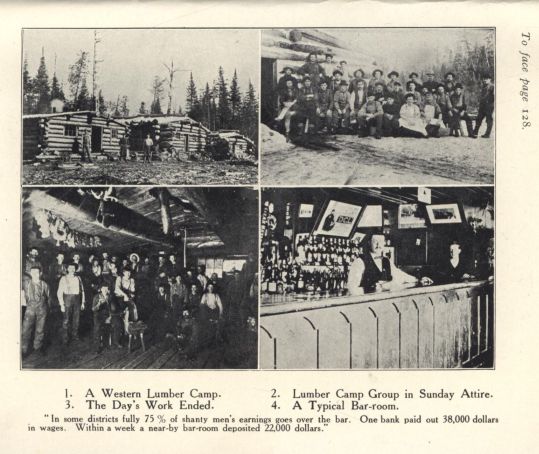
Along the hallway were men in various stages of intoxication, and the missioner knew from past experiences that some of the men were only at the beginning of a debauch that would last for several days, perhaps weeks. Much had been done by the lumber companies to improve the conditions in camp and to brighten and turn to good account the long winter evenings. Then, in order to protect the earnings of the men at paytime, arrangements were made to furnish immediate facilities for banking or for remitting home; yet everything proved ineffective in the case of some. The open bar with its foolish and dangerous treating system had led to what had become known around town as "the lumber-jacks' annual spring spree."
The cashier of one of the companies sauntered through the crowd, and the missioner entered into conversation with him, questioning him about the men thronging the bar-room. "Yes, Reverend, I know most of the boys; I make out pay-checks for over two hundred of them, and in my time I've run across thousands, and most of them are splendid fellows if you can only keep the booze away from them. They look pretty well damaged just now, eh? And they'll be worse yet. When they get started you can't stop them till they're at the end of their tether. See that fellow lighting his cigar in Ern. Dean's pipe? Wait till he turns round a bit—there! now! his ear's half gone, see? He's some fighter, believe me! A year ago last month somebody got a few bottles of whiskey into the camp on the q.t. We try to keep it out, but you might as well try to keep out mosquitoes in June. Well, sir, that night Bill got into a fight with a chap called Frenchy, and in about ten minutes Frenchy needed an identification label on him. Bill was clean plump crazy, and as Frenchy had been looking for a scrap for weeks the boys let them have their innings for a while. Just before the boys prised them apart, the two of them took a deuce of a tumble to the bunkhouse floor, and somehow Frenchy got his teeth on Bill's ear. We couldn't patch the thing together, so Bill had to foot it nearly thirty miles to the nearest town, and you see what the crossbones had to do to trim off his receiving apparatus? Bill gets ninety dollars a month—I handed him a check for four hundred and fifty last Saturday, and it would be safe to bet the whiskies he hasn't fifty dollars left right this minute. He doesn't know what he's done with it—quite likely a pile of it has been swiped when he was dead to the world. Between ourselves, Reverend, there's lots of dope served out right here, and when the boys come to, a good part of their boodle is gone. Just the other day Dick Booth was yelling blue murder around here, and Bertois came from the office and hooked his arm into Dick's and said, 'Come on, Dick, and have one on me.' In less than five minutes there wasn't so much as a chirp from Dick, and he looked like the dickens for a few seconds, and then he slid down the wall to the floor, and Bertois and Sam carried him into the snake-room. You bet Bertois fixed Dick's drink alright. The trouble comes between season when the boys are off a few weeks. They come into town to kill time, but it works the other way round."
Two days later the missioner was sitting writing at the hotel table when Bill, blear-eyed, unshaven and dirty, came staggering toward him. The voice was almost terrifying in its intensity of appeal, "For God's sake give me something to eat; I've had nothing but that stuff (pointing toward the bar-room) for three days."
Before anything more could be said, Bertois, the proprietor, hurried from behind his desk, and grabbing Bill by the shoulder, uttered an oath, and dragged him to a door at the end of the hall. Unfastening the door with his latch-key he gave Bill a vigorous shove, and the intoxicated man, stumbling over some object, fell heavily to the floor. Banging the door, Bertois turned to the basement stairway just around the corner, and in a sharp voice called "Sam." Sam immediately responded to the call.
"How in the —— did Bill Bird get out of there."
"Didn't know 'e was out, sir," was the reply.
"Did you give anybody your key?"
"Hi did not, sir."
"Well, then, you must have left the door unlocked; mind you don't let any more of them d—— fools out."
As calmly as was possible the missioner protested against the treatment Bill received.
"What would you do with them? Would you want them around the house?" was the gruff reply. "Give them a bed? Not much! We don't keep beds for that brand. The only thing you can do is to kick 'em into the snake-room. You don't know anything about Bill's kind. He's seeing life; them fellows have been counting on this blow-out for months."
An hour or so later the missioner found Sam alone in the basement. The old man was worthy of a better job than the doing of the dirtiest and most objectionable work around a lumber-town hotel, but times had gone hard with him of late years, and his few relatives were on the other side of the Atlantic.
"No, sir, hit ain't the kind of place hi expected to be in at my hage, but beggars mustn't be choosers, you know, sir, and after hi cut me foot half off with a hax I ad to take wot I could get, especially as me rheumatiz bothered me a lot. Wot's the snake-room like, did you say? Hit just depends oo's hin it. Hit's chuck full these days, I'm sorry to say, and it hain't a sight yer reverence would like to see. You want a peep hin, eh? Well, hi don't know as how you'd be allowed; the boss is rather perticlar about who sees 'is customers hin the snake-room. It hain't a very good hadvertisement, hin my opinion."
Nevertheless Sam agreed, if the territory was clear, to show the missioner the snake-room. By way of apology, the old man explained that he had often told his boss that it was a shame to put men into such a place without any kind of bed, with no food, and frequently, in decidedly cold weather, without any heat.
When the opportunity afforded itself, Sam and the missioner went quietly upstairs and, unseen, entered the snake-room. Accustomed as he had been to see the effects of alcohol and evil-living, the scene before the visitor was a fresh and terrible revelation of their destructive power.
The room was probably fifteen feet square. Its furnishings consisted of one table and two framed pictures—the latter being advertisements of "popular brands of whiskies," which were said to have "stood the test for nearly one hundred years." Some results of the test were upon the floor.
In order to get inside, Sam had pushed hard against the door, crowding back the feet of the man nearest. There was scarcely more floor space than the two men needed to stand on. Curses, snores and groans came from the filthy, stench-laden mass of men that covered the floor. Several boards in the wainscotting were spattered with human blood. One man with a recently made gash across his forehead was lying on his side, and with eyes closed, kept striking out with his fist, sometimes hitting the leg of an old man who seemed absolutely paralysed with liquor, and sometimes hitting the partition. Every blow was accompanied by profanity.
Partly under the table lay two camp cooks. One of them, Heinrich Lietzmann, was a most generous individual, and a great favourite with his fellow-workers. Because of his appearance he was dubbed "Roly-Poly" Lietzmann. His broken English was very attractive, and nothing pleased the younger men better than to "get him going" on international politics. Judging from his terribly bruised face, he had either fallen heavily or been in a fight. Poor Heinrich made several attempts to raise himself to a sitting posture, each time falling back with a disturbing effect on the men nearest him, and receiving therefore their muttered curses, which he returned in full measure.
Along the table, on his back, lay Chris. Rogers. Nobody knew the history of Chris. although, because of a remarkable gift of speech which he manifested when excited by liquor, the report that he had once been a "Shyster lawyer" in a Western State was generally believed. He was far above the average lumber-jack in knowledge, but far below in vice. After the discovery of an unusually mean trick, Bill Bird had, in the opinion of the camp, fittingly described Chris, when he said, "That dirty rascal is so near mongrel dog, that if he had a bit more hair on him he'd start running rabbits." Just why Chris. had been given charge of the camp stores was a mystery, but for nearly two years he had held the position. He was a slender, wiry man with a singularly repulsive face. His teeth were gone, and his long pointed moustache drooped alongside of the hard mouth that was continually stained with tobacco juice. His coat and vest were plastered with grease from careless eating and his whole appearance suggested a dirty demon-possessed man.
Bill Bird, the fighter, had managed to get into a corner, and was sitting with arms on knees and drooping head—a picture of wretchedness. Once he managed to look up, and for a moment gazed in a dazed way at the missioner: "By God! I wish I was dead:" then there was a prolonged cry on the word "Oh," as of a man in great agony. A few of the stupefied men roused themselves enough to utter a curse in Bill's direction. Gazing once more at the missioner, Bill cried out: "Oh! oh! the devil's got me for sure."
Sam laid his hand on the missioner's arm; "We'd better slip out now, sir, or there might be trouble."
With a sigh and a heavy heart the missioner passed into the hall and up to the room he had been occupying for ten days. With a whispered cry, "How long, O Lord, how long?" he fell on his knees at his bedside, and then in silence he pleaded with his God that at least Bill Bird might be released from the grip of the Evil One.
After the regular service that night, a few Christian people met for prayer. The missioner confided in those present, and with sadness told of his visit with Sam to the snake-room. "What are we doing," he asked, "either as a church or as individuals, for these men? Has Satan any opposition from us as he enslaves our fellow-countrymen? Surely it is not a matter of indifference to us when these men are wrecking their own and other lives, in dens of vice that have been allowed to plant themselves in this town, and that can only thrive as manhood and womanhood are debased?
"Several lumbermen in this district say that in the past fifteen years there has been a steady deterioration in the men employed in the woods. After every pay-day, by their debauchery, seventy-five per cent. unfit themselves for the work to be done, and take from two to eight weeks to get back to normal condition. There is much that may and must be done along social lines if we are going to arrest these degrading influences, but in the meantime is it not possible for us as individuals to get into personal touch with some of these boys, and throw around them the protection of our Christian friendship and hospitality? Preaching is not the only means for advancing the Kingdom. So much may be done if Christian people will put themselves and their possessions at the service of humanity, and learn to love the lowest as well as the best of the race. Some of these lumber-jacks might go back to camp changed men if we gave God a fair chance to use us. Perhaps some of you business men, or some of you ranchers, could get alongside of at least one poor fellow from that snake-room, and live for his reclamation. There are many ways of keeping in touch with these men, even when they return to the bush, and, in this land of investments, you would find nothing yield such a dividend as the investment of your time in the attractive presentation of the love and power of Jesus Christ. Will you at least make the effort, and leave the results to your Master?" The words were spoken and the question asked with an earnestness that had been intensified by the heart-rending appeal of the broken manhood that the speaker knew was represented by what he had looked upon in the snake-room.
In the prayerful atmosphere and the silence that followed the question, one man said in his heart, "I will." That man was George Clarke.
George Clarke had a small ranch a short distance from the town. He was one of the most industrious men in the Province, but his industry had not resulted in the prosperity that most of his neighbours enjoyed. He had met with enough reverses to absolutely dishearten the average man, but he had borne them all bravely, keeping his disposition unsoured, and his character clean. His extreme reticence, however, often led strangers to misjudge him, and to underestimate his worth. In public affairs he treated himself as though he had no right to anything but the most inferior position, and to have given expression to his own opinion before even a small audience would, in his own judgment, have resulted fatally. Once, under great pressure, he had consented to pass the collection plate at a church service, but after getting on his feet, "everything was a blur." The boys at the rear vowed that he stumbled against every bench-end but one, and that by the time he was half way down the aisle "he didn't know which side of the plate should be up." In replacing the plate on the organ, to the great surprise of the organist, he unceremoniously deposited most of the offering in her lap, and was too much overcome with embarrassment to assist her in replacing it. During the closing hymn he made his escape to a quiet spot in the bush, where he could wipe his profusely perspiring brow and where he could solemnly promise himself not to be entrapped again. But despite his reticence he was an exceptionally intelligent man, and when any individual could get George to express himself on questions of importance, it was not long before "this is what George Clarke thinks," was passed from mouth to mouth throughout the community. All through the years he had resided in the West he had been absolutely upright in his dealings and conduct, and though his reticence prevented him from taking an aggressive part in certain moral reforms that were advocated from time to time, yet there was never a shadow of a doubt as to which side he would be on. The cynical individual who stated that "every man has his price," was compelled to make an exception in the case of George Clarke.
And so it will not be deemed irreverent if we say that when George Clarke said in his heart "I will," God knew he could trust him.
Very thoughtfully George passed, with his wife, from the meeting out into the darkness. "I'm going to look for Bill Bird, Mary, and if I get him I'll bring him home—how would it do if you go on with the Frasers?" The suggestion was all that Mrs. Clarke needed, and her neighbours, without any questioning, cheerfully made room for her in their democrat.
George halted several times on his way to the hotel shed where his horse and buggy had been left—he was wondering how best to carry out his resolve. That resolve was to do his utmost to help Bill Bird to a new life. Years ago in the East he had been on very friendly terms with the Bird family, and though he had once or twice tried to show Bill a kindness, yet he knew he had not measured up to his opportunities and he felt condemned. Quietly he walked down the roadway to the rear of the Imperial Hotel. The shouts and oaths of the drinking and the drunken, and the clatter of glassware reached his ears as he passed along. Was Bill still inside, and if so, how could he get hold of him? A side door opened, and George stepped back into the deep shadow of the building. Bertois, the proprietor, and some man whom George did not know, came to the step and stood in the light for a moment. Then the door was pulled to, and the men stood silent as if listening to assure themselves they were alone. Under ordinary circumstances George would have spoken to Bertois, but this night he deemed it wiser to remain unobserved. The men conversed in low tones at first, but after a while Bertois' words reached him:
"Don't play too swift a game for a start: give 'em plenty of bait; they'll keep on biting till we land 'em. We can easily clear five hundred from those three suckers if you watch yourself. Dick knows the drinks to dish out. Here's for luck! Come on."
Re-entering they closed the door quietly, and George still waited, hoping that Sam would come out, and that the old man might be persuaded to get Bill Bird into the yard. Many times during the next fifteen minutes the door opened, and each time George Clarke got, in some form or other, information of the hell that was inside. The hour was late, yet he felt he must remain longer. Bill Bird was in his keeping, for like those near the blind beggar of old, George had heard the call from the Great Physician, "Bring him hither to Me."
To face the crowd of men he knew would be inside the hotel was more than he felt equal to, and he knew that in all probability any attempt to get Bill out under such circumstances would fail.
Once more the side door opened—this time slowly and unsteadily. A man leaned against the jamb for a few seconds as if needing support. Then some one from within slammed the door against him, and he slipped heavily down to the narrow platform. There was a curse and a drunken hiccough, and then the words the missioner had heard were uttered again, "By God, I wish I was dead."
George Clarke did not immediately recognize the voice, but he did immediately step near to his needy brother-man, and said sympathetically, "What's the matter, mate?"
Taken by surprise the man asked, "Who in the —— are you?"
George recognized the voice and the form and said, "I'm George Clarke, and I'm your friend, Bill Bird." His hand was laid upon the shoulder of the sickened man, and in a kindly voice he persuaded him to accompany him to his home. "The place here is crowded, and we've got lots of room at our place and can give you a comfortable bunk for the night: come along, Bill, for old time's sake."
Linking his arm in Bill's, he led the staggering man to the drive-shed, and after some difficulty and a few arguments, got him safely into his buggy, and not a soul in the place was the wiser.
Mrs. Clarke was a worthy helpmeet for George, and though her household cares were many, she grudged no extra labour that would please her husband and help a fellow-being. And so everything necessary for the comfort of the fallen man had been done. A supper had been prepared, and the guest-room made ready. Bill ate as freely as his condition would allow, and then very willingly acted on the suggestion that he should "creep in." George gave the dirty, tired, whiskey-soaked man such assistance as he felt would be advisable. Once Bill raised his heavy eyelids and appeared to be trying to understand the "why" of things. "This is no place for me, George Clarke—by God, no!" The body wobbled wearily, and Bill could think and talk no more. And so with most of his clothes on, filthy from his stay in the snake-room, Bill Bird was placed in the best bed in the best room of one of the truest homes with which the district was blessed.
Before retiring himself, George Clarke went to a wicker-basket in the parlour, and searched through the family collection of photographs. At last he found the one he sought. It was of the Bird family, and was taken shortly before the oldest boys went West. George took it out to his wife, who was still working in the kitchen. Pointing to the face of a bright manly boy who stood with hand upon his mother's shoulder, he said to his wife, "If Bertois and his gang changed a boy's face as terribly as Bill's has been changed, and did it in a few minutes, they would be sent to the 'pen' for five years, and yet we let that same gang take their time on the job, and do it in hundred lots, and scarcely raise so much as a finger to stop it—and I'm as guilty as the rest of them. Poor Bill! he used to be as decent a little chap as you could find in the County of Addington."
The photograph was returned to the parlour, and dropped somewhat carelessly upon the table, but the unthinking, and yet perhaps not unguided act was the first of many influences that brought better days to Bill Bird.
Long into the morning the occupant of the guest-room slept on. George Clarke had opened the door quietly at breakfast time, but the heavy breathing caused him to leave the wearied man undisturbed. About the middle of the forenoon, after much yawning and stretching, Bill's consciousness slowly returned.
He pushed back the white coverlets and gazed around the room. Many times he had awakened in a drive-shed, twice in the police cell, more than once in the "snake-room." But this morning everything was different. What had happened? Was he dreaming? The room was the most attractively furnished of any he had slept in for years, and his soiled clothes on the chair at the bedside were strangely out of harmony with the surroundings.
He had confused memories of events since he came out of the camp, but he knew he had spent his money in the way most of his earnings had gone for the last few years, and he condemned himself for having been a fool again. With a half-consciousness of some one being near, he looked to the opposite side of the room.
The bedroom door had been quietly opened and a bright "good-morning" greeted him. There need be no hurry, he was told, but whenever he was ready he might just as well have a bite of breakfast.
No word was spoken in explanation of his presence, nor in regard to the trouble George had had in getting him away from the "Imperial" the night before. Slowly and with mingled feelings of embarrassment and disgust, Bill attempted to clean himself up a little. He knew he was in George Clarke's home, and in his own words, "felt like a fool and looked the part to perfection."
It was not easy to face those he knew had befriended him, for sin had not yet lost its shame to Bill Bird.
His bedroom door opened into the parlour, and he stood alone for a few seconds. Then his eyes fell on the old photograph. His hands trembled as he held it and gazed into the faces of mother and brothers and sister. Pictures of the old home and of happy family relationships of past years crowded themselves upon his memory.
He remembered how his widowed mother had toiled and struggled to bring up her six boys aright and give them the best equipment possible for the battle of life. He recalled his own setting out from home—from the home to which he had never returned, and to which he had rarely written. The "Western fever" had gripped him in his early twenties, and nothing could induce him to stay on the Homestead. And so ere long the property had to pass into other hands, because there were no boys left to work the place. The mother's sorrow over the parting with her "Willie" had rested very lightly on him the morning he started Westward. Yet to-day he viewed it in a different light, and he lived the parting over again with very different feelings. The last breakfast had been prepared in silence by the one who had never ceased to love him. More than once she had tried to speak, but the lump in the throat prevented. At last they stood in the hall, and her words were uttered with sobs as she clung to her "baby boy." "Good-bye, my Willie, and remember, that as long as your mother has breath she will pray every day for her boy, and ask God to take care of him." He had assured her he could take care of himself. He remembered the last flutter of the handkerchief as she stood on the milk-stand watching the buggy disappear from the sideroad on to the "gravel." He had "taken care of himself," and a mighty poor job he had made of it, and there seemed little chance of any improvement.
While he was in the midst of such thoughts, George Clarke entered. Bill was still holding the photograph. With moistened eyes he looked into the face of his hospitable friend. "George Clarke," he commenced, "it takes a man a long time to own up that he has made a botch of things; it's too late now to make a fresh start, but I've been looking at this picture, and God knows I'd like to have as good a character as I had when that was taken. That woman is as good a mother as any boys ever had, and I haven't shown her the gratitude of a dog."
To this day, George Clarke feels that he never made a poorer attempt at trying to speak a helpful word to a discouraged man than on the morning when Bill Bird stood in his little parlour on the old ranch. One result of the conversation, however, was the decision on Bill's part to accept the invitation to remain at the Clarke ranch for at least a few weeks, and during those weeks he saw demonstrated the best type of Christian living with which he had ever come in contact. On several occasions he accompanied George to the hall in which the special services were being held. Rather to the surprise of the Clarkes, he made no response to the appeals from the missioner, which seemed to them so powerful. One Sabbath evening, however, as they sat around the stove, Bill expressed himself in such a way as to bring a thrill of joy to the hearts of those who were greatly concerned in seeing him make the "Choice of the Highest."
"George Clarke," said Bill, "I haven't taken much stock in religion, but if there's a kind that makes a man do what you and your missus did for me when I wasn't fit company for a pig, I guess I ought to go in for it." Then in a lower and subdued tone he added, "For anybody to take an interest in me is a stunner, the dirty tough that I was."
It was Bill's own opinion that for him life in the bush was no longer safe, and so, until his future was fully decided, he agreed to assist the Clarkes with the work on the ranch. When a few months later, through the death of a brother in the East, George Clarke decided to make his home in Nova Scotia, Bill Bird said in effect, "Where thou goest, I will go."
And it so happens that to-day, down by the Eastern sea, the former lumberjack is building a home, a business and a character. He has not again returned West, but he has often told intimate friends that there is a rancher's small home in the distant province which he never forgets; and he thanks God for those who valued a dirty, wrecked, but God-loved man more than furniture and carpets, and whose hospitality and service awakened desires that have transformed a life.
But it was not to Bill Bird alone that an uplift came. Let George Clarke speak for himself. His words were spoken as he renewed his acquaintance with the missioner two years later. The audience had dispersed, and George and the speaker walked down the street of the little fishing village. Bill Bird was the main subject of their conversation. For a long time they stood in the darkness as George narrated all that had transpired after the missioner's departure from the Western town. When his story was ended, the missioner clasped his hand and said, "God bless you, Clarke, for what you did in Bill's behalf. If only we could multiply that kind of effort we could redeem this dominion."
George clung to the extended hand as he said, "You are very good, sir, to say that to me, but I tell you honestly, when I tried to do that little bit for Bill Bird, I did a deal more for George Clarke. I have had my ups and downs as you know. Since I've been in the East I've done pretty well on the whole, but honestly, sir, the palmiest days I've ever had, and the best returns my bank-book ever showed, are as nothing in value compared to the satisfaction that came to me and my wife when we saw Bill Bird solidly on his feet as a Christian man. If you're going back by the Intercolonial, try to stop over at C——. Bill would be mighty glad to see you, and you'll see what the Lord can do with a man who has gone even as far as the "snake-room."
1. Part of a Town Site after being swept by Bush Fires. 2. A Bush Fire getting under way.
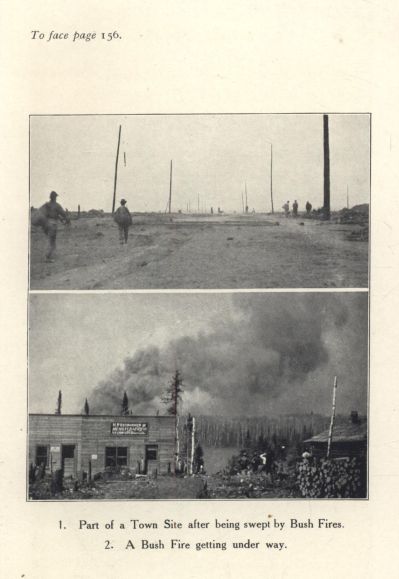
1. Improvised Dwellings: cover districts into which people have fled for safety. 2. The long line of Coke Ovens. (See page 183.) 3. The Fire rapidly approaching.
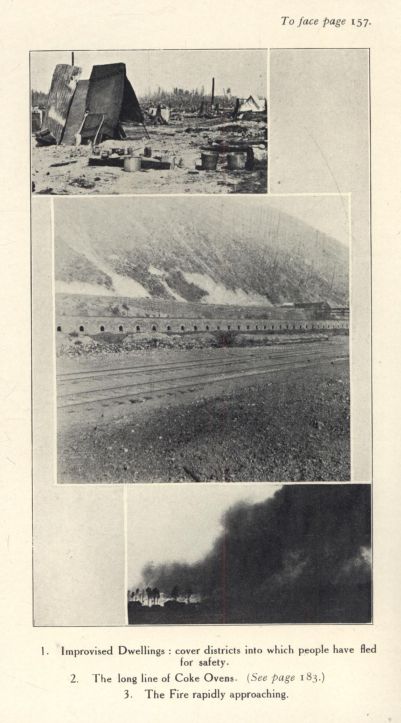
THE BUSH FIRE.
"Bush fires are said to be raging throughout the vicinity of Lundville."
This bulletin was one of several occupying the boards in front of "The Journal" building in Carlton Mines—a British Columbia mining town. As Lundville was thirty miles south-west, no unusual anxiety was felt by those who read the brief announcement about noon-tide on an August day. The atmosphere had been heavy with smoke for the past forty-eight hours; but that was not at all uncommon during that month.
By nightfall, however, the town was enveloped in a dense cloud of smoke; and from the roofs of high buildings on the outskirts the atmosphere seemed to be penetrated by the lurid glow of the raging fires which now extended for several miles. Telephone communication with Lundville had been impossible since noon, and from Burnt River, only fifteen miles away, the last message received told of the whole population being engaged in a desperate effort to effectively check the fire which threatened to wipe out the village. From Burnt River to Carlton Mines there were unbroken timber lands, a fact which caused deep anxiety to many of the inhabitants of the mining town. Not a few retired that night with forebodings that made anything but fitful and troubled sleep impossible. Many were the fervent hopes that ere morning the heavens might open and send forth an abundance of rain upon the sapless woods and withered grasses. Nothing but a heavy downpour of several hours' duration would penetrate the parched earth far enough to quench the fire which was well into the root-filled soil.
Fire rangers, assisted by many citizens, including nearly a hundred miners, spent the night in the woods at the edge of the town, cutting down as much bush as was possible, and clearing it away from such points as were considered dangerous connecting links with Carlton Mines. By dawn it was felt that the night's hard toil and the precautions taken had left the town fairly secure.
Shortly after daylight, however, the rough trail into Carlton Mines was dotted for miles with settlers hurrying distractedly, they scarcely knew where, before the cruel flames that had driven them from their homes, and that had by this time destroyed those homes and many other results of several years of hard labour.
All sorts of vehicles, from home-made toy wagons to dump-carts and ranch-wagons were loaded with household effects, some of which had to be left behind, when a few hours later, all that most people could hope to save was life itself.
By six o'clock, fire, church, and school-bells clanged out their general alarm, calling every available citizen to the fire-fighting, that perchance united effort might save the town. Already huge sparks were raining upon the south-west section, but fortunately in that section the shacks and buildings were few and far between. Yet it was soon apparent that the fire-fighters could not hold their position, even there, but would have to take up a fresh stand nearer the town's centre. Every household was on guard; tubs, barrels, pails, milkcans and kitchen utensils were filled with water, and for a time the falling sparks were quenched almost as quickly as they fell. Straddle-legged on the ridge of the roofs in the fire zone, boys and men with dampened clothes were kept busy extinguishing the sparks that would so easily ignite shingles upon which no rain had fallen for five weeks.
Throughout these long anxious hours, when men were toiling side by side for the protection of their town and their homes, no man had acquitted himself more worthily than the stalwart minister of St. Paul's Church. Until that night no one knew how he could make the chips fly from the tree trunk, and when the most needed work was the turning over of sods to arrest the fire running through the dry grass, no hands were readier than those of the Reverend Walter Nicholson, and when his palms began to blister and to peel, no one knew of it except himself.
When, after the general alarm, reinforcements arrived, he felt he could no longer leave his loved ones without some word of the probable and immediate danger. Stopping at only one or two homes on the way, he hastened to the manse. Despite the seriousness of the situation, Mrs. Nicholson could not restrain her laughter, as her husband stood, coatless and vestless, at the door of the dining-room. Pieces of coarse string had been substituted for certain important buttons which had been lost in his strenuous activity at the fire-fighting. The all-night's toil in the dirt and the smoke, amidst falling ashes, had transformed the immaculately clean husband into a dirt-begrimed labourer.
"It looks as if the town was doomed, Jess," he commenced. "The brewery's gone (though that's no particular loss), and a number of shacks are already burnt down. I must get right back with the men, but in the meantime you'd better get what you value most into a couple of valises. You'll need a few extra clothes for the youngsters and yourself. Put my marginal bible and my black suit in if you can. It's of no use trying to take much, as we may have to foot it for quite a distance. The 'Eastbound' hasn't come in yet, and it's hard to get any information because the wires are down, but it looks as if some of the bridges had been burned, so there isn't much hope of getting out by rail. You can count on me being back in about half an hour."
Mrs. Nicholson, as a bride, had brought to her Western home the handiwork of three busy years, and when the furnishing had been completed and her "extras" tastefully arranged, the minister and his young wife had looked with grateful pride upon the attractiveness of the manse. During the ten subsequent years her enthusiasm in keeping that home orderly, clean and cosy, had never failed. And now she had less than half an hour in which to select what she most desired from that home that had become endeared by ten years of effort to keep it, as it had been kept, a radiant centre of helpfulness—and that selection from their entire earthly possessions must fit the narrow compass of two valises.
The reader who is able to imagine Mrs. Nicholson's feelings on that memorable nineteenth day of August will readily believe that a few minutes were lost in the feeling of helplessness as to what was best to select. A glance through the window at the smoke-filled street, and occasional sparks, put an end to her hesitancy. Whatever was to be done must be done quickly. Her husband's request was first complied with, then such clothing as she and the children might need was included, and a small supply of food for immediate needs. Within a few minutes she had gathered together the few articles of jewellery she possessed, a package of business papers, a bit of silverware, one or two photographs, and an "encyclopædic" scrapbook which contained, among many other interesting items, several newspaper clippings of the work and doings of the Rev. W. Nicholson. From her much-prized secretary, a Christmas gift from the children in her Sunday School class, she took a locket in which was a small curl of hair—her mother's hair.
In her hurried packing she had not forgotten that at least two things must be included from her box of relics and sentimental treasures in the attic. The first pair of baby shoes ever worn in the manse were among Mrs. Nicholson's most valued reminders of the happy days spent in caring for Baby Dorothy—now a bright girl of eight years. Whenever a visit had been made to the box in the attic, the little shoes were always taken out and looked upon with a loving smile.
There were many other articles of much greater value than what was Mrs. Nicholson's final selection, but she could not leave "dear little Hugh's favourite toy." How he had loved that little horse! Even after the terrible accident that had left the "gee gee" noseless, nothing could ever displace it in his affections. For at least a year it had shared his bed without one night's exception, and though it was usually taken from his arms after the little lad had fallen asleep, it was always placed on the chair at the bed-side, so that on awakening he might immediately find his valued wooden friend. And when, during his long and fatal illness, he was unable to take an interest in any other toys, the wasted hand would rest for hours across the back of the broken toy-horse. And so the noseless little animal, with its stand minus two wheels, found a place among the most valued things that were chosen from the well-furnished manse when but a brief half-hour was given in which to make a final choice.
The thirty minutes had not fully elapsed when Mr. Nicholson came rushing in to say there was not a moment to lose. The wind by this time had increased well-nigh to a hurricane, and no force of men could have protected the buildings from the fiery embers that were being hurled in large quantities in all directions.
Walter Nicholson went forth with the two valises strapped over his shoulders, while on his left arm he carried his eighteen months old baby boy. Close behind him came his wife with a few extra wraps thrown over one arm, and her free hand clasping that of the trembling little Dorothy. Thus the Nicholson family departed from the manse, that twelve hours later was nothing but a heap of smouldering ashes.
The streets were filled with terror-stricken people laden with such of their worldly possessions as their strength would allow. The fierce wind hastened them on in their frenzied race for life. Shouts, shrieks, agonized cries and prayers greeted the ears of the minister and his wife as they joined the homeless throng on the streets of Carlton Mines. "Every house in Freeman's Terrace is burning." "The Methodist Church is ablaze." "The Opera House was on fire when we came by." "Oh, my God! what'll we all do?" "There won't be a house left in town." "God have mercy on us!" Such were the cries from scores of voices in the terrified crowd.
Here and there aged and sick folk were being borne in the arms of loved ones or neighbours, although each one rendering such willing service knew that the delay involved was imperilling his own life. Perhaps the saddest sight in the whole sad procession was that of a poor Italian woman, whose little girl had died the previous morning. The father was working in a construction gang several miles away, and the word of the child's death had not yet reached him. When the fire had spread to the humble dwelling, the distracted and sorrow-stricken mother could not endure the thought of leaving her darling to the devouring flames. Tenderly lifting the little one from the casket, she wrapped a shawl around the lifeless form and struggled with her burden alongside of some who knew not what she carried. Cries and prayers in her native tongue were intermingled with her broken English.
Walter Nicholson had forgotten for the moment that the previous afternoon he had heard of the poor woman's sorrow and had fully intended to at least call and offer such sympathy and help as was possible. But the call to the fire-fighting had caused everything else to be put aside. When, however, he heard the pathetic wail, "Oh, ma Annetta, ma leetle Annetta," and glanced at the strange-looking bundle the Italian woman was carrying, he at once surmised the meaning of it all.
Burdened and anxious though he was, he walked alongside of the lonely mother that he might share her burden also. The sad-eyed woman looked into his face, and in an appealing tone said, "Please not mak' her go from me—ma dear leetle Annetta. Da father, he no come yet. Oh! he must come first!" Walter Nicholson hurriedly readjusted his baggage and then held his baby boy so as to leave his right arm free to give the poor Italian woman such support as was possible. The assistance given was only slight, but his sympathetic words and the touch of his hand soothed a little the aching heart of one who felt that day the loneliness of a bereaved stranger in a strange land.
Information was passed through the fleeing crowd that the work-train was taking the people out of danger as rapidly as possible, and that the best course to pursue was to make for the railway station. In any case, the railway track eastward would be the safest highway down the Pass, as the mountain stream two miles away might be reached on foot if necessary. A place of at least temporary protection would be found there.
Before the station-house was reached, another member was added to the Nicholson party. A lad of not more than five years had either wandered away from his home before his friends had felt the necessity to leave, or had become separated from them on the way. At any rate, he was doing his very best to make everybody acquainted with the fact that he was lost. To attempt to locate his friends was out of the question. Mrs. Nicholson bent over him for a moment, and her words and looks produced a quieting effect on the little lad, who at once did as he was bidden, and clung to one of the wraps on the arm of his newly-found guardian.
By the time the railway station was reached the fire had made such headway that it would have been impossible to make a safe return as far as the manse, which had been left less than fifteen minutes before. The frame buildings of which most of the town was composed made the onrush of the flames the more rapid.
The station platform was packed with an impatient crowd awaiting the return of the work-train which had already made two trips as far as the coke-ovens at Twyford. The line was single track, and the only rolling-stock available consisted of an antiquated engine and two dingy passenger cars with rough board seats lengthwise beneath the windows. The morning of the fire there had been added to these cars a few open coal trucks. The old engine could not make the grades with anything but a light train, so that it was seen by many how improbable it was that all those then waiting could find transportation before the buildings around them would be licked up by the approaching fire. Surrounding roofs had been saturated by the station fire-hose, but the gauge-ball on the water-tank was rapidly lowering, and the engineer at the pump-house had been compelled to leave his post half an hour before, so that at best their protection by water was a matter of only an hour or so.
Yet it needed no small amount of courage to isolate oneself from the throng and to pass out of sight in that heavy cloud of smoke which prevented one seeing more than a short distance ahead. The fire now seemed to have gained headway in other directions, so that even if they went forth they might soon find themselves in a position where advance and retreat were alike impossible. Frequent explosions and loudly crackling timbers added to the anxiety of those who awaited the return of the work-train.
The Rev. Walter Nicholson was soon surrounded by a group of those anxious to hear any suggestion he had to make. The Station Agent assured him that even if the track remained clear, at least two additional trips would need to be made before all on the platform could be removed to a place of safety. "Then the wires are dead, Mr. Nicholson, and we've no news of any other train being on the way, so there isn't a minute to spare." He explained that the station-yard might be a comparatively safe place for a while, yet, in view of the extent of the fire, those remaining might find themselves hemmed in and have difficulty in getting over the burned and burning earth for many hours. Several buildings west of the station had already collapsed, blocking certain portions of the road-bed.
A number decided to follow the minister's lead and start on the journey along the eastward track. Mrs. Nicholson refused to remain for the train, preferring to share the fortunes or misfortunes of her husband, while the poor Italian woman, still clinging to her precious burden, followed every move her sympathizer made. Would she not wait and try to get on the train?
"Oh, no, please me walk wid you. I will be so strong!" Even the little lad refused to be transferred to the care of others, and as none were particularly anxious to add to their responsibilities, there was nothing for it but to take him along. It was no easy task that the Nicholsons had undertaken. The usual heat of mid-August was intensified by many miles of burning bush, while the smoke added greatly to the discomfort. Then the poorly ballasted track made walking exceedingly tiresome. Yet no complaints were uttered: even the children realized that every effort must be made to reach the stream before the resistless enemy overtook them. Little more than half a mile had been covered when the whistle and rumble of the work-train announced that it was returning for its third load of passengers. A glance at the cars as the train passed was sufficient to show that fire had broken out further east, at some point between the pedestrians and Twyford. The old paint was covered with blisters, and many of the windows were badly cracked through intense heat. A few minutes later the train returned with every foot of space occupied, even to the steps of cars and engine. A number of passengers tried to let their slower fellow-travellers know that the station-house was in flames, but the noise from the train drowned most of their words.
The inhabitants of Carlton Mines who had not driven or walked out earlier in the day or been conveyed on the railway were now hastening to the limit of their powers in the direction of Twyford. Fortunately for the almost exhausted pastor, the last half-mile of his journey was made a trifle easier by the voluntary assistance of a rugged Galician girl who had been well known at the manse. One small coarse bag contained her few belongings, and accustomed as she had been to long walks and heavy loads when she had lived on the Saskatchewan prairie, the carrying of the baby boy would make small difference to her.
And so at last the mountain stream was reached, and after crossing the bridge the wearied refugees laid down their burdens on the pebbly bed at the water's edge. At that point the width of the open space between the stream-divided bush was only about a hundred feet, so that in case the fire continued its course the danger would still be very great. Already they had seen showers of sparks carried much farther than the short distance that separated the banks between which they stood, and there was every probability that the timber on each side of the stream would be ablaze simultaneously.
But to continue their flight through the thick bush that lined both sides of the track for miles might be to place themselves in a much worse plight. Where they now stood was an abundance of water, and fortunately it was shallow enough to make it safe for all to stand in the centre when that time became necessary. It would then be a matter of endurance against the stifling heat.
Within five minutes the number of those seeking refuge at the stream side was considerably over a hundred. The Station Agent was the last one to arrive, and reported that when the third train-load was leaving, the railway yards and the station-house was seen to be on fire, everyone had immediately set out on foot. He had kept in the rear to be sure that no one was missing.
Except for an attempt on the part of some to safeguard certain belongings by burying them in the gravel, there was nothing to do but wait—and to many the moments seemed as hours. It was a race between old Dave Minehan, the driver on the antiquated engine from the East, and the devouring elements from the south-west. Which would reach them first? A few men acted as sentinels, and paced the track to discover the progress of the fire. The wind had dropped a little, but the flames were still making rapid headway, and very soon no report was needed from the outposts—the fire's own voice could be heard only too plainly. The agent figured out that the work-train had been due over ten minutes—something must have happened! Surely the train-crew realized the need of the courageous ones who had voluntarily walked, and of the others for whom no accommodation was possible.
Flames were now visible to all who were close to the bridge, and the scorching heat, the stifling smoke, and the ash-laden wind combined to make waiting almost unendurable. Brows of fainting ones were being bathed in the merciful stream, and the strongest were becoming fearful.
"Thank God, she's coming!" The shout was from the throat of the Station Agent who had been down the track listening for the return of the work-train. The words had scarcely ended when the shrill whistle from the little engine confirmed the statement.
When a few days later a number of men were discussing the disaster, one of them spoke for each individual at the stream when he said, "Say! I used to hate that blooming raspy whistle, but that day it was the finest bit of music I ever heard."
Dave Minehan slowed up as he neared the bridge, and the Agent signalled him to stop, and at once scrambled aboard to let him know that everybody had reached the bridge and that there was no need to try to go farther. Old Dave was trembling with excitement and irritation, but just then he had no time to tell of the fretful delay over a hot box, and all the trouble entailed in putting in a new "brass" at Twyford—and neither then nor later did he tell of the terrible strain that he had endured in taking his train through a piece of blazing bush three miles down.
The eager, frightened people were rushing up the banks, but Dave kept his train moving until it was about midway on the bridge. From the cab he shouted to them to "keep off." The moment he brought his train to a standstill he leaped from his engine and again thundered the same prohibition. Sharply he yelled to the men to line up and form a bucket-brigade. The fireman passed a dozen buckets from the tender, and Dave, with harsh and hasty commands, got the men on their job. For about five minutes, with a rapidity that would have done credit to a trained brigade, the double line passed the buckets and old Dave dashed the water over such portions of the cars as in his judgment needed the protection. In the meantime he had ordered the rest of the men to soak a few camp blankets that he had taken the precaution to bring along. "There's one bad spot where you'll maybe need to cover yourselves a bit: it'll be raining fire by when we get back—better give your coats and hats a dip too, boys! Get a move on!"
It was no longer possible to remain on the bridge. The old engineer shouted "All aboard," and hurried back to his engine. The women and children were rushed into the passenger car. At one end stood the Nicholsons, while in the corner the bereaved Italian mother sat with her lifeless child. More than once had the minister felt that he must insist on her leaving her burden behind, but each time that he glanced at the sad face and saw the passionate pleading of her eyes, and observed the tender clasp of the mother arms, his courage deserted him.
The last foot was scarcely off the ground when old Dave reversed the lever and opened the throttle, and with a jerk the train started once more.
Let the brakeman tell the story of the return trip, as we heard it from his lips months after in one of the temporary buildings that had arisen among the ash-heaps of Carlton Mines.
"Yes, siree, you just bet it kept me firing that morning. The west-bound express was away late, or it could have got the whole crowd out in two trips. I never thought "Old 98" would stand the gait she did that day. On that last trip we hit a clip both ways that would make your hair stand. Davie was bound to get them people to Twyford. We got a scorching on the up-trip let me tell you. Gosh! it seemed like we was running through Nebuchadnezzar's furnace. I wondered if Davie would face the return trip, 'cause the blaze was getting worse every minute. I moved over to him and asked him if he was going to try it. Whew! I wish you could have seen him! He hadn't cooled off from the mad he had on at Twyford. We had to put a 'brass' on the front car, and when the boys down there couldn't find their jackscrews, Davie got rip-tearing mad, 'cause he knew what the rest of the crowd at Carlton was up against, and he was scared he might be too late. Well, sir, he dumped all the bad language what was in his system on me. It was the kind you don't put in mother's letter. He finished up with the sickliest kind of smile I ever set eyes on, and yelled, 'You fool: do you think I'm up here on a Sunday School picnic?' But Davie knew what was what when we reached the bridge. He lined up the bosses and parsons and the rest of that crowd like he was a British General. And he got his orders obeyed in double-quick time too.
"But it was that last down-trip that this child won't need a diary to remember by! Gee! you know that curve about a mile and a half below the bridge? Well, we'd got most all the head on we could carry, and I was feeling about as safe as if I was having a smoke on a can of dynamite. I was watching for Dave to slow up for the curve, but blame me if he didn't open the throttle another notch.
"As Billy S—— would say, 'Religion isn't my long suit,' but I got ready to say my prayers; I backed up a bit into the coal-bunker, and gripped the side of the tender, and I told the Almighty I hadn't bothered Him much for a long time, but that if He'd keep the cars on the track around the curve I'd be much obliged. Seemed to me like some of them cars jumped clean off the rails, and I thought we were on the home stretch to Kingdom-come, but Davie brought us through O.K. Did we pass through much fire? Well, I should say! There wasn't a rail or post for half a mile that wasn't burning. If it hadn't been for the way Davie soused them cars, and got the fellows to fix their coats and the blankets, we'd never have made it.
"Did you see the watch they gave Davie? Get him to show it to you! It's a dandy—solid gold—got a whole lot of writing on the back—something about 'a tribute to Mr. Dave Minehan's courage and skill in the face of grave danger and difficulty.' He don't say much, but he's as tickled about it as the fellow what got a Christmas-box of sealskin underclothes. Davie's alright, you bet. I'd rather fire for him on 'Old 98' than for any guy I know on a big Mogul. He's a bit rough-like sometimes, but if he can help anybody he's on the job; he'd break his neck to do somebody a good turn."
Such was the brakeman's narration of Dave Minehan's final race on "Old 98," on the day that Carlton Mines was levelled by the bush fire.
* * * * *
The shadows of evening had fallen over Twyford on what is still regarded in Carlton Mines as "disaster day." The afternoon had been a busy one for the inhabitants of the almost verdureless village that is known chiefly for its long lines of coke-ovens. Generous hearts had made shacks and homes have an expansive hospitality that would have seemed incredible before the homeless throng arrived. But after every available lodging device had been resorted to there were many people unprovided for. And so the coke-ovens were the best accommodation that could be offered those still unhoused.
In one of these unusual lodging-houses a candle cast its dim light over the figures of two men and a woman who were kneeling in the attitude of prayer. In one corner a black box rested on two backless chairs. It had been made an hour or two before by the local carpenter, and covered with black cloth by the kindly hands of Mr. and Mrs. Nicholson. Little Annette was to be laid away in the early morning, and this was the best that loving hearts could devise in that place and under those circumstances. The manse valises had made their contribution to the final robing of little Annette, and the weeping mother, looking upon what Christ-like friends had done, clasped and kissed the hands that had dealt so kindly with her and her "leetle Annetta." For nearly eight hours the father had walked seeking his wife, and now they were kneeling together in the presence of their dead child.
Walter Nicholson's voice was tremulous with sympathy as he commended the sorrow-stricken strangers to the all-pitying Father. The mourners did not understand all that was uttered, but they understood the spirit that was manifested and were deeply grateful. A few words of comfort were spoken, and the minister passed out into the darkness to another oven in which his own loved ones were awaiting his return. Mrs. Nicholson was sitting on a box with Dorothy on her knee. Angus and the five-year-old stranger had fallen asleep on the ashy floor. No trace had been discovered of the lad's friends. He could give little information beyond the fact that his name was Hans Kuyper, and that he was "losted." Mrs. Nicholson had quieted the wee chap's fears, by assuring him that his mother would come soon, and though, with darkness at hand and no sign of mother, a few tears had been shed, it was not long before the wearied and worn child was asleep.