THE CAVERNS OF THE KICKAPOO.
Reading edition
THE CAVERNS OF THE KICKAPOO.
The scenery of the Prairie des Chiens is among the most beautiful of the western wilderness—nothing presents finer views than may be had from the lofty hills, which lie east of the Wisconsan. The prairie extends about ten miles along the eastern bank of the river, and is limited on that side by the before-mentioned hills, which rise to the height of about four hundred feet, and run parallel with the course of the river, at a distance of about a mile and a half from it. On the western bank, the bluffs which rise to the same elevation are washed at their base by the river. From the top of this majestic hill, which is called Pike's Mountain, there is a beautiful and magnificent view of the two rivers, Wisconsan and Mississippi, which mingle their waters at its foot. The prairie has retained its old French appellation, derived from an Indian who formerly resided there, and was called the Dog. The hill, or Pike's Mountain, has no particular limits in regard to extension, being merely a part of the river bluffs, which stretch along the margin of the river on the west for several miles, and retain nearly the same elevation above the water. The side fronting upon the river is so abrupt as to render the summit completely inaccessible even to a pedestrian, except in a very few places, where he may ascend by taking hold of the bushes and rocks that cover the slope. In general the acclivity is made up of precipices arranged one above another, some of which are a hundred and fifty feet high.
In one of the niches or recesses formed by one of these precipices, in the cavern of Kickapoo creek, which is a tributary of the Wisconsan, there is a gigantic mass of stone presenting the appearance of a human figure. It is so sheltered by the overhanging rocks, and by the sides of the recess in which it stands, as to assume a dark and gloomy character.
Has my brother—said the Indian chief to the traveller—ever heard how a beautiful woman of my nation became an image of stone? If he has, let him say so; if he has not, the Guard of the Red Arrows will tell him the story.
Once upon a time, many, very many ages ago, there lived in my nation a woman who was called Shenanska, or the White Buffalo Robe. She was an inhabitant of the prairie, a dweller in the cabins which stand upon the verge of the hills. She was the pride of our nation, not so much for her beauty, though she was exceedingly beautiful, as for her goodness, which made her beloved of all. The breath of the summer wind was not milder than the temper of Shenanska, the face of the sun was not fairer than her face. There was never a gust in the one, never a cloud passed over the other. Who but Shenanska dressed the wounds of the Brave when he returned from battle? who but she interceded for the warrior who came back from the fight without a blow? yet who was it encouraged him to wipe the black paint from the memory of his tribe by brave deeds? It was she who dreamed the dreams that led to the slaughter of the Sauks and the Foxes; it was she who pointed out the favourite haunts of the deer and the bison. When the warriors returned victorious from the field of blood, it was she who came out with songs sweeter than the music of the dove; and, when they brought no scalps, it was she who comforted them with stories of past victories, and dreams of those which were yet to be. Before she had seen the flowers bloom twice ten times, she had been by turns the wife of many warriors, for all loved her.
At length, it became the fortune of our tribe to be surprised in our encampment on the banks of the Kickapoo, by a numerous band of the bloody and warlike Mengwe. Many of our nation fell fighting bravely, the greater part of the women and children were scalped, and the remainder were compelled to fly to the wilds for safety. It was the fortune of Shenanska to escape from death, and perhaps worse evils. When the alarm of the war-whoop reached her ear, as she was sleeping in her lodge in the arms of her husband; she arose, and seizing her lance, and bow and arrows, she rushed with the Braves to battle. When she saw half of the men of her nation lying dead around, then she fled, and not till then. Though badly wounded, she succeeded in effecting her escape to the hills. Weakened by loss of blood, she had not strength enough left to hunt for a supply of food; she was near perishing with hunger.
Designed & Etched by W. H. Brooks, A. R. E. A. The Spirit breathed on her & she became Stone. page 104. London, Published by Colburn & Bentley, April 1830
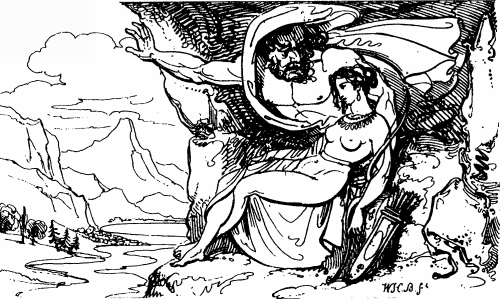
While she lay in this languishing state beneath the shade of a tree, there came to her a Being, who was not of this world. He said to her, in a gentle and soothing voice, "Shenanska! thou art wounded and hungry, shall I heal thee and feed thee? Wilt thou return to the lands of thy tribe, and live to be old, a widow and alone, or go now to the land of departed spirits, and join the shade of thy husband? The choice is thine. If thou wilt live crippled, and bowed down by wounds and disease, thou mayest; if thou better likest to rejoin thy friends in the country beyond the Great River, say so." Shenanska replied, that she wished to die. The Spirit then took her in his arms, and placed her in one of the recesses of the cavern, overshadowed by hanging rocks. He then spoke some low words, and, breathing on her, she became stone. Determined that a woman so good and so beautiful should not be forgotten by the world, nor be deprived of the ability of protecting herself from mutilation, he imparted to her statue the power of killing suddenly any Indian that approached near it. For a long time the statue relentlessly exercised this power. Many an unconscious Indian, venturing too near, fell dead without wound or bruise. At length, tired of the havoc it had made, the guardian Spirit took away the power he had given. At this day the statue may be approached with safety. Yet the Indian people hold it in fear and veneration, and none passes it without paying it the homage of a sacrifice. This is my story.