Volume 1 / Part 1 — PART FIRST.
Reading edition
The mill went merrily round, and Giles the miller sang and whistled from morning to noon, and from noon till evening, save when the mulcting-dish was about to be embowelled in the best sack; a business too serious for such levity, requiring careful and deliberate thought.
Goody Dickisson, the miller's wife, was a fat, round, pursy dame, of some forty years' travel through this wilderness of sorrow, and a decent, honest, sober, and well-conditioned housewife she was; cleanly, thrifty, and had an excellent cheesepress, which the whole neighbourhood could testify.
But the days of man's happiness are numbered, and woman's too, as the following narrative will set forth.
The mill had stood, for ages it may be, at the foot of a wild and steep cliff, forming the eastern extremity of the dreary range of Cliviger;[37] an elevated mountainous pass, from whence the waters descend both to the eastern and western seas. Upon those almost inaccessible crags the rock-eagle and falcon built their nests, unscared by the herdsmen, who in vain attempted their destruction. Through this pass, the very gorge of the English Apennines, the Calder,[38] a rapid and narrow torrent, brought an unfailing supply of grist to the ever-going hopper of Giles Dickisson.
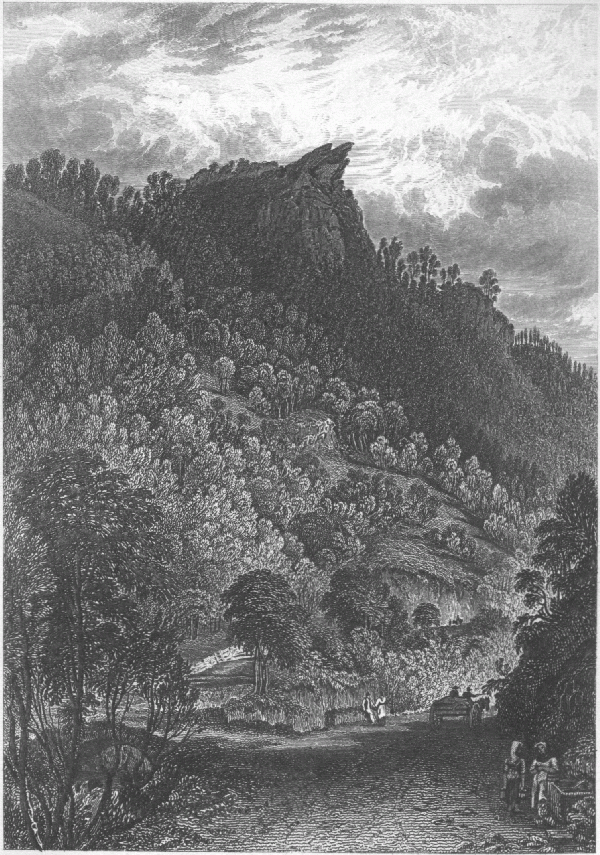
Not far from this happy abode, in the innermost part of the gorge, where the rocks of Lancashire and Yorkshire frown in close but harmless proximity, at an immense height,—the road and this narrow cleft only separating their barriers,—rises a crag of a singular shape, jutting far out from the almost perpendicular strata beneath. Its form is precisely that of a gigantic helmet, hammered out by the fanciful artist into the likeness of an eagle, its wings partly outstretched, and its beak—the point of the crag—overshadowing the grim head of some gaunt warrior. With but little aid from the imagination, the whole features may be discerned; hence it was denominated, "The Eagle Crag." But another appellation, more awful and mysterious, might be attached to it—a reminiscence of those "deeds without a name," which have rendered this district of Lancashire so fearfully notorious—"The witches' horse-block."
The narrow pass we have described opens out into a succession of picturesque valleys, abounding in waterfalls of considerable depth and beauty, and expanding towards the north in tracts of fertile pasture-ground to the base of Pendle, well known as the reputed scene of those mysteries in which "the witches of Pendle" acted so conspicuous a part.
Towards the close of the sixteenth and the beginning of the seventeenth century, the fame, or rather the infamy, of witchcraft, infested this once peaceful and sequestered district. The crag we have just noticed was, no doubt, to the apprehensions of the simple-hearted peasant, oft visited by the unhallowed feet of weirds and witches pluming themselves for flight to the great rendezvous at Malkin Tower, by the side of "the mighty Pendle."
EAGLE CRAG, VALE OF TODMORDEN. Drawn by G. Pickering. Engraved by Edwd Finden.
Little did our country deserve, in those days, the name of "Merry England." Plague or the most noisome pestilence would have been a visitation of mercy compared to the miseries caused by so dark a superstition. "Even he who lived remote from the scene of this spiritual warfare, though few such there could be, so rapidly was it transferred from county to county to the remotest districts;—he, in whose vicinity no one was suspected of dealing with the foul fiend, whose children, cattle, or neighbours, showed no symptoms of being marks for those fiery darts which often struck from a distance, yet would he not escape a sort of epidemic gloom, a vague apprehension of the mischief which might be. The atmosphere he breathed would come to him thick with foul fancies; he would ever be hearing or telling some wild and melancholy tale of crime and punishment. His best feelings and enjoyments would be dashed with bitterness, suspicion, and terror, as he reflected that, though uninvaded, yet these were at the mercy of malignant fellow-mortals, leagued with more malignant spirits, the laws and limits of whose operations were wholly undefinable.
"What must have been his feelings on whom the evil eye had glared,—against whom the spell had been pronounced; on whom misfortunes came thick and fast, by flood and field, at home and abroad, in business and in pleasure; whose cattle died, whose crops were blighted, and about whose bed and board, invisible, unwelcome, and mischievous guests held their revels; who saw not in his calamities the results of ignorance and error, to be averted by caution, nor the inflictions of Heaven to be borne with resignation, but was the victim of a compact, in which his disasters were part of the price paid by the powers of darkness for an immortal soul! He who pined in consumption supposed that his own waxen effigy was revolving and melting at the charmed fire; the changes of his sensations told him when wanton cruelty damped the flame, to waste it lingeringly, or roused it in the impatience of revenge: and when came those sharp and shooting pains, the hags were thrusting in their bodkins, and their laugh rang in his ears: they sat upon his breast asleep,—he awoke gasping, and, as he started up, he saw them melting into air. Yet more miserable was the wight whom the fiends were commissioned bodily to possess;—with whose breathing frame an infernal substance was incorporate and almost identified;—whose thoughts were sufferings, and his words involuntary blasphemies. Can we wonder that all this was not borne passively;—that its authors were hunted out, even, if needful, by their own charms;—that suspicion grew into conviction, and conviction demanded vengeance;—that it was deemed a duty to hold them up to public hatred, and drag them to the bar of public justice;—and that their blood was eagerly thirsted after, of which the shedding was often believed not merely a righteous retribution, but the only efficient relief for the sufferers?
"The notion of witchcraft was no innocent and romantic superstition, no scion of an elegant mythology, but was altogether vulgar, repulsive, bloody, and loathsome. It was a foul ulcer on the face of humanity. Other vagaries of the mind have been associated with lofty or with gentle feelings;—they have belonged more to sportiveness than to criminality;—they are the poetry interspersed on the pages of the history of opinions;—they seem to be dreams of sleeping reason, and not the putrescence of its mouldering carcase; but this has no bright side, no redeeming quality whatever."[39]
The human body is not more liable to contagion than is that faculty of the mind which is called imagination. That many of the accused believed in their crime, we have sufficient evidence in their own voluntary confessions, as well as in the traditions handed down to us on this subject. Both knavery and delusion were at work, as the following incidents will abundantly manifest. They have been selected from a wide range of materials on this important topic, as illustrating the varied operations of the same delusion on different orders and grades of mind,—the temptations warily suited to each disposition, all tending to the same crime, and ultimately to the same punishment.
Our lusty miller had no children: it was a secret source of grief and anxiety to his dame, and many an hour of repining and discontent was the consequence. Yet Giles Dickisson's song was none the heavier; and if his wheel went merrily round, his spirits whirled with it, and danced and frolicked in the sunshine of good humour, like the spray and sparkle from his own mill-race. But a change was gathering on his wife's countenance: her grief grew sullen; her aspect stern and forbidding:—some hidden purpose was maturing: she seldom spoke to her husband. When addressed, she seemed to arouse from a sort of stupor, unwillingly forcing a reply. "She is bewitched," thought Giles. He had his suspicions; but he could not confidently point out the source of the mischief.
One evening, as Goody Dickisson was sitting alone, pondering and discontented, there came in one Mal Spencer, a dark and scowling hag, to whom Giles bore no good-will. He had beforetime forbidden his wife to hold any intercourse with this witch-woman, who was an object generally of suspicion and mistrust. If the "evil eye" can be supposed to inhabit a human frame, this old woman had an undisputed claim to its possession. This night, however, old Molly came hobbling in without further ceremony than a "Good e'en, thou Dickisson wife," and took her seat opposite the dame in the miller's own chair. "Aroynt thee, witch," should have been returned to such an ill-omened salute; but the miller's wife was either unwilling or unable to utter this well-known preservative against the malice of the Evil Ones.
The horse-shoe had been taken down from the door, and the blessed herb, moly, was incautiously thrown aside; neither had Goody Dickisson offered up the usual petition that evening, to be defended from the snares of the devil. Her discontent was too great, and she was in a fitter mood for murmuring than prayer.
Leaning her long thin chin upon a little crutch, and throwing her bleared eyes full upon the dame, old Molly abruptly exclaimed, in a voice like the croaking of a raven—
"Thou hast asked for children, but they are denied thee. What said I to thee, Goody Dickisson, in the clough yonder, by the hollow trunk of the oak? Rememberest thou, when thou saidest thou wouldst pawn thy body for the wish of thy soul?"
Dame Dickisson waxed pale, and her knees shook; but the hag went on.
"Worship the master I serve, and thou shalt have thy desire—ay and more!"
"More!—What meanest thou?"
"Come to the feast, as I have bidden thee. If thou likest not the savour of our company, thou shalt depart, and without harm."
"But who shall give me a safe conduct that I come back, and harmless as I went? Once in your possession, methinks"——
"What!" shouted the beldame, with a look of dark and devilish malignity:—"the word of a prince! Shall Goody Dickisson, the miller's wife, hold it in distrust? Go, poor fool, and chew thy bitterness, and bake thy bannocks, and fret thy old husband until thy writhen flesh rot from thy bones, and thou gnawest them for malice and vexation. Is it not glorious to ride on the wind—to mount the stars—to kiss the moon through the dark rolling clouds, when the blast scatters them in its might? To ride unharmed on their huge peaks tipped with thunder? To be for ever young in desire and enjoyment, though old and haggard, and bent double with age and infirmities? To have our wish and our revenge—ay, and the bodies of our enemies wasting before our spells, like wax to the flame? But go, sneak and drivel, and mind thy meal and barley-cakes, and go childless to thy grave."
She rose as if to depart; but Goody Dickisson's evil destiny prevailed, and she promised to attend the feast, with this condition only, that no harm should befall her, nor force nor entreaty should be used to win her consent to join their confederacy. But she returned not from that unhallowed assembly until body and soul were for ever under the dominion of the destroyer.
The mill went merrily on no more, and the miller's song was still. He looked a heavy and a doomed man. Strange suspicions haunted him. His wife's ill-humour he could have borne; but her very laugh now made him tremble: it was as if the functions of mind and body were animated by a being distinct from herself. Her countenance showed not that her thoughts mingled in either mirth or misery, except at times, when terrible convulsions seemed to pass over like the sudden roll of the sea, tossed by some unseen and subterraneous tempest. The neighbours began to shun his dwelling. His presence was the signal for stolen looks and portentous whispers. To church his wife never came; but the bench, her usual sitting-place, was deserted. At the church-doors, after sermon, when the price of grain, the weather, and other marketable commodities were discussed and settled, Giles was evidently an object of avoidance, and left to trudge home alone to his own cheerless and gloomy hearth.
Dick Hargreave's only cow was bewitched. The most effectual and approved method of ascertaining under whose spell she laboured was as follows:—
The next Friday, a pair of breeches was thrown over the cow's horns; she was then driven from the shippen with a stout cudgel. The place to which she directed her flight was carefully watched, for there assuredly must dwell the witch. To the great horror and dismay of Giles Dickisson, the cow came bellowing down the lane, tail up, in great terror—telling, as plain as beast could speak, of her distress, until she came to a full pause, middle deep in his own mill-dam. This was a direct confirmation to his suspicions; but the following was a more undeniable proof, if need were, of his wife's dishonest confederacy with the powers of darkness.
One morning, ere his servant-man Robin had taken the grey mare from the stable, Giles awoke early, and found his wife had not lain by his side. He had beforetime felt half roused in the night from a deep but uneasy slumber; but he was too heavy and bewildered to recollect himself, and sleep again overcame him ere he could satisfy his doubts. He had either dreamt, or fancied he had dreamt, that his wife was, at some seasons, away for a whole night together, and he was rendered insensible by her spells. This morning, however, he awoke before the usual time, probably from some failure in the charm, and he met her as she was ascending the stairs. Something like alarm or confusion was manifest. She had been to look after the cattle, she stammered out, scolding Robin for an idle lout to lie a-bed so long. The stable-door was open. With an aching heart, he went in. The grey mare was in a bath of foam, panting and distressed as though from some recent journey. Whilst pondering on this strange occurrence, Robin came in. His master taxed him with dishonesty. After much ado, he confessed that his mistress had many times of late borrowed the mare for a night, always returning before the good man awoke. Giles was too full of trouble to rate Robin as he deserved, contenting himself with many admonitions and instructions how to act in the next emergency.
Not many nights after, as Robin was late in the stable, his mistress came with the usual request, and her magic bridle in her hand.
"Now, good Robin, the cream is in the bowl, and the beer behind the spigot, and my good man is in bed."
"Whither away, mistress?" said Robin, diligently whisping down and soothing the mare, who trembled from head to foot when she heard her mistress's voice.
"For a journey, Robin. I have business at Colne; but I will not fail to come back again before sunrise."
"Ay, mistress, this is always your tale; but measter catched her in a woundy heat last time, and will not let her go."
"But, Robin, she shall be in the stable and dry two hours before my old churl gets up."
"But measter says she maunna go."
"Thou hast told him, then,—and a murrain light on thee!"
With eyes glistening like witch-fires, did the dame bestow her malison. Robin half-repented his refusal; but he was stubborn, and his courage not easily shaken. Besides, he had bragged at the last Michaelmas feast that he cared not a rush for never a witch in the parish. He had an Agnus Dei in his bosom, and a leaf from the holy herb in his clogs; and what recked he of spells and incantations? Furthermore, he had a waistcoat of proof given to him by his grandmother.[40]
"Since thou hast denied me the mare, I'll take thee in her place."
Robin felt in his bosom for the Agnus Dei cake, but it was gone!—He had thrown of his waistcoat, too, for the work, and his clogs were lying under the rack. Before he could furnish himself with these counter-charms, Goody Dickisson threw the bridle upon him, using these portentous words:—
"Horse, horse, see thou be; And where I point thee carry me."
Swift as the rush of the wind, Robin felt their power. His nature changed: he grew more agile and capacious; and without further ado, found Goody upon his back, and his own shanks at an ambling gallop on the high-road to Pendle. He panted and grew weary, but she urged him on with an unsparing hand, lashing and spurring with all her might, until at last poor Robin, unused to such expedition, flagged and could scarcely crawl. But needs must when the witches drive. Rest and despite were denied, until, almost dead with toil and terror, he halted in one of the steep gullies of Pendle near to Malkin Tower.
It was an old grey-headed ruin, solitary and uninhabited. The cold October wind whistled through its joints and crannies;—the walls were studded with bright patches of moss and lichen;—darkness and desolation brooded over it, unbroken by aught but the cry of the moor-fowl and the stealthy prowl of the weasel and wild cat.
But this lonesome and time-hallowed ruin was now lit up as for some gay festival; lights were flickering through the crevices, and the coming of the guests, each mounted on her enchanted steed, was accompanied by loud and fiend-like acclamations. Shrieks and howlings were borne from afar upon the blast. Unhallowed words and unutterable curses came on the hollow wind. Forms of indescribable and abominable shape flitted through the troubled elements. Robin, trembling all over with fright and fatigue, was told by his mistress to graze where he could, while she went into the feast:—"Make good use of thy time, for in two hours I shall mount thee back again."
This was poor sustenance for Robin's stomach,—furze and heath were not at all to his mind, and he peeped about for a quiet resting-place. Here he was kicked and bitten by others of the herd; several of them were in the like pitiable condition with himself; but some were really of the brute kind, and these fared the best and were better mannered than most of their human companions. Often did our unfortunate hero wish himself in their place. Having little else to do, he was prompted by curiosity to approach the building, from whence the loud din of mirth and revelry grated harshly on his ears. A long chink disclosed to him some part of the mysteries within. There sat on the floor a great company of witches, feasting and cramming with all their might. An elderly gentleman of a grave and respectable deportment, clad in black doublet and hosen, sat on a stone-heap at the head, from whence he dealt out the delicacies with due care and attention. This was a mortifying sight to a hungry stomach, and Robin's humanity yearned at the display. After the first emotions had a little subsided, he found himself at leisure to examine the faces of the opposite guests, and he recognised several dames of his acquaintance, feasting right merrily at the witches' board. Either his fears and "thick-coming fancies" deceived him, or, as he afterwards declared, he saw nearly the whole of the neighbourhood at the assembly.
Presently it seemed as if the first course were ended, and the floor cleared by invisible hands in a twinkling.
"Now pull," said the grave personage in black.
Many ropes hung from the roof. These the women began to pull furiously, when down came pies, puddings, milk, cream, and rare wines, which they caught in wooden bowls; likewise sweet-meats and all manner of dainties, which made Robin's mouth to water so at the sight that he could bear it no longer. Intending to groan, he involuntarily uttered a loud neigh, which so alarmed the company that the lights were extinguished, and the guests sallied out, each immediately bestriding her steed, and setting forth at full gallop, save Goody Dickisson, who, in attempting to mount Robin, met with a sore mishap. Recollecting the charm which operated upon him, he gave his head a sudden fling: as good luck would have it, the bridle became entangled about her neck. His speech now came again, and he cried out—
"Mare, mare, see thou be; And where I point thee carry me."
Suddenly she was metamorphosed, and Robin in his turn bestrode the witch. He spared her not, as will readily be imagined, until he had her safe in her own stable before break of day. Leaving her there with the bridle about her neck, he entered the house, hungry and jaded. Soon he heard Giles coming down-stairs in a great hurry—
"How now, sirrah!" cried the incensed miller; "did I not tell thee to forbid thy mistress the mare?"
"Why, master," replied Robin, scratching his head, "and so I have—the beast hasna' been ridden sin' ye backed her on Friday."
"Thou art a lying hound to look me in the face and say so. Thy mistress hath been out again last night upon her old errands—I found it out when I awaked."
"And what's the matter of that?" said Robin, with great alacrity. "Ye may go see, master, an' ye liken—the mare's as dry as our meal-tub, and as brisk as bottled ale."
Giles turned angrily away from him towards the stable, tightening a tough cudgel in his grasp, with which he intended to belabour the unfortunate hind on his return. Nor was he long absent—Robin had scarcely swallowed a mouthful of hot porridge when his master thus accosted him—
"Why, thou hob thrust, no good can come where thy fingers are a-meddling; there is another jade besides mine own tied to the rack, not worth a groat. Dost let thy neighbours lift my oats and provender? Better turn my mill into a spital for horses, and nourish all the worn-out kibboes i' the parish!"
"Nay, measter, the beast is yours; and ye ha' foun' her bed and provender these twenty years."
"I'll cudgel that lying spirit out o' thee," said Giles, wetting his hands for a firm grasp at the stick.
"Hold, master!" said Robin, stepping aside; "she has cost you more currying than all the combs in the stable are worth. Step in and take off the bridle, and then say whose beast she is, and who hath most right to her, you or your neighbours. But mind, when the bridle is off her neck, she slip it not on to yours; for if she do you are a gone man."
Giles stayed not, but ran with great haste into the stable. The tired beast could scarcely stand; but he pulled off the bridle, and—as Robin told the tale—his own spouse immediately stood confessed before him!
Here we pause. In the next part we shall rapidly sketch another of the traditions current on this strange subject. It will but be a brief and shadowy outline: space forbids us to dilate: the whole volume would not contain the stories that tradition attributes to the prevalence of this unnatural and revolting, though, it may be, imaginary crime.