CROOKSTON CASTLE AND CATHCART CASTLE
Reading edition
One of the chief peculiarities of the Celtic nations is their fondness for local traditions. Every ruined Keep or dismantled Tower throughout the Highlands has some marvellous tale or romantic incident connected with it, which is lovingly preserved and handed down from generation to generation with undoubting faith and pious care, worthy sometimes of a better cause. The poetical cast of the Celtic mind throws around the most ordinary events a halo of romance which renders attractive many localities that would be otherwise uninteresting; and even the shrewdly practical Lowland mind, when brought under the influence of the spell, cannot entirely resist the glamour of the times that are gone, or remain indifferent to the tales of love and war, which are sanctified by their removal for several centuries.
Yet it needs not that the Lowlander should fly to the fastnesses of the Highland chieftains to feed upon romance, since there is an inexhaustible fund of interest to be found in the Castles within his own territories. Traditions, less mendacious but quite as romantic as the northern stories, are in existence with reference to all the Castles of note in the Lowlands, and require but the collector to rescue them from oblivion in this possibly too practical age. A romantic tale is not less interesting though its date be not that of a far-distant past; and it should be some recommendation if the story be a veritable fact, rather than a notion “all carved from the carver’s brain.” It is with the purpose of gathering up some of the traditions still preserved in local narratives of some of the historic Castles in all parts of Scotland that this work is written, being sure that these are not without interest to every lover of our country.
There is perhaps no character throughout the whole range of Scottish history that so completely awakens the enthusiasm of Scotsmen as Mary, Queen of Scots. The tale of her gay youth, her happy early years, the heavy clouds of misfortune which encompassed her middle life and deepened into the darkest misery, until finally completed by the thrilling horror of her tragic end—all form a life-drama which cannot fail to move the most stolid hearer to pity. This is not the place to narrate the oft-told tale; but as marking some of the great epochs in her eventful life, attention may be directed to some of the Castles which are inseparably associated with her name. The first of these is Crookston Castle, where she spent her honeymoon with Henry, Lord Darnley.
Crookston Castle.
Three miles south-east from Paisley, on the Glasgow Road, there stands the ancient Castle of Crookston, which, though seldom mentioned in connection with Queen Mary, has still a most pathetic relation to her history. The green lane, flanked with hawthorn hedges, which strikes off the main road at Hillington Bar, leads up a gentle ascent for about half a mile, bringing the traveller, somewhat unexpectedly, at once upon the Castle. Ere reaching this altitude, however, he must cross the course of the extinct Glasgow and Ardrossan Canal (now a railway line), and pass the entrance to Hawkhead, one of the seats of the Earl of Glasgow. Though thus reached by an easy slope, and quite free from the appearance of any precipitous elevation, the position of the Castle is most commanding. Upon three sides—south, east and west—the fertile fields of Renfrewshire are stretched at the base of the hill; while towards the north the Bowling Braes stand forth in a bold outline, their base being laved by the waters of the Clyde. Southwards no eminence is visible, save the dim figure of Neilston Pad in the hazy distance; while the intervening space is filled with “gentle slopes and groves between,” giving evidence of a richly fertile soil, and an industrious agricultural population. The gleaming silver line which meanders through the plain marks the course of the White Cart as it “rins rowin’ to the sea”; and near the spot where the Castle stands it receives the tributary water of the little rivulet, called the Levern.
Though never of great extent the Castle seems to have been compactly built, and designed in a lawless age to withstand a powerful enemy. Its position as a look-out station has been admirably chosen; and so commanding is the site that a few retainers might have held a considerable force at bay with comparative ease. The first Castle was probably built by Robert de Croc, apparently a scion of a Norman family, who was proprietor of the estate about 1190, and whose name survives in a corrupted form as “Crookstoun.” In 1330 the estate was purchased by Sir Alan Stewart, a kinsman of the Stuarts, Seigneurs of D’Aubigny, famous in the history of France and Scotland. Sir Alan, in 1361, granted the Castle and estate to Sir J. Stewart of Darnley; and thus they ultimately came into the possession of Henry, Lord Darnley (1546-67), centuries afterwards, with whom we have to deal.
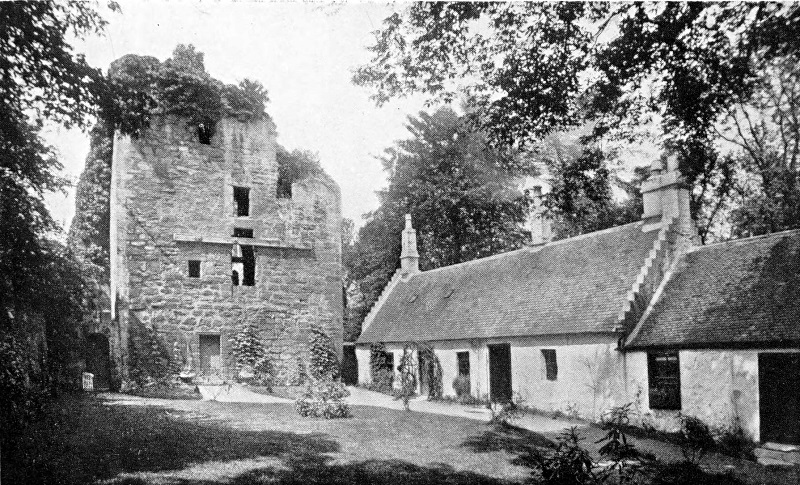
Valentine & Sons, Ltd.
CATHCART CASTLE
The remains of the present Castle probably belong to the 13th century (1290-1390), though the exterior arrangements plainly indicate that there was a Keep of some kind here long before that date, though the ruthless hand of Time has cleared all the relics away. But in 1488, when James IV. was fighting for the Crown after his father, James III., had been killed at Sauchieburn, he attacked his opponent, the Earl of Lennox, grandfather of Darnley, at Duchal, and besieged Crookston Castle, bringing “Mons Meg” from Edinburgh for the purpose. Surely this shows that even at that time the Castle was of considerable importance.
The main interest in Crookston of the present day, this “grey and antique tower,” is more nearly connected with love than war. Here it was, according to tradition, that the youthful Henry Darnley, then its lord, led his beauteous but unfortunate Queen to spend their honeymoon. And those battered and time-worn walls, through whose “looped and windowed raggedness” the mystic moonlight strays, have resounded to the voice and harp of a Chastelard or a Rizzio, whilst yet the fortunes of the martyred Queen were unclouded.
Could one gleam of prophetic foresight have been given to bride and bridegroom to display the future of either, how incredulous and horror-stricken would they have been at that festal hour! And yet, within a few years, the gay gallant had descended into the wretched, brutal, jealous husband, whose insatiable fury was not restrained from murder, even by the presence of his Queen. And the loved and lovely bride, whose day-dreams in Crookston Castle were of love, romance and song, might have shrunk in terror from the fearful doom which awaited her newly-wedded lord; or quailed before the shadow of the scaffold upon which she must ultimately meet her own. Yet, as Horace sang of old:—
“The Deity, prudent and careful, Encloses the future in night,”
and so Crookston witnessed nothing save dance and song; whilst joy was unconfined during the few happy days which Mary spent within its bounds. And when her hard fate was upon her, not without sad regret must she have thought, amid the gloom of Fotheringay, upon the pageants and revelries of Crookston, which had formed for her a sunny memory of other days. After a visit to Crookston Castle the Glasgow poet, William Motherwell, wrote thus:—
“Beneath yon tree— Now bare and blasted—so our annals tell The martyr Queen, ere that her fortunes knew A darker shade than cast her favourite yew, Loved Darnley passing well— Loved him with tender woman’s generous love, And bade farewell awhile to courtly state And pageantry for yon o’ershadowing grove— For the lone river’s banks whose small birds sing, Their little hearts with summer joys elate— Where tall broom blossoms, flowers profusely spring; There he, the most exalted of the land, Pressed with the grace of youth a Sovereign’s peerless hand.”
Cathcart Castle.
It is worthy of note that, whilst Crookston Castle witnessed the earlier and happier portion of Mary’s variegated life, Cathcart Castle, which is all but visible from it, was the scene of her final downfall. The latter stands about seven miles from Crookston, and nearly two miles south-east of Glasgow, upon the Mearns Road. An inconsiderable pathway which leaves the main road a short space beyond the bridge over the Cart, leads past the Castle gate, which is not surrounded now by any vestige of garden ground. Unlike Crookston, it must have afforded little advantage to its inmates in the matter of defence. It is easily approached on all sides, and is more like a pleasure-palace than a stronghold. There are arrow-slits in the walls, and the appearance of an attempt at fortification; but the surrounding locality affords too easy access for this to have been of much avail. Yet the outlook from one of the windows in the upper chamber, still called Queen Mary’s Window, is very lovely. The ground upon which the Castle stands slopes gently down to the river’s brink, whose silver sheen glimmers faintly here and there amid the overhanging boughs of birch and ash and nodding beech. Due north from this point of view lies the field of Langside, where was fought the final and decisive conflict which terminated Queen Mary’s career in Scotland.
The lands of Cathcart belonged in the 12th century to a family bearing that name, and so continued till 1546, when the Sempill family acquired them through marriage. The original Cathcart family was represented in 1740 by the eighth Baron, who repurchased the ancestral property. The Castle, which had been built in the 15th century, was partly demolished by this Baron Cathcart, and has not since been occupied. In 1814 the tenth Baron was created Earl Cathcart, and the members of the family have long been distinguished in military history. Cathcart House, which took the place of the old Castle, was built by Mr James Hill, Solicitor, Glasgow, who acquired part of the estate in 1788, and from him it passed, in 1801, to Earl Cathcart, when the rest of the estate was purchased by him.
The undulating lea, now called “Battlefield,” is completely commanded from “Queen Mary’s Window,” and it was doubtless from here that the hapless Queen watched with breathless interest the contest upon which her own future depended. After her daring and romantic escape from Lochleven, she made her way to the east coast so as to mislead her pursuers; then doubling back, she sought to reach Dumbarton Castle, which was then held by her partizans. Taking the road by Hamilton, she was soon joined by many of the Lowland gentry, with their retainers, and found herself at the head of a small but well-appointed army. Fearful of risking a conflict with her half-brother, the Regent Moray, who then lay with his troops at Glasgow, she took the south bank of the Clyde, intending to cross to the Dumbarton side when safe from interruption. But the intelligence which Moray had received of her movements enabled him to checkmate her plans. Detaching a strong body of his troops he occupied the field at Langside, which lay directly on her line of march, thus leaving her no option save either to dare the battle or fall helplessly into an ambuscade betwixt the two portions of his army. The confidence of the Queen in her cause decided her to adopt the former course, and in a fatal hour for her the armies engaged in deadly conflict. The position of Cathcart Castle, which overlooked the field of battle, afforded the most favourable spot from which to observe the course of the strife, although, from its proximity to the combatants, perhaps not the safest place for so precious a prize.
That she occupied Crookston Castle for this purpose is not a reasonable supposition, since its distance from Langside and its situation would effectually prevent her from obtaining early intelligence of the course of the battle. And her flight to Dundrennan Abbey after the disastrous issue of the conflict was much more easily accomplished from Cathcart than from Crookston. Yet one must remember that so weighty an authority as Sir Walter Scott mentions the latter place as the position which she held, though perhaps the romantic and poetical contrast between her earlier and later days at Crookston might influence the poet to adopt this theory even though not supported by facts. One thing is certain, that local tradition ascribes this melancholy interest to Cathcart, and even points out the particular spot where the ill-fated Queen beheld the overthrow of all her hopes. And thus, by a curious combination of circumstances, two Castles standing upon the banks of the same river, Cart, and separated by but a few miles from each other, serve as landmarks, tear-fraught and sad, recording the joys and sorrows of Scotland’s fairest Queen—her time of love and her time of war.
II