Part II CHILDREN OF FREEDOM (continued 2)
Reading edition
A Military Band
With open mouths and eyes intent they press around the stand,
A thousand listeners, in the flare of gas beneath the trees,
Young men and boys mostly, yet some older, and a few girls and women.
The red-coats sit in circle round their leader—solid and robust—their lips retracted, taking short quick breaths, their throats full-veined and swollen;
196The first cornets ring out wild and clear, backed by the ripienos, the tenors and the trombones;
The euphonium takes its strong and leading part, the cry of the hautboy is heard—apart—like the cry of a wounded animal, the flutes and flageolets pipe merrily, and the drums resound.
But the circle of faces—pale in the flickering gas—scarcely moves.
Look! how intent they are, face after face, with eyes fixed, strained, as though they would pierce through brass and scarlet!
What is it you fix so intently, O faces, have you never seen a red-coat before?
But no, they hardly see the red-coats: though all eyes centre there they hardly see what is before them.
Lo! a great curtain hanging from the topmost sky right down to the bottom of creation—
Flat, enormous, without rent, covering the whole world (yet hardly half-an-inch in diameter)—
Before each listener it hangs, and on it all things are painted.
Wonderful, figured all over from top to bottom, from side to side, wonderful wonderful—and for each one different:
On it—for some—forms of lust displayed, the glory of limbs flame-girdled, floating from side to side, with fierce clutches of beauty—(O eyes no wonder you are intent!)
197On it—for some—the battle-field mounting in smoke, the flag, the roar, the appalling roar of faced cannon, the certain death: the heroic the decisive the furious and disdainful act, the deathless figure of bravery—(O eyes no wonder you are intent!)
On it—see here!—a maiden at her window, peeping over her flowers: the pure, the sweet, the stainless starlike face, for the vow of true knighthood only—(O eyes no wonder you are intent!)
Lo there! even more beautiful, the face of year and year-long wife-hood: the friend, the trusted one without whom life cannot be imagined—dual love dividing and filling the universe—(O glistening eyes no wonder you are intent!)
On it—Ah! these are the eyes of the lost one, the departed mother: the tender watchful beseeching eyes, the sacred light—not God himself more sacred;
This is the glorious brow of comradeship, faithful unalterable, to heroic deeds arousing;
On it—here for this boy—scenes of the wild ocean and adventure, the ship in a storm, the raft, the lightning, and the rescue;
For another, ambition, the political arena, the debate, the crowded galleries, the centering of eyes;
The footlights of the stage, the murmured delight of the audience, the enthusiastic encore;
Scenes of travel, the lands of day-dreams and longing, the Andes, the Pacific, the Polar aurora and the ice, the trackless forests of Central America and Siberia and Western 198Australia, and of the Amazon; the wild animals of Central Africa;
The ancient cities, the historical world-old sites, the birth-places of gods, the thrones of kings, the centres of civilisation, the churches, ceremonials, processions, pilgrimages, the markets, railroads, great feats of engineering;
Faces, costumes, forms, objects innumerable—all these figured, arabesqued,
Running in free lines over the curtain which hangs from the zenith to the nadir;
And on it besides with the rest arabesqued and running,
The band-stand with the scarlet and the brass, and the conductor energetic with his baton in the midst, and the swollen veins and lithe lips of the first cornet player;
And on it running waved and dazzling the lines of gas against dark shade-masses of foliage—shot through with the electric scream of the flageolets and underborne with the deep thunder of drums;
And on it the faint blue evening sky and the faint faint stars behind it.
Wonderful, wonderful!
I too look upon the curtain: I see the figures, the symbols, the shining hieroglyphs written with free hand across it—I see the sun and moon;
I see the great dark background on which they are written—flat, enormous—falling from the zenith to the nadir.
See! how it flaps and sways in the cool night-air, as 199if it were about to give way—surely there is something behind it!—yet no rent.
Holding yet well together, holding your secret faithfully,
Curtain of each soul, curtain of creation, tiny curtain, vast enveloping all the universe,
Veil of the imperfect creature, under which the wings form—growing thinner momently and more transparent—
Amnion-veil of the vast universe—growing thinner—
O shot through with the scream of flageolets and underborne with the deep thunder of drums! almost pierced with the fixed gaze and strain of innumerable eyes!
Ah, wonderful wonderful!
Gazed upon thousands of years, nearer nearer, fascinating, drawing ever drawing multitudes towards it;
Children sitting at a theatre thinking the drop-scene the real play itself—others older guessing somewhat how the matter stands—lights dimly seen moving behind, corners lifted or swaying;
The Andes and Pacific dividing down their middle line, the vast forests disclosing in their depths, ancient cities blossoming like huge flowers and fading away in fragrance; the faint-blue star-spangled sky of evening rolling swiftly and noiselessly together, the round earth floating for a moment in the sunlight—and then gone, like the last patches of gold and blue on a soap-bubble; faces of brothers and sisters, faces of the speechless animals, opening back, myriads myriads of years back in perspective to him who sits upon the throne—
200Ah, wonderful wonderful!
In the great dark of the night swaying floating like a flag which a gentle wind dwells among the folds of—
Great mother Thou that foldest all creatures in thy folds—
Whom to explore, the children traveling from ages and ages back, by long pilgrimages and routes labyrinthine ever pressing on, to decipher, to unravel, to read the words that are written:
Once more and the stars shall fall showering from thee—the shining hieroglyphs shall fade; black for a moment thou shalt hang—then rolling swiftly together—
Lo! what mortal eye hath not seen nor ear heard—
All sorrow finished—the deep deep ocean of joy opening within—the surface sparkling—
The myriad-formed disclosed, each one and all, all things that are, transfigured—
Being filled with joy, hardly touching the ground, reaching cross-shaped with out-stretched arms to the stars, along of the mountains and the forests, habitation of innumerable creatures, singing joy unending—
As the sun on a dull morning breaking through the clouds, so from behind the sun another sun, from within the body another body—these shattered falling—
Lo! now at last or yet awhile in due time to behold that which ye have so long sought—
O eyes no wonder you are intent.
201
Wings
Wings, wings!
I beheld the young leaves breaking from the buds and poised on the tips of the branches;
I saw a squadron of anemones in the meadows all waving in the wind as impatient to take flight together;
I looked at the acorn buried in the earth, and lo! it divided and put forth two seed-wings; and the embryo plant resembled the penis and dual testicles of man and the animals;
And the starling like-shaped flew overhead through the trees, and the lark hung, a cross, in heaven;
And the butterfly flew by—emblem of the soul—and the bee hung downwards in the wind-flower cup;
And I stood by the hive in the garden and marked how from its lips the bees shot like arrows into the wide valley below;
And I stood in the great assembly and marked how from the decisive lips of the orator the winged words darted and transfixed the audience;
And I saw on the Central American savannahs the half-wild horses racing and bounding together down to the rivers or resting in the shade of the trees;
The light-footed tireless wolf I saw, and the eagle soaring over the mountains; and I watched the moth glide from the entrails of the caterpillar, and the gnat all perfect and stainless from its watery case;
And within myself and under the skin—deep down—I felt the wings of Man distinctly unfolding.
202And as I lay on the great hill-side the kisses of the sun alighted on me after their long flight, and rested; and the birds warbled through the midday; and the flowers and the earth itself and the great tree-boles sent forth their incense-swarms of atoms;
And behold! beyond the mountains and the great clouds floating by I beheld dim vast and aerial the figure as of a man with arms outstretched over the universe;
And as I gazed—lo! slowly all these other things swam with me and became incorporate with that figure, and the clouds floated and the streams ran down from ledge to ledge within it;
And the trees with their square arms took on a new signification, and the little seeds with their twin cotyledons were for an emblem, and I saw whither the birds were hastening, and the direction of the index of all generation;
And the starlings flew through the spaces of its thoughts, and the anemone squadrons trembled along its flanks;
And the horses galloping over the plains could not escape the plains they galloped over, nor the light-footed wolf its quest;
And the eagle could not deny its own form as it soared over the mountains—nor I the knowledge of that which was unfolding within me:
And I understood the meaning of the wings.
203
On an Atlantic Steamship
Mid-ocean, night—
The spars loom square and black against the sky, and the mast-head light sways slowly.
I hear as in a dream the never-ending lullaby, the continued surge of water off the bows, the vibration and smothered pulse of the engines.
Deep in the bowels of the great ship, half-naked huge-limbed grimy-eyed sweating, the firemen tend their thirty-six fires.
From time to time one slips on deck to enjoy the cool;
He lights his pipe. The moon along the high ridge of a pitch-black mass of cloud steals, peering over fitfully on the silent gulfs.
The ship glides on and on. Oily-surfaced heaves and sways the deep as far as eye can see.
Eight bells strike. The watch changes.
One bell—two bells. The deck is almost deserted. And still the ship glides on and on—the deep sways slightly rustling;
The look-out man in the bows cries ‘All is well’—and the lamps are brightly burning.
204
2
In the morning as usual the deck is alive with passengers
[The great ocean-plains swelling sparkling for hundreds, thousands, of miles round us, the visible circle unbroken by island or any object]—
Of all nations languages degrees, of various habits trades traditions,
Strangers to each other and to the water—they look with curious eyes upon the novel scene.
An elderly Indian civilian, saloon-passenger, in grey check morning suit and tennis shoes, blameless and wealthy, looks down with curious eyes from the rail of the upper deck upon the crowded emigrant groups;
He turns to draw the attention of the young lady standing beside him.
It is a strange and varied scene—the sparkling waters, the rigging and cordage, the children in red hoods playing on the sunny deck, the basking groups, some playing cards, some smoking, chatting—the silent companionless ones, pensive far-away-looking over the waves;
The Irish, mostly sitting or reclining in knots, young and old, men and women, in gay colors, resting their heads on each other or wrapped in pairs under one shawl—joking laughing kissing screaming slapping;
Germans, Hungarians, Poles, Norwegians, Laplanders, Swedes—some with red shirts and jack-boots, boys with concertinas and pipes, rosy Dutch girls, and mothers with tribes of children.
205Here walking up and down with their brother three English girls, fresh and bright as daisies—on their way to join their parents in the West;
Here a little lady from Dublin with clear low voice singing to a circle of companions;
There in a corner by himself unnoticed among the rest, in low musical chant by the hour reciting praying, sits an old Russian Jew.
Greybeard, with veined forehead, a tailor by trade—his son-in-law has sent for him to Texas;
Through Hamburg and Hull and Liverpool he has traveled, eating no Gentile food but dry bread.
The Hebrew text lies before him—but he knows it by memory mostly;
Prayers for the day he recites [“Abraham taught the morning prayer and Isaac the afternoon and Jacob the evening prayer”]—
Prayers for the captain and for the crew and the passengers and for all sea-travelers [“prayers for self alone God will not hear”]—
Prayers against storm, shipwreck, disease and famine, and all dangers of the deep—not forgetting the warning of Jonah; and for each man’s ruach against the ruach of the ocean; and against the changes of clime and time—
All these he recites, sitting alone with his thoughts amid strangers.
It is a strange and varied scene.
206The dark passion-eyed little Irish devil of a New York saloon-keeper with his blasphemous stories and unscrupulous confessions—takes it in from his point of view;
The long-headed long-twinkling-eyed elderly woman in her print hood, helpful and receptive, with broad mouth—enjoyer of jokes, not easily shocked—takes it in also from hers;
The gold-miner with slouch hat and easy dress leans with his back against the bulwarks—he has seen it all twice before;
He has been home just now to Cornwall to visit his wife and children, and is off again to the mountains of Idaho. By his side stands his seventeen-year-old son, silent, clear-eyed, loving well his father.
The cheerful elderly spinster brings her camp-stool on deck and chats to a companion—laughing hysterically over her own fears, and how she pushed against the side of her berth in the night when it was rough, to steady the rolling ship!
The American horse-dealer (he is bringing over some cart-horses from England) walks up and down—grey-eyed, with decisive chin and lips, easy careless sociable and ’cute.
Under the awning aft by the saloon gangway an elderly and well-to-do matron and her two daughters recline in easy chairs; the lean grey-haired ship’s purser, proud of his gentlemanly manners, stops as he passes to say a few words to them;
And the ship glides on and on—the water breaks from the bows,
The spars stand square and black against the sky, and the masts sway to and fro slowly.
207
3
What a scene!
Here in this hollow cup a thousand souls floating on the unmeasured deep—
A little dust of humanity gathered at random on the shores of one continent, to be tossed at random to the winds of another.
The young clerk with wife and babe, from London, going out to try his fortune at farming in Manitoba:
The great big-boned steerage steward, so kindly to the children and sensible—native of Rome, proud of his Latin origin, member of the Carbonari and imprisoned by Austrians in his time—now serving out treacle and bread and butter to emigrants;
The spruce first-cabin waiters and brawny slipshod humored crew,
The cooks, officers, the clean red-whiskered little captain on the bridge, the smug decent doctor, the oily-jacketed look-out behind his screen in the bows;
The taking of observations at breakfast time and again at noon, the sun’s limbs brought down to the horizon—the logarithms and tables, the charts and the log;
The long heave and gasp of the engines, the gulls slow floating behind or darting after waste slops;
The huge side of the ship, an iron wall 170 yards long to the waves, the flowers mirrors gilt and velvet of the saloon, the piano, the gossip, the elegant dinner, the mutual advances and recognitions, the parson who consents to read 208service on Sunday, the philanthropist interested in gutter children, the two self-possessed American girls, the young Englishmen doing the great tour;
The bare sanded boards of the steerage cabins, the crowded emigrant meals, the swinging watercan and electric lamp, the stretched arms with mugs and plates;
The berths with hundreds of sleepers at night, the family groups during the day;
The father, awkward and ox-like, with nine motherless children, caring for their little wants—the women pityingly helping him;
The narrow-eyed pale young basket-maker reading his Bible in his berth all day; the Lancashire laddie and his pals singing salvation-comics at meal-times;
The military-got-up old fellow (years and years ago he was in the regulars) so clean and spruce—brushing his boots carefully every morning; the little boy of twelve traveling all by himself, petted by the cook and peeling potatos for bits of dainties;
The love-making, bible-reading, card-playing, singing—the women sewing or washing baby-linen;
The captain’s cabin, with charts and glasses, the crew’s quarters in the forecastle—men smoking in their bunks—the stoke-hole, the bar, the engine-room;
The warm evenings with renewals of animation—
Jingles of music in the cabins, hymns and comic songs and dances on deck to the accordion;
The inquisitive-eyed priest, the same that read the service, looking out from the saloon door—peering fleshly at the better-looking boys and girls;
209At dusk the crew running among the women-passengers —firemen, cabin and deck-hands—fingering and fooling; the women enjoying;
The incorrigible nigger cook’s boy, with muscular developed frame, protruding his great lips at the girls and then drawing them back with a grin showing huge rows of white teeth;
The mean pudding-faced Swedish lad and Irish woman spitting at each other—with no other language in common;
The sickness, the smells, the refuse meat swept from floors and tables and thrown in bucketfuls overboard;
The coarse half-smothered lust, the gluttony and waste of food;
And the great ship gliding on and on—in her course pointed by the earth-pole and the stars and the sun—
The spars standing square and black against the sky, and the mast-head light swaying slowly.
4
The evening before last the water was oily-calm, floating blue flecked with yellow up to the western horizon.
Behind, the track of the great ship lay like white lace, with ridgy waves thrown off and rustling as they receded on each side; in the distance brooding the dappled clouds hovered ’twixt sky and sea—dove-color and grey and heavy with unformed rain.
After sunset there was preaching and singing forward on deck.
210One or two ladies from the saloon distributed tracts, some from the steerage joined in praying, and called upon the Lord for safety during the voyage.
Quite a little crowd got round, some earnest, some jeering, some quiet spectators—(the cabin-boys mostly dancing in pairs round the corner in time to the hymns).
All the while the great masts kept swaying slowly to and fro in the sky—as though never moving forward from their place—the huge vault rising enormous with dappled moonlit clouds in the east;
While from the west the faint daylight still shone upon the worshipers, and the sound of their music melted and died on the vast sea-bosom.
Later on, when the deck was almost deserted—All faintest dove-grey and silver, the gleaming water passing up without distinction into the gleaming sky, with moon behind the clouds—
All one hue, in faintest silent perpetual movement, like no earthly scene,
Immaterial, transfigured, the huge wash of ocean two miles deep lying so calm below—
The moonlit ocean of air unsuspected above the clouds—suspended between—
Gliding on and on, as in a mirror or a dream....
All so calm, large, undisturbed, vast in extent and power: the sea stretching out to the touch of the air—miles, hundreds, thousands of miles—
211The sympathetic answer of the floating cloud-layer to the floating heaving water-layer below....
I saw a vision of my own intimate passing out over the waters, and between them and the clouds—the vessel going on and leaving us—
Liberated, identified, all pain stript off and left with the husk behind—senses of enjoyment strangely widened, lifted—
Moving on at will, passing along the waters, the slow air—catching the faint scent, the whispers, the coherent incoherent words,
The marvelous calm, peace, grandeur, vastness, the incommunicable joy—
Entering into it, and being at rest.
5
In the morning all was changed again.
Drizzly and grizzly chopped the grey water with leaden clouds and rain; the horizon was a circle of mist;
Coldly and flabbily the passengers looked out upon the world.
Sullen like a marble cliff just tinged with blue, a huge slab a quarter mile long and eighty feet rising over the water,
Scored, festooned, beetling, with cavernous hollows washed by the sea,
With mist trailing to leeward of it, and thin mist passing over its white flat top, with white fragments dotting the sea around it—
212Sullen silent and lonely a great iceberg floated by.
For a few minutes the passengers were roused, and crowded the side of the vessel—some of the firemen running up from the stoke-hole to have a look.
But presently like bees stupefied with cold they dispersed to their cabins and to sleep, and the deck was clear again.
6
To-day, bright and fresh, with new warmth, as it were wafted from the approaching land—all is gay and cheerful.
The deep inky-blue of mid-ocean yields to a lighter tint, and the waves break merrily into flashes of turquoise light crowned with foam.
Six narrow-winged gulls pass by—flying low, serpentine—hunting across the water;
Every now and then shoals of porpoises appear—hundreds at a time—playing splashing swimming alongside, towards the wind, leaping half-a-dozen together out of the water—
[Bounding three or four yards, with evident enjoyment and commotion at the sight of the ship—their sharp backfins and divided horizontal tails plainly visible;]
Then a whale is seen spouting, or a fleet of Portuguese men of war drifts by, rose-color and blue—or a real ship is sighted and spoken with.
So the day speeds on; and pleasant is basking on the sunny deck, and pleasant the new companionships and the confidences; and the food tastes sweet, and the air has 213a breath of land in it, as of most distant hayfields; and hope and expectation range high;
And the evening falls, and late on into the warm night the clustered wanderers on the fore-deck sing the songs of the old country,
While the spars loom square and black against the stars, and the mast-head light sways slowly.
By Lake Wachusett
The night-breeze murmurs odorous through the wild chestnuts where Lake Wachusett lies embowered in trees;
The moon shines over the mountains not other than when the wild man walked them;
The crickets and frogs cry shrill, the bull-frog twangs his bass, and the firefly shines fitful among the bushes;
While solitary in his boat the fisher is known by his lamp gleaming over the water.
Murmured as in a dream I catch the import of creation.
Like a far-off sound which the attentive listener mistakes not:
Through the chirruping of the crickets and high fluting of the frogs, through the lull of the breeze and the voice of the fisherman singing across the lake—through the calls of the Indians faintly lingering still among the laurel and pine tangles—
Through the face of the moon leaning down from the sky, and the fitful bird-eluding flash of the firefly—
214Nay, through the remembered faces and calls of the city, and all sights and sounds—
Still I catch the old old theme, the theme of birth and deliverance.
Tremble on O breeze overhead, tremble O prince of love, with thy wings the whole universe overshadowing,
Calling Thou from their hidden dwelling-places the souls of men to their deliverance:
Where they lie hidden in the waters calling, or fitful in the air flashing—or in all strange elusive forms hiding vainly their birth-marks, yet by Thy voice discovered;
Where by the solitary lamp upon the lake, after trout and pickerel, or upon the pavements of cities, or with the moon through the mild night, or on the gleaming water-surfaces with cool gurgling throats—
Eluding, grotesque—still to thy voice they answer unwitting.
Tremble on O breeze glittering dissolving all things transparent—tremble O prince of love with thy wings all things overshadowing:
Calling invoking out of chaos, out of the mad jumble and whirligig of the world, through all destinies and forms and long agelong preparations—
Souls winged and equipped for freedom.
215
O Mighty Mother
O mighty Mother—in silence receive thy child.
Weary, fainting, having traveled far and forsaken thee, having undertaken burdens too great to be borne—
Atlas of griefs and sorrows, well nigh borne down beneath the load—
Thy foolish child, wandering afar from thee, yet led by what divine madness?—
O mighty Mother receive.
Never again to stray.
Having circled the globe, having completed the many-thousand-year-long round which thou secretly appointedst for me—
Through what mystifications troubles delays, what returning on old tracks, what torments and inward suffering (thou knowest best)—
What entanglements and illusions—
O mighty Mother receive!
Outcast and friendless (for that was my necessary doom) and homeless on the verge of creation I first knew myself—sorrow was the wall which divided me from thee.
I beheld thee afar and knew thee not; I was a prisoner and guessed not that I was in prison.
But now at thy feet—thanks, thanks!
216Pouring out my soul in gratitude to thee—thy child so foolish, to Thee, dear mother:
Whilst thou one by one disentanglest the loaded heavy chains which I have dragged so far—
(One by one, for not all at once will they come off, and fast and eating into my flesh are they riveted)—
At thy feet I sit and sing, knowing thou hast sworn to give me Freedom.
Ages shall my song last, for not all at once can I disburden myself;
Ages will I sing for joy—warbling in thy presence—as the birds to the risen sun;
Then at last arising Thou mother shalt take me by the hand: we will leave the earth, and thou shalt learn me to fly through heaven.
218
AFTER LONG AGES
Tired child, on thy way to Paradise:
Does the path seem long? Rest here and let us beguile a few moments.
Rest here, in mortal form Thou that I see advancing—Child of sin and sorrow and suffering rest close here.
Hast thou heard faintly between the clouds in the ever-lasting blue the music of voices and of wings? Hast thou gazed deep into the eyes of the animals?
Hast thou silent in the great secret caverns of thy own heart heard the awful footsteps of thy Lover advancing?
Be at peace. Fear not. Behold, thou shalt conquer all evil.
Clouds of gloom shall wrap thy soul; the long days without grace shall weary thee; the voice of whom thou lovest shall speak to thee as of old no more.
Be at peace. Fear not. Behold, thou shalt conquer all evil.
Turn, lift up thine eyelids, to me, beautiful one; clear away the shadows of the lashes from those liquid deeps;
Turn full-orbed thy gaze against mine. Fear not. Serene, serene as heaven is all that is between us.
219Who is it that I see sitting at her lattice window—far down those liquid deeps?
Who is it the voice of whose singing comes borne to me like the sound of a voice across the far sea?
What is this figure, dear child, that I see moving so mysteriously in those depths—
Vague-outlined, hinted, as of one moving behind a curtain?
Lo! the caged one, the solitary prisoner feeling around the walls of her prison!
Lo, the baffled beaten and weary soul! lo, the crowned and immortal god!
I
After long ages resuming the broken thread—coming back after a long but necessary parenthesis,
To the call of the early thrush in the woods, and of the primrose on the old tree-root by the waterside—
Up with the bracken uncurling from the midst of dead fronds of past selves:
As of morning, and to start again after long strange slumber and dreams,
Beholding the beautiful light, breathing the dainty sweet air, the outbreath of innumerable creatures,
Seeing the sun rise new upon the world as lovers see it after their first night,
All changed and glorified, the least thing trembling with beauty—all all old sights become new, with new meanings—
220Lo! we too go forth.
The great rondure of the earth invites us, the ocean-pools are laid out in the sunlight for our feet.
For now, having learned the lesson which it was necessary to learn, of the intellect and of civilisation—
Having duly taken in and assimilated, and again duly excreted its results—
Once more to the great road with the animals and the trees and the stars traveling to return—
To other nights and days undreamt of in the vocabularies of all dictionaries—
I inevitably call you.
II
Calm and vast stretches the sea as at the first day, in sheets of blue and white; a light ground-swell sends the transparent wash over a bank of shingle, where it lies in pools along the water’s edge.
A lug-sailed fishing boat drifts lazily with the tide, and then comes to anchor in the glaze; three or four porpoises show their backfins, oscillating as they pass;
While to the westward, far in the haze, phantom-like and large with the early sun on their sails, two square-rigged brigs glide on.
The chrysanthemums stand crowded in the cottage garden—and the ships glide on and on in the offing;
The low sun sends his light streaming over the world, 221and glows amid the myriad salmon-pink petals tipped with yellow.
Ho! the sweet autumnal air! the cool green leaves thick-waving!
O earth, naked in love, bulging sunwards, with rosy fingers clasped about your head, and feet at the opposite pole,
Smiling and proud and with raised head I see you glance at your own beautiful body—at the sea, at the ships, at the star-shaped flowers of autumn;
Smile for smile unashamed you return to greet the glances of your lord.
But when night comes and the stars appear,
Pensive, unobserved, up on one arm raising yourself, lo! now I see you gaze abroad in solemn wonder;
For a new life moves within you—yet what to be you divulge not.
III
Well-folded for man waits the word for which so many ages he waits; not one moment before its due time is it spoken.
The runnels of water tinkle downwards towards the sea;
Calling to their cattle over the hills the voices of the herdsmen sound very musically through the still air; from afar and down the galleries of Time come the sounds of all mortal occupations;
The axe rings hollow among the woods; high in great quarries facing the sun is heard the click of chisels and 222the helter-skelter of falling stone; the hammers of the riveters echo along the shipyards of numberless shores;
The great promontories stand out mute over the sea; not one moment before their due time do they speak;
And the ships glide past them to the coasts of all lands, the winged thoughts of the voyagers circle the globe.
Well-folded and concealed the purpose of the earth waits: innumerable are the arguments of the little creatures that run about on it; wonderful their designs, exemplary their tenacity; but this purpose puts all the arguments and designs aside in time—it overpowers and convinces the most tenacious.
[For all creatures that are on the earth have different designs, and their arguments and actions war against and destroy each other;
But if thou canst in thyself open the door to that purpose which all fulfil alike, then shalt thou be free from the bonds of action and of argument, and shalt be absolved from that time forward.]
IV
Sweet are the uses of Life.
The house is wreathed with holly boughs at Christmas; the shining holly—the smooth-leaved—out of the woods nods to the sparkling eyes of the children as they dance;
The candles are darkened, and they stand round the dragon-fire in the bowl, hushed, large-eyed, in the livid and flickering light.
223The sun rises magnificent in winter upon the vast concave of air—level bars of mist lie in the hollows; firs and evergreens adorn the bare and silent woodlands.
The horse in the stable purrs at the sound of the tread of his master, and turns his beautiful head, as much as to say, Why are you so late with my breakfast? He paws impatiently while his feed is being prepared.
Towards the city along all the roads in the early light the workers converge. They take wafts of the fresh morning with them to their work. Sorrow and joy accompany them and share their meals in the everyday old haunts.
In the house a Stranger waits for the children; he stands by in the dark and leans over them and watches their faces, as they watch the dancing blue flame;
He moves along the roads unseen, and waits in the great city, and in the woods at early dawn he waits. None but the woodman and He see the thin waned moon arising with stars in pale and silent beauty before the sun.
Sweet are the uses of Life.
The Stranger glides to and fro; hours and centuries and thousand-year stretches he waits.
Among the children of mankind he waits. He too takes his place with the rest; he is a king, a poet, a soldier, a priest, a herdsman, a fig-pricker, a pariah.
It is indifferent: he sees all and passes with all—joy surrounds him wherever he is.
He sees the down-trodden and outcast; he sees the 224selfish and tyrannical—he looks them right in the face but they do not see him;
He sees the patient and heroic; but he utters no word either of praise or blame.
The tall ash-shoots aspire in the hedge-rows; the trees lift innumerable fingers towards the sky, the brooks run downward unceasingly, atoms that have remained for thousands of years sealed in the rocks arise and pass beyond the boundaries of the earth and go voyaging through space;
All else hastens onward towards some unknown accomplishment—unerring;
He waits secure, and sings the songs of praise.
The morning and the evening are his song, and the land and the sea are the words of it, and the voices of all creation heard in silence are the perpetual offering of it.
He needs not to arise, nor to go hither and thither—all is finished and perfect.
What he desires, what he alone dreams of, that all mortal things through all time and space never-ceasingly occupy themselves to perform.
His fingers, as he sits at ease among the other children, are the myriad sunbeams and the thick-sown stars and the innumerable blades of grass;
The winds are his messengers over all the world, and flames of fire his servants; the icebergs break from their northern shores, the southern lands clothe themselves with green and yellowing crops, and the clouds float over the half-concealed dappled and shaded Earth—to fulfil his will, to fulfil his eternal joy.
225
V
Sweet are the uses of Life.
The morning breaks again over the world as a thousand and a million times before;
The light flows rippling in, and up to the window-pane, and passes through and touches the eyelids of the sleeper.
It says: “Come forth, I have something to show you.”
And the sleeper arises and goes forth—and everything is the same as yesterday.
Then he says to the light, “You have deceived me, there is nothing new here”—so he goes back sullenly to his chamber.
But the light is not huffed, but comes again next morning (thinks nothing of the long journey across) and slips through the window-pane and touches the sleeper’s eyelids as before, “Come forth, I have something to show you;”
And again the next morning, and the next, and the next.
And the sleeper wonders whatever the light would be at, but the latter says nothing—only fails not to keep his self-made appointment.
Then after many years, after many thousands of years—
After many times lying down to sleep and rising again, after many times entering again into the mother’s womb, after often passing through the gates of birth and death—the sleeper says to him that awakes him:
226“Ah! beautiful one, ah! prince of love, so many times with thy fingers in vain touching my closed lids!
Now at last thy love pouring in upon me has found an entrance, and filling my body breaks the bounds of it, and bursts forth back again into the regions whence thou comest.
Ah! prince of love, lord of heaven, most beautiful one, of thee I am enamored and overcome with love;
Beholding thy beauty, hearing the words that thou sayest to me, being touched with the nearness of thy breath and the divine odor which exhales from thee—being sick, constrained with love, rending the chains which detain me—
Henceforth the long chain of births and deaths I abandon, I arise and go forth with thee—to begin my real life.”
VI
Sweet are the uses of Life.
The woodstacks stand in the woods, and the ground is strewn with chips amid the fluttering anemones; the woodman downs his felling axe and lifts the beer-can to his lips;
The sweat streams in his face and beard, the sun-warm odor of the pines is wafted, and the bee booms through the clearing.
At night, ready for the alarm bell of fire, round their table in the engine-room smoking and playing cards the firemen sit; preparing for sleep the innocent girl rose-bud pats and smoothes her hair admiringly in the glass.
227Sweet are the uses, sweet the calls;
Out of the glass which is ever opposite peers a face which is not to be denied;
The flame leaps up behind the city roofs, the beer in the can stretches out like a lake among the trees before the thirsty drinker, the table is spread for the hungry with delicious viands;
The tongue presses gently the palate, the freshly running blood leaps and pulses like a brook through the arteries, the swarming millions in it dance past the Stranger who sits upon the banks;
Fresh comes the call each morning; (who knows whether now or when he will arise?)
The deed of daring calls, ambition calls, revenge and hatred call; the sun calls peeping over the mountains in the morning, the stars call glancing in at the windows at night, the myriad dancing sights and sounds call, weaving their magic circle as of old;
Hardly can he resist the fetch; he is drawn forth whether he will or no;
The primrose on the tree-root calls, love calls glancing from eyes of depth unfathomed;
Sexual lusts and cravings call—sweet fever for other flesh which nought else will satisfy,
Bruised bitter-sweet passion, determined and desperate, falling swooned and breathless on beloved lips and limbs.
228
VII
Centuries long in her antechambers tarrying,
Lost in strange mazes, wandering, dissatisfied—in sin and sorrow, lonely despised and fallen—
At length the soul returns to Paradise.
(O joy! the old burden, passing words!)
The humble-bee among the currant blooms hangs centuries long suspended; the lark still carols a mere speck in the sky.
Centuries long in her antechambers tarrying,
Lost in strange mazes, wandering dissatisfied,
Out of the windows peering wondering longing,
Following the shadowy angel—by others unseen—that comes and beckons,
Leaving all, leaving house and home, leaving year-long plans and purposes, ease and comfort,
Leaving good name and reputation and the sound of familiar voices, untwining loved arms from about her neck, yet twining them closer than ever—
Through the great gates, redeemed, liberated, suddenly in joy over the whole universe expanding—after her many thousand year long exile,
At length the soul returns to Paradise.
Cinderella the cinder-maiden sits unbeknown in her earthly hutch;
Gibed and jeered at she bewails her lonely fate;
229Nevertheless youngest-born she surpasses her sisters and endues a garment of the sun and stars,
From a tiny spark she ascends and irradiates the universe, and is wedded to the prince of heaven.
VIII
O let not the flame die out!
Hitherto with wayward feet, in ignorance as a child, with sweet illusions and shows like dancing fireflies, and hopes and disappointments, have you been led on;
Henceforth putting these aside, as coming of age and to your inheritance, deliberately looking before and after you shall measure your undertaking and your powers.
For as a traveler beholds a snow mountain on the distant verge, beautiful, with inexpressible longings through the hot summer air—so as belonging to another world shall you behold from afar the signal of the goal of your wanderings;
Rising, falling, lost in thickets wildernesses deserts, the untrodden summit shall yet gleam on you—its beauty shall never be forsaken of your love.
O let not the flame die out!
Cherished age after age in its dark caverns, in its holy temples cherished,
Fed by pure ministers of love,
Let not the flame die out!
Within thy body I behold it flicker,
Through the slight husk I feel the quick fire leaping—
Let not the flame die out!
230Send forth thy ministers for fuel.
Send forth the sight of thine eyes and the reaching of thy hands and the wayward stepping of thy feet,
Teach thy ears to bring thee and thy tongue to speak—labor, and spend all that thou hast for love; faint not: be faithful.
Cast at last thy body, thy mortal self, upon it, and let it be consumed;
And behold! presently the little spark shall become a hearth-fire of creation, and thou shalt endue another garment—woven of the sun and stars.
Cinderella the cinder-maiden sits unbeknown in her earthly hutch:
Love sees her once and rests no more till he has rescued and redeemed her.
IX
O laughter, laughter!
Shake out O clouds and winds your hidden words over the earth—and you ye meadows rejoice with innumerable daisies!
All the songs and hymns of creation from the first day, all the carols of the birds and choiring of the sun and stars in the limpid and boundless æther!
What sang and fluttered in the leaves, and was heard between the clouds in the blue;
What poured itself out in sorrow and was exhaled in death, stumbling on in the dark over stocks and stones—
231Weary and bruised yet faithful, determined and undaunted,
To become as that which is ever the same as itself, entering into the inheritance of beauty, the great veil lifted—
Beholding the original of all the things which move outside, the company of the immortal hosts, the rose of glory, radiant behind all mortal things—
Overcome, blinded with splendor, falling trembling on the threshold—
The long long journey is accomplished!
X
That day—the day of deliverance—shall come to you in what place you know not; it shall come but you know not the time.
In the pulpit while you are preaching the sermon, behold! suddenly the ties and the bands—in the cradle and the coffin, the cerements and swathing-clothes—shall drop off.
In the prison One shall come; and the chains which are stronger than iron, the fetters harder than steel, shall dissolve—you shall go free for ever.
In the sick-room, amid life-long suffering and tears and weariness, there shall be a sound of wings—and you shall know that the end is near—
[O loved one arise! come gently with me; be not too eager—lest joy itself should undo you.]
In the field with the plough and chain-harrow; by the side of your horse in the stall;
232In the brothel amid indecency and idleness and repairing your own and your companions’ dresses;
In the midst of fashionable life, in making and receiving morning calls, in idlesse, and arranging knicknacks in your drawing room—even there, who knows?—
It shall duly, at the appointed hour, come.
Ask no questions: all that you have for love’s sake spend;
For as the lightning flashes from the East to the West, so shall the coming of that day be.
All tools shall serve—all trades, professions, ranks, and occupations.
The spade shall serve. It shall unearth a treasure beyond price.
The stone-hammer and the shovel, the maul-stick and palette, the high stool and the desk, the elsin and the clamms and the taching ends, the whipping-lines and swingle-tree, will do;
To make a living by translating men’s worn-out coats into boys’ jackets—that also will do.
The coronet shall not be a hindrance to its wearer; the robes of office shall not detain the statesman; lands, estates, possessions, shall part aside for him who knows how to use them; he shall emerge from the midst of them, free.
The writer shall write, the compositor shall set up, the student by his midnight lamp shall read, a word never seen before.
The railway porter shall open the carriage door and the long expected friend shall descend to meet him.
233The engine-driver shall drive in faith through the night. With one hand on the regulator he shall lean sideways and peer into the darkness—and lo! a new signal not given in the printed instructions shall duly in course appear.
The government official shall sit in his pigeon-holed den, the publican shall recline on his couch in the back-parlor, the burglar shall plan his midnight raid, the grocer’s boy shall take the weekly orders in the kitchen, the nail-maker shall put his rod back in the fire and take a heated one out in its place;
The delicate-bred girl shall walk the correct thing in her salmon-pink silk slashed with blue; the sempstress shall sit in her bare attic straining the last hour of daylight—and by every stitch done in loyalty of heart shall she sew for herself a shining garment of deliverance.
The mother shall wear herself out with domestic duties and attending to her children; she shall have no time to herself, yet before she dies her face shall shine like heaven.
The Magdalen shall run down to answer the knock at the door, and Jesus her lover himself shall enter in.
XI
Where the Master is there is paradise.
I know that nothing else shall satisfy you—nothing else has any real sense at all.
In the antechamber of the body it is vain to tarry; among the forms that belong to it and are painted upon its walls—beautiful as they all without one exception are—you shall look in vain for the master.
234In the antechamber of the intellect (important as it is) it is vain to tarry; systems and philosophies, plans and purposes, proofs and arguments, shall please you for a time; but in the end they shall only contradict and destroy each other.
In the antechamber of art and morality (important as they are) you shall not tarry overlong. Here also as in the other chambers though you see the footsteps of the Master you shall not behold him face to face.
The trees grow in the Garden, but they are not the same as the lord of the Garden: out of them by themselves come only confusion and conflict and tangling of roots and branches.
This is the order of Man and all History.
Descending he runs to and fro over the world, and dwells (for a time) among things that have no sense;
Forgetful of his true self he becomes a self-seeker among shadows.
But out of these spring only war and conflict and tangling of roots and branches;
And things which have no sense succeed things which have no sense—for nothing can have any sense but by reason of that of which it is the shadow; and one phantasmal order follows another, and one pleasure or indulgence another, and one duty or denial another—
Till, bewildered and disgusted, finding no rest, no peace, but everywhere only disappointment,
He returns (and History returns) seeking for that which is.
235Toilsome and long is the journey; shell after shell, envelope after envelope, he discards.
Over the mountains, over the frowning barriers, undaunted, unwrapping all that detains him,
Enduring poverty, brother of the outcast and of animals, enduring ridicule and scorn,
Through vast morasses, by starlight and dawn, through dangers and labors and nakedness, through chastity and giving away all that he has, through long night-watches on the mountains and washings in the sunlit streams and sweet food untainted by blood, through praises and thanks and joy ascending before him—
All all conventions left aside, all limitations passed, all shackles dropped—the husks and sheaths of ages falling off—
At length the Wanderer returns to heaven.
Then all those things which have vainly tried to detain him—
When He comes who looks neither to the right nor the left for any of them,
Not being deluded by them but rather threatening to pass by and leave them all in their places just as they are—
Then they rise up and follow him.
Though thorns and briars before, in his path they now become pleasant fruits and flowers,
[Not till he has put them from him does he learn the love that is in them;]
236Faithful for evermore are they his servants—and faithful is he to them—
And this world is paradise.
XII
Therefore I say unto you: Faint not;
Rest here awhile and forgive my foolish prating;
Turn from these words and look again at the world around you, the work you have to do.
Not for one year or two;
Not for a whim or a passing passion, or for after jealousies and recriminations, but for something more—
Something to grow in other spheres and to be more precious than the casket which contains it—
For sovereignty and freedom and the life which is not seen, do we exchange the ancient language of creation.
And I conjure you, if you would understand me, to crush and destroy these thoughts of mine which I have written in this book or anywhere;
And my body (if it should be our destiny to meet in battle) I conjure you faithfully to destroy—nor be afraid—as I will endeavor to destroy yours: so shall you liberate me to dwell with you.
Spare not, respect not, believe not anything that I have written. Rest not till you have ground it to smallest meal between your teeth.
And, looking me in the face, accept not anything that I do or say—for it does not call for acceptation.
237Me alone, when you have separated and rejected all these, shall you see and not reject.
XIII
What else (than this) are the dreams of all people and of eras and ages upon the earth?
What else are the glowing dreams of boyhood, and the toys of age, and the promises floating ever on before—dim mirages to wayworn travelers? (faint not, O faint not!)
What else the sound of Christmas hymns across the snow—the tender and plaintive songs of centuries, dreams of the Better Land—coming down from before all history?
What the obstinate traditions of races and explorations by sea and land; the instinct of the chase; searches for the Earthly paradise, Utopias of social reformers, Eldorados and fabled Islands, stirrings of adventure and conquest; pilgrimages, myths, and the tireless quest of the Sangreal?
The unquenchable belief in the elixir of life and the philosopher’s stone; the feverish ardor of modern science, like a dog with its nose on the trail?
What else the marvelous dreams of the little creatures walking the earth—the dreams of religion—the skies peopled, and the vast cosmogonies of the gods, the huge and impending Otherworld, the mystic scroll of the Zodiac?
The dim-lit chambers of rock-temples and pyramids and cathedrals—the ark, the host, and the holy of holies?
The proclamations and gospels of all lands, the giving of fire from the mosque at Jerusalem, the lighting of innumerable candles; the far-away songs of the priests by 238the Nile-strand, standing by the empty sarcophagus with the words, “Osiris is risen”; the midnight naked dances of the Therapeutæ upon the sands, the processions of salvation armies and revivalists?
The daily life of each man and woman, the ever expected Morrow, the endless self-seeking, the illusive quests (faint not, O faint not!), the bog-floundering after fatuous wisps, the tears disappointments and obstinate renewals of hope—
All routes and roads and the myriad moving of feet to and fro over the earth—
What are they but Transparencies of one great fact—symbols of the innumerable paths.
By which the soul returns to paradise?
XIV
I beheld a vision of Earth with innumerable paths; I saw the faces that go up and down—the world that each carries within.
I heard the long roar and surge of History, wave after wave—as of the never-ending surf along the immense coast-line of West Africa.
I heard the world-old cry of the down-trodden and outcast: I saw them advancing always to victory.
I saw the red light from the guns of established order and precedent—the lines of defence and the bodies of the besiegers rolling in dust and blood—yet more and ever more behind!
239And high over the inmost citadel I saw magnificent, and beckoning ever to the besiegers, and the defenders ever inspiring, the cause of all that never-ending war—
The form of Freedom stand.
XV
I beheld a vision of Earth with innumerable paths;
And I saw, going up and down, the world-old faces of humanity—whom neither race nor clime nor time greatly alter;
Through barbarisms and civilisations, through agricultural and nomad and sea-faring, and dwelling in caves and dwelling in palaces, through all manner of crafts and cunning knowledge and out again, I saw the same old faces go.
The kingly face of duty loyal to the death, looking out upon the world before ever articulate words were uttered by tongue of man; the face of reason calm to deal with life;
Faces of tenderness and love, the quivering lips, the mother’s breast among the animals;
The sturdy resolute face I saw, and the transparent eyes of candor like a stainless lake—when there was no other mirror to look in;
The dear homely ungainly face (before ever there was a tent door to sit by), the incisive and penetrating face, the laughing erring loving satyr-face of the child of nature among the woods; and open and unfenced as Nature herself the face of divine equality;
These I saw going up and down the paths which lead hither and thither from darkness to darkness:
240I saw them in the street to-day, and when I looked beyond the farthest glimmer of history I saw the same.
And I saw, too, the menacing evil faces, creeping insincere worm-faces, faces with noses ever on the trail, hunting blankly and always for gain;
Faces of stolid conceit, of puckered propriety, of slobbering vanity, of damned assurance;
The swift sweep of self-satisfaction beneath the eyelids, set lips of obstinacy, wrinkled mouth of suspicion, swollen temples of anger—and the shamed shovel-face of self-indulgence;
These too I saw going up and down the paths which lead hither and thither from darkness to darkness:
I saw them in the street to-day, and when I looked beyond the farthest glimmer of history I saw the same.
O faces, whither whither are you going?
What are these paths innumerable leading from darkness to darkness?
Why under so many flags of disguise, under turban and fez and pigtail and sombrero, plaits of cow-dung and tufts of feathers, Greek arrow and Persian tiara, and cocked and chimney-pot hat, and head-dresses of gold pieces and straw and grass, do you (still the same) pass into light and out again—like ships across the pathway of the moon?
XVI
Through the narrow gas-lighted lanes of Florence the faces pass, and out of sight again.
241The old Campanile towers overhead into the yet lingering after-glow of sunset, the stars twinkle faintly already round its head—the memory of 500 years of Florentine life encircles it.
The tower of Galileo stands away off on the hills; but he from it watches the stars no more—his restless brain grinds no more at the problems of rest and motion;
The pilgrims of the Haj land in thousands at Jeddah, the route to Mecca is thronged with comers from all parts of the old world;
The children of the Roman Carnival pelt each other with confetti; the stream of worshipers into St. Peter’s wait each in turn to kiss the toe of the statue which fell down from heaven; the sacred and bejeweled bambino is taken out of its altar-cradle and carried in procession through the streets;
By the mouth of the Kolima in the long arctic night while the moon circles round the sky the Russian exile stands and hungers without hope for the dear faces of wife and children; the features of the wild Siberyaks are hateful to his sight;
The Chinese woman—her baby slung on her back—rows and rows the ferry boat across the river: it is her home and she leaves it neither night nor day;
The furtive little Londoner with the bottle in her pocket slips back home from the public house—to drink while her husband is working; the carefully brushed and buttoned young man walks down Piccadilly;
The bulky red bus-driver shouts cheerily to his mates 242as they pass; he cries “Cuckoo” in the warm April morning and looks innocently up into the empty sky;
Carriages with high-stepping horses crowd Regent Street; the policeman stops them and pilots—carries almost—a poor old woman across, very fragile, light as a little child;
The lame pinched old finder with grizzled hair and prowling eyes wanders the pavements all day, picking up oddments; he sees neither the houses nor the sky, neither men nor women; his eyes roll from side to side like one reading a book;
The lone mother sits in her dreary little shop, eyeing between the prints in the window the stupid gaping faces of the passers-by as they pause; in the chamber upstairs her boy lies ill; at long intervals a customer comes in and throws down a penny—which she puts duly in a teacup;
The country road-mender surveys his length of road with practised eye; he places marks on gate-posts and trees at intervals to indicate where the road-metal is to be shot;
The slip-shod old blacksmith prattles away as he rakes the cokes over his work and blows the bellows with his left hand; every now and then he stops to light his pipe with a few hot ashes;
On the hearth-side in the fitful glare sits the good-natured great farm-lad by the hour, enjoying his talk, obscene or otherwise.
XVII
At dusk the lamps are lighted in the great cathedral church—lines of gas fringe within the huge dusky dome 243mixing with the fading daylight. The hour of service approaches, the sound of footsteps becomes more frequent; around, the roar of the great city fades.
The commercial traveler comes in with his parcel and strap, deposits it on a chair and seats himself beside it; the city man comes with his bag; the country visitor gazes curiously aloft and around; the tired old piffler and newsroom loiterer slips in for half-an-hour’s sleep; the young English girl, graceful as a kitten, and her brother sit reverently down; the prostitute also arrives and chooses her place with discretion.
The shaven-faced verger lights the candles of the great lectern, and the organ booms slowly forth its first notes—trembling through the spaces of roof and dome.
The music-teacher leaves her roll of music on the chair, and kneels downright upon a mat; and the lady with her little boy join in the service;
The ragged wandering-minded old man shuffles in and sits down, muttering to himself; the young man from the waterworks talks in a low voice to the girl with whom he is keeping company;
The middle-aged man sleeps, with his little girl huddled wide-eyed against his side; the young mason with clear eyes and stubbly unshaven chin looks round at the vast columns and carven capitals;
And the sleepy old canon stumbles on through the service, while the choir-boys wink at the tenors and basses.
In the morning, in the thick January morning, rows of 244dirty tawny brick houses stretch all around through the fogs of London—here and there a light yet lingers in a window.
On the pavements are hurrying mortals with tall hats, bags, overcoats—depressed;
White-faced girls going to work, city men anxiously glancing at the papers as they go;
The postman with bag over his shoulders and bunch of letters in his hand, untidy servants sweeping the doorsteps, the butcher’s boy in his cart, the governess going to her lessons;
The milk-carts, brewers’ drays, hansom-cabs, the hurried self-absorbed crowd at the underground station, the skim downstairs, dash for the carriage doors, and train disappearing forthwith into the tunnel.
XVIII
O great city of millions scrambling backwards and forwards!—O toiling careworn millions of the earth!
Pursuing ever shadows shadows, laboring for that which seems to give so little return:
With tears tears, and short-lived laughter, and the black toad sitting ever in the heart.
O wanderers returning ever on your tracks—innumerable paths from darkness to darkness! O specks across the pathway of the moon!
You by the mouth of the Kolima regarding with pale face the great star-spangled sky—the glory all crossed and blotched with pain;
245You hurrying on in the foggy yellow dawn to the dressmaker’s gas-reeking den—or in the filthy back slum dreaming of your childhood and the banks of primroses;
You lying anxious at night, weary and broken with business cares ever closing upon you—you prowling by day the crowded footways:
Come, sit down now at your ease and forget all. Sleep, weary children, and dream of peace and quiet.
Far have you yet to go, but there is no need to hurry;
What seems the end of your journey now, may-be it is only the beginning; what terrifies you so in prospect perhaps after all you will pass and hardly be aware.
You with black bag hastening to catch the train, hasten no more: the deed which you want—which shall declare you free—you will find not at your office;
Train disappearing into the tunnel, delude the passengers no more with the promise of reaching their destinations;
Cease prowling the streets, old man! I have seen what you are searching for: it is safe, and the reward is great—but now rest for a moment.
And you, tight-gloved and booted and with penciled eyes, be not so choice about your gloves and boots and where you will be seated—for while you are busy with all these things your lover waits solitary for you.
Lone mother in the dreary little shop, tired child on the way to paradise—now to thy boy lying dead upstairs.
Does the path seem long?—rest here and let us beguile a few moments:
246Rest here in mortal form thou that I see enveloped:
Child of sin and sorrow and suffering rest close here.
XIX
The hills stand out in line against the yellow sunset, with snow in the hollows of their sides: in front stretch green undulating meadows, with trees and the sound of water, and smoke from cottage chimneys.
O cry aloud over the earth for the children of men, of immortal destinies!
The young farmer in gaiters and thick boots walks miles over the hills to see his sister at the lunatic asylum. In the visitor’s room calm in neat attire she meets him; they are near the same age. Thankful, with tears, suffused, reading each other’s eyes they sit together hand in hand.
Strange cobwebs cross and cross and cloud her face and mind, yet within her star-like burns her changeless love for him.
Praying, talking continually of the visions before them, pacing silent and mechanical up and down the ward, with disheveled hair, with narrow oblique eyes of suspicion, with animal postures and cries and chatterings and heavy stunned looks, the poor broken images and wasters of Humanity wait their time.
Now at evening from the meadows and the cottages and the familiar water-sides exhale tender regrets and memories—compunctions 247of partings long past, and faces seen and voices heard no more.
With the odors of evening they arise—from the breast of mortal men and women exhaled.
By the door thou standest wondering tenderly of him or her who is gone; presently the doorway shall be empty of thy form, and another shall stand there wondering of thee.
As thou after thy mother, so she wondered to know of hers, and her mother again of her who gave her birth;
By chains of tender memory and love encircling the earth are the children bound to each other—there is not one that escapes.
Whither is the resort of them that pass, and where do the uncounted generations abide?
In what hollow do they dwell and what valley do they inhabit?—where do they sleep their invisible sleep, and does the light of the sun awaken them?
Of what they meditated on earth do they dream, and on us do they look with eyes innumerable as the stars?
XX
O cry aloud over the Earth!
Great ragged clouds wild over the sky careering, pass changing shifting through my poems!
Blow O breezes, mingle O winds with these words—whose purpose is the same as yours!
Ye dark ploughed fields and grassy hills, and gorses where the yoldring warbles—write ye your myriad parallel gossamers among my lines!
248Lie out O leaves to the sun and moon, to bleach in their quiet gaze—whirl them O winds—float them away O sea, to drift in bays with the sea-smell and with odors of tar among the nets of fishermen!
Open O pages in all lands! Let them be free to all to pass in and out, let them lie like the streets of a great city!
Let them listen and say what the feet of the passengers say, and what the soughings of the fir trees say. Let them be equal—no more, no less—writing the words which are written as long as the universe endures.
XXI
O cry aloud over the Earth for the children of men, of immortal destinies!
The great orator stands upon the platform,
Careless of approval and careless of opposition he speaks from himself alone.
He is determined and will not abate one tittle of his determination.
The arguments, the pros and cons, he treats lightly—after a time he dismisses them;
Traditions of science and literature he discusses for a while, and then—somehow—quietly puts them aside;
Flowers and figures of rhetoric he uses, but presently they fail and fall away.
From the great rock-bases of his own humanity, of his 249own imperious instinct and determination, he appeals with uplifted arm to God and eternal Justice—
And from a thousand eyes flash the lightnings of tears and joy, from that vast sea of faces breaks a roar of terrible and deep-throated accord.
The arguments, the pros and cons, fly high in the air like leaves in a gale;
The tradition of centuries loses its form and outline—like melting ice in water.
From her deep-implanted seat in the human breast, from behind all reasoning and science and arguments,
Humanity speaks her Will, and writes a page of History.
XXII
As a meteor glides silent for a moment among the fixed stars and is gone—so among the words of this book glides eluding that other Word which reveals their significance;
Wonderful, eternal—when these words perish and fall apart from each other that word shall not perish but return thither whence it sprang.
To see the old sight—and to dream the old dream—the theatre is crowded.
The stout matron comes from behind the bar, the clerk slips down from his half-furnished fireless garret, the lady and gentleman lounge in from their five-course dinner:
The joiner’s apprentice slips off his apron and hurries over his tea and bread and butter; the dressmaker’s girl and the private soldier and the blasé from the club are all there—
250Amid the blaze of light and color, between the music and the jokes, the strange haunting clinging dream is there.
The young buck with coat-sleeves turned up with fur cannot but wait for it outside the stage door;
The improver goes back next morning to her work, but she cannot rightly see the box-plaits (as she runs them previous to putting them in the machine); when she hurries home through the streets at evening she keeps looking to see if what she caught sight of is there.
On the pavement in the flare of gas the motley crowd goes by; the policeman stands backed against the gin-shop at the corner, marshaling the buses or quietly gossiping with cronies.
Off the curb, by her tray of cork and felt socks, weary-eyed, wrapping her thin shawl close, the elderly woman stands, or tramps to and fro to keep her feet warm.
Under the great roof in the dockyard slip, amid incessant din, deep in the bowels of the iron ship, the riveters hammer day by day their red-hot iron rivets.
Brown-backed partridges fly across the ploughed land; far above them motionless the quick-eyed hawk discerns their moving shadows.
White-tunicked Albanian soldiers march across the hills above the beautiful city and lake of Janina.
Down beside a rippling stream over-shadowed by trees, at midnight the rapt watcher stands motionless. The stars in slow procession glide westward. They pass behind the dark tree-boles and emerge again; but he moves not—his thoughts move not.
251Absorbed, the world circles round him, the shackles of existence fall off, he passes into supreme joy and mastery.
Lo! the rippling stream and the stars and the naked tree-branches deliver themselves up to him. They come close; they are his body, and his spirit is rapt among them: without thought he hears what they and all things would say.
XXIII
Ah! the good news so long sought—the ancient indestructible Gospel!
The little boat sways on the great calm deep, the clouds hang in haze on the edges—faint and far is the land.
Faint and far are the mountains, and the forests where the sun sleeps at midnoon.
Ah! the good news desired of men—the dreams of so many ages!
Who has seen that land? who has floated on that ocean?
For the earth is round and many ships sail its seas and innumerable feet traverse its lands, and great are its thunderclouds piled in the air:
But who yet has truly walked its lands and who has floated on its seas and who has been the worthy companion of those its clouds piled so magnificent in the air?
The ships lie in the harbor, behind them stretches the far sea-horizon and the round ocean curving into other latitudes;
252The breeze floats gently off shore bearing the clouds on its bosom, and feeling among the folds of the flags;
The chrysanthemums stand crowded in the cottage garden, and the promontories rear their heads mute over the sea—not one moment before their due time do they speak.
Being transformed, being transformed into Thy likeness—passing the boundaries;
Passing the boundaries of evil, being delivered, being filled with joy;
Drinking out of the great lake that can never be emptied—having come to its shores—of the great inland ocean of joy that laves all mortal things;
Sitting down there under the trees, watching the birds that fly a little way out over it, watching the wild creatures that come down to drink also of it;
Sitting on the quay among the bales and spars, and taking stock of the ships that are waiting to sail, and the travelers that leave and arrive, seeing the breeze also floating gently the folds of the flags;
Content, overjoyed, knowing that I have yet far to go; but that all is open and free, and that Thou wilt provide—
Gladly O gladly I surrender myself to Thee.
XXIV
Lo! the stress, the immortal passion, the dashing against the barriers of self, the ever-widening of the bounds;
The endless contest, the melancholy haughty Titanic and lonely struggle of the soul;
253The ecstatic deliverance, the bursting of the sac, the outrush and innumerable progeny!
Lo! the healing power descending from within, calming the confused mind, spreading peace among the quivering nerves;
Lo! the eternal Savior, the sought after of all the world, dwelling hidden (yet to be disclosed) within each;
The haunting clinging dream, the theme and long refrain of ages, O joy insuperable!
Casting out types through all creation, tentative, loose notes and motifs,
Sleeping in the bosom of the hills before ever the naked foot of man trod among them,
Dwelling in mighty fir and oak, giants of the forest, and in the tiny life which springs about their roots,
Time out of mind immeasurable, standing behind the night and stars—inhabiting the wheeling earth—
Lo, all as at random, thrown forth!
[The old Red Indian walks the silent-wooded wildernesses—hundreds and scores of hundreds of miles are familiar to him;
Like an ancient rock full of lines, weatherworn impassive is his face—the stars are his well-known friends.
The young Zulu with feathers on his head and wildcat tails around his loins, and carriage erect and proud as an emu, joins the gathering of warriors—he seems to push the earth from beneath him as he walks.]
254
XXV
I behold the broad expanse of life over the earth—
I see the stalwart aborigines straying naked through the primal woods, light-footed amid the grass; I hear their powerful cries and calls to each other, resounding from cliffs and gullies;
I see the civilised man in his study among his books, or driving with his lady along the boulevards; I see the well-dressed crowds of Paris and New York; I see the famished and raging mobs of incendiaries;
The long vain fight of man against Nature I see, not traveling hand in hand with but setting himself in opposition to her: the necessary prologue and apprenticeship—as of a wayward boy against his mother—yet vanquished, finally and surely vanquished;
All well; and I see there is no need to hurry.
I behold well-pleased the broad expanse of life over the earth; I see the great factories, with smoke in the early morning—the hands coming in to work; the lines of shops along the principal streets of cities—the piers and wharves with those who toil on them;
I see the great broad pleasure of life among the millions, the energy, the scheming, planning, and the solid execution of plans;
The ties of marriage, friendship, heroic actions, dreams, adventures;
I see also the sufferings, the hardships, the hatred, 255the sin and misery, the clenched teeth, the evil of everything that is established and exists, and the need that it should be overthrown;
I take part in these too—they are well. I see the incessant change in society, the gaunt desperate problems which attend it in every stage,
And the great problem which for each man stands behind these problems—the open secret which unlooses them, dissolves them at a touch, as a drop of water dissolves a flake of snow.
XXVI
I behold well-pleased the broad expanse of life over the earth—nor is there anything in it which is not good.
All results in the great constitution of things are provided for, nor is it possible in all the fantastic freaks of Nature and of Man for anything to surpass its proper boundary or to fail of its due fruition.
Water does not lie level by a more inevitable law; into this great ocean (of the soul) all things at length return.
Free, free is the going and coming of so many feet; the kid-gloved fur-mantled lady sitting bible in hand among the poor is free to come and go;
So is the young thief—with his heavy burden of concealment, his weary eluding eyes yet not eluding, his face unlighted with laughter—free to come and go; (I do not scorn, I do not blame you—you are the same to me as the others are, and what you can take of me that you are free to;)
The selfish, the brave, the vain, the foolish, may come 256and go, but whether they come or whether they go the results are secured to them of all they do.
For a long time walking the earth, threading an immense and seemingly endless labyrinth, returning on our own tracks as in dreams and sleep-walking, with eyes open but seeing not, following some mirage, something ever receding and eluding—always about to clutch it;
Occupied in business, with affairs—thinking this important and that important, vexed to compass this or that end—caught by the leg in the trap which we ourselves have laid;
Caught by ambition, envy, greed; owners of wealth and lying awake at night with anxiety over it, driving herds of cattle and swallowing the dust thereof, planning houses and building us our own prisons—
We go.
There is no bar. The paths are all open, the sign-posts few—each must find the clue for himself, the exit from the labyrinth.
For a long time walking the earth as in a dream there is no clue, only bewilderment,
Then presently also as in a dream it all clears up; the insoluble and varied problems which constitute ordinary life disappear entirely leaving no traces—and Life in every direction is navigable as space to the rays of the sun.
XXVII
O come with me, my soul—follow the inevitable call, follow the call of the great sky overarching you.
257Disentangling the cobwebs of all custom and supposed necessity—the ancient cocoon in which humanity has lain so long concealed—
Pass forth, Thou, into the serene light: along the hills, by the clumps of overhanging trees, through the doorways of all mortal life, pass thou redeemed, enfranchised.
XXVIII
So after many wanderings, after long ages resuming the broken thread,
After wandering over the earth for many years—with the Red Indian from mountain to mountain, from river to river;
With the Tartar and Malaysian, the Teuton and the Celt; with the emigrant and the exile and the settler wandering; with the Norsemen in their ships to the shores of Iceland and America;
Embracing new climates, customs, times—being constrained by none, hindered by none;
After many times lying down to sleep and rising again—after many times entering into the mother’s womb;
The Sleeper says to him that awakens him:—
“Ah! beautiful one—ah! prince of love, so many times with thy fingers touching in vain my closed lids!
Now at last thy love pouring in upon me has found an entrance, and filling my body breaks the bounds of it and bursts forth back again into the regions whence thou comest.
258Ah! prince of love, lord of heaven, most beautiful one, of thee I am enamored and overcome with love;
Here amid the grass once more a child sitting—watching the trembling stamens sway against the distant landscape;
Beholding all life and finding it good—being satisfied;
Pouring out the wine of my life to Thee—being transformed into thy likeness;
I depart—never again thus and thus to return.
Henceforth when summer burns on the high ground where the breezes play—where Thou passest as a flame, transforming the trees yet not consuming them, I will follow thee.
When night hangs crowded with stars I will ascend with Thee the unknown gulfs and abysses.
Spread, O earth, with blue lines of distant hills—stretch for the feet of men and all creatures!
Sing, chant your hymns, O trees and winds and grass and immeasurable blue!
Being transformed being transformed into Thy likeness—lord of heaven and earth!
Being filled with love, having completed our pilgrimage,
We also pass into peace and joy eternal.”
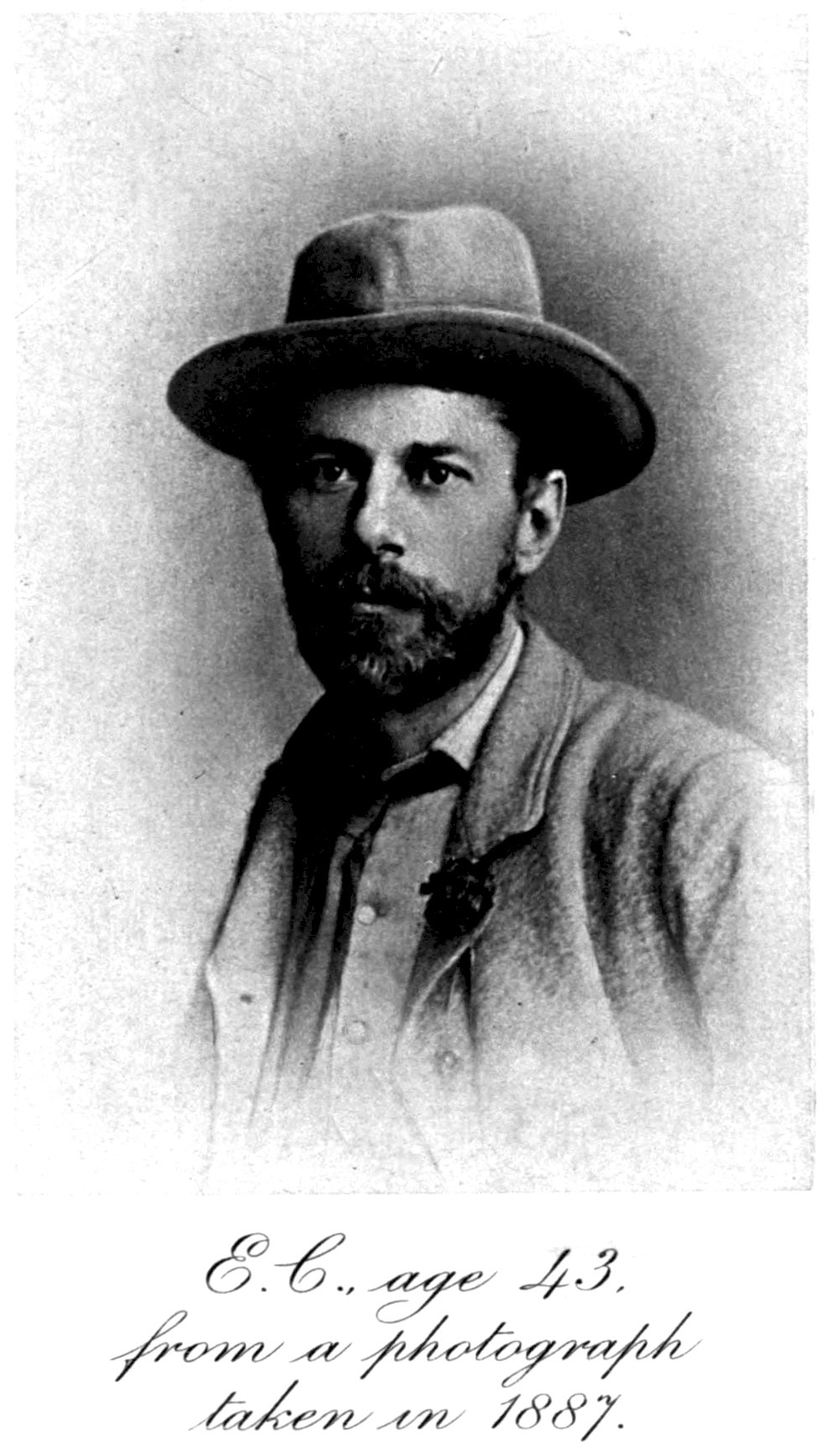
259