Planning the Operation
Reading edition
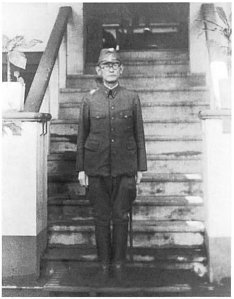
Photo courtesy of Cyril J. O’Brien
LtGen Haruyoshi Hyakutake, commanded the Japanese forces on Bougainville.
This kind of strong enemy reaction, in the air and at sea, had been expected by American staff officers who had put in long weeks planning the Bougainville operation. Looking at a map of the Solomon Islands chain, it was obvious that this largest island (130 by 30 miles) on the northwest end was a prime objective to cap the long and painful progress northward from the springboard of Guadalcanal at the south end. As Guadalcanal had been the beginning of the island chain, so now Bougainville would mark the top of the ladder in the Northern Solomons. From Bougainville airfields, American planes could neutralize the crucial Japanese base of Rabaul less than 250 miles away on New Britain. From Bougainville, the enemy could defend his massive air-naval complex at Rabaul. “Viewed from either camp, the island was a priority possession.”
There were the usual sequences of high level planning conferences, but, on 1 October 1943, Admiral William F. Halsey, Commander, South Pacific Area, notified General Douglas MacArthur, Supreme Allied Commander, Southwest Pacific Area, that the beaches on Empress Augusta Bay in the middle of Bougainville’s west coast would be the main objective. This location was selected as the point to strike because with the main Japanese forces 25 miles away at the opposite north and south ends of the island, it would be the point of least opposition. In addition, it provided a natural defensive region once the Marines had landed and their airfields had been gouged out of the swamp and jungle. Finally, the target area would provide a site for a long-range radar installation and an advanced naval base for PT (patrol torpedo) boats.
It promised to be a campaign in a miserable location. And it was. There were centipedes three fingers wide, butterflies as big as little birds, thick and nearly impenetrable jungles, bottomless mangrove swamps, crocodile infested rivers, millions of insects, and heavy daily torrents of rain with enervating humidity.
Major General Allen H. Turnage, the 3d Marine Division commander, summarized these horrors. “Never had men in the Marine Corps had to fight and maintain themselves over such difficult terrain as was encountered on Bougainville.”
To carry out this operation, Lieutenant General Alexander A. Vandegrift, Commanding General, I Marine Amphibious Corps (IMAC),A had in his command for the operation:
3d Marine Division
1st Marine Parachute Regiment
2d Marine Raider Regiment
37th Infantry Division, USA (in reserve)
The Marine riflemen in these units were supplemented by a wide range of support: 155mm artillery; motor transport; amphibian tractor; and signal, medical, special weapons, Seabee, and tank battalions. The 3d Division had its own engineers and pioneers in the 19th Marines and artillery in the 12th Marines.
Immediately following Vandegrift’s operation order, practice landing exercises were conducted in the New Hebrides and on Guadalcanal and Florida Islands.
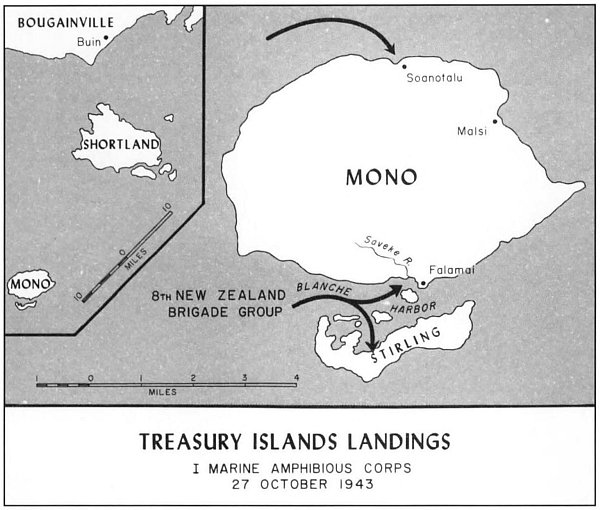
TREASURY ISLANDS LANDINGS
I MARINE AMPHIBIOUS CORPS 27 OCTOBER 1943
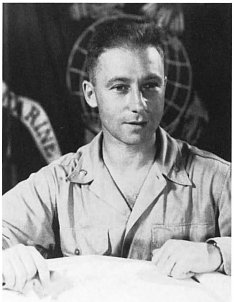
LtCol Victor H. Krulak was commander of the Choiseul operation.
Department of Defense Photo (USMC)
The objectives assigned on Bougainville were to seize a substantial beachhead and build airstrips. Then American planes could assure final neutralization of the Japanese airfields at Kahili, Buka, and Bonis airfields at the north and south ends of Bougainville. (By 31 October, American planes had initially rendered the Japanese fields inoperable.) After that would come a massive increase in air operations against Rabaul.
Facing the invading Marines was a formidable enemy force dispersed on the island. At Buin, for instance, there were 21,800 Japanese. Responsible for the defense was an old adversary, Lieutenant General Haruyoshi Hyakutake, commander of the Seventeenth Army, and the man the Marines had defeated at Guadalcanal. His main force was the 6th Division.
Working with the ground U. S. forces were the aviators of Air Solomons: New Zealand fighters, Army Air Force bombers, and the 1st and 2d Marine Aircraft Wings. As early as 15 August fighter planes from VMF-214 (the famous Black Sheep squadron) had strafed the Kahili airfield at the southern end of Bougainville. Now, in October, there were repeated strikes against the Japanese planes at other Bougainville airfields.
At sea, Halsey had designated Rear Admiral Theodore S. Wilkinson as commander of Task Force 31. Under him were Rear Admiral Frederick C. Sherman with the carriers (TF 38) and Rear Admiral Aaron S. “Tip” Merrill with the cruisers and destroyers (TF 39). Their job was to soften up the defenders before the landing and to safeguard the Marine-held beachhead.
[Sidebar (page 8):]
3d Marine Division
With Japan’s initial conquests spread over vast reaches of the Pacific, it quickly became obvious that additional Marine divisions were sorely needed. Accordingly, a letter from the Commandant on 29 August 1942 authorized the formation of the 3d Marine Division.
There was the 3d Marines, which had been activated first on 20 December 1916 at Santo Domingo in the Dominican Republic. Deactivated in August 1922, the regiment was again brought to life on 16 June 1942 at Camp Lejeune, North Carolina, and strengthened by boots from Parris Island. Its commander, Colonel Oscar R. Cauldwell, soon led to it to Samoa, arriving there in September 1942. Intensive training in jungle tactics and practice landings took place there. Then, in March 1943, it received a substantial number of reinforcing units and became a full-fledged regimental combat team, beefing up its strength to 5,600. Finally, in May 1943, it sailed for New Zealand, where the 3d Marine Division would come together.
Also with World War I roots, the 9th Marines was born 20 November 1917 at Quantico, Virginia, and was sent to Cuba. From there it moved to Texas, before being deactivated at the Philadelphia Navy Yard in April 1919. Reactivated on 12 February 1942 at Camp Elliott, California, under Colonel Lemuel C. Shepherd, Jr., it underwent training at the new Camp Pendleton. Similarly reinforced, by 1 January 1943 it was ready as a regimental combat team with 5,500 men. Movement overseas brought it to New Zealand on 5 February 1943.
The third infantry regiment that would make up the division was the 21st Marines. It was formed from a cadre of well-trained men from the 6th Marines, who had just returned from duty in Iceland. Arriving at Camp Lejeune on 15 July 1942, the cadre was augmented by boots from Parris Island and officers from Quantico. Colonel Daniel E. Campbell assumed command and the training began. Moving to join the other elements, the regiment arrived in New Zealand 11 March 1943.
The reinforcing of the infantry regiments to make them into self-sustaining regimental combat teams drew heavily on their two complementary regiments: the 12th Marines and the 19th Marines. The 12th Marines was a salty old unit, led by Brigadier General Smedley D. Butler in China in the 1920s. It’s antecedent was a small provisional contingent sent to protect American interests in China and designated the 12th Regiment (infantry), 4 October 1927. The 12th was reactivated at Camp Elliott on 1 September 1942 for World War II as an artillery regiment under command of Colonel John B. Wilson. Concluding its training, the regiment arrived in New Zealand on 11 March 1943.
The 19th Marines was different. It was made up of Seabees, engineers, bakers, piledrivers, pioneers, paving specialists, and many old timers from the 25th Naval Construction Battalion at the U.S. Naval Advance Base, Port Hueneme, California. It, too, was formed at Camp Elliott and its birthday was 16 September 1942. This was the regiment with pontoons for bridges, power plants, photographic darkrooms, bulldozers, excavators, needles, thread, and water purification machinery. No landing force would dare take an island without them. Colonel Robert M. Montague took command of the unit in New Zealand on 11 March 1943.
The division’s first commander was Major General Charles D. Barrett, a veteran of World War I. He assumed command in September 1942, but left a year later to take charge of IMAC and the planning for the Bougainville operation.
His assistant division commander had been Brigadier General Allen H. Turnage, and, upon Barrett’s death, he was promoted to major general and given command of the division which he would soon lead at Bougainville.