News Record
Reading edition
FROM FEBRUARY 7 TO MARCH 7, 1905
Government and Politics
February 7.—The Navy Department awards contracts for armor plate to two companies belonging to the Steel Trust, notwithstanding the fact that the Midvale Steel Co., which is outside the Trust, underbid the other two companies $56 per ton, or over $75,000 in the aggregate. Secretary of the Navy Paul Morton says the award was made because he feared the Midvale Steel Co. could not furnish the plates on time.
February 8.—The charge is made in the Wyoming Legislature that United States Senator Francis E. Warren has three persons on the payroll who are never in Washington and that the salaries are turned over to Warren. A resolution to investigate the charge is tabled.
The National Red Cross Society is reorganized with Honorable William H. Taft, Secretary of War, at its head.
Honorable Judson Harmon, of Cincinnati, and F. M. Judson, of St. Louis, are appointed special attorneys to investigate the granting of rebates by the Santa Fé Railroad.
Representative Comerford is expelled from the Illinois Legislature for making charges of graft against the members.
February 9.—The President signs the bill providing for the building of railroads in the Philippines.
February 10.—The United States takes over the custom house collections at Monte Cristi, Santo Domingo.
February 11.—It is announced at the White House that all the members of the Cabinet will be reappointed except Postmaster-General Wynne, who will be made Consul-General at London. George B. Cortelyou, Chairman of the Republican National Committee, will be the new Postmaster-General.
February 13.—Secretary of State Hay announces that the arbitration treaties, because of Senate amendments, will not be presented to the governments with which they were originally negotiated.
President Roosevelt, speaking at a Lincoln Day banquet in New York, defines his position on the race question.
February 15.—The President sends the Santo Domingo treaty to the Senate, with a letter upholding the Monroe Doctrine, but insisting that the smaller American republics must pay their debts.
February 16.—President Roosevelt orders a thorough investigation of the Standard Oil Trust in accordance with the House resolution.
Secretary of the Interior Hitchcock calls the lease of the oil lands of the Osage Indians to the Standard Oil interests “a public scandal.” This lease was made during President Cleveland’s second term.
February 17.—Six supporters of J. Edward Addicks desert him in the Delaware Senatorial fight.
Government agents start to Kansas to conduct the inquiry into the Standard Oil Co.
The West Virginia State Senate appoints a committee to investigate the charges that the Governor of the State has been in collusion with Standard Oil agents.
February 18.—Isthmian Canal Commissioners assert that they are authorized by the President to retain fees received as directors of the Panama Railway.
President Roosevelt receives a portrait of the Empress Dowager of China, sent as an evidence of China’s good will to the United States.
February 20.—Ex-Chief-Justice Alton B. Parker appears before the New York Court of Appeals to argue a case in favor of the New York City Interborough Railway Company, whose chief owner is August Belmont.
The United States Supreme Court sustains the Kansas Anti-Trust law, affirming sentence of fine and imprisonment against Edmund J. Smiley, an agent of the Missouri Pacific Railway Company.
A special committee of the California Legislature recommends the expulsion of five State Senators on the charge of soliciting and accepting bribes.
The Kansas Legislature, by concurrent resolution, asks the annulment of the Government’s blanket lease of Osage lands to the Standard Oil Company.
February 21.—The Government begins criminal prosecution of the Beef Trust before a Grand Jury at Chicago called especially for that purpose.
Despite the protests against it, Secretary Hitchcock decides to extend the leases of the Osage Indian oil lands.
The Illinois Legislature orders an investigation of the oil pipe lines of the State, and offers to loan the State of Kansas $100,000 to aid in the fight against the Standard Oil monopoly.
While J. Edward Addicks has lost all but about fifteen of his supporters in the Delaware Legislature, these decide to make the deadlock permanent and thus prevent the election of a United States Senator at this session.
President Truesdale, of the Lackawanna Railroad, criticizes President Roosevelt’s attitude on rate legislation.
At a dinner of the National Roosevelt League given in New York a criticism of the President’s message of condolence on the death of the Grand Duke Sergius was loudly cheered.
February 23.—The Interstate Commerce Commission hands down a decision that the Santa Fé and Southern Pacific railroads have violated the law by entering into a pool.
February 24.—The Department of Justice begins an investigation of the Tobacco Trust.
The Board of Trade of New York City decides to begin a campaign to force an investigation of the Telephone Trust.
Governor Edwin Warfield, of Maryland, in a speech in New York warmly commends President Roosevelt’s policy on the negro question.
February 25.—The Isthmian Canal Commission reports in favor of the Panama Canal being constructed at sea level with two or three sets of locks.
Despite the higher offer made by Kansas citizens, President Roosevelt decides that the lease of Osage oil lands to the Standard Oil interests must stand.
The Democrats of Chicago nominate Judge Edward F. Dunn for Mayor on a municipal ownership platform.
Secretary of the Treasury Leslie M. Shaw defends the action of his predecessor, Lyman J. Gage, in selling the New York Custom House to the City Bank.
Joseph V. Quarles, of Wisconsin, whose term as United States Senator ends March 4, is appointed United States District Judge. The La Follette men bitterly oppose the appointment.
February 27.—Four members of the California State Senate are expelled from that body for accepting bribes.
The United States Supreme Court sustains the Texas Anti-Trust Act under which two oil companies were forced to give up their licenses as a penalty for pooling.
February 28.—Word is received at Washington that Colombia will resume diplomatic relations with the United States.
March 1.—Secretary of State Hay, in a letter to the Haytian minister, says that the United States has no intention to annex Santo Domingo and “would not take it as a gift.”
In the contest for the Governorship of Colorado, thirteen Republican members of the committee appointed to conduct the contest report in favor of seating ex-Governor James H. Peabody, nine Democratic members sign a report favorable to Governor Alva Adams and five Republican members refuse to sign either report.
March 3.—Commissioner of Corporations James R. Garfield reports on the Beef Trust, his findings generally favoring the packers.
Former Land Commissioner Binger Hermann, of Oregon, is indicted in Washington for destroying public records.
March 4.—Theodore Roosevelt is sworn in as President of the United States in the presence of the largest assemblage and the most elaborate military display ever seen at an inauguration.
The Doings of Congress.
February 7.—The Senate passes the Statehood bill, but amends it to admit New Mexico as one State, leaving Arizona as a Territory. Oklahoma and Indian Territory constitute one State, as in the House bill.
February 8.—The electoral vote is canvassed by a joint session of the House and Senate, and the result is declared as 336 for Roosevelt and Fairbanks, to 140 for Parker and Davis.
The Senate Committee on Foreign Affairs disregards the wishes of the President and amends the arbitration treaties by striking out in each the word “agreement” and substituting therefor the word “treaty.”
C. W. Post, of the Postal Progress League, asks the Senate to expel Thomas C. Platt, of New York, on the ground that Platt is the President of the United States Express Co., and is not a fair representative of the people on any question involving the interests of that corporation.
February 9.—The Townsend-Esch bill, giving the Interstate Commerce Commission power to fix railroad rates, passes the House by a vote of 326 to 17.
February 10.—The Senate begins the impeachment trial of Judge Charles Swayne, of Florida.
The House Republicans decide to stand by their own Statehood bill, refusing to concur in the Senate amendments.
February 11.—The Senate, by an overwhelming vote, amends the arbitration treaties, thus virtually breaking with the President. It insists that all treaties must be ratified by the Senate.
Testimony was introduced in the Swayne impeachment trial to show that the defendant had falsely certified his expenses.
February 13.—Representative John A. Sullivan, of Massachusetts, makes a sensational attack on Representative William R. Hearst, of New York, and Mr. Hearst in reply shows that Sullivan was once indicted for murder in Massachusetts.
Senator Bacon, of Georgia, introduces a resolution calling for the facts relative to the United States seizing custom houses in Santo Domingo.
February 14.—Senators Lodge and Spooner defend the action of the Senate in amending the arbitration treaties.
Representative Littlefield, of Maine, warns Congress that it is riding for an $80,000,000 deficit.
The Senate passes the Agricultural Appropriation bill, but amends it by prohibiting drawbacks on wheat imported to make flour for export.
February 15.—The House, by unanimous vote, adopts a resolution introduced by Representative Campbell, of Kansas, which directs the Department of Commerce and Labor to investigate the Standard Oil Trust.
February 16.—The House declares the Senate’s amendment of the Agricultural Appropriation bill a violation of the Constitution.
The House passes the bill for the government of the Panama Canal zone.
February 17.—The House Committee investigating the Panama Railway hears testimony to the effect that the commissioners pocket the fees paid them as directors. The Senate withdraws its amendment to the Agricultural Appropriation bill.
February 20.—By the aid of 46 Democratic votes the Naval Appropriation bill, providing for two new battleships, passes the House.
Representative Baker, of New York, denounces President Roosevelt for having sent a message of condolence on the death of the Grand Duke Sergius.
Representative William R. Hearst introduces a bill to make oil pipe lines common carriers, thus taking them out of the exclusive control of the Standard Oil Company.
Friends of the freight-rate bill announce that they have abandoned hope of its becoming a law at this session.
February 21.—A letter is made public from former Senator William E. Chandler, of New Hampshire, to Senator Elkins, Chairman of the Senate Committee on Interstate Commerce, urging the passage of the rate bill and predicting that, if this is not done, government ownership of railroads will result.
The Senate Committee on Naval Affairs decides to report favorably the House bill providing for two additional battleships.
Senator T. M. Patterson, of Colorado, says that if the government does not control the railways the people will demand absolute government ownership.
February 23.—The House Indian Committee decides to investigate the Osage oil land lease.
Senator Chauncey M. Depew declares in favor of government regulation of railroad rates.
Stuyvesant Fish, President of the Illinois Central Railroad, tells the Senate Committee on Interstate Commerce that President Roosevelt, in a private conference, urged reduction of freight rates as long ago as 1902.
The House and Senate conferees on the Army Appropriation bill decide to give General Miles retired pay instead of full pay, as at present.
The Senate passes the Panama Canal bill with the clause destroying the Panama Canal Commission stricken out. Representative Bishop, of Michigan, attacks the River and Harbor bill and accuses fellow-members of being under the influence of the Great Lakes dredge owners.
February 24.—The item of $130,600 for the rent of the old New York Custom House from the City Bank (Standard Oil) is stricken from the Civil Appropriation bill by the Committee of the Whole House. Mr. Sulzer (Dem.) leads in the attack on this item, and the vote striking it out is 90 to 77.
Representative Vandiver, of Missouri, attacks the Armor Plate Trust and asks the Attorney-General why it has not been prosecuted.
Senator Morgan, of Alabama, starts a filibuster against the Statehood bill.
February 25.—Senator Hale, of Maine, makes sarcastic references to the Administration policy of “browbeating smaller Powers.”
Arguments are concluded in the impeachment case of Judge Charles Swayne.
Senator Morgan, of Alabama, lodges with the Senate Foreign Affairs Committee a formal protest against the action of President Roosevelt relating to Santo Domingo.
February 27.—Senator Dryden, of New Jersey, at the supposed request of the President, introduces a bill establishing Federal supervision of insurance.
Democratic leaders bitterly attack the President’s foreign policy in both the House and Senate.
The Senate votes in favor of the House appropriation for two additional battleships.
The Democrats of the House prevent the reinstatement of the appropriation for rent to the City Bank of New York, enough Republicans joining them to reverse the ruling of the Chair.
The Senate, sitting as an Impeachment Court, declares Judge Charles Swayne, of Florida, innocent of all the charges against him.
The House Committee on Interstate and Foreign Commerce resumes its investigation of the Panama Canal and Railroad, and brings out testimony to the effect that supplies were bought without bids, and that the President’s instructions were not always heeded.
The Naval Appropriation bill, as amended by the Senate, directs the Secretary of the Navy to investigate the cost of armor plate and report to the next Congress.
February 28.—The Senate votes an amendment to the Indian Appropriation bill providing that a portion of the educational fund may go to sectarian schools.
Senator Kearns, of Utah, in his farewell speech, makes a sensational attack on the Mormon Church, which he says is ruled by a “monarchy.”
March 1.—The day is spent on the appropriation bills, a large number of which are agreed to in conference, and pass both houses. The Senate does not attempt to reinstate the item for the rent of the New York Custom House from the Rockefeller bank. An objection by Representative Baker, of New York, prevents the President’s salary from being raised to $75,000. The House votes itself $190,000 for mileage for the “constructive recess.”
March 2.—Both houses spend the day on the appropriation bills. The Senate adopts the Kean resolution for a railroad rate inquiry during the recess.
The Senate kills the $190,000 mileage grab of the House.
March 3.—The Fifty-eighth Congress practically completes its work, both houses agreeing on all appropriation bills. Freight-rate legislation and the Statehood bill go over to the next Congress.
March 4.—The Fifty-eighth Congress ends and the new Senate convenes in special session.
General Home News
February 7.—August W. Machen and the Groff brothers, the Post-Office Department officials convicted in the postal fraud cases, and whose sentence has just been confirmed by the United States Supreme Court, are taken to prison.
It is announced that an international parcels post is to be established between Great Britain, France and the United States.
The Standard Oil interests are reported to have made a $20,000,000 purchase of stock, thus securing control of the Santa Fé Railroad system.
The Interstate Commerce Commission hears the charges brought against the Coal Trust by the Honorable William R. Hearst.
The Board of Aldermen of New York City takes steps for the construction of a municipal electric-lighting plant.
The State of Kansas continues its war on the Standard Oil Trust, the State Senate passing three bills providing for the erection of a State oil refinery, for making pipe lines common carriers, and for fixing freight rates in oil.
February 8.—Henry C. Frick, of the Steel Trust, and Henry H. Rogers, of the Standard Oil Company, are elected directors of the Santa Fé Railroad.
Elihu Root, former Secretary of War, leads an attack on the constitutionality of the New York State Barge Canal, which is opposed by the railroads, and which was supported by such an overwhelming majority in last fall’s election.
February 10.—In the hearing of the Hearst case against the Coal Trust, the attorney of the Trust says in effect that the United States has no power over the corporation.
February 13.—The Federal Grand Jury returns new indictments against Senator Mitchell and Representatives Hermann and Williamson, of Oregon, in the public land fraud cases.
February 14.—A sensational war in high finance is begun between President Alexander, of the Equitable Life Assurance Association, and James H. Hyde, its First Vice-President and majority stockholder.
February 15.—The Kansas House of Representatives passes the bill for a State oil refinery already passed by the Senate.
The New York Legislature adopts a resolution directing an investigation of the Telephone Trust.
February 16.—A truce is patched up between the warring factions of the Equitable Life Association on the promise of Vice-President Hyde to mutualize the company.
February 17.—Governor Hoch, of Kansas, signs the bill appropriating $400,000 for the erection of a State oil refinery.
February 20.—Mrs. Jefferson Davis, in a letter to the public press, scores General Nelson A. Miles for having placed her husband in irons, and asks General Miles to publish a photographic copy of her alleged letter of thanks.
An explosion in a coal mine at Virginia, Ala., entombs 160 men.
Thomas W. Lawson, in Everybody’s Magazine, continues his story of the formation of the Amalgamated Copper Company, outlines its devious operations under Standard Oil, accuses James M. Beck, ex-Assistant Attorney-General of the United States, of perjury, and attacks James H. Eckels, ex-Comptroller of the Currency, for his part in the infamous Cleveland bond deal.
February 21.—Mayor George B. McClellan and ex-Mayor Seth Low, of New York, appear before the Legislature at Albany to plead for a larger water supply for New York City, claiming that a few dry years would bring a water famine to the metropolis.
President Mellen, of the New York, New Haven & Hartford Railroad, refuses to arbitrate with the firemen who threaten a strike.
Fifty of the 160 miners entombed by the explosion at Virginia, Ala., are known to be dead, and little hope is entertained for the remainder.
A manuscript copy of one of Edgar Allan Poe’s poems sells for $1,000 in New York.
John W. Gates and Joseph H. Hoadley claim to have secured control of the Tennessee Coal & Iron Company.
February 22.—Washington’s Birthday is generally celebrated throughout the United States and foreign nations. President Roosevelt is the chief orator at the University of Pennsylvania, which institution confers the degree of LL.D. on himself and Emperor William of Germany. A bust of Washington is presented to Congress by M. Jusserand, the French Ambassador.
A “boodle fund” of $60,000 is produced in court at the trial of Charles Kratz at Butler, Mo. Thomas K.. Niedringhaus, Republican nominee for United States Senator, is summoned as a witness in the case.
Professor William Osler, in his farewell address to Johns Hopkins University, states that men after forty years of age are “comparatively useless,” and after sixty are entirely so.
President William R. Harper, of the University of Chicago, undergoes an operation for cancer while thousands of students and friends pray for his recovery. Physicians find cancer, but are unable to remove it.
Colonel William F. Cody, “Buffalo Bill,” says he will apply to Howard Gould, the millionaire, for $125,000 furnished Mrs. Howard Gould when she was an actress.
February 23.—General Nelson A. Miles, in the Independent, makes a rejoinder to those who had criticized him for placing Jefferson Davis in irons, publishing several letters, among them a note from Mrs. Davis thanking him for “kind answers,” and begging him to look after her husband’s health.
Standard Oil stocks drop 10 points, or $41,000,000 in nine days.
February 24.—The New York State Factory Inspector finds immigrant boys who are virtually made slaves and compelled to work twenty hours a day without pay.
Governor Vardaman, of Mississippi, employs troops to protect from lynching a negro accused of having assaulted a white girl.
Frank H. Monnett, ex-Attorney-General of Ohio, reaches Topeka, where he will assist in framing a case in the Supreme Court to oust the Standard Oil Company from the State.
The plan for mutualizing the Equitable Life Assurance Society fails, and the war between the Hyde and Alexander factions goes on.
The Vanderbilt interests purchase a majority of the stock of the Boston & Maine Railroad.
February 25.—Wall Street sees a wild day on the stock market because of a reported merger of the New York Central and Union Pacific railroads.
Independent crude oil producers and refiners of Kansas, Ohio, Illinois and Indiana unite to fight the Standard Oil Company.
A two-million-dollar fire sweeps Hot Springs, Ark., causing several deaths.
Richard Croker, former chief of Tammany Hall, sails for Ireland.
The Engineering Committee of the Isthmian Canal Commission estimates that a sea-level canal can be constructed for $230,500,000, and that the time occupied in building it will be ten or twelve years.
February 26.—A five-million-dollar fire sweeps the river front at New Orleans. Elevators and piers destroyed, entailing future loss of export trade.
February 27.—By the collapse of the second floor of the African Methodist Episcopal Zion Church, of Brooklyn, N. Y., eleven persons are killed and several score injured.
The Alexander-Hyde fight in the Equitable Life Assurance Society is carried into the courts.
After making from $5,000,000 to $8,000,000 in wheat, John W. Gates and his associates throw their holdings on the market, causing a sharp decline.
March 1.—Three New York thieves testify that they have been dividing proceeds with the police to secure immunity from arrest.
March 2.—H. Rider Haggard, the celebrated British novelist, visits the United States for the purpose of studying colonization plans for the poor.
March 6.—A general strike is declared on all the Subway and Elevated lines of New York City.
The Russo-Japanese War
February 7.—A growing peace sentiment is manifest in Russia, and press and public are becoming more outspoken against the further prosecution of a losing war.
General Kuropatkin sends word of a raid in which fifty Japanese were killed.
February 8.—Admiral Togo returns to his flagship, and resumes sea duty.
Tokio hears of skirmishes near Mukden, in which the Russians were defeated.
February 10.—The Russians retire from Songchin in Northeastern Corea.
The Russian Baltic fleet is reported off Madagascar on its way to the Far East.
General Stoessel says in answer to critics that he sacrificed glory to humanity in surrendering Port Arthur.
February 12.—Field Marshal Oyama reports two skirmishes in which the Russians are defeated.
February 13.—General Kuropatkin reports that a Japanese cavalry raid has destroyed several miles of railroad north of Mukden; also that the Japanese have resumed the bombardment of Lone Tree Hill.
February 15.—A large force of Russian cavalry moves against the Japanese left in the vicinity of Heikontai.
The Russian third Pacific squadron sails from Libau on its way east.
February 16.—Russian attacks at Waitao Mountain are repulsed, and the cavalry force, which moved against the Japanese left, is forced to retreat.
February 17.—General Grippenberg, who was removed from his command in the Russian army after the battle of Heikontai, is given an audience by the Czar, and says that General Kuropatkin refused to support him when victory was within reach.
February 18.—The Russian strike closes a number of Government factories and interferes with manufacturing and shipping of war supplies.
February 20.—Russian cavalry passes Japanese left flank near Hun River. Movement of no special importance, and losses insignificant.
Russia’s third Pacific naval squadron passes through the Great Belt off Denmark on its way to join the Baltic squadron.
Tokio gives out semi-official statement that Japanese casualties at the battle of Heikontai were near 10,000.
February 21.—Lieutenant-General Stoessel, former commandant at Port Arthur, lands at Kaffa, Russia, on his return from the Far East, and is received by a cheering crowd.
February 22.—A Cossack raid reaches nearly to the Yalu River, and destroys a Japanese depot of supplies.
February 24.—The Japanese move northward along the eastern coast of Korea, fortify Port Lazareff and threaten Vladivostok.
The Japanese move forward in the Tsinkhetchin district, and after desperate fighting force the Russians to abandon their base at Beresneff Hill.
February 25.—A battle involving General Kuropatkin’s left flank opens south of Mukden.
Mr. Kogoro Takahira, Japanese Minister to the United States, says that his country has made no peace advances to Russia.
February 26.—The battle brought on by the flank movement of the Russians is continued, and General Kuropatkin admits another defeat. Japanese capture the city of Tsinkhetchin, drive in the Russian outposts and cross the Sha River. It is reported that Oyama’s artillery is even throwing shells into Mukden.
February 27.—A number of Russian naval officers returning from Port Arthur are entertained by Count Cassini in Washington. Other Russian officers from the same siege land at Victoria, British Columbia; in interviews they speak disparagingly of General Stoessel, one expressing the opinion that Stoessel showed himself to be “not a hero, but a coward.”
Fighting continues about Mukden, the Japanese being the aggressors. It is now certain that General Kuroki has captured Tie Pass from the Russians.
February 28.—The battle near Mukden becomes general along a 100-mile front, and involving 700,000 men.
It is stated that the Cossacks lost 2,000 men at Tsinkhetchin.
March 1.—The Japanese make a terrific bombardment of Lone Tree or Putiloff Hill, employing for the purpose the great siege guns used at Port Arthur.
Fierce fighting rages over the Sha River bridge, which is finally held by the Japanese.
Field Marshal Oyama gradually forces the Russians back in the general battle about Mukden.
March 2.—The Russian flanks are pushed backward and Kuropatkin’s entire army continues to retire before the onslaughts of the Japanese.
March 3.—General Kuropatkin is in retreat toward Tie Pass and a portion of Oyama’s army reaches a point eleven miles west of Mukden.
The battle around Mukden continues, the results generally favoring the Japanese.
March 4.—General Kuropatkin’s left flank suffers and his position grows still more critical.
March 5.—A fierce artillery engagement rages throughout the day and Marshal Oyama continues his flanking movement.
March 6.—General Kuropatkin is hemmed in and vigorously attacks the Japanese left centre. Marshal Oyama relentlessly tightens his lines in an endeavor to trap his foe.
General Foreign News
February 7.—As a result of the massacre of Russian citizens on January 22, the Social Democratic Party of Russia calls on workmen to march on the Czar’s palace with arms in their hands instead of ikons and petitions.
Father Gapon, the Russian revolutionary leader, is reported to have escaped to Switzerland.
General Trepoff, the “man of iron” who has been placed at the head of the police system at St. Petersburg, threatens to close the universities because of the revolutionary sentiment there existing.
Disorders continue in Russian Poland, and several strikers are killed by the troops.
The assassin of Soisalon Soininen, Procurator-General of Finland, is identified a former student at one of the Finnish universities.
February 8.—Because of the failure of the employers to concede the demands of their workingmen, new strikes are declared at St. Petersburg, Vassili Ostroff and other points in Russia.
Strikers tear up the Siberian Railway east of Irkutsk.
Maxim Gorky, the Russian novelist, is questioned in court and afterward returned to prison.
The students of one of the St. Petersburg schools refuse to attend lectures because of police interference.
Because of the continued state of disorder in Russian Poland, many refugees leave the country.
The new protocol between the United States and Santo Domingo is signed at Santo Domingo. It provides for the territorial integrity of the island republic and for ratification by the United States Senate.
The British Government decides that John H. Gaynor and Benjamin H. Greene, American refugees in Canada, may be extradited and returned to the United States.
King Oscar, of Sweden, turns over the government to Crown Prince Gustav.
February 9.—Many strikers are killed by the troops at Sosnovice, Russian Poland.
M. Rouvier, the new Premier of France, submits a bill absolutely divorcing church and state.
German mine strikers denounce the action of their leaders in voting to return to work, and thousands decide to continue the struggle.
February 10.—Over sixty strikers are killed and hundreds are wounded by troops at Sosnovice and Lodz in Russian Poland.
Strikes are being renewed to such an extent in St. Petersburg that the authorities are growing apprehensive.
February 11.—Prince Paul Dolgorouki says that the Czar must call a Zemsky Sober (a popular assembly) if he would avoid a revolution.
The strike at Lodz now involves 100,000 men.
Four thousand ironworkers strike at Kharkoff.
Disquieting conditions are reported at Batoum in the Caucasus, with a general tie-up of railway lines in the vicinity.
February 12.—Three aeronauts make a balloon voyage from London to Paris in a little over six hours.
The Czar promises a commission, including workingmen, to deal with the labor problem.
Russian conscripts and reserves mutiny in several provinces. Cossacks kill eighteen at Kieff and wound over eighty.
Franz Kossuth, the leader of the Hungarian Independence Party, is received in audience by the Austrian Emperor.
February 13.—The Russian Cabinet decides to adopt reform measures, including some sort of concessions to the workingmen.
Arguments are concluded in the North Sea case before the International Commission at Paris. Decision, it is announced, will be handed down at a later date.
It is reported from Essen that the German coal strike, which has been one of the most important industrial struggles in German history, is ended.
February 14.—King Edward opens the British Parliament. The speech from the throne contains no significant passages.
February 15.—The strike in Warsaw again becomes general.
The Emperor of China approves a plan for a parliament of the empire’s leading officials.
President Castro, of Venezuela, refuses to arbitrate the asphalt claims and other disputes between that country and the United States.
February 16.—The strike at St. Petersburg, which was reported to be abating, breaks out with renewed force.
On a test vote the Balfour government is sustained in the British House of Commons by a majority of 63.
The Venezuela Supreme Court reaffirms its order sequestrating the lands belonging to the American Asphalt Company.
February 17.—The Grand Duke Sergius, uncle and brother-in-law of the Czar and the most reactionary and influential of the Grand Ducal clique, is blown to pieces by a bomb in the Kremlin, Moscow. The assassin, who is dressed in the garb of a workingman, is arrested.
February 18.—The Russian strike spreads to the employees of many railways and to the telegraphers.
Two Russian officials are assassinated in Transcaucasia.
Consternation reigns among the rulers of Russia, and members of the royal family do not venture to appear in public.
The British Government announces that in 1911 it will take over the entire property of the National Telephone Company.
February 20.—Three thousand Russian students and professors, in mass meeting, denounce the Czar, demand constitutional government and shut up the University of St. Petersburg till September.
Martial law is declared at Tsarskoe-Selo, the residence of the Czar.
China expresses the desire to pay all her indemnity at once, but some of the Powers object, as it deprives certain officials of commissions and interest.
Sir John E. Redmond leads an Irish attack on the British ministry.
February 21.—The Home Rule amendment offered by Sir John E. Redmond is defeated in the British House of Commons, and the Balfour government is sustained, but by the reduced majority of 50.
A general revolt against the Russian Government is reported throughout the entire Caucasus region.
February 22.—The Armenians seize three towns in the Caucasus.
Sir John E. Redmond renews his attack on the Balfour ministry, and the government majority is still further reduced to 42.
Polish disturbances continue, and all trains from Warsaw on the Vienna line are discontinued.
Many bodies of slain strikers are found in the streets of Baku, a town in the Caucasus.
Workmen destroy factories at Riga, Southern Russia.
February 23.—The London Times states that the Czar has decided to call a Zemsky Sober, or popular assembly, to decide, among other things, as to the continuation of the war in the Far East. The German Court, on the other hand, gives out the statement that the Czar is determined to continue the war.
The Tartars are turned loose on the Armenians in the Caucasus revolt. The number of corpses found in the streets of Baku is reported as high as 300. The revolt continues in other towns in the region, 40,000 Georgians being involved.
The strike extends at Warsaw and more railway lines are tied up.
Leonide Andreef, a famous Moscow author, known as “The Little Gorky,” is arrested.
Funeral services are held over the remains of Grand Duke Sergius at Moscow. The Czar attends a requiem at Tsarskoe-Selo. Both ceremonies pass without special incident.
February 24.—An unsuccessful attempt is made to assassinate President Morales, of Santo Domingo. Five persons are arrested.
The famous Simplon Tunnel through the Alps, leading from Switzerland to Italy, is completed.
It is announced from London that Sir Henry Irving, the famous actor, is so broken in health that he may never again appear on the stage.
A coffin believed to contain the long-sought remains of John Paul Jones, the American Revolutionary naval hero, has been found in Paris.
Strikes and rioting continue practically throughout the entire Russian empire, many railway lines are tied up, and moujiks are becoming fired with the idea of a general land division.
February 25.—The International Commission to inquire into the North Sea incident concludes its sittings in Paris and hands down its decision that the action of Admiral Rojestvensky, commander of the Russian Baltic fleet, in firing on the British fishing vessels was unjustified.
The Warsaw railway strikes are reported partially settled, but a street railway strike begins and disturbances continue.
Severe fighting between the Armenians and the Mussulmans continues in the Caucasus region; leading officials and merchants are assassinated at Batoum, and revolutionary manifestoes in favor of a republic are circulated broadcast.
The Countess of Warwick begins an automobile tour of Great Britain for the purpose of assisting the various labor candidates for Parliament.
A general railway strike begins in Italy, the workmen being dissatisfied with the treatment proposed to be given them under the bill creating State management of railways.
It is announced that the Czar has decided not to call the Zemsky Sober, and that he has irrevocably decided that the war with Japan must go on.
February 27.—Maxim Gorky, the famous Russian novelist, is released from prison only to be rearrested by order of General Trepoff and banished to Riga.
President Morales lays before the Dominican Congress the protocol with the United States.
Berlin’s new cathedral is dedicated in the presence of the Emperor and delegates from all parts of the world.
The Czar, in an effort to break the strike, orders a raise of wages on State railroads and in Government arsenals.
The disturbances in Russian Poland are augmented by a serious revolt of the peasantry in fifty villages.
A second Kishineff horror is reported from Theodosia in the Crimea, where forty-seven Jews were killed and many more injured in a recent massacre.
February 28.—The strike situation in Russia grows steadily worse, especially in Poland, where a coal famine is threatened.
The Russian Council of Ministers decides on more repressive measures and definitely refuses to call the Zemsky Sober.
March 1.—The workmen selected by the Czar to organize a commission on the labor situation meet and demand concessions from the Government before taking further action.
Lord Selbourne is chosen British High Commissioner in South Africa in place of Lord Milner, resigned.
March 2.—The Russian ministry votes to grant the people religious freedom.
The majority for the present British ministry is reduced to 24.
March 3.—The Czar calls a representative assembly, but without power except to consult and advise.
Rioting continues in Russian Poland and a general strike is ordered at St. Petersburg.
March 4.—Cossacks kill nine students and wound many more at Tomsk.
March 5.—The Czar’s action in calling an assembly has little or no influence on the Russian situation, which grows more grave.
Obituary.
February 7.—Joseph H. Manley, prominent Republican politician, dies at his home in Augusta, Me., aged 62.
February 8.—Rear-Admiral Frank C. Cosby, of the United States Navy, dies at the age of 65.
February 9.—Adolf von Menzel, famous German painter, dies in Berlin.
Chief-Justice Pardon E. Tillinghast, of the Supreme Court of Rhode Island, dies at the age of 68.
Henry W. Blodgett, former United States District Judge, dies at the age of 84.
February 11.—Sylvester Scovel, the well-known war correspondent, dies in Havana, aged 36.
February 14.—James C. Carter, leading New York lawyer, dies at the age of 78.
February 15.—General Lew Wallace, the celebrated author, dies at his home in Crawfordsville, Ind., aged 78.
William Cullen Bryant, publisher of the Brooklyn Times, dies at the age of 56.
February 16.—Jay Cooke, once famous as a financier, dies at the age of 83.
February 20.—Norton P. Otis, Member of Congress from New York, dies at the age of 65, at his home in Yonkers, N. Y.
February 21.—Jacob Worth, well-known Brooklyn politician and race-track man, dies at Hot Springs, Ark.; age, 67.
February 23.—W. F. G. Shanks, a well-known New York newspaper and magazine editor, dies in Bermuda, aged 68.
February 24.—Sidney Dillon Ripley, Treasurer of the Equitable Life Assurance Society, dies from the effects of an operation for appendicitis, at New York.
February 25.—Edward Cooper, ex-Mayor of New York and only son of Peter Cooper, dies at New York City, aged 81.
February 27.—Honorable George S. Boutwell, former Governor of Massachusetts, United States Senator and Secretary of the Treasury, dies at his home at Groton, Mass., aged 87.
Harry Morris, well-known American comedian, dies at New York, aged 49.
Henry C. Whitney, formerly one of Chicago’s leading lawyers, dies at Salem, Mass., aged 74.
Richard A. Donnelly, Quartermaster-General of New Jersey since 1890, dies at his home in Trenton, aged 64.
March 1.—Mrs. Jane Lathrop Stanford, widow of Leland Stanford and famous for her gifts to education, dies suddenly in Honolulu. Subsequent investigation shows she was poisoned.
Edward O. Wolcott, former United States Senator from Colorado, dies at Monte Carlo, Monaco, aged 56.
March 4.—H. L. Muldrow, Assistant Secretary of the Interior under President Cleveland, dies at Starkville, Miss.
Gobbled It All
SMITH—Some of our rich men claim it isn’t right to leave anything behind them.
Smythe—That’s their way exactly. Wherever they have been they have left mighty little behind them.
The Legal Acrobat
JUDSON—How did that expert come to contradict himself on the second trial?
Bludson—The other side hired him.
Extract from a three-column review in the San Francisco Examiner:
“Mr. Hastings has touched the very core of the matter respecting the proclivities of our doddering plutocracy. Throughout his book he has revealed that plutocracy in its true light and shown it to be something utterly conscienceless and debased. No more scathing review of the situation, as it is seen at present, could possibly be given in a work of fiction.”
SHALL WE HAVE A KING?
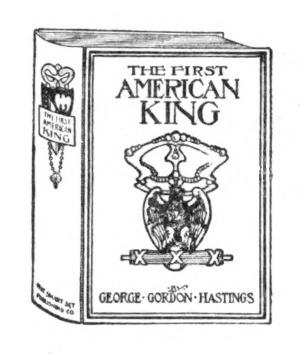
Will the United States be a monarchy in 1975? Have you read “THE FIRST AMERICAN KING,” by George Gordon Hastings? It is a dashing romance in which a scientist and a detective of today wake up seventy-five years later to find His Majesty, Imperial and Royal, William I, Emperor of the United States and King of the Empire State of New York, ruling the land, with the real power in the hands of half a dozen huge trusts. Automobiles have been replaced by phaërmobiles; air-ships sail above the surface of the earth; there has been a successful war against Russia; a social revolution is brewing. The book is both an enthralling romance and a serious sociological study, which scourges unmercifully the society and politics of the present time, many of whose brightest stars reappear in the future under thinly disguised names. There are wit and humor and sarcasm galore—a stirring tale of adventure and a charming love-story.
Net $1.00, postpaid. All Booksellers, or sent postpaid upon receipt of price by
TOM WATSON’S MAGAZINE
121 West 42d Street,NEW YORK CITY
“TOM WATSON”
is the one historian through whom we get the point of view of the laborer, the mechanic, the plain man, in a style that is bold, racy and unconventional. There is no other who traces so vividly the life of a people from the time they were savages until they became the most polite and cultured of European nations, as he does in
THE STORY OF FRANCE
In two handsome volumes, dark red cloth, gilt tops, price $5.00.
“It is well called a story, for it reads like a fascinating romance.”—Plaindealer, Cleveland.
“A most brilliant, vigorous, human-hearted story this: so broad in its sympathies, so vigorous in its presentations, so vital, so piquant, lively and interesting. It will be read wherever the history of France interests men, which is everywhere.”—New York Times’ Sat. Review.
NAPOLEON
A SKETCH OF HIS LIFE, CHARACTER, STRUGGLES AND ACHIEVEMENTS.
Illustrated with Portraits and Facsimiles. Cloth, 8vo, $2.25 net. (Postage 20c.)
“The Splendid Study of a Splendid Genius” is the caption of a double-column editorial mention of this book in The New York American and Journal when it first appeared. The comment urged every reader of that paper to read the book and continued:
“There does not live a man who will not be enlarged in his thinking processes, there does not live a boy who will not be made more ambitious by honest study of Watson’s Napoleon * * *
“If you want the best obtainable, most readable, most intelligent, most genuinely American study of this great character, read Watson’s history of Napoleon.”
“TOM WATSON”
in these books does far more than make history as readable as a novel of the best sort. He tells the truth with fire and life, not only of events and causes, but of their consequences to and their influence on the great mass of people at large. They are epoch-making books which every American should read and own.
Orders for the above books will be filled by Tom Watson’s Magazine, 121 West 42nd Street, New York City.