PART V
Reading edition
PART V[8]
WHAT IS TRUTH?
It was in 1890 that N. N. Gay painted the well-known picture of Tolstoy in his room at Yásnaya Polyána.
The picture which aroused most interest at Yásnaya that year, however, was not a portrait of Tolstoy, but Gay’s “What is Truth?” which had been exhibited in Petersburg early in the year and prohibited. After being exhibited privately, Gay brought it to show to Tolstoy, on whom it made a deep impression.
Already in January, when Gay had sent him a drawing of it, Tolstoy had written to him:
“I am always thinking about you and your picture. I am longing to hear how it is received. I am troubled over the figure of Pilate which, with that arm, seems wrong somehow. I don’t say it is, I only ask. If the connoisseurs say that that figure is correct, I shall be satisfied. About the rest I know, and have no need to ask anyone’s opinion.”
Though Tolstoy knew very well that Pilate’s arm was not well drawn, he was immensely pleased with the treatment of the subject and the thought and feeling expressed. Feinermann tells us:
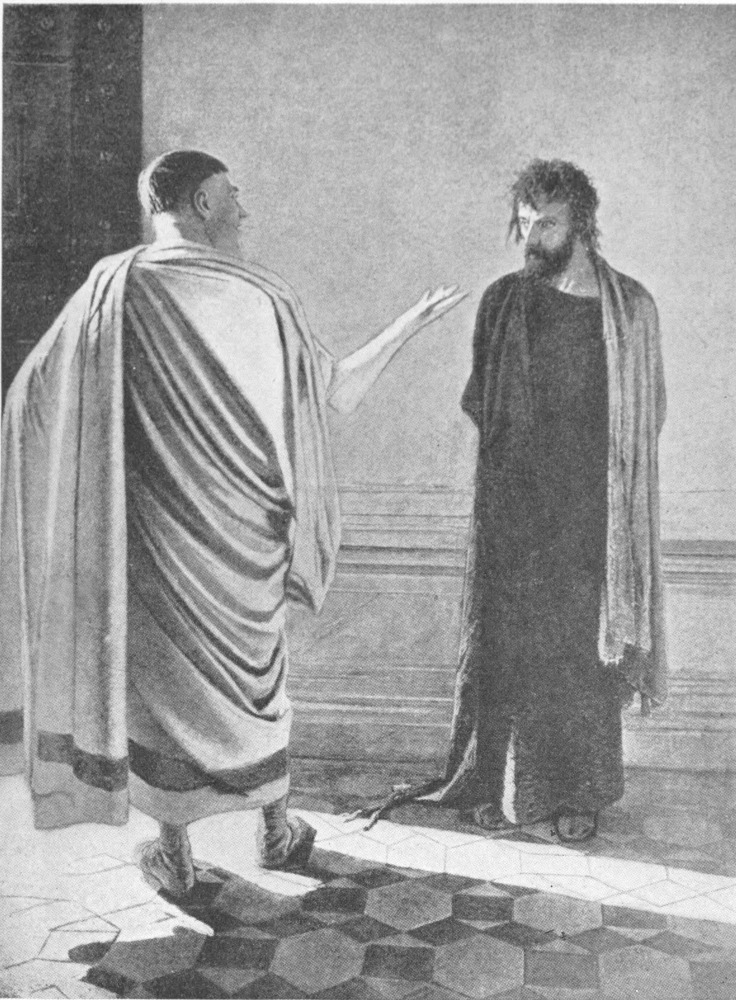
“WHAT IS TRUTH?” After a painting by N. N. Gay, 1890
“Leo Tolstoy, when he saw that painting, was so shaken and agitated that for days after he could hardly speak of anything else.
“‘I am in raptures,’ he said. ‘That’s a master! I confess that I myself only now understand the deep and true meaning of that short passage which always appeared to me, as it has to all the Bible commentators, unfinished and abrupt. Pilate asked, “What is Truth?” and then went out to the crowd without waiting for a reply. And everybody reads and understands it that way. But this picture gives a different interpretation. Pilate does not ask what truth is, expecting a reply. No! in the form of a question he contemptuously replies! When Christ says that he has come into the world as a witness of Truth, Pilate with a laugh and a contemptuous gesture throws the words carelessly at him: “And what is Truth? Truth is a relative thing; everybody takes it his own way!” and, evidently considering his retort decisive, he went out to the crowd. That is the light in which the moment is seized. It is new, it is profound, and how strongly and clearly the picture expresses it! That fat shaven neck of the Roman Governor, that half-turned, large, well-fed, sensual body, that out-stretched arm with its gesture of contempt—are all splendid—it is alive. It breathes and impresses itself on the memory for ever. And the face.... Together with all the dignity of that Roman figure there goes a slavish anxiety about himself: the mean trepidation of a petty soul. He is afraid he may be denounced at Rome.... And this smallness of soul is wonderfully caught by Gay, and notwithstanding the toga, and his height, and his majestic pose, Pilate appears so petty before the wornout sufferer who has undergone during the night arrest, judgment, and insults.... A wonderful picture! That is the way to paint!’
“Gay, touched and deeply moved by Tolstoy’s delight, embraced and kissed him, and said: ‘Do not praise it.... You will praise me so that I shall become proud. I am afraid of that.... I shan’t be able to paint!’”