INFORMATION FOR TOURISTS
Reading edition
Preliminary
There is only one way by which to directly reach the Grand Canyon of Arizona, and that is via the Santa Fe (The Atchison, Topeka & Santa Fe Railway System).
There are three ways of reaching the Canyon from the Santa Fe—rail from Williams, private conveyance from Flagstaff and Peach Springs.
The route from Flagstaff is not available in winter. The Peach Springs route is open in winter, but now little used. The bulk of the travel is via Williams, sixty-five miles north to Bright Angel—open all the year.
Three Gateways
There are but three points from which an easy descent may be made of the south wall to the granite gorge of the Grand Canyon:
1. At Grand View, down Berry’s (Grand View) or Hance’s (Red Canyon) trails.
2. At Bright Angel, down Bright Angel Trail.
3. At Bass’ Camp, down Mystic Spring Trail.
While the canyon may be reached over trails at other places outside of the district named (such as Lee’s Ferry Trail, by wagon from Winslow; Moki Indian Trail, by way of Little Colorado Canyon; and Diamond Creek road to Colorado River from Peach Springs station), most tourists prefer the Bright Angel, Grand View, and Bass’ Camp routes, because of the superior facilities and views there offered. The Peach Springs route is the only other one now used by the public to any extent.
It is near Grand View that Marble Canyon ends and the Grand Canyon proper begins. Northward, a few miles away, is the mouth of the Little Colorado Canyon. Here the granite gorge is first seen.
Bright Angel is approximately in the center, and Bass’ Camp at the western end of the granite gorge. By wagon road it is eighteen miles from Bright Angel east to Grand View, and twenty-three miles west to Bass’ Camp.
28
In a nutshell, the Grand Canyon at Grand View is accounted most sublime—a scene of wide outlooks and brilliant hues; at Bright Angel, deepest and most impressive—a scene that awakens the profoundest emotions; at Bass’ Camp, the most varied—a scene of striking contrasts in form and color.
Each locality has its special charm. All three should be visited, if time permits, as only by long observation can one gain even a superficial knowledge of what the Grand Canyon is. To know it intimately requires a longer stay and more careful study.
The Ride from Williams
Because of recent improvements in service the Grand Canyon of Arizona may now be visited, either in summer or winter, with reasonable comfort and without any hardship. No one need be deterred by fear of inclement weather or a tedious stage ride. The trip is entirely feasible for the average traveler every day in the year.
Leaving the Santa Fe transcontinental train at Williams, Arizona, passengers change in same depot to a local train of the Grand Canyon Railway, which leaves Williams daily, and arrives at destination after a three hours’ run.
Williams is a busy town of 1,500 inhabitants, 378 miles west of Albuquerque, on the Santa Fe. Here are located large sawmills, smelters, numerous well-stocked stores, and railroad division buildings. Prior to the disastrous fire in July, 1901, there were several excellent hotels. The one not destroyed affords good accommodations; it has been recently enlarged and otherwise improved.
There is usually ample time at Williams, between trains, for the ascent of Bill Williams Mountain, which rises near the town to a height of 9,000 feet. Tourists will find the trip thoroughly enjoyable. It can be made in five hours on horseback in perfect safety. The trail is an easy one, first leading through a gently sloping path of pines, then steeply up to the wind-swept summit alongside a pretty stream bordered by thickets of quaking aspens. Chimney Rock, with its eagle’s nest, is a noteworthy rock formation. On the summit is buried the historic pioneer scout, Bill Williams. From his resting-place there is a wide outlook, embracing, on clear days, the wall of the Grand Canyon, Verde River, Chino Valley, Jerome, Hell Canyon, Seligman, Ash Fork, and many neighboring peaks.
The railroad track to the canyon is remarkably smooth for a new line. It is built across a slightly rolling mesa, in places thickly wooded, in others open. The snow-covered San Francisco Peaks are on the eastern horizon. Kendricks, Sitgreaves, and Williams mountains are also visible. Red Butte, thirty miles distant, is a prominent local landmark. Before the terminus is reached the train climbs a long, high ridge and enters Coconino Forest, which resembles a natural park. The route here is amid fragrant pines, over low hills, and along occasional gulches and “washes.” Taken under the favorable conditions which generally prevail at this high altitude, the journey is a novelty and a delight.
At Destination
The hotel at head of Bright Angel Trail is reached early in the evening. The tourist then finds himself on the verge of a high precipice, from which is obtained by moonlight a magnificent view of the opposite wall and of the intervening crags, towers, and slopes. The suddenness, the surprise, the revelation come as a fitting climax to a unique trip. After nightfall the air becomes cold, for here you are 7,000 feet above the sea; yet the absence of humidity, peculiar to these high altitudes, makes the chill less penetrating than on lower levels. By day, in the sunshine, there is usually a genial warmth—then overcoats, gloves, and wraps are laid aside.
29
Bright Angel Hotel
The Bright Angel Hotel is managed by Mr. M. Buggeln, who also controls the stage line, trail stock, guides, etc. The hotel comprises a combination log and frame structure of eight rooms, with three frame annexes containing forty-six sleeping rooms, and (for summer use) several rows of tents, all clustered on the rim and surrounded by pines and spruces. Each room in the annexes has one or two beds, a stove, dressing table, and Navajo rugs. In the log-cabin part of the main edifice are two large rooms. One is used for reception purposes, being warmed by means of an old-fashioned fireplace and tastefully carpeted with Indian rugs, also furnished with capacious rocking chairs and a piano; the other of these two rooms is for the office.
Good meals are prepared by expert cooks and served in a pleasant dining-room. In a word, the hotel facilities are good, far better than one might expect to find for the reasonable rate charged. There is no “roughing it”; everything is homelike and comfortable. One must not, however, expect all the city luxuries. A telephone and telegraph line directly connects the hotel with the outer world at Williams.
Note.—A fine modern hotel of fifty rooms, with cottage annexes, to be known as Bright Angel Tavern, will be built in this vicinity during 1903 and managed by Mr. Fred Harvey. It will be a permanent affair and will provide all the latest conveniences.
While one ought to remain at least a week, a stop-over of three days from the transcontinental trip will allow practically two days at the canyon. One full day should be devoted to an excursion down Bright Angel Trail, and the other to walks and drives along the rim. Another day on the rim—making a four-days’ stop-over in all—will enable visitors to get more satisfactory views of this stupendous wonder.
Down Bright Angel Trail
The trail here is perfectly safe and is generally open the year round. In midwinter it is liable to be closed for a few days at the top by snow, but such blockade is only temporary. It reaches from the hotel four miles to the top of the granite wall immediately overlooking the Colorado River. At this point the river is 1,200 feet below, while the hotel on the rim is 4,300 feet above. The trip is commonly made on horseback, accompanied by a guide; charges for trail stock and services of guide are moderate. A strong person, accustomed to mountain climbing, can make the round trip on foot in one day, by starting early enough; but the average traveler will soon discover that a horse is a necessity, especially for the upward climb.
Eight hours are required for going down and coming back, allowing two hours for lunch, rest, and sight-seeing. Those wishing to reach the river leave the main trail at Indian Garden Spring and follow the downward course of Willow and Pipe creeks. Owing to the abrupt descent from this point, part of the side trail must be traversed on foot. Provision is made for those wishing to camp out at night on the river’s edge.
The famous guide, John Hance, is now located at Bright Angel.
What to Bring
If much tramping is done, stout, thick shoes should be provided. Ladies will find that short walking skirts are a convenience; divided skirts are preferable, but not essential, for the horseback journey down the zigzag trail. Traveling caps and (in summer) broad-brimmed straw hats are useful toilet adjuncts. Otherwise ordinary clothing will suffice. A good field glass and camera should be brought along.
30
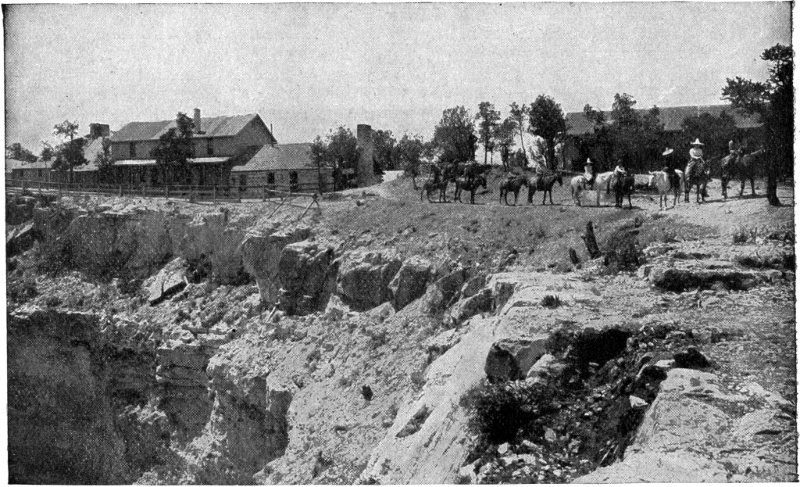
Bright Angel Hotel.
The round-trip ticket rate, Williams to Grand Canyon and return, is only $6.50. Adding $6 for two days’ stay at Canyon Hotel, $1 for part of a day at hotel in Williams, $1.50 for probable proportion of cost of guide, $3 for trail stock, and the total necessary expense of the three days’ stop-over is about $18 for one person; each additional day only adds $3 to the cost for hotel.
Stop-overs will be granted at Williams on railroad and Pullman tickets if advance application is made to train and Pullman conductors. Trunks may be stored in the station at Williams free of charge by arrangement with ticket agent.
Grand View
Grand View (previously mentioned) may be reached in summer by private conveyance from Flagstaff, a distance of seventy-five miles; or at any time of the year by stage from Bright Angel, sixteen miles along the rim. The rate for round trip, Bright Angel to Grand View, is $2.50 to $5 each person, according to size of party. While Flagstaff is an interesting place to visit—with its near-by cliff and cave dwellings and San Francisco Peaks—and the trip thence to the Grand Canyon is a novel one, distance and time are such that most travelers prefer to go in by railroad from Williams.
Grand View Hotel is a large, rustic structure, built near the head of Berry’s Trail and about three miles from Hance’s Trail, in the midst of tall pines and overlooking the mighty bend of the Colorado. This is the point to which visitors were conducted in the days of the old stage line from Flagstaff.
It is noted for its wide views of the Coconino Forest and Painted Desert, as well as for the beautiful forms and color of the canyon itself. A favorite trip here is to go down one trail and up the other. The hotel accommodations are quite good; capacity, forty guests; rate, $3 per day.
31
Bass’ Camp
At the western end of the granite gorge is Mystic Spring Trail, an easy route down to the Colorado River and up the other side to Dutton’s Point and Powell’s Plateau. The magnificent panorama eastward from Havasupai Point takes in fifty miles of the canyon, while westward is the unique, table-like formation which characterizes the lower reaches of the river. The views from both rims are pronounced by noted artists and explorers to be unequaled.
Present accommodations at Havasupai Hotel (Bass’ Camp), near head of this trail, are fairly good, consisting of a cabin, several tents, and good trail stock; wholesome meals are served in comfortable style. A new hotel is to be built here during 1903. Bass’ Camp is now reached by stage from Coconino, a station on the Grand Canyon Railway, or one may take a team direct from Bright Angel.
A visit should be made to the Havasupai Indian village in Cataract Canyon. Any bona fide tourist can procure an introductory letter from the railroad agent at Williams or Grand Canyon. On presenting same to the U. S. Indian agent at Supai, permission will be granted to enter the reservation. This is an unique trip of about forty miles, first by wagon across a timbered plateau, then on horseback down precipitous Topocobya Trail, along the rocky floors of Topocobya and Cataract canyons, deep in the earth, to a place of gushing springs, green fields, and enchanting waterfalls. Here live the Havasupai Indians, one of the most interesting tribes in Arizona. The round trip from Bright Angel or Bass’ Camp is made in three or four days at an expense of $35 to $50 each for a party of three persons.
Peach Springs Route
The trip in winter from Peach Springs station down to the Colorado River, through Diamond Creek Canyon, is most enjoyable. Owing to the low altitude here (4,780 feet at Peach Springs and approximately 2,000 feet at the river) the air is usually balmy from November to April; in summer the heat is a considerable drawback.
A journey of but twelve miles leads you through a miniature Grand Canyon with scenery increasingly sublime. On either side are abrupt walls and wonderfully suggestive formations—castles, domes, minarets. On your left, glancing backward, is an exact reproduction of Westminster Abbey.
This comparatively easy jaunt brings you by team to the very brink of the swift-rolling Colorado, whereas by the other Grand Canyon gateways you are landed on the rim and must go down thousands of feet by a steep trail. The outlook here is restricted to the river itself and the great walls rising precipitously from its banks—a scene well worth while, but not so impressive as the wide sweep of the canyon visible from the rim.
Following Diamond Creek to its source you may walk along the bed of the stream between walls thousands of feet high and glistening in the white sunlight as if varnished. The upper part of Diamond Creek is a veritable terrace of fern bowers, luxuriant vegetation, crystal cascades, and sequestered meadow parks.
Flagstaff and Vicinity
The town itself is an interesting place, prettily situated in the heart of the San Francisco uplift and surrounded by a pine forest.
Its hotels, business houses, lumber mills, and residences denote thrift. On a neighboring hill is the Lowell Observatory, noted for its many contributions to astronomical science.
32
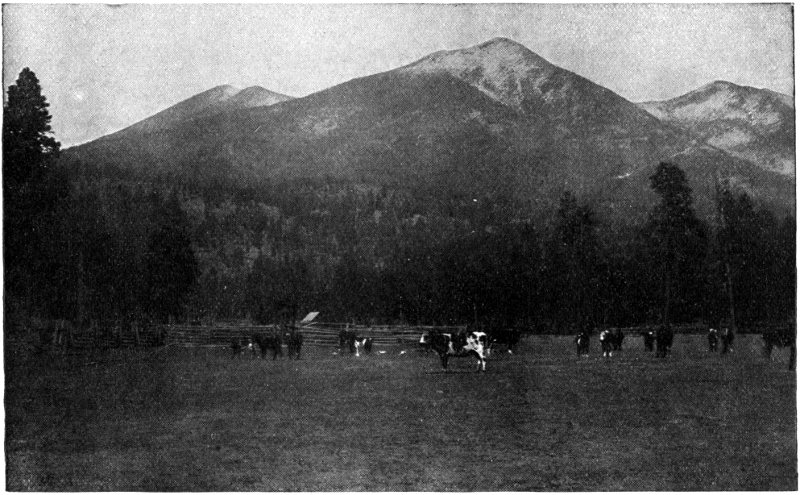
San Francisco Peaks.
Eight miles southwest from Flagstaff—reached by a pleasant drive along a level road through tall pines—is Walnut Canyon, a rent in the earth several hundred feet deep and three miles long, with steep terraced walls of limestone. Along the shelving terraces, under beetling projections of the strata, are scores of quaint cliff dwellings, the most famous group of its kind in this region. The larger abodes are divided into several compartments by cemented walls, many parts of which are still intact. It is believed that these cliff dwellers were of the same stock as the Pueblo Indians of to-day and that they lived here about 800 years ago.
Nine miles from Flagstaff and only half a mile from the old stage road to the Grand Canyon, upon the summit of an extinct crater, the remarkable ruins of the cave-dwellers may be seen.
The magnificent San Francisco Peaks, visible from every part of the country within a radius of a hundred miles, lie just north of Flagstaff. There are three peaks which form one mountain. From Flagstaff a road has been constructed up Humphrey’s Peak, whose summit is 12,750 feet above sea level. It is a good mountain road, and the entire distance from Flagstaff is only about ten miles. The trip to the summit and back is easily made in one day.
Announcement
The Santa Fe has published a new and beautiful book on the Grand Canyon. It contains articles by Hamlin Garland, Harriet Monroe, Robert Brewster Stanton, Chas. S. Gleed, John L. Stoddard, Charles Dudley Warner, R. D. Salisbury, “Fitz Mac,” Nat M. Brigham, Joaquin Miller, Edwin Burritt Smith, David Starr Jordan, C. E. Beecher, Henry P. Ewing, and Thomas Moran, as well as the authors represented in this pamphlet. The book has more than a hundred pages, illustrated with half-tones and portraits; the cover is from a painting of the Canyon by Thomas Moran, and is lithographed in seven colors. It will be forwarded on receipt of fifty cents.
A beautiful and unique color picture of the Grand Canyon, mounted to show all its colors as in nature, may be had for twenty-five cents.
Address W. J. BLACK, Gen’l Passenger Agent, A., T. & S. F. Ry., CHICAGO.
Ad. 71—2-3-03. 10M.