TISH'S SPY
Reading edition
THE ADVENTURE OF THE RED-HEADED DETECTIVE, THE LADY CHAUFFEUR, AND THE MAN WHO COULD NOT TELL THE TRUTH
I
It is easy enough, of course, to look back on our Canadian experience and see where we went wrong. What I particularly resent is the attitude of Charlie Sands.
I am writing this for his benefit. It seems to me that a clean statement of the case is due to Tish, and, in less degree, to Aggie and myself.
It goes back long before the mysterious cipher. Even the incident of our abducting the girl in the pink tam-o'-shanter was, after all, the inevitable result of the series of occurrences that preceded it.
It is my intention to give this series of occurrences in their proper order and without bias. Herbert Spencer says that every act of one's life is the unavoidable result of every act that has preceded it.
Naturally, therefore, I begin with the engagement by Tish of a girl as chauffeur; but even before that there were contributing causes. There was the faulty rearing of the McDonald youth, for instance, and Tish's æsthetic dancing. And afterward there was Aggie's hay fever, which made her sneeze and let go of a rope at a critical moment. Indeed, Aggie's hay fever may be said to be one of the fundamental causes, being the reason we went to Canada.
It was like this: Along in June of the year before last, Aggie suddenly announced that she was going to spend the summer in Canada.
"It's the best thing in the world for hay fever," she said, avoiding Tish's eye. "Mrs. Ostermaier says she never sneezed once last year. The Northern Lights fill the air with ozone, or something like that."
"Fill the air with ozone!" Tish scoffed. "Fill Mrs. Ostermaier's skull with ozone, instead of brains, more likely!"
Tish is a good woman—a sweet woman, indeed; but she has a vein of gentle irony, which she inherited from her maternal grandfather, who was on the Supreme Bench of his country. However, that spring she was inclined to be irritable. She could not drive her car, and that was where the trouble really started.
Tish had taken up æsthetic dancing in March, wearing no stays and a middy blouse and short skirt; and during a fairy dance, where she was to twirl on her right toes, keeping the three other limbs horizontal, she twisted her right lower limb severely. Though not incapacitated, she could not use it properly; and, failing one day to put on the brake quickly, she drove into an open-front butter-and-egg shop.
[This was the time one of the newspapers headed the article: "Even the Eggs Scrambled."]
When Tish decided to have a chauffeur for a time she advertised. There were plenty of replies, but all of the applicants smoked cigarettes—a habit Tish very properly deplores. The idea of securing a young woman was, I must confess, mine.
"Plenty of young women drive cars," I said, "and drive well. And, at least, they don't light a cigarette every time one stops to let a train go by."
"Huh!" Tish commented. "And have a raft of men about all the time!"
Nevertheless, she acted on the suggestion, advertising for a young woman who could drive a car and had no followers. Hutchins answered.
She was very pretty and not over twenty; but, asked about men, her face underwent a change, almost a hardening. "You'll not be bothered with men," she said briefly. "I detest them!"
And this seemed to be the truth. Charlie Sands, for instance, for whose benefit this is being written, absolutely failed to make any impression on her. She met his overtures with cold disdain. She was also adamant to the men at the garage, succeeding in having the gasoline filtered through a chamois skin to take out the water, where Tish had for years begged for the same thing without success.
Though a dashing driver, Hutchins was careful. She sat on the small of her back and hurled us past the traffic policemen with a smile.
[Her name was really Hutchinson; but it took so long to say it at the rate she ran the car that Tish changed it to Hutchins.]
Really the whole experiment seemed to be an undoubted success, when Aggie got the notion of Canada into her head. Now, as it happened, owing to Tish's disapproval, Aggie gave up the Canada idea in favor of Nantucket, some time in June; but she had not reckoned with Tish's subconscious self. Tish was interested that spring in the subconscious self.
You may remember that, only a year or so before, it had been the fourth dimension.
[She became convinced that if one were sufficiently earnest one could go through closed doors and see into solids. In the former ambition she was unsuccessful, obtaining only bruises and disappointment; but she did develop the latter to a certain extent, for she met the laundress going out one day and, without a conscious effort, she knew that she had the best table napkins pinned to her petticoat. She accused the woman sternly—and she had six!]
"Nantucket!" said Tish. "Why Nantucket?"
"I have a niece there, and you said you hated Canada."
"On the contrary," Tish replied, with her eyes partly shut, "I find that my subconscious self has adopted and been working on the Canadian suggestion. What a wonderful thing is this buried and greater ego! Worms, rifles, fishing-rods, 'The Complete Angler,' mosquito netting, canned goods, and sleeping-bags, all in my mind and in orderly array!"
"Worms!" I said, with, I confess, a touch of scorn in my voice. "If you will tell me, Tish Carberry—"
"Life preservers," chanted Tish's subconscious self, "rubber blankets, small tent, folding camp-beds, a camp-stove, a meat-saw, a wood-saw, and some beads and gewgaws for placating the Indians." Then she opened her eyes and took up her knitting. "There are no worms in Canada, Lizzie, just as there are no snakes in Ireland. They were all destroyed during the glacial period."
"There are plenty of worms in the United States," I said with spirit. "I dare say they could crawl over the border—unless, of course, they object to being British subjects."
She ignored me, however, and, getting up, went to one of her bureau drawers. We saw then that her subconscious self had written down lists of various things for the Canadian excursion. There was one headed Foodstuffs. Others were: Necessary Clothing; Camp Outfit; Fishing-Tackle; Weapons of Defense; and Diversions. Under this last heading it had placed binoculars, yarn and needles, life preservers, a prayer-book, and a cribbage-board.
"Boats," she said, "we can secure from the Indians, who make them, I believe, of hollow logs. And I shall rent a motor boat. Hutchins says she can manage one. When she's not doing that she can wash dishes."
[We had been rather chary of motor boats, you may remember, since the time on Lake Penzance, when something jammed on our engine, and we had gone madly round the lake a number of times, with people on various docks trying to lasso us with ropes.]
Considering that it was she who had started the whole thing, and got Tish's subconscious mind to working, Aggie was rather pettish.
"Huh!" she said. "I can't swim, and you know it, Tish. Those canoe things turn over if you so much as sneeze in them."
"You'll not sneeze," said Tish. "The Northern Lights fill the air with ozone."
Aggie looked at me helplessly; but I could do nothing. Only the year before, Tish, as you may recall, had taken us out into the Maine woods without any outfit at all, and we had lived on snared rabbits, and things that no Christian woman ought to put into her stomach. This time we were at least to go provisioned and equipped.
"Where are we going?" Aggie asked.
"Far from a white man," said Tish. "Away from milk wagons and children on velocipedes and the grocer calling up every morning for an order. We'll go to the Far North, Aggie, where the red man still treads his native forests; we'll make our camp by some lake, where the deer come at early morning to drink and fish leap to see the sunset."
Well, it sounded rather refreshing, though I confess that, until Tish mentioned it, I had always thought that fish leaped in the evening to catch mosquitoes.
We sent for Hutchins at once. She was always respectful, but never subservient. She stood in the doorway while Tish explained.
"How far north?" she said crisply. Tish told her. "We'll have no cut-and-dried destination," she said. "There's a little steamer goes up the river I have in mind. We'll get off when we see a likely place."
"Are you going for trout or bass?"
Tish was rather uncertain, but she said bass on a chance, and Hutchins nodded her approval.
"If it's bass, I'll go," she said. "I'm not fond of trout-fishing."
"We shall have a motor boat. Of course I shall not take the car."
Hutchins agreed indifferently. "Don't you worry about the motor boat," she said. "Sometimes they go, and sometimes they don't. And I'll help round the camp; but I'll not wash dishes."
"Why not?" Tish demanded.
"The reason doesn't really matter, does it? What really concerns you is the fact."
Tish stared at her; but instead of quailing before Tish's majestic eye she laughed a little.
"I've camped before," she said. "I'm very useful about a camp. I like to cook; but I won't wash dishes. I'd like, if you don't mind, to see the grocery order before it goes."
Well, Aggie likes to wash dishes if there is plenty of hot water; and Hannah, Tish's maid, refusing to go with us on account of Indians, it seemed wisest to accept Hutchins's services.
Hannah's defection was most unexpected. As soon as we reached our decision, Tish ordered beads for the Indians; and in the evenings we strung necklaces, and so on, while one of us read aloud from the works of Cooper. On the second evening thus occupied, Hannah, who is allowed to come into Tish's sitting-room in the evening and knit, suddenly burst into tears and refused to go.
"My scalp's as good to me as it is to anybody, Miss Tish," she said hysterically; and nothing would move her.
She said she would run no risk of being cooked over her own camp-fire; and from that time on she would gaze at Tish for long periods mournfully, as though she wanted to remember how she looked when she was gone forever.
Except for Hannah, everything moved smoothly. Tish told Charlie Sands about the plan, and he was quite enthusiastic.
"Great scheme!" he said. "Eat a broiled black bass for me. And take the advice of one who knows: don't skimp on your fishing-tackle. Get the best. Go light on the canned goods, if necessary; but get the best reels and lines on the market. Nothing in life hurts so much," he said impressively, "as to get a three-pound bass to the top of the water and have your line break. I've had a big fellow get away like that and chase me a mile with its thumb on its nose." This last, of course, was purely figurative.
He went away whistling. I wish he had been less optimistic. When we came back and told him the whole story, and he sat with his mouth open and his hair, as he said, crackling at the roots, I reminded him with some bitterness that he had encouraged us. His only retort was to say that the excursion itself had been harmless enough; but that if three elderly ladies, church members in good standing, chose to become freebooters and pirates the moment they got away from a corner policeman, they need not blame him.
The last thing he said that day in June was about fishing-worms.
"Take 'em with you," he said. "They charge a cent apiece for them up there, assorted colors, and there's something stolid and British about a Canadian worm. The fish aren't crazy about 'em. On the other hand, our worms here are—er—vivacious, animated. I've seen a really brisk and on-to-its-job United States worm reach out and clutch a bass by the gills."
I believe it was the next day that Tish went to the library and read about worms. Aggie and I had spent the day buying tackle, according to Charlie Sands's advice. We got some very good rods with nickel-plated reels for two dollars and a quarter, a dozen assorted hooks for each person, and a dozen sinkers. The man wanted to sell us what he called a "landing net," but I took a good look at it and pinched Aggie.
"I can make one out of a barrel hoop and mosquito netting," I whispered; so we did not buy it.
Perhaps he thought we were novices, for he insisted on showing us all sorts of absurd things—trolling-hooks, he called them; gaff hooks for landing big fish and a spoon that was certainly no spoon and did not fool us for a minute, being only a few hooks and a red feather. He asked a dollar and a quarter for it!
[I made one that night at home, using a bit of red feather from a duster. It cost me just three cents. Of that, as of Hutchins, more later.]
Aggie, whose idea of Canada had been the Hotel Frontenac, had grown rather depressed as our preparations proceeded. She insisted that night on recalling the fact that Mr. Wiggins had been almost drowned in Canada.
"He went with the Roof and Gutter Club, Lizzie," she said, "and he was a beautiful swimmer; but the water comes from the North Pole, freezing cold, and the first thing he knew—"
The telephone bell rang just then. It was Tish.
"I've just come from the library, Lizzie," she said. "We'd better raise the worms. We've got a month to do it in. Hutchins and I will be round with the car at eight o'clock to-night. Night is the time to get them."
She refused to go into details, but asked us to have an electric flash or two ready and a couple of wooden pails. Also she said to wear mackintoshes and rubbers. Just before she rang off, she asked me to see that there was a package of oatmeal on hand, but did not explain. When I told Aggie she eyed me miserably.
"I wish she'd be either more explicit or less," she said. "We'll be arrested again. I know it!"
[Now and then Tish's enthusiasms have brought us into collision with the law—not that Tish has not every respect for law and order, but that she is apt to be hasty and at times almost unconventional.]
"You remember," said Aggie, "that time she tried to shoot the sheriff, thinking he was a train robber? She started just like this—reading up about walking-tours, and all that. I—I'm nervous, Lizzie."
I was staying with Aggie for a few days while my apartment was being papered. To soothe Aggie's nerves I read aloud from Gibbon's "Rome" until dinner-time, and she grew gradually calmer.
"After all, Lizzie," she said, "she can't get us into mischief with two wooden pails and a package of oatmeal."
Tish and Hutchins came promptly at eight and we got into the car. Tish wore the intent and dreamy look that always preceded her enterprises. There was a tin sprinkling-can, quite new, in the tonneau, and we placed our wooden pails beside it and the oatmeal in it. I confess I was curious, but to my inquiries Tish made only one reply:—
"Worms!"
Now I do not like worms. I do not like to touch them. I do not even like to look at them. As the machine went along I began to have a creepy loathing of them. Aggie must have been feeling the same way, for when my hand touched hers she squealed.
Over her shoulder Tish told her plan. She said it was easy to get fishing-worms at night and that Hutchins knew of a place a few miles out of town where the family was away and where there would be plenty.
"We'll put them in boxes of earth," she said, "and feed them coffee or tea grounds one day and oatmeal water the next. They propagate rapidly. We'll have a million to take with us. If we only have a hundred thousand at a cent apiece, that's a clear saving of a thousand dollars."
"We could sell some," I suggested sarcastically; for Tish's enthusiasms have a way of going wrong.
But she took me seriously. "If there are any fishing clubs about," she said, "I dare say they'll buy them; and we can turn the money over to Mr. Ostermaier for the new organ."
Tish had bought the organ and had an evening concert with it before we turned off the main road into a private drive.
"This is the place," Hutchins said laconically.
Tish got out and took a survey. There was shrubbery all round and a very large house, quite dark, in the foreground.
"Drive onto the lawn, Hutchins," she said. "When the worms come up, the lamps will dazzle them and they'll be easy to capture."
We bumped over a gutter and came to a stop in the middle of the lawn.
"It would be better if it was raining," Tish said. "You know, yourself, Lizzie, how they come up during a gentle rain. Give me the sprinkling-can."
I do not wish to lay undue blame on Hutchins, who was young; but it was she who suggested that there would probably be a garden hose somewhere and that it would save time. I know she went with Tish round the corner of the house, and that they returned in ten minutes or so, dragging a hose.
"I broke a tool-house window," Tish observed, "but I left fifty cents on the sill to replace it. It's attached at the other end. Run back, Hutchins, and turn on the water; but not too much. We needn't drown the little creatures."
Well, I have never seen anything work better. Aggie, who had refused to put a foot out of the car, stood up in it and held the hose. As fast as she wet a bit of lawn, we followed with the pails. I spread my mackintosh out and knelt on it.
As fast as she wet a bit of lawn, we followed with the pails
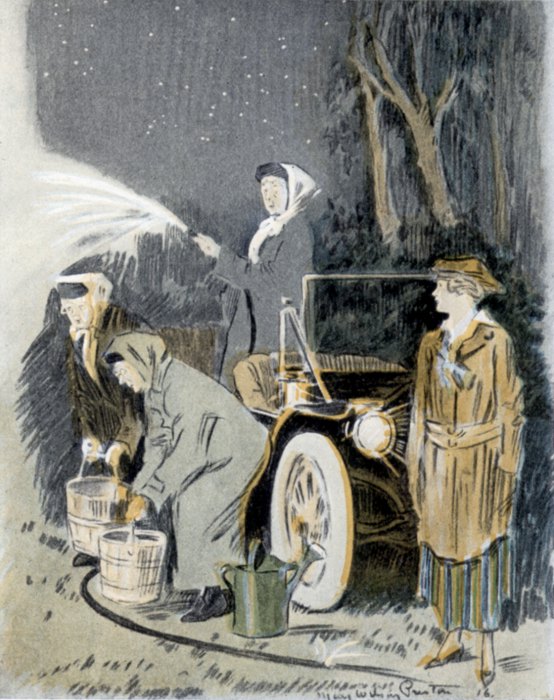
The thing took skill. The worms had a way of snapping back into their holes like lightning.
Tish got about three to my one, and talked about packing them in moss and ice, and feeding them every other day. Hutchins, however, stood on the lawn, with her hands in her pockets, and watched the house.
Suddenly, without warning, Aggie turned the hose directly on my left ear and held it there.
"There's somebody coming!" she cried. "Merciful Heavens, what'll I do with the hose?"
"You can turn it away from me!" I snapped.
So she did, and at that instant a young man emerged from the shrubbery.
He did not speak at once. Probably he could not. I happened to look at Hutchins, and, for all her usual savoir-faire, as Charlie Sands called it, she was clearly uncomfortable.
Tish, engaged in a struggle at that moment and sitting back like a robin, did not see him at once.
"Well!" said the young man; and again: "Well, upon my word!"
He seemed out of breath with surprise; and he took off his hat and mopped his head with a handkerchief. And, of course, as though things were not already bad enough, Aggie sneezed at that instant, as she always does when she is excited; and for just a second the hose was on him.
It was unexpected and he almost staggered. He looked at all of us, including Hutchins, and ran his handkerchief round inside his collar. Then he found his voice.
"Really," he said, "this is awfully good of you. We do need rain—don't we?"
Tish was on her feet by that time, but she could not think of anything to say.
"I'm sorry if I startled you," said the young man. "I—I'm a bit startled myself."
"There is nothing to make a fuss about!" said Hutchins crisply. "We are getting worms to go fishing."
"I see," said the young man. "Quite natural, I'm sure. And where are you going fishing?"
Hutchins surprised us all by rudely turning her back on him. Considering we were on his property and had turned his own hose on him, a little tact would have been better.
Tish had found her voice by that time. "We broke a window in the tool-house," she said; "but I put fifty cents on the sill."
"Thank you," said the young man.
Hutchins wheeled at that and stared at him in the most disagreeable fashion; but he ignored her.
"We are trespassing," said Tish; "but I hope you understand. We thought the family was away."
"I just happened to be passing through," he explained. "I'm awfully attached to the place—for various reasons. Whenever I'm in town I spend my evenings wandering through the shrubbery and remembering—er—happier days."
"I think the lamps are going out," said Hutchins sharply. "If we're to get back to town—"
"Ah!" he broke in. "So you have come out from the city?"
"Surely," said Hutchins to Tish, "it is unnecessary to give this gentleman any information about ourselves! We have done no damage—"
"Except the window," he said.
"We've paid for that," she said in a nasty tone; and to Tish: "How do we know this place is his? He's probably some newspaper man, and if you tell him who you are this whole thing will be in the morning paper, like the eggs."
"I give you my word of honor," he said, "that I am nothing of the sort; in fact, if you will give me a little time I'd—I'd like to tell all about myself. I've got a lot to say that's highly interesting, if you'll only listen."
Hutchins, however, only gave him a cold glance of suspicion and put the pails in the car. Then she got in and sat down.
"I take it," he said to her, "that you decline either to give or to receive any information."
"Absolutely!"
He sighed then, Aggie declares.
"Of course," he said, "though I haven't really the slightest curiosity, I could easily find out, you know. Your license plates—"
"Are under the cushion I'm sitting on," said Hutchins, and started the engine.
"Really, Hutchins," said Tish, "I don't see any reason for being so suspicious. I have always believed in human nature and seldom have I been disappointed. The young man has done nothing to justify rudeness. And since we are trespassing on his place—"
"Huh!" was all Hutchins said.
The young man sauntered over to the car, with his hands thrust into this coat pockets. He was nice-looking, especially then, when he was smiling.
"Hutchins!" he said. "Well, that's a clue anyhow. It—it's an uncommon name. You didn't happen to notice a large 'No-Trespassing!' sign by the gate, did you?"
Hutchins only looked ahead and ignored him. As Tish said afterward, we had a good many worms, anyhow; and, as the young man and Hutchins had clearly taken an awful dislike to each other at first sight, the best way to avoid trouble was to go home. So she got into the car. The young man helped her and took off his hat.
"Come out any time you like," he said affably. "I'm not here at all in the daytime, and the grounds are really rather nice. Come out and get some roses. We've some pretty good ones—English importations. If you care to bring some children from the tenements out for a picnic, please feel free to do it. We're not selfish."
Hutchins rudely started the car before he had finished; but he ignored her and waved a cordial farewell to the rest of us.
"Bring as many as you like," he called. "Sunday is a good day. Ask Miss—Miss Hutchins to come out and bring some friends along."
We drove back at the most furious rate. Tish was at last compelled to remonstrate with Hutchins.
"Not only are we going too fast," she said, "but you were really rude to that nice young man."
"I wish I had turned the hose on him and drowned him!" said Hutchins between her teeth.
II
Hutchins brought a newspaper to Tish the next morning at breakfast, and Tish afterwards said her expression was positively malevolent in such a young and pretty woman.
The newspaper said that an attempt had been made to rob the Newcomb place the night before, but that the thieves had apparently secured nothing but a package of oatmeal and a tin sprinkling-can, which they had abandoned on the lawn. Some color, however, was lent to the fear that they had secured an amount of money, from the fact that a silver half-dollar had been found on the window sill of a tool-house. The Newcomb family was at its summer home on the Maine coast.
"You see," Hutchins said to Tish, "that man didn't belong there at all. He was just impertinent and—laughing in his sleeve."
Tish was really awfully put out, having planned to take the Sunday school there for a picnic. She was much pleased, however, at Hutchins's astuteness.
"I shall take her along to Canada," she said to me. "The girl has instinct, which is better than reason. Her subconsciousness is unusually active."
Looking back, as I must, and knowing now all that was in her small head while she whistled about the car, or all that was behind her smile, one wonders if women really should have the vote. So many of them are creatures of sex and guile. A word from her would have cleared up so much, and she never spoke it!
Well, we spent most of July in getting ready to go. Charlie Sands said the mosquitoes and black flies would be gone by August, and we were in no hurry.
We bought a good tent, with a diagram of how to put it up, some folding camp-beds, and a stove. The day we bought the tent we had rather a shock, for as we left the shop the suburban youth passed us. We ignored him completely, but he lifted his hat. Hutchins, who was waiting in Tish's car, saw him, too, and went quite white with fury.
Shortly after that, Hannah came in one night and said that a man was watching Tish's windows. We thought it was imagination, and Tish gave her a dose of sulphur and molasses—her liver being sluggish.
"Probably an Indian, I dare say," was Tish's caustic comment.
In view of later developments, however, it is a pity we did not investigate Hannah's story; for Aggie, going home from Tish's late one night in Tish's car, had a similar experience, declaring that a small machine had followed them, driven by a heavy-set man with a mustache. She said, too, that Hutchins, swerving sharply, had struck the smaller machine a glancing blow and almost upset it.
It was about the middle of July, I believe, that Tish received the following letter:—
Madam: Learning that you have decided to take a fishing-trip in Canada, I venture to offer my services as guide, philosopher, and friend. I know Canada thoroughly; can locate bass, as nearly as it lies in a mortal so to do; can manage a motor launch; am thoroughly at home in a canoe; can shoot, swim, and cook—the last indifferently well; know the Indian mind and my own—and will carry water and chop wood.
I do not drink, and such smoking as I do will, if I am engaged, be done in the solitude of the woods.
I am young and of a cheerful disposition. My object is not money, but only expenses paid and a chance to forget a recent and still poignant grief. I hope you will see the necessity for such an addition to your party, and allow me to subscribe myself, madam,
Your most obedient servant,
J. UPDIKE.
Tish was much impressed; but Hutchins, in whose judgment she began to have the greatest confidence, opposed the idea.
"I wouldn't think of it," she said briefly.
"Why? It's a frank, straightforward letter."
"He likes himself too much. And you should always be suspicious of anything that's offered too cheap."
So the Updike application was refused. I have often wondered since what would have been the result had we accepted it!
The worms were doing well, though Tish found that Hannah neglected them, and was compelled to feed them herself. On the day before we started, we packed them carefully in ice and moss, and fed them. That was the day the European war was declared.
"Canada is at war," Tish telephoned. "The papers say the whole country is full of spies, blowing up bridges and railroads."
"We can still go to the seashore," I said. "The bead things will do for the missionary box to Africa."
"Seashore nothing!" Tish retorted. "We're going, of course,—just as we planned. We'll keep our eyes open; that's all. I'm not for one side or the other, but a spy's a spy."
Later that evening she called again to say there were rumors that the Canadian forests were bristling with German wireless outfits.
"I've a notion to write J. Updike, Lizzie, and find out whether he knows anything about wireless telegraphy," she said, "only there's so little time. Perhaps I can find a book that gives the code."
[This is only pertinent as showing Tish's state of mind. As a matter of fact, she did not write to Updike at all.]
Well, we started at last, and I must say they let us over the border with a glance; but they asked us whether we had any firearms. Tish's trunk contained a shotgun and a revolver; but she had packed over the top her most intimate personal belongings, and they were not disturbed.
"Have you any weapons?" asked the inspector.
"Do we look like persons carrying weapons?" Tish demanded haughtily. And of course we did not. Still, there was an untruth of the spirit and none of us felt any too comfortable. Indeed, what followed may have been a punishment on us for deceit and conspiracy.
Aggie had taken her cat along—because it was so fond of fish, she said. And, between Tish buying ice for the worms and Aggie getting milk for the cat, the journey was not monotonous; but on returning from one of her excursions to the baggage-car, Tish put a heavy hand on my shoulder.
"That boy's on the train, Lizzie!" she said. "He had the impudence to ask me whether I still drive with the license plates under a cushion. English roses—importations!" said Tish, and sniffed. "You don't suppose he went into that tent shop and asked about us?"
"He might," I retorted; "but, on the other hand, there's no reason why our going to Canada should keep the rest of the United States at home!"
However, the thing did seem queer, somehow. Why had he told us things that were not so? Why had he been so anxious to know who we were? Why, had he asked us to take the Sunday-school picnic to a place that did not belong to him?
"He may be going away to forget some trouble. You remember what he said about happier days," said Tish.
"That was Updike's reason too," I relied. "Poignant grief!"
For just a moment our eyes met. The same suspicion had occurred to us both. Well, we agreed to say nothing to Aggie or Hutchins, for fear of upsetting them, and the next hour or so was peaceful.
Hutchins read and Aggie slept. Tish and I strung beads for the Indians, and watched the door into the next car. And, sure enough, about the middle of the afternoon he appeared and stared in at us. He watched us for quite a time, smoking a cigarette as he did so. Then he came in and bent down over Tish.
"You didn't take the children out for the picnic, did you?" he said.
"I did not!" Tish snapped.
"I'm sorry. Never saw the place look so well!"
"Look here," Tish said, putting down her beads; "what were you doing there that night anyhow? You don't belong to the family."
He looked surprised and then grieved.
"You've discovered that, have you?" he said. "I did, you know—word of honor! They've turned me off; but I love the old place still, and on summer nights I wander about it, recalling happier days."
Hutchins closed her book with a snap, and he sighed.
"I perceive that we are overheard," he said. "Some time I hope to tell you the whole story. It's extremely sad. I'll not spoil the beginning of your holiday with it."
All the time he had been talking he held a piece of paper in his hand. When he left us Tish went back thoughtfully to her beads.
"It just shows, Lizzie," she said, "how wrong we are to trust to appearances. That poor boy—"
I had stooped into the aisle and was picking up the piece of paper which he had accidentally dropped as he passed Hutchins. I opened it and read aloud to Tish and Aggie, who had wakened:—
"'Afraid you'll not get away with it! The red-haired man in the car behind is a plain-clothes man.'"
Tish has a large fund of general knowledge, gained through Charlie Sands; so what Aggie and I failed to understand she interpreted at once.
"A plain-clothes man," she explained, "is a detective dressed as a gentleman. It's as plain as pikestaff! The boy's received this warning and dropped it. He has done something he shouldn't and is escaping to Canada!"
I do not believe, however, that we should have thought of his being a political spy but for the conductor of the train. He proved to be a very nice person, with eight children and a toupee; and he said that Canada was honeycombed with spies in the pay of the German Government.
"They're sending wireless messages all the time, probably from remote places," he said. "And, of course, their play now is to blow up the transcontinental railroads. Of course the railroads have an army of detectives on the watch."
"Good Heavens!" Aggie said, and turned pale.
Well, our pleasure in the journey was ruined. Every time the whistle blew on the engine we quailed, and Tish wrote her will then and there on the back of an envelope. It was while she was writing that the truth came to her.
"That boy!" she said. "Don't you see it all? That note was a warning to him. He's a spy and the red-haired man is after him."
None of us slept that night though Tish did a very courageous thing about eleven o'clock, when she was ready for bed. I went with her. We had put our dressing-gowns over our nightrobes, and we went back to the car containing the spy.
He had not retired, but was sitting alone, staring ahead moodily. The red-haired man was getting ready for bed, just opposite. Tish spoke loudly, so the detective should hear.
"I have come back," Tish said, "to say that we know everything. A word to the wise, Mister Happier Days! Don't try any of your tricks!"
He sat, with his mouth quite open, and stared at us: but the red-haired man pretended to hear nothing and took off his other shoe.
None of us slept at all except Hutchins. Though we had told her nothing, she seemed inherently to distrust the spy. When, on arriving at the town where we were to take the boat, he offered to help her off with Aggie's cat basket, which she was carrying, she snubbed him.
"I can do it myself," she said coldly; "and if you know when you're well off you'll go back to where you came from. Something might happen to you here in the wilderness."
"I wish it would," he replied in quite a tragic manner.
[As Tish said then, a man is probably often forced by circumstances into hateful situations. No spy can really want to be a spy with every brick wall suggesting, as it must, a firing-squad.]
Well, to make a long story short, we took the little steamer that goes up the river three times a week to take groceries and mail to the logging-camps, and the spy and the red-haired detective went along. The spy seemed to have quite a lot of luggage, but the detective had only a suitcase.
Tish, watching the detective, said his expression grew more and more anxious as we proceeded up the river. Cottages gave place to logging-camps and these to rocky islands, with no sign of life; still, the spy stayed on the steamer, and so, of course, did the detective.
Tish went down and examined the luggage. She reported that the spy was traveling under the name of McDonald and that the detective's suitcase was unmarked. Mr. McDonald had some boxes and a green canoe. The detective had nothing at all. There were no other passengers.
We let Aggie's cat out on the boat and he caught a mouse almost immediately, and laid it in the most touching manner at the detective's feet; but he was in a very bad humor and flung it over the rail. Shortly after that he asked Tish whether she intended to go to the Arctic Circle.
"I don't know that that's any concern of yours," Tish said. "You're not after me, you know."
He looked startled and muttered something into his mustache.
"It's perfectly clear what's wrong with him," Tish said. "He's got to stick to Mr. McDonald, and he hasn't got a tent in that suitcase, or even a blanket. I don't suppose he knows where his next meal's coming from."
She was probably right, for I saw the crew of the boat packing a box or two of crackers and an old comfort into a box; and Aggie overheard the detective say to the captain that if he would sell him some fishhooks he would not starve anyhow.
Tish found an island that suited her about three o'clock that afternoon, and we disembarked. Mr. McDonald insisted on helping the crew with our stuff, which they piled on a large flat rock; but the detective stood on the upper deck and scowled down at us. Tish suggested that he was a woman-hater.
"They know so many lawbreaking women," she said, "it's quite natural."
Having landed us, the boat went across to another island and deposited Mr. McDonald and the green canoe. Tish, who had talked about a lodge in some vast wilderness, complained at that; but when the detective got off on a little tongue of the mainland, in sight of both islands, she said the place was getting crowded and she had a notion to go farther.
The first thing she did was to sit on a box and open a map. The Canadian Pacific was only a few miles away through the woods!
Hutchins proved herself a treasure. She could work all round the three of us; she opened boxes and a can of beans for supper with the same hatchet, and had tea made and the beans heated while Tish was selecting a site for the tent.
But—and I remembered this later—she watched the river at intervals, with her cheeks like roses from the exertion. She was really a pretty girl—only, when no one was looking, her mouth that day had a way of setting itself firmly, and she frowned at the water.
We, Hutchins and I, set up the stove against a large rock, and when the teakettle started to boil it gave the river front a homey look. Sitting on my folding-chair beside the stove, with a cup of tea in my hand and a plate of beans on a doily on a packing-box beside me, I was entirely comfortable. Through the glasses I could see the red-haired man on the other shore sitting on a rock, with his head in his hands; but Mr. McDonald had clearly located on the other side of his island and was not in sight.
Aggie and Tish were putting up the tent, and Hutchins was feeding the tea grounds to the worms, which had traveled comfortably, when I saw a canoe coming up the river. I called to Tish about it.
"An Indian!" she said calmly. "Get the beads, Aggie; and put my shotgun on that rock, where he can see it." She stood and watched him. "Primitive man, every inch of him!" she went on. "Notice his uncovered head. Notice the freedom, almost the savagery, of the way he uses that paddle. I wish he would sing. You remember, in Hiawatha, how they sing as they paddle along?"
She got the beads and went to the water's edge; but the Indian stooped just then and, picking up a Panama hat, put it on his head.
"I have called," he said, "to see whether I can interest you in a set of books I am selling. I shall detain you only a moment. Sixty-three steel engravings by well-known artists; best hand-made paper; and the work itself is of high educational value."
Tish suddenly put the beads behind her back and said we did not expect to have any time to read. We had come into the wilderness to rest our minds.
"You are wrong, I fear," said the Indian. "Personally I find that I can read better in the wilds than anywhere else. Great thoughts in great surroundings! I take Nietzsche with me when I go fishing."
Tish had the wretched beads behind her all the time; and, to make conversation, more than anything else, she asked about venison. He shrugged his shoulders. J. Fenimore Cooper had not prepared us for an Indian who shrugged his shoulders.
"We Indians are allowed to kill deer," he said; "but I fear you are prohibited. I am not even permitted to sell it."
"I should think," said Tish sharply, "that, since we are miles from a game warden, you could safely sell us a steak or two."
He gazed at her disapprovingly. "I should not care to break the law, madam," he said.
Then he picked up his paddle and took himself and his scruples and his hand-made paper and his sixty-three steel engravings down the river.
"Primitive man!" I said to Tish, from my chair. "Notice the freedom, almost the savagery, with which he swings that paddle."
We had brought a volume of Cooper along, not so much to read as to remind us how to address the Indians. Tish said nothing, but she got the book and flung it far out into the river.
There were a number of small annoyances the first day or two. Hutchins was having trouble with the motor launch, which the steamer had towed up the day we came, and which she called the "Mebbe." And another civilized Indian, with a gold watch and a cigarette case, had rented us a leaky canoe for a dollar a day.
[We patched the leak with chewing gum, which Aggie always carried for indigestion; and it did fairly well, so long as the gum lasted.]
Then, on the second night, there was a little wind, and the tent collapsed on us, the ridgepole taking Aggie across the chest. It was that same night, I think, when Aggie's cat found a porcupine in the woods, and came in looking like a pincushion.
What with chopping firewood for the stove, and carrying water, and bailing out the canoe, and with the motor boat giving one gasp and then dying for every hundred times somebody turned over the engine, we had no time to fish for two days.
The police agent fished all day from a rock, for, of course, he had no boat; but he seemed to catch nothing. At times we saw him digging frantically, as though for worms. What he dug with I do not know; but, of course, he got no worms. Tish said if he had been more civil she would have taken something to him and a can of worms; but he had been rude, especially to Aggie's cat, and probably the boat would bring him things.
What with getting settled and everything, we had not much time to think about the spy. It was on the third day, I believe, that he brought his green canoe to the open water in front of us and anchored there, just beyond earshot.
He put out a line and opened a book; and from that time on he was a part of the landscape every day from 10 A.M. to 4 P.M. At noon he would eat some sort of a lunch, reading as he ate.
He apparently never looked toward us, but he was always there. It was the most extraordinary thing. At first we thought he had found a remarkable fishing-place; but he seemed to catch very few fish. It was Tish, I think, who found the best explanation.
"He's providing himself with an alibi," she stated. "How can he be a spy when we see him all day long? Don't you see how clever it is?"
It was the more annoying because we had arranged a small cove for soap-and-water bathing, hanging up a rod for bath-towels and suspending a soap-dish and a sponge-holder from an overhanging branch. The cove was well shielded by brush and rocks from the island, but naturally was open to the river.
It was directly opposite this cove that Mr. McDonald took up his position.
This compelled us to bathe in the early morning, while the water was still cold, and resulted in causing Aggie a most uncomfortable half-hour on the fourth morning of our stay.
She was the last one in the pool, and Tish absent-mindedly took her bathrobe and slippers back to the camp when she went. Tish went out in the canoe shortly after. She was learning to use one, with a life preserver on—Tish, of course, not the canoe. And Mr. McDonald arriving soon after, Aggie was compelled to sit in the water for two hours and twenty minutes. When Hutchins found her she was quite blue.
This was the only disagreement we had all summer: Aggie's refusing to speak to Tish that entire day. She said Mr. McDonald had seen her head and thought it was some sort of swimming animal, and had shot at her.
Mr. McDonald said afterward he knew her all the time, and was uncertain whether she was taking a cure for something or was trying to commit suicide. He said he spent a wretched morning. At five o'clock that evening we began to hear a curious tapping noise from the spy's island. It would last for a time, stop, and go on.
Hutchins said it was woodpeckers; but Tish looked at me significantly.
"Wireless!" she said. "What did I tell you?"
That decided her next move, for that evening she put some tea and canned corn and a rubber blanket into the canoe; and in fear and trembling I went with her.
"It's going to rain, Lizzie," she said, "and after all, that detective may be surly; but he's doing his duty by his country. It's just as heroic to follow a spy up here, and starve to death watching him, as it is to storm a trench—and less showy. And I've something to tell him."
The canoe tilted just then, and only by heroic effort, were we able to calm it.
"Then why not go comfortably in the motor boat?"
Tish stopped, her paddle in the air. "Because I can't make that dratted engine go," she said, "and because I believe Hutchins would drown us all before she'd take any help to him. It's my belief that she's known him somewhere. I've seen her sit on a rock and look across at him with murder in her eyes."
A little wind had come up, and the wretched canoe was leaking, the chewing gum having come out. Tish was paddling; so I was compelled to sit over the aperture, thus preventing water from coming in. Despite my best efforts, however, about three inches seeped in and washed about me. It was quite uncomfortable.
The red-haired man was asleep when we landed. He had hung the comfort over a branch, like a tent, and built a fire at the end of it. He had his overcoat on, buttoned to the chin, and his head was on his suit-case. He sat up and looked at us, blinking.
"We've brought you some tea and some canned corn," Tish said; "and a rubber blanket. It's going to rain."
He slid out of the tent, feet first, and got up; but when he tried to speak he sneezed. He had a terrible cold.
"I might as well say at once," Tish went on, "that we know why you are here—"
"The deuce you do!" he said hoarsely.
"We do not particularly care about you, especially since the way you acted to a friendly and innocent cat—one can always judge a man by the way he treats dumb animals; but we sympathize with your errand. We'll even help if we can."
"Then the—the person in question has confided in you?"
"Not at all," said Tish loftily. "I hope we can put two and two together. Have you got a revolver?"
He looked startled at that. "I have one," he said; "but I guess I'll not need it. The first night or two a skunk hung round; two, in fact—mother and child—but I think they're gone."
"Would you like some fish?"
"My God, no!"
This is a truthful narrative. That is exactly what he said.
"I'll tell you what I do need, ladies," he went on: "If you've got a spare suit of underwear over there, I could use it. It'd stretch, probably. And I'd like a pen and some ink. I must have lost my fountain pen out of my pocket stooping over the bank to wash my face."
"Do you know the wireless code?" Tish asked suddenly.
"Wireless?"
"I have every reason to believe," she said impressively, "that one of the great trees on that island conceals a wireless outfit."
"I see!" He edged back a little from us both.
"I should think," Tish said, eyeing him, "that a knowledge of the wireless code would be essential to you in your occupation."
"We—we get a smattering of all sorts of things," he said; but he was uneasy—you could see that with half an eye.
He accompanied us down to the canoe; but once, when Tish turned suddenly, he ducked back as though he had been struck and changed color. He thanked us for the tea and corn, and said he wished we had a spare razor—but, of course, he supposed not. Then:—
"I suppose the—the person in question will stay as long as you do?" he asked, rather nervously.
"It looks like it," said Tish grimly. "I've no intention of being driven away, if that's what you mean. We'll stay as long as the fishing's good."
He groaned under his breath. "The whole d—d river is full of fish," he said. "They crawled up the bank last night and ate all the crackers I'd saved for to-day. Oh, I'll pay somebody out for this, all right! Good gracious, ladies, your boat's full of water!"
"It has a hole in it," Tish replied and upturned it to empty it.
When he saw the hole his eyes stuck out. "You can't go out in that leaky canoe! It's suicidal!"
"Not at all," Tish assured him. "My friend here will sit on the leak. Get in quick, Lizzie. It's filling."
The last we saw of the detective that night he was standing on the bank, staring after us. Afterward, when a good many things were cleared up, he said he decided that he'd been asleep and dreamed the whole thing—the wireless, and my sitting on the hole in the canoe, and the wind tossing it about, and everything—only, of course, there was the tea and the canned corn!
We did our first fishing the next day. Hutchins had got the motor boat going, and I put over the spoon I had made from the feather duster. After going a mile or so slowly I felt a tug, and on drawing my line in I found I had captured a large fish. I wrapped the line about a part of the engine and Tish put the barrel hoop with the netting underneath it. The fish was really quite large—about four feet, I think—and it broke through the netting. I wished to hit it with the oar, but Hutchins said that might break the fin and free it. Unluckily we had not brought Tish's gun, or we might have shot it.
At last we turned the boat round and went home, the fish swimming alongside, with its mouth open. And there Aggie, who is occasionally almost inspired, landed the fish by the simple expedient of getting out of the boat, taking the line up a bank and wrapping it round a tree. By all pulling together we landed the fish successfully. It was forty-nine inches by Tish's tape measure.
Tish did not sleep well that night. She dreamed that the fish had a red mustache and was a spy in disguise. When she woke she declared there was somebody prowling round the tent.
She got her shotgun and we all sat up in bed for an hour or so.
Nothing happened, however, except that Aggie cried out that there was a small animal just inside the door of the tent. We could see it, too, though faintly. Tish turned the shotgun on it and it disappeared; but the next morning she found she had shot one of her shoes to pieces.
III
It was the day Tish began her diary that we discovered the red-haired man's signal. Tish was compelled to remain at home most of the day, breaking in another pair of shoes, and she amused herself by watching the river and writing down interesting things. She had read somewhere of the value of such records of impressions:—
10 A.M. Gull on rock. Very pretty. Frightened away by the McDonald person, who has just taken up his customary position. Is he reading or watching this camp?
10.22. Detective is breakfasting—through glasses, he is eating canned corn. Aggie—pickerel, from bank.
10.40. Aggie's cat, beside her, has caught a small fish. Aggie declares that the cat stole one of her worms and held it in the water. I think she is mistaken.
11. Most extraordinary thing—Hutchins has asked permission to take pen and ink across to the detective! Have consented.
11.20. Hutchins is still across the river. If I did not know differently I should say she and the detective are quarreling. He is whittling something. Through glasses, she appears to stamp her foot.
11.30. Aggie has captured a small sunfish. Hutchins is still across the river. He seems to be appealing to her for something—possibly the underwear. We have none to spare.
11.40. Hutchins is an extraordinary girl. She hates men, evidently. She has had some sort of quarrel with the detective and has returned flushed with battle. Mr. McDonald called to her as she passed, but she ignored him.
12, noon. Really, there is something mysterious about all this. The detective was evidently whittling a flagpole. He has erected it now, with a red silk handkerchief at end. It hangs out over the water. Aggie—bass, but under legal size.
1.15 P.M. The flag puzzles Hutchins. She is covertly watching it. It is evidently a signal—but to whom? Are the secret-service men closing in on McDonald?
1. Aggie—pike!
2. On consulting map find unnamed lake only a few miles away. Shall investigate to-morrow.
3. Steamer has just gone. Detective now has canoe, blue in color. Also food. He sent off his letter.
4. Fed worms. Lizzie thinks they know me. How kindness is its own reward! Mr. McDonald is drawing in his anchor, which is a large stone fastened to a rope. Shall take bath.
Tish's notes ended here. She did not take the bath after all, for Mr. McDonald made us a call that afternoon.
He beached the green canoe and came up the rocks calmly and smilingly. Hutchins gave him a cold glance and went on with what she was doing, which was chopping a plank to cook the fish on. He bowed cheerfully to all of us and laid a string of fish on a rock.
"I brought a little offering," he said, looking at Hutchins's back. "The fishing isn't what I expected but if the young lady with the hatchet will desist, so I can make myself heard, I've found a place where there are fish! This biggest fellow is three and a quarter pounds."
Hutchins chopped harder than ever, and the plank flew up, striking her in the chest; but she refused all assistance, especially from Mr. McDonald, who was really concerned. He hurried to her and took the hatchet out of her hand, but in his excitement he was almost uncivil.
"You obstinate little idiot!" he said. "You'll kill yourself yet."
To my surprise, Hutchins, who had been entirely unemotional right along, suddenly burst into tears and went into the tent. Mr. McDonald took a hasty step or two after her, realizing, no doubt, that he had said more than he should to a complete stranger; but she closed the fly of the tent quite viciously and left him standing, with his arms folded, staring at it.
It was at that moment he saw the large fish, hanging from a tree. He stood for a moment staring at it and we could see that he was quite surprised.
"It is a fish, isn't it?" he said after a moment. "I—I thought for a moment it was painted on something."
He sat down suddenly on one of our folding-chairs and looked at the fish, and then at each of us in turn.
"You know," he said, "I didn't think there were such fish! I—you mustn't mind my surprise." He wiped his forehead with his handkerchief. "Just kick those things I brought into the river, will you? I apologize for them."
"Forty-nine inches," Tish said. "We expect to do better when we really get started. This evening we shall go after its mate, which is probably hanging round."
"Its mate?" he said, rather dazed. "Oh, I see. Of course!"
He still seemed to doubt his senses, for he went over and touched it with his finger. "Ladies," he said, "I'm not going after the—the mate. I couldn't land it if I did get it. I am going to retire from the game—except for food; but I wish, for the sake of my reason, you'd tell me what you caught it with."
Well, you may heartily distrust a person; but that is no reason why you should not answer a simple question. So I showed him the thing I had made—and he did not believe me!
"You're perfectly right," he said. "Every game has its secrets. I had no business to ask. But you haven't caught me with that feather-duster thing any more than you caught that fish with it. I don't mind your not telling me. That's your privilege. But isn't it rather rubbing it in to make fun of me?"
"Nothing of the sort!" Aggie said angrily. "If you had caught it—"
"My dear lady," he said, "I couldn't have caught it. The mere shock of getting such a bite would have sent me out of my boat in a swoon." He turned to Tish. "I have only one disappointment," he said, "that it wasn't one of our worms that did the work."
Tish said afterward she was positively sorry for him, he looked so crestfallen. So, when he started for his canoe she followed him.
"Look here," she said; "you're young, and I don't want to see you get into trouble. Go home, young man! There are plenty of others to take your place."
He looked rather startled. "That's it exactly," he said, after a moment. "As well as I can make out there are about a hundred. If you think," he said fiercely, raising his voice, "that I'm going to back out and let somebody else in, I'm not. And that's flat."
"It's a life-and-death matter," said Tish.
"You bet it's a life-and-death matter."
"And—what about the—the red-headed man over there?"
His reply amazed us all. "He's harmless," he said. "I don't like him, naturally; but I admire the way he holds on. He's making the best of a bad business."
"Do you know why he's here?"
He looked uneasy for once.
"Well, I've got a theory," he replied; but, though his voice was calm, he changed color.
"Then perhaps you'll tell me what that signal means?"
Tish gave him the glasses and he saw the red flag. I have never seen a man look so unhappy.
"Holy cats!" he said, and almost dropped the glasses. "Why, he—he must be expecting somebody!"
"So I should imagine," Tish commented dryly. "He sent a letter by the boat to-day."
"The h—l he did!" And then: "That's ridiculous! You're mistaken. As a—as a matter of fact, I went over there the other night and commandeered his fountain pen."
So it had not fallen out of his pocket!
"I'll be frank, ladies," he said. "It's my object just now to keep that chap from writing letters. It doesn't matter why, but it's vital."
He was horribly cast down when we told him about Hutchins and the pen and ink.
"So that's it!" he said gloomily. "And the flag's a signal, of course. Ladies, you have done it out of the kindness of your hearts, I know; but I think you have wrecked my life."
He took a gloomy departure and left us all rather wrought up. Who were we, as Tish said, to imperil a fellow man? And another thing—if there was a reward on him, why should we give it to a red-haired detective, who was rude to harmless animals and ate canned corn for breakfast?
With her customary acumen Tish solved the difficulty that very evening.
"The simplest thing," she said, "of course, would be to go over during the night and take the flag away; but he may have more red handkerchiefs. Then, too, he seems to be a light sleeper, and it would be awkward to have him shoot at us."
She sat in thought for quite a while. Hutchins was watching the sunset, and seemed depressed and silent. Tish lowered her voice.
"There's no reason why we shouldn't have a red flag, too," she said. "It gives us an even chance to get in on whatever is about to happen. We can warn Mr. McDonald, for one thing, if any one comes here. Personally I think he is unjustly suspected."
[But Tish was to change her mind very soon.]
We made the flag that night, by lantern light, out of Tish's red silk petticoat. Hutchins was curious, I am sure; but we explained nothing. And we fastened it obliquely over the river, like the one on the other side.
Tish's change of heart, which occurred the next morning, was due to a most unfortunate accident that happened to her at nine o'clock. Hutchins, who could swim like a duck, was teaching Tish to swim, and she was learning nicely. Tish had put a life-preserver on, with a clothes-line fastened to it, and Aggie was sitting on the bank holding the rope while she went through the various gestures.
Having completed the lesson Hutchins went into the woods for red raspberries, leaving Tish still practicing in the water with Aggie holding the rope. Happening to sneeze, the line slipped out of her hand, and she had the agonizing experience of seeing Tish carried away by the current.
I was washing some clothing in the river a few yards down the stream when Tish came floating past. I shall never forget her expression or my own sense of absolute helplessness.
"Get the canoe," said Tish, "and follow. I'm heading for Island Eleven."
"Get the canoe and follow. I'm heading for Island Eleven"
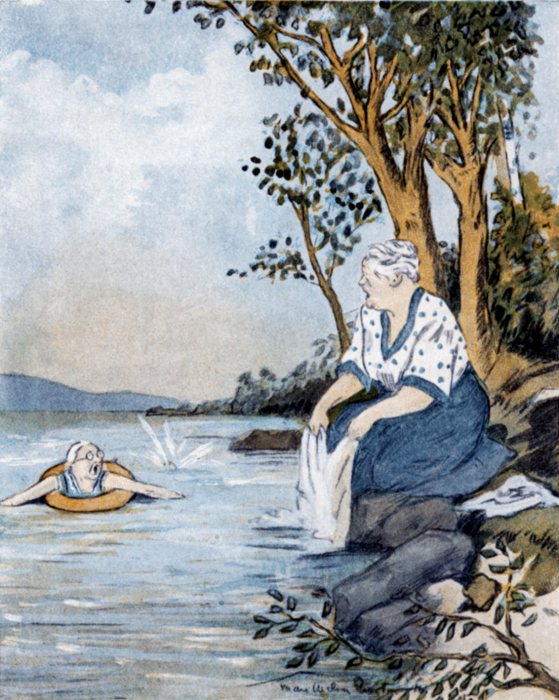
She was quite calm, though pale; but, in her anxiety to keep well above the water, she did what was almost a fatal thing—she pushed the life-preserver lower down round her body. And having shifted the floating center, so to speak, without warning her head disappeared and her feet rose in the air.
For a time it looked as though she would drown in that position; but Tish rarely loses her presence of mind. She said she knew at once what was wrong. So, though somewhat handicapped by the position, she replaced the cork belt under her arms and emerged at last.
Aggie had started back into the woods for Hutchins; but, with one thing and another, it was almost ten before they returned together. Tish by that time was only a dot on the horizon through the binocular, having missed Island Eleven, as she explained later, by the rope being caught on a submerged log, which deflected her course.
We got into the motor boat and followed her, and, except for a most unjust sense of irritation that I had not drowned myself by following her in the canoe, she was unharmed. We got her into the motor boat and into a blanket, and Aggie gave her some blackberry cordial at once. It was some time before her teeth ceased chattering so she could speak. When she did it was to announce that she had made a discovery.
"He's a spy, all right!" she said. "And that Indian is another. Neither of them saw me as I floated past. They were on Island Eleven. Mr. McDonald wrote something and gave it to the Indian. It wasn't a letter or he'd have sent it by the boat. He didn't even put it in an envelope, so far as I could see. It's probably in cipher."
Well, we took her home, and she had a boiled egg at dinner.
The rest of us had fish. It is one of Tish's theories that fish should only be captured for food, and that all fish caught must be eaten. I do not know when I have seen fish come as easy. Perhaps it was the worms, which had grown both long and fat, so that one was too much for a hook; and we cut them with scissors, like tape or ribbon. Aggie and I finally got so sick of fish that while Tish's head was turned we dropped in our lines without bait. But, even at that, Aggie, reeling in her line to go home, caught a three-pound bass through the gills and could not shake it off.
We tried to persuade Tish to lie down that afternoon, but she refused.
"I'm not sick," she said, "even if you two idiots did try to drown me. And I'm on the track of something. If that was a letter, why didn't he send it by the boat?"
Just then her eye fell on the flagpole, and we followed her horrified gaze. The flag had been neatly cut away!
Tish's eyes narrowed. She looked positively dangerous; and within five minutes she had cut another flag out of the back breadth of the petticoat and flung it defiantly in the air. Who had cut away the signal—McDonald or the detective? We had planned to investigate the nameless lake that afternoon, Tish being like Colonel Roosevelt in her thirst for information, as well as in the grim pugnacity that is her dominant characteristic; but at the last minute she decided not to go.
"You and Aggie go, Lizzie," she said. "I've got something on hand."
"Tish!" Aggie wailed. "You'll drown yourself or something."
"Don't be a fool!" Tish snapped. "There's a portage, but you and Lizzie can carry the canoe across on your heads. I've seen pictures of it. It's easy. And keep your eyes open for a wireless outfit. There's one about, that's sure!"
"Lots of good it will do to keep our eyes open," I said with some bitterness, "with our heads inside the canoe!"
We finally started and Hutchins went with us. It was Hutchins, too, who voiced the way we all felt when we had crossed the river and were preparing for what she called the portage.
"She wants to get us out of the way, Miss Lizzie," she said. "Can you imagine what mischief she's up to?"
"That is not a polite way to speak of Miss Tish, Hutchins," I said coldly. Nevertheless, my heart sank.
Hutchins and I carried the canoe. It was a hot day and there was no path. Aggie, who likes a cup of hot tea at five o'clock, had brought along a bottle filled with tea, and a small basket containing sugar and cups.
Personally I never had less curiosity about a lake. As a matter of fact I wished there was no lake. Twice—being obliged, as it were, to walk blindly and the canoe being excessively heavy—I, who led the way, ran the front end of the thing against the trunk of a tree, and both Hutchins and I sat down violently, under the canoe as a result of the impact.
To add to the discomfort of the situation Aggie declared that we were being followed by a bear, and at the same instant stepped into a swamp up to her knees. She became calm at once, with the calmness of despair.
"Go and leave me, Lizzie!" she said. "He is just behind those bushes. I may sink before he gets me—that's one comfort."
Hutchins found a log and, standing on it, tried to pull her up; but she seemed firmly fastened. Aggie went quite white; and, almost beside myself, I poured her a cup of hot tea, which she drank. I remember she murmured Mr. Wiggins's name, and immediately after she yelled that the bear was coming.
It was, however, the detective who emerged from the bushes. He got Aggie out with one good heave, leaving both her shoes gone forever; and while she collapsed, whimpering, he folded his arms and stared at all of us angrily.
"What sort of damnable idiocy is this?" he demanded in a most unpleasant tone.
Aggie revived and sat upright.
"That's our affair, isn't it?" said Hutchins curtly.
"Not by a blamed sight!" was his astonishing reply.
"The next time I am sinking in a morass, let me sink," Aggie said, with simple dignity.
He did not speak another word, but gave each of us a glance of the most deadly contempt, and finished up with Hutchins.
"What I don't understand," he said furiously, "is why you have to lend yourself to this senile idiocy. Because some old women choose to sink themselves in a swamp is no reason why you should commit suicide!"
Aggie said afterward only the recollection that he had saved her life prevented her emptying the tea on him. I should hardly have known Hutchins.
"Naturally," she said in a voice thick with fury, "you are in a position to insult these ladies, and you do. But I warn you, if you intend to keep on, this swamp is nothing. We like it here. We may stay for months. I hope you have your life insured."
Perhaps we should have understood it all then. Of course Charlie Sands, for whom I am writing this, will by this time, with his keen mind, comprehend it all; but I assure you we suspected nothing.
How simple, when you line it up: The country house and the garden hose; the detective, with no camp equipment; Mr. McDonald and the green canoe; the letter on the train; the red flag; the girl in the pink tam-o'-shanter—who has not yet appeared, but will shortly; Mr. McDonald's incriminating list—also not yet, but soon.
How inevitably they led to what Charlie Sands has called our crime!
The detective, who was evidently very strong, only glared at her. Then he swung the canoe up on his head and, turning about, started back the way we had come. Though Hutchins and Aggie were raging, I was resigned. My neck was stiff and my shoulders ached. We finished our tea in silence and then made our way back to the river.
I have now reached Tish's adventure. It is not my intention in this record to defend Tish. She thought her conclusions were correct. Charlie Sands says she is like Shaw—she has got a crooked point of view, but she believes she is seeing straight. And, after a while, if you look her way long enough you get a sort of mental astigmatism.
So I shall confess at once that, at the time, I saw nothing immoral in what she did that afternoon while we were having our adventure in the swamp.
I was putting cloths wrung out of arnica and hot water on my neck when she came home, and Hutchins was baking biscuit—she was a marvelous cook, though Aggie, who washed the dishes, objected to the number of pans she used.
Tish ignored both my neck and the biscuits, and, marching up the bank, got her shotgun from the tent and loaded it.
"We may be attacked at any time," she said briefly; and, getting the binocular, she searched the river with a splendid sweeping glance. "At any time. Hutchins, take these glasses, please, and watch that we are not disturbed."
"I'm baking biscuit, Miss Letitia."
"Biscuit!" said Tish scornfully. "Biscuit in times like these?"
She walked up to the camp stove and threw the oven door open; but, though I believe she had meant to fling them into the river, she changed her mind when she saw them.
"Open a jar of honey, Hutchins," she said, and closed the oven; but her voice was abstracted. "You can watch the river from the stove, Hutchins," she went on. "Miss Aggie and Miss Lizzie and I must confer together."
So we went into the tent, and Tish closed and fastened it.
"Now," she said, "I've got the papers."
"Papers?"
"The ones Mr. McDonald gave that Indian this morning. I had an idea he'd still have them. You can't hurry an Indian. I waited in the bushes until he went in swimming. Then I went through his pockets."
"Tish Carberry!" cried Aggie.
"These are not times to be squeamish," Tish said loftily. "I'm neutral; of course; but Great Britain has had this war forced on her and I'm going to see that she has a fair show. I've ordered all my stockings from the same shop in London, for twenty years, and squarer people never lived. Look at these—how innocent they look, until one knows!"
She produced two papers from inside her waist. I must confess that, at first glance, I saw nothing remarkable.
"The first one looks," said Tish, "like a grocery order. It's meant to look like that. It's relieved my mind of one thing—McDonald's got no wireless or he wouldn't be sending cipher messages by an Indian."
It was written on a page torn out of a pocket notebook and the page was ruled with an inch margin at the left. This was the document:—
1 20 1 pkg. 1 doz. 3 lbs. 1 bot. 3 1
Dozen eggs. Yards fishing-line. Needles—anything to sew a button on. A B C bass hooks. Meat—anything so it isn't fish. Ink for fountain pen. Tins sardines. Extractor.
Well, I could not make anything of it; but, of course, I have not Tish's mind. Aggie was almost as bad.
"What's an extractor?" she asked.
"Exactly!" said Tish. "What is an extractor? Is the fellow going to pull teeth? No! He needed an e; so he made up a word."
She ran her finger down the first letters of the second column. "D-y-n-a-m-i-t-e!" she said triumphantly. "Didn't I tell you?"
IV
Well, there it was—staring at us. I felt positively chilled. He looked so young and agreeable, and, as Aggie said, he had such nice teeth. And to know him for what he was—it was tragic! But that was not all.
"Add the numbers!" said Tish. "Thirty-one tons, perhaps, of dynamite! And that's only part," said Tish. "Here's the most damning thing of all—a note to his accomplice!"
"Damning" is here used in the sense of condemnatory. We are none of us addicted to profanity.
We read the other paper, which had been in a sealed envelope, but without superscription. It is before me as I write, and I am copying it exactly:—
I shall have to see you. I'm going crazy! Don't you realize that this is a matter of life and death to me? Come to Island Eleven to-night, won't you? And give me a chance to talk, anyhow. Something has got to be done and done soon. I'm desperate!
Aggie sneezed three times in sheer excitement; for anyone can see how absolutely incriminating the letter was. It was not signed, but it was in the same writing as the list.
Tish, who knows something about everything, said the writing denoted an unscrupulous and violent nature.
"The y is especially vicious," she said. "I wouldn't trust a man who made a y like that to carry a sick child to the doctor!"
The thing, of course, was to decide at once what measures to take. The boat would not come again for two days, and to send a letter by it to the town marshal or sheriff, or whatever the official is in Canada who takes charge of spies, would be another loss of time.
"Just one thing," said Tish. "I'll plan this out and find some way to deal with the wretch; but I wouldn't say anything to Hutchins. She's a nice little thing, though she is a fool about a motor boat. There's no use in scaring her."
For some reason or other, however, Hutchins was out of spirits that night.
"I hope you're not sick, Hutchins?" said Tish.
"No, indeed, Miss Tish."
"You're not eating your fish."
"I'm sick of fish," she said calmly. "I've eaten so much fish that when I see a hook I have a mad desire to go and hang myself on it."
"Fish," said Tish grimly, "is good for the brain. I do not care to boast, but never has my mind been so clear as it is to-night."
Now certainly, though Tish's tone was severe, there was nothing in it to hurt the girl; but she got up from the cracker box on which she was sitting, with her eyes filled with tears.
"Don't mind me. I'm a silly fool," she said; and went down to the river and stood looking out over it.
It quite spoiled our evening. Aggie made her a hot lemonade and, I believe, talked to her about Mr. Wiggins, and how, when he was living, she had had fits of weeping without apparent cause. But if the girl was in love, as we surmised, she said nothing about it. She insisted that it was too much fish and nervous strain about the Mebbe.
"I never know," she said, "when we start out whether we're going to get back or be marooned and starve to death on some island."
Tish said afterward that her subconscious self must have taken the word "marooned" and played with it; for in ten minutes or so her plan popped into her head.
"'Full-panoplied from the head of Jove,' Lizzie," she said. "Really, it is not necessary to think if one only has faith. The supermind does it all without effort. I do not dislike the young man; but I must do my duty."
Tish's plan was simplicity itself. We were to steal his canoe.
"Then we'll have him," she finished. "The current's too strong there for him to swim to the mainland."
"He might try it and drown," Aggie objected. "Spy or no spy, he's somebody's son."
"War is no time to be chicken-hearted," Tish replied.
I confess I ate little all that day. At noon Mr. McDonald came and borrowed two eggs from us.
"I've sent over to a store across country, by my Indian guide, philosopher, and friend," he said, "for some things I needed; but I dare say he's reading Byron somewhere and has forgotten it."
"Guide, philosopher, and friend!" I caught Tish's eye. McDonald had written the Updike letter! McDonald had meant to use our respectability to take him across the border!
We gave him the eggs, but Tish said afterward she was not deceived for a moment.
"The Indian has told him," she said, "and he's allaying our suspicions. Oh, he's clever enough! 'Know the Indian mind and my own!'" she quoted from the Updike letter. "'I know Canada thoroughly.' 'My object is not money.' I should think not!"
Tish stole the green canoe that night. She put on the life preserver and we tied the end of the rope that Aggie had let slip to the canoe. The life-preserver made it difficult to paddle, Tish said, but she felt more secure. If she struck a rock and upset, at least she would not drown; and we could start after her at dawn with the Mebbe.
"I'll be somewhere down the river," she said, "and safe enough, most likely, unless there are falls."
Hutchins watched in a puzzled way, for Tish did not leave until dusk.
"You'd better let me follow you with the launch, Miss Tish," she said. "Just remember that if the canoe sinks you're tied to it."
"I'm on serious business to-night, Hutchins," Tish said ominously. "You are young, and I refuse to trouble your young mind; but your ears are sharp. If you hear any shooting, get the boat and follow me."
The mention of shooting made me very nervous. We watched Tish as long as we could see her; then we returned to the tent, and Aggie and I crocheted by the hanging lantern. Two hours went by. At eleven o'clock Tish had not returned and Hutchins was in the motor boat, getting it ready to start.
"I like courage, Miss Lizzie," she said to me; "but this thing of elderly women, with some sort of bug, starting out at night in canoes is too strong for me. Either she's going to stay in at night or I'm going home."
"Elderly nothing!" I said, with some spirit. "She is in the prime of life. Please remember, Hutchins, that you are speaking of your employer. Miss Tish has no bug, as you call it."
"Oh, she's rational enough," Hutchins retorted: "but she is a woman of one idea and that sort of person is dangerous."
I was breathless at her audacity.
"Come now, Miss Lizzie," she said, "how can I help when I don't know what is being done? I've done my best up here to keep you comfortable and restrain Miss Tish's recklessness; but I ought to know something."
She was right; and, Tish or no Tish, then and there I told her. She was more than astonished. She sat in the motor boat, with a lantern at her feet, and listened.
"I see," she said slowly. "So the—so Mr. McDonald is a spy and has sent for dynamite to destroy the railroad! And—and the red-haired man is a detective! How do you know he is a detective?"
I told her then about the note we had picked up from beside her in the train, and because she was so much interested she really seemed quite thrilled. I brought the cipher grocery list and the other note down to her.
"It's quite convincing, isn't it?" she said. "And—and exciting! I don't know when I've been so excited."
She really was. Her cheeks were flushed. She looked exceedingly pretty.
"The thing to do," she said, "is to teach him a lesson. He's young. He mayn't always have had to stoop to such—such criminality. If we can scare him thoroughly, it might do him a lot of good."
I said I was afraid Tish took a more serious view of things and would notify the authorities. And at that moment there came two or three shots—then silence.
I shall never forget the ride after Tish and how we felt when we failed to find her; for there was no sign of her. The wind had come up, and, what with seeing Tish tied to that wretched canoe and sinking with it or shot through the head and lying dead in the bottom of it, we were about crazy. As we passed Island Eleven we could see the spy's camp-fire and his tent, but no living person.
At four in the morning we gave up and started back, heavy-hearted. What, therefore, was our surprise to find Tish sitting by the fire in her bathrobe, with a cup of tea in her lap and her feet in a foot-tub of hot water! Considering all we had gone through and that we had obeyed orders exactly, she was distinctly unjust. Indeed, at first she quite refused to speak to any of us.
"I do think, Tish," Aggie said as she stood shivering by the fire, "that you might at least explain where you have been. We have been going up and down the river for hours, burying you over and over."
Tish took a sip of tea, but said nothing.
"You said," I reminded her, "that if there was shooting, we were to start after you at once. When we heard the shots, we went, of course."
Tish leaned over and, taking the teakettle from the fire, poured more water into the foot-tub. Then at last she turned to speak.
"Bring some absorbent cotton and some bandages, Hutchins," she said. "I am bleeding from a hundred wounds. As for you"—she turned fiercely on Aggie and me—"the least you could have done was to be here when I returned, exhausted, injured, and weary; but, of course, you were gallivanting round the lake in an upholstered motor boat."
Here she poured more water into the foot-tub and made it much too hot. This thawed her rather, and she explained what was wrong. She was bruised, scratched to the knees, and with a bump the size of an egg on her forehead, where she had run into a tree.
The whole story was very exciting. It seems she got the green canoe without any difficulty, the spy being sound asleep in his tent; but about that time the wind came up and Tish said she could not make an inch of progress toward our camp.
The chewing gum with which we had repaired our canoe came out at that time and the boat began to fill, Tish being unable to sit over the leak and paddle at the same time. So, at last, she gave up and made for the mainland.
"The shooting," Tish said with difficulty, "was by men from the Indian camp firing at me. I landed below the camp, and was making my way as best I could through the woods when they heard me moving. I believe they thought it was a bear."
I think Tish was more afraid of the Indians, in spite of their sixty-three steel engravings and the rest of it, than she pretended, though she said she would have made herself known, but at that moment she fell over a fallen tree and for fifteen minutes was unable to speak a word. When at last she rose the excitement was over and they had gone back to their camp.
"Anyhow," she finished, "the green canoe is hidden a couple of miles down the river, and I guess Mr. McDonald is safe for a time. Lizzie, you can take a bath to-morrow safely."
Tish sat up most of the rest of the night composing a letter to the authorities of the town, telling them of Mr. McDonald and enclosing careful copies of the incriminating documents she had found.
During the following morning the river was very quiet. Through the binocular we were able to see Mr. McDonald standing on the shore of his island and looking intently in our direction, but naturally we paid no attention to him.
The red-haired man went in swimming that day and necessitated our retiring to the tent for an hour and a half; but at noon Aggie's naturally soft heart began to assert itself.
"Spy or no spy," she said to Tish, "we ought to feed him."
"Huh!" was Tish's rejoinder. "There is no sense is wasting good food on a man whose hours are numbered."
We were surprised, however, to find that Hutchins, who had detested Mr. McDonald, was rather on Aggie's side.
"The fact that he has but a few more hours," she said to Tish, "is an excellent reason for making those hours as little wretched as possible."
It was really due to Hutchins, therefore, that Mr. McDonald had a luncheon. The problem of how to get it to him was a troublesome one, but Tish solved it with her customary sagacity.
"We can make a raft," she said, "a small one, large enough to hold a tray. By stopping the launch some yards above the island we can float his luncheon to him quite safely."
That was the method we ultimately pursued and it worked most satisfactorily.
Hutchins baked hot biscuits; and, by putting a cover over the pan, we were enabled to get them to him before they cooled.
We prepared a really appetizing luncheon of hot biscuits, broiled ham, marmalade, and tea, adding, at Aggie's instructions, a jar of preserved peaches, which she herself had put up.
Tish made the raft while we prepared the food, and at exactly half-past twelve o'clock we left the house. Mr. McDonald saw us coming and was waiting smilingly at the upper end of the island.
"Great Scott!" he said. "I thought you were never going to hear me. Another hour and I'd have made a swim for it, though it's suicidal with this current. I'll show you where you can come in so you won't hit a rock."
Hutchins had stopped the engine of the motor boat and we threw out the anchor at a safe distance from the shore.
"We are not going to land," said Tish, "and I think you know perfectly well the reason why."
"Oh, now," he protested; "surely you are going to land! I've had an awfully uncomfortable accident—my canoe's gone."
"We know that," Tish said calmly. "As a matter of fact, we took it."
Mr. McDonald sat down suddenly on a log at the water's edge and looked at us.
"Oh!" he said.
"You may not believe it," Tish said, "but we know everything—your dastardly plot, who the red-haired man is, and all the destruction and wretchedness you are about to cause."
"Oh, I say!" he said feebly. "I wouldn't go as far as that. I'm—I'm not such a bad sort."
"That depends on the point of view," said Tish grimly.
Aggie touched her on the arm then and reminded her that the biscuits were getting cold; but Tish had a final word with him.
"Your correspondence has fallen into my hands, young man," she said, "and will be turned over to the proper authorities."
"It won't tell them anything they don't know," he said doggedly. "Look here, ladies: I am not ashamed of this thing. I—I am proud of it. I am perfectly willing to yell it out loud for everybody to hear. As a matter of fact, I think I will."
Mr. McDonald stood up suddenly and threw his head back; but here Hutchins, who had been silent, spoke for the first time.
"Don't be an idiot!" she said coldly. "We have something here for you to eat if you behave yourself."
He seemed to see her then for the first time, for he favored her with a long stare.
"Ah!" he said. "Then you are not entirely cold and heartless?"
She made no reply to this, being busy in assisting Aggie to lower the raft over the side of the boat.
"Broiled ham, tea, hot biscuits, and marmalade," said Aggie gently. "My poor fellow, we are doing what we consider our duty; but we want you to know that it is hard for us—very hard."
When he saw our plan, Mr. McDonald's face fell; but he stepped out into the water up to his knees and caught the raft as it floated down.
Before he said "Thank you" he lifted the cover of the pan and saw the hot biscuits underneath.
"Really," he said, "it's very decent of you. I sent off a grocery order yesterday, but nothing has come."
Tish had got Hutchins to start the engine by that time and we were moving away. He stood there, up to his knees in water, holding the tray and looking after us. He was really a pathetic figure, especially in view of the awful fate we felt was overtaking him.
He called something after us. On account of the noise of the engine, we could not be certain, but we all heard it the same way.
"Send for the whole d—d outfit!" was the way it sounded to us. "It won't make any difference to me."
V
The last thing I recall of Mr. McDonald that day is seeing him standing there in the water, holding the tray, with the teapot steaming under his nose, and gazing after us with an air of bewilderment that did not deceive us at all.
As I look back, there is only one thing we might have noticed at the time. This was the fact that Hutchins, having started the engine, was sitting beside it on the floor of the boat and laughing in the cruelest possible manner. As I said to Aggie at the time: "A spy is a spy and entitled to punishment if discovered; but no young woman should laugh over so desperate a situation."
I come now to the denouement of this exciting period. It had been Tish's theory that the red-haired man should not be taken into our confidence. If there was a reward for the capture of the spy, we ourselves intended to have it.
The steamer was due the next day but one. Tish was in favor of not waiting, but of at once going in the motor boat to the town, some thirty miles away, and telling of our capture; but Hutchins claimed there was not sufficient gasoline for such an excursion. That afternoon we went in the motor launch to where Tish had hidden the green canoe and, with a hatchet, rendered it useless.
The workings of the subconscious mind are marvelous. In the midst of chopping, Tish suddenly looked up.
"Have you noticed," she said, "that the detective is always watching our camp?"
"That's all he has to do," Aggie suggested.
"Stuff and nonsense! Didn't he follow you into the swamp? Does Hutchins ever go out in the canoe that he doesn't go out also? I'll tell you what has happened: She's young and pretty, and he's fallen in love with her."