XI.
Reading edition
MR. WRANGLER.
On your way to the Cortlandt Street Ferry, which is on everybody's way to everywhere, and on the left-hand side of the street when you turn out of Broadway, and not very far from the ferry-house itself, there is a little old, low brick building which has stood there a good many years and is going to stand a good many more if Billy Warlock knows himself, and he thinks he does. You may talk about progress all you please, but Billy will soon give you to understand that the only kind of progress which will take that house from him, or him from it, is the progress toward the stars, and that, while he hopes to take it in the Lord's good time, he isn't ready for just yet. Billy Warlock owns that house and lives in it and does business there, and the great big heart that thumps in Billy's great big body and gives strength to Billy's great big arm, loves every individual square inch of brick and earth and planking and plaster in that old house from cellar to scuttle. Part with it! Speculate on it! Sacrifice it to progress! Well, scarcely. Not if you were to offer him its weight in solid gold. Not if its neighbor on one side were a Mills Building and its neighbor on the other an Equitable. Not if you were to build an elevated railroad around it and run ten trains per minute, day and night. So long as Billy Warlock can keep himself above ground, so long will that old house keep him company, and so long will his forges blow fiery sparks in the cellar, while he hammers and hums and hums and hammers on the anvil by his side.
It was just twelve years ago on Christmas Eve that Billy Warlock bought the smithy in the cellar of that little old house. Billy had been working for the man who owned it, and the man who owned it, being a little short of wind and a trifle weak in his legs, had decided to sell and retire. Billy had become the purchaser, and not without many qualms and doubts as to the wisdom of assuming such heavy responsibilities. Billy knew he was a good mechanic, and could put a tire on a wheel or a shoe on a horse as quickly and as well as the next man. But it took a good big pile of dollars, as Billy counted dollars, to get those forges, and before he turned them over to his late employer Billy scratched his head a good many times and did a power of thinking. But at last he let go the dollars, and laid his big fist on the biggest forge and blew a blast through the coals that made them glow brighter than ever they glowed before. For it was the master and not the man who sent the draught through them.
He bade the men good-night and wished them a Merry Christmas, closed the doors, locked them tight, and looked his property over. It was worth being proud of, make no mistake. It was all any man need wish for. It was well stocked and in prime condition. The house, in the cellar of which his smithy stood, was mainly let in lodgings. On the first floor, raised just far enough above the street to give his customers a fair passage out, there was a saloon and eating-room. Back of these were Billy's own rooms, two nice big rooms where his mother took care of him and cooked his meals and washed his clothes and aired his bed as only good old mothers can. Over this floor were two others, let, as I have said, in lodgings—to whom, who knows? Who ever knows to whom lodgings are let in this big, crowded city?
Billy finished his dinner and drew up his chair and one for his mother by the stove, and filled his huge mug with beer, and his huge pipe with tobacco, and talked it all over with his mother. She was a fine woman, was Billy's mother, and she drew a straight, steady rein over her big, burly, good-natured boy. She was Billy's best friend, and he knew it, and when she told him she would stand by and help him, and save for him and look out after him, Billy reached forth his brawny arm, and drew her over on his knee and danced her up and down, smoothing back her gray hair and kissing her old cheeks as if she were a baby.
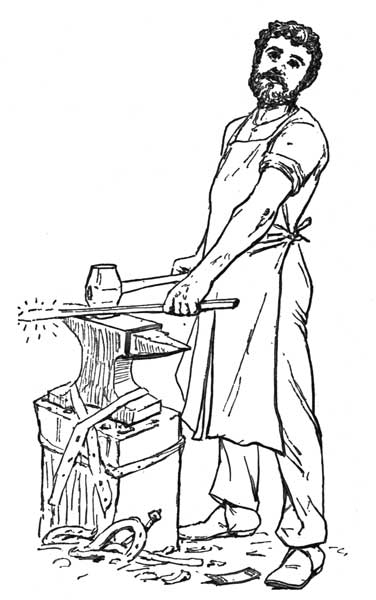
Then, when the clock struck nine, she got up to wash the dishes, and Billy took his lantern to go down among his forges again. Not that he had anything particular to do, though there never was a time when Billy couldn't find something, but the novelty of owning a business was strong with him, and he wanted to hammer just for the fun of hammering. He descended into the cellar through a side-door which opened from the back hall upon a short ladder. The street doors were barred and bolted. He set his lantern on the ladder steps and lit an oil lamp that hung over his anvil, picked up his iron and his hammer, thrust the one into the coals and laid the other on his anvil, and blew away. Oh, what an arm that was of Billy's! How it made the bellows bulge and the wind roar up the great chimney! How the black coals reddened and flamed and blazed! How the iron glowed and whitened with the heat, and when Billy drew his great hammer down upon it with a hoarse grunt accompanying each blow as if to give it effectiveness, how the sparks scampered about in a furious effort to escape!
OH, WHAT AN ARM WAS THAT OF BILLY'S!
Billy was hammering and grunting at a great rate, and the forge fire was throwing upon the ceiling fantastic illuminations and causing a thousand still more fantastic shadows, when, wholly without preliminary warning or greeting, Billy felt a slight touch on his arm. It was a slight touch, as I said, but a cold one, a very cold one indeed. Billy turned swiftly around with his hammer in one hand and his red-hot iron in the other. Standing almost beside him, with the glare of the fire working a curiously weird effect upon one-half of him, while the other half was almost hidden in the dense shadow beyond, was a tall, spare, angular man with queer little snappy eyes that flashed like diamonds in the light of the forge. His hand was stretched out in a friendly way, and a bland smile stretched across his face, following the lines of his wide, extended lips.
"Aha!" he said cheerily, "how d'ye do? But I forgot! You don't know me and I don't know you. Awkward, eh? But soon fixed, soon fixed. My name's Wrangler, and yours is—er—what by the way, is yours?"
"Warlock," said Billy, laying down his iron and his hammer, and gazing amiably at the stranger—"Billy Warlock."
"Warlock," Mr. Wrangler repeated. "Exactly. Well, then, Warlock, Wrangler. Wrangler, Warlock. And now the formalities have been observed. I don't know how it is with you, Warlock, but I'm a great stickler for the formalities. 'Pon my life, I consider them the web upon which the social fabric hangs together. They're not to be dispensed with upon any account whatever. While I was abroad recently, the American Minister and I were walking along the Mall together. 'Ah,' he suddenly said, 'My dear Wrangler, here comes the Prince. Of course you know him.' Now, it so happened that H. R. H. and I had never met. I didn't have time to reply, for just as I was about to speak the Prince stopped us, and, after greeting the Minister, utterly regardless of the formalities, he told me that he hoped he saw me well. I gave him a look, Warlock, my boy, that he will never forget, and coldly replying, 'Sir, I have not the pleasure of your acquaintance,' I walked on. That afternoon the Minister sent me an apology, but for which damme if I'd ever have spoken to him again."
"AHA!" HE SAID CHEERILY, "HOW D'YE DO?"
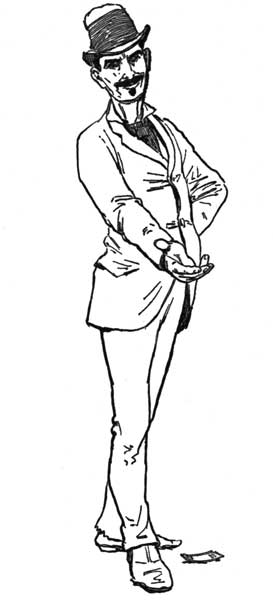
During this speech, to which Billy listened with great attention and some little awe, he examined Mr. Wrangler carefully. Mr. Wrangler's clothes were harmoniously seedy. In the degree of their wornness his hat was a match for his coat, and his coat a match for his trowsers, and his trowsers a match for his boots. Although the weather was desperately cold, and a heavy Christmas snow had fallen, he had on neither overcoat nor overshoes. He did not appear to notice Billy's inspecting glances, but having caught his breath, he went cheerily on.
"I am glad and proud to know you, Warlock, old fellow, and I want you to be glad and proud to know me. And you shall be; you shall be; 'gad you sha'n't be able to help it. And you'll find as you know me better that while you won't know any great good of me, you won't know any great harm."
Billy contemplated Mr. Wrangler for a few moments more, and then amiably replied: "Well, that's all right. What more could a man ask?"
"Precisely so," answered Mr. Wrangler, dusting off the anvil and sitting down upon it. "That, I take it, is quite enough. I have not broken in upon your privacy, Warlock, old fellow, without serious occasion. In fact, I'm troubled—sorely troubled."
"I'm sorry for that," said Billy.
"Of course you are, dear boy, and well you may be. The trouble I'm in is a sad one—sad and novel. Not that trouble in itself is a strange experience to me, for I've had my ups and downs. My life hasn't been one of unmixed gayety, I assure you, not by a long shot. But, you see, I have a habit of bowing to the inscrutable will of Providence. Some people experience a great deal of difficulty finding out what the inscrutable will of Providence is. That doesn't bother me in the least. Having ascertained what my own will is, I know the chances are ten to one that the Providential will is exactly the reverse. That is simple and direct enough, isn't it?"
Billy was very much interested in this glib but melancholy stranger, and he resolved, if it came in his way, that he would do the man a favor. So he turned his hammer with the handle to the ground, sat himself upon the head of it, and remarked: "It's right enough, Mr. Wrangler, to make the Lord's will yours. I try to do my best in that line too. But still, there is a point, you know, where it comes hard."
"True, dear boy, very true; and how much harder it is to find yourself in a situation which you did nothing to bring about, for which you are in no sense responsible, which is wholly in conflict with your own will, and to the best of your belief with the will of Providence also! This is my unparalleled situation at this particular moment, and it all comes of being the uncle of a little girl baby."
"No?" said Billy inquiringly, "you don't mean it?"
"I knew you'd be surprised," said Mr. Wrangler, edging up to the forge, which Billy had kept going at a gentle heat to warm their hands now and then. "It ought to be an occasion of unalloyed happiness to be the uncle of a little girl baby. But I was not intended for such a position. It was clearly a mistake to thrust me into it."
"I don't scarcely see how you could help it," said Billy.
"No, I couldn't, could I? It came upon me suddenly and without my knowing it. I had no time for preparation. My brother, who was one of the evils to which, under the will of Providence, I have bowed, called me to him recently, and without so much as a drop of brandy to break the force of the blow, he said: 'Cephas,' said he, 'you are the uncle of a little girl baby!'
"Pale and for a moment speechless, I leaned against the wall and shook with emotion. 'Courage, old man!' said he, 'bear up! bear up!' At first I refused to believe him. 'It is false, Orlando,' I said, 'it can't be so.' But he shook his head sadly. 'It is true, Cephas,' he replied, 'and I guess I ought to know.' That argument was of course conclusive. It admitted of no reply. I only asked him how could he so have wronged me. He said nothing in defense of himself. He could say nothing. He simply bent his head and cried for pardon."
"Well, well," said Billy, "this is queer. It seems to me like a big to-do over a very little matter."
Mr. Wrangler looked up with an expression of dismay. "Little!" he cried. "Little! May I ask, Mr. Warlock, if you have ever been the uncle of a little girl baby?"
"No," said Billy, "I never was."
"Ah, well, that explains it. Then you can't know the bitterness of that hour. You can't put yourself in my place. I forgave him. I told him with a sob that it was all right. Then, in the name of our mother, he implored me to do him a favor. The infant was in California. He had left it there to—er—learn the language, I reckon. He bade me go and fetch it. At first I hesitated—all but refused. But who can withstand an appeal made in the name of his mother? I pressed his hand in silent acquiescence and took the next train West. I found the child and folded it to my heart. I bought it a milk bottle with a fancy nozzle, a bull's eye, and a rattle. It wept, and I dried its tears. Then I brought it back with me. Fancy my feelings, Warlock; picture to yourself my lacerated, bleeding heart, when upon reaching town this afternoon I learned that my brother was dead! Yes, Warlock, old man, dead and buried and cold in his grave, and another party living in his flat. It was all in vain that the tears streamed from my eyes—all in vain that I begged him at least to take the child. I called him brother, kinsman, royal Wrangler, and bade him remember that this was a matter of honor between him and me. I begged him to think of the situation he had placed me in, for I feared the laugh of callous cynics as much as the cry of the innocent child, but the ungrateful dead answered not."
Mr. Wrangler paused and touched his handkerchief to his eyes, while Billy gazed at him in amazement, uncertain to what category of disease his case should be assigned. "I don't know as I ever heard a queerer tale than this," he said at length. "What did you do about it?"
"I'm doing now," answered Mr. Wrangler. "It is on a special mission that I'm seeking you. Warlock, dear boy, you don't happen to have a bottle of paregoric with you, do you, now?"
"Paregoric!" exclaimed Billy. "Why, is the child sick?"
"Hanged if I know!" Mr. Wrangler replied, with evident sincerity. "I'm not what you'd call a connoisseur in infantile disorders, but I guess she's sick. Anyhow, something's the matter. It may be malaria, or chills, or measles, or whooping-cough, or Bright's disease. But whatever it is, it keeps her very wakeful at night. It disturbs her rest sadly. That might, perhaps, be overlooked; but as an intimate consequence it also disturbs mine. At first I supposed it was because she did not get enough nourishment, so, as she wouldn't drink any more milk from her bottle, I bought a syringe, and filling it with milk, I played it down the little darling's throat."
"Great Scott!" cried Billy, "it's a wonder she didn't choke to death!"
"Is it?" asked Mr. Wrangler innocently. "Well, to tell the truth, she did come dev'lish near it, and so I inferred that I hadn't correctly diagnosed the case. After she had got done coughing her spirits seemed more than ever depressed. I went to bed in the vain hope that her supply of tears would in time become exhausted. As the hours drew along and that hope died away, I concluded she must have headache. I had one, and I thought it only natural that she should, too. The question was, what remedy should I apply? In a happy moment paregoric occurred to me. I seemed indistinctly to remember that when I was a child paregoric did the business. How fortunate one is, dear boy, in such moments as that to have the memories of his boyhood to fall back on. I got up, dressed, and went out to hunt a drug-store. Unfortunately, the only two I came across were closed. I returned disconsolate, but as I entered I heard the sound of your hammer and saw the glimmer of the lantern on your ladder. I descended hither. I looked upon you and said: 'Here is a friend.' Warlock, old fellow, find me some paregoric!"
"I don't know much about babies, Mr. Wrangler," said Billy, slowly and rather sternly, "for I never had one, and I never was throwed with 'em. But I think the chances is that you'll kill your'n before morning."
Mr. Wrangler was standing in the shadows where Billy couldn't see him very well, but his snappy little eyes were shining in a way that Billy didn't like.
"How old is the baby?" asked Billy.
"I haven't an idea—not one," answered Mr. Wrangler, laughing merrily, as if his not knowing were a monstrous joke. "But she can walk and talk."
"And you trying to feed her on milk in a bottle?" exclaimed Billy. "How'd you like to be fed on iron filings? I rather think they'd make a good diet for you!" Billy was indignant, and he fetched his hammer down on a log that lay near with a blow that split it through and through. Mr. Wrangler stepped back into the shadows still further, and his little eyes glowed in the darkness like a cat's.
"Ha! ha!" he laughed; "good, very good. But you mustn't make fun of me, old fellow. It isn't fair, now, really."
"Where is the child, anyhow?"
"Upstairs."
"Here, in this house?"
"Precisely."
"Come on, then; take me to her, and let's see what the matter is."
"That's a good fellow!" cried Mr. Wrangler. "As soon as I saw you I knew you would prove to be my deliverer. Come."
The forge fire had now gone out, and directing Mr. Wrangler to stand on top of the ladder, Billy took the lantern, blew out the hanging lamp, and both ascended from the smithy into the hall of the house. Billy locked the door behind him and followed Mr. Wrangler upstairs into the third story. They paused before the hall bedroom and bent forward to listen. Not a sound broke the night's stillness, and softly Mr. Wrangler turned the key and opened the door. Billy moved noiselessly ahead and lit the dull gas.
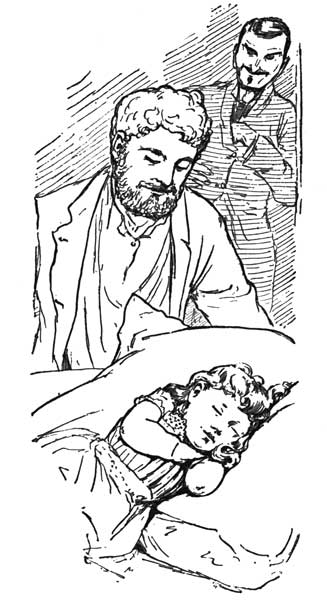
Upon the bed, with one hand under her cheek and the other one, small and dotted with dimples, resting lightly on her plump neck, lay as pretty a child as he had ever seen. Her eyes were closed, for she was sleeping heavily, as if repose had come to her only when her little frame was utterly worn out. A great mass of thick, tangled curls clustered on the pillow about her head. A dark line down her flushed cheek marked the course of the tears she had been shedding, and the pillow that supported her was still wet with them.
Billy stooped down and kissed her parted lips and her white forehead, while Mr. Wrangler, leaning jauntily against the door, hummed in low strains a melodious lullaby.
"Nothing ails this child," said Billy, when the sound of Mr. Wrangler's voice had died away. "Nothing at all."
UPON THE BED LAY AS PRETTY A CHILD AS HE HAD EVER SEEN.
"Warlock, dear boy," replied Wrangler, "I think you told me you had never been an uncle. The man who has not drank the bitter waters of an uncle's experience for himself is—pardon me, but I must say it—wholly incompetent to speak as to the woes of childhood. How often have you wooed sleep amid the wailings of an infant voice? I'm disappointed in you, Warlock!"
"Don't talk so loud, you'll waken her."
"Spare us that. Let me have my hat and stick. I'll get that paregoric if I have to commit burglary!" and Mr. Wrangler started back as if fully prepared to carry out his threat.
"Be quiet," said Billy, "and look here. My rooms are downstairs where I live with my mother. It's too cold in here for the child. That's one thing that ails her. I'll take her down with me, and when she's had her breakfast in the morning, you can come for her."
Mr. Wrangler seized Billy's hand and shook it fervently. "Dear boy," he said, "you're the kind of a friend to have. Take her and give her a good night's rest."
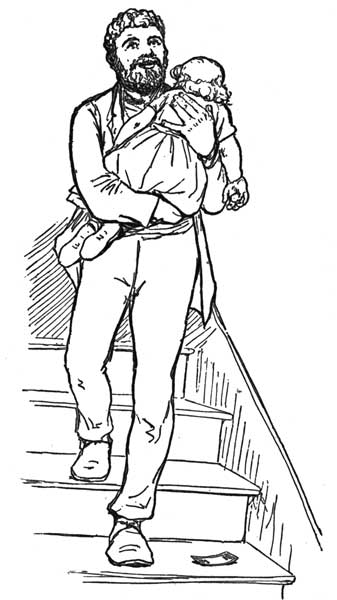
Billy leaned over the bed, lifted the soundly sleeping child tenderly in his big arms and, followed by Mr. Wrangler, he carried her down to his own room and deposited her upon the bed. Then he turned to Wrangler.
"You'll come for her in the morning, you know?" he said.
HE CARRIED HER DOWN TO HIS OWN ROOM.
"Certainly, old fellow. Good-night, I must get some sleep."
"Good-night," said Billy, "and a Merry Christmas to you."
Mr. Wrangler waved his hand with a grand farewell flourish, blew a kiss toward the little form upon the bed, and passed out into the hall. He waited there an instant, as if undecided what course to pursue. Then he ran upstairs to the hall room, hurriedly crowded his personal effects that lay scattered around the room into his valise, and ran down again into the street. The front door closed with a sharp bang behind him, and he quickly disappeared in the snowy night.
Billy could not help confessing to a sense of relief when his curious new acquaintance left him. Not that he felt any definite fear of Mr. Wrangler. The human being had yet to be born of whom Billy Warlock was afraid. But there was a something about Mr. Wrangler that he didn't fancy. "It's them eyes," said Billy "and he don't make no noise when he walks." His own bed being occupied by the child, he piled a lot of blankets on the floor, stretched himself upon them, and was soon asleep.
The Christmas sun was peeping obliquely into Billy's room and making, with the aid of his shaving-glass, all sorts of fantastic colors on the wall, when a slight tug at the blankets which covered him moved him to start, turn over, open his eyes, stare blankly before him, shut them, open them again, rub them desperately, and finally gaze with awakened consciousness up at the object which had disturbed his slumbers. She was leaning half over the bed, her little fat arms, shoulders, and throat all bare, her bright, tangled hair knotted in bewildering confusion all about her head, and her big blue eyes looking down upon him with a curious interest. How long she had been awake he could only conjecture, but evidently her patience had at last been exhausted, and she had set about premeditatedly to arouse him. Billy was charmed by the little-picture above him, and smiled a cheery greeting. She smiled too, right merrily, and said, "What's your name?"
"Billy," said he. "What's yours?"
The smile straightway faded from her face like the color from a withered blossom, and she glanced hurriedly and anxiously around the room.
"Where's the black man!" she whispered.
"The black man!" cried Billy. "What black man, my dear?"
"Don't you know him? He's had me ever so long."
Billy was puzzled. "A black man had you?" he repeated. "Why you don't mean your uncle, do you?"
"Yes," she said, "that's him, and he says if I don't call him 'uncle' he'll cut off my big toe!"
Billy Warlock jumped upon his feet like a shot. "The devil he did!" he cried. "I'll punch his head for that!"
"And his knife has got six cutters in it!"
"I guess he was only funning," said Billy. "He didn't mean it."
"That's what he said," she insisted.
"Yes, my dear, but he didn't mean it. He was joking."
"That's what he said!" Her accent was very positive, and she added as if conning it over, "His knife had six cutters."
Billy felt himself somewhat at a loss to deal with this well-formed impression, so he contented himself with the remark, "But you haven't told me what your name is yet?"
She rose upon her knees in the bed and leaned over toward him. "My really name is Lotchen."
"Lotchen what?"
"That's all—just Lotchen."
"Where's your mother, Lotchen?"
"I don't know; do you?"
"There's something queer about this business," said Billy to himself. "And if that Wrangler man don't make it plain he'll find hisself in trouble. What is your father's name, Lotchen?" he inquired aloud.
"Who's that?"
"Your father. Haven't you a father?"
"I don't know. The black man says he can turn me into a toothpick if he wants to."
Billy doubled up his fist and looked at it grimly.
"Well, he won't want to," he said. "Don't you be afraid. I'll take care of you."
"Oh, will you?"
"For a little while, anyhow."
"How long?"
"Well, till you get your breakfast."
"Where's he gone?"
"Who?"
"The black man."
"He's upstairs in his room. You can go to him after breakfast."
"I don't want to go. I'm afraid of his knife. I sit and hold on my big toe all day. Have you got a knife, too?" She looked at him with an expression he could not understand. Perhaps her natural trust in mankind had been somewhat shaken.
"My knife wont hurt you," he said. Lotchen crawled to the edge of the bed, leaned over and put her two hands on his, and said, "Then let's you and me run away from the black man."
Billy looked much amused. "No," he replied, "we won't do that, Lotchen; but I shouldn't wonder if he was to run away from us. Don't your uncle love you?"
"He loves his nose better," she replied.
"His which?"
"His nose. He's all the time rubbing it up and down."
"But don't he love you, too?"
"No."
"What makes you think that?"
"'Cause I'm afraid of him."
"When did you see him first, Lotchen?"
"Oh, ever so long. He's had me, you know."
"Yes, I know that. What's he been doing with you?"
The expression on her face was so blank that Billy saw, whatever Mr. Wrangler might intend, she knew nothing more than that she was being "had" under circumstances that caused her constant fright. He did not question her further, but went into the kitchen where his mother was getting the griddle hot for the buckwheat cakes and the spider hot for the sausages, and he told her of Wrangler and the child. She went in to see Lotchen, and snuggled the little one up to her close and tight, and told her she should have a merry Christmas and she mustn't be afraid of anybody, for her Billy, that is, Billy's mother's Billy, could whip anybody on earth, she didn't care who he was, and nobody should frighten this dear little soul; and the old lady began now to express her ideas in that strange language which is hidden from the wise and prudent but revealed unto grandmammas and babes. "B'essings!" she said, "b'essings on 'e dear heart an' e' 'ittie body, wiv 'e 'ittie youn' nose, an' 'e ittie b'u' eyes, an' 'e ittie youn' cheeks, an' e' ittie youn' evysing, an' nobody s'all bozzer her at all, not 'e 'east ittie bit, 'tause s'e was a sweet ittie fwing, and Billy, wiz him big fist an' him date big arm, Billy dust take 'e b'ack mans an' all 'e uzzer mans wot bozzer zis ittie soul an' 'e frow 'em yite in 'e Norf Yiver, yite in, not carin' 'tall bout 'e ice, but dus' frow 'em in an' yet 'em det out e' bes' way zay tan. B'ess ittie heart!"
Then Lotchen smiled and put up her pretty face to be kissed, which she didn't have to do twice before it was kissed by them both, and Billy who hadn't slung hammers all his life for nothing, rolled up his shirt-sleeves and doubled up his fists, and sparred away at the air as if to suggest what would happen to any one who laid as much as his little finger on her.
All through the breakfast Billy kept his eyes on that round, pretty face, and wondered what he should say and do when the "black man" came to get her. He began to grow moody and sullen as the buckwheat cakes disappeared, and when thirty of them had been disposed of Billy felt himself ready to meet Mr. Wrangler. He had some questions he desired to ask Mr. Wrangler, and the oftener he thought them over the more he felt his fingers itch to close themselves around Mr. Wrangler's long and scraggy neck. He waited an hour, two hours, but no Mr. Wrangler came, and at last Billy concluded to mount the stairs and to interview Mr. Wrangler in the hall bedroom.
He told Lotchen to go into his room, where she had spent the night, and on her assuring him that she wasn't afraid, he locked her in and stowed the key away in his pocket. Then he shot upstairs to the hall bedroom. He knocked, but no answer came. He opened the door. The room was empty. The bed was just as he had left it the night before with the impression upon it of the little form he had carried away. It had evidently been without a tenant during the night. All that Christmas Day he waited and watched for Mr. Wrangler, but he waited and watched in vain.
Two days afterward an express wagon drew up before the smithy, and a box was delivered to Billy marked with his name. It contained a liberal supply of child's clothing, which Lotchen recognized as hers. Little by little Billy and his mother drew from her fragments of her history. She remembered a big house by the water, and a little bed of lilies-of-the-valley under a couple of pear-trees. She remembered a colored man named Pete, but there was no response in her memory to the words "father" and "mother," and the only woman who appeared to be impressed on her mind was one who called her "Lassie" and gave her horrid stuff from a bottle in a wooden spoon.
Days and weeks and years went on, and Billy Warlock's purse grew plumper and his heart grew lighter with each of them. His smithy in the cellar grew in dimensions and gradually he absorbed the little old house over it. The saloon disappeared, and the room it had occupied became a parlor for Lotchen. The lodgers went out one by one until the whole house was Billy's dwelling.
One day when she was nearly fourteen years old, Billy received a letter that worried him a good deal. It was dated at the Newcastle Jail in Delaware. It read:
My Dear Warlock:
It seems to be definitely settled about my being an error of judgment. You can see by the enclosed newspaper clipping that I ought not to have been involved in the scheme of the creation. You needn't mention it to anybody else. I forget what name you knew me by, but I think it was
Cephas Wrangler.
The newspaper clipping contained these words:
Nothing, therefore, remains for the Court but to pronounce the sentence which a jury, almost wholly of your own selection, has adjudged your fitting doom. The crime you have committed is the most dreadful known to the law. For it there is but one penalty, the requisition of your life in forfeit for the one you have taken. The sentence of the Court is that you be conducted hence to the prison from which you came, and that you be confined there until Friday, the 18th day of March, following, and that you then, between the hours of 7 and 11 in the morning, be hanged by the neck until you are dead, and may God have mercy on you!
This is all that Billy Warlock knows or cares to know of the circumstances under which Lotchen became his child. He never made the slightest effort to discover more. It didn't interest him, and he didn't wish it to interest her. She was his child, and that was enough—at least, it was enough for several years. The precise moment at which it ceased to be enough is not fixed in Billy's mind, but last Christmas, when Lotchen found a gold watch in her stocking, and when she came and put her arms around his neck and kissed him, which she hadn't done very often of late, and when she whispered that she wished she had something to give him, Billy turned his eyes to the floor and stuck his big fists in his trowsers pockets, and did a power of thinking. He knew then, if he had not fully known it before, that for her to be his child was not enough. So he said very solemnly, "Are you sure you mean that, Lotchen? Now, don't answer without you know, for you might have something you wouldn't want to give me, and if I was to ask for it and you was to look hesitatin', I—well I don't know what I should do."
"I don't have to think, Billy," Lotchen answered promptly, "for I've been thinking a great deal and wondering whether you—"
She stopped there short, and her face—her pretty face, her dear, round, dimpled face, her truthful, honest, womanly face—got very red, and she jumped up and ran out of the room.
After that last Christmas, Billy and Lotchen talked and walked with each other on a different footing from that on which their intercourse had previously been conducted. He said nothing to her, nor she to him, that referred to their interrupted conversation until October came, and then one day he said: "Lotchen, is my Christmas gift ready?" and he held out his hand to her—both hands—and smiled.
"Yes, Billy," she answered.
And on next Tuesday morning, Christmas morning, when the bells are ringing merrily and all the world is glad, Billy Warlock, as I said at the very beginning of my story, dressed in his big frock coat and the whitest of snowy neckties, will—but you know the rest, so what's the use of my telling it?