Appendix to Chapter IV.
Reading edition
It may be useful to give a simple form of proof of the law which governs the time of oscillation of a pendulum whose length is given.
Unfortunately, it is impossible to give one so simple as to be comprehended by those who know nothing whatever of mathematics. It is, however, possible to give a proof that requires very little mathematical knowledge.
We know that when a mass of matter is whirled round at the end of a string it tends to fly outwards and puts a strain on the string. The faster the speed at which the mass is whirled, the stronger will be the strain on the string. Suppose that the length of the string equals R, the velocity of the mass as it flies round equals V. Let a be the body whirled round by a string o a from a centre at O. The body always, of course, tends to fly on in a straight line from the point at which it is at any instant. But that tendency is frustrated by the pull of the string which constrains it to take a circular path. It is, of course, all one whether the force that tends to pull the body inwards towards O is a string or an attractive force of any kind acting through a distance without any string at all. Evidently if the body keeps its place in the circle it must be because the centrifugal force tending to whirl it out is equal to the centripetal or attractive force tending to pull it in.
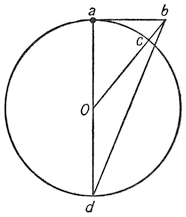
Fig. 60.
The strain on the body, due to the force tending to pull it inwards, we shall designate by F, meaning by F the number of feet of velocity that would in one second be imparted to the body by the attractive force.
Suppose that at some given instant of time the body is at a point a. At that instant its direction will be along a b, tangential to the circle at a, and that is the path it would take if the centripetal or attractive force ceased to act just as the body got to a. In that case the body would be whirled off like a stone from a sling along the line a b, and would at the end of a given time, let us suppose a second, arrive at b. But it is not so whirled off; it is attracted towards O and pulled inwards, and comes to c. Hence, then, the attractive force acting during one second must have been sufficient to pull the mass in from b to c. But we know that if an accelerating force (F) acts on a body for a second it produces a final velocity equal to F at the end of the second, and an average velocity half F during the second.
Hence, then, the space b c, by which the body has been pulled in, is represented by half F, but a b, the space which the body would have travelled forwards, will be represented by V, the velocity of the body in a second; but if the motion be such that the distance b c travelled in a second is very small, then the triangles a b d and a b c are approximately similar, and the smaller a b is the more nearly similar they are. Whence then (a b)/(b c) = (a d)/(a b), that is to say (a b)² = a d × b c.
But a b represents the space which would have been traversed by the body in one second at the rate it was going, and hence is equal to V; a d is the diameter of the circle, and hence equals 2 R; b c is the space through which the body has been drawn in the second by the attractive force F, and therefore equals half F.
Whence then V² = 2 R × half F = R F.
We took a second as the limit of time during which the motion was to be considered. Of course any other time could have been taken. Now what is true of the motion of a body during a very short time is also true of the body during the whole of its path, assuming that the path is a circle, and that F remains constant, as it obviously will if the path is a circle, and the velocity is uniform. Whence then we may generally say that if a body is being whirled round at the end of a string the strain F on the string is directly proportional to the square of the velocity, and is inversely proportional to the length of the string.
The time of rotation, is of course = length of the path ÷ velocity
= (2πR)/V = (2πR)/√(R F) = 2π√(R/F).
Whence then we see that for motion in a circle of a mass under the attraction of a centripetal force, or pull of a string, the time of rotation will be uniform, provided that the centripetal force always varies as the radius of the path. From this it is evident that a body fixed on to an elastic thread where the pull varies as the extension would make its rotations always in equal times. If your sling consists of elastic, whirl as you will, you can only whirl the body round so many times in a second, and no more. Any increase in your efforts only makes the string stretch, and the circle get bigger. The velocity of the body in its path of course increases, but the time it takes to go once round is invariable.
It also follows that if a body hung by a string of length l, under the action of gravity, be travelling in a circle round and round, then, if the circle is a small one compared with the length of the string, the inward acceleration f towards the centre will be approximately proportional to the radius r of the circle, and the time of rotation will be
t = 2π√(r/f).
But in this case f, the inward acceleration, is to g the acceleration downwards of gravity as A B:A P or
f/g = (A B)/(A P) = (A P)/(O P) = r/l.
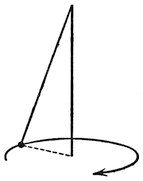
Fig. 61.
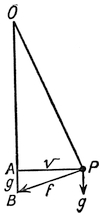
Fig. 62.
Whence then the time of rotation of this body would be if the circle of rotation was small
= 2π√(l/g).
And if you try you will find that this is so. For instance, take a thread 39-1/7 inches long, that is 3·25 feet. Hang anything heavy from one end of it, and cause it to swing round and round in a small circle. Now g the acceleration of gravity = 32·2 feet per second. π the ratio of the circumference of a circle to its diameter = 3·14. From which it follows that the time of rotation = 2 × 3·14√(3·25/32·2) seconds = 2 seconds. But if we look at the rotating body sideways, it appears to act as a pendulum; it matters nothing whether we swing it round and round or to and fro. For in any case the accelerative force tending to bring it back to a position of rest is always proportional to the distance of displacement, and, therefore, its time of motion must always be 2π√(l/g) and its motion harmonic.
The length of a seconds pendulum, that is a pendulum that makes its double swing in two seconds, will therefore be
l = 4/((2π)²) × g feet
= (g × 12)/π² inches
= 39·14 inches.