Chapter XVI
Reading edition
Final warnings against theft—Humiliating a protectionist—Kindly tribes—Five of the Expedition abandoned to slavery for theft—Safeni goes mad from joy—Goaded to crime—Ali Kiboga’s adventures—The cataract of Isangila—Only five marches from white faces!—Staunch to the death—Rum—My appeal to Embomma—The forlorn hope—The “powerful man” insults us—Struggling on—“We are saved, thank God!”—“Enough now; fall to”—My letter of thanks—Approaching civilization—Amongst whites—Boma—The Atlantic Ocean.
July 6.—Strongly impressed with the knowledge that nothing but a persevering, persistent, even impetuous advance towards the sea could now save us from the pangs of famine, we only halted two days at Kilanga. Therefore on the 6th July the goods were transported to a distance of two miles to Kinzoré, beyond the district Suki, or “Hair.” Having ascertained that no rapids of a dangerous nature, during the quick recession of the flood, troubled the narrow and tortuous gap, Uledi was directed to lead the canoes past Kinzoré and camp to Mpakambendi, which enabled us to move forward next morning to join them without delay or accident.
Mpakambendi terminates the narrow, walled chasm which we had followed since leaving the Kalulu Falls, and in which we had spent 117 days—that is, from 29th March to 6th July. The distance from Mpakambendi to Ntamo along the course of the river is only 95 geographical miles, and we were 131 days effecting this journey! At Mpakambendi the defile through which the river rushes opens to a greater width, and the mountains slope away from it with a more rounded contour, and only at intervals do they drop down abrupt in cliffs. Consequently the river expands, and, being less tortured by bouldery projections and cliffy narrows, assumes somewhat of a milder aspect. This is due to the change in the character of the rocks. Above, we had horizontally stratified gneiss and sandstone with an irregular coping of granite masses, and here and there a protrusion of the darker trappean rocks. Below Mpakambendi, 329the river is disturbed by many protruded ledges of the softer greenish shales, which have been so pounded and battered by the river that we have merely rapids without whirlpools and leaping waves to interrupt our descent. Every other mile or so of the river shows symptoms of interruption, and its surface is here marked by thin lines of low waves, and there by foamy stretches.
From Mpakambendi to the rounded mount-shoulder on which Nsenga is situate stretches about a mile and a half of calm river, deep and majestic, and a long strip of land along the right side affords admirable camping-places or sites for fishing-stations.
The Wangwana still persisted in robbing the natives. Two were here apprehended by them for stealing the fowls and maltreating the women, and of course I had either to redeem them or leave them in the hands of those whom they had injured. We consented to redeem them, and paid so largely that it left us nearly beggared and bankrupt. Again a warning was given to them that such a course must end in my abandoning them to their fate, for they must never expect me to use force to release them from the hands of the natives, or to adopt any retaliatory measures on behalf of thieves.
Two poor souls succumbed to life’s trials and weariness here—one of them from mortification supervening on ulcers; the other of chronic dysentery. This latter disease worried many of the people, and scant and poor food had reduced us all to hideous bony frames.
The Western Babwendé, from Mpakambendi to the lands of the Basundi are wilder in appearance than those farther east, and many adopt the mop head, and bore the lobes of their ears, like the Wasagara and Wagogo on the east side of the continent. Some Bakongo and Bazombo natives of Congo and Zombo were seen here as they were about to set off east for a short trading trip. It appeared to me on regarding their large eyes and russet-brown complexions that they were results of miscegenation, probably descendants of the old Portuguese and aborigines; at least, such was my impression, but if it is an erroneous one, the Bakongo and Bazombo are worthy of particular study for their good looks and clear brown complexions. They are of lower stature than the negro Babwendé, Basessé, and Bateké.
They did not seem to relish the idea of a white Mundelé 330in a country which had hitherto been their market, and they shook their heads most solemnly, saying that the country was about to be ruined, and that they had never known a country but was injured by the presence of a white man. Poor aboriginal conservatives! But where is the white or the black, the yellow or the red man who does not think himself happier with his old customs than with new? The history of mankind proves how strong is the repugnance to innovations. I questioned an old growler who was rapidly beginning to win sympathizers among my Babwendé friends by asking him in their presence where he obtained his gun.
“From the Mputu” (coast), said he.
“Where did you obtain that fine cloth you wear?”
“From the Mputu.”
“And those beads, which certainly make you look handsome?”
He smiled. “From the Mputu.”
“And that fine brass wire by which you have succeeded in showing the beauty of your clear brown skin?”
He was still more delighted. “From the Mputu; we get everything from the Mputu.”
“And wine too?”
“Yes.”
“And rum?”
“Yes.”
“Have the white men been kind to you?”
“Ah, yes.”
“Now,” said I, turning to my Babwendé friends, “you see this man has been made happy with a gun, and cloth, and beads, wire, wine, and rum, and he says the white men treat him well. Why should not the Babwendé be happier by knowing the white men? Do you know why he talks so? He wants to sell those fine things to the Babwendé himself, for about double what he paid for them. Don’t you see? You are wise men.”
The absurd aboriginal protectionist and conservative lost his influence immediately, and it appeared as though the Babwendé would start a caravan instantly for the coast. But the immediate result of my commercial talk with them was an invitation to join them in consuming a great gourdful of fresh palm-wine.
July 10.—On the 10th of July we embarked the goods, 331and descended two miles below Mpakambendi, and reached the foot of the Nsenga Mount. The next day we descended in like manner two miles to the lofty mountain bluff of Nsoroka, being frequently interrupted by the jagged shaly dykes which rose here and there above the stream, and caused rapids.
Two miles below Nsoroka we came to Lukalu, which is a point projecting from the right bank just above the Mansau Falls and Matunda Rapids, which we passed by a side-stream without danger on the 13th. Between Matunda Rapids and Mansau Falls, we were abreast of Kakongo, that warlike district of which we had heard. But though they crossed the river in great numbers, the men of Kakongo became fast friends with us, and I was so successful with them that five men volunteered to accompany me as far as the “Njali Ntombo Mataka Falls,” of which we had heard as being absolutely the “last fall.” “Tuckey’s Cataract,” no doubt, I thought, for it was surely time that, if there was such a fall, it ought to be seen.
Below Matunda Falls, in the district of Ngoyo, are a still more amiable people than the Upper Babwendé, who share the prevalent taste for boring their ears and noses. We held a grand market at Ngoyo, at which bananas, pine-apples, guavas, limes, onions, fish, cassava bread, ground-nuts, palm-butter, earthenware pots, baskets, and nets, were exchanged for cloth, beads, wire, guns, powder, and crockery.
July 16.—On the 16th, accompanied by our volunteer guides, we embarked all hands, and raced down the rapid river a distance of three miles to the great cataract, which on the right side is called Ntombo Mataka, and on the left Ngombi Falls, or Njali Ngombi. On the right side the fall is about 15 feet, over terraces of lava and igneous rocks; on the left it is a swift rush, as at Mowa, Ntamo, Zinga, Inkisi, with a succession of leaping waves below it.
There was a large concourse of natives present, and all were exceedingly well-behaved and gentle. Three chiefs, after we had camped, advanced and offered their services, which were at once engaged, and the next morning 409 natives conveyed the canoes and boat below the fall in admirable style, though one small canoe was wrecked. They expressed as much concern about the accident as though they had been the authors of it, but I paid them even more liberally than I had contracted for, and the utmost good 332feeling prevailed. Indeed, the chiefs were so grateful that they offered to take the canoes themselves a distance of three miles to the sand-beaches on the right bank opposite Kinzalé Kigwala—and the offer was gladly accepted.
The Ntombo Mataka people I regarded as the politest people I had encountered in Africa, and they certainly distinguished themselves by a nobility of character that was as rare as it was agreeable.
Arrived at the beautiful camping-place below the falls, I proceeded in a canoe to a cluster of low rocky islets, to view the cataract which we had so agreeably and pleasantly passed, and it struck me at the time that this was the great cataract described by Tuckey as being above that “Farthest,” which has been printed on so many charts. The cataract has a formidable appearance from the centre of the river as one looks upward, and during the rainy season the whole of the rocky dyke is covered with water, which would then give a direct fall of 20 feet. The natives of Ntombo Mataka were not aware of any more obstructions below of any importance. About five miles north-north-east of this point is the large and popular market-place of Manyanga, where the natives of Ngoyo, Kakongo, Ntombo Mataka, Ngombi, Ilemba, Kingoma, Kilanga, Kinzoré, Suki, Nguru, Mbelo, Zinga, Mowa, and Nzabi, up river, meet the natives of Ndunga, Mbu, Bakongo, and Bassessé.
July 19.—On 19th of July we cautiously descended three miles to Mpangu, on the right bank. From the slope of the table-land there is projected a line of lower hills, tawny with sere and seeding grass, and gently sloping sides, smooth shores marked by extensive lengths of sandbanks, and here and there on the lower levels a cassava garden. But though the river is much wider, the rapids are frequent, rocky projections from the schistose rocks on the right breaking the river’s surface, while along the centre sweeps the mighty stream fiercely and hoarsely.
The schistose dykes which thus interrupt the river are from a few hundred yards to a mile apart, and between them, in the intermediate spaces, lie calm basins. Nor is the left bank free from them, though all the force of the river has been for ages mainly directed against it.
July 20.—We descended on the 20th to Mata river, on both sides of which the natives were sulky, and disposed to resent our approach, but no outbreak occurred to mar our 333peaceful progress to the sea. They would not, however, part with food except at extravagant prices. They are devoted to whitebait or minnow-catching, which they dry on the rocks for sale in the markets, and here, all day long, we found them, crouched behind the shelter of large rocky fragments with their enormous hand-nets resting close by them, whistling to the minnows. As soon as the shoal advanced about them, they swam out in a body forming line with their nets laid diagonally across in front of them to meet the shoal; and then, returning to the shore, would empty their “finds” on a large slab-like rock, amid boasts, and jests, and rude excitement. At the same time the canoes would be employed skirmishing in the deeper portions, and the crews with the handle of their hand-nets laid under their legs, paddling up and down with long silent strokes, would thus secure large hauls.
By a daring rush down river we passed the rapids of Ungufu-inchi, and, proceeding six miles along low sandy shores, and alluvial folds between low hills, we came to the rapids between Kilemba and Rubata, and were halted abreast of the Rubata Cauldron, near the village of Kibonda, which occupies the summit of a bluff opposite Elwala river on the left bank.
The natives here are given up to the cultivation of ground-nuts and cassava, and minnow-catching. Food was therefore so scarce, and so unsuitable for the preservation of working men’s strength, that our sick-list was alarmingly increased. The Basundi are a most wretched, suspicious, and degraded race, quarrelsome, and intensely disposed to be affronted. I was unable to purchase anything more than a few ground-nuts, because it involved such serious controversy and chaffer as sickened the hungry stomach. The Wangwana were surprised, after their recent experiences, to meet people more extortionate than any they had yet seen, and who abated nothing of the high demands they made. One of them, unable to obtain food, proceeded to the cassava gardens and coolly began to dig up a large stock of tubers, and when warned off behaved very violently. The natives, indisposed to brook this, closed round him, and, binding him hand and foot, carried him to their village.
On hearing of it I despatched men to ascertain the truth, and they brought the chief and some of his elders to camp to obtain the price of his freedom. Unfortunately the price 334was so large—being four times the total value of all our store—that, despite all our attempts to induce them to lower their demands, we saw that the captive was doomed. One of my chiefs suggested that we should lay hands on the chief of Kibonda, and retain him until Hamadi, the captive, was released; but this suggestion I positively refused to entertain for one moment. We were too poor to buy his freedom, and it would have been an injustice to employ violence. He was therefore left in captivity.
July 24.—I hoped this would have stopped the Wangwana from venturing to appropriate the property of such determined aborigines; but on the 24th, after descending 3½ miles to Kalubu, another man was arrested for theft of fowls and cloth. The case was submitted to the captains and members of the Expedition, and it was explained to them, that if the man’s liberty could be purchased, half of the goods were at their disposal; but that if they determined to fight for his release, they must give me warning, so that I might move down river with those who preferred to be guided by me. The captains unanimously condemned him to captivity, and their decision was gravely delivered in presence of all.
Just above Kalubu, on the right side of the river, a lofty reddish cliff stands, which, upon examination, presents many traces of igneous eruptions. From the elbow below it are visible the remains of an old cataract, and lava is so abundant that it gives quite a volcanic appearance to the scene. A lofty ridge south of Kalubu strikes towards the north-north-east, and formed a notable feature as we descended from Mata river.
July 25.—Four miles farther down brought us, on the 25th, to a little cove above Itunzima Falls, where was another furious display of the river, and a most dangerous cataract. Crossing over to the left bank, we succeeded next day in passing it, after a laborious toil of eight hours, and camped in a beautiful bend below.
At this camp we first met natives who were acquainted with the name Yellala, but they informed us that there were several great rapids below Itunzima, upon which I finally abandoned the search for “Tuckey’s Cataract,” and instead of it strove to ascertain if any were acquainted with the name of “Sangalla.” None of them had ever heard of it; but they knew “Isangila,” which we were informed was 335about five days’ journey by water; but that no native journeyed by river, it being too dangerous.
The Wangwana, weakened by scant fare and suffering from pining vitals, were intensely affected when I announced to them that we were not far from the sea. Indeed one poor fellow—distinguished in the first volume as the coxswain of the Lady Alice during the adventurous circumnavigation of Lake Victoria—was so intoxicated with joy that he became outrageous in his behaviour. Still I did not suspect that this was madness, and when he advanced to me and embraced my feet, saying, “Ah, master ! El hamd ul Illah! We have reached the sea! We are home! we are home! We shall no more be tormented by empty stomachs and accursed savages! I am about to run all the way to the sea, to tell your brothers you are coming!” the idea of his lunacy was far from my mind. I attributed his tears and wildness simply to excess of emotion and nervous excitement. I replied to him soothingly; but he, seizing his parrot and placing it on his shoulder, plunged into the woods. After a few seconds’ reflection, it occurred to me that the man was a lunatic, and I sent three men instantly to bring him back, and to recover him by force if necessary; but after four hours’ search they returned unsuccessful, and I never saw the sage Safeni more. We probably might have been able to recover him after several days’ search; but valuable as he had been, and dear as he was, death by starvation threatened us all, and we were compelled to haste—haste away from the baleful region to kinder lands.
July 26.—On the 26th of July I obtained by observation south latitude 5° 9′.
From the bend below Itunzima Falls we had a straight stretch of four miles, on a river which recalled to our minds reminiscences of the quiet-flowing stream below Chumbiri. Clinging to the left, we had a glorious grey sandbank, backed by growths of wild olive and a narrow belt of forest trees, in which the tracks of game were numerous. The right bank was similar, and dome-like hills rose conspicuous in a deep fold of the retreating table-land.
We reached at the end of this course, on the left bank, a small quiet river, 30 yards wide at the mouth, entering the Livingstone between steep alluvial banks about 20 feet high. The table-land had approached the river again, and formed a high point opposite the place where the little river 336debouched, and, directly below it, roared and thundered another cataract. A large island rose, high, rocky, and steep, from the centre. To the right it was utterly impassable; but after examining the rapids on the left, and discovering that the main force of the stream was on the other side, we raced down the waters with all hands on board without accident.
July 28.—On the 28th we began our journey early, and discovered that the river was still much obstructed, rapids roaring at every short distance, and requiring caution and vigilance. By noon however we had passed four series without trouble. Above the islet line above Kilolo I found we had reached south latitude 5° 19′.
There are but few natures among my own race, either in Europe or America, who would not feel a curious pleasure in, and envy me the opportunity of, exploring the beautiful and endless solitudes of this region, were they but certain that they would be sustained the while by nourishing food, and be secure from fatal harm. For in all civilized countries that I have travelled in, I have observed how very large a number of people indulge this penchant for travel in such unfrequented corners and nooks of wild woodland, glen, or heath as present themselves near home. I myself was conscious that the table-land on both sides of the Livingstone, with its lofty ridges, which ran away north or south to some complicated watershed, enclosing, no doubt, some awesome glens and solemn ravines, or from whose tops I might gaze upon a world of wild beauty never seen before, presented to me opportunities of exploring such as few had ever possessed: but, alas! all things were adverse to such pleasure; we were, to use a Miltonian phrase, subject to the “hateful siege of contraries.” The freshness and ardour of feeling with which I had set out from the Indian Ocean had, by this time, been quite worn away. Fevers had sapped the frame; over-much trouble had strained the spirit; hunger had debilitated the body, anxiety preyed upon the mind. My people were groaning aloud; their sunken eyes and unfleshed bodies were a living reproach to me; their vigour was now gone, though their fidelity was unquestionable; their knees were bent with weakness, and their backs were no longer rigid with the vigour of youth, and life, and strength, and fire of devotion. Hollow-eyed, sallow, and gaunt, unspeakably miserable in aspect, we yielded at length to imperious 337nature, and had but one thought only—to trudge on for one look more at the blue ocean.
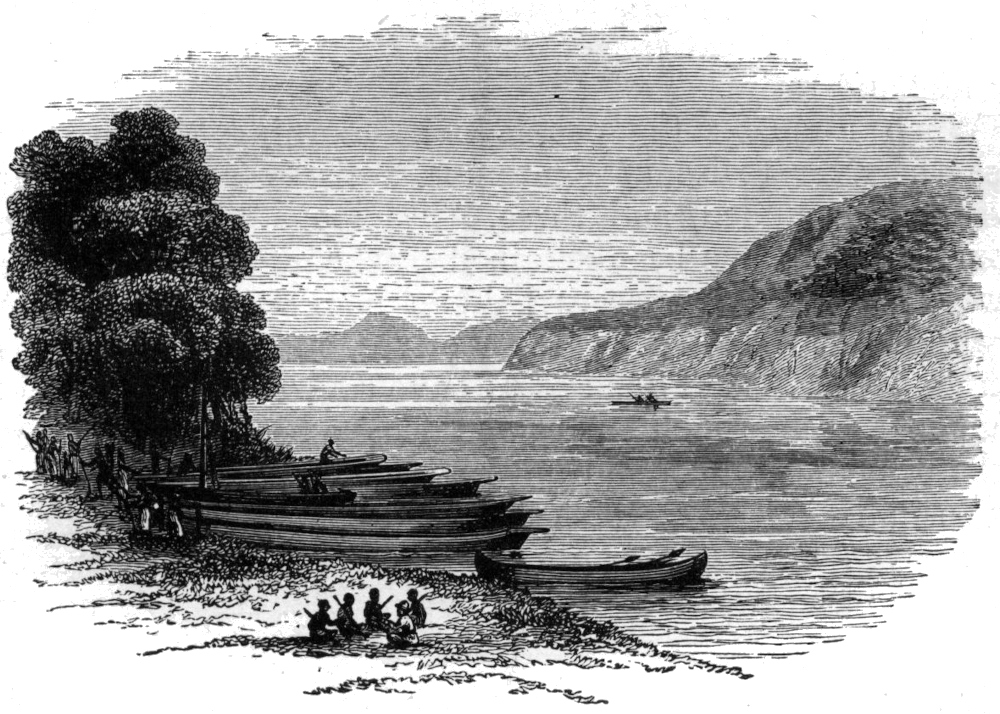
CAMP AT KILOLO.
Rounding, after a long stretch of tolerably calm water, a picturesque point, we view another long reach, and halfway on the left bank we camp. Maddened by sharp pangs of hunger, the people soon scatter about the district of Kilolo. What occurs I know not. Likely enough the wretched creatures, tormented by the insufferable insolence of the aborigines, and goaded by a gnawing emptiness, assisted themselves with the wanton recklessness of necessity, and appropriated food unpaid for. While I am seated among a crowd from the right bank, who have come across the river to elate me with stories of white men whom they have seen by the sea, and from whom I learn the news that there are whites like myself at Embomma, I hear shots on the cultivated uplands; and though I pretend to take no interest in them, yet a bitter, restless instinct informs me that those shots have reference to myself; and presently the people return, some with streaming wounds from oxide of copper pellets and iron fragments which have been fired at them. Uledi comes also, bearing a mere skeleton on his back, whom, with his usual daring, he has rescued from the power of the men who would shortly have made a prisoner of him; and he and the rest have all a horrible tale to tell. 338“Several men have been captured by the natives for stealing cassava and beans.”
“Why did you do it?”
“We could not help it,” said one. “Master, we are dying of hunger. We left our beads and moneys—all we had—on the ground, and began to eat, and they began shooting.”
In a very short time, while they are yet speaking, a large force of natives appears, lusty with life and hearty fare, and, being angered, dare us, with loaded guns, to fight them. A few of the men and chiefs hasten to their guns, and propose to assume the defensive, but I restrain them, and send my native friends from the right bank to talk to them; and, after two hours’ patient entreaties, they relax their vindictiveness and retire.
When I muster the people next morning, that we may cross the river to Nsuki Kintomba, I discover that six men have been wounded, and three, Ali Kiboga,[15] Matagera, and Saburi Rehani, have been detained by the infuriated villagers. It would have been merely half an hour’s quick work, not only to have released the three captives, but to have obtained such an abundance of food as to have saved us much subsequent misery, but such an act would have been quite contrary to the principles which had governed and guided the Expedition in its travels from the eastern sea. Protection was only to be given against a wanton assault on the camp and its occupants; arms were only to be employed to resist savagery; and though, upon considering the circumstances, few could blame the hungry people from appropriating food, yet we 339had but sympathy to give them in their distress. Sad and sorrowful, we turned away from them, abandoning them to their dismal fate.
The river between Kilolo and Nsuki Kintomba was about fourteen hundred yards wide, and both banks were characterized by calm little bays, formed by projected reefs of schistose rock. Just above Nsuki Kintomba a range of mountains runs north-west from some lofty conical hills which front the stream. Below a pretty cove, overhung by a white chalky cliff, in the centre of which there stood a tree-covered islet, we occupied a camp near a high and broad tract of pure white sand.
The inhabitants of the settlement on the right side were unfriendly and they had little, save ground-nuts and cassava, to sell. Whether embittered by the sterility of their country, or suffering from some wrongs perpetrated by tribes near Boma, they did not regard our advent to their country with kindly eyes by any means. Indeed, since leaving Ntombo Mataka we had observed a growing degradation of the aborigines, who were vastly inferior in manners and physical type to the Babwendé. They talked “largely,” but we had been accustomed to that, and our sense of self-respect had long ago become deadened. We obtained a little food—a supply of ground-nuts and bitter cassava; otherwise we must have died.
July 30.—On the 30th of July we continued our journey along the right bank. We first passed several serrated schistose reefs; and behind these we saw a deep creek-like cove—no doubt the Covinda Cove of Tuckey.
Observing at Rock Bluffs Point that the river was ruffled by rocks, we struck again to the left bank, and, following the grove-clad bend, we saw a fine reach of river extending north-west by north, with a breadth of about eighteen hundred yards. Again we crossed the river to the right bank, and a mile from Rock Bluffs Point came to some rapids which extended across the river. We passed these easily, however, and continued on our journey under the shelter of brown stone bluffs, from fifty to eighty feet high. On the left side of the river I observed a line of rock-islets close to the shore. At the end of this long reach was a deep bend in the right bank, through which a lazy creek oozed slowly into the Livingstone. From this bend the great river ran south-south-west, and the roar of a great cataract two miles below 340became fearfully audible, and up from it light clouds of mist, and now and then spray showers, were thrown high into view. Towering above it, on the left, was the precipitous shoulder of a mountain ridge, the summit of which appeared crescent-shaped as we approached it from above. Picking our way towards it cautiously, close to projected reefy points, behind which are the entrances to the recesses in the mountainous bank already described, we arrived within fifty yards of the cataract of Isangila, or Tuckey’s “Second Sangalla.”
We drew our boat and canoes into a sandy-edged basin in the low rocky terrace, and proceeded to view the cataract of Isangila. On the left rises the precipitous shoulder of a mountain ridge, the highest summit of which may be 900 feet. On the right a naked and low rocky terrace is projected from a grassy and gently sloping shelf a mile deep, above which the table-land rises 1200 feet with steep slopes. The rocky terrace appears to be covered by the river in the flood season, but at this period it is contracted to a width of 500 yards. The fall is in the shape of a crescent, along which arise at intervals rocky protuberances of an iron-rust colour, seven in number, one of which, near the middle of the stream, is large enough to be called an islet, being probably a hundred yards in length. Near the right side there is a clear drop of 10 feet, and close below it another drop of 8 feet; on the left side the river hurls itself against the base of the cliff, and then swerves abruptly aside to a south-west-by-south direction; it bounds down the steep descent in a succession of high leaping billows, along a wild tempestuous stretch of a mile and a half in length, disparted in its course by a lofty island, below which it sweeps round into an ample sand-lined basin on the left bank, south of the cataract. To study the nature of the ground I proceeded to a point opposite this basin, and observed the river continue in a westerly course (magnetic). There are abundant traces of lava in the neighbourhood of this cataract, and the cliffs opposite have the appearance of rock subjected to the influence of a fierce fire.
After about two hours’ stay here, the inhabitants of Mwato Zingé, Mwato Wandu, and Mbinda visited us, and we soon became on terms of sociable and friendly intercourse with them; but, unfortunately, they possessed nothing but ground-nuts, bitter cassava, and a few bananas. A couple of goats were purchased at a ruinous price; a handful 341of ground-nuts cost a necklace of beads, while cowries were worthless. Rum, gunpowder, and guns would have purchased ample supplies; but such things required a railway for transportation, and our own guns we could not part with. One chief from the left bank above the cataract came over with his little boy, a pure albino, with blue eyes, curly white hair, and a red skin, of whom he appeared to be very proud, as he said he was also a little Mundelé. The old chief’s hands were bleached in the palms, and in various parts of the body, proving the origin of the peculiar disease.
We received the good news that Embomma was only five days’ journey, rated thus:—
From Isangila to Inga 1 day.
” Inga ” Boondi ”
” Boondi ” Ntabo ”
” Ntabo ” Bibbi ”
” Bibbi ” Embomma ”
We heard also that there were three great cataracts below Isangila, and “any number” of intermediate “Mputu-putu-putu” rapids. The cataracts were Nsongo Yellala, a larger one than either Isangila, Yellala, or Ngufu.
There was not the slightest doubt in my mind that the Isangila cataract was the second Sangalla of Captain Tuckey and Professor Smith, and that the Sanga Yellala of Tuckey and the Sanga Jelalla of Smith was the Nsongo Yellala, though I could not induce the natives to pronounce the words as the members of the unfortunate Congo Expedition of 1816 spelled them.[16]
As the object of the journey had now been attained, and the great river of Livingstone had been connected with the Congo of Tuckey, I saw no reason to follow it farther, or to expend the little remaining vitality we possessed in toiling through the last four cataracts.
342I announced, therefore, to the gallant but wearied Wangwana that we should abandon the river and strike overland for Embomma. The delight of the people manifested itself in loud and fervid exclamations of gratitude to Allah! Quadruple ration-money was also distributed to each man, woman, and child; but owing to the excessive poverty of the country, and the keen trading instincts and avaricious spirit of the aborigines, little benefit did the long-enduring, famine-stricken Wangwana derive from my liberality.
July 31.—Fancy knick-knacks, iron spears, knives, axes, copper, brass wire, were then distributed to them, and I emptied the medicine out of thirty vials; and my private clothes-bags, blankets, waterproofs, every available article of property that might be dispensed with, were also given away, without distinction of rank or merit, to invest in whatever eatables they could procure. The 31st of July was consequently a busy day, devoted to bartering, but few Wangwana were able to boast at evening that they had obtained a tithe of the value of the articles they had sold, and the character of the food actually purchased was altogether unfit for people in such poor condition of body.
At sunset we lifted the brave boat, after her adventurous journey across Africa, and carried her to the summit of some rocks about five hundred yards north of the fall, to be abandoned to her fate. Three years before, Messenger of Teddington had commenced her construction; two years previous to this date she was coasting the bluffs of Uzongora on Lake Victoria; twelve months later she was completing her last twenty miles of the circumnavigation of Lake Tanganika, and on the 31st of July, 1877, after a journey of nearly 7000 miles up and down broad Africa, she was consigned to her resting-place above the Isangila Cataract, to bleach and to rot to dust!
* * * * * * * *
Aug. 1.—A wayworn, feeble, and suffering column were we when, on the 1st of August, we filed across the rocky terrace of Isangila and sloping plain, and strode up the ascent to the table-land. Nearly forty men filled the sick list with dysentery, ulcers, and scurvy, and the victims of the latter disease were steadily increasing. Yet withal I smiled proudly when I saw the brave hearts cheerily respond to my encouraging cries. A few, however, would not believe that within five or six days they should see Europeans. 343They disdained to be considered so credulous, but at the same time they granted that the “master” was quite right to encourage his people with promises of speedy relief.
So we surmounted the table-land, but we could not bribe the wretched natives to guide us to the next village. “Mirambo,” the riding-ass, managed to reach half-way up the table-land, but he also was too far exhausted through the miserable attenuation which the poor grass of the western region had wrought in his frame to struggle further. We could only pat him on the neck and say, “Good-bye, old boy; farewell, old hero! A bad world this for you and for us. We must part at last.” The poor animal appeared to know that we were leaving him, for he neighed after us—a sickly, quavering neigh, that betrayed his excessive weakness. When we last turned to look at him he was lying on the path, but looking up the hill with pointed ears, as though he were wondering why he was left alone, and whither his human friends and companions by flood and field were wandering.
After charging the chief of Mbinda to feed him with cassava leaves and good grass from his fields, I led the caravan over the serried levels of the lofty upland.
At the end of this district, about a mile from Mwato Wandu, we appeared before a village whose inhabitants permitted us to pass on for a little distance, when they suddenly called out to us with expostulatory tones at an almost shrieking pitch. The old chief, followed by about fifty men, about forty of whom carried guns, hurried up to me and sat down in the road.
In a composed and consequential tone he asked, “Know you I am the king of this country?”
I answered mildly, “I knew it not, my brother.”
“I am the king, and how can you pass through my country without paying me?”
“Speak, my friend; what is it the Mundelé can give you?”
“Rum. I want a big bottle of rum, and then you can pass on.”
“Rum?”
“Yes, rum, for I am the king of this country!”
“Rum!” I replied wonderingly.
“Rum; rum is good. I love rum,” he said, with a villainous leer.
344Uledi, coming forward, impetuously asked, “What does this old man want, master?”
“He wants rum, Uledi. Think of it!”
“There’s rum for him,” he said, irreverently slapping his Majesty over the face, who, as the stool was not very firm, fell over prostrate. Naturally this was an affront, and I reproved Uledi for it. Yet it seemed that he had extricated us from a difficult position by his audacity, for the old chief and his people hurried off to their village, where there was great excitement and perturbation, but we could not stay to see the end.
Ever and anon, as we rose above the ridged swells, we caught the glimpse of the wild river on whose bosom we had so long floated. Still white and foaming, it rushed on impetuously seaward through the sombre defile. Then we descended into a deep ravine, and presently, with uneasy throbbing hearts, we breasted a steep slope rough with rock, and from its summit we looked abroad over a heaving, desolate, and ungrateful land. The grass was tall and ripe, and waved and rustled mournfully before the upland breezes. Soon the road declined into a valley, and we were hid in a deep fold, round which rose the upland, here to the west shagged with a thin forest, to the north with ghastly sere grass, out of which rose a few rocks, grey and sad. On our left was furze, with scrub. At the bottom of this, sad and desolate, ran a bright crystal brook. Up again to the summit we strove to gain the crest of a ridge, and then, down once more the tedious road wound in crooked curves to the depth of another ravine, on the opposite side of which rose sharply and steeply, to the wearying height of 1200 feet, the range called Yangi-Yangi. At 11 A.M. we in the van had gained the lofty summit, and fifteen minutes afterwards we descried a settlement and its cluster of palms. An hour afterwards we were camped on a bit of level plateau to the south of the villages of Ndambi Mbongo.
The chiefs appeared, dressed in scarlet military coats of a past epoch. We asked for food for beads. “Cannot.” “For wire?” “We don’t want wire!” “For cowries?” “Are we bushmen?” “For cloth?” “You must wait three days for a market! If you have got rum you can have plenty!!” Rum ! Heavens ! Over two years and eight months ago we departed from the shores of the Eastern Ocean, and they ask us for rum!
345Yet they were not insolent, but unfeeling; they were not rude, but steely selfish. We conversed with them sociably enough, and obtained encouragement. A strong healthy man would reach Embomma in three days. Three days! Only three days off from food—from comforts—luxuries even! Ah me!
Aug. 2.—The next day, when morning was greying, we lifted our weakened limbs for another march. And such a march!—the path all thickly strewn with splinters of suet-coloured quartz, which increased the fatigue and pain. The old men and the three mothers, with their young infants born at the cataracts of Massassa and Zinga, and another near the market town of Manyanga, in the month of June, suffered greatly. Then might be seen that affection for one another which appealed to my sympathies, and endeared them to me still more. Two of the younger men assisted each of the old, and the husbands and fathers lifted their infants on their shoulders and tenderly led their wives along.
Up and down the desolate and sad land wound the poor, hungry caravan. Bleached whiteness of ripest grass, grey rock-piles here and there, looming up solemn and sad in their greyness, a thin grove of trees now and then visible on the heights and in the hollows—such were the scenes that with every uplift of a ridge or rising crest of a hill met our hungry eyes. Eight miles our strength enabled us to make, and then we camped in the middle of an uninhabited valley, where we were supplied with water from the pools which we discovered in the course of a dried-up stream.
Our march on the third day was a continuation of the scenes of the day preceding until about ten o’clock, when we arrived at the summit of a grassy and scrub-covered ridge, which we followed until three in the afternoon. The van then appeared before the miserable settlement of Nsanda, or, as it is sometimes called, Banza (town) N’sanda N’sanga. Marching through the one street of the first village in melancholy and silent procession, voiceless as sphinxes, we felt our way down into a deep gully, and crawled up again to the level of the village site, and camped about two hundred yards away. It was night before all had arrived.
Aug. 4.—After we had erected our huts and lifted the tent into its usual place, the chief of Nsanda appeared, a youngish, slightly made man, much given to singing, being 346normally drunk from an excess of palm-wine. He was kindly, sociable—laughed, giggled, and was amusing. Of course he knew Embomma, had frequently visited there, and carried thither large quantities of Nguba ground-nuts, which he had sold for rum. We listened, as in duty bound, with a melancholy interest. Then I suddenly asked him if he would carry a makanda, or letter, to Embomma, and allow three of my men to accompany him. He was too great to proceed himself, but he would despatch two of his young men the next day. His consent I obtained only after four hours of earnest entreaty. It was finally decided that I should write a letter, and the two young natives would be ready next day. After my dinner—three fried bananas, twenty roasted ground-nuts, and a cup of muddy water, my usual fare now—by a lamp made out of a piece of rotten sheeting steeped in a little palm-butter I wrote the following letter:—
“Village of Nsanda, August 4, 1877.
“To any Gentleman who speaks English at Embomma.
“Dear Sir,
“I have arrived at this place from Zanzibar with 115 souls, men, women and children. We are now in a state of imminent starvation. We can buy nothing from the natives, for they laugh at our kinds of cloth, beads, and wire. There are no provisions in the country that may be purchased, except on market days, and starving people cannot afford to wait for these markets. I, therefore, have made bold to despatch three of my young men, natives of Zanzibar, with a boy named Robert Feruzi, of the English Mission at Zanzibar, with this letter craving relief from you. I do not know you; but I am told there is an Englishman at Embomma, and as you are a Christian and a gentleman, I beg you not to disregard my request. The boy Robert will be better able to describe our lone condition than I can tell you in this letter. We are in a state of the greatest distress; but if your supplies arrive in time, I may be able to reach Embomma within four days. I want three hundred cloths, each four yards long, of such quality as you trade with, which is very different from that we have; but better than all would ten or fifteen man-loads of rice or grain to fill their pinched bellies immediately, as even with the cloths it would require time to purchase food, and starving people cannot wait. The 347supplies must arrive within two days, or I may have a fearful time of it among the dying. Of course I hold myself responsible for any expense you may incur in this business. What is wanted is immediate relief; and I pray you to use your utmost energies to forward it at once. For myself, if you have such little luxuries as tea, coffee, sugar, and biscuits by you, such as one man can easily carry, I beg you on my own behalf that you will send a small supply, and add to the great debt of gratitude due to you upon the timely arrival of the supplies for my people. Until that time I beg you to believe me,
“Yours sincerely,
“H. M. Stanley,
“Commanding Anglo-American Expedition
for Exploration of Africa.
“P.S.—You may not know me by name I therefore add, I am the person that discovered Livingstone in 1871.—H. M. S.”
I also wrote a letter in French, and another in Spanish as a substitute for Portuguese, as I heard at Nsanda that there was one Englishman, one Frenchman, and three Portuguese at Embomma; but there were conflicting statements, some saying that there was no Englishman, but a Dutchman. However, I imagined I was sure to obtain provisions—for most European merchants understand either English, French, or Spanish.
The chiefs and boat’s crew were called to my tent. I then told them that I had resolved to despatch four messengers to the white men at Embomma, with letters asking for food, and wished to know the names of those most likely to travel quickly and through anything that interposed to prevent them; for it might be possible that so small a number of men might be subjected to delays and interruptions, and that the guides might loiter on the way, and so protract the journey until relief would arrive too late.
The response was not long coming, for Uledi sprang up and said, “Oh, master, don’t talk more; I am ready now. See, I will only buckle on my belt, and I shall start at once, and nothing will stop me. I will follow on the track like a leopard.”
“And I am one,” said Kachéché. “Leave us alone, 348master. If there are white men at Embomma, we will find them out. We will walk, and walk, and when we cannot walk we will crawl.”
“Leave off talking, men,” said Muini Pembé, “and allow others to speak, won’t you? Hear me, my master. I am your servant. I will outwalk the two. I will carry the letter, and plant it before the eyes of the white men.”
“I will go too, sir,” said Robert.
“Good. It is just as I should wish it; but, Robert, you cannot follow these three men. You will break down, my boy.”
“Oh, we will carry him if he breaks down,” said Uledi. “Won’t we, Kachéché?”
“Inshallah!” responded Kachéché decisively. “We must have Robert along with us, otherwise the white men won’t understand us.”
Aug. 5.—Early the next day the two guides appeared, but the whole of the morning was wasted in endeavouring to induce them to set off. Uledi waxed impatient, and buckled on his accoutrements, drawing his belt so tight about his waist that it was perfectly painful to watch him, and said, “Give us the letters, master! we will not wait for the pagans. Our people will be dead before we start. Regard them, will you! They are sprawling about the camp without any life in them. Goee—Go-ee—Go-ee.” Finally, at noon, the guides and messengers departed in company.
Meanwhile a bale of cloth and a sack of beads were distributed, and the strongest and youngest men despatched abroad in all directions to forage for food. Late in the afternoon they arrived in camp weakened and dispirited, having, despite all efforts, obtained but a few bundles of the miserable ground-nuts and sufficient sweet potatoes to give three small ones to each person, though they had given twenty times their value for each one. The heartless reply of the spoiled aborigines was, “Wait for the zandu,” or market, which was to be held in two days at Nsanda; for, as amongst the Babwendé, each district has its respective days for marketing. Still what we had obtained was a respite from death; and, on the morning of the 5th, the people were prepared to drag their weary limbs nearer to the expected relief.
Our route lay along the crest of a ridge, until we arrived at a narrow alluvial valley, in which the chief village of the Nsanda district is situate, amidst palms, ground-nut, and 349cassava gardens, and small patches of beans, peas, and sweet potatoes. From this valley we ascended the grassy upland, until we came to what we might call Southern Nsanda. We had proceeded about two hundred yards beyond it when a powerful man, followed by a large crowd, advanced toward us, and, like him near Mwato Wandu, demanded to know why we passed through without payment.
“Payment! Payment for what? Look at my people; they are skin and bone. They are dying for want of food in your country. Brother, stand off, or these men will be smelling food for themselves, and I would not stop them.”
He became outrageous; he called for his gun; his followers armed themselves. Observing matters getting serious, I disposed as a precautionary measure twenty men as skirmishers in front of the road and ten in rear, leaving the goods and sick people in the centre. Word was then given to the powerful man that they had better not shoot, for our people were angry, and were very different from any they had seen, and nothing could stop them if they began; and it was possible they might eat every soul in Nsanda. I observed that the last sentence had a potent effect; the angry demonstrations were followed by a loud consultation; the loud consultation subsided into whispers, and soon the “powerful man” said “Enough,” and we advanced towards each other, laughed, and shook hands heartily. At this juncture appeared the chief of the central village, who had furnished us with guides, and he, upon hearing of the intended injury to the Mundelé, insisted upon the “powerful man” bringing forth a gourd and jug and wash-basin full of palm-wine, and sealing our friendship by a “drink all round;” which was done, and I promised to send the “powerful man” a present of a bottle of rum from Embomma.
At 3 P.M., after a march of twelve miles, the van of the Expedition descended the slope of the high wood-covered ridge of Ikungu, whence the populous valley of Mbinda lay revealed. Halfway down the slope we camped, being in view of eighteen villages. The entire population of Mbinda—the valley, or basin, derives its name from the south-eastern ridge, which is called Mbinda—I roughly estimated at being about three thousand souls. Each of these villages bears a different name, but the entire number is under three chiefs, who are styled “kings,” and are extremely absurd in their pomposity. The people are sufficiently amiable, but terribly extortionate 350and grasping, and so niggardly and close in trade that the Wangwana became more and more weakened. Festishism is carried to an extraordinary extent. Idols of wood, tolerably well carved, are numerous, and the various ceremonies practised by these people would fill a volume. Some hideous and ghostly objects, with chalked bodies, wearing skirts of palm-leaves or grass, hovered about at respectful distance, and I was told by the chief of Nsanda that they had been lately circumcised. Ground-nuts are the chief produce here, as well as of all the region from Manyanga of the Babwendé, because they are in demand by the merchants of Embomma. By means of the markets held alternately in each district, the ground-nuts are being brought from immense distances. But while their cultivation retards exploration, it proves that the natives are willing to devote themselves to any branch of agriculture that may be profitable. In former days the slave and the ivory-trade supported a vast portion of this region, but perceiving that slaves are not now in demand, and ivory not abundant enough to be profitable, the natives have resorted to the cultivation of ground-nuts for the supply of the Europeans at Embomma, palms for the sake of their intoxicating juice, and only a few small patches of beans, vetches, sweet potatoes, &c., for home consumption.
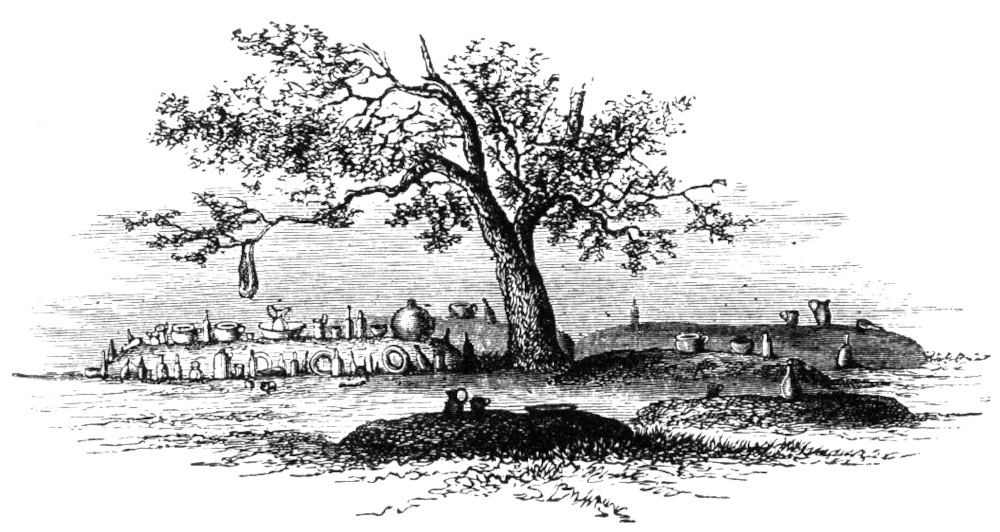
MBINDA CEMETERY.
Close to our camp was a cemetery of a village of Mbinda. The grave-mounds were neat, and by their appearance I should judge them to be not only the repositories of the dead, but also the depositories of all the articles that had belonged to the dead. Each grave was dressed out with the various mugs, pitchers, wash-basins, teapots, kettles, glasses, gin, 351brandy, and beer bottles, besides iron skillets, kettles, tin watering-pots, and buckets; and above the mound thus curiously decorated were suspended to the branch of a tree the various net haversacks of palm-fibre in which the deceased had carried his ground-nuts, cassava bread, and eatables. The various articles of property thus exhibited, especially the useful articles, had all been purposely rendered useless, otherwise I doubt if, with all their superstition, thieves could have been restrained from appropriating them.
Aug. 6.—On the 6th we roused ourselves for a further effort, and after filing through several villages separated from each other by intervals of waste land, we arrived at 9 A.M. near Banza Mbuko. Haggard, woe-begone invalids, with bloated faces, but terribly angular bodies, we sought a quiet spot a mile beyond the outermost village of the settlement. Mbinda’s wooded ridge was in view, and Ikungu’s bearded summits were fast receding into distance and obscurity. Banza Mbuko seemed prosperous; the inhabitants appeared to be well fed, but, as though we were denizens of another world, nothing of warm sympathy could I detect in the face of any one of all those that gazed on us. Ah! in what part of all the Japhetic world would such a distressed and woful band as we were then have been regarded with such hard, steel-cold eyes? Yet not one word of reproach issued from the starving people; they threw themselves upon the ground with an indifference begotten of despair and misery. They did not fret, nor bewail aloud the tortures of famine, nor vent the anguish of their pinched bowels in cries, but with stony resignation surrendered themselves to rest, under the scant shade of some dwarf acacia or sparse bush. Now and then I caught the wail of an infant, and the thin voice of a starving mother, or the petulant remonstrance of an older child; but the adults remained still and apparently lifeless, each contracted within the exclusiveness of individual suffering. The youths, companions of Uledi, and the chiefs, sat in whispering groups, removed from the sick and grieving, and darkly dotted the vicinity of the tent; the childless women were also seen by twos and threes far apart, discussing, no doubt, our prospects, for at this period this was the most absorbing topic of the camp.
Suddenly the shrill voice of a little boy was heard saying, “Oh! I see Uledi and Kachéché coming down the hill, and there are plenty of men following them!”
352“What!—what!—what!” broke out eagerly from several voices, and dark forms were seen springing up from amongst the bleached grass, and from under the shade, and many eyes were directed at the whitened hill-slope.
“Yes; it is true! it is true! La il Allah il Allah! Yes; el hamd ul Illah! Yes, it is food! food! food at last! Ah, that Uledi! he is a lion, truly! We are saved, thank God!”
Before many minutes, Uledi and Kachéché were seen tearing through the grass, and approaching us with long springing strides, holding a letter up to announce to us that they had been successful. And the gallant fellows, hurrying up, soon placed it in my hands, and in the hearing of all who were gathered to hear the news I translated the following letter:—
“Embomma, “6.30 A.M.,
“English Factory. “Boma, 6th August, 1877.
“H. M. Stanley, Esq.
“Dear Sir,
“Your welcome letter came to hand yesterday, at 7 P.M. As soon as its contents were understood, we immediately arranged to despatch to you such articles as you requested, as much as our stock on hand would permit, and other things that we deemed would be suitable in that locality. You will see that we send fifty pieces of cloth, each 24 yards long, and some sacks containing sundries for yourself; several sacks of rice, sweet potatoes, also a few bundles of fish, a bundle of tobacco, and one demijohn of rum. The carriers are all paid, so that you need not trouble yourself about them. That is all we need say about business. We are exceedingly sorry to hear that you have arrived in such piteous condition, but we send our warmest congratulations to you, and hope that you will soon arrive in Boma (this place is called Boma by us, though on the map it is Em-bomma). Again hoping that you will soon arrive, and that you are not suffering in health,
“Believe us to remain,
“Your sincere friends,
“Hatton & Cookson.
(Signed) “A. da Motta Veiga.
“J. W. Harrison.”
353Uledi and Kachéché then delivered their budget. Their guides had accompanied them halfway, when they became frightened by the menaces of some of the natives of Mbinda, and deserted them. The four Wangwana, however, undertook the journey alone, and, following a road for several hours, they appeared at Bibbi after dark. The next day (the 5th), being told by the natives that Boma (to which Embomma was now changed) was lower down river, and unable to obtain guides, the brave fellows resolved upon following the Congo along its banks. About an hour after sunset, after a fatiguing march over many hills, they reached Boma, and, asking a native for the house of the “Ingreza” (English), were shown to the factory of Messrs. Hatton and Cookson, which was superintended by a Portuguese gentleman, Mr. A. da Motta Veiga, and Mr. John W. Harrison, of Liverpool. Kachéché, who was a better narrator than Uledi, then related that a short white man, wearing spectacles, opened the letter, and, after reading awhile, asked which was Robert Feruzi, who answered for himself in English, and, in answer to many questions, gave a summary of our travels and adventures, but not before the cooks were set to prepare an abundance of food, which they sadly needed, after a fast of over thirty hours.
By this time the procession of carriers from Messrs. Hatton and Cookson’s factory had approached, and all eyes were directed at the pompous old “capitan” and the relief caravan behind him. Several of the Wangwana officiously stepped forward to relieve the fatigued and perspiring men, and with an extraordinary vigour tossed the provisions—rice, fish, and tobacco bundles—on the ground, except the demijohn of rum, which they called pombé, and handled most carefully. The “capitan” was anxious about my private stores, but the scene transpiring about the provisions was so absorbingly interesting that I could pay no attention as yet to them. While the captains of the messes were ripping open the sacks and distributing the provisions in equal quantities, Murabo, the boat-boy, struck up a glorious loud-swelling chant of triumph and success, into which he deftly, and with a poet’s licence, interpolated verses laudatory of the white men of the second sea. The bard, extemporizing, sang much about the great cataracts, cannibals, and pagans, hunger, the wide wastes, great inland seas, and niggardly tribes, and wound up by declaring that the journey was over, 354that we were even then smelling the breezes of the western ocean, and his master’s brothers had redeemed them from the “hell of hunger.” And at the end of each verse the voices, rose high and clear to the chorus—
“Then sing, O friends, sing; the journey is ended;
Sing aloud, O friends, sing to this great sea.”
“Enough now; fall to,” said Manwa Sera, at which the people nearly smothered him by their numbers. Into each apron, bowl, and utensil held out, the several captains expeditiously tossed full measures of rice and generous quantities of sweet potatoes and portions of fish. The younger men and women hobbled after water, and others set about gathering fuel, and the camp was all animation, where but half an hour previously all had been listless despair. Many people were unable to wait for the food to be cooked, but ate the rice and the fish raw. But when the provisions had all been distributed, and the noggin of rum had been equitably poured into each man’s cup, and the camp was in a state of genial excitement, and groups of dark figures discussed with animation the prospective food which the hospitable fires were fast preparing, then I turned to my tent, accompanied by Uledi, Kachéché, the capitan, and the tent-boys, who were, I suppose, eager to witness my transports of delight.
With profound tenderness Kachéché handed to me the mysterious bottles, watching my face the while with his sharp detective eyes as I glanced at the labels, by which the cunning rogue read my pleasure. Pale ale! Sherry! Port wine! Champagne! Several loaves of bread, wheaten bread, sufficient for a week. Two pots of butter. A packet of tea! Coffee! White loaf-sugar! Sardines and salmon! Plum-pudding! Currant, gooseberry, and raspberry jam!
The gracious God be praised for ever! The long war we had maintained against famine and the siege of woe were over, and my people and I rejoiced in plenty! It was only an hour before we had been living on the recollections of the few pea-nuts and green bananas we had consumed in the morning, but now, in an instant, we were transported into the presence of the luxuries of civilization. Never did gaunt Africa appear so unworthy and so despicable before my eyes as now, when imperial Europe rose before my delighted eyes and showed her boundless treasures of life, and blessed me with her stores.
355When we all felt refreshed, the cloth bales were opened, and soon, instead of the venerable and tattered relics of Manchester, Salem, and Nashua manufacture, which were hastily consumed by the fire, the people were reclad with white cloths and gay prints. The nakedness of want, the bare ribs, the sharp protruding bones were thus covered; but months must elapse before the hollow sunken cheeks and haggard faces would again resume the healthy bronze colour which distinguishes the well-fed African.
My condition of mind in the evening of the eventful day which was signalized by the happy union which we had made with the merchants of the west coast, may be guessed by the following letter:—
“Banza Mbuko, August 6, 1877.
“Messrs. A. da Motta Veiga and J. W. Harrison,
Embomma, Congo River.
“Gentlemen,
“I have received your very welcome letter, but better than all, and more welcome, your supplies. I am unable to express just at present how grateful I feel. We are all so overjoyed and confused with our emotions, at the sight of the stores exposed to our hungry eyes—at the sight of the rice, the fish, and the rum, and for me—wheaten bread, butter, sardines, jam, peaches, grapes, beer (ye gods! just think of it—three bottles pale ale!) besides tea and sugar—that we cannot restrain ourselves from falling to and enjoying this sudden bounteous store—and I beg you will charge our apparent want of thankfulness to our greediness. If we do not thank you sufficiently in words, rest assured we feel what volumes could not describe.
“For the next twenty-four hours we shall be too busy eating to think of anything else much; but I may say that the people cry out joyfully, while their mouths are full of rice and fish, ‘Verily, our master has found the sea, and his brothers, but we did not believe him until he showed us the rice and the pombé (rum). We did not believe there was any end to the great river; but, God be praised for ever, we shall see white people to-morrow, and our wars and troubles will be over.’
“Dear Sirs—though strangers, I feel we shall be great friends, and it will be the study of my lifetime to remember my feelings of gratefulness, when I first caught sight of your 356supplies, and my poor faithful and brave people cried out, ‘Master, we are saved!—food is coming!’ The old and the young—the men, the women, the children—lifted their wearied and worn-out frames, and began to chant lustily an extemporaneous song, in honour of the white people by the great salt sea (the Atlantic) who had listened to their prayers. I had to rush to my tent to hide the tears that would issue, despite all my attempts at composure.
“Gentlemen, that the blessing of God may attend your footsteps whithersoever you go is the very earnest prayer of
“Yours faithfully,
“Henry M. Stanley,
“Commanding Anglo-American Expedition.”
Aug. 7.—At the same hour on the morning of the 7th that we resumed the march, Kachéché and Uledi were despatched to Boma with the above letter. Then surmounting a ridge, we beheld a grassy country barred with seams of red clay in gullies, ravines, and slopes, the effects of rain, dipping into basins with frequently broad masses of plateau and great dyke-like ridges between, and in the distance south-west of us a lofty, tree-clad hill-range, which we were told we should have to climb before descending to N’lamba N’lamba, where we proposed camping.
Half an hour’s march brought us to a market-place, where a tragedy had been enacted a short time before the relief caravan had passed it the day previous. Two thieves had robbed a woman of salt, and, according to the local custom which ordains the severest penalties for theft in the public mart, the two felons had been immediately executed, and their bodies laid close to the path to deter others evilly disposed from committing like crimes.
At noon we surmounted the lofty range which we had viewed near Banza Mbuko, and the aneroid indicated a height of 1500 feet. A short distance from its base, on two grassy hills, is situate N’lamba N’lamba, a settlement comprising several villages, and as populous as Mbinda. The houses and streets were very clean and neat; but, as of old, the natives are devoted to idolatry, and their passion for carving wooden idols was illustrated in every street we passed through.
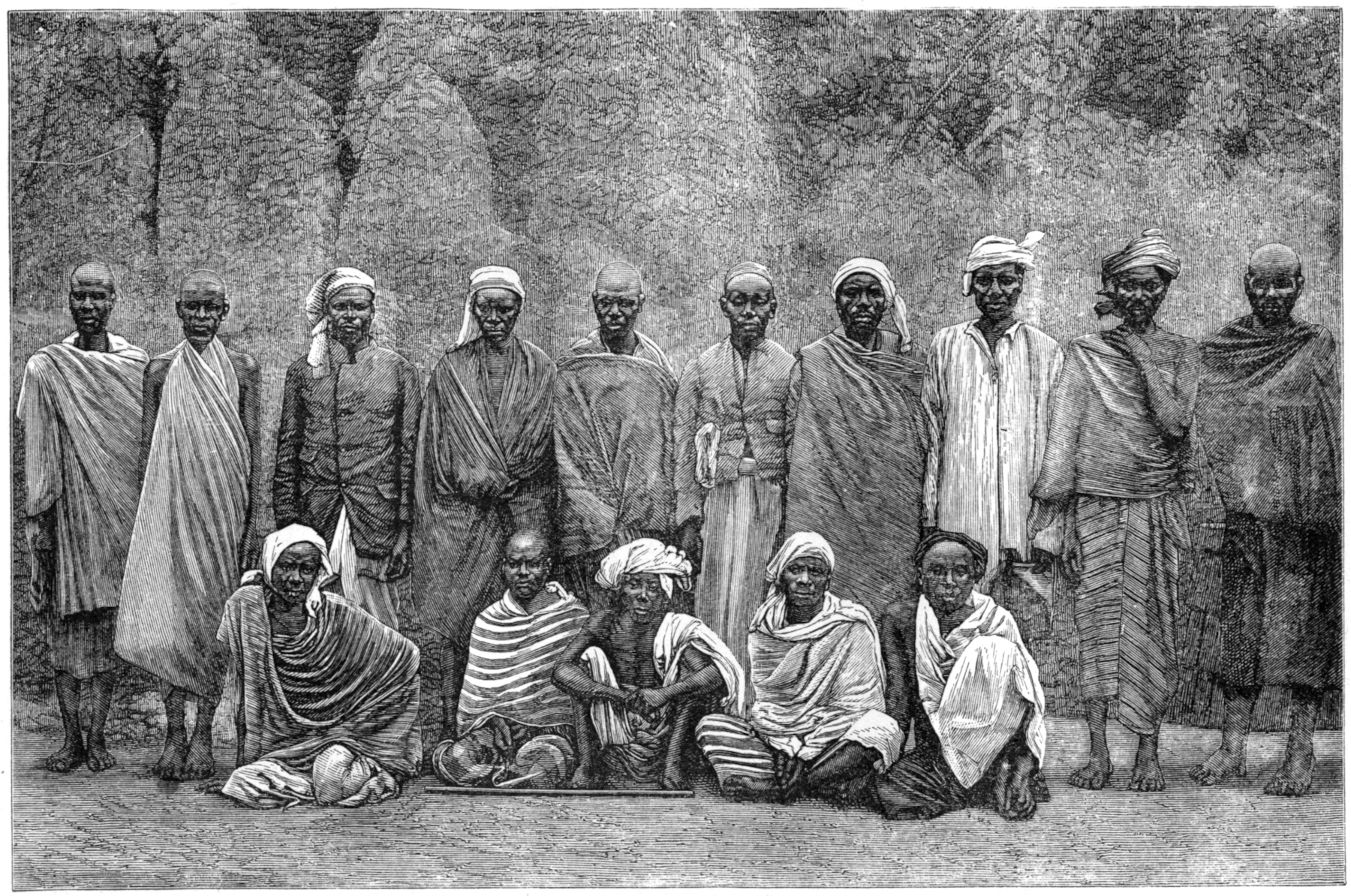
GROUP OF MR. STANLEY’S FOLLOWERS AT KABINDA, WEST COAST OF AFRICA, JUST AFTER CROSSING THE “DARK CONTINENT.” (From a photograph by Mr. Phillips, of Kabinda.)
Aug. 8.—On the 8th we made a short march of five 357miles to N’safu, over a sterile, bare, and hilly country, but the highest ridge passed was not over 1100 feet above the sea. Uledi and Kachéché returned at this place with more cheer for us, and a note acknowledging my letter of thanks.
In a postscript to this note, Mr. Motta Veiga prepared me for a reception which was to meet me on the road halfway between N’safu and Boma; it also contained the census of the European population, as follows:—
“Perhaps you do not know that in Boma there are only eleven Portuguese, one Frenchman, one Dutchman, one gentleman from St. Helena, and ourselves (Messrs. Motta Veiga and J. W. Harrison), Messrs. Hatton and Cookson being in Liverpool, and the two signatures above being names of those in charge of the English factory here.”
Aug. 9.—On the 9th of August, 1877, the 999th day from the date of our departure from Zanzibar, we prepared to greet the van of civilization.
From the bare rocky ridges of N’safu there is a perceptible decline to the Congo valley, and the country becomes, in appearance, more sterile—a sparse population dwelling in a mere skeleton village in the centre of bleakness. Shingly rocks strewed the path and the waste, and thin sere grass waved mournfully on level and spine, on slope of ridge and crest of hill; in the hollows it was somewhat thicker; in the bottoms it had a slight tinge of green.
We had gradually descended some five hundred feet along declining spurs when we saw a scattered string of hammocks appearing, and gleams of startling whiteness, such as were given by fine linen and twills.
A buzz of wonder rang along our column.
Proceeding a little farther, we stopped, and in a short time I was face to face with four white—ay, truly white men!
As I looked into their faces, I blushed to find that I was wondering at their paleness. Poor pagan Africans—Rwoma of Uzinja, and man-eating tribes of the Livingstone! The whole secret of their wonder and curiosity flashed upon me at once. What arrested the twanging bow and the deadly trigger of the cannibals? What but the weird pallor of myself and Frank! In the same manner the sight of the pale faces of the Embomma merchants gave me the slightest suspicion of an involuntary shiver. The pale colour, after so 358long gazing on rich, black and richer bronze, had something of an unaccountable ghastliness. I could not divest myself of the feeling that they must be sick; yet, as I compare their complexions to what I now view, I should say they were olive, sunburnt, dark.
Yet there was something very self-possessed about the carriage of these white men. It was grand; a little self-pride mixed with cordiality. I could not remember just then that I had witnessed such bearing among any tribe throughout Africa. They spoke well also; the words they uttered hit the sense pat; without gesture, they were perfectly intelligible. How strange! It was quite delightful to observe the slight nods of the head; the intelligent facial movements were admirably expressive. They were completely clothed, and neat also; I ought to say immaculately clean. Jaunty straw hats, coloured neck-ties, patent-leather boots, well-cut white clothes, virtuously clean! I looked from them to my people, and then I fear I felt almost like being grateful to the Creator that I was not as black as they, and that these finely-dressed, well-spoken whites claimed me as friend and kin. Yet I did not dare to place myself upon an equality with them as yet; the calm blue and grey eyes rather awed me, and the immaculate purity of their clothes dazzled me. I was content to suppose myself a kind of connecting link between the white and the African for the time being. Possibly familiarity would beget greater confidence.
They expressed themselves delighted to see me; congratulated me with great warmth of feeling, and offered to me the “Freedom of Boma!” We travelled together along the path for a mile, and came to the frontier village of Boma, or Embomma, where the “king” was at hand to do the honours. My courteous friends had brought a hamper containing luxuries. Hock and champagne appeared to be cheap enough where but a few hours previous a cup of palm-wine was as precious as nectar; rare dainties of Paris and London abundant, though a short time ago we were stinted of even ground-nuts. Nor were the Wangwana forgotten, for plenty had also been prepared for them.
My friends who thus welcomed me amongst the descendants of Japhet were Mr. A. da Motta Veiga, Senhores Luiz Pinto Maroo, João Chaves, Henrique Germano Faro, and Mr. J. F. Müller, of the Dutch factory. They had brought a hammock with them, and eight sturdy, well-fed bearers. 359They insisted on my permitting them to lift me into the hammock. I declined. They said it was a Portuguese custom. To custom, therefore, I yielded, though it appeared very effeminate.
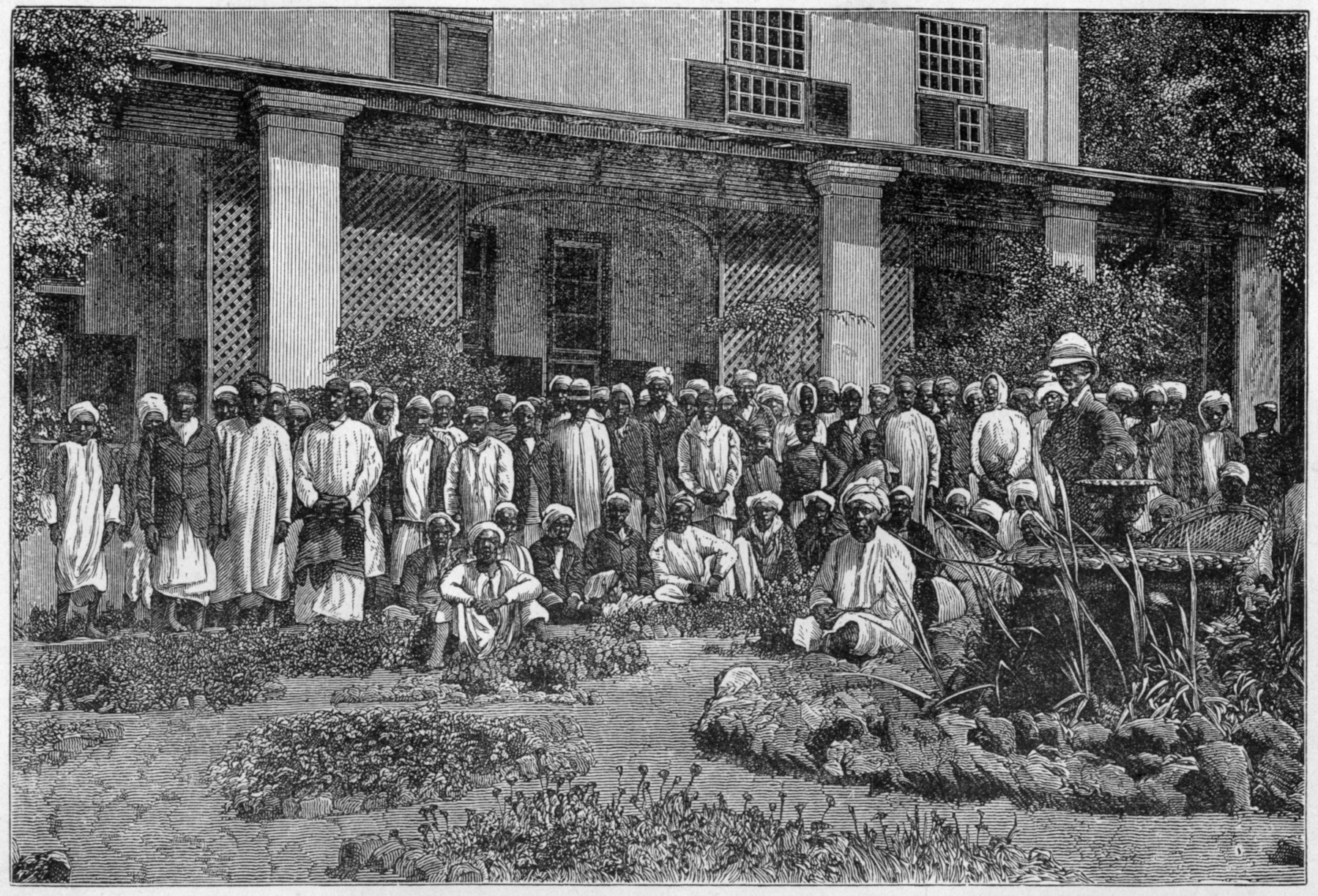
THE RECUPERATED AND RECLAD EXPEDITION AS IT APPEARED AT ADMIRALTY HOUSE, SIMON’S TOWN, AFTER OUR ARRIVAL ON H.M.S. ‘INDUSTRY.’
It was a gradual slope through a valley, which soon opened into a low alluvial plain, seamed here and there with narrow gullies, and then over the heads of the tall grass as I lay in the hammock I caught a glimpse of the tall square box of a frame-house, with a steep roof, erected on rising ground. It brought back a host of old recollections; for everywhere on the frontiers of civilization in America one may see the like. It approached nearer and larger to the view, and presently the hammock was halted by whitewashed palings, above which the square two-storied box rose on piles with a strangeness that was almost weird. It was the residence of those in charge of the English factory.
Looking from the house, my eyes rested on the river. Ah! the hateful, murderous river, now so broad and proud and majestically calm, as though it had not bereft me of a friend, and of many faithful souls, and as though we had never heard it rage and whiten with fury, and mock the thunder. What a hypocritical river! But just below the landing a steamer was ascending—the Kabinda, John Petherbridge, master. How civilization was advancing on me! Not a moment even to lie down and rest! Full-blooded, eager, restless, and aggressive, it pressed on me, and claimed me for its own, without allowing me even the time to cast one retrospective glance at the horrors left behind. While still overwhelmed by the thought, the people of the Expedition appeared, pressing forward to admire and gaze wide-eyed at the strange “big iron canoe,” driven by fire on their river; for there were several Wanyamwezi, Waganda, and east coast men who would not believe that there was anything more wonderful than the Lady Alice.
Our life at Boma,[17] which lasted only from 11 A.M. of the 9th to noon of the 11th, passed too quickly away; but throughout it was intensest pleasure and gaiety.
There are some half-dozen factories at Boma, engaging the attention of about eighteen whites. The houses are all constructed of wooden boards, with, as a rule, corrugated zinc roofs. The residences line the river front; the Dutch, 360French, and Portuguese factories being west of an isolated high square-browed hill, which, by-the-bye, is a capital site for a fortlet; and the English factory being a few hundred yards above it. Each factory requires an ample courtyard for its business, which consists in the barter of cotton fabrics, glass-ware, crockery, iron-ware, gin, rum, gums and gunpowder, for palm-oil, ground-nuts, and ivory. The merchants contrive to exist as comfortably as their means will allow. Some of them plant fruits and garden vegetables, and cultivate grape-vines. Pine-apples, guavas and limes may be obtained from the market, which is held on alternate days a short distance behind the European settlement.
Though Boma is comparatively ancient, and Europeans have had commercial connections with this district and the people for over a century, yet Captain Tuckey’s description of the people, written in 1816—their ceremonies and modes of life, their suspicion of strangers and intolerance, their greed for rum and indolence, the scarcity of food—is as correct as though written to-day. The name “Boma,” however, has usurped that of “Lombee,” which Captain Tuckey knew; the banza of Embomma being a little distance inland. In his day it was a village of about one hundred huts, in which was held the market of the banza, or king’s town.
The view inland is dreary, bleak, and unpromising, consisting of grassy hills, and of a broken country, its only boast the sturdy baobab, which relieves the nakedness of the land. But—fresh from the hungry wilderness and the land of selfish men, from the storm and stress of the cataracts, the solemn rock defiles of the Livingstone, and the bleak table-land—I heeded it not. The glowing warm life of Western civilization, the hospitable civilities and gracious kindnesses which the merchants of Boma showered on myself and people, were as dews of Paradise, grateful, soothing, and refreshing.
Aug. 11.—On the 11th, at noon, after a last little banquet and songs, hearty cheers, innumerable toasts, and fervid claspings of friendly hands, we embarked. An hour before sunset the “big iron canoe,” after a descent of about thirty-five miles, hauled in-shore, on the right bank, and made fast to the pier of another of Hatton and Cookson’s factories at Ponta da Lenha, or Wooded Point. Two or three other Portuguese factories are in close neighbourhood to it, lightening the gloom of the background of black mangrove and forest.
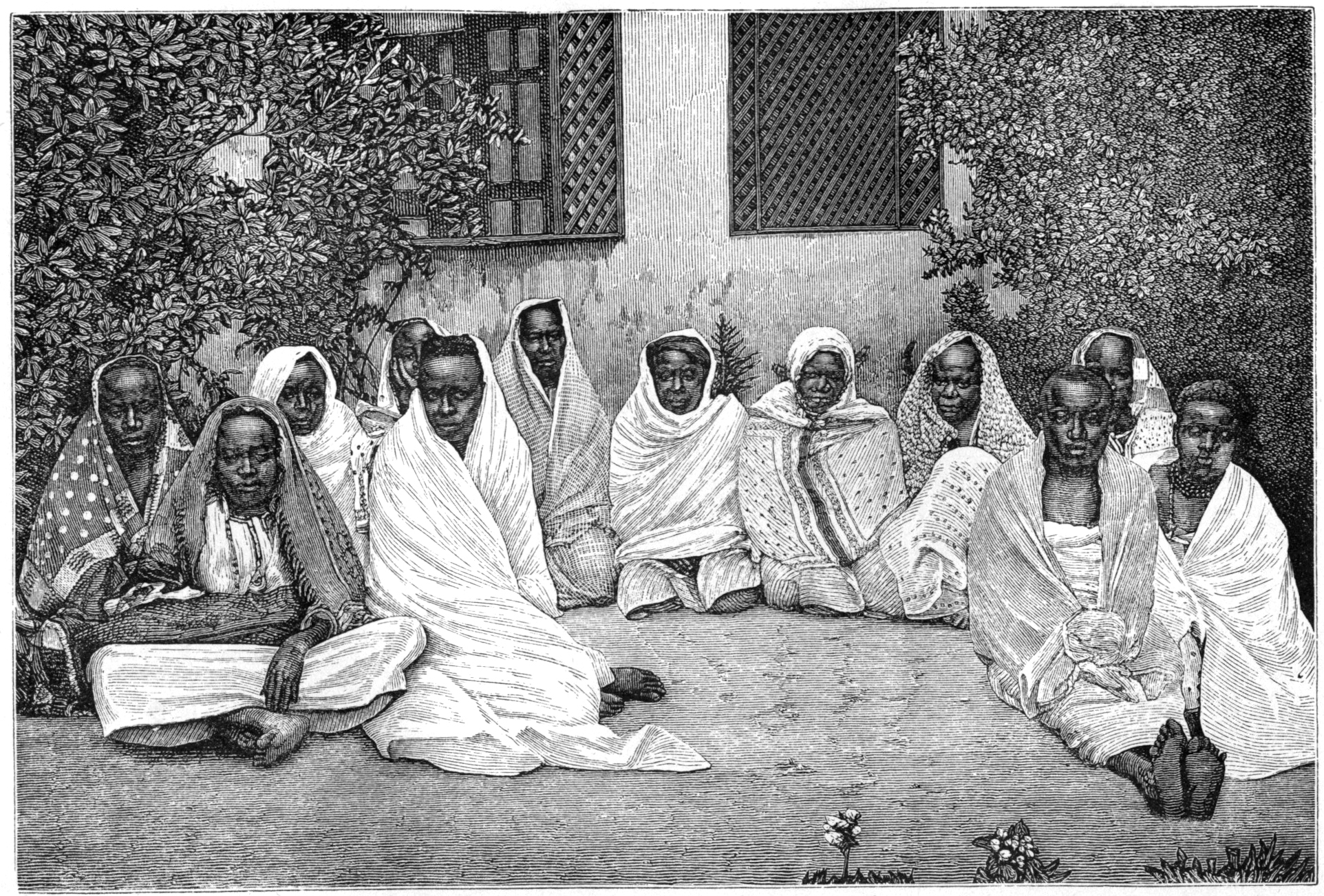
1. Wife of Murabo. 4. Half caste of Gambaragara, whom Wadi Rehani married. 7. Wife of Manwa Sera. 10. Wife of Muscati.
2. ” Robert. 5. Zaidi’s wife. 8. ” Chowpereh. 11. ” Chiwonda.
3. ” Mana Koko. 6. Wife of Wadi Baraka. 9. ” Muini Pembé. 12. ” Multa.
361After a very agreeable night with our hospitable English host, the Kabinda was again under way.
The puissant river below Boma reminded me of the scenes above Uyanzi; the colour of the water, the numerous islands, and the enormous breadth recalled those days when we had sought the liquid wildernesses of the Livingstone, to avoid incessant conflicts with the human beasts of prey in the midst of Primitive Africa, and at the sight my eyes filled with tears at the thought that I could not recall my lost friends, and bid them share the rapturous joy that now filled the hearts of all those who had endured and survived.
A few hours later and we were gliding through the broad portal into the Ocean, the blue domain of civilization!
Turning to take a farewell glance at the mighty River on whose brown bosom we had endured so greatly, I saw it approach, awed and humbled, the threshold of the watery immensity, to whose immeasurable volume and illimitable expanse, awful as had been its power, and terrible as had been its fury, its flood was but a drop. And I felt my heart suffused with purest gratitude to Him whose hand had protected us, and who had enabled us to pierce the Dark Continent from east to west, and to trace its mightiest River to its Ocean bourne.
362
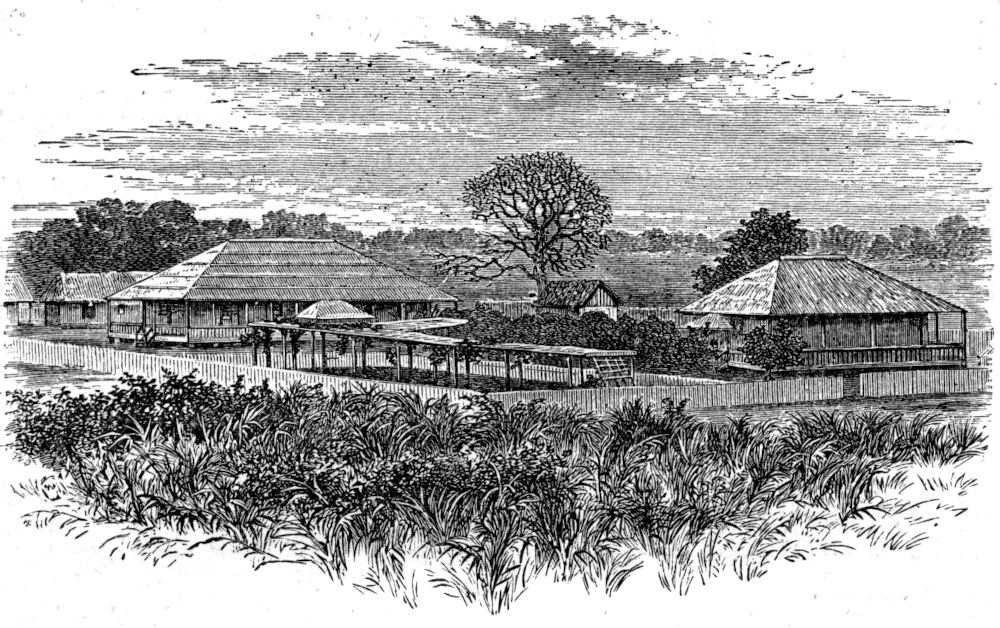
AT REST: MY QUARTERS AT KABINDA BY THE SEA. (From a photograph by Mr. Phillips.)]