I HISTORICAL SKETCH (continued 2)
Reading edition
Also by this time any illusions the Inca may have had as to the continuance of the ancient dynasty under the protection of the Spaniards were dispelled. By this time even his complaisant subjects must have discovered that these superhuman deliverers, as they had thought them, were mere men—or else, if they were indeed a different order of beings, that order, they must have concluded, was infernal rather than divine. The sovereignty of the Inca had become little more than a fiction. As in the islands of the Caribbean and elsewhere, the fairest lands in the country had been divided into vast estates and great numbers of natives practically reduced to slavery and set to work them for the benefit of their new masters. With respect to their treatment in general, though Pizarro himself seems to have been guilty of few acts of wanton cruelty, he either could not, or did not if he could, restrain the oppression of them by his followers. If their behavior was not quite as atrocious as that of other Spaniards toward the tribes in the north, there was an utter lack of considerateness in it and disregard of their property and rights that galled even them.
Roused at last, the Inca took advantage of the opportunity afforded by the scattering of the Spanish force and made his escape from Cuzco, where Hernando Pizarro and his younger brothers Juan and Gonzalo were in command, and, finding his subjects ripe for revolt, had no difficulty in raising two large armies. One he sent against the Adelantado, who was in Lima; with the other he returned to Cuzco and took the great citadel of Sacsahuaman, overlooking the town, and began a siege that was to last more than six months, and during which Juan Pizarro was killed in an attempt to recapture the citadel. The army that went to the coast was ambushed and defeated by the Spaniards and their local adherents before ever it reached Lima. All that what was left of it could do was to prevent the sending of reinforcements to Cuzco despite the desperate straits to which the Spanish force there was reduced. Pizarro was himself compelled to send to the Isthmus for help. Just before it was too late, however, he managed to get away two hundred and fifty men to the relief of his brothers, and just at that juncture also, Almagro, on his way back from Chile, turned up with his followers, and, caught between Cuzco and these two new detachments of the enemy, the Inca was overwhelmed and concluded to retire into the wild region of Vilcabamba, where the Spaniards could not follow with any hope of success, and there held out for some years. But with his retreat all that remained of the Inca dominion came to an end. There were a few other attempts, but neither he nor his descendants ever succeeded in recovering the throne.
As for Almagro, he had had a frightful experience during his excursion into Chile and had met with nothing but disappointment and disaster. The route unwittingly chosen had been over the bleak Bolivian plateaux and across the mountains where the Cordillera reaches its highest, at a season when the passes are buried in snow and swept by furious storms, and his men had perished by thousands, some of the best of his Spaniards among the number. When he had at last made his way to the beautiful central valley between the Cordillera and the coast range and down to the river Maule, he had found nothing of the opulence of Peru, but only a poor but brave, warlike people who in a fierce battle had succeeded in checking his advance. And now, disgusted with this country of his to the south, he returned and made claim to Cuzco as being within his half of the conquered territory and demanded of the Pizarros its surrender. On their refusal, he promptly carried it by assault, made Hernando and Gonzalo his prisoners, and went out to meet the troops that had been sent to their relief by the Adelantado and defeated them.
And then, as Hawthorne puts it, “had he cut off the heads of both of these gentlemen on the spot, he would have saved himself years of struggle, with a death on the scaffold at the end of them. But he was not of the right fiber for the work that was laid upon him; he was not what the English would call ‘thorough’”; he temporized and listened to his wily associate. “Civil disturbances went on for eleven years,” continues Hawthorne, “‘in the course of which,’ as Professor Fiske remarks, ‘all the principal actors were swept off the stage as in some cheap blood-and-thunder tragedy. It is not worth while to recount the petty incidents of the struggle—how Almagro was at one moment ready to submit to arbitration and the next refused to abide by the decision; how Hernando was set at liberty and Gonzalo escaped; how Almagro’s able lieutenant, Rodrigo de Orgoñez, won a victory over Pizarro’s men at Abancay but was totally defeated by Hernando Pizarro at Las Salinas and perished on the field; how at last Hernando had Almagro tried for sedition and summarily executed. On which side was the more violence and treachery it would be hard to say. Indeed, as Sir Arthur Helps observes, “in this melancholy struggle it is difficult to find anybody whom the reader can sympathize much with.”’”
Then, once more Francisco Pizarro entered Cuzco in triumph, this time wearing an ermine robe that had been presented to him by Hernando Cortés, and again he devoted himself to organizing his government and extending the Spanish dominion over the distant provinces. The number of his compatriots had increased to eight thousand. Gonzalo was appointed Governor of Quito, from whence he strayed to make a disastrous journey down the eastern slope of the Andes in search of the mythical Eldorado, which he did not find, but which resulted in the discovery of and voyage down the Amazon, from the mountains to the sea, by Francisco de Orellana, his second in command. Hernando went to Bolivia to search for the mines from which the Incas were supposed to have gotten their wealth, a labor that was rewarded by the discovery of Potosí, which has yielded more than two billions of ounces of silver—and silver and gold were of equal value in Europe in those days. Pedro de Valdivia undertook the conquest of Chile and Alonso de Alvarado, one of the most generous and humane of the Conquistadores, that of the mountains of northern Peru. The Adelantado himself traveled over most of the empire, founding cities at strategic points in the more populous and fertile valleys, among them Arequipa, and here in Bolivia as in the country about Cuzco he divided the most desirable of the lands into repartimientos and apportioned them among his favorites.
In the meanwhile Almagro’s adherents, helpless and impoverished, were burning with envy of their more fortunate comrades, who were, by favor of the successful rival, rapidly enriching themselves with Indian tribute and gold and silver taken from the mines. At last, unable to stand it, they sent the news of their leader’s illegal execution to Spain, with a demand for justice against the Pizarros. The rest of the story is told by Dawson as follows:
“The Spanish government was not unwilling to secure a selfish advantage from the disputes among the original conquerors and sent out Vaca de Castro to investigate and report. When the Royal Commissioner arrived at Panama early in 1541, the latest news from Peru was tranquilizing. Pizarro was busily engaged in enlarging and beautifying Lima, in regulating the revenue and the administration, in distributing ‘encomiendas,’ and in restraining the rapacity of his Spaniards. However, Lima was full of the ‘men of Chile,’ as Almagro’s adherents were called, all bitter enemies of the Governor. They passed him in the street without saluting, and their attitude was so menacing that Pizarro received repeated warnings and was urged to banish them. Absolutely incapable of personal fear, magnanimous when his passions had not been aroused, he only replied: ‘Poor fellows. They have had trouble enough. We will not molest them.’ He even sent for Juan de la Rada—the guide, counselor, and guardian of the young half-breed who was Almagro’s heir—and condescended to try to argue him into a better frame of mind, saying, at parting: ‘Ask me frankly what you desire;’ but the iron had entered too deeply into Rada’s soul. He had already organized a conspiracy to assassinate Pizarro.
“At noon, on Sunday, the 26th of June, 1541, Pizarro was sitting at dinner in his house with twenty gentlemen, among them his half-brother Francisco Alcantara, and several of the most illustrious knights who had taken part in the conquest. The great door into the public square was lying wide open. The conspirators, to the number of a score, had assembled in a house opposite. All of a sudden they rushed into the square fully armed and carrying their swords naked in their hands. A young page standing in front of the Governor’s house saw them and ran back shouting: ‘To arms! All the men of Chile are coming to kill the Marquis, our lord.’ The guests rose in alarm from the table and all but half a dozen fled to the windows and dropped into the garden. Pizarro threw off his gown and snatched up a sword, while the valiant Francisco Chaves stepped forward through the ante-room to dispute the passage at the staircase. The ferocious crowd of murderers rushed up and laid him dead on the stairs. Alcantara checked them for a few moments with his single sword, but was soon forced back into the dining-room and fell pierced with many thrusts. The old lion shouted from the inside: ‘What shameful thing is this! Why do you wish to kill me?’ and, with a cloak wrapped round one arm and his sword grasped in the other hand, he rushed forward to meet his assassins and strike a blow to avenge his brother before he himself should fall. Only two faithful young pages remained at his side. Though over seventy years of age, his practiced sword laid two of the crowd dead before he was surrounded. The two boys were butchered, and, in the mêlée, Pizarro received a mortal wound in his throat, and, falling to the floor, made the sign of the cross on the boards” (with his blood) “and kissed it. One of the ruffians had snatched up an earthen water jar and with this pounded out the old man’s brains as he lay prostrate, disdaining to ask for mercy.
“Thus perished by the sword this great man of blood. The measure he had meted out to Atahualpa and Almagro was measured to him again. He who had shamelessly broken his oath times without number to gain his own high ends was slain by treacherous, cowardly assault. But his great vices should not blind us to his greater virtues. Courageous, indomitable, far-sighted, patriotic, large-minded, public-spirited, possessing a God-given instinct to see straight into the center of a problem and the energy to strike at the psychological moment, he was equally great as an explorer, a soldier, a general, a diplomatist, and an administrator. Even his shocking moral delinquencies lose something of their turpitude when we consider the greatness of his aims and the baseness of his origin.... But that his real nature was magnanimous, generous, and truthful is proven by the many instances in which he forgave his enemies and kept his word to his serious loss, and that his ambition was not too sordid is shown by his self-sacrificing devotion to the public good during the later years of his life. Formed in nature’s grandest mold, circumstances and environment had much deformed his character, but the original lineaments are plain.”
Pizarro thus disposed of, young Almagro assumed the governorship and transferred his headquarters to Cuzco, where his father’s party was stronger than at Lima, and the Royal Commissioner, appointed Governor by the King, sailed from Panama, got together an army with the help of Pizarro’s friends, and proceeded to Guamanga, to which point the usurper was advancing with his forces from Cuzco. The battle that ensued was more hotly contested than any that had theretofore been fought. Of the twelve hundred Spaniards engaged, less than five hundred escaped death or wounds. Almagro’s troops were practically annihilated. Two days afterward those of the Adelantado’s murderers who had survived were executed in the public square and young Almagro himself, who had succeeded in making his escape, was recaptured and put to death. Then for the time being Vaca de Castro administered the office without further opposition.
Before this, the great-hearted Padre Bartolomé de las Casas, the Indians’ indefatigable champion and friend, had written his famous book exposing the horrors of their treatment and had so successfully appealed to the King in their behalf that it had been decided to abolish native slavery and gradually do away with the system of repartimientos and encomiendas (allotments of land and Indians); and, since manifestly such a course would result in trouble with the Conquistadores, it seemed best to appoint a viceroy who would not be subject to their influence and invest him with absolute power. This dangerous office was bestowed upon Blasco Nuñez de Vela, whose integrity, piety, and rigid obedience to the King had already gained for him high positions. Arriving in Peru early in 1544, he promulgated the new laws abolishing personal service by the Indians, providing that encomiendas might not be sold or descend by inheritance, and, worst of all, that those granted to participants in the war between Pizarro and Almagro should lapse. To set the example, in his journey down the coast, the Viceroy sternly insisted that no Indian be compelled to carry a burden against his will.
To the Spaniards this seemed an outrageous violation of the natural order of things. The whole fabric of their fortunes was based on enforced Indian labor. Without it how could they work their mines and estates or transport their goods? In the general dismay, armed resistance was decided on, and Gonzalo Pizarro was called from his estate in southern Bolivia and induced to take the lead. He seized the artillery and stores at Cuzco and was soon at the head of some four hundred desperate men, well armed and provided. “The Viceroy retreated north beyond Quito to Popayan,” says Dawson—
“But, being joined by more recruits, rashly returned to the neighborhood of Quito to offer battle. He was defeated and killed. Pizarro went back to Lima, while his lieutenant, Carbajal, hunted down and put to death every loyalist who remained under arms in southern Peru. Gonzalo’s administration lasted three years. They were golden ones to the Spanish adventurers. The marvelous silver mines of Potosí and the gold washings of southern Ecuador were discovered. Encomiendas were lavishly granted; the Indians were sent back to their fields; the mining industry began that marvelous development which soon made Peru the treasure box of the world and Potosí the synonym for limitless wealth. But the dazzling sunlight of prosperity was dimmed by the shadow of Pizarro’s scaffold slowly creeping across the Atlantic and down the coast. His chief lieutenants, knowing that they had sinned past forgiveness, urged him to declare himself King of Peru, but he was at once too proud and too patriotic to fling away his right to die a loyal Spaniard. Philip, the leaden-eyed, close-mouthed despot, was regent of Spain. Bitterly chagrined that the stream of Peruvian gold had ceased to flow into the royal treasury, his vindictive heart had no mercy for the gallant soldier whose sword had helped win the riches now temporarily diverted. He selected a man after his own heart—Pedro de la Gasca, an ugly, deformed little priest, hypocritically humble, though astute and untiring, whose success as an inquisitor was a guarantee that he would be as pitiless and cruel as even Philip could wish.”
This man, says Hawthorne, was—
“A real diplomatist, with a tongue capable of making the worse appear the better reason and of winning support from the ranks of the enemy. He was endowed with official powers, but chiefly with brains and with the tongue aforesaid. His first step was to repeal such parts of the abolition laws as were hardest upon the colonists, and thereby he won their favor. Not until after these good news had been promulgated did Gasca venture to leave Panama for Peru. The captains of Pizarro’s fleet had been despatched to Panama to meet and watch the new emissary and either stop or bribe him, as might seem most expedient. But allowance had not been made for that tongue. Gasca wagged it with such good effect that they thought perhaps they were not Pizarro’s captains after all; at all events they put their fleet at his disposal and to Peru he came, landing at Tumbez in June, 1547.... Captain Diego de Centeno, acting for Gasca, captured Cuzco, but was defeated in the battle of Huarina. Hereupon Pizarro pressed on, nothing doubting—and indeed one can hardly blame him for his confidence, since it lay not in human foresight to anticipate the magical seductiveness of this Gasca’s conversation. The armies met, but Gasca did but open his mouth and Pizarro’s soldiers began deserting by troops. The thing was inexplicable; it was uncanny. We would call him a magnetic man nowadays, and Pizarro’s men were the iron filings. Even those who stood by him could not be induced to fight. By great efforts fifteen men contrived to get themselves slain, and then Pizarro, losing patience, got on his horse, rode over to Gasca’s camp, and gave himself up.”
With his execution, Spain’s conquest of Peru was complete.
IX
In 1525, at the foot of the great outlying mass of mountains on the peninsula that lies between the Gulfs of Maracaibo and Darien, and not far from where the Magdalena River empties into the Caribbean Sea, the town of Santa Marta had been founded—the first Spanish settlement in Colombia beyond the Isthmus. It was nothing more than a slave station for a time, from whence kidnaping parties made raids into the country round about and captured natives to sell to the gold miners in Española. Real attempts at colonization were not begun until Pedro de Heredia founded Cartagena, farther west, in 1533; but it was from these points that the explorations were undertaken that led to the discovery of the next great stores of gold and also to fresh, and this time seemingly trustworthy, affirmations of the truth of the story told by the Indians of the Isthmus, of the king the Spaniards called El Dorado (the Gilded Man), in whose country the rivers were said to run over sands of silver, where the palaces were of gold, with doors and columns studded with precious stones and the king bathed in aromatic essences and covered his body with gold dust.
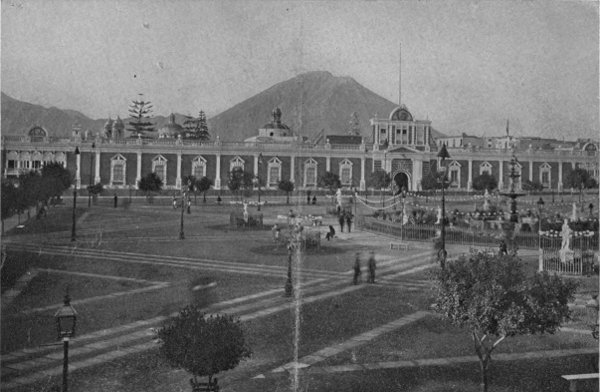
PIZARRO’S PALACE, LIMA—NOW THE GOVERNMENT BUILDING. IT WAS HERE THAT THE GREAT CONQUISTADOR WAS ASSASSINATED.
Heredia had found that the hills south of Cartagena contained profitable gold washings and had learned from the Indians of a region called Zenufana back in the mountains of the interior where the deposits were more valuable still, and this story, having proven true, had brought about the conquest of the rich valley of the Cauca and the development of mines that have yielded hundreds of millions in gold. The shares, even of Heredia’s men in the first outcroppings, are declared by the chroniclers to have been greater than those of the followers of Pizarro in the ransom of the Inca. And, at about the same time, Pizarro’s enterprising lieutenant, Sebastian de Benalcázar, the conqueror of Quito, had continued north and fought his way through the warlike, semi-civilized tribes that inhabited the high plateaux around Pasto to the lower country now known as Popayan, where the Cauca gathers its headwaters, and, in rapid succession, had overcome the tribes that opposed his progress until he had met the expedition from Cartagena, after which he had gone back to Peru.
His purpose was to return and undertake the conquest of the region of the upper Magdalena and the rich Indian communities on the broad table-land on top of the eastern Cordillera; but, before he could set out, an expedition from Santa Marta, under the command of the gallant young Gonzalo Jiminez de Quesada—ranked by many as the greatest of the Conquistadores after Cortés and Pizarro—had forestalled him. Quesada too had heard the stories of El Dorado and had been directed to a lake called Guatavita, two miles high in the mountains, that was supposed to be in the country over which El Dorado ruled, and also the dwelling place of a powerful goddess to whom the people offered jewels and gold by throwing them in the water. “They had a legend,” says Hawthorne—
“To the effect that the Goddess of the Lake had been the wife of a former chief who had thrown herself into the lake to escape a whipping, and, like the maidens of Greek mythology, had been made one of the immortals. Pilgrims came from afar to add their offerings of gold and emeralds to the divinity. At every installation of a chief there was an imposing ceremony. First marched a squad of naked men painted with red ocher, as mourners, then men adorned with gold and emeralds, with feather headdresses, then warriors in jaguar skins. These shouted and made an uproar on horns, pipes, and conch shells. Black-robed priests accompanied the procession, with white crosses on their breasts, and in the rear came the nobles, bearing the new chief on a barrow hung with gold disks. He was naked, his body rendered sticky with resinous gums and then smeared over with gold dust. Having reached the shore of the lake, he got on a barge and was rowed to the center, where he dived into the water and washed off his gold, while the assemblage on the shore shouted with joy and flung their offerings into the transparent abode of the Goddess.”
This, it seems, had once been true, but, although the Indians of the lowlands may not have known it, the custom had ceased to exist long before the coming of the Spaniards. Many of the bravest were lured to their death in the vain quest, not only in the Colombian Andes but in the valleys of the Orinoco and Amazon, and even south along the Paraguay and Paraná, before the discovery was made that the custom was a thing of the past.
In the belief that it still existed, therefore, Quesada and his company of nearly eight hundred men had left Santa Marta sometime in 1536, and, harassed by bands of savages, forced their way, with almost inconceivable difficulty, through the wild forests and undergrowth, along the foothills bordering the Magdalena and up the steep side of the Cordillera to the delightful series of plateaux which were then, as they are yet, the populous heart of the country and the principal seat of her wealth and culture. In the continual fights with the Indians and from starvation and fatigue, three-fourths of the company had died, but here the survivors found themselves at last in a beautiful, fertile region, where the climate is perfect and all the products of the temperate zone grow luxuriantly, and where the inhabitants, the Chibchas, had reached a state of civilization not much inferior to that of the Aztecs of Mexico and the Caras of Ecuador. Quesada, after having subdued them, had founded Bogotá near the site of the Chibcha capital, on the 7th of August, 1538.
Later the same year, to his dismay, Benalcázar, who had come down the Magdalena from Pasto, in the opposite direction, reached this same plateau, and, a few days later, to the confusion of both, another expedition, under the command of Nicolaus Federmann, which had started from Coro in Venezuela, crossed the mountains south of Maracaibo, continued in that direction along the llanos (plains) at the eastern base of the Cordillera and ascended at that point, also put in an appearance. Thus these three adventurers, believing they had almost reached the goal for which many were yet to search, found themselves simultaneously in the very neighborhood of the former domain of the gilded chiefs, but each confronted with the prospect of losing all that he had toiled so hard for unless he could overcome his rivals.
What was to be done? Undoubtedly Quesada had the right to possession by virtue of his prior discovery and conquest, but the other two made claim on plausible grounds, and he had not been commissioned by the King. With his depleted force he could not hope to defeat their forces combined. Besides, as all realized, if they should fight, there would probably not be enough of the men left to hold the country against the natives, who would only be emboldened by such a dissension. So when it was found that Quesada had already gathered in all the spoils in sight—which consisted of several thousand emeralds and gold vases and ornaments that made a pile so high that a man on horseback could be concealed behind it—Benalcázar and Federmann allowed themselves to be persuaded to accept shares in the loot and submit to the King’s arbitration their respective claims to the country. Soon afterward the three captains set out for Spain in the same ship, leaving Quesada’s brother in command. None of them ever returned. Federmann and Benalcázar were censured for exceeding the authority given them by their superiors and undertaking conquests on their own account, and, instead of appointing Quesada Adelantado, the King sent over another governor with considerable reinforcements, after which the process of assimilation and settlement went on about as it was going on in Peru.
X
Very different was the experience of Pedro de Valdivia in Chile. Unlike these other adventurers, when he set out it was not in the expectation of finding any great store of gold, since Almagro had reported that the inhabitants were poor, but with the intention of conquering the country and converting it into a province of Peru. In accomplishing only a part of this purpose, he was to have a far more difficult task, had he but known it, and many more Spanish lives were to be sacrificed, than in all the other conquests put together. It had already been discovered by Almagro, however, that as far south as he had gone, the natives were subjects of the Inca and that their civilization and system of irrigation and agriculture had been brought to almost as high a standard. He had advanced down the great central valley as far as the river Maule, finding everywhere a population as dense, probably, as that which exists to-day, and had met with little resistance, probably because of the presence in his party of the brother of the Inca, until he reached the boundary of the empire and encountered the independent tribes beyond, and there met his reverse.
As a consequence, misled by this favorable experience with the northern tribes and his own with the easily conquered natives of Peru, Valdivia took with him, besides his Indian auxiliaries, only about two hundred Spaniards and a number of women belonging to their families. He soon found that, since they had learned of the execution of Huascar and Atahualpa and that the new Inca, Manco Capac, was little more than a mere puppet of Pizarro’s, the disposition even of these northern tribes had changed; that they now regarded themselves as released from their vassalage. He found also that, although they all spoke the same language and appeared to belong to the same race, they still maintained their tribal organizations, each with its own Cacique and entirely distinct from the others; that the Inca socialistic system had not been adopted, and that individually they were democratic, resentful of encroachments on their liberty, and self-reliant. Hardly had he entered their country when his troubles began. To this second invasion, these people, who had only looked askance at Almagro, now promptly showed their hostility. Their lack of efficient military organization and concert of action made it easy, however, to overcome what resistance they could offer on the spur of the moment, and Valdivia succeeded in pushing on for several hundred miles until he came to the section of the valley through which flows the river Mapocho.
There, fascinated doubtless by the gorgeousness of the environment, he selected a site at the river side, at the base of an isolated hill (called Santa Lucia), in the midst of the broad plain that lies between the two great mountain ranges, two thousand feet above the level of the sea, and founded the city of Santiago, which has ever since remained the capital. Following Pizarro’s example, among the first buildings he caused to be erected were the Cathedral and Bishop’s house, and afterward, and only just in time to save the colony from annihilation, he fortified Santa Lucia, for the town itself was soon attacked by an overwhelming force of Indians and half the houses burned to the ground before they could be driven off with the help of an exploring party that opportunely returned. This was only one of many such vicissitudes, in the course of which, so beset were the invaders and so reduced did their number and the health of the survivors become by privations and fighting, that all but Valdivia were for abandoning the conquest and making a dash for Peru.
Mutiny was only prevented by the discovery of gold in the mountains near by and the arrival of reinforcements from Lima. After that he was enabled to found the town of Coquimbo on the coast about two hundred and fifty miles north of the capital, and visit Peru to arrange for the sending of more colonists and supplies. While there he assisted in the suppression of Gonzalo Pizarro’s revolt, and had no difficulty in inducing a large body of adventurers to go back with him, for Lima now was swarmed with men who were eager enough to win lands and slaves or take their chance of making their fortunes in the mines. “With their help,” says Dawson, “the conquest and settlement of all Chile as far south as the Maule was effectually completed. The land was apportioned among the cavaliers, each becoming a sort of feudal baron, and in effect creating a landed aristocracy which has continued to rule the country to the present day.”
In 1544, Valdivia founded Valparaiso, the seaport of the capital, and rebuilt Coquimbo, which had been taken and burned by the neighboring Indians during his absence in Peru. He then devoted several years to making good his conquest and firmly establishing the colony, and in 1550 turned his attention to the country south of the Maule. Between the Maule and the Bio-bio were the Promaucians and their kindred tribes, and south of the Bio-bio was a confederacy composed of tribes, also related by blood and language, which inhabited the forests and mountains and lake region for a stretch of two hundred miles. Chief among these were the Araucanians—the one unconquered aboriginal race in the new world, the one aboriginal race in America, North or South, that never was conquered by Europeans, the one race that checked the victorious march of the Spaniards and compelled them, after more than a hundred years of almost incessant warfare, to acknowledge their independence and accept the Bio-bio as the southern boundary of the Spanish possessions—not warfare of the usual desultory, treacherous Indian sort, but warfare abounding in formal campaigns and sieges and pitched battles, in which large armies were engaged, in numbers often evenly matched.
Inferiorly armed with clubs, spears, and bows and arrows, their bodies protected only by leather cuirasses, they met the Spaniards and their native auxiliaries in open field and charged and fought them hand to hand, and defeated them too in many a Homeric fray in spite of the steel armor and swords of the Conquistadores and their cavalry, artillery, and firearms. Inspired by admiration, a chivalrous Castilian, the soldier-poet Alonso de Ercilla, who was himself in some of the fights, has told the first part of the story in his historical epic in thirty-seven cantos—the story of how their lion-hearted chief, Caupolican, undismayed by defeat in the first encounter, persisted until he had destroyed an army of the invaders and driven the survivors back to Santiago; how, when wounded and helpless, he was captured at last and underwent torture and death with the stoicism of a Mohawk; how his wife, indignant at his having permitted himself to be taken alive, ran to the scaffold and threw their baby at his feet, crying out that she would no longer be the mother of the child of a coward; how the brilliant young Lautero took three Spanish strongholds, invaded the country north of the Bio-bio, defeated every army that was sent against him, and laid siege to Santiago itself; how the fiery Tucapel, while besieging a Spanish fort, scaled the wall alone, ran the gantlet of the garrison, killed four mail-clad Spaniards in fighting his way through, and escaped by leaping from a cliff; how another of their chiefs, moved to pity by the straits to which he had reduced a town he was besieging, gallantly challenged the Spanish commander to single combat, on condition that if he should defeat him the town must be surrendered, but that if he were himself defeated the siege would be raised, and how, when he was killed, the Indians kept the compact and withdrew—and many other such stories, some of them rivaling those told of the Scottish chiefs.[1]
These Araucanians “had not felt the influence of Peruvian culture,” says Hawthorne; they were “still in their healthy, primitive condition. In person,” he goes on—
“Most of them were tall, strong, and active, with a complexion of light, reddish brown, sometimes approaching white. They had a copious language, cooked their food, made bread and brewed a dozen kinds of spirituous liquors. Cities, in the Peruvian sense, they had none, but lived in patriarchal hamlets, ruled by ulmens, who were in turn subject to a cacique of the tribe. Each farmer was master of his own field; there was none of that land ownership by the state that obtained in Peru.... They made cloth garments, which their women adorned with embroidery and dyed with vegetable or animal extracts. They manufactured a kind of soap, and their utensils were of well-fashioned pottery, wood and marble.... They went to sea in canoes and fished with fish hooks. They knew something of astronomy and physics and had some rather crude notions of drawing and carving. They called themselves Children of the Sun, and are supposed to have worshiped the sun and moon; they had the red man’s vision of happy hunting grounds after death, and believed that those who died fighting in battle were certain of a happy immortality.... Cleanly they were in the extreme, in this respect offering a sharp contrast to their invaders.... They took particular pains to keep their magnificent teeth white and clean, and were careful to remove all hairs from their faces and bodies. The women were dressed in woolen garments of a green color, with a cloak and girdle; the men wore shirts and breeches, woolen caps and footgear, and over all capacious woolen ponchos (capes). The military system was efficiently organized.”
Having learned that the Araucanians and Promaucians were hereditary enemies, Valdivia’s first step toward the conquest of the former’s country was to form an alliance with the latter and to establish a base of supplies at the mouth of the Bio-bio, where he founded the city of Concepcion, and, during the year 1551, occupied himself in fortifying it and making preparations for the invasion. On the arrival of reinforcements he had sent for, he advanced a hundred and fifty miles south, and, encountering but little opposition, founded the city of Imperial, and from that point pushed on a hundred miles farther and founded the city to which he gave his name. On the way back in 1553 he built several forts and at Santiago found awaiting him a fresh body of troops and horses. Two hundred of the men, with an Indian contingent, he sent across the Andes to begin the conquest of what is now the Province of Mendoza in Argentina; and then, as Hawthorne relates it—
“The Araucanians, uniting with local tribes, made ready to clear the country of Spaniards. An army of four thousand Indians crossed the bloody Bio-bio and gave battle to Valdivia, but that stout warrior succeeded, after a desperate conflict, in driving them back for the time. In the following year he carried the war into the enemy’s country.... There was among them a remarkable old Ulysses named Colocolo, who added to ardent patriotism a wonderful sagacity in both war and intrigue. He traveled over the country preaching a crusade against the invaders. A great conference was held among the various tribes, and a chief named Caupolican was, at Colocolo’s suggestion, chosen commander in chief. This hero was modest and valiant, a giant in stature, and wise in counsel as he was brave. His first exploit was the capture of the fort of Arauco, which he accomplished by an unexpected attack, compelling the garrison, after severe fighting, to evacuate and retire to the fort at Puren. The garrison at Tucapel fort was in like manner driven to Puren, from which place word was sent to Valdivia of their peril.
“He started for the seat of war with two hundred men and five thousand Indians.... The two armies came in sight of each other on the 3d of December, 1553, and maneuvered for position. The right wing of the Araucanians was led by Mariantu, the left by Tucapel, the Murat of the host. At the opening of the battle Mariantu attacked and cut to pieces the Spanish left, and served in the same manner a detachment sent to their support. At the same time Tucapel swept down on the Spanish right. The latter’s artillery wrought terrible havoc among the Indians and they were thrice repulsed, though without being thrown into confusion. At the critical moment of the fight, a young man saved the day for the Araucanians. His name was Lautero. He had been previously captured by Valdivia, baptized and made a page, but he seized this opportunity to escape from the enemies of his country and join his friends. He called on them to follow him in a final charge. They caught the contagion of his valor, and, collecting themselves, swept the Spaniards and their allies from the field with awful carnage.
“Valdivia himself was captured. He begged hard for his life, even promising, if he were spared, to quit Chile with all his followers. Nor did he scruple to entreat Lautero to intercede for him. This the magnanimous former page did, but in vain. The grim old ulmens knew too well the worth of Spanish promises, and, disregarding Valdivia’s screams for mercy, one of them crushed his skull with his war club. And the next day the trees that grew in the great plain again bore Spanish heads as fruit, and Lautero was appointed Caupolican’s second in command. At the council which was forthwith held, it was resolved, in accordance with the advice of old Colocolo, to make a general attack upon all the Spanish strongholds. Angol and Puren were promptly abandoned by the invaders, who congregated in Valdivia and Imperial. Lautero fortified himself on the precipitous mountain of Mariguenu, in order to prevent possible Spanish incursions southward. Of a band of fourteen Spanish cavaliers who were riding from Imperial to Tucapel, seven were slain by the Araucanian Lincoyan.
“The inhabitants of Concepcion were terrified at these catastrophes. Villagran was chosen Valdivia’s successor. He made careful preparations and advanced with a strong army of Spaniards and native allies toward Mariguenu. In a narrow defile Lautero fell upon him. The Spaniards tried to scale the mountain but were checked by slings and arrows, and a body of the Indians, falling furiously upon the Spanish cannoneers, captured the guns. An attack was then delivered upon the Spanish front and it gave way, Villagran flying headlong with the rest and barely making good his escape. The remnant of the Spanish army was pursued by Lautero to the river Bio-bio, where the Araucanians paused, and the fugitives staggered into Concepcion. There Villagran stayed only long enough to gather together what property he could, and then, with all the inhabitants, he fled to Santiago. When Lautero entered Concepcion the next day, he found nothing but empty houses, which he destroyed. The seven cities were having a hard life of it.
“An attempt some time afterward to retake and rebuild Concepcion was prevented by the Araucanians, who met and defeated the Spaniards in open plain and again drove them back to Santiago.... In the next campaign Lautero went against Santiago, while Caupolican attempted the siege of Imperial and Valdivia. Lautero laid waste the country of the Promaucians and fortified himself on the Claro. A Spanish reconnoitering party was surprised and cut to pieces and Santiago was in danger. Villagran, being ill, gave the command to his son Pedro, who was led into an ambuscade by Lautero and his army slaughtered. But this was Lautero’s last victory, for a few days later, standing on his battlements to watch the approach of a Spanish party, he was killed by a chance shot, and though in the battle that followed the Araucanians fought valiantly, they were finally overpowered. The death of Lautero was for three days celebrated by the Spaniards; and indeed his fall meant much to them. He had invariably defeated them in battle and outgeneraled them in maneuvers, and at the age of only nineteen had made a reputation as a warrior such as any veteran might envy.”
From then on the war continued with varying success, the Spaniards stubbornly persisting in their efforts to conquer their indomitable opponents, the Araucanians always resisting, and, when beaten for a time, retreating to the mountains, only to recruit and return to the contest with renewed vigor, and this even when their enemies had grown so numerous that they could put thousands of their well armed and trained soldiers into the field instead of hundreds. Gradually, in the course of many years, the Spaniards secured more and more of a foothold, until the great leader Paillamachu took command of the Indians and began an uninterrupted series of victories. He burned Concepcion and Chillan, a hundred miles to the north, ravaged the whole country as far up as the Maule, carried Valdivia by storm and captured, besides the garrison and inhabitants, $2,000,000 of booty and a large store of arms and ammunition, afterward reduced Imperial, Osorno, Villarica, Cañete, Angol, Coya and Arauco, and, by the time of his death in 1603, every one of their cities and forts on the mainland; and, at last, when the Spaniards, after many other attempts, had failed to recover the lost ground they were forced to resort to a treaty. Says Hawthorne:
“Another term of raids and reprisals ensued, with no conclusive results to either party. Spanish governors and Araucanian chiefs succeeded one another year after year; the operations now favored one side, now another, but the Spaniards on the whole lost more than did the Indians. It was not until 1640, about a hundred years since the outbreak of the war, that anything approaching a settlement was made, and the initiative came from the Spaniards. At the village of Quillin the Spanish Governor, the Marquis of Baides, met the Araucanian chief Lincopichion, both being attended by a great retinue. The treaty was ratified by speeches and the sacrifice of a llama. The Spaniards and Araucanians were mutually to refrain from incursions and the Araucanians were not to permit the troops of foreign powers to land on their coasts or to furnish supplies to the enemies of Spain. This clause was inserted in view of recent attempts of the Dutch to effect a lodgment in Chile. This compact was kept by the Indians, in spite of temptations to break it, for ten or a dozen years, when hostilities broke out afresh owing to bad faith on the part of Spain. The Spanish were overwhelmingly defeated in 1655 and during ten years the power of Spain in lower Chile was broken. In 1665 the Spaniards were glad to make another treaty with the Indians, which was kept for half a century. The invaders from the first had gained much more by their treaties than by their arms.”
“Thenceforward,” says Dawson—
“The Bio-bio remained the southern boundary of the Spanish possessions. An army of two thousand men and a line of forts guarded the frontier; and, though hostilities were frequent, for centuries no real progress was made toward depriving the Araucanians of their independence. In the progress of time the slow infiltration of Spanish blood and Spanish customs modified their characteristics, but it was not until 1882 that they became real subjects of the Chilean government.”
It may be that the Spaniards ought not to be blamed for these efforts to complete their conquest of Chile and the appalling amount of bloodshed and distress they caused. After all, they only did what the Aztecs, Caras, and Incas had already done to the peoples of their neighboring countries, what the European peoples were constantly doing to each other, what England soon afterward did in India, and what, within the last century, our own people did in Mexico, the French in Algiers, and the English in South Africa. It may be true, as is asserted by their apologists, that the motive that actuated the Spanish in their conquests was not alone greed of land and gold, but in large part to Christianize a pagan people and bring them into the true fold; but for the long, brave fight these Araucanians made, for their high standard of patriotism, for their adherence to their convictions, both religious and political, we can feel only admiration and sympathy. For these things, as Hawthorne puts it, “they merit the thanks of all friends of manhood and liberty.”
The northern areas of Argentina submitted more quietly to the conquerors. In 1542, Diego de Rojas led the first expedition from Peru down through the Humahuaca Valley. Though he was killed in a fight with a wild tribe near the main Cordillera, his followers continued their march. Near the site of the present city of Tucumán they passed out from the mountain defiles, and, leaving the desert to their right, penetrated through Córdoba to the Paraná River country beyond. Lured by the reports of peaceful and wealthy native communities in the irrigated valleys and the magnificent pasture lands in the pampas stretching away to the east—now the scene of Argentina’s enormous stock-raising and wheat industries—other adventurers soon followed from Peru and Chile and were met by expeditions from the Atlantic coast, marching west in quest of another Peru. No permanent settlement was made on the site of the present city of Buenos Aires until 1580. The two parties that had attempted it, the first commanded by Juan Diaz de Solis, the other by Pedro de Mendoza, had been defeated by the Indians and driven off, but Mendoza had penetrated into the interior, and his lieutenant, Domingo Irala, who remained and founded a colony, became the dominant figure of the new agricultural empire.
XI
The system adopted by Spain for the government of her vast colonial possessions is set forth in the famous code known as the Compilation of Laws of the Kingdoms of the Indies, framed in the reign of Philip IV and published in 1680 in the reign of Charles II. The American possessions had originally been divided into two great political entities by the Emperor Charles V in 1542. These were known as New Spain and New Castile and were governed only by Real Audiencias, (royal audiences, or tribunals that had both legislative and judicial functions). Later they were created Viceroyalties, and the name New Castile was changed to Peru. “We order and decree,” said the King in Law 1, Title 3, Book III of the Compilation, “that the Kingdoms of Peru and New Spain be ruled and governed by Viceroys who shall represent our royal person. These shall exercise superior power, do and administer justice equally to all our subjects and vassals and apply themselves to all that will promote the tranquillity, repose, ennoblement and pacification of these provinces.”
At that time the Viceroyalty of New Spain embraced all the provinces of Central America and the islands of the Caribbean, and Mexico and (west of the Mississippi) pretty much all the land to the north, and in the Viceroyalty of Peru were included Panama and all the land in South America, except, of course, Brazil. These viceroyalties themselves were subdivided into great provincial districts, each administered by a Real Audiencia. These audiencia districts were in turn divided into lesser governmental jurisdictions known as Gobernaciones (provincial sub-districts), Alcaldias Mayores, Alcaldias Ordinarias and Corregimientos (municipal districts of greater and lesser extent), and, in harmony with this political arrangement, there was also an ecclesiastical division: into Archbishoprics, coextensive with the audiencia districts, Bishoprics, corresponding with the gobernaciones and alcaldias mayores; and Parishes and Curacies, corresponding with the alcaldias ordinarias and corregimientos. The Viceroys were respectively Presidents of the Audiencias and Captains-General of the military forces at Lima and the City of Mexico, the viceregal capitals; the provincial audiencia districts were presided over by Gowned Presidents (Ministros Togado) and were under the military command of Captains-General, both of which officers were subordinate to the Viceroys.
Within the jurisdiction of the Viceroy of Peru were seven royal audiencias: Panama (created in 1535), Lima (created in 1542), Santa Fé de Bogotá, now Colombia (created in 1549), Charcas, now Bolivia (created in 1559), San Francisco de Quito, now Ecuador (created in 1563), Chile (created in 1609) and Buenos Aires, now Argentina (created in 1661). In the eighteenth century two more viceroyalties were created from districts withdrawn from the Viceroyalty of Peru: New Granada and Buenos Aires. That of New Granada, established in 1717, was made up of the Audiencias of Santa Fé de Bogotá, Panama, San Francisco de Quito and Venezuela; that of Buenos Aires, established in 1778, included the territory now embraced in Argentina, Uruguay, Paraguay, Patagonia, Bolivia (Charcas) and the southern part of Chile. Afterward the Audiencias of Venezuela and Chile were constituted independent Captaincies-General, subordinate only to the Council of the Indies in Spain, and the Audiencia of Charcas was returned by royal decree of 1810 to the Viceroyalty of Peru. From these colonial divisions logically sprang the South American republics as they exist to-day—of course, again excepting Brazil, which, after she had secured her independence in 1822, retained a monarchial form of government until 1889, when she became a republic like the others.
Under this Spanish colonial system, therefore, the King was absolute sovereign, and governed, not through his ministers of the cabinet—for the various provinces were regarded as appanages of the Crown—but primarily through his Council of the Indies, to which his officers in America reported directly, and secondarily through these officers themselves—the Viceroys and Captains-General, and their subordinates. In addition to these executive officers and the royal audiences, there were Cabildos (municipal councils), which had jurisdiction of local affairs in their respective communities, but there were no elective officers or tribunals, or legislative bodies representing the people. The King regarded the provinces as his personal property and their occupants as instruments for their development for his benefit alone. Incidentally, they might derive for themselves what profit out of it they could, but only in ways consistent with his interests and policies.
Consequently, during this colonial period, the Spanish Americans had no opportunity to develop a representative and self-sustaining body politic, which, in the course of time, might by peaceful means have altered this theory and corrected the evils of such a system—as was the case in Brazil, where the Portuguese King in person resided in the country for several years (during the period of Napoleon’s Peninsula invasion) and in that way became familiar with local conditions and the needs of his people. He, on his return to Portugal, opened the Brazilian ports to the commerce of the world and created Brazil a vassal kingdom, with a form of government almost wholly autonomous.
In contrast with this, no Spaniard (and certainly no foreign trader) was allowed to freight ships for the colonies, or to buy a pound of goods anywhere else, without obtaining special permission and paying well for the privilege. Cadiz was the only port in Europe from which ships were permitted to sail for America, and the whole trade was farmed out to a ring of Cadiz merchants. Every port in Spanish South America was closed to transatlantic traffic except Nombre de Dios on the Caribbean side of the Isthmus of Panamá, near the present city of Colon. Not a merchant ship could enter Buenos Aires, Valparaiso, Callao or Guayaquil. Imports from Spain must first go to the Isthmus, there be disembarked and transported over the Andean passes and the Bolivian plateaux on the backs of llamas, and finally be carried down over the Argentina pampas to Buenos Aires, or along the arid coast to the Peruvian and Chilean settlements. Under such conditions in the southern provinces European manufactures, agricultural and mining implements, and other essentials for a people’s advancement were to be had only at fabulous prices.
On the other hand, also, the system made exports impossible, except the precious metals mined in the north, and drugs, and other easily transportable products. Hides, hair, wool, agricultural products and hard woods would not stand the cost of such long and difficult hauls. The Peninsula authorities acted upon the theory that America should be confined to producing gold and silver. The Plata settlements, especially, and all others south and east of the Peruvian-Bolivian mining region, suffered from this ruinous suppression. Having no mines, they were considered worthless, so far as the royal treasury was concerned, and were in consequence ignored—until they came in conflict with home industries by the cultivation of olives and grapes, and then, to protect the Peninsula growers, the Argentinos were forced to cut down their olive trees and uproot their vines. The inevitable results followed. Smuggling, bribe-giving, evasion and contempt for all law, and hostility to the fiscal authorities of the Peninsula grew up when, in their stead, the colonists could have been developed into a bulwark for Spain, which was so soon to totter from her proud position as the greatest of the world powers. Where science of government and national up-building should have been taught and fostered, revolution became the only political refuge.
In 1808, when Napoleon forced the abdication of Charles IV, held him and his successor, Ferdinand VII, prisoners in France, and established his brother Joseph on the throne, came the colonists’ opportunity. In April, 1809, a Junta (national assembly) was formed in Caracas; in July of the same year the example was followed in Peru, and in August at Quito; in May of the next year, Santa Fé de Bogotá and Buenos Aires followed, and Santiago elected the Chilean Junta in September. The colonists expected by these steps to release the Indians from slavery in the mines in the north and west; to restore and develop the cultivation of grapes, olives and tobacco, and build up their grazing and agricultural industry in the south and east; also to open their ports to commerce with Europe, so that they might buy commodities essential to their growth, and export their own products by way of exchange; also to lighten the crushing imposts and internal taxation, to abolish the tithe system, and reclaim and parcel out the vast feudal estates which had gradually been absorbed by the Spanish officials in the course of an administration which could only be likened to that of the rapacious Roman proconsuls against which Cicero inveighed so impotently.
But the ambitious attempts at reform met with immediate and successful opposition. The country was full of Spanish office-holders who saw in them their dismissal and the death blow to their spoils system. In the short struggle that followed, the success of the royal forces was almost universal. The colonists had had no training in warfare, nor had they yet developed as a people the unity of purpose and sturdy self-dependence which was eventually to bring them their freedom. The junta governments were everywhere effectively suppressed, except in Bogotá and Buenos Aires, where the fires of revolution smouldered during the succeeding years of Peninsula chaos that preceded Waterloo, and the colonists, with eyes opened at last to the true and only remedy for their ills, were formulating their great resolve to separate themselves entirely from the mother country; for, while their measures of reform had been suppressed, the ideas that called them into being could not be obliterated. Furthermore their unsuccessful clash with the viceroys and lesser officials brought even more glaringly before their eyes the extortions and brutal indifference of the ruling class. The attitude of the Peninsulares toward the creoles and mestizos of the colonies had always been contemptuous, and now at last the creoles, being for the most part of unmixed Spanish descent (they were called creoles only because born in America) found their resentment of that attitude more than they could endure.
The series of military successes that was destined to lead to the desired result began with the fights at Tucumán in the northern part of Argentina, in the fall of 1812, and at Salta, a little farther north, in February, 1813. By these battles the persistent efforts of the royalist forces in Peru to put an end, to the junta government of 1810 in the Plata settlements, were checked under the leadership of Manuel Belgrano. But on the first of October following, the Royalists, in violation of the armistice entered into after Salta, almost destroyed Belgrano’s army at Vilcapujio. Disastrous as was the reverse for the time-being, this before long proved a distinct service to the colonists, for it placed in command of the remnants of Belgrano’s army General José de San Martín, one of the two great patriots who finally brought the war to a successful issue, and who had then just returned with the experience and prestige acquired by twenty years’ service in the Peninsula armies against Napoleon’s famous marshals. The other of these great patriots was Simon Bolívar.
San Martín recognized at once the futility of pursuing the campaign and attacking the Royalists in the mountainous regions of Bolivia, with over a thousand miles of difficult roads between his army and base of supplies. He conceived, therefore, the idea of compelling Spain to defend her own bases at Lima and Callao, and to this end elaborated a plan for the invasion of Chile and capture of Valparaiso, and, from thence, a combined military and naval attack on the capital of Peru, the seat of Spain’s continental power. With this purpose in view, he repaired to the almost inaccessible town of Mendoza on the Argentine slope of the Andes, on about the same parallel with the Chilean capital, Santiago, and remained there two years, recruiting and training a strong force and accumulating equipment.
Shortly after he had established his camp of instruction, the Chileans under General Bernardo O’Higgins had extorted from the Royalist General at Talca a truce whereby the protracted struggle to maintain the junta government in Chile was for the moment suspended. This truce of Talca, however, was repudiated by the Viceroy at Lima, and General Ossorio was soon on his way south with another Royalist army, against which, weakened by local political dissensions, the Chilenos were unable to prevail, and were decisively beaten at Rancagua in October, 1814. As this meant a complete restoration of Spanish authority in Chile, O’Higgins and a few of his officers made their escape with the wreck of their army, crossed the Andes and placed themselves under the command of San Martín.
In January, 1817, San Martín’s army, four thousand strong, was ready to move against the unsuspecting Spanish in Chile, who had been led by a stratagem to believe that he would enter the country through one of the more easily accessible of the Andean passes to the south. San Martín, however, chose the highest and most terrible of them all, one four thousand feet higher than St. Bernard, and which lay to the north instead of south of Aconcagua, and accomplished a feat which, in endurance and skill, is thought by the historians to have surpassed Napoleon’s famous crossing of the Alps. Descending the western slope, he fell upon the Spanish outpost at La Guardia on the 7th of February, and on the 12th, surprised and defeated Ossorio’s main force at Chacabuco. Two days later the liberating army entered Santiago. The patriot government was at once re-established and the directorship conferred on O’Higgins after San Martín, refusing to be diverted from his plans for the liberation of the entire continent, had declined the honor.
On the first day of the ensuing year the independence of Chile was proclaimed. De facto independence was not achieved until the decisive defeat of the Royalists on the plains of Maypú, on the 5th of April, 1815, and then, with Chile cleared of Spanish troops, and the port of Valparaiso at his service as a base of supplies, San Martín was ready to enter upon the next stage of his work—the liberation of Peru.
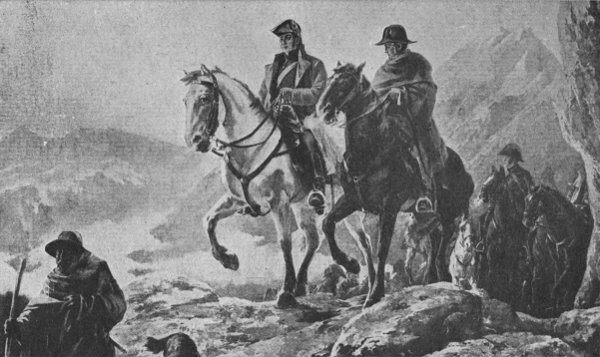
SAN MARTÍN’S PASSAGE OF THE ANDES—FROM VILA’S FAMOUS PAINTING.
Another period devoted to recruiting, organizing, and drilling elapsed. In August, 1820, his combined military and naval expedition set out from Valparaiso with some 4500 troops. Thus far this stronghold of Spain had undergone less violent revolutionary disturbances than any other part of her American possessions. In 1820 it was fully under the control of Don Joaquín de la Pezuela, the forty-fourth successor of Pizarro. But it was three years now since Pezuela had reported to the Madrid government that he stood over a volcano liable to burst into action at any moment, and had received no aid, a situation San Martín understood. In this expedition he was ably seconded by Lord Cochrane, a former British naval officer, who was to render most valuable service in the naval warfare that was at once begun against the Viceroy. Cochrane’s first success was the capture of Valdivia, Spain’s best harbor on the Pacific south of Valparaiso, in spite of the fact that his rockets were filled with sand instead of powder, the Chilean authorities having imprudently employed Spanish prisoners in the manufacture of ammunition.
Arrived off Callao, the seaport of Lima, the liberators entered upon operations and negotiations lasting several months, during which effective missionary work in the cause of independence was done throughout Peru by San Martín’s lieutenants. At last, on the 6th of July, 1821, the Spanish leaders, neglected by their home government, and realizing the ineffectiveness of their forces, evacuated Lima, which was at once occupied by San Martín. He did not come, he said, as a conqueror, and it was with much hesitation that he accepted the supreme power offered by the patriots; he styled himself Protector of Peru, promising to surrender the government to the people as soon as the Peruvian congress should be assembled to take over the burden, and retained his control of the embryo republic for a year, notwithstanding the hostility that was engendered by misconception of the high purposes embodied in the title he assumed. The wisdom of his retention in power at such a critical period is hardly to be contested.
This was the decisive campaign of the war of independence on the continent. The future of Buenos Aires and Chile, of New Granada and Venezuela, and of all the Spanish settlements depended on the battles that were now to be fought in the mountains of Peru, where the Royalist forces had concentrated, for this was the very heart of the Spanish stronghold. San Martín was not to fight these final battles, but to him is due the credit of conceiving the plan of action, of executing it almost to the end, and of showing, by his retirement in favor of a more convincingly popular fellow-patriot of the north, a modesty, soundness of judgment, and generosity almost unparalleled among statesmen—for in the meantime the northern movement, under the direction of Simon Bolívar, was approaching Peru. It arrived at the coast town of Guayaquil in the spring of 1822. San Martín immediately repaired to that port for a conference, leaving his administration in the hands of the Marquis of Torre Tagle, a member of the old nobility who had turned revolutionist, and Bernardo Monteagudo.
The meeting of the two Liberators marked the close of San Martín’s military career. He saw clearly that there could be no room for himself and a brilliant, ambitious, magnetic leader like Bolívar in the same sphere of action, that it was necessary for the welfare of the common cause that one of them should retire. He was great and patriotic enough to make the sacrifice. Returning to Lima, he resigned the supreme authority and retired to Europe. There was no place for him in Buenos Aires, except as a leader in the civil wars which by this time were distracting the country, and this rôle he disdained. In 1850 he died in France at the age of seventy-two, after a thirty years’ struggle with sickness and poverty, but attended always by his devoted daughter. After his death his body was brought to Buenos Aires and reverently placed in a tomb, one of the handsomest in the world, about which stand three marble figures representing Buenos Aires, Chile, and Peru.
Bolívar’s career had begun in Venezuela, where he was born. After Spain’s suppression of the junta established in Caracas in 1810, Bolívar, with the revolutionist Miranda, had landed in Venezuela and called into being the first congress of the people, and the independence of the country was proclaimed. In the fighting that followed, the movement thus started met a speedy end—literally shattered by an awful earthquake that occurred on Holy Thursday of 1812, which the Royalists claimed was a stroke of Divine vengeance against those who would have overthrown the anointed of the Lord.
Miranda was captured and ended his days in a Spanish prison, but Bolívar escaped into New Granada and soon had full sway in the revolutionary councils of the northern provinces. In 1813 he founded at Bogotá an active revolutionary junta and a military organization. With the latter he struck the Royalists at Cucutá, just within the eastern border of Colombia, and passed over the mountains to Caracas, proclaiming war to the death. Here his rôle of Dictator began. His career, however, was punctuated by many disasters before the decisive battle of Boyacá placed Bogotá permanently in his hands and gave assurance of eventual success. But from this triumph Bolívar hurried to the revolutionary congress he had some time before called at Angostura and procured the enactment of a law providing for the union of Venezuela and New Granada, to form the Republic of Colombia, and was elected President; and by the end of the year 1821 all of this territory, except Panama and Puerto Cabello, near La Guayra, had been freed from the control of Spain.
The famous battle of Pichincha, won on the 24th of May, 1822, by Bolívar’s great lieutenant, Antonio José de Sucre, gave Ecuador also to the northern federation; later it was formally incorporated into the new Colombian Republic. Still for two years the final clash between the Royalists and the patriots was deferred, during which time the confusion of sectional interests and negotiations by the now desperate mother country threatened to undo the great work of the liberators. But once more Bolívar triumphed. By the withdrawal in his favor of San Martín, harmony was restored; with his victory at Junín on the 6th of August, 1824, and the decisive battle on the plain of Ayacucho, midway between Lima and Cuzco, on the 9th of December, the war came to an end. In that brilliantly fought battle the patriot army, again under Sucre, defeated a largely superior force commanded by the Viceroy in person in less than eighty minutes. The Viceroy wounded and a prisoner, and his men having deserted by hundreds, his second in command sued for terms, and that afternoon fourteen generals, five hundred and sixty-eight officers of other grades, and three thousand two hundred privates became prisoners of war.
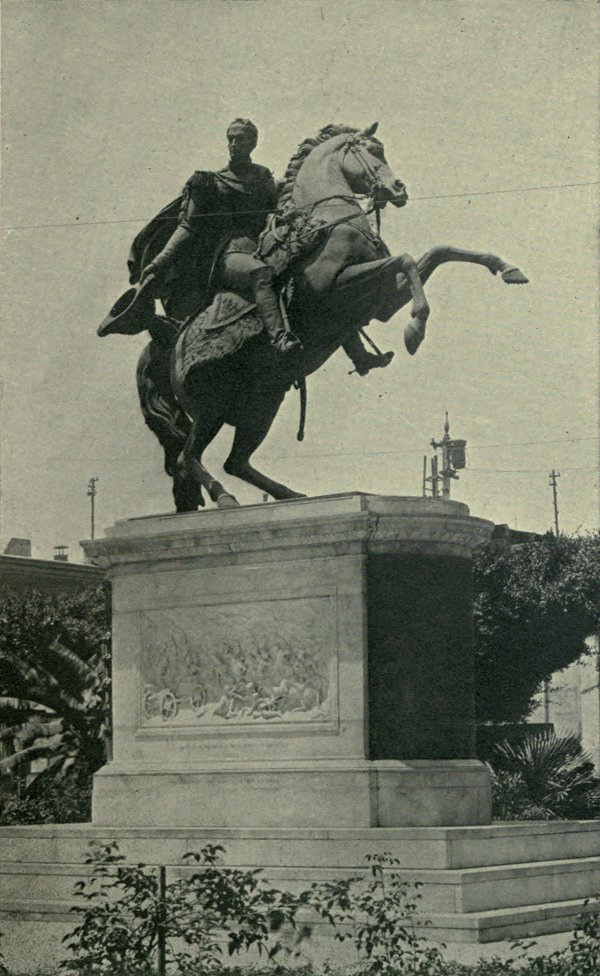
STATUE OF BOLÍVAR, LIMA.
Following this victory, Sucre proceeded to Charcas and convened the patriot congress which in August, 1825, proclaimed the Republic of Bolívia, and became its first President. Bolívar was then at the head of affairs in Peru. He soon, however, relinquished his dictatorship and returned to Bogotá to resume, for a brief term, his functions as President of the federation of Colombia. From that time on he sank rapidly from his apogee and, beset on all sides by the enemies his supposed imperial designs had made for him, died on his estate of Santa Marta on the 17th of December, 1830, at the early age of forty-seven. Disheartened, his personal fortune gone, he had abandoned any designs of that character he might once have had and only a few days before the end wrote to the Colombians: “My last wishes are for the country’s happiness. If my death can contribute to the quieting of party strife and to the consolidation of the union, I shall go down to the grave in peace.” To him also in after years his people erected monuments in tardy recognition of his matchless services.
The Portuguese provinces were the only ones to continue the monarchical system. They too, however, declared themselves independent, and became known as the Empire of Brazil, until 1889, when the present republic was declared.