"Through South Africa" (continued 2)
Reading edition
Close to it were specimens from the Adventurers Reef in the Insiza district which assay 1 ounce to the ton. Beyond was the Willoughby’s Consolidated Company, Limited, which had exhibits from the favourite mines, called Bonsor, Dunraven, and Queen’s. Shafts in the Bonsor have been sunk to 365 feet, the lode is 30 inches wide, and the average assay per ton is 18 pennyweight. The Dunraven has been sunk to a depth of 320 feet, lode and assay the same as the Bonsor. The Queen’s has been penetrated 100 feet, lode 30 inches, and assay 18 pennyweight. People who have no pecuniary interest in mines have told me that the best mines in Rhodesia, and of which there is not the least doubt, are the Globe and Phoenix, Bonsor, Dunraven, Tebekwe, and Geelong, all of which are in the Selukwe district, excepting the last, which is in Gwanda.
Next were exhibits from the Matabele Sheba Gold Mining Company: dark quartz, of which there were fourteen specimens. This reef is twenty miles from Bulawayo, and assays 2 ounces 10 pennyweight per ton. The Marlborough Reef, four miles from Bulawayo; the Ullswater Reef, sixteen miles from town; Piper’s Reef, three miles from town, averaging respectively 1 ounce to 5 ounces, 15 pennyweight to 5 ounces, and 25 pennyweight. Very little gold is visible in these specimens; but the owners have panned repeatedly, and are satisfied that they contain the precious metal in profitable quantities.
Bulawayo the Centre of Auriferous Fields.
Just above these specimens was a large map showing the Rhodesian Gold Fields very clearly. From this I learned that the Gwanda district was south of Bulawayo; the Tuli district, which contains the Monarch Mine, is south-west from here, and constitutes a little republic of its own; the Bembezi field is north; Insiza district is east; and so is the Filabusi and Belingwe; the Selukwe district is east-north-east, comprising Gwelo; the Sebakwe, north-east; and the Mafungabusi district, north-north-east; so that the Bulawayan gold field seems to be the centre of this cluster of auriferous fields.
The Fort Victoria exhibit showed a large lump of native copper and excellent bits of gold quartz. The Masterton Reef, forty miles from Bulawayo, had two specimens and certificate of assay of 18 pennyweight and 22 pennyweight respectively. The Springs Reef, Belingwe district, exhibits consisted of galena, copper and gold, and appeared very fine.
The Unreliability of Assays.
From the Number 2 Kirkcubbin Reef, Bulawayo district, it appeared that an assay of 62 ounces 16 pennyweight to the ton was obtained, while from the Number 1 same reef there was an assay of 24 ounces 14 pennyweight to the ton. It should be observed that these assays, no matter by whom they are made, are misleading to the uninitiated, and though the panning is better, neither are to be relied on as sure guides to what the reef will prove throughout. When, say, 10,000 tons are crushed we shall better know by the result the true status of Rhodesia among gold-bearing countries. Nevertheless, every assay or panning has a value as indicating the presence of gold.
The next exhibit was from the Sinnanombi gold belt, south of the Matoppos. The Saint Helen’s Development Syndicate exhibit consisted of several pans full of grey powdered quartz ready for panning, each of which has been assayed by the Standard Bank with the following results: Thirkleby, Antelope, Rosebery, Constitution and Thela Reefs, in the Sinnanombi district, respectively 2 ounce 4 pennyweight, 136 pennyweight, 27 pennyweight 18 grains, 58 pennyweight, and 46 pennyweight. The Syndicate have also properties in the Insiza district, the Nellie Rey Reef, Eileen Reef in Mavin district, Ben Nevis and Guinea Fowl Reefs in Selukwe district.
“In Every Stone the Gold Sparkled.”
The West Glen May Mine exhibit contained sections, one of which was remarkable as showing a 60-foot wide reef. Its rock specimens were rich with visible gold. There was also a rich exhibit from the Christmas Reef, sixteen miles from Bulawayo—in every stone the gold sparkled.
From Purdon’s Reef, in the Makukuku district, alluvial gold was on show. There was also an old iron gad from the ancient workings. Alluvial gold is found in the Myema River, twenty miles from Bulawayo.
Among other things at the Chamber of Mines Exhibition was a thick log of fine grained teak, several planks, furniture from native woods, samples of lime, trachyte blocks, Bulawayo brick, coal blocks from Tuli coal districts 200 miles south-east of Bulawayo and the Zambesi district 120 north of Bulawayo, and a champagne case full of plumbago lately discovered at a spot fifty miles from the Zambesi.
For the patient courtesy shown to me while making my notes, and the instructing and interesting conduct of me round the room, I am under the warmest obligations to Mr Walter Broad, the Hon. Curator, who, as you will be interested to know, is a Canadian, and whose first impulse to seek Africa as a field for his labours was obtained through reading my “Dark Continent.”
A Visit to the Criterion Mine.
After this exhaustive inspection of the ores on exhibition, it remained for us to see one of these Rhodesian mines in operation to dispel the last remnant of doubt which eloquent sceptics had inspired me with. We chose the Criterion Mine, which is by no means the nearest to the town. It belongs to the Rhodesia Ltd. Company, and is situate eight miles south from Bulawayo, and as Mr Hirschler, the Engineer of the mine, was willing to take upon himself the trouble of being our guide, we flung ourselves gladly upon his generosity. In one hour and a half we made the distance in a spring cart drawn by four spirited little mules. We halted at the Engineer’s station on a commanding grassy ridge, which neighbours that once occupied by Mosilikatse’s old kraal of Gubulawayo during the forties, fifties, and sixties of this century. A few spaces from the spot where we outspanned we came to a series of “old workings” which ran along the crest of the ridge for about 2000 feet. Where one of these old workings was untouched by the Engineer, it reminded me of just such a big hole as might have been made to unearth a boulder, or to root out a large tree. One of these hollows was chosen by the Engineer to sink his first shaft. After penetrating through fifty feet of débris, he came upon the reef which the ancients had abandoned because of flooding, and time, aided by rain, had filled up. He continued for about 10 feet more, sampling every 3 feet as he went, to discover the grade of the ore. Since then he has sunk eight other shafts. The mine consists of 170 claims, but the development is concentrated on about twenty-five claims, ten of which are in the centre of the property, and fifteen towards the eastern boundary. In the centre two shafts are being sunk to the 150 foot level, and are at present connected by a drive 300 feet long. On this level the reef is throughout payable, while a chute 100 feet long is of high grade ore. Trenches on the line of the reef indicate its occurrence towards the eastern portion of the mine, where five shafts varying from 100 feet to 150 feet deep have been sunk. At the depth of 150 feet the various shafts will be connected by a gallery, which will give 2000 feet of reef material. At the present time work is being done for the purpose of developing sufficient ore to keep a twenty-stamp mill going. The necessary machinery has been ordered, and the engineers expect to begin producing some time about the middle of 1898. On examining the material at the mouths of the shafts, those among us who knew of what they were speaking declared that much of it was of high grade. High pyritic quartz abounded, and this was rich in fine gold. Sulphide galena was found in some of the quartz. At the mouth of one shaft visible gold was very frequent, and about forty of the visitors obtained specimens wherein miniature nuggets were plainly visible. Where the reef was being worked at the deepest shaft it showed a breadth of 24 inches; in some places it is only 18 inches wide; at others it is 48 inches broad.
“We saw enough to prove that Rhodesia is an Auriferous Country.”
My readers need scarcely be told that the exhibits of ores are only such as a few companies of Rhodesia were induced to send after urgent appeals from the public-spirited citizens of Bulawayo. I saw none from Salisbury, Mazoe, or any part of Mashonaland, and only a few mines in Matabeleland were represented. There was no time for a proper exhibition. Many more were en route, but the distances are great and the ox-wagon is slow. At any rate we have seen sufficient to prove that Rhodesia is an auriferous country though as yet no one knows what rank it will take among gold-producing lands. My own conviction—a conviction that is, I suppose, made up from what I have seen and heard from qualified men—is that Rhodesia will not be much inferior to the Transvaal. True, it has no Witwatersrand—forty miles of reefs; but the superficial area is twice the size of the Transvaal State, and the prospectors have only succeeded in discovering a few plums.
Then, though the railway has been brought to Bulawayo, it is still far from the Belingwe and Selukwe districts, and within a radius of 100 miles from the town there are many gold fields richer than those in the immediate neighbourhood of the railway terminus. It is necessary to state this in the clearest manner, for many will be carried away by the idea that now the railway is at Bulawayo the output of gold should follow immediately.
But even the most forward among the mining companies can only say: “We have ordered all the needful machinery and shall set to work as soon as it arrives.” The machinery in a few cases is on the rail between Port Elizabeth and Bulawayo; but the necessities of life must precede mining machinery, and several weeks more may elapse before any portion of the material may reach Bulawayo. Then we shall have to consider the terrible calamity endured by Rhodesia, as well as South Africa in general. The rinderpest is not over yet, and cattle, mules, and donkeys are scarce, and the haulage of heavy machinery over the veld with feeble and sickening cattle for forty, seventy, and a hundred miles will be a tedious business.
Then will come the erection of buildings, the fitting of engines, etc., etc., with inexpert natives, and I think I need but suggest that all these preliminaries will occupy much time. The more confident engineers declare that they will be ready to produce about the middle of next year. They may be as good as their word, knowing their business better than we casual visitors; but it seems to me but common prudence to withhold expectation of results until eighteen months from the present.
Rhodesia’s Requirements.
There is no doubt in my mind that gold will be produced in payable quantities from these Rhodesian mines; but the extent of profit depends upon circumstances. It is also as certain that Rhodesia cannot hope to compete with the Transvaal under present conditions. Bulawayo is 1360 miles from the sea, and at least 40 miles from the richest mines. Johannesburg is 390 miles from the sea, and is in the centre of its forty mile long gold field. That simple fact means a great deal, and shows an enormous disadvantage to Rhodesia. The latter country will have to pay four times more for freight than the Transvaal gold fields. Against this must be set the small duties that will have to be paid. After paying five per cent to Cape Colony, goods will be admitted free to Rhodesia. Then the heavy taxes paid to the Boers will still further diminish the disadvantages of Rhodesia; yet when we consider the time wasted in the long railway journey, and the haulage by ox-wagon to the mines, we shall find a much heavier bill of costs against the gold output of Rhodesia, than on that of the Transvaal. A good substantial railway from Beira or Sofala to Bulawayo, viâ Victoria, would completely reverse things. Bulawayo would then be about the same rail distance from the sea as Johannesburg is; the poorer ores could then be worked profitably, and the aggregate of gold product would in a few years rival that of the Rand. If I were a Chartered Director, my first object should be to get the shortest and most direct route to the sea from Bulawayo, and a substantial railway along it, and having obtained that, and a liberal mining law, I should feel that the prosperity of Rhodesia was assured.
Chapter Four.
Letter from Johannesburg.
Go-ahead Bulawayo.
Between Bulawayo and Johannesburg there is a great difference. In common with some 400 guests of the Festivities Committee, I looked in admiring wonderment at the exuberant vitality, the concentrated joyous energy, and the abounding hopefulness of the young sons of British fathers who, in the centre of Rhodesian life, were proud of showing us a portion of their big country, and what they had done towards beginning their new State. We shared with them their pride in their young city, their magnificently broad avenues, the exhibits of their resources, their park, their prize cabbages, and the fine, bold, go-ahead-iveness which distinguished their fellow-citizens. We felt they had every reason to be proud of their victories over the rebel Matabele, the endurance they had shown under various calamities, and the courageous confidence with which they intended to face the future. From our hearts we wished them all prosperity.
Johannesburg’s Wrongs.
At Johannesburg, however, different feelings possessed us. Without knowing exactly why, we felt that this population, once so favoured by fortune, so exultant and energetic, was in a subdued and despondent mood, and wore a defeated and cowed air. When we timidly inquired as to the cause, we found them labouring under a sense of wrong, and disposed to be querulous and recriminatory. They blamed both Boers and British: the whole civilised world and all but themselves seemed to have been unwise and unjust. They recapitulated without an error of fact the many failures and shames of British Colonial policy in the past, gave valid instances of their distrust of the present policy, pointed to the breaches of the Convention of 1884, and the manifest disregard of them by the Colonial Secretary, described at large the conditions under which they lived, and demanded to know if the manner in which the charter of their liberties was treated was at all compatible with what they had a right to expect under the express stipulations of the Convention. “Why,” said they, “between Boer arrogance and British indifference, every condition of that Power of Attorney granted to Paul Kruger has been disregarded by the Boer, and neglected by the British.” They then proceeded to dilate upon Boer oppression, Boer corruption, the cant and hypocrisy of President Kruger, the bakshish-begging Raad, the bribe-taking Ministry, the specious way in which promises were made, and, when their trust was won, the heartless way in which these same promises were broken. From these eloquent themes they proceeded to detail their worries from taxation, high wages, extortionate freight charges, the exactions levied upon every necessity of their industry, the exorbitant price for coal, and imposts on food designed expressly to pamper the burgher at the expense of the miner. Then in a more melancholy tone they discussed the mistakes of their friends—Jameson’s tactless raid—the poverty of the country, the decline of business in the city, the exodus of the Australians, and the prospects of a deficit in the Treasury, etc., etc.
Contact brings Conviction.
I wish that I could have taken down verbatim all that was said to me, for the spokesmen were of undoubted ability, fluent in speech, and full of facts, not a tithe of which I can remember. As I fear I cannot do justice to what was urged with such vehemence and detail, you must be content with the broad sense of their remarks only. These men have stories to say which should be said to shorthand writers. I have read many books and articles on South African politics, but I was never so interested or convinced as when these men told their stories straight from the heart.
Johannesburg Early Last Month.
I then turned an inquiring attention to the Johannesburg newspapers, and from a heap of them obtained their opinions on the gloom prevailing in the “Golden City.” There were columns of allusions to the general distress, of the unemployed becoming numerous, of tradespeople unable to find custom. Clergymen had been interviewed, who said that “poverty was rampant,” that shopkeepers were almost distracted through fear of insolvency, that the country’s credit was going and almost gone, that Australians were leaving in such numbers that sufficient berths on steamers could not be found, and that the inaction of the Government was driving skilled and willing workmen away.
Effects of Bad Times.
My hotel-keeper, a bright sociable man, was induced to give me his own opinions on the depression. He acknowledged that his own hotel was doing fairly well, but the other hotels were mostly empty. Tradesmen he knew were bitterly lamenting the want of custom, buildings in course of erection were stopped because the owners did not think themselves justified in proceeding with the structures, rents were hard to collect from tenants, the upper storeys were already empty, reductions had been made on the lower floors, and still there were no permanent tenants; goods stored in bonded warehouses had to be auctioned, as the proprietors had not the means to take them away, etc., etc.
One Man’s View—
Encountering a gentleman whom I knew in Sydney, Australia, and who is now on the Stock Exchange here, I inquired of him what he thought of the condition of things. He said: “Mostly everything is at a standstill, I think. To-day stocks and real estate are a trifle firmer, but I cannot conceive any reason for it. There is nothing within my knowledge to justify confidence. Old Kruger is relentless and implacable. He will never yield, whatever people may say. And unless the reforms are granted, so that the mines can be worked at a profit, Johannesburg must decline, and things will become as bad for the State as for ourselves. The old man positively hates us, and would be glad to see the town abandoned. On the strength of the Industrial Commission report, many of us bought largely, but when we found that there was a majority against us, we sold out in such a haste that for a while it looked like a panic. The majority in the Raad had been bought out by the Dynamite Company, and, of course, we were helpless. You people at home have no idea of the corruption of our Government. Kruger appears not to know that when he calls the Dynamite Company a corner-stone of the State, he is giving himself away. We know that the Company and its twin brother, the Netherlands Railway Company, support the twenty-four members of the Raad, and as they, with Kruger, are the State, those companies may well be called corner-stones.”
And Another’s.
At the club I met a gentleman whose moderate way of expressing himself made me regard him as being inclined to be impartial, and when urged to give his views, he said that “undoubtedly there were great grievances which every well-wisher of the State would desire to see removed. The administration was so corrupt that it was difficult to get a Boer official to attend to any business, unless his palm was oiled beforehand. The officials had got into the habit of excusing themselves from doing their duties because they were overwhelmed with work, or that they had no time. It is a way they have of hinting that unless it is made worth their while, they will not put themselves out to do what they are paid to do by Government. Many companies understand this so well that they set apart a fund from the profits to meet this necessity. You know, perhaps, that the Dynamite Concession is one of the most corrupt things in the State. One member of the Raad gets five shillings a case, and the Government pocket ten shillings for every case of dynamite sold in the Republic. When we know that forty-seven shillings would be a sufficient price for a case of dynamite, to invoice a case at forty shillings higher shows that some people must have grand pickings. Were the mines in full operation they would consume about 250,000 cases, and this extortion of 2 pounds a case means 500,000 blackmail on the mining industry. Then the railway administration is just as bad. The tariff is abnormally heavy. The first-class fares are greatly in excess, and as for freight charges, you can imagine how high they were when it was proved during the drift closure that ox-wagons could make the transport as cheaply as the railway.”
“Then you appear to justify Rhodes in his attempt to rectify this?” I said.
“No, I do not; but all that he stated before the Parliamentary Committee about the abuses is perfectly true. I cannot, however, absolve him for attempting to promote a revolution to effect a change. But about this corruption at Pretoria. I do not blame the Boers so much as I blame the Hollanders and our Jews here. They are the real causes of the disorders in the State. The corruption was started by the Hollanders, and the Jews have been only too willing to resort to bribery, until the share market has become demoralised. These fellows unite together to discredit a mine, until there is no option but to close it. Many of the mines have been closed through their intrigues. Mine is one of them, for instance.”
Passing Customs at Vereeniging.
This was my first day’s introduction to the moral condition of Johannesburg. But to begin at the beginning. On arriving at midnight at the frontier of the Transvaal, near the Vaal River, the train was stopped in the open veld until daylight, for Boer officials require daylight to make their conscientious examination of passengers and their luggage. Half-an-hour after dawn the train moved over the Vaal Bridge, and we were soon within the grip of the Boer Custom House. I was told later that the officials were insolent; but I saw nothing uncommon, except a methodical procedure such as might belong to a people resolved to make a more than usually thorough search. The officials came in at the rear end of the carriage, locked the door behind them, and informed us we were to go out before them. The male passengers were ushered into one corrugated-iron house, the females with their respective searchers behind them into another. One burly passenger had diamonds concealed on his person, but his clothes were only slightly felt. A small pale clergyman just behind him, however, received marked attention, and was obliged to take off his boots, and every article of his baggage was minutely scrutinised. Probably some of the women searchers performed their duties just as thoroughly. My servant was asked to pay duty on some of my shirts, but he refused to pay anything, on the ground that the shirts had been repeatedly worn and washed.
Getting News from the Rand.
The distance to Johannesburg from the frontier was but an hour and a half of ordinary running, but from the time we neared the Vaal River it occupied us eleven hours. A reporter from the Star had come aboard at the frontier station, and from him we learned a few facts regarding Johannesburg, such as that the uitlander miners intended to starve the burghers out by closing the mines, that the Australians were leaving in crowds, and though there were three Presidential candidates in the field, Kruger was sure to be returned for a fourth term, as General Joubert was known to be weak, and Schalk Burger almost unknown.
A Panoramic View of the Mines.
The Transvaal veld was much greener, and more rolling, than that of the Orange Free State. Johannesburg came into view about 9 a.m.; but instead of making direct for it, the train sheered off and came to a halt at Elandsfontein, six miles east. It was then we first obtained an intelligent comprehension of the term “Main Reef,” to whose production of gold the existence of Johannesburg is due. Its total length, I am told, is 38.5 miles, to be accurate, and along this a chain of mines, well equipped and developed, exists, out of which, however, only ten miles of the reef can be profitably worked under the present economic circumstances. The working of the remaining twenty-eight miles depends mainly upon the removal of the burdens, upon low wages, abundant labour, cheap transport, etc. The richer and dividend-paying section of the Reef contains such mines as the Langlaagte, Paarl Central, Crown Reef, Pioneer, Bonanza, Robinson, Worcester, Ferreira, Wemmer, Jubilee, City and Suburban, Meyer and Charlton, Wolhuter, George Goch, Henry Nourse, New Heriot, Jumpers, Geldenhuis, Stanhope, and Simmer and Jack. To either side of Elandsfontein runs a lengthy line of chimney stacks, engine houses, tall wooden frames, supporting the headgear, stamp mills, with clusters of sheds, huts and offices, hills of white tailings, and ore. To the westward these become more numerous, and as the train moved from Elandsfontein towards Johannesburg, it clung to the side of a commanding ridge by which we obtained a panoramic view of mine after mine, each surrounded by its reservoirs, hills of tailings, lofty stores of ore, iron sheds, mills, offices, and headgear structures, until finally they occupied an entire valley. Presently, while we still clung to the ridge, we saw that the scattered cottages, with their respective groves, were becoming more massed, and looking ahead of them we saw the city of Johannesburg, filling the breadth of a valley, girdled by a thin line of tall smoke-stacks, and dominated by two parallel lines of hills, the crests of which rose perhaps 300 feet or so above the city. The scent of eucalyptus groves filled the air, for now the ridge on our right was given up to cottages, villas, mansions, each separated by firs, eucalyptus, flower gardens, and varied shrubberies, the whole making a charming sight, and a worthy approach to the capital of the mining industry.
Population and Area of Johannesburg.
Reduced to matter-of-fact figures, Johannesburg proper covers four square miles; its roads and streets are 126 miles in length, twenty-one miles of which are macadamised, and ten miles have tram lines. The city’s parks and open spaces occupy eighty-four acres. There have been twenty miles of gas-piping laid, while the electric light is supplied by forty-two miles of wire. The waterworks supply 600,000 gallons of water daily for domestic use, exclusive of what is required for the mines and street watering. The population of the town at the census of July, 1896, consisted of 79,315 males and 22,763 females, of whom 32,357 males and 18,520 females were European, making a total European population of 50,877. It is believed that during the seventeen months which have elapsed this population has been augmented to about 55,000.
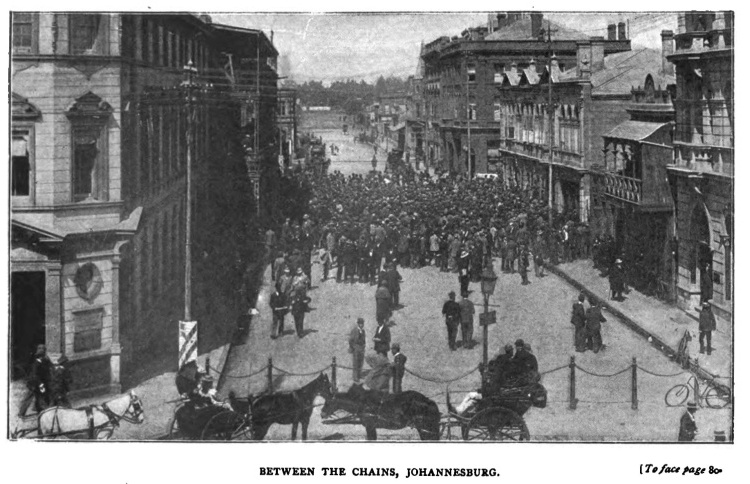
The Streets of Johannesburg.
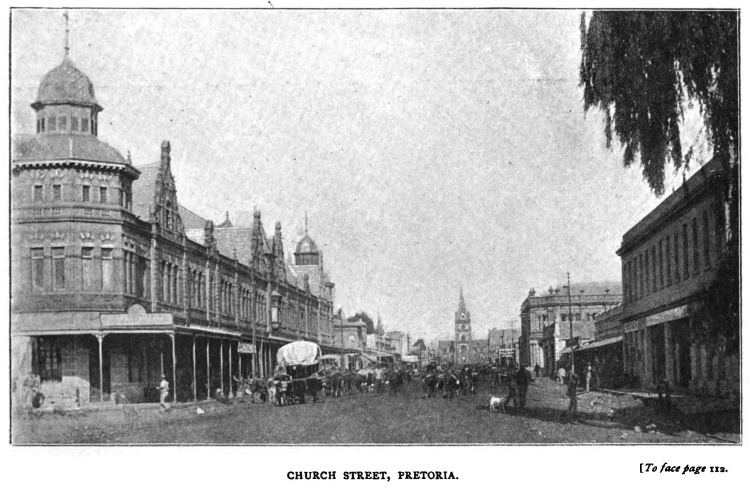
The streets of the city generally are about 50 feet wide, while the principal business streets average 90 feet in width. Several of these are flanked by buildings which would be no discredit to any provincial city in England, while the array of shops have their windows as artistically dressed with wares as those of Regent Street in London, which gave me some idea of the character and good taste of the people.
Johannesburg as it was and is.
A photograph of Johannesburg taken in 1888 revealed a thin collection of galvanised iron structures, widely scattered over a roadless veld, while that of 1897 shows a mature city, compact, with an aspect of age, well furnished with churches, massive buildings, parks with trees over a hundred feet in height, rich villas and artistic mansions, etc. It was scarcely credible that in such a short period such a marvellous change had been wrought. The wonder was increased when I was driven along the length of Hospital Hill, and noted the streets of this suburb, bordered by artistic and costly houses, luxuriant shrubberies, flower gardens, and stately lines of shade trees. The marvel was greater still when my conductor told me that as late as 1892—five years ago—this suburb, now so flourishing, was a mere virgin grassy veld. “What, all these miles of groves and gardens and villas sprung up since 1892?”
“Yes, so prodigiously rapid is the growth of vegetation, trees, climbing plants and shrubs, when daily watered, that these shade trees which give the suburb such an appearance of age have only been planted during the last five years!”
Krupp Guns in Eden.
Now these picturesque and comfortable residences of such varying architecture, whose furniture I could just see through open windows and doors, and bespoke great wealth and taste, you must bear in mind would adorn Birmingham or Manchester. Imagine miles of such houses crowded with fair occupants and troops of daintily-clad children, their long hair floating in the wind as they sported in snowy garments on the lawns and amid the flowers, and then my surprise and something more as I suddenly came in view of a fort, which the rude Boers have built to terrorise this community. The superb ridge, which seemed to me with its beautiful houses and gardens a veritable Paradise after four thousand miles of travel over treeless plains, and which would certainly be an ornament to any city on the globe, had in its centre a large and ugly earthwork, behind which were monstrous Krupp guns to lay waste this Eden, should the humanity of Johannesburg ever be driven by despair to strive physically for the rights of freemen. The mere suggestion of it is brutish, and a Government which can coolly contemplate such a possibility and frighten timid women and young children with such horrid prospects, are only fit to be classed with the Herods of the Dark Ages.
Then and Now.
A short drive northward of the suburb placed me in a position to view the far-reaching desolate wastes of the primitive veld, and to realise more fully what human intellect, skill, energy, and capital have done on Hospital Hill and in Johannesburg itself. Twelve years ago there was not a vestige of life—human or vegetable, except the grass—to be seen within the entire range of vision from the Hill, and yet the creators of the remarkable transformation we had just seen were to be threatened with slaughter and devastation if once they plucked up courage to exact the rights which every civilised Government would long ago have granted to them!
Johannesburg and its Great Industry “Subject to Senile Madness and Boorish Insensibility.”
It were well now, after briefly showing what Johannesburg and its population is, that the chief of the State and his rustic burghers, in whose hands lie the future of this remarkable city and its industry, should be presented to your readers, in order that they might realise the striking incongruity of first-class mechanical ingenuity, spirited enterprise, business sagacity, and tireless industry being subject to senile madness and boorish insensibility. That such a thing should be is most preposterous and contrary to all human precedent. For elsewhere, and since the dawn of civilisation, Intellect has always become Master, Captain and King over Ignorance, but at Johannesburg it is Asinine Ignorance which rules Intellect. Another reversal of human custom is seen in the submissiveness of Intellect to Ignorance, and though, being naturally sensitive under the whip and restless under the goad, it remonstrates sometimes, its remonstrance is in such a sweet mild way that the spectator can only smile and wonder.
“Overmastering Surprise” at the State of Things on the Rand.
Fitting words are wanting to describe my overmastering surprise at the state of things in the Transvaal; I am limited by space and time, so that I must let my pen race over three pages and trust largely to the intelligence of those who read the lines. I have a printed cutting before me of a discussion in the First Raad of the Boer Republic, during which the President, in the support of his views, stands up and says that Isaiah had been told by the Lord that Israel had been punished because the rulers of that people had not hearkened unto the voice of the poor. Another speaker of similar intelligence rose up to contend that the Lord had enjoined that the rich, not the rulers, should help the poor, and Isaiah had not been told that the poor were to be helped with other people’s money. This construction of Scripture raised the President of the State to his feet again, and he reiterated the fact that the Lord had meant the rulers, whereupon another Senator interpolated the remark that some people were in the habit of shielding themselves behind the Bible with a view to saving their own pockets.
Nailing it with Scripture.
Fancy a discussion of that kind taking place in the Legislative of a British Colony! What vexation and shame we should feel that a Colonial Government should be based on what Isaiah had conceived had been told to him respecting Jewish elders and rulers! We should undoubtedly feel that such a discussion was an outrage on common sense and good taste, and that the Colony had mistaken a parliamentary hall for a synagogue. But at Pretoria such discussions appear to be everyday incidents—the most commonplace arguments are supported by quotations from Isaiah or some other prophet.
Kruger’s Cant.
At Standerton, the other day, the President was questioned as to the prospects of assistance being given to poor burghers. His entire reply is worth quoting, but I have only room for a small portion of it. Said he: “The burghers’ distress has been caused by the war (Jameson’s raid), and the subsequent unrest has not tended to improve matters. The burghers have suffered from these circumstances. The country has been compelled to spend a lot of money on the building of forts, nearly 2,000,000 pounds, by which our means have been exhausted. In the Zoutpansberg district especially, the condition of things I know to be most distressing. White families as well as black are dying rapidly. Still I expect you to turn to the Bible in a time of adversity like this. Follow the prophet Isaiah’s advice, and look to the Lord God who has so far befriended you. Why will men not follow in the path of the Lord instead of losing money at races and by gambling?” etc., etc.
Two Millions on Forts while People Starve.
One knows not which most to pity, the blundering muddle-headed President, or the wretched feeble-minded people who listen to him. Even little English school-boys would have had the courage and sense to tell the President how unfit to govern anything but a small pastorate on the veld he had proved himself after such a speech, and have pointed out to him that the two million pounds spent on unnecessary forts, had been the means of starving the Zoutpansberg frontier, and that it was blasphemy to make the Lord responsible for his own foolish and stupid extravagance, besides adding insult to injury to accuse people with love of horse-racing and gambling when they were starving through his criminal folly.
The burghers, however, lacking the intelligence of English school-boys, adjourn after the speech to banquet their venerable chief and to glorify him.
At Heidelberg the President was asked if the Secret Service Fund was divided into two sections. “Yes,” he replied, “for I have to keep my eyes wide open, and I have private detectives all over the country to prevent any surprise like that of the Jameson raid occurring again.”
What an extraordinary man, to devote 80,000 pounds a year fighting an enemy that does not exist, when, according to his own words, his burghers are dying of starvation at Zoutpansberg!
That Corner-Stone.
When questioned as to his objections to the Industrial Report, the President said that “if it had been accepted the independence of the Republic would have been lost.” Provided certain obstacles were removed, he was in favour of taking over the railway. The profits of the railway were divided at the rate of five per cent, to the Company, ten per cent, to the shareholders, and eighty-five per cent, to the State. The shareholders, according to him, were not the Netherlands Company. As regards dynamite, it was the corner-stone of the State’s independence.
Wolf!
Whenever President Kruger can get an opportunity to utter a word which will reach the public ear, he harps upon the independence of the country being in danger, and the dynamite concession being the corner-stone of that independence. The cry of the wolf being at the door has enabled him to enjoy fifteen years of office, with its princely emoluments, and to the ossified brains of his burghers the same old story may be related with endless repetitions.
The Dynamite Disgrace.
At one electioneering meeting the President said that he refused to have electric trams at Johannesburg because he could not see his burghers deprived of the means of selling their forage. He also assured his audience that the Dynamite Company should be compelled to manufacture dynamite from the products of the country—although it is well known that almost every constituent of it must be imported from Europe. He also stated that the Dynamite Company was essential to the independence of the State since it made the manufacture of gunpowder possible, whereas he knows well that the ingredients of the composition must be purchased abroad.
At another place the President said: “I get so much money from the mines that in a short time I shall be able to pay for the dynamite factory. I will not break the factory. I will not allow any importation of the ingredients to take place, but at the same time I will not throw up the factory.” The people were unable to perceive any nonsense in his words. As the factory can only manufacture 80,000 cases a year, and as 250,000 cases are needed, it never struck them that 170,000 cases would have to be bought elsewhere, nor that as dynamite cannot be made in the Transvaal without obtaining its constituents elsewhere did it seem necessary to ask how the President could keep his promise.
The Presidential Dotard will be Elected a Fourth Time.
If one will read the above carefully over, he will be able to gauge the intellect of this wonderful statesman fairly well, and measure the sense of the people who gape at these absurdities. What with political economy drawn from Isaiah and practical life being ordered by what the prophet Isaiah said, with a future policy based upon the manufacture of dynamite in the Transvaal, and the support of the tariffs of the Netherlands Railway, and the ensuring of a produce market at Johannesburg by not allowing the people of that city to have electric trams, the payment of 225,000 pounds a year to keep the forts in order, and 200,000 pounds interest on the capital expended on the wholly useless structures, the constant denunciation of the murderer Rhodes, the squandering of 80,000 pounds a year to spare the Transvaal from another surprise like the Jameson raid, It appears to the simple burghers that their President is the only fit man for the office he holds, and that Kruger is only second to Washington.
And yet both President and people are within reach and close connection with every possible civilised influence; but the truth is that their dull, dense, and dark minds are impenetrable to good sense, impervious to reason, and insensitive to the noble examples we see at Johannesburg. Though there may be neither rhyme nor reason in anything the Presidential dotard may say or do, the burgher farmer will cling to him and make him victor over all rivals for a fourth time.
My Advice to “The Bright, Clever Men at Johannesburg.”
This is the wonderful incongruity I spoke of that such a President and people as above described should be rulers over the enlightened progressive community of Johannesburg. At a dinner at the Club I quietly suggested a corrective of this incongruous and unprecedented condition of things, and said that it lay in the saying: “It was expedient that one man should die for many.” I was conscious of being stared at, and, indeed, if with all their intellectual capacity the idea never entered their minds before, I can quite understand their surprise. But it appears to me that if, according to their own admission, they have tried everything—pleading, arguments, petitions, resolutions, menaces, bribery—and all have failed, relief can only come through one of two things, viz.: Active interference of England, or a determination on their own part to endure no more. As to the first, every public man in England knows that the active interference of England in a matter of this kind is impossible. It may be her moral duty to interfere, but those bright, clever men at Johannesburg should know as well as we do that the present age and times will not admit of national action on grounds purely moral. The story of their wrongs will always receive sympathy, but to move a nation to action something more than sympathy is required. We delivered the Transvaal territory over to the charge of its own citizens, and they only are responsible for what happens in their territory. If their laws are oppressive or unjust to the strangers residing amongst them, the strangers may withdraw, or endure the evils of which they complain as well as they can. It is not for us to advise them what they should do; the choice must lie with themselves. They may fly the country or leave their properties in the charge of trustworthy Boer agents, if any such can be found, or they may continue to suffer all that the Boers may choose to inflict, or they may all unite in ceasing work and pay neither dues, taxes or bribes until justice be done to them, but we cannot interfere until we know what Johannesburg has resolved upon doing. What we may do in any event is not worth discussing—no, not until the Johannesburg people act like Englishmen.
Chapter Five.
Pretoria, South African Republic. November 23, 1897.
Paul and his Oil Painting.
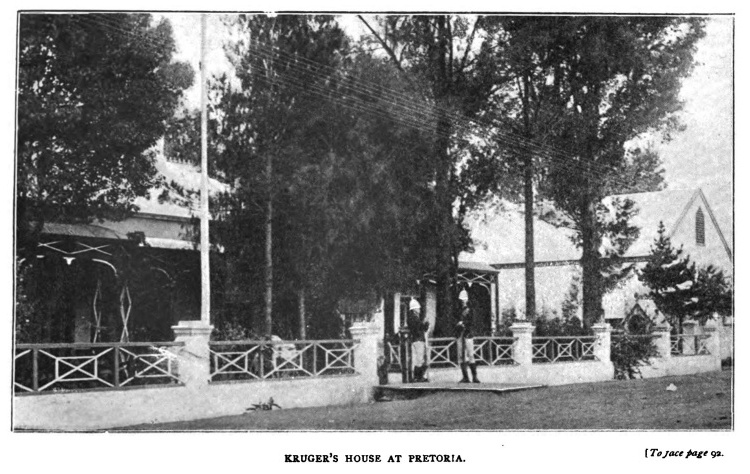
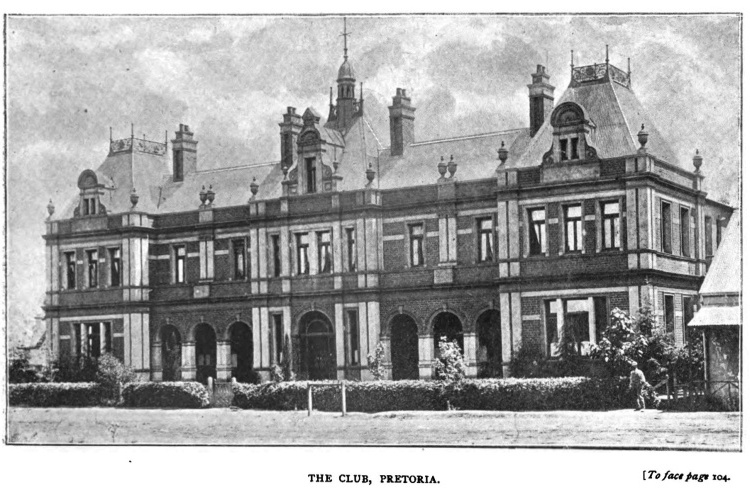
I was fortunate enough to have an early morning (5:30 a.m.) interview with President Kruger before he departed on what may probably be his last electioneering tour. As he was fully dressed in the usual black suit and little old-fashioned top hat, and smoking on the verandah of his house, the old President must have risen from bed an hour earlier at least, and though all the clocks in this region are fully thirty minutes behind time, 5 a.m. is a remarkably early hour to begin business. Two armed guards in the uniform of London police inspectors stood in the street barring the way to the house; but a mere look from the President sufficed to give us admission. His “Good-morning” in English slipped from him unconsciously, and after a shake hands he led the way to a spacious saloon, wherein the first thing that attracted my attention was a large and coarse oil painting of him. It happened that the seat shown to me placed Mr Kruger and his picture directly in a line, in front of me, and I was thus forced to compare the original with the copy. The history of the painting I do not know, but as it is permitted to be hung so prominently in the reception room, it is to be presumed that the President and his friends regard it as a faithful likeness, and are consequently proud of it. This small fact proved to be the A B C of my study of the man of destiny of South Africa. It was clear that neither Kruger nor his friends knew anything of art, for the picture was an exaggerated reproduction of every defect in the President’s homely features, the low, narrow, unintellectual brow, over-small eyes, and heavy, massive expanse of face beneath. The man himself was almost beautiful in comparison with the monster on the canvas, and I really could not help pitying him for his innocent admiration of a thing that ought to be cast into the fire. But presently the President spoke—a mouthful of strange guttural words—in a voice that was like a loud gurgle, and as the great jaws and checks and mouth heaved and opened, I stole a glance at the picture, and it did not seem to me then as if the painter had libelled the man. At any rate, the explosive dialect so expanded the cheeks and widened the mouth that I perceived some resemblance to the brutal picture.
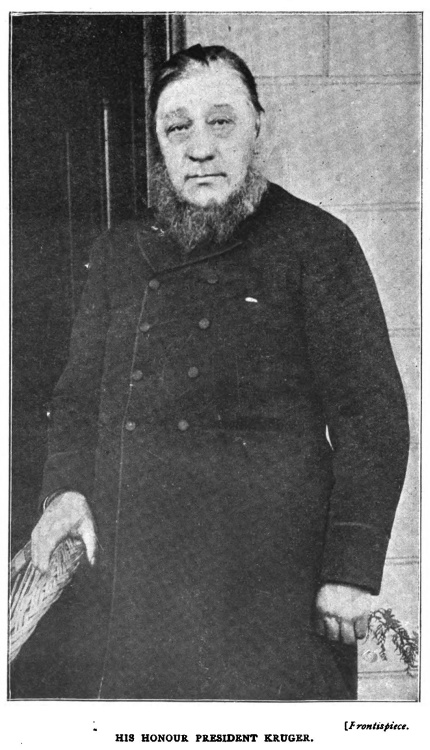
The Transvaal “Sir Oracle.”
I was told by my introducer, after the interview was over, that the President had already read a chapter in the Bible, and that it is his custom to do so every morning before appearing in public. I then understood the meaning and tone of his last words to me. Said he: “What I have said, shall be done.” He was alluding to the fact that the Dynamite Monopoly and Railway Rates were the children of the State, but they should be put into the hands of the Attorney-General, and if it were discovered that the terms of the concessions were in any way contravened, reparation should be made. The manner of his last words reminded me of the Jovic way—“and what I will, is fate”—but when I learned how he had been engaged, I knew he had been infected with the style of the Pentateuch.
The “Humbug Pose.”
This humour of Mr Kruger’s is becoming more pronounced as he ages. He has fully arrived at that stage of life which made Mr Gladstone so impossible in the Cabinet. There is abundance of life and vitality in the President, but he is so choleric that he is unable to brook any opposition. Any expression suggesting him to be mistaken in his views or policy rouses his temper, the thunderous gurgle is emitted, and the right arm swings powerfully about, while the eyes become considerably buried under the upper eyelids. I suppose, from the photograph of him now on sale at Pretoria, which represents his eyes looking upward, he fancies this to be the impressive gaze. He receives a stranger with the air of a pedagogue about to impress his new pupil, and methodically starts to inculcate the principles of true statesmanship; but he soon heats himself with the dissertation, and breaks out into the strong masterful style which his friends say is such a picturesque feature in his character, and which his critics call the “humbug pose.” If by the latter is meant the repetition of stale platitudes, and the reiteration of promises which will never be carried out, I fear I must agree with the critics.
Look on this Picture and—
Had I been asked to describe Mr Kruger’s character as conceived by me from what I had read of him, I should have summed him up after the style of an old author, thus: “What can be more extraordinary than that a man of no education, no fortune, no eminent qualities of body, should have had the courage to attempt, and the happiness to succeed, in wresting back this splendid country from the tenacious grasp of one of the greatest powers of the earth? That he should have the pluck and skill to defeat a British general in the field, even while that general was flattering himself for his successful manoeuvre, compel the British Government to relinquish what it had gained, and to reinstate the independence of his country by a Convention; and then upon second thoughts to cancel that Convention and substitute another which almost made his country a sovereign State; then, in flat opposition to the terms of that Convention, dare to disclose his vindictive hatred of the British race, among whom he was born and whom he often served, oppress so many thousands of his former fellow-subjects, curtail their guaranteed rights, trample upon them as he pleased, and spurn those who did not please his tastes, make every diplomatist who ventured to plead for them ridiculous for his failures; and while he dealt so hardly with those whom he characterised as his enemies, could make his friends understand that he was master, his burghers awe-stricken by his successes, at the same time make both friends and enemies give ready credence to his professions of justice and benevolence, to mock three of the most powerful nations of Europe by turns, and compel each with equal facility to maintain its distance; to make his illiterate and rude burghers feared and courted by the Governors of the several Colonies around him, to make their Governors and Legislatures humbly thank and congratulate him, to make one sovereign State solicit a nearer connection with his own, to be the dictator of the colony wherein he was born, and its Government obsequious to his slightest wish, and lastly (for there is no end to all the particulars of his glory), have talented and educated men of the world visit him, and depart for home enchanted with his condescension, enraptured with his humour and piety, and overflowing with admiration for his greatness and many excellences of character; to be able to have himself elected President for a fourth time, compel his ministers, generals, and rivals to sing his praises in their election addresses, and keep his burghers firm in the belief that he alone is the saviour of his country, and the only true patriot whom they can trust—to do all this is, at any rate, to be extraordinary.”
On This.
That was my ideal picture of Stephanus Johannes Paulus Kruger before the interview; but since I have been permitted to see him face to face, I am lost in amazement at the ridiculous picture my fancy, fed by cowardly and designing men, had conjured up. That so many people should have united in singing this man’s praises can only be accounted for by the fact that they must have had some interest, political or pecuniary, to serve, otherwise how is it that his “greatness” solely consists in my mind of what he has derived from the cowardice and weaknesses of others? “Many a mickle makes a muckle,” and hundreds of little advantages obtained over petitioners of all kinds, and by the follies and mistakes of others, constitute in the mind of the curious multitude what they have been pleased to term “greatness.” In appearance he is only a sullen, brutal-looking concierge, dressed in old-fashioned, ill-made black clothes. He appears to know absolutely nothing outside of burgherdom; he has neither manners nor taste; his only literature seems to be limited to the Bible, and a few treaties and documents about the Republic; he has no intrinsic excellence of character that should appeal to the admiration of the public; but what he does know, he knows well. He knows the simplicity of his rude and bearded brethren of the veld; he can play upon their fears, and their creed, with perfect effect, and it is in the nature of his ill-conditioned personality to say “no.” All the rest has fallen to him because he is so stubborn, so unyielding, and others so vacillating and so pitifully weak.
Kruger’s “Strength.”
I do not suppose there are any people in the world so well represented by a single prominent man as the Boers of South Africa are represented by Mr Kruger. He is pre-eminently the Boer of Boers in character, in intellect, and in disposition, and that is one reason why he has such absolute control over his people. His obstinacy—and no man with a face like his could be otherwise than obstinate—his people call strength. Age and its infirmities have intensified it. His reserve—born of self-pride, consciousness of force—limited ambitions, and self-reliance, they call a diplomatic gift. His disposition, morose from birth, breeding, isolation fostered by contact with his kind, is unyielding and selfish, and has been hardened by contempt of the verbose weaklings who have measured themselves against him.
“Dense, Ignorant, and Impenetrable.”
This is the man whom the Johannesburgers hope to weary with their prayers and petitions; but they never will do it. Nor will they convince him by their arguments, for he is too dense, ignorant and impenetrable. This is the man our new High Commissioner hopes to soften with his cultured letters and amiable allusions to the possibilities of restoring concord in South Africa. I feel a reluctance to say it, but his labour will be in vain. This is the man to whom the accomplished and lovable British Agent at Pretoria has been sent with a view to obliterate the memory of Jameson’s raid, and smooth the way to a kindly and humane consideration of his countrymen’s grievances; but he cannot make any impression on an unimpressible nature like Kruger’s.
The Efforts to Educate Kruger.
But the singular thing is that despite repeated, nay constant, rebuffs, all who have any dealings with Mr Kruger persist in hoping that he will relent in the end, and may genially try to exercise his authority for the termination of the existing unpleasantness. I spoke with all sorts and conditions of men at Johannesburg, and I only met one man who expressed his convictions that it was utterly impossible to induce the President to alter, or modify, his views. The rest, so often defeated and humbled, still continue to entertain a lively hope that things will improve. They are mostly clever and highly educated men, but whether it is that they have no time to study the disposition of the man, in whose hand lie their destinies, or their faith in themselves is so great, I know not, but it is certain that no sooner are they baffled in one attempt, than a new project has captivated their fancy, and enlisted their enthusiasm. They have tried to shame Kruger by their ill-considered demonstration in favour of Sir Henry Loch. The National Union has published its solemn declarations of uitlander claims and rights, they have had a Jameson raid, they have had the benefit of Lord Rosmead’s diplomacy, they have resorted to giving indiscriminate backsheesh, they have made much of the Progressive party, they have had an Industrial Commission, Chamber of Mines gatherings and speeches, but they are not a whit further advanced, and if to-morrow it is suggested that the mines should be closed, I suppose they would adopt that course or any other with equal belief in its efficacy.
Mr Chamberlain and the President.
Mr Chamberlain again, despite his better sense, and possibly his inclinations to try different methods, has—judging from the blue books which contain his letters—come round to the belief that the old methods of diplomacy are best, and now conscientiously exchanges courtesies in the blandest and most amiable fashion, as though there were no burning questions unsettled. He professes to cherish a profound belief in the integrity of Mr Kruger, and assumes an assurance that everything will be done by him according to the spirit of the London Convention. Sir Alfred Milner has been also heard to say that it is all “humbug and nonsense” to express a doubt of good relations being restored, and probably Mr Greene in the first flush of his coming has written in equally strong terms of the approaching pacification of South Africa. I wish I could share in this buoyant feeling, but the spirit of the Boer, as it has impressed itself on my mind, since I crossed the Vaal, forbids me to believe that while Kruger lives there can be any amelioration in the condition of the Johannesburger. The Boers have endowed Kruger with almost absolute power, and if up to seventy-two years of age Kruger has been the incarnation of hostility to England, it would be a miracle indeed if in his extreme old age he should be converted.
Paul’s Spoof.
It strikes me with wonder also that with all our astuteness, our experience, and our knowledge of human nature, we should be so credulous of these many professions of amity from the Transvaal. I am fresh from my visit to Mr Kruger. It was but yesterday I heard the many dismal complaints of Johannesburg; I have but now come in from a look at the fortified heights of Pretoria. I open the last blue book and extract the following from the Boer despatches:—
1. “No unfriendliness is intended by Volksraad. It would be unfair to interpret it as such.”
2. “This Government also can give the assurances that it has no other than peaceable intentions.”
3. “This Government again expresses its opinion that through friendly co-operation, the confidence so rudely shaken, as well as peace and prosperity, will be restored.”
9. “The Government readily gives the assurances that there is no intention on its part of infringing its obligations.”
5. “This Government need hardly assure Her Majesty’s Government that it will comply with its obligations as soon as It is in a position to do so.”
6. “His Honour the President requests me to assure you that there is no intention on his part to depart from the terms of the London Convention, and that he is anxious to act throughout in conformity with those assurances, etc.”
“A Boer Machiavelli.”
One who knows anything of the conditions under which the Johannesburgers live need not come to Pretoria to know how hollow and insincere these and countless other professions are; but when read at Pretoria with those four forts constructed at lavish expense commanding the approaches to the capital from the Johannesburg direction, the mendacity of the writer seems appalling. Take these in conjunction with the many promises President Kruger has uttered to interviewers, to casual English visitors, to deputations or in public speeches, in relation to his intentions to adhere strictly to the terms of the Convention of 1884, and one cannot but conclude that, though the President reads the Bible daily, he must have overlooked the sentences that apply to liars. If, despite the cordiality, conciliatoriness, and numerous expressions of goodwill, that are visible in Mr Chamberlain’s despatches, and the entreaties, remonstrances, and the continual patient efforts of the uitlanders to soften the asperities of Boer rule, President Kruger and his burghers, while writing in the style of the above quotations, build these great forts at Pretoria and Johannesburg, it is evident that English people have wholly failed to understand this man, and that their ideal of a “goodish sort of man, kindly and a little old-fashioned, a little slow perhaps, and stubborn after the Dutch type,” never existed since Pretoria was founded. On the contrary, the real Kruger is a Boer Machiavelli, astute and bigoted, obstinate as a mule, and remarkably opinionated, vain and puffed up with the power conferred on him, vindictive, covetous and always a Boer, which means a narrow-minded and obtuse provincial of the illiterate type.
How the Convention was Contravened.
“Go and tell your people,” said he once to a deputation from the uitlanders, “that I will never change my policy.”
For once he spoke the truth, and having seen him I feel convinced he never will, but he has persuaded so well and spoken so fairly, that I doubt if a Colonial Office official will abandon hope of him.
I recall to mind the last portion of Article 14 of the London Convention, which refers to those persons other than natives who may enter the South African Republic. “They shall not be subject, in their persons or property, commerce or industry, to any taxes, local or general, other than those which are or may be imposed on citizens of the South African Republic.”
How does that agree with a fourpenny tax on a four-pound loaf of bread? Or a shilling tax for every four pounds of meat, or a shilling tax on every four pounds of potatoes, or a sixpence for every half-pound of butter eaten at breakfast by a miner and his family?
The Racial War Bogey.
People at home do not stoop to consider what such details mean. They have probably more in their minds the general effect of a racial war in South Africa, and see red ruin in place of the peace and content that ought to prevail here. But what have we to do with racial war and its horrors? Our business is to look at the immediate present, and not anticipate events which need not take place. We have to abide by the Convention; why should not the other party also abide by it? It was a fair understanding. Kruger himself drew up the terms, and they were mutually agreed to, and it is scarcely common sense to suggest that the party which seeks to maintain the Convention instigates a racial war, while the party that has broken the Convention repeatedly should be held innocent and blameless.
The Laws of “A Choleric, Obstinate Old Man.”
There is another point in this article which has attracted my attention here. The first part of Article 14 says, “All persons other than natives, conforming themselves to the laws of the South African Republic, will have full liberty to enter, travel, or reside in any part of the South African Republic.” I am curious to know what laws were meant here. Were they any laws which the sacred twenty-four members of the First Raad might choose to impose, or were they such laws as might be made conformable to civilised countries? If the laws were made by the people of the Transvaal, we, of course, should not hear so much of grievances, but the existing laws of the South African Republic have mostly been proposed by President Kruger, and obsequiously enacted by the twenty-four members of the First Raad without reference to the people, and consequently they could not fail to be intolerable to the larger number. The Grondwet throws a light upon the character of the laws that were meant when the fourteenth Article of the Convention was framed. Its first chapter declares that the Government shall be Republican, that the territory of the Transvaal shall be free to all foreigners, and that there shall be liberty of the Press. Then I think that, as Her Majesty’s Ministers admitted and sanctioned the terms of the fourteenth Article, they understood the “Laws of the South African Republic” to mean the Constitution, and such other laws as obtain in civilised countries, for it is scarcely credible that they would have signed the Convention had they understood that Englishmen could not be admitted into the rights of burghership until after fifteen years’ residence, or if poverty was to be a barrier to that “full liberty” sanctioned by the Grondwet and the fourteenth Article. We may also rest assured that the British Commissioners would not have signed the Convention if that “full liberty” did not include free speech and a free Press, the full use of one’s native language, the full exercise of every faculty according to custom prevailing in all civilised countries, or if certain British individuals who happened to misconduct themselves were liable to receive excessive punishments, or if for writing a market note in English a 5 pound fine was to be imposed, or if for grumbling an Englishman was to be expelled from the country, or if for considering himself as being a little better than a Kaffir he should be compelled to wear a badge that marked him as inferior to a Boer. I think it may be taken for granted also that no British Commissioner would have attached his name to a Convention had he guessed that the Laws of the Republic might mean any odd or fantastic whim that might enter into the head of a choleric, obstinate old man like the present President for instance.
Uitlanders’ Rights secured by a Solemn Convention.
Far from deserving the title of great which some English visitors have bestowed upon Mr Kruger, it seems to be that the most fitting title would be “little.” The gifts the gods have given his State he resolutely refuses. His sole purpose and object seems to be to make the South African Republic the China of South Africa. He declines to admit men who are in every way qualified to the burghership, though every other new country is competing for such men. The Americans welcomed every able-bodied incomer as a fresh ally, and valued each workman as being worth 200 pounds to the State. Thirty years ago citizenship depended upon nativity, and could never be abandoned. The idea was a relic of the Middle Ages, and was traceable to tribal superstition of prehistoric times, but as nearly every country in the civilised world has consented to admit people of all races to citizenship after a probationary period of from three to five years, the South African Republic only marks its own retrogression to barbarism by extending the term to fifteen years. Mr Kruger, instead of granting to foreigners common rights which were sealed to them by a Solemn Convention, for which let it be always remembered the independence of the State was assured, prefers to keep 80,000 uitlanders outside the pale of citizenship, to irritate them by onerous laws passed by an oligarchy of twenty-four men, and to grind them with taxes. If he made them burghers his country would be the premier State in South Africa, and he might then do almost what he liked, except invade his neighbours’ territories. The worst that could befall a Boer is that some candidate might be thwarted in his hopes of the Presidency, but the inviolability of the Republic and its Independence would be placed beyond danger.
What Kruger’s Policy will Lead to.
Mr Kruger professes to seek the prosperity and progress of the State, but I will simply mention the dynamite and other monopolies, of which we have heard so much lately, and point out that it is only a Boer audience that could be persuaded to believe in him. The resources of the State are forbidden to be exploited, the Minister of Mines refuses to proclaim new gold fields; the taxation on those in operation is so heavy that only a few of the richest mines on the main reef can be profitably worked. The expenditure of the State is extravagant—quite 40 per cent, could be saved, I am told. The reforms lately mentioned by the Industrial Commission, if granted, would reduce the cost of working expenses by 4 shillings per ton, and be the means of re-opening mines which were closed as being unprofitable, as well as bringing several miles of the reef into the payable degree. But Mr Kruger’s idea of increasing the prosperity of the State is by raising the taxes on the mines that continue to pay dividends, in order to compensate the Treasury for the loss of revenue incurred from the collapse of the poorer mines. If, as one mine after another succumbs to the burden of taxation, he increases the taxes on the richer mines, every mine must become closed, because no gold mine was ever discovered that did not cost much money and high-priced labour to extract the gold from it.
Those who Pay the Piper.
Mr Kruger’s ideas of government are to divide the people into two classes—those who get their living from the surface soil and those who get it underground. He himself favours the former. According to him they only are entitled to have any voice in the Government, and to be considered as citizens of the Republic. As for the other class, they have no rights, and the country would be relieved if they departed. Yet, according to the last Budget, I find 3,799,913 pounds of the State’s revenue were derived from the class who labour underground, while only 1,086,586 pounds were obtained from the other class.
Kruger’s Cant.
But if we wish to know and realise Mr Kruger thoroughly, we should pay attention to his last election address, issued about a week ago. He says: “As I have before told you, I aim, as instructed by the Scriptures, at justice and righteousness to all men—to by down on our political territory the eternal principles of God as the foundation of our State. The taking to heart of the lessons of that Word enables us to be certain under all our difficulties. These lead us to a recognition of our absolute dependence, not on the great ones and power holders of the world, but upon Him who sent that Word to us.”
“Burghers and fellow-countrymen, the times are such that a wise and judicious development of our sources of aid requires the most earnest consideration. Therefore these must be protected and advanced, and while we lend a helping hand to the mining industry we must not lose sight of the agriculture and cattle farming, so that prosperity and progress may be brought to the doors, not of some only, but of all. That will be my earnest endeavour. Many of you have sustained almost irreparable losses through rinderpest, and you know what has been done in order to help you to tide over these hard times. I desire to proceed in this direction everywhere that such assistance may be required, to the end that many of the very pith of the people, at present bowed under the yoke of adversity and misery, may be helped and heartened by the strengthening of the feeble knees.”
I do not think I need quote any more. As will be seen by the first paragraph, Mr Kruger takes the Scriptures as his guide in matters of policy, and, as he considers the Boers to be the chosen people, we may infer what the miserable Canaanites who dwell along the Raad may expect from the course adopted by Joshua towards their ancient prototypes. The second paragraph is more secular, but the policy of Mr Kruger is just as distinctly indicated. The “very pith of the people,” the Boers, must be helped and heartened by the strengthening of the feeble knees, which means money must be taken from those who did not suffer in their flocks and herds, viz., the miners, and distributed amongst those that sustained almost “irreparable loss through rinderpest.”
Mr Chamberlain’s Lost Opportunity.
Mr Chamberlain has led us to believe that he has a policy which will set these matters right. He has great faith in Sir Alfred Milner and Mr Greene; he has also faith in himself. In brief, his policy consists of conciliatoriness and firmness combined. If I have succeeded in this letter to properly express my convictions and the grounds for them, it will not surprise anyone if, with all my belief in Mr Chamberlain’s genius, I utterly decline to share this faith. Time was, and that not many months back, when he might by other methods, not war, nor necessarily leading to war, have broken down Kruger’s obduracy, and made him more sensible; but that time has passed. It is now too late. Time was, and that not long ago, when the Johannesburgers might have imposed terms on Kruger and, unassisted by outsiders, have rectified matters themselves; but the opportunity was lost through Jameson’s interference.
Force no Remedy.
The Press has frequently suggested other means of bringing Mr Kruger to reason, the author of “Boers and Little Englanders” has stated what he thinks ought to be done, the Johannesburgers themselves are brimful of suggestions, but I think that, though some are partially right, I have not come across any which seems to meet the complex case entirely. We have the sentiments of the Colonies to consider as well as the sentiments of the people of Great Britain, and the whole of Europe in fact. Therefore forcible measures in cold blood are out of the question, because from what I heard I doubt that the people of Johannesburg themselves would be grateful if we resorted to them.
Salvation Lies in a United Johannesburg, Passively Resisting Tyranny.
I quite agree that it is the duty of Her Majesty’s Government to strengthen our forces in South Africa to show the Boers that we are serious, and that power is at hand in case of necessity, but as long as our forces remain inactive their effect will wear away, and the Boers will soon fall back again to their sullen and vindictive attitude. What, then, is to be done? Nothing, absolutely nothing, until the Johannesburgers themselves prove to us that they are serious, united, and firm, and make the first move. It will be said, however, that they have no arms. No arms are needed of any kind, but the will to suffer and the courage to endure. Their lives will be safe in any case, for even Boers do not shoot unarmed and unresisting men, but if they all say that the taxes are ruinous, that their property is confiscated by these legal exactions—why pay the taxes, why continue to pay bribes to those in authority for trifling relaxations, why assist in any way to perpetuate the “corrupt and rotten” Government of which they complain so bitterly? It amounts to this. The Boers have a right to administer their country as they think best, but if their administration is unjust and oppressive, surely the oppressed have the right of passive resistance, for it is in human nature to resist injustice. The consequence of passive resistance will be imprisonment. But when a sparsely populated State is obliged to imprison some score of thousands of non-taxpayers, and to feed them, bankruptcy is not far off. If any die in prison from starvation, or blood is shed, or general confiscation of property takes place, we then shall have a legitimate cause for action. I do not say that this policy of waiting upon Johannesburg is a noble one, but as we have been so indifferent to the obligations of the Convention, as we have closed every sense to our countrymen’s complaints, as we have been the slaves of every petty circumstance, as South Africa is so contentious and fault-finding, as the English uitlanders themselves have threatened to lift their rifles against us if we move to exert pressure on the Boers, it seems to me that we must wait upon Johannesburg and let the people of that city point the way. Every civilised people in Europe can furnish instances of how to resent injustice and defeat oppression. England, Ireland, Wales, France, Spain, Italy, Germany, etc., all have their examples of what courage can do when nerved by despair, and I think, if it is really serious, it is the turn of Johannesburg to show what it can do; otherwise we must wait until Mr Kruger’s nature changes, which will be “Never, no, never.”
Chapter Six.
Summary of a Few Impressions.
On my return from South Africa I was interviewed by a representative of South Africa. I had proposed to write on my voyage to England a closing communication describing my visit to Natal and summarising my views on the South African outlook generally. Unfortunately, I was attacked with severe rheumatic pains shortly after the steamer left Cape Town, and was not able to put pen to paper. I, however, gave the representative of South Africa the impressions I should have written on the voyage, had circumstances permitted me to do so.
The Labour Question in Natal.
“How were you impressed with Natal?”
“I was very much struck by its beauty and its fitness for a white population. There was one curious anomaly, however, in the fact that the natives in Natal are very numerous, and yet the Colonists suffer from a deficiency of labour. Ships often lie at the wharves for days, waiting for coal, because labourers cannot be got to put it on board. At the same time the labour party, or the white man’s party, at Durban are complaining that the coolies are being brought to Natal in too great numbers.”
“Those are points in economic development that want immediate tackling?”
“Something should be done to start the enlistment of Zulus of Natal in its labour forces for the development of the State. It is a most interesting little State, very quietly governed, and the people are an exceptional class of Colonists, but they seem to have some problems before them which will tax the ability of future Ministries.”
“The coolie immigration question, I take it, is not one of the least of these?”
“That is so. There are masses of white men in England and on the Continent, it seems to me, who would jump at the opportunity of getting allotments of land in Natal. The Government might do worse than afford some greater facilities for the importation of white labour. In Natal there are 45,000 white men against 400,000 Zulus. In addition to that they have taken Zululand with about half a million of Zulus, so that there are now 45,000 whites against 900,000 blacks.”
“Then, in your opinion, that mass of blacks wants leavening by the introduction of white men. The immigration would have to be worked from this end, would it not?”
“Yes, they would have to be liberally treated for the first few years to induce them to go. Natal, as I have said, is a very lovely country. There are enormous estates railed off for sheep and cattle raising, and it seemed to me that I saw more places there fit for small estates of white men than in any other part of the country, excepting Rhodesia.”
Mr Stanley was careful to further emphasise the exception to his rule furnished by Rhodesia.
“That opens up a very interesting question,” remarked the interviewer, “for emigration from this country has been allowed to take its own course without much assistance, save from the emigration agencies, who, of course, have to be approached by intending emigrants instead of approaching them.”
Natal should be Better Advertised.
“Yes,” rejoined Mr Stanley; “the wants of a Colony like Natal must be advertised, and its claims to the consideration of those desiring new homes should be pressed upon the people of England.”
“How do you think the white men in Natal now would regard the influx?”
“Well, they must be considered, but it is as much for their interests as for those of anyone else. If they are as narrow-minded as the labour party at Durban, there may probably be a serious calamity some day.”
“Had you an opportunity of discussing such problems with Mr Escombe or any of the leading politicians of the Colony?”
“I saw perhaps twenty, but I fancy they are rather afraid of saying what is in their minds, because the ultimate solution depends upon the democracy of Natal, and Ministers hesitate to be leaders in any such agitation.”
Although he has already treated the subject of Rhodesia and its future prospects so exhaustively, Mr Stanley had nevertheless still many points of importance to touch upon. He insisted very strongly upon the necessity for offering inducements to other settlers besides those engaged in mining.
More Settlers Wanted in South Africa.
“I think,” said he, “every Colony in South Africa has been very remiss in the matter of attracting immigrants. You have only to look at the statistics of population—black and white—to see how disproportionate are the two races. The Cape of Good Hope, with 221,000 square miles, has nearly a million and a quarter of coloured people to 377,000 whites, and the former are multiplying with extraordinary rapidity. Natal, again, as I have said, has 45,000 whites and nearly a million coloured people. British Bechuanaland, with only a little over 5000 whites, has 65,000 coloured people. Matabeleland, or rather what is now Rhodesia, had some years ago only 2500 whites and 250,000 natives. Of course, the whites are more numerous now, but still the disparity is sufficiently striking.”
“It has been asserted very freely that until the production of gold assumes large proportions the white population cannot increase, because they have nothing to subsist upon.”
“There is always a place for intending farmers. If the land is to be parcelled out among such, the present is as good a time for them as it is for the miners.”
“Men, of course, can support themselves on farms, even although there is no town in the vicinity to furnish a market for their surplus produce?”
“Exactly so. It is necessary in the end to have markets, of course; but the first necessary thing is to make a home. Considering the conditions of this country and the rapid growth of population, with the closure of the United States, with only Canada and Australia open to the surplus population, where is there a better country for Englishmen than Rhodesia?”
Immigration Wanted to Counterbalance Boer Influence.
“You think Mr Rhodes has perhaps overlooked the advantage of putting forward these considerations?”
“Not only Mr Rhodes, but all the politicians of the Cape Colony and Natal. The best work the British Government ever did was in sending those five thousand English people to South-East Africa in the early part of this century. The experiment unfortunately has never been repeated. There is a different kind of population going out now. When they go to the Cape, they begin to spread themselves over every part of South Africa as far as Salisbury. It seems to me that there ought to be three or four hundred families going out every week to settle in new homes. There is a great political question in the background, and if Englishmen are not awake to it they must be instructed. The Boers, not alluding to any political party such as the Afrikander Bond, or the Krugerites, or the Republicans of the Orange Free State and the Transvaal, but judging by their general conduct and the tone of their public utterances, seem to have determined to keep Englishmen out of South Africa in order to maintain the balance of power in their own favour. Their whole action tends to that. Supposing the Cape Colony had a grievance against the British Empire, and chose to form a Republic of its own, it would be a Boer Republic, because the Boers are more numerous than the English. It would be an addition to the Orange Free State and the Transvaal. Some great absorbing question might arise at any time; yet no one seems to have done anything to prepare for such a contingency, or to maintain the balance of power in favour of the English. The Dutch would naturally take sides with one another, as they did in the Jameson raid affair. Then all the Dutch population veered round in favour of the Transvaal, whereas before that, as in the Drifts question, the Cape Dutch rather thought that the Transvaal was wrong. The unjustifiable attack upon the Transvaal, so unexpected, like a bolt from the blue, gave the Dutch an impression that the British Government were at the back of the raiders, or if not the British Government, at least the British nation. They said to themselves, ‘the British people are ever hostile to us, and are determined to have this country English, and under the thumb of the British Government. We refuse to have the British Government vex us now as it has done in the past. They drove the Transvaal Dutch from the Cape Colony; and they may drive us away if we are not united in opposing this constant British hostility or meddlesomeness with our peculiar habits, principles, and ideas.’”
“It is perhaps more correct to say that the Dutch retired before the advance of the English rather than that the English drove them away by persecution.”
A Hint to Downing Street.
“An over-sensitive English sentiment is at the root of many of the past disturbances. When I was going to South Africa on the Norman the great question of the hour was the indenturing of the Bechuanaland rebels. I talked a good deal with Colonial people on board, and they were not disposed to be reticent about their feelings. They frankly said the British people were just beginning the same old game of meddlesomeness. ‘Here,’ they said, ‘are rebels whom we have caught in the act of fighting against us, raiding and murdering our fellow-colonists. We pay for the forces to suppress that rebellion; we have taken hold of the prisoners who have surrendered. We do not know what to do with them better than to distribute them, with their own consent, among the farmers for a term of five years, instead of imprisoning them, and thereby making them non-productive and a burden to the State. If we had sent them back to their own country, they would simply have died, or made it very dangerous for anyone with property to go near their country, and we should have had to begin again. You English say it is a form of slavery. We deny it. It is no more than Sir Charles Warren did in 1878. What the British Government did in 1878 we are doing now. Don’t you suppose that, having given us an almost independent Government, we have got plenty of pious, well-educated, intelligent men as capable of looking after our morals as the civilised people of England? Why do you all the time place English sentiment in opposition to us, with a view of tyrannising over us? We make our laws, and can correct them if they are wrong. We do not want you to interfere all the time. Our lives and our property, the welfare of our wives and children, depend upon good government. But immediately we do anything you raise the cry that we are barbarous and wicked, and are reducing rebels to the state of slaves, and thus you excite and disturb the people.’ ‘Supposing,’ said one of the speakers, ‘that the majority of the British nation were inclined to that opinion, and believed that we were so wickedly disposed as to subject our coloured people to a condition of slavery, Parliament would raise the question, and very possibly, if the sentiment has taken deep hold of your people, would pass a law to prevent it. Then a collision of interests would take place—Boers against English. The English would probably follow the British Government, except a few who have been resident in South Africa and understand those questions as well as the born Colonists. Thus the Colonists would become divided. The Boers and Afrikanders could not trek again, as Bechuanaland and Rhodesia shut them off from the north. They therefore would demand a republic, to cut themselves adrift from the Imperial Government. The same question would be raised as was raised in the United States when they separated from Great Britain. Danger only can arise from the English habit of interfering in Colonial matters which they do not understand, and from not giving the Colonists credit for being able to manage their own affairs.’”
“Then, in your opinion, the remedy for that is to reinforce the English population in South Africa, and for Exeter Hall here to exercise more reserve?”
“Precisely,” replied Mr Stanley. “If you have a manager of an estate and you suppose he is a man of ability and you entrust him with the management of your estate, and then cavil at everything he does, he will resign. That is just the sort of feeling that is so apt to be raised in South Africa—the incompatibility of temper between the people of South Africa and the too sentimental people of Great Britain. There are two parties in South Africa, Boer and British, and if the former are inclined to be tyrannical to the natives and subject them to slavery, you have the English party, which is as clever and intelligent as people here, ready to preach to and convert the oppressors and to act in opposition to them. Therefore, the English criticism at home is not needed, and it should not interfere with the Colonists’ domestic concerns. England must give the Colonists credit for their intelligence, and for a desire to act like civilised people. There would be no need then for a Republican, or a Separatist party at the Cape.”
A Great Emigration Company Wanted.
“What do you propose as a means towards the end you speak of?”
“It is natural,” replied Mr Stanley, “that the English of Cape Colony should be anxious for the future of the country in case of a separation from Great Britain, and that they should fear the establishment of a Boer Republic. I see in this a very strong reason why someone with power, wealth and influence should step forward and try to lead them to do something to prepare for maintaining the balance of power. Rhodesia, the Transvaal, the Orange Free State and Natal draw away from the Cape Colony a large number of enterprising Englishmen, and consequently the Boers, not being so enterprising, nor so very fond of running from one home to another unless a great political principal is at stake, prefer to stay on their farms and multiply there, whereas the English are all the time thinned down by those everlasting discoveries and developments in the north and north-east, so that they remain numerically inferior to the Dutch. If there was a Company with a man like Mr Rhodes at the head of it, which would buy land and settle on it new colonists of English birth, they would be all the time keeping up the equality that is necessary to prevent the English from being Boer-ridden.”
“Do you think Rhodesia would adapt itself to such a policy as well as the Cape Colony.”
“Quite as well. With the opening of all those mines reported to be so promising, and with the vast advertisement of the opening of the railway, Mr Rhodes ought to see that more miners have been coming into the country than agriculturalists, and something ought to be done to provide for the provisioning of so many people and keeping the prices of food down by multiplying the producers of food. The country is just as well adapted for them as any other in South Africa. If the Government of Rhodesia neglect this, the Boers will go on filtering through the Transvaal to Rhodesia, and the same mistakes will recur that have been made in the Cape Colony and the Transvaal, where the settled population is Dutch and the moving English.”
Australians Available.
“What are the principal countries outside South Africa from which such settlers could be drawn?”
“There are plenty of people in Australia, for instance, who would be very glad of the opportunity to settle in nice places in Rhodesia if they were tempted to do so. You must show that Rhodesia is better than Australia, where you have the fringes of the coast and the best parts of the interior already taken up. You have only to go to Melbourne, Sydney, and other large Australian towns, to find that they have a very large population who do not know what to do with themselves or where to go, who would be valuable to a new country like Rhodesia. Take, for example, the people who went from Australia to Paraguay. These would be far better in Rhodesia amongst Englishmen than in Paraguay surrounded by Spanish Americans, whose ideas and modes of life are so entirely different. When I was in Melbourne I had an offer from fifteen hundred Australians to settle in East Africa. I advised them not to do so until the railway was built. They wanted to start ranches and raise cattle there, but I said their stock would die before they could reach the pastures. In Rhodesia to-day, however, you have a country, to which such people would be very advantageous. Cape Colony has an enormous area that requires to be populated, and so has Natal. How are you to reach the class of people required for this? What are you to offer them? It must be something better than where they are now.”
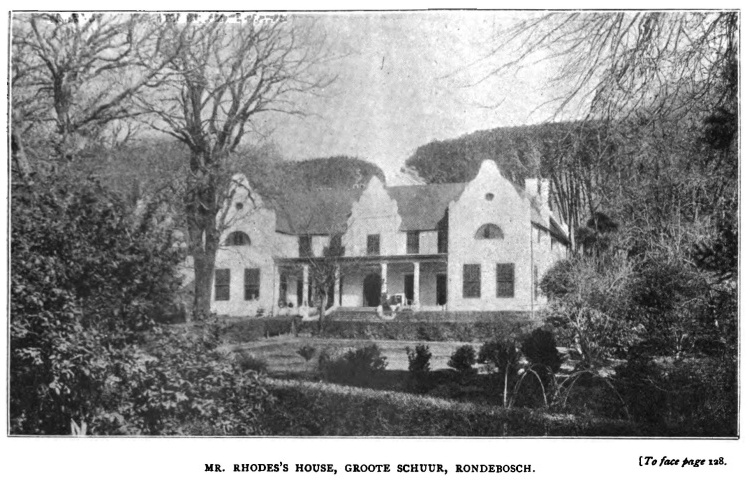
“In your opinion Rhodesia is well adapted for cattle raising?”
“Yes; the Matabele found it so, and there are still many cattle there despite the rinderpest. New cattle will do well enough, I think, if you take them rapidly by railway across the malarial belt.”
“And seeing that the Cape is so much nearer to England than Australia, there is no reason why an export trade should not be developed in time?”
Charming East London.
“Certainly not,” was Mr Stanley’s emphatic rejoinder. Proceeding to deal more particularly with the future possibilities of various parts of the Cape Colony, he alluded to his visit to East London, which he thought one of the healthiest places he had ever seen, characterising the country around as a most charming one. “I was more taken with the south-east coast,” said he, “than with any other part of South Africa. Probably it was due to the season, but everything was as green as in England. People looked healthy, and little children as rosy as they could be. I admired the magnificent groves of trees planted by colonists and the flourishing estates that were visible all the way until we got into the Karroo. The best part of the eastern province is perhaps as large as Scotland. I should say it was just as well adapted for white people as any part of England, and yet the population is so scant as compared with the vast acreage. It was in that part that the English families were settled, and made beautiful towns like Grahamstown and King Williamstown.”
“And at that time,” interpolated the interviewer, “they had to contend with natives, who are now subdued?”
“Yes,” said Mr Stanley, “that is a disadvantage that settlers nowadays would be exempted from.”
“Is there not an obstacle to your scheme, in the circumstance that people nowadays are not content to go abroad for a mere living? They demand something more than they can get at home—not perhaps a fortune, but at least the chances of amassing sufficient money to raise them to a position of comparative independence?”
How Farmers Make Profits.
“But there are different ways of making a fortune or of saving money,” replied Mr Stanley. “It can be done by agriculture as well as by mining. The farmer, however, must be content to look upon the farm as his home, and the capital and labour devoted to it as constantly increasing in value. The farm which he buys at 10 shillings an acre may become worth in a few years from 5 to 10 pounds an acre. There is his profit. He buys an estate say of 200 acres for 100 pounds, and in five or ten years’ time it may be worth 500 or 1,000 pounds. It depends upon the progress made in the general development of a country by the working of its mineral resources and by its commerce and trade. The greater the development of the country the greater will be the value of the farmer’s land, because more people are constantly coming who don’t care to be pioneers, but will buy a farm already developed. The pioneer then goes from farm to farm, and in this he makes his profit. People who went from New England to Ohio or Kentucky, for instance, developed farms which they sold at an enhanced price, afterwards removing to Kansas; after getting, perhaps, twenty-five times as much for their farms in Kansas as they had paid for them, they went next to Colorado, where their farms ultimately fetched twenty-five or fifty times as much as their original cost. Then they went on to Salt Lake, Mexico, Arizona, or other parts of America, and repeated the same process. That is the way a farmer makes his money in such countries.”