Chapter VIII · NATURE NOTES
Reading edition
It would be difficult to picture East Africa without her vivid abundance of Nature, for it is “the creatures of the earth” that for ever astonish all who enter this country of vast wildernesses and few habitations of white men.
In this connection I will endeavour to describe some of the forms of wild life that were most closely associated with camp and trek during the campaign.
NATIVES OF EAST AFRICA
To begin with, if I may bring them into the category of wild things them made splendid Askaris, while as trained porters, for machine-guns, signalling sections, and stretcher-bearers, they were extremely useful, and many thousands were utilised for such work. Those natives were extraordinarily keen on their drills—in which they were daily instructed, whenever opportunity arose, to ensure combined movement without confusion, and quick obedience to orders—and it was a common thing to see them, after a parade had been dismissed, continue their drill within their own lines, under the direction of one of their enthusiastic headmen. They were simple, good-natured people, those blacks, and very easy to deal with if one took the trouble to understand them and their language, and ruled with a strong yet considerate hand. But they were unfortunate, and at a loss, when they came under the charge of strangers who had not had opportunity to understand them or their language—which often occurred, owing to loss of experienced men through sickness or casualties, and their replacement by men freshly arrived in the country.
When we entered German territory many Swahili natives, of the inhabited districts we passed through, were hired by all ranks as personal servants, and thenceforth became followers of the column. Those were usually boys of from fifteen years to twenty-five years. They subsisted on any kind of diet, and often foraged for scraps in camp and for fruits in the bush, with much of the instinct of animals. Those who were ignorant were taught to cook, and to do the many little duties of body-servant; and were a great boon to trek-tired men when camp was reached and they were available to cut grass for the bed on the ground, fetch water, kindle camp fires, and help in the cooking of food.
The Kavirondos from the Lake District, and the Kikuyus from the Nairobi area, were used almost exclusively for carriers and camp cleaners, and were perhaps less intelligent than the average Swahili native, and of lower type. Nevertheless, some of them were very useful, and I have used picked men from both tribes as higher-grade machine-gun porters, and found them come very close to the standard of the good Swahili.
The warlike nomad Masai roamed the upland grass-lands of their great reserves and held aloof from warfare. Only as guides in the early days on the frontier were they of usefulness to our forces, and at that time they were often seen about our camps. They were remarkable for their knowledge of direction in a country of few apparent landmarks, and for the speed at which they could cover long distances, with their ungainly shuffling run.
BIG GAME
I turn now to the big game of the country.
I know no more interesting and wonderful sight than that we often witnessed, and that may be to-day witnessed, on the Kajiado Plains, and in the neighbourhood of the Guaso Nyero valley. Not even the wonderful migration of the vast bands of caribou in the far Canadian North can surpass the sight of game one will see here in a day. In a single day’s march herd after herd of game may be passed feeding plainly in view in the open grass veldt—herds of wildebeeste, hartebeeste, zebra, and Grant’s gazelle, are the most plentiful; and small groups of Thomson’s gazelle, oryx antelope, giraffe, and ostrich. While in the Guaso Nyero valley it may be your good fortune to sight a large herd of buffalo.
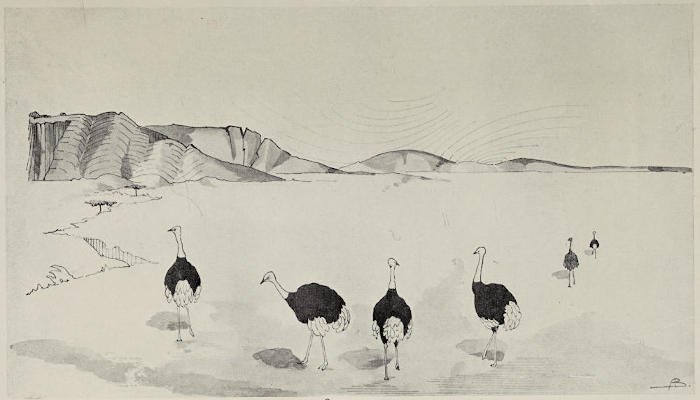
Ostriches.
Eland antelope I only remember seeing in two localities—at Maktau on the frontier, and in the Rufiji valley.
Within German territory no such vast numbers of game were encountered: but that may have been because we did not again travel through open veldt of the same nature as contained the herds on the frontier. Most game, in German territory, were seen in the low-lying Mgeta and Rufiji valleys. At Tulo and Kissaki, some species of game were plentiful. At Tulo, reedbuck, waterbuck, mpala, and wart-hog were numerous, while a number of hippopotamus haunted the sluggish Mwuha River. At Kissaki, bushbuck, Harvey’s duiker, and wart-hog were the principal small game, while here, and out to the great Ruaha and Rufiji Rivers, the territory was renowned for elephant.
Elephant tracks, old and new, were everywhere in the neighbourhood of Kissaki, but animals were seldom seen, since they were very wary, and extraordinarily quick in scenting danger. If they detect human scent—which they will pick up a mile or more down-wind—they are at once alarmed and fast travel away from the danger, very often covering great distances before reassured that they have reached a zone of safety.
HIPPOPOTAMUS, RHINOCEROS
At the Rufiji River a remarkable number of hippopotamus were seen. North of Kibambawe village there is a chain of lakes no great distance apart, and I have passed one of those lakes, Lake Tágalala, when there have been scores of hippo, visible in the water. I should think the marsh-banked Rufiji River throughout its course teems with those strange, cumbersome, uncomely animals.
Rhinoceros were perhaps most plentiful on the frontier, and were often encountered when patrolling the thick bush, or bush-covered hill-country. During the many times I have met those animals at close quarters—and I have stumbled across as many as four separate animals in a single night when on particular reconnaissance—I have never known them to charge seriously when not wounded. I have experienced them rush straight on to the sound of a stick crackling underfoot, but, when they drew close and got my wind, they veered off instantly to one side, and escaped in the bush rapidly and fearfully. I remarked my experiences to Selous, for they were not what I had been led to expect, and he corroborated them by saying that he also had never seen one charge a man when unmolested.
Selous, too, in discussing lions, in his quiet, practical way, laid very little stress on the dangers of hunting those animals. He said there was little danger of their ever venturing to attack unless wounded, and then the greatest danger was in going into long grass to search for an animal that in all probability would be lying there concealed, and at bay, and ready to spring on an over-hasty pursuer. Selous’s advice was that, “in hunting lions you should try to get a clean clear shot at your quarry, at fairly close quarters, and to shoot to kill with your first shot.” “Don’t attempt snapshots and wild shooting, which only lead to a bad hit, and a dangerous lion at bay to be dealt with.”
The eerie roar of lions was often heard at night outside our camps, or near to the bivouac of a lonely outpost, and sometimes, through the day, they were seen by our outlying pickets; but I only know of three being shot by members of our battalion during our service in East Africa.
BIRD LIFE
I turn now to the bird life of the country. In the bush, in the neighbourhood of water, birds, of various kinds, were often plentiful, and were remarkable, as a rule, for their brilliant plumage. But they were seldom conspicuous in numbers in the open, for, as a rule, they kept closely within the cover of the bush and jungle grass; and on this account I have often heard unobservant men remark on how little bird life they saw during the campaign in East Africa. Their unobtrusiveness, too, was added to by the fact that very few African birds are songsters.
I think the bird most commonly seen throughout the campaign was the Red-eyed Turtle Dove (Streptopelia semitorquata), and their soft cooing in the quiet evenings was certainly the outstanding note of bird life in the country. It is a truly African sound—a sound which one who has heard it will always associate with African fantasy—and which sometimes strikes the ear as most pleasant and soothing, and, at other times, haunts you with its persistent hint of native sadness.
A more remarkable call, but only heard in certain localities, was the strange bottle-bubbling echoing call of the Lark-heeled Cuckoo—a largish partridge-barred brown bird with a long tail—which was usually uttered at dark, or through the night, by a lone bird perched somewhere on the topmost twig of an outstanding bush or tree, sending his soft note-clear call out over the ocean of misty leaf-tops; where it would be picked up and responded to by another like sentinel at some other distant signal-post.
The most common bird to enter our encampments was the White-necked Raven, a bird similar in habit and colour to the British Rook, but with a large white mark on the nape of the neck. He was the chief scavenger of our camps, though, sometimes, he was ably aided by the Egyptian Kite, one, or a pair, of which species was commonly with us.
Common varieties of the neat little mouse-like Waxbills were, on occasions when we were near to permanent habitations, the only “sparrows” to visit camp.
In odd hours, when the chance occurred, I, and one or two others who became interested, collected some specimens of bird life, chiefly with catapult and trap, in the absence of better weapons, and, notwithstanding the difficulties of storage and transport of the skins, at the end of the campaign had secured the specimens below recorded; which, along with a collection of butterflies, eventually, by purchase, passed into the magnificent collection in Lord Rothschild’s museum at Tring, where such splendid scientific research in world-wide zoology is being extensively and actively prosecuted.
The correct nomenclature of all species has been very kindly formulated by Dr. E. J. O. Hartert, Director of the Tring Museum.
LIST OF SPECIES COLLECTED
Name of Species. Sex. Where Secured. Date. Reference No.
WADERS
Plover, Ringed (Charadrius hiaticula hiaticula) ♂ Maktau, B.E.A. 25.10.15 30
Stilt (Himantopus himantopus himantopus) ♂ Bura, B.E.A. 29.12.15 81
Sandpiper, Common (Tringa hypoleuca) ♀ Maktau, B.E.A. 27.9.15 12
HERONS, STORKS, ETC.
Hammerhead (Scopus umbretta bannermani) ♂ Bura, B.E.A. 29.12.15 82
Heron, Buff-backed (Bubulcus ibis ibis) ♂ Moschi, G.E.A. 9.4.16 110
PIGEONS
Pigeon, Hartert’s Green (Treron calva brevicera) ♀♂ Moschi, G.E.A. 12.4.16 115, 116
Pigeon, Rameron (Columba arquatrix arquatrix) ♂♀ juv. ♀♂ Kibosho, G.E.A. 1.5.16- 5.5.16 147, 150, 154, 155
Pigeon, Crimson-winged (Turturoena delegorguei harterti) ♂ Kibosho, G.E.A. 7.5.16 160
Dove, Tamburine (Tympanistria tympanistria fraseri) ♂ Moschi, G.E.A. 16.4.16 128
” Red-eyed Turtle (Streptopelia semitorquata semitorquata) ♀ Lindi, G.E.A. 6.7.17 218
GAME BIRDS
Guinea-fowl, Crested (Guttera pucherani) ♂ Kirengwe, G.E.A. 2.12.16 210
BIRDS OF PREY
Hawk, Lesser Barred (Kaupifalco monogrammicus meridionalis) ♀ Lindi, G.E.A. 25.6.17 216
Eagle, African Crested (Lophoaetus occipitalis) ♂ Bura, B.E.A. 23.12.15 78
” Steppe (Aquila nipalensis orientalis) ♂ Kissaki, G.E.A. 30.11.16 209
Buzzard, Steppe (Buteo buteo rufiventris Jerd. [= anceps, Brehm]) ♂ ” 30.10.16 183
Falcon, African Lanner (Falco biarmicus biarmicus) ♀ ” 14.11.16 196
Falcon, Pigmy (Poliohierax semitorquatus) ♂ Maktau, B.E.A. 7.11.15 45
OWLS
Owl, Great Eagle (Bubo lacteus lacteus) ♀ Tulo, G.E.A. 26.9.16 171
” Spotted Eagle (Bubo africanus africanus) ♂ Lindi, G.E.A. 7.7.17 219
PARROTS
Parrot, Meyer’s (Poicephalus meyeri Matschiei) (Remarkable yellow variety) ♀ Namanga, G.E.A. 2.3.16 85
” Brown-headed (Poicephalus fuscicapillus) ♀ Lindi, G.E.A. 9.7.17 221
PLANTAIN EATERS
Plantain Eater, White-bellied, Grey (Schizaerhis leucogastra) ♂ Bura, B.E.A. 22.12.15 77
” Hartlaub’s (Turacus hartlaubi) ♂ Moschi, G.E.A. 22.4.16 138
CUCKOOS
Cuckoo, Lark-heeled (Centropus superciliosus superciliosus) ♀ Bura, B.E.A. 16.11.15 49
” ” ♂ ” 14.12.15 69
Coucal, Southern Green (Centhmochares aereus australis) ♂ Kirengwe, G.E.A. 20.11.16 202
Cuckoo, Golden (Chrysococcyx caprius [= cupreus auct.]) ♂♂ Bura, B.E.A. 18.11.15 14.12.15 50
” Klass’s Golden (Chrysococcyx klassi) ♂ Lindi, G.E.A. 11.7.17 222
BARBETS
Barbet, Black-winged (Lybius melanopterus melanopterus) ♀♂ Moschi, G.E.A. 16.4.16 125-130
” Yellow-vented (Lybius torquatus irroratus) ♀♂ Kissaki, G.E.A. 15.11.16 197, 198
” Spotted-breasted (Tricholaema stigmatothorax) ♀ Maktau, B.E.A. 19.9.15 3
” ” ♀♂ ” 27.9.15 10-11
” Pied (Tricholaema lacrymosum) ♀ Moschi, G.E.A. 3.4.16 95
Tinker, Small (Barbatula pusilla affinis) ♀ Bura, B.E.A. 3.1.16 84
Barbet, Böhm’s (Trachyphonus darnaudi böhmi) ♀♂ ” 11.12.15 57, 58
” White-cheeked (Smilorhis leucotis kilimensis) ♂ Moschi, G.E.A. 27.4.16 142
WOODPECKERS
Woodpecker, Bearded (Mesopicos namaquus) ♀ Kirengwe, G.E.A. 20.11.16 203
” Masai Cardinal (Dendropicos guineensis massaicus) ♀? Moschi, G.E.A. 8.4.16 106
” Hartlaub’s Cardinal (Dendropicos guineensis hartlaubi) ♀ Kissaki, G.E.A. 9.11.16 192
COLIES
Coly, White-headed (Colius leucocephalus) ♂ Maktau, B.E.A. 1.11.15 36
” White-cheeked (Colius striatus affinis) ♂ Bura, B.E.A. 12.12.15 62
” ” ♂♀ Moschi, G.E.A. 5.4.16 8.4.16 101, 108
ROLLERS
Roller, Lilac-breasted (Coracias caudatus caudatus) ♂ Moschi, G.E.A. 9.4.16 112
” Cinnamon African (Eurystomus afer suahelicus) ♀ Maktau, B.E.A. 6.12.16 40
” ” ♂ Kissaki, G.E.A. 7.12.16 212
HORNBILLS
Hornbill, Crested (Bycanistes cristatus) ♀ Moschi, G.E.A. 30.4.16 145
” von der Decken’s (Lophoceros deckeni) ♀ Maktau, B.E.A. 31.10.15 32
” Crowned (Lophoceros melanoleucus suahelicus) ♀ Moschi, G.E.A. 1.5.16 149
KINGFISHERS
Kingfisher, Hooded (Halcyon leucocephala leucocephala) ♂ Bura, B.E.A. 14.12.15 68
” Lesser Brown Hooded (Halcyon albiventris orientalis) ♀ Moschi, G.E.A. 28.4.16 143
” Striped (Halcyon chelicuti) ♂ Makindu, G.E.A. 29.7.16 167
” Painted (Ispidina picta picta) ♀ Moschi, G.E.A. 14.5.16 163
” Crested (Corythornis cristata) ♂? Bura, B.E.A. 19.12.15 74
BEE-EATERS
Bee-eater, Little Yellow-throated (Melittophagus pusillus cyanostictus) ♂ Maktau, B.E.A. 2.11.15 39
” Southern Little Yellow-throated (Melittophagus pusillus meridionalis) ? Bura, B.E.A. 4.1.16 85
Bee-eater, Southern Little Yellow-throated (Melittophagus pusillus meridionalis) ♂ Kissaki, G.E.A. 21.10.16 178
Bee-eater, Cinnamon (Melittophagus oreobates) ♂ Moschi, G.E.A. 28.4.16 144
” Olive-Green (Merops superciliosus) ♀ Lindi, G.E.A. 8.7.17 220
HOOPOES
Hoopoe, Wood (Irrisor erythrorhynchus marwitzi) ♂ Lindi, G.E.A. 6.7.17 217
NIGHTJARS
Nightjar, Inornated (Caprimulgus inornatus) ♀ Makindu, G.E.A. 5.12.15 55
” Fosse’s (Caprimulgus fossii fossii) ♀ Lindi, G.E.A. 12.7.17 223
SWIFTS
Swift, Palm (Tachornis parvus myochrous) ♂ young Kissaki, G.E.A. 18.10.16 176
SWALLOWS
Swallow, Common European (Hirundo rustica rustica) ♂ Maktau, B.E.A. 31.10.16 31
” Lesser Stripe-Breasted (Hirundo puella) ♂ Moschi, G.E.A. 1.4.16 88
” ” ♀ ” 7.5.16 157
” Ermin’s Red-breasted (Hirundo emini) ♂ ” 2.4.16 90
” Wire-tailed (Hirundo smithi smithi) ♂ Kibosho, G.E.A. 21.4.16 137
” ” ♀ ” 1.5.16 148
FLYCATCHERS
Flycatcher, Neumann’s Scrub (Bradornis neumanni) ♂ Maktau, B.E.A. 7.11.15 46
” Mouse-coloured Scrub (Bradornis pallidus murinus) ♂ Makindu, G.E.A. 28.7.16 166
” Littoral Puff-backed (Batis molitor littoralis) ♀? Maktau, B.E.A. 7.11.15 47
” ” ♀ Bura, B.E.A. 12.12.15 64
” Puff-backed (Batis molitor puella) ♀♂ Moschi, G.E.A. 15.4.16 121, 122
” Wattle-eyed (Platysteira peltata peltata) ♀ Kirengwe, G.E.A. 21.11.16 207
” Suaheli Paradise (Tchitrea perspicillata suahelica) ♂ Moschi, G.E.A. 16.4.16 126
SHRIKES
Shrike, White-headed Crow (Eurocephalus rüppelli deckeni) ♂ Bura, B.E.A. 18.12.15 72
” Helmeted (Sigmodus retzii) ♀ juv. Narunyu, G.E.A. 2.9.17 226
” Yellow-spotted Bush (Nicator gularis) ♂ Kirengwe, G.E.A. 19.11.16 119
” Black-fronted Bush (Chlorophoneus nigrifrons) ♀ Moschi, G.E.A. 19.4.16 141
” Red-breasted (Rhodophoneus cruentus cathemagmenus) ♂♀ Makindu, G.E.A. 7.11.15- 18.11.15 44-48
” Sombre (Laniarius funebris funebris) ♂ Maktau, B.E.A. 18.9.15 2
” Lesser Sombre (Laniarius funebris degener) ♂ Moschi, G.E.A. 7.4.15 105
” Black-and-White Bush (Laniarius aethiopicus aethiopicus) ♂ ” 13.4.16 119
” Grey-headed Green (Malaconotus poliocephalus approximans) ♀ Lindi, G.E.A. 16.7.17 224
” Lesser Puff-backed (Dryoscopus cubla suahelicus) ♀ Moschi, G.E.A. 9.4.16 111
” ” ♂ Makindu, G.E.A. 30.7.16 169
” Great African (Lanius cabanisi) ♂ Maktau, B.E.A. 24.10.15 29
” Fiscal (Lanius collaris humeralis) ♀ Moschi, G.E.A. 8.4.16 107
” Black-crowned Bush (Harpolestes senegalus orientalis) ♂ Bura, B.E.A. 18.11.15 52
” Lesser Three-streaked Bush (Harpolestes australis) ♂ Kissaki, G.E.A. 6.11.16 185
DRONGOS
Drongo (Dicrurus ater lugubris) ♀ Makindu, G.E.A. 28.7.16 165
ORIOLES
Oriole, Lesser Black-headed (Oriolus larvatus rolleti) ♂ Moschi, G.E.A. 3.5.16 151
STARLINGS
Starlings, White-bellied, Glossy (Cinnyricinclus leucogaster verreauxi) ♂♀ Moschi, G.E.A. 7.5.16 158, 159
” Stuhlman’s Lesser Red-winged (Stilbopsar stuhlmanni) ♂? ” 7.5.16 156
WEAVERS, WAXBILLS, WHYDAHS, ETC.
Weaver, Black-headed (Ploceus nigriceps) ♂ Bura, B.E.A. 18.11.15 51
” Cabanis’ Yellow-Black (Ploceus melanoxanthus) ♂ Maktau, B.E.A. 7.11.15 43
” Golden (Ploceus aureoflavus aureoflavus) ♂ Kissaki, G.E.A. 8.11.16 189
” Uniform Gros-beak (Amblyospiza unicolor) ♀ Kirengwe, G.E.A. 21.11.16 205
Bishop, Red-crowned (Pyremelana flamiceps) ♂ Kissaki, G.E.A. 15.10.16 172
Finch, Hooded Weaver (Spermestes scutata) ♂ Moschi, G.E.A. 18.4.16 133
Waxbill, White-spotted (Hypargos niveoguttatus) ♀ Kirengwe, G.E.A. 19.11.16 200
Finch, Melba (Pytelia melba) ♂ Makindu, G.E.A. 30.7.16 168
” ” (or Kirk’s?) (Pytelia melba belli [or kirki]) ♀ juv. Kirengwe, G.E.A. 21.11.16 204
Waxbill, Mozambique (Estrelda astrilda cavendishi) ♀ Kissaki, G.E.A. 22.10.16 181
” Little Ruddy (Lagonosticta senegala ruberrima) ♂ Moschi, G.E.A. 18.4.16 136
” Violet-bellied (Uraeginthus ianthinogaster hawkeri) ♂ Maktau, B.E.A. 6.10.15 17
” ” ♀ ” 1.11.15 35
” Bengali (Uraeginthus bengalus niassensis) ♂ Kissaki, G.E.A. 18.10.16 177
” Northern Bengali (Uraeginthus bengalus schoanus) ♂ Moschi, G.E.A. 26.4.16 140
Whydah, Pied Pintail (Vidua serena) ♂ ” 16.4.16 129
FINCHES
Sparrow, Suaheli, Grey-headed (Passer griseus suahelicus) ♂ Moschi, G.E.A. 4.4.16 97
” ” ♀ ” 17.4.16 131
Finch, Hartert’s Serin (Serinus maculicollis harterti) ♀ Maktau, B.E.A. 25.9.15 6
” Buchanan’s Serin (Serinus buchanani) ♂ ” 18.9.15 1
” ” ♀ ” 9.10.15 26
Siskin, Spotted African (Spinus hypostictus) ♀ Moschi, G.E.A. 15.4.16 123
” ” ♂ ” 18.4.16 132
WAGTAILS AND PIPITS
Wagtail, African Pied (Motacilla vidua) ♀ Moschi, G.E.A. 3.4.16 92
” Long-tailed Pied (Motacilla clara) ♂ ” 3.5.16 152
Pipit, Golden (Tmetothylacus tenellus) ♂ Maktau, B.E.A. 1.11.15 38
LARKS
Lark, Masai Sabota (Mirafra poecilosterna) ♂ Maktau, B.E.A. 15.10.15 24
” Foxy (Mirafra alopex) ♂ ” 19.10.15 25
” ” ♀ ” 31.10.15 33
BULBULS
Bulbul, Greater Green Forest (Andropadus insularis insularis) ♀ Kirengwe, G.E.A. 21.11.16 206
” Yellow-vented (Pycnonotus barbatus micrus) ♂ Moschi, G.E.A. 3.4.16 96
” ” ♀ ” 12.4.16 113
SUNBIRDS
Sunbird, Little Collared (Anthreptes collaris elachior) ♂ Kissaki, G.E.A. 21.10.16 179
” Lampert’s Senegal (Cinnyris senegalensis lamperti) ♂ Moschi, G.E.A. 31.3.16 86
” ” ♀ ” 3.4.16 93
” Yellow-bellied (Cinnyris venusta falkensteini) ♂ ” 1.4.16 87
” Bifasciated (Cinnyris bifasciata microrhyncha) ♀ Kissaki, G.E.A. 18.10.16 173
” Kilimanjaro Long-tailed (Nectarinia kilimensis kilimensis) ♂ Moschi, G.E.A. 13.4.16 117
WARBLERS
Warbler, Red-headed Grass (Cisticola ruficeps scotoptera) ♂ Maktau, B.E.A. 29.9.15 14
” Dwarf Grass (Cisticola nana) ♂ ” 8.10.15 18
” Common Grass (Cisticola lateralis) ♂ Moschi, G.E.A. 6.4.16 102
” Uniform Wren (Calamonastes simplex simplex) ♀ Maktau, B.E.A. 10.10.15 20
” Long-tailed Scrub (Prinia mistacea tenella) ♂ Kissaki, G.E.A. 9.11.16 194
Crombec, Jackson’s (Sylvietta) [probably jacksoni] ♀ juv. Moschi, G.E.A. 7.4.16 103
Warbler, Yellow-bellied Bush (Eremomela flaviventris abdominalis) ♀ Maktau, B.E.A. 10.10.15 21
” Golz’s Long-tailed Forest (Euprinodes flavidus golzi) ♀ ” 8.10.15 19
” ” ♂ Kissaki, G.E.A. 9.11.16 191
Babbler, Aylmer’s (Argya aylmeri mentalis) ♀ Maktau, B.E.A. 26.9.15 8
” Kirk’s (Crateropus kirki) ♀ Moschi, G.E.A. 14.4.16 120
Whinchat, African (Saxicola torquata axillaris) ♂ Kibosho, G.E.A. 8.5.16 161
Wheatear, European (Oenanthe oenanthe) ♀ Maktau, B.E.A. 28.9.15 13
” Pileated (Oenanthe pileata) ♀ Moschi, G.E.A. 4.4.16 98
SPECIES OF INTEREST
This was, under the circumstance of soldier life, but a small collection, but it is interesting to note that they proved useful and of interest. Dr. Hartert wrote concerning them:
“Nos. 1 and 26. It is surprising that a new species should still be found in British East Africa. It seems, however, probable that the specimens mentioned by Reichenow from Ugogo as probably—judging by the somewhat poor description and figure in the Proceedings of the Zoological Society—being Serinus donaldsoni, are not the latter, but this new species, which I have described as Serinus buchanani at the January meeting of the British Ornithological Club, 1919. I have compared the specimens with the types and other examples of S. donaldsoni in the British Museum, from Somaliland, and it is evident that S. buchanani differs by its larger and less curved bill, longer wing, and more yellowish colour, especially the sides being yellow with faint stripes, not green with black streaks.
“The nest of S. buchanani was found at Maktau in the fork of a thorn tree about eight feet above the ground, on 26th September, 1915. It is a somewhat flat structure of fibres and rootlets, interwoven with cobwebs and wool. The three eggs are pale blue with purplish black dots and short lines around the wide pole. They measure 20 by 14·8 and 19·3 by 14·7 mm. They closely resemble the eggs of the Trumpeter Bullfinch.
(init.) “E. H.”
“No. 13, Oenanthe oenanthe (European Wheatear) collected at Maktau, B.E.A., on 28th September, 1915. This appears to be an early date for the occurrence of the European Wheatear so far south.
(init.) “E. H.”
“No. 36. Colius leucocephalus (White-headed Coly). This species is still very rare in collections. It is at once distinguished from all other colies by its well-marked white head. The first example was obtained by Fisher at Wapokomo, B.E.A., in 1878, and long remained a unicum. The trader Abdu Jindi sold a skin from Bardera to the Paris Museum. The British Museum possesses specimens obtained on the Guaso Nyero, B.E.A., by Lord Delamere, and by Atkinson at Logh, Somaliland. The late Baron Erlanger collected five specimens in Southern Somaliland. The bird is figured in Coliidae, Genera Avium VI, 1906. Quite recently Zedlitz received three males and one female from Afgoi, South Somaliland.
(init.) “E. H.”
“No. 105. Laniarius funebris degener (Lesser Sombre Shrike), collected at Moschi, Kilimanjaro Area, is from a locality that is remarkable. Hitherto only known from South Somaliland, but agrees perfectly with degener, being smaller than atrocaeruleus, and much less deep black than L. funebris funebris.
(init.) “E. H.”
“Nos. 115, 116. Treron calva brevicera (Hartert’s Green Pigeon). In Novitates Zoologicae, XXV. 1918, I have, with the help of Arthur Goodson, reviewed the African Green Pigeons of the calva group. We were able to distinguish not less than nine sub-species, and there seem to be one or two other, still doubtful ones, in N.E. Africa. In the Catalogue of Birds in the British Museum all these nine forms were united, while Reichenow separated two, and recently four different ones. The specimens from East Africa have given us the greatest trouble. It is evident that a distinct form with a very short naked ‘cere’ or basal portion of the beak, and with a sharply defined lavender-grey nuchal collar, is found in East Africa around Kilimanjaro and thence to the Athi River, Machakos, Matabato Hills, and to the Kikuyu Mountains and Escarpment. This form we called Treron calva brevicera.
(init.) “E. H.”
“No. 152. Motacilla clara (Long-tailed Pied Wagtail). This is the bird which used to be called for many years Motacilla longicauda, but as this name had been preoccupied, Sharpe named it Motacilla clara in the fifth volume of the Hand-list of Birds.
(init.) “E. H.”
PLANTS COLLECTED
I collected also during our travels some specimens of plants for Dr. A. B. Rendle of the British Museum, and was fortunate to secure some interesting species, four of which were new, and not formerly recorded, and have been described in the Journal of Botany (October, 1916), while others, unfortunately, were too fragmentary to determine, or to give more than a genus name, though nine of them are possibly new species.
The East African plants obtained were:
CAPPARIDEAE
Cleome hirta Oliv.
PORTULACACEAE
Talinum cuneifolium Willd.
TILIACEAE
Grewia canescens A. Rich.
GERANIACEAE
Pelargonium sp.
LEGUMINOSAE
Vigna fragrans Bak. fil.
Rhynchosia sp.
RUBIACEAE
Pentas carnea Benth. (forma)
Oldenlandia Bojeri Hiern
COMPOSITAE
Erlangea Buchananii S. Moore (sp. nov.)
Vernonia Hoffmanniana S. Moore
Vernonia lasiopus O. Hoffm.
Ageratum conyzoides L.
Notonia abyssinica A. Rich.
Wedelia abyssinica Vatke
Melanthera Brownei Sch. Bip.
Senecio disciflorus Oliv.
Berkheyopsis diffusa O. Hoffm.
Aspilia, sp.
Achyrocline luzuloides Vatke
Zinnia multiflora L. (New World plant; an escape from gardens.)
Erythrocephalum longifolium Benth.
Triplocephalum Holstii O. Hoffm.
Mikania scandens Willd.
Pluchea dioscoridis D. C.
Polycline (sp. nov.?)
OLEACEAE
Jasminum Buchananii S. Moore (sp. nov.)
APOCYNACEAE
Adenium coetaneum Stapf
ASCLEPIADACEAE
Daemia extensa R. Br.
Sarcostemma viminalis R. Br.
BORAGINACEAE
Cynoglossum lanceolatum Forsk.
CONVOLVULACEAE
Ipomaea Wightii Choisy
Hewittia bicolor Wight
SOLANACEAE
Solanum panduraeforme E. Mey.
SCROPHULARIACEAE
Rhamphicarpa Heuglinii Hochst.
Rhamphicarpa serrata Klotzsch. var. longipedicellata Engl.
Striga elegans Thunb.
GESNERIACEAE
Streptocarpus caulescens Vatke (Ulugúru Mts.)
Streptocarpus sp. (Ruwu River)
PEDALINEAE
Sesamum (sp. nov.?)
ACANTHACEAE
Thunbergia affinis var. pulvinata S. Moore
Thunbergia alata Bojer
Barleria maculata S. Moore (sp. nov.)
Ruellia, sp.
Eranthemum Hildebrandtii C. B. Clarke
Ecbolium namatum C. B. Clarke
Barleria, spp.
Barleria ramulosa C. B. Clarke
Somalia (sp. nov.).
Blepharis linariaefolia Pers.
Justicia Fischeri Lindau
VERBENACEAE
Priva leptostachya Thunb.
LABIATAE
Leucas, sp.
Erythrochlamys spectabilis Gürke
Coleus decumbens Gürke
Plectranthus buraeensis S. Moore (sp. nov.)
Leucas leucotricha Baker
NYCTAGINEAE
Boerhaavia plumbaginea Cav.
Boerhaavia pentandra Burch.
AMARANTACEAE
Aerua lanata Juss.
Aerua brachiata Mart.
Digera arvensis Forsk.
Centema rubra Lopr.
CHENOPODIACEAE
Chenopodium album L.
EUPHORBIACEAE
Phyllanthua amarus Schum. & Thonn.
(Species possibly new when genus only is given.)
A. B. Rendle.
British Museum (Nat. Hist.) 30th May, 1916.
In collecting in this way, in odd hours, one was constantly moving about, and to that, strange as it may seem, I ascribe my good fortune in keeping fit and free of sickness during the first two years of service in the tropics. I feel sure, even if one feels listless and exhausted, that it is a mistake to lie about camp in the oppressive heat when off duty, pestered by flies and camp dust, and brooding over your discomforts. Some of the men of the battalion became interested in this searching for curious things, and, after a time, it was noticeable that they were the ones most contented with the hardships they endured, and among the fittest on trek. Africa had undoubtedly the power to depress men’s spirits in no light manner, and thus, to find something to do and think about, in any interval of idleness, was a good thing.
PESTS OF CAMP AND TREK
Lastly, I will refer to the pests of camp-life and trek.
The common house-fly was a terrible pest at all times. They swarmed over everything, and were a particular source of annoyance when food was being prepared, or being eaten. It was impossible to take steps to reduce their number in the limitless areas through which we were constantly passing, and there was nothing for it but to endure the plague, while, whenever camp was established for a few days, all rubbish was scrupulously burned or buried so that they would have as little to attract them to our neighbourhood as possible.
A large glossy “blue-bottle”—following the ghastly trail of dying transport animals, was also a common and disease-carrying pest. When the elephants—mentioned previously—were shot in the Ulugúru Mountains, they were miles from any habitation, and in vague bush country, which one would judge was no habitat of “blue-bottles,” yet in an hour they were in millions on the dead carcases—so many that the standing grass was weighed down with the blackness of flies settled on each stem. The sense that brought such swarms to one small centre in so short a time is beyond understanding. Should a horse die on the roadside, but a day will elapse before it becomes a seething mass of “blue-bottle” larva and terrible to look upon.
Mosquitoes, in regard to their irritating bite and their nocturnal activities, were, on the whole, not very troublesome, and in no instance have I a record of their being particularly bad, but they carry the malaria germ, and, in that they did so, they were our most deadly enemy. As protection against them everyone was supposed, by S.M.O. order, to sleep beneath mosquito net, but that was often quite impossible when trekking, and our kit miles in rear.
In some parts we passed through, especially if riding, the tsetse fly was a terrible pest, for they bite hard and deep, and follow you persistently on your way for many miles. It is that fly which is credited with carrying the germ of that dread disease sleeping sickness—while, as is well known, its bite is particularly fatal to imported horses and mules, and, in lesser degree, to cattle.
ANTS AND BEES
Ants, too, were among our enemies. And once you have been amongst red fighting ants in long marsh grass you are never likely to forget them. Sometimes, too, those species trek during the night, and I have seen a sleeping camp turned out in the middle of the night by those insects swarming over everyone and biting furiously. And, after a day of hard trekking, this kind of disturbance is very far from pleasant, as may be judged by the vicious exclamations of abuse that arise out of the darkness. These red ants were the worst of their tribe, and many an uncomfortable experience we had with them. Again, there was a tiny species of ant that was always with us. It infested every article of our belongings, and particularly anything edible, and on that score was a great nuisance, though quite harmless otherwise. As if there was not enough to plague the life of man, spiders, tarantulas, and scorpions on occasions found their way into your blanket, and they were insects that were dreaded, for their stings were very painful and poisonous and inflamed and irritated the part afflicted for days.
There are a great many bees in East Africa, and the natives place hives for them in the trees and collect the wild honey from time to time. These bees, if annoyed, are the most dreadful insect in Africa. On two occasions hives were disturbed by our battalion, and swarms of the annoyed inmates descended to inflict terrible punishment on all those in the neighbourhood. On the first occasion their attack was more than human flesh could endure, and an entire company was routed in disorder from the neighbourhood. I have never before seen bees attack with such ferocity nor sting so poisonously. On the first occasion of attack one unfortunate man was completely overcome, and lay on the ground groaning and screaming, while bees were apparently biting him to death. From this he was rescued, but not before he was mentally unbalanced, and had to be removed to hospital. On the second occasion of attack another individual suffered almost equally severely.
Many snakes were killed about camp, but no one of our battalion, so far as I know, was ever seriously bitten by one. One python was killed and a number of puff-adders, and a great many of the smaller grass snakes. I have seen men, when sleeping in the open, awake at daylight to find a snake, 4 to 6 feet long, curled against their body for warmth, but, on being disturbed, they slid off quietly into the grass, and were gone without attempting to be antagonistic.
At Kissaki camp we experienced a bad plague of mice. At the time we were there, the entire neighbourhood had been burnt out by the natives in clearing their cultivated ground of undergrowth, and this had driven the mice into camp. There were thousands of them—they lived in your grass roof by the score, they scuttled about the floor of your hut o’ nights, and while you slept they played “hide and seek” over your blankets. It was a common thing for half a dozen biscuit-tin traps—make-shift traps made by ingenious Tommies—to catch a hundred mice in a night.
Those are but brief references to the forms of Nature that were closely associated with the campaign; some giving us pleasure, some adding to our trials and discomforts—but all memorable to those who have bivouacked and trekked under the tropic sun.