THREE WISCONSIN CUSHINGS (continued 2)
Reading edition
A special message came from President Lincoln, recommending a vote of thanks by Congress, so that the young hero might be advanced to the grade of lieutenant-commander. This was immediately followed by the vote requested, and by his promotion to that rank, under the law providing "That any line officer of the Navy or Marine Corps may be advanced one grade, if upon recommendation of the President by name he receives the thanks of Congress for highly distinguished conduct in conflict with the enemy, or for extraordinary heroism in the lines of his profession." The importance, as well as the "highly distinguished" character, of the exploit with the "Albemarle" may be understood when it is learned that not only were the Carolina Sounds thereafter free to all such of our vessels as were of sufficiently light draft, but the town of Plymouth fell a few days later also, without a struggle. Even Cushing's coat, which he had cast off when he leaped from the launch into the river, was returned to him. The back of it was shot away, and there were other bullet holes through it; but a gold chain remained safely sewed under the collar, where he had caused it to be placed in honor of the girl to whom it belonged.
At Fort Fisher and Afterwards
After this promotion, Cushing took command of the admiral's flagship, the "Malvern," and in December was engaged in the operations at Fort Fisher, where in various attempts to capture that stronghold, so many failures had been recorded against both our army and navy. In an open skiff there, he performed a service as perilous as before, although less spectacular. This was the buoying the channel for the fleet, which task occupied him for about six hours under a shower of shot and shell from the fort.
On January 12, 1865, the bombardment was resumed from sixty vessels, and after three days of that exercise an assault was ordered, in which Lieutenant-Commander Cushing was permitted to take part. It proved to be one of the bloodiest little affrays of the war. Two of his classmates at Annapolis, Lieutenants B. H. Porter and S. W. Preston, were killed by his side; which caused him, he said, the bitterest tears he had ever shed. No other officer being near him, he rallied a few hundred men and was about to resume the assault, when he received orders to join the land forces under General Ames. He then had the satisfaction of witnessing the surrender of the fort before midnight.
After the works had been taken, Cushing proceeded to round up all the pilots in the vicinity, and by threatening to hang them procured all necessary information about the signals used for the guidance of the blockade runners who were in the habit of coming in at that point. Within four or five days, one of that class, the "Charlotte," commanded by a British ex-naval officer, steamed up to her anchorage, bringing two English army officers as well as a valuable cargo of arms and ammunition. Gratified at their successful trip, the officers were enjoying a banquet in honor of the event. Cushing, who liked surprises, stepped into the cabin and informed them that they were prisoners, but that he would join them in a glass of the champagne with which the table was loaded. The Englishmen made the best of the predicament, but the feast was interrupted by the announcement that another steamer, the "Stag," was coming up the river, whereupon their young captor excused himself to attend to the fresh arrival.
The war was now practically over, and during the few additional months of its continuance no further adventures appear to Cushing's credit. In 1867 he was given command of the "Maumee," and attached to the Pacific squadron, where life was no longer strenuous. On January 31, 1872, he was made full commander, and in July, 1873, placed in charge of the "Wyoming." In November of the same year he heard of the execution of several of the crew of the insurgent vessel, "Virginius," at Santiago de Cuba. Steaming for that port without orders, he stopped the executions, pending instructions from Spain by which they were entirely discontinued.
The following year, and the day before Cushing's untimely death (at Washington, December 17, 1874), the "Virginius" was handed over to the United States authorities. For three days, without medical attendance, the young commander had suffered indescribable tortures from sciatic inflammation. The servants in the house at last recognized the serious character of his ailment, and called a physician. Soon the inflammation reached the patient's brain, and he was removed to the government hospital for the insane, where, universally lamented, he expired some days later.
Of this young hero's personal appearance we have his own statement. In an early letter to his cousin he says that he was "tall and slim." In one of his published letters the poet Longfellow described his face as of a beauty resembling Schiller's. Since all of the foregoing was written, however, I have received from the widow of Commander Cushing (still living with their two daughters at Fredonia, New York), a letter containing a description of him so admirably lifelike that I am glad to reproduce it in full. For reasons appearing elsewhere, however, it would seem that her recollection of what she heard forty years ago as to Alonzo's stature is not so perfect as her remembrance of her husband. She writes under date of January 1, 1910:
Mr. Theron W. Haight,
My Dear Sir: Your letters of kind inquiry regarding Commander Cushing's personal appearance, height, etc., have unavoidably remained too long unanswered. I trust you will pardon the delay, and that the information I send will be satisfactory and not too late for your use.
I met Mr. Cushing for the first time in the late spring of 1867—a few months before I acted as bridesmaid at his sister's wedding.
Mr. Cushing was tall, slender and very erect. His movements easy and graceful, at the same time indicating force and strength. His head was well poised, his look clear, direct, and steady. His features were regular and clear cut, with a fascinating expression about the mouth when he smiled which attracted one's attention to that feature. His hair was of a medium brown, soft, fine, dark, and straight, without a suggestion of curl. His rather delicate mustache was of a lighter brown, suggestive of golden lights, never of reddish tints.
His animation and enthusiasm in conversation lent a glow to his light, blue-gray eyes that made them seem dark. His brilliant mind was expressed in choice and facile diction—he was a fluent and charming writer. All his impulses were fine, noble. He was generous to a fault, tender and affectionate, and exemplified the sentiment,
The bravest are the tenderest; The loving are the daring.
What he achieved and lived through in the Civil War, the perilous tasks he assumed and accomplished for his country in her time of greatest danger, form a background from which his figure stands out in vivid relief. It beams with his indomitable courage and is gilded with his heroic character.
I have often heard Mr. Cushing speak of his brother Alonzo, who was two years his senior and two inches taller. My husband was exactly six feet without shoes. They were as intimate and devoted as girls, and quite the opposite in manner and speech, I should say.
Alonzo and Howard I never saw, but the picture of the former stands out in my mind as a tall, gentle, dark-haired, reticent man (he was only 22 when he died), as against the younger, more lively and more impressionable brother.
When I became acquainted with Mr. Cushing, he seemed to have become the head of the family. I mean that he assumed and bore the responsibility of the family. He had been more fortunate in financial matters and was therefore in a position to help all the others, which he did on occasions with the most open-handed liberality.
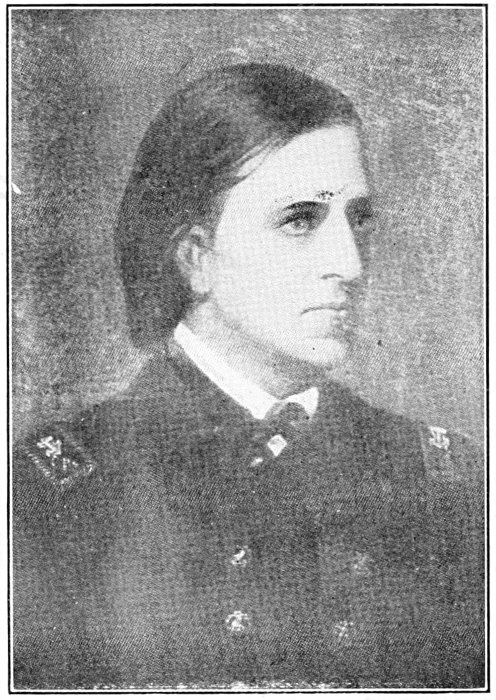
William Barker Cushing
From oil portrait (1865) by A. Bradish.
See Mrs. Cushing's letter, p. 87.
Alonzo died at Gettysburg in '63, long before I knew the family. Howard was killed by the Apaches after I was married. I well remember what a shock it was to my husband, and how he grieved for him, and tried to comfort his mother, obtaining all possible details of his brilliant service and lamentable death in Arizona through correspondence with the commanding general and officers, and with the War Department at Washington.
I wish to thank you most cordially for the fine photogravure you sent. It arrived in excellent condition. It is an admirable copy of the Bradish portrait, which we have, but the portrait itself does not seem correctly proportioned on the side turned away, being a trifle too broad under the eye, and so represents the face as too pointed. The photo shows it more clearly than the painting. My criticism of the portrait, however, does not affect your fine copy or the kindness that prompted you to send it. I thank you sincerely for it.
I wish also to thank you for the work you are doing, and trust your history of the Three Wisconsin Cushings will be admirable in every way, and fully meet your own expectations, as well as receive the merited reward of the approbation of the State Historical Society and of the public.
Respectfully yours,
Kate L. Cushing.
Forest Place, Fredonia, N. Y.
Howard Cushing With the Artillery
Of Howard Cushing, the attainable memorials are very meagre. Indeed, whatever may have been the achievements of a private soldier in a volunteer regiment in war time, they are not commonly mentioned in official reports. In the case of Howard it is only apparent on the face of the records of the Illinois regiment with which he served, that his conduct there was at least sufficiently creditable to warrant his promotion (November 30, 1863) to a second lieutenancy in the regular artillery.
His claim to distinction was not made conspicuously emphatic during his artillery service. However, it is probable that this was due rather to circumstances than to any failure on his part to do what might be done by a soldier of very high class under the conditions which he found after entering the regular service. At his own request he was assigned to Battery A of the Fourth, in which his brother Alonzo lost his life. But he had not the éclat with which his brother was signalized on his graduation from West Point; moreover, the fact that Sergeant Fuger, now an officer in the same organization, had also served as an enlisted man, did not tend to keep it at the same level, in the esteem of other regular officers, as would have been the case had one of the two, at least, arrived at his position by way of the Academy. It may be that the exclusiveness here noted tends to the general advantage of the army, but not unlikely it is somewhat depressing to appointees from the ranks.
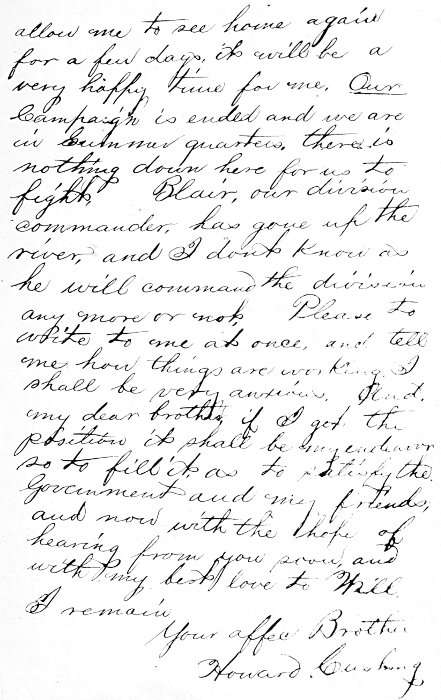
allow me to see home again for a few days, it will be a very happy time for me. Our campaign is ended and we are in Summer quarters, there is nothing down here for us to fight. Blair, our division commander, has gone up the river, and I don't know as he will command the division any more or not. Please to write to me at once, and tell me how things are working. I shall be very anxious. And, my dear brother, if I get the position it shall be my endeavor so to fill it, as to satisfy the government and my friends, and now with the hope of hearing from you soon, and with my best love to Will.
I remain
Your affec. Brother
Howard Cushing
Facsimile of part of letter from Howard B. Cushing to his brother Milton; dated August 6, 1863
At all events, what happened to Battery A after Howard's assignment to duty with it was, that it was kept in camp near Brandy Station, Virginia, until the following March. Then it was attached to the second division of the cavalry corps of the Army of the Potomac, and took part in Sheridan's battles at Mine Run, Virginia (May 3, 1864), at Todd's Tavern (May 4), at Meadow Bridge (May 6), at Yellow Tavern, where General "Jeb" Stuart was killed in front of Howard's section (May 11), at Strawberry Hill (May 13), and at Hawes's Shop the same day. In these battles Howard commanded a section of two three-inch guns. The losses of the battery in those fights were so considerable that it was, in the latter part of May, sent back to Washington to recuperate, remaining there until after the conclusion of the war, with the exception hereinafter mentioned.
After its transfer to the capital, the last experience of the battery in hostilities came very near proving serious. Early's raid into Maryland occurred shortly after the first of July. On the ninth he fought a battle with a Union force on the Monocacy, in which he was victorious, and headed for Washington, then defended by only about 5,000 soldiers. Battery A was then at Fort Totten, near Bladensburg, where the ranking officer was a captain of one hundred-day troops from Ohio, and of course in command. He seems, nevertheless, to have had good discretion, and before making any movement in the way of defense requested the advice of the seasoned officers under him. Late on the tenth, soldiers of the Veteran Reserve Corps from the city, accompanied by clerks from the departments and convalescents from the hospitals, swarmed out to the outer line of earthworks and manned the rifle-pits stretching along between the forts.
The next day, Confederate cavalry came into sight and the smoke of burning houses behind them told the sort of work they were doing. In the afternoon, Confederate infantry appeared, but stopped after forming in line of battle. On the twelfth they began moving before sunrise, and were met by shells from the forts—among others, three 100-pound Parrott guns, handled by the men of Battery A, being brought into action. There was also infantry fighting, but not of a serious character. Towards night the Sixth Corps of the Union army, which had been brought up the river on transports, began to arrive at the earthworks, and no further danger was feared. Advancing in line of battle it was found that the Confederates were now in retreat; but if they had not been so cautious the day before, it is probable that Early's 18,000 tried soldiers would have made their way into Washington, and inflicted the most humiliating disaster of the war.
Late in the fall, the senior lieutenant of the battery being absent on leave, Lieutenant Cushing was ordered to take the men and guns to Elmira, New York, to assist in guarding the prison pen at that place. There, about 12,000 Confederates were confined, in charge of a regiment of short-term men, undisciplined and unaware of the responsibilities of their position. The prisoners were in consequence unruly and often uproarious.
The day after his arrival, Cushing went with his second in command, Lieutenant Frank Wilkeson, to inspect the outer lines of the camp, and was assailed with jeers and howls of contempt by the prisoners. Quick action was needed. Cushing gave the Confederates the following talk, reported[10] to have been delivered in a low, clear voice, in terms far from polite, but nevertheless effective, for no further trouble was experienced:
See here ——, ——, ——! I am just up from the front, where I have been killing such infernal wretches as you are. I have met you in twenty battles. I never lost a gun to you. You never drove a battery I served with from its position. You are a crowd of insolent, cowardly scoundrels, and if I had command of this prison I would discipline you, or kill you, and I should much prefer to kill you. I have brought a battery of United States artillery to this pen, and if you give me occasion I will be glad to dam that river [pointing to the Chemung] with your worthless carcasses, and silence your insolent tongues forever. I fully understand that you are presuming on your position as prisoners of war when you talk to me as you have; but [and here his hand shook warningly in the faces of the group], you have reached the end of your rope with me. I will kill the first man of you who again speaks insultingly to me while I am in this pen, and I shall be here daily. Now, go to your quarters!
The release of all prisoners of war, in 1865, made unnecessary the further presence of cannon at Elmira. Cushing thereupon returned to Washington. His entire organization was dismounted, and early in 1866 assigned to duty as heavy artillery at Fort Meyer, across the river from Georgetown, D. C. It may well be imagined that the new service, consisting principally of drilling recruits, would not be much to the taste of the dashing young lieutenant who was now in his twenty-eighth year, full of life and vigor, a lover of literature and art, but above all imbued with the desire to write his name by the side of those of his brothers, whose services to their country were worthy of a permanent place on the tablets of the Nation's memory.
Transferred to the Cavalry
It was not until he had completed his twenty-ninth year that Howard obtained a transfer to the cavalry, which was then engaged in subduing Indians, the only warlike enterprise then in operation. On September 7, 1867, he became second-lieutenant of troop F of the Third cavalry, probably with reasonable certainty of early promotion, for about three months later he received a commission as first lieutenant.
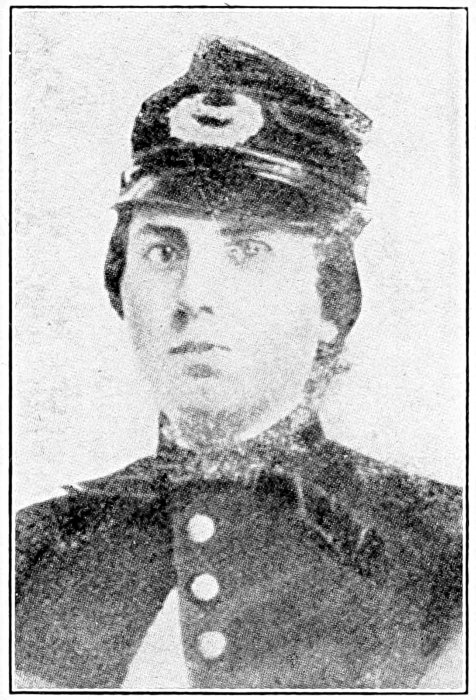
Alonzo Hersford Cushing
From the border annals, it would appear that thenceforward he was practically commander of his troop. So closely identified was he with it, that what the troop did was credited to Cushing, and what Cushing did was the pride and the boast of the troop. In captivating the hearts of his followers, Howard displayed a power and quality of bravery much resembling that of his brothers. Captain Bourke, who served with him as junior lieutenant, in the same troop, frankly stated in private conversation that Howard Cushing was the bravest man he ever saw; and repeated for emphasis, "I mean just that—the bravest man I ever saw." In Bourke's volume,[11] he writes to like effect, although not in the identical language above quoted. One among his many allusions to Cushing is given in the "Appreciations" preceding the present narrative; but there are others, expressed with nearly as strong emphasis—for instance, a list of the able and gallant officers who had helped clear Arizona of Apaches is recited, with the conclusion: "They were all good men and true, but if there were any choice among them I am sure that the verdict, if left to those soldiers themselves, would be in favor of Cushing." In a burst of indignation, after speaking of the lieutenant's "determination, coolness and energy, which had made his name famous all over the southwestern border," Bourke adds: "There is an alley named after him in Tucson, and there is, or was when last I saw it, a tumble-down, worm-eaten board to mark his grave, and that was all to show where the great American nation had deposited the remains of one of its bravest."
Cushing's first cavalry service of distinction was in western Texas, from which he drove the savages in 1869. The next spring, after a cruel massacre by the Indians of a party of thirty white men and women on their way to work at a private ranch, he was selected to head an expedition for the punishment of the murderers. Patiently searching for every indication of the trails of the Indians, he found their camp one night, and the following morning surprised and destroyed them, almost to the last man. They were said to have the more easily succumbed to the attack, from having drunk a quantity of patent medicines taken from the baggage of their earlier victims. This stuff was composed mostly of what the distillers call "high wines," containing a large percentage of crude alcohol.
On returning to Camp Grant the troop rested for a short time, and then started on an extended expedition touching the Sierra Apache and Mesquite Springs—losing only one man, the blacksmith, in the course of the trip, and inflicting no great injury on the Indians. Other expeditions followed, about as fruitless; but towards the end of summer the headquarters were moved fifty-five miles west to Tucson, which had not then acquired fame as a mining centre. It was, however, noted as being the capital of Arizona and one of the dirtiest of little Spanish-American towns. The camp was on the eastern border of the village, and the Apaches were in the habit of coming up to its close neighborhood to steal and drive away live stock. Even after the arrival of Cushing's troop, the savages had shown strong tendencies towards mischief, seriously wounding one of his men. Later they simultaneously attacked wagon trains and widely-separated settlements, thus confusing the calculations of our officers. As a crowning exploit they carried away a herd of cattle from Tucson itself, and followed that achievement by the killing of a stage-mail rider and the massacre of a party of Mexicans on their way to Sonora.
During the time when these events occurred, Cushing kept his troop hard at work and extirpated many of the hostile Indians—how many, is not stated in any work of which I have knowledge. Cochise, chief of the Chiricahua clan of Apaches (and predecessor of Geronimo), finally came into camp as winter drew nigh, and claimed that he wanted peace and a resting-place on the reservation. He had already been fighting the white people for fourteen years, and had tried every trick upon his enemies save this. Cushing vainly protested against coddling the wily chief during cold weather, to suffer from his depredations when warmth should again prevail. Cochise was taken care of all winter; and before May, 1871, was on the warpath with Cushing close after him. On May 5th the lieutenant was at the head of a reconnoitering party of twenty-two men at Bear Springs, in the Whetstone Mountains, about fifty miles southeasterly from Tucson, and twenty-five southwesterly from the site of the present town of Benson.
Death of the Young Cavalryman
Cushing was riding at the head of the party with three soldiers and a citizen or two near him, when Sergeant John Mott saw movements of some Apaches who were trying to get to the rear of the detachment. He sent word to the lieutenant, inducing him to fall back, although already engaged with an ambush of Cochise's followers in front. The latter had succeeded in entirely surrounding the little party, and Cushing, with four at his side, were all slain before they could get back to the rest of their party.
Sylvester Maury, a graduate of West Point—pioneer miner, and author of a classic of modern Arizona, entitled Arizona and Sonora—in a letter to the New York Herald shortly after Cushing's death, boldly charged the catastrophe to the foolish policy then prevailing, of dealing with the Indians of the Southwest. Under this policy, the ravages of the enemy were promoted by feeding them up well during any intervals when they might feel like taking a rest from assassination and plunder. He added:
Now we have the result. There is not a hostile tribe in Arizona or New Mexico, that will not celebrate the killing of Cushing as a great triumph. He was a beau sabreur, an unrelenting fighter; and although the Indians have got him at last, he sent before him a long procession of them to open his path to the undiscovered country. * * * He has left behind him in Arizona a name that will not die in this generation.
As a comment on the foregoing, I need only say that in response to my request, at an Arizona newspaper office a few weeks ago, for some special information regarding Howard Cushing, I was told that the writer had "never heard of the party inquired after." Sic transit gloria mundi, making very rapid time in the transit, in many of the modern instances. Nevertheless, Arizona has taken enough care of Cochise's name to attach it to one of her large counties.
Howard's death occurred more than three-and-a-half years before that of William; but I fancy that the acts and sayings of the latter at the time of his brother's demise were such as to indicate something in the nature of nervous affection. Mrs. Bouton informs me that it was difficult to dissuade him from a project that he had in mind, to go into the frontier service himself and there take vengeance on Howard's slayers. On first hearing of the fatality he had been unable to refrain from tears, even after reaching the office of a commercial bank. Before leaving the place, he wrote the following letter to his brother Milton:
THE BLACKSTONE NATIONAL BANK, BOSTON,
May 15th, 1871.
My only and very dear Brother: With a heart full of agony I write to you of our terrible misfortune. Dear, brave "Howie" is no more. I saw the news in the paper at 8 a. m. in the country this morning, and hastened in to break it to Mother. Poor, dear little Ma! Her heart is almost broken. Oh! dear old fellow—we are left alone now—the last of four; and let us swear to stand by each other and our noble Mother in all things. Let our old boyhood and vows come back with full force and meaning, and let us cling together in truest and most unselfish love and friendship. I long for you, dear brother—for a clasp of your true, honest hand, and the comfort of one glance into your eyes. How much it would comfort Mother to see you before you go! Tomorrow I take her with me into the Country where we are living. I am in delightful quarters, and shall take good care of little Ma. God bless her! Kate [the writer's wife] is like a real daughter to her; and I thank Heaven that she was not alone in Mary's absence. [Referring to the present Mrs. Bouton, whose name was Mary Isabel, the "Mary" having since been dropped by her.]
Dear old fellow—we must be doubly loving and attentive to little Ma now. Write often to her. One thing is certain of her Sons; they can not be beaten. You can kill but not conquer them. A beautiful tribute was paid to Lon by the General of his brigade at the great Army of the Potomac meeting here. He described his wonderful, superhuman bravery. How he demanded—white with loss of blood—to go again to the front. The General said, "You have done all that mortal can do; attend now to your wounds." Lon answered, "No, I will fall by my guns." He selected Allie as the only one to especially eulogize, God bless the brave boys! I can almost see their meeting—the handclasp of two who gave up life for duty; and Father, joined by his noble Sons, proudly and tenderly embracing them.
God bless you, dear brother! Don't lose love for me. We are alone now. My tears are falling so that I can scarcely see. Good bye.
With all his heart your loving brother
Will.
The story of these noble sons of Wisconsin might properly be concluded with the foregoing letter; but for the satisfaction of those who may wish to have a good idea of the personal appearance of the young cavalryman, I will add the description given by Captain Bourke:
He was about five feet seven in height, spare, sinewy, active as a cat; slightly stoop-shouldered, sandy complexioned, keen gray or bluish gray eyes, which looked you through when he spoke and gave a slight hint of the determination, coolness and energy which had made his name famous all over the southwestern border.
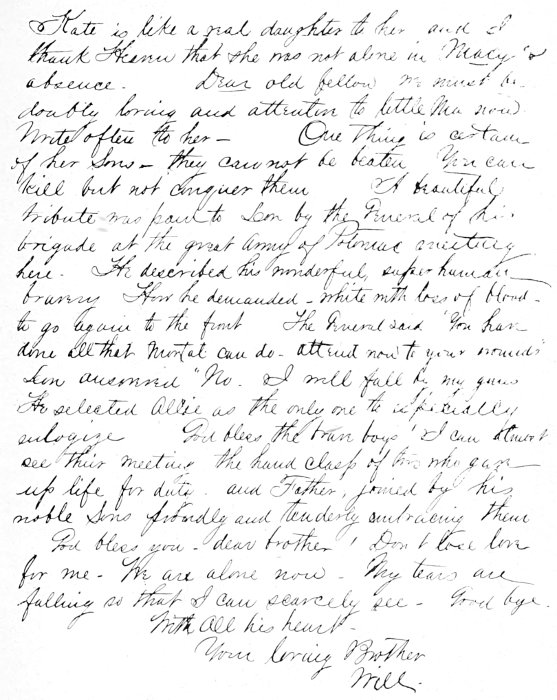
Kate is like a pal daughter to her and I thank Heaven that she was not alone in Macy's absence. Dear old fellow it must be doubly boring and attrition to little Ma now. Write often to her—One thing is certain of her Son—they can not be beaten. You care kill but not conquer them. A beautiful tribute was paid to Lon by the General of his brigade at the great Army of Potomac awaiting here. He described his wonderful, super human bravery. How he demanded—white with loss of blood—to go again to the front. The General said 'You have done all that mortal can do—attend now to your wounds.' Lon answered "No. I will fall by my guns." He selected Allie as the only one to especially eulogize. God bless the brave boys! I can almost see their meeting the hand clasp of two who gave up life for duty, and Father, joined by his noble Sons proudly and tenderly embracing them.
God bless you—dear brother! Don't lose love for me—We are alone now—My tears are falling so that I can scarcely see—Good bye.
With all his heart Your loving Brother Will.
Facsimile of part of letter from William B. Cushing to his brother Milton; dated May 15, 1871
So long as such men can be produced in the republic, there is little danger of its decline and fall. Without such, or men of stamina approximating to their standard, our country would be likely to meet the fate of its predecessors, and become the prey of stronger peoples. It would therefore be foolish indeed to withhold from our fighting men the honor and the more substantial rewards which tend to encourage bravery and, when necessary, the upholding of our national solidarity by force of arms. To a considerable degree this is accomplished by our national pension system; but that is faulty, in respect that it makes no distinction, as to the amount of his quarterly stipend, between a four-years' fighting soldier and a ninety-days' malingerer in or about hospitals.
That it was difficult to provide for advancement in the army, in accordance with desert, is evident from the fact that Howard Cushing served as a private soldier in the same battery for twenty months. That was, indeed, keeping talent hidden in a very inconspicuous napkin. It may be that such bad fortune was unavoidable on the whole, and that a just grading of pensions would be still more difficult to attain than logically-just promotions in the army. At all events, it is clear to me that whatever does tend most effectually to keep alive in our citizenship such devotion to the country as to make men willing to strive to the uttermost and to die for its sake, is what ought to be practised—and where possible, improved.