TWO OF THEM
Reading edition
WITH MAP AND FIFTY-NINE ILLUSTRATIONS ON WOOD FROM SKETCHES BY THE AUTHORS
LONDON LONGMANS, GREEN, AND CO. 1882
All rights reserved
LONDON: PRINTED BY SPOTTISWOODE AND CO., NEW-STREET SQUARE AND PARLIAMENT STREET
CONTENTS

PAGE
Introduction xi
CHAPTER
I. The Voyage 1
II. Christiania 6
III. By Rail and Lake 14
IV. By Road 21
V. The First Camp 28
VI. Misery 39
VII. Happiness 45
VIII. Fly Sæter 56
IX. Sikkildal 62
X. Besse Sæter 72
XI. Gjendin 82
XII. The Camp 89
XIII. Gjendesheim 98
XIV. John 105
XV. Back to Camp 115
XVI. Trout 120
XVII. Reindeer 127
XVIII. Success at last 137
XIX. Gjendeboden 146
XX. A Formal Call 153
XXI. Fishing 167
XXII. Memurudalen 180
XXIII. A Picnic 191
XXIV. The Skipper’s Return 200
XXV. The Gjende Fly 210
XXVI. Disaster 224
XXVII. A Change 230
XXVIII. Rapid Running 242
XXIX. Rus Vand 257
XXX. Luck 273
XXXI. Not lost, but gone before 286
XXXII. A Last Stalk 295
XXXIII. Homeward Bound 303
XXXIV. Bjölstad 315
XXXV. Down to Christiania 327
XXXVI. Home again 336
LIST OF ILLUSTRATIONS.
PLATES
PAGE
Running the Rapids below Gjendesheim Frontispiece
On the Track near Sikkildals Lake to face 59
On the Top of Glopit. Returning from Rus Lake „ 172
Baking by Night in Memurudalen „ 178
The Camp in Memurudalen „ 182
Death of the ‘Stor Bock’ at the Iceberg Lake, Tyknings Hö „ 267
Good Sport, Bad Weather. The Skipper’s two ‘Stor Bocks’ „ 279
Cheerful! The Huts at Rus Lake „ 289
WOODCUTS IN TEXT.
Norwegian Arrangement of Dishes at Table 10
Midnight Study of Stockings at Dalbakken 26
The Start on Espedals Lake 29
The Skipper’s first Cast 30
Our Camp on Espedals 31
Black-throated Diver 36
View of Bredsjö by Night 40
Sunset at Fly Sæter 54
Desperate Conflict between Esau and the Mosquito 58
Sæter Girls in a Boat on Sikkildals Lake 65
Old Siva carrying a Canoe up the Sikkildals Pass 73
Greenshank 77
Ring Dotterel 78
Scaup 80
Our first View of Gjendin Lake 83
Two of our Retainers: Ivar and his Pony 87
The Skipper returns to Camp disgusted with life 93
Throwing for a Rise 99
The Skipper takes Miss Louise for a Cruise at Gjendesheim 102
The Huts at Rusvasoset 109
John returns from fishing in Summer Costume 121
John and Esau: ‘How’s that for high?’ 122
The two ‘Meget Stor Bocks’ (very big Bucks) on Memurutungen 128
Hot Soup and Northern Lights 134
Esau and Ola return in Triumph 141
A careful Finishing Shot 143
The Colony at Breakfast in Memurudalen 159
An Exciting Moment in Rus Lake Shallows 168
Esau’s Best Day among the Trout 170
Esau stalking near Hinaakjærnhullet 188
John diving for his knife in Rus Lake 198
The Skipper about to astonish the Reindeer 203
Öla performing the Funeral Rites 205
Canoeing after Duck in a Storm 236
Andreas: our Retriever 237
Ola and Andreas capturing a wounded Grouse 238
John and the Skipper upsetting in the Canoe 240
Making a Portage by the Sjoa River 244
A Norwegian Fire-place 246
Jens and his Pony on their way over Bes Fjeld 252
A Stormy Crossing at Rusvasoset 259
Gloptind Rock, at the Western End of Rus Lake 275
The old stone Hut near Gloptind 280
A Night at Rusvasoset, after a Day at Haircutting 284
Rus Lake from the Western End: Nautgardstind in the Distance 290
Glissading home after a blank day 293
Rus Lake from the Eastern End: Tyknings Hö and Memurutind in the distance 294
Off! A Reindeer recollecting an engagement 295
Old Buildings in the Courtyard at Bjölstad 316
Barley Sheaves: A Norwegian ‘Atrocity’ 323
Three at Home Again 341
MAP.
The Jotun Fjeld at end of volume.
INTRODUCTION.
HISTORY.
‘Canadian canoes are the only boats that will do’ was our conclusion after a thorough inspection of every existing species of boat, and long consultation with ‘Sambo’ of Eton about a totally new variety, invented but fortunately not patented by one of our number.
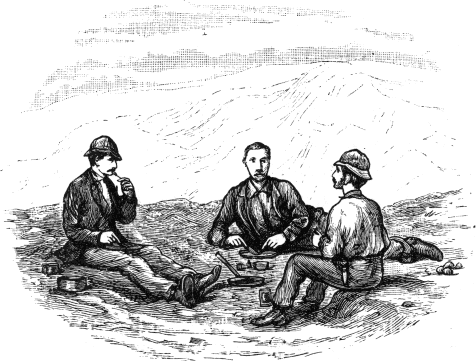
Our party consisted of three men, who shall be briefly described here. First, ‘the Skipper,’ so called from his varied experience by land and sea in all parts of the world, but especially in Norway, whither we were now intending to go in search of trout, reindeer, and the picturesque. The Skipper is lank and thin, looking as though he had outgrown his strength in boyhood, and never summoned up pluck enough to recover it again. His high cheek-bones and troubled expression give one the idea of a man who cannot convince himself that life is a success, which is perhaps pretty nearly the view he actually takes of existence.
Secondly, ‘Esau,’ who received this name in consequence of the many points in which his character and history resemble that of the patriarch who first rejoiced in it: for our Esau, like his prototype, is ‘a cunning hunter and man of the fjeld;’ and we are sure that if he ever had such a thing as a birthright, he would willingly have sold it for a mess of pottage. Esau is short and joyous, and is one of those people who never indigest anything, but always look and always are in perfect health and spirits. It is annoying to see a man eat things that his fellow-creatures can not without suffering for it afterwards, but Esau invariably does this at dinner, and comes down to breakfast next morning with a provoking colour on his cheek and a hearty appetite. His office in this expedition was that of Paymaster; not because he possessed any qualifications for the post, but because the Skipper had conclusively proved that such employment was too gross and mundane for his ethereal soul, by constantly leaving the purse which contained our united worldly wealth on any spot where he chanced to rest himself, when he and Esau went to spy out the land two years before this.
Lastly, ‘John,’ so called for no better reason than the fact that he had been christened Charles: he had never yet visited the wilds of Scandinavia. John is an Irishman, whose motto in life is ‘dum vivimus vivamus:’ he is tall and straight, with a colossal light moustache. He generally wears his hat slightly tilted forward over his forehead when engaged in conversation; and the set of his clothes and whole deportment convey an idea that he is longing to tell you the most amusing story in the world in confidence. He is no gossip, and the anecdotes of his countrymen, of which he has an inexhaustible supply always ready, are merely imparted to his listeners from philanthropic motives, and because he longs for others to share in the enjoyment which he gleans from their mental dissection.
The general idea of the campaign was that the Skipper and Esau should leave England in the early part of July; fish their way up a string of lakes into the Jotunfjeld, getting there in time for the commencement of the reindeer season; establish a camp somewhere; and then that John, starting a month later, should join, and the three of us sojourn in that land until we were tired thereof. How we accomplished this meritorious design we have tried to relate in the following pages.
GEOGRAPHY.
The map of Norway, apart from Sweden, presents an outline something like a tadpole with a crooked irregular tail. The Jotunfjeld is an extensive range of the highest mountains which are to be found in Northern Europe: before 1820 A.D. they were totally unexplored, and at the present time they are still perfectly wild and desolate, their summits covered with eternal ice and snow, and even their valleys uninhabited. That part of the Jotunfjeld which we intended to make our goal and headquarters is situated about the middle of the tadpole’s body, and nearly equidistant from Throndhjem and Christiania.
LANGUAGES.
It is customary when writing a book on any foreign country to scatter broadcast in your descriptions words and phrases in the language of that country, in order to show that you really have been there. We propose to depart from this usage in the course of this work; but if at any time the exigencies of narrative seem to demand the use of the foreign tongue, we have little doubt that the English language will provide an equivalent, which shall be inserted for the benefit of the uninitiated.
MATHEMATICS.
Foreigners have a curious prejudice which leads them to adopt different systems of coinage and measurement from those in favour in England. But shall a Briton pander to this prejudice by making any use of their ridiculous figures? Decidedly not. What matters it to us that a Norwegian land-mile contains seven of our miles, and a sea-mile four? we speak only of the British mile. What care we that the Norwegian kröne is worth about 13½d.? Shall that prevent us from always calling it a shilling? Never! And shall the fact that it is divided into ten 10-öre pieces (which are little nickel coins worth about five farthings each) restrain us from alluding to them as the ‘threepenny bits’ which they so much resemble? Not while life remains.
EXTRA SUBJECTS.
Some of the statements that will be found in these pages may strike the reader as being, to say the least of it, improbable. We therefore wish to explain that all the incidents of sport and travel are simple facts, but that here and there is introduced some slight fiction which is too obviously exaggerated to require any comment.