Egerton Ryerson Young (continued 5)
Reading edition
It was an exciting time for the boys, but they had learned to have such confidence in these grand old red men that such a thing as fear was now about unknown in any of them, even at the most trying moments.
While there sitting they were startled by a shrill bird call from not far behind them. They could hardly believe their ears when they found it came from the lips of Mustagan. In a minute or two it was repeated, and then again and again, with short intervals between.
To their surprise another bird call some hundreds of yards ahead of them was heard, and after a time it was repeated. Then the blackbird’s notes rang out from behind, and then another note came from the front. Ere the voice behind could again reply a solemn “Hoot-a-hoot-a-hoo” came from the front.
For a time all was still, and then the song of the robin was heard in front, and only a chirp was heard in the rear.
Sharp and quick was the ending.
Soon after this chirp the boys heard the bushes rustling in front of them not fifty yards away. Then they saw in the opening the two children, closely followed by two young bears. As the children slowly moved along they kept plucking the berries and feeding them to the greedy young animals. The children were ragged and sadly changed as, from their still hidden position, the boys watched them; they could see that Wenonah, at least, seemed to know that they must act cautiously, and they observed that frequently she spoke to the little fellow at her side.
It was her bird notes that had answered Mustagan. Little did they realise, a year or so before, as he taught Wenonah these calls of the birds and what they meant, that her very life would so soon depend upon her knowledge of them.
Still cautiously advancing with little Roderick at her side, and both of them feeding the little bears, she at length reached a spot where she caught a glimpse of the boys. Without at all raising her voice she said:
“Crouch down as well as you can and bring the berries.”
This they quickly did.
“Feed these greedy young ones while I give a basket to the old ones, so that while they are eating them we can get away.”
Poor girl! She knew not of the number of guns that were now within range of anything that would dare to harm her, and the boys were warned not to speak.
Taking one of the baskets of berries, she quickly disappeared among the dense bushes, while the boys, with the other full baskets, had made friends with the young bears. When Wenonah returned, she found the young bears were filling themselves with the fruit. So thoroughly terrified had the children become, through fear of the bears, that although the boys by expressive signs urged them at once to hurry in the direction of safety and deliverance, they hesitated, and even when they started kept fearfully looking back.
The instant they reached Mustagan he shouted to the boys to return, and not a moment too soon, for crashing through the bushes came the two old bears, fierce and savage, and showing that in some way they had become suspicious of danger.
Coolly picking up the two baskets which the two young bears had upset, the boys, keeping their faces to the fierce, savage brutes, slowly retreated. The bears, at first only seeing the boys, came rushing toward them, but when they reached their young ones they stopped for a time, and then came on to attack the boys.
To the ledge of rocks Mustagan had carried the now happy children. They had nearly smothered “dear old Mustagan,” as they loved to call him, with their kisses. Wild, indeed, were they with joy as father and mother rushed forward and received them as from the dead. They could only lie clinging to them while they wept out their bliss.
From it they were startled, as out rang a volley from the guns, and two great, fierce bears rolled over each other, each shot through more than one vital spot.
“Capture the little fellows alive!” was the cry.
And soon, after a lively chase and some sharp struggling, two four months’ old cubs were so tied up as to be unable to do any injury either with teeth or claws.
Very anxious had the boys been during the search for the lost children. Their only regret was that they were so powerless as to be unable to join in the search. Very proud, however, were they to have had some share in the exciting events of the last hours of their strange deliverance. Tears were in their eyes and dimmed their vision as they first saw them in the company of the wild beasts, showing by their appearance what they must have suffered during the long days and nights of such hardships.
The story of the children’s account of their adventures and hardships will be given in another chapter. Suffice here to say that very quickly was the march taken up, after the half-famished little ones had been fed, for they had had nothing but berries to eat, and, as Roderick put it:
“Naughty bears, they kept me all the time picking berries for them.”
The return to the camp on the banks at Sea River Falls, and then to Sagasta-weekee, was soon made.
Great were the rejoicings there as well as at the mission, and at the Hudson’s Bay Company’s fort, when the news of the finding of the lost ones reached them. A special thanksgiving service was held the next Sabbath at the mission church, at which whites and Indians from near and far gathered, and entered heartily into the spirit of the service.
Chapter Twenty Three.
Wenonah’s Story of their Marvellous Adventures with and Deliverance from the Bears—Roderick’s Comments.
It was wisely decided that, as the children were so exhausted, at least a couple of days should be allowed to pass before they were asked to give anything like a full account of their marvellous adventures.
Wenonah, of course, was the principal speaker, but Roderick often put in some quaint remark, which gave additional interest to the story. Seated in her father’s arms, while Roderick monopolised those of his mother, while Minnehaha and the boys, with some friends from the Fort and mission, gathered round, Wenonah told in her own way the story of their strange adventures:
“Roderick and I were to try and gather as many berries as Minnehaha; so we took our rogans, and we went to where the berries were thickest, and once we came back and emptied our dishes, and then we hurried away where we had seen a good many. But we did not find as many there as we hoped, and so we went on and on, and it took us a long time to fill our rogans, and when we did we started to come back, but we did not find the way, and so we hurried on and on. Then after a while we called, and called, and nobody answered us. So Roddy and I said we would not cry. So we hurried on and on, to try and get back. Then we came to some high rocks, and we climbed up as high as we could, and when we called again we thought we heard voices answering us from some other rocks, and so we hurried over there, but there was nobody, and no voice. Then we pushed on, and on, and soon we heard the thunder, but we never stopped, but just tried to get back before the rain.
“Soon we left the rocky land, and went down a long hill where we saw a little stream. This we crossed where the water was not deep.
“We wanted to get home, so we tried not to feel tired or to cry; but, although we tried ever so hard, we could not find the way. We had held on to our dishes, but now they were not half full, and so we stopped and ate some of the berries. Soon after it began to thunder very hard, and there was lightning, and so we hurried up to some big trees, and while we were standing under the branches to be out of the rain we saw one old tree that was all hollow on one side, and as the rain was coming down through the branches we went and got into this hollow tree. I had Roderick go in first so that I could keep him dry, and I stood at the outside.”
Here Roderick spoke up and said:
“I wanted to stand on the outside because I was the boy, but Wenonah said she had better because she was the biggest.”
“Then,” continued Wenonah, “as it soon got very dark, and none of you came for us, we began to cry, and we could not help it, for there we were all alone in that hollow tree in the dark.
“After a while a big owl in one of the trees began to call. I knew what it was for Mustagan had taught me. At first Roddy said it was somebody calling him.”
Again Roddy, who was now nestling in his mother’s arms, spoke up and said:
“I thought it was somebody saying to me, ‘Who, who, who!’ and I said, ‘We are Roddy and Wenonah Ross, and we are lost.’
“Then, when it called again, it only said:—
“‘Oo! oo! oo!’ So then we knew what it was, as we had often heard it at night here at home.”
“We were glad to hear it,” said Wenonah, “for all was now so dark and lonely. We could not lie down; we just had to stand up there all night. I held Roddy up as well as I could. Once we heard the cry of the wild cat, and that made us keep very still. I must have nodded some, as I leaned against the inside of that old tree, but it was an awful long night, and we were glad when it was light enough to see. Then we left that old hollow tree, and took up our dishes, and as we were very hungry we went out among the berry-bushes and ate some of the berries. We were careful to leave no tracks, because of that wild cat. We ate a lot of berries, but we did miss our good breakfast at home. We filled our dishes, and then started for home; but we could not find it. While we were going on among the bushes we came out into a little opening, and there were the two little bears. We thought at first they were two little black dogs. They came right up to us, and when they sat up so funnily on their little hind legs we saw they were bears, and of course we were afraid.
“Then they came and smelled our baskets of berries, and as we held them out to them they seemed very hungry, and at once began eating.”
“But they were so greedy; they were worse than little piggies,” said little Roderick; “they made such funny little noises all the time they were eating.”
“But,” continued Wenonah, “that sound of theirs seemed to call the old bears, that we had not yet seen. They came rushing through the bushes, and we were so frightened we could not even cry out or let go of our baskets.
“When they rushed at us the little bears, that were between them and us, seemed to think that all the old bears wanted to do was to get at the berries too, and so they kept so funnily twisting their little bodies between the old bears and us, while all the time they were eating the berries. When the old bears saw this they stopped looking so fierce and savage, and just sat down on their hind legs and looked at us feeding their young ones.
“Then we began to wonder what would happen when the little bears had eaten all the berries that were in our baskets.
“Little Roddy seemed to know just what to do; for as there were some berries growing close to him, while he held his basket in one hand he picked some more berries and fed them to the little bear. Then I did the same to the one that had been eating out of my dish. Soon we began moving slowly among the bushes for more berries, to find plenty for the greedy little fellows, but we kept them as well as we could between the old bears and us.
“As the old bears kept moving around we could not keep their little ones between them and us very long, and so by and by they came close up to us, but they did not now seem to be very angry. One of them got close up to Roddy, and there he stood up and looked so big beside my little brother that I almost screamed out, I was so frightened. But I did not do it for fear he might hurt him. He only moved a little, and then he came down again on all his four legs, and as he put his big mouth close to him Roddy just put in it a handful of berries. After that there was no more trouble with him except to get berries enough.”
“Yes,” said Roderick, “I just thought that if big bears like berries as well as little bears perhaps they would rather have them than eat us little children; so I just chucked that handful in his mouth, and he just did like them.”
“I was slower in making such good friends with the other bear,” continued Wenonah, “because the little one I was feeding was such a greedy little pig. He would not, for a long time, let me gather a handful and give to the big bear that, once or twice, got so close to me as to put its cold nose against my face. My! it made me shiver. But I said in my heart, ‘I will be brave, for I want to save Roddy,’” and the child’s voice broke. “I did want to see my father, and my mother, and Minnehaha again.”
“But we did not cry here, did we?” said Roderick.
But the memory of that event was too great for them now, and throwing themselves in each other’s arms they burst out in a passionate fit of weeping, that was so contagious no eyes remained dry in that group of loved ones there gathered to hear their pathetic story.
When calm again Wenonah went on with the story:
“After a while the little ones had enough, and then they began wrestling and playing with each other. They acted as if they wanted Roddy to play with them, and I told him to do so, but not to hurt them, and perhaps the old father and mother bears would not hurt us before we could run away.”
“Yes,” said Roddy, “I had great times with them, but they always wanted to wrestle with me more than any other kind of sport.”
“I kept gathering berries,” said Wenonah, “while Roddy played with the young bears. The old ones kept me busy now and were just about as greedy as the young ones had been.
“After a while I said to Roddy, ‘We must try and get away from here,’ for we did want to come home and see you all.
“We did not talk very much to each other, for our voices seemed to make the bears angry. But we found that when we tried to get away they got right in front of us and stopped us with their big bodies. This made me feel very bad, but I did not tell Roddy. Some time early in the day I heard some one calling, and I tried to answer, but one of the bears struck me such a blow with one of his paws, and showed his dreadful teeth in such a way, that I was so frightened that I dare not call again.”
Said little Roddy, once again: “When I saw that naughty bear hit my sister with his paw I wanted to hit him with a stick.”
“This voice of whatever it was seemed to frighten the bears, and so off they started,” said Wenonah, “and they made us go along with them. We had to go; for if we stopped, or tried to go some other way, they growled at us, and pushed us with their noses, and so we had to go with them. Soon they came out of the bushes and crossed over the sand, and went up on the other side into the dark woods. We were very much afraid, but we whispered that we would not cry, but just be brave, for we knew you would soon come and fight those great big bears.
“The way the bears made us go was this. One big bear went on before, then the little ones followed next, then they made Roddy and me follow next. We had to do it, for just behind us was the other big bear, and he would growl at us if we did not just walk right along.
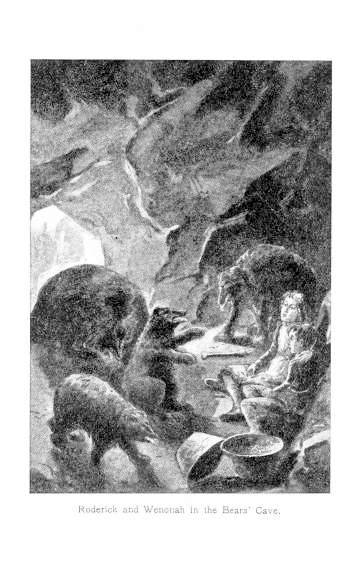
“Then, after we had travelled some time, we came out of the dark forest among some, O, such big rocks, bigger than houses. Among them we had to go, until we came to a dark opening like a big door, and into this we had to go. It must have been the home of the bears.
“Roddy cried out, with fear, but the bears growled again and showed their great teeth, and so we had to go in.”
“I didn’t want to go in,” said the poor boy, as he put his arms around the neck of his mother; “it was worse than a cellar, it looked so dark. But the old bear behind just kept pushing me along with his nose, so I had to go.”
“It was not such a bad place after all,” said Wenonah, “when we once got into it. It seemed dark at first as we went in out of the sunshine; but when we were in it, and looked back, there was a good deal of light. In it were big piles of leaves and dry grass, and on them the bears soon lay down. One of the big bears lay down between us and the door, so we could not get out. We sat down by the little bears, and I whispered to Roddy to be brave, for God would take care of us and our friends would surely find us. Then we lay down on the dry grass and, being very weary, soon went to sleep, with our arms around each other.
“How long we slept we knew not, but were suddenly roused up by the little bears playing and tumbling over and around us. So we got up, and the bears made us go back again across the sands into the berry-bushes, and there we all ate berries, as there was nothing else to eat. The little ones kept poking their noses into our hands, and thus begged us to pick berries for them.”
“The lazy little fellows,” said Roderick, now smiling as he thought of them; “little greedy piggies that never had enough.”
“There we stayed in the bushes,” said Wenonah, “until nearly night, and then they made us go back again with them in the same way to the same place. It seemed so dreadful to have to spend the night in that place with those wild bears; but we whispered, ‘We will be brave,’ and so we lay down between the little bears, for in some way or other we felt the little ones were our best friends, and it was because of them the old ones did not kill us.
“I thought we could never spend the night in such a place, but we did. We just whispered our prayers as there we lay, and ended with, ‘Now I lay me down to sleep.’ And sleep we did until the little bears woke us up again the next morning.
“The old bears were now so friendly that they let us pat them, and so I thought that perhaps they would let us go; and so, when we came to the sand, I whispered to Roddy, ‘Let us try and get away.’ But those wicked bears would not let us go; for when we tried to go along the sand in one direction one of the big bears got in our way and made us go back; then we tried to go the other way, and they stopped us there. I now felt that we were like prisoners, and that we had to go with them. They led us again into the berry-bushes, and Roddy and I ate a good many, for we were very hungry, and the little bears teased us so much we had to pick a lot for them. It was when I was feeling the worst, and fearing that perhaps they would never let us leave them, that I heard the bird note. O, how sweet it sounded! For I knew it was from Mustagan, and that it meant we would soon be free. But I saw that the bears had heard it, and were very uneasy, as they had been at all sounds. For a time they stopped eating berries and stood up and listened. However, when it came again and again, so bird-like, they lost their fear and again began eating the berries.”
Said Wenonah: “I was afraid to answer, for the bears had always been so angry at us when we made any noise; but I knew that sweet call meant rescue and home, and must be answered, and so, while putting a big handful of berries in the mouth of the fiercest old bear, I gave the answering call. Then came the reply.
“I must have been trembling, for in my reply I shook in my voice, and the bears were angry and growled at me. How ever, I knew I could correctly give the owl call which Mustagan knew was our signal of danger. So when I passed behind a tree I gave it as loud as I could, as though from an owl in the tree above me. When all was right again I gave the robin song, and you all know the rest.”
Chapter Twenty Four.
Congratulations—Other Incidents of Lost Children—Long Excursion by the Boys—Indian Legend—“Why is the Bear Tailless?”—Oxford Lake—Black Bears as Fishermen—The Lookout from the Trees—Fish-Stealing Bears—The Conflict—Bears versus Boys and Indians—Sam’s Successful Thrust—Plenty of Bear Meat.
The thrilling adventures and escape of Wenonah and Roderick were, of course, the great sensations that were most talked about for many a day. Children have wonderful recuperative powers, and so the two little ones recovered from the effects of their strange mishaps long before Mr and Mrs Ross or even Minnehaha did. But time is a great healer, and soon all were well and in good spirits again.
The event produced a deep impression upon Frank, Sam, and Alec, and drew out from the older servants at the home and some of the Indians some very interesting stories. It is simply amazing what a difference there is in people in respect to their ability to find their way out of a forest when once the trail is lost. Some people invariably get lost in as small an area as a hundred-acre forest, and are almost sure to come out on the opposite side to the one desired. Indians, perhaps on account of their living so much in the woods, are not so liable to get bewildered and lost as white people. Still some of them are as easily perplexed as other people.
One of this class went out hunting and lost himself so completely that his friends became alarmed and went searching for him. When they fortunately found him, one, chaffing him, said:
“Hello, are you lost?”
To this he indignantly replied:
“No, Indian not lost, Indian here; but Indian’s wigwam lost!”
It would never do for him to admit that such a thing could possibly happen as his being lost.
So popular and beloved were Mr Ross and his family that not only did the congratulations on the recovery of the children come from the Hudson Bay Company officials and other white people from far and wide, but Indians of other tribes, who had known Mr Ross in the years gone by, when he was in the company’s service, came from great distances, and in their quiet but expressive way indicated their great pleasure at the restoration of the little ones to their parents. Mustagan was, of course, the hero of the hour, and as usual he received the congratulations with his usual modesty and gave great credit to Big Tom. He also had nothing but kind words for the brave white lads, who had so coolly and unflinchingly played their part in the closing scene of the rescue. His only regret was that he had not had them take their guns with them when they went to the front with the berries, so that they might have had a share in the grand fusillade that stopped so suddenly the rush of the furious bears. The actions of the bears in thus sparing the children’s lives brought out from the Indians several remarkable stories of similar conduct known to have occurred elsewhere.
One Indian told of an old mother bear that boldly attacked an Indian woman who, with her young babe, had gone out into the forest to gather wood. The mother fought for her child until unconscious. When she came to herself both the bear and the papoose were gone. She returned to her wigwam and gave the alarm, but as the men were away hunting several days passed ere they could begin the search.
When at length they discovered the bear’s den they found the child was there alive. In killing the bear they had to take the greatest care lest they hurt the child, as the bear seemed in its ferocity to think more of defending the child from them than of saving its own life. The child when rescued was perfectly naked, yet was fat and healthy, and cried bitterly when taken away from the warm den and the body of the dead bear that it had suckled with evident satisfaction.
To this and other wonderful stories the boys listened with the greatest delight. The fact is, while the children were lost they were as miserable a trio as could be found, and now the reaction had come, and they were just bubbling over with delight and ready for any story that had, even in the remotest degree, anything similar to what had so excited them.
Indians love good companions, and they found them in the boys; so it was not long before some of those who had come from Oxford Lake invited them to return with them, and they promised them some rare sport. At first Mr Ross was a bit fearful about letting them go so far, but as Big Tom and Martin Papanekis offered to go in charge of the two canoes he at length yielded. So, in company with the Indians from that place, they started off in great spirits, well supplied with guns and ammunition, and all the necessary camping outfit for a ten days’ or two weeks’ excursion.
It was with very great delight that the boys set off with their fresh, dusky, red companions on this trip. It was principally down the rapid lakes and rivers up which the boatmen gallantly rowed on their journey from York Factory. The running of the rapids, especially a wild, dangerous one through Hell’s Gate, very much excited the boys.
On one of the beautiful islands in Oxford Lake they pitched their tents, and had some capital sport in fishing for the gamy trout which there abound. The only drawback to the fishing in such a land as this, where the fish are so abundant, is that the sportsmen soon get weary with drawing up the fish so rapidly. The finest whitefish in the world are to be found in Oxford Lake. They, however, will not take the hook, and so are caught only in gill nets.
Black bears are quite numerous in this part of the country. They are very fond of fishing, and so it was proposed to try and get a shot at one or two, as the Indians well knew their favourite resorts. Indeed, the Indian tradition of why the bear has such a short tail is the result of his preference for fish diet. They say that originally the bear had a beautiful tail, so long that with it he could easily whisk the flies off his ears. One winter a greedy bear, not content to stay in his den and sleep as bears ought to do, wandered out on a great frozen lake. There he met a fox hurrying along with a fine fish in his mouth. The bear being the larger and stronger animal, he rushed at him to capture the fish. The fox, seeing him coming, quietly dropped it on the ice, and, putting his forepaw upon it, said to the bear:
“Why bother yourself with such an insignificant fish as this, when, if you hurry, you can get any number of fine large ones.”
“Where are they to be found?” asked the bear.
“Why,” said the fox, “did you not hear the thunder of the cracking ice on the lake?”
“Yes, I heard it, and trembled,” said the bear.
“Well, you need not fear,” said the fox, “for it was only the Frost King splitting the ice, and there is a great crack, and the fish are there in great numbers. All you have to do is to go and sit across the crack and drop your long, splendid tail in the water, and you will be delighted to see with what pleasure the fish will seize hold of it. Then all you will have to do will be to just whisk them out on the ice, and then you will have them.”
The silly bear swallowed this story, and away he rushed to a crack in the ice. These cracks are very frequently found in these northern lakes in bitter cold weather. They are caused by the ice contracting and thus bursting.
Down squatted the bear on his haunches, and, dropping his beautiful tail in the water, he patiently waited for the bite. But the water in these cracks soon freezes again, especially when it is fifty or sixty degrees below zero, and so it was not long before in this crack it was solid again. And so when the bear got tired waiting for a bite, or even a nibble, he tried to leave the place, but found it was impossible without leaving his tail behind him. This he had to do, or freeze or starve to death, and so he broke loose, and ever after has been tailless.
This is one of the many traditions that abound among the Indians. They have traditions to account for almost everything in nature. Some of them are interesting, ingenious; others are ridiculous and senseless. It is well-known, however, no matter how the bear lost his beautiful tail, if he ever had one, he is still very fond of fish, and often displays a great deal of ingenuity in capturing them.
So it was decided that, if possible, the boys should have a chance to see him at his work, and, if possible, get a shot or two, as this was the favourable time of the year, as certain kinds of fish were spawning in the shallows of the streams, and for them he would be on the lookout. As these regions were the hunting grounds of the Oxford Indians, whom they had accompanied from Mr Ross’s, they knew every place likely to be frequented by the bears; and so three canoes were fitted out, with one of our boys in each, and away they started, full of pleasurable anticipation, not so much just now to shoot or kill, as to find the place where they could see bruin at what was at this season his favourite occupation, namely, that of catching fish.
Oxford Lake, when no storms are howling over it, is one of the most beautiful in the world. As the weather was now simply perfect, the boys enjoyed very much the canoe excursions, and, in addition, a fair amount of shooting. Ducks, partridges and other birds were shot on the wing, or at the points where they stopped to rest and eat.
They were rewarded in their search by finding several places where the bears had undoubtedly been at work at their favourite pastime. The shrewd Indians were also able to tell as to the success or ill luck of the bears in their fishing efforts.
At places where only a few bones or fins were to be seen scattered about, the Indians said:
“Poor fishing here; only catch a few, eat them all up.”
However, they found other places where only part of the fish had been eaten, and here the Indians said:
“This looks better. When fish plenty, bear eat only the best part.”
At length, however, they reached a place that made even the eyes of the generally imperturbable Indians flash with excitement. It was on the north-eastern part of the lake, where the river that flows from Rat Lake enters into Oxford Lake. Here, not far from the mouth of the stream, were some gravelly shallows which were evidently favourite resorts for the fish during the spawning season. Just a little way out from the shore were several broad, flat granite rocks that rose but a little above the surface of the water. Between these rocks and the shore was quite a current of water that ran over a gravelly bed.
On the mainland opposite this flat ridge of granite rocks were to be seen a large number of fish, each ranging in weight from eight to ten pounds. What most excited and pleased the Indians was that while the numerous tracks indicated that several bears had been there fishing only the night before, yet each fish had only had one piece bitten out of it, and that was on the back just a little behind the head. Bears are very dainty when they have abundance to choose from, and so, when fish are very plentiful, especially the whitefish, they are content with only biting out that portion containing some dainty fat, which is, as we have said, on the swell of the back just behind the head.
When this discovery was made the men in the other canoes were notified, and quietly and quickly, plans were made to not only see the bears at work that night, when they would return, but to have some shots at them; for the Indians said:
“Bears not such fools as to leave such a place while food so plenty.”
The impression among those who knew their habits was that even now the bears were sleeping not very far away in the dense forests. So the place was carefully looked over, and the best spots for observation were selected. An important consideration was to form some idea as to the direction from which the bears would come, if they returned that night to this spot. Indian cleverness, sharpened by experience in such matters, enabled them to solve this very important question by studying the trail along which they had been cautiously coming and going very recently. This they found to be almost a straight line running directly back into the depths of the dense forest.
To climb trees as points of observation from which to view bears is, as a general thing, a dangerous experiment, as bears themselves are such capital climbers. But there are times when it is the only possible course available for those who would observe their action, on account of the flatness of the country thereabout. So, speedily as possible, the trees were selected that were considered most suitable. These were situated a little north and south of the spot where the bears had thrown their fish on the shore. They were a little distant from the trail along which it was likely the bears would come. Three trees were thus selected, and it was decided that Sam, Alec, and Frank should each have one Indian in his tree with him in case of attack. The other Indians were to remain out from the shore in their canoes, sheltered from view by some rocks that were not far distant. They were not so far away as to be beyond call, if they should be needed.
All these matters having been decided upon, they entered their canoes again and quietly paddled out to one of the rocky isles, not far distant, and on the side opposite to the mainland they gathered some dry wood and had a good dinner, for which they had capital appetites. Then the Indians lit their pipes and curled down on the rocks for a smoke and rest, and urged the boys also to try and get some sleep. They at first thought they were too excited, in view of the coming night’s adventures, to sleep, but as the Indians so desired they lay down near the shore, and the rippling waves were such a soothing lullaby that, strange to say, they were soon in dreamless slumber.
A couple of hours was all that could be allowed them, for, as the Indians said:
“Sometimes bears move around early, and we must be all there in the trees before they come.”
All the preparations were soon made. The guns were freshly loaded with ball, and some extra ammunition was taken in the pockets of each one. Their hunting knives were given a few rubs on the stones to see that they were keen and sharp. In addition, much to the boys’ surprise, there was given to each one of them a good solid birch club, about eighteen inches in length and an inch and a half thick. As an extra precaution against their being dropped, the Indians, who had prepared them while the boys slept, had bored a hole through one end, and inserted a deerskin thong to slip over the wrist. How they were to be used, and the wisdom of preparing them, we shall see later on. The Indians were similarly armed, but, in addition, they stuck their hunting hatchets in their belts.
A few final instructions were given and the signals decided upon, and then the boys and their Indian comrades were noiselessly paddled to the shore. They were landed as closely as possible to the trees into which they were to be ensconced, so as to leave but little scent of their footsteps on the ground.
In the two trees selected on the north side were Frank and Alec, each with an Indian hunter, while Sam and his comrade took up their assigned station in a fine large tree on the south side. It was about an hour before sundown ere they were all quietly stowed away in these peculiar resting places. The other Indians quietly paddled back to the places designated beyond the rocks.
For a couple of hours they had to sit there in silence, broken only by the singing of some birds around them, or the call or cry of some wild animal in the forest. They were first aroused by hearing the crunching of bones where they had noticed the fish lying. On peering out from their hiding places they saw an old black fox, with a litter of half-grown ones, making a hasty meal out of the fish. The Indians would have loved to have captured them, as the skin of the black fox is very valuable. However, it was not foxes they were now after, but bears; and, besides this, the skin of the fox is only prime in the cold, wintry months. So they had to be content with watching them as there they greedily devoured the fish. Suddenly they were disturbed in their repast, and dashed away, each with a piece of fish in its mouth, and the watchers observed that what had caused their sudden retreat was a large wolverine that had quite unexpectedly appeared upon the scene. He, too, seemed to be fond of fish, and at once began to feast upon them.
Not long, however, was he permitted to thus enjoy himself, for out in the beautiful gloaming a great black bear was seen emerging from the now dark forest upon the shore. At his coming the thievish wolverine at once slunk away. The bear did not attempt to eat any of the fish that were still remaining; but, after a short survey of the coast up and down to see that all was clear, he boldly plunged into the water and crossed over to one of the shallow rocks only a few yards away. Hardly had he reached it ere another, and then another, bear came out from the forest along the central trail which the men had earlier in the day discovered.
They were not long in joining their comrade on the smooth, wide rocks which we have described. After they had spent a little time in inspection they lay down on the rocks facing the shore, as close to the water as they could without really touching it. These movements could be distinctly seen by the boys, as they were looking out toward the west, where the sky was still bright and the few clouds golden.
For a few minutes the bears were very still, then there was a quick movement on the part of one of them as he shot out one of his handlike paws into the water under a passing fish, and threw it from him across the stream, high and dry, up on the shore. Soon the other bears were similarly employed, and the fish were rapidly being captured. The boys excitedly watched these sturdy fishermen, and were astonished at the cleverness and quickness with which they were able to throw out the fish upon the shore. Although they had to throw them quite a number of yards, they very seldom miscalculated and allowed any to fall short and thus drop back into the water.
But before the pile of fish had become very large there happened something else to divert the attention of the spectators from the three four-footed fishermen out on the flat rocks. Suddenly they heard the sounds of tearing flesh and breaking bones. On looking down to see who were these new intruders, they were able to see not many yards below them a couple of other bears that, in their prowling around and looking for their supper, had found their way to this capital supply of fish. As the watchers peered down at them it was evident by the greedy way in which they attacked the fish that they were so hungry as not to be at all particular.
Their sudden appearance and attack on the fish were not at all appreciated by the industrious trio that had been so skillfully catching these fish for their own supper. They had no disposition to be fishermen for others, and so with growls of rage they suddenly dashed into and across the water, and sprang upon the intruders. It was a fierce battle, and but little of it could be distinctly seen, especially when under the shadows of the trees. When, however, in their struggles they came out on the bright, sandy shore, there was still enough of the western twilight in which to witness a good deal of terrific fighting. Bears have thick fur and tough hides, and so their battles are generally carried on until one side is shaken into exhaustion or knocked into submission. But so stubborn was the fight here that it continued with but few intermissions until the moon, which was nearly full, had so risen up that everything was made about as bright as in the daytime.
It was evident that the two intruding bears were so hungry that, although they had been well shaken, they were loath to consider themselves beaten or to leave so sumptuous a supper, and so they again returned to the conflict. The battle was renewed in all its fury, and when the three were again victorious the vanquished ones, instead of again retreating into the forest, each shaking off his opponent rushed to the nearest tree and began its ascent, one followed by two bears and the other by one.
These two trees, up which the five bears were now climbing, happened to be the ones in which Frank and Alec and their two Indian companions were hid.
Bears are capital climbers, and these two fellows, stimulated by the cuffs and bites of their antagonists behind them, made good time in the ascent. Now, for the first time, the boys saw for what purpose they had been armed with those handy birch clubs. A bear’s tenderest spot is his nose. This the Indians well know, and so, when they are chased by a bear, always defend themselves by there striking him. A bear that will stand heavy blows with a club on his skull, or shoulders, or even paws, gives up the fight at once when rapped over the nose.
Secrecy was now no longer possible, and so the quiet command of the Indians to the boys was:
“Hit them on the nose whenever you can.”
The two angry bears were so taken up with the attack of their own species behind them that they little imagined that there were enemies above, and so about the first suspicions they had of the presence of the boys and Indians were the smart raps they received on their noses.
Whack! whack! whack! fell the blows upon their snouts, and down they dropped suddenly to the ground, each of them carrying with him an assailant that happened to be just below him. The sudden discomfiture of the bears brought a cheer from the boys. This, of course, startled and excited the other bears, that were in a very pugnacious mood.
The two were additionally angry at the ugly blows that had met them, and the other three fishermen seemed to imagine that fresh assailants were there in the trees ready to come down and rob them of their supper of fish. This they resolved to resist, and so the fight was on in good earnest.
The Indians declare the bears know how to talk with each other; anyway, these five seemed for the present to proclaim a truce among themselves, that together they might attack their common foes, who were ensconced up there above them in the trees.
Fortunate was it for our friends that the moon was now so high in the heavens that they could see every movement of the bears as distinctly as though it had been daylight. For a time the bears moved about excitedly below them, and occasionally made a feint, as though they were about to climb the trees and again attack them. They hesitated, however, and kept moving angrily about from tree to tree. Sam and his comrade in the third tree were soon discovered, and two or three of the bears made a pretence of climbing it, but soon desisted and dropped back to the ground.
In the meantime the rest of the Indians out in the canoes had heard the growlings and fightings among the bears, and had paddled in much nearer to the shore. By their expressive calls the Indians in the trees had given to those in the canoes some idea of how the conflict stood, and that they were still able to defend themselves.
The bears at length seemed to have come to some arrangement among themselves, for they so divided that they began attacking the three trees at once. The two that had come last attacked the tree in which Sam and his comrade were ensconced; two of the other three began climbing the tree in which were Alec and his comrade; while Frank and his companion had only to face the remaining one.
“Strike them on the nose,” was still the cry of the Indians. And although the bears made the most desperate efforts to defend their tender nostrils while they still advanced, they eventually had to give up the attempt, one after another, and drop back to the ground fairly howling with rage and pain. Angry bears have a great deal of perseverance, and so this phase of the fight was not over until each bear had tried every one of the three trees in succession ere he seemed discouraged. After moving round and round, and growling out their indignation, they tried the plan of as many as possible of them climbing up the same tree together. However, as the trees were not very large this scheme did not succeed any better, and they were again repelled.
“What trick will they try next, I wonder?” said Frank.
“Get your guns handy,” was the answer, “for you may soon need them.”
And sure enough the bears, after talking in their whining, growling way to each other again, rushed to the attack; and while three of them began each to climb one of the trees in which were our friends; the other two began climbing a couple of other trees, whose great branches interlaced with those of the trees in which were two of the boys.
The Indians were quick to notice this ruse, and said:
“The bears must never be allowed to get up those trees above us, for if they do it may go hard with us.”
Very cunning were the bears, for they tried as much as possible to climb up the trees on the sides opposite the places where were hidden Frank and Alec and their Indians. However, they could not keep entirely hid, and so, at the command of one of the Indians, there rang out the simultaneous discharge of the four guns. One of the bears suddenly dropped to the ground, but the other one continued his climbing until he reached a position quite close to Frank on the branch of the tree in which he had ascended. The boys and men had not time to load their guns, as they were single-barrelled muzzle-loaders. In addition to watching this attack on the two bears, they had to vigorously use their clubs on the noses of those attacking three. As before, these three were speedily defeated, and now the excitement was to see how Frank and his comrade would deal with the big fellow that had succeeded in reaching a position on a branch that was in a line with them. They could observe him cautiously working his way on a great branch of the tree which he had ascended, and was endeavouring to get into the branches of the tree in which they were located.
After some clever balancing he managed to get hold of a long branch that reached out horizontally toward him, and steadying himself on it, and holding on to a much smaller one above, he gradually began making his way toward them. The Indian at once saw his opportunity, and told Frank, who was on this upper branch to which the bear with his forepaws was clinging, to bravely crawl out on it as far as he safely could, and keep up a vigorous attack with his club on the bear’s nose. This Frank gallantly did, and while thus employed the Indian drew his axe and began vigorously chopping the large limb of the tree on which the bear was standing. Assailed by Frank’s blows he made but little headway, and so, before he knew what was up, the branch suddenly gave way under him and he fell to the ground, a badly stunned and discouraged bear. This gave time for the guns to be carefully reloaded, and then the besieged, thinking they had had excitement enough for one night, became the assailants, and so began firing down upon the bears below them.
Sam, in his excitement, had put too much powder in his gun, and when he fired the kick of the weapon caused him to lose his balance and he tumbled to the ground. It was fortunate for him that he fell in a soft place, and was not in the least hurt or stunned, for the only unwounded bear soon made a rush for him, but was not quick enough to find him unprepared.
Sam now knew more about bears than he did when he rushed into the camp with one not far behind him. So here there was no desire to even try and regain his position in the tree, from the branches of which he had so suddenly descended. Springing up from the spot where he had fallen, he drew his keen-bladed knife, and placing his back against the tree he awaited the attack. He had not long to wait. The bear, maddened by the battle that had been going on, and doubly excited by the smell of blood from his wounded comrades, rushed at him with the intention of making short work of him by hugging him to death. But he little knew what was before him. With all the nerve and coolness of an old Indian hunter, Sam waited until the big fore paws, like great, sinewy arms, were almost around him. Then with a sudden lunge he drove the knife firm and true into the very heart of the fierce brute. There was one great convulsive shiver, and then the bear fell over dead.
The next instant there was a great shout from those who had landed from the canoes in time to witness this brave act. The shout was caught up by the others, who, when they saw Sam’s unceremonious descent from the tree, began to descend more slowly, and were in good time to see him give the deadly thrust.
Sam had indeed redeemed himself, and was the hero for many a day. Alec and Frank were very proud of him, and hearty indeed were their congratulations. Sam cheerfully accepted their congratulations, but had his own opinion of himself, first, for putting too much powder into his gun, and secondly, for so ignominiously tumbling out of the tree.
On looking over the ground they found four dead bears. One, badly wounded, had managed to crawl away into the forest.
They had had enough excitement for that night, so they gathered up some dry wood, made a fire, and cooked some fine whitefish in thorough Indian style. They had good appetites for a good supper, and after it were soon sound asleep. As usual the boys were the last to wake up the next morning, and found that the Indians had already tracked and killed the wounded bear that had escaped in the night.
Some time was spent in skinning them, and then, loaded with the robes and meat, they returned in high spirits where they had left Big Tom and Martin Papanekis and the other Indians.
There were great rejoicings at their success, and even quiet Big Tom had some cheery congratulatory words to say to Sam, which Sam prized very much indeed.
Chapter Twenty Five.
A Successful Mission—Peculiar Address—The Visit to the Beavers—Commodious Houses—Well-constructed Dams—The Moonlight Sight—Strange Interruption—Stealthy Wolverine—Crouching Wolves—More Cunning Men—A Mixed-up Battle—Delighted Boys—Return to Sagasta-weekee.
They rested that day, and then, the next being Saturday, they decided to go to the upper end of the lake and there camp, so as to be near the newly formed mission, established by a Reverend Mr Brooking, and thus be able to attend the service on the Sabbath.
They met with a cordial welcome from Mr and Mrs Brooking, who, living in such a lovely place, were delighted to welcome them, especially the boys, who were all to give them a great deal of information about friends in the old land, which they had not visited for many years.
The boys were very much interested in the mission and the school. As they remained camped in the vicinity a few days, they saw and heard a good deal of the genuineness of the work done, and always, in after years, were they strong advocates for foreign missions. And yet there were some amusing things, which showed how wise and patient a missionary has to be in leading a people up from the darkness and ignorance of paganism.
The missionary told them many amusing stories. Here is a simple one: One of his converts was anxious to preach to his fellow-countrymen, and in this laudable desire he was encouraged by the missionary. As long as he stuck to his subject, and talked about the Gospel, he did very well indeed. But soon his ambitions led him to tackle subjects about which he was not very well informed.
One day, in addressing a company of his countrymen, he exclaimed:
“My friends, the missionary says the world is round, but he is mistaken; it is flat, yes, as flat as the top of that stove,” he said, pointing to the great iron stove in the centre of the room.
When the missionary heard this of course he had to give Metassis a lecture in geography. He showed him a map of the hemispheres, and, as he thought, so fully explained the matter that there could be no further mistake.
The next time Metassis stood up to speak he said:
“Friends, I made a mistake. The world is round, but it is flat one way for sure.”
This he said from having seen the flat maps on the wall. It was thus evident that another lesson in geography was necessary, and a school globe had to be brought into requisition before he could be convinced that it was round. His apology did not much mend matters. Here it is:
“My friends, I made another mistake. The world is round, but then it stands on three legs.”
This he said owing to the fact he had had his last lesson in geography from a globe that worked in a frame that was supported by a tripod stand.
To see the industrious beavers at work was one of the sights that long had been desired by the boys. At many a camp fire they had heard the Indians talk about these most industrious of all animals, and tell such wonderful stories of their cleverness; and so now, as the moon was still bright, it was decided to accept of the very kind invitations of some friendly Indians, and go and visit a large beaver dam that they had discovered was being constructed by a large colony of these animals. Nothing could have given greater pleasure to the boys than this invitation, and so it was gladly accepted.
In view of the fact that the moon was already waning, it was decided to set off that very afternoon in order to reach that place by sundown, so as to be in good positions to see, ere the beavers began the night’s varied occupations.
Of the many wonderful things which have been written and told about the beavers we need not here repeat; suffice to say that those Indians who most hunt them, and thus have the best opportunity of studying their ways and doings, are the ones who speak most strongly and enthusiastically about them.
Of the size of the trees they can cut down with their teeth, and of the length and strength of the dams they can construct, as well as the reason and instinct they seem to exercise in giving the right curve to these dams at the dangerous places, so that they will be most able to resist the force of the current, even when swollen by heavy floods, we need not here describe in detail. It is enough to say that stumps of trees over two feet in diameter are still to be found with the marks of the teeth of the beaver, that had so cleverly and accurately felled the great trees that had stood there defying every storm, proud monarchs of the forests, until these industrious animals laid them low.
Dams hundreds of yards long, and wide enough and strong enough for great wagons to easily travel over and pass each other, can still be traced out in regions where the beavers have long been destroyed.
Vast beaver meadows are still prized by the farmers for the hundreds of acres of richest hay land that have been formed by the gradual filling up of the rich lands, brought down in times of freshets from the high regions beyond, and year after year deposited in these beaver ponds, until at length they were so filled up that what was once like a great inland lake has become a prairie or meadow of rich waving grass.
Their houses were in some instances not only larger, but in every case much more cleverly and thoroughly built than were the habitations of the pagan Indians.
Their forethought in cutting and depositing upon the bottoms of the waters and ingeniously fastening there vast quantities of the birch or willow, the bark of which was to serve as food during the long winter months, was far ahead of the habits of the improvident people, who literally took “no thought for the morrow,” and so were often at starvation point, while the industrious beavers in their warm, cozy homes had enough and to spare.
As soon as it was decided to go the preparations were soon made, and, bidding farewell to the noble missionary and his heroic wife, from whom they parted with regret, the canoes were pointed to the east again, and after some hours of hard paddling they reached a fairly large river, up which they were to go to a large creek which entered into it, and upon which the beaver dam now being constructed was to be found.
At the mouth of the river they went ashore for a rest and supper. Here the whole program of the night was talked over and all arrangements made. It was necessary that everything should be thoroughly understood and carried out, as beavers are very watchful and timid animals; the least alarm sends them to their retreat, and it is a long time ere they resume their work. As a precaution against surprise from bears or wolves, or even wolverines, who are very fond of beaver flesh, it was decided to take their guns along.
The creek, which was more like a small river, ran through a beautiful valley, and on either side were hills, some of which rose up so precipitously from the water that they formed admirable positions from which the cautious sightseers could watch the operations of the busy toilers when they were at work in the waters below.
The wind was everything that could be desired, and so our three boys were able to be together; but they had to wait quite a time in the most complete silence for the appearance of the industrious but timid workers.
It is amazing how all animals seem to be acquainted with the natural sounds that come from the woods or prairies, and are but little disturbed by them, while a sound that is unnatural is at once detected. For example, Big Tom was more than once heard to say in his quiet way that, when hunting moose, he noticed that a storm might be raging, and the great branches of the trees snapping and breaking in the gale, yet the moose seemed to pay no attention to any of these sounds; but just let the hunter be careless enough to let a dry stick snap under his moccasined foot, and the moose was alarmed and off like a shot. So it is with the beaver. The ordinary night sounds disturb them not, but the report of a gun, it may be a mile away, sends them instantly to their retreats, while the slightest evidence of hunters so disturbs them that perhaps for twenty-four hours they will keep under cover without making the slightest movement.
The moon was quite high up in the heavens ere the first rippling sounds were heard upon the waters. The first arrivals seemed to be the watchers, who had come to report. They appeared to swim almost from end to end of the great pond that had already been made by the strong dam, which seemed about finished.
As soon as they had in some way reported that the coast was clear, others appeared upon the scene, until between twenty and thirty were at the same time visible. Some were industriously employed in carrying additional stones and mud to the dam, and carefully filling up every crack and crevice. Others were guiding great logs down the current, and fastening them in position where they would strengthen the dam against possible floods and freshets. The majority, and they were principally the smaller ones, were employed in cutting down small birch and willows, which they dragged by their teeth to the edge of the pond, and there they suddenly dived with them to the bottom. The pieces that they could not firmly stick in the mud they fastened down in the bottom by piling stones upon them to keep them from floating.
The boys were too far away to see by the moon’s light the beavers actually at work among a clump of large trees that stood on the shore some way up the stream, but the crashing down of a couple of trees into the water told very clearly that some were there industriously at work. Thus for a couple of hours the boys and Indians watched with great interest these clever animals, and then there was an abrupt ending. It was not caused by any of our party, as the Indians, having abundance of food, had no desire to now kill the beaver. Then, in addition, the skins, so valuable in winter, were now of but little worth.
As we have stated, the beavers have many enemies. Their flesh is very much prized as food by all the carnivorous animals of that country. And so, while our party was watching with such pleasure the varied movements of the beaver, there were other eyes upon them, full of evil purposes, and, strange to say, they were not very far away from where our boys and Indians were hid.
As before mentioned, our party was on the top of a hill that abruptly rose up from the pond, caused by the backing up of the waters by the beaver dam. From this point of observation they looked out toward the west. On the left side were some hills much smaller and less abrupt. Just about the time they were thinking of retiring, the sharp eyes of one of the Indians noticed a dark object on the small hill nearest to them. Giving a whispered word of caution, they all lay as low as possible and watched. On and on, and at length out from the shadows of some bushes into the clear moonlight, came the creature, and now the sharp eyes of the Indians saw that it was a wolverine. The fact of our party being so high above it was the only reason they had not been detected.
It was evident from its actions that it was on a beaver hunt. At every extra noise the busy animals made in the water, as logs were rolled in or the beavers plunged in with birch or willow saplings in their mouths, the wolverine stopped and listened. There was but little wind, and so it was evident that even when the cruel beast had nearly reached the shore, and there crouched behind a small rock, the beavers were still unconscious of his presence. There was only a little strip of land about a yard between this rock and the water; but along this narrow strip of land the beavers had been coming and going while at their varied duties. This, in some way or other, the cunning wolverine seemed to have discovered.
But while the boys and some of the Indians were intently watching his movements, others of them, as the result of long experience, had occasionally cast a searching glance in every direction around them.
“Hist!” in a quiet whisper arrested the attention of all. Without a word, but by a gesture scarcely perceptible, they were directed to look along the very trail the wolverine had made, and there stealthily moving along, now in the light and now in the shadow, were two large grey wolves.
This was complicating matters, and making things interesting indeed. The Indians, leaving the boys their guns loaded with ball, and enjoining perfect silence upon them, took up their own weapons and noiselessly withdrew. So gloriously bright was the night in that land where fogs and mists are almost unknown, and where the rays of the moon cast a clear and distinct shadow, that everything passing was distinctly seen.
There out in the waters, and around the shore and on the dam, were perhaps thirty beavers hard at work. Here to the left below them lay crouching, like a ball of black wool, the savage, alert wolverine, patiently waiting until an unsuspecting beaver, loaded with wood, stones, or gravel, should pass along that trail within reach of his deadly spring.
A couple of hundred yards behind the wolverine, and yet high enough up on the hillside to observe his every movements, and yet not be observed by him, were the two wolves, now crouching down flat upon the ground. As they remained so quiet, the boys were surprised and wondered, if they were after the wolverine, why they did not attack him. But, while they watched the wolverine, it was not wolverine meat they were after, but beaver. But their wish and hope was that the wolverine might obtain it for them. How far their expectations were realised we shall soon see.
“Hush!” said Alec, “look!” And sure enough there were the Indians, some hundreds of yards behind the wolves, and spread out like a third of a circle, cautiously moving on toward the two wolves, which were intently watching the wolverine, which was watching the beavers. It was to the hunters an interesting sight, and so fascinated the boys that they could hardly keep still. Soon the tension was broken and there was a sudden change.
A couple of fine large beavers came in sight along the trail on the shore with a large stone, which they were evidently wishing to take to the dam. So intent were they upon their work that they knew not of danger until with a great spring the wolverine had fastened his sharp teeth and claws in the back of one of them, which uttered a cry of pain as he was dashed to the ground. The other beaver instantly sprang into the water, as did all the other beavers within sound of that death-cry.
In a few seconds the wolves, with great bounding leaps, had cleared the space between them and the wolverine. They fiercely attacked him and endeavoured to at once secure the beaver. But the wolverine is a plucky animal when thus assailed, and he made a good fight for his hard-earned supper. In the meantime, the instant the wolves started, the Indians, who from their higher ground had seen the movements, also began to advance; and so, ere the wolves and wolverine had settled the matter as to the ownership of the dead beaver, a volley of bullets killed the wolves, while the wolverine turned and began climbing up the steep place of the hill where the boys were hid.
“Shoot him!” shouted the Indians. A volley rang out from the guns of the boys, and a dead wolverine with three bullets in him went tumbling back to the bottom of the hill.
No need of silence now, and so the long-continued hush was broken with a will, and there were many shouts and congratulations. The boys speedily and safely descended the side of the hill, that sloped downward in the direction of the men, and joined them at the spot where they were examining the dead wolves and beaver. The wolverine had not had much time to kill the latter ere the wolves were upon him, and so he was not very much torn. The splendid broad tail was uninjured, and was eagerly examined by the boys. The dead wolverine was dragged in by the men, and it was decided, as dry wood was abundant, for some of them to make a fire, while others went for kettles, food, and blankets, and there spent the rest of the night.
They had two objects in view. One was to be on hand to skin the animals early in the morning, and the other was to have the opportunity of inspecting the beaver dam, and seeing the size of some of the stumps where those wonderful animals, with their teeth alone, had cut down some great trees.
A tired, sleepy trio of boys were they even ere their midnight meal was eaten, and so very quickly after they were rolled up in their blankets and stretched out on the smooth rock fast asleep.
As there are many wild animals in this part of the country, the Indians, ere they lay down to sleep, took the precaution of rolling some of the logs cut down by the beavers on the fire. These would keep up a blaze until at least sunrise, after which there would be no danger.
Refreshing and invigorating is the sleep which comes to those who have the courage and enterprise to visit these lands, and in this way live out a great deal in the open air. The night was never close and sultry. The air seems full of ozone, and scented with the balm of the great forest. So it was here as in many similar experiences with these hearty, healthy lads. So soundly did they sleep that it was after eight o’clock ere they opened their eyes. As they sprang up, half ashamed of themselves, the Indians chided them not, but one, in broken English, comforted them when he said:
“Plenty sleep, strong men, clear eye, firm grip; good medicine.”
So they were comforted by this, and ever after when they overslept themselves they called it “good medicine.”
The wolves and wolverine were already skinned, and so as soon as the boys had had their breakfasts, which had long been waiting them, they set off to visit the beaver dam. When they reached it the boys could hardly realise how it was possible that animals not heavier than an ordinary retriever dog could build such a structure. It was in shape like a crescent, with the outer curve up stream. It was thus able to meet and best resist the force of the great currents in times of freshets and floods.
Many of the logs used in its construction would have been prized as valuable for timber in saw mills. Then, in addition to the large logs, there were great numbers that were smaller. The stones, gravel, and mud used would require many men, with horses and carts, for many days to transport. Yet here visible to the eye were gathered all of this material by these animals, that have no tools but their teeth and paws, and all piled up and arranged in a manner so scientific and accurate that the finest engineer in the land would not have lost anything in his reputation to have claimed the work as his most careful planning.
The beaver house was also visited. It was apparently all built on the land, but it so overhung the lake at one side that the water ever found access, and there was abundance of room for the beavers to swim out or in whenever they desired. No attempt was made to break it, nor in any way to disturb it, neither would there be in the winter months, when the Indians would make the attack upon them. A more clever and successful way for their capture is well known, and this would be put in practice. But we must not anticipate an interesting adventure at this very spot.
The return to Sagasta-weekee was made in a few days. With the exception of an upset of a canoe in one of the rapids, where they were trying to work up stream instead of making a portage, nothing of a very startling nature occurred. Alec was the boy who was in this canoe, and he was quite carried under by the rapid current, and only reappeared above the surface a couple of hundred feet lower down. Fortunately there were some canoes near at hand, and he was quickly rescued. But the accident gave them all a great fright. They lost everything in the canoe that would not float. They most regretted the loss of three reliable guns. After this they were much more cautious, and the boys were taught the admonitory lesson that these sports and adventures were not to be enjoyed without many risks, and that there was at all times as great (a) demand for caution and watchfulness as there was on certain occasions for daring and courage.
Chapter Twenty Six.
The Excursion in the Reindeer Country—Numerous Herds—The Battle between Reindeer and Wolves in the Lake—Reaching the Herds—The Long Stalk for the Leader—Alec’s Successful Shot—Consternation of the Herd—Abundance of Venison.
To see and, if possible, to hunt a herd of reindeer, both on land and in the water, was one of the ambitions of the boys. They had frequently heard some remarkable stories of these animals from northern hunters whose homes were in regions where they occasionally visited in their migrations, and so they were much pleased when Mr Ross, returning one day from the Hudson Bay Company’s Fort, informed them that a number of the Indians from that land were there trading, and that he had obtained the permission of the Hudson Bay Company’s officials for them to return with these Indians for some sport in that land. He also added that the Indians themselves had stated that the herds of reindeer this year were numerous, and that it would be a very great pleasure to take charge of the young “palefaces,” who were so highly spoken of by the red men, and do all they could to assist them in their sports in their country.
This was glorious news, and, as the weeks were now rapidly going by, no time was to be lost.
Alec deeply regretted the loss of his favourite gun, but Mr Ross speedily replaced it with another; and so, well supplied, and with a couple of Mr Ross’s Indians as servants to look after the camp and be on hand in any emergency, the journey was commenced under the happiest auspices.
We need not repeat the description of the trip down or up the river and across the portages. There were several nights when they slept as usual at the camp fires on the rocks. There was a good deal of sunshine and a few storms.
They passed through some lakes of rarest beauty, that simply fascinated the boys and drew from them the warmest expressions of admiration of which they were capable. Even Sam at some glimpses on these lovely sheets, where the water was so transparent that at times it seemed as though they were paddling through the air, lost his powers of speech for a time, and then when the spell was broken he exclaimed, in almost sorrowful tones, “That beats Killarney!” How glorious must have been the sight when even a loyal Irish boy would make such an admission!
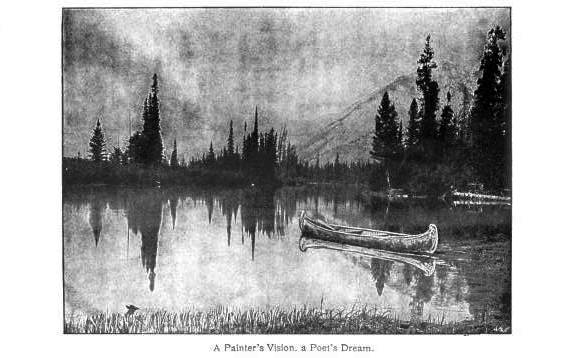
The Dominion of Canada has in it more fresh-water lakes than any other country in the world. Some of them are equal, if not superior, in the clearness and purity of their waters, in the distinctness of the reflections cast upon their limpid surface by surrounding hill or forest, and in the wild, weird beauty of their environments, to any of the world’s old favourite ones that have been long praised in song and story. They are slowly being discovered and prized, for some of them are as a poet’s dream and a painter’s vision.
They saw various wild animals, but as they were in charge of the trading outfit for the Hudson Bay Company’s post in that region of country they were under obligations to push on as rapidly as possible. The only time they did make a stop of any length was in Split Lake, where, as they were rowing their boats along, they saw a great commotion in the water a long way ahead of them. When they drew near to it they saw it was a battle between a couple of splendidly antlered reindeer and four wolves.
It was evident that the wolves were being badly worsted in the fight, as the reindeer were now the aggressors. From the Indians’ idea of it, it looked as if the wolves had either chased the deer into the lake or, seeing them in there swimming, had plunged in after them. The deer, at first much alarmed, had boldly struck out into the lake, and were followed by the wolves. Of course, it was impossible to say whether the wolves had been able to reach them and make the attack, or whether the reindeer, when they had drawn them a long way out, had not then turned upon them.
The reindeer has large lungs, and so swims high on the water. He is not only able to use his antlers, but can turn while swimming and kick most viciously. A wolf can only swim like a dog, and as his head is so low he cannot make much of a fight. And so here the boys had the rare sight of seeing a couple of deer chasing with great delight four of their most dreaded foes on land.
They passed across the bows of the boat near enough for them to see quite distinctly the deer suddenly give a spurt and then strike the wolves with their great horns. Every effort of the wolves to attack seemed to meet with complete failure, until at length their only ambition seemed to be to reach the shore, and in this way two were successful. The deer succeeded in drowning the other two.
The victory of the deer over their cruel and relentless foes gave very much delight to the Indians as well as to Frank, Alec, and Sam, and it was decided not to fire at the beautiful creatures, but to leave them to enjoy their victory.
After several days more of travel and varied adventure they reached the trading post and Burntwood River, and shortly after started off to Lake Wollaston, as the hunters had reported the reindeer were there in great herds. To that place they now travelled in birch canoes, and in them the boys were much happier than in the big boats in which, with the company’s goods, they had travelled from Norway House.
They saw traces of bears, beavers, wild cats, and other animals; but they were after reindeer, and just now cared but little for any other kinds of game. At a camp fire, where they were having supper, the old Indian who had been appointed captain on account of his experience in this kind of hunting gave the boys some instructions how to act should they discover a large herd. He told them it would not be very difficult to get within range of one or more of them, but they were to crawl up as close to the herd as possible on the leeward side, and there, from their hidden places, watch them until they saw the great one that was the leader of the herd. They would not have any trouble to pick him out. They would soon see how he bossed the rest, and was always at the head when the herd moved.
What they were to do was to keep moving along with the herd, skulking from one rock to the shelter of another, and, taking advantage of every inequality in the ground, to get within range of the leader, “but never let him once get sight of you.” It was not so very particular about the others, as they would not run until the leader started, unless very much frightened. They were told to take, in addition to the gun and ammunition, some food, a small axe in their belt, as well as their trusty knife. They were not to be discouraged if hours passed before they got a shot at the leader. They were to be patient and they would succeed. The boys were amazed when the old Indian told them that sometimes he had followed a great herd for three days before he got at the leader. “But,” he added, “it well paid me, as I shot twelve deer ere they had a new leader.”
How this could happen was a mystery to the boys until he explained to them that when these herds come down fresh from the great barren lands under the guidance of the leader they have such confidence in him, or are in such fear of him, that when he is shot down the whole herd is thrown into confusion, and they run here and there and jump about in such a foolish manner, waiting for their leader to show them the way, that a quick, clever Indian, hid behind a rock or standing in some dense bushes, can keep loading and firing until he shoots from six to a dozen of them. Then another great deer gives a snort and dashes off, and they all follow him as the new leader. They are now so frightened that, under his leadership, they will generally run a great many miles ere they stop.
Early one morning, shortly after this information had been imparted by the experienced old Indian to the boys, some scouts who had been on the lookout came in with the information that two herds of deer were visible. They were in different parts, and could be hunted at the same time without any difficulty.
At once all preparations were made. As but one boy and one Indian could go together, it was decided that Frank and Alec should make the first attempt to show their skill in this kind of hunting. The old captain took Alec with him, while another almost equally experienced hunter accompanied Frank.
Sam was left boss of the camp, but he determined to do a little hunting on his own account while the rest were off after the reindeer.
The clothing of the boys was inspected by the Indians, and everything of a bright nature was discarded. They were all dressed in smoked leather suits, with caps to match. This made them almost the colour of the rocks and dried ferns, or bracken, among which they would have to do a good deal of crawling. The deer hunters left the camp about six o’clock in the morning, Alec and the captain going in a north-easterly direction, and Frank and his companion about due west. The understanding was to be back, if possible, not later than midnight. Each Indian, however, took the precaution of strapping on his back a grey blanket in case of delay.
The adventures of Alec and the captain we will have.
They started off in a north-easterly direction, and had to travel several miles ere, from an eminence far away, the herd was sighted. They were feeding as they leisurely moved along, and seemed to have no suspicion of danger. It was in our hunters’ favour that the country was very much broken with a succession of hills and dales, rocky ridges and ravines, clumps of spruce forests, and long stretches of marshy lands, in which the dried ferns and bracken were very abundant. The first thing after the discovery of the herd in the distance was to find out from them the direction in which they seemed to be moving, and then to notice the direction of the wind, as it is always best to be on the lee side on account of the scent.
All arrangements being made, the two started off quite rapidly, as it was possible to push on for quite a time without much precaution, owing to the character of the country. Alec’s trips to the Highlands of his beloved Scotland, and his excursions with the experienced gillie there, stood him in good service here. After about an hour’s swift travelling the Indian said:
“We are not far from them; stay here a few minutes while I go to that large rock and see how they are moving, and, if I can, make out the leader. Keep where you can see me when I come down a little from the side of the rock, and if I stretch out my arms for a sign come on and join me there.”
Alec was not kept long in waiting, for soon after his companion had crawled to the summit of the rock that rose up before them he speedily drew back a little, so as to be out of sight of the deer, and, gave the signal to advance. It did not take Alec long to join him. The Indian informed him that the herd was a large one, and that some of the deer were so close that they could easily be shot from the top of the rock.
Very cautiously did Alec with his companion climb to the point of observation, and there, carelessly moving before them, was a magnificent herd of several hundred splendid deer. As their food was abundant they were in splendid condition and were a beautiful sight. Numbers of them were very heavily antlered, and as Alec tried to count the numerous points he saw many pass muster as “royals” in his beloved Highlands. It was evident the leader was not to be distinguished from that position, and so the keen-eyed Indian watched for a few minutes the gradually receding herd until he was perfectly satisfied of the direction they intended to keep, and then he indicated to Alec their probable route, and stated that in all probability several hours would pass ere they would get a shot.
So, carefully retreating, they began their careful march in a line parallel with the herd, but generally from two to four hundred yards distant, according to the cover the country afforded to screen them from observation. Several times did the Indian leave Alec carefully hid from observation while he, as we have once described, took advantage of some high rock, or steep declivity, to crawl forward and observe the position of the herd. On one of these tours of inspection the Indian observed that before them was now a long valley, and the appearance of the country was as though two hills were quite close together with only a narrow passage between them. Almost as by intuition—perhaps it was the result of long experience—the Indian reasoned, “If we can reach that spot ahead of the herd we are almost sure to be successful. But can we do it? is the question.”
Rapidly returning to Alec, he told him what he had seen, and what he thought might be accomplished.
“Let us try,” excitedly said Alec, and off they started.
The Indian was amazed at the endurance of this Scotch lad, who so generally kept close to him in his rapid march. When well sheltered behind great rocky ridges or in ravines they ran without fear of being discovered, but when it was on a barren plain, with scores of deer in plain sight, it was a different matter. There they had to crawl snakelike along the ground. Thus on it went, the Indian repeatedly uttering a cheery word of encouragement to Alec, who had so won his admiration by his pluck and endurance.
“What is that?” they both said, as they crowded as low as possible.
“Wait till I see,” said the Indian, as he crawled forward to discover.
Soon he came back with the word that it was all right; only a big buck crowded up too near the front, and the leader turned on him and they had a battle, in which the intruder was soon conquered and driven back.
This delay stopped the herd for a time, and so Alec and his companion were now about in a line with the front of the herd.
Only about a mile more had they to make ere they reached the desired position, and so about half an hour before the deer arrived they were well hidden and ready for action. They had taken the precaution to get out, ready for use, their ammunition, so that, if they threw the herd into confusion, they might have several shots ere the herd dashed away.
Soon the deer were so close to them that they could hear them very distinctly. Cautiously the Indian watched them, and then, as arranged, he signalled to Alec, who was stretched out behind a rock that had a narrow cleft in it. This break was just large enough for a lookout, and it would also serve as a good rest for the gun. As Alec cautiously peeped through this narrow opening his heart gave a great thump, for there within fifty yards of him were the most magnificent deer he had ever seen. There was no difficulty now in picking out the leader.
So, pulling himself together, he waited until his heart stopped thumping, and then, carefully and coolly aiming, so as to strike the game immediately behind the fore shoulder, he fired. The deer gave one great bound and dropped dead. Instantly there rang out another report, as Alec’s comrade fired, and another great deer fell dead. Now there was one of those panics that occur among these reindeer when the leader is suddenly shot down. They made no attempt to escape. They ran up to where lay the fallen leader, and then they retreated a hundred yards or so. Some ran one way and some another, and then veered around and returned again.
In the meantime Alec and the Indian were carefully loading and firing, until perhaps between them a dozen deer had been killed. Then the Indian gave the signal to stop firing; but they continued to watch them for several minutes more while panic-stricken and bewildered they aimlessly ran from point to point.
“Look,” said the Indian, “quick, see the new leader!”
And sure enough there was a great, handsome fellow snorting out his notes of authority and defiance. None now disputed his guidance, and so off he started, and in a few seconds not a deer, with the exception of those that were shot, was visible. No hunters could get within range now, nor for many a day to come.
“Why did you give the word to stop firing?” said Alec.