Front matter
Reading edition
EDWIN MARKHAM
Come, let us live the poetry we sing.
THOUGHTS Selected from the Writings of Favorite Authors
BY
Ladies of Fabiola Hospital Association
Oakland, California

NEW YORK:
Dodge Publishing Company
53 and 55 Fifth Avenue
The Compilers acknowledge with grateful thanks the courtesy of Messrs. Houghton, Mifflin and Company; Dodd, Mead and Company (for selections from Hamilton Wright Mabie’s “Before My Library Fire,” “In the Forest of Arden,” and other publications); Little, Brown and Company (selections from Lilian Whiting’s “From Dreamland Sent,” “The World Beautiful,” First, Second and Third Series, and other publications), and others in allowing insertion of selections from works of which they own the copyright.
[Thoughts. 4]
Copyrighted, 1901,
by
JESSIE K. FREEMAN and SARAH S. B. YULE.
The pleasantest things in the world are pleasant thoughts, and the great art in life is to have as many of them as possible.
—Bovée.
To get peace, if you do want it, make for yourselves nests of pleasant thoughts. None of us yet knows, for none of us has been taught in early youth, what fairy palaces we may build of beautiful thoughts—proof against all adversity. Bright fancies, satisfied memories, noble histories, faithful sayings, treasure-houses of precious and restful thoughts, which care cannot disturb, nor pain make gloomy, nor poverty take away from us—houses built without hands for our souls to live in.
—Ruskin.
I saw the mountains stand Silent, wonderful, and grand, Looking out across the land When the golden light was falling On distant dome and spire; And I heard a low voice calling, “Come up higher, come up higher, From the lowland and the mire, From the mist of earth desire, From the vain pursuit of pelf, From the attitude of self; Come up higher, come up higher.”
—James G. Clarke.
The thrift of time will repay in after life with usury of profit beyond your most sanguine dreams, and waste of it will make you dwindle alike in intellectual and moral stature beyond your darkest reckoning.
—Gladstone.
Never bear more than one kind of trouble at a time. Some people bear three—all they have had, all they have now, and all they expect to have.
—Edward Everett Hale.
Age is opportunity no less Than youth itself, though in another dress; And as the evening twilight fades away The sky is filled with stars invisible by day.
—Longfellow.
If there is any person to whom you feel dislike, that is the person of whom you ought never to speak.
—R. Cecil.
The great thing in the world is not so much where we stand, as in what direction we are moving.
—Oliver Wendell Holmes.
In nature there is no blemish but the mind;—none can be called deformed but the unkind.
—Shakespeare.
“You never can tell what your thoughts will do, In bringing you hate or love; For thoughts are things, and their airy wings Are swifter than carrier doves. They follow the law of the universe,— Each thing must create its kind; And they speed o’er the track to bring you back Whatever went out from your mind.”
Do the duty which lies nearest thee, which thou knowest to be a duty. Thy second duty will already have become clearer.
—Carlyle.
We need a revival of the individual. The question is not, What are they doing?—but, What am I doing? Not, Why do you not do this, that, or the other?—but, Why am not I doing this, that, or the other?
—Jenkin Lloyd Jones.
That man is blessed who every day is permitted to behold anything so pure and serene as the western sky at sunset, while revolutions vex the world.
—Henry D. Thoreau.
There’s life alone in duty done, And rest alone in striving.
—Whittier.
It is a matter of economy to be happy, to view life and all its conditions from the brightest angle; it enables one to seize life at its very best. It expands the soul.
—H. W. Dresser.
To educate the heart, one must be willing to go out of himself, and to come into loving contact with Others.
—James Freeman Clarke.
Associate reverently, and as much as you can, with your loftiest thought.
—Henry D. Thoreau.
This question then is ours—are we doing our part in the growth of the race? In the current of life are we moving forward? Do our years mark milestones in humanity’s struggle towards perfection? Is the God within us so much more unrolled, when our development has reached its highest point? Can we transmit to our children a better heritage of brain and soul than our fathers left to us? Has the race through us gained some little in the direction of the law of love? If we have done our part in this struggle our lives have not been in vain.
—David Starr Jordan.
Virgil said of the winning crew in his boat-race, “They can, because they believe they can.”
Let us be of good cheer, remembering that the misfortunes hardest to bear are those which never come.
—Lowell.
To be wise we must first learn to be happy: for those who can finally issue forth from self by the portal of happiness, know infinitely wider freedom than those who pass through the gate of sadness.
—Maurice Materlinck.
When we humor our weaknesses they force themselves continually upon our attention, like spoiled children. When we assert our mastery of ourselves and compel its recognition, we stand secure in our sovereign rights.
—Chas. B. Newcomb.
Put away all sarcasm from your speech. Never complain. Do not prophesy evil. Have a good word for everyone, or else keep silent.
—Henry Ward Beecher.
Boys flying kites haul in their white winged birds, You can’t do that way when you’re flying words. Thoughts unexpressed may sometimes fall back dead, But God himself can’t stop them when they’re said.
—Will Carleton.
Mould conditions aright, and men will grow good to fit them.
—Horace Fletcher.
Pride Is littleness; he who feels contempt For any living thing hath faculties Which he has never used.
—Wordsworth.
Treat your friends for what you know them to be. Regard no surfaces. Consider not what they did, but what they intended.
—Henry D. Thoreau.
Small kindnesses, small courtesies, small considerations, habitually practiced in our social intercourse, give a greater charm to the character than the display of great talent and accomplishments.
—Kelty.
I believe that the mind can be profaned by the habit of attending to trivial things, so that all our thoughts shall be tinged with triviality.
—Henry D. Thoreau.
Don’t hang a dismal picture on the wall, and do not daub with sables and glooms in your conversation. Don’t be a cynic and disconsolate preacher.
—Emerson.
No good thing is failure and no evil thing success.
—W. C. Gannett’s favorite proverb.
Wisdom is knowing what to do next; Skill is knowing how to do it, and Virtue is doing it.
—David Starr Jordan.
Always laugh when you can; it is a cheap medicine. Merriment is a philosophy not well understood. It is the sunny side of existence.
—Byron.
If we are not responsible for the thoughts that pass our doors, we are at least responsible for those we admit and entertain.
—Charles B. Newcomb.
Not for the crying, Not for the loud beseeching Will peace draw near. Rest with palms folded, Rest with thine eyelids fallen, Lo! peace is here.
—E. R. Sill.
Would you remain always young, and would you carry all joy and buoyancy of youth into your maturer years? Then have care concerning but one thing—how you live in your thought world.
—R. W. Trine.
Lord, for to-morrow and its needs I do not pray, Help me from stain of sin Just for to-day. Let me both diligently work And duly pray, Let me be kind in word and deed Just for to-day. Let me be slow to do my will, Prompt to obey, Help me to sacrifice myself Just for to-day. Let me no wrong or idle word Unthinking say, Put Thou Thy seal upon my lips Just for to-day. So for to-morrow and its needs I do not pray, But keep me, guide me, hold me, Lord, Just for to-day.
—Canon Farrar.
To live in love is to live an everlasting youth. Whoever enters old age by this royal road will find the last of life to be the very best of life. Instead of finding himself descending the hills of life, he will find it up-hill all the way, into clearer air. There the vision reaches further; here the sunsets are more golden and the twilight lasts longer.
—Mrs. Mary A. Livermore.
Those who live on the mountain have a longer day than those who live in the valley. Sometimes all we need to brighten our day is to rise a little higher.
—Rev. S. J. Barrows.
Good luck is the willing handmaid of upright, energetic character, and conscientious observance of duty.
—James Russell Lowell.
The highest compact we can make with our fellow is, let there be truth between us two forevermore.
—Emerson.
Unfaithfulness in the keeping of an appointment is an act of clear dishonesty. You may as well borrow a person’s money as his time.
—Horace Mann.
All service ranks the same with God— There is no last nor first.
—Browning.
Logic makes only one demand, that of conscience. But life makes a thousand. The body wants health; the imagination cries out for beauty; and the heart for love. Pride asks for consideration; the soul yearns for peace; the conscience for holiness; our whole being is athirst for happiness and for perfection.
—Amiel.
What if it does look like rain, it is fine now!
—William Smith.
Was there ever a wiser or more loving conspiracy than that which keeps the venerable figure of Santa Claus from slipping away, with all the other old-time myths, into the forsaken wonderland of the past?
—Hamilton Wright Mabie.
Mankind are always happier for having been happy. So that if you make them happy now, you make them happy twenty years hence by the memory of it.
—Sydney Smith.
Never fancy you could be something if only you had a different lot and sphere assigned you. The very things that you most deprecate, as fatal limitations or obstructions, are probably what you most want. What you call hindrances, obstacles, discouragements, are probably God’s opportunities.
—Horace Bushnell.
Who may not strive, may yet fulfil The harder task of standing still, And good but wished, with God is done.
—Whittier.
Happiness and the sense of victory are only for those who live for conscience and duty and the soul’s higher ideals.
—Newell Dwight Hillis.
“Try this for one day:—Think as though your thoughts were visible to all about you.”
The world turns aside to let any man pass who knows whither he is going.
—David Starr Jordan.
Beware lest thy friend learn to tolerate one frailty of thine, and so an obstacle be raised to the progress of thy love.
—Thoreau.
As soon as a stranger is introduced into any company, one of the first questions which all wish to have answered, is, How does that man get his living? And with reason; every man is a consumer, and ought to be a producer. He fails to make his place good in the world unless he not only pays his debts but also adds something to the common wealth.
—Emerson.
All impatience disturbs the circulation, scatters force, makes concentration difficult if not impossible.
—C. B. Newcomb.
When the sun of joy is hidden And the sky is overcast, Just remember light is coming And a storm can never last.
—J. B. Smiley.
There is no music in a rest, that I know of, but there is the making of music in it.
—Ruskin.
Our lives are songs; God writes the words, And we set them to music at leisure: And the song is sad, or the song is glad As we choose to fashion the measure. We must write the song, Whatever the words, Whatever its rhyme, or meter; And if it is sad, we must make it glad, And if sweet, we must make it sweeter.
—Gibbon.
For what you find in these sweet days, Depends on how you go about it; A glad heart helps poor eyes to see, What brightest eyes can’t see without it. One child sees sunlit air and sky And bursting leaf buds, round and ruddy; Another looks at his own feet, And only sees that it is muddy!
—Henrietta R. Eliot.
The work of the world is done by few; God asks that a part be done by you.
—Sarah K. Bolton.
This nation, under God, shall have a new birth of freedom, and government of the people, by the people, for the people, shall not perish from the earth.
—Abraham Lincoln.
We are haunted by an ideal life, and it is because we have within us the beginning and the possibility of it.
—Phillips Brooks.
Earth’s crammed with heaven, And every common bush afire with God.
—E. B. Browning.
Thoughts are forces: through their instrumentality we have in our grasp, and as our rightful heritage, the power of making life and all its manifold conditions exactly what we will.
—R. W. Trine.
People seem not to see that their opinion of the world is also a confession of character.
—Emerson.
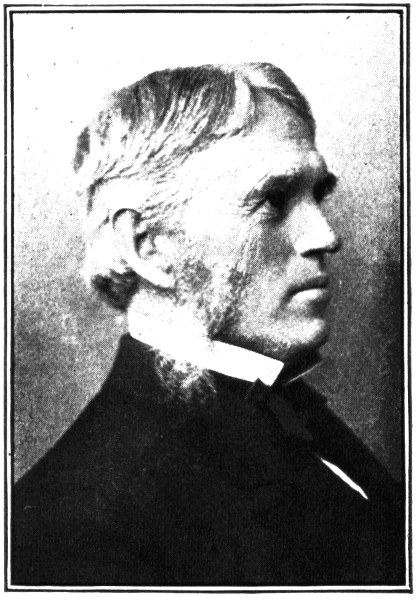
HORATIO STEBBINS
The understanding is the vestibule of the mind! Uncover thy head, and enter the temple of the soul! Behold the power, the beauty and the love! If we had nothing but understanding, how little should we know or think or feel!
Blessed are the Happiness Makers. Blessed are they who know how to shine on one’s gloom with their cheer.
—Henry Ward Beecher.
The time will come when the civilized man will feel that the rights of every living creature on the earth are as sacred as his own. Anything short of this cannot be perfect civilization.
—David Starr Jordan.
Search thine own heart. What paineth thee In others, in thyself may be; All dust is frail, all flesh is weak; Be thou the true man thou dost seek.
—Whittier.
Beware of despairing about yourself.
—St. Augustine.
If you were born to honor, show it now: If put upon you, make the judgment good That thought you worthy of it.
—Shakespeare.
Then a voice within his breast Whispered, audible and clear: “Do thy duty; that is best; Leave unto the Lord the rest!”
—Longfellow.
“There are loyal hearts, there are spirits brave, There are souls that are pure and true; Then give to the world the best you have, And the best will come to you. Give love, and love to your heart will flow, A strength in your utmost need; Have faith, and a score of hearts will show Their faith in your word and deed.”
Fortune will call at the smiling gate.
—Japanese Proverb.
“Talk health; the dreary never-ending tale Of mortal maladies is worn and stale. You cannot charm or interest or please By harping on that minor chord, disease. Say you are well, or all is well with you And God shall hear your words and make them true.”
Whenever you are angry, be assured that it is not only a present evil, but that you have increased a habit.
—Epictetus.
How true it is that what we really see day by day depends less on the objects and scenes before our eyes than on the eyes themselves and the minds and hearts that use them.
—F. D. Huntington.
You have not fulfilled every duty, unless you have fulfilled that of being pleasant.
—Charles Buxton.
If I am not for myself who will be for me? But if I am for myself alone what am I? If not now—when?
—Hillel.
I asked the New Year for some motto sweet, Some rule of life by which to guide my feet; I asked and paused. It answered, soft and low: “God’s will to know.” “Will knowledge then suffice, New Year?” I cried; But ere the question into silence died, The answer came: “Nay; this remember, too, God’s will to do.” “To know; to do; can this be all we give To Him in Whom we are, and move and live? No more, New Year?” “This, too, must be your care: God’s will to bear.” Once more I asked: “Is there still more to tell?” And once again the answer sweetly fell; “Yea, this one thing, all other things above; God’s will to love.”
—J. M. C. Bouchard, S. J.
Shun idleness, it is the rust that attaches itself to the most brilliant metals.
—Voltaire.
Few men suspect how much mere talk fritters away spiritual energy—that which should be spent in action, spends itself in words. Hence he who restrains that love of talk lays up a fund of spiritual strength.
—F. W. Robertson.
Truthfulness is the foundation of all personal excellence. It exhibits itself in conduct. It is rectitude, truth in action, and shines through every word and deed.
—Samuel Smiles.
The cry of the age is more for fraternity than for charity. If one exists, the other will follow, or better still, will not be needed.
—Dr. Henry D. Chapin.
There is philosophy as well as philanthropy in the keeping in touch with all sweetness and love, in the being swift to be kind. This is living on the spiritual plane, and spirituality is power.
—Lilian Whiting.
Manners are the happy ways of doing things. If they are superficial, so are the dewdrops, which give such a depth to the morning meadows.
—Emerson.
Being all fashioned of the self-same dust, Let us be merciful as well as just.
—Longfellow.
“The man who never makes mistakes loses a great many chances to learn something.”
Why should a true and sincere appreciation be termed flattery, and degraded to the level of insincere praise? Why should an individual be accused of acting from base and selfish policy because he feels the glow and warmth of social response?
—The World Beautiful, Lilian Whiting.
Our power over others lies not so much in the amount of thought within us as in the power of bringing it out.
—W. E. Channing.
Could a greater miracle take place than for us to look through each other’s eyes for an instant?
—Thoreau.
Why should we wear black for the guests of God?
—Ruskin.
I always seek the good that is in people and leave the bad to Him who made mankind and knows how to round off the corners.
—Goethe’s Mother.
I am not concerned that I have no place, I am concerned how I may fit myself for one. I am not concerned that I am not known, I seek to be worthy to be known.
—Confucius.
The sunrise never failed us yet.
—Celia Thaxter.
Don’t bewail and bemoan. Omit the negative propositions. Nerve us with incessant affirmations. Don’t waste yourself in rejection, nor bark against the bad, but chant the beauty of the good.
—Emerson.
How the sting of poverty, or small means, is gone when one keeps house for one’s own comfort, and not for the comfort of one’s neighbors.
—Dinah Maria Mulock.
Culture is not an accident of birth, although our surroundings advance or retard it; it is always a matter of individual education.
—Hamilton W. Mabie.
No man need hunt for his mission. His mission comes to him. It is not above, it is not below, it is not far—not to make happy human faces now and then among the children of misery, but to keep happy human faces about us all the time.
—J. F. W. Ware.
God’s best gift to us is not things, but opportunities.
—Alice W. Rollins.
Whoever will prosper in any line of life must save his own time and do his own thinking. He must spend neither time nor money which he has not earned.
—David Starr Jordan.
I pray you, O excellent wife, not to cumber yourself and me to get a rich dinner for this man or this woman who has alighted at our gate, nor a bed-chamber made ready at too great a cost. These things they can get for a dollar at any village. But let this stranger, if he will, in your looks, in your accent, and behavior, read your heart and earnestness, your thought and will, which he cannot buy at any price in any village or city, and which he may well travel fifty miles and dine sparely and sleep hard in order to behold. Certainly, let the board be spread and let the bed be dressed for the traveler; but let not the emphasis of hospitality lie in these things. Honor to the house where they are simple to the verge of hardship, so that there the intellect is awake and reads the laws of the Universe.
—Emerson.
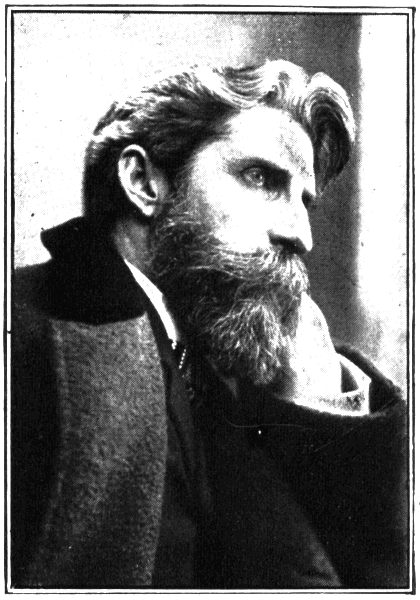
JOHN VANCE CHENEY
The happiest heart that ever beat Was in some quiet breast, That found the common daylight sweet And left to heaven the rest.
“The secret of the joy of living is the proper appreciation of what we actually possess.”
So then believe that every bird that sings, And every flower that stars the elastic sod, And every thought the happy summer brings To the pure spirit is a word of God.
—Coleridge.
Thrust an Emerson into any Concord, and his pungent presence will penetrate the entire region. Soon all who come within the radius of his life respond to his presence as flowers and trees respond with boughs, brilliant and fragrant, to the sunshine. After a little, each Emerson stands girt about with Hawthornes, Whittiers, Holmeses and Lowells.
—Newell Dwight Hillis.
Make it your habit not to be critical about small things.
—Edward Everett Hale.
The nobler life is just as possible to us all as that which is ignoble. The moment one will assert his freedom from petty cares, perplexities, troubles, and anxieties, that moment they fall off of themselves.
—A Study of Mrs. Browning, Lilian Whiting.
He approaches nearest to the gods who knows how to be silent even though he knows he is in the right.
—Cato.
Ah! let us hope that to our praise Good God not only reckons The moments when we tread His ways, But when the spirit beckons— That some slight good is also wrought Beyond self-satisfaction, When we are simply good in thought, Howe’er we fail in action.
—Lowell.
We need only obey. There is guidance for each of us, and by lowly listening, we shall hear the right word.
—Emerson.
When a man has not a good reason for doing a thing, he has one reason for letting it alone.
—Sir Walter Scott.
Pure religion as taught by Jesus Christ is a life, a growth, a divine spirit within, coming out in love and sympathy and helpfulness to our fellow-men.
—Dr. H. W. Thomas.
Be sure of the foundation of your life. Know why you live as you do. Be ready to give a reason for it. Do not, in such a matter as life, build on opinion or custom, or what you guess is true. Make it a matter of certainty and science.
—Thomas Starr King.
Nothing raises the price of a blessing like its removal; whereas, it was its continuance which should have taught us its value.
—Hannah More.
The soul occupied with great ideas, best performs small duties.
—James Martineau.
Christianity wants nothing so much in the world as sunny people, and the old are hungrier for love than for bread. The Oil of Joy is very cheap, and if you can help the poor with a Garment of Praise, it will be better for them than blankets.
—Drummond.
You will find it less easy to uproot faults than to choke them by gaining virtues. Do not think of your faults, still less of others’ faults. In every person who comes near you look for what is good and strong; honor that; rejoice in it; and as you can, try to imitate it; and your faults will drop off like dead leaves, when their time comes.
—Ruskin.
When you hold persistently to the successful mental state, you become a magnet drawing other people to aid you as you in return can aid them. But if you are much of the time despondent and gloomy, you become the negative magnet driving the best from you.
—Prentice Mulford.
There are two days about which nobody should ever worry, and these are yesterday and to-morrow.
—Robert J. Burdette.
A child, however educated, is still untaught if by his teaching we have not emphasized his individual character, if we have not strengthened his will and its guide and guardian, the mind.
—David Starr Jordan.
“I am only a child who is lying On the bosom of Infinite Love. I speak not of living or dying; I know not of sorrow or crying; My thoughts are dwelling above. “The spring of the life that is flowing Is hidden with Christ in God. Not yet the mystery knowing, I feel that the peace is growing, As a river grows deep and broad. “All I need without price I am buying By my trust in the Goodness above. There’s an end to my yearning and sighing, For just like a child I am lying On the bosom of Infinite Love.”
The optimist, by his superior wisdom and insight, is making his own heaven, and in the degree that he makes his own heaven, is he helping to make one for all the world beside.
—R. W. Trine.
Do not let your head run upon that which is none of your own, but pick out some of the best of your circumstances, and consider how eagerly you would wish for them, were they not in your possession.
—Marcus Aurelius.
Insist on your self; never imitate. There is at this moment for you an utterance brave and grand as that of the colossal chisel of Phidias, or the pen of Moses or Dante, but different from these. If you can hear what these patriarchs say, surely you can reply to them in the same pitch of voice.
—Emerson.
Just because there’s fallen A snow-flake on his forehead, He must go and fancy ’Tis winter all the year!
—Aldrich.
How poor they are that have not patience.
—Shakespeare.
O God, animate us to cheerfulness! May we have a joyful sense of our blessings, learn to look on the bright circumstances of our lot, and maintain a perpetual contentedness.
—W. E. Channing.
Thy love shall chant its own beatitudes After its own self-working. A child’s kiss Set on the sighing lips shall make thee glad; A poor man served by thee shall make thee rich; A sick man helped by thee shall make thee strong; Thou shalt be served thyself by every sense Of service which thou renderest.
—E. B. Browning.
“Then take this honey for the bitterest cup; There is no failure, save in giving up; No real fall so long as one still tries, For seeming setbacks make the strong man wise. There’s no defeat, in truth, save from within; Unless you’re beaten there, you’re bound to win.”
A crowd of troubles passed him by As he with courage waited; He said, “Where do you troubles fly When you are thus belated?” “We go,” they say, “to those who mope, Who look on life dejected, Who weakly say ‘good-bye’ to hope, We go where we’re expected.”
—Francis J. Allison.
“Bring me men to match my mountains, Bring me men to match my plains; Men with empires in their purpose And new eras in their brains.”
“Who will remember that skies are gray If he carries a happy heart all day?”
A man is specially and divinely fortunate, not when his conditions are easy, but when they evoke the very best that is in him; when they provoke him to nobleness, and sting him to strength, when they clear his vision, kindle his enthusiasm and inspire his will.
—Hamilton Wright Mabie.
The deeper the feeling the less demonstrative will be the expression of it.
—Balzac.
The most I can do for my friend is simply to be his friend. If he knows I am happy in loving him, he will want no other reward.
—H. D. Thoreau.
“Live blameless; God is near.”
—Inscribed over the door of the house of Linnæus, at Hammerby, Sweden.
It is always good to know, if only in passing, charming human beings. It refreshes one like flowers and woods and clear brooks.
—George Eliot.
Do not discharge in haste the arrow which can never return: it is easy to destroy happiness; most difficult to restore it.
—Herder.
Disappointment should always be taken as a stimulant, and never viewed as a discouragement.
—C. B. Newcomb.
In all the crowded Universe There is but one stupendous word: Love. There is no tree that rears its crest, No fern or flower that cleaves the sod Nor bird that sings above its nest, But tries to speak this word of God.
—J. G. Holland.
He who has a thousand friends has not one friend to spare, And he who has one enemy shall meet him everywhere.
—From the Arabic.
It is a great folly not to part with your own faults, which is possible, but to try instead to escape from other people’s faults, which is impossible.
—Marcus Aurelius.
“To persuade one soul to lead a better life is to leave the world better than you found it.”
If you intend to be happy, don’t be foolish enough to wait for a just cause.
—Chap-Book.
Don’t borrow a creed from other people, Nor hang most faith on the stoutest steeple. Look up for your law, but oh! look higher Than the hands on any human spire. If ten think alike, and you think alone, That never proves ’tis ten to one They are right, you wrong; for truth, you see, Is not a thing of majority. It never can make you false, them true, That there’s more of them than there is of you: If your touch is on Truth’s garment’s hem, There is more of you than a world of them. ’Tis not alone in the Orient region That a certain hero’s name is Legion. Nor was it only for once to be That the whole herd together ran down to the sea. Your zenith for no man else is true: Your beam from the sun comes alone to you. And the thought the great God gave your brain Is your own for the world, or the world’s in vain.
—Edward Rowland Sill.
Discontent is want of self-reliance: it is infirmity of will.
—Emerson.
“He that brings sunshine into the lives of others cannot keep it from himself.”
Give us, oh, give us, the man who sings at his work! Be his occupation what it may, he is equal to any of those who follow the same pursuit in silent sullenness. He does more in the same time—he will do it better—he will persevere longer.
—Carlyle.
Set about what thou intendest to do: the beginning is half the battle.
—Cæsar.
By the street of By-and-By, one arrives at the house of Never.
—Cervantes.
No wind serves him who has no destined port.
—Montaigne.
Be sure you give men the best of your wares though they be poor enough; and the gods will help you to lay by a better store for the future.
—Henry D. Thoreau.
Reading is indeed to the mind as food is to the body—the material of which its fibre is made. It is surprising to note the difference in the quality of mental thought which even one-half hour’s good reading each day will make.
—Lilian Whiting.
Men are four: He who knows, and knows he knows,— He is wise—follow him. He who knows, and knows not he knows,— He is asleep—wake him:— He who knows not, and knows not he knows not,— He is a fool—shun him. He who knows not, and knows he knows not,— He is a child—teach him.
—Arabian Proverb.
Cherish ideals as the traveler cherishes the north star, and keep the guiding light pure and bright and high above the horizon.
—Newell Dwight Hillis.
The days come and go like muffled and veiled figures sent from a distant friendly party; but they say nothing, and if we do not use the gifts they bring, they carry them as silently away.
—Emerson.
’Tis not in seeking, ’Tis not in endless striving, Thy quest is found. Be still and listen, Be still and drink the quiet Of all around.
—E. R. Sill.
To keep one’s foot firmly set in the way that leads upwards, however dark and thorny it may be at the moment, is to conquer.
—The World Beautiful, Lilian Whiting.
And daily, hourly, loving and giving In the poorest life makes heavenly living.
—Rose Terry Cooke.
To love is the great glory, the last culture, the highest happiness; to be loved is little in comparison.
—The Story of William and Lucy Smith, George S. Merriam.
To persevere in one’s duty, and to be silent, is the best answer to calumny.
—Washington.
I have lived to know that the secret of happiness is never to allow your energies to stagnate.
—Adam Clarke.
Entertaining is the finest of all the fine arts, and it cannot be done by proxy. It cannot be done by the cook, nor yet by the decorator. Let the hostess give her guests her personal interest, her sympathetic comprehension, and she will have then mastered the delicate and subtle art.
—Lilian Whiting.
Read the best books first, or you may not have a chance to read them at all.
—Henry D. Thoreau.
I am primarily engaged to myself to be a public servant to all the gods, to demonstrate to all men that there is a good will and intelligence at the heart of things, and ever higher and yet higher leadings.
—Emerson.
Be noble, and the nobleness that lies In other men, sleeping, but never dead, Will rise in majesty to meet thine own; Then shalt thou see it gleam in many eyes, Then will pure light about thy way be shed.
—Lowell.
Few causes age the body faster than wilful indolence and monotony of mind—the mind, that very principle of physical youthfulness.
—James Lane Allen.
“To speak wisely may not always be easy, but not to speak ill requires only silence.”
If you have not slept, or if you have slept, or if you have a headache, or sciatica, or leprosy, or thunder stroke, I beseech you by all the angels to hold your peace, and not pollute the morning, to which all the housemates bring serene and pleasant thoughts, by corruptions and groans.
—Emerson.
“‘Downward the path of life!’ Oh, no! Up, up, with patient steps, I go; I watch the skies fast brightening there; I breathe a sweeter, purer air.”
Happiness rarely is absent. It is we that know not of its presence. The greatest felicity avails us nothing if we know not that we are happy.
—Maurice Materlinck.
There is no good in life but love—but love! What else looks good, is some shade flung from love; Love gilds it, gives it worth.
—Robert Browning.
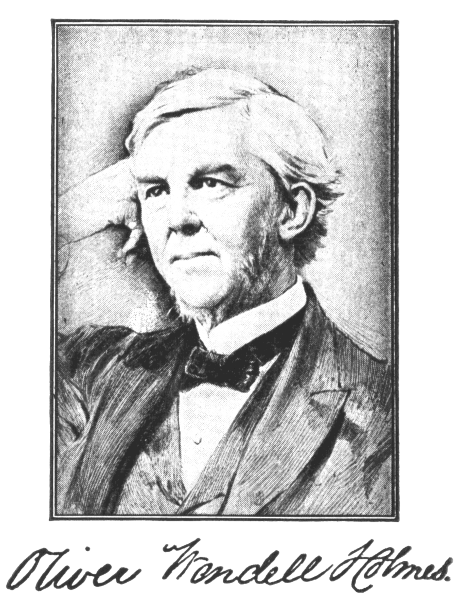
Oliver Wendell Holmes
The great thing in the world is not so much where we stand, as in what direction we are moving.
Instead of a gem, or even a flower, cast the gift of a lovely thought into the heart of a friend.
—Geo. Macdonald.
Be satisfied with nothing but your best.
—Edward Rowland Sill.
Do not think it wasted time to submit yourself to any influence that will bring upon you any noble feeling.
—Ruskin.
Thank God every morning when you get up that you have something to do that day, which must be done whether you like it or not. Being forced to work, and forced to do your best, will breed in you ... a hundred virtues which the idle never know.
—Charles Kingsley.
Foresight is very wise, but foresorrow is very foolish; and castles are, at any rate, better than dungeons in the air.
—Sir John Lubbock.
It requires a sterner virtue than good nature to hold fast the truth, that it is nobler to be shabby and honest, than to do things handsomely in debt.
—Juliana H. Ewing.
“Drop the subject when you cannot agree; there is no need to be bitter because you know you are right.”
It is not only a part of the wisdom of happiness, but it is absolutely essential to the conditions of any true work in the world, to so live that one may not be too greatly affected by the attitude of other people. A man’s life is, after all, primarily between God and himself.
—Lilian Whiting.
Get your distaff ready, and God will send you flax.
—Mary A. Livermore’s favorite proverb.
The thoughts that come often unsought, and, as it were, drop into the mind, are commonly the most valuable we have, and therefore should be secured, because they seldom return again.
—Locke.
The little worries that we meet each day May be as stumbling-blocks across our way, Or we may make them stepping-stones to be Of grace, O Lord, to Thee!
—A. E. Hamilton.
A man’s own good breeding is the best security against other people’s ill manners.
—Chesterfield.
The best teacher of duties that still lie near to us, is the practice of those we see and have at hand.
—Carlyle.
“The secret of a sweet and Christian life is learning to live by the day. It is the long stretches that tire us.”
To one who is in the rôle of host there can be no more bitter rebuke than to have any guest or chance caller go out from the portals with the feeling that he is sorry he came—that he is depressed rather than up-lifted. For all personal association, whether permanent or transient, whether prearranged or a matter of accidental contact, should leave behind it a lingering charm, a deeper sense of the loveliness of life.
—Lilian Whiting.
One of the natural tendencies of the mortal mind is toward proselyting. The moment we believe something to be true, we begin to try to convert others to our belief. We learn to say, with some degree of realization, “God worketh in me to will and to do of His good pleasure,” but we quite forget that the same God is working equally in our brother “to will and to do.” “I am the door,” says the Christ within every man’s own soul. Now you are trying to have your dear one enter in through your door. He must enter in through his own Christ, his own desire.
—H. Emilie Cady.
You may not be able to leave your children a great inheritance, but day by day you may be weaving coats for them which they will wear through all eternity.
—T. L. Cuyler.
He that cannot forgive others, breaks the bridge over which he must pass himself; for every man has need to be forgiven.
—Lord Herbert.
We exhaust our strength in our impatience at our work, and the conditions that surround us. There is nothing that comes to us which we could not do easily with true adjustment, but we waste our forces in our worries.
—C. B. Newcomb.
It seems as if heroes had done almost all for the world that they can do; and not much more can come until common men awake and take their common tasks. I believe the common man’s task is the hardest.
—Phillips Brooks.
When we climb to heaven ’tis on the rounds of love to men.
—Whittier.
When you find a person a little better than his word, a little more liberal than his promise, a little more than borne out in his statements by facts, a little larger in deed than in speech, you recognize a kind of eloquence in that person’s utterance not laid down in Blair or Campbell.
—Holmes.
Young man! let the nobleness of your mind impel you to its improvement. You are too strong to be defeated, save by yourself.
—W. D. Howard.
What we earnestly aspire to be, that in some sense we are.
—Anna Jameson.
The mark of the man of the world is absence of pretension. He does not make a speech, he takes a low business tone, avoids all brag, promises not at all, performs much. He calls his employment by its lowest names, and so takes from evil tongues their sharpest weapon.
—Emerson.
“In judging others, weigh carefully the method against the motive. If the latter be pure, be patient and charitable, however different from your own the method may be.”
“Refuse to regard as unfortunate the treatment you receive from others; let it stimulate you to deal more justly with yourself and with them.”
The strength of affection is a proof not of the worthiness of the object, but of the largeness of the soul which loves.
—F. W. Robertson.
Every flower is a hint of His beauty; every grain of wheat a token of His beneficence; every atom of dust, a revelation of His power. In and through all things He is attracting our regard.
—Furness.
One never speaks of himself except at a loss.
—Montaigne.
It is easy in the world, to live after the world’s opinion: it is easy in solitude, to live after our own. But the great man is he who in the midst of the crowd keeps with perfect sweetness the independence of solitude.
—Emerson.
If you knew the light That your soul casts in my sight, How I look to you For the good and true, The beauteous and the right.
—Robert Browning.
Manners impress as they indicate real power. A man who is sure of his point, carries a broad and contented expression, which everybody reads. And you cannot rightly train one to an air and manner, except by making him the kind of man of whom that manner is the natural expression. Nature forever puts a premium on reality.
—Emerson.
Who looks to Heaven alone to save his soul May keep the path, but will not reach the goal: But he who walks in love may wander far, And God will bring him where the blessed are.
—Henry Van Dyke.
“If you and I—just you and I— Should laugh instead of worry; If we should grow—just you and I— Kinder and sweeter hearted, Perhaps in some near by and by A good time might get started; Then what a happy world ’twould be For you and me—for you and me!”
Let nothing disturb thee, Nothing affright thee; All things are passing; God never changeth; Patient endurance Attaineth to all things; Who God possesseth In nothing is wanting; Alone God sufficeth.
—Longfellow.
The world is full of judgment-days, and in every assembly that a man enters, in every action he attempts, he is gauged and stamped. A man passes for what he is worth.
—Emerson.
Life is noble in proportion to the nobleness of faith; it is successful in proportion to the fixedness of faith.
—Joseph Le Conte.
We should tell ourselves once for all that it is the first duty of the soul to become as happy, complete, independent, and great as lies in its power.
—Maurice Materlinck.
“Cold and reserved natures should remember that though not infrequently flowers may be found beneath the snow, it is chilly work to dig for them, and few care to take the trouble.”
Whenever we send out loving thought in generous profusion, every part of our environment echoes back a sweet benediction.
—Henry Wood.
A good book, whether a novel or not, is one that leaves you farther on than when you took it up. If when you drop it, it drops you down in the same old spot, with no finer outlook, no clearer vision, no stimulated desires for that which is better and higher, it is in no sense a good book.
—Anna Warner.
Silence is a great peacemaker.
—Longfellow.
Each act of humble service is that divine touching of the ground which enables one to get the spring whereby he leaps to greater heights.
—R. W. Trine.
Every noble life leaves the fibre of it interwoven forever in the works of the world.
—Ruskin.
“It is no use running; to set out betimes is the main point.”
One ought never to speak of the faults of one’s friends; it mutilates them. They can never be the same afterward.
—William D. Howells.
Whatever betide, every misfortune must be overcome by enduring it.
—Virgil.
“Never argue with a man who talks loud. You couldn’t convince him in a thousand years.”
The new science perceives that instincts and aspirations in the mind are facts of nature that must be interpreted and accounted for by reason as truly as a stone in the hand.
—Newell Dwight Hillis.
Work and love: that is the body and soul of the human being. Happy he where they are one.
—Auerbach.
You picture to yourself the beauty of bravery and steadfastness. And then some little, wretched, disagreeable duty comes which is your martyrdom, the lamp for your oil; and if you do not do it, your oil is spilled.
—Phillips Brooks.
“Watch the thought you hold for the neighbor who is yet living in the consciousness of truth as you understand it. As you are taught of the Spirit, so will he be taught in the way best adapted to him.”
Why do we so often prefer to believe in the necessity of suffering and weakness rather than in the possibility of strength and gladness?
—C. B. Newcomb.
Great powers and natural gifts do not bring privileges to their possessor, so much as they bring duties.
—Henry Ward Beecher.
Every day should have some part Free for the Sabbath of the heart.
—Wordsworth.
The beautiful is as useful as the useful.
—Victor Hugo.
The higher education of women means more for the future than all conceivable legislative reforms. Its influence does not stop with the home.
—David Starr Jordan.
“It is not the spurt at the start, but the continued, unresting, unhasting advance that wins the day.”
That which is past is gone and irrevocable, and wise men have enough to do with things present and to come.
—Francis Bacon.
Whichever way the wind doth blow Some heart is glad to have it so; Then blow it east or blow it west, The wind that blows, that wind is best.
—Caroline A. Mason.
A lady’s dress should be such as to please God, not laying aside taste, for is He not much more pleased when His children look well than otherwise? I have no idea that Christ was negligent of his dress. His garment was one counted worthy of casting lots upon.
—Mary Lyon.
Experience shows that success is due less to ability than to zeal. The winner is he who gives himself to his work, body and soul.
—Charles Buxton.
“The smelter bends above his pot of silver Watching its restless heavings to and fro, ’Till ready for the careful coiner, His face reflected, the fused metal show.”
It is monotony which eats the heart out of joy, destroys the buoyancy of the spirit, and turns hope to ashes; it is monotony which saps the vitality of the emotions; depletes the energy of the will, and finally turns the miracle of daily existence into dreary commonplace. And monotony has its roots, not in our conditions, but in ourselves.
—Hamilton Wright Mabie.
Begin, therefore, with little things. Is it a little oil spilt or a little wine stolen? Say to yourself, this is the price paid for peace and tranquillity; and nothing is to be had for nothing. And when you call your servant, consider that it is possible he may not come at your call, or, if he does, that he may not do what you wish. But it is not at all desirable for him, and very undesirable for you, that it should be in his power to cause you any disturbance.
—Epictetus.
Let us never forget that an act of goodness is of itself an act of happiness. No reward coming after the event can compare with the sweet reward that went with it.
—Maurice Materlinck.
I said, “I will go out and look for mine enemies,” and that day I found no friends. Again, I said, “I will go out and look for my friends,” and that day I found no enemies.
—Gertrude R. Lewis.
Such as are thy habitual thoughts, such also will be the character of thy mind, for the soul is dyed by the thoughts.
—Marcus Aurelius.
Have faithfulness and sincerity as first principles.
—Confucius.
“If you will call your ‘troubles’ ‘experiences,’ and remember that every experience develops some latent force within you, you will grow vigorous and happy, however adverse your circumstances may seem to be.”
Wanting to have a friend is altogether different from wanting to be a friend. The former is a mere natural human craving, the latter is the life of Christ in the soul.
—J. R. Miller.
When we cultivate thoughts of strength for others, we ourselves grow strong. Habitual thoughts of peace bring us tranquillity.
—C. B. Newcomb.
All high happiness has in it some element of love; all love contains a desire for peace. One immediate effect of new happiness is to make us turn toward the past with a wish to straighten out its difficulties, heal its breaches and forgive its wrongs.
—James Lane Allen.
When I am very weary I do not try to pray. I only shut my eyes, and wait To hear what God will say. Such rest it is to wait for Him As comes no other way.
—Alice E. Worcester.
You have not fulfilled every duty unless you have fulfilled that of being pleasant.
—Charles Buxton.
We do a great deal of shirking in this life on the ground of not being geniuses.
—Rose E. Cleveland.
We never know for what God is preparing us in His schools—for what work on earth, for what work in the hereafter. Our business is to do our work well in the present place, whatever that may be.
—Dr. Lyman Abbott.
Health is the first of all liberties, and happiness gives us the energy which is the basis of health.
—Amiel’s Journal.
Not in the clamor of the crowded street, Nor in the shouts and plaudits of the throng, But in ourselves, are triumph and defeat.
—Longfellow.
Whatever you may be sure of, be sure of this, that you are dreadfully like other people.
—James Russell Lowell.
There is a dust that settles on the heart as well as that which rests upon the ledge. It is better to wear out than to rust out.
—Sir John Lubbock.
How many a thing which we cast to the ground, when others pick it up becomes a gem.
—George Meredith.
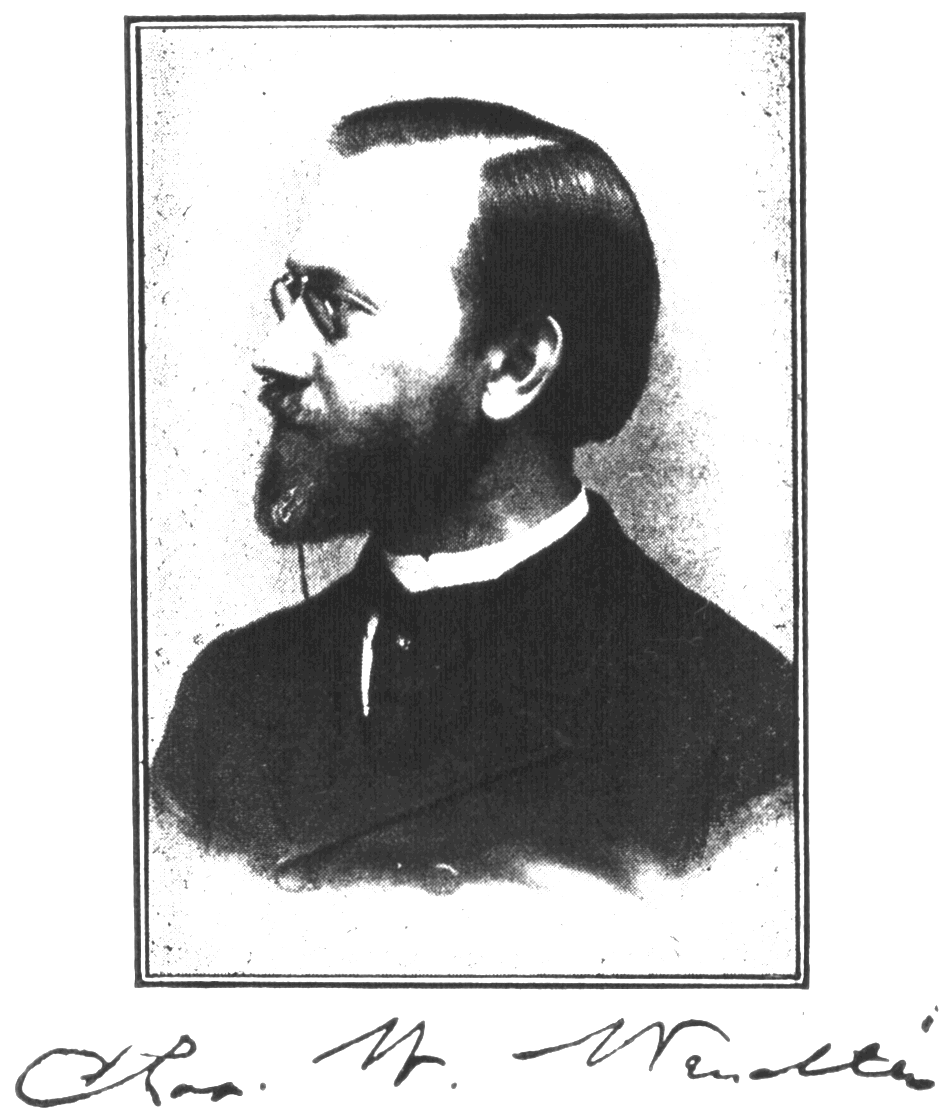
Chas. W. Wendte
Success in life is a matter not so much of talent or opportunity as of concentration and perseverance.
Sunshine is delicious, rain is refreshing, wind braces up, snow is exhilarating; there is really no such thing as bad weather, only different kinds of good weather.
—Ruskin.
A haze on the far horizon, The infinite, tender sky; The ripe, rich tint of the corn-fields, And the wild geese sailing high; And all over upland and lowland The charm of the golden-rod,— Some of us call it Autumn And others call it God.
—M. H. Carruth.
I built a chimney for a comrade old, I did the service not for hope or hire, And then I traveled on in winters cold; Yet all the day I glowed before the fire.
—Edwin Markham.
Flowers, says Ruskin, seem intended for the solace of ordinary humanity. Children love them; quiet, tender, contented, ordinary people love them as they grow; they are the cottager’s treasure; and in the crowded town mark, as with a little broken fragment of rainbow, the windows of the workers in whose heart rests the covenant of peace.
Great privileges never go save in company with great responsibilities.
—Hamilton W. Mabie.
He who has a high standard of living and thinking will certainly do better than he who has none at all.
—Samuel Smiles.
You will find as you look back upon your life that the moments that stand out, the moments when you have really lived, are the moments when you have done things in a spirit of love.
—Henry Drummond.
And let him go where he will, he can only find so much beauty or worth as he carries.
—Emerson.
As you grow ready for it, somewhere or other you will find what is needful for you—in a book, or a friend, or, best of all, in your own thoughts, the eternal thought speaking in your thought.
—George Macdonald.
Be thou the rainbow to the storms of life! The evening beam that smiles the clouds away And tints to-morrow with prophetic ray.
—Byron.
Displays of moral excellence, truths set forth in living actions, are multiplied as they are shown. Men are won by what they approve. They are led to imitate what they admire. Laudable actions never stand alone. They go from eye to eye, from heart to heart, creating fresh copies of their immortal worth.
—Dr. Frothingham.
Wouldst shape a noble life? Then cast No backward glances toward the past, And though somewhat be lost and gone, Yet do thou act as one new-born; What each day needs, that shalt thou ask, Each day will set its proper task.
—Goethe.
We should think just as though our thought were visible to all about us. Real character is not outward conduct, but quality of thinking.
—Henry Wood.
It is a much shallower and more ignoble occupation to detect faults than to discover beauties.
—Carlyle.
Whatever you wish to accomplish, be willing to do, and to commence your work at once, right where you find yourself, and decide that you do not want anything better to begin with than the conditions that surround you, for God is with you.
—Raja Yoga.
No one is respectable who is not doing his best.
—Horace Fletcher.
The broad-minded see the truth in different religions; the narrow-minded see only their differences.
—Chinese Proverb.
The dawn is not distant, Nor is the night starless; Love is eternal! God is still God, and His faith shall not fail us; Christ is eternal!
—Longfellow.
Let us be like the bird for a moment perched On a frail branch while he sings; Though he feels it bend, yet he sings his song, Knowing that he hath wings.
—Victor Hugo.
Let us love so well Our work shall still be sweeter for our love, And still our love be sweeter for our work.
—Elizabeth Barrett Browning.
“If you have gracious words to say Oh, give them to our hearts to-day, But if your words will cause us sorrow, Pray keep them till the last to-morrow.”
High thoughts and noble in all lands Help me: my soul is fed by such. But ah, the touch of life and hands, The human touch! Warm, vital, close, life’s symbols dear, These need I most, and now, and here.
—Richard Burton.
To live in the presence of great truths and eternal laws, to be led by permanent ideals,—that is what keeps a man patient when the world ignores him, and calm and unspoiled when the world praises him.
—Dr. A. Peabody.
The test of an enjoyment is the remembrance which it leaves behind.
—Jean Paul.
No education is complete, nor, indeed, of great permanent value, that does not teach how to live contentedly and to economize nerve energy.
—Mary Roberts Smith.
I have seen manners that make a similar impression with personal beauty, that give us the like exhilaration, and refine us like that. But they must be marked by fine perception, they must always show self-control. Then they must be inspired by the good heart.
—Emerson.
Patience! have faith and thy prayer will be answered.
—Longfellow.
“Sentiment cannot do duty for humanity.”
The life of a man consists not in seeing visions and in dreaming dreams, but in active charity and in willing service.
—Longfellow.
We find in life exactly what we put into it.
—Emerson.
Every duty we omit obscures some truth we should have known.
—Ruskin.
From Socrates to Browning the thinkers and poets have all been emancipators. In the end, this bringing of new light into the minds of the world will be counted their chief service.
—Hamilton W. Mabie.
By all means use sometimes to be alone. Salute thyself: see what thy soul doth wear. Dare to look in thy chest—for ’tis thine own,— And tumble up and down what thou findest there. Who cannot rest till he good fellows finde, He breaks up house, turns out of doors his minde.
—George Herbert.
Personal happiness is almost synonymous with personal interests; the wider the range of the latter, the higher is the degree of happiness.
—Lilian Whiting.
Thoughts of courage, and hope, and highest expectation growing habitual, may lift out and up many a weary pilgrim.
—L. Purington.
“The ornaments of a home are the guests who frequent it.”
Do not waste a minute—not a second—in trying to demonstrate to others the merit of your own performance. If your work does not vindicate itself, you cannot vindicate it.
—Thomas Wentworth Higginson.
To go about moping, depressed, blue, out of spirits in general, is to exist, but not to live. It is the condition of a mollusk, and unworthy a human being. Worry is a state of spiritual corrosion. A trouble either can be remedied, or it cannot. If it can be, then set about it; if it cannot be, dismiss it from your consciousness, or bear it so bravely that it may become transfigured to a blessing.
—Lilian Whiting.
“It is easy enough to be pleasant When life flows by like a song, But the man worth while is the man who will smile When everything goes dead wrong; For the test of the heart is trouble, And it always comes with years, And the smile that comes with the praises of earth Is the smile that shines through tears.”
I think we should treat our minds as innocent children whose guardian we are—be careful what objects and what subjects we thrust on their attention.
—Henry D. Thoreau.
Gather roses while they blossom; to-morrow is not to-day! Allow no moment to escape; to-morrow is not to-day.
—Gleim.
Cheapness of nature can be redeemed only from one source—that of the invisible power on the divine side of life. By seeking this in silence and concentration for a little time each day all refinement and loveliness and charm can be achieved. It is the magic of life.
—The World Beautiful, Lilian Whiting.
I have wished to teach a single lesson, true alike to all men—the lesson of the saving of time.
—David Starr Jordan.
There are so many things—best things—that can only come when youth is past, that it may well happen to many of us to find ourselves happier and happier to the last.
—George Eliot.
This world is no blot for us Nor blank; it means intensely, and means good.
—Browning.
Poetry frequents and keeps habitable those upper chambers of the mind that open toward the sun’s rising.
—James Russell Lowell.
The individual who cultivates grievances, and who is perpetually exacting explanations of his assumed wrongs, can only be ignored, and left to the education of time and of development.... One does not argue or contend with the foul miasma that settles over stagnant water; one leaves it and climbs to a higher region, where the air is pure and the sunshine fair.
—Lilian Whiting.
“Manners must adorn knowledge, and smooth its way through the world.”
Let not future things disturb thee, for thou wilt come to them if it shall be necessary, having with thee the same reason which thou now usest for present things.
—Marcus Aurelius.
We hear much said of “environment.” We need to realize that environment should never be allowed to make the man, but that man should always, and always can, condition the environment. When we realize this, we will find that many times it is not necessary to take ourselves out of any particular environment, because we may yet have a work to do there; but by the very force we carry with us, we can so affect and change matters that we will have an entirely new set of conditions in an old environment.
—Ralph Waldo Trine.
FABLE.
The mountain and the squirrel Had a quarrel, And the former called the latter “Little Prig”; Bun replied, “You are doubtless very big; But all sorts of things and weather Must be taken in together, To make up a year And a sphere. And I think it no disgrace To occupy my place. If I’m not so large as you, You are not so small as I, And not half so spry. I’ll not deny you make A very pretty squirrel track; Talents differ; all is well and wisely put; If I cannot carry forests on my back, Neither can you crack a nut.”
—Emerson.
O the paralyzing effect of fear of evil! It surely doth make “cowards of us all.” It makes us pygmies where we might be giants, were we only free from it.
—H. Emilie Cady.
As you grow old, guard against the tendency to live more coarsely, to relax in your discipline. Obey your finest instincts. Be fastidious to the extreme of sanity.
—Thoreau.
“Then let us smile when skies are gray, And laugh at stormy weather, And sing life’s lonesome times away: So worry and the dreariest day Will find an end together.”
Character is not only written in the face, expressed in conduct and language, but is sent forth as a thought atmosphere.
—Dresser.
Others shall Take patience, courage, to their heart and hand From thy hand and thy heart and thy brave cheer, And God’s grace fructify through thee to all.
—Elizabeth Barrett Browning.
To love one soul for its beauty and grace and truth is to open the way to appreciate all beautiful and true and gracious souls, and to recognize spiritual beauty wherever it is seen.
—H. Black.
We must alter for the better always and unceasingly. Nature seems to be at rest only because she is perpetually renewed. The soul enjoys repose on the same terms.
—De Ravignon.
God gives us power to bear all the sorrows of His making: but He does not give the power to bear the sorrows of our own making, which the anticipation of sorrow most assuredly is.
—Ian MacLaren.
Ever laughs the sunlight in our eyes at morning and at noon, Comes the pure, cool wind, to whisper past our cheek its cheery tune, Just to tell us Earth is beautiful, and at the quiet even Every star looks down lest we forget that earth is crowned with Heaven.
—E. R. Sill.
“The whole world unites in pushing us the way we have really made up our mind to go.”
Without distinction, without calculation, without procrastination, love. Lavish it upon the poor, where it is very easy; especially upon the rich, who often need it most; most of all upon our equals, where it is very difficult, and for whom perhaps we each do least of all.
—Henry Drummond.
Are you in earnest? Seize this very minute! What you can do, or think you can, begin it!
—Goethe.
’Tis better to live rich than to die rich.
—Dr. Johnson.
It seems to me there is no maxim for a noble life like this: Count always your highest moments your truest moments. Believe that in the time when you were the greatest and most spiritual man, then you were your truest self.
—Phillips Brooks.
Fine society is the graceful, genial, sympathetic intercourse of fine souls.
—Lilian Whiting.
The stream of content must flow from ourselves, taking its source from a deliberate disposition to learn what is good, and a determined resolution to seek for and enjoy it, however small the portion may be.
—Zimmermann.
When you have a number of disagreeable duties to perform, always do the most disagreeable first.
—Josiah Quincy.
God says, live deeply, earnestly in the present, and the spirit of all the ages shall come and reveal itself to you.
—Phillips Brooks.
To try too hard to make people good is one way to make them worse. The only way to make them good, is to be good, remembering well the beam and the mote.
—George Macdonald.
“Ask God to give thee skill For comfort’s art, That thou may’st consecrated be, And set apart Unto a life of sympathy! For comforters are needed much Of Christ-like touch.”
For he that wrongs his friend Wrongs himself more, and ever bears about A silent court of justice in his breast, Himself the judge and jury, and himself The prisoner at the bar, ever condemned.
—Tennyson.
The sense of humor is the oil of life’s engine. Without it, the machinery creaks and groans. No lot is so hard, no aspect of things is so grim, but it relaxes before a hearty laugh.
—G. S. Merriam.
The happiest heart that ever beat Was in some quiet breast, That found the common daylight sweet And left to Heaven the rest.
—John Vance Cheney.
“Of all work,” said the Bishop of Exeter, “that produces results, nine-tenths must be drudgery. There is no work, from the highest to the lowest, which can be done well by any man who is unwilling to make that sacrifice.”
It is a hard thing to close up a discourse and to cut it short, when you are once in, and have a great deal more to say. There is nothing wherein the strength and breeding of a horse is so much seen as in a round, graceful, and sudden stop.
—Montaigne.
Greatly begin! though thou have time But for a line, be that sublime— Not failure, but low aim, is crime.
—James Russell Lowell.
Can anything be sadder than work left unfinished? Yes; work never begun.
—Christina Rossetti.
When we feel a strong desire to thrust our advice on others, it is usually because we suspect their weakness; but we ought rather to suspect our own.
—Colton.
Sorrow is the mere rust of the soul. Activity will cleanse and brighten it.
—Dr. Johnson.
Efforts to be permanently useful, must be uniformly joyous—a spirit all sunshine—graceful from very gladness, beautiful because bright.
—Carlyle.
Read the philosophers, and learn how to make life happy; seeking useful precepts and brave and noble words which may become deeds.
—Seneca.
“I pray the prayer of Pluto old; God make thee beautiful within, And let thine eye the good behold In everything save sin.”
Nothing is so strong as gentleness, nothing so gentle as real strength.
—St. Francis de Sales.
Oh! square thyself for use; a stone that may Fit in the wall is left not in the way.
—R. C. French.
The best piece of good fortune which can come to one is opportunity for intimacy with a leader, in whatever line of life he may be engaged.
—Edward Everett Hale.
God has delivered yourself to your care, and says: “I had no fitter to trust than you.”
—Epictetus.
I gazed on the throng of hurrying faces, Some in tatters and some in laces, And I said to myself, “How will it be, When the soul of each is at last set free?” For she who is plainest and most forlorn, May, by her beauty, God’s heaven adorn; While she who is fairest of form and face, May, near God’s beautiful, look out of place. So I said, “How, my soul, will it be with thee?”
—Laura Barker.
Half the world is on the wrong scent in the pursuit of happiness. They think it consists in having and getting, and in being served by others. It consists in giving and in serving others.
—Henry Drummond.
What we like determines what we are, and is the sign of what we are; and to teach taste is inevitably to form character.
—Ruskin.
One feast of holy days the crest I, though no Churchman, love to keep; All-Saints—the unknown good that rest In God’s still memory folded deep.
—Lowell.
Doing nothing for others is the undoing of ourselves.
—Horace Mann.
Of nothing may we be more sure than this, that if we cannot sanctify our present lot, we could sanctify no other. Our heaven and our Almighty Father are there or nowhere.
—Dr. James Martineau.
“Whether in large or small affairs, there must be perpetual adjustment. Neither men nor women, more than our finely strung musical instruments, can escape the need of constant tuning.”
As nothing reveals character like the company we like and keep, so nothing foretells futurity like the thoughts over which we brood.
—Newell Dwight Hillis.
Simply do the best you know, then trust. He who seeks to live by the Spirit and who cares above all for that, will not be without guidance.
—Horatio W. Dresser.
Though to-day may not fulfill All thy hopes, have patience still; For perchance to-morrow’s sun Sees thy happier day begun.
—P. Gerhardt.
There are beautiful things far out in the years: Can we not bear bravely some burdens and fears?
—From Dream Land Sent, Lilian Whiting.
The years Have taught some sweet, some bitter lessons, none Wiser than this, to spend in all things else, But of old friends to be most miserly.
—Lowell.
“It is better to endure all the frowns and anger of the greatest on earth, than to have an uneasy conscience within our breast. O, let the bird in the soul be always kept singing whatsoever one may suffer.”
The men and women that are lifting the world upward and onward are those who encourage more than criticise.
—Elizabeth Harrison.
I ought not to pronounce judgment on a fellow creature until I know all that enters into his life; until I can measure all the forces of temptation and resistance; until I can give full weight to all the facts in the case. In other words, I am never in a position to judge another.
—Hamilton W. Mabie.
What I am thinking and doing day by day is resistlessly shaping my future—a future in which there is no expiation except through my own better conduct. No one can save me. No one can live my life for me. If I am wise I shall begin to-day to build my own truer and better world from within.
—H. W. Dresser.
I am an enemy to long explanation; they deceive either the maker or the hearer, generally both.
—Goethe.
He who is false to present duty, breaks a thread in the loom, and will find a flaw, when he may have forgotten the cause.
—Henry Ward Beecher.
“When the outlook is not good, try the uplook.”
Every advance we make toward the realization of the truth of the permanence and immanence of law, brings us nearer to Him, who is the First Cause of all law and all phenomena.
—David Starr Jordan.
When in the mid-day march we meet The outstretched shadows of the night, The promise, how divinely sweet, “At eventide, it shall be light.”
—Alice Cary.
You are never to complain of your birth, your training, your employments, your hardships; never to fancy that you could be something if only you had a different lot and sphere assigned you. God understands his own plan, and He knows what you want a great deal better than you do yourself.
—H. Bushnell.
Soar on and up, it’s God projecting as it goes, Expanding into love and joy and peace—but not repose.
—W. W. Story.
“If you would have a happy family life, remember two things: in matters of principle, stand like a rock; in matters of taste, swim with the current.”
Learn not only by a comet’s rush, but by a rose’s blush.
—Browning.
When the Kingdom is once found, life ceases to be a plodding, and becomes an exaltation, an ecstasy, a joy.
—R. W. Trine.
Immortality will come to such as are fit for it; and he who would be a great soul in the future must be a great soul now.
—Emerson.
There is no kind of bondage which life lays upon us that may not yield both sweetness and strength; and nothing reveals a man’s character more fully than the spirit in which he bears his limitations.
—Hamilton W. Mabie.
The vision of things to be done may come a long time before the way of doing them appears clear. But woe to him who distrusts the vision.
—Jenkin Lloyd Jones.
“Every day is a fresh beginning, Listen, my soul, to the glad refrain; And, spite of old sorrow and older sinning, Take heart with the day and begin again.”
In order to manage children well, we must borrow their eyes and their hearts, see and feel as they do, and judge them from their own point of view.
I pray God to make parents reasonable.
—Eugenie de Guerin.
The finest culture comes from the study of men in their best moods.
—Plutarch.
Far away there in the sunshine are my highest aspirations; I cannot reach them, but I can look up and see their beauty, believe in them, and try to follow where they lead.
—Louisa May Alcott.
No power in society, no hardship in your condition can depress you, keep you down, in knowledge, power, virtue, influence, but by your own consent.
—Channing.
Contentment comes neither by culture nor by wishing; it is reconciliation with our lot, growing out of an inward superiority to our surroundings.
—Rev. J. K. McLean.
At times it is only necessary to rest one’s self in silence for a few minutes, in order to take off the pressure and become wonderfully refreshed.
—Dresser.
Touchiness, when it becomes chronic, is a morbid condition of the inward disposition.
It is self-love inflamed to the acute point.
—Drummond.
It is not written, blessed is he that feedeth the poor, but he that considereth the poor. A little thought and a little kindness are often worth more than a great deal of money.
—Ruskin.
For life, with all its yields of joy and woe And hope and fear,—believe the aged friend,— Is just our chance o’ the prize of learning love; How love might be, hath been indeed, and is; And that we hold henceforth to the uttermost Such prize despite the envy of the world, And having gained truth, keep truth, that is all.
—Robert Browning.
Oh, do not pray for easy lives. Pray to be stronger men! Do not pray for tasks equal to your powers. Pray for powers equal to your tasks! Then the doing of your work shall be no miracle. But you shall be a miracle. Every day you shall wonder at yourself, at the richness of life which has come in you by the grace of God.
—Phillips Brooks.
What does your anxiety do? It does not empty to-morrow, brother, of its sorrow; but ah! it empties to-day of its strength. It does not make you escape the evil; it makes you unfit to cope with it if it comes.
—Ian MacLaren.
If you wish to be miserable, think about yourself, about what you want, what you like, what respect people ought to pay you; and then to you nothing will be pure. You will spoil everything you touch, you will make misery for yourself out of everything which God sends you: you will be as wretched as you choose.
—Charles Kingsley.
But on God’s dial-plate of time, ’Tis never late to him who stands Self-centred in a trust sublime, With mastered force and thinking hands.
—Minot J. Savage.
“Look for the light that the shadow proves.”
Oh, the little birds sang East, and the little birds sang West, And I smiled to think God’s greatness flowed around our incompleteness, Round our restlessness, His rest.
—E. B. Browning.
Be thrifty, but not covetous: therefore give Thy need, thine honor, and thy friend his due. Never was scraper brave man. Get to live; Then live, and use it: else it is not true That thou hast gotten. Surely use alone Makes money not a contemptible stone.
—George Herbert.
“I do not deem that it matters not How you live your life below; It matters much to the heedless crowd That you see go to and fro; For all that is noble and high and good Has an influence on the rest, And the world is better for everyone Who is living at his best.”
Let us beware of losing our enthusiasm. Let us ever glory in something, and strive to attain our admiration for all that would ennoble, and our interest in all that would enrich and beautify our life.
—Phillips Brooks.
A high purpose is magnetic and attracts rich resources.
—Lilian Whiting.
Be firm: one certain element in luck Is genuine, solid old Teutonic pluck.
—Oliver Wendell Holmes.
Not only to say the right thing in the right place, but far more difficult still, to leave unsaid the wrong thing at the tempting moment.
—George Augustus Sala.
It is astonishing what a lot of odd minutes one can catch during the day, if one really sets about it.
—Dinah Maria Mulock.
So I will trudge with heart elate, And feet with courage shod, For that which men call chance and fate Is the handiwork of God.
—Alice Cary.
“This world is a difficult world indeed, And people are hard to suit, And the man who plays on the violin Is a bore to the man with a flute.”
No man can be provident of his time who is not prudent in the choice of his company.
—Jeremy Taylor.
Every great man is always being helped by everybody; for his gift is to get good out of all things and all persons.
—Ruskin.
Belief in compensation, or that nothing is got for nothing, characterizes all valuable minds.
—Emerson.
Never shrink from anything which your business calls you to do. The man who is above his business may one day find his business above him.
—Drew.
The common problem, yours, mine, every one’s, Is not to fancy what were fair in life, Provided it could be—but finding first What may be, then find how to make it fair Up to our means.
—Browning.
Every life that has God in it has the index to character and the key to the highest attainment.
—L. Purington.
Be resolutely and faithfully what you are; be humbly what you aspire to be. Man’s noblest gift to man is his sincerity, for it embraces his integrity also.
—Henry D. Thoreau.
We often do more good by our sympathy than by our labors.
—Canon Farrar.
Dost thou love life? Then waste not time; for time is the stuff that life is made of.
—Benjamin Franklin.
The best way of training the young, is to train yourself at the same time; not to admonish them, but to be seen always doing that of which you would admonish them.
—Plato.
It is a good and safe rule to sojourn in every place, as if you meant to spend your life there, never omitting an opportunity of doing a kindness, or speaking a true word, or making a friend.
—Ruskin.
Landor’s definition of a great man: He who can call together the most select company when it pleases him.
We go apart to get still; that new life, new inspiration, new power of thought, new supplies from the Fountainhead, may flow in.
—H. Emilie Cady.
Perhaps it is a good thing to have an unsound hobby ridden hard; for it is sooner ridden to death.
—Charles Dickens.
“Take a dash of water cold And a little leaven of prayer, A little bit of sunshine gold Dissolved in the morning air; Add to your meal some merriment And a thought for kith and kin; And then, as a prime ingredient A plenty of work thrown in: But spice it all with the essence of love And a little whiff of play: Let a wise old book and a glance above Complete a well spent day.”
Judge not thy friend until thou standest in his place.
—Rabbi Hillel.
“He who is always inquiring what people will say, will never give them opportunity to say anything great about him.”
Borrowing is the canker and the death of every man’s estate.
—Sir Walter Raleigh.
It is not so much what you say to the children that charges the atmosphere of your home, as it is the spirit of your life, the temper you exhibit, the ends which you live for.
—Dr. J. K. McLean.
Punishment closely follows sin, it being born at the same time with it. Whoever expects punishment, already suffers it; whoever has deserved it, expects it.
—Montaigne.
I hope I shall possess firmness and virtue enough to maintain what I consider the most enviable of all titles, that of an “Honest Man.”
—George Washington.
Trust in God, as Moses did, let the way be never so dark; and it shall come to pass that your life at last shall surpass even your longing. Not, it may be, in the line of that longing; that shall be as it pleaseth God; but the glory is as sure as the grace, and the most ancient heavens are not more sure than that.
—Robert Collyer.
Men suffer all their life long under the foolish superstition that they can be cheated. But it is as impossible for a man to be cheated by anyone but himself, as for a thing to be and not to be at the same time. There is a third silent party to all our bargains. The nature and soul of things takes on itself the guaranty of the fulfilment of every contract, so that honest service cannot come to loss. If you serve an ungrateful master, serve him the more. Put God in your debt. Every stroke shall be repaid. The longer the payment is withholden, the better for you; for compound interest on compound interest is the rate and usage of this exchequer.
—Emerson.
I believe if we could only see beforehand what it is that our Heavenly Father means us to be, the soul beauty and perfection and glory, the glorious and lovely spiritual body that this soul is to dwell in through all eternity, if we could have a glimpse of this, we should not grudge all the trouble and pains he is taking with us now to bring us up to that ideal which is his thought of us.
—Annie Keary.
Let thy every word and act be perfect truth, uttered in genuine love. Let not the forms of business, or the conventional arrangements of society reduce thee into falsehood. Be true to thyself. Be true to thy friend. Be true to the world.
—Lydia Maria Child.
Infidelity to self is infidelity to God.
—Charles B. Newcomb.
Learn to handle and control the ignorant part of your being as you would watch and guide a child. Hold thought and expression to your highest ideal. Learn from your failure.
—God’s Light as It Came to Me.
Self reliance is the basis of behavior, as it is the guaranty that the powers are not squandered in too much demonstration.
—Emerson.
For not in far-off realms of space The Spirit hath its throne; In every heart it findeth place And waiteth to be known.
—F. L. Hosmer.
Difficulties may surround our path; but if the difficulties be not in ourselves, they may generally be overcome.
—Prof. Jowett.
Life is made up, not of great sacrifices or duties, but of little things, in which smiles and kindnesses and small obligations, given habitually, are what win and preserve the heart and secure comfort.
—Sir Humphrey Davy.
He that respects himself is safe from others; He wears a coat of mail that none can pierce.
—Longfellow.
Chilo, having had the question put to him, What is difficult? said: “To be silent about secrets; to make good use of one’s leisure; and to be able to submit to injustice.”
We should every day call ourselves to an account. What infirmity have I mastered to-day? What temptation have I resisted? What virtue acquired? Our vices will abate of themselves if they be brought every day to the shrift.
—Seneca.
Life is something, while the senses heed The spirit’s call; Life is nothing, when our grosser need Engulfs it all.
—Julia Ward Howe.
The true spirit of conversation consists in building on another man’s observation, not overturning it.
—Bulwer.
Revery is the Sunday of thought; and who knows which is the more important and fruitful for man, the laborious tension of the week, or the life-giving repose of the Sabbath?
—Amiel’s Journal.
There is nothing ridiculous in seeming to be what you really are, but a good deal in affecting to be what you are not.
—Sir J. Lubbock.
In life’s small things be resolute and great To keep thy muscles trained: knowest thou when Fate Thy measure takes, or when she’ll say to thee, “I find thee worthy, do this thing for me?”
—Lowell.
If I can stop one heart from breaking, I shall not live in vain. If I can ease one life the aching, Or cool one pain, Or help one fainting robin Unto his nest again, I shall not live in vain.
—Emily Dickinson.
I know of no more encouraging fact than the unquestionable ability of a man to elevate his life by a conscious endeavor. It is something to be able to paint a particular picture, or to carve a statue, and so make a few objects beautiful; but it is far more glorious to carve and paint the very atmosphere and medium through which we look, which morally we can do.
—Henry D. Thoreau.
Much which we think essential is merely a matter of habit.
—Thomas Wentworth Higginson.
The royal road to success is to obey the inner genius, to act in accordance with one’s own intuition, regardless of the fear or favor of those who are bound to the wheel of conventional consistency.
—Lilian Whiting.
Act well at the moment, and you have performed a good action for all eternity.
—Lavater.
New occasions teach new duties; Time makes ancient good uncouth; They must upward still, and onward, Who would keep abreast of truth.
—James Russell Lowell.
What do we live for if it is not to make life less difficult to each other?
—George Eliot.
Good to forgive, best to forget.
—Browning.
What reason have we to think any other station in the universe more sanctifying than our own? There is none, so far as we can tell, under the more immediate touch of God, none whence sublimer deeps are open to adoration, none murmuring with the whisper of more thrilling affections or ennobled as the theater of more glorious duties. Those to whom the earth is not consecrated will find their heaven profane.
—Dr. James Martineau.
Whoever can influence men should strive to make them more courageous, more enduring, more hopeful, simpler, more joyful.
—Bishop Spaulding.
It is our part in life to work with all our strength toward the realization of ideal humanity, to add one more link to the chain which joins the man-brute of the past, through the man of the present, to the man of the future. The man who is likest Him, we have chosen for our ideal.
—David Starr Jordan.
My own experience and development deepens every day my conviction that our moral progress may be measured by the degree in which we sympathize with individual suffering and individual joy.
—George Eliot.
“When opposition of any kind is necessary, drop all color of emotion out of it and let it be seen in the white light of truth.”
The true use of a man’s possessions is to help his work, and the best end of all his work is to show us what he is. The noblest workers of our world bequeath us nothing so great as the image of themselves.
—James Martineau.
“What is the secret of your life?” asked Mrs. Browning of Charles Kingsley; “tell me, that I may make mine beautiful too?” He replied, “I had a friend.”
—William C. Gannett.
Better make penitents by gentleness than hypocrites by severity.
—St. Francis de Sales.
Wondrous is the strength of cheerfulness; altogether past calculation its powers of endurance.
—Carlyle.
Yea, from the table of my memory I’ll wipe away all trivial fond records, that youth and observation copied there; and thy commandment all along shall live within the book and volume of my brain, unmixed with baser matter.
—Shakespeare.
I am surprised that intelligent men do not see the immense value of good temper in their homes; and am amazed that they will take such pains to have costly houses and fine furniture, and yet sometimes neglect to bring home with them good temper.
—Theodore Parker.
Everyone should consider his body as a priceless gift from one whom he loves above all, a marvelous work of art, of indescribable beauty, and mastery beyond human conception, and so delicate that a word, a breath, a look, nay, a thought may injure it.
—Nikola Tesla.
Beware of desperate steps; the darkest day, Lived till to-morrow, will have passed away.
—Cowper.
Education should be full of feeling. It takes sunlight to draw out the fragrance of the violet and the perfume of the rose.
—Ellen A. Richardson.
We are encompassed about by the forces that make for righteousness. All power we possess, or seem to possess, comes from our accord with these forces. There is no lasting force, except the power of God.
—David Starr Jordan.
If one admires the patience, gentleness, sweetness and unfailing energy of another; if he finds himself renewed and invigorated and inspired by such contact,—why does he not himself so live that he may bring the same renewal and inspiration to others?
—Lilian Whiting.
The flighty purpose never is o’ertook Unless the deed go with it.
—Shakespeare.
Characters are determined not by the opinions which we profess, but by those on which our thoughts habitually fasten, which recur to them most forcibly and which color our ordinary views of God and duty.
—William Ellery Channing.
We are too busy, too encumbered, too much occupied, too active! We read too much! The one thing needful is to throw off all one’s load of cares, and to become young again, living happily and gracefully in the present hour. We must know how to put occupation aside, which does not mean that we must be idle.
—Translation, Mrs. Humphry Ward.
The new conditions of life demand the higher spirituality of the individual. But what is this? Is it a name, a mental state of exaltation, an ecstasy? Is it an exalted hour, or is it conduct? Is it a merely theoretical thing, a vision caught in some rare hour?... If it be thus, it may have a decorative value in ethics, but is devoid of any practical bearing on our common life. Unless spirituality is the power that transforms falsehood to truth, selfishness to generosity, unless it enters into character as a pervasive force, of what use can it be?
Spirituality is not negative. It is not the mere absence of sin. It is the most positive state.
—The World Beautiful, Lilian Whiting.
The world seemed empty, and black, and cold, And wretched, and helpless, and very old. God gave me a thought; a new world grew, The thought created the world anew.
—S. W. Foss.
Apology is only egotism wrong side out.
—Oliver Wendell Holmes.
No one has any more right to go about unhappy than he has to go about ill-bred. He owes it to himself, to his friends, to society and the community in general, to live up to his best spiritual possibilities, not only now and then, but every day and every hour.
—Lilian Whiting.
Who shoots at the mid-day sun, though he be sure that he shall never hit the mark, yet as sure is he that he shall shoot higher than he who aims but at a bush.
—Sir Philip Sidney.
Blessed are they who have the gift of making friends, for it is one of God’s best gifts. It involves many things, but, above all, the power of going out of one’s self, and seeing and appreciating whatever is noble and loving in another.
—Thomas Hughes.
There is no duty the fulfillment of which will not make you happier, nor any temptation for which there is no remedy.
—Seneca.
Let nothing come between you and the light.
—Henry D. Thoreau.
“The summer vanishes, but soon shall come The glad young days of yet another year. So do not mourn the passing of a joy, But rather wait the coming of a good, And know God never takes a gift away But He sends other gifts to take its place.”
We must be as courteous to a man as to a picture, which we are willing to give the benefit of a good light.
—Emerson.
The old year is fast slipping back behind us. We cannot stay it if we would. We must go on and leave our past. Let us go forth nobly. Let us go as those whom greater thoughts and greater deeds await beyond.
—Phillips Brooks.
Opportunity is a good angel, but she deserts those who fail to recognize her. The ring of power must be worn; ... if the charm is not held to service, it slips away.
—Lilian Whiting.
A dull day need not be a depressing day; depression always implies physical or moral weakness, and is therefore never to be tolerated so long as one can struggle against it.
—Hamilton W. Mabie.
’Tis greatly wise to talk with our past hours And ask them what report they bore to heaven.
—Young’s Night Thoughts.
For the will and not the gift makes the giver.
—Lessing.
Write it on your heart that every day is the best day of the year.
—Emerson.
If I shoot at the sun I may hit a star.
—P. T. Barnum.
The highest point of achievement of yesterday is the starting point of to-day.
—Motto of Paulist Fathers.
I look upon that man as happy, who, when there is a question of success, looks into his work for a reply; not into the market, not into opinion, not into patronage. Work is victory. You want but one verdict; if you have your own, you are secure of the rest.
—Emerson.
There is ever a song somewhere, my dear, Be the skies above or dark or fair, There is ever a song that our hearts may hear— There is ever a song somewhere, my dear— There is ever a song somewhere!
—James Whitcomb Riley.
“The Present, the Present is all thou hast For thy sure possessing; Like the Patriarch’s angel, hold it fast Till it gives its blessing.”
What a sublime doctrine it is that goodness cherished now, is eternal life already entered upon!
—William Ellery Channing.
He who feels contempt For any living thing, hath faculties That he has never used: And thought with him Is in its infancy.
—Phillips Brooks.
“‘This one thing I do,’ or, ‘These forty things I dabble in,’—which shall it be?”
I expect to pass through this life but once. If, therefore, there is any kindness I can show, or any good I can do to any fellow-being, let me do it now, let me not defer it, for I shall not pass this way again.