REMARKS ON THE NORSE SETTLEMENT: TABLE OF THE CHRONOLOGY: INDEX TO THE MAPS: & NOTES TO THE STORY.
Reading edition
The Norse Settlement.
Popular attention was called to this subject about forty years ago by Mr. Robert Ferguson, M.P., F.S.A., in his lecture and book on the Northmen in Cumberland and Westmorland. Following out the suggestion of the great Worsaæ, he laid down the main lines of the ethnological map, just as William Smith laid down the main lines of English geology. In both cases the details had still to be more accurately surveyed; but, in spite of much doubt and criticism, the hypothesis grew into a theory, and the theory into an article of faith. Mr. Freeman accepted it in his History of the Norman Conquest (vol. I. app. FF.), and Chancellor Ferguson has adopted it in his already standard Histories of Cumberland and Westmorland. Various local antiquaries have added to the subject, especially in the Transactions of the Cumberland and Westmorland Antiquarian and Archæological Society; among which may be named the papers of the Rev. T. Ellwood, M.A., comparing the language and customs of Lakeland and Iceland; and the identification by Mr. H. Swainson Cowper, F.S.A., of the Norse Thingstead in Little Langdale. Mr. Ellwood’s “Landnámabók, as illustrating the dialect, &c.,” is published separately (T. Wilson, Kendal, 1894).
Our antiquaries, however, have found us no Lakeland Saga. The reason is simple. By the time when the Sagas were written down, the Norman Conquest and the feudal organisation of England had cut these Norse colonists away from their kindred, and had begun to assimilate them to the condition of the Saxon villeins; while the repeated inroads of the Scots in the 12th Century made life insecure, and reduced civilisation in the Fells to its lowest terms. Whatever songs and stories of Viking ancestors were then current in the mouths of the people found no scribe such as Ari the learned, or Hall Gizurson. One would have thought that in the abbeys of the district some native monk might have noted them down, as the Icelandic folklore was noted down at Flatey, and Helgafell. But the great abbeys hereabouts were founded by aliens, and their mental life had no room for local patriotism. Jocelyn of Furness, our greatest literary figure in that era, was busy with his Celtic legends of St. Patrick and St. Kentigern; at Calder and Holm Cultram it was work enough to live, and old tales were nothing to the stir of passing events. The saga-period went by; and in another couple of centuries, when the age of Border ballads had set in, there were new themes in plenty to sing about. The old legends were out of mind, except for isolated traditions and surviving names.
And yet, even at this day, enough of these remain to give us glimpses of the past. We can picture the life of the Norse settlers from almost contemporary accounts of Orkney and Iceland, checked and verified, in details innumerable, by the dialect and customs of the district. Their arts, wood-carving and iron-work chiefly, we see in the old interwoven panel-patterns and spiral smith-wares, that seem to show a permanence, through several centuries, of the ancestral habit of mind. Their public institutions we can infer from a comparison of the remaining Lawburgs here, with those elsewhere of which there are records in the literature of the North. Their attitude towards neighbouring peoples can be surmised from general history, which now and then throws a light into the darkness. Even the very names of the colonists we can read in the map, at the places they seized and settled.
And so to write this story of Thorstein of the Mere—the eponymus of our Thurston-water (Coniston Lake)—is only as it were to string afresh a handful of broken beads from an opened cairn. There was a Thorstein’s saga, no doubt, once upon a time; or at least ballads of the giants on the fell, and the invasion of Eadmund. “Thus sung, or would, or could, or should have sung” the local skald. And there were old folk of the last generation who would sit in the chimney-corner telling tales of the past, fragmentary sagas, that had come down from they knew not where, but fixed in form, and delivered with animation and with all the richness of the rolling dialect. They were belated sagamen. They had forgotten the Norse stories, but they kept the Norse style. To put a Thorstein’s saga into the mouth of an old “Statesman” would strain truth but little, imagination not at all.
The belated Sagaman, however, needs a little editing. As usual with his tribe, he assumes that you take his allusions without explanation and his statements without reference; while with a laudable curiosity some readers ask for more than he gives. To satisfy them, and to justify him, the following pages are added.
Chronology.
876. Danes from York under Halfdan take Carlisle (see pp. 21, 55.)
880, or thereabouts, the first Norse settlements on Solway and Morecambe after Harold’s invasion of the Irish Sea (pp. 33, 34.)
913. Ragnwald attacks the Isle of Man (p. 2.) Swein comes to Greenodd (p. 3.)
916-918. Ragnwald king in Waterford (pp. 2, 25.)
920. Sigtrygg, driven from Dublin, invades Deira (p. 21.)
923. Ragnwald takes York (p. 25.) Eadward takes Manchester (p. 24.) Thorstein born (p. 3.)
924. Eadward fortifies Bakewell (p. 26.) The commendation of Scotland and Strathclyde (p. 27.)
925. Eadward dies (p. 30.) Succeeded by Athelstan, who marries his sister to Sigtrygg (p. 37.)
926. Great aurora about Easter time (p. 38.) Sigtrygg dies (p. 39.) Athelstan takes York; Sigtrygg’s sons escape (p. 40.) Peace of Dacre, July 12 (p. 56.) Eadulf expelled from Bamborough (p. 55.)
927. Guthferth and Olaf Cuaran take York, and are expelled by Athelstan (p. 72.)
929 or 930. Althing established in Iceland (p. 76.)
930. Athelstan grants Amounderness to York (p. 73.)
931. About this time or later Olaf Cuaran marries Constantine’s daughter (p. 74.)
932. Althing at Legburthwaite (p. 78.)
933. Constantine and Owain revolt; Athelstan ravages Scotland (p. 79.)
934. Thorstein finds Thurston-water, and is taken by the Fell-folk (pp. 80-104.)
937. Great revolt of the North (pp. 113, 118.) Battle of Brunanburh (pp. 134, 138, 147, 155.) Athelstan founds St. Leonard’s at York (p. 252.) Thorstein’s escape and return to Greenodd (pp. 134-167.)
938. Thorstein goes to sea (pp. 177, 180.) Thorstein Codbiter drowned in Iceland (p. 184.) About this time Eric Bloodaxe expelled from Norway by Hakon (p. 186,) and set over York by Athelstan (p. 192.)
939. Thorstein visits Iceland and Norway (pp. 184-192), and winters in London (pp. 193-195.)
940. Thorstein comes home in autumn (p. 196.) Athelstan dies October 25, succeeded by Eadmund (p. 203.)
941. Revolt in the North; Eric expelled from York (p. 214.) Thorstein marries Asdis, June (p. 213.) Olaf takes York (pp. 214-215.) Slaying of Orm and Doordoom at Blawith (pp. 223-233.) Thorstein at Cartmel during the winter (pp. 239-244.)
942. Thorstein at York (pp. 245-255.) Olaf Guthferson killed (pp. 247, 255.) Thorstein marries Raineach and settles on Peel Island, autumn (pp. 255-264.)
943. Swein Thorsteinson born, August (p. 268.)
944. Thorstein Thorsteinson born, Christmas (p. 270.)
945. Attack on Peel Island, February (pp. 274-280.) Eadmund ravages Galloway and Cumbria, expels Domhnaill, and grants the land to Malcolm (pp. 284, 295.) Death of Thorstein, June (p. 294).
946. Eadmund killed May 26 (p. 303.)
960. Thored ravages Westmorland (p. 304.)
975. Domhnaill dies at Rome.
1000. Ethelred ravages Cumberland (pp. 37, 304.)
The maps (pp. 32 and 50) are in the last degree tentative, and offered only as graphic suggestions of the state of the country in the tenth and eleventh centuries, rather later than the actual period of the story.
The Roman roads must have been more or less practicable, and though in disrepair, like the ruined roads of China, the only available lines of march for an army or of travel for trade. In drawing them, Chancellor Ferguson (Histories of Cumberland and Westmorland, and sketch map in the Archæological Survey, Archæologia, Vol. LIII.) has been followed, with one or two expressions of uncertainty. Near Thirlmere the old road on the western bank has been traditionally considered as the original track, via the Steading Stone, and the ford with the so-called Celtic bridge; all of which is now destroyed. Some path thence to Threlkeld along the vale of St. John seems reasonable. The road from Satterthwaite to Dalton is doubtful; I have given alternative routes, after consultation with Mr. H. Swainson Cowper, the district secretary of the Society of Antiquaries and co-editor of the Survey. From the Thingstead at Fellfoot some path must have been practicable southward, and a study of the ground has suggested the straight course to Coniston. Thence the mines’ produce went to Ambleside, West says; but the name Greetagate indicates a road from Duddon Sands to Broughton, and towards Coniston, ancient, if not Roman.
As I have filled the maps with names I suppose I must explain them. Those in capitals I take to be Celtic; a few such as Dacor, Penningtun, Stank, are Anglian and pre-Norse. In Vídhborran, Glæsartún, Kilvestravegr, Berrhöfudsegg, may be Celtic loan-words which I have elsewhere discussed (“Some Manx Names in Cumbria,” Trans. C. & W. Ant. Soc.) and rendered as Wide-ruin, Brook-town, Cell of the west road, and Road-head’s edge. Alinskálar, formerly Alinschales, now Elliscales, and Alinthveit, formerly Allinthwaite, now Allithwaite, may be connected with “Helen,”—the chapel of St. Helen being near the former, the latter near a Holy-well, and both on the Roman road; thus pointing to the patroness of roads and wells in Yorkshire and Wales (see Elton, “Origins,” p. 322). The rest are simply old Norse equivalents of the oldest known forms. In reading them the old pronunciation must be given as far as possible. Vigfusson and Powell (Icelandic Reader, p. 467,) give á as in father (though Báss becomes “bowse,” and ásmundarljá becomes Osmotherley). Y short is like the French u; ý long like the German ü. The diphthongs au, ei, ey, have the force of the component vowels. V is our w; j our y; þ is sharp th (thing;) ð is flat th (the) or dh. The terminal r of the nominative was dropped in pronunciation. So read, many names are identical with modern local forms; and few can be explained at all except as survivals from the Norse.
Old Norse. Mediæval. Modern. Meaning.
Alpt Alps Swan
Angra-tún Angertun Angerton Bay-town
Armingja-vadh (cf. Ermyngthweit) Armboth Poor-folk’s-wath
Arna-sídha Arneside Arnside Arni’s hillside
Aska-heim Askhome Askam Ash-home
Asmundar-ljá Asmunderlawe Osmotherley Asmund’s lea
Aur-gröf Ourgrave Orgrave Clay-pit
Baæsinga-brunnr Bassingburne Baisbrown Outlaw’s well
Bakka-borg Backbarrow Bank-burg
Barr-ey Barray Barrow Barley-isle
Bás-fold Bousfield Byre-field
Beyka-stadhr Bowkerstead Cooper’s stead
Birk-hryggr Birkrigg Birch ridge
Blár vidhr Blawyth Blawith Blue wood
Blá tjörn Blea tarn Blue tarn
Blátt vatn (or vatr) Blea water Blue water
Blá vík Blowick Blue Bay
Bleikr holmr Blake holm Yellow holm
Borgar-dalr Borcheredale Borrowdale Burg-dale
Borgar-tún Borch Broughton Burg-town
Brautar-kjarr Bottocar Bethecar Road-copse
Brautar-vatn Broaderwater Brothers-water Road-water
Brekku-myrr Brackmere Thirlmere Motehill-mere
Brim-fell (from its form) Brim fell Breaking-wave fell
Brott-haugr Brotto Road-howe
Búdh Bowth Bouth Booth
Bygg-land Bigland Barley-land
Dal-tún Daltún Dalton Dale-town
Djúpr dalr Depedale Deepdale Deep dale
Dökkrá Docwra Dockwray Dark nook
Drjúg-mýrr Droomer Dreigh-mire
Dunna-dalr(?) Dundersdale Dunnerdale Wild-duck’s dale
Dunna-holmr Dunerholme Dunnerholm Wild-duck’s holm
Elra-thveit Ellerthwaite Elder-thwaite
Eng (Hall-)inge Ings Meadow
Epla-thveit Aplethwate Applethwaite Apple-thwaite
Esju-dalr (cf. Eschedale I.o.M.) Easedale Clay-dale
Fagrt fold Fairfield Fair-field
Fins-thveit Finnesthwait Finsthwaite Fin’s thwaite
Fjor-greina-gil Farragrain-gill Four-branches-gill
Flat-skógr (cf. Flascoo, Holm) Flaska Flat wood
Flokka-borg Flokeberew Flookburgh Host-burg
Folks-fold (cf. Foxdale I.o.M.) Foxfield People’s field
Forn-sídha Fornside Fornside Ancient seat
Froska-vegr (? the road that jumps) Froswick Frog’s path
Gafl (cf. Gaflfell Iceland) Gavel Gable
Gardha-gröf (cf. Grauff I.o.M.) Gargreave Garth-trench
Gardhar Guards Garths
Gardh-skógr Garthscoh Gascow Garth wood
Geirlods-vardha Gerleuuorde ?Ireleth Geirlod’s beacon
Godha-bjarg Goadsbarrow Priest’s barrow
Godha-thveit Goathwaite Priest’s thwaite
Gras-mýrr Gresmer Grasmere Grass-mere
Grettis-thveit Graythwait Graythwaite Gretti’s thwaite
Grísa-dalr Grisedale Grisdale Pigs’ dale
Græn hóp Greenup Green inlet
Grænn kambr Greencomb Green crest
Grænn oddr (or oddi) Greenodd Green point
Grænn skógr Greenscow Green wood
Gunnars-haugr Gummershow Gunnar’s howe
Grýtá, Grjotá Greata Greta Stony river
Grýta-gata Greetygate Stony path
Hafra-thveit Haverthwaite Haverthwaite Oats-thwaite
Hákonar-setr Haukenshead Hawkshead Hakon’s seat
Hall-stadhr Hallstead Rock-stead
Hamal’s setr Hamelsate Ambleside Hamal’s seat
Hát kot Hawcott Hawcoat High cott
Hauks-völlr Hawkswell Hawk’s field
Heidha-thveit Heathwaite Heath-thwaite
Hjalmr High Haume and Helm Crag Helmet
Hjörts-hóp Harteshopp Hartsop Hart’s inlet
Hlad-steinar Ladstones Pile-stones
Hol-bekkr Holebeck Hollow-beck
Hóla-kjarr Holker Knoll-copse
Hóll-thveit Hoathwaite Knoll-thwaite
Hörgs-hlídh (Same in Iceland) Arklid Holy-place fellside
Hramns-ey (cf. Ramsey, I.o.M.) Ramsey Raven’s isle
Hramns-sídha Rammesheved Rampside Raven’s seat
Hreins-bjarg Rainsbarrow Reindeer’s crag
Hreysa-thveit Raisethwaite Cairn-thwaite
Hrossa-thveit (cf. Rozefell, I.o.M.) Rosethwaite Horse-thwaite
Hunda-haugr Hundhow Hound’s howe
Hválla-thveit Wallthwaite Wallthwaite Hill-thwaite
Hválla-tún Walletun Walton Hill-town
Hvelps-sídha Quelpsat Whelpside Whelp’s seat
Ikorna-thveit Yccornethewayt Ickenthwaite Squirrels’-thwaite
Illt bál Ill Bell Evil beacon
Jarls-sídha Yerlisyde Yarlside Earl’s seat
Jatgars-hlidh Eadgarslithe Adgarley Edgar’s fellside
Kalfa-gardhr Calvgarth Calgarth Calves’ garth
Kaup-rönd (cf. Cowper, Cumb.) Cowprond Traders’ shore
Keldu-rá Keldray Well-nook
Ketels-veggr (cf. Ketelton, Kelton) Keswick Ketel’s wall
Kirkju-bær Cherchebi Kirkby Church-farm
Klapparnes-gata Clappersgate Jutting-rock road
Kleif Clayf Claife Cliff
Klifa-tún Clivertune Cleverton Cliff-town
Kolla-tún Colton Colton Town on a peak
Kolla-vidhr Colwith Wood on a peak
Kollr Caw Peak
Konungs-á Consey Cunsey King’s river
Konungs-hæd Cunningsheved Conishead King’s headland
Konungs-tún Connyngeston Coniston King’s town
Kötts-stiga-kambr (Casticand, Camden) Catstycam Cat’s-path-crest
Langidalr Langedene Langdale Long dale
Látra-bjarg (same in Iceland) Latterbarrow Lair-crag
Laudha-fors (cf. Lowther) Lodore Foam-force
Laufa-veggr Laufwic Lowick Leaf-wall
Laun-skáli Lonscale Lone-shed
Lá-vatn Low water Shallow water
Leyni-brekka Lenibrick Covert-brink
Lin-dalr Lindale Lindal Flax-dale
Lög-hryggr Lochrigg Loughrigg Lake-ridge
Lög-berg Legbarrow Law-burg
Lög-borgar-thveit Legburthwaite Law-burg-thwaite
Lundr Lund Grove
Lyng-mór Lyngemouthe Lingmoor Ling-moor
Mana-hryggr (cf. Mansergh) Mansriggs Moon’s-ridge
Mela-fell Mellfell Bent-grass fell
Mósi-dalr Mosedale Moss-dale
Mæri-höll Merry hall Border-hall
Mær-tún Meretun Marton Border-town
Nauta-dalr Naddale Neats’-dale
Ný-borgar-thveit Newburthwait Nibthwaite New-burg-thwaite
Ný-bygging Newbigging Newbiggin New settlement
Ný-tun Neutun Newton New town
Orma-thveit Ormathwaite Ormathwaite Snakes’ thwaite
Orms-gil Ormsgill Orm’s gill
Orröstu-hæd Orrest head Battle headland
Ösp Esps Aspen
Öxna-fell Oxynfelde Oxenfell Oxen-fell
Polla-vík Poolwyke Pool-bay
Rá Wray Nook
Raudhr völlr Rathvale Red-field
Rauds-ey Roudsey Raud’s isle
Raudh skrídha Red Screes Red scree
Reyd-á Routha Rotha Trout-river
Reynis-hals Wreneshals Wrynose Pass of the rowan
Rolfs-land Rolesland Rusland Rolf’s land
Rolfs-setr Rosset Rolf’s seat
Ruga-dalr Rydale Rydal Rye-dale
Runna-hæd Ronhed Roanhead Grove-headland
Sæta-haugr Satterhow Chalet-howe
Sæta-thveit Saterthwait Satterthwaite Chalet-thwaite
Sand-gate Sandgate Path over sands
Sand-skáli Sandescale Sandscale Sand-shed
Saudha-gata Soutergate Soutergate Sheep-path
Saudha-stadhr Southerstead Sheep-stead
Saur-bær Sourebi Sowerby Mud-farm
Seta-hóll Seatle Seat-hill
Skála-gil Scalegill Shed-gill
Skálar Scales Scales Sheds, halls
Skála-vidhr Skelwith Skelwith Shed-wood
Skardha-thveit Skafthwait Scathwaite Gap-thwaite
Skrídha-thveit Scrithwaite Scree-thwaite
Stafa-hlídh (cf. Stavenerge) Staveley Staff-hillside
Steina-hlídh Staynerleth Stennerley Stony hillside
Stein-tún Steintun Stainton Stone-town
Stein-vegr Stanwick Stenock Stone-way
Stikill Stickle Peak
Sumar-hóll Summerhill Pasture-hill
Svartr mór Swartmore Swarthmoor Swart moor
Svina-brekka Swenebrec Sunbrick Swine-brink
Sydhri-borgar-thveit Subberthwaite South-burg-thwaite
Tangi Tongue Tongue
Thröng Thrang Narrow pass
Thröng-kelda fons de Trankeld Trinkeld Narrow well
Thorolfs-kelda Thirilkelde Threlkeld Thorolf’s well
Thyrni-thveit Thornthwaite Thorn-thwaite
Tjald-borgar-thveit Tilderburghthwait Tilberthwaite Tent-burg-thwaite
Trödha-bekkr Truttebeck Troutbeck Pasture-beck
Ulfa-á Ulfay Ulpha Wolves’-water
Ulfa-dalr Ulldale Yewdale Wolves’-dale
Ulfa-knútr Woolknot Wolves’-rock
Ulfa-skardh Ullscarf Wolves’-gap
Ulfars-tún Ulvrestune Ulverston Ulfar’s town
Ulfs-vatn Ullswater Ulf’s lake
Urdha-veggr Ursewic Urswick Stone-walls
Vala-bjarg Wallabarrow Hawks’-crag
Vanga-thveit Wanthwaite Garden-thwaite
Vatns-hladha Wattenland Watendlath Barn by the water
Vedhra-hjalmr (clouded before rain) Wetherlam Weather-helmet
Veit-heim Waitham Ditch-howe
Vé-skógr (near “Druid circle.”) Wescow Temple-wood
Vidha-haugr Wythow Wood-howe
Vík-hús Wykehouse Bay-house
Many of these names deserve further explanation and illustration, and some may be thought doubtful. The confusion between vegr, road, and veggr, wall; hlídh, fellside, and hlidh, gate; and that between setr, seat, sætr, chalet, sídha, country-side, and hæd, head, must be allowed for.
Notes to the Story.
Frontispiece and Title. The two pages together give the view from Lake-bank at the foot of Coniston Water, to illustrate pp. 67, 68. Over Thorstein’s head is the Old Man; in the middle of the lake is Peel Island (p. 261,) above it, Fairfield, with Helvellyn (pp. 119, 288,) to the left. Under Helvellyn is Yewdale crag, with the White Lady (p. 117). Between Helvellyn and Fairfield is Grizedale Hause (p. 300). Under Fairfield is Nab Scar (p. 51). The lower points are easy to recognise. The frames of the views are imitated from Norse doorways; the design over the title illustrates p. 142.
P. 1. Bardi Ottarson: slain 913 according to the Ulster Annals (Johnstone, Antiq. Celto-Normannicæ, p. 66) or 914, Sir J. Ware’s Antiq. Hibernicæ (op. cit. p. 77). Skene (Celtic Scotland, I. p. 347) reads Barid mac n-Octir, and explains “son of Ottir.” I suppose Barid (Johnstone’s Barred) is Irish for Bardi; and that the headquarters of this viking were near the scene of the action, i.e., in Man, which had been deserted some 30 years before, in the time of Harald’s invasion (Heimskringla, Harald, c. 22).
Ketil Flatnose is named as one of the settlers in Iceland who had been christened (Landnámabók). By other accounts he died in the South-isles (Eyrb. Saga, c. 5). He is, however, by no means an easy subject for a biographer; compare Skene (Celt. Scot. I. p. 312,) with Eyrb. Saga, c. I.
P. 2. Unna, Una, Unn. Aud, Ketel’s daughter, is so called by Dasent (Burnt Njál, II. p. 240). Another Unn was her grand-daughter (Eyrb. c. 7). Another Una is mentioned in Grettis Saga, c. 3, as having a cousin Konal; which connects the name with Ireland and suggests Fin McCoul’s Oonagh and Spenser’s Una.
P. 2. Ragnwald, variously spelt and corresponding to Ranald, Ronald and Reginald, was one of the grand-sons of Ivar, who play so great a part in the period that it is perhaps worth giving a pedigree of the chief names, for reference throughout the story. Ragnwald himself is important because discrepancies in various accounts of his death have been used by partisan writers to throw doubt on the Commendation of Scotland to Eadward. His biography is, however, no more confused than any other for which we have to gather materials from widely divergent sources.
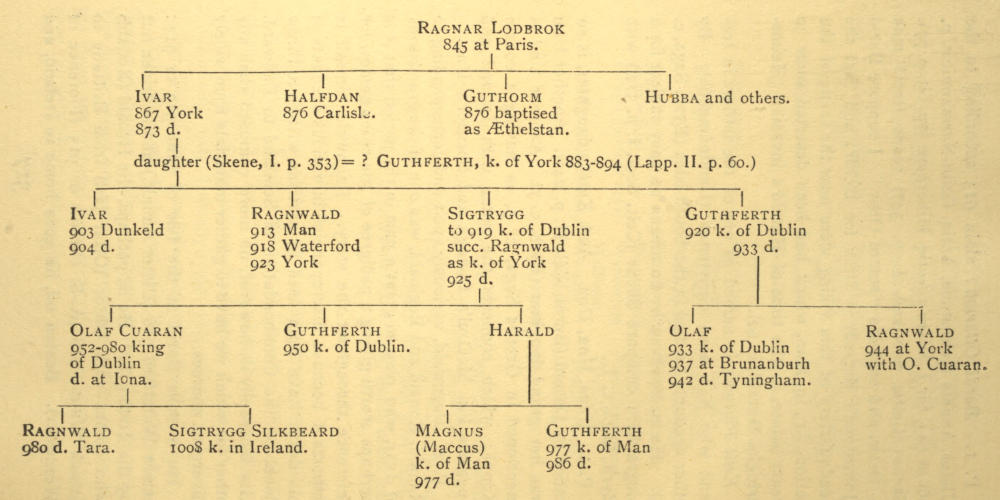
He attacks Barid at the Isle of Man 913 or 914: seizes Waterford 916 (Ulster Annals,) and is driven out by the Irish 918. He is, perhaps, the Hroald (Ronald) who comes with Ohtor (Ottar jarl) from Brittany to attack Wales, 918 (A.-S. chron.) or 915 (Florence of Worcester). Beaten off, he goes home to Ireland, and hence with Ottar and Osulf Cracabam or Cracaban, (“Kraki’s bane”?) he attacks Scotland:—Symeon of Durham (Ed. Hodgson Hinde, p. 63,) says he ravaged “Dunbline” in 912; the anonymous history of St. Cuthbert (op. cit. p. 147,) makes him conquer the Scots at “Corebricge”; the Ulster Annals give him an important victory, in 917 (Ed. Johnstone,) or 918 (Ed. Skene, “Chronicles of the Picts and Scots”;) the Pictish Chronicle (same vol. p. 9,) makes the battle at “Tinemore,” and Ragnwald beaten; the “wars of the Gaedhil and Gaill” kill him off, along with Ottar; others let him escape. Skene tries to reconcile these accounts (Celtic Scotland, I. pp. 347, 348,) but refuses to make a similar attempt for the rest of the story.
Leaving Scotland he invades Bernicia and then Deira; and takes York, 923 (A.-S. Chron.) or 919 (Symeon, corrected and confirmed by Hodgson Hinde, preface p. lii). The Saxon Chronicle says he was one of the kings who commended themselves to Eadward, 924; but the Ulster Annals make him die in 920 (Johnstone,) or 921 (Skene). Skene suggests (Celt. Scot. I. p. 350,) that Florence ante-dates the Commendation to get Ragnwald in; Canon Raine (York, p. 37,) adopts the Saxon Chronicle date, but identifies this Ragnwald with Olaf Cuaran’s ally 20 years later (R. Guthferthson, see pedigree,) and accounts for his absence by an invasion of France (on the suggestion of Lappenberg, following Frodoard).
In all this, real events seem to be reported by totally independent chroniclers, each with his own partisan bias, and different system of chronology. But one does not invalidate the other. Ragnwald may well have won York, attended the Commendation, left York to his brother Sigtrygg, invaded France and died within a short time; though whether this was 919-921 or 923-925 may be left an open question.
P. 4. Norse house, see Dasent’s preface to Burnt Njál. It may be said here that the dress, manners, &c., of the story are based on sagas or archæological evidence, compared with Lake District characteristics, which it would be tedious to point out in every instance: as for example—
P. 5. Chats, twigs. Long logs: there is a story told of Coniston Hall, and elsewhere, that when such a log had been three days burning, whoop! out flew an owl.
P. 11. Toy boats of chip. “Harald (afterwards Hardradi) was sailing chips on the water. Olaf asked him what they were; he said they were his war-ships.” (St. Olaf’s saga).
P. 13. White linen sark. Anderson (Scotland in Pagan times: Iron Age, p. 30) shows linen smoothers of glass, used in getting up vikings’ shirts.
P. 18. Howe; Eyrb. 38, and Magnússon’s Note, p. 277. The path is through the wood over the railway station.
P. 20. Arnold’s-by, Arnolby (temp. Ed. I.) Arnaby.
P. 21. Sigurd’s hörg Sigarith-erge (temp. Ric. I.) Sizergh.
Donal: Duvenaldus filius Ede rex eligitur (Pictish Chronicle) i.e., Domhnaill or Donal mac Aedh, brother of Constantine; reigned over Strathclyde and Cumbria about 908-925.
Cartmel, given by Ecgfrith to St. Cuthbert 677, “with the Britons on it.”
Halfdan. A coin of “Halfdan Rex” found at Castlehead, Grange, suggests that his conquest was widespread.
P. 22. Ketel, supposed founder of Kelswick on the Solway.
Dundraw (cf. Dunderrow, Ireland,) “hill of oaks.”
P. 23. Sigtrygg; see pedigree. In the English form Sihtric. “919. Sigtrygg m’ Ivar by the Divine power was forced to leave Dublin” (Ulster Annals); he came to Deira, and succeeded Ragnwald at York.
P. 24. Manchester taken by Eadward 923 (A.-S. Chron.)
P. 25. Bakewell. Eadward “went into Peakland to Bakecanwell and commanded a town to be built nigh thereunto, and manned. And then chose him to father and to lord the Scots king and all the Scots’ people, and Rægnald, and Eadulf’s son, and all those who dwell in Northumbria as well English as Danes, and Northmen, and others, and eke the Strathclyde Welshmen’s king and all the Strathclyde Welsh” (A.-S. Chron. 924; Florence, 921). As Freeman (Norman Conquest, I. p. 578) points out, it is not said that the Commendation took place at Bakewell; but the text suggests it, enough at least for the purpose of a story. Sigtrygg is not named, but implied among the Danes. The mention of Northmen, as distinguished from Danes, indicates that Norse vikings were already settled in what is now the North of England, and such a settlement could hardly have been any other than ours on Solway and Morecambe Bay.
P. 30. Death of Eadward, 924 or 925 (A.-S. Chron., &c.)
P. 31. Pennington: the Castle hill is described by Mr. H. Swainson Cowper (Ancient Settlements, &c., of Furness, Archæologia, Vol. LIII.) The name shows it to be Anglian, the settlement of the family of Pæninga, Penning, Penny, and therefore pre-Norse. Swarthmoor is so named before Martin Schwartz, though the origin of the name is only a guess.
P. 37. Eathgita, Roger of Wendover, 925.
P. 41. Athelstan. William of Malmesbury describes him (II. 6). In this “saga” the Norse form is used instead of Æthelstan, as Sigtrygg for Sihtric, &c. Eadward, however, and Eadmund correspond to the Norse Jatvard, Jatmund.
P. 52. Donal, Donevaldus, d. 908, was the last king of Strathclyde claiming Roman descent (Skene, Celtic Scotland, I. p. 346.)
P. 53. City of Helvellyn, Wythburn. The cyclopean wall of this “wide-borran” is now partly submerged. One section of it is taken to be the remains of a circle by the Rev. S. Barber, “Beneath Helvellyn’s Shade.”
P. 55. Picts of Galloway, read “Gaels of Scotland,” if the view be taken that all Picts were Ivernian.
P. 55-60. Dacor, Dacre, so spelt (Bede, Ecc. Hist. IV. 32,) to disconnect the name from the false etymology D’Acre. The Rev. Canon Mathews and the Rev. W. S. Calverley, F.S.A., (Trans. C. & W. Antiq. Soc., Vol. XI. Art. 18,) are followed as to the origin of the Dacre stone. The place of meeting, Emont, is a well-known crux. The initial is from an original sketch, with the plait down the edge of the stone turned into the curve of the D. Prof. George Stephens (Northern Mythology, S. 13,) considers that the Hart symbolizes Christ. The dedication of the church points to Wilfrith as founder.
P. 59. Peaceful settlement of Northmen, see the Rev. T. Ellwood (Landnámabók, pp. iii, iv). The law of Athelstan is given in Wilkin’s Leges A.-S., quoted by Baines (Lancashire, I. p. 52).
P. 64. Signy and Sigmund, Völsunga Saga, 7.
P. 69. Anglo-cymric Score, Rev. T. Ellwood (Trans. Cumb. Assoc. VIII. p. 97.)
P. 72. Thingstead at Fellfoot, Thingvöllr on map, p. 50; described by Mr. H. S. Cowper (Trans. C. & W. Antiq. Soc., XI. p. 1).
Guthferth’s invasion: A.-S. Chron. and Wendover, 927; Skene, Celtic Scotland, I. p. 251. William of Malmesbury, II. 6, makes him G. Sigtryggson, but Guthferth O’Ivar was then king of Dublin (Ulster Annals).
P. 74. Olaf Cuaran’s marriage, Florence, 938. It may have been brought about by the invasion of Scotland mentioned under 931 in a fragment of Irish annals (Chron. P. & S. p. 407).
P. 76. Iceland Althing founded 929 or 930 (Landn.)
P. 79. Ravaging of Scotland, A.-S. Chron. and Wendover, 933; Florence, 934.
P. 92. Heathwaite Settlement, described by Mr. H. S. Cowper (Ancient Settlements, &c., of Furness). He does not, however, accept the beehive hut, which I think I see in one of the cairns: nor is he responsible for the notion that the place was inhabited in the 10th century. The legend—though legends are not evidence—suggests that it was inhabited down to times of which local memory takes notice, i.e., to the colonization of the neighbourhood by the ancestors of present inhabitants. And the fell-folk of Heathwaite could not have been kin to their neighbours in the dales, or they would not have been looked on as giants. The Rev. F. Evans, of Ulverston, found calcined bones in the “Giant’s Grave,” from which Dr. Barber (Furness and Cartmel Notes, p. 35,) thinks that it was a Viking interment. And yet there must have been Gaels, as well as Cymry, in the district, especially in the wilder parts, as shewn by a few Gaelic names; and these Caledonian Gaels seem to have been distinguished by their tallness and their red hair, like Ironhook in Kingsley’s “Hereward.”
P. 112. The Brough, Borch, Borg, at Broughton, possibly an early fortress.
P. 113. Confederation of Dublin Danes, Scots and Cumbrians, 937, leading up to Brunanburh.
P. 119. Armboth Settlement has been previously mentioned by Mr. W. Wilson (Trans. Cumb. and West. Assoc., IX. p. 62). These rectangular buildings, similar to others in the district, generally near Roman roads, connected with cairns, and in this case with a British fort; certainly not sheep-folds nor peat-sheds, seem to be post-Roman, and may have been inhabited at this time by “poor-folk,” Armings; whence perhaps the name Armboth.
P. 126. Domhnaill, so spelt to distinguish him from previous Donals, is called by Roger of Wendover Dummail, and in local tradition Dunmail. The legend is that he loved a “fairy” in the Thirlmere valley; exchanged his torque for her ring; deserted her for a beautiful captive; and was led to destruction by her vengeance. He was, historically, king from about 937 to 945 or 946, when Eadmund defeated him and put out his sons’ eyes (Wendover, 946). He seems to have regained some portion of his power, perhaps as sub-king to Malcolm or leader of Gall-gaedhil in Demetia (Pembrokeshire.) He may be the Donvald, father of Andarch in 971 (Skene, Celt. Scot. I. p. 367) and the Dufnall of Florence (corruptly Dusual in Wendover) who was one of the Celtic kings at Chester in 973. St. Cadroe visited him before his fall (Vita St. C. in Chron. Picts and Scots, p. 116,) and he died on pilgrimage to Rome 975 (Ulster Annals, and Annals of Tighernac).
P. 127. Mineralogy of Cockrigg gill. Of the Armboth and Helvellyn dyke, Mr. Clifton Ward (Geol. of the Northern Lakes, p. 34) says: “In a dull red felspathic base are numerous crystals of pink felspar and quartz, together with sparsely scattered green mica, and some of the same soft, steatitic-looking mineral as in the St. John’s quartz felsite.” He mentions (p. 103) how this dyke creates “doors” or chasms.
P. 131. The mysterious fire, immense and yet unconsuming, is one of the forms of the well-known Dalehead “Boggle”; like other such appearances, a piece of widespread folklore, localized at this point, which is rich in ghosts.
P. 141. Birches. Where heather is, birches grew, and the roots are visible. The rolling forms of Kirkfell etc., are remarkable from Ullscarf, as are the monstrous shapes of boulders and hummocks near Bleatarn. But the blue railings of the Manchester Corporation boundary discount the romance, unless you get very tired and hungry, and meet a thunderstorm.
P. 162. Fox and Geese. I have taken some liberty with the pieces in the picture. The “fox-game” was played with 12 lambs and a fox (Magnússon’s Note to Grettis Saga, 70). The pieces were, however, carved as animals: see figures in Du Chaillu’s Viking Age, II. p. 354, and elsewhere.
P. 183. Orkney dynasty: Orkneyinga Saga. I.
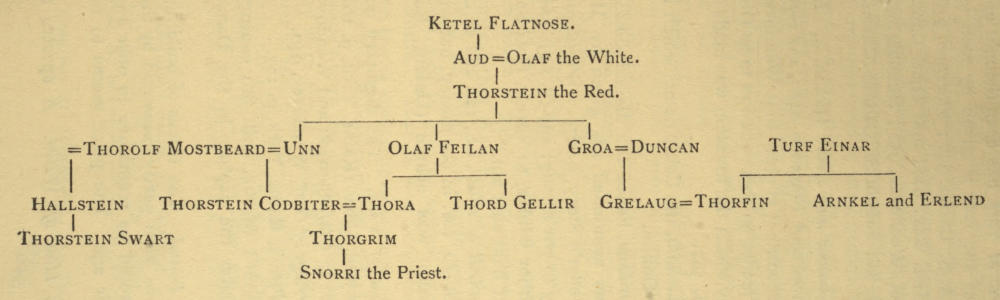
P. 184. Thora’s connections: Combining the above with Eyrb. (Magnússon’s Genealogy,) we get the pedigree opposite.
P. 186. Hakon the good. For his life and character see Heimskringla, Hakon, 6, 11, 15-18, 32.
P. 191. Bishop Aelfheah or Elphege the Bald, a relative of Dunstan, bishop of Winchester 935-951 (Florence). Roger of Wendover gives legendary details.
P. 192. Eric at York has been thought unhistorical; but mention of the fact is given by such independent witnesses as A.-S. Chron. 948; Florence, 949; Symeon of Durham, Hist. Reg. 948; and Hist. Cont. sub. ann. 1072; Roger of Wendover, 950; Heimskringla, Hakon, 3; Egils Saga, 72; Life of St. Cadroe (Chron. P. and S. p. 116).
P. 214. Eadmund and Eric: Hakon, 4. Invasion of Olaf, A.-S. Chron. and Florence 941; and Symeon 940; from whose accounts it is clear that Wendover is wrong in making the leader on this occasion to be Olaf Cuaran. For the road by which the invasion was made see Skene, Celt. Scot. I. p. 361.
P. 216. Athacliath, the Celtic name, which Domhnaill would use, for Dublin.
P. 225. Doordoom, hence the dialect durdom, uproar. The regulations mentioned are given by Magnússon. Note to Eredweller’s Story, p. 275. Whittlegate, “knife-road,” free play to one’s knife; and (p. 243) addle w. “to earn board,” from ödhlaz, to earn. Hold up, to clear; cf. “das Wetter hellt sich auf.”
P. 230. Hundred of silver, i.e., 120 ells of cloth paid in silver; about £4 10s. in our money, but worth much more where coin was scarce (Dasent, Burnt Njál, Appendix).
P. 244. Abbot of York. The dignitary now called “Dean” was styled Abbas (Raine, York, p. 166).
P. 247. Death of Olaf, Symeon and Wendover, 941.
P. 249. Marriage of Olaf, Wendover, 940.
P. 252. St. Peter’s, Raine, York, p. 187.
P. 253. Aelberht’s minster, built 8th century after a fire; restored after the capture by the Danes (Raine, York, p. 148).
P. 260. Peel Island. The traces of building marked on the map have been partly excavated by the present writer, but it would be premature to offer any definite opinion on their age. The place seems to have been fortified.
P. 288. The Host of Weird. A spectre army, as described in the story, was seen on Helvellyn on the eve of the Battle of Marston Moor. On Midsummer Eve, 1735, and again on Midsummer Eve, 1737 and 1745, similar effects were seen on Souter Fell, to the immediate north of the Helvellyn range. In the last case some of the rebel forces were exercising on the Scotch coast, and it was explained by the Lonsdale Magazine that the movements of the troops had been reflected “by some transparent vapour similar to the fata morgana,” (Survey of the Lake District, Miss Harriet Martineau, in Whellan’s Cumberland and Westmorland). In our story, Eadmund’s advance on Threlkeld sufficiently accounts for the mirage.
P. 291. Eadmund, “with the aid of Leoling, king of South Wales, ravaged the whole of Cumberland and put out the eyes of the two sons of Dummail, king of that province. He then granted that kingdom to Malcolm, king of the Scots, to hold of himself, with a view to defend the northern parts of England from hostile invasions by sea and land,” Wendover, 946: the A.-S. chron. and Florence make it 945: Welsh annals give 944 and 946. All suggest that the whole business was a punitive expedition to clear the north-western coast of Viking settlers, and to provide against attack from that quarter in future. That it was unsuccessful is seen from the fact that a similar invasion was made 55 years later. In 924 the Northmen swore to Eadward; in 945 their settlements were the object of Eadmund’s attack; in 1000 they were again attacked by Ethelred. These are the points at which the Norse settlement of the Lake district comes into contact with general English history, and is corroborated by it. The third point is accepted by Mr. Freeman and others; the first two I think worth consideration.
P. 303. Eadmund’s death, St. Augustine’s Day, May 26, 946, at the hands of Leof the robber. In a saga, the hero must be avenged before the story comes to a close.
P. 304. Penalties of Wythburn, the bye-laws of an ancient parish parliament held at the Steading Stone: penalties for turning out too many sheep on the fell, allowing horses and cattle to stray, defiling the beck, &c. “A copy of this document is at present (1883) in the possession of Mr. Graves, ex-Mayor of Manchester,” (Mr. W. Wilson, Trans. C. & W. Assoc. IX. p. 64).
The Redheads. Throughout the Middle Ages the villages of High Furness were inhabited by clans, as in Scotland. Records show that in Henry VIII.’s time at Nibthwaite all were Redheads (West, Antiq. of Furness, Ed. 1822, p. 32).