Part 3 — CHAPTER XXXIV HOW TO MAKE FRIENDS WITH THE STARS
Reading edition

WHEN you used to recite about the cow jumping over the moon, you did not know that there were all sorts of animals and people up among the stars near the moon, and, while they may never have followed the example of the cow in the nursery rhyme, probably they often feel as though they would enjoy doing so. But these starry people and their pets are very well behaved, and so far they have been perfectly content to remain exactly where they were placed hundreds of years ago.
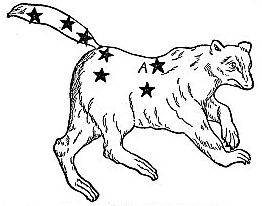
Fig. 616.—Ursa Major, the Great Bear.
There is one animal in particular with which you must make friends—a bear, an immense creature called
Ursa Major.
Never could an earthly bear have such a tail as you see in Fig. 616. However, the Great Bear is very different from the ordinary bear, and needs the big, bushy tail for three bright stars. Four more equally bright stars are on the creature’s side. Trace the big bear on cardboard, and be sure to get the stars in the right places. Cut out the pasteboard bear, and with a large, coarse pin or needle pierce a hole in the centre of each star; then hold the bear up to the light, as the little girl holds the lion in Fig. 617. Look through the bear and you will see seven tiny, twinkling stars forming a dipper. Pretend you have stretched a string from star to star, and what you will see will resemble Fig. 618. Look again and if the dipper is not distinct, make the holes in the centres of the stars larger.
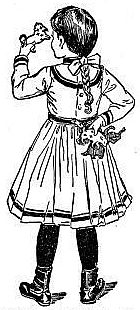
Fig. 617.—Making friends with the stars.
After you have learned precisely how Ursa Major looks with its starry dipper, and can see it even with your eyes closed, peep out into the night and try to find your friend up in the real sky. The bear is there, but you must recognize it by the dipper, for of course you cannot really see the animal itself. When you find the dipper you will know that the Great Bear is in the sky looking down upon you. You can see the big bear during the early evening hours of March, April, May, June and July.
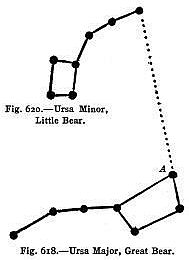
Fig. 619 gives another bear, a little one, whose name is
Ursa Minor;
he also has a long tail spangled with stars and four more stars on the side of his body which form a little dipper; the three stars on the tail make the handle. Though the bear is small, he is very important because of the large star on the end of his tail, which you must call the Pole star. This star shines out to show which direction is north when one gets lost or confused about his way. The Pole star may always be depended upon as a guide, and sailors look for it to help them find their course through the waters.
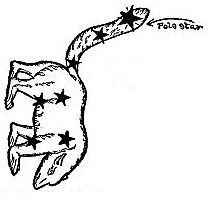
Fig. 619.—Ursa Minor, Little Bear.
Ursa Minor is turned in an opposite direction and position from the Great Bear, and the pose makes it easy for us to find the Pole star, because when we once trace out the stars of the Great Bear in the real sky we will see that the two outermost stars of the four which form its bowl, point to the Pole star. We can pretend that we have tied a string on the star in the outside top end of the Big Dipper (Figs. 616 and 618 A), and that we are stretching that string out from the Dipper star in a direct line; then we can tie the string on the Pole star in the end of the Little Bear’s tail, as shown in Figs. 618 and 620, where the dotted line represents a string.
Trace on cardboard and cut out Ursa Minor, punch holes through the stars and hold the little fellow up to the light, head down. The Little Bear, too, is visible shining not far from the Big Bear during the same months.
There is
A Fairy Tale
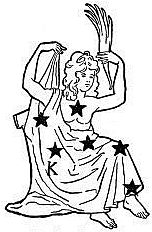
Fig. 621.—Cassiopeia.
about the starry bears. The story tells us that a long time ago these animals were not bears and did not live among the stars. The Great Bear was a gentle lady, and the Little Bear her son. The poor mother and son were turned into bears by the goddess Juno, and their friend Jupiter had not enough power to disenchant them and restore to them their human forms. So he did what he thought was next best; he placed the two bears, mother and son, up in the sky among the stars, where they remain to this day.
Fig. 621 is
Cassiopeia

Fig. 622.—Cassiopeia.
In the sky all of her stars are brilliant, except the one marked K. This is a shy little twinkler and appears rather faint at times; but in the Autumn when you hunt for Cassiopeia, you will be able to see the star K, if your eyes are bright. This lady with uplifted arms is the wife of a king. Trace her and cut her out, punch holes through the centres of the seven stars, then catch hold of the sweeping train of the queen’s dress and hold her up to the light, when the pinholes will look like Fig. 622, reminding one of a chair turned upside down, with its feet toward the queen’s head and its back down toward her feet. You will be delighted with this constellation, for it is very beautiful, and you may find Cassiopeia any night of August, September, October, November, December, January and February, as she is always then visible after dark.
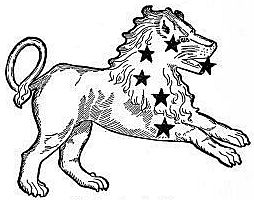
Fig. 623.—Leo, the Lion.
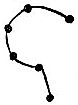
Fig. 624.—Leo, the Lion.
Now we will make the king of beasts,
Leo, the Lion,
for he is very fine-looking with his starry mane and a star almost in his mouth (Fig. 623). Trace the lion carefully, name him Leo, and cut him out; pierce holes through the stars and hold the figure up to the light. The little girl in Fig. 617 is enjoying her Leo very much. Notice how earnestly she peers through the holes, for she is determined to know the constellation. When you look through the pinholes of Leo, you will find that the constellation resembles a sickle, as in Fig. 624. The lion is in plain sight during February, March, April, May and June, so you have a long time to make friends with him.
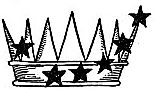
Fig. 625.—The Northern Crown.
During the Spring you can see all the constellations we have made, and also the beautiful starry
Northern Crown

Fig. 626.—The Northern Crown.
(Fig. 625), shining in a brilliant half circle as shown in Fig. 626. The gems of stars in the crown sparkle and shine for us during April, May, June, July, August, September and October.
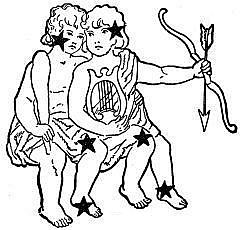
Fig. 627.—Gemini, the Twins.
The little twin brothers,
Castor and Pollux,
sons of Jupiter; always sit together up among the stars. The constellation is called Gemini (Fig. 627). When stars are clustered together, we say the group is a constellation. All of the starry people and animals are only different constellations. In this group each boy has a star on his head, a star on one knee and a star on one foot, which makes six stars. Trace the twins on cardboard, cut them out together in one piece and punch a hole through the centre of each star. Hold the constellation up to the light, and the group of wee, sparkling stars seen through the pinholes will resemble Fig. 628. Look for the twins during the months of December, January, February, March, April and May, and remember you must find the group of stars like Fig. 628.
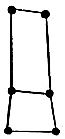
Fig. 628.—Gemini, the Twins.

Fig. 629.—Orion, the Giant.
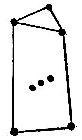
Fig. 630.—Orion, the Giant.
Winter will bring
Orion
(Fig. 629). He appears in November and remains where we can see him through December, January, February and March. Orion is one of the most brilliant of constellations. The strenuous hunter has but one visible foot, the other being hidden by his pet hare seated in front of it; so we are obliged to make the star, man with one foot. The fairy tale says that he was a giant and the mightiest hunter ever known. There is a star on each of his shoulders and one on his cheek, forming a triangle; then there is another star down on his left foot and one on his right knee. Trace the mighty hunter and cut him out as you did the other constellations. Draw a line from star to star and, after adding the three stars which form Orion’s belt, pierce holes in all, look through them (Fig. 630) and make friends with the harmless, starry giant. Fig. 631 is
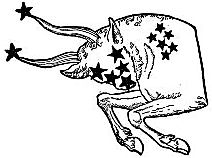
Fig. 631.—Taurus, the Bull.
Taurus,
a very lively-looking bull for one so aged; possibly the stars, being bright and cheery, keep the milk-white creature from growing old. Only a portion of the bull can be seen; other stars hide the remainder. Taurus must be greatly dazzled by the stars, for there is actually one in each of his eyes, the two forming the ends of the V-shaped group of stars across his face. The tip of each horn is decked with a glorious star, while on the Bull’s neck is a cluster of stars called the Pleiades. These stars were in all seven beautiful sisters, daughters of the giant Atlas; but one star daughter married a mortal and lost her brightness for doing so; consequently you can now see but six star sisters.
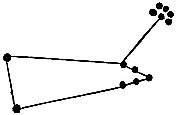
Fig. 632.—Taurus, the Bull.
In Fig. 632 you will find the constellation of Taurus as it looks when seen through the pinholes in the stars of the Bull, and also as the constellation appears in the sky on a clear night during November, December, January, February and March.