REPTILES. (continued 2)
Reading edition
The only specimen in Mr. Darwin’s collection is in so bad a condition, that it is impossible to say with any certainty what is its natural colour. It is brown 44above, with a lighter band across the head between the eyes, and there are traces of a longitudinal line down the back; the limbs are banded with brown and brownish yellow; the under parts are pale, dotted with brown.
DIMENSIONS.
Inches. Lines.
Length of the head 0 5
of the body 1 0
of the anterior extremities 1 0
of the posterior extremities 2 1
Found by Mr. Darwin at Valdivia.
Genus—HYLORINA. Bell.
Caput subrotundum planum. Linguæ magnâ circularis, posticè libera. Dentes palatini in lineâ transversâ, parum interruptâ, dispositi. Tympanum distinctum. Digiti subdepressi, ad apicem obtusi, haud expansi; anteriores ferè liberi; posteriores ad basin membranâ connexi, et marginati. Femora multò glandulosa.
A genus nearly allied to Hylodes, from which, however, it may at once be distinguished by the palmure of the hinder toes—which in Hylodes are entirely free—and by the absence of even the slightest dilatation of their extremities; offering another example of an osculant form between the Hylidæ and the Ranidæ.
Hylorina sylvatica. Mihi.
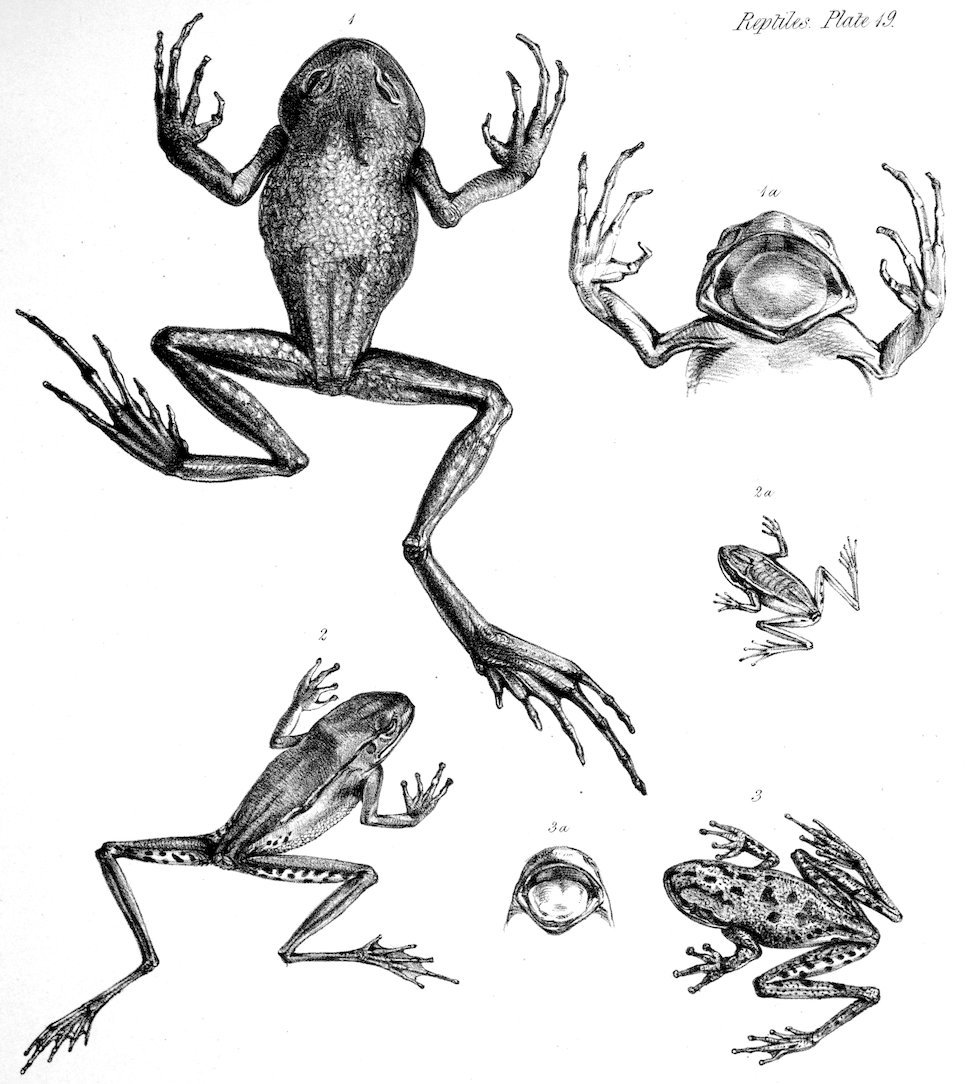
Plate XIX.—Fig. 1.
Description.—Head broad, rounded, the anterior margin, from the nose to the lip, nearly perpendicular. Eyes large and prominent. Tympanum distinct, small, round. Tongue very large, circular, and entire, the posterior half free. Palatine teeth placed in a transverse line between the posterior nostrils, scarcely interrupted in the middle. Skin of the back rugose. Anterior feet with the toes long, rather slender, united at the base only by a very short membrane, with round subarticular tubercles, the apex rounded, but not presenting the slightest expansion. Hinder toes similarly formed, but with the connecting membrane more conspicuous, and extending along the sides of the toes nearly to the extremity. Thighs covered on the under and posterior surface with rather large and distinct glands.
Reptiles. Plate 19.
Drawn from Nature on stone by B. Waterhouse Hawkins. C. Hullmandel Imp.
1. 1a. Hylorina syvatica.
2. 2a. Hyla agrestis.
3. 3a. Vauterii.
45The following is the description of the colouring, as given by Mr. Darwin from the living specimen. “Above fine grass green, mottled all over with copper colour, which nearly forms two longitudinal bands; beneath entirely of a lurid reddish lead colour. Iris brown.”
DIMENSIONS.
Inches. Lines.
Length of the head 1 0
of the body 1 8
of the anterior extremities 2 1
of the posterior extremities 4 4
Found by Mr. Darwin in the Archipelago of Chonos (S. of Chiloe) in thick forests.
Genus—HYLA. Hyla Vauterii. Bibr.
Plate XIX. Fig. 2.
Linguæ subcordiformi, posticè emarginatâ. Dentibus palatinis in fasciculis binis ovalilibus, subcontiguis. Oculis prominentibus. Capite tam lato quam longo. Gulâ bi-plicatâ; suprà levitèr—infrà multùm granulosâ. Dorso fusco-griseo, punctis, maculis et fasciis lateralibus nigris.
Hyla Vauterii. Bibr. MS.
Description.—Head short, thick, the sides anteriorly converging towards a nearly right angle, the muzzle rounded. Tongue nearly cordate, posteriorly emarginate, free for about one-fourth of its length. Palatine teeth in two oval fasciculi, placed nearly transversely between the posterior nares, and almost contiguous. Eyes prominent. Tympanum circular, rather large. Body plump, the sides nearly parallel for two-thirds of its length. The skin nearly smooth, but covered with very small inconspicuous granulations over the whole upper surface, which are rather more obvious on the head. The throat, the belly, and the inferior surface of the thighs covered with large prominent granulations. Beneath the lower jaw the granulations are smaller, and the under surface of the limbs excepting the thighs is quite smooth. A small fold of skin over the tympanum passes backwards to the arm; and beneath the throat there are two considerable transverse folds, one of which is before and the other immediately behind the arms. Fore feet, with the palms covered with small granular tubercles, and a tubercle under the joints of the fingers, which are connected to about one-third of their length. Hinder legs longer than the head and body by the whole foot and tarsus. The soles tuberculated. Toes rather short, palmate to half their length.
Colour.—The whole of the upper parts are greyish brown, with a tinge of red, and minutely punctured with black. There are scattered spots of the latter colour on the back and sides, assuming somewhat of a longitudinal arrangement, and a broad blackish grey fascia extends 46from the eye backwards to the arm, including the tympanum, and this fascia is bordered beneath by a white line. The thighs and legs are barred and spotted with black. The under parts are yellowish white, excepting under the lower jaw, where it is finely mottled with black and white.
I received the name of this species from Mons. Bibron, who had, I believe, applied it to specimens in the Paris Museum. It was taken by Mr. Darwin at Maldonado, lurking under a stone, and at Rio Janeiro on palm-trees.
DIMENSIONS.
Inches. Lines.
Length of the head and body 1 6
of anterior extremities 0 9
of posterior extremities 2 5
Hyla agrestis. Mihi.
Capite brevi. Oculis subprominentibus. Tympano mediocri circulari. Lingua subrotundâ, posticè libera, anticè angustatâ. Dentibus palatinis in fasciculis binis, paulò separatis, ad marginem postico-interiorem narium posteriorum. Dorso granuloso. Gulâ plicatâ. Digitis anticis ad basin tantùm, posticis usque ad phalanges penultimas palmatis. Suprà viridis, lineâ albâ laterali, femoribus posticè atque lateribus abdominis, albis, nigro-maculatis.
Habitat, Maldonado, in grassy fields.
Description.—Head short, thick, the two sides of the muzzle approaching each other at a rather acute angle, rounded at the extremity. Eyes rather large and prominent. Tympanum circular, of moderate size, and very distinct. Tongue entire, rounded, and free behind, narrowed, and almost angular in front. Palatine teeth in two oval parcels separated by a very small interval, and placed on a line with the hinder margin of the posterior nares; the whole of the back covered with extremely small granules; a slight fold or elevation of the skin commencing above the posterior margin of the tympanum, and extending backwards just above the arm, in front of which it is met by a more considerable one which crosses the throat from side to side; the under parts covered with large granules; fore feet with the toes palmated only at the base; hinder ones palmated to four-fifths of the length.
The colour of this beautiful species is thus given by Mr. Darwin:—“Above emerald green, beneath white; a silvery white stripe bordered beneath with a very narrow black line, extends from the corner of the eye, along the side, to the 47thigh; a smaller one at the corner of the mouth; the posterior surface of the hinder legs and the flanks marked with black spots. Iris gold coloured; tympanum brown.”
DIMENSIONS.
Inches. Lines.
Length of the head and body 1 8
of the anterior extremities 1 0
of the posterior extremities 2 8
The young of this species, instead of the bright green colour of the upper parts, is of a delicate grey with small brown markings; and a lateral fascia of brown, bordered above and beneath with a white line, extends from the fore part of the head backwards, the upper white line nearly to the thigh, the inferior one to the shoulder. The black spots on the flanks and thighs are but just visible.
This species so nearly resembles the Hyla pulchella of Mons. Bibron, at least as far as his description enables me to ascertain its characters, that it was with some hesitation that I came to the conclusion that they are distinct. Exclusive, however, of the difference of colour, the back of the present species is granulated, and the throat still more distinctly so, whereas the other animal has the skin on the upper parts, as well as on the anterior part of the throat, quite smooth. The palatine teeth also appear to be somewhat differently arranged.
Mr. Darwin observes, that this species was found in numbers in the open grass plains, and likewise in swamps, about Maldonado, and that they can never ascend trees, as these are entirely wanting at the places frequented by the Hylæ.
Fam.—BUFONIDÆ. Genus—RHINODERMA. Bibr.
Lingua cordato-ovata, posticè libera et subemarginata. Dentes palatini nulli. Tympanum celatum. Glandæ parotideæ nullæ. Digiti breves, depressi; anteriores ad basin tantùm, posteriores ferè dimidio palmati. Rostrum cutis appendiculo filiformi instructum.
48
Rhinoderma Darwinii. Bibr.
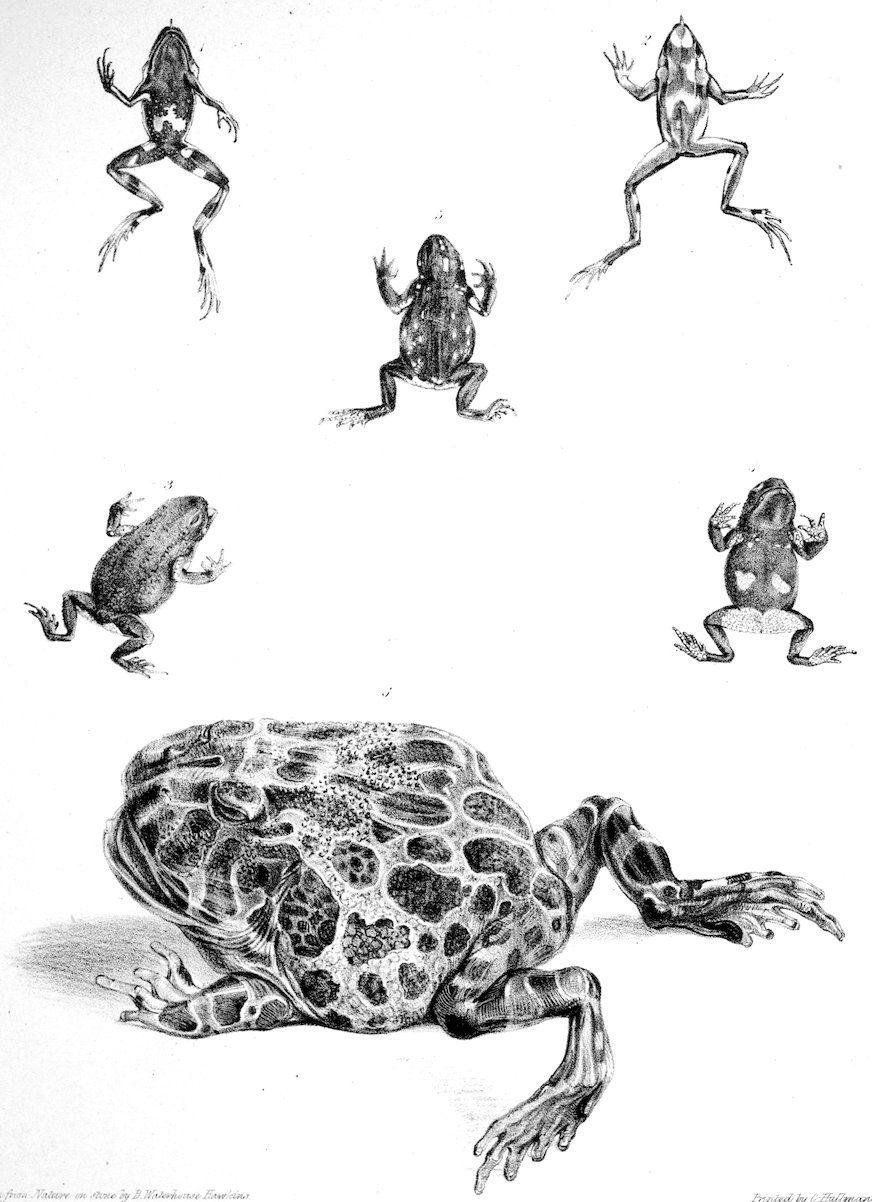
Plate XX.—Fig. 1, 2.
Suprà pallidè rufo-cinereum, fasciis transversis viridescentibus; subtus castaneonigrum, maculis albis.
Rhinoderma Darwinii. Bibr. Hist. Nat. Rept. VIII. p. 659. Var. Dorso fuscescenti-nigro.
Description.—The head and body are flattened, the head triangular, slightly truncated in front, but appearing angular from the skin being produced into a small filiform appendage, standing forwards from the extremity of the snout. The eyes are lateral, slightly prominent. Body very slender. Skin perfectly smooth, and without apparent glands, excepting on the thighs. Fore legs rather short, reaching quite to the thighs when placed by the side; the toes almost wholly separate, there being but the rudiment of a connecting membrane at their base. Hinder legs long, extending forwards beyond the head by the whole length of the foot; the hinder toes are connected nearly half their length, and the connecting membrane is thick and coloured like the rest of the skin.
Colour.—The colour varies greatly in different individuals. The following are the principal variations in the specimens collected by Mr. Darwin. Above pale iron rust-colour, with a transverse fascia across the head, a triangular one over the shoulders, a large broad mark on the loins, and the upper part of the thighs all of a bright beautiful green. The under side anteriorly rich chestnut-brown, passing into black posteriorly, with several irregular snow-white spots, particularly a broad one across the belly, and white bands across the legs. Another specimen was cream colour above, the markings darker, and with small spots of green. In one the chestnut colour beneath was replaced by bright yellow. There is one, constituting a very distinct variety, in which the upper part is wholly and almost uniformly dark brown. The female is greenish grey above, without conspicuous markings.
This is the only known species of the genus, which was founded by Mons. Bibron upon the specimens collected by Mr. Darwin. The general slightness and elegance of its form, and its slender proportions, would lead us to consider it at first sight as rather belonging to the Ranidæ than the Bufonidæ; but the total absence of teeth in the upper maxillary arch, shews that its proper place is in the latter group. Its form and the length of the posterior extremities would also prepare us to expect that it can leap freely, which Mr. Darwin states to be the fact. It inhabits thick and gloomy forests, and is excessively common in the forest of Valdivia.
DIMENSIONS.
Inches. Lines.
Length of the head and body 1 0
of the anterior extremities 0 5
of the posterior extremities 1 4
Reptiles. Plate 20.
Drawn from Nature on stone by B. Waterhouse Hawkins. Printed by C. Hullmandel.
1. 2. Rhinoderma Darwinii. Nat. Size.
3. 4. 5. Phryniscus nigricans.
6. Uperodon. ornatum.
49
Bufo Chilensis. Bibr.
Of this species, which has been described under different names by many naturalists, and the synonymy of which has only lately been cleared up by Mons. Bibron, there exist numerous specimens in the collection of Mr. Darwin, who found it at Buenos Ayres, and also in the Archipelago of Chonos, on the west coast of South America. It is certainly remarkable that the same species should be found on the opposite sides of the Continent; but on a careful examination I do not find any specific distinctions between the specimens from the different localities. The Prince de Wied has described it as found at Brazil, under the name of Bufo cinctus, and it is also well known as having been repeatedly procured in Peru and in Chile; but Mons. Bibron has in his work considered them all as belonging to but one species. The following account of its habits as given by Mr. Darwin is very curious and interesting:—“These Toads are exceedingly abundant all over the treeless damp mountains of granite, crawling about, and eating during the daytime, and making a noise similar to that which is commonly used in England to quicken horses. Many of them on being touched close their eyes, arch their back, and draw up their legs (as if the spinal marrow was divided), probably as an artifice. They are remarkable from their curious manner of running like the Natter Jack of England; they scarcely ever jump, neither do they crawl like a toad, but run very quickly. Their bright colours give them a very strange appearance. They abound at an elevation of 500 to 2500 feet.”
Genus—PHRYNISCUS. Phryniscus nigricans. Weigm.
Plate XX.—Fig. 3, 4, 5.
Dorso granuloso, scabriusculo. Pedibus posticis subpalmatis. Corpore membrisque nigris, abdomine maculâ magnâ transversâ ad partem posteriorem et maculâ rotunda utrinque medium versus, palmis atque plantis, omnibus coccineis.
Phryniscus nigricans. Weigm. Nov. Act. Leop. XVII. p. 264. Bibr. Hist. Rept. VIII. p. 723.
Chaunus formosus. Tschudi Classif. Batrach.
Habitat, Maldonado and Bahia Blanca.
50This curious little species has been described by Weigman under the present name,—by Tschudi under the generic name of Chaunus, and fully by Bibron, who retained the name originally given to it by Weigman. It now remains only to correct, from Mr. Darwin’s notes, some points respecting the colours, which had been mis-stated in consequence of the action of the spirit in which the specimen had been preserved. The colour of this curious miniature representation of a Toad, is “ink black,” excepting the palms and soles of the feet, a large transverse spot across the posterior part of the abdomen, two smaller ones near the middle, and in some specimens a few scattered little spots, all of the most intense vermilion red. There is one specimen from Bahia Blanca which has also some small “buff-orange” spots on the upper part.[4] Mr. Darwin observes that “the appearance of the vermilion colour is as if the animal had crawled over a newly painted board;” and he adds—“This Toad inhabits the most dry and sandy plains of Bahia Blanca, where there is no appearance of water ever lodging.” The other specimens were taken at Maldonado, where it inhabits the sand-dunes near the coast. Mr. Darwin threw one into a pool of fresh-water, but he found it could hardly swim, and he thinks, if unassisted, it would have been soon drowned.
This species is diurnal in its habits, and may be daily seen under a scorching sun, crawling over the parched and loose sand. M. D’Orbigny brought specimens from Monte Video.
DIMENSIONS.
Inches. Lines.
Length of the head and body 1 0
of the anterior extremities 0 5
of the posterior extremities 0 8
Genus—UPERODON. Bibr. Uperodon Onatum. Mihi.
Plate XX.—Fig. 6.
Capite multò latiore quam longiore. Dorso olivaceo, maculis fuscis, albo marginatis.
Habitat Buenos Ayres.
Description.—Head more than half as broad again as it is long, and equal in breadth to half the entire length of the head and body. Muzzle rounded. Nostrils oval, opening upwards and a 51little outwards. Eyes rather large, the upper eyelids forming perfect flaps, which entirely cover the eyes. Body rounded, very broad. The shoulders and thighs wholly concealed by the skin of the body. Limbs very short. The anterior feet very broad. The toes somewhat depressed, very short, bordered with a fold of skin. Hinder feet with the toes more depressed and more distinctly bordered. Back covered with small glands.
Colour.—The colour of the upper surface is dark olive, becoming lighter at the sides, and having numerous dark brown spots, which are round, oval, elliptical, or irregular, of very various sizes, placed somewhat symmetrically, and each bordered with a whitish or yellow line. Beneath pale, excepting the throat, which is black.
I have ventured to consider this remarkable amphibian as specifically distinct from U. marmoratum of Bibron; a conclusion to which I have been almost imperatively led, by the fact of its inhabiting a different hemisphere from all known specimens of that species. The other was found by M. Leschenault in the interior of the peninsula of India: the specimen from which the present description is taken was obtained by Mr. Darwin at Buenos Ayres. Notwithstanding the similarity of the two species, which is so great as to have led Mons. Bibron to consider them as identical, I could not assent to such an anomaly as the existence of an animal, at once so rare and possessed of such limited powers of locomotion, in two regions so widely remote. I have not the opportunity of comparing the specimens of the former species with the present, but, even from Mons. Bibron’s description, I believe that I can discover sufficient discrepancies between the animals, to bear me out in the view I have taken. These discrepancies I venture to place in the following tabular view, and leave zoologists to form their own conclusions.
UPERODON MARMORATUM. UPERODON ORNATUM.
“La tête offre en arrière une largeur à peu près égale à son longueur totale, laquelle entre pour le quart environ dans l’étendue de l’animal.” Head fully half as broad again as it is long, and equal in breadth to half the total length of the animal.
“On pourrait considérer la peau comme étant parfaitement lisse, si l’on ne voyait éparses sur le dessus du tronc un certain nombre de verrues glanduleuses d’un assez grand diamètre relativement à la grosseur de l’animal, mais fort peu saillantes ou à peine convexes.” Back covered with numerous small glandular tubercles, notably elevated.
“Les parties supérieures de ce Batracien présentent sur un fond olivâtre, d’énormes taches brunes, toutes confluentes, ou s’anastomosant diversement.”[5] All the spots on the back are quite distinct, not in any way passing into each other or connected, and each encircled by a white line.
London:
Printed by Stewart and Murray,
Old Bailey.
TRANSCRIBER’S NOTES
Page Changed from Changed to
16 minutè granulato. Seriebus duabas squamarum supralabialium. Femorum facie minutè granulato. Seriebus duabus squamarum supralabialium. Femorum facie
Fixed typos; non-standard spelling and dialect retained.
Renumbered footnotes.
Corrected the issues mentioned in the Errata