"The Young Voyageurs" (continued 4)
Reading edition
“Shooting the canvass-backs is a source of profit to hundreds of gunners who live around the Chesapeake Bay, as these birds command a high price in the markets of the American cities. Disputes have arisen between the fowlers of different States around the Bay about the right of shooting upon it; and vessels full of armed men—ready to make war upon one another—have gone out on this account. But the government of these States succeeded in settling the matter peacefully, and to the satisfaction of all parties.”
The canoe at this moment shot round a bend, and a long smooth expanse of the river appeared before the eyes of our voyageurs. They could see that upon one side another stream ran in, with a very sluggish current; and around the mouth of this, and for a good stretch below it, there appeared a green sedge-like water-grass, or rushes. Near the border of this sedge, and in a part of it that was thin, a flock of wild fowl was diving and feeding. They were small, and evidently ducks; but the distance was yet too great for the boys to make out to what species they belonged. A single large swan—a trumpeter—was upon the water, between the shore and the ducks, and was gradually making towards the latter. François immediately loaded one of his barrels with swan, or rather “buck” shot, and Basil looked to his rifle. The ducks were not thought of—the trumpeter was to be the game. Lucien took out his telescope, and commenced observing the flock. They had not intended to use any precaution in approaching the birds, as they were not extremely anxious about getting a shot, and were permitting the canoe to glide gently towards them. An exclamation from Lucien, however, caused them to change their tactics. He directed them suddenly to “hold water” and stop the canoe, at the same time telling them that the birds ahead were the very sort about which they had been conversing—the “canvass-backs.” He had no doubt of it, judging from their colour, size, and peculiar movements.
The announcement produced a new excitement. All four were desirous not only of shooting, but of eating, a canvass-back; and arrangements were set about to effect the former. It was known to all that the canvass-backs are among the shyest of water-fowl, so much so that it is difficult to approach them unless under cover. While feeding, it is said, they keep sentinels on the look-out. Whether this be true or not, it is certain that they never all dive together, some always remaining above water, and apparently watching while the others are under. A plan to get near them was necessary, and one was suggested by Norman, which was to tie bushes around the sides of the canoe, so as to hide both the vessel and those in it. This plan was at once adopted—the canoe was paddled up to the bank—thick bushes were cut, and tied along the gunwale; and then our voyageurs climbed in, and laying themselves as low as possible, commenced paddling gently downward in the direction of the ducks. The rifles were laid aside, as they could be of little service with such game. François’ double-barrel was the arm upon which dependence was now placed; and François himself leaned forward in the bow in order to be ready, while the others attended to the guidance of the vessel. The buck-shot had been drawn out, and a smaller kind substituted. The swan was no longer cared for or even thought of.
In about a quarter of an hour’s time, the canoe, gliding silently along the edge of the sedge—which was the wild celery (Valisneria spiralis)—came near the place where the ducks were; and the boys, peeping through the leafy screen, could now see the birds plainly. They saw that they were not all canvass-backs, but that three distinct kinds of ducks were feeding together. One sort was the canvass-backs themselves, and a second kind very much resembled them, except that they were a size smaller. These were the “red-heads” or “pochards.” The third species was different from either. They had also heads of a reddish colour, but of a brighter red, and marked by a white band that ran from the root of the bill over the crown. This mark enabled Lucien at once to tell the species. They were widgeons (Anas Americana); but the most singular thing that was now observed by our voyageurs was the terms upon which these three kinds of birds lived with each other. It appeared that the widgeon obtained its food by a regular system of robbery and plunder perpetrated upon the community of the canvass-backs. The latter, as Lucien had said, feeds upon the roots of the valisneria; but for these it is obliged to dive to the depth of four or five feet, and also to spend some time at the bottom while plucking them up. Now the widgeon is as fond of the “celery” as the canvass-back, but the former is not a diver—in fact, never goes under water except when washing itself or in play, and it has therefore no means of procuring the desired roots. Mark, then, the plan that it takes to effect this end. Seated as near as is safe to the canvass-back, it waits until the latter makes his somersault and goes down. It (the widgeon) then darts forward so as to be sufficiently close, and, pausing again, scans the surface with eager eye. It can tell where the other is at work, as the blades of the plant at which it is tugging are seen to move above the water. These at length disappear, pulled down as the plant is dragged from its root, and almost at the same instant the canvass-back comes up holding the root between his mandibles. But the widgeon is ready for him. He has calculated the exact spot where the other will rise; and, before the latter can open his eyes or get them clear of the water, the widgeon darts forward, snatches the luscious morsel from his bill, and makes off with it. Conflicts sometimes ensue; but the widgeon, knowing himself to be the lesser and weaker bird, never stands to give battle, but secures his prize through his superior agility. On the other hand, the canvass-back rarely attempts to follow him, as he knows that the other is swifter upon the water than he. He only looks after his lost root with an air of chagrin, and then, reflecting that there is “plenty more where it came from,” kicks up its heels, and once more plunges to the bottom.
The red-head rarely interferes with either, as he is contented to feed upon the leaves and stalks, at all times floating in plenty upon the surface.
As the canoe glided near, those on board watched these curious manoeuvres of the birds with feelings of interest. They saw, moreover, that the “trumpeter” had arrived among them, and the ducks seemed to take no notice of him. Lucien was struck with something unusual in the appearance of the swan. Its plumage seemed ruffled and on end, and it glided along in a stiff and unnatural manner. It moved its neck neither to one side nor the other, but held its head bent forward, until its bill almost touched the water, in the attitude that these birds adopt when feeding upon something near the surface. Lucien said nothing to his companions, as they were all silent, lest they might frighten the ducks; but Basil and Norman had also remarked the strange look and conduct of the trumpeter. François’ eyes were bent only upon the ducks, and he did not heed the other.
As they came closer, first Lucien, and then Basil and Norman, saw something else that puzzled them. Whenever the swan approached any of the ducks, these were observed to disappear under the water. At first, the boys thought that they merely dived to get out of his way, but it was not exactly in the same manner as the others were diving for the roots. Moreover, none of those that went down in the neighbourhood of the swan were seen to come up again!
There was something very odd in all this, and the three boys, thinking so at the same time, were about to communicate their thoughts to one another, when the double crack of François’ gun drove the thing, for a moment, out of their heads; and they all looked over the bushes to see how many canvass-backs had been killed. Several were seen dead or fluttering along the surface; but no one counted them, for a strange, and even terrible, object now presented itself to the astonished senses of all. If the conduct of the swan had been odd before, it was now doubly so. Instead of flying off after the shot, as all expected it would do, it was now seen to dance and plunge about on the water, uttering loud screams, that resembled the human voice far more than any other sounds! Then it rose as if pitched into the air, and fell on its back some distance off; while in its place was seen a dark, round object moving through the water, as if making for the bank, and uttering, as it went, the same hideous human-like screams!
This dark object was no other than the poll of a human being; and the river shallowing towards the bank, it rose higher and higher above the water, until the boys could distinguish the glistening neck and naked shoulders of a red and brawny Indian! All was now explained. The Indian had been duck-hunting, and had used the stuffed skin of the swan as his disguise; and hence the puzzling motions of the bird. He had not noticed the canoe—concealed as it was—until the loud crack of François’ gun had startled him from his work. This, and the heads and white faces of the boys peeping over the bushes, had frightened him, even more than he had them. Perhaps they were the first white faces he had ever seen. But, whether or not, sadly frightened he was; for, on reaching the bank, he did not stop, but ran off into the woods, howling and yelling as if Old Nick had been after him: and no doubt he believed that such was the case.
The travellers picked up the swan-skin out of curiosity; and, in addition to the ducks which François had killed, they found nearly a score of these birds, which the Indian had dropped in his fright, and that had afterwards risen to the surface. These were strung together, and all had their necks broken.
After getting them aboard, the canoe was cleared of the bushes; and the paddles being once more called into service, the little craft shot down-stream like an arrow.
Chapter Twenty.
The Ducks of America.
Lucien now continued his “monograph” of the American ducks.
“There are,” said he, “more than two dozen species of ducks on the waters of North America. These the systematists have divided into no less than eighteen genera! Why it would be more easy to learn all that ever was known about all the ducks in creation, than to remember the eighteen generic names which these gentlemen have invented and put forward. Moreover, the habits of any two species of these ducks are more similar than those of any two kinds of dogs. Why then, I should ask—why this complication? It is true that the ducks do not resemble each other in every thing. Some species are fonder of water than others. Some feed entirely upon vegetable substances; others upon small fish, insects, crustacea, etcetera. Some live entirely in the sea; others make their home in the freshwater lakes and rivers, while many species dwell indifferently, either in salt or fresh waters. Some love the open wave; others the sedgy marsh; while one or two species roost upon trees, and build their nests in the hollow trunks. Notwithstanding all this, there is such a similarity in the appearance and habits of the different species, that I think the systematists have improved but little, if anything, upon the simple arrangement of the true naturalist Wilson, who—poor Scotch émigré as he was, with an empty purse and a loaded gun—has collected more original information about the birds of America than all that have followed him. He described the ducks of America under the single genus Anas; and, in my opinion, described them in a more intelligent and intelligible manner than any one has done since his time—not even excepting another great and true naturalist, whose career has been longer, more successful, and happier; and whose fame, in consequence of his better fortune, has become, perhaps, higher and more extended.
“The water-fowl of America,” continued Lucien—“I mean the swans, geese, and ducks, are of great importance in the fur countries where we are now travelling. At certain seasons of the year, in many parts, they furnish almost the only article of food that can be procured. They are all migratory—that is, when the lakes and rivers of these regions become frozen over in the winter they all migrate southward, but return again to breed and spend the summer. They do this, perhaps, because these wild territories afford them a better security during the season of incubation, and afterwards of moulting. It is not very certain, however, that this is the reason, and for my part I am inclined to think not, for there are also wild, uninhabited territories enough in southern latitudes, and yet they forsake these and migrate north in the spring. ‘Their arrival in the fur countries,’ writes a distinguished naturalist, ‘marks the commencement of spring, and diffuses as much joy among the wandering hunters of the Arctic regions, as the harvest or vintage excites in more genial climes.’ Both by the Indians and hunters in the employ of the Hudson’s Bay Company swans, geese, and ducks, are slaughtered by thousands, and are eaten not only when fresh killed, but they are salted in large quantities, and so preserved for winter use, when fresh ones can no longer be procured. Of course, both Indian and white hunters use all their art in killing or capturing them; and to effect this they employ many different methods, as decoying, snaring, netting, and shooting them: but Cousin Norman here could give a better description of all these things than I. Perhaps he will favour us with some account of them.”
“The Indians,” said the young trader, taking up the subject without hesitation, “usually snare them. Their most common way is to make a number of hedges or wattle fences projecting into the water at right angles to the edge of the lake, or, it may be, river. These fences are two or three yards apart, and between each two there is, of course, an opening, into which the birds swim, as they make towards the shore for their food. In these openings, then, the snares are set and tied so firmly to a post stuck in the bottom, that the birds, whether ducks, geese, or swans, when caught, may not be able to drag it away. To keep the snare in its place, it is secured to the wattles of the fence with tender strands of grass, that of course give way the moment the fowl becomes entangled. The snares are made out of deer sinews, twisted like packthread, and sometimes of thongs cut from a ‘parchment’ deerskin, which, as you know, is a deerskin simply dried, and not tanned or dressed. The making of the fences is the part that gives most trouble. Sometimes the timber for the stakes is not easily had; and even when it is plenty, it is no easy matter to drive the stakes into the bottom and wattle them, while seated in a vessel so crank as a birch canoe. Sometimes, in the rivers where the water-fowl most frequent, the current is swift, and adds to this trouble. Where the lakes and rivers are shallow, the thing becomes easier; and I have seen small lakes and rivers fenced in this way from shore to shore. In large lakes this would not be necessary, as most of the water-birds—such as the swans and geese—and all the ducks that are not of the diving kinds, are sure to come to the shore to feed, and are more likely to be taken close in to land than out in the open water.
“The Indians often snare these birds upon the nest, and they always wash their hands before setting the snare. They have a notion—I don’t know whether true or not—that if their hands are not clean, the birds can smell the snare, and will be shy of going into it. They say that all these birds—and I believe it’s true of all fowls that make their nests upon the ground—go into the nest at one side, and out at the opposite. The Indians knowing this, always set their snares at the side where the bird enters, and by this they are more sure of catching them, and also of getting them some hours sooner.
“Besides snaring the water-fowl,” continued Norman, “the Indians sometimes catch them in nets, and sometimes on hooks baited with whatever the birds are known to eat. They also shoot them as the white hunters do, and to get near enough use every sort of cunning that can be thought of. Sometimes they decoy them within shot, by putting wooden ducks on the water near their cover, where they themselves are stationed. Sometimes they disguise their canoes under brushwood, and paddle to the edge of the flock; and when the moulting season comes round, they pursue them through the water, and kill them with sticks. The swans, when followed in this way, often escape. With their strong wings and great webbed feet, they can flap faster over the surface than a canoe can follow them. I have heard of many other tricks which the Indians of different tribes make use of, but I have only seen these ways I have described, besides the one we have just witnessed.”
Norman was one of your practical philosophers, who did not choose to talk much of things with which he was not thoroughly acquainted.
Lucien now took up the thread of the conversation, and gave some further information about the different species of American ducks.
“One of the most celebrated,” said he, “is the ‘eider-duck’ (Anas mollissima). This is prized for its down, which is exceedingly soft and fine, and esteemed of great value for lining quilts and making beds for the over-luxurious. It is said that three pounds’ weight of ‘eider down’ can be compressed to the size of a man’s fist, and yet is afterwards so dilatable as to fill a quilt of five feet square. The down is generally obtained without killing the bird, for that which is plucked from dead birds is far inferior, and has lost much of its elasticity. The mode of procuring it is to steal it from the nest, in the absence of the birds. The female lines the nest with down plucked from her own breast. When this is stolen from her, by those who gather the commodity, she plucks out a second crop of it, and arranges it as before. This being also removed, it is said that the male bird then makes a sacrifice of his downy waistcoat, and the nest is once more put in order; but should this too be taken, the birds forsake their nest never to return to it again. The quantity of ‘eider down’ found in a single nest is sufficient to fill a man’s hat, and yet it will weigh only about three ounces.
“The eider-duck is about the size of the common mallard, or wild duck proper. Its colour is black below, and buff-white on the back, neck, and shoulders, while the forehead is bluish black. It is one of the ‘sea-ducks,’ or fuligulae, as the naturalists term them, and it is rarely seen in fresh water. Its food is principally the soft mollusca common in the Arctic seas, and its flesh is not esteemed except by the Greenlanders. It is at home only in the higher latitudes of both Continents, and loves to dwell upon the rocky shores of the sea; but in very severe winters, it makes its appearance along the Atlantic coast of the United States, where it receives different names from the gunners—such as ‘black-and-white coot,’ ‘big sea-duck,’ ‘shoal-duck,’ and ‘squaw-duck;’ and under these titles it is often sold in the markets of American cities. Some suppose that the eider-duck could be easily domesticated. If so, it would, no doubt, prove a profitable as well as an interesting experiment; but I believe it has already been attempted without success. It is in the countries of Northern Europe where the gathering of the eider down has been made an object of industry. On the American Continent the pursuit is not followed, either by the native or white settler.
“Another species common to the higher latitudes of both Continents is the ‘king-duck,’ so called from its very showy appearance. Its habits are very similar to the ‘eider,’ and its down is equally soft and valuable, but it is a smaller bird.
“A still smaller species, also noted for its brilliant plumage, inhabits the extreme north of both continents. This is the ‘harlequin-duck;’ or, as the early colonists term it, the ‘lord.’
“But the ‘wood-duck’ (Anas sponsa) is perhaps the most beautiful of all the American species, or indeed of all ducks whatever—although it has a rival in the mandarin duck of China, which indeed it very much resembles both in size and markings. The wood-duck is so called from the fact of its making its nest in hollow trees, and roosting occasionally on the branches. It is a freshwater duck, and a Southern species—never being seen in very high latitudes; nor is it known in Europe in a wild state, but is peculiar to the Continent of America. It is one of the easiest species to domesticate, and no zoological garden is now without it; in all of which its small size—being about that of a widgeon—its active movements and innocent look, its musical peet-peet, and, above all, its beautiful plumage, make it a general favourite.
“Besides these, there are many others of the American ducks, whose description would interest you, but you would grow tired were I to give a detailed account of them all; so I shall only mention a few that are distinguished by well-known peculiarities. There is the ‘whistler’ (Anas clangula), which takes its trivial name from the whistling sound of its wings while in flight; and the ‘shoveller,’ so called from the form of its bill; and the ‘conjuring,’ or ‘spirit’ ducks of the Indians (Anas vulgaris and albeola), because they dive so quickly and dexterously, that it is almost impossible to shoot them either with bow or gun. There is the ‘old wife,’ or ‘old squaw’ (Anas glacialis), so called from its incessant cackle, which the hunters liken to the scolding of an ill-tempered old wife. This species is the most noisy of all the duck tribe, and is called by the voyageurs ‘caccawee,’ from its fancied utterance of these syllables; and the sound, so often heard in the long nights of the fur countries, has been woven into and forms the burden of many a voyageur’s song. In some parts of the United States the caccawee is called ‘south-southerly,’ as its voice is there thought to resemble this phrase, while at the time when most heard—the autumn—these ducks are observed flying in a southerly direction.
“Besides these,” continued Lucien, “there are the teals—blue and green-winged—and the coots, and the widgeon—slightly differing from the widgeon of Europe—and there is the rare and beautiful little ruddy duck (Anas rubida), with its bright mahogany colour—its long upright tail and short neck—that at a distance give it the appearance of a duck with two heads. And there is the well-known ‘pintail,’ and the ‘pochard’ or ‘red-head;’ and the ‘mallard,’ from which comes the common domestic variety, and the ‘scoter,’ and ‘surf,’ and ‘velvet,’ and ‘dusky,’ ducks—these last four being all, more or less, of a dark colour. And there are the ‘shell-drakes,’ or ‘fishers,’ that swim low in the water, dive and fly well, but walk badly, and feed altogether on fish. These, on account of their toothed bills, form a genus of themselves—the ‘mergansers,’—and four distinct species of them are known in America.”
The approach of night, and the necessity of landing, to make their night camp, brought Lucien’s lecture to a close. Indeed François was glad when it ended, for he was beginning to think it somewhat tedious.
Chapter Twenty One.
The Shrike and the Humming-Birds.
The picturesque scenery of the Elk appeared to be a favourite resort with the feathered creation. Here our voyageurs saw many kinds of birds; both those that migrate into the fur countries during summer, and those that make their home there in the cold, dark days of winter. Among the former were observed,—the beautiful blue bird of Wilson (Sialia Wilsoni) which, on account of its gentle and innocent habits, is quite as much esteemed in America as the “robin” in England. Another favourite of the farmer and the homestead, the purple martin, was seen gracefully wheeling through the air; while, among the green leaves, fluttered many brilliant birds. The “cardinal grosbeak” (Pitylus cardinalis) with his bright scarlet wings; the blue jay, noisy and chattering; the rarer “crossbill” (Loxia) with its deep crimson colour; and many others, equally bright and beautiful, enlivened the woods, either with their voice or their gaudy plumage. There was one bird, however, that had neither “fine feathers” nor an agreeable voice, but that interested our travellers more than any of the others. Its voice was unpleasant to the ear, and sounded more like the grating of a rusty hinge than anything else they could think of. The bird itself was not larger than a thrush, of a light grey colour above, white underneath, and with blackish wings. Its bill resembled that of the hawks, but its legs were more like those of the woodpecker tribe; and it seemed, in fact, to be a cross between the two. It was neither the colour of the bird, nor its form, nor yet its song, that interested our travellers, but its singular habits; and these they had a fine opportunity of observing at one of their “noon camps,” where they had halted to rest and refresh themselves during the hot midday hours. The place was on one of the little islets, which was covered with underwood, with here and there some larger trees. The underwood bushes were of various sorts; but close to the spot where they had landed was a large thicket of honeysuckle, whose flowers were in full bloom, and filled the air with their sweet perfume.
While seated near these, François’ quick eye detected the presence of some very small birds moving among the blossoms. They were at once pronounced to be humming-birds, and of that species known as the “ruby-throats” (Trochilus rolubris), so called, because a flake of a beautiful vinous colour under the throat of the males exhibits, in the sun, all the glancing glories of the ruby. The back, or upper parts, are of a gilded green colour; and the little creature is the smallest bird that migrates into the fur countries, with one exception, and that is a bird of the same genus,—the “cinnamon humming-bird” (Trochilus rufus). The latter, however, has been seen in the Northern regions, only on the western side of the Rocky Mountains; but then it has been observed even as far north as the bleak and inhospitable shores of Nootka Sound. Mexico, and the tropical countries of America, are the favourite home of the humming-birds; and it was, for a long time, supposed that the “ruby-throats” were the only ones that migrated farther north than the territory of Mexico itself. It is now known, that besides the “cinnamon humming-bird,” two or three other species annually make an excursion into higher latitudes.
The “ruby-throats” not only travel into the fur countries, but breed in numbers upon the Elk River, the very place where our travellers now observed them.
As they sat watching these little creatures, for there were several of them skipping about and poising themselves opposite the flowers, the attention of all was attracted to the movements of a far different sort of bird. It was that one we have been speaking of. It was seated upon a tree, not far from the honeysuckles; but every now and then it would spring from its perch, dash forward, and after whirring about for some moments among the humming-birds, fly back to the same tree.
At first the boys watched these manoeuvres without having their curiosity excited. It was no new thing to see birds acting in this manner. The jays, and many other birds of the fly-catching kind (Muscicapae), have this habit, and nothing was thought of it at the moment. Lucien, however, who had watched the bird more narrowly, presently declared to the rest that it was catching the humming-birds, and preying upon them—that each time it made a dash among the honeysuckles, it carried off one in its claws, the smallness of the victim having prevented them at first from noticing this fact. They all now watched it more closely than before, and were soon satisfied of the truth of Lucien’s assertion, as they saw it seize one of the ruby-throats in the very act of entering the corolla of a flower. This excited the indignation of François, who immediately took up his “double-barrel,” and proceeded towards the tree where the bird, as before, had carried this last victim. The tree was a low one, of the locust or pseud-acacia family, and covered all over with great thorny spikes, like all trees of that tribe. François paid no attention to this; but, keeping under shelter of the underwood, he crept forward until within shot. Then raising his gun, he took aim, and pulling trigger, brought the bird fluttering down through the branches. He stepped forward and picked it up—not that he cared for such unworthy game, but Lucien had called to him to do so, as the naturalist wished to make an examination of the creature. He was about turning to go back to camp, when he chanced to glance his eye up into the locust-tree. There it was riveted by a sight which caused him to cry out with astonishment. His cry brought the rest running up to the spot, and they were not less astonished than he, when they saw the cause of it. I have said that the branches of the tree were covered with long thorny spikes that pointed in every direction; but one branch in particular occupied their attention. Upon this there were about a dozen of these spines pointing upward, and upon each spike was impaled a ruby-throat! The little creatures were dead, of course, but they were neither torn nor even much ruffled in their plumage. They were all placed back upwards, and as neatly spitted upon the thorns as if they had been put there by human hands. On looking more closely, it was discovered that other creatures, as well as the humming-birds, had been served in a similar manner. Several grasshoppers, spiders, and some coleopterous insects were found, and upon another branch two small meadow-mice (Arvicolae) had been treated to the same terrible death!
To Basil, Norman, and François, the thing was quite inexplicable, but Lucien understood well enough what it meant. All these creatures, he informed them, were placed there by the bird which François had shot, and which was no other than the “shrike” (Lanius) or “butcher-bird”—a name by which it is more familiarly known, and which it receives from the very habit they had just observed. Why it follows such a practice Lucien could not tell, as naturalists are not agreed upon this point. Some have asserted that it spits the spiders and other insects for the purpose of attracting nearer the small birds upon which it preys; but this cannot be true, for it preys mostly upon birds that are not insect-eaters, as the finches: besides, it is itself as fond of eating grasshoppers as anything else, and consumes large quantities of these insects. The most probable explanation of the singular and apparently cruel habit of the butcher-bird is, that it merely places its victims upon the thorns, in order to keep them safe from ground-ants, rats, mice, raccoons, foxes, and other preying creatures—just as a good cook would hang up her meat or game in the larder to prevent the cats from carrying it off. The thorny tree thus becomes the storehouse of the shrike, where he hangs up his superfluous spoil for future use, just as the crows, magpies, and jays, make their secret deposits in chinks of walls and the hollows of trees. It is no argument against this theory, that the shrike sometimes leaves these stores without returning to them. The fox, and dog, as well as many other preying creatures, have the same habit.
Wondering at what they had seen, the voyageurs returned to their camp, and once more embarked on their journey.
Chapter Twenty Two.
The Fish-Hawk.
A few days after, another incident occurred to our voyageurs, which illustrated the habits of a very interesting bird, the “osprey,” or fish-hawk, as it is more familiarly known in America.
The osprey (Falco halicetus) is a bird of the falcon tribe, and one of the largest of the genus—measuring two feet from bill to tail, with an immense spread of wing in proportion, being nearly six feet from tip to tip. It is of a dark-brown colour above, that colour peculiar to most of the hawk tribe, while its lower parts are ashy white. Its legs and bill are blue, and its eyes of a yellow orange. It is found in nearly all parts of America, where there are waters containing fish, for on these it exclusively feeds. It is more common on the sea-coast than in the interior, although it also frequents the large lakes, and lives in the central parts of the continent during summer, when these are no longer frozen over. It is not often seen upon muddy rivers, as there it would stand no chance of espying its victims in the water. It is a migratory bird, seeking the South in winter, and especially the shores of the Great Mexican Gulf, where large numbers are often seen fishing together. In the spring season these birds move to the northward, and make their appearance along the Atlantic coast of the continent, where they diffuse joy into the hearts of the fishermen—because the latter know, on seeing them, that they may soon expect the large shoals of herring, shad, and other fish, for which they have been anxiously looking out. So great favourites are they with the fishermen, that they would not knowingly kill an osprey for a boat-load of fish, but regard these bold fishing birds in the light of “professional brethren.” In this case the old adage that “two of a trade never agree” is clearly contradicted. The farmer often takes up his gun to fire at the osprey—mistaking it for the red-tailed buzzard (Buteo borealis) or some other hawk, several species of which at a distance it resembles—but, on discovering his mistake, brings down his piece without pulling trigger, and lets the osprey fly off unharmed. This singular conduct on the part of the farmer arises from his knowledge of the fact, that the osprey will not only not kill any of his ducks or hens, but that where he makes a settlement he will drive off from the premises all the hawks, buzzards, and kites, that would otherwise prey upon the poultry. With such protection, therefore, the osprey is one of the securest birds in America. He may breed in a tree over the farmer’s or fisherman’s door without the slightest danger of being disturbed in his incubation. I say his incubation; but the male takes no part in this domestic duty, further than to supply his loved mate with plenty of fish while she does the hatching business. Of course, thus protected, the osprey is not a rare bird. On the contrary, fish-hawks are more numerous than perhaps any other species of the hawk tribe. Twenty or thirty nests may be seen near each other in the same piece of woods, and as many as three hundred have been counted on one little island. The nests are built upon large trees—not always at the tops, as those of rooks, but often in forks within twenty feet of the ground. They are composed of large sticks, with stalks of corn, weeds, pieces of wet turf, and then lined plentifully with dry sea-grass, or any other grass that may be most convenient. The whole nest is big enough to make a load for a cart, and would be heavy enough to give any horse a good pull. It can be seen, when the woods are open, to an immense distance, and the more easily, as the tree upon which it is built is always a “dead wood,” and therefore without leaves to conceal it. Some say that the birds select a dead or decaying tree for their nest. It is more probable such is the effect, and not the cause, of their building upon a particular tree. It is more likely that the tree is killed partly by the mass of rubbish thus piled upon it, and partly by the nature of the substances, such as sea-weed in the nest, the oil of the fish, the excrement of the birds themselves, and the dead fish that have been dropped about the root, and suffered to remain there; for when the osprey lets fall his finny prey, which he often does, he never condescends to pick it up again, but goes in search of another. Boys “a-nesting” might easily discover the nest of the osprey; but were they inclined to despoil it of its three or four eggs (which are about the size of a duck’s, and blotched with Spanish brown), they would find that a less easy task, for the owners would be very likely to claw their eyes out, or else scratch the tender skin from their beardless cheeks: so that boys do not often trouble the nest of the osprey. A very curious anecdote is related of a negro having climbed up to plunder a nest of these birds. The negro’s head was covered with a close nap of his own black wool, which is supposed by a certain stretch of fancy to have the peculiarity of “growing in at both ends.” The negro, having no other protection than that which his thick fur afforded him, was assailed by both the owners of the nest, one of which, making a dash at the “darkie’s” head, struck his talons so firmly into the wool, that he was unable to extricate them, and there stuck fast, until the astonished plunderer had reached the foot of the tree. We shall not answer for the truthfulness of this anecdote, although there is nothing improbable about it; for certain it is that these birds defend their nests with courage and fury, and we know of more than one instance of persons being severely wounded who made the attempt to rob them.
The ospreys, as already stated, feed exclusively on fish. They are not known to prey upon birds or quadrupeds of any kind, even when deprived of their customary food, as they sometimes are for days, on account of the lakes and rivers, in which they expected to find it, being frozen over to a later season than usual. Other birds, as the purple grakles, often build among the sticks of the osprey’s nest, and rear their young without being meddled with by this generous bird. This is an important point of difference between the osprey and other kinds of hawks; and there is a peculiarity of structure about the feet and legs of the osprey, that points to the nature of his food and his mode of procuring it. His legs are disproportionately long and strong. They are without feathers nearly to the knees. The feet and toes are also very long, and the soles are covered with thick, hard scales, like the teeth of a rasp, which enable the bird to hold securely his slippery prey. The claws, too, are long, and curved into semicircles, with points upon them almost as sharp as needles.
I have stated that an incident occurred to our party that illustrated some of the habits of this interesting bird. It was upon the afternoon of a Saturday, after they had fixed their camp to remain for the following day. They had landed upon a point or promontory that ran out into the river, and from which they commanded a view of a fine stretch of water. Near where they had placed their tent was the nest of an osprey, in the forks of a large poplar. The tree, as usual, was dead, and the young were plainly visible over the edge of the nest. They appeared to be full-grown and feathered; but it is a peculiarity of the young ospreys that they will remain in the nest, and be fed by the parent birds, until long after they might be considered able to shift for themselves. It is even asserted that the latter become impatient at length, and drive the young ones out of the nest by beating them with their wings; but that for a considerable time afterwards they continue to feed them—most likely until the young birds learn to capture their finny prey for themselves.
This Lucien gave as a popular statement, but did not vouch for its truth. It was not long, however, before both he and his companions witnessed its complete verification.
The old birds, after the arrival of the voyageurs upon the promontory, had remained for some time around the nest, and at intervals had shot down to where the party was, uttering loud screams, and making the air whizz with the strokes of their wings. Seeing that there was no intention of disturbing them, they at length desisted from these demonstrations, and sat for a good while quietly upon the edge of their nest. Then first one, and shortly after the other, flew out, and commenced sailing in circles, at the height of an hundred feet or so above the water. Nothing could be more graceful than their flight. Now they would poise themselves a moment in the air, then turn their bodies as if on a pivot, and glide off in another direction. All these motions were carried on with the most perfect ease, and as if without the slightest aid from the wings. Again they would come to a pause, holding themselves fixed in mid-air by a gentle flapping, and appearing to scrutinise some object below. Perhaps it was a fish; but it was either too large a one, or not the species most relished, or maybe it had sunk to too great a depth to be easily taken. Again they sail around; one of them suddenly arrests its flight, and, like a stone projected from a sling, shoots down to the water. Before reaching the surface, however, the fish, whose quick eye has detected the coming enemy, has gone to the dark bottom, and concealed himself; and the osprey, suddenly checking himself by his wings and the spread of his full tail, mounts again, and re-commences his curvilinear flight.
After this had gone on for some time, one of the birds—the larger one, and therefore the female—was seen to leave off hunting, and return to the nest. There she sat only for a few seconds, when, to the astonishment of the boys, she began to strike her wings against the young ones, as if she was endeavouring to force them from the nest. This was just what she designed doing. Perhaps her late unsuccessful attempt to get them a fish had led her to a train of reflections, and sharpened her determination to make them shift for themselves. However that may be, in a few moments she succeeded in driving them up to the edge, and then, by half pushing, and half beating them with her wings, one after the other—two of them there were—was seen to take wing, and soar away out over the lake.
At this moment, the male shot down upon the water, and then rose again into the air, bearing a fish, head-foremost, in his talons. He flew directly towards one of the young, and meeting it as it hovered in the air, turned suddenly over, and held out the fish to it. The latter clutched it with as much ease as if it had been accustomed to the thing for years, and then turning away, carried the fish to a neighbouring tree, and commenced devouring it. The action had been perceived by the other youngster, who followed after, and alighted upon the same branch, with the intention of sharing in the meal. In a few minutes, the best part of the fish was eaten up, and both, rising from the branch, flew back to their nest. There they were met by the parents, and welcomed with a loud squeaking, that was intended, no doubt, to congratulate them upon the success of their first “fly.”
Chapter Twenty Three.
The Osprey and his Tyrant.
After remaining for some time on the nest along with the others, the old male again resolved to “go a-fishing,” and with this intent he shot out from the tree, and commenced wheeling above the water. The boys, having nothing better to engage them, sat watching his motions, while they freely conversed about his habits and other points in his natural history. Lucien informed them that the osprey is a bird common to both Continents, and that it is often seen upon the shores of the Mediterranean, pursuing the finny tribes there, just as it does in America. In some parts of Italy it is called the “leaden eagle,” because its sudden heavy plunge upon the water is fancied to resemble the falling of a piece of lead.
While they were discoursing, the osprey was seen to dip once or twice towards the surface of the water, and then suddenly check himself, and mount upward again. These manoeuvres were no doubt caused by the fish which he intended to “hook” having suddenly shifted their quarters. Most probably experience had taught them wisdom, and they knew the osprey as their most terrible enemy. But they were not to escape him at all times. As the boys watched the bird, he was seen to poise himself for an instant in the air, then suddenly closing his wings, he shot vertically downward. So rapid was his descent, that the eye could only trace it like a bolt of lightning. There was a sharp whizzing sound in the air—a plash was heard—then the smooth bosom of the water was seen to break, and the white spray rose several feet above the surface. For an instant the bird was no longer seen. He was underneath, and the place of his descent was marked by a patch of foam. Only a single moment was he out of sight. The next he emerged, and a few strokes of his broad wing carried him into the air, while a large fish was seen griped in his claws. As the voyageurs had before noticed, the fish was carried head-foremost, and this led them to the conclusion that in striking his prey beneath the water the osprey follows it and aims his blow from behind.
After mounting a short distance the bird paused for a moment in the air, and gave himself a shake, precisely as a dog would do after coming out of water. He then directed his flight, now somewhat slow and heavy, toward the nest. On reaching the tree, however, there appeared to be some mismanagement. The fish caught among the branches as he flew inward. Perhaps the presence of the camp had distracted his attention, and rendered him less careful. At all events, the prey was seen to drop from his talons; and bounding from branch to branch, went tumbling down to the bottom of the tree.
Nothing could be more opportune than this, for François had not been able to get a “nibble” during the whole day, and a fresh fish for dinner was very desirable to all. François and Basil had both started to their feet, in order to secure the fish before the osprey should pounce down and pick it up; but Lucien assured them that they, need be in no hurry about that, as the bird would not touch it again after he had once let it fall. Hearing this, they took their time about it, and walked leisurely up to the tree, where they found the fish lying. After taking it up they were fain to escape from the spot, for the effluvium arising from a mass of other fish that lay in a decomposed state around the tree was more than any delicate pair of nostrils could endure. The one they had secured proved to be a very fine salmon of not less than six pounds weight, and therefore much heavier than the bird itself! The track of the osprey’s talons was deeply marked; and by the direction in which the creature was scored, it was evident the bird had seized it from behind. The old hawks made a considerable noise while the fish was being carried away; but they soon gave up their squealing, and, once more hovering out over the river, sailed about with their eyes bent upon the water below.
“What a number of fish they must kill!” said François. “They don’t appear to have much difficulty about it. I should think they get as much as they can eat. See! there again! Another, I declare!”
As François spake the male osprey was seen to shoot down as before, and this time, although he appeared scarcely to dip his foot in the water, rose up with a fish in his talons.
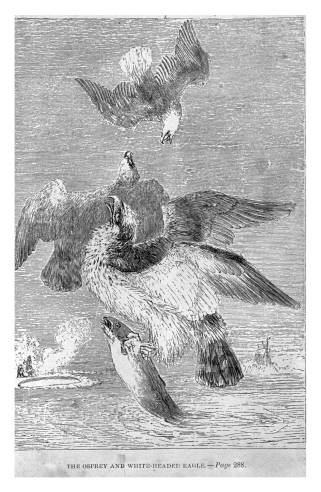
“They have sometimes others to provide for besides themselves,” remarked Lucien. “For instance, the bald eagle—”
Lucien was interrupted by a cackling scream, which was at once recognised as that of the very bird whose name had just escaped his lips. All eyes were instantly turned in the direction whence it came—which was from the opposite side of the river—and there, just in the act of launching itself from the top of a tall tree, was the great enemy of the osprey—the white-headed eagle himself!
“Now a chase!” cried François, “yonder comes the big robber!”
With some excitement of feeling, the whole party watched the movements of the birds. A few strokes of the eagle’s wing brought him near; but the osprey had already heard his scream, and knowing it was no use carrying the fish to his nest, turned away from it, and rose spirally upward, in the hope of escaping in that direction. The eagle followed, beating the air with his broad pinions, as he soared after. Close behind him went the female osprey, uttering wild screams, flapping her wings against his very beak, and endeavouring to distract his attention from the chase. It was to no purpose, however, as the eagle full well knew her object, and disregarding her impotent attempts, kept on in steady flight after her mate. This continued until the birds had reached a high elevation, and the ospreys, from their less bulk, were nearly out of sight. But the voyageurs could see that the eagle was on the point of overtaking the one that carried the fish. Presently, a glittering object dropped down from the heavens, and fell with a plunge upon the water. It was the fish, and almost at the same instant was heard the “whish!” of the eagle, as the great bird shot after it. Before reaching the surface, however, his white tail and wings were seen to spread suddenly, checking his downward course; and then, with a scream of disappointment, he flew off in a horizontal direction, and alit upon the same tree from which he had taken his departure. In a minute after the ospreys came shooting down, in a diagonal line, to their nest; and, having arrived there, a loud and apparently angry consultation was carried on for some time, in which the young birds bore as noisy a part as either of their parents.
“It’s a wonder,” said Lucien, “the eagle missed the fish—he rarely does. The impetus which he can give his body enables him to overtake a falling object before it can reach the earth. Perhaps the female osprey was in his way, and hindered him.”
“But why did he not pick it up in the water?” demanded François.
“Because it went to the bottom, and he could not reach it—that’s clear.”
It was Basil who made answer, and the reason he assigned was the true one.
“It’s too bad,” said François, “that the osprey, not half so big a bird, must support this great robber-tyrant by his industry.”
“It’s no worse than among our own kind,” interposed Basil. “See how the white man makes the black one work for him here in America. That, however, is the few toiling for the million. In Europe the case is reversed. There, in every country, you see the million toiling for the few—toiling to support an oligarchy in luxurious ease, or a monarch in barbaric splendour.”
“But why do they do so? the fools!” asked François, somewhat angrily.
“Because they know no better. That oligarchy, and those monarchs, have taken precious care to educate and train them to the belief that such is the natural state of man. They furnish them with school-books, which are filled with beautiful sophisms—all tending to inculcate principles of endurance of wrong, and reverence for their wrongers. They fill their rude throats with hurrah songs that paint false patriotism in glowing colours, making loyalty—no matter to whatsoever despot—the greatest of virtues, and revolution the greatest of crimes; they studiously divide their subjects into several creeds, and then, playing upon the worst of all passions—the passion of religious bigotry—easily prevent their misguided helots from uniting upon any point which would give them a real reform. Ah! it is a terrible game which the present rulers of Europe are playing!”
It was Basil who gave utterance to these sentiments, for the young republican of Louisiana had already begun to think strongly on political subjects. No doubt Basil would one day be an M.C.
“The bald eagles have been much blamed for their treatment of the ospreys, but,” said Lucien, “perhaps they have more reason for levying their tax than at first appears. It has been asked: Why they do not capture the fish themselves? Now, I apprehend, that there is a natural reason why they do not. As you have seen, the fish are not always caught upon the surface. The osprey has often to plunge beneath the water in the pursuit, and Nature has gifted him with power to do so, which, if I am not mistaken, she has denied to the eagles. The latter are therefore compelled, in some measure, to depend upon the former for a supply. But the eagles sometimes do catch the fish themselves, when the water is sufficiently shallow, or when their prey comes near enough to the surface to enable them to seize it.”
“Do they ever kill the ospreys?” inquired François.
“I think not,” replied Lucien; “that would be ‘killing the goose,’ etcetera. They know the value of their tax-payers too well to get rid of them in that way. A band of ospreys, in a place where there happens to be many of them together, have been known to unite and drive the eagles off. That, I suppose, must be looked upon in the light of a successful revolution.”
The conversation was here interrupted by another incident. The ospreys had again gone out fishing, and, at this moment, one of them was seen to pounce down and take a fish from the water. It was a large fish, and, as the bird flew heavily upward, the eagle again left its perch, and gave chase. This time the osprey was overtaken before it had got two hundred yards into the air, and seeing it was no use attempting to carry off the prey, it opened its claws and let it drop. The eagle turned suddenly, poised himself a moment, and then shot after the falling fish. Before the latter had got near the ground, he overtook and secured it in his talons. Then, arresting his own flight by the sudden spread of his tail, he winged his way silently across the river, and disappeared among the trees upon the opposite side. The osprey, taking the thing as a matter of course, again descended to the proper elevation, and betook himself to his work. Perhaps he grinned a little like many another royal tax-payer, but he knew the tax had to be paid all the same, and he said nothing.
An incident soon after occurred that astonished and puzzled our party not a little. The female osprey, that all this time seemed to have had but poor success in her fishing, was now seen to descend with a rush, and plunge deeply into the wave. The spray rose in a little cloud over the spot, and all sat watching with eager eyes to witness the result. What was their astonishment when, after waiting many seconds, the bird still remained under water! Minutes passed, and still she did not come up. She came up no more! The foam she had made in her descent floated away—the bosom of the water was smooth as glass—not a ripple disturbed its surface. They could have seen the smallest object for a hundred yards or more around the spot where she had disappeared. It was impossible she could have emerged without them seeing her. Where, then, had she gone? This, as I have said, puzzled the whole party; and formed a subject of conjecture and conversation for the rest of that day, and also upon the next. Even Lucien was unable to solve the mystery. It was a point in the natural history of the osprey unknown to him. Could she have drowned herself? Had some great fish, the “gar pike,” or some such creature, got hold of and swallowed her? Had she dashed her head against a rock, or become entangled in weeds at the bottom of the river?
All these questions were put, and various solutions of the problem were offered. The true one was not thought of, until accident revealed it. It was Saturday when the incident occurred. The party, of course, remained all next day at the place. They heard almost continually the cry of the bereaved bird, who most likely knew no more than they what had become of his mate. On Monday our travellers re-embarked and continued down-stream. About a mile below, as they were paddling along, their attention was drawn to a singular object floating upon the water. They brought the canoe alongside it. It was a large fish, a sturgeon, floating dead, with a bird beside it, also dead! On turning both over, what was their astonishment to see that the talons of the bird were firmly fixed in the back of the fish! It was the female osprey! This explained all. She had struck a fish too heavy for her strength, and being unable to clear her claws again, had been drawn under the water and had perished along with her victim!
Chapter Twenty Four.
The Voyage Interrupted.
About ten days’ rapid travelling down the Elk River brought our party into the Athabasca Lake—sometimes called the “Lake of the Hills.” This is another of those great bodies of fresh water that lie between the primitive rocks of the “Barren Grounds,” and the more fertile limestone deposit upon the west. It is nearly two hundred miles long from west to east, and is only fifteen miles in breadth, but in some places it is so narrow and full of islands that it looks more like a broad river than a lake. Its shores and many of its islands are thickly wooded, particularly upon the southern and western edges; and the eye of the traveller is delighted with many a beautiful vista as he passes along. But our voyageurs took little heed of these things. A gloom had come over their spirits, for one of their party had taken ill, and was suffering from a painful and dangerous disease—an intermittent fever. It was Lucien—he that was beloved by all of them. He had been complaining for several days—even while admiring the fair scenery of the romantic Elk—but every day he had been getting worse, until, on their arrival at the lake, he declared himself no longer able to travel. It became necessary, therefore, to suspend their journey; and choosing a place for their camp, they made arrangements to remain until Lucien should recover. They built a small log-hut for the invalid, and did everything to make him as comfortable as possible. The best skins were spread for his couch; and cooling drinks were brewed for him from roots, fruits, and berries, in the way he had already taught his companions to prepare them. Every day François went forth with his gun, and returned with a pair of young pigeons, or a wood-partridge, or a brace of the beautiful ruffed grouse; and out of these he would make delicate soups, which he was the better able to do as they had procured salt, pepper, and other ingredients, at the Fort. They had also brought with them a stock of tea—the real China tea—and sugar; and as the quantity of both was but small, this luxurious beverage was made exclusively for Lucien, and was found by him exceedingly beneficial during his illness.
To the great joy of all the invalid was at length restored to health, and the canoe being once more launched and freighted, they continued their journey.
They coasted along the shores of the lake, and entered the Great Slave River, which runs from the Athabasca into the Great Slave Lake. They soon came to the mouth of another large river, called the Peace. This runs into the Great Slave a short distance below Lake Athabasca, and, strange to say, the sources of the Peace River lie upon the western side of the Rocky Mountains, so that this stream actually runs across the mountain-chain! It passes through the mountains in a succession of deep gorges, which are terrible to behold. On both sides dizzy cliffs and snow-capped peaks rise thousands of feet above its rocky bed, and the scenery is cold and desolate. Its head-waters interlock with those of several streams that run into the Pacific; so that, had our voyageurs wished to travel to the shores of that ocean, they might have done so in their birch-bark canoe nearly the whole of the way. But this was not their design at present, so they passed the débouchure of the Peace, and kept on for the Great Slave Lake. They were still upon the same water as the Elk, for the Great Slave is only another name for that part of the river lying between the two lakes—Athabasca and Great Slave. Of course the river had now become much larger by the influx of the Peace, and they were travelling upon the bosom of a magnificent stream, with varied scenery upon its banks. They were not so happy, however, as when descending the Elk—not but that they were all in good health, for Lucien had grown quite strong again. No, it was not any want of health that rendered them less cheerful. It was the prospect before them—the prospect of coming winter, which they now felt certain would arrive before they had got to the end of their journey. The delay of nearly a month, occasioned by Lucien’s illness, had deranged all their calculations; and they had no longer any hope of being able to finish their voyage in what remained of the short summer. The ice would soon make its appearance; the lakes and rivers would be frozen up; they could no longer navigate them in their canoe. To travel afoot would be a most laborious undertaking, as well as perilous in an extreme degree. In this way it is only possible to carry a very small quantity of provisions—for the traveller is compelled to load himself with skin-clothing in order to keep out the cold. The chances of procuring game by the way in that season are precarious, and not to be depended upon. Most of the birds and many of the quadrupeds migrate to more southern regions; and those that remain are shy and rare. Besides, great snow-storms are to be encountered, in which the traveller is in danger of getting “smoored.” The earth is buried under a deep covering of snow, and to pass over this while soft is difficult, and at times quite impossible. All these circumstances were known to our young voyageurs—to Norman better than any of them—and of course the prospect was a cheerless one—much more so than those unacquainted with the winter of these dreary regions would be willing to believe.
It was the month of August, near its end, when they reached the Great Slave Lake, in the latitude of 62 degrees. The days had now become very short, and their journeys grew short in proportion. They already experienced weather as cold as an English winter. There were slight frosts at night—though not yet enough to cover the water with ice—and the midday hours were hot, sometimes too hot to be comfortable. But this only caused them to feel the cold the more sensibly when evening set in; and all their robes and skins were necessary to keep them warm during the night.
The Great Slave Lake, like the Athabasca, is very long and very narrow. It extends full 260 miles from east to west, but at its widest part is not over thirty, and in some places much less. Along its northern shores lies the edge of the “Barren Grounds,” and there nothing meets the eye but bleak and naked hills of primitive rock. On its southern side the geology is entirely of a different character. There the limestone prevails, and scarcely anything that deserves the name of hill is to be seen. There are fine forests too, in which poplars, pines, and birches, are the principal trees. The lake is filled with islands, many of which are wholly or partially covered with timber of these kinds, and willows also are abundant. There are fish of several species in its waters, which are in many places of great depth—sixty fathoms deep—and in some of the islands, and around the wooded shores, game exists in abundance in the summer season. Even in winter it is not scarce, but then it is difficult to follow it on account of the deep snow. Many of the animals, too, at this season become torpid, and are of course hidden in caves and hollow trees, and even in the snow itself, where no one can find them. Notwithstanding all this, our voyageurs knew that it would be the best place for them to make their winter camp. They saw that to complete their journey during that season would be impossible. Even had it been a month earlier it would have been a difficult undertaking. In a few days winter would be upon them. They would have to stop somewhere. There was no place where they could so safely stay as by the lake. One thing they would have there, which might not be found so plenty elsewhere, that was wood for their fire; and this was an inducement to remain by the lake. Having made up their minds, therefore, to encamp on some part of it, they looked from day to day for a place that would be most suitable, still continuing their journey towards its western end. As yet no place appeared to their liking, and as the lake near its western point trends away towards the south, Norman proposed that they should follow the shore no longer, but strike across to a promontory on the northern shore of the lake, known as “Slave Point.” This promontory is of the limestone formation, and as Norman had heard, is well wooded, and stocked with game. Even buffaloes are found there. It is, in fact, the farthest point to the north-east that these animals range, and this presents us with a curious fact. It is the farthest point that the limestone deposit extends in that direction. Beyond that, to the east and north, lie the primitive rocks of the Barren Grounds, into which the buffaloes never stray. Thus we observe the connexion that exists between the fauna of a country and its geological character.
Of course they all agreed to Norman’s proposal. The canoe was, therefore, headed for the open waters; and, after a hard day’s paddling—for there was a head-wind—the voyageurs landed upon a small wooded island, about halfway over the lake, where they encamped for the night, intending next day to cross the remaining part.
Chapter Twenty Five.
Fishing under the Ice.
On awaking next morning, to their great surprise, they saw that the lake was frozen over! They had almost anticipated as much, for the night was one of the coldest they had yet experienced—so cold that one and all of them had slept but badly. As yet the ice was thin, but so much the worse. It was thick enough to prevent them from using the canoe, but too thin to bear their weight, and they now saw that they were prisoners upon the island!
It was not without some feelings of alarm that they made this discovery; but their fears were allayed by reflecting, that they could remain upon the island until the ice either thawed away or became strong enough to bear them, and then they could cross upon it to the northern shore.
With this consolation, therefore, they set about making their temporary quarters upon the island as snug as circumstances would permit. Their apprehensions, however, began to return again, when several days had passed over, and the ice neither grew any thinner nor any thicker, but seemed to remain at a standstill. In the early part of the morning it was almost strong enough to bear them; but during the day the sun melted it, until it was little better than a scum over the surface of the water. The alarm of our voyageurs increased. Their provisions were nearly out. There was no game on the islet—not so much as a bird—for they had beaten every bush, and found nothing. Once or twice they thought of launching their canoe and breaking a way for it through the ice. But they knew that this proceeding would be one of much labour as well as danger. The islet was full ten miles from the shore, and they would therefore have to break the ice for ten miles. Moreover, to stand up in a bark canoe, so as to get at the work, would be a difficult task. It could not be accomplished without endangering the equilibrium of the vessel, and indeed without upsetting it altogether. Even to lean forward in the bow would be a perilous experiment; and under these considerations the idea of breaking a way was abandoned. But their provisions were at length entirely exhausted, and what was to be done? The ice was still too weak to carry them. Near the shore it might have been strong enough, but farther out lay the danger. There they knew it was thinner, for it had not frozen over until a later period. It would have been madness to have risked it yet. On the other hand, they were starving, or likely to starve from hunger, by staying where they were. There was nothing eatable on the island. What was to be done? In the water were fish—they doubted not that—but how were they to catch them? They had tried them with hook and line, letting the hook through a hole in the ice; but at that late season the fish would not take a bait, and although they kept several continually set, and “looked” them most regularly and assiduously, not a “tail” was taken.
They were about to adopt the desperate expedient, now more difficult than ever, of breaking their way through the ice, when, all at once, it occurred to Norman, that, if they could not coax the fish to take a bait, they might succeed better with a net, and capture them against their will. This idea would have been plausible enough, had there been a net; but there was no net on that islet, nor perhaps within an hundred miles of it. The absence of a net might have been an obstacle to those who are ever ready to despair; but such an obstacle never occurred to our courageous boys. They had two parchment skins of the caribou which they had lately killed, and out of these Norman proposed to make a net. He would soon do it, he said, if the others would set to work and cut the deerskins into thongs fine enough for the purpose. Two of them, therefore, Basil and Lucien, took out their knives, and went briskly to work; while François assisted Norman in twining the thongs, and afterwards held them, while the latter wove and knotted them into meshes. In a few hours both the skins were cut into fine strips, and worked up; and a net was produced nearly six yards in length by at least two in width. It was rude enough, to be sure, but perhaps it would do its work as well as if it had been twined out of silk. At all events, it was soon to have a trial—for the moment it was finished the sinkers were attached to it, and it was carried down to the edge of the water.
The three “Southerners” had never seen a net set under ice—for in their country ice is an uncommon thing, and indeed never freezes of sufficient thickness to carry the weight of a man. They were therefore very curious to know how the thing was to be done. They could not conceive how the net was to be stretched under the ice, in such a manner as to catch the fish. Norman, however, knew all about it. He had seen the Indians, and had set many a one himself. It was no new thing for him, and he set about it at once.
He first crept out upon the ice to the distance of about twenty or thirty yards from the shore. He proceeded cautiously, as the ice creaked under him. Having arrived at the place where he intended to set the net, he knelt down, and with his knife cut several holes in the ice, at the distance of about six feet from each other, and all in one line. He had already provided himself with a straight sapling of more than six feet in length, to one end of which he had attached a cord. The other end of this cord was tied to the net, at one of its corners. He now thrust the sapling through the first hole he had made, and then guided it so as to pass directly under the second. At this hole he took a fresh hold of the stick, and passed it along to the next, and so on to the last, where he pulled it out again, and of course along with it the string. The net was now drawn into the first hole, and by means of the cord already received through, was pulled out to its full length. The sinkers, of course, fell down in the water, and drew it into a vertical position. At both its upper corners the net was made fast above the ice, and was now “set.” Nothing more could be done until the fish came into it of their own accord, when it could be drawn out upon the ice by means of the cord attached; and, of course, by the same means could easily be returned to its place, and set again.
All of them now went back to the fire, and with hungry looks sat around it, waiting the result. They had made up their minds, should no fish be caught, to get once more into the canoe and attempt breaking their way to the shore. Summoning all their patience, therefore, they waited for nearly two hours, without examining the net. Then Norman and Basil crawled back upon the ice, to see what fortune had done for them. They approached the spot, and, with their hearts thumping against their ribs, untied the knot, and commenced hauling out.
“It certainly feels heavy,” said Basil, as he net was being drawn. “Hurrah!” he shouted, “Something kicks, hurrah!” and with the second “hurrah!” a beautiful fish was pulled up through the hole, and landed upon the ice. A loud “hurrah” was uttered in response by Lucien and François—who, fearing the ice might not bear so many, had remained upon the shore. A yard or two more of the net was cleared, and a second fish still larger than the former was greeted with a general “hurrah!” The two fish were now taken out—as these were all that had been caught—and the net was once more carefully set. Basil and Norman came back to the shore—Norman to receive quite a shower of compliments from his companions. The fish—the largest of which weighed nearly five pounds—proved to be trout; and it was not long before their quality was put to the proof. All declared they had never eaten so fine trout in their lives; but when the condition of their appetites is taken into account, we may infer that there was, perhaps, a little exaggeration in this statement. If hunger really makes good sauce, our voyageurs had the best of sauce with their fish, as each of them was as hungry as a half-famished wolf.
They felt quite relieved, as far as present appetite went, but they were still uneasy for the future. Should they not succeed in taking more fish—and it was by no means certain they should succeed—they would be no better off than ever. Their anxiety, however, was soon removed. Their second “haul” proved even more successful than the first—as five fish, weighing together not less than twenty pounds, were pulled up.
This supply would enable them to hold out for a long time, but they had not much longer to remain on the islet. Upon that very night there was one of those severe frosts known only in high latitudes, and the ice upon the lake became nearly a foot in thickness. They had no longer any fear of its breaking under their weight; and taking their canoe with all their “traps,” they set out to cross over upon the ice. In a few hours they reached the shore of the lake, near the end of the promontory, where they chose a spot, and encamped.
Chapter Twenty Six.
An Odd Alarm.
The first thing our voyageurs did after choosing a suitable situation, was to build a log-hut. Being young backwoodsmen this was but a trifle to them. All four of them knew how to handle an axe with dexterity. The logs were soon cut and notched, and a small cabin was put up, and roofed with split clap-boards. With the stones that lay near the shore of the lake they built a chimney. It was but a rude structure, but it drew admirably. Clay was wanted to “chink” the cabin, but that could not be had, as the ground was hard frozen, and it was quite impossible to make either clay or mud. Even hot water poured out would freeze into ice in a few minutes. This was a serious want—for in such a cold climate even the smallest hole in the walls will keep a house uncomfortable, and to fill the interstices between the logs, so as to make them air-tight, some soft substance was necessary. Grass was suggested, and Lucien went off in search of it. After a while he returned with an armful of half-withered grass, which all agreed would be the very thing; and a large quantity was soon collected, as it grew plentifully at a short distance from the cabin.
They now set to work to stuff it into the chinks; when, to their astonishment, they found that this grass had a beautiful smell, quite as powerful and as pleasant as that of mint or thyme! When a small quantity of it was flung into the fire it filled the cabin with a fragrance as agreeable as the costliest perfumes. It was the “scented grass,” which grows in great profusion in many parts of the Hudson’s Bay territory, and out of which the Indians often make their beds, burning it also upon the fire to enjoy its aromatic perfume.
For the first day or two, at their new abode, the travellers had lived altogether on fish. They had, of course, brought their net with them from the island, and had set it near the shore in the same way as before. They had captured as many as they wanted, and, strange to say, at one haul they found no less than five different species in the net! One kind, a white fish, the Coregonus albus of naturalists, but which is named “tittameg” by the fur-traders, they caught in great plenty. This fish is found in nearly all the lakes and rivers of the Hudson’s Bay territory, and is much prized both by whites and Indians for its delicate flavour. At some of the trading posts it often forms, for weeks together, the only food which the residents can obtain; and they are quite satisfied when they can get enough of it. The tittameg is not a large fish; the largest attain to the weight of about eight pounds.
There was another and still smaller species, which, from its colour, the voyageurs call the “poisson bleu,” or blue fish. It is the Coregonus signifer of ichthyologists. It is a species of grayling, and frequents sharp-running water, where it will leap at the fly like a trout. Several kinds of trout also inhabit the Great Slave Lake, and some of these attain to the enormous weight of eighty pounds! A few were caught, but none of so gigantic proportions as this. Pike were also taken in the net, and a species of burbot (Gadus lota). This last is one of the most voracious of the finny tribe, and preys upon all others that it is able to swallow. It devours whole quantities of cray-fish, until its stomach becomes crammed to such a degree as to distort the shape of its whole body. When this kind was drawn out, it was treated very rudely by the boys—because its flesh was known to be extremely unsavoury, and none of them cared to eat it. Marengo, however, had no such scruples, and he was wont to make several hearty meals each day upon the rejected burbot.
A fish diet exclusively was not the thing; and as our party soon grew tired of it, the hunter Basil shouldered his rifle, and strode off into the woods in search of game. The others remained working upon the cabin, which was still far from being finished.
Basil kept along the edge of the lake in an easterly direction. He had not gone more than a quarter of a mile, when he came upon a dry gravelly ridge, which was thickly covered with a species of pine-trees that resembled the Scotch fir (Pinus sylvestris). These trees were not over forty feet in height, with very thick trunks and long flexible branches. No other trees grew among them, for it is the nature of this pine—which was the “scrub” or grey pine (Pinus Banksiana) to monopolise the ground wherever it grows. As Basil passed on, he noticed that many of the trees were completely “barked,” particularly on the branches; and small pieces of the bark lay scattered over the ground, as though it had been peeled off and gnawed by some animal. He was walking quietly on and thinking what creature could have made such a wreck, when he came to a place where the ground was covered with fine sand or dust. In this, to his astonishment, he observed what he supposed to be the tracks of human feet! They were not those of a man, but small tracks, resembling the footsteps of a child of three or four years of age. He was about stooping down to examine them more closely, when a voice sounded in his ears exactly like the cry of a child! This brought him suddenly to an erect attitude again, and he looked all round to discover who or what had uttered that strange cry. He could see no one—child or man—and strange, too, for he had a clear view through the tree-trunks for several hundred yards around. He was filled with curiosity, not unmixed with alarm; and, stepping forward a few paces, he was about to bend down and examine the tracks a second time, when the singular cry again startled him. This time it was louder than before, as if he was closer to whatever had uttered it, but Basil now perceived that it proceeded from above him. The creature from which it came was certainly not upon the ground, but high up among the tops of the trees. He looked up, and there, in the fork of one of the pines, he perceived a singular and hideous-looking animal—such as he had never before seen. It was of a brown colour, about the size of a terrier-dog, with thick shaggy hair, and clumped up in the fork of the tree—so that its head and feet were scarcely distinguishable. Its odd appearance, as well as the peculiar cry which it had uttered, would have alarmed many a one of less courage than our young hunter, and Basil was at first, as he afterwards confessed, “slightly flurried;” but a moment’s reflection told him what the animal was—one of the most innocent and inoffensive of God’s creatures—the Canada porcupine. It was this, then, that had barked the scrub-pines—for they are its favourite food; and it was its track—which in reality very much resembles that of a child—that Basil had seen in the sand.
The first thought of the young hunter was to throw up his rifle, and send a bullet through the ungainly animal; which, instead of making any effort to escape, remained almost motionless, uttering, at intervals, its child-like screams. Basil, however, reflected that the report of his rifle would frighten any large game that might chance to be near; and as the porcupine was hardly worth a shot, he concluded, upon reflection, it would be better to leave it alone. He knew—for he had heard Lucien say so—that he would find the porcupine at any time, were it a week, or even a month after—for these creatures remain sometimes a whole winter in the same grove. He resolved, therefore, should no other game turn up, to return for it; and, shouldering his rifle again, he continued his course through the woods.
As he proceeded, the timber became thinner. The scrub-pines gave place to poplar-trees, with here and there an undergrowth of willows. The trees stood far apart, and the willows grew only in clumps or “islands,” so that the view was nearly open for many hundred yards around. Basil walked on with all the silence and watchfulness of a true “still” hunter—for, among backwoodsmen, this species of hunting is so called. He ascended a low hill, and keeping a tree in front of him, looked cautiously over its crest. Before him, and stretching from the bottom of the hill, was a level tract of considerable extent. It was bounded on one side by the edge of the lake, and on all the others by thin woods, similar to those through which the hunter had been for some time travelling. Here and there, over the plain, there stood trees, far apart from each other, and in nowise intercepting the view for a mile or more. The ground was clear of underwood, except along the immediate edge of the lake, which was fringed by a thicket of willows.
As Basil looked over the hill, he espied a small group of animals near the interior border of the willows. He had never seen animals of the same species before, but the genus was easily told. The tall antlered horns, that rose upon the head of one of them, showed that they were deer of some kind; and the immense size of the creature that bore them, together with his ungainly form, his long legs, and ass-like ears, his huge head with its overhanging lip, his short neck with its standing mane, and, above all, the broad palmation of the horns themselves, left Basil without any doubt upon his mind that the animals before him were moose-deer—the largest, and perhaps the most awkward, of all the deer kind. The one with the antlers was the male or bull-moose. The others were the female and her two calves of the preceding year. The latter were still but half-grown, and, like the female, were without the “branching horns” that adorned the head of the old bull. They were all of a dark-brown colour—looking blackish in the distance—but the large one was darker than any of the others.
Basil’s heart beat high, for he had often heard of the great moose, but now saw it for the first time. In his own country it is not found, as it is peculiarly a creature of the cold regions, and ranges no farther to the south than the northern edge of the United States territory. To the north it is met with as far as timber grows—even to the shores of the Polar Sea! Naturalists are not certain, whether or not it be the same animal with the elk (Cervus alces) of Europe. Certainly the two are but little, if anything, different; but the name “elk” has been given in America to quite another and smaller species of deer—the wapiti (Cervus Canadensis). The moose takes its name from its Indian appellation, “moosoa,” or “wood-eater;” and this name is very appropriate, as the animal lives mostly upon the leaves and twigs of trees. In fact, its structure—like that of the camelopard—is such that it finds great difficulty in reaching grass, or any other herbage, except where the latter chances to be very tall, or grows upon the declivity of a very steep hill. When it wishes to feed upon grass, the moose usually seeks it in such situations; and it may often be seen browsing up the side of a hill, with its legs spread widely on both sides of its neck. But its favourite food is found at a more convenient height, and consists of the young shoots of many species of trees. It prefers those of the poplar, the birch-tree, and willows, and one kind of these last, the red willow, is its particular favourite. The “striped” maple (Acer striatum) is also much relished by the moose—hence the name “moose-wood,” by which this tree is known among the hunters. It loves also the common water-lilies (Nympha); and in summer it may be seen wading out into lakes, and plucking up their succulent leaves. It takes to the water also for other purposes—to cool its body, and rid itself of several species of gnats and mosquitoes that at this season torment it exceedingly. At such times it is more easily approached; and the Indians hunt it in their canoes, and kill it in the water, both with spears and arrows. They never find the moose, however, in large numbers—for it is a solitary animal, and only associates in pairs during one part of the year, and in families at another season—as Basil now found it. In winter the Indians track it through the snow, following it upon snow-shoes. These give them the advantage of skimming along the surface, while the moose plunges through the deep drift, and is therefore impeded in its flight. Notwithstanding, it will frequently escape from the hunter, after a chase of several days’ duration! Sometimes, in deep snow, a dozen or more of these animals will be found in one place, where they have got accidentally together. The snow will be trodden down until the place appears as if enclosed by a wall. This the hunters term a “moose-pound,” and when found in such situations the moose are easily approached and surrounded—when a general battue takes place, in which few or none of the animals are allowed to escape.
I have said that Basil’s heart beat high at the sight of the moose. He was very desirous of killing one—partly on account of the novelty of the thing, and partly because he and his companions at the camp were anxious for a change of diet. Moose-meat was the very thing; and he knew that if he could return to camp with a few pieces of this strung over his gun, he would receive a double welcome. He was well aware that the flesh of the moose was of the most savoury and delicate kind, and that the long pendulous upper lip is one of the “tit-bits” of the fur countries. Moreover, the fine hide would be an acceptable addition to their stock, as it is the best of all deerskins for mocassins, as well as snow-shoes—articles which Basil knew would soon be needed. For these reasons he was unusually desirous of killing one of the moose.
He knew it would be difficult to approach them. He had heard that they were shyest at that very season—the beginning of winter—and indeed such is the case. No deer is so difficult to get a shot at as a moose in early winter. In summer it is not so—as then the mosquitoes torment these animals to such a degree that they pay less heed to other enemies, and the hunter can more easily approach them. In winter they are always on the alert. Their sense of smell—as well as of sight and hearing—is acute to an extreme degree, and they are cunning besides. They can scent an enemy a long distance off—if the wind be in their favour—and the snapping of a twig, or the slightest rustle of the leaves, is sufficient to start them off. In their journeyings through the snow, when they wish to rest themselves, they make a sort of détour, and, coming back, lie down near the track which they have already passed over. This gives them an opportunity of hearing any enemy that may be following upon their trail, and also of making off in a side-direction, while the latter will be looking steadfastly ahead for them.