"The Young Castellan" (continued 5)
Reading edition
“Ay, sir; and it will be two directly; and I wish it was three for the enemy’s sake.”
The second gun was hoisted, and mounted rapidly, thanks to the trained skill of the four regular soldiers; while the men from the mill who helped looked on with profound admiration, though they were pretty clever at moving stones.
Discipline was relaxed over this manual labour, with the consequence that Sam Donny’s tongue began to run rather freely, a certain intimacy having existed in the past between Roy and the miller’s man connected with the demand and supply of meal-worms for catching and feeding nightingales, which came about as far west as the castle and no farther.
“Beat us chaps to ’a done that, Master Roy,” he said.
“Captain Roy,” growled Ben.
“Ay. Forgetted,” said the man. “T’other seems so nat’ral. Beat us chaps, Captain Roy. We’m as strong as them, but they’ve got a way a handling they brass guns as seems to come nat’ral to ’em like. But if they’ll come to the mill, we’ll show ’em something along o’ flour-sacks, and the grinding-stones as’ll make ’em stare. Every man to his trade.”
“Well, you’re a soldier now, Sam Donny, and you must learn to handle guns as well as you handle sacks of flour.”
“We will, master—I mean cap’n. I should just like me and my mates to have the letting o’ them guns down again. May we, sir?”
“No. Absurd.”
“But we’d get ’em up again, sir.”
“Wait till the enemy have gone,” said Roy, “and then we’ll see.”
A portion of the afternoon was devoted to taking up the necessary ammunition and re-arranging the top platform they had to prepare for the guns; and just at dusk, after the sentinels had been doubled, a strong party stood in the gate-way, armed with shovel and pick, waiting for the bridge to be lowered. Another party had a number of beams; and, lastly, already drawn up, stood a guard prepared to watch over the safety of the workers, and hand them weapons for their defence, if, perchance, they were seen by the enemy, and an attempt made to rush in.
But no sign was given to warn the parliamentarians, and Roy and the secretary stood on the platform of the great gate-way, watching the enemy, till, in the dim light, a body of men marched to the front, halted a quarter of a mile from the gate; a large square was rapidly marked out with pegs, and then an order seemed to be given, for the party began at once to dig and throw up a breastwork, evidently for the shelter of their guns.
Master Pawson watched everything eagerly, and kept on pointing out what was going on, while Roy leaned upon one of the guns, saying, “I’ve been wondering whether these guns will carry as far as that work they are making—I mean so as to hit hard.”
“They think they will not,” said the secretary, “and have placed their battery just out of reach.”
“How do you know?” said Roy, sharply.
“I—oh, of course, I don’t know,” said Master Pawson; “it is only what I judge from seeing them make their battery there.”
“Oh, I see,” said Roy, quietly. And he thought no more of the remark just then. He waited till the figures of the men digging grew more and more indistinct, and then quite invisible from where they stood; and he was just about to descend, when the sergeant joined them, to say, respectfully—
“We’re all ready, sir, and I’ve got some more poles and planks out of the wood-house.”
“Then we’ll start at once,” said Roy; “but I’ll have these guns manned at once to cover our working-party.”
Ben coughed.
“You don’t think that’s right?” said Roy, quickly.
“Well, sir, I wouldn’t have presumed to interfere with my commanding officer’s orders ’fore any one else. But—”
“Now don’t talk nonsense, Ben,” said Roy, warmly. “There’s no one here but Master Pawson, who is as anxious about preserving the place as we are.”
“Indeed, I am,” said the secretary, earnestly.
“So don’t let’s have any of that silly ceremony. I wish you wouldn’t pretend to believe I was so conceited.”
“I don’t, captain,” said Ben, abruptly; “only want you to see when you’re wrong.”
“Then speak out at once. Now then; you don’t think it worth while to man these guns now?”
“No, sir. If they hear us at work, and attack, we’ve got to retreat over the bridge fast as we can, and get it hoisted. Say you’ve got these guns manned and loaded, a shot or two might check the attacking party; but how in the dark are we to know when it is best to fire? How are we to take aim? And what’s to prevent our hitting friends instead of enemies.”
“Fire high, over their heads.”
“That’s wasting two good charges for the sake of making a noise. I don’t think I’d trouble about them to-night, sir.”
“No; you’re right.—Eh, Master Pawson?” said Roy.
“I don’t much understand these things,” said the secretary; “but it sounds the more sensible idea. You’re not offended by my speaking out?”
“No; but I soon shall be if you all treat me as if I thought of nothing but dressing up as a soldier, and wanting to have my own way over matters where I’m wrong. Come along, down.”
Roy led the way down through the corner turret, Master Pawson following and Ben coming last; while, as they wound round the narrow spiral, the secretary turned his head to whisper—
“He’ll make a splendid officer, Martlet.”
The only reply he obtained was a very hog-like grunt; then Ben spoke to himself:
“I wish to goodness you were along o’ the enemy, or anywhere but here; you’re supposed to be a friend, but somehow I can’t never feel as if you are one. My cantank’rousness, I s’pose. Not being a scholard like you, maybe. Anyhow, though, I’m more use just now than you are; not but what that’s easy, for you aren’t none at all.”
By this time they were down in the gate-way once more, where the portcullis was raised as silently as possible in the darkness, the bridge lowered, and the heavily laden working-party, followed by their guard marched slowly and silently out; a second strong guard was posted at the far end of the bridge to cover the retreat if one should have to be made—these last being under the command of the corporal; and Master Pawson volunteered in a whisper to stay with the men. Roy acquiesced, feeling rather glad to be without his company.
Next a halt was called, and all listened as they gazed out in the darkness in the direction of the enemy. Then feeling how commanding a position the latter had in the possession of their horsemen to act as scouts, and who might approach very near unseen, and discover the plans of the night, Roy gave orders for the guard at the end of the bridge to advance two men, to station them as sentries at equal distances, to keep in touch with the working-party.
“Fiddler’s right,” growled Ben, to himself. “He will make a splendid officer one of these days.”
The next minute the work was silently begun, the guard being thrown out in a half-moon formation in front of the outer gate-way which covered the bridge.
Ben’s plans were very simple. He had the heaviest beams they had brought stretched across the gate-way, as high as they could reach overhead, and propped against the masonry on either side with shorter beams; then poles, planks, and fagots were stretched in a slope from the ground to the crossing timbers, so as to make a scarp; and, as soon as this was done, shovel and pick were set to work to dig a deep wide ditch, the earth from which was thrown up over the wood; while men on either side filled baskets and carried their loads to pile upon the slope as well.
It was roughly done work, but every shovelful added to the strength of the bank, which rapidly grew in thickness as the hours glided on, the workers being relieved from time to time to do duty as guards, while the guard took their turn at shovelling and filling.
There was no halting, the men having refreshments served out to them by Roy’s forethought as they were relieved; and so the work went on till towards dawn, when a couple of men were strengthening the bank from behind with short pieces of wood wedged up against the crossbeams, as the weight of the earth began to make them bend.
“You’ll have to set a party to work by daylight, filling up on this side, Master Roy,” said Ben, quietly. “If we heap up earth and turf here, it will be the best support, and a regular trap for all their balls.”
“I begin to fear that as soon as they begin to fire they will batter it all to pieces, Ben.”
“Dessay they’ll damage it a bit, sir; but if they do, we must mend it; and every night we work, we can get it stronger and more earthy. Nothing like soil to swallow balls. Of course it’s no use as a defence, because the enemy could come round either end; but it’ll do what’s wanted, sir—stop the shot from hitting the bridge-chains and smashing through the grating. Hello! what’s that?”
That was a challenge, followed by a shot, and the rush of feet as the sentries thrown out ran back. This was followed by the trampling of hoofs, and the shouting of orders, as a small body of horse made a dash at the working-party, sweeping by the gate, but only to be received by a scattered volley as they were dimly seen riding out of the black darkness and disappearing again. But not without coming to the closest of close quarters, for there was the clashing noise of swords striking against steel, and, in the brief time occupied by their passing, blows were returned amidst angry shouting, and several dull thuds told that the blows had taken effect on horse or man.
It was merely the work of moments, the charge having been delivered from the left by a party of mounted men who had evidently been reconnoitring along by the edge of the moat, and came up at a slow walk unheard by the sentries on the walls. Then, finding the working-party before them, they had charged and galloped clear.
Roy fully expected another attack, for which he was now well prepared, the workers having seized their weapons; but all was still, and he was arguing with himself as to whether it would not be as well to work on till daybreak, when a voice from out of the darkness said, faintly—
“Will some ’un come and lend me a hand?”
“Sam Donny!” cried Roy, and, in company with Ben, he ran forward for quite forty yards before they came upon the man lying prone upon the earth.
“Why, Sam!” cried Roy; “are you hurt?”
“Well, it’s only a scratch, sir; but it do hurt, and it’s a-bleeding like hooroar. One on ’em chopped at me with his sword. I’d only got a pick, you see; but I hit at him with that, and somehow it got stuck, and I was dragged ever so far before I had to let go. He’s got the pick in his big saddle, I think. But I’ll pay for it, sir, or get you a new one.”
“Never mind the pick, Sam. Where are you hurt?”
“Oh, down here, on my right leg, sir. He made a big cut at me; but I’ll know my gen’leman again. I’ll have a sword next time and pay him back; and so I tell him.” Ben was down upon his knees, busy with a scarf, binding the wound firmly, a faint suggestion of the coming day making his task easier; and, summoning help, a rough litter was formed of a plank, and the wounded man rapidly carried in over the bridge.
That brought the defensive operations to an end, for Roy withdrew his men into the castle, and the daylight showed their rough work, which pretty well secured the gate-way; but it also displayed the work of the enemy, who had constructed a well-shaped earthwork, out of whose embrasures peered a couple of big guns.
The rapidly increasing light, too, showed something more, for about a couple of hundred yards from the outworks, a horse, saddled and bridled, lay upon its side, quite dead; for the terrible stroke the miller’s man had delivered with his pickaxe had struck into the horse’s spine.
Chapter Twenty Five.
Lady Royland turns Nurse.
Roy was face to face with the first of the stern realities of war, as he hurried into the long chamber beneath the eastern rampart, which Lady Royland had set apart for the use of any of the men who might, she said, “turn ill.”
Poor Sam Donny had fainted away before he reached the hospital-room, and upon Roy entering, eager to render assistance, it was to find himself forestalled by Lady Royland, who, with the old housekeeper, attended to the wounded man.
Lady Royland hurried to her son, as he appeared at the door.
“No,” she said, firmly, “not now: leave this to us. It is our duty.”
“But, mother, do you understand?” protested Roy.
“Better, perhaps, than any one here,” she replied. “Go to your duties; but come by-and-by to see how the poor fellow is. It will cheer him.”
Roy could not refuse to obey the order, and hurried back to meet Ben on the way to the sufferer’s side.
“Not go in?” said the sergeant. “Her ladyship says so? Oh, very well—then of course it is all right.”
“But I feel so anxious,” said Roy; “my mother is not a chirurgeon.”
“More aren’t we, Master Roy; but she’s what’s just as good—a splendid nurse. So’s old Grey’s wife; so Sam Donny’s in clover. I was being a bit anxious about him, for fear Master Pawson was doing the doctoring, and I’d rather trust myself.”
“But the wound—the terrible wound?” cried Roy.
“Tchah! Nothing terrible about that, captain. Just a clean sword-cut. You’ve cut your finger many a time, haven’t you?”
“Of course.”
“Well, did you want a doctor? No; you had it tied up tightly, and left it alone. Then it grew together again!”
“Yes, yes, yes,” cried Roy, impatiently. “But this was a terrible slash on the poor fellow’s thigh. You saw how horribly it bled.”
“Come, Master Roy, we’re both soldiers, and we mustn’t talk like this. I saw his leg bleed, and stopped it, but it wasn’t horrible. Leg’s only like a big finger, and a strong healthy chap soon grows together again. You mustn’t take any notice of a few cuts. They’re nothing. What we’ve got to mind is the cannon-balls. Now a wound from one of them is terrible, because you see they don’t cut clean, but break bones and do all kinds of mischief. Well, we mustn’t talk away here, but see to the men, and get ready for what’s to come.”
“Do you think they’ll attack us to-day?”
“Yes, sir; and as soon as they’ve finished their two-gun battery. Now, by rights, we ought to go and destroy that work, and spike their guns; but they’ve got the advantage of us with all that horse, and if we tried they’d cut us up before we could get at it. Only chance is to try and do it at night, if we can’t dismount the guns with ours.”
A hasty breakfast was eaten, and then the sergeant went up to the newly mounted guns on the top of the square tower, where Roy promised to join him as soon as he had been to visit the wounded man.
“Tell him I mean to come as soon as I can, my lad,” said Ben, “but it won’t do him any good for me to come now. Wounded man’s best left alone till he gets over his touch of fever. But tell him I’m sorry he’s down, and that I shall very much miss my best gunner. It’ll please him, and it’s quite true.”
Roy nodded, and in due time went to the hospital-room, where he tapped lightly, and the door was opened by the old housekeeper, who looked rather pale; but Lady Royland, who was seated by the wounded man’s bedside, rose and came to her son.
“Yes,” she said; “go and speak to him; but don’t stay many minutes, for he must not talk much. A few words from you, though, will do him good.”
Roy glanced towards the bed, which was close to one of the windows looking out on the court-yard garden, and he could see that the man was watching him intently.
“Go to him. I’ll leave you and come back when I think you have been here long enough.”
The door closed behind Lady Royland and her old assistant as Roy made for the couch, expecting to see a painful sight of agony and terror; but, as he approached, the man’s countenance expanded into a broad grin.
“Don’t be hard on a poor fellow, captain,” he said, just as Roy was ready with a prepared speech about being sorry to see the man in so grievous a condition.
“Hard upon you, Sam! What for?”
“Sneaking out o’ all the fun like this here! ’Taren’t my fault, you know. I didn’t want to stop in bed; but my lady says I must, and that she’ll report me to you if I don’t obey orders. I say, let me get up, sir. It’s just foolishness me lying here.”
“Foolishness! What! with that bad wound?”
“Bad, sir? Why, you don’t call that bad. If he’d cut my head off, I’d ha’ said it was.”
“How?” cried Roy, unable to repress a smile.
“How, sir? Why—oh! o’ course not. Didn’t think o’ that; I s’pose I couldn’t then. But I say, Master Roy, sir—I mean cap’n, I’m just ashamed o’ myself letting her ladyship wait on the likes o’ me!”
“Why should you be, Sam? Haven’t you been risking your life to defend us?”
“Me? No, sir, not as I knows on,” said the man, staring.
“Well, I do know; and now you are not to talk.”
“Oh, sir! If I’m to be here I must talk.”
“You must not, Sam. There, I came to see how you were.”
“Quite well, thank ye kindly, sir.”
“You are not. You have a bad wound.”
“But I aren’t, Master Roy. It’s on’y a bit cut; and I want to have a stick and come up on the tower in case we have to work that gun.”
“If you want to help to work that gun again, Sam, you will have to lie still and let your wound heal.”
“Master Roy!—I mean oh, cap’n—it’s worse than the wound to hear that.”
“We can’t help it. Tell me, are you in much pain?”
“Oh, it hurts a bit, sir; but if I was busy I should forget that, and—”
Crash!—Boom!
A strange breaking sound, and the rattling of the windows as a heavy report followed directly after, and Roy sprang from the chair he had taken by the wounded man’s couch.
“On’y hark, sir—that was my gun atop o’ the gate tower begun firing, and me not there.”
“Be patient, Sam,” cried Roy, excitedly. “It was not one of our guns, but the enemy’s, and the fight has begun in earnest. Good-bye, and lie still.”
He was half across the room as he said this, and the door opened to admit Lady Royland, looking deadly pale.
“Roy, my boy,” she cried, in a low, pained voice, as she caught his hands; “they are firing.”
“Yes, mother; and so will we,” cried the lad, excitedly.
“You—you will not expose yourself rashly,” she whispered; “you will take care?”
“I’m going to try not to do anything foolish, mother,” he said; “but I must be with the men.”
She clung to him wildly, and her lips trembled as she tried to speak; but no words came, and Roy bent forward, kissed her, and tried to withdraw his hands, but they were too tightly held.
Boom! came another report following closely upon a peculiar whizzing sound, apparently over the open window.
“Another gun from the enemy, and we’re doing nothing,” said Roy, impatiently. “Mother, don’t stop me; they will think I’m afraid. I must be with the men.”
Lady Royland drew a deep breath, and her face became fixed and firm once more, though the pallor seemed intensified.
“Yes,” she said, quickly, as she threw her arms about her son for a brief embrace; “you must be with your men, Roy. Go, and remember my prayers are with you always. Good-bye!”
“Just for a while,” he cried. “You shall soon have news of how we are going on.”
Chapter Twenty Six.
Going under Fire.
Roy ran out of the room, leaving the old housekeeper, who was waiting outside, to close the door, and dashed down the few stairs and out into the court-yard, where the greater part of their little force was drawn up on either side of the gate-way, looking very serious and troubled; but as soon as he appeared they burst into a cheer, to which Roy answered by waving his hand.
“The game has begun,” he cried.
“Yes, sir,” said one of the troopers, who with Farmer Raynes was in command of the men; “first shot struck the tower full, and splintered down some stone. Better mind how you cross the gate-way.”
“Yes,” said Roy, quickly; “I will.” And he ran across to the door-way at the foot of the big spiral, reaching it just as a shot came whizzing overhead, and a heavy report followed.
“Third, and not one from us,” muttered Roy, as he hurried up the stairway to reach the platform at the top, and found Ben Martlet and the troop-corporal from his father’s regiment, each busy with one of the guns, arranging wedges under the breeches, and assisted by the men told off to work each piece, while two more now came to the turret door-way, bearing fresh charges ready when wanted.
Ben looked up and smiled grimly as Roy appeared, and the boy cried, excitedly—
“Three shots from them, and you doing nothing.”
Rush!—Boom!
Roy ducked down his head, for the rushing noise seemed to be close over him; and as he raised it again, flushing with shame and glancing sharply round to see what impression his flinching had made on the men around, Ben said, quietly—
“Four, sir; and you see on’y one hit us; the earthwork has thrown all the others upward. That last one was nigh to a hundred foot overhead.”
“A hundred feet! and I flinched,” thought Roy. “But why don’t you fire?” he cried, aloud.
“Thought I’d wait for you, sir, and that you’d like the first shot.”
“Yes, of course,” cried the boy, excitedly.
“And we haven’t wasted time, sir; corp’ral and me’s been pretty busy, getting what we thinks about the right depression of the muzzles, for you see we’re a good height up here. I don’t know that we shall be right, but we can soon get the range; and if you’ll begin now, sir, I’d like you to try my gun first.”
“Ready!” cried Roy, whose heart began to thump heavily.
“Like to take a squint along her, sir, first?” said Ben.
“No; I’ll trust to your aim.”
“Then, stand fast there!” cried Ben; and taking the port-fire from the man who held it, he presented it to the young castellan, who glanced at the earthwork, where he could see men busy, and a couple of squadrons of troopers drawn up some distance back on either side; and then, setting his teeth hard, he let the sparkling fuse fall softly on the touch-hole of the gun.
There was a flash, a great ball of smoke, the gun rushed backward, and the report seemed to stun Roy, whose ears rang, and a strange singing noise filled his head.
Ben said a few words, and leaned over the battlement, sheltering his eyes to watch the effect of the shot, as the smoke rose and began to spread. Then he turned and shouted something; but what it was Roy could not hear, neither could he catch a word that was uttered by the trooper-corporal, though the movement of his lips suggested that he was speaking.
“Can’t hear you,” shouted Roy, as loudly as he could; and the man smiled, and pointed to the port-fire and the second gun.
That was clear enough to understand; so Roy took a couple of steps towards the breech, and as the men stood drawn up in regular form on either side, he once more touched the priming.
Another flash, puff, and deafening roar, which he heard quite plainly; and oddly enough it seemed to have had the effect of restoring his ears to their customary state, for, in spite of the tremendous singing and cracking going on, he heard the order given to the men to stop the vents, sponge, and begin to reload.
“Just a shade more up,” said Ben; “and yours wants a bit more than mine, corporal.—See where the shot hit, sir?”
“I? No,” said Roy.
“Both on ’em just in front of their works, and covered ’em with earth and stones. They all bolted out. Look, they’re coming back again, and they’ll give us something directly.”
“Yes,” said the corporal, as the men went on loading; “and those shots have shown ’em what we can do. Look, sir.”
“Why, they’re drawing off those two troops of horse.”
“Yes, sir,” said the corporal; “and if Sir Granby Royland had been in command they’d never have been there.”
“No,” said Ben, with his lips pinched together; “we could have bowled over two or three of ’em with the guns, but I thought the captain would like to have a try at the earthwork first.—For they’re not soldiers, Master Roy.—Are they, corporal?”
The trooper laughed.
“Just a mob of men scratched together, and put into jerkins and headpieces, and with swords stuck in their fisties. Why, there aren’t many of ’em as can ride,” continued Ben.
The thought occurred to Roy that his own garrison was composed of extremely raw material, but he said nothing, and Ben went grumbling on:
“I don’t say but what they could be made into decent soldiers in time; but they don’t seem to have anybody much over them.”
Just then a couple of shots were fired by the enemy, one of which struck the tower with a tremendous crash, sending splinters of stone flying, and a tiny cloud of dust rose slowly. The other shot went whizzing overhead.
“I wouldn’t get looking over the edge, Master Roy, sir,” whispered Ben. “Some of those chips of stone might give you an ugly scratch. But that just shows what I say’s right. They haven’t got the right man there or he’d soon change things. You see they’ve brought up their guns with orders to batter down our drawbridge and smash the portcullis, thinking they’ll make you surrender. Don’t seem to come into their thick heads that if they did manage to smash the bridge, they’d be no nearer to us than before, because we should soon pile up a good breastwork, and pitch every man back into the moat who swam across. But, as I was going to say, they’ve got their orders to batter down the bridge, and they keep at it. We’ve been hit up here, but only by accident; they never fired straight at us. Now, if you were in command out there, sir, you’d do something different.”
“I should fire straight up here, Ben, and try to silence these guns.”
“Of course you would, sir; just as you’re going to silence theirs.”
“And the sooner the better, Ben. They’re nearly ready again.”
“Are they, sir? I can’t see. My eyes are not so young as yours. Well, we’re quite ready; and if you orders, we’re going to give it ’em in earnest.”
“Go on, then,” said Roy, “and see if you can’t stop their firing.”
Ben smiled grimly, and bent down to regulate the aim he took, while the same was done with the other gun. The result was that the corporal’s shot went right through the embrasure of the piece to the left, while Ben’s went over.
As the smoke cleared away, a scene of confusion was visible; but the gun on the right was fired directly after, and the shot plunged into the bank of earth raised the previous night.
“Ah!” grumbled Ben; “you’ve got the best gun, my lad; there must be a twist in mine, for she throws high.”
“Like to change?” said the corporal.
“No. I’m going to get used to mine and make her work better.”
Shot after shot was fired from the gate tower, the men warming to their work, and the results were very varied; for, in spite of the care exercised and the rivalry between Ben and the corporal, the clumsily cast balls varied greatly in their courses, so that at the end of an hour’s firing very little mischief was done on either side. The enemy had had their earthen parapet a good deal knocked about, and some men had been injured; but all the advantage they had obtained was the battering down of some scraps of stone, which lay about the front of the great gate-way.
“Soon clear that away with a broom,” growled Ben; “but I’m a bit disappointed over these guns, captain. We ought from up here to have knocked theirs off the carriages by this time.”
“We shall do it yet,” said Roy; and during the next few shots he himself laid the guns, taking the most careful aim.
“As I said afore, your eyes are younger and better than mine, Master Roy, but you don’t shoot any more true.—Hullo! what are they doing there?”
He looked earnestly at the battery, where the men seemed to be extra busy, and at a solid mass of troops marching on from some hundreds of yards behind, straight for the castle.
“They’re never mad enough to come and deliver an assault; are they, corp’ral?” cried Ben, excitedly.
“Seems like it, sergeant.”
Ben turned to Roy with an inquiring look, and he nodded.
“Do what you think best,” he said.
What Ben thought best was to withdraw the great wedge which depressed the muzzle of his gun, the corporal doing the same; and then, after a careful aim-taking, both pieces roared out a salute to the coming infantry, which was marching forward in steady array.
The balls went skipping along after striking the ground a hundred yards or so beyond the enemy’s battery, and, ricochetting, darted right for the solid moving mass of men. The effect was ludicrous, for in an instant they could be seen from the tower to be in a terrible state of confusion, breaking and running in all directions, and, as it were, melting away.
“First time they’ve ever faced cannon-ball,” said Ben, with a smile. “I’ve seen better men than they after more training do the same. They won’t do it next time, though.”
As far as could be seen, few people were hurt; but the shots had their effect, for the men, as they were restored to something like order, were marched back behind a patch of woodland, and the duel between the two pairs of guns was recommenced with a couple of shots from the battery, both of which struck the tower high up.
“Aha!” cried Ben, with another of his grim smiles; “got tired, then.”
“Does not seem like it, Ben,” said Roy.
“Tired of plumping balls into our earthwork, and doing what they ought to have begun with.—Come, corporal, it’s time we did better.”
“Let’s do it, then,” said the man, sternly.
“Look here, Master Roy,” said Ben, in a low tone; “they’ve just sent out two parties of horse to right and left, and it strikes me they’re going to try something on the other side of us when they meet. Will you take a round of the ramparts, and see as all’s right, and keep the lads on the lookout?”
“Let me fire these two shots first,” said Roy.
He fired both guns, and there was a tremendous mass of earth sent flying; but that seemed to be the only mischief done; and then as Ben superintended the reloading, which began to be carried out now with a fair amount of speed, he said, in a low tone—
“Now, capt’n, will you take a look round? You ought to be everywhere at once now.”
At that moment a shot just grazed one of the crenelles, and hurtled away close overhead, making the men wince, as it gave them a better idea of the enemy’s powers than they had had before.
“Yes, that’s why you want me to go, Ben,” whispered Roy. “You think it is getting dangerous here. Thank you; I’ll stay. I daresay the men are all right.”
“Well, sir, I did think something of the kind; but it’s real truth. You ought to be everywhere, and you must really give a look round and tell ’em to fire at any of the enemy who come too near, specially at the troops of horse; it’ll teach ’em to keep their distance.”
Another shot struck the tower, and the splinters of stone rattled down, making Roy hesitate to leave. But he felt that the old sergeant was right, and, descending to the ramparts, he visited the south-west tower, where the men in charge of the guns awaited orders to join in the fray. Then the north-west tower was reached, and here Roy encountered Master Pawson.
“I am glad you’ve come,” he cried. “There’s a strong body of horse gathering over at the foot of the hill to the north.”
“Whereabouts?” said Roy, hurrying through. “Anywhere near the old ruins?”
“Ruins? ruins?” said the secretary, looking at him in a peculiar manner. “Ah, I see now: you mean those old stones on the top. No; they are on the level ground below. Hadn’t we better fire?”
“As soon as they come within reach, send a ball at them. Let the gun be well elevated, so as to fire over their heads. We want to scare them off, and not to destroy.”
As he spoke, Roy ascended with the secretary to the platform, and there, well within range, saw a strong squadron of horse approaching; while Roy’s keen eyes detected a flash or two as of the sun from steel in amongst the trees at the foot of the hill.
“They have infantry there,” he said. “And these horse must be coming to feel their way for them, and to see if we are prepared.”
The men at the guns watched their young captain eagerly; and as soon as he gave orders for one of the guns to be used as he had directed, he was obeyed with an alacrity which showed how eager the people were to join in the fray commenced on the other side of the castle.
A shot soon went whizzing overhead, and caused a general movement among the horsemen; but they steadied again, and advanced. Upon a second shot being fired directly with the muzzle depressed, a little cloud of dust was seen to rise in front of the advancing squadron, which was suddenly thrown into confusion; and directly after the body of cavalry divided into two and began to retire, leaving an unfortunate horse struggling upon the ground; while after a close scrutiny Roy made out the fact that two men were riding upon one horse in the rear of the right-hand troop.
The men on the tower gave a loud cheer, trifling as their success had been, and were eager to fire again; but Roy was content to show the enemy that the defenders were well prepared let them advance where they would, for he knew that the slaying of a few men by a lucky shot would not have much influence on his success.
He stayed till the men had disappeared beyond the trees on the hill slope; and then, enjoining watchfulness, completed his visit to the other towers, descended to report how matters were progressing to his mother, who announced that her patient slept, and lastly hurried back to where the enemy were pounding away at the gate-way, and Ben and his men steadily replying.
“Hurt?” he cried excitedly, as he saw that one of the men had a rough bandage about his arm. “You had better go below at once.”
“What! for that, sir?” said the man, staring; “it’s only a scratch from a bit of stone.”
The injury was very slight; but during Roy’s absence the enemy had managed to send one shot so truly that it had struck the front corner of the embrasure of the corporal’s gun, and splintered away a great piece of the stone, many fragments still lying about on the platform.
“Yes, sir; they’re shooting better than we are, or their guns are more true. Our powder’s good, old as it is; but it doesn’t matter how carefully we aim, we can never tell to a foot or two where the shot will hit. They won’t go where we want ’em.”
“Well, theirs will not either, Ben,” said Roy, “or they would have done more mischief to us than this.”
“That’s true, sir,” grumbled the old soldier; “and after all said and done, I don’t think much of big guns. If you could get ’em close up to the end of a ridgement, and the men would stand still, you could bowl a lot of ’em over like skittles; but there’s a lot of waste going on with this sort of firing, and if it warn’t for the show we make, and which keeps ’em off, we might as well sit down and smoke our pipes, and watch where the balls went that they send.”
“But you must keep on, Ben. You may have a lucky shot yet.”
“Oh, we aren’t done so very badly since you went, sir! Soon as they’d done that bit o’ damage to the top there, as’ll cost Sir Granby a lot o’ money to repair, the corporal sent ’em an answer which made ’em carry away four men to the rear.”
“Killed?” said Roy, excitedly.
“Ah! that’s more than we can say, sir. They didn’t send us word. He’s got the best gun, you see, sir; and I don’t take so well to this sort of work. I want a good horse between my knees, and your father ahead of me to lead. Why, if he was here with his ridgement, he’d take us along like a big brush, and sweep this mob o’ rebels off the country, as clean as one of the maids would do it with a broom. I say, sir; try your luck. The men like to see you have a shot or two. You boys are so lucky.”
Roy tried and tried again as the day wore on, and the duel between tower and battery went on, but tried in vain. The men were relieved, and the fresh relay kept up a steady fire, shot for shot with the enemy; but nothing was done beyond knocking the earth up in all directions; while as fast as the face of the battery was injured, they could see spades and baskets at work, and the earth was replaced by more. A demonstration was made by the enemy on the sides of the castle, as if to try what was to be expected there; but a shot or two from the corner towers forced the horsemen to retire; and night was approaching fast when Ben and the corporal relieved the men who had been firing all the afternoon, and Roy was with them just as the old soldier took aim for his first shot.
“I’ve given her an extra charge of powder, sir,” he said. “I’d ha’ give her a double dose, on’y it would be a pity to burst her. Like to run your eye along before she’s fired, sir?”
“No; you try this time, Ben.”
As Roy spoke, there was a tremendous crash, followed by the report of the enemy’s gun; and the rattling down of the splintered stone told how heavy the impact of the shot had been.
“More damage,” growled Ben. “They’re a-shooting ever so much better than us, corporal.”
The next minute he applied the port-fire, and the gun sprang back, as a tremendous report followed.
“Made her kick quite savage, sir,” said Ben, with a chuckle. “She says it’s more powder than she likes.”
He stepped to the embrasure as the smoke slowly rose, and gazed out at the enemy’s battery.
“Come and look, Master Roy,” he said, with a grim smile.—“I say, corporal, that’s one to me.”
The men raised a tremendous cheer, for plainly enough seen in the dim evening light, the interior of the battery was in confusion; and as the smoke quite cleared away, they saw that one of the guns was lying several feet back behind the shattered carriage, and at right angles to its former position.
“Give ’em yours now, my lad,” growled Ben; and the corporal fired; but his shot went right over the battery and struck up the earth twenty yards behind.
“Depress the muzzle, man!” cried Roy.
“I did, sir, more than usual,” said the corporal, rather sulkily.
“Yes, sir,” said Ben; “he’s a better gunner than me. Mine was on’y a bit o’ luck, for I raised mine this time.”
While the guns were being reloaded, Roy and his lieutenant watched the proceedings in the battery, waiting to withdraw when the enemy seemed to be about to fire.
But no further shot was sent roaring and whizzing against the tower, and, night falling, it soon became impossible to see what was going on.
Chapter Twenty Seven.
A Startling Portent.
That same night the proceedings at the earthwork were repeated under cover of a strong guard, the greater portion of the little garrison being engaged in repairing and strengthening the great earthen bank from the inner side; and this was carried out till dawn without the slightest interruption.
When the day broke, the reason for this was plain, for the enemy’s battery had been carefully repaired; and just at sunrise a troop of horse was seen coming from the encampment of the main body of the force, half a mile away. As they came nearer, it was made out why they approached. For the troop was the escort of a couple of guns, each drawn by six horses; and an hour later a fresh embrasure was unmasked, and there were three guns ready to try and solve the problem unsolved on the previous day.
“Shall we hoist up another gun, Ben?” said Roy; but the old fellow shook his head.
“No, sir; I don’t see any good in it. You know it’s just a chance about hitting, and though they keep touching us, what good do they do? They may hammer away at the gate tower till they’ve half knocked it down, and it’ll take ’em about a month to do it. And what better will they be then? They won’t stand an inch nearer to getting in than they do to-day. Let ’em fire. You give ’em a shot now and then to tell ’em you’re at home. Don’t you waste more good ammunition than you can help.”
Roy took his lieutenant’s advice; and for a week the siege went on with the accompaniment of demonstrations of cavalry round the castle, and approaches by night, all of which kept the little garrison well on the alert, but did not advance the reduction of the stronghold in the least.
Sam Donny’s wound progressed favourably; but the hospital-room was occupied as well by three more men, all suffering from cuts and contusions, caused by the flying chips of stones when a ball struck the edges of the crenelles.
The routine of the defenders was becoming monotonous, mounting guard, firing a little, and drilling a great deal; for Ben gave the men no rest in the way of practising them in the management of their weapons.
The result was that the condition of the garrison improved day by day, while Lady Royland grew more hopeful as she listened to her son’s words.
“It can’t last much longer, mother. Either they’ll get tired of trying to drive us out, or some of the king’s forces will come and relieve us.”
Lady Royland shook her head the first time, but the second, Roy added—
“Look here, mother; the news is sure to reach London that we are being besieged. Then father will hear it; and do you suppose he will stand still? Either he will come himself, or see that help is sent.”
Roy repeated his encouraging words one day at dinner, in the presence of the secretary, a full three weeks after the enemy had sat down before the castle, and Master Pawson laughed and rubbed his hands.
“They must give in,” he said. “They’ll never take the place.”
“Never!” said Roy, triumphantly; “But I say, Master Pawson, I’m going to ask a favour of you.”
“What is it?” said the secretary, eagerly.
“I want you to take a turn at the watch-keeping now and then.”
“Keep watch?” said the secretary, staring.
“Yes, just now and then, so as to relieve a man and give the poor fellow a good sleep.”
“Master Pawson will, I am sure,” said Lady Royland, gravely. “He has said that he would do anything he could to help us in our time of need.”
“Of course, Lady Royland, of course,” he replied, hastily. “I only hesitated because I am so helpless—such a poor creature over matters like this.”
“It doesn’t want anything but to keep awake, and a sharp lookout. You ought to be able to do that, sir. You’ve had plenty of sleep lately, going to bed at nine, and sometimes at eight.”
“Yes, I—I often go to bed very soon, Roy. My head seems to require a great deal of sleep. I suppose it’s from studying so much. But I’ll come and keep watch—after to-night. You will not want me to-night?”
“Why not to-night?”
“I don’t feel prepared for it. My head is bad, and I fear that I should not be of much use. To-morrow night, if you want me, I will gladly come and take any duty you wish me to perform.”
“Very well, Master Pawson,” said Roy. “To-morrow night, then. I say, though,” he added, merrily, “you had better come to the armoury with me.”
Bang—bang! in rapid succession went the guns from the battery, followed a moment or two later by the third.
“That’s right!” cried Roy. “Hammer away; only you might let us have our dinner in peace.”
“Yes,” said the secretary, with a forced laugh; “they might let her ladyship have her dinner in peace.”
“Oh, mother!” cried Roy, “don’t look so white and anxious. You ought to be used to the firing by now.”
Lady Royland gave him a wistful look, and smiled faintly.
“They are only powdering down the stone; and I daresay the king will pay for it all being done up again.”
“No doubt he will,” said the secretary. “But you were saying something about the armoury. Shall I have to see to the men’s weapons being served out?”
“No,” said Roy, merrily. “I want you to select a helmet, breastplate, and back-piece to fit you, and a good sword.”
“Oh, no, no!” said the secretary, quickly. “I am not a man of war.”
“But you’ll have to be, while you are on guard.”
“Not like that. I might wear a good sharp sword; in fact, I did pick out one, and I have it in my room.”
“Well done!” cried Roy, clapping his hands. “There, mother, who’s ever going to think of surrendering when Master Pawson makes preparations like that.—I say, don’t be too hard on the enemy, sir. Try and wound; don’t cut off heads.”
“Ah, you are making fun of me, Roy! But never mind. Don’t you forget that by-and-by, when the fighting’s over, I shall take my revenge.”
“What—over lessons? Very well. I’m having a capital holiday from the old Latin.”
The bent of the conversation turned, and the dinner ended in a very cheerful manner, for as time went on, Lady Royland could not help feeling hopeful. For want of the necessary war-material, the enemy seemed to be able to do no more in the way of a regular siege, and their efforts with the battery were becoming somewhat relaxed. No more men had been injured, and the sufferers in hospital were doing well. In fact, the general opinion in the castle was that before very long the enemy would, if they found they could not starve the defenders out, give up the attack, the castle being too hard a nut to crack.
That evening, while the firing was going on in a desultory way, Roy visited the hospital, meeting the secretary on the way.
“You’ve been to see the poor fellows?” said Roy, smiling.
“Yes—yes—they look white and ill. It is very sad, Roy. Such fine strong men, too. But what do you think of my going to read to them for an hour or two every day?”
“Not Latin?” said Roy, laughing.
“No, no, of course not. Something about the old wars.”
“Capital!” cried Roy. “Do!”
“And I might take my viol over, and play to them a little.”
“No, no; I say, don’t do that,” cried Roy.
“Eh? Why not? It would be so soothing.”
“No; it wouldn’t. Only make them miserable. They don’t understand sarabands and corantos; and you can’t play jigs.”
“No,” said the secretary, grandly, but with a peculiar look. “Perhaps they would not appreciate good music. And you are right; I do not understand jigs.”
He nodded and crossed to the door-way leading up to his room, and Roy directly after encountered old Jenk.
“Hallo! where are you going?”
“Eh, eh? Master Roy? Oh, only up on to the platform to see the firing for a bit!”
“I say, don’t you get shot.”
“Me? Me? No, sir; they won’t hit me. Look—look!” he cried, pointing upward. “Flag—ladyship’s flag! Blows out bravely. See—we’ll never surrender.”
“Yes. Never surrender, Jenk. Too good soldiers for that.”
“Ay, ay, ay!” cried the old man. “Too good soldiers for that. Brave boy! Your father’s son. But you’ll have my little gate-house built up again, Master Roy, when they’ve gone, eh? They’ve knocked it about a deal. But old soldiers don’t mind scars.”
“Oh, yes; we’ll have it put right when we’ve made the enemy run.”
“Yes, yes, make ’em run, Master Roy; and I’ll tell your father what a brave soldier Ben Martlet and I have made you.”
The old man chuckled and went in at the door-way to mount the spiral stairs, while Roy turned and looked up at the flag, well blown out by the evening breeze.
“Poor old fellow! Helped to make me a soldier, has he? Well, it pleases him to think so.”
The lad ran his eye along the side of the court-yard, sadly trampled now, and fancied he saw a head quickly withdrawn at one of the narrow windows of the north-west tower; but he was not sure, and it did not impress him then as he went on to the hospital-room, where the wounded men received him eagerly, Sam Donny being the most demonstrative, and ending by begging that he might be ordered on duty again.
“Another week at least, first,” said Roy. “Only too glad to have you all back.”
Roy stayed till it was dark, and he was descending to the court-yard when a loud shouting below took his attention, and upon running out he found a knot of men eagerly talking and looking up at the gate tower.
“What is it? What’s wrong?” said the boy, excitedly.
“The flag, sir,” cried Farmer Raynes. “Did you order it to be pulled down?”
“I? No!” cried Roy, excitedly. “I said it was to be kept up night and day. Who has dared to do this?”
Chapter Twenty Eight.
By a Traitor’s Hand.
The last words were spoken as he hurried across to the door-way in the gate tower; and before he reached the platform at the top, he could hear Ben Martlet storming and shouting at the men, who were very silent; but from the noise of footsteps it was evident that they were running to and fro.
As Roy reached the top of the stairs, it was to find his exit on to the platform blocked by Ben and the corporal, the former being decked with the flag hanging over his shoulder like a mantle. They were evidently busy with the halyards at the little opening, down beside which the flag-pole butt was fixed in iron loops, and through which window the flag was hoisted and the halyards secured.
“What’s the meaning of this?” cried Roy, breathlessly. “The enemy will think we have surrendered.”
“Let ’em come, then, sir, and we’ll show ’em we haven’t,” roared Ben, fiercely.
“But why was the flag hauled down?”
“Wasn’t hauled down, sir. Come down with a run right on to the leads.”
“What! Did the line break?”
“I wish it had broke, sir. You just look at that!” And he held out an end of the thin, strong hempen cord which ran through a pulley at the top of the pole, and to which the flag was always attached.
“Cut?” cried Roy.
“Yes, sir; cut. Some one has sawed through it with a sharp knife; and I want to know who it was.”
“Some one up here on the platform?”
“No, sir; I’ll answer for that,” said the corporal.
“Some one then in the ammunition chamber?”
“Nay; I don’t believe any one there would do it, sir,” growled Ben, who was now busy splicing the line, which came swinging down by the window.
“How’s that?” said Roy, eagerly.
“What—that rope, sir? One of the lads has swarmed up the flag-staff, and run it over the wheel again,” cried Ben, who now re-attached the flag, well above the splice, and began to haul it up again, the folds gliding from his shoulder, and out of the window, to rise into sight from the platform, where the men greeted it with a hearty cheer.
“Ha!” ejaculated Ben, as the colours reached the top, and he fastened the line. “That don’t look like surrendering, sir.”
“No, Ben; but I want to know who dared to cut it. Who has been here?”
“No one but old Jenk, sir. He came and stopped some time, standing in the door-way, looking on and chattering to us a bit before he went down.”
“Oh, but surely he wouldn’t have done such a thing as that, Ben!”
“So I say, sir. If he did, it’s quite time he was taken over to the church, and buried, for he must be out of his wits.”
“Oh, impossible! He couldn’t have done it. Are you sure it was cut?”
“Well, sir, you see the end.”
“It must have been frayed by rubbing against the edge of the parapet.”
“Didn’t look like it sir; that’s all that I can say.”
“Has any one else been here?”
“Not as I know of, sir; but we’ve been too busy to see, keeping our faces to the enemy. I thought I heard some one run down.”
“Well, it was an unfortunate accident, Ben; but you’ve soon repaired it,” said Roy. And he stepped out on to the platform to look aloft at the flag, which was once more fluttering and flapping in the breeze; and then he stepped upon a stone to gaze over towards the enemy’s battery to see if the lowering of the flag had had any effect there.
But all was quiet. They had evidently ceased firing for the evening, and the shades of night were descending so quickly, that the figures in the rear of the earthwork were beginning to look dim and indistinct. Away to the right, though, was a shadowy body which seemed to be moving along towards where the enemy’s camp lay, behind the wooded patch of country; and Roy was not long in coming to the conclusion that it was a troop of horse, returning from the neighbourhood of the battery.
He took a long sweep round, gazing hard at the beautiful wooded landscape, and the soft calm of the hour, with the sweet moist odours of evening which were wafted to him by the breeze, had a depressing effect. He found himself thinking of what a sad business it all was, that the peaceful district should become the scene of war and bloodshed—little enough of the latter; but who could tell how soon a terrible assault might be made upon the place, and their guns would have to be directed so as to mow down the advancing enemy like the hay fell before the mower’s scythe.
Away to the west a bright planet was seen blinking in the dark grey sky, but that evening it did not seem to Roy like a star of hope; and when, a few minutes later, there came the faintly heard, mournful cry of an owl, he turned away to descend to the ramparts and walk round so as to visit, according to his custom, each tower in turn, where he was respectfully questioned by the men as to the lowering of the flag, and whether it had any meaning.
Roy laughed it off; but the fact of this incident impressing the men so strongly had a bad effect upon him, and he found himself forced to make an effort to fight it back before he joined his mother for the quiet hour or so he always spent with her before going on duty or retiring to rest.
But he was not to go straight to her; for on descending to the sadly trampled garden, he found the secretary slowly walking up and down the least-injured patch of grass, with his head bent, shoulders rounded, and his hands behind him, clasped together as if they were manacled.
He started sharply as Roy came near, actually wincing, and looking deadly pale.
“I wasn’t going to hit you, Master Pawson,” said Roy, with a smile.
“No, of course not; but all this firing has made me nervous. I am afraid I am not at all brave, Roy, and my head is so bad to-night, it makes me worse. I started just as if you were some enemy, and it sent a shock right through me.”
“Better now?” said Roy, mockingly.
“Oh, yes, better now; but I’m very glad I do not go on duty to-night. I think I shall go to bed very soon, and sleep it off.”
“Best thing; but you’ll come with me to have some supper?”
“No, not to-night. Please make my excuses to my lady. It’s a sad thing to be so weak of health, Roy. Sadder still to see this lovely garden spoiled by the trampling of armed men.”
“Yes, it’s a great pity,” replied Roy; “but we’ll soon set it straight again as soon as the enemy’s sent to the right-about; and who would not sacrifice a few flowers for the sake of king and country?”
“Ah, who, indeed!” cried the secretary, with a slight flush coming into his cheeks. “Going?”
“Yes; I must join my mother now.”
“And—er—are you on duty to-night?”
“Not till twelve o’clock,” said Roy, frankly. “Then I have to go my rounds, and again at four. I hope the enemy will not disturb us.”
“How can they?” said the secretary. “They cannot deliver an assault without rafts and ladders, or with boats; and we should see their preparations long before they could attack us.”
“Yes, I suppose so,” said Roy, thoughtfully. “The only thing I dread is a surprise.”
“Surprise!” cried the secretary, starting violently. “Don’t say that.”
“Sorry I did say it,” replied Roy, smiling; “for it made you jump as if you had been shot.”
“Yes, Roy; sieges do not agree with me. But whatever made you say that?”
“Only because I think it possible, in spite of all our precautions, that the enemy might find a way to get into the place; that’s all.”
“What a horrible idea!” faltered the secretary.
“Well, I suppose it is,” said Roy; “but don’t let it keep you awake to-night, Master Pawson. Perhaps it is impossible.”
“Impossible? Of course it is. There, good-night. I must go and lie down.”
“And I am late in going to my mother,” said Roy.
“Then good—good-night. Make your men keep the strictest of watches for all our sakes, my brave young castellan!”
“I will,” said Roy; and each went his way.
“Now, if I didn’t begin to know that Master Pawson really liked me, I should have thought he was sneering,” said the lad to himself. “I’m always fancying people look down upon me because I’m such a mere boy. But he’s trusty enough, as he has shown us. I wish he hadn’t called me ‘my brave young castellan,’ though. It sounds so sugary and oily. Surprise—surprise?” he thought. “No, they couldn’t surprise us, unless they got in by a secret passage; and if there were one, they would never find it out. If we couldn’t, it isn’t likely that strangers would. I wish Ben and I had had another big search. All this put it out of our heads. I’ll ask mother if she thinks it possible there is one. No, I will not,” he said to himself, as he reached the door. “It would frighten her into fits. She’d be too nervous to go to sleep, and want me to let all the men search the dungeons, and make them nervous, too. Bah! It’s only an old woman’s tale. I don’t believe in such things.”
He opened the door, to be welcomed by Lady Royland, who sprang from her chair, and proudly monopolised the task of taking off her son’s helmet, cuirass, and back-piece, after unbuckling his sword.
“My duty, Roy,” she said. “The one I was proud to perform for your father. Ah, my boy, if he were only here that I might assist him now! But no news, Roy; no news. It is cruel work.”
“No news is good news, mother,” cried Roy, cheerily. “Come and feed me, for I’m terribly hungry again.”
An attractive meal was waiting; and to have seen mother and son soon after at the table, no one would have imagined that they were in a beleaguered castle with a strong body of the enemy close at hand.
Roy sat till the clock struck nine, and then rose.
“Then you will get no proper sleep to-night, my boy?” said Lady Royland, as she helped her son to resume his arms.
“Oh, yes; I shall lie down as I am, and jump up at twelve to take the round. I shall be back in my room in a quarter of an hour if the enemy is quiet, and sleep again till four, when I go my round again. I say, isn’t it wonderful how one wakes at the right time when one has had a little practice.”
“Roy, my boy, it is wearing you out. Let me go and see if the men are doing their duty to-night.”
“What nonsense, mother!” cried the lad, merrily. “Just as if this was going to wear me out. To-morrow night old Ben will make the round, and I shall be snoring in my bed. There, good-night.”
“Good-night, my darling,” cried Lady Royland, pressing him to her breast.
“I say, what a hard-hearted creature I must feel with this on,” said Roy, laughing merrily.
“I never notice the cuirass,” said Lady Royland, embracing her son again. “I only feel my boy’s warm, true heart beating against mine.”
She followed him to the door, and he turned and kissed her again, and then hurried away, depressing his sword-hilt to keep the steel end of the scabbard from clinking on the pavement.
“Why did I do that?” said Roy to himself. “It was not as if—as if—Oh, what nonsense! It’s the weather makes me feel low; and she feels low too. I was obliged to try and cheer her up.”
He mounted to the battlements, whence he entered the room over the guard-chamber where, according to custom now, Ben was waiting with his lighted lantern, and wearing his long cloak, one side of which he threw over the light when he took it up.
“All well, Ben?”
“All’s well, sir. Enemy as still as mice. I’m beginning to think that one of these mornings we shall get up and find they’ve gone without saying good-bye.”
“Hope you’re right, Ben. Ready?”
“Ready, sir.”
“Then march.”
They ascended to the top of the gate tower, where they were challenged, and then descended to the rampart to be challenged by the sentinel posted half-way between the towers, and again by the sentry on each tower in turn. It was everywhere the same. The men were well upon the lookout, and they had all the same report to give, that everything was still and nothing had been seen.
“You’ll have Master Pawson on duty to-morrow night, so as to relieve one man, Ben,” said Roy, as he completed his round.
“Won’t relieve no man, sir,” said Ben, sourly. “I shall want one to watch that chap to see that he don’t do nothing foolish.”
“Ah, you’re prejudiced. But I say, Ben, suppose we were surprised, how long would it take us to man the walls?”
“Couldn’t surprise us, sir,” growled the old soldier. “First alarm, the men would be out of the rooms and up atop of the leads at the guns; and all the rest would make for the ramparts, ready to run to any spot that was attacked. We’re all right, sir, ’cept one thing.”
“What’s that?” cried Roy, anxiously.
“Old Jenk is worrying me, sir. He’s been wandering about the ramparts to-night in a curious, crazy way, speaking to nobody, and acting silly-like. I’m pretty sure it was him as cut that line and let down the flag.”
“I’ll talk to him to-morrow. Good-night till twelve, Ben. I’m tired, and shall be glad of my rest.”
“Good-night till twelve, captain,” said the old soldier; and Roy went to his room, took off helmet and sword-belt, and threw himself upon a couch, to forget all his low spirits and troubles in less than a minute, falling at once into a deep sleep, from which he started at the first chime of the tower clock.
The little lamp was burning dimly now on the mantelpiece, but it gave him light enough to buckle on his sword; and as he did so, the chiming and striking of the midnight hour went on in the midst of what seemed an unnatural silence, which impressed him. The next moment his helmet was on, and he stepped quickly out into the corridor, to find it full of armed men, four of whom dashed at him as his hand flew to his side, and he drew his sword.
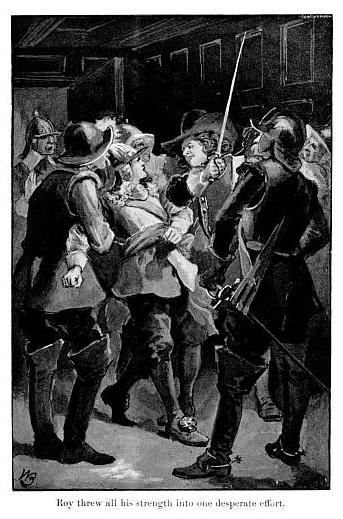
It was a vain effort; his arms were roughly grasped, and the cry he tried to raise was smothered by a hand pressed upon his mouth; while, by the light of a lantern raised on high, he saw the figure of the secretary, who stepped forward and took the sword wrenched from his hand.
“Thanks, my brave young castellan,” he said, mockingly. “We will take off your steel toys and gewgaws by-and-by. One word, though,” he said, in a fierce whisper: “make the slightest sound, and you will be thrown into the moat. Be silent, and we will recollect that you are only a boy, and treat you as one.”
For answer, Roy threw all his strength into one desperate effort, wrenched his head round so that it was clear of the hand pressed upon it, and shrieked out the one word—
“Judas!”
The word seemed to cut into the wretched traitor’s brain; and, raising the boy’s sword, he struck at him; but the blade glanced from the perfectly tempered helmet, and the next moment one who seemed to be an officer interposed.
“Prisoners are not treated like that, sir,” he said, sternly. “Which way now?”
“This,” said the secretary; and he led the way along the corridor, towards the door opening upon the court-yard.
Chapter Twenty Nine.
A Dark Night’s Deeds.
At that moment, when Roy would have surrendered his life to have rung out an alarm, the signal of danger, treachery, and hopeless disaster rang out in the form of a shot from the battlements overhead, and this was followed by another and another. But as the prisoner was hurried into the open air, armed men seemed to be gliding out of the darkness on all sides, their source, as far as he could make out in those agitated moments, being the bases of the towers. Then, as the trumpet rang out, fighting began all around the castle at once, not from the outside, but from within. Men had evidently crept silently up to the four towers, and gathered there from the corridors to which they had been admitted; and at the sound of the trumpet, a simultaneous attack was made, which, coming from the unguarded rear, and in tremendous, constantly increasing force, could not fail of being successful.
Roy stood there in the midst of his mother’s once pleasant garden, with the stars glinting over his head, and guarded by half-a-dozen troopers, listening to the clash of steel, and the firing going on all round where the little garrison made desperate efforts to maintain themselves. But they could not even grow stronger by joining, for the occupants of each tower were isolated and driven back as they tried to communicate with their officers, who, at the first alarm, tried to lead the men in the guard-room to the gathering point selected in case of emergency. Ben had just lit his lantern, expecting the coming of Roy at twelve, when the first shot came; and, shouting an alarm, he drew his sword to dash out, but only to be hurled back, the door-way of the guard-room being blocked by men; while, when the occupants of the chambers beneath the platforms of each tower tried to descend, they, too, in spite of desperate efforts, were driven upward by the constantly arriving enemies, who forced them on to the leads by the now useless guns.
Here, in each case, a desperate encounter went on, which Roy, with his blood running cold, was able to mentally picture, as he stood there listening to the wild shouts of the attacking party, the defiant cries of the garrison—the mere handfuls of men who tried to hold their own.
There was no more firing: all was being done with the keen-edged naked blade for a few minutes; and this was followed by a wild despairing cry from the gate tower, and directly after there was a dull, sickening crash which told that a man had been hurled from the parapet into the court-yard, where he lay never to move again.
The shock of this was succeeded by others nearly as terrible, as the struggle went on at the tops of the different towers; and cry after cry arose, followed by heavy splash after splash, which, Roy interpreted rightly, meant that the victors were driving the defenders over the battlements into the moat, to sink or swim for life as they could.
A mad feeling of rage and despair seized upon the boy as he heard all this, and he struggled desperately with his captors in his endeavours to escape, and try to aid the poor fellows fighting to the death in their vain efforts to defend the place.
Vain, too, were his efforts; for a couple of men held him while others wrenched his arms behind his back, and tearing off his gay scarf, bound his elbows so tightly together that he could not stir, but had to listen helplessly to the yells and despairing cries that arose towards the silent vault of heaven.
It seemed to Roy like an hour of horror, during which he was listening to what seemed to be the massacre of the men, every one of whom he looked upon as a friend. But it was only a matter of a few minutes at the most, before a shout rang out from the top of the gate tower, to be answered with a burst of wild “hurrahs” from the four corners, and the ramparts as well; for the clashing of swords, the yells of rage, and the sounds of fierce and desperate struggles going on had ceased.
Roy’s despair was at its height; he knew that the castle was taken, and its defenders killed, hurled into the moat, or captive.
But the boy’s sinking heart gave one leap, for he knew that the flickering fire of defence blazed up in one spot, and that was in the guard-room, where he calculated that there must be twelve or fourteen men, with Ben Martlet, Farmer Raynes, and the corporal.
He was nearly right to a man. There were, including their officers, twelve men penned up in the big stone chamber, where they had plenty of arms and ammunition. The others had their quarters in the five chambers in the towers, and were stationed as sentinels. All these had been accounted for, save the wounded men in hospital.
And as Roy listened to the hurrying tramp of feet, there was gathering silence on the ramparts, while around him, in the court-yard, hundreds of men were united and drawn up in line.
Then, in the darkness beneath the gate-way, Roy heard a commanding voice call upon the men in the guard-room to surrender.
“What?” came out clearly in a harsh, snarling voice, which Roy hardly knew as Ben’s. “Do what?”
“Surrender, my man! The place is taken.”
“Yes, by cowardly treachery, Ben,” yelled Roy, desperately. “Don’t give in. Fight to the last.”
A man came hurrying up, and the secretary, fierce with passion, stood before him.
“If this boy dares to speak another word, ram a gag in his mouth.—No, not yet.—Here, bring him up to the gate.”
Roy was half pushed and dragged to the great archway, and, as he reached it, the clock chimed the quarter after midnight.
“Now, general,” cried Pawson, “we’ll have them out. It’s not worth while to waste good men’s lives to tear a set of mad rats out of their hole.”
“Well, get them out,” said the same commanding voice, and in the officer a short distance from him, Roy recognised the one he had met with the flag of truce.
“Now, then, if you value your life,” snarled Pawson in the boy’s ear, “order those fools to come out before we blow them to pieces with a keg of powder. Do you hear? Come forward and speak!”
Roy felt a fierce desire to spit in the traitor’s face, but he mastered himself and stepped forward.
“Ah, you’ve come to your senses, then,” said Pawson. “Lucky for you, my popinjay. Now, then, tell them to surrender.”
“Why?” said Roy, spitefully. “They don’t know what it means.”
“Speak!” cried Pawson; and he pricked the lad with the point of his sword.
Roy in those terrible moments had to fight hard to be dignified, as he felt he ought to be, before the enemy; but the desire was strong upon him, when he felt a slight prick in the side from the keen point of the sword, to turn round and kick his aggressor with all his might.
Then he spoke.
“Sergeant Martlet, corporal, Farmer Raynes, all of you, I’m a prisoner, and can’t help myself. There are two or three hundred men here. Can you hear me?”
“Ay, ay, sir; go on,” cried Ben.
“They bid me tell you to surrender. What do you say?”
“Let ’em come and make us. God save her ladyship and the king!”
“Hurrah!” came rolling back from nearly a dozen lusty throats, and was followed by a shout from Ben.
“Get back, Master Roy; we’re going to fire.”
“Then fire,” cried Roy. “Never mind me now.”
Another cheer followed this; and there was a rattling noise which Roy interpreted, for he knew that the men in the guard-room had seized the pikes from the rack, and that a bristling hedge of steel was being formed in the door-way.
Just then the officer in command stepped forward.
“Silence there!” he cried, in a loud clear voice. “Listen to me, my men. The castle is taken, and I have four hundred men here. You are the only defenders left.—Sergeant Martlet, I suppose you are an old soldier, and if so, you know this boy’s words are madness. Enough men have perished, and I should be sorry to add your party to those who have made so brave a defence. Come, you have all done your duty, and your case is hopeless; surrender, and you shall suffer no harm.”
“When my captain tells me—not before.”
“Well spoken, and like a brave man,” said the officer; and he turned to Roy.
“Now, captain,” he said, and there was a touch of sarcasm in his voice, “you don’t want those stout fellows shot down, or smothered like rats in their holes. Tell them to give up their arms and come out.”
“To a set of cowards who attacked us as you did with the help of that treacherous dog!” cried Roy, passionately. “No!”
“Hurrah!” was shouted from the guard-room door and Farmer Raynes roared out:
“Well said, Master Roy; we’ll beat ’em yet.”
“Take that boy away,” cried the officer; and Roy was dragged to one side, where he heard the speaker again bid the party surrender; but only received a shout of defiance in reply.
A few short, sharp orders followed; and Roy quivered with passion as he saw from the brightening sparks that a party of men who tramped forward were blowing the matches of their firelocks.
An order followed, and a ragged volley was fired in at the door, which was answered by a cheer, and directly after by half-a-dozen shots and some confusion among the attacking party, for two men staggered back and fell groaning upon the stones.
The officer stamped his foot.
“Pikes and swords,” he cried; and in obedience to his orders a little column of a score of men dashed forward and tried to enter, thrusting in their pikes; and as many as could get to the door striving desperately, but only to be beaten back, and their discomfiture increased by a few more shots.
The attack was resumed with fresh men again and again, but the defenders fought desperately, and in every case the attacking party were driven back with several men badly wounded.
“Block the place up and starve them out,” said Pawson.
“No,” said the officer sternly. “The work must be done at once. Powder,” he cried to a couple of men near him, and a party marched off.
After a short delay, during which Roy looked vainly round for the secretary, the latter appeared again with the men, one of whom bore a keg. To this a piece of fuse was attached ready for lighting, and the officer walked to Roy’s side.
“Look here, youngster,” he said. “I shall stand at nothing to complete the reduction of this nest. You see that keg of powder. If these men do not surrender at once, I shall treat them as desperate vermin and blast them out or bury them, with perhaps half the tower upon their heads. It rests with you whether I shall kill a dozen or so of brave men or spare them. Which is it to be?”
Roy was silent.
“Come,” said the officer, “I want to be merciful now. You are Sir Granby Royland’s son. He is a brave soldier, though mistaken in defending a tyrant. I tell you that when a cause is hopeless he would act as I ask you to do. Now you have well proved your courage, and you spoke before in the rage of defeat. Speak now as a brave officer who would not willingly sacrifice his men. What do you say?”
Roy said nothing, for his heart swelled with emotion, and the words would not come. The officer came closer, so that none other could hear.
“In God’s name, boy,” he whispered, “don’t force me to do this brutal act; I ask you as the son of a brave soldier. Tell them to surrender now.”
The way in which these words came to Roy’s ear achieved that which no threats or insult would have done. It was an enemy speaking, but something told him that he was a brave soldier too; and without another word Roy stepped up to the door-way, from whence a mistaken shot might have laid him low.
The officer grasped this, and shouted loudly—
“Within there! Don’t fire!”
It was only just in time, for half-a-dozen muskets were presented.
The next moment Roy’s voice rang out clearly:
“Sergeant Martlet, corporal, Raynes, all of you, we have done our duty, and it is hopeless to fight longer. You are the only men left. To resist is to give all your lives for nothing. March out and throw down your arms.”
A groan rose from within, and a figure came to the door-way.
“Don’t say that, Master Roy,” cried Ben, hoarsely. “Couldn’t we do it if we held out?”
“No; they will blow the place up. The powder is waiting. I am your captain; I order you to surrender now.”
“Master Roy! Master Roy!” cried the old soldier in a piteous voice; “it was no doing of mine. I was on the alert. Don’t think it was any fault of mine.”
“Fault of yours, Ben?” cried Roy. “No, nor mine neither.”
“But how did they get in, sir?”
“By the secret passage that we could not find.”
“But how? Where can it be?”
“I’ve been thinking, Ben. I don’t know for certain; but it must open into Master Pawson’s room.”
“And he let ’em through?”
“Yes; filling the corridors silently with troops while I slept.”
“The traitor! Then that was the signal, boy. Oh, my lad, my lad, why didn’t I kill him when I thought it must be he? What about repairing the stone gallows now?”
“I—don’t understand you.”
“The lowering of the flag, sir—the lowering of the flag.”
“Yes,” said the officer, who had advanced to them unobserved in the gloom of the archway; “that was the signal, sergeant. You were betrayed from within. Step out now with your men, like the brave fellow you are. Give me your hand; and let me tell you that I don’t believe I could have taken the place without.”
“Am I to surrender, Master Roy?” said the old fellow, bitterly.
“Yes, Ben; it is all over now.”
The hilt of a sword was thrust out as the old soldier held it to the officer by the blade.
“Shake hands with that, sir,” he said, bitterly. “I’m a king’s man still.—Forward!”
This to his brave companions; and as they marched slowly out and gave up their arms, a tremendous roar arose from all assembled in the court-yard.
It was no derisive cry, no jeer at the conquered, but a full-throated cheer of admiration for the brave little party, blood-stained, bandaged roughly, three of them hardly able to keep their feet; and Roy’s heart once more swelled within him in spite of his despair, for he noticed in the gloom that the officer in command took off his helmet as the men marched by into the court; and then, as he replaced it, he said quietly to Roy—
“All this is not necessary, sir.—Quick, one of you; untie this gentleman’s hands.”
For the first time that night, Roy felt giddy and sick with pain. But he roused himself directly, for Master Pawson came up, and spoke quickly in a low voice to the officer, who replied coldly, and with a ring of contempt in all as he said, loudly—
“Of course, sir,” he said, “in some things, by the terms of your bargain, you are master here of the place and the estate. All that the Parliament desires is the destruction of the castle as a stronghold; but as to the garrison, that is another thing. We shall hold the place for a time, and while I await further orders the prisoners will be my charge.”
He turned to give some orders, and the secretary turned to Roy.
“Yes,” he said, “I am master here now of everything; so go and take off all that tawdry rubbish. You will never make a soldier, and I shall tame down all this bullying haughtiness. You never thought my day would come when I was forced to put up with the insults and jeers of a miserable cub of a boy. But every man has his day. Your party has gone down at last, and mine is in power. Ah, you may pretend not to hear me, and that you treat everything I say with contempt! Judas, am I, because I saved bloodshed by a diplomatic stroke? Well, we shall see. You’ll come cringing to me soon.”
“When my father returns, and, if you have not already been hung for a traitor, he punishes you as you deserve. Shall I cringe to you, then?”
“Your father,” said Pawson, mockingly. “Your proud swashbuckling father is dead,—killed as he deserved, with scores of his fighting bullies. You may look to me as your father now. Your mother and I thought it better to end this sham defence at once. Hah! does that sting you? I thought I should manage it at last. Yes, she thought with me. A fine, handsome woman still, Roy, and a clever one, though she did pet and spoil her idiotic cub of a son. But there, I forgive her, and we understand each other fully now. Ha, ha! I thought that would touch you home!”
Roy nearly staggered as he heard these words, and the next moment he would have flung himself at the traitor’s throat; but just then a friendly hand was laid upon his shoulder, and the officer said—
“I have given orders for your wounded men to be seen by our doctor. Meanwhile, you had better come with me.”
He passed his arm through Roy’s, and turned his back on Pawson, marching the lad towards the private apartments of the castle; while the traitor stood gazing after them, stung as deeply as his victim now in turn.
Chapter Thirty.
“And all through my Neglect.”
Seeing how completely prostrated his companion seemed to be, the officer turned to him as they reached the entrance to the private apartments and said, quietly—
“Perhaps you will show me a room where I and my officers can have some refreshment. We are starving. You can tell your servants that they have nothing to fear. I will see that they are not insulted; and then perhaps you would prefer to be alone.”
“Thank you,” faltered Roy, speaking in a strange, dazed way, as if he were in a dream.
“Come, be a man, sir,” said the officer, rather sternly. “It is the fortune of war. A young soldier must not lose heart because he finds he is a prisoner. There, meet me at breakfast-time, and you and I will have a chat together. But listen first before you go: do not attempt any foolish, reckless pranks in the way of trying to escape. I tell you honestly, the castle will be so guarded and watched that it would be madness.—By the way, where are Lady Royland’s apartments?”
Roy pointed to a door.
“Tell her when you see her that there is nothing to fear. But Master Pawson told me that he would place guards over her.”
Roy drew a deep breath but said nothing, merely contented himself with pointing out the dining-room and library to his conqueror. Then he stopped at his own door.
“Your room? Very well; take my advice, and have a few hours’ sleep,” said the officer, opening the door, entering, and looking round by the light of the dim lamp. “Where does that big window open upon?”
“The garden,—the court-yard.”
“And that narrow slit?”
“Upon the moat.”
“Hah! Good-night to you.”
He strode out, and Roy stood where he had been left, with his head throbbing as if it would burst from the terrible thoughts that invaded it.
Directly after he heard the tramp of heavy feet, a few words delivered in an imperious tone, and there was the heavy rap, rap of a couple of musket butts upon the oaken floor, telling him that guards had been placed at his door. His despair now knew no bounds, for he had determined to go straight to his mother’s chamber, and ask her if Master Pawson’s words were true. Now all communication was cut off, for he was a prisoner.
But his agony had reached its greatest height, and in a short time he grew calmer; for light came into his darkened brain, and he told himself he was glad that he had not been able to go and insult his mother by asking such a question.
“It is horrible!” he said to himself; “and I must have been mad to think such a thing possible. Liar! traitor! wretch! How could I think there was the faintest truth in anything he said!”
Utterly exhausted, he took off his armour and laid it and his sword-belt and empty scabbard aside.
“Done with now,” he said, bitterly; and he sank upon the couch to try and think whether he was to blame for not searching more for the passage leading out beyond the moat.
“But I did try, and try hard,” he muttered. “No; I could not foresee that the man chosen by my father would betray us. It was my duty to trust him. It was not my fault.”
Through the remainder of that night he sat there thinking. Now listening to the tramp of the sentries at his door and overhead upon the ramparts, starting from time to time as he heard them challenge, and the word passed on, till it died away; now thinking bitterly of the ease with which they had been beaten, and of the men who must have fallen in their defence. Then, from utter exhaustion, his eyes would close, and consciousness leave him for a few minutes as he sank back.
But he never thoroughly went to sleep, the act of sinking back making him start into wakefulness, bitter and angry with himself for these lapses, and in every case springing up to pace the room.
“Poor mother! What she must have suffered through it all, and I scarcely gave her a thought. That wretch must have locked her in her room or she would certainly have been seeing to the wounded.”
The clock chimed and struck, and chimed and struck again, with Roy counting the long lingering hours as they went on, for he was longing for the day to appear, hopeless as the dawn would be. But he wanted to see the general, to beg that he might go to Lady Royland; and the time when he would meet him seemed as if it would never come.
But at last the faint light began to dawn through the window, and, hot and feverish, he threw it open, to look out across the court and over the eastern ramparts at the coming signs of day, which grew brighter and clearer till the sentinels upon the terrace-like place, and the crenellations, stood out of a purply black plainly marked against the sky.
There were at least twenty men marching to and fro where at the most he had had two; and he groaned in spirit for a time as he went over again the occurrences of the past night. But far on high the sky began to be dappled with orange and golden clouds, which increased in brightness till the whole east was one glory of light, bringing with it hope; while the soft cool breeze he drank in gave him fresh courage and the strength to act the part he had to play,—that of one too proud to be cast down, so that his men should speak of him ever after as his father’s son.
“Better than being in one of the dungeons,” he thought, as he indulged in a good bathe, and dressed himself simply; after which he carefully hung up his armour, with the helmet above, and longed for his sword that it might occupy its old place.
“Better be lying rusting in the moat than resting in such hands as his,” he muttered.
After spending some time at the window gazing across the court at the windows of the long chamber used for the hospital, and at the opening to the stabling down below, he fell to wondering as to how the poor fellows who were wounded had passed the night; and this brought a shudder, and he ran across to the little slit in the thickness of the wall to open the tiny casement, and look down at the moat, peering to right and left with starting eyes in expectant dread of seeing some ghastly sign of the horrible struggle that had taken place upon the tower platforms. But the lilies floated peacefully enough, and displayed their great white cups, and the fish played about beneath the leaves, making rings in the smooth patches where they rose—rings which spread and spread till they slightly swayed the reeds and rushes at the edge.
But he saw no dead white face gazing up at the sunlit heavens, and, search the waters as he would, there was not a sign to send a shudder through his frame.
All at once there was the tramp of feet overhead, and he went back to the other window, where he stood and looked across, and on the eastern rampart saw the guard relieved, the sun burnishing the men’s steel caps; and soon after, as he watched, wondering what the day would bring forth, he heard the sentries at his door relieved in turn.
This ended, the echoes of the place were awakened by the blast of a trumpet, and the boy stood looking in wonder at the strength of the force drawn up in the court, and saw fully half of them march towards the great gate-way. Then he heard the drawbridge lowered, and the heavy, hollow tramp of the men as they passed across. Soon after, the neighing of horses reached his ears, and then came the beating of hoofs on the bridge, raising echoes from the walls at the other end, as a troop rode in and were drawn up on either side—sturdy-looking fellows, who sat their horses well, as Roy was fain to grant in spite of Ben Martlet’s disparaging remarks.
He was still watching the troopers and their horses, when he heard a movement outside his door as if the sentries had presented arms; and directly after the general strode into the room, with his stern, thoughtful countenance lighting up as he encountered Roy’s frank, bold eyes.