AMERICAN INDIAN LEGENDS
Reading edition
LITTLE SCAR-FACE
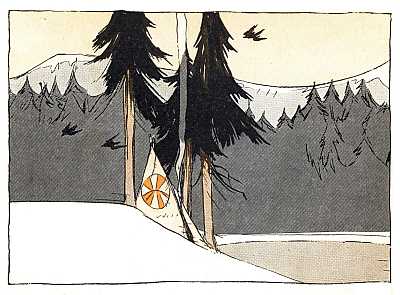
Among the pine trees, by a quiet lake, stood the wigwam of a great Indian whose name was Big Moose. His sister kept the wigwam for him, and took care of all that was his. Her name was White Maiden.
No one but White Maiden had ever seen Big Moose. The Indians could see the marks of his feet in the snow, and they could hear his sled as it ran over the ice, but they could not see him.
It was said that this was because they were not kind and good.
White Maiden was kind and good, and she could always see him.
One day White Maiden called all the Indian maidens and said:
"My brother, Big Moose, wishes to marry, but he will not marry any one who cannot see him, and only those who are good can see him."
All the Indian maidens were glad when they heard that Big Moose wished to marry. They had all heard how brave and strong he was, and what a great hunter he was, and how kind and good and wonderful he was, in every way.
Each wished that he would choose her for his wife, and each was very sure that she could see him.
For a long time after that the Indian maidens would go down to the wigwam of Big Moose, by the lake, and try to see him. Every evening some of them would go at sunset and sit and watch for him.
When he came they would hear him, and the door of the wigwam would be opened, and he would go in, but they could not see him.
At the other end of the village lived an old Indian with his three daughters. The two older daughters were not kind to the youngest one. They made her do all the work and gave her little to eat.
The oldest sister had a very hard heart. Once, when she was angry, she threw a pail of hot ashes at the youngest sister.
The child's face was burned, and she was called Little Scar-Face.
One day in early winter, when the first white snow lay on the ground, the oldest sister said:
"Come, Scar-Face, bring me my shell beads and help me to dress. I am going to marry Big Moose."
Little Scar-Face brought the beads and put them on the oldest sister and helped her to dress.
At sunset the oldest sister went down to the wigwam by the lake. White Maiden asked her to come in. By and by they heard Big Moose. They could hear his sled running through the snow.
White Maiden took the sister to the door of the wigwam and said, "Can you see my brother?"
"Yes, I can see him very well," answered the other.
"Then look and tell me what the string of his sled is made of," said White Maiden.
"It is made of moose skin," said the sister of Little Scar-Face.
"No, it is not made of moose skin. You have not seen my brother. You must go away," said White Maiden.
So she drove out the oldest sister. Next day the next to the oldest sister said to Little Scar-Face:
"Come, Scar-Face, bring me my shell beads and help me to dress. I am going to marry Big Moose."
Little Scar-Face brought the beads and helped her sister to dress.
In the evening, just at sunset, the sister went down through the pine trees to the lake.
"Come in," said White Maiden.
Soon they heard Big Moose coming.
"Can you see my brother?" asked White Maiden.
"Yes, I can see him very well," said the other.
"Then what is his sled string made of?" asked White Maiden.
"It is made of deerskin," said the other.
"No, it is not made of deerskin," said White Maiden.
"You have not seen my brother. You must go away."
And she drove her out.
The next morning Little Scar-Face worked very hard. She built the fire and carried out all the ashes and brought in the wood and did everything that she could.
Then she said to her two sisters, "Sisters, let me take your beads. I too should like to find out if I can see Big Moose."
Her sisters laughed loud and long. They would not let her take their beads. No, indeed!
At last one of the sisters said she had an old broken string of beads that Scar-Face might take.
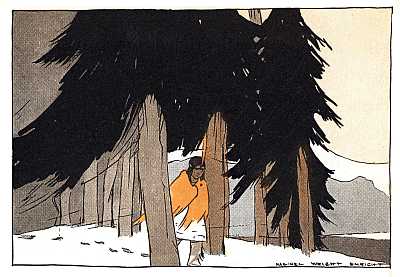
So Little Scar-Face took the old broken string of beads and tied it together and put it on. Then she made a queer little dress out of birch bark, and she washed herself all fresh and clean, and brushed her hair, and put on the dress and the old string of beads. So she went down through the village and the dark pine woods to the wigwam of Big Moose.
She was not a pretty child, for her face and hair were burned, and her clothes were very queer.
But White Maiden asked her to come in and spoke kindly to her. So she went in and sat down.
Soon she heard Big Moose coming.
White Maiden took her to the door of the wigwam and said:
"Little Scar-Face, can you see my brother?"
"Yes, indeed, and I am afraid, for his face is very wonderful and very beautiful."
"What is his sled string made of?" asked White Maiden.
"How wonderful! how wonderful!" cried Little Scar-Face.
"His sled string is the rainbow!"
Big Moose heard her and said, "Sister, wash the eyes and hair of Little Scar-Face in the magic water."
White Maiden did so, and every scar faded away, and the hair of Little Scar-Face grew long and black, and her eyes were like two stars.
White Maiden put a wonderful dress of deerskin and a string of golden beads on Little Scar-Face, and she was more beautiful than any of the other maidens.
And Big Moose made her his wife.
THE HUNTER WHO FORGOT
Once there was a great hunter who was very rich. He had many strings of shell money around his neck. The Indians call these shells wampum.
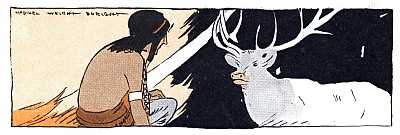
In the woods near his home lived a big white elk that used to come and talk to him. The elk told him what was right and what was wrong. The Great Spirit sent the elk to him.
When he obeyed the elk, he was happy and everything went well, but when he did not obey, he was not happy, and everything went wrong.
One day the elk said to him:
"You are too hungry for wampum. Look! your neck and shoulders are covered with long strings of wampum. Some of it belongs to your wife. You took it from her. You took some of it from other Indians and gave them deer meat that was not fit to eat. You are not honest."
The hunter was much ashamed, but he would not give back the wampum. He thought too much of it to give it back.
"I will give you enough wampum to fill your heart," said the elk, "but you must do just as I tell you. Will you do it?"
"I will do it," said the hunter.
"Go to the top of the great white mountain. There you will find a black lake. Across the lake are three black rocks. One of them is like the head of a moose.
"Dig in the earth before this rock. There you will find a cave full of wampum. It is on strings of elk skin. Take all you want.
"While you dig, twelve otters will come out of the black lake. Put a string of wampum around the neck of each of the otters and upon each of the three black rocks."
The hunter went back to the village. There he got an elk-horn pick and set out. No one knew where he went.
He made his camp that night at the foot of the great white mountain. As soon as it was light, he began to climb up the mountain side. At last he stood on the top, and there before him was a great hollow. It was so great that he could not shoot an arrow across it.
The hollow was white with snow, but in the middle was a black lake, and on the other side of the lake stood the three black rocks.
The hunter walked around the lake over the snow. Then he took the elk-horn pick and struck one blow before the black rock which looked like the head of a moose.
Four great otters came up out of the black lake and sat beside him.
He struck another blow. Four more otters came and sat behind him.
He struck again. Four more otters came and sat on the other side.
At last the pick struck a rock. The hunter dug it out, and beneath it was a cave full of wampum.
The hunter put both of his hands into the wampum and played with it. It felt good. He took out great strings of it and put them around his neck and over his shoulders.
He worked fast, for the sun was now going down, and he must go home.
He put so many strings of wampum around his neck and shoulders that he could hardly walk.
But he did not put any around the necks of the twelve otters, nor on the three black rocks. He did not give them one string—not one shell.
He forgot what the white elk had told him. He did not obey.
Soon it grew dark. He crept along by the shore of the big black lake. The otters jumped into it and swam and beat the water into white foam. A black mist came over the mountain.
Then the storm winds came, and the Great Spirit was in the storm.
It seemed as if the storm said, "You did not obey! You did not obey!"
Then the thunder roared at him, "You did not obey!"
The hunter was greatly frightened. He broke a great string of wampum and threw it to the storm winds, but the storm winds only laughed.
He broke another string and threw it to the thunder voices, but the thunder roared louder than before.
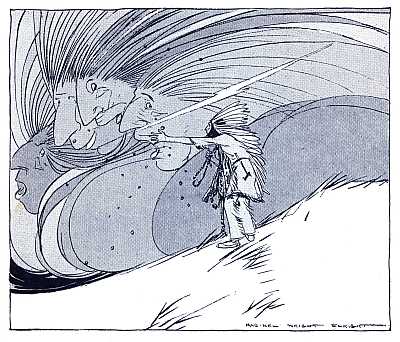
He threw away one string after another until all of them were gone. Then he fell upon the ground and went to sleep. He slept long.
When he woke up he was an old man with white hair. He did not know what had happened, but he sat there and looked at the great mountain, and his heart was full of peace.
"I have no wampum. I have given it all away. I am not hungry for it any more. I will go home," he said.
He could hardly find his way, for the trees had grown across the trail.
When at last he got home, no one but his wife knew him. She was now very old and had white hair like himself. She showed him a tall man near by, and said it was their baby.
The hunter looked at them.
"I have slept many moons," he said.
He lived among the Indians long after that and taught them much. He taught them to keep their word, and to obey the Great Spirit.
THE WATER LILY
One summer evening, many years ago, some Indians were sitting out under the stars, telling stories.
All at once they saw a star fall. It fell halfway down the sky.
That night one of the Indians had a dream about the star. It seemed to come and stand beside him, and it was like a young girl, dressed all in white.
She said, "I have left my home in the sky because I love the Indians and want to live among them. Call your wise men together and ask them what shape I shall take."
The Indian woke up and called all the wise men together.
Then he told them his dream.
The wise men said, "Let her choose what shape she will take. She may live in the top of a tree, or she may live in a flower, or she may live where she will."
Every night the star came down a little lower in the sky, and stood over the valley where the Indians lived, and made it very bright.
Then one night it fell down upon the side of the mountain and became a white rose.
But it was lonely on the mountain. The rose could see the Indians, but it could not hear them talk. So one day it left the mountain and came down into the plain and became a great white prairie flower.
Here it lived for a time. But the buffaloes and the other wild beasts of the prairie ran all around it and over it, and it was afraid.
One night the Indians saw a star go up from the prairie.
They knew that it was the prairie flower and they thought that it was going back into the sky.
But it floated toward them until it came over the lake that lay just beside them.
It looked down into the lake, and there it saw its shadow and the shadows of the other stars that live in the sky.
It came down lower and lower, and at last floated on the top of the water.
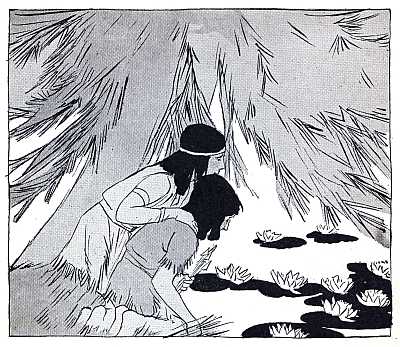
The next morning the lake was covered with water lilies.
"See! the stars have blossomed!" said all the children.
But the wise men answered:
"It is the white star and her sisters. They will stay with us."