Captain Mayne Reid (continued 2)
Reading edition
“Ef I don’t guide ye strait custrut into thar campin’-place ye may call ole ’Lije Orton blinder than the owls o’ a purairia-dog town. So git your things ready, boys; an’ kum right arter me!”
It was an invitation that needed no pressing. The hope of being revenged on the hated subchief of the Cheyennes—for deeds done either to themselves, their friends, or the comrades of their calling—beat high in every heart; and, in less than ten minutes’ time, every trapper staying at Saint Vrain’s Fort, with a half-score other hangers-on of the establishment, was armed to the teeth, and on horseback!
In less than five minutes more, they were hastening across the prairie with ’Lije Orton at their head, in search of the Yellow Chief.
They were only five-and-twenty of them in all; but not one of their number who did not consider himself a match for at least three Indians!
As for Black Harris, and several others of like kidney, they would not have hesitated a moment about encountering six each. More than once had these men engaged in such unequal encounters, coming out of them victorious and triumphant!
Twenty-five against fifty, or even a hundred, what signified it to them? It was but sport to these reckless men! They only wanted to be brought face to face with the enemy; and then let their long rifles tell the tale.
It was a tale to be told, before the going down of the sun.
Chapter Eleven.
Captors and Captives.
Once more in the gorge, where the young Cheyenne chief and his band had encamped, before making attack upon the emigrant caravan.
It is the day succeeding that event, an hour before mid-day, with a bright sun shining down from a cloudless sky. The stage is the same, but somewhat changed the characters who figure upon it, having received an addition of more than double the number. The Indians are there; but even they do not seem the same. From the quiet earnest attitude of an expeditionary band, they have been transformed into a crowd of shouting savages.
Foxes before the quarry was run down, they are now ravening wolves.
Some are carousing, some lying on the grass in a state of helpless inebriety; while others, restrained by the authority of their chief, have kept sober, and stand guard over their new-made captives.
Only a few are needed for this duty. Three sentinels are deemed sufficient—one to each group; for the prisoners have been separated into three distinct parties—holding places apart from one another. The negroes, men, women, and children, driven into a compact ring, occupy an angular space between two projections of the cliff. There, huddled together, they have no thought of attempting to escape.
To them their new condition of captivity is not so very different from that to which they have been all their lives accustomed; and, beyond some apprehension of danger, they have not much to make them specially discontented. The Indian who stands beside them, with the butt of his long spear resting upon the turf, seems to know that his guard duty is a sinecure.
So also the sentinel who keeps watch over the white women—five in all, with about three times as many children—boys and girls of various degrees of age.
There is one among them, to whom none of these last can belong. She is old enough to be a wife; but the light airy form and virginal grace proclaim her still inexperienced in marriage, as in the cares of maternity. It is Clara Blackadder.
Seated alongside the others, though unlike them in most respects, she seems sad as any.
If she has no anxiety about the children around her, she has grief for those of older years—for a father, whom but a few hours before she had seen lying dead upon the prairie turf, and whose grey hairs, besprinkled with blood, are still before her eyes.
It is his scalp that hangs from the point of a spear, stuck upright in the ground, not ten paces from where she sits!
There is yet another group equally easy to guard; for the individuals composing it are all securely tied, hand, neck, and foot.
There are six of them, and all white men. There had been nine in the emigrant party. Three are not among the prisoners; but besides the white scalp accounted for, two others, similarly placed on spears, tell the tale of the missing ones. They have shared the fate of the leader of the caravan, having been killed in the attack upon it.
Among the six who survive are Snively, the overseer, and Blount Blackadder, the former showing a gash across his cheek, evidently made by a spear-blade. At best it was but an ill-favoured face, but this gives to it an expression truly horrible.
A top belonging to one of the wagons has been brought away—the wagons themselves having been set on fire, out of sheer wanton wickedness; such cumbrous things being of no value to the light cavalry of the Cheyennes.
The single tilt appears in the camping-place, set up as a tent; and inside it the chief, somnolent after a sleepless night, and wearied with the work of the morning, is reclining in siesta.
Waboga, with the body-servant, keeps sentry outside it. Not that they fear danger, or even intrusion; but both know there is a spectacle intended—some ceremony at which they will be wanted, and at any moment of time.
Neither can tell what it is to be—whether tragic or comic; though both surmise it is not likely to be the latter.
The white men are not so fast bound, as to hinder them from conversing. In a low tone, telling of fear, they discuss among themselves the probability of what is to be done with them.
That they will have to suffer punishment, is not the question; only what it is to be, and whether it is to be death. It may be even worse: death preceded by torture. But death of itself is sufficient to terrify them; and beyond this their conjectures do not extend.
“I don’t think they’ll kill us,” said Snively. “As for myself, they ought to be satisfied with what they’ve done already. They could only have wanted the plunder—they’ve got all that; and what good can our lives be to them?”
“Our lives, not much,” rejoins a disconsolate planter. “You forget our scalps! The Indians value them more than anything else—especially the young braves, as these appear to be.”
“There’s reason in that, I know,” answers the overseer. “But I’ve heard that scalps don’t count, if taken from the heads of prisoners; and they’ve made us that.”
“It won’t make much difference to such as them,” pursues the apprehensive planter. “Look at them! Three-fourths of them drunk, and likely at any minute to take the notion into their heads to scalp us, if only for a frolic! I feel frightened every time they turn their eyes this way.”
Of the six men, there are four more frightened when the carousing savages turn their eyes in another direction—towards the group of white women. One of these is a widow, made so that same morning, her husband at the time lying scalped upon the prairie—his scalp of luxuriant black curls hanging before her face, upon the bloody blade of a lance!
Three others have husbands among the men—the fourth a brother!
The men regarding them, and thinking of what may be their fate, relapse into silence, as if having suddenly bet speech. It is the speechlessness of despair.
Chapter Twelve.
A Novel Mode of Punishment.
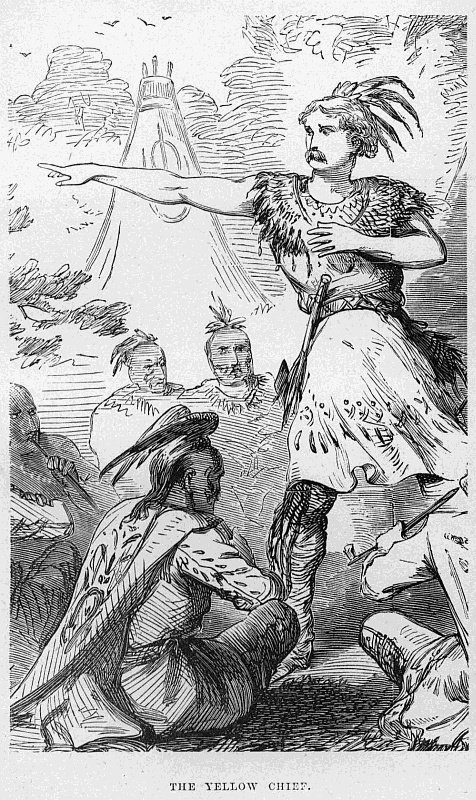
The sun was already past the meridian when the young Cheyenne chief, coming out from under the wagon tilt, once more showed himself to his captives. Since last seen by them there was a change in his costume. It was no more the scant breech-cloth worn in war; but a gala dress, such as is used by savages on the occasion of their grand ceremonies. His coat was the usual tunic-like shirt of the hunter, with fringed cape and skirt; but, instead of brown buckskin, it was made of scarlet cloth, and elaborately adorned by bead embroidery. Underneath were fringed leggings, ending in moccasins, worked with the porcupine quill. A Mexican scarf of crimson China crape was around his waist, with its tasselled ends hanging behind. On his head was a checkered Madras kerchief, tied turban fashion, its corners jauntily knotted on one side; while above the other rose a “panache” of bluish plumes, taken from the wings of the “gruya,” or New Mexican crane, their tips dyed scarlet.
Stuck behind his sash was a glittering bowie-knife, that might once have been the property of a Kansas regulator; and there were also pistols upon his person, concealed under the white wolf-skin robe that still hung toga-like from his shoulders. But for the emblematical painting on his face, freshly touched up, he might have appeared handsome. With this he was still picturesque, though terrible to look upon. His size—he was full six feet—gave him a commanding appearance; and his movements, easy and without agitation, told of a commanding mind. His followers seemed to acknowledge it; as, on the moment of emerging from the tent, even the most roysterous of them became quiet over their cups.
For some minutes he remained by the open end of the tent, without speaking to any one, or even showing sign that he saw any one around him. He seemed occupied with some mental plan, or problem; the solution of which he had stepped forth to seek.
It was in some way connected with the tiny waterfall, that fell like a spout from the cliff; for his eyes were upon it.
After gazing at it for some time, they turned suddenly up to the sun; and as if seeing in it something to stimulate him, his attitude became changed. All at once he appeared to arouse himself from a lethargy, like one who has discovered the necessity for speedily entering upon action.
“Waboga!” he called, addressing himself to the Choctaw.
The traitor was not one of the intoxicated, and soon stood before him.
“Take some of the young men. Cut down a tree—one of the pinons yonder. Lop off the branches, and bring it here.”
Waboga went about the work, without saying a word; and a couple of tomahawks were soon hacking at the tree.
It was but a slender one, of soft pine wood; and shortly fell. Then, lopped and topped, its trunk was dragged up to the spot where the chief stood, and where he had remained standing ever since issuing the order.
“It will do,” he said, looking at the felled piñon, as if satisfied of its being suitable for his purpose. “Now take it to the fall there, and set it up; behind the jet of the water, so that it just clears it. Sink a deep hole, and see you stake it firmly.”
The hole was sunk; the tree set upright in it; and then firmly wedged around with stones. The tiny stream, coming down from the cliff, fell vertically in front, according to the directions given, just clearing its top.
By further instructions from the chief, a stout piece of timber, taken from one of the limbs, was lashed transversely to it, forming a cross, about five feet above the ground.
During all these preparations no one knew for what they were intended. Even the Indians employed could not tell, and Waboga was himself ignorant.
The captives were equally at a loss to make out what was meant; though they surmised it to be the preliminary to some mode of punishment intended for themselves.
When they saw the erection taking the form of a crucifix, this of itself was suggestive of torture; but observing also the strange spot in which it was being set up, there began to glimmer on their minds a shadowy thought of its kind. Snively and one or two others—Blount Blackadder among them—in the upright post and its cross-piece, with the water-jet falling in front, were reminded of a mode of punishment they had themselves too often inflicted.
“I wonder what they can be after wantin’ with that,” said one of the planters to his fellow-captives.
None of them made reply. The same thought was in the minds of all, and it was terrifying them beyond the power of speech.
The interrogatory was answered in a different way. About a dozen of the Indians, who had been called up around the chief, appeared to receive some directions from him. They were given in the Cheyenne tongue, and the captives could not make out what was said; though they could tell by the attitude and gestures of the chief Indians it related to themselves.
They were not long before discovering its object. Five or six of the young braves, after listening to the commands of their leader, turned their backs upon him, and came bounding on to the spot where the prisoners lay. They appeared in high glee, as if some sport was expected; while the hostile glance from their fierce eyes proclaimed it to be of a malignant kind—some ceremony of torture. And so was it.
It could scarce have been by accident that Blount Blackadder was the first victim selected. He was behind the others, and half crouching in concealment, when he was seized by two of the painted savages; who, jerking him suddenly to his feet, undid the fastenings around his ankles.
It was not to set him free; only to save them the trouble of carrying him to the spot where he was to afford them a spectacle. And it was of the kind at which he had himself often assisted—though only as a spectator.
His fellow-prisoners had no longer a doubt as to the torture intended for him, and in store for themselves. If they had, it was soon settled by their seeing him conducted forward to the spot where fell the tiny cataract, and forced under it—with his back towards the tree-trunk.
In a few seconds, his ankles were bound around its base. Then his arms, set free, were pulled out to their full stretch, and fast lashed to the transverse bar, so that his attitude resembled that of one suffering crucifixion!
Something still remained to be done. A raw-hide rope was passed around his throat and the tree-trunk behind, to which it was firmly attached. His head was still untouched by the water-jet, that fell down directly in front of his face.
But he was not to remain thus. As soon as his position seemed satisfactory to the Indian chief, who stood examining it with a critical eye, and, so far as could be judged through the paint, with a pleased expression upon his face, he called some words of direction to a young warrior who was near. It was obeyed by the Indian, who, picking up an oblong block of stone, stood holding it above the head of him who was bound to the cross.
“So, Blount Blackadder!” cried the Cheyenne chief, no longer speaking in the Indian tongue, but in plain understandable English. “It’s your turn now. Give him a double dose!”
As he spoke, the Indian, who held the stone, sogged it down between the back of Blackadder’s neck and the trunk of the tree. Wedged there, it brought his head into such a position, that the stream of water fell vertically upon his crown!
The words pronounced by the Cheyenne chief produced a startling effect. Not so much upon him, who was transfixed under the jet; though he heard them through the plashing water, that fell sheeted over his ears.
For he well knew the purpose for which he had been so disposed, as well as the pain to be endured; and he was already in a state of mind past the possibility of being further terrified.
It was not he, but others, who heard them with increased fear; others who knew them to be words of dread import.
Snively started as they fell upon his ear; and so to Clara Blackadder. She looked up with a strange puzzled expression upon her countenance.
Give him a double dose!
What could it mean? Snively had heard the order before—remembered a day on which he was commanded to execute it!
And the words, too, came from the mouth of an Indian chief—a painted savage—more than a thousand miles from the scene that recalled them. Even among the blacks, huddled up in the rocky embayment, there were faces that expressed surprise, some the ashy pallor of fear, as if from a stricken conscience.
“Give him a double dose! Gollamity!” exclaimed one. “What do de Indyin mean? Dat’s jess wha’ Massa Blount say five year ago, when dey wa’ gwine to pump on de head ob Blue Dick!”
More than one of the negroes remembered the cruel command, and some also recalled how cruelly they had sneered at him on whom the punishment was inflicted. A speech, so strangely recurring, could not help giving them a presentiment that something was nigh at hand to make them repent of their heartlessness.
They, too, as well as Snively, looked towards the chief for an explanation, and anxiously listened for what he might next say.
For a time there was no other word to make the matter clearer! With his wolf-skin robe hanging from his shoulders, the chief stood contemplating the punishment he had decreed to his captive; a smile of exultation overspreading his face, as he thought of the pain his white victim was enduring.
It ended in a loud laugh, as he ordered the sufferer to be unloosed from his lashings; and dragged clear of the cross.
And the laugh broke forth again, as Blount Blackadder, half drowned, half dead from the aching pain in his skull, lay prostrate on the grass at his feet.
Then came from his lips an additional speech, the young planter might not have heard, but that smote upon the ears of the overseer with a meaning strangely intelligible.
“It’ll do for the present. Next time he offends in like manner, he shall be pumped upon till his thick skull splits like a cedar rail!”
Chapter Thirteen.
Making a Bolt.
At the new and still strange speech, Snively started again, and Clara Blackadder looked up with a yet still more puzzled expression; while among the blacks there ran a murmur of interrogatories and exclamations of terror.
It was on the overseer, however, that the words produced the strongest impression. He was a man of too much intellect—or that ’cuteness that passes for it—to be any longer in doubt as to the situation in which he and his fellow-captives, were placed. A clear memory, coupled with an accusing conscience, helped him to an explanation, at the same time telling him of a danger far worse than being captive in the hands of hostile Indians. It was the danger of death, with torture for its prelude. Both now appeared before his imagination, in their most horrid shape—an apprehension of moral pain, added to the physical.
He glanced at his fastenings; examined them, to see if there was any chance of setting himself free. It was nor the first time for him to make the examination; but never more earnestly than now.
The raw-hide thong, wetted with the sweat of his body—in places with his blood—showed signs of stretching. By a desperate wrench he might get his limbs clear of it!
What if he should succeed in untying himself?
His liberty could only last for a moment—to be followed by a renewal of his captivity, or by a sudden death?
Neither could be worse than the fate that now seemed to be awaiting him, and near? Even death would be preferable to the agony of apprehension he was enduring!
One more glance at his fastenings, and along with it the determination to set himself free from them.
And, without reflecting further, he commenced a struggle, in which all his strength and cunning were concentrated.
The raw-hide ropes yielded to the superhuman effort; and, clearing himself of their coils, he sprang out from among his fellow-prisoners; and off at full speed towards the prairie!
He did not continue far in the direction of the outward plain. With no other hope of getting clear, than that held out by mere swiftness of foot, he would not have made the attempt. With the Indians’ horses standing near, ready to be mounted at a moment’s notice, the idea would have been simply absurd. Even before he had made a half-score strides, several of the savages were seen rushing towards their steeds to take up the pursuit, for the prairie Indian never thinks of following a foe upon foot.
Had Snively kept on for the open plain, the chase would have been a short one. He had determined on a different course. While lying on the ground, and speculating on the chances of getting away, he had noticed a ravine that ran sloping up towards the summit of the cliff. Trees grew thickly in it. They were dwarf cedars, bushy and umbrageous. If he could only get among them, screened by their foliage, he might succeed in baffling his pursuers. At all events, their arrows and bullets would be aimed with less likelihood of hitting him.
Once on the mountain slope above, which was also forest-clad, he would have at least a chance for his life.
He was a man of great strength, swift too of foot, and he knew it. It was his knowledge of the possession of these powers that gave him hope, and determined him on the attempt he had made.
It was not so unfeasible, and might have succeeded, had his only pursuers been they who had taken to their horses.
But there was one who followed him on foot, of equal strength, and swifter of foot than he. This was the Cheyenne chief. The latter had noticed the prisoner as he gave the last wrench to the ropes, and saw that he had succeeded in setting himself free from their coils. At the same instant that Snively sprang out from among his fellow-prisoners, the chief was upon the hound after him, with his long spear poised and ready for a thrust. He had thrown off his wolf-skin cloak to obtain freedom of movement for his arms.
Snively, as he had intended, turned abruptly to one side, and struck up the ravine, with the chief close following him. Those who had taken to their horses were for the time thrown out of the chase.
In a few seconds, both fugitive and pursuer had entered the gorge, and were lost to view under the spreading fronds of the cedars.
For a time those remaining below could not see them, but by the crackling of the parted branches, and the rattle of stones displaced by their feet, it could be told that both were still struggling up the steep.
Then came loud words, proclaiming that the pursuer had overtaken the pursued.
“A step further, you accursed nigger-driver! one step further, and I’ll run my lance-blade right up through your body! Down again! or I’ll split you from hip to shoulder.”
Although they saw it not from below, a strange tragical tableau was presented at the moment when these words were spoken.
It was the chief who had uttered the threat. He was standing upon a ledge, with his spear pointed vertically upward. Above him, hanging from a still higher ledge, with one hand grasping the edge of the rock, was the long lathy form of the Mississippian overseer, outlined in all its ungainly proportions against the façade of the cliff!
He had been endeavouring to climb higher; but, not succeeding, was now overtaken, and at the mercy of his savage pursuer.
“Down!” repeated the latter, in a voice that thundered along the cliffs. “Why do you want to run away? You see I don’t intend to kill you? If I did, how easily I might do it now. Down, I say!”
For a moment Snively seemed to hesitate. A desperate effort might still carry him beyond the reach of the threatening spear. Could he be quick enough?
No. The eye of his enemy was too watchful. He felt, that on turning to make another attempt, he would have the iron blade, already red with his own blood, thrust through his body.
Another thought came into his mind. Should he drop down, grapple with the savage, and endeavour to wrest the weapon from his hands? He now knew whose hands held it.
It was a design entertained but for a moment. Ere he could determine upon its execution, half a dozen of the Indians, who had close followed their chief, came rushing up the ravine, and stood upon the ledge beside him.
Exhausted by long hanging, with but slight foothold against the cliff, Snively’s gripe became detached from the rock; and he fell back into their midst; where he was at once seized and tied more securely than ever.
“Drag him down!” commanded the Cheyenne chief, speaking to his followers. And then addressing himself to the overseer, he continued: “When we get below, Mr Snively, I’ll explain to you why you’re not already a dead man. I don’t wish that; I want to have you alive for awhile. I’ve a show for you, as well as the others—especially those belonging to old Blackadder’s plantation; but above all for yourself, its worthy overseer. Bring him below!”
The recaptured captive, dragged back down the ravine, though with fearful apprehensions as to what was in store for him, had no longer any doubt as to the identity of him with whom he had to deal.
When the Cheyenne chief strode up to the waterfall; washed the paint from his face; and, then, turning towards the other captives, showed them the bright yellow skin of a mulatto, he was not taken by surprise.
But there was profound astonishment on the countenances of the negro captives; who, on recognising the freshly washed face, cried out as with one voice:
“Blue Dick!”
Chapter Fourteen.
The Rescuers.
While the savage scenes described were being enacted in the mountain valley, a band of horsemen was fast approaching it, making their way around the skirting spurs that at intervals protruded into the prairie.
It is scarce necessary to say that these were the trappers from Saint Vrains, nor to add that they were riding at top-speed—fast as the horses and mules on which they were mounted could carry them.
Conspicuous in the front were two who appeared to act in the double capacity of leaders and guides. One of them seemed exceedingly anxious to press forward—more than any of the party. He was acting as if some strong urgency was upon him. It was the young Irishman, O’Neil. The man riding by his side, also seemingly troubled about time, was his old comrade, ’Lije Orton, the trapper.
The two kept habitually ahead, now in muttered converse with one another, and now shouting back to their companions, to urge them onward. Some of these came close up, while some, at times, showed a disposition to straggle.
The truth is, the “mountain men” had brought their whisky-flasks along with them, and, at every stream crossed, they insisted on stopping to “take a horn.”
O’Neil was the one who chafed loudest at the delay. To him it was excruciating torture.
“Arter all,” said Orton, with the intention less to restrain than comfort him, “it won’t make so much diffrence, Ned. A wheen o’ minutes ant neyther hyur nor thur, in a matter o’ the kind. In course, I know well o’ what ye’re thinkin’ about.”
He paused, as if expecting a rejoinder.
O’Neil only answered with a deep, long-drawn sigh.
“Ef anything air to happen to the gurl,” continued ’Lije, rather in the strain of a Job’s comforter, “it will hev happened long ’fore this.”
The young Irishman interrupted him with a groan.
“Maybe, howsomdever,” continued ’Lije, “she air all right yet. It air possible enuf the Injuns’ll all get drunk, as soon as they lay ther claws on the licker that must ’a been in the waggins; an’ ef that be the case, they won’t think o’ troublin’ any o’ thar keptives till thar carousin’ kums to a eend. This chile’s opeenyun is, ef they intend any torturin’, they’ll keep that sport over till the morrow: an’, shud they do so, darn me, ef we don’t dissapeint ’em. Oncst we git upon the spot, we’ll gi’e ’em sport very diff’runt from that they’ll be expectin’.”
There was reason in what ’Lije said. His words were consolatory to O’Neil; and, for a time, he rode on with a countenance more cheerful.
It soon became clouded again, as he returned to reflect on the character of the Indians who were supposed to have “struck” the caravan; more especially their chief, whose fame as a hater of white men was almost equalled by his reputation as a lover of white women. There was more than one story current among the trappers, in which the Yellow Chief had figured as a gallant among white-skinned girlish captives, who had fallen into his hands on their passage across the prairie.
With the remembrance of these tales coming freshly before his mind, O’Neil groaned again.
What if Clara Blackadder—in his memory still an angel—what if she should, at that moment, be struggling in the arms of a paint-bedaubed savage? Beauty in the embrace of a fiend! The reflection was fearful—odious, and, as it shadowed the young hunter’s heart, he drove the spurs deep into the flanks of his horse, and cried to his comrade, “Come on, ’Lije! come on!”
But the time had arrived when something besides haste was required of them. They were nearing the spot where the pillagers of the caravan were supposed to have made camp; and the trappers were too well acquainted with the wiles of prairie life to approach either men or animals in an open manner. They knew that no Indians, even in their hours of carousal, would leave their camp unguarded. A whole tribe never gets drunk together. Enough of them always stay sober to act as sentinels and videttes.
Safe as the Cheyenne Chief and his fellow-plunderers might deem themselves—far away from any foe likely to molest them—they would, for all this, be sure to keep pickets around their camping-place, or scouts in its vicinity.
There was a bright daylight, for it was yet early in the afternoon. To attempt approaching the bivouac of the savages across the open plain, or even close-skirting the mountains, could only lead to a failure of their enterprise. They would be sure of being seen, and, before they could get within striking distance, the Indians, if not disposed to fight, would be off, carrying along with them both their booty and their captives. Mounted on fresher horses than those ridden by the trappers, now panting and sweating after a long, continuous gallop, they could easily accomplish this.
There seemed but one way of approaching the Indian camp—by stealth; and this could only be done by waiting for the night and its darkness.
As this plan appeared to be the best, most of the trappers counselled following it. They could think of no other.
The thought of such long delay was agony to O’Neil. Was there no alternative?
The question was put to his comrade, ’Lije, while the discussion was in progress.
“Thur air a alturnative,” was the answer addressed to all, though to none who so welcomed it as his young friend.
“What other way?” demanded several voices, O’Neil’s being the first heard.
“You see them mountings?” said ’Lije, pointing to a range that had just opened to their view.
“Sartin; we ain’t all; blind,” replied one of the men. “What about them?”
“You see that hill that sticks out thur, wi’ the trees on top o’t, jest like the hump o’ a buffler bull.”
“Well, what of it?”
“Clost by the bottom o’ that, them Injuns air camped—that be, ef this chile hain’t made a mistake ’bout thar intenshuns. We’ll find ’em thur, I reck’n.”
“But how are we to approach the place without their spying us? There ain’t a bit o’ cover on the prairie for miles round.”
“But there air kiver on the mounting itself,” rejoined ’Lije. “Plenty o’ tree kiver, as ye kin see.”
“Ah! you mean for us to make a circumbendibus over the ridge, and attack ’em from the back-side. Is that it, ’Lije?”
“That’s it,” laconically answered the old trapper.
“You must be mistaken about that, Orton,” put in Black Harris, supposed to be the sagest among “mountain men.”
“We might get over the ridge ’ithout bein’ noticed, I reck’n; but not with our animals. Neyther hoss nor mule can climb up yonder. And if we leave them behind, it’ll take longer than to wait for the night. Besides, we mightn’t find any track up among the rocks. They look, from here, as if they had been piled up by giants as had been playing jack-stones wi’ ’em.”
“So they do, Harry,” responded ’Lije, “so do they, But, for all that, there’s a coon kin find a path to crawl through among ’em, an’ that’s ’Lije Orton. I hain’t trapped all roun’ hyur ’ithout knowin’ the neer cuts; an’ there’s a way over that ridge as’ll fetch us strait custrut to the Injun campin’-groun’, an’ ’ithout their purseevin’ our approach in the clarest o’ sunlight. Beeside, it’ll bring us into sech a pursishun that we’ll hev the skunks ’ithin reech o’ our guns, afore they know anythin’ ’bout our bein’ near ’em. Beeside, too, it’ll save time. We kin get thur long afore dark, so as to have a good chance o’ lookin’ through the sights o’ our rifles.”
“Let us go that way,” simultaneously cried several voices, the most earnest among them being that of O’Neil.
No one dissenting, the mountain-path was determined upon.
Continuing along the plain for a half-mile farther, the trappers dismounted, cached their animals among the rocks, and commenced ascending the steep slope—’Lije Orton still acting as their guide.
Chapter Fifteen.
Retaliation in Kind.
The thrill that passed through the captives as Blue Dick discovered to them his identity was not so startling to all. With Blount Blackadder and Snively, his words, as well as his acts, had long since led to his recognition. Also among the slaves were some who remembered that scene in the court-yard of the old home plantation, when he had been subjected to the punishment of the pump. Despite their supposed obtuseness, they were sharp enough to connect it with the very similar spectacle now before their eyes; and, on hearing the command, “Give him a double dose,” more than one remembered having heard the words before. Those who did were not happy, for they also recalled their own conduct on that occasion, and were apprehensive of just retaliation from the hands of him whom they had scoffed. Seeing how their young master had been served, they became sure of it; still more when the overseer, Snively, was submitted to the same dread castigation, and, after him, the huge negro who had worked the pump-handle when Blue Dick was being douched.
Both these received the double dose, and more than double. As Snively was unloosed from the cross, and dragged out beyond the water-jet, the hideous gash along his cheek looked still more hideous from its blanching.
And the negro, thick as was his skull, roared aloud, and felt as though his head had been laid open. He said so on recovering his senses. The grin upon his face was no longer that of glee, as when he himself was administering the punishment. It was a contortion that told of soul-suffering agony.
He was not the last to be so served. Others were taken from the crowd of slaves, not indiscriminately, but evidently selected one after another. And the rest began to see this, and to believe they were not to be tortured. Some were solaced by the thought that to others gave keen apprehension. They had not all jeered their fellow-slave, when he was himself suffering. Only the guilty were stricken with fear.
And need had they to fear; for, one after another, as the chief pointed them out, they were seized by his satellites, dragged from amongst their trembling fellow-captives, and in turn tied to the pine-tree cross. And there were they kept, till the cold melted snow from Pike’s Peak, descending on their crania, caused them to shriek out in agony.
All this while were the Cheyennes looking on; not gravely, as becomes the Indian character, but laughing like the spectators of a Christmas pantomime, capering over the ground like its actors, and yelling until the rocks gave back the mimicry of their wild mirth in weird unearthly echoes.
Never till now had they held in such high esteem the mulatto adopted into their tribe, who, by brave deeds, had won chieftainship over them. Never before had he treated them to such a spectacle, consonant to their savage natures, and still more in consonance with their hate for the pale face.
For, even at this period of their history, when the elders of the Cheyenne tribe were in a sort of accord with the white man, and professing a false amity, the young filibustering “bloods” were with difficulty restrained from acts of hostility.
The Yellow Chief, who had strayed among them coming from afar, who had married the belle of their tribe—the beautiful daughter of their “medicine man”—who surpassed all of them in his hatred of the white race, and more than once had led them in a like murderous maraud against their hereditary enemies was the man after their heart, the type of a patriotic savage.
Now, more than ever, had he secured their esteem; now, as they saw him, with cruel, unsparing hand, deal out castigation to their pale-faced captives; a punishment so quaintly original, and so terribly painful, that they would not have believed in it, but for the cries of keen agony uttered by those who had to endure it.
To Cheyenne ears they were sounds so sweet and welcome, as to awake the intoxicated from their alcoholic slumbers, and call them up to become sharers in the spectacle. Drunk and sober alike danced over the ground, as if they had been so many demons exhibiting their saltatory skill upon the skull-paved, floors of Acheron.
Nor was their laughter restrained when they saw that the punishment, hitherto confined to their male captives, was about to be extended to the women. On the contrary, it but increased their fiendish glee. It would be a variety in the performance—a new sensation—to see how the latter should stand it.
And they did see; for several of the female slaves—some of them still young, others almost octogenarian “aunties”—were ruthlessly led up to the stake, to that martyrdom of water painful as fire itself!
Chapter Sixteen.
The White Women.
For more than two hours was the fiendish spectacle kept up—a tragedy of many acts; though, as yet, none of them ending in death.
But neither actors nor spectators knew how soon this might be the termination of it.
So horrified were the captives, they could not calmly reflect; though, from the heartless revelry around them, instinct itself guided them to expect very little mercy.
The discrimination shown in their punishment led some to entertain a hope. All, both blacks and whites, now knew with whom they had to deal; for, in a whispered conversation among themselves, the story of Blue Dick was told to those of the emigrant party who had never heard of him before.
And the slaves who were not of the Blackadder plantation, as also the white men to whom these belonged, began to indulge in the belief that they were not to be made victims to the vengeance of the mulatto.
They were allowed time enough to reflect; for after some ten or a dozen of the female slaves had been douched, to the delight of the young Cheyennes, and the apparent satisfaction of their chief, there was an interlude in the atrocious performance. The renegade, as if contented with revenge—at least, for the time—had turned away from the waterfall, and gone inside his tent.
Among the three captive groups, there was none in which apprehension could be more keen than that composed of the white women. They had to fear for something dearer to them to life—their honour.
Several of them were young, and more than one good-looking. Not to know it they could not have been women.
Up to that hour the savages had not insulted them. But this gave them no assurance. They knew that these loved wine more than women; and the whisky taken from the despoiled wagons had hitherto diverted the savages from intruding upon them.
It could not long continue, for they had been told of something besides this. The character of cold incontinence given to the forest-Indian—he who figured in the early history of their country’s colonisation—has no application to the fiery Centaurs of the prairie. All they had ever heard of these savages led to this conclusion; and the white women, most of them wives, while thinking of danger to their husbands, were also apprehensive about their own.
She who had no husband, Clara Blackadder, suffered more than any of them. She had seen her father’s corpse lying upon the prairie sward, bathed in its own blood. She had just ceased to behold her brother subjected to a punishment she now knew to be fearfully painful; and she was reflecting what might be in store for herself.
She remembered Blue Dick well. As his master’s daughter—his young mistress—she had never been unkind to him. But she had never been specially kind; for some influence, exerted by the slave Sylvia, had rather turned her against him. Not to actual hostility; only to the showing of a slight disfavour. The truth was, that the heart of the planter’s daughter had been so occupied with its own affairs—its love for the young stranger, O’Neil—it had little room for any other thought.
The same thought was still there; not dead, but surrounded by a woe-begone despair; that, even now, hindered her from feeling, keenly as she otherwise might have done, the danger of the situation.
Still was she not insensible to it. The Cheyenne Chief, in passing, had glared angrily upon her, with an expression she remembered more than once to have seen in the eyes of Blue Dick. As Sylvia’s mistress, as the friend and confidant of the quadroon slave, more than all, as the sister of Blount Blackadder, she could not expect either grace or mercy from the mulatto. She knew not what she might expect. It was painful to think, still more to converse, upon it with the women around her.
These did not talk or think of her fate. It was sorrow enough for them to reflect upon their own. But she had more to dread than any of them, and she knew it. With that quick instinct peculiar to women, she knew she was the conspicuous figure in the group.
As the horror of the situation came palpably before her mind, she trembled. Strong as she was, and self-willed as through life she had been, she could not help having the keenest apprehensions.
But along with her trembling came a determination to escape, even with Snively’s example and failure before her face!
She might be overtaken. No matter. It could not increase the misery of her situation. It could not add to its danger. At the worst, it could only end in death; and death she would accept sooner than degradation.
She was but slightly tied. In this the Indians do not take much pains with their women captives. It is not often these make any effort to get free; and when they do, it costs but little trouble to track and recapture them.
Still have there been incidents in the history of the prairies where brave, heroic women—even delicate ladies—have contrived to escape from such captivity, and in a manner almost miraculous. The early history of the West teems with such episodes; and she, a child of the West, had heard them as part of her nursery lore. It was their remembrance that was partly inspiring her to make the attempt.
She did not communicate the design to her fellow-captives. They could not aid, but only obstruct her. Under the circumstances, it would be no selfishness to forsake them.
One might deem it a wild, hopeless chance. And so, too, would she, but for a thought that had stolen into her mind. It had been suggested by the sight of an animal standing near. It was her own horse, that had been appropriated by one of the Indians. He was standing with the saddle still on, and the bridle resting over the crutch. A riding-gear so new to them had caught the fancy of the Indians, and they had left it on for exhibition.
Clara Blackadder knew her horse to be a fleet one.
“Once on his back,” thought she, “I might gallop out of their reach.”
She had a thought beyond. She might get upon the trace which the wagons had followed from Bent’s Fort. She believed she could remember, and return along it.
And still another thought. At the Fort she had seen many white men. They might be induced to come back with her, and rescue her captive companions—her brother.
All this passed through her mind in a few short moments; and while it was so passing, she slipped off the thongs, that were but carelessly lapped around her delicate limbs, and prepared for a start.
Now was the time, while the chief was inside his tent.
Chapter Seventeen.
A Flight Urged by Despair.
“Now or never!” was the reflection that passed through Clara Blackadder’s mind; and she was in the act of springing up from her recumbent position, when a circumstance occurred seeming to say, “never!”
The mulatto had stepped out from the canvas screen, and stood in front of it; no longer robed in the costume of an Indian chief, but wearing the same dress he had worn as a slave on the Mississippi plantation. It was the same as on that morning when she had been a spectator of his punishment. He was the Blue Dick of bygone days, only taller and stouter. But the coarse jeans coat and cotton trousers, of copperas-stripe, had been ample enough not to be outgrown.
“You’ll know me better now, my old masters and fellow-slaves,” he shouted out, adding a derisive laugh. “And you, too, my young mistress,” he continued, turning toward the group of white women, and approaching it in a triumphant stride. “Ha, Miss Clara Blackadder! You little thought, when one fine day you stood in the porch of your father’s fine house, looking calmly on while I was in torture, that, some other fine day, your turn would come for being tortured too. It has come! The rest, including your beautiful brother, have had a taste—only a taste of what’s in store for them. I’ve kept you to the last, because you are the daintiest. That’s always the way in a feast of revenge. Ha, ha, ha!”
The young lady made no reply. In the fiendish glance cast upon her, she saw there was no hope for mercy, and that words would be thrown away. She only crouched cowering before him.
But even at that moment she did not lose presence of mind. She still contemplated springing up, and making toward her horse.
Alas! it seemed impossible. He stood right in the way, and could have caught her before she had taken three steps.
And he did catch her before she had made one—even before she had attempted to stand erect.
“Come!” cried he, roughly clasping her waist, and jerking her to her feet. “Come with me. You’ve been a looker-on long enough. It’s your turn now to afford sport for others.”
And, without waiting for a reply, he commenced dragging her in the direction of the waterfall.
She made no resistance. She did not scream, nor cry out. She knew it would be idle.
But there was a cry sent from the other side of the glen—a shriek so loud, wild, and unearthly, that it caused the mulatto to stop suddenly, and look in the direction whence it came.
Rushing out from among the crowd of negro captives, was one who might have been the oldest of them—a woman of near seventy years of age, and that weird aspect common among the old crones of a plantation. With hollow cheeks, and white wool thinly set over her temples, with long shrivelled arms outstretched beyond the scant rag of garment which the plunderers had permitted to remain upon her shoulders, she looked like some African Hecate, suddenly exorcised for the occasion.
Despite the forbidding aspect, hers was not an errand of destruction, but mercy.
“Let go hole of de young missa!” she cried, pressing forward to the spot. “You let go hole ob her, Bew Dick. You touch a hair ob her head! Ef you do, you a tief—a murderer. Yach! wuss dan dat. You be a murderin’ ob you own fresh an’ brud!”
“What do you mean, you old fool!” cried the mulatto, at the same time showing, by his looks, that her words had surprised him.
“Wha de ole fool mean? She mean wha she hab jess say. Dat ef you do harm to Missy Crara, you harm you own sissa!”
The mulatto started as if he had received a stab.
“My sister!” he exclaimed. “You’re gabbling, Nan. You’re old, and have lost your senses.”
“No, Bew Dick; Nan habent loss none o’ her senses, nor her ’membrance neider. She ’memba dan’lin you on her knee, when you wa’ bit piccaninny, not bigger dan a ’possum. She nuss Miss Crara ’bout de same time. She know who boaf come from. You boaf childen ob de same fadder—ob Mass Brackadder; an’ she you sissa. Ole Nan tell you so. She willin’ swar it.”
For a time Blue Dick seemed stunned by the startling revelation. And equally so she, whose wrist he still held in angry clasp. It was a tale strange and new to both of them.
But the asseverations of the old negress had in them the earnestness of truth; more so at such a moment. And along with this were some gleams of light, derived from an indefinite source—instincts or dreams—perhaps some whisperings over the cradle—that served to confirm her statement.
Revolting as was the thought of such a relationship to the delicate sensibilities of the young lady, she did not attempt to deny it. Perhaps it might be the means of saving her brother and herself; and, for the first time, she turned her eyes toward the face of Blue Dick in a glance of appeal.
It fell in sudden disappointment. There was no mercy there—no look of a brother! On the contrary, the countenance of the mulatto—always marked by a harsh, sinister expression—seemed now more merciless than ever. His eyes were absolutely dancing with a demoniac triumph.
“Sister!” he cried, at length, sarcastically hissing the word through his teeth. “A sweet sister! she who all my early life has been but my tyrant mistress! What if we are from the same father? Our mothers were different, and I am the son of my mother. A dear father, indeed, who taught me but to toil for him! And that an affectionate brother!”—here he pointed to Blount, who, restored to his fastenings, lay stretched on the grass—“who only delighted in torturing me; who ruined my love—my life! Sweet sister, indeed! you, who treated me as a menial and slave! Now shall you be mine! You shall sweep out my tent, wait upon my Indian wife, work for her, slave for her, as I have done for you. Come on, Miss Clara Blackadder!”
Freshly grasping the young lady’s wrist, he recommenced dragging her across the camp-ground.
An involuntary murmur of disapprobation rose from the different groups of captives. During their long, toilsome journey across the plains, Clara Blackadder had won the good wishes of all—not only by her grace and beauty, but for many kindnesses shown to her travelling companions, black as well as white. And when they now saw her in the clutch of the unnatural monster, being led, as they supposed, to the terrible torture some of them had already experienced, one and all uttered exclamations against it. They were not certain that such was the torture intended by the spiteful renegade; they only guessed it, by the direction in which he was conducting her.
Whatever might have been his purpose, it was prevented.
With a spring as if all the energies of youth had been restored to her shrivelled frame, the old nurse rushed upon him; and clutching his throat in her long bony fingers, caused him to let go his hold.
He turned upon her like an enraged tiger, and, after a short struggle, ending with a blow from his strong arm, old Nan fell flat upon the earth.
But on facing toward the girl to renew his grasp, he saw she was no longer within his reach! While he was struggling with the negress, she had darted away from his side; and, springing upon the back of her own horse, was urging the animal in full gallop out of the gorge!
Chapter Eighteen.
The Stalkers Astonished.
Making their way up the steep mountain-path, climbing over fallen tree-trunks, obstructed by thicket and scaur, the trappers at length got close to the cliff which, as ’Lije Orton had told them, looked down on the camping-place of the Cheyennes.
They had ceased talking aloud, and communicated with one another only in whispers. There was a deathlike stillness in the pure mountain air, and they knew that the slightest sound might make known their approach to the enemy.
They had thrown themselves into a deployed line, after the manner of skirmishers, crouching silently among the stunted pines, and gliding rapidly forward where the ground was without cover. Orton was directing them by signs; O’Neil stepping close by his side, and near enough for the slightest whisper to be heard between them.
The young Irishman still kept impatiently urging the advance. Every moment of delay seemed a month to the heart of the lover. Over and over again came before his mind that hideous picture his fancy had painted—Clara Blackadder struggling in the embrace of a savage! And that savage the Yellow Chief of the Cheyennes!
These fancies were like the waves of a tempestuous sea, following one another at intervals. As each rose grimly before him, he came near groaning aloud. He was only restrained by knowing the necessity for silence. As a relief he kept constantly whispering to his old comrade, and urging him to a more rapid advance.
“Dod rot it, Ned!” replied the latter; “don’t be so hurrified ’bout it. We’ll git theer in good time, take this chile’s word for it. Theer’s been plenty o’ licker in the emigrant wagons, I guess. Them Massissippy planters don’t offen go travellin’ ’thout a good stock o’ corn. An’ as for the Injuns, they ain’t a-goin’ to trouble theerselves ’bout weemen as long ’s the licker lasts. Don’t you be uneezy; we’ll git up time enuf to purtect the gurl, an’ chestise the skunks has ev captered her; you see if we don’t.”
“But why go creeping this way? Once upon the cliff, we must declare ourselves. We can’t get down among them, as you say; and since it must all be done with our rifles, the first shot will discover us.”
“So it will; diskiver us to a sartinty. But theer’s jest the pint. That fust shot must be deelivered by all o’ us at the same instinck o’ time. Unless we make a latter o’ them, as the French trappers call it, they’d be off in the shakin’ o’ a goat’s tail, prehaps takin’ thar prisners along wi’ ’em. An’ whar ’ud we be to foller ’em? Thurfor, we must fix things so’st’ every one may take sight on a different Injun at the same time; an’ then, afore they kin git clar out o’ the gully, we’ll be loaded for a second shot. I guess that’ll make ’em think o’ somethin’ else than toatin’ off thar captives. Keep yur patience, young fellur! Trust to ole ’Lije Orton, when he sez yur gurl air still safe an’ soun’.”
The anxious lover, despite his anxiety, could not help feeling confidence in the words thus whispered. More than once had he seen ’Lije Orton acting under circumstances of a like trying nature, and as often coming out triumphant. With an effort he restrained his impatience, and imitated the cautious approach of his comrade.
They were soon sufficiently near the edge of the cliff to hear a murmur of voices rising up out of the valley. As the ears of all were well attuned to such sounds, they knew them to be the voices of Indians. And these could be no other than Yellow Chief, and his band of marauders.
A halt was made; and a hurried council held, about the best mode of making attack.
“There must be ne’er a noise among ye,” whispered ’Lije, “not the speakin’ o’ a word, till we’ve got one fire at ’em. Then churge yur rifles agen, quick’s ever you kin. Two sets o’ shots oughter thin ’em, so as they won’t mind ’beout thar captives, nor any thin’ else, ’ceptin’ to streak it—that air, sech as be left o’ ’em.”
This counsel was delivered in a whisper, and in the same way passed along the line.
“Only one half o’ ye fire at a time,” continued ’Lije. “You fellurs on the left shoot first. Let the tothers resarve for the second volley. ’Twon’t do to waste two bullets on the same redskin. Leave Yellow Chief to me. I hev got a ole score to settle wi’ that Injun.”
With these precautions, communicated from left to right, the trappers once more advanced—no longer as skirmishers, but in line, and as near to one another as the inequality of the ground would permit.
They could now hear the voice of a man, who talked loudly and in a tone of authority. They could even make out some of the words, for they were in English!
This gave them a surprise; but they had scarce time to think of it, when there arose a chorus of cries, uttered in quick sharp intonation, that told of some unusual occurrence. Among these were the screams of women.
At the same instant the trampling of hoofs resounded along the rocks, as if a horse was going off at a gallop over the hard turf of the prairie. Then succeeded another chorus of yells—a confused din—and soon after the pattering of many hoofs, as of a whole troop of horses following the first.
The sound, reaching the ears of the trappers, carried their eyes out toward the plain; where they beheld a sight that caused one and all of them wild throbbings of the heart. Upon the prairie, just clearing the scarped edge of the cliff, was a woman on horseback. At a glance they could tell it was a young girl; but as her back was toward them, they could see neither face nor features. She was in a lady’s saddle; and urging her horse onward as if riding for life—her skirt and hair streaming loosely behind her.
There was one among them that knew who she was. The quick instinct of love told Edward O’Neil well the fugitive upon horseback was Clara Blackadder. His instincts were aided by remembrance. That magnificent head of hair, black as the plumage of a raven, was well remembered by him. It had often been before his fancy in a lone bivouac—at night entwining itself with his dreams.
“O Heavens!” he exclaimed, “it is Clara herself!”
“Yur right, Ned,” responded ’Lije, gazing intently after her. “Darned ef it ain’t her, that very gurl! She’s a-tryin’ to git away from ’em. See! thar goes the hul o’ the Injuns arter her, gallopin’ like h—!”
As Orton spoke, the pursuers began to appear, one after another passing outside the cliff-line—urging their horses onward with blows and loud vociferations.
Several of the trappers raised their rifles to the level, and seemed calculating the distance.
“For yur lives, don’t shoot!” cautioned ’Lije, speaking in a constrained voice, and making himself better understood by a wave of the hand. “It kin do ne’er a good now, but only spile all. Let ’em go off. Ef the gurl gits clur, we’ll soon track her up. Ef she don’t, they’re boun’ to bring her back, an’ then we kin settle wi’ ’em. I reck’n they’re not all arter her. Theer’s some o’ the skunks still below. Let’s jest see to them; an’ then we kin lay out our plans for them’s have rid out in the purshoot.”
’Lije’s counsel was unanimously accepted, and the gun-barrels brought down again.
“Lie clost hyur,” he again counselled, “while some o’ us steal forard an’ reconnoitre. Harry, s’pose you kum ’longs wi’ me?”
His purpose was understood by Black Harris, who instantly volunteered to accompany the old trapper—his senior in years, and his equal in rank among the “mountain men.”
“Now, boys!” muttered ’Lije on leaving them, “lie close as I’ve tolt you, and ne’er a word out o’ one o’ ye till we git back.”
So saying, he crept forward, Black Harris by his side—the two going on hands and knees, and with as much caution as if they had been approaching a herd of antelopes.
The glance of the others did not follow them. All eyes were turned downward to the prairie; watching the pursuit, now far off and still going farther across the open plain.
But no one watched with such anxiety as O’Neil. It absorbed his whole soul, like some pent-up agony. His very breathing seemed suspended, as he crouched behind the dwarf cedar-tree, calculating the distance between pursuers and pursued. How he regretted having left his horse behind him! What would he not have given at that moment to be on the back of his brave steed, and galloping to the rescue of his beloved!
Perhaps his suffering would have been still more acute, but for the words just spoken by his old comrade. The girl would either get off, or be brought back; and either way there was hope of saving her. With this thought to console him, he witnessed the spectacle of the pursuit with more equanimity. So, watching it with eager eyes, he awaited the result of the reconnoissance.
Crouching slowly and cautiously along, Orton and Harris at length reached the edge of the cliff, and looked down into the valley below. A glance enabled them to comprehend the situation. It was just as they had conjectured. The white and negro captives seen in separate groups, guarded by something less than a moiety of the Indian band, and these reeling over the ground half intoxicated.
“They’ll be a eezy capter now,” said ’Lije, “and we must capter ’em. Arter that, we kin kill ’em ’ithout much noise.”
“Why not bring up the rest, and shoot ’em whar they stand? We can rub out every redskin of ’em at a single volley.”
“Sartin we could; but don’t ye see, old hoss, that ’ud niver do. Ye forget the gurl; an she are the only one ’o the hul lot wuth savin’, I reckin; the only one I’d give a darn to waste powder for. Ef we wur to fire a shot, the purshooers out yonner ’ud be surtin to hear it, and then good-bye to the gurl—that is, if they git their claws on her agin.”
“I see what you mean; an you’re right. We must bag this lot below, without makin a rumpus; then we can set our traps for the others.”
“Jess so, Harry.”
“How are we to do it, think ye, ’Lije? We’ll have to go back to whar we left our horses, and ride round by the open eend of the valley. That way we’ll have them shut up like sheep in a pen.”
“No, Harry; we han’t time to go back for the anymals. Afore we ked git roun’ thar, the purshooers mout catch the gurl and be comin’ back. Then it ’ud be no go. I bethinks me o’ a better way.”
Black Harris waited to hear what it was.
“I know a pass,” continued ’Lije, “by the which we may git down wi’ a leetle streetchin’ o’ the arms. If we kin only reech bottom afore they sees us, we’ll make short work o’ ’em. But we must be cunnin’ beout it. Ef but a one o’ the skunks hev the chance to eescape, the gurl’ll be lost sure. Thar aint a second o’ time to be wasted. Let’s back to the boys, an at oncest down inter the gully.”
Chapter Nineteen.
Setting a Strange Scene.
Retreating from the edge of the cliff with the same caution as they had approached it, the two mountain men rejoined their companions in ambush. ’Lije, after making known his design, led them toward the pass of which he had spoken—a sloping ravine, the same up which Snively had made his vain attempt at escaping.
Screened by the scrub-cedars, the trapper party succeeded in descending it, without being perceived either by the Indians below, or the captives over whom these were keeping but careless watch.
Their sudden appearance upon the plain was a surprise to both: to the latter a joyful sight; to the former a terrible apparition—for they saw in it the quick harbinger of death.
Not a shot was fired by the assailants. On the moment of their feet touching the plain, they flung aside their guns; and, drawing daggers and knives, went at the Indian sentinels, in a hurried but silent slaughter.
There was grappling, struggling, and shouts; but the attacking party outnumbered those attacked; and in less than ten minutes’ time the shouting ceased—since there was not a living Indian upon the ground to continue it. Instead was the green meadow sward strewn with dead bodies, every one of them showing a bronze-coloured skin, horribly enamelled with gashes or gouts of crimson blood!
The captives were in raptures of joy. They saw that their rescue was complete. The whites, both men and women, sprang to their feet, and struggled with their fastenings—wishing to have their arms free in order to embrace their preservers; while the negroes, none of whom were bound, came pouring forth out of the cul-de-sac, where they had been hitherto penned up, uttering frenzied shouts.
“Keep yur groun’ an’ stop yur durned shoutin’!” cried ’Lije, with a gesture waving them back. “Don’t one ’o ye stir out o’ yur places. Back, back, I say! Stay as ye wur, till we gie ye the word. An’ you alser,” he continued, running to the other side and checking the forward movement of the whites, “hunker down jest as ye did afore. We haint finished this show bizness yit. Thar’s another scene o’ it to kum.”
Both negroes and whites were a little surprised, at being thus restrained from the full ebullition of their joy. But the earnest tone of the old trapper, sustained as it was by the gestures of his companions, had its effect upon them; and all at once cowered back into their original position. What was the intention they could not guess; but, released from the agony of fear, they were willing to wait for it with patience.
They soon beheld a spectacle, so strange as almost to restore them to terrified thought. They saw the dead bodies of the Indians raised from their recumbent position; set up beside their long spears, that had been previously planted in the ground; and lashed to these in such a manner as to sustain them in an erect attitude. There were distributed here and there over the sward, most of them close to the captives, as if still keeping guard over them! Those not so disposed of were dragged off, and hidden away behind the large boulders of rock that lay along the base of the cliff.
“Now!” thundered the old trapper, addressing his speech to the captives, white as well as black, “ef one o’ ye stir from the spot ye’re in, or venturs to show sign o’ anythin’ thet’s tuk place, till ye git the word from me, ye’ll hev a rifle bullet sent plum through ye. The gurl hez got to be rescooed ’ithout harm done to her; an’ I reck’n she’s wuth more than the hul o’ ye thegither. Thar’s but one way o’ savin’ her, an’ thet’s by yur keepin’ yur heads shet up, an’ yur karkidges ’ithout stirrin’ as much as a finger. So don’t make neery movement, ef ye vally yur preecious lives. Ye unnerstan’ me?”
The captives were too much controlled to make rejoinder; but they saw, by the earnestness of the old trapper, that his commands were to be obeyed; and silently resolved to obey them.
After delivering the speech, ’Lije turned toward his trapper companions—all of whom knew what was meant; and who, without waiting word or sign, rushed toward their rifles—still lying on the ground.
In a few seconds they had regained them; and, in less than five minutes after, not a trapper was to be seen about the place. They had disappeared as suddenly as sprites in a pantomime; and the little valley seemed suddenly restored to the state in which it had been left, when the pursuers of Clara Blackadder swept out of it. Any one glancing into it at that moment could have had no other thought, than that it contained the captives of an emigrant train, with their Indian captors keeping guard over them.
Chapter Twenty.
A Ride for more than Life.
Nerved by the fear of a terrible fate, did the escaping captive urge forward her swift horse, encouraging the animal both with words and caresses.
He knew her voice, and did his best. He seemed to know, also, why he was thus put to the top of his speed, for under such circumstances the horse seems to be stirred by something more than instinct.
The one ridden by Clara Blackadder was a hunter, of the best Kentucky breed, and might have distanced any of the mustangs mounted by the Indians.
But there was another of the same race among his pursuers—one superior in size, strength, and swiftness even to himself. It was the horse that had belonged to the young lady’s brother, appropriated by Blue Dick, and now following with the mulatto upon his back.
She did not know who. She only knew that one of the pursuers was coming close after her, and saw that the rest had fallen far behind. But, to her terror, she saw that this single horseman was gradually gaining upon her.
Had she been a strong man and armed, she might have reined up, and given him combat. But she knew that the weakest of the Indian warriors would be more than a match for her: and, if overtaken, she must succumb.
There was no hope for her, but in the swiftness of her horse; and once more she spoke words of encouragement, patting him on the neck with her little hands, while striking the heel of her tiny boot against his sides.
The Kentucky blood, answering to this urgency, did his best; and galloped onward, as if his own life, as well as that of the rider, depended upon his speed.
It was all to no purpose. Ere the fleeing girl had made another mile across the prairie, the close clattering of hoofs gave warning that the pursuer was rapidly drawing near; and, giving a glance black, she saw him within less than a hundred lengths from the heels of her own horse.
She saw, besides, what rendered her fears yet more agonising, that it was no Indian who was thus hotly pursuing her, but a man in a cotton shirt—he who was once a slave on her father’s plantation. It was the Yellow Chief divested of his Indian habiliments, whom now, from what she had heard, she must believe to be her brother.
And a brother so cruel—so unnatural! She trembled at the thought of the encounter!
It could not be avoided. In ten minutes more he was riding by her side.
Clutching the bridle-rein of her horse, he drew the animal down upon its haunches—at once putting an end to the pursuit.
“No, no, Miss Clarey!” he tauntingly cried out, “you shan’t escape me so easily. You and I don’t part company, till you’ve served me and mine as I’ve served you and yours. It makes no matter if I am your brother, as Old Nan says. You’ve got to come back with me, and see how you’ll like being a slave. We keep slaves among the Indians, just as you proud planters of Mississippi. Come along with me, and see!”
The young lady offered no resistance; nor did she say a word in reply. From what she had already seen and experienced, she knew it would be idle; and resigning the rein, she permitted her horse to be controlled by him who had so easily overtaken her.
Turning about upon the prairie, captor and captive commenced retracing their tracks; the former sitting erect in his saddle, exultant of success; the latter with bent attitude, and eyes regarding the ground in a look of despair.
The Indians soon came up with their chief; and the captive was conducted back toward the scene where she had witnessed so much suffering.
And what was to be her torture? She could not tell. She did not even think of it. Her spirit was crushed beyond the power of reflection.
The chase had occupied about half an hour. It took over twice the time for the Indians to return. The sun had already sunk low over the ridge of the Rocky Mountains, and it was twilight within the little valley. But, as they advanced, there was light enough for them to distinguish the other captives still lying on the grass, and their comrades keeping guard over them.
So thought the Yellow Chief, as, on reaching the crest of the ridge that ran transversely across the entrance, he glanced up the gorge, and saw the different groups to all appearance as he had left them.
Riding in the front, he was about to descend the slope, when an exclamation from the rear caused him to rein up, and look back.
Several of the Indians, who had also mounted the ridge, were seen halted upon its summit, as if something was causing them surprise or alarm.
It could not be anything seen in the encampment. Their faces were not turned in that direction, but along the mountain line to the northward.
The chief, suddenly wheeling about, trotted back to the summit; and there saw what was causing surprise to his followers, and what now, also, astonished himself. Making out from the mountain, and scattering over the prairie, was a troop of horses without riders. In such a place they might have passed for wild steeds, with some mules among them, for they saw also these. But they were near enough nor to be mistaken for mustangs.
Besides, it was seen that they all carried saddles on their backs, and bridles over their necks—the reins of most of them trailing down to the grass.
The red marauders knew at a glance what it meant. It could be nothing else than the cavallada of some camp that had “stampeded.”
An encampment of whites, or men of their own colour? This was the question that, for a while, occupied their attention, as they stood regarding the movements of the animals.
It did not take them long to arrive at a conclusion. The strange horses, at first scampering in different directions, had wheeled back toward a common centre; and in a drove were now coming toward the spot occupied by the Indians. As they drew nearer, the style of the saddles and other riding-gear told the Cheyennes that their owners were not Indians.
On first seeing them, the Yellow Chief had commanded his followers to take position behind a clump of trees standing upon the slope of the ridge, and hindering observation from the northward. There, for a time, they continued to observe the movements of the riderless horses.
What seemed strange was, that there were no men following them. If escaping from a camp in broad daylight, as it still was, they should have been seen, and some attempt made to recapture them. But, as they strayed under the eyes of the Indians, no owners appeared to be after them.
For some time the Cheyenne chief and his followers sat gazing upon the cavallada, and endeavouring to explain its presence.
They could make nothing out of it, beyond the fact of its being a troop of stampeded animals.
And these could only have come from a camp of whites; for neither the horses nor their trappings were such as are in use among Indians. There were American horses among them, very different from the mustang of the prairies.
Had they got away in the night, when their owners were asleep? Not likely. Even thus they would have been trailed and overtaken. Besides, when the Indians first set eyes on them, they were galloping excitedly, as if freshly stampeded. They were now getting quieted after their scare—whatever it may have been—some of them, as they stepped along, stooping their heads to gather a mouthful of grass.
To the Indians it was a tempting sight. Horse-stealing is their regular profession, and success at it one of their boasted accomplishments. A young brave, returning to his tribe with the captured horse of an enemy, is received almost with as much triumph and congratulation as if he carried the scalp of that enemy on the point of his spear.
They remained in ambush only long enough to see that there were no men within sight of the straying horses; and to reflect that, even if the owners were near, they must be afoot, and therefore helpless to hinder their cattle from being captured. A dash after the drove would do it. They were all provided with their lazos, and there could be little difficulty in securing the strays, to all appearance docile, as if jaded after a long journey. With the quickness of lightning these thoughts passed through the minds of the marauders; and simultaneously they turned their eyes upon the chief, as if seeking permission to ride off in pursuit. Not only was it given, but he himself determined to lead the chase.
Among his other evil passions, cupidity was one; and, by Indian law, the prize belongs to him who takes it. The chance of adding two or three fine horses to his stock was not to be slighted; and turning to one of the men who kept guard over the captive girl, he ordered him to take her on to the encampment.
Then, setting the example to his followers, he rode out from behind the copse, and, at an easy pace, directed his course toward the sauntering cavallada.
Chapter Twenty One.
A Pleasanter Captivity.
If the sight of the straying horses had caused surprise to the Indians, not less astonished were they who, within the valley, had been awaiting their approach. The trappers, placed in a well-contrived ambush, had seen Yellow Chief as he ascended to the crest of the ridge, and noticed his strange movements. Divided into two parties, they were stationed near the entrance of the gorge, about one-half their number on each side of it. Two lateral ravines running some distance into the face of the rocky cliff, and thickly studded with scrub-cedars, afforded them a place of concealment. Their plan was to let the returned pursuers pass in, and then, rushing out, to close up the entrance, and thus cut off their retreat. Trusting to their guns, pistols, and knives, as well as the panic which the surprise would undoubtedly create, they intended making a battue of the savages—to strike a grand “coup,” as they themselves expressed it. There was no talk of giving quarter. The word was not even mentioned. In the minds of these men the thought of mercy to an Indian enemy has little place; less for a Cheyenne; and less still for the band of braves led by the Yellow Chief—a name lately distinguished for treacherous hostility toward trappers as well as cruelty of every kind.
“Let’s kill every redskin of them!” was the resolution understood by all, and spoken by several, as they separated to take their places in ambuscade. When they saw the Indians mount upon the summit of the ridge, the chief already descending, they felt as if their design was soon to be accomplished. They were near enough to the savages to make out the expression upon their countenances. They saw no signs denoting doubt. In five minutes more the unconscious enemy would be through the gap, and then—
And then was it that the exclamation was heard from those upon the hill, causing the chief suddenly to turn his horse and ride back.
What could it mean? Not one of the trappers could guess. Even ’Lije Orton was puzzled by the movement.
“Thar must be somethin’ queery on tother side,” he whispered to O’Neil, who was in ambush by his side. “That ere movement can’t a be from anything they’ve seed hyar. They waant lookin’ this way. Durn me, if I kin make out what stopped ’em!”
Of all those awaiting the approach of the Indians, no one suffered so much from seeing them halt as the young Irishman. For the first time in five years he had a view of that face, almost every night appearing to him in his dreams. She was near enough for him to trace the lineaments of those features, indelibly impressed upon his memory. If he saw change in them, it was only that they appeared more beautiful than ever. The wan hue of sadness, and that pallor of complexion, natural to a daughter of the South, had been replaced by a red suffusion upon her cheeks, caused by the chase, the capture, and the terrible excitement of the situation; and she seemed to glow with beauty. And there was something that at the moment rendered her still more beautiful in the eyes of O’Neil. During the interval of hasty action since entering the Indian encampment, he had found time to place himself in communication with some of the white captives, her companions on the journey. From them he had learnt enough to know, that Clara Blackadder was yet unwedded; something, too, of her mood of habitual melancholy, as if there was a void in her heart, none of them understood!
As he knelt behind the cedar-trees, expectant of her return, he had indulged in sweet conjectures as to its cause; and when he saw her upon the ridge, riding down as it were into his arms, a thrill of delightful anticipation passed over his spirit. He could scarce restrain himself from rushing forth to receive her; and it was with difficulty the old trapper could keep him silent in his concealment.
Still more difficult as the Indians halted on the hill.
“They may ride off again,” said he, in an agonised whisper, to his more patient comrade. “Supposing they suspect our presence? They may gallop off, and take her along with them? We have no horses to follow. We should never overtake them afoot.”
“You kedn’t ef we charged on ’em now. They’re ayont the carry o’ our guns. Ef they git a glimps o’ one o’ us, they’ll be sartin to stampede. Don’t show the tip o’ yur nose, Ned; for yur life, don’t!”
The counsel might not have been heeded. O’Neil was in an agony of impatient apprehension. It seemed so easy to rush up to the summit of the ridge, and rescue her he so dearly loved. He felt as if he could have outrun the swiftest horse, and alone vanquished the full band of savages that surrounded her!
Yielding to the impetuosity of his long-constrained passion, he might have made the suicidal attempt, had he not been stayed by the next movement of the Indians, who, to the surprise of all, both prisoners and trappers, were seen to turn their backs upon the encampment, leaving the young girl in the charge of a single savage! Even then Orton found it difficult to restrain O’Neil from leaping out from his ambush and rushing toward his beloved. It seemed now so easy to rescue her!
The old trapper was again compelled to use force, throwing his arms around and holding him in his place.
“A minnit more, ye fool!” was the hurried though not very complimentary speech hissed into O’Neil’s ear. “Hev patience one minnit, and she’ll coflumix right into yur arms, like a barked squirrel from the branch o’ a tree. Hish!”
The last exclamation was simultaneous with a movement on the part of the Indian who had been left in charge of the captive. In obedience to the hurried order of his chief, the savage had taken the bridle of her horse, and commenced leading the animal down the slope in the direction of the ravine, his eyes straying over the ground of the encampment.
Before entering the gap, he looked ahead! The silence there seemed somewhat to astonish him. It was strange there was no movement. He could see several of his comrades lying upon the grass, and others standing over the captives, these still in their planes just as he remembered them, when starting forth on the pursuit.
The Indians upon the ground seemed natural enough. They were those who had drunk too freely of the white man’s fire-water. But the guards standing erect—leaning upon their long lances—it was odd they should be so silent, so motionless! He knew his comrades to be trained to a certain stoicism; but, considering the exciting scenes that had occurred, this was beyond expectation.
For all, the thing caused him no suspicion. How could he have a thought of what had transpired in his absence?
He advanced without further pause, leading the captive’s horse, till he had passed through the gap of the gorge. Whether he then saw enough to tell him of the trap into which he had fallen can never be known. If he did, he had no time either to reflect upon or escape from it. A man, gliding silently out from the bushes, sprang like a panther upon the croup of his horse; and before he could turn to see who thus assailed him, a bowie-knife had gone deep into his dorsal ribs, causing him to drop dead to the ground without uttering a groan!
It was the bowie-knife of old ’Lije Orton that had inflicted the fatal stab.
At the same instant another man, rushing out from the same cover, clasped the captive girl in his arms, and tenderly lifted her from the saddle.
She was surprised, but not terrified. There could be no more terror there. If there had, it would have passed in a moment, when in her deliverer she recognised one who, for five long years, had been alike the torture and solace of her thoughts.
Chapter Twenty Two.
The Scene Re-arranged.
Edward O’Neil held Clara Blackadder in his arms. He now knew she loved and had been true to him, though not from any words that had passed between them.
There was scarce time for them to do more than pronounce one another’s names; but the glance exchanged was eloquent to the hearts of both. Each saw in the other’s eyes that the old fondness was still there, strengthened, if aught changed, by the trials through which they had passed.
Almost on the instant of their coming together they were again parted by the trappers; who, with ’Lije Orton and Black Harris directing them, had hastily commenced rearranging the ambuscade. Every moment they might expect the return of the Indians. A scout, who had hurried up to the crest of the ridge, telegraphed back why the savages had ridden off.
With the quick perception common to men of their calling, they at once understood all. They remembered that in their haste they had but slightly secured their horses. Something, some sort of wild beast, perhaps a grizzly bear, had got among them, causing the stampede. It was an occurrence not new to them.
It only increased their thirst for vengeance against the detested Cheyennes, and made them more than ever determined on a wholesale destruction of the predatory band.
“Let’s rub them out, every redskin of them!” was the counsel passed around.
“We must get back our horses anyhow!”
“We’ll do thet,” said Orton, “an’ thar horses, too, to redemnify us for the trouble. But, boyees, ’t won’t do to go foolich about it. Though thar’s no fear o’ these hyur skunks tellin’ tales, we must take percaushuns for all that. This nigger wants proppin’ up like the rest o’ ’em. When that air done, we’ll be riddy to gie ’em thar recepshun.”
The others knew what ’Lije meant, and hastened to reset the stage for the next scene of the sanguinary drama.
While the scout on the crest of the ridge kept them warned as to the movements of the Indians, the others were busy placing the tableau that was to greet them on their return. The young lady was directed to assume a half-recumbent attitude on the grass—her horse still saddled standing near. Close by, propped up, was the dead body of the savage to whose keeping she had been entrusted; not seeming dead, but life-like by the side of his own horse, as if still keeping guard over the captive. All was arranged in less than ten minutes of time. These rude mountain men are ready at such ruses. No wonder their wits should be quick and keen; their lives often depend upon the successful execution of such schemes.
They found time to make many changes in the arrangement previously made. In their haste the stage had not been set to their satisfaction. The other dead sentinels were placed in attitudes more life-like and natural, and all traces of the brief struggle were carefully blotted out or removed. The captives, both white and black, were cautioned to keep their places, and instructed how to act, in case of any unforeseen accident causing a change in the carrying out of the programme.
When everything was fixed to their satisfaction, the trappers returned to their ambush; as before, distributing themselves into two parties—one for each side of the gorge. A vidette was still kept upon the top of the ridge, though not the man first deputed for the performance of this duty. There were now two of them—Black Harris and ’Lije Orton.
It was an interval of strange reflection with the young Irishman, O’Neil. Before his eyes—almost within reach of his arms—upon the grassy sward, he saw lying that fair form which for long absent years had remained vividly outlined in his memory. How he longed to go nearer and embrace her! And all the more, that he could perceive her glance turned toward the spot where he lay concealed, as if endeavouring to penetrate the leafy screen that separated them. How he longed for the final event that would terminate this red tragedy, and bring them together again, in life never more to be parted! It was a relief, as well as joy to him, when his old comrade, Orton, close followed by Black Harris, was seen hastily descending the slope, their gestures showing that the horse-hunt was over, and the savages were riding back toward the encampment.
“Now, boyees!” said ’Lije, gliding to both sides of the gorge, and addressing the trappers in a cautious undertone, “ef ye’ll jest keep yerselves purfectly cool for about ten minutes longer, an’ wait till ye git the word from Black Harry or myself, ye’ll have a chance o’ wipin’ out any scores ye may hev run up ’twixt yur-selves an’ Yellow Chief. Don’t neer a one o’ ye touch trigger till the last of the cussed varmints hev got clar past the mouth o’ this hyur gully. An’ then wait till ye hear the signal from me. It’ll be the crack o’ my rifle. Arter thet, the Injuns aint like to hev any chief; an’ ye kin go in, an’ gie ’em eturnal darnation.”
In ten seconds after he had ceased speaking not a trapper was to be seen near the Indian encampment; only the captives with their sentinels standing over them, surrounded by a stillness as of death. It was like the ominous calm that comes between two gusts of a storm, all the more awful from the contrasting silence.
Chapter Twenty Three.
The Stampeders Captured.
In starting in chase of the straying cavallada, the Cheyennes did not go on at full speed. The spectacle of over twenty horses saddled and bridled, wandering about without riders on their backs, or the sign of an owner following after them, was one so novel, that, while causing astonishment to the savages, it also aroused their instincts of caution. It looked like what the Indians had first taken it for—a stampede. And still it might be the ruse of an enemy, with the design of drawing them into an ambuscade. Partly for this reason, and partly that the ownerless animals might not be scared into a second stampede, and so become difficult of capture, the Cheyennes rode toward them slowly and deliberately.
As they drew near, however, and still no white men appeared in sight, they quickened their pace, and at length broke into a gallop—charging at full speed upon the sauntering drove. This had become necessary, as the white men’s horses had “smelt Indian,” and with crests erect, and snorting nostrils, showed signs of making off.
For a period of ten minutes there was a confused movement upon the plain—a sort of irregular tournament, in which horses ridden by dusky riders, and others without any, were mingled together and galloping towards every point of the compass; long slender ropes, like snakes, suddenly uncoiled, were seen circling through the air; wild cries were heard, sent forth from a score of savage throats—the clamour increased by the shrill neighing of horses and the shriller hinneying of the mules—while the firm prairie turf echoed the tread of over a hundred hoofs.
And soon this tableau underwent a change. The dark moving mass became scattered over a wider surface, and here and there could be seen, at intervals apart, the oft-described spectacle of a horseman using the lazo: two horses at opposite ends of a long rope stretched taut between them, tails toward each other, one of them standing with feet firmly planted, the lazo fast to a stapled ring in the tree of his saddle; the other prostrate upon the ground, with the rope wound around his neck, no longer struggling to free himself, but convulsively to get breath.