Front matter (continued 2)
Charles Leonard Leese translation
Besides, Deterding knows more about the affairs of the Standard than the Standard itself. This statement was made by a director of the American company. Deterding has no difficulty in following its movements. On one of his visits to New York, he installed himself in the Board-room of the Standard, in order to tell the directors that he was not satisfied with the way in which the Chinese agreement was respected, that they owed him a rebate on oil sold in his preserves, and that they must not sell any more there—or it would be war. He spoke for ten or fifteen minutes, and that was time enough to say a great deal. Without a note, he quoted many details, and even figures; for example, the exact number of gallons sold by the Standard in various places. And when one of his hearers inquired, after his departure, whether it was all accurate, another of Mr. Deterding's interrogators replied: "Last time he came, we took down all his statements in shorthand and verified them afterwards. We saw that he had an incredible knowledge of our affairs in every country in which our interests conflict with his own."
Will there soon be a renewed conflict between the Royal Dutch and the Standard Oil? Deterding wanted it quite recently. If we are to believe the authorities on the matter, we have narrowly escaped the greatest oil war in history. For once, Deterding gave way to the moderate counsels of the more conservative members of his company, and war was not declared. Mr. Colijn was sent from The Hague to the office in Great St. Helen's, in the city of London, and it was announced that Mr. Deterding was taking a much-needed rest.
These personal struggles with the Standard are probably at an end.
Agreement is actively sought, at present, between the Standard and the Anglo-Persian, especially owing to the influence of Sir John Cadman. Since 1922, Elliot Alves and the British Controlled Oil-fields have followed the same policy. Perhaps before long there will be an "oil peace," concluded between the directors of the great Trusts. Was it not even outlined at The Hague Conference? Time will show how long it will last.
My information, drawn from an authoritative source, tends to prove that a great re-grouping of oil interests will not long be delayed.
A true saying, but perhaps a strange one—"Oil will be poured on the troubled waters of Europe." For economics is more powerful than politics. We are at the dawn of the great "Age of Oil."
FOOTNOTES:
PART III
THE STRUGGLE BETWEEN THE POWERS
CHAPTER VII
THE EUROPEANISCHE PETROLEUM UNION:
A German Trust for the Control of European Oil, which Foundered in the Great World Conflict
The adoption of oil for general use coincided with the half-century of prosperity which preceded the great catastrophe, the great world War. Between 1865 and 1914, mazut, kerosene, petrol, vaseline and paraffin made their appearance, and spread throughout Europe.
And yet Europe consumed foreign oil almost exclusively. For a long time, this oil came entirely from the United States. It was the golden age of the Standard Oil in Europe. Its influence ruled over British distributing companies and French refiners, over the governments of Germany, Italy, Rumania and Spain.
But the appearance of oil from the Caucasus and Eastern Europe rapidly broke up the Standard's monopoly. The Rothschilds and the Nobels, the Deutsche Bank and the Disconto Gesellschaft; the banks of Lille and Roubaix, exploiting the oil in Galicia; the cartel of French refiners founding the Polish company, Limanowa and the Aquila Franco-Romana in Rumania, and lastly, the Royal Dutch through the Astra Romana and the Black Sea Company—all multiplied their efforts between 1900 and 1914 to create various independent oil concerns on both sides of the Caucasus and the Carpathians.
Parallel with these private efforts of manufacturers and bankers, the governments of Europe were engaged in safeguarding the independence of their States in this complex question of oil. In 1903, the French Chamber voted for the principle of monopoly in oil. From 1908 onwards, the British Government, through the d'Arcy group, encouraged the formation of the Anglo-Persian. And, while appearing to fear the remarkable growth of the Shell, it surreptitiously assisted it, and tried to guarantee supplies from Mexico through Pearson, from India through the Burmah Oil, and from Mesopotamia through the Turkish Petroleum in agreement with Germany.
In 1911 the Reichstag was on the point of adopting the same course as the French Chamber. Under the influence of the Kaiser, important companies such as the Deutsche Erdol Aktien Gesellschaft and the Deutsche Petroleum Verkaufs Gesellschaft were formed to gain control of Austrian, Rumanian and Caucasian oil. The powerful Steaua Romana, with a capital of 100 million francs, owed its existence to the latter, which had succeeded in acquiring a monopoly of the whole output of the Galician companies, Schodnika, David Fanto, and Galizische Karpathen, and had also obtained an interest in the Danube Navigation Company, Bayerischer Lloyd. In Rumania, the Deutsche Erdol controlled the Konzern group, which included the Vega, Concordia, and Credit Petrolifer. The oil of Pechelbronn in Alsace was also in its hands.
In 1906 the Deutsche Bank and the Disconto Gesellschaft took under their control the great company of Nobel Brothers, in Russia. They founded, at Bremen, the Europeanische Petroleum Union, a trust which amalgamated the principal European oil interests, and was to give Germany the certainty of European preponderance. They absorbed the Akverdoff company at Grosny, created the Spies Petroleum, and undertook the conquest of the oil industry in the Caucasus and in Apsheron. From 1911 to 1914, German capital and German interest predominated in the whole of Central and Eastern Europe, in Scandinavia, and even in Turkey, for the Deutsche Bank became an associate of Great Britain in the Turkish Petroleum, the sole concessionnaire of the Sultan for the oil of Mosul and Bagdad. This was the time when Sir Ernest Cassel, a little Frankfurt Jew, who became one of the lords of British finance and whose grand-daughter and heiress married a cousin of the King of England in July 1922, was striving to avert the impending world War by bringing French, British and German interests into association wherever possible. An agreement was arrived at. The capital of the Turkish Petroleum was provided by the Royal Dutch, the Anglo-Persian Oil, and the Deutsche Bank.
But for the catastrophe of 1914, Germany would have ended by dominating European oil. Probably the United States and Great Britain would not to-day share between them the lordship over oil.
CHAPTER VIII
THE WAR AND OIL
The War which has just ravaged the world, proved that the country which controls oil will one day control the earth. It is just as Elliot Alves predicted: "Armies, navies, money, even entire populations, will count as nothing against the lack of oil." That the Allies have won this War is in great part due to the two greatest trusts, the Standard Oil and the Royal Dutch-Shell, which placed themselves at the service of the Entente. Germany, hemmed in on all sides, saw her last resources disappear when the Eastern front broke up.
Without petrol for lorries, tractors, motor-cars, aeroplanes—without heavy oil for ships' boilers and factory engines—without lubricating oil for all machinery, how was it possible to carry out the combined movements of armies? It was not until about 1916 that people began to say this War would be a "war of oil." The army staffs first grasped its real utility during the defence of Verdun, situated at the end of a wretched railway with a single line of metals. The destruction of many railway lines and the inadequacy of the system behind the front led the generals to transport their troops more and more frequently by motor-lorry. It might be said that this War was the victory of the lorry over the railway. The last phase, in particular, consisted in a campaign of motors and aeroplanes against railways. Rich in railway materials, our enemies were poor in petrol. Our High Command, at the end of 1918, resolved to profit by our superiority on this point.
Before the War, Germany imported 1,263,000 tons of oil:
719,000 from the United States; 220,000 from Galicia; 158,000 from Russia; 114,000 from Rumania; 52,000 from India.
From the very beginning of hostilities nearly all these sources were closed to her. That is why the German General Staff fought so hard for Galicia, then for Rumania, and finally for the Caucasus.
"As Austria could not supply us with sufficient oil," wrote Ludendorff in his Memoirs, "and as all our efforts to increase production were unavailing, Rumanian oil was of decisive importance to us. But even with deliveries of Rumanian oil, the question of oil supplies still remained very serious, and caused us great difficulty, not only for the conduct of the War, but for the life of the country. The stocks of the Caucasus opened a more favourable prospect for us in 1918."
"The eastward march of the central empires is thus explained as due to the urgent need for the conquest of oil. The treaty of Bukarest was an 'oil peace,' as also was that of Brest Litovsk.
"In Rumania, Germany seized all the oil-deposits, all the refineries, all the pipe-lines, and altered and reorganized them according to the immediate needs of her armies. For the benefit of her dependent company, the Steaua Romana, she plundered all the properties of the British, Dutch, French, or purely Rumanian companies.
"It was then that she destroyed the Baïkop-Constantza pipe-line and relaid the pipes on a military route from Ploesti to Giurgiu. It was then that the economic staff of her army founded in 1917-18 the Erdol Industrie Anlagen Gesellschaft, which sequestrated, liquidated, despoiled all the other oil companies and collected the booty for its own profit in a vast monopoly of exploitation and distribution. This monopoly was only broken in August 1918, by the double victories of the Allies on the Eastern and Western fronts."[14]
When the Eastern front gave way, Germany's resources vanished. She had left only her benzol, a little heavy oil, and no lubricating oil. She had to give benzol to her airmen instead of petrol, although knowing perfectly well that their machines would thereby lose greatly in power. Her motor-lorries were not in use during calm periods; Ludendorff kept them for critical moments. And the scarcity of oil was so serious in the interior of Germany that the peasants passed the long winter evenings in darkness.
The Allies, also, lived through some tragic moments.
The year 1917 was the most terrible for them. Their armies almost ran short of petrol, their navies of heavy oils. Now, their armies consumed a million tons of petrol a year, their navies eight million tons of heavy oils. The stocks were reduced to such a point that, in May 1917 the Grand Fleet had to give up its training cruises and battle exercises, for the German submarines made a special point of attacking tankers coming from America or Asia. In France and Italy, the use of oil and even petrol was severely restricted.
In December 1917, when the cartel of the ten French refiners, which had undertaken to supply the French armies, recognized that it was powerless, and had to admit in an official letter that its stocks would be exhausted in March 1918, on the eve of the spring campaign, M. Clemenceau sent a despairing appeal to President Wilson. The representative of the Commander-in-Chief had pointed out that France did not possess in its storage depots sufficient reserves to last more than three days in a situation like that of Verdun.
Here is the text of the historic telegram: "At the decisive moment of this War, when the year 1918 will see military operations of the first importance begun on the French front, the French army must not be exposed for a single moment to a scarcity of the petrol necessary for its motor-lorries, aeroplanes, and the transport of its artillery.
"A failure in the supply of petrol would cause the immediate paralysis of our armies, and might compel us to a peace unfavourable to the Allies. Now the minimum stock of petrol computed for the French armies by their Commander-in-Chief must be 44,000 tons and the monthly consumption is 30,000 tons. This indispensable stock has fallen to-day to 28,000 tons and threatens to fall almost to nothing if immediate and exceptional measures are not undertaken and carried out by the United States.
"These measures can and must be undertaken without a day's delay for the common safety of the Allies, the essential condition being that President Wilson shall obtain permanently from the American oil companies tank steamers with a supplementary tonnage of 100,000 tons. This is essential for the French army and population. These tank-steamers exist. They are sailing at this moment in the Pacific instead of the Atlantic Ocean. Some of them may be obtained from the fleet of new tankers under construction in the United States.
"President Clemenceau personally requests President Wilson to give the necessary Government authority for the immediate dispatch to French ports of these steamers.
"The safety of the Allied nations is in the balance. If the Allies do not wish to lose the War, then, at the moment of the great German offensive, they must not let France lack the petrol which is as necessary as blood in the battles of to-morrow."
To "harness the Standard Oil to the victorious chariot of the Entente," to use the expression of Mr. Page, nothing less was necessary than the official intervention of the United States Government. The Standard preferred to compete with the Royal Dutch in the Pacific.
Wilson put an end to this state of affairs and the Petroleum War Board immediately placed all the necessary boats at the disposal of France. Thanks to the reserves thus built up, Foch, at the time of the great German push in Picardy, was able to bring up heavy reinforcements by motor-lorries and fill the gaps where the British front had been broken. Marshal Foch was able to execute his strategic surprises only by relying on the 92,000 motor-lorries and the 50,000 tons of petrol a month, which the Government placed at his disposal from March to November, 1918.
The Allied Governments had already decided to pool their resources, and had set up the Inter-Allied Petroleum Conference, a central body whose task was to supply them all.
It was constituted as follows:
1. Sir John Cadman, Kembal Cook, Ashdown and Graham, representing the British Petroleum Executive.
2. Captain Foley and L.J. Thomas, representing the American Petroleum War Board.
3. Professor Bordas, Controller-General of the French Technical Services, and head of the laboratories of the Ministry of Finance; Henry Bérenger, Lieutenant Georges Bénard, and the Marquis de Chasseloup-Laubat, representing the French General Petroleum Commission.
4. Captain Pozzo and Lieutenant Farina, representing the Italian Commission on Mineral Oils.
The Chairman was Sir John Cadman, a former professor in the University of Birmingham, who has played so important a part in British policy during the last few years.
The Inter-Allied Petroleum Conference had a gigantic task to face. During the last eighteen months of the War, it had to procure twelve or thirteen million tons of oil. It succeeded because it was able to guarantee the co-operation of the Royal Dutch and the Standard Oil in the cause of the Entente. It ordered the two trusts to supply each country from the nearest producing country. This was a great sacrifice for them, as it obliged each trust to refrain from fighting in the territory of the other. It arranged for the transport of oil in the double bottoms of British ships; 1,280 ships were adapted in this way, being equivalent to a hundred new tank-steamers. And it hurried on the construction of tank-steamers in Great Britain and the United States; 600,000 tons were built in America and 400,000 in Great Britain. During hostilities the Americans tripled their oil fleet.
Its efforts were so successful that, on March 28, 1918, at the height of Ludendorff's offensive, the President of the French General Petroleum Commission was able to write to the Prime Minister:
"France has at her disposal for the battle 170,526 tons of petrol and 67,000 tons of other oils, instead of the 44,000 tons asked for."
"Thanks to the Inter-Allied Petroleum Conference," as M. Henry Bérenger remarked, "never, at any moment, have our soldiers lacked a drop of this spirit which gives them the necessary means of rapid movement and of cornering and defeating the enemy. If hostilities had lasted only a few more days, our victorious troops would have taken, in the Ardennes, whole armies whose line of retreat was becoming so congested that they must have fallen into our hands without resistance. Hence the Germans hastily accepted the conditions which were imposed upon them, without either hesitation or discussion." (December 7, 1918.)
This time, the military and political importance of oil was apparent to every eye. On the morrow of the Armistice (November 21, 1918), it was celebrated in enthusiastic speeches. And Lord Curzon was able to declare, at Lancaster House, "Truly posterity will say that the Allies floated to victory on a wave of oil."
FOOTNOTES:
CHAPTER IX
AN IMPERIALISM NOT WITHOUT GREATNESS
If the trusts were powerful before the War, they are much more so to-day, assisted as they have been by the fantastic rise of the dollar and the pound and the unheard-of prices at which they were able to sell oil during the great conflict. The Europeanische Petroleum Union has fallen to pieces; therefore they have no longer to fear a third rival. The Royal Dutch and the Standard Oil, by helping the Allies, have also served their own interests.
We are living in the midst of a general disorganization of the world. Only two nations have found their position strengthened by the War: Great Britain and the United States. "Sentiment rapidly yielded to self-interest." Scarcely was the Armistice signed when the United States demanded the winding-up of the Inter-Allied Petroleum Conference. The Standard was eager to regain its liberty. In vain France drew attention to her unhappy position, both in Paris and in London, and asked for the continuance of the Inter-Allied Conference. Britain was not sorry to be able to dispute the oil supremacy of the United States and to reap the benefit of the preparations she had been slyly making for several years.
The British Empire rests on a foundation of coal. A new fuel, oil, appears which has such advantages over the former that it displaces it everywhere. Unfortunately, Great Britain possesses so little of it that Dr. David White, of the American Geological Survey, does not even mention it in his estimate of the oil deposits of the world. If we take the whole British Empire, it contains scarcely 4 per cent. of the known resources of the globe.
Great Britain, to maintain her world supremacy, resolved to win the control of oil as she had done that of coal. Besides, her coal will only last another century.
It was the silent task of a few men. Their proceedings were unknown, even to the people interested, and they did not fear to bring conflict into the world to win new greatness for their country. Meanwhile the United States basked in a false security, trusting in their production, which gave them 70 per cent. of the world's oil.
"Ten years ago France and Britain were in the same position as regards oil. Each had a few millions invested in distant enterprises; neither had control over an indispensable fuel. Suddenly it was discovered that a technical invention, the introduction of mazut into the furnaces of ships, was going to give the United States the power to make all other nations her tributaries. At once a few British business men, technical experts, and diplomatists joined forces. They decided to wrest from America the mastery of this new force. They laid their plans in silence and followed them for years with determination; they sank millions of money, carried on intrigue in every corner of the world; they fomented revolutions and accumulated on their own shoulders responsibilities, risks, expenses.
"Why? To gain money or honours? No! Sir Marcus Samuel and Lord Cowdray count their wealth in millions; Lord Curzon is at the height of his diplomatic career.... But in Britain, as in America, there is a tradition that a successful business man has obligations towards the society in which he has amassed his millions. He must make a personal contribution to its greatness....
"It is to this tradition that Britain owes her great leaders; it is these leaders who have created her world-wide Empire, and who, under our astonished eyes, have just made possible for her so prodigious a development.... Their imperialism is a universal danger, but it does not lack a certain greatness."[15]
FOOTNOTES:
CHAPTER X
THE STRUGGLE BETWEEN GREAT BRITAIN AND THE UNITED STATES IN MEXICO
There is no country in the world where the struggle for oil between Britain and the United States has been so acute as in Mexico. That this country has been for many years in a state of perpetual unrest is because of the fight for oil concessions.
The Standard Oil enjoyed practically a monopoly in Mexico up to the time when the deposits at Tampico were discovered. It was the only firm which sold oil there, so it did not scruple to abuse its position. It imported crude oil, refined it on the spot, and re-sold it at a profit of 600 per cent. Immediately the oil deposits were discovered, Porfirio Diaz, to put an end to this monopoly, granted important concessions to the British firm of Pearson, which shortly afterwards founded the Mexican Eagle. These concessions were the signal for the newspaper campaign which was let loose against Porfirio Diaz in the United States, and for the outbreak of the Maderist insurrection in Sonora and Chihuahua. Rockefeller and Pearson made war on each other with the help of Mexican condottieri. The United States supported Madero, Great Britain Porfirio Diaz.
The Standard Oil subsidized the Maderists. Lane Wilson, formerly Ambassador of the United States to Mexico, actually stated in public, on January 7, 1913, that the movement on behalf of Madero had been paid for by the Standard, and that a document lying in the archives of the State Department at Washington proved it! Manuel Liyo, an official in a high position in the Mexican Ministry of the Interior, stated, before the Committee of the United States Senate, that the brothers Madero had concluded the following treaty with the Standard:—
I. If Madero is made President, he will grant to the Standard all available concessions.
II. He will withdraw all those granted to Pearson.
When Madero was made President, the market price of the Standard rose in Wall Street by 50 per cent. But this triumph did not last long. We are often astonished at the continual changes of front of the United States, which support the feeble Presidents in Mexico and oppose the energetic ones. By 1913 the Daily Graphic and the Vossische Zeitung had discovered the key to this mystery. Ever since Pearson obtained a footing in Mexico the Standard has poured out gold in floods to drive out the British. It wishes to be the sole mistress of those immense oil-fields, which have turned out to be among the richest in the world. Only 54 million acres are being exploited at present, and already Mexico holds the second place in world production. Now the Mexican Minister of Industry and Commerce estimates the area of the oil-fields of that country at 150 million acres. Where will Mexico stand when all this territory is exploited?
To arrest the progress of Pearson, the Standard sent an emissary to Mexico to demand a monopoly of oil exploitation. It offered, in return, the immediate conclusion of a loan of 200 million Mexican dollars. Rockefeller's envoy promised, moreover, that the revolution would die down as though by magic, while, in case of refusal, it would continue until General Huerta was replaced by a more tractable President who would submit to American requirements.
Like his predecessor, Porfirio Diaz, General Huerta refused to make Mexico the vassal of the great trust, and the insurrection redoubled in violence.[16]
Tired of the continual struggles which ravaged their country for the benefit of the two great Anglo-Saxon nations, the Mexicans resolved to profit by the European War to win their freedom for ever. According to the laws of the country (1884, 1892, 1910) the owner of the surface was also the owner of the subsoil. All that a company had to do was to buy the ground and it was at peace with God and man. The Constitution of 1917 disturbed this peace. "The subsoil," it declared, "belongs to the nation." To exploit petroleum deposits a Government permit was required. This permit is only to be granted to Mexicans or to foreigners who consent to submit to the laws of the country as natives, and thus renounce their privileges as foreigners.
As soon as they received word of these new arrangements the British and American newspapers thundered against the unhappy President Carranza, whose fall from power was not long delayed. Taught by his example, his successor attempted a policy of conciliation, but in vain. The present President, General Obregon, is faced with the same difficulties, but holds firm. The Mexican Government hopes to free itself for ever, by means of the Constitution of 1917, from the diplomatic interference which has poisoned its existence. But the Obregon Government, though moderate, is not strong. It is supported by the middle-classes, but has the army and the people against it. Now, for some time, unfortunate tendencies have been shown by the Mexican people. It has just indulged in a Communist Congress, with the object of "grouping all the forces of the proletariat."
If President Wilson always maintained a policy of non-intervention towards Mexico—a policy, moreover, which was severely criticized within the United States—his successor at the White House meant to make himself felt there as well as in other parts of the world. President Harding had among his ministers Mr. Fall[17] of New Mexico, who has always interested himself in this question, and who at one time made energetic protests. He demanded that American citizens should not be expelled from Mexico on the simple order of the President of the Republic, and that a Commission should assess, at the earliest moment, the damages suffered by Americans during the Revolution-requirements contrary to the Constitution.
Thus I was not particularly surprised to hear that the Committee of the United States Senate had undertaken to recognize the new Mexican Government only on the condition that the article of the Constitution of 1917 which forbids foreigners to hold mineral rights was not applied to United States citizens.
The Mexican Eagle, however, is undisturbed. Pearson was clever enough, at its formation, to place it under Mexican law. His borings have continued uninterruptedly, while American companies were obliged to suspend operations and wait for Government authority.
Pearson and the Mexican Eagle
The struggle between Pearson and the Standard Oil became at one time so acute that the United States Government acquiesced in the payment by American oil companies operating in Mexico of royalties to bandits and insurgents as though to the established Government.[18] The general insecurity was such that certain American companies paid 1,500 dollars a month to a bandit in the Tampico district on the understanding that he would guarantee not to cut their pipe-lines.
Such a state of affairs could not go on for ever. After many years of conflict the two companies came to a sort of understanding by which they shared the exploitation of oil deposits, and when faced by the hostility of General Carranza's Government they sent a common delegation to the Peace Conference to defend their interests against expropriation by the Mexican Government.
In order to centralize its interests, each of the two groups founded, after a time, a company for the exploitation of the concessions granted to it. It was in this way that the Mexican Eagle was created in 1908, to take up a part of the Pearson[19] interests. Its capital, which was originally 30 million Mexican dollars, was increased to 50 millions in 1911, on the acquisition of the Pearson oil properties in the Tehuantepec region. In 1920 it was 86,277,000 Mexican dollars.
"An institution is the elongated shadow of a man," said Emerson. This definition applies very well to the Eagle, in the success of which the personality of Pearson has been the dominating factor. From the earliest days the difficulties it had to struggle against were considerable. They would have discouraged a man of weaker character and less tenacity. His entire production was destroyed in the disaster at the Dos Bocal well—an enormous gusher which took fire. A fierce price-war was going on at the moment, conducted by Americans with great persistence for many months. Then came the time of unrest and fighting, and of the civil war to drive the British from Mexico.
However, the Eagle remains, triumphant, possessing an immense domain of a million hectares in the richest regions, extending along the borders of the Gulf, in the State of Vera Cruz and the isthmus of Tehuantepec.
Although it holds in reserve the greater part of this domain, its output exceeds 100,000 barrels a day. One of its wells alone produces in six days as much as the Pechelbronn deposits in Alsace yield to France in a year (60,000 tons), and, according to the estimates of British experts, its oil-field at Naranjos is alone capable of producing before its exhaustion a sum of money equal to the whole of the British national debt.
Pearson's war against the Standard Oil was worth while.
1919
The Royal Dutch-Shell Lays Hands upon the Mexican Eagle
Towards 1919 the weak spot about the Mexican Eagle was its isolation among organisms so powerful as the two dominating groups of the world, the Standard Oil and the Royal Dutch-Shell. Isolated producers sometimes lack markets, especially if by their geographical position they are far from great centres of consumption. This was the case with the Mexican Eagle, which, though it remained independent, was nevertheless obliged to submit to the very burdensome competition of the Standard in the sale of its products.
Lord Cowdray held so large a number of shares in the Mexican Eagle that to obtain them was practically to obtain control of the concern. In 1911 the Standard wished to buy them from him; he refused. In 1913 the Royal Dutch suffered the same rebuff. It had only offered him £2 15s. a share when he wanted £3. These shares, which were issued at par—10 Mexican gold dollars, that is, 25.90 francs, or scarcely more than £1—have risen at a phenomenal rate. Their lowest prices were:—
1912 36 francs 1918 83 francs 1919 126 francs 1920 398 francs
And they rose to 712 francs in 1919 and 738 francs in 1920! Since then they have depreciated considerably, as have all oil securities. Skilful man[oe]uvres on a large scale provoked a panic among holders of Mexican shares, which made it possible to buy them at a low price, and led to important operations on the Stock Exchanges, beginning in December 1921 in New York.
In June 1919 Deterding offered Lord Cowdray £6 a share; he accepted. The Shell Transport took one million, the Royal Dutch a million and a half.
If Pearson consented to get rid of the controlling interest which he had in the vast undertaking founded by his genius and perseverance, it was by reason of the enormous sums which had to be found before the immense resources contained in the oil-bearing properties of the Mexican Eagle could be turned to account. It can only handle 111,000 barrels a day, whereas, since the discovery of the oil-fields of Zacamixtle and Naranjos, its production could be increased, if it were desired, to 700,000 barrels a day, that is, about 110 million litres or 110,000 tons a day. In order that non-specialists may understand the importance of such a yield, we may say that one gallon contains 4.546 litres, one barrel (36 gallons) contains 163.655 litres, and that six barrels represent one ton. The Eagle's first well, which gave, to begin with, 100,000 barrels a day, thus yielded a daily production of 16,000,000 litres or 16,000 tons of oil. And it continued to yield large quantities—diminishing progressively, be it understood—until November 1919, when it was invaded by salt water.
The Shell intends to spend several millions within the next five years in order to triple the output of the Eagle. Very shortly the development of its installations will allow of its refining 140,000 barrels daily, and it is clear that, some time hence, the enormous figure of 200,000 barrels daily will be reached, that is, 5 million barrels a month against the present 2-1/2 million. The Shell's engineers will not push its exploitation to the maximum possible, for they wish to make the Eagle last half a century.
In acquiring control of the Compania Mexicana de Petroleo El Aguila (the true name of the Eagle) the Shell had in view simply to ensure a sufficiency of liquid fuel for the British Navy. For the Mexican Eagle will soon hold one of the first positions among the world's producers. Before long it will furnish, by itself alone, one-third of the Mexican production. The capital of the Shell was increased in 1919 simply with the object of hastening the development of the oil-fields it controls. In view of the considerable increase in Britain's need of petroleum we may believe that patriotism was Lord Cowdray's motive also. However it may be, the negotiations were concluded in June 1919, and it was a master-stroke on the part of the Royal Dutch-Shell group, for its position was greatly strengthened by this association, which increased its production of oil by 50 per cent. Moreover, the Royal Dutch-Shell made a very successful deal, since the shares bought at £6 each are now worth double on account of the increase of capital at par in January 1920 and the new increase in January 1921 under the same conditions, that is, one new for two old shares at par. Since the Mexican Eagle came under the control of the great Anglo-Dutch trust it has benefited by the incomparable selling power of the Shell: the great shipping companies, the Pirrie and the Furness-Withy groups, and the Argentine railways immediately concluded with it important contracts for the supply of oil. And this alliance brings the Eagle practically unlimited financial resources.
Financial Results of the Mexican Eagle for Eleven Years
Year. Gross Profits. Net Profits. Sinking Fund and Reserves. Dividend.
$ $ $ Per cent.
1911 1,974,000 874,000 194,000 8
1912 5,703,000 4,265,000 2,920,000 8
1913 10,488,000 8,166,000 3,551,000 8
1914 13,005,000 9,689,000 5,857,000 8
1915 14,676,000 11,215,000 6,562,000 8
1916 18,082,000 17,064,000 8,259,000 16
1917 20,521,000 12,948,000 6,922,000 20
1918 28,857,000 15,860,000 19,830,000 25
1919 36,868,000 29,508,000 11,050,000 45
1920 59,453,000 54,659,000 8,952,000 60
1921 81,982,000 69,083,000 34,879,000 30
The balance-sheets of the Mexican Eagle are expressed in Mexican gold dollars. The Mexican dollar, which, on the gold basis, is worth about half a dollar, was equivalent, at the rate of exchange of January 1, 1921, to:—
8.50 francs. 2s. 9d. 0.495 dollar.
Present Position of the Petroleum Industry in Mexico
Almost the whole of the Mexican petroleum industry is in the hands of the two great Anglo-Saxon nations.
Seventy per cent. of the capital invested there is American in origin, 27 per cent. Anglo-Dutch. Now Great Britain, in spite of the smallness of the capital she has sunk, triumphs more and more. Only 3 per cent. of the capital invested in this Mexican industry is Mexican.[20]
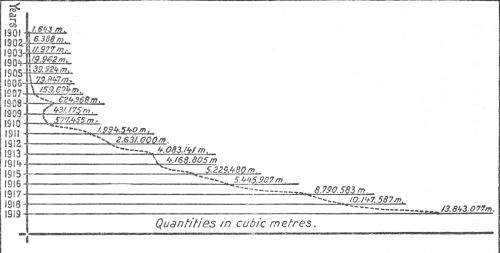
Increase of oil production in Mexico from 1900 to 1920.
Production continues to grow at a prodigious rate.[21] It has risen from 87 million barrels in 1919 to 195 million in 1921. Edward Doheny declares that it will continue to increase for thirty years. Considerable oil-fields are still unexploited along the coast of the Pacific, and the Mexican Government officially announced the discovery of oil in the islands of the Gulf of California in September 1921. The Mexican Petroleum has just bored a well, the Cerro Azul, producing 100,000 barrels a day. Two miles from this well there is another which yields 260,000 barrels a day. All these deposits are found at an almost uniform depth of 600 metres. It is estimated that Mexico can still produce 4,500 million barrels of oil.
There were 367 wells in production in Mexico on January 1, 1921, of which 61 belong to the Eagle and 34 to the American Petroleum. Other companies, with five exceptions, rarely hold more than a dozen wells.
The Eagle stands to-day at the head of all producing companies. Here are the four companies which produce the most:—
Mexican Eagle 32 million barrels
Standard Oil of New Jersey 19 million barrels
Texas Company 12-1/2 million barrels
Mexican Petroleum 12-1/2 million barrels
Great Britain has played a very clever game. As Phelan, the American Senator, wrote: "Her companies accommodate themselves to the political views of the Mexican Government." Moreover, they have all, from the Mexican Eagle down to subsidiary companies of the Royal Dutch like the Corona, been placed under Mexican law, which shields them from the effect of the Constitution of 1917. American companies, on the other hand, whether constituted under the laws of New Jersey, Texas or Delaware, remain foreign companies.
Since March 1922 they have been working out a plan for amalgamation, so as to form a powerful American group which could resist the demands of the Mexican Government.
The companies joining the group would be the Standard Oil, the Sinclair, the Texas Company of Mexico, the Atlantic Refining and the Mexican Petroleum. The Supreme Court of Mexico has decided[22] that properties acquired before the Constitution of 1917 was promulgated would not be confiscated—a declaration which has reassured the United States.
Mexico retains only 4 per cent. of her production. In 1920 alone she exported 153 million barrels out of the 159 million produced, keeping for home consumption only 6 million barrels. Seventy-eight per cent. of her production went to the United States. Every year Great Britain takes from Mexico more than 40 million gallons of illuminating oil, benzine and fuel oil. Mexico literally saves the world. Without her there would be a universal shortage of petroleum.[23]
FOOTNOTES:
CHAPTER XI
A STATE-SUBSIDIZED COMPANY: THE ANGLO-PERSIAN
Although the United States, in spite of the civil wars they let loose there, could never drive Pearson out of Mexico, they triumphed over him in Central America and the chief States of South America by the mere force of their prestige. During 1912 and 1913 Pearson obtained concessions in Costa Rica, Colombia, Venezuela, and Ecuador. That would have given him a monopoly of the supply of oil to all shipping passing through the Panama Canal. Washington placed its veto on these concessions and caused them to be annulled in the name of the Monroe Doctrine. No South American republic dared to resist.
Meanwhile the Shell installed itself in Trinidad, a British colony, then in Venezuela and Colombia. To quiet all fears it was wise enough to associate itself with American firms: for example, the Colon Development was founded, a British company constituted in common with the American Carib Syndicate. It has since come out that all the British shares are grouped in the hands of the Burlington Investment, which is itself dependent on the Royal Dutch-Shell. Not having succeeded directly, through Pearson, who was too much distrusted by America, Britain has none the less succeeded indirectly, through Deterding, in controlling the entrance to the Panama Canal.
It is a strange fact that, while the United States were watching the activities of the Pearson group with evident hostility, they displayed not the least mistrust of the Royal Dutch-Shell. By a bold and masterly policy, the latter obtained a footing in the very heart of the territory of the Standard Oil. American law, unlike French, does not distinguish between ownership of land and ownership of the minerals. As in Mexico before 1917, both belong to the owner of the surface. The Royal Dutch-Shell bought land, sank wells, and was thus able to exploit oil as it pleased. Cleverly following the example of the Royal Dutch, the Shell endeavoured to place its shares with the American people, so as to give them an interest in its prosperity. It was not difficult, considering its high dividends. In 1919 the Shell placed 750,000 shares upon the New York market; by so doing, it realized a premium of £4,390,623, of which £4,000,000 were appropriated to reserve and to amortization. The source of its capital did it no harm, for, before the War, all American large-scale industries had had to make calls upon European savings. And if the Shell was British, the Royal Dutch was without a considerable German element, although officially a Dutch company. Deterding had not yet openly joined forces with Great Britain. He was hesitating. Foreseeing the imminent outbreak of the world conflict, he was much too clever to bind himself before he knew who would win.
These two companies, connected since 1907, but each keeping its separate financial organization (at the same time reserving for each other a 40 per cent. share in any new subsidiary company), were thus freely allowed to install their reservoirs and pipe-lines beside those of the Standard. Besides, the Democrats, fearful of the political and commercial power of the American trusts, were not sorry to set against them competitors who could have no influence upon the domestic politics of the United States. They came to be looked upon as international undertakings without any political ends. To complete the illusion the British Government, which assisted them in secret, simulated fear of their excessive growth.
The British Admiralty declared that it was important to free the Royal Navy from the tutelage of the trusts. It was voted the money required to obtain an interest in the operations of the Burmah Oil, thus ensuring for itself a share of the oil of Burmah; and in May 1914 it bought half the shares of the Anglo-Persian Oil, which holds a thirty-years' monopoly for the exploitation of oil deposits in Persia, excepting only the five northern provinces. For Persian territory on the borders of the Caspian Sea was always reserved for Russian influence.
The Anglo-Persian began obscurely. Its inception, in 1909, passed unnoticed. It was founded, without an appeal to the public to subscribe its capital, by the Burmah Oil, a company at that time better known in Scotland than on the London Stock Exchange. Its first object was to take over the concessions which the Australian, d'Arcy, had obtained in 1901, and which covered the enormous area of 500,000 square miles. D'Arcy had obtained these concessions from the Persian Government for the infinitesimal sum of 200,000 francs, of which 100,000 francs only were paid in cash and the rest in shares. The Persian Government was to receive 16 per cent. of whatever profit d'Arcy might make. It was much disappointed, for the first investigations along the Turko-Persian frontier were really discouraging. D'Arcy spent five million francs in vain, and he was thinking of abandoning the whole affair when he heard of oozings and gushings in the Shustar region, 140 miles north of Mohammerah, to the north of the Persian Gulf. D'Arcy recognized the presence of oil, but had to face the construction of a pipe-line and refinery, and to find new capital for these purposes. Certain foreign capitalists made him tempting offers, but D'Arcy, who had found a staunch supporter in Admiral Fisher, the reorganizer of the British Navy in the twentieth century, resolved that the Persian concessions should remain under British control. He obtained the financial assistance of the Burmah Oil, and the latter founded the Anglo-Persian in 1909. The Royal Navy had already 150 ships burning oil. Pretyman, a Lord of the Admiralty, got Lord Strathcona appointed to the chairmanship of the Anglo-Persian, the first results of which were encouraging, so that the British Government could direct its future. The capital of the new company was very quickly used up. It constructed a pipe-line 145 miles long to bring its oil to the Persian Gulf, and a refinery on the island of Abadan which cost a great deal. But as the prospecting then taking place revealed the existence in Persia of rich deposits, a commission of geological experts, presided over by a rear-admiral, was sent to the spot by Winston Churchill, then First Lord of the Admiralty, to make an inquiry. On the conclusions embodied in its report, the British Government decided to take control of the business. In the month of May 1914 the Anglo-Persian made a somewhat stormy entrance into history, for up to then very little had been heard of it: the negotiations and then the contract with the Admiralty had been conducted with the greatest secrecy. Parliament showed great surprise when Winston Churchill placed the matter before it, and asked for its sanction to the agreements which had been made. It was even necessary for Sir Edward Grey to come to the rescue in order to win a majority in the House.
The Government had a certain majority of two thousand votes by the purchase of £2,200,000 of new ordinary shares. This amount has since been more than doubled, for on March 6, 1921 the Government announced in the House of Commons that it held £5,200,000 ordinary shares, £1,000 preference shares, and £199,000 debentures. Two-thirds of the ordinary shares of the Anglo-Persian are to-day in the hands of the British Government, the other third is held by the Burmah Oil, which is directed by the Admiralty. Thus absolute Government control is assured.
The Anglo-Persian has become literally a State-directed company, but British officials are wise enough to entrust to technical experts the actual management of the undertaking. This explains its great success. Two trustees, Lord Inchcape and Sir E.H. Packe, represent the Government on the Board of Directors: they have the right of absolute veto upon all decisions.
Finally, the Government has made a contract with the Anglo-Persian for the supply of important quantities of oil at an advantageous price for a certain number of years. The needs of the Navy are thus guaranteed for a period of years. There is no surprise to be feared, for the oil-fields are near the Persian Gulf, where Great Britain reigns as mistress, and where no foreign ship can enter without her permission. It is, moreover, an important strategic point; ships can be dispatched from there to all parts of the world where Great Britain has interests—Suez, Gibraltar, India, Australia, Africa.
The oil-deposits of Persia are so rich that it will soon be necessary to increase tenfold the projected development of the equipment, pipe-lines, and refineries, to deal with future production. Even in our time the natives collect the oil by rudimentary processes and transport it on the backs of camels to the markets of the interior, where it serves as an object of exchange. Persia is one of the few countries in which numerous spontaneous springs and seepages reveal the existence of oil. In certain valleys it flows along the slopes and pours into the rivers, making the water unfit for consumption. The Anglo-Persian already ranks among the chief oil-producing companies of the world. It is precisely this success, we may believe, which has caused so much apprehension in the United States on the subject of the rivalry between British and American producing companies. The Anglo-Persian controls an almost unlimited production in Persia, and as soon as there are enough pipe-lines and reservoirs, the output will increase in enormous proportions. From 1923 onward, the Anglo-Persian, by itself, will be in a position to supply a large proportion of the needs of Great Britain. It will then be free of the contract which, for more than seven years, has bound it to the Royal Dutch-Shell, obliging it to dispose of a considerable portion of its production through the latter company.
When its program is completed, the Anglo-Persian will possess a fleet, the capacity of which will exceed a million tons. Expenses are small, because of the great productivity of the wells, which gives to Persia a marked superiority over all the other oil-fields of the world, except perhaps Mexico. Its yield of benzine and kerosene is much superior to that of most of the oil-fields of the United States; it is richer than that of Mexico.
But for several years, the Anglo-Persian has no longer been content with Persia, rich as it is. Its ambitions now extend to the whole world. It is in process of installing its depots in all the great ports of the world. In French territory alone, reservoirs will be constructed in the ports of Dunkirk, Le Havre, Rouen, Saint-Nazaire, La Pallice, Bordeaux, Marseilles, Bizerta, Algiers, Oran, Casablanca, Dakar. Through the agency of its subsidiary, the d'Arcy Exploration, it is prospecting for oil in every part of the globe. Wherever geological conditions appear to indicate the presence of oil in commercial quantities, the operations of drilling are undertaken. The activities of the d'Arcy Exploration are carried on at present in Great Britain, Australia, New Zealand, Canada, Hungary; and again, quite recently, the company has concluded arrangements for investigating and prospecting in districts of France and her colonies which are likely to produce oil. A French company, the Société Générale des Huiles de Pétrole, has been founded, with an initial capital of 100 million francs, jointly subscribed by French and British groups, with the object of undertaking the refining and distribution of oil in France as well as her colonies. According to the agreement signed in London on October 27, 1920, by Sir Basil Zaharoff for the Banque de la Seine, nine subsidiary companies will be founded, each having a different function: importation, refining, distribution, and transport of oil.[24] And this "Franco-British Anglo-Persian" is even going to build an oil fleet, thanks to the Société Navale de l'Ouest.
Other enterprises are also under consideration. The Anglo-Persian Oil has acquired important interests in the British Oil Bunkering, and it has also founded the Tankers Insurance Company Limited, an insurance company with a capital of £100,000, for it intends, henceforward, to do its own insurance. By means of the Scottish American Oil, of which it has technical and commercial control, it has even succeeded in penetrating into Mexico, thus completing the work begun by Pearson and continued by the Shell.
Its activities, during the month of December 1920 alone, were remarkable. It obtained a footing in Spain, founding a company with a capital of 25 million pesetas, of which 55 per cent. was subscribed by the Anglo-Persian and 45 per cent. by a Spanish group having at its head the Banco Urquijo and the Spanish Credit Bank. It concluded a contract with the Hungarian Government guaranteeing it exclusive rights of exploitation on Magyar territory, in case oil should be discovered there, which has happened. Deposits have been found near Letenye and the quantities which it is hoped to obtain will no doubt be more than sufficient to supply the needs of Hungary.
The Hungarian Minister of Finance submitted to the National Assembly, in December 1920, a report concerning the cession of rights to prospect for oil to a syndicate controlled by the d'Arcy Exploration. The Government at Budapest, not having the necessary capital for exploration, was favourably disposed to the offers of the subsidiary of the Anglo-Persian. The negotiations were conducted by Dr. Telesky, a former Minister of Finance, and Dr. von Bockh, Secretary of State. According to the agreement reached, the d'Arcy Exploration undertook to devote at least £100,000 to prospecting for oil; if the results were satisfactory, the company would exploit one-third of the geological productive units, one-third would be kept in reserve, and the remaining third would revert, free of all expense, to the State. As regards the second portion, the Hungarian Government reserved complete freedom of action. A company was formed with a capital of £1,000,000 sterling, of which the Hungarian Government subscribed ten per cent.; the company had to deposit with the Government 25 per cent. of the shares, and to undertake to hand over to it each year one-tenth of the production, in kind or in money.
The Anglo-Persian has also obtained possession of the oil-bearing territory of Transylvania, ceded to Rumania. During the War, this was seized and exploited by the Austrian military authorities, for it belonged to the Hungarian National Petroleum Company. The capital of this company was heavily drawn upon for repairs undertaken at the close of hostilities. An appeal for funds became necessary. The Anglo-Persian demanded that the technical and commercial management of the undertaking should be entrusted to it and that two of its nominees should sit on the Board of Directors; it then subscribed £500,000 in preference shares. Each of these shares carried twenty votes against one for an ordinary share: thus the Anglo-Persian has complete control.
In addition to this, it has taken over the share which was reserved for Britain in the German interest in the Steaua Romana, and disposes of nearly 80 per cent. of the shares in the Turkish Petroleum, which has claims to oil concessions in Mesopotamia.
On October 13, 1921, the Anglo-Persian made an agreement with the Japanese company Tei-Koku, undertaking to supply it with 350,000 barrels of petroleum yearly. Half of this is destined for the Japanese Navy.
Organizations for the sale of its products are to be found in Belgium, Denmark and Norway.
Part of the famous deposits of Rivadavia, which the Argentine Government intended to reserve for itself, has fallen under its control.
In co-operation with the Australian Government—from which it had already obtained, in May 1920, exclusive rights in the former German colonies of Papua—the Anglo-Persian founded the Commonwealth Oil Refineries, with a capital of £500,000. It is prospecting actively in Western Australia, and has asked the Government of Perth for a concession of 100,000 acres.
In New Zealand it has offered to subscribe 50 per cent. towards the formation of a capital of £100,000 for prospecting purposes.
And the Anglo-Persian is, at the present moment, building vast works in New Brunswick, for the distillation of oil from shale. The oil produced will be used for heating the boilers of British ships. The oil-bearing lands in this region are rich and extensive, and the shale of which it is composed has been found twice as rich in oil as the Scottish shale, the first from which the precious "rock-oil" was distilled.[25] As in Wyoming, Colorado and Utah, there are enormous laminate rocks, stretching in beds below the valleys, of a thickness of eight to ten metres; when distilled they may produce up to 240 litres of oil to the ton. When the Mormons, fleeing from persecution in 1846, took refuge in the Far West and discovered these oil shales, they never suspected the service they would render half a century later to the British and American Navies.[26] They found themselves held up in their march across the desert for want of fuel, but one of their leaders announced that Providence would soon supply their needs. The prophecy came true that very day: a Mormon was surprised to notice that the stones on which he placed his saucepan took fire. Since then, hunters and prospectors venturing into these desolate regions use no other fuel than these rocks.
FOOTNOTES:
CHAPTER XII
AN AMERICAN BALKANISM
The British Controlled Oil-fields
The Anglo-Persian Oil is no longer sufficient for Great Britain, which founded a new company in 1918, the British Controlled Oil-fields, specially commissioned to fight the Standard Oil. Established under Canadian law with an initial capital of £12,000,000, increased later to £40,000,000, and capable of a further increase up to £159,000,000, the British Controlled Oil-fields will be one of the greatest financial powers of the world. Like the Anglo-Persian, it is entirely in the hands of the British Government under the system of the voting trust. It seems that an immense tract of oil-bearing territory exists from Mexico to the Argentine, a continuation of that of the United States. Already Mexico has become the second greatest producing State in the world; and oil has been found in almost all the South American States, even in Brazil and on the plateaux of Bolivia. Of these immense deposits the British Controlled Oil-fields wishes to gain possession on behalf of the British Government, thus completing the work of the Royal Dutch-Shell in Venezuela and in the neighbourhood of the Panama Canal. It possesses properties of very great value from Mexico to Brazil, in Trinidad, Venezuela and Costa Rica. In 1920 it began operations in Ecuador, and it is at present prospecting in Brazil, in the State of Bahia, where bituminous seepages and traces of asphalt abound. Its concessions actually surround two-thirds of the Caribbean Sea: they are situated in the States of Guatemala, Honduras, Nicaragua, Costa Rica, Panama, British Guiana, Colombia, Venezuela, Peru, Ecuador, and the island of Trinidad. The concessions of the British Controlled Oil-fields are nearly always on the sea coast—or rather in close proximity to the sea—which is a considerable advantage. It has expressly chosen them, on both the Atlantic and the Pacific, as a precaution in case war should break out between Britain and the United States; for, even with the help of the Japanese fleet, the British Navy might not be able to seize the Panama Canal. And its units must be in a position to replenish their stores of fuel without being obliged to make a long detour round the Magellan Straits.
The British Controlled Oil-fields is at present negotiating for the control of important concessions in Panama and Nicaragua. It controls all those of British Guiana, nearly all those of Honduras, but I fear it is about to lose those it had in Costa Rica. In order to obtain them, Great Britain did not hesitate to foment revolution in this little Republic. Unable to obtain anything from the established Government, it helped to place in power the revolutionary President Tinoco, from whom it got all it wanted: more than 6,000 square miles granted to the British Controlled Oil-fields. Unfortunately Tinoco has been overthrown: the regular Government, restored to power, hastened to annul these concessions. Great Britain, to compel it to ratify these concessions, stirred up a war between Costa Rica and Panama, while she sent the cruiser Cambrian to the coast of Costa Rica in order to increase the pressure. Events went against her. Costa Rican troops invaded Panama. A landing took place on February 28, 1921, on the Pacific coast, south of the Dulce Gulf, the eastern shore of which is common to both countries, and another less important one on the Atlantic, towards Bocas del Toro. Panama lost the territory of Coto.
Mr. Alves, Chairman of the British Controlled Oil-fields, set out in March 1921 for Costa Rica, to study the question at issue. But the United States stepped in; and Judge White, as arbitrator, pronounced in favour of Costa Rica. On August 26, 1921, an American naval detachment assisted the Costa Rican forces to take definite possession of the contested territory, in spite of the indignant protests of the Government of Panama against the violent measures of which it was the victim.
There is continual warfare among the little republics of Central America. The imbroglio of British and American affairs around the Gulf of Mexico and the Caribbean Sea (British Controlled Oil-fields, Mexican Eagle, Royal Dutch Shell, Mexican Petroleum, Standard Oil) makes this region the Balkans of the oil world.
The British Controlled Oil-fields, the board of which includes a British admiral and a Member of Parliament, is the result of long investigations pursued by Lord Fisher on behalf of the Admiralty. The results of these studies are being methodically turned to account in order to ensure to Great Britain the supremacy of the sea by means of the supremacy of oil.
CHAPTER XIII
POLITICAL TENDENCIES OF THE ROYAL DUTCH
The British Oil Empire
Until 1914, the British Government seemed to resist the formidable extension of the Royal Dutch throughout the world. Under the pretext of ensuring reserves for itself, it got possession of outlets which this company had not yet touched, taking control of the Anglo-Persian and in 1918 founding the British Controlled Oil-fields. The reason was that they were not yet allied. But since the War an event of considerable importance has taken place: Deterding has thrown in the fortunes of his trust with those of the greatest empire in the world, the British Empire, whose policy at present dominates the world.
At the beginning of its history, the Royal Dutch was a Dutch company. If the Royal Dutch became British by its union with the Shell, it was German through its Rumanian share in the Deutsche Petroleum, which united the petroleum interests of the Deutsche Bank, Steaua, European Petroleum, and the Deutsche Mineratal Industrie. The first important capital of this powerful consortium was furnished by German banks: the Deutsche Bank, the Disconto Gesellschaft, and the firm of Bleichröder are, as it were, the fundamental tripod supporting the edifice. It has been justly said that if Germany had not the most important place in the Royal Dutch, it is because Mr. Deterding was more concerned with British interests. He uses the power of nations as he uses money. Great Britain being mistress of the seas, he has given to British capital the most important part in his undertakings. But the Rothschild family is international. There are branches in London, Paris, Berlin, and Vienna. Mr. Deterding had safe places to anchor while waiting for the wind. During the retreat of the Rumanian army, the wells controlled by the Royal Dutch were partly destroyed. Whether this destruction was the work of Rumanian or of German soldiers is not important. The Deutsche Bank was associated with Mr. Deterding in Rumania. Whatever was the result of the War, the Royal Dutch-Shell had to be compensated....
It would have been just the same as far as Bagdad. If Germany had gained Asia Minor, the property of the Royal Dutch would still have been saved by the Deutsche Bank. As the Allies have the upper hand, Mr. Deterding has nothing to fear. He is in close touch with France and Britain. He is in opposition only to America. And this coalition of the oil powers is a very curious one, in which enemy nations agree at certain times and disagree at others, all of them being led by a superior power to unsuspected ends, just as they were in the world race for armaments. An important fact which may puzzle the simple-minded, is that, during the War, Mr. Deterding made his flag respected.
His cleverness was such that, whichever side was victorious, he was bound to come out unscathed from the conflict.
Since Great Britain has conquered Germany, he has thrown in his fortunes with hers.
It was a master-stroke for British policy. Allied to this powerful trust, Great Britain now possesses an oil empire extending throughout the world:—
Europe
Russia Royal Dutch-Shell
Rumania Royal Dutch-Shell
Hungary Anglo-Persian
Jugo-Slavia Royal Dutch-Shell
Albania Anglo-Persian
America
Newfoundland Anglo-Persian
New Brunswick Anglo-Persian
California Royal Dutch-Shell
Oklahoma Royal Dutch-Shell
Texas, Louisiana Royal Dutch-Shell
Mexico Royal Dutch-Shell (Mexican Eagle)
Central America British Controlled Oil-fields
Trinidad Royal Dutch-Shell
Venezuela Royal Dutch-Shell
Guiana British Controlled Oil-fields
Brazil British Controlled Oil-fields
Colombia British Controlled Oil-fields
Ecuador British Controlled Oil-fields
Argentine Anglo-Persian
Asia
Caucasus Royal Dutch-Shell
Persia Anglo-Persian
Mesopotamia Turkish Petroleum
India Burmah Oil
Dutch Indies Royal Dutch-Shell
Straits Settlements Royal Dutch-Shell
China Royal Dutch-Shell
Oceania
Australia Anglo-Persian
New Zealand Anglo-Persian
Papua Anglo-Persian
Africa
Egypt Royal Dutch-Shell
Madagascar Royal Dutch-Shell
South Africa Royal Dutch-Shell
Morocco Anglo-Persian
CHAPTER XIV
HOW THE UNITED STATES LOST SUPREMACY OVER OIL
The Americans themselves realize that they are about to lose their supremacy over oil. "While we were basking in a false security, lulled by the knowledge of our resources," the American Nation wrote recently, "foreign companies silently and energetically took possession of the unexploited oil-fields." The Mexican Eagle, a British company, received vast concessions in Mexico. The Shell, another British group, established itself in many places. The Royal Dutch, which, in appearance at least, was originally a Dutch company, was founded to exploit the oil of the East Indies. Later, a fusion of the Royal Dutch and the Shell took place, and the Mexican Eagle sheltered under the wings of the new company. The Anglo-Persian was created to exploit Persia and the East, and the British Government subscribed £2,000,000, reserving the control for itself in order to supply the needs of the navy.[27] This company was for years closely connected with the Royal Dutch.[28] This gigantic aggregation of British interests, at the present time, owns or controls a great part of the oil of California, Oklahoma, Louisiana, Mexico, Trinidad, Venezuela, Colombia, Rumania, Russia, Persia, Egypt, India, and the East Indies. Except in North America, many of the concessions are so vast that they exclude American companies from the most profitable oil-fields. However, adds the Nation, the experts of the United States Geological Survey were making disturbing discoveries that 40 per cent. of American oil was exhausted, and that, at the present rate of production, the exploitation would be complete in fifteen or twenty years, for home requirements were becoming so great that more oil would have to be imported than was being exported. In 1920, the imports exceeded the exports by 100 million barrels. And British companies, closely connected with the British Government, are now in exclusive possession of 90 to 97 per cent. of the future world production. What a change in the situation!
Ten years ago, Britain possessed no oil, to-day she is independent, to-morrow she will be mistress. The feat has been accomplished by the silent efforts of a few men such as Sir Marcus Samuel, chairman of the Shell, Lord Cowdray (Pearson), Lord Curzon, formerly Viceroy of India, Sir John Cadman, technical adviser to the British Government, Professor in the University of Birmingham, and Chairman of the Inter-Allied Petroleum Conference during the War, Lord Strathcona, creator of the Canadian railways, who played a great part in the Anglo-Persian, and, above all, Admiral Lord Fisher.
These men acted even without the knowledge of the British people and its parliamentary representatives. Their fellow-countrymen and their opponents only heard of their activities when they had endowed their country with a world-wide oil empire.
There was veritable amazement in the House of Commons when it was informed of what Lord Fisher and Lord Strathcona had done with the Anglo-Persian. Their work narrowly escaped undoing. Lord Fisher himself described, in September 1919, the opposition he met with, even among his colleagues. "I was dubbed 'an oil maniac' when I was at the Admiralty in 1885. Lord Ripon, the First Lord, sent for me and told me I was called a Radical enthusiast and nicknamed 'Gambetta,' and said he meant to make me a member of the Board of Admiralty. I told him all the rest of the Board would leave. He saw me a week after and confessed it was so; but, thank God! I was spared to be Director of Naval Ordnance instead."
Lord Fisher experienced the same difficulties when he wished to equip the British Navy with submarines. It is to him, and to the Bethlehem Steel Works (United States), that the Allies owed the prompt completion of the special type of submarines which "went, unconvoyed from America to the Dardanelles and acted there prodigiously." A few of these submarines which succeeded in passing through the wire nets of Chanak-Nagara, for a long time controlled the Sea of Marmora and prevented the Turks from taking supplies by sea to their fortifications on the Straits. Oil supremacy and naval supremacy go hand-in-hand. When he wished to give his country empire over oil, Lord Fisher's principal object was to preserve her dominion over the seas. For that fleet will be victorious which has at its disposal the most abundant sources of oil. Ships using oil have driven out those burning coal, just as the latter replaced sailing ships.
When we compare the results obtained by France and by Britain, on whose soil it seems that no deposits of mineral oil have yet been discovered (a fact which rendered Lord Fisher's task none the easier); and when we see Britain mistress of nearly all the oil remaining in the world, we stand confounded with admiration before the genius of those to whom she owes such an empire.
British Oil Policy
Having been obliged to allow the first place to America, the country which first discovered oil, and which until recently produced 70 per cent. of the world's output, Great Britain began to gain upon her by keeping command of oil-carrying ships. Whoever transports a commodity controls it, and is master of it up to a certain point, for he is the indispensable intermediary for those who wish to obtain it. Should any difficulty arise, the transporter, according as he fulfils his office or not, grants or withholds supplies for the markets, as he pleases. The British genius has always sought to compensate, by maritime superiority, for the inferiority of Great Britain in certain respects. If the United States occupied the first place among producers of oil, they ranked second to Great Britain as transporters. Great Britain, understanding that oil "is destined to play the same part in the world as coal, cotton or steel," made a special point of retaining control of oil-carrying ships. It was a thrilling duel.
The world tonnage of tank-steamers rose by June 30, 1919, to 2,616,000, tons, of which 1,500,000 tons sailed under the British flag, 1,000,000 tons under the American. In June, 1920, the United States had gained the first position. They had 308 tank-steamers, amounting to 1,734,843 tons, or 51 per cent. of the whole (3,386,091 tons). On January 1, 1921, the supremacy of Great Britain was restored. Of the 524 oil-steamers afloat, 252 belonged to her, the United States having only 191. But she lost this position again six months later.
Mistress of one of the foremost oil-carrying fleets, Britain next sought, until 1922, to monopolize almost all the remaining resources of the world. The Royal Dutch-Shell, British Controlled Oil-fields, and Anglo-Persian Oil were valuable auxiliaries of the Foreign Office for this object. According to Dr. David White, one of the members of the American Geological Survey, this is what Great Britain possesses to-day:—
Million barrels.
Canada: the whole of the deposits are reserved for British control 995
Algeria, Egypt: 50 per cent. 462.5
Persia, Mesopotamia: 75 per cent. 4,365
S.E. Russia, S.W. Siberia, Caucasus: 50 per cent. 2,925
Rumania, Galicia, Europe: 50 per cent. 1,567.5
New Russia and Sakhaline: 50 per cent. 462.5
Dutch Indies: 50 per cent. 753.75
India: the whole 995
In Peru alone have the United States triumphed over Great Britain. The discovery of oil there is due to the English. But, thanks to the power of its capital, the Standard Oil, through the medium of the International Petroleum Company, managed to acquire the shares of the four most important British companies. And the United States at present controls 70 per cent. of the output there, the British retaining only 27 per cent. and Italy 3 per cent. The Peruvian production, however, is not very high; it does not yet reach 3 million barrels.
The need for oil has grown so great that the deposits containing this precious liquid fuel are greedily coveted by the various governments which take shelter behind financial groups. There is a shortage of 250 million tons of coal on this planet, and it produces only 98 million tons of oil. But no Government can boast, in this matter, of having shown a foresight equal to that of Great Britain.
The British Government is no longer content to-day to encourage, favour and defend its own nationals. Better than this, it makes conquests or establishes protectorates having as essential object the reservation exclusively for its nationals of new oil-bearing territories, such as Persia and Mesopotamia. The treaty recently imposed on Persia was nothing but a disguised protectorate. Fortunately for Britain, the Soviet Government has voluntarily given up its advance into that country since it concluded a trade agreement with London. And it is sufficient to read the Treaty of Sèvres to see the underlying motives of the British negotiators: the desire to monopolize the oil of Asia, and anxiety to keep out the United States, all the oil-fields left to France being in particular granted to her with the idea of a future British participation.
The British Government is so jealous of its position in Mesopotamia that it will not even tolerate American prospectors there, and certain incidents have happened in connection with which the disappointed Yankees have asked the State Department at Washington to demand satisfaction.
The British oil policy is not uniform. Sometimes, when it seems possible, she gets possession of proved oil-fields. Sometimes, in the case of a country which would hold its own, she negotiates for an advantageous share in the profits—this is what happened with France by the San Remo Agreement—or she makes contracts ensuring abundant supplies of the precious mineral oil.
When a State does not fall in with her views sufficiently quickly, Britain does not recoil from any means of pressure. This is what led Admiral Degouy, in April 1920, to write: "As a corollary to well-known negotiations with one of the richest countries in oil in the Near East, the British Admiralty has organized and is maintaining on the Danube a numerous flotilla of gunboats and river monitors." The reason is easy to guess.
From 1918 to 1920 an unofficial squadron of small Russian steamers, requisitioned and armed by Great Britain, dominated the Caspian Sea, so that Batum, the port of embarkation for oil on the Black Sea, and Baku, its place of production, were both in the hands of the British. They disposed of the petroleum and mazut there at their own pleasure, permitting no control over their purchases. Britain first took as much as she could; it was only afterwards that she allowed France to replenish her stores in turn, provided there was any petroleum left.[29]
Thus ends the work of Lord Fisher, who applied himself for more than thirty years to the problems of oil. Thus end the experiments and observations conducted modestly and quietly for so long at Portsmouth.
Henceforward the British Navy is sure of its supplies of oil for a century. But the position is such that the United States can avoid war only at the price of industrial servitude.
Hemming-in of the United States
While Great Britain was pouncing upon nearly all the oil remaining in the world, the United States basked in a false security. Had they not supplied 80 per cent. of the needs of the Allies during the War? It is true that if the War had continued the United States would not have been able to satisfy those needs. "In September and October 1918," declared Mr. Deen, who played such an important part in the alliance of the Royal Dutch with the Shell and who now directs the oil industry of Oklahoma, "the Allies were taking each day 194,000 barrels of petrol, while the average daily output was 191,000. Adding together the consignments sent to Europe by Mexico and the United States, we reach the figure of 1,200,000 barrels a day, while the United States was producing only 960,000 and Mexico 140,000. The daily deficit was thus 300,000 barrels."
The United States sacrificed themselves in the cause of the Allies during the War.[30] Great Britain has shown no gratitude. They had already reached the point at which they could not supply their home consumption, since 25 per cent. of the petroleum consumed in the States used to come from Mexico, and they sent the Allies more than their own production. The War contributed not a little to placing them in their present position.
According to Walter Teagle, the new chairman of the Standard Oil, if their consumption continues to increase at the present rate they will consume, in a few years, 630 million barrels, or double what they produced in 1919. Since 1914 alone the number of motor-cars in the United States has increased from 1,700,000 to 8,000,000 (Ford cars swarm there). These alone absorb 85 per cent. of the national output, leaving only 15 per cent. for the railways, shipping, manufactures and export.
The American companies have made a great effort. They have speeded up production, raising it from 376 million barrels in 1919 to 443 million in 1920. New exploratory work has been carried on, especially in Texas and Kansas. But will not this hasten yet more the time when the resources of the United States will be exhausted?
At the word of command from the United States Government, "Draw more and more on the oil in foreign countries," the Standard sent out prospectors all over the world. But everywhere they ran up against an unforeseen obstacle. An American prospector had the misfortune to appear on the shores of the Dead Sea in October 1919. Without hesitation the British General who was Governor of Palestine had him arrested in Jerusalem. To the indignant protests of President Wilson Britain simply replied that it was not a question of measures aimed specially against the Americans, but that all prospecting in Palestine was forbidden until a new order. The same thing happened in Mesopotamia.
Everywhere in the world, except possibly Canada, in which country they have considerable influence on account of their geographical proximity, the Americans for two years found the "closed door."[31] Generally they were either completely excluded from oil-bearing concessions situated in the territory, the colonies, or even the sphere of influence of Great Britain, Japan and the Netherlands; or else they were authorized to establish themselves only under such conditions that they would lose the effective control of their undertakings. Foreigners are forbidden to prospect for oil in Burma, India, Persia, Uganda and the United Kingdom. A policy which excludes foreigners from the control of petroleum products is followed in Algeria, Australia, Barbados, Kenya Colony, British Guiana, France, French West Africa, Guatemala, Japan, Formosa, Saghalien, Madagascar, Mexico, New Guinea, and probably in the Union of South Africa. Venezuela and Uganda are considering a similar policy.
The right to exploit mineral wealth cannot be granted to foreigners in Australia, Barbados, Kenya Colony, New Guinea, the Dutch Indies, France, French West Africa, Guatemala, India (probably), Great Britain, Japan (practically), Trinidad (in part), Venezuela, Madagascar, and, except for rights already acquired, in Rumania and Slovakia. Temporary restrictions have been placed on the acquisition of oil concessions by foreigners in two districts of Colombia and in the new Rumanian territory.
The ownership of oil deposits belongs to the Government in Bolivia, Costa Rica, Slovakia, South Africa, Uganda, Venezuela, Great Britain, and partly so in the Argentine, Australia, British Guiana, Ecuador, India, Trinidad, Canada and Colombia. The Dominican Republic, Mexico, Rumania and Russia are considering the possibility of following the same course. But the United States have pledged themselves not to recognize the new Mexican Government unless it renounces this measure. In France the Government has regalian rights over the riches of the subsoil; it grants them at its discretion.
In face of this situation, Senator Gore of Oklahoma, on March 10, 1920, demanded of the Federal Government a report upon the measures taken by foreign Governments to exclude Americans from oil-fields. Two months later, on May 17th, President Wilson transmitted to the Senate the report of the Secretary of State.
"The policy of the British Empire," wrote the Acting Secretary of State, Frank L. Polk, "is reported to be to bring about the exclusion of foreigners from the control of the petroleum supplies of the Empire, and to endeavour to secure some measure of control over oil properties in other countries. This policy appears to be developing along the following lines, which are directly or indirectly restrictive on citizens of the United States:—
"1. By debarring foreigners and foreign nationals from owning or operating oil-producing properties in the British Isles, colonies and protectorates.
"2. By direct participation in ownership and control of petroleum properties.
"3. By arrangements to prevent British oil companies from selling their properties to foreign-owned or controlled companies.
"4. By Orders in Council that prohibit the transfer of shares in British oil companies to other than British subjects or nationals."
These measures have led to the control of the Shell, by agreement with the Royal Dutch, which holds 60 per cent. of its shares. "It is understood that the British Government has a controlling interest in the Anglo-Persian Oil Company, and that it has also assisted in the development of the Papuan oil-fields by bearing one-half of the expense and contributing experts...." All prospecting for oil in the United Kingdom must be authorized by the Board of Trade. In fact, the only borings carried out in the country are by S. Pearson and Son, Ltd., acting as petroleum development managers to the Government. In Trinidad no one may acquire oil-bearing land without the authorization in writing of the Governor, subject to the approval of the Secretary of State for the colonies. Now the latter requires of every British company that not more than 25 per cent. of its capital is to be held by aliens and that the majority of the directors shall be British.
The Polk Report goes on to prove that almost all other countries, even the smallest, close the door to Americans. Only Bolivia, Colombia and Costa Rica, which has recently annulled the concessions granted to the British Controlled Oil-fields place Americans and their own nationals on the same footing. The case is different in Guatemala, in Ecuador, and, above all, in Mexico, "only Mexicans by birth or naturalization and Mexican companies have the right to acquire ownership in lands, waters and their appurtenances, or to obtain concessions to develop mines, waters, or mineral fuels in the Republic of Mexico. The nation may grant the same rights to foreigners provided they agree before the Department of Foreign Affairs to be considered Mexicans in respect of such property and accordingly not to invoke the protection of their Governments in respect to the same, under penalty, in case of breach, of forfeiture to the nation of property so acquired. Within a zone of 100 kilometres (62.14 miles) from the frontiers and of 50 kilometres (31.07 miles) from the sea-coast, no foreigner shall under any conditions acquire direct ownership of lands and waters."
Meantime the San Remo Agreement had been signed, by which the French Government—voluntarily or no—associated itself with Great Britain in order to drive out America from the Asiatic centres of petroleum production, and delivered over to her the resources which might be discovered in the zones of influence reserved for France. The French Government was so embarrassed about this agreement that for three months it dared not publish it.
When it made up its mind to do so, the publication aroused grave anxiety in the United States.
The Struggle for Mesopotamia
However, public opinion and American official circles followed the progress of the struggle with passionate interest. The situation became even more strained in consequence of an article in Sperling's Journal by Sir Edward Mackay Edgar, which constituted a literal defiance. Great Britain openly boasted of her triumph. "I should say," wrote Sir Edward, "that two-thirds of the oil-fields exploited in Central and South America are in British hands. In the states of Guatemala, Honduras, Nicaragua, Costa Rica, Panama, Colombia, Venezuela, and Ecuador, the great majority of the concessions are in the hands of British subjects and will be developed by our capital.
"The Alves group (British Controlled Oil-fields) whose properties extend two-thirds round the Caribbean Sea is entirely British; and the regulations controlling it ensure the absolute perpetuity of direction in the interests of Great Britain. No citizen, no American group, has attained, or will ever attain, in Central America a position ... like that of Mr. Alves. If we consider the greatest of all petroleum organizations, the Shell group, it possesses or controls undertakings in every oil-producing country of the world, including the United States, Russia, Mexico, the Dutch Indies, Rumania, Egypt, Venezuela, Trinidad, India, Ceylon, the Malay States, China, Siam, the Straits Settlements and the Philippines.
"No doubt we shall have to wait some years before the benefits of this position can be reaped; but there is no doubt that the harvest will be magnificent. Before long America will be obliged to buy from British companies, at the rate of millions of pounds every year and to pay in dollars, in increasing quantities the oil she cannot do without, and which she can no longer obtain from her own reserves.
"I estimate that if their consumption continues to increase at the present rate, in ten years the Americans will be obliged to import 500 million barrels, which, at the very low price of two dollars a barrel, means an annual paying out of a thousand million dollars, of which the greater part will fall into British pockets. With the exception of Mexico and a small part of Central America, the whole world is solidly barricaded against an attack in force by the United States. The British position is impregnable."
One year after the peace the struggle between Great Britain and America reached its bitterest phase. The United States wished to obtain, at any price, part of the oil deposits of Mesopotamia and of the new oil-bearing territory which had just been discovered at Djambi in the Sunda Islands. Consequently, on November 20, 1920, Mr. Colby, Secretary of State, addressed a Note to Lord Curzon, which the American Press published on the 24th, in which he protested against the exclusion of Americans from Mesopotamia and claimed equality of treatment for all nations.
The British Government made, at the time, only a vague reply to the Colby Note. The English Press published the complete text.[32] Lord Curzon then declared that the existing British rights in Mesopotamia were only the confirmation of those acquired before the War by the Turkish Petroleum Company, the control of which the British Government holds in common with the Royal Dutch, for it has bought 200,000 ordinary shares in this company. But for the War the exploitation of the oil deposits of Mosul and Baghdad would long since have begun. The rights acquired by the French Government under the San Remo Agreement represent only the German share, and they were granted in return for facilities given for the dispatch to the Mediterranean of the petroleum produced. Neither the rights of the Turkish Petroleum Company, nor the San Remo Agreement will preclude the Arab State of Iraq from enjoying the full benefit of ownership or from prescribing the conditions upon which the oil-fields shall be developed. The British Government has no desire whatever to deny the United States a share in the expansion of the petroleum industry of Mesopotamia. And the British Note draws attention to the fact that London by no means agrees with Washington on the estimate of the petroleum resources of the various nations. While the potentialities of the future are necessarily problematical, the undisputed fact remains that at present United States soil produces 70 per cent. of the oil production of the world.[33] It is not easy, therefore, to justify the United States Government's insistence that American control should now be extended to resources which may be developed in mandated territories. The British Government, nevertheless, is in general agreement with the contention of the United States Government that the world's oil resources should be thrown open for development without reference to nationality.
This somewhat hypocritical reply did not satisfy the Federal Government. Great Britain might be in agreement with its contention that "oil resources should be thrown open for development without reference to nationality," but that did not make her open up Mesopotamia to Americans. And on the occasion of a meeting of the Council of the League of Nations at Paris, to examine in detail the problem of mandates, Washington, to annoy London, sent a Note on February 1, 1921, demanding that the question of mandates over former German colonies should be reconsidered. In the end America won her point, for during the negotiations which were conducted in London at the end of July 1922, Walter Teagle asked that the shares in the Turkish Petroleum granted to the Anglo-Persian (50 per cent.), to the Royal Dutch (25 per cent.), and to France (25 per cent.) should be reduced in order to make room for American interests. Deterding protested, but finally accepted. The British Government gave way immediately. It is a doubtful victory for the United States, for who knows when this region will be pacified? And France will do her utmost to avoid the diminution of her share. The Angora Government showed itself at Lausanne determined to resume possession of the Mosul region, which is so rich in oil and which M. Clemenceau gave up to Britain with so little resistance.
The Struggle for Djambi
Meanwhile the Royal Dutch, which, in agreement with the Anglo-Persian, had asked the British Government to reserve for it the exploitation of Mesopotamian deposits, was endeavouring to monopolize the new deposits discovered at Djambi in the Sunda Islands.
Djambi is the last great territory to be exploited in the Dutch Indies; the oil-fields in this district cover four million acres. At first the designs of the Royal Dutch met with no opposition, and it obtained from the Dutch Lower Chamber the grant of these deposits for its subsidiary, the Bataafsche Petroleum. But two representatives of the Standard brought a communication to the Dutch Chamber and Ministers at The Hague. The Standard offered to found a company in partnership with the Dutch Government, which would hold half the territories of Djambi on the same terms as the Royal Dutch. It recalled the fact that in the United States the Dutch had been given every facility, and counted on reciprocal treatment.
This unexpected communication caused great disturbance in the financial and political world of the Netherlands. A deputy asked if the note from the Standard came from the American Government. The Prime Minister replied that he did not know, but that in any case this note must express the views of Washington. A Socialist member proposed exploitation of the whole field by the State; this was defeated by 55 votes to 24. The Liberals, fearing international complications, were opposed to the Government plan. Finally, the Second Chamber adopted this plan by 49 votes to 30.
Thereupon a vigorous Note arrived at The Hague from Mr. Hughes, the Secretary of State, who nearly defeated Wilson on the occasion of his re-election to the Presidency and who holds to-day the most important post in Mr. Coolidge's Cabinet. Mr. Hughes ordered the United States Ambassador to insist vigorously that the Dutch Government should grant the same facilities in the Dutch Indies to American as to other companies. For, he said, the nationals of all countries have an equal right to vital natural resources, and one cannot forbid access to one particular nation. "We do not seek preference over other countries, but we do not wish other countries to obtain advantages to our detriment. And concerning oil, the solution of the problem is to give equal rights to all the companies of all nations."
The Government of the Netherlands sent to Washington its reply to the American Note. It drew special attention to the disinterestedness shown by the Americans at the time when competition was free, a time chosen by the Royal Dutch to make a much more advantageous offer than those of its rivals. In 1915 the exploitation of the deposits in the Sumatra regions was granted to the State; but in 1918 this ruling was modified, and it was decided that exploitation might take place directly by the State, or through the agency of a company, or under the system of a State-controlled monopoly.
At this time no American protest had reached the Dutch Government, and none was sent until after the signing of the contract between the Royal Dutch and the Government.
However, added the Note, there still remain numerous valuable oil-fields in the East Indies, and the Dutch Government would be prepared to grant concessions to American capital.
This affair seems to have been by no means settled by the vote of the Dutch Lower Chamber. The polemic continued between Washington and The Hague. In May 1921 the American Government demanded the publication of its Note of April 19th, which The Hague was determined to keep secret. And in Holland the Colonial Secretary was violently reproached for having concealed from the Chamber the details of the correspondence exchanged with the United States. I have been able to procure the text of the letter submitted by the Standard:
"The development of petroleum deposits is at present a vital question for every country, and increasing attention must be devoted to it by the whole world. The Dutch colonies have the good fortune to possess extremely rich petroleum deposits, especially in the Djambi region. The Standard Oil, an American limited liability petroleum company, asks to be allowed to share in the development of the deposits at Djambi, and a decision must shortly be taken on the matter. Considering the great extent of the oil-fields of Djambi, the Dutch Government will certainly not consider it to the interest of the country and people to allow them to be exploited by a single company.
"The Standard Oil submits for the approval of the Dutch Government a scheme for founding a Dutch company under the mining legislation of the Dutch Indies, according to which part of the Djambi region would be exploited on the basis of the native law. This project would have to be submitted to the Second Chamber of the States-General. The Standard Oil declares itself ready to furnish all necessary guarantees for the exploitation of the said territory.
"The Standard Oil is convinced that the Dutch Government will readily admit that the United States, which are and always have been the greatest producers of petroleum, could bring as much profit to Dutch interests as they have done for their own citizens.[34] We American companies, therefore, believe that we have a right to share in the development of the petroleum fields of Djambi, and we are sure that this participation would serve the interests of Holland equally with those of the United States, and would help to strengthen the bonds of friendship which exist between the two countries."
This did not have a soothing effect on public opinion in Great Britain. Since the War, wrote The Times, the question of petroleum had become an international question of the first order. Great Britain took an especial interest in it; its security depended, more than that of other countries, on power over sea and air. Up to Trafalgar, when the essential thing was to have ships of stout oak, she watched carefully over her forests.... She could not do the same with oil, for she possessed so little in the Empire.
The United States desire equality of treatment. Britain denies the justice of this claim. "United States soil," wrote Lord Curzon, "produces 70 per cent., and American interests in adjoining territory control a further 12 per cent. of the oil production of the world." Great Britain, he pointed out, had only 40 per cent., and that in distant territories.