Part 1 — PRESENT-DAY EGYPT
Reading edition
Alexandria. Where East and West Meet.
lexandria is the great commercial center of the southern Mediterranean. Approached from the sea, the coast is so level that the city is not visible until the harbor is almost reached. Modern docks and warehouses are crowded along the shore.
In spite of its modern appearance, Alexandria is an old city, founded by Alexander the Great, in 332 B.C. He evinced his usual insight and good judgment in the site chosen, it being sufficiently far west to escape the deposits brought down by the Nile and carried to sea by its various outlets. The only important city of all those founded by the great conqueror, Alexandria became a center of culture and education. Scholars and men of genius were encouraged to come here by the Ptolomies, who were determined to make the place a second Athens. A museum was founded and a library established, some 900,000 rolls of manuscript being accumulated. This we may feel sure embraced the wealth of ancient learning.
When the city was besieged by the Romans in the time of Cæsar, this priceless collection of books was destroyed. The loss to the future was irreparable. However, an earnest effort was put forth to replace as many as possible of the writings, and for years scribes copied precious rolls sent them from other educational centers and from private collections. Indeed, it was plainly hinted by those best informed that the originals were never returned to rightful owners, but that copies were invariably returned and the original kept to grace the public library. When Omar overcame Egypt in the seventh century, he proclaimed the Koran sufficient for all, saying that it included whatever wisdom men needed. Whereupon he commanded the destruction of this second library. It is recorded that the contents were distributed among four thousand public baths of Alexandria and that fires were kept burning for six months before the books were consumed. Lovers of antiquity can never cease to regret these two wanton wastes of ancient literature.
Pompey's Pillar[A] may be seen towering high above the city as one draws near. While its significance is not absolutely proved, nevertheless it is thought to have been erected in honor of Diocletian in the third century. It is made of red granite and was originally crowned by a statue. Aside from it and the catacombs, there is little to suggest the venerable age of the place. The catacombs were used here, as in Rome, by early Christians for interment.
In many respects Alexandria is like certain European cities. Its streets are well paved, it has broad avenues in its newer sections, and the local activities center around a great public square, named after Mohammet Ali, who loved the place and did much to beautify it. Except for the ruinous policy of Saïd and Ismail, who involved their country in heavy debt, Alexandria would be a very wealthy metropolis, for its yearly shipment of cotton alone is nearly one million bales. Nevertheless, while as conspicuous a commercial center as Liverpool, its commerce is slight compared to what it was before shipping interests were diverted around the Cape of Good Hope.
In no other locality can one see such a meeting of the nations. All languages are heard in a general babel around the harbor and in the streets. Numbering about three hundred and forty thousand people, its population includes Asiatics and Europeans of every description, who offer a striking contradiction to Kipling's couplet:
"For East is East, and West is West, And never the twain shall meet."
Cairo.
The ride from Alexandria to Cairo leads across the level plains of the delta. Fields of grain, occasional palms, scattering villages of mud huts, and the ever-evident canals make up the landscape. As one draws near the city a sight of the Pyramids is gained; then the suburbs of Cairo appear.
Unlike Alexandria, Cairo is a comparatively modern city. The seaport was twelve hundred years old before a stone of Cairo had been set in place. Now having a population of about six hundred thousand, it, too, shows great diversity of people. While the Arabs make up the bulk of the inhabitants, representatives of all countries and climes are seen. The domed mosques stand on every hand, monuments to the teachings of Mohammed.
Much as Venice attracts artists by its lavish display of color, Cairo also offers visions for one who is skillful with the brush. Its sapphire skies, gorgeous sunsets with their marvellous after-glow, the gleaming sands of the desert and Pyramids turned to gold in the setting sun, are intoxicating. It is the land of Arabian Nights, and slight imagination is required to make the visitor fancy himself back in story land. Strange and unfamiliar sights greet him everywhere; even the odor of the oriental city, incapable of description, is present when darkness has eliminated many of the scenes, and slumber has lessened many of the sounds.
Although few spend much time in Alexandria, all visitors to Egypt devote as many days or weeks as may be possible to Cairo. From there one may visit the great Pyramids, going by train if limited in point of time; going by donkey or camel if fond of following historic customs. Here, too, one starts upon the trip up the Nile, without which any visit to Egypt would be incomplete. The bazaars afford much entertainment for the sojourner in Cairo. Even those who for some reason have made this city their abode for a protracted time never tire of the street scenes or the bazaars. Unlike our shops, each bazaar displays in a series of booths one commodity; rugs and carpets have a bazaar given up to them alone; jewels and ornaments are displayed at another, and so on. It would seem as if each article was priced according to the purse of the customer. It is impossible in oriental lands to shop expeditiously, as in western countries. The oriental makes bargains with his customers; he names a price considerably larger than he expects to receive; the would-be customer names another considerably less than he expects to pay; and sometimes for hours the bickering is continued, each satisfied in the end and probably far better pleased than if the matter had been speedily adjusted.
Many festivals are observed in Egypt. The year is lunar: if New Year's Day be ascertained, it is very easy to account for the months, each being twenty-eight days in length. Within a period of thirty-three years a complete circuit is made and another begun. The fact that a given holiday was celebrated last year in one month proves immediately that this year it will fall at another time. Mohammedan feasts and fasts are strictly observed. The month of Ramadan is the holy month, corresponding in some measure to our Lent. None of the faithful will allow a morsel of food or a drop of water to pass their lips during that month from sunrise to sunset. But the moment the golden orb has fallen below the horizon the feasting begins, often to last throughout the night. When this month of daily fasting falls in the hot summer-time, the mortality is very great, not only because of immoderate indulgence through the night, but because of the suffering for lack of water through the day.
The yearly departure of the caravan for Mecca is a remarkable sight. Every true Mohammedan hopes to some day make a pilgrimage to Mecca—the sacred city of his prophet. Each year those who are able set out upon their journey. A carpet which has been woven for this purpose is sent to the sacred shrine, to take the place of the one placed there the previous year. The procession of pilgrims winds through the streets of Cairo, witnessed by the entire population, who throng the streets to catch sight of the carpet and, if possible, to touch it Reaching Mecca, the carpet which has absorbed holiness during the past year is torn up, the pieces being distributed among the pilgrims, who treasure them as their dearest possessions.
Upon his return home, each pilgrim is looked upon with envy and honor by his Mohammedan brethren. He and all who behold him know that his entrance into Paradise is secure; henceforward he is distinguished for his piety, and those less fortunate can but dream of the day when they, too, may be able to follow his worthy example.
The Egyptian Museum.
Only in comparatively recent years have antiquities been adequately prized or cared for. Early in the nineteenth century Lord Elgin, then on diplomatic service to Turkey, was so dismayed by the spectacle of Parthenon fragments lying about unprotected on the Acropolis at Athens, that he succeeded in obtaining permission from the Sublime Porte to remove them to England. Subsequently the British Museum purchased them from him for much less than had been the expense incurred in removing and exporting them from Greece. Similarly, valuable recoveries in Egypt were left for private individuals to take away as they saw fit; sometimes they were finally collected by national museums, but quite as often they became the possessions of the favored few, or in some cases were even wholly lost.
In 1863 Mariette obtained the exclusive right to excavate in Egypt He also awakened the government to the need of placing all recoveries under its exclusive control. Since the time of Napoleon scarcely a vessel had left Alexandria without carrying some priceless treasure to be added to the collections of the Louvre or the British Museum. In 1878 Mariette founded the Egyptian Museum at Balak, and for a long time it was known as the Balak Museum.
Although small and without the slightest protection against fire, it nevertheless provided a place for antiques; some were merely stored in sheds, for lack of room, and others remained unclassified because there was no opportunity to display them. In 1889 the need for another building was keenly felt. Egypt could not build at this time, but the Palace of Gizeh was placed at the disposal of the collection. While somewhat larger than Balak, it was neither commodious nor safe.
On the first day of April, 1897, the corner stone of a national museum was laid in Cairo by the Khedive. This substantial and fireproof building, constructed at a cost of almost $900,000, was completed November 15, 1902, and is now the repository of the largest and most valuable collection of Egyptian antiquities in the world.
This museum has been fortunate in its curators—all men of scholarly attainments and well versed in Egyptian history. Mariette was succeeded by M. Maspero, whose voluminous work upon Egyptian history is well known to many. Later he resigned this position to resume his literary work in Europe, only to return by a fortunate circumstance in 1899, in time to supervise the transfer of the many priceless treasures to their present abode.
Leaving the busy streets of Cairo, one turns from Mohammedan to ancient Egypt. On every hand the past looms up; pharaohs and beings of a period far remote populate this little world, and so far as life can express itself in material things, these are available for examination and study. The plan followed in the arrangement is the chronological one used also in the earlier buildings. The heavier objects have been given place on the ground floor; the lighter and smaller articles on the floor above. The first six rooms on the ground floor are devoted to the remains of the Old Empire—particularly of the fourth, fifth and sixth dynasties. The diorite statue of Khafra, so often shown in prints, is here; also the squatting statue of a scribe, second only in beauty to the one in the Louvre. The next series of rooms are given over to the remains of the Middle Empire. The statue of Amenemhet III, of the twelfth dynasty, is worthy of special mention. Moreover, statues and sphinxes of the Hyksos period are also found here.
The New Empire left evidences of regal splendor, eclipsing all earlier periods; gilded chairs, chariots, dishes of gold and silver, as well as statues of the kings themselves attract attention. Other rooms record Egypt's decay—when Ethiopians ruled the land; the period of Egyptian Renaissance, productive of wonderful sculpture; the coming of Alexander and Greek supremacy; the period of Roman rule; and finally Byzantine Egypt.
The second floor is the treasure house for the more varied remains. One may see the mummies of the priests of Ammon, funerary furniture, dolls and other toys, alabaster vases, domestic furniture, funerary barks, terra-cottas of the Græco-Roman period, statues of the gods, amulets and "answerers" and, most imposing of all perhaps, the royal mummies.
In one of the rooms is an example of the finest surviving Egyptian painting: a picture of geese feeding. This, like other paintings of ancient Egypt, was found in an old tomb.
The Galerie des Bijoux is also on this upper floor. Some of its wonderful treasures rival the workmanship of Tiffany; others are even more perfect. The stones most frequently used were lapis lazuli, carnelian, jasper and garnets. The favorite ornaments were rings, collars, chains, amulets and bracelets.
One might spend months in this museum and fail to exhaust its marvels. Few can do this, and for those whose visit to Cairo must be brief, it is better to see only a little and see it well than to attempt to hurriedly pass through all the rooms. The British Museum, the Louvre and the Metropolitan Museum in New York all have departments of Egyptian antiquities.
Since the work of excavation and discovery still goes on, it may reasonably be expected that further light will be thrown upon the past by the labor of the next few years. For this reason only recent publications regarding the Nile dwellers have any great value.
The Suez Canal.
The Suez Canal has been the cause of Egypt's late international importance. It exemplifies several striking paradoxes. Opposed bitterly by England at first, it is now largely under her control; made possible by the heavy investments of the viceroy of Egypt, this country has no shipping today to profit by the canal nor does it receive any benefit whatever because of it. On the contrary, it has been the real cause of Egypt's loss of independence. Before the building of the canal began Egypt had no debt; while the viceroy acknowledged the suzerainty of the Sultan of Turkey, in a large measure he was free to conduct all internal affairs, and hoped in time to gain full sovereignty. The enormous amounts supplied by Viceroy Saïd for the canal with the idle hope of dazzling the eyes of Europe were the first of a long series of extravagances which so burdened his country with debt that progress finally ceased and activities became paralyzed. To protect their subjects, who had loaned money at a rate of interest prohibited in their own lands, European countries stepped in and assumed control of Egyptian finances. Today it is impossible to foresee how Egypt can regain the independence she has lost.
In ancient times canals provided Egyptians access to the Red Sea. When the expedition was made to Punt during the early years of the New Empire, it is probable that ships built at Thebes were dispatched directly to the sea by means of some constructed water way. Again, we know that a canal was built two or three hundred years before the Christian Era and that Cleopatra tried to save the remnant of her fleet after the battle of Actium by means of it; but owing to its impaired condition and the low water at that season, her attempt failed.
When Egypt became a Roman province a water way connecting the Red and Mediterranean seas was projected but not constructed. Napoleon was quick to see its opportunities during his Egyptian campaign and set his engineers to work upon the plan, which was abandoned upon his withdrawal from Africa. The idea prevailed that the two seas were of different levels. In 1847 England, France and Austria sent out a commission to ascertain the facts, and their surveys proved that the levels were the same. However, nothing was done and the matter was forgotten save by a French engineer by the name of De Lesseps, who continued to brood over the undertaking. In 1856, having unusual opportunities to cultivate the acquaintance of Viceroy Saïd, De Lesseps obtained from him a concession for the construction of a canal to join the Red Sea and the Mediterranean, it being distinctly stated that this should cost Egypt nothing, that fifteen per cent of the profits should fall to her share, and that in ninety-nine years, upon payment of the actual improvements made by the canal company along the banks, the canal should revert to Egypt. To prevent the importation of vast hordes of laborers, Saïd agreed to supply peasant labor at a nominal price, De Lesseps and his associates to provide them with adequate food and care; likewise to bring fresh water to the scene of action for their use. The concession was made conditional to the approval of the Sultan of Turkey, suzerain of Egypt, whose consent was to be obtained by De Lesseps without mediation of the viceroy.
When it came to procuring capital sufficient to promote the enterprise, De Lesseps found it far more difficult than he had imagined. England had completed a railroad from Alexandria to Suez in 1858 and vigorously opposed the canal project; private funds might have been forthcoming from Englishmen but for the fact that the government disapproved so heartily; French capital was needed largely at home. The canal company issued 400,000 shares, which for some time went begging. De Lesseps finally persuaded Saïd to take 177,662 shares, which marked the beginning of Egypt's enslavement and at the same time the beginning of De Lesseps' success. Stock was readily sold now, and in 1859 the digging began.
In 1863 Saïd died and Ismail became viceroy of Egypt. He fell into the mistake of his predecessor and became a willing victim for the canal company. The work upon the canal was but one-fourth completed; twenty-five thousand peasants had been impressed every three months, but their insufficient food and cruel treatment had resulted in the death of thousands. Protests were made by civilized countries everywhere—particularly did the English government take a stand for humane conditions, "her philanthropy and political interests being roused to simultaneous action."
It is amusing to review articles written during the years when the canal was first discussed as a possibility, then as an actual undertaking. The following lines have been taken from a magazine published in 1860:
"We have once more to advert to the monster folly of the nineteenth century. It is now understood that our government perceives the wisdom of leaving a project so insane to the fate and ridicule which inevitably await it. It was their opposition alone that gave it any importance, and by exciting the national prejudices of France, enabled the projectors to raise funds which they never could have got without it....
"The project is to cut a ship canal three hundred feet wide and thirty feet deep over ninety miles of flat sand. As the level of the Mediterranean and the Red Sea are the same, the canal will be near thirty feet below the level of both, and hence it will be a stagnant and in all likelihood a pestilential ditch....
"The Suez Canal will be begun but never completed nor half completed. Its wreck, as useless as the Pyramids, but far less interesting, will like to be exhibited to posterity probably under the name of the 'French Folly.'"[A]
England's appeal to the Sublime Porte to have the work upon the canal stopped brought to light the fact that the Sultan's sanction to the undertaking had never been procured. The work done so far had followed very primitive methods, peasants digging the sand up by handsful, putting it in palm-leaf baskets and carrying these up the steep bank to empty. France made great effort to obtain the Sultan's approval, for the situation was critical. His reply was that he confirmed the concession granted by Viceroy Saïd, but that the work henceforth should not be done by impressed peasants. The company's treasury was again empty; it chose to hold the viceroy responsible for the predicament caused by the withdrawal of the peasants and brought him a bill for damages. The claims made could not have been substantiated in any court, for there was no contract, and the concession distinctly stated that the canal was to cost Egypt nothing. However, the viceroy was peculiarly situated; he was dreaming of a day when he might shake off the suzerainty of Turkey and be recognized by the powers as a monarch of independent might. Moreover, he valued the friendship of France—which was to cost him dear. He had been educated in Paris and hoped to make Cairo the Paris of Egypt. Refusing to pay the damages asked, De Lesseps prevailed upon him to submit the matter for arbitration and—strange as it may seem—the emperor of France was agreed upon, his judgment to be final. Napoleon III ruled that the clause wherein the viceroy had agreed to provide peasant labor amounted to a contract; that by the decree of the Sultan this labor was now unavailable; hence the company had suffered severe loss. The fact that the water was already filtering in from the sea, necessitating the use of dredges, was not brought to light. Not only sustaining the company's claim, he added other injuries which they had overlooked. The result was that the viceroy paid a large amount, which added to Egypt's rapidly increasing debt, and at the same time enabled the canal company to continue operations.
In 1869 the canal was finished, and its completion was celebrated by sumptuous festivities. The Empress of France, Emperor of Austria, Crown Prince of Prussia, Prince of Wales, and many other important members of royalty were present. Forty-eight ships were required to convey the guests thither; the celebration lasted one month—the entire cost defrayed by the viceroy, or the Egyptian government. It amounted to about $21,000,000. It was for this occasion that Verdi wrote his opera Aïda, the great Egyptologist Mariette Bey studying ancient costumes and settings to give added interest and reality, while the Egyptian Museum supplied jewels for the gifted musicians brought from various parts of Europe to present the opera.
A few years later it was found that the debt of Egypt amounted to over $450,000,000. Securities for this vast amount were held by English, French and German subjects. Even the stipulated fifteen per cent of the canal profits had been used as security; the Nile valley suffered from insufficient water supply, and the inflated price of cotton, obtaining during the Civil War in the United States, fell. In the face of impending ruin, something had to be done. At the clamorous demands of Europe, the Sultan deposed Ismail, whose reckless policy, together with that of Saïd, had brought this overwhelming trouble upon his country. The British government bought the stock held by the viceroy—177,662 shares—for $20,000,000, thus obtaining a controlling voice in the company. France and England established what was known as the "dual control" in Egypt, which continued until the revolt of 1882, at which time France refused to go to the extreme of bombarding Alexandria and withdrew—thus ending her control in Egyptian affairs. Since 1882 English "occupation" has continued and bids fair to continue for an indefinite time. It is even now evident that if the canal reverts to the Egyptian government upon the expiration of ninety-nine years, this may be a very different government from that which gave the original concession.
From the standpoint of commercial history, few events have been more signal than the completion of the Suez Canal. Heretofore vessels have saved little except time by making use of it, for the tolls exacted have been equal to the expense of about three thousand miles ocean travel. One dollar and ninety cents per vessel tonnage and two dollars per passenger, crews excepted, have been required, thus making the cost of large vessels passing through amount sometimes to $10,000; $400 has been charged for a small yacht. However, it is now contemplated to make the tolls for both Panama and Suez canals uniform—one dollar and twenty cents per vessel tonnage and no charge for passengers being the proposed change. The distance has been greatly reduced by means of the canal; from England to Bombay lessened from 10,860 to 4,620 miles; from New York to Bombay from 11,520 to 7,920 miles.
The Suez Canal is one hundred miles in length, four hundred twenty feet wide surface measure, and one hundred eight feet on the bottom; it was originally twenty-seven feet nine inches deep but has been since dredged to a depth of thirty-one feet, lakes making it deeper in some places. It takes about fifteen hours and forty minutes to pass through, electricity making night passage possible.
The majority of ships passing through fly under the English flag; next in number are those sailing under the French flag; fewer still belonging to Germany. Except for passenger vessels and men of war, few United States crafts have been seen in these waters. However, in view of the opening of Panama, the shipping of this country may be expected to rapidly increase.
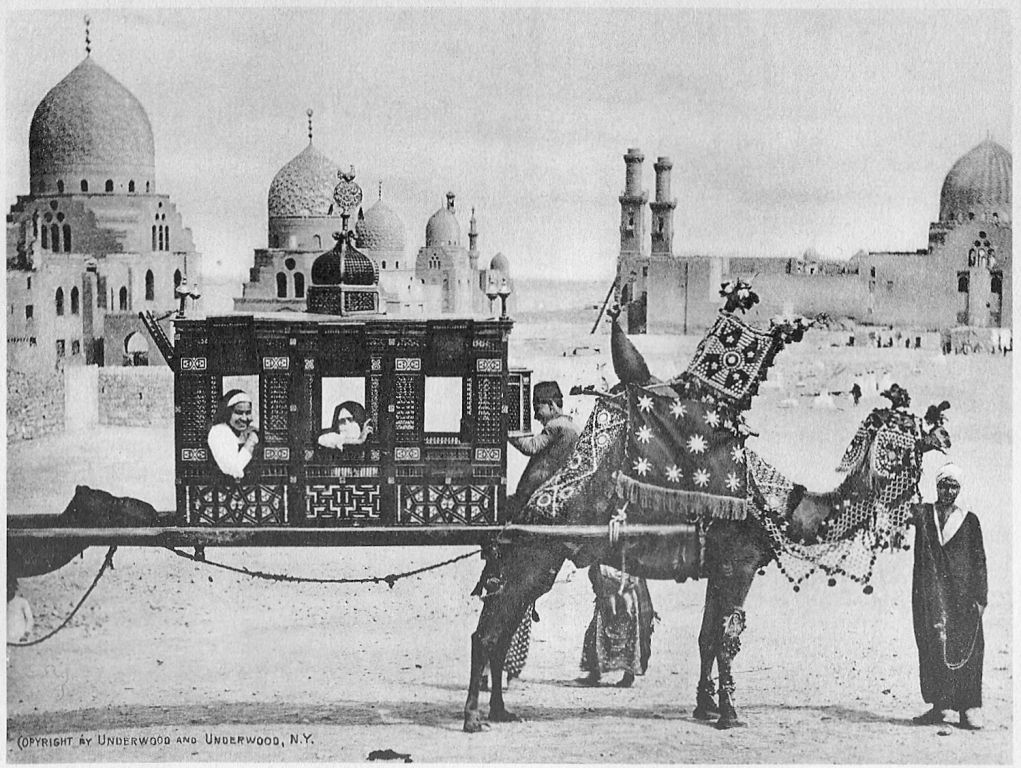
A "SHIP OF THE DESERT."
Here one sees ladies of modern Cairo out taking the air—"smelling the air," as they call it. Since one of them has removed her veil, it is safe to conclude that they do not belong to the upper class. Brides are usually transported in such a conveyance as this upon their wedding day, and the tinkling bells and smart trappings of the camel add to the pleasure of the occasion.