Chapter XVIII · CORONEL AND THE FALKLANDS October, November and December, 1914
Reading edition
‘Ill fared it then with Roderick Dhu,
That on the field his targe he threw,
Whose brazen studs and tough bull hide
Had Death so often dashed aside.
For train’d abroad his arms to wield
Fitz James’s blade was sword and shield.’
Scott, ‘The Lady of the Lake,’ Canto V, XV.
The Mystery of Admiral von Spee—First Threat to South American Waters—His Apparition at Samoa—His Second Disappearance—Renewed Threat to South America—Rear-Admiral Cradock Ordered to Concentrate—The Relative Forces—Importance of the Battleship Canopus—The First Combination against Admiral von Spee—Rear-Admiral Cradock’s Disquieting Telegram—His Cruise up the Chilean Coast without the Canopus—Certain News of the Enemy’s Arrival—Admiralty Measures—News of the Action of Coronel—The Meeting of the Squadrons—The British Attack the Germans—Destruction of the Good Hope and Monmouth—Escape of the Glasgow—Reflections upon the Admiralty Examined—An Explanation of Rear-Admiral Cradock’s Action—The Alternatives Open to the German Squadron—Second Combination against Admiral von Spee—Battle-cruisers Invincible and Inflexible Ordered to South America—Arrangements with the Japanese Admiralty—Development of the Second Combination—British Naval Resources at their Utmost Strain—Königsberg Blockaded and the Emden Sunk—Relief in the Indian Ocean—Accelerated Despatch of the Battle-Cruisers—What Admiral von Spee Found at the Falklands—News of the Battle and of Victory—The Action—Total Destruction of the German Squadron—End of the German Cruiser Warfare—End of the Great Strain.
As has already been described, Admiral von Spee, the German Commander-in-Chief in the Far East, sailed from Tsingtau (Kiaochau),[80] in the last week of June, with the 443Scharnhorst and Gneisenau, and on August 5, immediately after the British declaration of war, these two powerful ships were reported as being near the Solomon Islands. They were subsequently reported at New Guinea on the 7th August, and coaling at the Caroline Islands on the 9th. After this they vanished into the immense Pacific with its innumerable islands, and no one could tell where they would reappear. As the days succeeded one another and grew into weeks, our concern on their account extended and multiplied. Taking the Caroline Islands as the centre, we could draw daily widening circles, touching ever more numerous points where they might suddenly spring into action. These circles were varied according as the Germans were credited with proceeding at most economical speed, at three-quarter speed, or at full speed; and the speed at which they would be likely to steam depended upon the nature of the potential objective which in each case might attract them.
We have seen how the mystery of their whereabouts affected the movements of the New Zealand and Australian convoys, and what very anxious decisions were forced upon us. We have seen how the uncertainty brooded over the little expedition from New Zealand to Samoa: how glad we were when it arrived safely and seized the island: how prompt we were—providentially prompt—to snatch every vessel away from the roadstead of Samoa the moment the troops and stores were landed. When at length more than five weeks had passed without any sign of their presence, we took a complete review of the whole situation. All probabilities now pointed to their going to the Magellan Straits or to the West Coast of South America. The Australian convoy was now provided with superior escort. Not a British vessel could be found in the anchorage at Samoa. The old battleships were already on their way to guard the convoys in the Indian Ocean. There was nowhere where they could do so much harm as in the Straits of Magellan. Moreover, we thought 444we had indications of German coaling arrangements on the Chilian coast. There were rumours of a fuelling base in the Magellan Straits, for which diligent search was being made. There was certainly German trade still moving along the Western Coast of South America.
Accordingly, on the 14th September, the Admiralty sent the following telegram to Rear-Admiral Cradock, who commanded on the South American Station:—
Admiralty to Rear-Admiral Cradock, H.M.S. “Good Hope.”
September 14, 5.50 p.m.
The Germans are resuming trade on West Coast of South America, and Scharnhorst and Gneisenau may very probably arrive on that coast or in Magellan Straits.
Concentrate a squadron strong enough to meet Scharnhorst and Gneisenau, making Falkland Islands your coaling base, and leaving sufficient force to deal with Dresden and Karlsruhe.
Defence is joining you from Mediterranean, and Canopus is now en route to Abrolhos.[81] You should keep at least one County class and Canopus with your flagship until Defence joins.
When you have superior force, you should at once search Magellan Straits with squadron, keeping in readiness to return and cover the River Plate, or, according to information, search as far as Valparaiso northwards, destroy the German cruisers, and break up the German trade.
You should search anchorage in neighbourhood of Egg Harbour and Golfo Nuevo....[82]
Two days later all uncertainties, and with them our anxieties, vanished, and news was received that both Scharnhorst and Gneisenau had appeared off Samoa on the 14th September. There was nothing for them to hurt there. The empty roadstead mocked their power. The British flag flew on shore, and a New Zealand garrison far too strong for any landing 445party snarled at them from behind defences. Thus informed of the fate of their colony, the German cruisers put to sea after firing a few shells at the Government establishments.
A week later, the 22nd, they were at Papeete, which they bombarded, destroying half the town and sinking the little French gunboat Zélée which was in harbour. They left the same morning, steering on a Northerly course. We did not hear of this till the 30th. Then once again silence descended on the vast recesses of the Pacific.
We could now begin drawing our circles again from the beginning, and at any rate for several weeks we need not worry about these ships. Accordingly the Admiralty telegraphed to Admiral Cradock, on the 16th September, telling him the new situation and that he need not now concentrate his cruisers, but could proceed at once to attack German trade in the Straits of Magellan and on the Chilian coast.
Nothing more happened for a fortnight. On October 4, wireless signals from the Scharnhorst were heard by Suva wireless station, and also at Wellington, New Zealand. From this it appeared that the two vessels were on the way between the Marquesas Islands and Easter Island. Evidently the South American plan was in their mind. We passed our information to Admiral Cradock with the following telegram:—
Admiralty to Rear-Admiral Cradock. (October 5.)
It appears from information received that Gneisenau and Scharnhorst are working across to South America. A Dresden may be scouting for them. You must be prepared to meet them in company. Canopus should accompany Glasgow, Monmouth and Otranto, and should search and protect trade in combination.
On the 8th (received 12th) Admiral Cradock replied as follows:—
‘Without alarming, respectfully suggest that, in event of the enemy’s heavy cruisers and others concentrating West 446Coast of South America, it is necessary to have a British force on each coast strong enough to bring them to action.
‘For, otherwise, should the concentrated British force sent from South-East Coast be evaded in the Pacific, which is not impossible, (? and) thereby (? get) behind the enemy, the latter could destroy Falkland, English Bank, and Abrolhos coaling bases in turn with little to stop them, and with British ships unable to follow up owing to want of coal, enemy might possibly reach West Indies.’
And on the same day (received 11th) he reported evidences of the presence of the Dresden in South American waters:—
Following intelligence re Scharnhorst and Gneisenau has been received. Evidence found by Good Hope revisiting Orange Bay on 7th October that Dresden had been there 11th September, and there are indications that Scharnhorst and Gneisenau may be joined by Nürnberg, Dresden, and Leipzig. I intend to concentrate at Falkland Islands and avoid division of forces. I have ordered Canopus to proceed there, and Monmouth, Glasgow, and Otranto not to go farther north than Valparaiso until German cruisers are located again....
With reference to Admiralty telegram No. 74, does Defence join my command?
This was an important telegram. It showed a strong probability that the enemy was concentrating with the intention to fight. In these circumstances we must clearly concentrate too. I now looked at the Staff telegram of 5th October, and thought it was not sufficiently explicit on the vital point, viz., concentration for battle. In order that there should be no mistake, I wrote across the back of Admiral Cradock’s telegram received on the 12th October the following minute:—
First Sea Lord.
In these circumstances it would be best for the British ships to keep within supporting distance of one another, whether in the Straits or near the Falklands, and to postpone the cruise 447along the West Coast until the present uncertainty about Scharnhorst-Gneisenau is cleared up.
They and not the trade are our quarry for the moment. Above all, we must not miss them.
W. S. C.
The First Sea Lord the same evening added the word ‘Settled.’
On the 14th October, I discussed the whole situation which was developing with the First Sea Lord, and in accordance with my usual practice I sent him a minute after the conversation of what I understood was decided between us.
First Sea Lord.
I understood from our conversation that the dispositions you proposed for the South Pacific and South Atlantic were as follows:—
(1) Cradock to concentrate at the Falklands Canopus, Monmouth, Good Hope and Otranto.
(2) To send Glasgow round to look for Leipzig and attack, and protect trade on the West Coast of South America as far north as Valparaiso.
(3) Defence to join Carnarvon in forming a new combat squadron on the great trade route from Rio.
(4) Albion to join the flag of C.-in-C. Cape for the protection of the Luderitz Bay expedition.
These arrangements have my full approval.
Will you direct the Chief of the Staff to have a statement prepared showing the dates by which these dispositions will be completed, and the earliest date at which Scharnhorst and Gneisenau could arrive in the respective spheres.
I presume Admiral Cradock is fully aware of the possibility of Scharnhorst and Gneisenau arriving on or after the 17th instant in his neighbourhood; and that if not strong enough to attack, he will do his utmost to shadow them, pending the arrival of reinforcements.
The following telegram was sent to Admiral Cradock at the same time:—
448Admiralty to Rear-Admiral Cradock, October 14.
Concur in your concentration of Canopus, Good Hope, Glasgow, Monmouth, Otranto, for combined operation.
We have ordered Stoddart in Carnarvon to Montevideo as Senior Naval Officer north of that place.
Have ordered Defence to join Carnarvon.
He will also have under his orders Cornwall, Bristol, Orama and Macedonia.
Essex is to remain in West Indies.
On the 18th Admiral Cradock telegraphed:—
‘I consider it possible that Karlsruhe has been driven West, and is to join the other five. I trust circumstances will enable me to force an action, but fear that strategically, owing to Canopus, the speed of my squadron cannot exceed 12 knots.’
Thus it is clear that up to this date the Admiral fully intended to keep concentrated on the Canopus, even though his squadron speed should be reduced to 12 knots. Officially the Canopus could steam from 16 to 17 knots. Actually in the operations she steamed 15½.
Let us now examine the situation which was developing.[83] The Scharnhorst and the Gneisenau were drawing near the South Coast of America. On the way they might be met by the light cruisers Leipzig, Dresden and Nürnberg. The squadron which might thus be formed would be entirely composed of fast modern ships. The two large cruisers were powerful vessels. They carried each eight 8–inch guns arranged in pairs on the upper deck, six of which were capable of firing on either beam. Both ships being on permanent foreign service were fully manned with the highest class of German crews; and they had in fact only recently distinguished themselves as among the best shooting ships of the whole German Navy. Against these two vessels and their attendant light cruisers, Admiral Cradock had the Good Hope and the Monmouth. 449The Good Hope was a fine old ship from the Third Fleet with a 9·2–inch gun at either end and a battery of sixteen 6–inch guns amidships. She had exceptionally good speed (23 knots) for a vessel of her date. Her crew consisted mainly of reservists, and though she had good gunlayers she could not be expected to compare in gunnery efficiency with the best manned ships either in the British or German Navies. The Monmouth was one of the numerous County class against which Fisher had so often inveighed—a large ship with good speed but light armour, and carrying nothing heavier than a battery of fourteen 6–inch guns, of which nine could fire on the beam. These two British armoured cruisers had little chance in an action against the Scharnhorst and Gneisenau. No gallantry or devotion could make amends for the disparity in strength, to say nothing of gunnery. If brought to battle only the greatest good fortune could save them from destruction. It was for this reason that the moment the Admiralty began to apprehend the possibility of the arrival of the Scharnhorst and Gneisenau on the South American station, we sent a capital ship to reinforce Admiral Cradock. Our first intention had been to send the Indomitable from the Dardanelles, and at one time she had already reached Gibraltar on her way to South America when increasing tension with Turkey forced her to return to the Dardanelles. As we did not conceive ourselves able to spare a single battle-cruiser from the Grand Fleet at that time, there was nothing for it but to send an old battleship; and by the end of September the Canopus was already steaming from Abrolhos rocks through the South Atlantic.
With the Canopus, Admiral Cradock’s squadron was safe. The Scharnhorst and Gneisenau would never have ventured to come within decisive range of her four 12–inch guns. To do so would have been to subject themselves to very serious damage without any prospect of success. The old battleship, with her heavy armour and artillery, was in fact a citadel 450around which all our cruisers in those waters could find absolute security. It was for this reason that the Admiralty had telegraphed on 14th September: ‘Keep at least Canopus and one County class with your flagship’; and again, on the 5th October: ‘Canopus should accompany Glasgow, Monmouth and Otranto.’ It was for this reason that I was glad to read Admiral Cradock’s telegram: ‘Have ordered Canopus to Falkland Islands, where I intend to concentrate and avoid division of forces,’ on which I minuted: ‘In these circumstances it would be best for the British ships to keep within supporting distance of one another, whether in the Straits or near the Falklands’; and it was for this same reason that the Admiralty telegraphed on the 14th October: ‘Concur in your concentration of Good Hope, Canopus, Monmouth, Glasgow, Otranto for combined operation....’
It was quite true that the speed of the Canopus was in fact only fifteen and a half knots, and that as long as our cruisers had to take her about with them they could not hope to catch the Germans. All the Canopus could do was to prevent the Germans catching and killing them. But that would not be the end of the story; it would only be its beginning. When the Germans reached the South American coast after their long voyage across the Pacific, they would have to coal and take in supplies: they were bound to try to find some place where colliers could meet them, and where they could refit and revictual. The moment they were located, either by one of our light cruisers or reported from the shore, the uncertainty of their whereabouts was at an end. We could instantly concentrate upon them from many quarters. The Japanese battleship Hizen and cruiser Idzumo, with the British light cruiser Newcastle, were moving southward across the Northern Pacific towards the coast of South America—a force also not capable of catching the Scharnhorst and Gneisenau, but too strong to be attacked by them. On the East Coast of South America was Rear-Admiral Stoddart’s squadron 451with the powerful modern armoured cruiser Defence, with two more County class cruisers, Carnarvon (7·5–inch guns) and Cornwall, the light cruiser Bristol, and the armed merchant cruisers Macedonia and Orama. All these ships could be moved by a single order into a common concentration against the German squadron the moment we knew where they were; and meanwhile, so long as he kept within supporting distance of the Canopus, Admiral Cradock could have cruised safely up the Chilean coast, keeping the Germans on the move and always falling back on his battleship if they attempted to attack him. The Good Hope and Monmouth steaming together were scarcely inferior in designed speed to the Scharnhorst and Gneisenau, and these last had been long at sea. Admiral Cradock could, therefore, have kept on observing the Germans, disturbing them, provoking them and drawing them on to the Canopus. Moreover, in the Glasgow he had a light cruiser which was much superior in speed to the Scharnhorst and Gneisenau, and superior both in strength and speed to any one of the German light cruisers concerned.
I cannot therefore accept for the Admiralty any share in the responsibility for what followed. The first rule of war is to concentrate superior strength for decisive action and to avoid division of forces or engaging in detail. The Admiral showed by his telegrams that he clearly appreciated this. The Admiralty orders explicitly approved his assertion of these elementary principles. We were not, therefore, anxious about the safety of Admiral Cradock’s squadron. A more important and critical situation would arise, if in cruising up the West Coast of South America with his concentrated force Admiral Cradock missed the Germans altogether, and if they passed to the southward of him through the Straits of Magellan or round the Horn, refuelling there in some secret bay, and so came on to the great trade route from Rio. Here they would find Admiral Stoddart, whose squadron when 452concentrated, though somewhat faster and stronger than the Germans, had not much to spare in either respect. It was for this reason that I had deprecated in my minute of the 12th October Admiral Cradock’s movement up the West Coast and would have been glad to see him remaining near the Straits of Magellan, where he could either bar the path of the Scharnhorst and the Gneisenau, or manœuvre to join forces with Admiral Stoddart. However, I rested content with the decisions conveyed in the Admiralty telegram of the 14th October, and awaited events.
Suddenly, on the 27th October, there arrived a telegram from Admiral Cradock which threw me into perplexity:—
Rear-Admiral Cradock to Admiralty.
Good Hope. 26th October, 7 p.m. At sea.
Admiralty telegram received 7th October. With reference to orders to search for enemy and our great desire for early success, I consider that owing to slow speed of Canopus it is impossible to find and destroy enemy’s squadron.
Have therefore ordered Defence to join me after calling for orders at Montevideo.
Shall employ Canopus on necessary work of convoying colliers.
We were then in the throes of the change in the office of First Sea Lord, and I was gravely preoccupied with the circumstances and oppositions attending the appointment of Lord Fisher. But for this fact I am sure I should have reacted much more violently against the ominous sentence: ‘Shall employ Canopus on necessary work of convoying colliers.’ As it was I minuted to the Naval Secretary (Admiral Oliver) as follows:—
‘This telegram is very obscure, and I do not understand what Admiral Cradock intends and wishes.’
I was reassured by his reply on the 29th October:—
453‘The situation on the West Coast seems safe. If Gneisenau and Scharnhorst have gone north they will meet eventually Idzumo, Newcastle, and Hizen moving south, and will be forced south on Glasgow and Monmouth who have good speed and can keep touch and draw them south on to Good Hope and Canopus, who should keep within supporting distance of each other.’
The half fear which had begun to grow in my mind that perhaps the Admiral would go and fight without the Canopus which I thought was so improbable that I did not put it on paper, was allayed. It would, of course, be possible for him to manœuvre forty or fifty miles ahead of the Canopus and still close her before fighting. To send the Defence to join Admiral Cradock would have left Admiral Stoddart in a hopeless inferiority. Indeed, in a few hours arrived Admiral Stoddart’s protest of the 29th October:—
‘I have received orders from Admiral Cradock to send Defence to Montevideo to coal, obtain charts, and to await further orders.
Submit I may be given two fast cruisers in place of Defence, as I do not consider force at my disposal sufficient....’
The Admiralty Staff had, however, already replied in accordance with all our decisions:—
Admiralty to Rear-Admiral Cradock.
(Sent October 28, 1914, 6.45 p.m.)
Defence is to remain on East Coast under orders of Stoddart.
This will leave sufficient force on each side in case the hostile cruisers appear there on the trade routes.
There is no ship available for the Cape Horn vicinity.
Japanese battleship Hizen shortly expected on North American coast; she will join with Japanese Idzumo and Newcastle and move south towards Galapagos.
454But neither this nor any further message reached Admiral Cradock. He had taken his own decision. Without waiting for the Defence, even if we had been able to send her, and leaving the Canopus behind to guard the colliers, he was already steaming up the Chilean coast. But though he left the inexpugnable Canopus behind because she was too slow, he took with him the helpless armed merchant cruiser Otranto, which was scarcely any faster. He was thus ill-fitted either to fight or run.
He telegraphed to us from off Vallenar at 4 p.m. on 27th October (received 1st November, 4.33 a.m.):—
‘Have received your telegram 105. Have seized German mails. Monmouth, Good Hope and Otranto coaling at Vallenar. Glasgow patrolling vicinity of Coronel to intercept German shipping rejoining flag later on. I intend to proceed northward secretly with squadron after coaling and to keep out of sight of land. Until further notice continue telegraphing to Montevideo.’
And at noon on 29th October (received 1st November, 7.40 a.m.):—
‘Until further notice mails for Rear-Admiral Cradock, Good Hope, Canopus, Monmouth, Glasgow, Otranto, should be forwarded to Valparaiso.’
The inclusion of the Canopus in the middle of the latter message seemed to indicate the Admiral’s intention to work in combination with the Canopus even if not actually concentrated. These were the last messages received from him.
On the 30th October Lord Fisher became First Sea Lord. As soon as he entered the Admiralty I took him to the War Room and went over with him on the great map the positions and tasks of every vessel in our immense organisation. It took more than two hours. The critical point was clearly in South American waters. Speaking of Admiral Cradock’s 455position, I said, ‘You don’t suppose he would try to fight them without the Canopus?’ He did not give any decided reply.
Early on the 3rd November we got our first certain news of the Germans.
Consul-General, Valparaiso, to Admiralty. (Sent 5.20 p.m., 2nd November. Received 3.10 a.m., 3rd November.)
Master of Chilean merchant vessel reports that on 1st November 1 p.m. he was stopped by Nürnberg 5 miles off Cape Carranza about 62 miles north of Talcahuano. Officers remained on board 45 minutes. Two other German cruisers lay west about 5 and 10 miles respectively. Master believes one of these was Scharnhorst. On 26th October, 1 p.m. Leipzig called at Mas-a-Fuera having crew 456 and 10 guns, 18 days out from Galapagos. She was accompanied by another cruiser name unknown. They bought oxen and left same day. On 29th October unknown warship was seen in lat. 33 south, long. 74 west, steaming towards Coquimbo.
Here at last was the vital message for which the Admiralty Staff had waited so long. Admiral von Spee’s squadron was definitely located on the West Coast of South America. He had not slipped past Admiral Cradock round the Horn as had been possible. For the moment Admiral Stoddart was perfectly safe. With the long peninsula of South America between him and the Scharnhorst and Gneisenau, there was no longer any need for him to keep the Defence. She could join Cradock for what we must hope would be an early battle. After surveying the new situation we telegraphed to Admiral Stoddart as follows:—
(Sent 6.20 p.m., 3rd November.)
Defence to proceed with all possible dispatch to join Admiral Cradock on West Coast of America. Acknowledge.
This telegram was initialled by Admiral Sturdee, Lord Fisher and myself. We telegraphed at the same time to the Japanese Admiralty:—
456Scharnhorst, Gneisenau, Nürnberg, Leipzig, Dresden have been located near Valparaiso coaling and provisioning. This squadron is presumably concentrated for some serious operation. We are concentrating Glasgow, Good Hope, Canopus, Monmouth, and Defence on the S.W. coast of South America, hoping to bring them to battle.... We hope that the Japanese Admiralty may now find it possible to move some of their squadrons eastward in order to intercept the German squadron and prevent its return to Asiatic or Australian waters.... We indicate our views in order to obtain yours and to concert common action.
We also telegraphed to Admiral Cradock once more reiterating the instructions about the Canopus:—
(Sent 6.55 p.m., 3rd November.)
Defence has been ordered to join your flag with all dispatch. Glasgow should find or keep in touch with the enemy. You should keep touch with Glasgow concentrating the rest of your squadron including Canopus. It is important you should effect your junction with Defence at earliest possible moment subject to keeping touch with Glasgow and enemy. Enemy supposes you at Corcovados Bay. Acknowledge.
But we were already talking to the void.
When I opened my boxes at 7 o’clock on the morning of November 4, I read the following telegram:—
Maclean, Valparaiso, to Admiralty. (Sent November 3, 1914, 6.10 p.m.)
Have just learnt from Chilean Admiral that German Admiral states that on Sunday at sunset, in thick and wicked weather, his ships met Good Hope, Glasgow, Monmouth, and Otranto. Action was joined, and Monmouth turned over and sank after about an hour’s fighting.
Good Hope, Glasgow and Otranto drew off into darkness.
Good Hope was on fire, an explosion was heard, and she is believed to have sunk.
Gneisenau, Scharnhorst and Nürnberg were among the German ships engaged.
457The story of what had happened, so far as it ever can be known, is now familiar; it is fully set out in the official history, and need only be summarised here. Arrived on the Chilean coast, having refuelled at a lonely island, and hearing that the British light cruiser Glasgow was at Coronel, Admiral von Spee determined to make an attempt to cut her off, and with this intention steamed southward on November 1 with his whole squadron. By good fortune the Glasgow left harbour before it was too late. Almost at the same moment, Admiral Cradock began his sweep northward, hoping to catch the Leipzig, whose wireless had been heard repeatedly by the Glasgow. He was rejoined by the Glasgow at half-past two, and the whole squadron proceeded northward abreast about fifteen miles apart. At about half-past four the smoke of several vessels was seen to the northward, and in another quarter of an hour the Glasgow was able to identify the Scharnhorst, Gneisenau and a German light cruiser. The Canopus was nearly 300 miles away. Was there still time to refuse action? Undoubtedly there was. The Good Hope and Monmouth had normal speeds of 23 knots and 22·4 respectively and could certainly steam 21 knots in company that day. The Glasgow could steam over 25. The Scharnhorst and Gneisenau had nominal speeds of 23·2 and 23·5; but they had been long in southern seas and out of dock. On the knowledge he possessed at that moment Admiral Cradock would have been liberal in allowing them 22 knots. Rough weather would reduce speeds equally on both sides. Had he turned at once and by standing out to sea offered a stern chase to the enemy, he could only be overhauled one knot each hour. When the enemy was sighted by the Glasgow at 4.45, the nearest armoured ships were about 20 miles apart. There were scarcely two hours to sundown and less than three to darkness.
But the Otranto was a possible complication. She could only steam 18 knots, and against the head sea during the 458action she did in fact only steam 15 knots. As this weak, slow ship had been for some unexplained reason sent on ahead with the Glasgow, she was at the moment of sighting the enemy only 17 miles distant. Assuming that Admiral von Spee could steam 22 knots, less 3 for the head sea, i.e. 19, he would overhaul the Otranto 4 knots an hour. On this he might have brought her under long-range fire as darkness closed in. To that extent she reduced the speed of the British squadron and diminished their chances of safety. This may have weighed with Admiral Cradock.
We now know, of course, that in spite of being cumbered with the Otranto he could, as it happened, easily and certainly have declined action had he attempted to do so. At the moment of being sighted, Admiral von Spee had only steam for 14 knots, and had to light two more boilers to realise his full speed. Further his ships were dispersed. To concentrate and gain speed took an hour and a half off the brief daylight during which the British ships would actually have been increasing their distance. Moreover, in the chase and battle of the Falklands the greatest speed ever developed by the Scharnhorst and Gneisenau did not exceed 20 knots in favourable weather. There is therefore no doubt he could have got away untouched.
But nothing was farther from the mind of Admiral Cradock. He instantly decided to attack. As soon as the Glasgow had sighted the enemy, she had turned back towards the flagship, preceded by the Monmouth and the Otranto all returning at full speed. But Admiral Cradock at 5.10 ordered the squadron to concentrate, not on his flagship the Good Hope, the farthest ship from the enemy, but on the Glasgow, which though retreating rapidly was still the nearest. At 6.18 he signalled to the distant Canopus: ‘I am now going to attack enemy.’ The decision to fight sealed his fate, and more than that the fate of the squadron.
To quote the log of the Glasgow, ‘The British Squadron 459turned to port four points together towards the enemy with a view to closing them and forcing them to action before sunset, which if successful would have put them at a great disadvantage owing to the British squadron being between the enemy and the sun.’ The German Admiral easily evaded this manœuvre by turning away towards the land and keeping at a range of at least 18,000 yards. Both squadrons were now steaming southward on slightly converging courses—the British to seaward with the setting sun behind them, and the Germans nearer the land. And now began the saddest naval action in the war. Of the officers and men in both the squadrons that faced each other in these stormy seas so far from home, nine out of ten were doomed to perish. The British were to die that night: the Germans a month later. At 7 o’clock the sun sank beneath the horizon, and the German Admiral, no longer dazzled by its rays, opened fire. The British ships were silhouetted against the afterglow, while the Germans were hardly visible against the dark background of the Chilean coast. A complete reversal of advantage had taken place. The sea was high, and the main deck 6–inch guns both of the Monmouth and of the Good Hope must have been much affected by the dashing spray. The German batteries, all mounted in modern fashion on the upper deck, suffered no corresponding disadvantage from the rough weather. The unequal contest lasted less than an hour. One of the earliest German salvos probably disabled the Good Hope’s forward 9·2–inch gun, which was not fired throughout the action. Both she and the Monmouth were soon on fire. Darkness came on and the sea increased in violence till the Good Hope, after a great explosion, became only a glowing speck which was presently extinguished; and the Monmouth, absolutely helpless but refusing to surrender, was destroyed by the Nürnberg, and foundered, like her consort, with her flag still flying. The Otranto, an unarmoured merchantman, quite incapable of taking part in the action, rightly held her 460distance and disappeared into the gloom. Only the little Glasgow, which miraculously escaped fatal damage among the heavy salvos, continued the action until she was left alone in darkness on the stormy seas. There were no survivors from the two British ships: all perished, from Admiral to seaman. The Germans had no loss of life.
Quoth the Glasgow in her subsequent report:—
‘... Throughout the engagement the conduct of officers and men was entirely admirable. Perfect discipline and coolness prevailed under trying circumstances of receiving considerable volume of fire without being able to make adequate return. The men behaved exactly as though at battle practice; there were no signs of wild fire, and when the target was invisible the gunlayers ceased firing of their own accord. Spirit of officers and ship’s company of Glasgow is entirely unimpaired by serious reverse in which they took part, and that the ship may be quickly restored to a condition in which she can take part in further operations against the same enemy is the unanimous wish of us all.’
This as it happened they were not to be denied.
Surveying this tragic episode in the light of after knowledge, the official historian has blamed the Admiralty on various grounds: first, for dividing the available force into two inadequate squadrons under Admiral Cradock and Admiral Stoddart; secondly, for a lack of explicitness in the wording of the Staff telegrams. I cannot admit that the first charge is in any way justified. It would, of course, have been much simpler to have concentrated the squadrons of Admiral Cradock and Admiral Stoddart in the Straits of Magellan and awaited events. But until we knew for certain that the German cruisers were coming to South America, there was a great disadvantage in denuding the main trade route from Rio of all protection. Suppose we had done this and Admiral von Spee had remained, as he could easily have done, for many weeks at Easter Island, or anywhere else in the Pacific, the 461whole of the Plate trade would then, for all we knew, have been at the mercy of the Karlsruhe or of any other German commerce destroyer. At least six different courses were open to von Spee, and we had, while our resources were at the fullest strain, to meet every one of them. Suppose for instance he had gone northward to the Panama Canal and, passing swiftly through, had entered the West Indies: of what use would be our concentration in the Straits of Magellan? The reasoning and state of mind which would have led to such a concentration would have involved a virtual suspension of our enterprises all over the world. We could not afford to do that. We decided deliberately in October to carry on our protection of trade in every theatre in spite of the menace of the unlocated Scharnhorst and Gneisenau, and to do this by means of squadrons which, though they would not be homogeneous in speed and class, were in every case if held together capable of fighting the enemy with good prospects of success. This was true of the Anglo-Japanese squadron. It was true of the escort of the Australian convoy. It was true of Admiral Stoddart. Most of all was it true of Admiral Cradock. The last word in such an argument was surely spoken by Admiral von Spee. ‘The English,’ he wrote the day after the battle, ‘have here another ship like the Monmouth; and also it seems a battleship of the Queen type, with 12–inch guns. Against this last-named we can hardly do anything. If they had kept their forces together we should, I suppose, have got the worst of it.’
So far as the clarity of the Staff telegrams is concerned, no doubt here and there the wording of naval messages had not been sufficiently precise, and this fault ran through much of the Naval Staff work in those early days; but on the main point nothing could have been more emphatic, nor, indeed, should any emphasis have been needed. It ought not to be necessary to tell an experienced Admiral to keep concentrated and not to be brought to action in circumstances of great 462disadvantage by superior forces. Still, even this was done, and in telegram after telegram the importance of not being separated from the Canopus, especially sent him for his protection, was emphasised.
Lastly, the official historian has represented the new decision to reinforce Cradock by the Defence as a reversal by Lord Fisher of the mistaken policy hitherto pursued.
‘By the time it (Admiral Cradock’s telegram of 31st) reached the Admiralty the new Board was installed with Lord Fisher as First Sea Lord, and one of their first acts was an effort to improve the precarious position in which Admiral Cradock found himself. The Defence was immediately ordered to join him.’[84]
This is unjust both to Prince Louis and to Admiral Sturdee. It was not possible to order the superior concentration until the enemy had been located, and such concentration would have been ordered by any Board the moment the uncertainty was cleared up. The official historian would not have fallen into this error in a work distinguished for its care and industry, if he had mentioned the telegram from the Consul-General, Valparaiso, which was received on the morning of the 3rd, or if he had noticed that although the position in South American waters was known to Lord Fisher on the 30th October, no fresh dispositions were made or could be made until the whereabouts of the enemy was clearly ascertained. Then and not till then could we strip Admiral Stoddart or inform Admiral Cradock that the Defence was hurrying to join him.
So far as Admiral Cradock is concerned, I cannot do better than repeat the words which I wrote at the time and which commanded the recorded assent both of Lord Fisher and of Sir Arthur Wilson.
463Draft of an answer to a Parliamentary question not subsequently put.
Sir,—As I have already said, I did not think it convenient to go into this matter, but since it is pressed I will state that the Canopus was sent from St. Vincent to join Admiral Cradock’s flag on September 4th, as soon as the possibility of the arrival of the Scharnhorst and Gneisenau on the West Coast of South America could be taken into account. On October 12th Admiral Cradock telegraphed to the Admiralty that the indications showed the possibility of Dresden, Leipzig, and Nürnberg joining Scharnhorst and Gneisenau; and that he had ordered Canopus to Falkland Islands, where he intended to concentrate and avoid division of forces; and on October 14th the Admiralty approved specifically by telegram Admiral Cradock’s proposed concentration of Good Hope, Monmouth, Canopus, Glasgow, and Otranto for combined operations. The squadron thus formed was amply strong enough to defeat the enemy if attacked by them. It was not fast enough to force an engagement; but in view of the uncertainty as to which part of the world the enemy’s squadron would appear in, it was not possible at that time to provide another strong fast ship at that particular point.
Admiral Cradock was an experienced and fearless officer, and we are of opinion that feeling that he could not bring the enemy immediately to action as long as he kept with the Canopus, he decided to attack them with his fast ships alone, in the belief that even if he himself were destroyed in the action, he would inflict damage upon them which in the circumstances would be irreparable, and lead to their certain subsequent destruction. This was not an unreasonable hope; and though the Admiralty have no responsibility for Admiral Cradock’s decision they consider that it was inspired by the highest devotion, and in harmony with the spirit and traditions of the British Navy.
We had now to meet the new situation. Our combinations, such as they were, were completely ruptured, and Admiral von Spee, now in temporary command of South American waters, possessed a wide choice of alternatives. He might turn back into the Pacific, and repeat the mystery tactics 464which had been so baffling to us. He might steam northward up the West Coast of South America and make for the Panama Canal. In this case he would run a chance of being brought to battle by the Anglo-Japanese Squadron which was moving southward. But of course he might not fall in with them, or, if he did, he could avoid battle owing to his superior speed. He might come round to the East Coast and interrupt the main trade route. If he did this he must be prepared to fight Admiral Stoddart; but this would be a very even and hazardous combat. Admiral Stoddart had against the two armoured German ships three armoured ships, of which the Defence, a later and a better ship than either of the Germans, mounted four 9·2–inch and ten 7·5–inch guns, and was one of our most powerful armoured-cruiser class. Lastly, he might cross the Atlantic, possibly raiding the Falkland Islands on his way, and arrive unexpectedly on the South African coast. Here he would find the Union Government’s expedition against the German colony in full progress and his arrival would have been most unwelcome. General Botha and General Smuts, having suppressed the rebellion, were about to resume in a critical atmosphere their attack upon German South-West Africa, and a stream of transports would soon be flowing with the expedition and its supplies from Cape Town to Luderitz Bay. Subsequently or alternatively to this intrusion, Admiral von Spee might steam up the African coast and strike at the whole of the shipping of the expedition to the Cameroons, which was quite without means of defending itself against him.
All these unpleasant possibilities had to be faced by us. We had to prepare again at each of many points against a sudden blow; and, great as were our resources, the strain upon them became enormous. The first step was to restore the situation in South American waters. This would certainly take a month. My minute of inquiry to the Chief of the Staff, written an hour after I had read the first news of 465the disaster, will show the possibilities which existed. It will be seen that in this grave need my mind immediately turned to wresting a battle-cruiser from the Grand Fleet which, joined with the Defence, Carnarvon, Cornwall and Kent, would give Admiral Stoddart an overwhelming superiority.
4/11/14.
Director of Operations Division.
1. How far is it, and how long would it take Dartmouth and Weymouth to reach Punta Arenas, Rio, or Abrolhos respectively, if they started this afternoon with all dispatch?
2. How long would it take—
(a) Kent to reach Rio and Abrolhos?
(b) Australia (1) without, and (2) with Montcalm to reach Galapagos via Makada Islands, and also Idzumo and Newcastle to reach them?
(c) The Japanese 2nd Southern Squadron to replace Australia at Fiji?
(d) Defence, Carnarvon and Cornwall respectively to reach Punta Arenas?
(e) Invincible to reach Abrolhos, Rio, Punta Arenas?
(f) Hizen and Asama to reach Galapagos or Esquimalt?[85]
W.S.C.
But I found Lord Fisher in a bolder mood. He would take two battle-cruisers from the Grand Fleet for the South American station. More than that, and much more questionable, he would take a third—the Princess Royal—for Halifax and later for the West Indies in case von Spee came through the Panama Canal. There never was any doubt what ought to be sent. The question was what could be spared. We measured up our strength in home waters anxiously, observing that the Tiger was about to join the 1st Battle-Cruiser Squadron, that the new battleships Benbow, Empress of India and Queen Elizabeth were practically ready. We sent forthwith the following order to the Commander-in-Chief:—
466(November 4, 1914, 12.40 p.m.)
Order Invincible and Inflexible to fill up with coal at once and proceed to Berehaven with all dispatch. They are urgently needed for foreign service. Admiral and Flag-Captain Invincible to transfer to New Zealand. Captain New Zealand to Invincible. Tiger has been ordered to join you with all dispatch. Give her necessary orders.
I also telegraphed personally to Sir John Jellicoe as follows:—
(November 5, 12.5 a.m.)
From all reports received through German sources, we fear Cradock has been caught or has engaged with only Monmouth and Good Hope armoured ships against Scharnhorst and Gneisenau. Probably both British vessels sunk. Position of Canopus critical and fate of Glasgow and Otranto uncertain.
Proximity of concentrated German squadron of 5 good ships will threaten gravely main trade route Rio to London. Essential recover control.
First Sea Lord requires Invincible and Inflexible for this purpose.
Sturdee goes Commander-in-Chief, South Atlantic and Pacific.
Oliver, Chief of Staff. Bartolomé, Naval Secretary.
Apparently we had not at this stage decided finally to send the Princess Royal. Sir John Jellicoe rose to the occasion and parted with his two battle-cruisers without a word. They were ordered to steam by the West Coast to Devonport to fit themselves for their southern voyage. Our plans for the second clutch at von Spee were now conceived as follows[86]:—
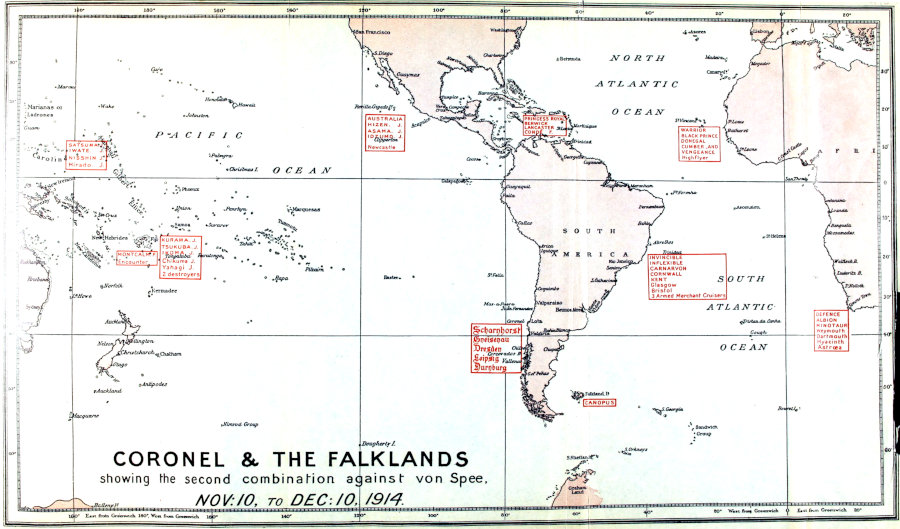
(1) Should he break across the Pacific; he would be dealt with by the very superior Japanese 1st Southern Squadron, based on Suva to cover Australia and New Zealand, and composed as follows:—Kurama (battleship), Tsukuba and Ikoma (battle-cruisers), Chikuma and Yahagi (light cruisers). At Suva also were the Montcalm and Encounter. Another strong 467Japanese squadron (four ships) was based on the Caroline Islands.
(2) To meet him, should he proceed up the West Coast of South America, an Anglo-Japanese Squadron, comprising Australia (from Fiji), Hizen, Idzumo, Newcastle, was to be formed off the North American Coast.
(3) Should he come round on to the East Coast, Defence, Carnarvon, Cornwall, Kent were ordered to concentrate off Montevideo, together with Canopus, Glasgow and Bristol, and not seek action till joined by Invincible and Inflexible, thereafter sending the Defence to South Africa.
(4) Should he approach the Cape station, he would be awaited by Defence and also Minotaur (released from the Australian convoy, after we knew of von Spee’s arrival in South American waters), together with the old battleship Albion, and Weymouth, Dartmouth, Astræa and Hyacinth, light cruisers: the Union Expedition being postponed for 14 days.
(5) Should he come through the Panama Canal, he would meet the Princess Royal, as well as the Berwick and Lancaster, of the West Indian Squadron, and the French Conde.
(6) Cameroons were warned to be ready to take their shipping up the river beyond his reach.
(7) Should he endeavour to work homewards across the South Atlantic, he would come into the area of a new squadron under Admiral de Robeck to be formed near the Cape de Verde Islands, comprising the old battleship Vengeance, the strong armoured cruisers Warrior and Black Prince and the Donegal, Highflyer, and later Cumberland.
Thus to compass the destruction of five warships, only two of which were armoured, it was necessary to employ nearly thirty, including twenty-one armoured ships, the most part of superior metal, and this took no account of the powerful Japanese Squadrons, and of French ships or of armed merchant cruisers, the last-named effective for scouting.
I telegraphed to the Japanese Admiralty as follows:—
468British Admiralty to Japanese Admiralty.
November 5, 1914.
In consequence of unsuccessful action off Chili and definite location of German squadron, we have ordered concentration off Montevideo of Defence, Kent, Carnarvon and Cornwall. These will be joined with all dispatch by Invincible and Inflexible battle-cruisers from England, and Dartmouth light cruiser from East Africa, and remainder of defeated squadron from Chili. This assures the South Atlantic situation. We now desire assistance of Japan in making equally thorough arrangements on Pacific side. We propose for your consideration and friendly advice the following:—Newcastle and Idzumo to go south in company to San Clemente Island off San Diego, California, there to meet Hizen from Honolulu. Meanwhile Asama will be able to effect internment or destruction of Geier. We also propose to move Australia battle-cruiser from Fiji to Fanning Island. By the time these moves are complete, probably by November 17, we may know more of Scharnhorst and Gneisenau movements and a further concentration of Australia and Asama with Hizen, Idzumo and Newcastle will be possible either at San Clemente or further to the south, further movements depending on the enemy.
We should also like a Japanese squadron to advance to Fiji to take the place of the Australia and so guard Australia and New Zealand in case the Germans return.
With regard to the Indian Ocean and Western Pacific, it is now known that Emden is the only enemy ship at large. We therefore hope that the Japanese squadrons and vessels not involved in the eastward movement will draw westward into the vicinity of Sumatra and the Dutch East Indies in order to block every exit and deny every place of shelter up to the 90th meridian of east longitude.
British Admiralty are combining in Indian waters in search of Emden the following light cruisers:—Weymouth, Gloucester, Yarmouth, Melbourne, Sydney, and the armoured cruiser Hampshire and Russian cruiser Askold. These ships will be ready by the middle of November. Thus by concerted action between the Allied fleets the Emden should be speedily run down.
469Japanese Admiralty to British Admiralty. November 7, 1914.
Secret and Private.
‘Japanese Admiralty give their consent generally to strategical scheme proposed and beg to withdraw the proposal of November 6, put forward through Admiral Oguri to the British War Staff. Measures will be taken in vicinity of Sumatra and Dutch East Indies as asked. First Southern Squadron will be dispatched to Fiji, but Japanese Admiralty think that it may be necessary for them to extend their sphere of operations to the Marquesas Islands. With reference to the movements of the Hizen and Asama, Japanese Admiralty will carry out your wishes as far as possible, bearing in mind necessity of watching the Geier until her (? disposition) is settled, but the Hizen will be dispatched at once.
‘With reference to the Hizen, Asama and Idzumo, Japanese Admiralty request British Admiralty to make arrangements necessary for their supply of coal, etc.’
Meanwhile it had been necessary to provide, as far as possible, for the safety of the surviving ships of Admiral Cradock’s squadron and to move the reinforcing ships.
Admiralty to H.M.S. Kent.
(November 4, 1914.)
Urgent. Proceed to the Abrolhos Rocks with all dispatch and communicate via Rio. It is intended you shall join Admiral Stoddart’s squadron.
Admiralty to Rear-Admiral Stoddart, Carnarvon.
(November 4, 1914.)
In view of reported sinking of Good Hope and Monmouth by Scharnhorst and Gneisenau off Coronel, November 1, armoured ships on S.E. Coast America must concentrate at once. Carnarvon, Cornwall should join Defence off Montevideo. Canopus, Glasgow, Otranto have been ordered if possible to join you there. Kent from Sierra Leone also has been ordered to join your flag via Abrolhos. Endeavour to get into communication with them. Enemy will most likely come on to the Rio trade route. Reinforcements will meet you shortly from England.
Acknowledge.
470From Admiralty to Canopus.
(November 4, 1914.)
In view of reported sinking of Good Hope and Monmouth by Scharnhorst and Gneisenau on 1st November you should make the best of your way to join Defence near Montevideo. Keep wide of track to avoid being brought to action by superior force.
If attacked, however, Admiralty is confident ship will in all circumstances be fought to the last as imperative to damage enemy whatever may be consequences.
Admiralty to ‘Glasgow,’ ‘Otranto’
(November 4, 1914.)
You should make the best of your way to join Defence near Montevideo. Keep wide of track to avoid being brought to action by superior force.
Admiralty to Governor, Falkland Islands.
(November 5, 1914.)
German cruiser raid may take place. All Admiralty colliers should be concealed in unfrequented harbours. Be ready to destroy supplies useful to enemy and hide codes effectively on enemy ships being sighted. Acknowledge.
In a few days we learned that her continuous fast steaming had led to boiler troubles in the Canopus, and we had to direct her to the Falklands.
Admiralty to Canopus.
(November 9, 1914, 3.10 a.m.)
You are to remain in Stanley Harbour. Moor the ship so that the entrance is commanded by your guns. Extemporise mines outside entrance. Send down your topmasts and be prepared for bombardment from outside the harbour. Stimulate the Governor to organise all local forces and make determined defence. Arrange observation stations on shore, by which your fire on ships outside can be directed. Land guns or use boats’ torpedoes to sink a blocking ship before 471she reaches the Narrows. No objection to your grounding ship to obtain a good berth.
Should Glasgow be able to get sufficient start of enemy to avoid capture, send her on to the River Plate; if not, moor her inside Canopus.
Repair your defects and wait orders.[87]
The strain upon British naval resources in the outer seas, apart from the main theatre of naval operations, was now at its maximum and may be partially appreciated from the following approximate enumerations:—
Combination against von Spee, 30 ships.
In search of the Emden and Königsberg, 8 ships.
General protection of trade by vessels other than the above, 40 ships.
Convoy duty in the Indian Ocean, 8 ships.
Blockade of the Turco-German fleet at the Dardanelles, 3 ships.
Defence of Egypt, 2 ships.
Miscellaneous minor tasks, 11 ships.
Total, 102 ships of all classes.
We literally could not lay our hands on another vessel of any sort or kind which could be made to play any useful part. But we were soon to have relief.
Already on October 30 news had reached us that the Königsberg had been discovered hiding in the Rufigi River in German East Africa, and it was instantly possible to mark her down with two ships of equal value and liberate the others. On November 9 far finer news arrived. The reader will remember for what purposes the Sydney and Melbourne had been attached to the great Australian convoy which was now crossing the Indian Ocean. On the 8th, the Sydney, cruising 472ahead of the convoy, took in a message from the wireless station at Cocos Island that a strange ship was entering the Bay. Thereafter, silence from Cocos Island. Thereupon the large cruiser Ibuki increased her speed, displayed the war flag of Japan and demanded permission from the British Officer in command of the convoy to pursue and attack the enemy. But the convoy could not divest itself of this powerful protection and the coveted task was accorded to the Sydney. At 9 o’clock she sighted the Emden and the first sea fight in the history of the Australian Navy began. It could have only one ending. In a hundred minutes the Emden was stranded, a flaming mass of twisted metal, and the whole of the Indian Ocean was absolutely safe and free.
In consideration of all the harm this ship had done us without offending against humanity or the laws of sea war as we conceived them, we telegraphed:—
Admiralty to Commander-in-Chief, China.
November 11, 1914.
‘Captain, officers and crew of Emden appear to be entitled to all the honours of war. Unless you know of any reason to the contrary, Captain and officers should be permitted to retain swords
These martial courtesies were, however, churlishly repaid.
The clearance of the Indian Ocean liberated all those vessels which had been searching for the Emden and the Königsberg. Nothing could now harm the Australian convoy. Most of its escort vanished. The Emden and the Königsberg were accounted for, and von Spee was on the other side of the globe. The Minotaur had already been ordered with all speed to the Cape. All the other vessels went through the Red Sea into the Mediterranean, where their presence was very welcome in view of the impending Turkish invasion of Egypt.
Meanwhile the Invincible and Inflexible had reached Devonport. We had decided that Admiral Sturdee on vacating the 473position of chief of the staff should hoist his flag in the Invincible, should take command on the South American station, and should assume general control of all the operations against von Spee. We were in the highest impatience to get him and his ships away. Once vessels fall into dockyard hands, a hundred needs manifest themselves.
On November 9, when Lord Fisher was in my room, the following message was put on my table:—
The Admiral Superintendent, Devonport, reports that the earliest possible date for completion of Invincible and Inflexible is midnight 13th November.
I immediately expressed great discontent with the dockyard delays and asked, ‘Shall I give him a prog?’ or words to that effect. Fisher took up the telegram. As soon as he saw it he exclaimed, ‘Friday the 13th. What a day to choose!’ I then wrote and signed the following order, which as it was the direct cause of the battle of the Falklands may be reproduced in facsimile.[88]
The ships sailed accordingly and in the nick of time. They coaled on November 26 at Abrolhos, where they joined and absorbed Admiral Stoddart’s squadron (Carnarvon, Cornwall, Kent, Glasgow, Bristol and Orama) and despatched Defence to the Cape, and without ever coming in sight of land or using their wireless they reached Port Stanley, Falkland Islands, on the night of Dec. 7. Here they found the Canopus in the lagoon, prepared to defend herself and the colony in accordance with the Admiralty instructions. They immediately began to coal.
After his victory at Coronel, Admiral von Spee comported himself with the dignity of a brave gentleman. He put aside the fervent acclamations of the German colony of Valparaiso 474and spoke no word of triumph over the dead. He was under no delusion as to his own danger. He said of the flowers which were presented to him, ‘They will do for my funeral.’ Generally, his behaviour would lead us to suppose that the inability of the Germans to pick up any British survivors was not due to want of humanity; and this view has been accepted by the British navy.
After a few days at Valparaiso he and his ships vanished again into the blue. We do not know what were the reasons which led him to raid the Falkland Islands, nor what his further plans would have been in the event of success. Presumably he hoped to destroy this unfortified British coaling base and so make his own position in South American waters less precarious. At any rate, at noon on December 6 he set off to the eastward from the Straits of Magellan with his five ships; and about 8 o’clock on December 8 his leading ship (the Gneisenau) was in sight of the main harbour of the Falklands. A few minutes later a terrible apparition broke upon German eyes. Rising from behind the promontory, sharply visible in the clear air, were a pair of tripod masts. One glance was enough. They meant certain death.[89] The day was beautifully fine and from the tops the horizon extended thirty or forty miles in every direction. There was no hope for victory. There was no chance of escape. A month before, another Admiral and his sailors had suffered a similar experience.
At 5 o’clock that afternoon I was working in my room at the Admiralty when Admiral Oliver entered with the following telegram. It was from the Governor of the Falkland Islands and ran as follows:—
‘Admiral Spee arrived at daylight this morning with all his ships and is now in action with Admiral Sturdee’s whole fleet, which was coaling.’
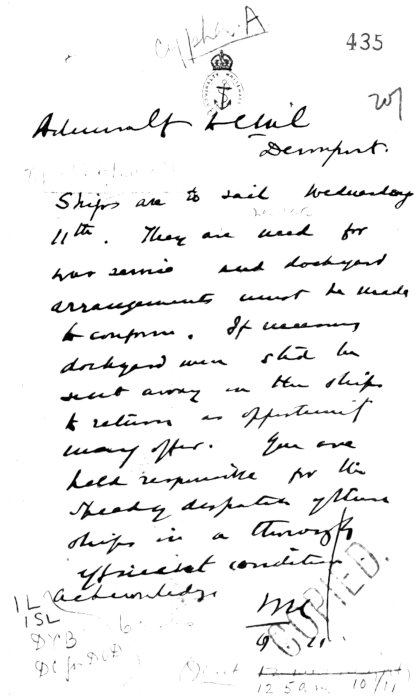
Facsimile of Admiralty’s Instructions to the Commander-in-Chief at Devonport.
475We had had so many unpleasant surprises that these last words sent a shiver up my spine. Had we been taken by surprise and, in spite of all our superiority, mauled, unready, at anchor? ‘Can it mean that?’ I said to the Chief of the Staff. ‘I hope not,’ was all he said. I could see that my suggestion, though I hardly meant it seriously, had disquieted him. Two hours later, however, the door opened again, and this time the countenance of the stern and sombre Oliver wore something which closely resembled a grin. ‘It’s all right, sir; they are all at the bottom.’ And with one exception so they were.
When the leading German ships were sighted far away on the distant horizon, Admiral Sturdee and his squadron were indeed coaling. From the intelligence he had received he had convinced himself that the Germans were at Valparaiso, and he intended to sail the next day in the hopes of doubling the Horn before the enemy could do so. More than two hours passed after the enemy first came in sight before he could raise steam and get under way. The first shots were fired by the 12–inch guns of the Canopus from her stationary position on the mudbanks of the inner harbour. The Gneisenau had continued to approach until she saw the fatal tripods, whereupon she immediately turned round and, followed by one of her light cruisers, made off at full speed to join her main body. In a few moments the whole of the German squadron was steaming off in a westerly direction with all possible speed. At 10 o’clock, the Kent, Carnarvon and Glasgow having already sailed, Admiral Sturdee came out of the harbour in the Invincible, followed by the Inflexible and Cornwall; while the light cruisers, one of whom (the Bristol) had her engines actually opened up, hurried on after as fast as possible.
The whole five ships of the German squadron were now visible, hull down on the horizon about fifteen miles away. 476The order was given for general chase, but later on, having the day before him, the Admiral regulated the speeds, the battle-cruisers maintaining only about 20 knots. This, however, was quite sufficient to overhaul the Germans, who after their long sojourn in the Pacific without docking were not able to steam more than 18 knots in company. Even so, the Leipzig began to lag behind, and shortly before 1 o’clock, the Inflexible opened fire upon her at 16,000 yards. Confronted with having his ships devoured one by one, von Spee took a decision which was certainly in accordance with the best traditions of the sea. Signalling to his light cruisers to make their escape to the South American coast, he turned with the Scharnhorst and Gneisenau to face his pursuers. The action which followed was on the British side uneventful. The German Admiral endeavoured more than once to close to ranges at which his powerful secondary armament of 5·9’s could play their part. The British held off just far enough to make this fire ineffective and pounded their enemy with their 12–inch guns. At this long range, however, it took a considerable time and much ammunition to achieve the destruction of the German cruisers. The Scharnhorst, with the Admiral and all hands, sank at 4.17 p.m., her last signal to her consort being to save herself. Gneisenau continued to fight against hopeless odds with the utmost fortitude until 6 o’clock when, being in a completely disabled condition, she opened her sea-cocks and vanished, with her flag still flying, beneath the icy waters of the ocean. The British ships rushing to the spot and lowering every available boat were able only to save 200 Germans, many of whom died the next day from the shock of the cold water. When both the Scharnhorst and Gneisenau had sunk, the Inflexible had only thirty and the Invincible only twenty-two rounds left for each of their 12–inch guns.
[Click anywhere on map for high resolution image.]
477Meanwhile, the other British cruisers had each selected one of the flying German light vessels, and a series of chases ensued. The Kent (Captain Allen) overtook and sunk the Nürnberg by an effort of steaming which surpassed all previous records and even, it is stated, her designed speed. The Nürnberg refused to surrender, and as she foundered by the head, the victors could see a group of men on her uplifted stern waving to the last the German flag. The Leipzig was finished off by the Glasgow and the Cornwall. The Dresden alone for the time made good her escape. She was hunted down and destroyed three months later in the roadstead of Mas-a-Fuera.
Thus came to an end the German cruiser warfare in the outer seas. With the exception of the Karlsruhe, of which nothing had been heard for some time and which we now know was sunk by an internal explosion on November 4, and the Dresden soon to be hunted down, no German ships of war remained on any of the oceans of the world. It had taken four months from the beginning of the war to achieve this result. Its consequences were far-reaching, and affected simultaneously our position in every part of the globe. The strain was everywhere relaxed. All our enterprises, whether of war or commerce, proceeded in every theatre without the slightest hindrance. Within twenty-four hours orders were sent to a score of British ships to return to Home Waters. For the first time we saw ourselves possessed of immense surpluses of ships of certain classes, of trained men and of naval supplies of all kinds, and were in a position to use them to the best advantage. The public, though gratified by the annihilating character of the victory, was quite unconscious of its immense importance to the whole naval situation.
478
CORONEL AND THE FALKLANDS.
SHIPS DIRECTLY INVOLVED.
Approximate Figure of Comparative Power. Name. Effective Speed: Knots. Guns.
BATTLE CRUISERS.
5 INVINCIBLE 24 8–12 inch
----------
----------
----------
----------
----------
5 INFLEXIBLE 24 8–12 inch
----------
----------
----------
----------
----------
BATTLESHIP.
4 CANOPUS 15½ 4–12 inch
------- 12–6 inch
-------
-------
-------
CRUISERS.
3 DEFENCE 22 4–9·2 inch
------- 10–7·5 inch
-------
-------
2½ SCHARNHORST 22 8–8·2 inch
----------- 6–5·9 inch
-----------
------
2½ GNEISENAU 22 8–8·2 inch
--------- 6–5·9 inch
---------
-----
2 GOOD HOPE 21½ 2–9·2 inch
---------- 16–6 inch
----------
1½ CARNARVON 21 4–7·5 inch
--------- 6–6 inch
-----
1 MONMOUTH 21 14–6 inch
--------
1 KENT 21½ 14–6 inch
----
1 CORNWALL 21 14–6 inch
--------
LIGHT CRUISERS.
GLASGOW 24 2–6 inch
10–4 inch
BRISTOL 24 2–6 inch
10–4 inch
LEIPZIG 21 10–4·1 inch
NÜRNBERG 22 10–4·1 inch
DRESDEN 22 10–4·1 inch
ARMED MERCHANT CRUISERS.
MACEDONIA 17
OTRANTO 16 4–4·7 inch
Note:—The figures of comparative value are only intended to enable the reader to follow the account. As broad classifications they are true, but they can only be taken as approximate.
479