Volume 23 — THE LETTERS OF ROBERT LOUIS STEVENSON
Reading edition
I
STUDENT DAYS AT EDINBURGH
TRAVELS AND EXCURSIONS
1868-1873
The following section consists chiefly of extracts from the correspondence and journals addressed by Louis Stevenson, as a lad of eighteen to twenty-two, to his father and mother during summer excursions to the Scottish coast or to the Continent. There exist enough of them to fill a volume; but it is not in letters of this kind to his family that a young man unbosoms himself most freely, and these are perhaps not quite devoid of the qualities of the guide-book and the descriptive exercise. Nevertheless they seem to me to contain enough signs of the future master-writer, enough of character, observation, and skill in expression, to make a certain number worth giving by way of an opening chapter to the present book. Among them are interspersed four or five of a different character addressed to other correspondents, and chiefly to his lifelong friend and intimate, Mr. Charles Baxter.
On both sides of the house Stevenson came of interesting stock. His grandfather was Robert Stevenson, civil engineer, highly distinguished as the builder of the Bell Rock lighthouse. By this Robert Stevenson, his three sons, and two of his grandsons now living, the business of civil engineers in general, and of official engineers to the Commissioners of Northern Lights in particular, has been carried on at Edinburgh with high credit and public utility for almost a century. Thomas Stevenson, the youngest of the three sons of the original Robert, was Robert Louis Stevenson’s father. He was a man not only of mark, zeal, and inventiveness in his profession, but of a strong and singular personality; a staunch friend and sagacious adviser, trenchant in judgment and demonstrative in emotion, outspoken, dogmatic,—despotic, even, in little things, but withal essentially chivalrous and soft-hearted; apt to pass with the swiftest transition from moods of gloom or sternness to those of tender or freakish gaiety, and commanding a gift of humorous and figurative speech second only to that of his more famous son.
Thomas Stevenson was married to Margaret Isabella, youngest daughter of the Rev. Lewis Balfour, for many years minister of the parish of Colinton in Midlothian. This Mr. Balfour (described by his grandson in the essay called The Manse) was of the stock of the Balfours of Pilrig, and grandson to that James Balfour, professor first of moral philosophy and afterwards of the law of nature and of nations, who was held in particular esteem as a philosophical controversialist by David Hume. His wife, Henrietta Smith, a daughter of the Rev. George Smith of Galston, to whose gift as a preacher Burns refers scoffingly in the Holy Fair, is said to have been a woman of uncommon beauty and charm of manner. Their daughter, Mrs. Thomas Stevenson, suffered in early and middle life from chest and nerve troubles, and her son may have inherited from her some of his constitutional weakness. Capable, cultivated, companionable, affectionate, she was a determined looker at the bright side of things, and hence better skilled, perhaps, to shut her eyes to troubles or differences among those she loved than understandingly to compose or heal them. Conventionally minded one might have thought her, but for the surprising readiness with which in later life she adapted herself to conditions of life and travel the most unconventional possible. The son and only child of these two, Robert Louis (baptized Robert Lewis Balfour3), was born on November 13, 1850, at 8 Howard Place, Edinburgh. His health was infirm from the first, and he was with difficulty kept alive by the combined care of his mother and a most devoted nurse, Alison Cunningham; to whom his lifelong gratitude will be found touchingly expressed in the course of the following letters. In 1858 he was near dying of a gastric fever, and was at all times subject to acute catarrhal and bronchial affections and extreme nervous excitability.
In January 1853 Stevenson’s parents moved to Inverleith Terrace, and in May 1857 to 17 Heriot Row, which continued to be their Edinburgh home until the death of Thomas Stevenson in 1887. Much of the boy’s time was also spent in the manse of Colinton on the Water of Leith, the home of his maternal grandfather. Ill-health prevented him getting much regular or continuous schooling. He attended first (1858-61) a preparatory school kept by a Mr. Henderson in India Street; and next (at intervals for some time after the autumn of 1861) the Edinburgh Academy.
Schooling was interrupted in the end of 1862 and first half of 1863 by excursions with his parents to Germany, the Riviera, and Italy. The love of wandering, which was a rooted passion in Stevenson’s nature, thus began early to find satisfaction. For a few months in the autumn of 1863, when his parents had been ordered for a second time to Mentone for the sake of his mother’s health, he was sent to a boarding-school kept by a Mr. Wyatt at Spring Grove, near London. It is not my intention to treat the reader to the series of childish and boyish letters of these days which parental fondness has preserved. But here is one written from his English school when he was about thirteen, which is both amusing in itself and had a certain influence on his destiny, inasmuch as his appeal led to his being taken out to join his parents on the French Riviera; which from these days of his boyhood he never ceased to love, and for which the longing, amid the gloom of Edinburgh winters, often afterwards gripped him by the heart.
Spring Grove School, 12th November 1863.
MA CHERE MAMAN,—Jai recu votre lettre Aujourdhui et comme le jour prochaine est mon jour de naisance je vous écrit ce lettre. Ma grande gatteaux est arrivé il leve 12 livres et demi le prix etait 17 shillings. Sur la soirée de Monseigneur Faux il y etait quelques belles feux d’artifice. Mais les polissons entrent dans notre champ et nos feux d’artifice et handkerchiefs disappeared quickly, but we charged them out of the field. Je suis presque driven mad par une bruit terrible tous les garcons kik up comme grand un bruit qu’il est possible. I hope you will find your house at Mentone nice. I have been obliged to stop from writing by the want of a pen, but now I have one, so I will continue.
My dear papa, you told me to tell you whenever I was miserable. I do not feel well, and I wish to get home. Do take me with you.
R. Stevenson.
This young French scholar has yet, it will be discerned, a good way to travel; in later days he acquired a complete reading and speaking, with a less complete writing, mastery of the language, and was as much at home with French ways of thought and life as with English.
For one more specimen of his boyish style, it may be not amiss to give the text of another appeal which dates from two and a half years later, and is also typical of much in his life’s conditions both then and later:—
2 Sulgarde Terrace, Torquay, Thursday [April 1866].
RESPECTED PATERNAL RELATIVE,—I write to make a request of the most moderate nature. Every year I have cost you an enormous—nay, elephantine—sum of money for drugs and physician’s fees, and the most expensive time of the twelve months was March.
But this year the biting Oriental blasts, the howling tempests, and the general ailments of the human race have been successfully braved by yours truly.
Does not this deserve remuneration?
I appeal to your charity, I appeal to your generosity, I appeal to your justice, I appeal to your accounts, I appeal, in fine, to your purse.
My sense of generosity forbids the receipt of more—my sense of justice forbids the receipt of less—than half-a-crown.—Greeting from, Sir, your most affectionate and needy son,
R. Stevenson.
From 1864 to 1867 Stevenson’s education was conducted chiefly at Mr. Thomson’s private school in Frederick Street, Edinburgh, and by private tutors in various places to which he travelled for his own or his parents’ health. These travels included frequent visits to such Scottish health resorts as Bridge of Allan, Dunoon, Rothesay, North Berwick, Lasswade, and Peebles, and occasional excursions with his father on his nearer professional rounds to the Scottish coasts and lighthouses. From 1867 the family life became more settled between Edinburgh and Swanston Cottage, Lothianburn, a country home in the Pentlands which Mr. Stevenson first rented in that year, and the scenery and associations of which sank deeply into the young man’s spirit, and vitally affected his after thoughts and his art.
By this time Louis Stevenson seemed to show signs of outgrowing his early infirmities of health. He was a lover, to a degree even beyond his strength, of outdoor life and exercise (though not of sports), and it began to be hoped that as he grew up he would be fit to enter the family profession of civil engineer. He was accordingly entered as a student at Edinburgh University, and for several winters attended classes there with such regularity as his health and inclinations permitted. This was in truth but small. The mind on fire with its own imaginations, and eager to acquire its own experiences in its own way, does not take kindly to the routine of classes and repetitions, nor could the desultory mode of schooling enforced upon him by ill-health answer much purpose by way of discipline. According to his own account he was at college, as he had been at school, an inveterate idler and truant. But outside the field of school and college routine he showed an eager curiosity and activity of mind. “He was of a conversable temper,” so he says of himself, “and insatiably curious in the aspects of life, and spent much of his time scraping acquaintance with all classes of men and womenkind.” Of one class indeed, and that was his own, he had soon had enough, at least in so far as it was to be studied at the dinners, dances, and other polite entertainments of ordinary Edinburgh society. Of these he early wearied. At home he made himself pleasant to all comers, but for his own resort chose out a very few houses, mostly those of intimate college companions, into which he could go without constraint, and where his inexhaustible flow of poetic, imaginative, and laughing talk seems generally to have rather puzzled his hearers than impressed them. On the other hand, during his endless private rambles and excursions, whether among the streets and slums, the gardens and graveyards of the city, or farther afield among the Pentland hills or on the shores of Forth, he was never tired of studying character and seeking acquaintance among the classes more nearly exposed to the pinch and stress of life.
In the eyes of anxious elders, such vagrant ways naturally take on the colours of idleness and a love of low company. Stevenson was, however, in his own fashion an eager student of books as well as of man and nature. He read precociously and omnivorously in the belles-lettres, including a very wide range of English poetry, fiction, and essays, and a fairly wide range of French; and was a genuine student of Scottish history, especially from the time of the persecutions down, and to some extent of history in general. The art of literature was already his private passion, and something within him even already told him that it was to be his life’s work. On all his truantries he went pencil and copybook in hand, trying to fit his impression of the scene to words, to compose original rhymes, tales, dialogues, and dramas, or to imitate the style and cadences of the author he at the moment preferred. For three or four years, nevertheless, he tried dutifully, if half-heartedly, to prepare himself for the family profession. In 1868, the year when the following correspondence opens, he went to watch the works of the firm in progress first at Anstruther on the coast of Fife, and afterwards at Wick. In 1869 he made the tour of the Orkneys and Shetlands on board the steam yacht of the Commissioners of Northern Lights, and in 1870 the tour of the Western Islands, preceded by a stay on the isle of Earraid, where the works of the Dhu Heartach lighthouse were then in progress. He was a favourite, although a very irregular, pupil of the professor of engineering, Fleeming Jenkin, whose friendship and that of Mrs. Jenkin were of great value to him, and whose life he afterwards wrote; and must have shown some aptitude for the family calling, inasmuch as in 1871 he received the silver medal of the Edinburgh Society of Arts for a paper on a suggested improvement in lighthouse apparatus. The outdoor and seafaring parts of an engineer’s life were in fact wholly to his taste. But he looked instinctively at the powers and phenomena of waves and tide, of storm and current, reef, cliff, and rock, with the eye of the poet and artist, and not those of the practician and calculator. For desk work and office routine he had an unconquerable aversion; and his physical powers, had they remained at their best, must have proved quite unequal to the workshop training necessary to the practical engineer. Accordingly in 1871 it was agreed, not without natural reluctance on his father’s part, that he should give up the hereditary vocation and read for the bar: literature, on which his heart was set, and in which his early attempts had been encouraged, being held to be by itself no profession, or at least one altogether too irregular and undefined. For the next several years, therefore, he attended law classes instead of engineering and science classes in the University, giving to the subject a certain amount of serious, although fitful, attention until he was called to the bar in 1875.
So much for the course of Stevenson’s outward life during these days at Edinburgh. To tell the story of his inner life would be a far more complicated task, and cannot here be attempted even briefly. The ferment of youth was more acute and more prolonged in him than in most men even of genius. In the Introduction I have tried to give some notion of the many various strains and elements which met in him, and which were in these days pulling one against another in his half-formed being, at a great expense of spirit and body. Add the storms, which from time to time attacked him, of shivering repulsion from the climate and conditions of life in the city which he yet deeply and imaginatively loved; the moods of spiritual revolt against the harsh doctrines of the creed in which he had been brought up, and to which his parents were deeply, his father even passionately, attached; the seasons of temptation, to which he was exposed alike by temperament and circumstance, to seek solace among the crude allurements of the city streets.
In the later and maturer correspondence which will appear in these volumes, the agitations of the writer’s early days are often enough referred to in retrospect. In the boyish letters to his parents, which make up the chief part of this first section, they naturally find no expression at all; nor will these letters be found to differ much in any way from those of any other lively and observant lad who is also something of a reader and has some natural gift of writing. At the end of the section I have indeed printed one cry of the heart, written not to his parents, but about them, and telling of the strain which matters of religious difference for a while brought into his home relations. The attachment between the father and son from childhood was exceptionally strong. But the father was staunchly wedded to the hereditary creeds and dogmas of Scottish Calvinistic Christianity; while the course of the young man’s reading, with the spirit of the generation in which he grew up, had loosed him from the bonds of that theology, and even of dogmatic Christianity in general, and had taught him to respect all creeds alike as expressions of the cravings and conjectures of the human spirit in face of the unsolved mystery of things, rather than to cling to any one of them as a revelation of ultimate truth. The shock to the father was great when his son’s opinions came to his knowledge; and there ensued a time of extremely painful discussion and private tension between them. In due time this cloud upon a family life otherwise very harmonious and affectionate passed quite away. But the greater the love, the greater the pain; when I first knew Stevenson this trouble gave him no peace, and it has left a strong trace upon his mind and work. See particularly the parable called “The House of Eld,” in his collection of Fables, and the many studies of difficult paternal and filial relations which are to be found in The Story of a Lie, The Misadventures of John Nicholson, The Wrecker, and Weir of Hermiston.
To Thomas Stevenson
In July 1868 R. L. S. went to watch the harbour works at Anstruther and afterwards those at Wick. Of his private moods and occupations in the Anstruther days he has told in retrospect in the essay Random Memories: the Coast of Fife. Here are some passages from letters written at the time to his parents. “Travellers” and “jennies” are, of course, terms of engineering.
’Kenzie House or whatever it is called, Anstruther. [July 1868.]
First sheet: Thursday. Second sheet: Friday.
MY DEAR FATHER,—My lodgings are very nice, and I don’t think there are any children. There is a box of mignonette in the window and a factory of dried rose-leaves, which make the atmosphere a trifle heavy, but very pleasant.
When you come, bring also my paint-box—I forgot it. I am going to try the travellers and jennies, and have made a sketch of them and begun the drawing. After that I’ll do the staging.
Mrs. Brown “has suffered herself from her stommick, and that makes her kind of think for other people.” She is a motherly lot. Her mothering and thought for others displays itself in advice against hard-boiled eggs, well-done meat, and late dinners, these being my only requests. Fancy—I am the only person in Anstruther who dines in the afternoon.
If you could bring me some wine when you come, ’twould be a good move: I fear vin d’Anstruther; and having procured myself a severe attack of gripes by two days’ total abstinence on chilly table beer I have been forced to purchase Green Ginger (“Somebody or other’s ‘celebrated’“), for the benefit of my stomach, like St. Paul.
There is little or nothing doing here to be seen. By heightening the corner in a hurry to support the staging they have let the masons get ahead of the divers and wait till they can overtake them. I wish you would write and put me up to the sort of things to ask and find out. I received your registered letter with the £5; it will last for ever. To-morrow I will watch the masons at the pier-foot and see how long they take to work that Fifeness stone you ask about; they get sixpence an hour; so that is the only datum required.
It is awful how slowly I draw, and how ill: I am not nearly done with the travellers, and have not thought of the jennies yet. When I’m drawing I find out something I have not measured, or, having measured, have not noted, or, having noted, cannot find; and so I have to trudge to the pier again ere I can go farther with my noble design.
Love to all.—Your affectionate son,
R. L. Stevenson.
To Mrs. Thomas Stevenson
’Kenzie House, Anstruther [later in July, 1868].
MY DEAR MOTHER,—To-night I went with the youngest M. to see a strolling band of players in the townhall. A large table placed below the gallery with a print curtain on either side of the most limited dimensions was at once the scenery and the proscenium. The manager told us that his scenes were sixteen by sixty-four, and so could not be got in. Though I knew, or at least felt sure, that there were no such scenes in the poor man’s possession, I could not laugh, as did the major part of the audience, at this shift to escape criticism. We saw a wretched farce, and some comic songs were sung. The manager sang one, but it came grimly from his throat. The whole receipt of the evening was 5s. and 3d., out of which had to come room, gas, and town drummer. We left soon; and I must say came out as sad as I have been for ever so long: I think that manager had a soul above comic songs. I said this to young M., who is a “Phillistine” (Matthew Arnold’s Philistine you understand), and he replied, “How much happier would he be as a common working-man!” I told him I thought he would be less happy earning a comfortable living as a shoemaker than he was starving as an actor, with such artistic work as he had to do. But the Phillistine wouldn’t see it. You observe that I spell Philistine time about with one and two l’s.
As we went home we heard singing, and went into the porch of the schoolhouse to listen. A fisherman entered and told us to go in. It was a psalmody class. One of the girls had a glorious voice. We stayed for half an hour.
Tuesday.—I am utterly sick of this grey, grim, sea-beaten hole. I have a little cold in my head, which makes my eyes sore; and you can’t tell how utterly sick I am, and how anxious to get back among trees and flowers and something less meaningless than this bleak fertility.
Papa need not imagine that I have a bad cold or am stone-blind from this description, which is the whole truth.
Last night Mr. and Mrs. Fortune called in a dog-cart, Fortune’s beard and Mrs. F.’s brow glittering with mist-drops, to ask me to come next Saturday. Conditionally, I accepted. Do you think I can cut it? I am only anxious to go slick home on the Saturday. Write by return of post and tell me what to do. If possible, I should like to cut the business and come right slick out to Swanston.—I remain, your affectionate son,
R. L. Stevenson.
To Mrs. Thomas Stevenson
An early Portfolio paper On the Enjoyment of Unpleasant Places, as well as the second part of the Random Memories essay, written twenty years later, refer to the same experiences as the following letters. Stevenson lodged during his stay at Wick in a private hotel on the Harbour Brae, kept by a Mr. Sutherland.4
Wick, Friday, September 11, 1868.
MY DEAR MOTHER,— ... Wick lies at the end or elbow of an open triangular bay, hemmed on either side by shores, either cliff or steep earth-bank, of no great height. The grey houses of Pulteney extend along the southerly shore almost to the cape; and it is about half-way down this shore—no, six-sevenths way down—that the new breakwater extends athwart the bay.
Certainly Wick in itself possesses no beauty: bare, grey shores, grim grey houses, grim grey sea; not even the gleam of red tiles; not even the greenness of a tree. The southerly heights, when I came here, were black with people, fishers waiting on wind and night. Now all the S.Y.S. (Stornoway boats) have beaten out of the bay, and the Wick men stay indoors or wrangle on the quays with dissatisfied fish-curers, knee-high in brine, mud, and herring refuse. The day when the boats put out to go home to the Hebrides, the girl here told me there was “a black wind“; and on going out, I found the epithet as justifiable as it was picturesque. A cold, black southerly wind, with occasional rising showers of rain; it was a fine sight to see the boats beat out a-teeth of it.
In Wick I have never heard any one greet his neighbour with the usual “Fine day” or “Good morning.” Both come shaking their heads, and both say, “Breezy, breezy!” And such is the atrocious quality of the climate, that the remark is almost invariably justified by the fact.
The streets are full of the Highland fishers, lubberly, stupid, inconceivably lazy and heavy to move. You bruise against them, tumble over them, elbow them against the wall—all to no purpose; they will not budge; and you are forced to leave the pavement every step.
To the south, however, is as fine a piece of coast scenery as I ever saw. Great black chasms, huge black cliffs, rugged and over-hung gullies, natural arches, and deep green pools below them, almost too deep to let you see the gleam of sand among the darker weed: there are deep caves too. In one of these lives a tribe of gipsies. The men are always drunk, simply and truthfully always. From morning to evening the great villainous-looking fellows are either sleeping off the last debauch, or hulking about the cove “in the horrors.” The cave is deep, high, and airy, and might be made comfortable enough. But they just live among heaped boulders, damp with continual droppings from above, with no more furniture than two or three tin pans, a truss of rotten straw, and a few ragged cloaks. In winter the surf bursts into the mouth and often forces them to abandon it.
An émeute of disappointed fishers was feared, and two ships of war are in the bay to render assistance to the municipal authorities. This is the ides; and, to all intents and purposes, said ides are passed. Still there is a good deal of disturbance, many drunk men, and a double supply of police. I saw them sent for by some people and enter an inn, in a pretty good hurry: what it was for I do not know.
You would see by papa’s letter about the carpenter who fell off the staging: I don’t think I was ever so much excited in my life. The man was back at his work, and I asked him how he was; but he was a Highlander, and—need I add it?—dickens a word could I understand of his answer. What is still worse, I find the people here-about—that is to say, the Highlanders, not the northmen—don’t understand me.
I have lost a shilling’s worth of postage stamps, which has damped my ardour for buying big lots of ’em: I’ll buy them one at a time as I want ’em for the future.
The Free Church minister and I got quite thick. He left last night about two in the morning, when I went to turn in. He gave me the enclosed.—I remain your affectionate son,
R. L. Stevenson.
To Mrs. Thomas Stevenson
Wick, September 5, 1868. Monday.
MY DEAR MAMMA,—This morning I got a delightful haul: your letter of the fourth (surely mis-dated); papa’s of same day; Virgil’s Bucolics, very thankfully received; and Aikman’s Annals,5 a precious and most acceptable donation, for which I tender my most ebullient thanksgivings. I almost forgot to drink my tea and eat mine egg.
It contains more detailed accounts than anything I ever saw, except Wodrow, without being so portentously tiresome and so desperately overborne with footnotes, proclamations, acts of Parliament, and citations as that last history.
I have been reading a good deal of Herbert. He’s a clever and a devout cove; but in places awfully twaddley (if I may use the word). Oughtn’t this to rejoice papa’s heart—
“Carve or discourse; do not a famine fear. Who carves is kind to two, who talks to all.”
You understand? The “fearing a famine” is applied to people gulping down solid vivers without a word, as if the ten lean kine began to-morrow.
Do you remember condemning something of mine for being too obtrusively didactic. Listen to Herbert—
“Is it not verse except enchanted groves And sudden arbours shadow coarse-spun lines? Must purling streams refresh a lover’s loves? Must all be veiled, while he that reads divines Catching the sense at two removes?”
You see, “except” was used for “unless” before 1630.
Tuesday.—The riots were a hum. No more has been heard; and one of the war-steamers has deserted in disgust.
The Moonstone is frightfully interesting: isn’t the detective prime? Don’t say anything about the plot; for I have only read on to the end of Betteredge’s narrative, so don’t know anything about it yet.
I thought to have gone on to Thurso to-night, but the coach was full; so I go to-morrow instead.
To-day I had a grouse: great glorification.
There is a drunken brute in the house who disturbed my rest last night. He’s a very respectable man in general, but when on the “spree” a most consummate fool. When he came in he stood on the top of the stairs and preached in the dark with great solemnity and no audience from 12 p.m. to half-past one. At last I opened my door. “Are we to have no sleep at all for that drunken brute?” I said. As I hoped, it had the desired effect. “Drunken brute!” he howled, in much indignation; then after a pause, in a voice of some contrition, “Well, if I am a drunken brute, it’s only once in the twelvemonth!” And that was the end of him; the insult rankled in his mind; and he retired to rest. He is a fish-curer, a man over fifty, and pretty rich too. He’s as bad again to-day; but I’ll be shot if he keeps me awake, I’ll douse him with water if he makes a row.—Ever your affectionate son,
R. L. Stevenson.
To Mrs. Thomas Stevenson
The Macdonald father and son here mentioned were engineers attached to the Stevenson firm and in charge of the harbour works.
Wick, September 1868. Saturday, 10 a.m.
MY DEAR MOTHER,—The last two days have been dreadfully hard, and I was so tired in the evenings that I could not write. In fact, last night I went to sleep immediately after dinner, or very nearly so. My hours have been 10-2 and 3-7 out in the lighter or the small boat, in a long, heavy roll from the nor’-east. When the dog was taken out, he got awfully ill; one of the men, Geordie Grant by name and surname, followed shoot with considerable éclat; but, wonderful to relate! I kept well. My hands are all skinned, blistered, discoloured, and engrained with tar, some of which latter has established itself under my nails in a position of such natural strength that it defies all my efforts to dislodge it. The worst work I had was when David (Macdonald’s eldest) and I took the charge ourselves. He remained in the lighter to tighten or slacken the guys as we raised the pole towards the perpendicular, with two men. I was with four men in the boat. We dropped an anchor out a good bit, then tied a cord to the pole, took a turn round the sternmost thwart with it, and pulled on the anchor line. As the great, big, wet hawser came in it soaked you to the skin: I was the sternest (used, by way of variety, for sternmost) of the lot, and had to coil it—a work which involved, from its being so stiff and your being busy pulling with all your might, no little trouble and an extra ducking. We got it up; and, just as we were going to sing “Victory!” one of the guys slipped in, the pole tottered—went over on its side again like a shot, and behold the end of our labour.
You see, I have been roughing it; and though some parts of the letter may be neither very comprehensible nor very interesting to you, I think that perhaps it might amuse Willie Traquair, who delights in all such dirty jobs.
The first day, I forgot to mention, was like mid-winter for cold, and rained incessantly so hard that the livid white of our cold-pinched faces wore a sort of inflamed rash on the windward side.
I am not a bit the worse of it, except fore-mentioned state of hands, a slight crick in my neck from the rain running down, and general stiffness from pulling, hauling, and tugging for dear life.
We have got double weights at the guys, and hope to get it up like a shot.
What fun you three must be having! I hope the cold don’t disagree with you.—I remain, my dear mother, your affectionate son,
R. L. Stevenson.
To Mrs. Thomas Stevenson
The following will help the reader to understand the passage referring to this undertaking in Stevenson’s biographical essay on his father where he has told how in the end “the sea proved too strong for men’s arts, and after expedients hitherto unthought of, and on a scale hyper-Cyclopean, the work must be deserted, and now stands a ruin in that bleak, God-forsaken bay.” The Russels herein mentioned are the family of Sheriff Russel. The tombstone of Miss Sara Russel is to be seen in Wick cemetery.
Pulteney, Wick, Sunday, September 1868.
MY DEAR MOTHER,—Another storm: wind higher, rain thicker: the wind still rising as the night closes in and the sea slowly rising along with it; it looks like a three days’ gale.
Last week has been a blank one: always too much sea.
I enjoyed myself very much last night at the Russels’. There was a little dancing, much singing and supper.
Are you not well that you do not write? I haven’t heard from you for more than a fortnight.
The wind fell yesterday and rose again to-day; it is a dreadful evening; but the wind is keeping the sea down as yet. Of course, nothing more has been done to the poles; and I can’t tell when I shall be able to leave, not for a fortnight yet, I fear, at the earliest, for the winds are persistent. Where’s Murra? Is Cummy struck dumb about the boots? I wish you would get somebody to write an interesting letter and say how you are, for you’re on the broad of your back I see. There hath arrived an inroad of farmers to-night; and I go to avoid them to Macdonald if he’s disengaged, to the Russels if not.
Sunday (later).—Storm without: wind and rain: a confused mass of wind-driven rain-squalls, wind-ragged mist, foam, spray, and great, grey waves. Of this hereafter; in the meantime let us follow the due course of historic narrative.
Seven p.m. found me at Breadalbane Terrace, clad in spotless blacks, white tie, shirt, et cætera, and finished off below with a pair of navvies’ boots. How true that the devil is betrayed by his feet! A message to Cummy at last. Why, O treacherous woman! were my dress boots withheld?
Dramatis personæ: père Russel, amusing, long-winded, in many points like papa; mère Russel, nice, delicate, likes hymns, knew Aunt Margaret (’t’ould man knew Uncle Alan); fille Russel, nominée Sara (no h), rather nice, lights up well, good voice, interested face; Miss L., nice also, washed out a little, and, I think, a trifle sentimental; fils Russel, in a Leith office, smart, full of happy epithet, amusing. They are very nice and very kind, asked me to come back—“any night you feel dull: and any night doesn’t mean no night: we’ll be so glad to see you.” C’est la mère qui parle.
I was back there again to-night. There was hymn-singing, and general religious controversy till eight, after which talk was secular. Mrs. Sutherland was deeply distressed about the boot business. She consoled me by saying that many would be glad to have such feet whatever shoes they had on. Unfortunately, fishers and seafaring men are too facile to be compared with! This looks like enjoyment! better speck than Anster.
I have done with frivolity. This morning I was awakened by Mrs. Sutherland at the door. “There’s a ship ashore at Shaltigoe!” As my senses slowly flooded, I heard the whistling and the roaring of wind, and the lashing of gust-blown and uncertain flaws of rain. I got up, dressed, and went out. The mizzled sky and rain blinded you.
She was a Norwegian: coming in she saw our first gauge-pole, standing at point E. Norse skipper thought it was a sunk smack, and dropped his anchor in full drift of sea: chain broke: schooner came ashore. Insured: laden with wood: skipper owner of vessel and cargo: bottom out.
I was in a great fright at first lest we should be liable; but it seems that’s all right.
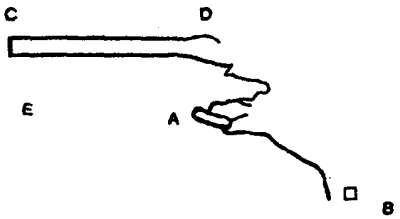
C D is the new pier.
A the schooner ashore. B the salmon house.
Some of the waves were twenty feet high. The spray rose eighty feet at the new pier. Some wood has come ashore, and the roadway seems carried away. There is something fishy at the far end where the cross wall is building; but till we are able to get along, all speculation is vain.
I am so sleepy I am writing nonsense.
I stood a long while on the cope watching the sea below me; I hear its dull, monotonous roar at this moment below the shrieking of the wind; and there came ever recurring to my mind the verse I am so fond of:—
“But yet the Lord that is on high Is more of might by far Than noise of many waters is Or great sea-billows are.”
The thunder at the wall when it first struck—the rush along ever growing higher—the great jet of snow-white spray some forty feet above you—and the “noise of many waters,” the roar, the hiss, the “shrieking” among the shingle as it fell head over heels at your feet. I watched if it threw the big stones at the wall; but it never moved them.
Monday.—The end of the work displays gaps, cairns of ten ton blocks, stones torn from their places and turned right round. The damage above water is comparatively little: what there may be below, on ne sait pas encore. The roadway is torn away, cross-heads, broken planks tossed here and there, planks gnawn and mumbled as if a starved bear had been trying to eat them, planks with spates lifted from them as if they had been dressed with a rugged plane, one pile swaying to and fro clear of the bottom, the rails in one place sunk a foot at least. This was not a great storm, the waves were light and short. Yet when we are standing at the office, I felt the ground beneath me quail as a huge roller thundered on the work at the last year’s cross wall.
How could noster amicus Q. maximus appreciate a storm at Wick? It requires a little of the artistic temperament, of which Mr. T. S.,6 C.E., possesses some, whatever he may say. I can’t look at it practically however: that will come, I suppose, like grey hair or coffin nails.
Our pole is snapped: a fortnight’s work and the loss of the Norse schooner all for nothing!—except experience and dirty clothes.—Your affectionate son,
R. L. Stevenson.
To Mrs. Thomas Stevenson
I omit the letters of 1869, which describe at great length, and not very interestingly, a summer trip on board the lighthouse steamer to the Orkneys, Shetlands, and the Fair Isle. The following of 1870 I give (by consent of the lady who figures as a youthful character in the narrative) both for the sake of its lively social sketches—including that of the able painter and singular personage, the late Sam Bough,—and because it is dated from the Isle of Earraid, celebrated alike in Kidnapped and in the essay Memoirs of an Islet.
Earraid, Thursday, August 5th, 1870.
MY DEAR MOTHER,—I have so much to say, that needs must I take a large sheet; for the notepaper brings with it a chilling brevity of style. Indeed, I think pleasant writing is proportional to the size of the material you write withal.
From Edinburgh to Greenock, I had the ex-secretary of the E.U. Conservative Club, Murdoch. At Greenock I spent a dismal evening, though I found a pretty walk. Next day on board the Iona, I had Maggie Thomson to Tarbet; Craig, a well-read, pleasant medical, to Ardrishaig; and Professor, Mrs., and all the little Fleeming Jenkinseses to Oban.
At Oban, that night, it was delicious. Mr. Stephenson’s yacht lay in the bay, and a splendid band on board played delightfully. The waters of the bay were as smooth as a mill-pond; and, in the dusk, the black shadows of the hills stretched across to our very feet and the lights were reflected in long lines. At intervals, blue lights were burned on the water; and rockets were sent up. Sometimes great stars of clear fire fell from them, until the bay received and quenched them. I hired a boat and skulled round the yacht in the dark. When I came in, a very pleasant Englishman on the steps fell into talk with me, till it was time to go to bed.
Next morning I slept on or I should have gone to Glencoe. As it was, it was blazing hot; so I hired a boat, pulled all forenoon along the coast and had a delicious bathe on a beautiful white beach. Coming home, I cotogai’d my Englishman, lunched alongside of him and his sister, and took a walk with him in the afternoon, during which I find that he was travelling with a servant, kept horses, et cetera. At dinner he wished me to sit beside him and his sister; but there was no room. When he came out he told me why he was so empressé on this point. He had found out my name, and that I was connected with lighthouses, and his sister wished to know if I were any relative of the Stevenson in Ballantyne’s Lighthouse. All evening, he, his sister, I, and Mr. Hargrove, of Hargrove and Fowler, sate in front of the hotel. I asked Mr. H. if he knew who my friend was. “Yes,” he said; “I never met him before: but my partner knows him. He is a man of old family; and the solicitor of highest standing about Sheffield.” At night he said, “Now if you’re down in my neighbourhood, you must pay me a visit. I am very fond of young men about me; and I should like a visit from you very much. I can take you through any factory in Sheffield and I’ll drive you all about the Dookeries.” He then wrote me down his address; and we parted huge friends, he still keeping me up to visiting him.
Hitherto, I had enjoyed myself amazingly; but to-day has been the crown. In the morning I met Bough on board, with whom I am both surprised and delighted. He and I have read the same books, and discuss Chaucer, Shakespeare, Marlowe, Fletcher, Webster, and all the old authors. He can quote verses by the page, and has really a very pretty literary taste. Altogether, with all his roughness and buffoonery, a more pleasant, clever fellow you may seldom see. I was very much surprised with him; and he with me. “Where the devil did you read all these books?” says he; and in my heart, I echo the question. One amusing thing I must say. We were both talking about travelling; and I said I was so fond of travelling alone, from the people one met and grew friendly with. “Ah,” says he, “but you’ve such a pleasant manner, you know—quite captivated my old woman, you did—she couldn’t talk of anything else.” Here was a compliment, even in Sam Bough’s sneering tones, that rather tickled my vanity; and really, my social successes of the last few days, the best of which is yet to come, are enough to turn anybody’s head. To continue, after a little go in with Samuel, he going up on the bridge, I looked about me to see who there was; and mine eye lighted on two girls, one of whom was sweet and pretty, talking to an old gentleman. “Eh bien,” says I to myself, “that seems the best investment on board.” So I sidled up to the old gentleman, got into conversation with him and so with the damsel; and thereupon, having used the patriarch as a ladder, I kicked him down behind me. Who should my damsel prove, but Amy Sinclair, daughter of Sir Tollemache. She certainly was the simplest, most naïve specimen of girlhood ever I saw. By getting brandy and biscuit and generally coaching up her cousin, who was sick, I ingratiated myself; and so kept her the whole way to Iona, taking her into the cave at Staffa and generally making myself as gallant as possible. I was never so much pleased with anything in my life, as her amusing absence of mauvaise honte: she was so sorry I wasn’t going on to Oban again: didn’t know how she could have enjoyed herself if I hadn’t been there; and was so sorry we hadn’t met on the Crinan. When we came back from Staffa, she and her aunt went down to have lunch; and a minute after up comes Miss Amy to ask me if I wouldn’t think better of it, and take some lunch with them. I couldn’t resist that, of course; so down I went; and there she displayed the full extent of her innocence. I must be sure to come to Thurso Castle the next time I was in Caithness, and Upper Norwood (whence she would take me all over the Crystal Palace) when I was near London; and (most complete of all) she offered to call on us in Edinburgh! Wasn’t it delicious?—she is a girl of sixteen or seventeen, too, and the latter I think. I never yet saw a girl so innocent and fresh, so perfectly modest without the least trace of prudery.
Coming off Staffa, Sam Bough (who had been in huge force the whole time, drawing in Miss Amy’s sketchbook and making himself agreeable or otherwise to everybody) pointed me out to a parson and said, “That’s him.” This was Alexander Ross and his wife.
The last stage of the steamer now approached, Miss Amy and I lamenting pathetically that Iona was so near. “People meet in this way,” quoth she, “and then lose sight of one another so soon.” We all landed together, Bough and I and the Rosses with our baggage; and went together over the ruins. I was here left with the cousin and the aunt, during which I learned that said cousin sees me every Sunday in St. Stephen’s. Oho! thought I, at the “every.” The aunt was very anxious to know who that strange, wild man was? (didn’t I wish Samuel in Tophet!). Of course, in reply, I drew it strong about eccentric genius and my never having known him before, and a good deal that was perhaps “strained to the extremest limit of the fact.”
The steamer left, and Miss Amy and her cousin waved their handkerchiefs, until my arm in answering them was nearly broken. I believe women’s arms must be better made for this exercise: mine ache still; and I regretted at the time that the handkerchief had seen service. Altogether, however, I was left in a pleasant frame of mind.
Being thus left alone, Bough, I, the Rosses, Professor Blackie, and an Englishman called M——: these people were going to remain the night, except the Professor, who is resident there at present. They were going to dine en compagnie and wished us to join the party; but we had already committed ourselves by mistake to the wrong hotel, and besides, we wished to be off as soon as wind and tide were against us to Earraid. We went up; Bough selected a place for sketching and blocked in the sketch for Mrs. R.; and we all talked together. Bough told us his family history and a lot of strange things about old Cumberland life; among others, how he had known “John Peel” of pleasant memory in song, and of how that worthy hunted. At five, down we go to the Argyll Hotel, and wait dinner. Broth—“nice broth“—fresh herrings, and fowl had been promised. At 5.50, I get the shovel and tongs and drum them at the stair-head till a response comes from below that the nice broth is at hand. I boast of my engineering, and Bough compares me to the Abbot of Arbroath who originated the Inchcape Bell. At last, in comes the tureen and the hand-maid lifts the cover. “Rice soup!” I yell; “O no! none o’ that for me!”—“Yes,” says Bough savagely; “but Miss Amy didn’t take me downstairs to eat salmon.” Accordingly he is helped. How his face fell. “I imagine myself in the accident ward of the Infirmary,” quoth he. It was, purely and simply, rice and water. After this, we have another weary pause, and then herrings in a state of mash and potatoes like iron. “Send the potatoes out to Prussia for grape-shot,” was the suggestion. I dined off broken herrings and dry bread. At last “the supreme moment comes,” and the fowl in a lordly dish is carried in. On the cover being raised, there is something so forlorn and miserable about the aspect of the animal that we both roar with laughter. Then Bough, taking up knife and fork, turns the “swarry” over and over, shaking doubtfully his head. “There’s an aspect of quiet resistance about the beggar,” says he, “that looks bad.” However, to work he falls until the sweat stands on his brow and a dismembered leg falls, dull and leaden-like, on to my dish. To eat it was simply impossible. I did not know before that flesh could be so tough. “The strongest jaws in England,” says Bough piteously, harpooning his dry morsel, “couldn’t eat this leg in less than twelve hours.” Nothing for it now, but to order boat and bill. “That fowl,” says Bough to the landlady, “is of a breed I know. I knew the cut of its jib whenever it was put down. That was the grandmother of the cock that frightened Peter.”—“I thought it was a historical animal,” says I. “What a shame to kill it. It’s as bad as eating Whittington’s cat or the Dog of Montargis.”—“Na—na, it’s no so old,” says the landlady, “but it eats hard.”—“Eats!” I cry, “where do you find that? Very little of that verb with us.” So with more raillery, we pay six shillings for our festival and run over to Earraid, shaking the dust of the Argyll Hotel from off our feet.
I can write no more just now, and I hope you will be able to decipher so much; for it contains matter. Really, the whole of yesterday’s work would do in a novel without one little bit of embellishment; and, indeed, few novels are so amusing. Bough, Miss Amy, Mrs. Ross, Blackie, M—— the parson—all these were such distinct characters, the incidents were so entertaining, and the scenery so fine, that the whole would have made a novelist’s fortune.
MY DEAR FATHER,—No landing to-day, as the sea runs high on the rock. They are at the second course of the first story on the rock. I have as yet had no time here; so this is α and ω of my business news.—Your affectionate son,
R. L. Stevenson.
To Mrs. Churchill Babington
This is addressed to a favourite cousin of the Balfour clan, married to a Cambridge colleague of mine, Professor Churchill Babington of learned and amiable memory, whose home was at the college living of Cockfield near Bury St. Edmunds. Here Stevenson had visited them in the previous year. “Mrs. Hutchinson” is, of course, Lucy Hutchinson’s famous Life of her husband the regicide.
[Swanston Cottage, Lothianburn, Summer 1871.]
MY DEAR MAUD,—If you have forgotten the handwriting—as is like enough—you will find the name of a former correspondent (don’t know how to spell that word) at the end. I have begun to write to you before now, but always stuck somehow, and left it to drown in a drawerful of like fiascos. This time I am determined to carry through, though I have nothing specially to say.
We look fairly like summer this morning; the trees are blackening out of their spring greens; the warmer suns have melted the hoarfrost of daisies of the paddock; and the blackbird, I fear, already beginning to “stint his pipe of mellower days“—which is very apposite (I can’t spell anything to-day—one p or two?) and pretty. All the same, we have been having shocking weather—cold winds and grey skies.
I have been reading heaps of nice books; but I can’t go back so far. I am reading Clarendon’s Hist. Rebell. at present, with which I am more pleased than I expected, which is saying a good deal. It is a pet idea of mine that one gets more real truth out of one avowed partisan than out of a dozen of your sham impartialists—wolves in sheep’s clothing—simpering honesty as they suppress documents. After all, what one wants to know is not what people did, but why they did it—or rather, why they thought they did it; and to learn that, you should go to the men themselves. Their very falsehood is often more than another man’s truth.
I have possessed myself of Mrs. Hutchinson, which, of course, I admire, etc. But is there not an irritating deliberation and correctness about her and everybody connected with her? If she would only write bad grammar, or forget to finish a sentence, or do something or other that looks fallible, it would be a relief. I sometimes wish the old Colonel had got drunk and beaten her, in the bitterness of my spirit. I know I felt a weight taken off my heart when I heard he was extravagant. It is quite possible to be too good for this evil world; and unquestionably, Mrs. Hutchinson was. The way in which she talks of herself makes one’s blood run cold. There—I am glad to have got that out—but don’t say it to anybody—seal of secrecy.
Please tell Mr. Babington that I have never forgotten one of his drawings—a Rubens, I think—a woman holding up a model ship. That woman had more life in her than ninety per cent. of the lame humans that you see crippling about this earth.
By the way, that is a feature in art which seems to have come in with the Italians. Your old Greek statues have scarce enough vitality in them to keep their monstrous bodies fresh withal. A shrewd country attorney, in a turned white neckcloth and rusty blacks, would just take one of these Agamemnons and Ajaxes quietly by his beautiful, strong arm, trot the unresisting statue down a little gallery of legal shams, and turn the poor fellow out at the other end, “naked, as from the earth he came.” There is more latent life, more of the coiled spring in the sleeping dog, about a recumbent figure of Michael Angelo’s than about the most excited of Greek statues. The very marble seems to wrinkle with a wild energy that we never feel except in dreams.
I think this letter has turned into a sermon, but I had nothing interesting to talk about.
I do wish you and Mr. Babington would think better of it and come north this summer. We should be so glad to see you both. Do reconsider it.—Believe me, my dear Maud, ever your most affectionate cousin,
Louis Stevenson.
To Alison Cunningham
The following is the first which has been preserved of many letters to the admirable nurse whose care, during his ailing childhood, had done so much both to preserve Stevenson’s life and awaken his love of tales and poetry, and of whom until his death he thought with the utmost constancy of affection. The letter bears no sign of date or place, but by the handwriting would seem to belong to this year:—
1871?
MY DEAR CUMMY,—I was greatly pleased by your letter in many ways. Of course, I was glad to hear from you; you know, you and I have so many old stories between us, that even if there was nothing else, even if there was not a very sincere respect and affection, we should always be glad to pass a nod. I say, “even if there was not.” But you know right well there is. Do not suppose that I shall ever forget those long, bitter nights, when I coughed and coughed and was so unhappy, and you were so patient and loving with a poor, sick child. Indeed, Cummy, I wish I might become a man worth talking of, if it were only that you should not have thrown away your pains.
Happily, it is not the result of our acts that makes them brave and noble, but the acts themselves and the unselfish love that moved us to do them. “Inasmuch as you have done it unto one of the least of these.” My dear old nurse, and you know there is nothing a man can say nearer his heart except his mother or his wife—my dear old nurse, God will make good to you all the good that you have done, and mercifully forgive you all the evil. And next time when the spring comes round, and everything is beginning once again, if you should happen to think that you might have had a child of your own, and that it was hard you should have spent so many years taking care of some one else’s prodigal, just you think this—you have been for a great deal in my life; you have made much that there is in me, just as surely as if you had conceived me; and there are sons who are more ungrateful to their own mothers than I am to you. For I am not ungrateful, my dear Cummy, and it is with a very sincere emotion that I write myself your little boy,
Louis.
To Charles Baxter
After a winter of troubled health, Stevenson had gone to Dunblane for a change in early spring; and thence writes to his college companion and lifelong friend, Mr. Charles Baxter:—
Dunblane, Friday, 5th March 1872.
MY DEAR BAXTER,—By the date you may perhaps understand the purport of my letter without any words wasted about the matter. I cannot walk with you to-morrow, and you must not expect me. I came yesterday afternoon to Bridge of Allan, and have been very happy ever since, as every place is sanctified by the eighth sense, Memory. I walked up here this morning (three miles, tu-dieu! a good stretch for me), and passed one of my favourite places in the world, and one that I very much affect in spirit when the body is tied down and brought immovably to anchor on a sickbed. It is a meadow and bank on a corner on the river, and is connected in my mind inseparably with Virgil’s Eclogues. Hic corulis mistos inter consedimus ulmos, or something very like that, the passage begins (only I know my short-winded Latinity must have come to grief over even this much of quotation); and here, to a wish, is just such a cavern as Menalcas might shelter himself withal from the bright noon, and, with his lips curled backward, pipe himself blue in the face, while Messieurs les Arcadiens would roll out those cloying hexameters that sing themselves in one’s mouth to such a curious lilting chant.
In such weather one has the bird’s need to whistle; and I, who am specially incompetent in this art, must content myself by chattering away to you on this bit of paper. All the way along I was thanking God that he had made me and the birds and everything just as they are and not otherwise; for although there was no sun, the air was so thrilled with robins and blackbirds that it made the heart tremble with joy, and the leaves are far enough forward on the underwood to give a fine promise for the future. Even myself, as I say, I would not have had changed in one iota this forenoon, in spite of all my idleness and Guthrie’s lost paper, which is ever present with me—a horrible phantom.
No one can be alone at home or in a quite new place. Memory and you must go hand in hand with (at least) decent weather if you wish to cook up a proper dish of solitude. It is in these little flights of mine that I get more pleasure than in anything else. Now, at present, I am supremely uneasy and restless—almost to the extent of pain; but O! how I enjoy it, and how I shall enjoy it afterwards (please God), if I get years enough allotted to me for the thing to ripen in. When I am a very old and very respectable citizen with white hair and bland manners and a gold watch, I shall hear three crows cawing in my heart, as I heard them this morning: I vote for old age and eighty years of retrospect. Yet, after all, I dare say, a short shrift and a nice green grave are about as desirable.
Poor devil! how I am wearying you! Cheer up. Two pages more, and my letter reaches its term, for I have no more paper. What delightful things inns and waiters and bagmen are! If we didn’t travel now and then, we should forget what the feeling of life is. The very cushion of a railway carriage—“the things restorative to the touch.” I can’t write, confound it! That’s because I am so tired with my walk.... Believe me, ever your affectionate friend,
R. L. Stevenson.
To Charles Baxter
The “Spec.” is, of course, the famous and historical debating society (the Speculative Society) of Edinburgh University, to which Stevenson had been elected on the strength of his conversational powers, and to whose meetings he contributed several essays.
Dunblane, Tuesday, 9th April 1872.
MY DEAR BAXTER,—I don’t know what you mean. I know nothing about the Standing Committee of the Spec., did not know that such a body existed, and even if it doth exist, must sadly repudiate all association with such “goodly fellowship.” I am a “Rural Voluptuary” at present. That is what is the matter with me. The Spec. may go whistle. As for “C. Baxter, Esq.,” who is he? “One Baxter, or Bagster, a secretary,” I say to mine acquaintance, “is at present disquieting my leisure with certain illegal, uncharitable, unchristian, and unconstitutional documents called Business Letters: The affair is in the hands of the Police.” Do you hear that, you evildoer? Sending business letters is surely a far more hateful and slimy degree of wickedness than sending threatening letters; the man who throws grenades and torpedoes is less malicious; the Devil in red-hot hell rubs his hands with glee as he reckons up the number that go forth spreading pain and anxiety with each delivery of the post.
I have been walking to-day by a colonnade of beeches along the brawling Allan. My character for sanity is quite gone, seeing that I cheered my lonely way with the following, in a triumphant chaunt: “Thank God for the grass, and the fir-trees, and the crows, and the sheep, and the sunshine, and the shadows of the fir-trees.” I hold that he is a poor mean devil who can walk alone, in such a place and in such weather, and doesn’t set up his lungs and cry back to the birds and the river. Follow, follow, follow me. Come hither, come hither, come hither—here shall you see—no enemy—except a very slight remnant of winter and its rough weather. My bedroom, when I awoke this morning, was full of bird-songs, which is the greatest pleasure in life. Come hither, come hither, come hither, and when you come bring the third part of the Earthly Paradise; you can get it for me in Elliot’s for two and tenpence (2s. 10d.) (business habits). Also bring an ounce of honeydew from Wilson’s.
R. L. S.
To Mrs. Thomas Stevenson
In the previous year, 1871, it had become apparent that Stevenson was neither fitted by bodily health nor by inclination for the family profession of civil engineer. Accordingly his summer excursions were no longer to the harbour works and lighthouses of Scotland, but to the ordinary scenes of holiday travel abroad.
Brussels, Thursday, 25th July 1872.
MY DEAR MOTHER,—I am here at last, sitting in my room, without coat or waistcoat, and with both window and door open, and yet perspiring like a terra-cotta jug or a Gruyère cheese.
We had a very good passage, which we certainly deserved, in compensation for having to sleep on the cabin floor, and finding absolutely nothing fit for human food in the whole filthy embarkation. We made up for lost time by sleeping on deck a good part of the forenoon. When I woke, Simpson was still sleeping the sleep of the just, on a coil of ropes and (as appeared afterwards) his own hat; so I got a bottle of Bass and a pipe and laid hold of an old Frenchman of somewhat filthy aspect (fiat experimentum in corpore vili) to try my French upon. I made very heavy weather of it. The Frenchman had a very pretty young wife; but my French always deserted me entirely when I had to answer her, and so she soon drew away and left me to her lord, who talked of French politics, Africa, and domestic economy with great vivacity. From Ostend a smoking-hot journey to Brussels. At Brussels we went off after dinner to the Parc. If any person wants to be happy, I should advise the Parc. You sit drinking iced drinks and smoking penny cigars under great old trees. The band place, covered walks, etc., are all lit up. And you can’t fancy how beautiful was the contrast of the great masses of lamplit foliage and the dark sapphire night sky with just one blue star set overhead in the middle of the largest patch. In the dark walks, too, there are crowds of people whose faces you cannot see, and here and there a colossal white statue at the corner of an alley that gives the place a nice, artificial, eighteenth century sentiment. There was a good deal of summer lightning blinking overhead, and the black avenues and white statues leapt out every minute into short-lived distinctness.
I get up to add one thing more. There is in the hotel a boy in whom I take the deepest interest. I cannot tell you his age, but the very first time I saw him (when I was at dinner yesterday) I was very much struck with his appearance. There is something very leonine in his face, with a dash of the negro especially, if I remember aright, in the mouth. He has a great quantity of dark hair, curling in great rolls, not in little corkscrews, and a pair of large, dark, and very steady, bold, bright eyes. His manners are those of a prince. I felt like an overgrown ploughboy beside him. He speaks English perfectly, but with, I think, sufficient foreign accent to stamp him as a Russian, especially when his manners are taken into account. I don’t think I ever saw any one who looked like a hero before. After breakfast this morning I was talking to him in the court, when he mentioned casually that he had caught a snake in the Riesengebirge. “I have it here,” he said; “would you like to see it?” I said yes; and putting his hand into his breast-pocket, he drew forth not a dried serpent skin, but the head and neck of the reptile writhing and shooting out its horrible tongue in my face. You may conceive what a fright I got. I send off this single sheet just now in order to let you know I am safe across; but you must not expect letters often.
R. L. Stevenson.
P.S.—The snake was about a yard long, but harmless, and now, he says, quite tame.
To Mrs. Thomas Stevenson
Hotel Landsberg, Frankfurt, Monday, 29th July 1872.
... Last night I met with rather an amusing adventurette. Seeing a church door open, I went in, and was led by most importunate finger-bills up a long stair to the top of the tower. The father smoking at the door, the mother and the three daughters received me as if I was a friend of the family and had come in for an evening visit. The youngest daughter (about thirteen, I suppose, and a pretty little girl) had been learning English at the school, and was anxious to play it off upon a real, veritable Englander; so we had a long talk, and I was shown photographs, etc., Marie and I talking, and the others looking on with evident delight at having such a linguist in the family. As all my remarks were duly translated and communicated to the rest, it was quite a good German lesson. There was only one contretemps during the whole interview—the arrival of another visitor, in the shape (surely) the last of God’s creatures, a wood-worm of the most unnatural and hideous appearance, with one great striped horn sticking out of his nose like a boltsprit. If there are many wood-worms in Germany, I shall come home. The most courageous men in the world must be entomologists. I had rather be a lion-tamer.
To-day I got rather a curiosity—Lieder und Balladen von Robert Burns, translated by one Silbergleit, and not so ill done either. Armed with which, I had a swim in the Main, and then bread and cheese and Bavarian beer in a sort of café, or at least the German substitute for a café; but what a falling off after the heavenly forenoons in Brussels!
I have bought a meerschaum out of local sentiment, and am now very low and nervous about the bargain, having paid dearer than I should in England, and got a worse article, if I can form a judgment.
Do write some more, somebody. To-morrow I expect I shall go into lodgings, as this hotel work makes the money disappear like butter in a furnace.—Meanwhile believe me, ever your affectionate son,
R. L. Stevenson.
To Mrs. Thomas Stevenson
Hotel Landsberg, Thursday, 1st August 1872.
... Yesterday I walked to Eckenheim, a village a little way out of Frankfurt, and turned into the alehouse. In the room, which was just such as it would have been in Scotland, were the landlady, two neighbours, and an old peasant eating raw sausage at the far end. I soon got into conversation; and was astonished when the landlady, having asked whether I were an Englishman, and received an answer in the affirmative, proceeded to inquire further whether I were not also a Scotchman. It turned out that a Scotch doctor—a professor—a poet—who wrote books—gross wie das—had come nearly every day out of Frankfurt to the Eckenheimer Wirthschaft, and had left behind him a most savoury memory in the hearts of all its customers. One man ran out to find his name for me, and returned with the news that it was Cobie (Scobie, I suspect); and during his absence the rest were pouring into my ears the fame and acquirements of my countryman. He was, in some undecipherable manner, connected with the Queen of England and one of the Princesses. He had been in Turkey, and had there married a wife of immense wealth. They could find apparently no measure adequate to express the size of his books. In one way or another, he had amassed a princely fortune, and had apparently only one sorrow, his daughter to wit, who had absconded into a Kloster, with a considerable slice of the mother’s Geld. I told them we had no Klosters in Scotland, with a certain feeling of superiority. No more had they, I was told—“Hier ist unser Kloster!” and the speaker motioned with both arms round the taproom. Although the first torrent was exhausted, yet the Doctor came up again in all sorts of ways, and with or without occasion, throughout the whole interview; as, for example, when one man, taking his pipe out of his mouth and shaking his head, remarked àpropos of nothing and with almost defiant conviction, “Er war ein feiner Mann, der Herr Doctor,” and was answered by another with “Yaw, yaw, und trank immer rothen Wein.”
Setting aside the Doctor, who had evidently turned the brains of the entire village, they were intelligent people. One thing in particular struck me, their honesty in admitting that here they spoke bad German, and advising me to go to Coburg or Leipsic for German.—“Sie sprechen da rein” (clean), said one; and they all nodded their heads together like as many mandarins, and repeated rein, so rein in chorus.
Of course we got upon Scotland. The hostess said, “Die Schottländer trinken gern Schnapps,” which may be freely translated, “Scotchmen are horrid fond of whisky.” It was impossible, of course, to combat such a truism; and so I proceeded to explain the construction of toddy, interrupted by a cry of horror when I mentioned the hot water; and thence, as I find is always the case, to the most ghastly romancing about Scottish scenery and manners, the Highland dress, and everything national or local that I could lay my hands upon. Now that I have got my German Burns, I lean a good deal upon him for opening a conversation, and read a few translations to every yawning audience that I can gather. I am grown most insufferably national, you see. I fancy it is a punishment for my want of it at ordinary times. Now, what do you think, there was a waiter in this very hotel, but, alas! he is now gone, who sang (from morning to night, as my informant said with a shrug at the recollection) what but ’s ist lange her, the German version of Auld Lang Syne; so you see, madame, the finest lyric ever written will make its way out of whatsoever corner of patois it found its birth in.
“Mein Herz ist im Hochland, mein Herz ist nicht hier, Mein Herz ist im Hochland im grünen Revier. Im grünen Reviere zu jagen das Reh; Mein Herz ist im Hochland, wo immer ich geh.“
I don’t think I need translate that for you.
There is one thing that burthens me a good deal in my patriotic garrulage, and that is the black ignorance in which I grope about everything, as, for example, when I gave yesterday a full and, I fancy, a startlingly incorrect account of Scotch education to a very stolid German on a garden bench: he sat and perspired under it, however, with much composure. I am generally glad enough to fall back again, after these political interludes, upon Burns, toddy, and the Highlands.
I go every night to the theatre, except when there is no opera. I cannot stand a play yet; but I am already very much improved, and can understand a good deal of what goes on.
Friday, August 2, 1872.—In the evening, at the theatre, I had a great laugh. Lord Allcash in Fra Diavolo, with his white hat, red guide-books, and bad German, was the pièce-de-résistance from a humorous point of view; and I had the satisfaction of knowing that in my own small way I could minister the same amusement whenever I chose to open my mouth.
I am just going off to do some German with Simpson.—Your affectionate son,
R. L. Stevenson.
To Thomas Stevenson
Frankfurt, Rosengasse 13, August 4, 1872.
MY DEAR FATHER,—You will perceive by the head of this page that we have at last got into lodgings, and powerfully mean ones too. If I were to call the street anything but shady, I should be boasting. The people sit at their doors in shirt-sleeves, smoking as they do in Seven Dials of a Sunday.
Last night we went to bed about ten, for the first time householders in Germany—real Teutons, with no deception, spring, or false bottom. About half-past one there began such a trumpeting, shouting, pealing of bells, and scurrying hither and thither of feet as woke every person in Frankfurt out of their first sleep with a vague sort of apprehension that the last day was at hand. The whole street was alive, and we could hear people talking in their rooms, or crying to passers-by from their windows, all around us. At last I made out what a man was saying in the next room. It was a fire in Sachsenhausen, he said (Sachsenhausen is the suburb on the other side of the Main), and he wound up with one of the most tremendous falsehoods on record, “Hier alles ruht—here all is still.” If it can be said to be still in an engine factory, or in the stomach of a volcano when it is meditating an eruption, he might have been justified in what he said, but not otherwise. The tumult continued unabated for near an hour; but as one grew used to it, it gradually resolved itself into three bells, answering each other at short intervals across the town, a man shouting at ever shorter intervals and with superhuman energy, ”Feuer—im Sachsenhausen,” and the almost continuous winding of all manner of bugles and trumpets, sometimes in stirring flourishes, and sometimes in mere tuneless wails. Occasionally there was another rush of feet past the window, and once there was a mighty drumming, down between us and the river, as though the soldiery were turning out to keep the peace. This was all we had of the fire, except a great cloud, all flushed red with the glare, above the roofs on the other side of the Gasse; but it was quite enough to put me entirely off my sleep and make me keenly alive to three or four gentlemen who were strolling leisurely about my person, and every here and there leaving me somewhat as a keepsake.... However, everything has its compensation, and when day came at last, and the sparrows awoke with trills and carol-ets, the dawn seemed to fall on me like a sleeping draught. I went to the window and saw the sparrows about the eaves, and a great troop of doves go strolling up the paven Gasse, seeking what they may devour. And so to sleep, despite fleas and fire-alarms, and clocks chiming the hours out of neighbouring houses at all sorts of odd times and with the most charming want of unanimity.
We have got settled down in Frankfurt, and like the place very much. Simpson and I seem to get on very well together. We suit each other capitally; and it is an awful joke to be living (two would-be advocates, and one a baronet) in this supremely mean abode.
The abode is, however, a great improvement on the hotel, and I think we shall grow quite fond of it.—Ever your affectionate son,
R. L. Stevenson.
To Mrs. Thomas Stevenson
13 Rosengasse, Frankfurt, Tuesday Morning, August 1872.
... Last night I was at the theatre and heard Die Judin (La Juive), and was thereby terribly excited. At last, in the middle of the fifth act, which was perfectly beastly, I had to slope. I could stand even seeing the cauldron with the sham fire beneath, and the two hateful executioners in red; but when at last the girl’s courage breaks down, and, grasping her father’s arm, she cries out—O so shudderfully!—I thought it high time to be out of that galère, and so I do not know yet whether it ends well or ill; but if I ever afterwards find that they do carry things to the extremity, I shall think more meanly of my species. It was raining and cold outside, so I went into a Bierhalle, and sat and brooded over a Schnitt (half-glass) for nearly an hour. An opera is far more real than real life to me. It seems as if stage illusion, and particularly this hardest to swallow and most conventional illusion of them all—an opera—would never stale upon me. I wish that life was an opera. I should like to live in one; but I don’t know in what quarter of the globe I shall find a society so constituted. Besides, it would soon pall: imagine asking for three-kreuzer cigars in recitative, or giving the washerwoman the inventory of your dirty clothes in a sustained and flourishous aria.
I am in a right good mood this morning to sit here and write to you; but not to give you news. There is a great stir of life, in a quiet, almost country fashion, all about us here. Some one is hammering a beef-steak in the rez-de-chaussée: there is a great clink of pitchers and noise of the pump-handle at the public well in the little square-kin round the corner. The children, all seemingly within a month, and certainly none above five, that always go halting and stumbling up and down the roadway, are ordinarily very quiet, and sit sedately puddling in the gutter, trying, I suppose, poor little devils! to understand their Muttersprache; but they, too, make themselves heard from time to time in little incomprehensible antiphonies, about the drift that comes down to them by their rivers from the strange lands higher up the Gasse. Above all, there is here such a twittering of canaries (I can see twelve out of our window), and such continual visitation of grey doves and big-nosed sparrows, as make our little bye-street into a perfect aviary.
I look across the Gasse at our opposite neighbour, as he dandles his baby about, and occasionally takes a spoonful or two of some pale slimy nastiness that looks like dead porridge, if you can take the conception. These two are his only occupations. All day long you can hear him singing over the brat when he is not eating; or see him eating when he is not keeping baby. Besides which, there comes into his house a continual round of visitors that puts me in mind of the luncheon hour at home. As he has thus no ostensible avocation, we have named him “the W.S.” to give a flavour of respectability to the street.
Enough of the Gasse. The weather is here much colder. It rained a good deal yesterday; and though it is fair and sunshiny again to-day, and we can still sit, of course, with our windows open, yet there is no more excuse for the siesta; and the bathe in the river, except for cleanliness, is no longer a necessity of life. The Main is very swift. In one part of the baths it is next door to impossible to swim against it, and I suspect that, out in the open, it would be quite impossible.—Adieu, my dear mother, and believe me, ever your affectionate son,
Robert Louis Stevenson
(Rentier).
To Charles Baxter
On the way home with Sir Walter Simpson from Germany. The L.J.R. herein mentioned was a short-lived Essay Club of only six members; its meetings were held in a public-house in Advocate’s Close; the meaning of its initials (as recently divulged by Mr. Baxter) was Liberty, Justice, Reverence; no doubt understood by the members in some fresh and esoteric sense of their own.
Boulogne Sur Mer, Wednesday, 3rd or 4th September 1872.
Blame me not that this epistle Is the first you have from me. Idleness has held me fettered, But at last the times are bettered And once more I wet my whistle Here, in France beside the sea. All the green and idle weather I have had in sun and shower, Such an easy warm subsistence, Such an indolent existence I should find it hard to sever Day from day and hour from hour. Many a tract-provided ranter May upbraid me, dark and sour, Many a bland Utilitarian Or excited Millenarian, —“Pereunt et imputantur You must speak to every hour.” But (the very term’s deceptive) You at least, my friend, will see, That in sunny grassy meadows Trailed across by moving shadows To be actively receptive Is as much as man can be. He that all the winter grapples Difficulties, thrust and ward— Needs to cheer him thro’ his duty Memories of sun and beauty Orchards with the russet apples Lying scattered on the sward. Many such I keep in prison, Keep them here at heart unseen, Till my muse again rehearses Long years hence, and in my verses You shall meet them rearisen Ever comely, ever green. You know how they never perish, How, in time of later art, Memories consecrate and sweeten These defaced and tempest-beaten Flowers of former years we cherish, Half a life, against our heart. Most, those love-fruits withered greenly, Those frail, sickly amourettes, How they brighten with the distance Take new strength and new existence Till we see them sitting queenly Crowned and courted by regrets! All that loveliest and best is, Aureole-fashion round their head, They that looked in life but plainly, How they stir our spirits vainly When they come to us Alcestis- like returning from the dead! Not the old love but another, Bright she comes at Memory’s call Our forgotten vows reviving To a newer, livelier living, As the dead child to the mother Seems the fairest child of all. Thus our Goethe, sacred master, Travelling backward thro’ his youth, Surely wandered wrong in trying To renew the old, undying Loves that cling in memory faster Than they ever lived in truth.
So; en voilà assez de mauvais vers. Let us finish with a word or two in honest prose, tho’ indeed I shall so soon be back again and, if you be in town as I hope, so soon get linked again down the Lothian road by a cigar or two and a liquor, that it is perhaps scarce worth the postage to send my letter on before me. I have just been long enough away to be satisfied and even anxious to get home again and talk the matter over with my friends. I shall have plenty to tell you; and principally plenty that I do not care to write; and I daresay, you, too, will have a lot of gossip. What about Ferrier? Is the L.J.R. think you to go naked and unashamed this winter? He with his charming idiosyncrasy was in my eyes the vine-leaf that preserved our self-respect. All the rest of us are such shadows, compared to his full-flavoured personality; but I must not spoil my own début. I am trenching upon one of the essayettes which I propose to introduce as a novelty this year before that august assembly. For we must not let it die. It is a sickly baby, but what with nursing, and pap, and the like, I do not see why it should not have a stout manhood after all, and perhaps a green old age. Eh! when we are old (if we ever should be) that too will be one of those cherished memories I have been so rhapsodizing over. We must consecrate our room. We must make it a museum of bright recollections; so that we may go back there white-headed, and say “Vixi.” After all, new countries, sun, music, and all the rest can never take down our gusty, rainy, smoky, grim old city out of the first place that it has been making for itself in the bottom of my soul, by all pleasant and hard things that have befallen me for these past twenty years or so. My heart is buried there—say, in Advocate’s Close!
Simpson and I got on very well together, and made a very suitable pair. I like him much better than I did when I started which was almost more than I hoped for.
If you should chance to see Bob, give him my news or if you have the letter about you, let him see it.—Ever your Affct. friend,
R. L. Stevenson.
To Charles Baxter
Through the jesting tenor of this letter is to be discerned a vein of more than half serious thinking very characteristic of R. L. S. alike as youth and man.
17 Heriot Row, Edinburgh, October 1872.
MY DEAR BAXTER,—I am gum-boiled and face swollen to an unprecedented degree. It is very depressing to suffer from gibber that cannot be brought to a head. I cannot speak it, because my face is so swollen and stiff that enunciation must be deliberate—a thing your true gibberer cannot hold up his head under; and writ gibber is somehow not gibber at all, it does not come forth, does not flow, with that fine irrational freedom that it loves in speech—it does not afford relief to the packed bosom.
Hence I am suffering from suppressed gibber—an uneasy complaint; and like all cases of suppressed humours, this hath a nasty tendency to the brain. Therefore (the more confused I get, the more I lean on Thus’s and Hences and Therefores) you must not be down upon me, most noble Festus, altho’ this letter should smack of some infirmity of judgment. I speak the words of soberness and truth; and would you were not almost but altogether as I am, except this swelling. Lord, Lord, if we could change personalities how we should hate it. How I should rebel at the office, repugn under the Ulster coat, and repudiate your monkish humours thus unjustly and suddenly thrust upon poor, infidel me! And as for you—why, my dear Charles, “a mouse that hath its lodging in a cat’s ear” would not be so uneasy as you in your new conditions. I do not see how your temperament would come thro’ the feverish longings to do things that cannot then (or perhaps ever) be accomplished, the feverish unrests and damnable indecisions, that it takes all my easy-going spirits to come through. A vane can live out anything in the shape of a wind; and that is how I can be, and am, a more serious person than you. Just as the light French seemed very serious to Sterne, light L. Stevenson can afford to bob about over the top of any deep sea of prospect or retrospect, where ironclad C. Baxter would incontinently go down with all hands. A fool is generally the wisest person out. The wise man must shut his eyes to all the perils and horrors that lie round him; but the cap and bells can go bobbing along the most slippery ledges and the bauble will not stir up sleeping lions. Hurray! for motley, for a good sound insouciance, for a healthy philosophic carelessness!
My dear Baxter, a word in your ear—“DON’T YOU WISH YOU WERE A FOOL?” How easy the world would go on with you—literally on castors. The only reason a wise man can assign for getting drunk is that he wishes to enjoy for a while the blessed immunities and sunshiny weather of the land of fooldom. But a fool, who dwells ever there, has no excuse at all. That is a happy land, if you like—and not so far away either. Take a fool’s advice and let us strive without ceasing to get into it. Hark in your ear again: “THEY ALLOW PEOPLE TO REASON IN THAT LAND.” I wish I could take you by the hand and lead you away into its pleasant boundaries. There is no custom-house on the frontier, and you may take in what books you will. There are no manners and customs; but men and women grow up, like trees in a still, well-walled garden, “at their own sweet will.” There is no prescribed or customary folly—no motley, cap, or bauble: out of the well of each one’s own innate absurdity he is allowed and encouraged freely to draw and to communicate; and it is a strange thing how this natural fooling comes so nigh to one’s better thoughts of wisdom; and stranger still, that all this discord of people speaking in their own natural moods and keys, masses itself into a far more perfect harmony than all the dismal, official unison in which they sing in other countries. Part-singing seems best all the world over.
I who live in England must wear the hackneyed symbols of the profession, to show that I have (at least) consular immunities, coming as I do out of another land, where they are not so wise as they are here, but fancy that God likes what he makes and is not best pleased with us when we deface and dissemble all that he has given us and put about us to one common standard of——Highty-Tighty!—when was a jester obliged to finish his sentence? I cut so strong a pirouette that all my bells jingle, and come down in an attitude, with one hand upon my hip. The evening’s entertainment is over,—“and if our kyind friends——“
Hurrah! I feel relieved. I have put out my gibber, and if you have read thus far, you will have taken it in. I wonder if you will ever come this length. I shall try a trap for you, and insult you here, on this last page. “O Baxter what a damned humbug you are!” There,—shall this insult bloom and die unseen, or will you come toward me, when next we meet, with a face deformed with anger and demand speedy and bloody satisfaction. Nous verrons, which is French.
R. L. Stevenson.
To Charles Baxter
In the winter of 1872-73 Stevenson was out of health again; and by the beginning of spring there began the trouble which for the next twelve months clouded his home life. The following shows exactly in what spirit he took it:—
17 Heriot Row, Edinburgh, Sunday, February 2, 1873.
MY DEAR BAXTER,—The thunderbolt has fallen with a vengeance now. On Friday night after leaving you, in the course of conversation, my father put me one or two questions as to beliefs, which I candidly answered. I really hate all lying so much now—a new found honesty that has somehow come out of my late illness—that I could not so much as hesitate at the time; but if I had foreseen the real hell of everything since, I think I should have lied, as I have done so often before. I so far thought of my father, but I had forgotten my mother. And now! they are both ill, both silent, both as down in the mouth as if—I can find no simile. You may fancy how happy it is for me. If it were not too late, I think I could almost find it in my heart to retract, but it is too late; and again, am I to live my whole life as one falsehood? Of course, it is rougher than hell upon my father, but can I help it? They don’t see either that my game is not the light-hearted scoffer; that I am not (as they call me) a careless infidel. I believe as much as they do, only generally in the inverse ratio: I am, I think, as honest as they can be in what I hold. I have not come hastily to my views. I reserve (as I told them) many points until I acquire fuller information, and do not think I am thus justly to be called “horrible atheist.”