Chapter VIII · —Journal: November 14, 1813-April 19, 1814 (continued 3)
Reading edition
tea
, that I did not get to sleep till six this morning. R.
says
I am to be in
this Quarterly
—cut up, I presume, as they "hate us youth."
2
N'importe
. As Sharpe was passing by the doors of some debating society (the Westminster Forum), in his way to dinner, he saw rubricked on the wall
Scott's
name and
mine
—"Which the best poet?" being the question of the evening; and I suppose all the Templars and
would-bes
took our rhymes in vain in the course of the controversy. Which had the greater show of hands, I neither know nor care; but I feel the coupling of the names as a compliment—though I think Scott deserves better company.
Wedderburn Webster called—Lord Erskine, Lord Holland, etc., etc. Wrote to ——
The Corsair
report. She says she don't wonder, since "Conrad is so
like
." It is odd that one, who knows me so thoroughly, should tell me this to my face. However, if she don't know, nobody can.
Mackintosh is, it seems, the writer of the defensive letter in the
Morning Chronicle
. If so, it is very kind, and more than I did for myself.
Told
Murray
to secure for me Bandello's Italian Novels
3
at the sale to-morrow. To me they will be
nuts
. Redde a satire on myself, called "Anti-Byron," and told Murray to publish it if he liked. The object of the author is to prove me an atheist and a systematic conspirator against law and government. Some of the verse is good; the prose I don't quite understand. He asserts that my "deleterious works" have had "an effect upon civil society, which requires," etc., etc., etc., and his own poetry. It is a lengthy poem, and a long preface, with an harmonious title-page. Like the fly in the fable, I seem to have got upon a wheel which makes much dust; but, unlike the said fly, I do not take it all for my own raising.
A
letter
from
Bella
4
, which I answered. I shall be in love with her again if I don't take care.
I shall begin a more regular system of reading soon.
Footnote 1:
John Henderson, the Bath Roscius (1747-1785), without any great personal advantages, was, according to Mrs. Siddons, "a fine actor ... the soul of intelligence." Rogers (
Table-Talk
, ed. 1887, p. 110) says,
"Henderson was a truly great actor: his Hamlet and his Falstaff were equally good. He was a very fine reader too: in his comic readings, superior, of course, to Mrs. Siddons: his John Gilpin was marvellous."
In Sharp's
Letters and Essays
(ed. 1834, pp. 16-18) will be found an interesting letter to Henderson, written a few days before his death, giving an account of John Kemble's first appearance on the London boards, in the character of "Hamlet."
"There has not," says Sharp, "been such a first appearance since yours; yet Nature, though she has been bountiful to him in figure and feature, has denied him a voice.... You have been so long without a 'brother near the throne,' that it will perhaps be serviceable to you to be obliged to bestir yourself in Hamlet, Macbeth, Lord Townley, and Maskwell; but in Lear, Richard, Falstaff, and Benedict, you have nothing to fear, not-withstanding the known fickleness of the public and its love of novelty."
return to footnote mark
Footnote 2:
Henry IV
, Part I. act ii. sc. 2.
return
Footnote 3:
Matteo Bandello (1480-1562), a native of Piedmont, became in 1550 Bishop of Agen. His 214 tales, in the manner of Boccaccio, were published at Milan (1554-73). In the Catalogue of Byron's books, "sold by auction by Mr. Evans, at his house, No. 26, Pall Mall, on Friday, April 5, 1816, and following day," appears "Bandello,
Novelle
, 8 vol., wanting vol. 9,
Livorn
, 1791."
return
Footnote 4:
Miss Milbanke, afterwards Lady Byron.
return
List of Journal Entries Contents
Thursday, March 17th [1814]
I have been sparring with Jackson for exercise this morning; and mean to continue and renew my acquaintance with the muffles. My chest, and arms, and wind are in very good plight, and I am not in flesh. I used to be a hard hitter, and my arms are very long for my height (5 feet 8 1/2 inches). At any rate, exercise is good, and this the severest of all; fencing and the broad-sword never fatigued me half so much.
Redde
the
Quarrels of Authors
1
(another sort of
sparring
)—a new work, by that most entertaining and researching writer, Israeli. They seem to be an irritable set, and I wish myself well out of it. "I'll
not
march through Coventry with them, that's flat."
2
What the devil had I to do with scribbling? It is too late to inquire, and all regret is useless. But, an it were to do again,—I should write again, I suppose. Such is human nature, at least my share of it;—though I shall think better of myself, if I have sense to stop now. If I have a wife, and that wife has a son—by any body—I will bring up mine heir in the most anti-poetical way—make him a lawyer, or a pirate, or—any thing. But, if he writes too, I shall be sure he is none of mine, and cut him off with a Bank token. Must write a letter—three o'clock.
Footnote 1:
Disraeli's
Curiosities of Literature
, 2 vols. (1807);
Calamities of Authors
, 2 vols. (1812); and
Quarrels of Authors
, 3 vols. (1814), appear in the Sale Catalogue.
return to footnote mark
Footnote 2:
Henry IV
., Part I. act iv. sc. 2.
return
List of Journal Entries Contents
Sunday, March 20th [1814]
I
intended
to go to Lady Hardwicke's
1
, but won't. I always begin the day with a bias towards going to parties; but, as the evening advances, my stimulus fails, and I hardly ever go out—and, when I do, always regret it. This might have been a pleasant one;—at least, the hostess is a very superior woman.
Lady
Lansdowne's
2
to-morrow—Lady Heathcote's
3
Wednesday. Um!—I must spur myself into going to some of them, or it will look like rudeness, and it is better to do as other people do—confound them!
Redde
Machiavel
4
, parts of Chardin, and Sismondi, and Bandello—by starts. Redde the
Edinburgh
, 44, just come out.
In
the beginning of the article on Edgeworth's
Patronage
, I have gotten a high compliment, I perceive
5
. Whether this is creditable to me, I know not; but it does honour to the editor, because he once abused me. Many a man will retract praise; none but a high-spirited mind will revoke its censure, or
can
praise the man it has once attacked. I have often, since my return to England, heard Jeffrey most highly commended by those who know him for things independent of his talents. I admire him for
this
—not because he has
praised me
(I have been so praised elsewhere and abused, alternately, that mere habit has rendered me as indifferent to both as a man at twenty-six can be to any thing), but because he is, perhaps, the
only man
who, under the relations in which he and I stand, or stood, with regard to each other, would have had the liberality to act thus; none but a great soul dared hazard it. The height on which he stands has not made him giddy;—a little scribbler would have gone on cavilling to the end of the chapter. As to the justice of his panegyric, that is matter of taste. There are plenty to question it, and glad, too, of the opportunity.
Lord Erskine called to-day. He means to carry down his reflections on the war—or rather wars—to the present day. I trust that he will. Must send to Mr. Murray to get the binding of my copy of his pamphlet finished, as Lord E. has promised me to correct it, and add some marginal notes to it. Any thing in his handwriting will be a treasure, which will gather compound interest from years.
Erskine
has high expectations of Mackintosh's promised History. Undoubtedly it must be a classic, when finished
6
.
Sparred with Jackson again yesterday morning, and shall to-morrow. I feel all the better for it, in spirits, though my arms and shoulders are very stiff from it.
Mem
. to attend the pugilistic dinner:—Marquess Huntley
7
is in the chair.
Lord Erskine thinks that ministers must be in peril of going out. So much the better for him. To me it is the same who are in or out;—we want something more than a change of ministers, and some day we will have it.
I remember, in riding from Chrisso to Castri (Delphos), along the sides of Parnassus, I saw six eagles in the air. It is uncommon to see so many together; and it was the number—not the species, which is common enough—that excited my attention.
The last bird I ever fired at was an
eaglet
, on the shore of the Gulf of Lepanto, near Vostitza. It was only wounded, and I tried to save it, the eye was so bright; but it pined, and died in a few days; and I never did since, and never will, attempt the death of another bird. I wonder what put these two things into my head just now? I have been reading Sismondi, and there is nothing there that could induce the recollection.
I am mightily taken with Braccio di Montone, Giovanni Galeazzo, and Eccelino. But the last is
not
Bracciaferro (of the same name), Count of Ravenna, whose history I want to trace. There is a fine engraving in Lavater, from a picture by Fuseli, of
that
Ezzelin, over the body of Meduna, punished by him for a
hitch
in her constancy during his absence in the Crusades.
He
was right—but I want to know the story
8
.
Footnote 1:
Philip Yorke, third Earl of Hardwicke, married, in 1782, Elizabeth, daughter of the fifth Earl of Balcarres.
return to footnote mark
Footnote 2:
Louisa Emma, daughter of the second Earl of Ilchester, was married, in 1808, to the Marquis of Lansdowne, at that time Lord Henry Petty.
return
Footnote 3:
Katherine Sophia, daughter of John Manners, of Grantham Grange, co. Lincoln, was married, in 1793, to Sir Gilbert Heathcote.
return
Footnote 4:
Machiavelli's
Opere
, 13 vols.,
in russia, Milan
(1804); Sismondi's
De la Littérature du Midi
, 4 vols.,
in russia
, Paris (1813); and Chardin's
Voyages en Perse
, 10 vols. and Atlas (1811), appear in the Catalogue of Sale.
return
Footnote 5:
"It is no slight consolation to us, while suffering under alternate reproaches for ill-timed severity, and injudicious praise, to reflect that no very mischievous effects have as yet resulted to the literature of the country, from this imputed misbehaviour on our part. Powerful genius, we are persuaded, will not be repressed even by unjust castigation; nor will the most excessive praise that can be lavished by sincere admiration ever abate the efforts that are fitted to attain to excellence. Our alleged severity upon a youthful production has not prevented the noble author from becoming the first poet of his time."
Edinburgh Review
, vol. xxii. p. 416.
return
Footnote 6:
Mackintosh wrote
a History of England for Lardner's Cabinet Cyclopaedia (1830);
a History of the Revolution in England (1834).
return
Footnote 7:
Afterwards fifth, and last, Duke of Gordon. He died in May, 1836.
return
Footnote 8:
"Fuseli's picture of Ezzelin Bracciaferro musing over Meduna, slain by him for disloyalty during his absence in the Holy Land, was exhibited at the Royal Academy in 1780. Mr. Knowles, in his Life of the painter, relates the following anecdote: 'Fuseli frequently invented the subject of his pictures without the aid of the poet or historian, as in his composition of Ezzelin, Belisaire, and some others: these he denominated "philosophical ideas intuitive, or sentiment personified." On one occasion he was much amused by the following inquiry of Lord Byron: "I have been looking in vain, Mr. Fuseli, for some months, in the poets and historians of Italy, for the subject of your picture of Ezzelin: pray where is it to be found?" "Only in my brain, my Lord," was the answer: "for I invented it"' (vol. i. p. 403)" (Moore).
return
List of Journal Entries Contents
Tuesday, March 22nd [1814]
Last night,
party
at Lansdowne House.
To-night
,
party
at Lady Charlotte Greville's
1
—deplorable waste of time, and something of temper. Nothing imparted— nothing acquired—talking without ideas:—if any thing like
thought
in my mind, it was not on the subjects on which we were gabbling. Heigho!—and in this way half London pass what is called life. To-morrow there is Lady Heathcote's—shall I go? yes—to punish myself for not having a pursuit.
Let me see—what did I see? The
only
person who much struck me was Lady S—d's [Stafford's] eldest daughter, Lady C. L.
2
[Charlotte Leveson]. They say she is
not
pretty. I don't know—every thing is pretty that pleases; but there is an air of
soul
about her—and her colour changes—and there is that shyness of the antelope (which I delight in) in her manner so much, that I observed her more than I did any other woman in the rooms, and only looked at any thing else when I thought she might perceive and feel embarrassed by my scrutiny. After all, there may be something of association in this. She is a friend of Augusta's, and whatever she loves I can't help liking.
Her mother, the Marchioness, talked to me a little; and I was twenty times on the point of asking her to introduce me to
sa fille
, but I stopped short. This comes of that affray with the Carlisles.
Earl
Grey
told me laughingly of a paragraph in the last
Moniteur
, which has stated, among other symptoms of rebellion, some particulars of the
sensation
occasioned in all our government gazettes by the "tear" lines,—
only
amplifying, in its re-statement, an epigram (by the by, no epigram except in the
Greek
acceptation of the word) into a
roman
. I wonder the
Couriers
, etc., etc., have not translated that part of the
Moniteur
, with additional comments
3
.
The Princess of Wales has requested Fuseli to paint from
The Corsair
—leaving to him the choice of any passage for the subject: so Mr. Locke tells me. Tired, jaded, selfish, and supine—must go to bed.
Roman
, at least
Romance
, means a song sometimes, as in the Spanish. I suppose this is the
Moniteur's
meaning, unless he has confused it with
The Corsair
.
Footnote 1:
Daughter of William Henry Cavendish, third Duke of Portland, married, in 1793, to Charles Greville.
return to footnote mark
Footnote 2:
Afterwards Countess of Surrey.
return
Footnote 3:
"Londres le 9 Mars... On vient de publier une caricature insolente et grossiere centre le mariage projeté (de la Princesse de Galles) et centre le Prince d'Orange. En commentant cette gravure, le Town Talk a osé avancer que la Princesse Charlotte détestait son époux futur, et que ses véritables affections étaient sacrifices à des vues politiques. Le Lord Byron a fait de ce bruit populaire le sujet d'une romance."
Moniteur
, 17 Mars, 1814.
return
List of Journal Entries Contents
March 28th [1814]
Albany
This
night got into my new apartments
1
, rented of Lord Althorpe, on a lease of seven years. Spacious, and room for my books and sabres.
In
the
house
, too, another advantage. The last few days, or whole week, have been very abstemious, regular in exercise, and yet very
un
well.
Yesterday, dined
tête-à-tête
at the Cocoa with Scrope Davies—sat from six till midnight—drank between us one bottle of champagne and six of claret, neither of which wines ever affect me. Offered to take Scrope home in my carriage; but he was tipsy and pious, and I was obliged to leave him on his knees praying to I know not what purpose or pagod. No headach, nor sickness, that night nor to-day. Got up, if any thing, earlier than usual—sparred with Jackson
ad sudorem
, and have been much better in health than for many days. I have heard nothing more from Scrope. Yesterday paid him four thousand eight hundred pounds, a debt of some standing, and which I wished to have paid before. My mind is much relieved by the removal of that
debit
.
Augusta
wants me to make it up with Carlisle. I have refused
every
body else, but I can't deny her any thing;—so I must e'en do it, though I had as lief "drink up Eisel—eat a crocodile."
2
Let me see—Ward, the Hollands, the Lambs, Rogers, etc., etc.,—every body, more or less, have been trying for the last two years to accommodate this
couplet
quarrel, to no purpose. I shall laugh if Augusta succeeds.
Redde a little of many things—shall get in all my books to-morrow.
Luckily
this room will hold them— with "ample room and verge, etc., the characters of hell to trace."
3
I must set about some employment soon; my heart begins to eat
itself
again.
Footnote 1:
In 1804 Albany House, in Piccadilly, long occupied by the Duke of York and Albany, was converted into sets of bachelor chambers, and the gardens behind were also built over with additional suites of rooms. Byron's were in the original house on the ground floor, No. 2. Moore, writing to Rogers, April 12, 1814 (
Memoirs, etc
., vol. viii. p. 176), says,
"Lord Byron, as you know, has removed into Albany, and lives in an apartment, I should think thirty by forty feet."
return to footnote mark
Footnote 2:
Hamlet
, act v. sc. 1, line 299.
return
Footnote 3:
"Give ample room, and verge enough The characters of hell to trace."
Gray,
The Bard
, lines 51, 52.
return
List of Journal Entries Contents
April 8th [1814]
Out of town six days.
On
my return, found my poor little pagod, Napoleon, pushed off his pedestal;—the thieves are in Paris. It is his own fault. Like Milo, he would rend the oak
1
; but it closed again, wedged his hands, and now the beasts—lion, bear, down to the dirtiest jackal—may all tear him. That Muscovite winter
wedged
his arms;—ever since, he has fought with his feet and teeth. The last may still leave their marks; and "I guess now" (as the Yankees say) that he will yet play them a pass. He is in their rear—between them and their homes. Query—will they ever reach them?
Footnote 1:
He adopted this thought afterwards in his
Ode to Napoleon
, as well as most of the historical examples in the following paragraph:
"He who of old would rend the oak, Dream'd not of the rebound; Chain'd by the trunk he vainly broke— Alone—how look'd he round?"
return
List of Journal Entries Contents
Saturday, April 9th, 1814
I mark this day!
Napoleon Buonaparte has abdicated the throne of the world. "Excellent well." Methinks Sylla did better; for he revenged and resigned in the height of his sway, red with the slaughter of his foes—the finest instance of glorious contempt of the rascals upon record. Dioclesian did well too—Amurath not amiss, had he become aught except a dervise—Charles the Fifth but so so—but Napoleon, worst of all. What! wait till they were in his capital, and then talk of his readiness to give up what is already gone!! "
What
whining monk art thou— what holy cheat?"
1
'Sdeath!—Dionysius at Corinth was yet a king to this. The "Isle of Elba" to retire to!—Well—if it had been Caprea, I should have marvelled less. "I
see
men's minds are but a parcel of their fortunes."
2
I am utterly bewildered and confounded.
I don't know—but I think
I
, even
I
(an insect compared with this creature), have set my life on casts not a millionth part of this man's. But, after all, a crown may be not worth dying for. Yet, to outlive
Lodi
for this!!!
Oh
that
Juvenal or Johnson could rise from the dead!
Expende—quot libras in duce summo invenies
?
3
I knew they were light in the balance of mortality; but I thought their living dust weighed more
carats
4
. Alas! this imperial diamond hath a flaw in it, and is now hardly fit to stick in a glazier's pencil:—the pen of the historian won't rate it worth a ducat.
Psha
! "something too much of this."
5
But I won't give him up even now; though all his admirers have, "like the thanes, fallen from him."
6
Footnote 1:
In Otway's
Venice Preserved
(act iv. sc. 2), Pierre says to Jaffier, who had betrayed him:
"What whining monk art thou? What holy cheat? That would'st encroach upon my credulous ears, And cant'st thus vilely! Hence! I know thee not!"
return to footnote mark
Footnote 2:
"I see, men's judgements are a parcel of their fortunes."
Antony and Cleopatra
, act iii. sc. II, line 32.
return
Footnote 3:
"Expende Hannibalem: quot libras in duce summo Invenies?"
Juvenal,
Sat
. x. 147.
"Produce the urn that Hannibal contains, And weigh the mighty dust which yet remains: And is this all?"
Gifford's
Juvenal
(ed. 1802), vol. ii. pp. 338, 339.
return
Footnote 4:
"In the Statistical Account of Scotland, I find that Sir John Paterson had the curiosity to collect, and weigh, the ashes of a person discovered a few years since in the parish of Eccles. Wonderful to relate, he found the whole did not exceed in weight one ounce and a half! And is this all!"
Gifford's
Juvenal, ut supra
.
return
Footnote 5:
Hamlet
, act iii. sc. 2.
return
Footnote 6:
Macbeth
, act v. sc. 3,
"Doctor, the thanes fly from me!"
return
List of Journal Entries Contents
April 10th [1814]
I do not know that I am happiest when alone; but this I am sure of, that I never am long in the society even of
her
I love, (God knows too well, and the devil probably too,) without a yearning for the company of my lamp and my utterly confused and tumbled-over library. Even in the day, I send away my carriage oftener than I use or abuse it.
Per esempio
,—I have not stirred out of these rooms for these four days past: but I have sparred for exercise (windows open) with Jackson an hour daily, to attenuate and keep up the ethereal part of me. The more violent the fatigue, the better my spirits for the rest of the day; and then, my evenings have that calm nothingness of languor, which I most delight in.
To-day
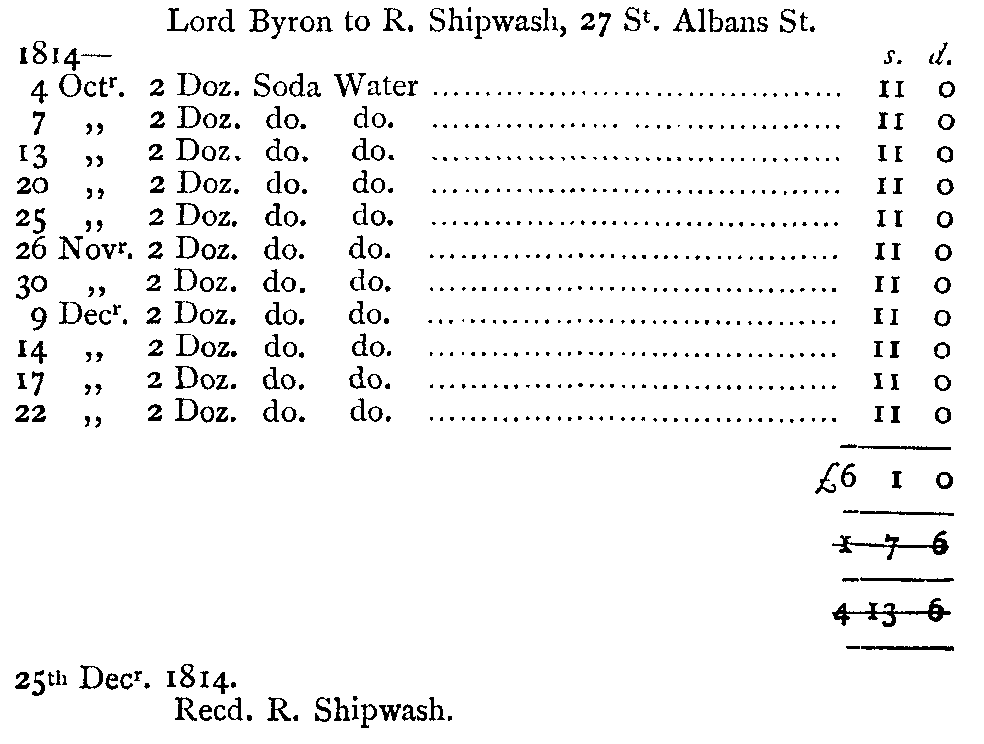
I have boxed an hour—written an ode to Napoleon Buonaparte—copied it—eaten six biscuits—drunk four bottles of soda water
1
—redde away the rest of my time— besides giving poor [? Webster] a world of advice about this mistress of his, who is plaguing him into a phthisic and intolerable tediousness. I am a pretty fellow truly to lecture about "the sect." No matter, my counsels are all thrown away.
Footnote 1:
The following is one of Byron's bills for soda water:
return
List of Journal Entries Contents
April 19th, 1814
There is ice at both poles, north and south—all extremes are the same—misery belongs to the highest and the lowest only, to the emperor and the beggar, when unsixpenced and unthroned. There is, to be sure, a damned insipid medium—an equinoctial line—no one knows where, except upon maps and measurement.
"And all our yesterdays have lighted fools The way to dusty death."1
I
will
keep no further journal of that same hesternal torch-light; and, to prevent me from returning, like a dog, to the vomit of memory, I tear out the remaining leaves of this volume, and write, in
Ipecacuanha
,—"that the Bourbons are restored!!!"—"Hang up philosophy."
2
To be s
ure, I have long despised myself and man, but I never spat in the face of my species before—"O fool! I shall go mad."
3
Footnote 1:
Macbeth
, act v. sc. 5, line 22.
return to footnote mark
Footnote 2:
Romeo and Juliet
, act iii. sc. 3.
return
Footnote 3:
King Lear
, act ii. sc. 4.
return
List of Journal Entries Contents