Chapter IV · — Travels in Albania, Greece, etc. — Death of Mrs. Byron (continued 2)
Reading edition
return to footnote mark
Footnote 2:
Sir William Gell (1777-1836) published the
Topography of Troy
(1804);
Geography and Antiquities of Ithaca
(1807); the
Itinerary of Greece
(1810); and many other subsequent works. (For Byron's review of
Ithaca
and
Greece
, in the
Monthly Review
for August, 1811, see
Appendix III
.) In the MS. of
English Bards, and Scotch Reviewers
(line 1034) he called him "coxcomb Gell;" but, having made his personal acquaintance before the Satire was printed, he changed the epithet to "classic." After seeing the country himself, he again altered the epithet —
"Of Dardan tours let Dilettanti tell, I leave topography to rapid Gell."
To these lines is appended the following note:
"'Rapid,' indeed! He topographised and typographised King Priam's dominions in three days! I called him 'classic' before I saw the Troad, but since have learned better than to tack to his name what don't belong to it."
To this passage Byron, in 1816, added the further expression of his opinion, that "Gell's survey was hasty and superficial." One of two suppressed stanzas in
Childe Harold
(Canto II. stanza xiii.) refers to Gell and his works:—
"Or will the gentle Dilettanti crew Now delegate the task to digging Gell? That mighty limner of a bird's-eye view, How like to Nature let his volumes tell; Who can with him the folio's limits swell With all the Author saw, or said he saw? Who can topographise or delve so well? No boaster he, nor impudent and raw, His pencil, pen, and shade, alike without a flaw."
return
Footnote 3:
Imitations and Translations from the Ancient and Modern Classics, etc.
(London, 1809, 8vo). Of the sixty-five pieces, nine were by Byron (see
Poems
, vol. i, Bibliographical note; and vol. vi, Bibliographical note). The second and enlarged edition of
English Bards, and Scotch Reviewers
, with Byron's name attached, appeared in October, 1809.
return
Footnote 4:
Two boys of this name, sons of J. Claridge, of Sevenoaks, entered Harrow School in April, 1805. George became a. solicitor, and died at Sevenoaks in 1841; John (afterwards Sir John) went to Christ Church, Oxford, became a barrister, and died in 1868. John Claridge seems to have been one of Byron's "juniors and favourites," whom he "spoilt by indulgence."
return
Footnote 5:
"Still to my brother turns with ceaseless pain, And drags at each remove a lengthening chain."
Goldsmith's
Traveller, lines 9, 10.
return
Footnote 6:
The allusion is to the familiar lines inserted by Isaac Bickerstaffe in
Love in a Village
(1762), act i. sc. 3 —
"There was a jolly miller once, Liv'd on the river Dee; He work'd and sung from morn till night; No lark more blithe than he. "And this the burden of his song, For ever us'd to be — I care for nobody, not I, If no one cares for me."
return
Footnote 7:
"During our stay at Athens," writes Hobhouse (Travels in Albania, etc., vol. i. pp. 242, 243), "we occupied two houses separated from each other only by a single wall, through which we opened a doorway. One of them belongs to a Greek lady, whose name is Theodora Macri, the daughter of the late English Vice-Consul, and who has to show many letters of recommendation left in her hands by several English travellers. Her lodgings consisted of a sitting-room and two bedrooms, opening into a court-yard where there were five or six lemon-trees, from which, during our residence in the place, was plucked the fruit that seasoned the pilaf and other national dishes served up at our frugal table."
The beauty of the Greek women is transient. Hughes (
Travels in Sicily, etc.
, vol. i. p. 254, published in 1820) speaks of the three daughters of Madame Macri as "the
belles
of Athens." Of Theresa, the eldest, he says that "her countenance was extremely interesting, and her eye retained much of its wonted brilliancy; but the roses had already deserted the cheek, and we observed the remains only of that loveliness which elicited such strains from an impassioned poet." Walsh, in his
Narrative of a Resident in Constantinople
(vol. i p. 122), speaks of Theresa Macri, the "Maid of Athens," whom he saw in 1821, as "still very elegant in her person, and gentle and ladylike in her manners," but adds that "she has lost all pretensions to beauty, and has a countenance singularly marked by hopeless sadness." On the other hand, Williams, in his
Travels in Italy, etc.
(vol. ii. pp. 290, 291), speaks, in 1820, with an artist's enthusiasm, of the beauty of the three daughters of Theodora Macri. He quotes from the "Visitors' Book," to which Hobhouse alludes, four lines written by Byron in answer to an anonymous versifier —
"This modest bard, like many a bard unknown, Rhymes on our names, but wisely hides his own; But yet, whoe'er he be, to say no worse, His name would bring more credit than his verse."
Theresa and Mariana Macri were dark; Katinka was fair. The latter name Byron uses as that of the fair Georgian in
Don Juan
(Canto VI. stanza xli.).
"It was," says Moore, "if I recollect right, in making love to one of these girls that he had recourse to an act of courtship often practised in that country; — namely, giving himself a wound across the breast with his dagger. The young Athenian, by his own account, looked on very coolly during the operation, considering it a fit tribute to her beauty, but in no degree moved to gratitude."
Theresa, sometimes called Thyrza, Macri married an Englishman named Black, employed in H.M.'s Consular service at Missolonghi. She survived her husband, and fell into great poverty. Finlay, the historian of Greece, made an appeal on her behalf, which obtained the support of the leading members of Athenian society, including M. Charilaus Tricoupi, for some time Prime Minister at Athens, the son of Spiridion Tricoupi — Byron's intimate friend. In the
New York Times
for October 22, 1875, Mr. Anthony Martelaus, United States Consular Agent at Athens, describes Mrs. Black, whom he visited in August, 1875, as "a tall old lady, with features inspiring reverence, and showing that at a time past she was a beautiful woman." Theresa Black died October 15, 1875, aged 80 years. (See letters to the
Times
, October 25 and October 27, 1875, by Richard Edgcumbe and Neocles Mussabini respectively.)
return
List of Letters
137 — To Francis Hodgson
Salsette
frigate, in the Dardanelles, off Abydos, May 5, 1810.
I am on my way to Constantinople, after a tour through Greece, Epirus, etc., and part of Asia Minor, some particulars of which I have just communicated to our friend and host, H. Drury. With these, then, I shall not trouble you; but as you will perhaps be pleased to hear that I am well, etc., I take the opportunity of our ambassador's return to forward the few lines I have time to despatch. We have undergone some inconveniences, and incurred partial perils, but no events worthy of communication, unless you will deem it one that two days ago I swam from Sestos to Abydos.
This
, with a few alarms from robbers, and some danger of shipwreck in a Turkish galliot six months ago, a visit to a Pacha, a passion for a married woman at Malta
1
, a challenge to an officer, an attachment to three Greek girls at Athens, with a great deal of buffoonery and fine prospects, form all that has distinguished my progress since my departure from Spain.
Hobhouse rhymes and journalises; I stare and do nothing — unless smoking can be deemed an active amusement. The Turks take too much care of their women to permit them to be scrutinised; but I have lived a good deal with the Greeks, whose modern dialect I can converse in enough for my purposes. With the Turks I have also some male acquaintances — female society is out of the question. I have been very well treated by the Pachas and Governors, and have no complaint to make of any kind. Hobhouse will one day inform you of all our adventures — were I to attempt the recital, neither
my
paper nor
your
patience would hold out during the operation.
Nobody, save yourself, has written to me since I left England; but indeed I did not request it. I except my relations, who write quite as often as I wish. Of Hobhouse's volume I know nothing, except that it is out; and of my second edition I do not even know
that
, and certainly do not, at this distance, interest myself in the matter.
I
hope you and Bland
2
roll down the stream of sale with rapidity.
Of my return I cannot positively speak, but think it probable Hobhouse will precede me in that respect. We have been very nearly one year abroad. I should wish to gaze away another, at least, in these evergreen climates; but I fear business, law business, the worst of employments, will recall me previous to that period, if not very quickly. If so, you shall have due notice.
I hope you will find me an altered personage, — I do not mean in body, but in manner, for I begin to find out that nothing but virtue will do in this damned world. I am tolerably sick of vice, which I have tried in its agreeable varieties, and mean, on my return, to cut all my dissolute acquaintance, leave off wine and carnal company, and betake myself to politics and decorum. I am very serious and cynical, and a good deal disposed to moralise; but fortunately for you the coming homily is cut off by default of pen and defection of paper.
Good morrow! If you write, address to me at Malta, whence your letters will be forwarded. You need not remember me to any body, but believe me,
Yours with all faith,
Byron
.
Constantinople, May 15, 1810.
P.S. — My dear H., — The date of my postscript "will prate to you of my whereabouts."
We
anchored between the Seven Towers and the Seraglio on the 13th, and yesterday settled ashore
3
.
The
ambassador
4
is laid up;
but
the secretary
5
does the honours of the palace, and we have a general invitation to his palace. In a short time he has his leave of audience, and we accompany him in our uniforms to the Sultan, etc., and
in
a few days I am to visit the Captain Pacha with the commander of our frigate
6
. I have seen enough of their Pashas already; but I wish to have a view of the Sultan, the last of the Ottoman race.
Of Constantinople you have Gibbon's description, very correct as far as I have seen. The mosques I shall have a firman to visit. I shall most probably (
Deo volente
), after a full inspection of Stamboul, bend my course homewards; but this is uncertain. I have seen the most interesting parts, particularly Albania, where few Franks have ever been, and all the most celebrated ruins of Greece and Ionia.
Of England I know nothing, hear nothing, and can find no person better informed on the subject than myself. I this moment drink your health in a bumper of hock; Hobhouse fills and empties to the same; do you and Drury pledge us in a pint of any liquid you please — vinegar will bear the nearest resemblance to that which I have just swallowed to your name; but when we meet again the draught shall be mended and the wine also.
Yours ever,
B.
Footnote 1:
Mrs. Spencer Smith (see page 244,
note
i).
"In the mean time," writes Galt, who was at Malta with him, "besides his "Platonic dalliance with Mrs. Spencer Smith, Byron had involved himself in a quarrel with an officer; but it was satisfactorily settled"
(
Life of Byron
, p. 67).
return to footnote mark
Footnote 2:
The Rev. Robert Bland (1780-1825), the son of a well-known London doctor, educated at Harrow and Pembroke College, Cambridge, was an assistant-master at Harrow when Byron was a schoolboy. There he became one of a "social club or circle," to which belonged J. Herman Merivale, Hodgson, Henry Drury, Denman (afterwards Lord Chief Justice), Charles Pepys (afterwards Lord Chancellor), Launcelot Shadwell (afterwards Vice-Chancellor), Walford (afterwards Solicitor to the Customs), and Paley, a son of the archdeacon. A good singer, an amusing companion, and a clever, impulsive, eccentric creature, he was nicknamed by his friends "Don Hyperbolo" for his humorous extravagances. Some of his letters, together with a sketch of his life, are given in the
Life of the Rev. Francis Hodgson
, vol. i pp. 226-250. In the
Monthly Magazine
for March, 1805, he and Merivale began to publish a series of translations from the Greek minor poets and epigrammatists, which were afterwards collected, with additions by Denman, Hodgson, Drury, and others, and published (1806) under the title of
Translations, chiefly from the Greek Anthology, with Tales and Miscellaneous Poems
. Bland and Merivale (1779-1844) are addressed by Byron (
English Bards, and Scotch Reviewers
, lines 881-890) as "associate bards," and adjured to "resign Achaia's lyre, and strike your own." The two friends also collaborated in the
Collections from the Greek Anthology
(1813), and
A Collection of the most Beautiful Poems of the Minor Poets of Greece
(1813). Bland also published two volumes of original verse:
Edwy and Elgiva
(1808), and
The Four Slaves of Cythera, a Poetical Romance
(1809). Several generations of schoolboys have learned to write Latin verse from his
Elements of Latin Hexameters and Pentameters
. A lover of France, and of the French nation and of French acting, he spoke the language like a native, travelled in disguise over the countries occupied by Napoleon's armies, and (1813) published, in collaboration with Miss Plumptre, a translation of the
Memoirs
of Baron Grimm and Diderot. He was appointed Chaplain at Amsterdam, whence he returned in 1811. (For the circumstances of his quarrel with Hodgson, see page 195,
note
1.) He was successively Curate of Prittlewell and Kenilworth. At the latter place, where he eked out a scanty income by taking pupils, he died in 1825 from breaking a blood-vessel.
return
Footnote 3:
Byron and Hobhouse landed on May 14, and rode to their inn.
"This," says Hobhouse (Travels in Albania, etc., vol. ii pp. 216, 217), "was situated at the corner of the main street of Pera, here four ways meet, all of which were not less mean and dirty than the lanes of Wapping. The hotel, however (kept by a Mons. Marchand), was a very comfortable mansion, containing many chambers handsomely furnished, and a large billiard-room, which is the resort of all the idle young men of the place. Our dinners there were better served, and composed of meats more to the English taste, than we had seen at any tavern since our departure from Falmouth; and the butter of Belgrade (perfectly fresh, though not of a proper consistency) was a delicacy to which we had long been unaccustomed. The best London porter, and nearly every species of wine, except port, were also to be procured in any quantity. To this eulogy cannot be added the material recommendation of cheapness."
return
Footnote 4:
Robert Adair. (See page 260,
note
1.)
return
Footnote 5:
Stratford Canning, afterwards Lord Stratford de Redcliffe.
return
Footnote 6:
Captain Bathurst, and the officers of the
Salsette
, anxious to see the arsenal and the Turkish fleet, paid a visit with Byron to Ali, the Capudan-Pasha, or Lord High Admiral.
"He was," writes Hobhouse (Travels in Albania, etc., vol. ii. p. 279), "in his kiosk of audience at Divan-Hane, a splendid chamber, surrounded by his attendants, and, contrary to custom, received us sitting. He is reported to be a ferocious character, and certainly had the appearance of being so."
return
List of Letters
138 — To his Mother
Constantinople, May 18, 1810.
Dear Madam, — I arrived here in an English frigate from Smyrna a few days ago, without any events worth mentioning, except landing to view the plains of Troy, and afterwards, when we were at anchor in the Dardanelles,
swimming
from Sestos to Abydos, in imitation of Monsieur Leander, whose story you, no doubt, know too well for me to add anything on the subject except that I crossed the Hellespont without so good a motive for the undertaking. As I am just going to visit the Captain-Pacha, you will excuse the brevity of my letter. When Mr. Adair takes leave I am to see the Sultan and the mosques, etc.
Believe me, yours ever,
Byron
.
List of Letters
139 — To his Mother
Constantinople, May 24, 1810.
Dear Mother, — I wrote to you very shortly the other day on my arrival here, and, as another opportunity avails, take up my pen again, that the frequency of my letters may atone for their brevity. Pray did you ever receive a picture of me in oil by
Sanders
in
Vigo Lane
, London? (a noted limner); if not, write for it immediately; it was paid for, except the frame (if frame there be), before I left England. I believe I mentioned to you in my last that my only notable exploit lately has been swimming from Sestos to Abydos in humble imitation of
Leander
, of amorous memory; though I had no
Hero
to receive me on the other shore of the Hellespont.
Of Constantinople you have of course read fifty descriptions by sundry travellers, which are in general so correct that I have nothing to add on the subject. When our ambassador takes his leave I shall accompany him to see the Sultan, and afterwards probably return to Greece. I have heard nothing of Mr. H — — , but one remittance without any letter from that legal gentleman. If you have occasion for any pecuniary supply, pray use my funds as far as they
go
, without reserve; and lest there should not be enough, in my next to Mr. H — — I will direct him to advance any sum you want, leaving at your discretion how much, in the present state of my affairs, you may think proper to require.
I have already seen the most interesting part of Turkey in Europe and Asia Minor, but shall not proceed further till I hear from England. In the mean time I shall expect occasional supplies, according to circumstances, and shall pass my summer amongst my friends the Greeks of the Morea. You will direct to Malta, where my letters are forwarded.
And believe me, with great sincerity, yours ever,
Byron
.
P.S. — Fletcher is well. Pray take care of my boy Robert and the old man Murray. It is fortunate they returned; neither the youth of the one nor the age of the other would have suited the changes of climate and fatigue of travelling.
List of Letters
140 — To Henry Drury
Constantinople, June 17, 1810.
Though
I wrote to you so recently, I break in upon you again to congratulate you on a child being born
1
, as a letter from Hodgson apprizes me of that event, in which I rejoice.
I am just come from an expedition through the Bosphorus to the Black Sea and the Cyanean Symplegades, up which last I scrambled with as great risk as ever the Argonauts escaped in their hoy.
You
remember the beginning of the nurse's dole in the
Medea
, of which I beg you to take the following translation, done on the summit:—
"Oh how I wish that an embargo Had kept in port the good ship Argo! Who, still unlaunched from Grecian docks, Had never passed the Azure rocks; But now I fear her trip will be a Damned business for my Miss Medea, etc., etc.,"2
as it very nearly was to me; — for, had not this sublime passage been in my head, I should never have dreamed of ascending the said rocks, and bruising my carcass in honour of the ancients.
I have now sat on the Cyaneans, swam from Sestos to Abydos (as I trumpeted in my last), and, after passing through the Morea again, shall set sail for Santa Maura, and toss myself from the Leucadian promontory; — surviving which operation, I shall probably join you in England. Hobhouse, who will deliver this, is bound straight for these parts; and, as he is bursting with his travels, I shall not anticipate his narratives, but merely beg you not to believe one word he says, but reserve your ear for me, if you have any desire to be acquainted with the truth.
I am bound for Athens once more, and thence to the Morea; but my stay depends so much on my caprice, that I can say nothing of its probable duration. I have been out a year already, and may stay another; but I am quicksilver, and say nothing positively. We are all very much occupied doing nothing, at present. We have seen every thing but the mosques, which we are to view with a firman on Tuesday next. But of these and other sundries let H. relate, with this proviso, that
I
am to be referred to for authenticity; and I beg leave to contradict all those things whereon he lays particular stress. But, if he soars at any time into wit, I give you leave to applaud, because that is necessarily stolen from his fellow-pilgrim.
Tell
Davies
3
that Hobhouse has made excellent use of his best jokes in many of his Majesty's ships of war; but add, also, that I always took care to restore them to the right owner; in consequence of which he (Davies) is no less famous by water than by land, and reigns unrivalled in the cabin as in the "Cocoa Tree."
4
And
Hodgson has been publishing more poesy — I wish he would send me his
Sir Edgar
,
5
and Bland's
Anthology
, to Malta, where they will be forwarded. In my last, which I hope you received, I gave an outline of the ground we have covered. If you have not been overtaken by this despatch, Hobhouse's tongue is at your service. Remember me to Dwyer, who owes me eleven guineas. Tell him to put them in my banker's hands at Gibraltar or Constantinople. I believe he paid them once, but that goes for nothing, as it was an annuity.
I wish you would write. I have heard from Hodgson frequently. Malta is my post-office.
I
mean to be with you by next Montem. You remember the last, — I hope for such another; but after having swam across the "broad Hellespont," I disdain Datchett
6
. Good afternoon!
I am yours, very sincerely,
Byron
.
Footnote 1:
Henry Drury, afterwards Archdeacon of Wilts.
return to footnote mark
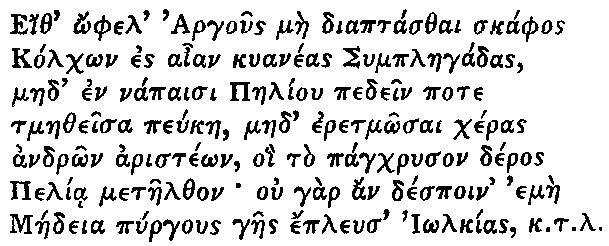
Footnote 2:
Euripides,
Medea
, lines 1-7 —
return
Footnote 3:
For Scrope Berdmore Davies, see page 165,
note
2.
return
Footnote 4:
"The Cocoa Tree," now 64, St. James's Street, formerly in Pall Mall, was, in the reign of Queen Anne, the Tory Chocolate House. It became a club about 1745, and was then regarded as the headquarters of the Jacobites. Probably for this reason Gibbon, whose father professed Jacobite opinions, belonged to it on coming to live in London (see his journal for November, 1762, and his letter to his stepmother, January 18, 1766: "The Cocoa Tree serves "now and then to take off an idle hour"). Byron was a member.
return
Footnote 5:
Hodgson's
Sir Edgar
was published in 1810.
return
Footnote 6:
Alluding to his having swum across the Thames with Henry Drury, after the Montem, to see how many times they could make the passage backwards and forwards without touching land. In this trial Byron was the conqueror.
return
List of Letters
141 — To his Mother
Constantinople, June 28, 1810.
My dear Mother, — I regret to perceive by your last letter that several of mine have not arrived, particularly a very long one written in November last from Albania, where I was on a visit to the Pacha of that province. Fletcher has also written to his spouse perpetually.
Mr. Hobhouse, who will forward or deliver this, and is on his return to England, can inform you of our different movements, but I am very uncertain as to my own return. He will probably be down in Notts, some time or other; but Fletcher, whom I send back as an incumbrance (English servants are sad travellers), will supply his place in the interim, and describe our travels, which have been tolerably extensive.
I have written twice briefly from this capital, from Smyrna, from Athens and other parts of Greece; from Albania, the Pacha of which province desired his respects to my mother, and said he was sure I was a man of high birth because I had small ears, curling hair, and white hands!!! He was very kind to me, begged me to consider him as a father, and gave me a guard of forty soldiers through the forests of Acarnania. But of this and other circumstances I have written to you at large, and yet hope you will receive my letters.
I remember Mahmout Pacha, the grandson of Ali Pacha, at Yanina, (a little fellow of ten years of age, with large black eyes, which our ladies would purchase at any price, and those regular features which distinguish the Turks,) asked me how I came to travel so young, without anybody to take care of me. This question was put by the little man with all the gravity of threescore. I cannot now write copiously; I have only time to tell you that I have passed many a fatiguing, but never a tedious moment; and all that I am afraid of is that I shall contract a gypsy like wandering disposition, which will make home tiresome to me: this, I am told, is very common with men in the habit of peregrination, and, indeed, I feel it so. On the 3rd of May I swam from
Sestos
to
Abydos
. You know the story of Leander, but I had no
Hero
to receive me at landing.
I also passed a fortnight on the Troad. The tombs of Achilles and Æsyetes still exist in large barrows, similar to those you have doubtless seen in the North.
The
other day I was at Belgrade (a village in these environs), to see the house built on the same site as Lady Mary Wortley's
1
. By-the-by, her ladyship, as far as I can judge, has lied, but not half so much as any other woman would have done in the same situation.
I have been in all the principal mosques by the virtue of a firman: this is a favor rarely permitted to Infidels, but the ambassador's departure obtained it for us. I have been up the Bosphorus into the Black Sea, round the walls of the city, and, indeed, I know more of it by sight than I do of London. I hope to amuse you some winter's evening with the details, but at present you must excuse me; — I am not able to write long letters in June. I return to spend my summer in Greece. I write often, but you must not be alarmed when you do not receive my letters; consider we have no regular post farther than Malta, where I beg you will in future send your letters, and not to this city.
Fletcher is a poor creature, and requires comforts that I can dispense with. He is very sick of his travels, but you must not believe his account of the country. He sighs for ale, and idleness, and a wife, and the devil knows what besides. I have not been disappointed or disgusted. I have lived with the highest and the lowest. I have been for days in a Pacha's palace, and have passed many a night in a cowhouse, and I find the people inoffensive and kind. I have also passed some time with the principal Greeks in the Morea and Livadia, and, though inferior to the Turks, they are better than the Spaniards, who, in their turn, excel the Portuguese.
Of
Constantinople you will find many descriptions in different travels; but Lady Mary Wortley errs strangely when she says, "St. Paul's would cut a strange figure by St. Sophia's."
2
I have been in both, surveyed them inside and out attentively. St. Sophia's is undoubtedly the most interesting from its immense antiquity, and the circumstance of all the Greek emperors, from Justinian, having been crowned there, and several murdered at the altar, besides the Turkish Sultans who attend it regularly. But it is inferior in beauty and size to some of the mosques, particularly "Soleyman," etc., and not to be mentioned in the same page with St. Paul's (I speak like a
Cockney
). However, I prefer the Gothic cathedral of Seville to St. Paul's, St. Sophia's, and any religious building I have ever seen.
The walls of the Seraglio are like the walls of Newstead gardens, only higher, and much in the same
order
; but the ride by the walls of the city, on the land side, is beautiful. Imagine four miles of immense triple battlements, covered with ivy, surmounted with 218 towers, and, on the other side of the road, Turkish burying-grounds (the loveliest spots on earth), full of enormous cypresses. I have seen the ruins of Athens, of Ephesus, and Delphi.
I
have traversed great part of Turkey, and many other parts of Europe, and some of Asia; but I never beheld a work of nature or art which yielded an impression like the prospect on each side from the Seven Towers to the end of the Golden Horn
3
.
Now for England. I am glad to hear of the progress of
English Bards
, etc. Of course, you observed I have made great additions to the new edition. Have you received my picture from Sanders, Vigo Lane, London? It was finished and paid for long before I left England: pray, send for it. You seem to be a mighty reader of magazines: where do you pick up all this intelligence, quotations, etc., etc.?
Though
I was happy to obtain my seat without the assistance of Lord Carlisle, I had no measures to keep with a man who declined interfering as my relation on that occasion, and I have done with him, though I regret distressing Mrs. Leigh
4
, poor thing! — I hope she is happy.
It is my opinion that Mr. B — — ought to marry Miss R — — . Our first duty is not to do evil; but, alas! that is impossible: our next is to repair it, if in our power. The girl is his equal: if she were his inferior, a sum of money and provision for the child would be some, though a poor, compensation: as it is, he should marry her. I will have no gay deceivers on my estate, and I shall not allow my tenants a privilege I do not permit myself —
that
of debauching each other's daughters. God knows, I have been guilty of many excesses; but, as I have laid down a resolution to reform, and lately kept it, I expect this Lothario to follow the example, and begin by restoring this girl to society, or, by the beard of my father! he shall hear of it. Pray take some notice of Robert, who will miss his master; poor boy, he was very unwilling to return. I trust you are well and happy. It will be a pleasure to hear from you.
Believe me, yours very sincerely,
Byron
.
P.S. — How is Joe Murray?
P.S. — I open my letter again to tell you that Fletcher having petitioned to accompany me into the Morea, I have taken him with me, contrary to the intention expressed in my letter.
Footnote 1:
Lady Mary describes the village of Belgrade in a letter to Pope, dated June 17, 1717 (
Letters
, edit. 1893, vol. i. pp. 331-333). But Walsh (
Narrative of a Residence in Constantinople
, vol. ii 108, 109), who visited Belgrade in 1821, says that no trace of her description was then to be seen — no view of the Black Sea, no houses of the wealthy Christians, no fountains, and no fruit-trees. "The very tradition" of the house, which had disappeared before Dallaway visited Belgrade in 1794, had perished.
return to footnote mark
Footnote 2:
Lady Mary does not compare St. Paul's with St. Sophia's, but with the mosque of the Valide,
"the largest of all, built entirely of marble, the most prodigious, and, I think, the most beautiful structure I ever saw, be it spoken to the honour of our sex, for it was founded by the mother of Mahomet IV. Between friends, St. Paul's Church would make a pitiful figure near it"
(
Letters
, vol. i. p. 356).
return
Footnote 3:
"The European with the Asian shore Sprinkled with palaces; the ocean stream Here and there studded with a seventy-four; Sophia's cupola with golden gleam; The cypress groves; Olympus high and hoar; The twelve isles, and the more than I could dream, Far less describe, present the very view Which charm'd the charming Mary Montagu."
Don Juan
, Canto V stanza 3.
return
Footnote 4:
For Mrs. Leigh,
née
Augusta Byron, see page 18,
note
1.
return
List of Letters
142 — To his Mother
Constantinople, July 1, 1810.
My dear Mother, — I have no wish to forget those who have any claim upon me, and shall be glad of the good wishes of R — — when he can express them in person, which it seems will be at some very indefinite date. I shall perhaps essay a speech or
two
in the House when I return, but I am not ambitious of a parliamentary career, which is of all things the most degrading and unthankful. If I could by my own efforts inculcate the truth, that a man is not intended for a despot or a machine, but as an individual of a community, and fit for the society of kings, so long as he does not trespass on the laws or rebel against just governments, I might attempt to found a new Utopia; but as matters are at present, in course you will not expect me to sacrifice my health or self to your or anyone's ambition.
To quit this new idea for something you will understand better, how are Miss R's, the W's, and Mr. R's blue bastards? for I suppose he will not deny their
authorship
, which was, to say the least, imprudent and immoral. Poor Miss — — : if he does not marry, and marry her speedily, he shall be no tenant of mine from the day that I set foot on English shores.
I am glad you have received my portrait from Sanders. It does not
flatter
me, I think, but the subject is a bad one, and I must even do as Fletcher does over his Greek wines — make a face and hope for better. What you told me of — — is not
true
, which I regret for your sake and your gossip-seeking neighbours, whom present with my good wishes, and believe me,
Yours, etc.,
Byron
.
List of Letters
143 — To Francis Hodgson
Constantinople, July 4, 1810.
My Dear Hodgson, — Twice have I written — once in answer to your last, and a former letter when I arrived here in May. That I may have nothing to reproach myself with, I will write once more — a very superfluous task, seeing that Hobhouse is bound for your parts full of talk and wonderment. My first letter went by an ambassadorial express; my second by the
Black John
lugger; my third will be conveyed by Cam, the miscellanist.
I shall begin by telling you, having only told it you twice before, that I swam from Sestos to Abydos. I do this that you may be impressed with proper respect for me, the performer; for I plume myself on this achievement more than I could possibly do on any kind of glory, political, poetical, or rhetorical. Having told you this, I will tell you nothing more, because it would be cruel to curtail Cam's narrative, which, by-the-by, you must not believe till confirmed by me, the eye-witness. I promise myself much pleasure from contradicting the greatest part of it. He has been plaguily pleased by the intelligence contained in your last to me respecting the reviews of his hymns. I refreshed him with that paragraph immediately, together with the tidings of my own third edition, which added to his recreation. But then he has had a letter from a Lincoln's Inn Bencher, full of praise of his harpings, and vituperation of the other contributions to his
Missellingany
, which that sagacious person is pleased to say must have been put in as
Foils
(
horresco referens!
); furthermore he adds that Cam "is a genuine pupil of Dryden," concluding with a comparison rather to the disadvantage of Pope.
I have written to Drury by Hobhouse; a letter is also from me on its way to England intended for that matrimonial man. Before it is very long, I hope we shall again be together; the moment I set out for England you shall have intelligence, that we may meet as soon as possible. Next week the frigate sails with Adair; I am for Greece, Hobhouse for England.
A
year together on the 2nd July since we sailed from Falmouth. I have known a hundred instances of men setting out in couples, but not one of a similar return. Aberdeen's
1
party split; several voyagers at present have done the same. I am confident that twelve months of any given individual is perfect ipecacuanha.
The
Russians and Turks are at it
2
, and the Sultan in person is soon to head the army. The Captain Pasha cuts off heads every day, and a Frenchman's ears; the last is a serious affair. By-the-by I like the Pashas in general. Ali Pasha called me his son, desired his compliments to my mother, and said he was sure I was a man of birth, because I had "small ears and curling hair." He is Pasha of Albania six hundred miles off, where I was in October — a fine portly person. His grandson Mahmout, a little fellow ten years old, with large black eyes as big as pigeon's eggs, and all the gravity of sixty, asked me what I did travelling so young without a
Lala
(tutor)?
Good night, dear H. I have crammed my paper, and crave your indulgence. Write to me at Malta. I am, with all sincerity,
Yours affectionately,
Byron
.
Footnote 1:
George Hamilton Gordon, Earl of Aberdeen (1784-1860), afterwards Prime Minister (1852-55), succeeded his grandfather as fourth earl in 1801. Grandson of the purchaser of Mrs. Byron's old home of Gight, and writer of an article in the
Edinburgh Review
(July, 1805) on Gell's
Topography of Troy,
he has a place in
English Bards, and Scotch Reviewers
(lines 508, 509). He also appears as "sullen Aberdeen," in a suppressed stanza of
Childe Harold
, Canto II., which in the MS. follows stanza xiii., among those who
" — — pilfer all the Pilgrim loves to see, All that yet consecrates the fading scene."
After leaving Harrow, and before entering St. John's College, Cambridge, he spent two years (1801-3) in Greece. On his return he founded the Athenian Society, and became President of the Society of Antiquaries from 1812 to 1846. It may be added that he was Foreign Secretary when the Porte acknowledged the independence of Greece by the Treaty of Adrianople (1829).
return to footnote mark
Footnote 2:
In this war, the scene of which lay chiefly in Wallachia, Bosnia, Bulgaria, and Servia, the main episodes were the two battles of Rustchuk (July 4 and October 14, 1811), the recapture of Silistria by the Russians, and the Convention of Giurgevo between the contending forces (October 28, 1811).
return
List of Letters
144 — To his Mother
Athens, July 25, 1810.
Dear Mother, — I have arrived here in four days from Constantinople, which is considered as singularly quick, particularly for the season of the year.
I
left Constantinople with Adair, at whose adieux of leave I saw Sultan Mahmout
1
, and obtained a firman to visit the mosques, of which I gave you a description in my last letter, now voyaging to England in the
Salsette
frigate, in which I visited the plains of Troy and Constantinople. Your northern gentry can have no conception of a Greek summer; which, however, is a perfect frost compared with Malta and Gibraltar, where I reposed myself in the shade last year, after a gentle gallop of four hundred miles, without intermission, through Portugal and Spain. You see, by my date, that I am at Athens again, a place which I think I prefer, upon the whole, to any I have seen.
My next movement is to-morrow into the Morea, where I shall probably remain a month or two, and then return to winter here, if I do not change my plans, which, however, are very variable, as you may suppose; but none of them verge to England.
The
Marquis of Sligo
2
, my old fellow-collegian, is here, and wishes to accompany me into the Morea. We shall go together for that purpose; but I am woefully sick of travelling companions, after a year's experience of Mr. Hobhouse, who is on his way to Great Britain. Lord S. will afterwards pursue his way to the capital; and Lord B., having seen all the wonders in that quarter, will let you know what he does next, of which at present he is not quite certain. Malta is my perpetual post-office, from which my letters are forwarded to all parts of the habitable globe:— by the bye, I have now been in Asia, Africa, and the east of Europe, and, indeed, made the most of my time, without hurrying over the most interesting scenes of the ancient world. Fletcher, after having been toasted and roasted, and baked, and grilled, and eaten by all sorts of creeping things, begins to philosophise, is grown a refined as well as a resigned character, and promises at his return to become an ornament to his own parish, and a very prominent person in the future family pedigree of the Fletchers, who I take to be Goths by their accomplishments, Greeks by their acuteness, and ancient Saxons by their appetite. He (Fletcher) begs leave to send half-a-dozen sighs to Sally his spouse, and wonders (though I do not) that his ill-written and worse spelt letters have never come to hand; as for that matter, there is no great loss in either of our letters, saving and except that I wish you to know we are well, and warm enough at this present writing, God knows. You must not expect long letters at present, for they are written with the sweat of my brow, I assure you. It is rather singular that Mr. Hanson has not written a syllable since my departure. Your letters I have mostly received as well as others; from which I conjecture that the man of law is either angry or busy.
I trust you like Newstead, and agree with your neighbours; but you know
you
are a
vixen
— is not that a dutiful appellation? Pray, take care of my books and several boxes of papers in the hands of Joseph; and pray leave me a few bottles of champagne to drink, for I am very thirsty; — but I do not insist on the last article, without you like it. I suppose you have your house full of silly women, prating scandalous things. Have you ever received my picture in oil from Sanders, London? It has been paid for these sixteen months: why do you not get it? My suite, consisting of two Turks, two Greeks, a Lutheran, and the nondescript, Fletcher, are making so much noise, that I am glad to sign myself
Yours, etc., etc.,
Byron
.
Footnote 1:
On July 10, 1810, the British ambassador, Robert Adair, had his audience of Sultan Mahmoud II, and on the 14th the
Salsette
set sail. She touched at the island of Zea to land Byron, who thence made his way to Athens.
It was in making war against Mahmoud II, the conqueror of Ali Pasha and the destroyer of the Janissaries, that Byron lost his life. The following description of the Sultan is given by Hobhouse (
Travels in Albania, etc.,
vol. ii. pp. 364, 365):—
"The chamber was small and dark, or rather illumined with a gloomy artificial light, reflected from the ornaments of silver, pearls, and other white brilliants, with which it is thickly studded on every side and on the roof. The throne, which is supposed the richest in the world, is like a four-posted bed, but of a dazzling splendour; the lower part formed of burnished silver and pearls, and the canopy and supporters encrusted with jewels. It is in an awkward position, being in one corner of the room, and close to a fireplace. "Sultan Mahmoud was placed in the middle of the throne, with his feet upon the ground, which, notwithstanding the common form of squatting upon the hams, seems the seat of ceremony. He was dressed in a robe of yellow satin, with a broad border of the darkest sable; his dagger, and an ornament on his breast, were covered with diamonds; the front of his white and blue turban shone with a large treble sprig of diamonds, which served as a buckle to a high, straight plume of bird-of-paradise feathers. He, for the most part, kept a hand on each knee, and neither moved his body nor head, but rolled his eyes from side to side, without fixing them for an instant upon the ambassador or any other person present. Occasionally he stroked and turned up his beard, displaying a milk-white hand glittering with diamond rings. His eyebrows, eyes, and beard, being of a glossy jet black, did not appear natural, but added to that indescribable majesty which it would be difficult for any but an Oriental sovereign to assume; his face was pale, and regularly formed, except that his nose (contrary to the usual form of that feature in the Ottoman princes) was slightly turned up and pointed; his whole physiognomy was mild and benevolent, but expressive and full of dignity. He appeared of a short and small stature, and about thirty years old, which is somewhat more than his actual age."
Byron, at the audience, claimed some precedence in the procession as a peer. On May 23, 1819, Moore sat at dinner next to Stratford Canning (afterwards Lord Stratford de Redcliffe), who
"gave a ludicrous account of Lord Byron's insisting upon taking precedence of the corps diplomatique in a procession at Constantinople (when Canning was secretary), and upon Adair's refusing it, limping, with as much swagger as he could muster, up the hall, cocking a foreign military hat on his head. He found, however, he was wrong, and wrote a very frank letter acknowledging it, and offering to take his station anywhere"
(
Journals, etc., of Thomas Moore
, vol. ii. p. 313).
An incident of the voyage from Constantinople to Zea is mentioned by Moore (
Life
, p. 110). Picking up a Turkish dagger on the deck, Byron looked at the blade, and then, before replacing it in the sheath, was overheard to say to himself, "I should like to know how a person feels after committing a murder." In
Firmilian; a Spasmodic Tragedy
(scene ix.) the sentiment is parodied. Firmilian determines to murder his friend, in order to shriek "delirious at the taste of sin!" He had already blown up a church full of people; but —
"I must have A more potential draught of guilt than this With more of wormwood in it!... ... Courage, Firmilian! for the hour has come When thou canst know atrocity indeed, By smiting him that was thy dearest friend. And think not that he dies a vulgar death — 'Tis poetry demands the sacrifice!"
And he hurls Haverillo from the summit of the Pillar of St. Simeon Stylites.
return
Footnote 2:
For Lord Sligo, see page 100,
note
2. Lord Sligo was at Athens with a 12-gun brig and a crew of fifty men. At Athens, also, were Lady Hester Stanhope and Michael Bruce, on their way through European Turkey. As the party were passing the Piraeus, they saw a man jump from the mole-head into the sea. Lord Sligo, recognizing the bather as Byron, called to him to dress and join them. Thus began what Byron, in his Memoranda, speaks of as "the most delightful acquaintance which I formed in Greece." From Lord Sligo Moore heard the following stories:—
Weakened and thinned by his illness at Patras, Byron returned to Athens. There, standing one day before a looking-glass, he said to Lord Sligo, "How pale I look! I should like, I think, to die of a consumption." "Why of a consumption?" asked his friend. "Because then," he answered, "the women would all say, 'See that poor Byron — how interesting he looks in dying!'"
He often spoke of his mother to Lord Sligo, who thought that his feeling towards her was little short of aversion. "Some time or "other," he said, "I will tell you why I feel thus towards her." A few days after, when they were bathing together in the Gulf of Lepanto, pointing to his naked leg and foot, he exclaimed,
"Look there! It is to her false delicacy at my birth I owe that deformity; and yet as long as I can remember, she has never ceased to taunt and reproach me with it. Even a few days before we parted, for the last time, on my leaving England, she, in one of her fits of passion, uttered an imprecation upon me, praying that I might prove as ill formed in mind as I am in body!"
Relics of ancient art only appealed to Byron's imagination among their original and natural surroundings. For collections and collectors he had a contempt which, like everything he thought or felt, was unreservedly expressed. Lord Sligo wished to spend some money in digging for antiquities, and Byron offered to act as his agent, and to see the money honestly applied. "You may safely trust
me
" he said; "I am no dilettante. Your connoisseurs are all thieves; but I care too little for these things ever to steal them."
His system of thinning himself, which he had begun before he left England, was continued abroad. While at Athens, where he stayed at the Franciscan Convent, he took a Turkish bath three times a week, his usual drink being vinegar and water, and his food seldom more than a little rice. The result was that, when he returned to England, he weighed only 9 stone 11-1/2 lbs. (see page 127,
note
1).
Moore's account of the "cordial friendship" between Byron and Lady Hester Stanhope requires modification. Lady Hester (see page 302,
note
I) thus referred in after-life to her meeting with Byron, if her physician's recollection is to be trusted (
Memoirs
, by Dr. Meryon, vol. iii. pp. 218, 219) —
"'I think he was a strange character: his generosity was for a motive, his avarice for a motive; one time he was mopish, and nobody was to speak to him; another, he was for being jocular with everybody. Then he was a sort of Don Quixote, fighting with the police for a woman of the town; and then he wanted to make himself something great ... At Athens I saw nothing in him but a well-bred man, like many others; for, as for poetry, it is easy enough to write verses; and as for the thoughts, who knows where he got them? ... He had a great deal of vice in his looks — his eyes set close together, and a contracted brow — so' (imitating it). 'Oh, Lord! I am sure he was not a liberal man, whatever else he might be. The only good thing about his looks was this part' (drawing her hand under the cheek down the front of her neck), 'and the curl on his forehead.'"
Michael Bruce, with the help of Sir Robert Wilson and Capt. Hutchinson, assisted Count Lavallette to escape from Paris in January, 1816. For an account, see Wilson's intercepted letter to Lord Grey (
Memoires du Comte Lavallette
, vol. ii. p. 132) and the story of their trial, conviction, and sentence before the Assize Court of the Department of the Seine (April 22-24, 1816), given in the
Annual Register
for 1816, pp. 329-336.
return
cross-reference: return to Footnote 4 of Letter 51
List of Letters
145 — To his Mother.
Athens, July 27, 1810.
Dear Mother, — I write again in case you have not received my letters. To-day I go into the Morea, which will, I trust, be colder than this place, where I have tarried in the expectation of obtaining rest. Sligo has very kindly proposed a union of our forces for the occasion, which will be perhaps as uncomfortable to him as to myself, judging from previous experience, which, however, may be explained by my own irritability and hurry.
At Constantinople I visited the Mosques, plains, and grandees of that place, which, in my opinion, cannot be compared with Athens and its neighbourhood; indeed I know of no Turkish scenery to equal this, which would be civilised and Celtic enough with a little alteration in situation and inhabitants. An usual custom here, as at Cadiz, is to part with wives, daughters, etc., for a trifling present of gold or English arms (which the Greeks set a high value upon). The women are generally of the middle height, with Turkish eyes, straight hair, and clear olive complexion, but are not nearly so amorous as the Spanish belles, whom I have described to you in former letters. I have some feats to boast of when I return, which is undesired and undesirable — I always except you from my complaints, and hope you will expect me with the same delight that I anticipate meeting you. You can have no conception of Lord S.'s ecstasy when I informed him of my probable movements. The man is well enough and sensible enough by himself; but the swarm of attendants, Turks, Greeks, Englishmen that he carries with him, makes his society, or rather theirs, an intolerable annoyance. If you will read this letter to — — , you may imagine in what capacity I believe you excel.
Before I left England I promised to give my silver-mounted whip (in your chamber) to Charles. Present it to him, poor boy, for I should not like him to suppose me as unfaithful as his
amante
, who, by the way is no better than she should be, and no great loss to himself or his family. Hobhouse is silent, and has, I suppose, not yet returned; indeed, like myself, he appears to love the world better than England, and the Devil more than either, who I regret is not present to be informed of this. Do not fail, if you see him (Hobhouse, I mean), to repeat it, and the assurance that I am to him, with yourself,
Ever affectionately,
Byron
.
List of Letters
146 — To his Mother
Patras, July 30, 1810.
Dear Madam
, — In four days from Constantinople, with a favourable wind, I arrived in the frigate at the island of Teos, from whence I took a boat to Athens, where I met my friend the Marquis of Sligo, who expressed a wish to proceed with me as far as Corinth. At Corinth we separated, he for Tripolitza, I for Patras, where I had some business with the consul, Mr. Strané, in whose house I now write. He has rendered me every service in his power since I quitted Malta on my way to Constantinople, whence I have written to you twice or thrice.
In
a few days I visit the Pacha
1
at Tripolitza, make the tour of the Morea, and return again to Athens, which at present is my head-quarters. The heat is at present intense. In England, if it reaches 98° you are all on fire: the other day, in travelling between Athens and Megara, the thermometer was at 125°!!! Yet I feel no inconvenience; of course I am much bronzed, but I live temperately, and never enjoyed better health.
Before I left Constantinople, I saw the Sultan (with Mr. Adair), and the interior of the mosques, things which rarely happen to travellers. Mr. Hobhouse is gone to England: I am in no hurry to return, but have no particular communications for your country, except my surprise at Mr. Hanson's silence, and my desire that he will remit regularly. I suppose some arrangement has been made with regard to Wymondham and Rochdale. Malta is my post-office, or to Mr. Strané, consul-general, Patras, Morea. You complain of my silence — I have written twenty or thirty times within the last year: never less than twice a month, and often more. If my letters do not arrive, you must not conclude that we are eaten, or that there is war, or a pestilence, or famine: neither must you credit silly reports, which I dare say you have in Notts., as usual. I am very well, and neither more nor less happy than I usually am; except that I am very glad to be once more alone, for I was sick of my companion, — not that he was a bad one, but because my nature leads me to solitude, and that every day adds to this disposition. If I chose, here are many men who would wish to join me — one wants me to go to Egypt, another to Asia, of which I have seen enough. The greater part of Greece is already my own, so that I shall only go over my old ground, and look upon my old seas and mountains, the only acquaintances I ever found improve upon me.
I have a tolerable suite, a Tartar, two Albanians, an interpreter, besides Fletcher; but in this country these are easily maintained. Adair received me wonderfully well, and indeed I have no complaints against any one. Hospitality here is necessary, for inns are not. I have lived in the houses of Greeks, Turks, Italians, and English — to-day in a palace, to-morrow in a cow-house; this day with a Pacha, the next with a shepherd. I shall continue to write briefly, but frequently, and am glad to hear from you; but you fill your letters with things from the papers, as if English papers were not found all over the world. I have at this moment a dozen before me. Pray take care of my books, and believe me, my dear mother,
Yours very faithfully,
Byron
.
Footnote 1:
For Veli Pasha, see page 248,
note
1.
return to footnote mark
List of Letters
147 — To his Mother.
Patras, October 2, 1810.
Dear Madam
, — It is now several months since I have received any communication from you; but at this I am not surprised, nor indeed have I any complaint to make, since you have written frequently, for which I thank you; but I very much condemn Mr. Hanson, who has not taken the smallest notice of my many letters, nor of my request before I left England, which I sailed from on this very day
fifteen
months ago. Thus one year and a quarter have passed away, without my receiving the least intelligence on the state of my affairs, and they were not in a posture to admit of neglect; and I do conceive and declare that Mr. Hanson has acted negligently and culpably in not apprising me of his proceedings; I will also add uncivilly. His letters, were there any, could not easily miscarry; the communications with the Levant are slow, but tolerably secure, at least as far as Malta, and there I left directions which I know would be observed.
I have written to you several times from Constantinople and Smyrna.
You
will perceive by my date I am returned into the Morea
1
, of which I have been making the tour, and visiting the Pacha, who gave me a fine horse, and paid me all possible honours and attention. I have now seen a good portion of Turkey in Europe, and Asia Minor, and shall remain at Athens, and in the vicinity, till I hear from England.
I have punctually obeyed your injunctions of writing frequently, but I shall not pretend to describe countries which have been already amply treated of. I believe before this time Mr. Hobhouse will have arrived in England, and he brings letters from me, written at Constantinople. In these I mention having seen the Sultan and the mosques, and that I swam from Sestos to Abydos, an exploit of which I take care to boast.
I am here on business at present, but Athens is my head-quarters, where I am very pleasantly situated in a Franciscan convent. Believe me to be, with great sincerity, yours very affectionately,
Byron
.
P.S. — Fletcher is well, and discontented as usual; his wife don't write, at least her scrawls have not arrived. You will address to Malta. Pray have you never received my picture in oil from Sanders, Vigo Lane, London?
Footnote 1:
In a note upon the Advertisement prefixed to his
Siege of Corinth
, Byron says,
"I visited all three (Tripolitza, Napoli, and Argos) in 1810-11, and, in the course of journeying through the country, from my first arrival in 1809, I crossed the Isthmus eight times in my way from Attica to the Morea, over the mountains, or in the other direction, when passing from the Gulf of Athens to that of Lepanto."
return to footnote mark
List of Letters
148 — To Francis Hodgson
Patras, Morea, October 3, 1810.
As I have just escaped from a physician and a fever, which confined me five days to bed, you won't expect much
allegrezza
in the ensuing letter. In this place there is an indigenous distemper, which when the wind blows from the Gulf of Corinth (as it does five months out of six), attacks great and small, and makes woful work with visiters. Here be also two physicians, one of whom trusts to his genius (never having studied) — the other to a campaign of eighteen months against the sick of Otranto, which he made in his youth with great effect.
When I was seized with my disorder, I protested against both these assassins; — but what can a helpless, feverish, toast-and-watered poor wretch do? In spite of my teeth and tongue, the English consul, my Tartar, Albanians, dragoman, forced a physician upon me, and in three days vomited and glystered me to the last gasp. In this state I made my epitaph — take it:—
Youth, Nature, and relenting Jove, To keep my lamp in strongly strove: But Romanelli was so stout, He beat all three — and blew it out.
But Nature and Jove, being piqued at my doubts, did, in fact, at last, beat Romanelli, and here I am, well but weakly, at your service.
Since I left Constantinople, I have made a tour of the Morea, and visited Veley Pacha, who paid me great honours, and gave me a pretty stallion. H. is doubtless in England before even the date of this letter:— he bears a despatch from me to your bardship. He writes to me from Malta, and requests my journal, if I keep one. I have none, or he should have it; but I have replied in a consolatory and exhortatory epistle, praying him to abate three and sixpence in the price of his next boke, seeing that half a guinea is a price not to be given for any thing save an opera ticket.
As for England, it is long since I have heard from it. Every one at all connected with my concerns is asleep, and you are my only correspondent, agents excepted. I have really no friends in the world; though all my old school companions are gone forth into that world, and walk about there in monstrous disguises, in the garb of guardsmen, lawyers, parsons, fine gentlemen, and such other masquerade dresses. So, I here shake hands and cut with all these busy people, none of whom write to me. Indeed I ask it not; — and here I am, a poor traveller and heathenish philosopher, who hath perambulated the greatest part of the Levant, and seen a great quantity of very improvable land and sea, and, after all, am no better than when I set out — Lord help me!
I have been out fifteen months this very day, and I believe my concerns will draw me to England soon; but of this I will apprise you regularly from Malta.
On
all points Hobhouse will inform you, if you are curious as to our adventures
1
. I have seen some old English papers up to the 15th of May.
I
see the
Lady of the Lake
2
advertised. Of course it is in his old ballad style, and pretty. After all, Scott is the best of them. The end of all scribblement is to amuse, and he certainly succeeds there. I long to read his new romance.
And how does
Sir Edgar
? and your friend Bland? I suppose you are involved in some literary squabble. The only way is to despise all brothers of the quill. I suppose you won't allow me to be an author, but I contemn you all, you dogs! — I do.
You
don't know Dallas, do you? He had a farce
3
ready for the stage before I left England, and asked me for a prologue, which I promised, but sailed in such a hurry I never penned a couplet. I am afraid to ask after his drama, for fear it should be damned — Lord forgive me for using such a word! but the pit, Sir, you know the pit — they will do those things in spite of merit. I remember this farce from a curious circumstance.
When
Drury Lane
4
was burnt to the ground, by which accident Sheridan and his son lost the few remaining shillings they were worth, what doth my friend Dallas do?
Why
, before the fire was out, he writes a note to Tom Sheridan
5
, the manager of this combustible concern, to inquire whether this farce was not converted into fuel with about two thousand other unactable manuscripts, which of course were in great peril, if not actually consumed. Now was not this characteristic? — the ruling passions of Pope are nothing to it.
Whilst
the poor distracted manager was bewailing the loss of a building only worth £300,000., together with some twenty thousand pounds of rags and tinsel in the tiring rooms, Bluebeard's elephants
6
, and all that — in comes a note from a scorching author, requiring at his hands two acts and odd scenes of a farce!!
Dear H., remind Drury that I am his well-wisher, and let Scrope Davies be well affected towards me. I look forward to meeting you at Newstead, and renewing our old champagne evenings with all the glee of anticipation. I have written by every opportunity, and expect responses as regular as those of the liturgy, and somewhat longer. As it is impossible for a man in his senses to hope for happy days, let us at least look forward to merry ones, which come nearest to the other in appearance, if not in reality; and in such expectations I remain, etc.
Footnote 1:
Hobhouse, writing to Byron from Malta, July 31, 1810, says,
"Mrs. Bruce picked out a pretty picture of a woman in a fashionable dress in Ackerman's Repository, and observed it was vastly like Lord Byron. I give you warning of this, for fear you should make another conquest and return to England without a curl upon your head. Surely the ladies copy Delilah when they crop their lovers after this fashion. 'Successful youth! why mourn thy ravish'd hair, Since each lost lock bespeaks a conquer'd fair, And young and old conspire to make thee bare?' This makes me think of my poor Miscellany, which is quite dead, if indeed that can be said to be dead which was never alive; not a soul knows, or knowing will speak of it." Again, July 15, 1811, he writes: "The Miscellany is so damned that my friends make it a point of politeness not to mention it ever to me."
return to footnote mark
Footnote 2:
The Lady of the Lake
was published in May, 1810.
return
Footnote 3:
For Dallas, see page 168,
note 1
. His farce, entitled,
Not at Home
, was acted at the Lyceum, by the Drury Lane Company, in November, 1809. It was afterwards printed, with a prologue (intended to have been spoken) written by Walter Rodwell Wright, author of
Horæ Ionicæ
.
return
Footnote 4:
Drury Lane Theatre, burned down in 1791, and reopened in 1794, was again destroyed by fire on February 24, 1809.
return
Footnote 5:
Thomas Sheridan (1775-1817), originally in the army, was at this time assisting his father, Richard Brinsley Sheridan, as manager of Drury Lane Theatre. His
Bonduca
was played at Covent Garden in May, 1808. He married, in 1805, Caroline Henrietta Callender, who was "more beautiful than anybody but her daughters," afterwards Mrs. Norton, the Duchess of Somerset, and Lady Dufferin. He died at the Cape of Good Hope in 1817. "Tom Sheridan and his beautiful wife" were at Gibraltar in 1809, when Byron and Hobhouse landed on the Rock, and, as Galt states (
Life of Byron
, p. 58), brought the news to Lady Westmorland of their arrival. (See
English Bards, and Scotch Reviewers
, lines 572, 573, and
note
1.)
return
Footnote 6:
Bluebeard, or Female Curiosity
, by George Colman the Younger (1762-1836), was being acted at Drury Lane in January, 1809. "Bluebeard's elephants" were wicker-work constructions. It was at Covent Garden that the first live elephant was introduced two years later. Johnstone, the machinist employed at Drury Lane, famous for the construction of wooden children, wicker-work lions, and paste-board swans, was present with a friend.
"Among the attractions of this Christmas foolery, a real elephant was introduced.... The friend, who sat close to Johnstone, jogged his elbow, whispering, 'This is a bitter bad job for Drury! Why, the elephant's alive! He'll carry all before him, and beat you hollow. What do you think on't, eh?' 'Think on't?' said Johnstone, in a tone of utmost contempt, 'I should be very sorry if I couldn't make a much better elephant than that, at any time'"
(George Colman the Younger,
Random Records
, vol. i. pp. 228, 229).
return
List of Letters
149 — To John Cam Hobhouse
Patras, Morea, October 4th, 1810.
My
Dear Hobhouse, —
I
wrote to you two days ago, but the weather and my friend Strané's conversation being much the same, and my ally Nicola
1
in bed with a fever, I think I may as well talk to you, the rather, as you can't answer me, and excite my wrath with impertinent observations, at least for three months to come.
I will try not to say the same things I have set down in my other letter of the 2nd, but I can't promise, as my poor head is still giddy with my late fever.
I
saw the Lady Hesther Stanhope
2
at Athens, and do not admire "that dangerous thing a female wit." She told me (take her own words) that she had given you a good set-down at Malta, in some disputation about the Navy; from this, of course, I readily inferred the contrary, or in the words of an
acquaintance
of ours, that "you had the best of it."
She evinced a similar disposition to
argufy
with me, which I avoided by either laughing or yielding. I despise the sex too much to squabble with them, and I rather wonder you should allow a woman to draw you into a contest, in which, however, I am sure you had the advantage, she abuses you so bitterly.
I have seen too little of the Lady to form any decisive opinion, but I have discovered nothing different from other she-things, except a great disregard of received notions in her conversation as well as conduct. I don't know whether this will recommend her to our sex, but I am sure it won't to her own. She is going on to Constantinople.
Ali Pacha is in a scrape. Ibrahim Pacha and the Pacha of Scutari have come down upon him with 20,000 Gegdes and Albanians, retaken Berat, and threaten Tepaleni. Adam Bey is dead, Vely Pacha was on his way to the Danube, but has gone off suddenly to Yanina, and all Albania is in an uproar.
The mountains we crossed last year are the scene of warfare, and there is nothing but carnage and cutting of throats. In my other letter I mentioned that Vely had given me a fine horse. On my late visit he received me with great pomp, standing, conducted me to the door with his arm round my waist, and a variety of civilities, invited me to meet him at Larissa and see his army, which I should have accepted, had not this rupture with Ibrahim taken place. Sultan Mahmout is in a phrenzy because Vely has not joined the army. We have a report here, that the Russians have beaten the Turks and taken Muchtar Pacha prisoner, but it is a Greek Bazaar rumour and not to be believed.
I have now treated you with a dish of Turkish politics.
You
have by this time gotten into England, and your ears and mouth are full of "Reform Burdett, Gale Jones
3
, minority, last night's division, dissolution of Parliament, battle in Portugal," and all the cream of forty newspapers.
In my t'other letter, to which I am perpetually obliged to refer, I have offered some moving topics on the head of your
Miscellany
, the neglect of which I attribute to the half guinea annexed as the indispensable equivalent for the said volume.
Now I do hope, notwithstanding that exorbitant demand, that on your return you will find it selling, or, what is better, sold, in consequence of which you will be able to face the public with your new volume, if that intention still subsists.
My journal, did I keep one, should be yours. As it is I can only offer my sincere wishes for your success, if you will believe it possible for a brother scribbler to be sincere on such an occasion.
Will you execute a commission for me?
Lord
Sligo tells me it was the intention of Miller
4
in Albemarle Street to send by him a letter to me, which he stated to be of consequence. Now I have no concern with Mr. M. except a bill which I hope is paid before this time; will you visit the said M. and if it be a pecuniary matter, refer him to Hanson, and if not, tell me what he means, or forward his letter.
I
have just received an epistle from Galt
5
, with a Candist poem, which it seems I am to forward to you. This I would willingly do, but it is too large for a letter, and too small for a parcel, and besides appears to be damned nonsense, from all which considerations I will deliver it in person. It is entitled the "Fair Shepherdess," or rather "Herdswoman;" if you don't like the translation take the original title "
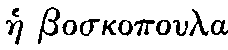
." Galt also writes something not very intelligible about a "Spartan State paper" which by his account is everything but Laconic. Now the said Sparta having some years ceased to be a state, what the devil does he mean by a paper? he also adds mysteriously that the
affair
not being concluded, he cannot at present apply for it.
Now, Hobhouse, are you mad? or is he? Are these documents for Longman & Co.? Spartan state papers! and Cretan rhymes! indeed these circumstances super-added to his house at Mycone (whither I am invited) and his Levant wines, make me suspect his sanity. Athens is at present infested with English people, but they are moving,
Dio bendetto!
I am returning to pass a month or two; I think the spring will see me in England, but do not let this transpire, nor cease to urge the most dilatory of mortals, Hanson. I have some idea of purchasing the Island of Ithaca; I suppose you will add me to the Levant lunatics. I shall be glad to hear from your Signoria of your welfare, politics, and literature.
Your
last letter closes pathetically with a postscript about a nosegay
6
; I advise you to introduce that into your next sentimental novel. I am sure I did not suspect you of any fine feelings, and I believe you were laughing, but you are welcome.
Vale
; "
I
can no more," like Lord Grizzle
7
.
Yours,

Footnote 1:
Nicolo Giraud, from whom Byron was learning Italian.
return to footnote mark
Footnote 2:
Hobhouse had written to Byron, speaking of Lady Hester Stanhope "as the most superior woman, as Bruce says, of all the world." The daughter of Pitt's favourite sister, Lady Hester (1776-1839) was her uncle's constant companion (1803-6). In character she resembled her grandfather far more than her uncle, who owed his cool judgment to the Grenville blood. Lady Hester inherited the overweening pride, generosity, courage, and fervent heat of the "Great Commoner," as well as his indomitable will. Like him, she despised difficulties, and ignored the word "impossibility." Her romantic ideas were also combined with keen insight into character, and much practical sagacity. These were the qualities which made her for many years a power among the wild tribes of Lebanon, with whom she was in 1810 proceeding to take up her abode (1813-39).
return
cross-reference: return to Footnote 3 of Letter 144
Footnote 3:
Sir Francis Burdett (1770-1844), a lifelong friend of Lady Hester Stanhope, was afterwards Hobhouse's colleague as M.P. for Westminster (1820-33). He was committed to the Tower in 1810 for publishing a speech which he delivered in the House of Commons in defence of John Gale Jones, whom the House (February, 1810) had sent to Newgate for a breach of privilege. Sir Francis refused to obey the warrant, and told the sergeant-at-arms that he would not go unless taken by force. His refusal led to riots near his house (77, Piccadilly), in which the Horse Guards, or "Oxford Blues" as they were called, gained the name of "Piccadilly Butchers" (Lord Albemarle's
Recollections
, vol. i. pp. 317, 318).
return
Footnote 4:
See page 319,
note
2.
return
Footnote 5:
John Galt (1779-1839), the novelist, was at this time endeavouring to establish a place of business at Mycone, in the Greek Archipelago. He published in 1812 his
Voyages and Travels in the Years
1809, 1810, 1811. (For his meeting with Byron at Gibraltar, see page 243,
note i
.)
return
Footnote 6:
Hobhouse's letter to Byron of July 31, 1810, ends with the following postscript:—
"I kept the half of your little nosegay till it withered entirely, and even then I could not bear to throw it away. I can't account for this, nor can you either, I dare say."
return
Footnote 7:
Lord Grizzle, in Fielding's
Tom Thumb
, is the first peer in the Court of King Arthur, who, jealous of Tom Thumb and in love with the Princess Huncamunca, turns traitor, and is run through the body by Tom Thumb. It is the ghost, not Grizzle, who says, "I can no more." (See page 226,
note
1.)
return
List of Letters
150 — To Francis Hodgson
Athens, November 14, 1810.
My Dear Hodgson
, — This will arrive with an English servant whom I send homewards with some papers of consequence. I have been journeying in different parts of Greece for these last four months, and you may expect me in England somewhere about April, but this is very dubious. Hobhouse you have doubtless seen; he went home in August to arrange materials for a tour he talks of publishing. You will find him well and scribbling — that is, scribbling if well, and well if scribbling.
I suppose you have a score of new works, all of which I hope to see flourishing, with a hecatomb of reviews.
My
works are likely to have a powerful effect with a vengeance, as I hear of divers angry people, whom it is proper I should shoot at, by way of satisfaction. Be it so, the same impulse which made "Otho a warrior" will make me one also. My domestic affairs being moreover considerably deranged, my appetite for travelling pretty well satiated with my late peregrinations, my various hopes in this world almost extinct, and not very brilliant in the next, I trust I shall go through the process with a creditable
sang froid
and not disgrace a line of cut-throat ancestors.
I
regret in one of your letters to hear you talk of domestic embarrassments
1
, indeed I am at present very well calculated to sympathise with you on that point. I suppose I must take to dram-drinking as a
succedaneum
for philosophy, though as I am happily not married, I have very little occasion for either just yet.
Talking of marriage puts me in mind of Drury, who I suppose has a dozen children by this time, all fine fretful brats; I will never forgive Matrimony for having spoiled such an excellent Bachelor. If anybody honours my name with an inquiry tell them of "my whereabouts" and write if you like it. I am living alone in the Franciscan monastery with one "fri
ar
" (a Capuchin of course) and one "fri
er
" (a bandy-legged Turkish cook), two Albanian savages, a Tartar, and a Dragoman. My only Englishman departs with this and other letters. The day before yesterday the Waywode (or Governor of Athens) with the Mufti of Thebes (a sort of Mussulman Bishop) supped here and made themselves beastly with raw rum, and the Padré of the convent being as drunk as
we
, my
Attic
feast went off with great
éclat
. I have had a present of a stallion from the Pacha of the Morea. I caught a fever going to Olympia. I was blown ashore on the Island of Salamis, in my way to Corinth through the Gulf of Ægina. I have kicked an Athenian postmaster,
I
have a friendship with the French consul
2
and an Italian painter, and am on good terms with five Teutones and Cimbri, Danes and Germans
2
, who are travelling for an Academy. Vale!
Yours,
3
Footnote 1:
Hodgson's father, Rector of Barwick-in-Elmet, Yorkshire, died in October, 1810, heavily in debt. Francis Hodgson undertook to satisfy the claims of his father's creditors (
Life of the Rev. Francis Hodgson
, vol. i. pp. 147, 148).
return to footnote mark
Footnote 2:
M. Fauriel, the French Consul: Lusieri, an Italian artist employed by Lord Elgin; Nicolo Giraud, from whom Byron learned Italian, and to whose sister Lusieri proposed; Baron Haller, a Bavarian
savant
; and Dr. Bronstett, of Copenhagen, were among his friends at Athens.
return
Footnote 3:
The signature represents "Byron" in modern Greek, Μπ [Greek: Mp] being the correct transliteration of 'B'.
return
List of Letters
151 — To his Mother
Athens, January 14, 1811.
My Dear Madam, — I seize an occasion to write as usual, shortly, but frequently, as the arrival of letters, where there exists no regular communication, is, of course, very precarious. I have lately made several small tours of some hundred or two miles about the Morea, Attica, etc., as I have finished my grand giro by the Troad, Constantinople, etc., and am returned down again to Athens. I believe I have mentioned to you more than once that I swam (in imitation of Leander, though without his lady) across the Hellespont, from Sestos to Abydos. Of this, and all other particulars, Fletcher, whom I have sent home with papers, etc., will apprise you. I cannot find that he is any loss; being tolerably master of the Italian and modern Greek languages, which last I am also studying with a master, I can order and discourse more than enough for a reasonable man. Besides, the perpetual lamentations after beef and beer, the stupid, bigoted contempt for every thing foreign, and insurmountable incapacity of acquiring even a few words of any language, rendered him, like all other English servants, an incumbrance. I do assure you, the plague of speaking for him, the comforts he required (more than myself by far), the pilaws (a Turkish dish of rice and meat) which he could not eat, the wines which he could not drink, the beds where he could not sleep, and the long list of calamities, such as stumbling horses, want of
tea!!!
etc., which assailed him, would have made a lasting source of laughter to a spectator, and inconvenience to a master. After all, the man is honest enough, and, in Christendom, capable enough; but in Turkey, Lord forgive me! my Albanian soldiers, my Tartars and Jannissary, worked for him and us too, as my friend Hobhouse can testify.
It is probable I may steer homewards in spring; but to enable me to do that, I must have remittances. My own funds would have lasted me very well; but I was obliged to assist a friend, who, I know, will pay me; but, in the mean time, I am out of pocket. At present, I do not care to venture a winter's voyage, even if I were otherwise tired of travelling; but I am so convinced of the advantages of looking at mankind instead of reading about them, and the bitter effects of staying at home with all the narrow prejudices of an islander, that I think there should be a law amongst us, to set our young men abroad, for a term, among the few allies our wars have left us.
Here I see and have conversed with French, Italians, Germans, Danes, Greeks, Turks, Americans, etc., etc., etc.; and without losing sight of my own, I can judge of the countries and manners of others. Where I see the superiority of England (which, by the by, we are a good deal mistaken about in many things), I am pleased, and where I find her inferior, I am at least enlightened. Now, I might have stayed, smoked in your towns, or fogged in your country, a century, without being sure of this, and without acquiring any thing more useful or amusing at home. I keep no journal, nor have I any intention of scribbling my travels. I have done with authorship, and if, in my last production, I have convinced the critics or the world I was something more than they took me for, I am satisfied; nor will I hazard
that reputation
by a future effort. It is true I have some others in manuscript, but I leave them for those who come after me; and, if deemed worth publishing, they may serve to prolong my memory when I myself shall cease to remember. I have a famous Bavarian artist taking some views of Athens, etc., etc., for me. This will be better than scribbling, a disease I hope myself cured of. I hope, on my return, to lead a quiet, recluse life, but God knows and does best for us all; at least, so they say, and I have nothing to object, as, on the whole, I have no reason to complain of my lot. I am convinced, however, that men do more harm to themselves than ever the devil could do to them. I trust this will find you well, and as happy as we can be; you will, at least, be pleased to hear I am so, and
Yours ever.
List of Letters
152 — To his Mother
Athens, February 28, 1811.
Dear Madam
, — As I have received a firman for Egypt, etc., I shall proceed to that quarter in the spring, and I beg you will state to Mr. Hanson that it is necessary to [send] further remittances. On the subject of Newstead, I answer as before,
No
. If it is necessary to sell, sell Rochdale. Fletcher will have arrived by this time with my letters to that purport. I will tell you fairly, I have, in the first place, no opinion of funded property; if, by any particular circumstances, I shall be led to adopt such a determination, I will, at all events, pass my life abroad, as my only tie to England is Newstead, and, that once gone, neither interest nor inclination lead me northward. Competence in your country is ample wealth in the East, such is the difference in the value of money and the abundance of the necessaries of life; and I feel myself so much a citizen of the world, that the spot where I can enjoy a delicious climate, and every luxury, at a less expense than a common college life in England, will always be a country to me; and such are in fact the shores of the Archipelago. This then is the alternative — if I preserve Newstead, I return; if I sell it, I stay away. I have had no letters since yours of June, but I have written several times, and shall continue, as usual, on the same plan.
Believe me, yours ever,
Byron
.
P.S. — I shall most likely see you in the course of the summer, but, of course, at such a distance, I cannot specify any particular month.
List of Letters
153 — To his Mother
Volage
frigate, at sea, June 25, 1811.
Dear Mother
, — This letter, which will be forwarded on our arrival at Portsmouth, probably about the 4th of July, is begun about twenty-three days after our departure from Malta. I have just been two years (to a day, on the 2d of July) absent from England, and I return to it with much the same feelings which prevailed on my departure, viz. indifference; but within that apathy I certainly do not comprise yourself, as I will prove by every means in my power. You will be good enough to get my apartments ready at Newstead; but don't disturb yourself, on any account, particularly mine, nor consider me in any other light than as a visiter. I must only inform you that for a long time I have been restricted to an entire vegetable diet, neither fish nor flesh coming within my regimen; so I expect a powerful stock of potatoes, greens, and biscuit; I drink no wine. I have two servants, middle-aged men, and both Greeks. It is my intention to proceed first to town, to see Mr. Hanson, and thence to Newstead, on my way to Rochdale. I have only to beg you will not forget my diet, which it is very necessary for me to observe. I am well in health, as I have generally been, with the exception of two agues, both of which I quickly got over.
My plans will so much depend on circumstances, that I shall not venture to lay down an opinion on the subject. My prospects are not very promising, but I suppose we shall wrestle through life like our neighbours;
indeed
, by Hanson's last advices, I have some apprehension of finding Newstead dismantled by Messrs. Brothers
1
, etc., and he seems determined to force me into selling it, but he will be baffled. I don't suppose I shall be much pestered with visiters; but if I am, you must receive them, for I am determined to have nobody breaking in upon my retirement: you know that I never was fond of society, and I am less so than before. I have brought you a shawl, and a quantity of attar of roses, but these I must smuggle, if possible. I trust to find my library in tolerable order.
Fletcher is no doubt arrived. I shall separate the mill from Mr. B — 's farm, for his son is too gay a deceiver to inherit both, and place Fletcher in it, who has served me faithfully, and whose wife is a good woman; besides, it is necessary to sober young Mr. B — , or he will people the parish with bastards. In a word, if he had seduced a dairy-maid, he might have found something like an apology; but the girl is his equal, and in high life or low life reparation is made in such circumstances. But I shall not interfere further than (like Buonaparte) by dismembering Mr. B.'s
kingdom
, and erecting part of it into a principality for field-marshal Fletcher! I hope you govern my little
empire
and its sad load of national debt with a wary hand. To drop my metaphor, I beg leave to subscribe myself
Yours ever,
Byron
.
P.S. July 14. — This letter was written to be sent from Portsmouth, but, on arriving there, the squadron was ordered to the Nore, from whence I shall forward it. This I have not done before, supposing you might be alarmed by the interval mentioned in the letter being longer than expected between our arrival in port and my appearance at Newstead.
Footnote 1:
Brothers, an upholsterer of Nottingham, had put in an execution at Newstead for £1600.
return to footnote mark
List of Letters
154 — To R. C. Dallas
Volage
Frigate, at sea, June 28, 1811.
After two years' absence (to a day, on the 2d of July, before which we shall not arrive at Portsmouth), I am retracing my way to England. I have, as you know, spent the greater part of that period in Turkey, except two months in Spain and Portugal, which were then accessible. I have seen every thing most remarkable in Turkey, particularly the Troad, Greece, Constantinople, and Albania, into which last region very few have penetrated so high as Hobhouse and myself. I don't know that I have done anything to distinguish me from other voyagers, unless you will reckon my swimming from Sestos to Abydos, on May 3d, 1810, a tolerable feat for a
modern
.
I am coming back with little prospect of pleasure at home, and with a body a little shaken by one or two smart fevers, but a spirit I hope yet unbroken. My affairs, it seems, are considerably involved, and much business must be done with lawyers, colliers, farmers, and creditors. Now this, to a man who hates bustle as he hates a bishop, is a serious concern. But enough of my home department.