Act 5 — ACT V.—SCENE I.
Reading edition
Enter Creon, Alcander, and Pyracmon.
Creon. Thebes is at length my own; and all my wishes, Which sure were great as royalty e'er formed, Fortune and my auspicious stars have crowned. O diadem, thou centre of ambition, Where all its different lines are reconciled, As if thou wert the burning glass of glory!
207 Pyr. Might I be counsellor, I would intreat you To cool a little, sir; find out Eurydice; And, with the resolution of a man Marked out for greatness, give the fatal choice Of death or marriage.
Alc. Survey cursed Œdipus, As one who, though unfortunate, beloved, Thought innocent, and therefore much lamented By all the Thebans: you must mark him dead, Since nothing but his death, not banishment, Can give assurance to your doubtful reign.
Cre. Well have you done, to snatch me from the storm Of racking transport, where the little streams Of love, revenge, and all the under passions, As waters are by sucking whirlpools drawn, Were quite devoured in the vast gulph of empire. Therefore, Pyracmon, as you boldly urged, Eurydice shall die, or be my bride. Alcander, summon to their master's aid My menial servants, and all those whom change Of state, and hope of the new monarch's favour, Can win to take our part: Away.—What now?[Exit Alcander.
Enter Hæmon.
When Hæmon weeps, without the help of ghosts I may foretel there is a fatal cause.
Hæm. Is't possible you should be ignorant Of what has happened to the desperate king?
Cre. I know no more but that he was conducted Into his closet, where I saw him fling His trembling body on the royal bed; All left him there, at his desire, alone; But sure no ill, unless he died with grief, Could happen, for you bore his sword away.
208 Hæm. I did; and, having locked the door, I stood; And through a chink I found, not only heard, But saw him, when he thought no eye beheld him. At first, deep sighs heaved from his woful heart Murmurs, and groans that shook the outward rooms. And art thou still alive, O wretch! he cried; Then groaned again, as if his sorrowful soul Had cracked the strings of life, and burst away.
Cre. I weep to hear; how then should I have grieved, Had I beheld this wondrous heap of sorrow! But, to the fatal period.
Hæm. Thrice he struck, With all his force, his hollow groaning breast, And thus, with outcries, to himself complained:— But thou canst weep then, and thou think'st 'tis well, These bubbles of the shallowest emptiest sorrow, Which children vent for toys, and women rain For any trifle their fond hearts are set on; Yet these thou think'st are ample satisfaction For bloodiest murder, and for burning lust: No, parricide! if thou must weep, weep blood; Weep eyes, instead of tears:—O, by the gods! 'Tis greatly thought, he cried, and fits my woes. Which said, he smiled revengefully, and leapt Upon the floor; thence gazing at the skies, His eye-balls fiery red, and glowing vengeance,— Gods I accuse you not, though I no more Will view your heaven, till, with more durable glasses, The mighty soul's immortal perspectives, I find your dazzling beings: Take, he cried, Take, eyes, your last, your fatal farewel-view. Then with a groan, that seemed the call of death, With horrid force lifting his impious hands, He snatched, he tore, from forth their bloody orbs, The balls of sight, and dashed them on the ground.
Cre. A master-piece of horror; new and dreadful!
Hæm. I ran to succour him; but, oh! too late; 209 For he had plucked the remnant strings away. What then remains, but that I find Tiresias, Who, with his wisdom, may allay those furies, That haunt his gloomy soul?[Exit.
Cre. Heaven will reward Thy care, most honest, faithful,—foolish Hæmon! But see, Alcander enters, well attended.
Enter Alcander, attended.
I see thou hast been diligent.
Alc. Nothing these, For number, to the crowds that soon will follow; Be resolute, And call your utmost fury to revenge.
Cre. Ha! thou hast given The alarm to cruelty; and never may These eyes be closed, till they behold Adrastus Stretched at the feet of false Eurydice. But see, they are here! retire a while, and mark.
Enter Adrastus, and Eurydice, attended.
Adr. Alas, Eurydice, what fond rash man, What inconsiderate and ambitious fool, That shall hereafter read the fate of Œdipus, Will dare, with his frail hand, to grasp a sceptre?
Eur. 'Tis true, a crown seems dreadful, and I wish That you and I, more lowly placed, might pass Our softer hours in humble cells away: Not but I love you to that infinite height, I could (O wondrous proof of fiercest love!) Be greatly wretched in a court with you.
Adr. Take then this most loved innocence away; Fly from tumultuous Thebes, from blood and murder, Fly from the author of all villainies, Rapes, death, and treason, from that fury Creon: 210 Vouchsafe that I, o'er-joyed, may bear you hence, And at your feet present the crown of Argos. [Creon and attendants come up to him.
Cre. I have o'er-heard thy black design, Adrastus, And therefore, as a traitor to this state, Death ought to be thy lot: Let it suffice That Thebes surveys thee as a prince; abuse not Her proffered mercy, but retire betimes, Lest she repent, and hasten on thy doom.
Adr. Think not, most abject, most abhorred of men, Adrastus will vouchsafe to answer thee;— Thebans to you I justify my love: I have addrest my prayer to this fair princess; But, if I ever meant a violence, Or thought to ravish, as that traitor did, What humblest adorations could not win, Brand me, you gods, blot me with foul dishonour, And let men curse me by the name of Creon!
Eur. Hear me, O Thebans, if you dread the wrath Of her whom fate ordained to be your queen; Hear me, and dare not, as you prize your lives, To take the part of that rebellious traitor. By the decree of royal Œdipus, By queen Jocasta's order, by what's more, My own dear vows of everlasting love, I here resign, to prince Adrastus' arms, All that the world can make me mistress of.
Cre. O perjured woman! Draw all; and when I give the word, fall on.— Traitor, resign the princess, or this moment Expect, with all those most unfortunate wretches, Upon this spot straight to be hewn in pieces.
Adr. No, villain, no; With twice those odds of men, I doubt not in this cause to vanquish thee.— Captain remember to your care I give 211 My love; ten thousand, thousand times more clear, Than life or liberty.
Cre. Fall on, Alcander.— Pyracmon you and I must wheel about For nobler game, the princess.
Adr. Ah, traito2, dost thou shun me? Follow, follow, My brave companions! see, the cowards fly! [Exeunt fighting: Cruon's Party beaten off by Adrastus.
Enter Œdipus.
Œdip.O, 'tis too little this; thy loss of sight, What has it done? I shall be gazed at now The more; be pointed at, There goes the monster! Nor have I hid my horrors from myself; For, though corporeal light be lost for ever, The bright reflecting soul, through glaring optics, Presents in larger size her black ideas, Doubling the bloody prospect of my crimes; Holds fancy down, and makes her act again, With wife and mother:—Tortures, hell and furies! Ha! now the baleful offspring's brought to light! In horrid form, they rank themselves before me;— What shall I call this medley of creation? Here one, with all the obedience of a son, Borrowing Jocasta's look, kneels at my feet, And calls me father; there, a sturdy boy, Resembling Laius just as when I killed him, Bears up, and with his cold hand grasping mine, Cries out, how fares my brother Œdipus? What, sons and brothers! Sisters and daughters too! Fly all, begone, fly from my whirling brain! Hence, incest, murder! hence, you ghastly figures! O Gods! Gods, answer; is there any mean? Let me go mad, or die.
212 Enter Jocasta.
Joc. Where, where is this most wretched of mankind, This stately image of imperial sorrow, Whose story told, whose very name but mentioned, Would cool the rage of fevers, and unlock The hand of lust from the pale virgin's hair, And throw the ravisher before her feet?
Œdip. By all my fears, I think Jocasta's voice!— Hence fly; begone! O thou far worse than worst Of damning charmers! O abhorred, loathed creature! Fly, by the gods, or by the fiends, I charge thee, Far as the East, West, North, or South of heaven, But think not thou shalt ever enter there; The golden gates are barred with adamant, 'Gainst thee, and me; and the celestial guards, Still as we rise, will dash our spirits down.
Joc. O wretched pair! O greatly wretched we! Two worlds of woe!
Œdip. Art thou not gone then? ha! How darest thou stand the fury of the gods? Or comest thou in the grave to reap new pleasures?
Joc. Talk on, till thou mak'st mad my rolling brain; Groan still more death; and may those dismal sources Still bubble on, and pour forth blood and tears. Methinks, at such a meeting, heaven stands still; The sea, nor ebbs, nor flows; this mole-hill earth Is heaved no more; the busy emmets cease: Yet hear me on—
Œdip. Speak, then, and blast my soul.
Joc. O, my loved lord, though I resolve a ruin, To match my crimes; by all my miseries, 'Tis horror, worse than thousand thousand deaths, To send me hence without a kind farewell.
213 Œdip. Gods, how she shakes me!—stay thee, O Jocasta! Speak something ere thou goest for ever from me!
Joc. 'Tis woman's weakness, that I would be pitied; Pardon me then, O greatest, though most wretched. Of all thy kind! My soul is on the brink, And sees the boiling furnace just beneath: Do not thou push me off, and I will go, With such a willingness, as if that heaven With all its glory glowed for my reception.
Œdip. O, in my heart I feel the pangs of nature; It works with kindness o'er: give, give me way! I feel a melting here, a tenderness, Too mighty for the anger of the gods! Direct me to thy knees: yet, oh forbear, Lest the dead embers should revive. Stand off, and at just distance Let me groan my horrors!—here On the earth, here blow my utmost gale; Here sob my sorrows, till I burst with sighing; Here gasp and languish out my wounded soul.
Joc. In spite of all those crimes the cruel gods Can charge me with, I know my innocence; Know yours. 'Tis fate alone that makes us wretched, For you are still my husband.
Œdip. Swear I am, And I'll believe thee; steal into thy arms, Renew endearments, think them no pollutions, But chaste as spirits' joys. Gently I'll come, Thus weeping blind, like dewy night, upon thee, And fold thee softly in my arms to slumber. [The Ghost of Laius ascends by degrees, pointing at Jocasta.
Joc. Begone, my lord! Alas, what are we doing? Fly from my arms! Whirlwinds, seas, continents, And worlds, divide us! O, thrice happy thou, Who hast no use of eyes; for here's a sight 214 Would turn the melting face of mercy's self To a wild fury.
Œdip. Ha! what seest thou there?
Joc. The spirit of my husband! O, the gods! How wan he looks!
Œdip. Thou ravest; thy husband's here.
Joc. There, there he mounts In circling fire among the blushing clouds! And see, he waves Jocasta from the world!
Ghost. Jocasta, Œdipus. [Vanish with thunder.
Œdip. What wouldst thou have? Thou knowest I cannot come to thee, detained In darkness here, and kept from means of death. I've heard a spirit's force is wonderful; At whose approach, when starting from his dungeon, The earth does shake, and the old ocean groans, Rocks are removed, and towers are thundered down; And walls of brass, and gates of adamant Are passable as air, and fleet like winds.
Joc. Was that a raven's croak, or my son's voice? No matter which; I'll to the grave and hide me. Earth open, or I'll tear thy bowels up. Hark! he goes on, and blabs the deed of incest.
Œdip. Strike then, imperial ghost; dash all at once This house of clay into a thousand pieces; That my poor lingering soul may take her flight To your immortal dwellings.
Joc. Haste thee, then, Or I shall be before thee. See,—thou canst not see! Then I will tell thee that my wings are on. I'll mount, I'll fly, and with a port divine Glide all along the gaudy milky soil, To find my Laius out; ask every god In his bright palace, if he knows my Laius, My murdered Laius!
Œdip. Ha! how's this, Jocasta? Nay, if thy brain be sick, then thou art happy. 215 Joc. Ha! will you not? shall I not find him out? Will you not show him? are my tears despised? Why, then I'll thunder, yes, I will be mad, And fright you with my cries. Yes, cruel gods, Though vultures, eagles, dragons tear my heart, I'll snatch celestial flames, fire all your dwellings, Melt down your golden roofs, and make your doors Of crystal fly from off their diamond hinges; Drive you all out from your ambrosial hives, To swarm like bees about the field of heaven. This will I do, unless you show me Laius, My dear, my murdered lord. O Laius! Laius! Laius! [Exit Jocasta.
Œdip. Excellent grief! why, this is as it should be! No mourning can be suitable to crimes Like ours, but what death makes, or madness forms. I could have wished, methought, for sight again, To mark the gallantry of her distraction; Her blazing eyes darting the wandering stars, To have seen her mouth the heavens, and mate the gods, While with her thundering voice she menaced high, And every accent twanged with smarting sorrow; But what's all this to thee? thou, coward, yet Art living, canst not, wilt not find the road To the great palace of magnificent Death; Though thousand ways lead to his thousand doors, Which, day and night, are still unbarred for all. [Clashing of Swords. Drums and Trumpets without. Hark! 'tis the noise of clashing swords! the sound Comes near;—O, that a battle would come o'er me! If I but grasp a sword, or wrest a dagger, I'll make a ruin with the first that falls.
Enter Hæmon, with Guards.
Hæm. Seize him, and bear him to the western tower.— 216 Pardon me, sacred sir; I am informed That Creon has designs upon your life: Forgive me, then, if, to preserve you from him, I order your confinement.
Œdip. Slaves, unhand me!— I think thou hast a sword;—'twas the wrong side. Yet, cruel Hæmon, think not I will live; He, that could tear his eyes out, sure can find Some desperate way to stifle this cursed breath: Or if I starve!—but that's a lingering fate; Or if I leave my brains upon the wall!— The airy soul can easily o'er-shoot Those bounds, with which thou striv'st to pale her in. Yes, I will perish in despite of thee; And, by the rage that stirs me, if I meet thee In the other world, I'll curse thee for this usage.[Exit.
Hæm. Tiresias, after him, and with your counsel, Advise him humbly: charm, if possible, These feuds within; while I without extinguish, Or perish in the attempt, the furious Creon; That brand which sets our city in a flame.
Tir. Heaven prosper your intent, and give a period To all our plagues. What old Tiresias can, Shall straight be done.—Lead, Manto, to the tower. [Exeunt Tiresias and Manto.
Hæm. Follow me all, and help to part this fray, [Trumpets again. Or fall together in the bloody broil.[Exeunt.
Enter Creon with Eurydice; Pyracmon, and his party, giving Ground to Adrastus.
Cre. Hold, hold your arms, Adrastus, prince of Argos! Hear, and behold; Eurydice is my prisoner.
Adr. What would'st thou, hell-hound?
Cre. See this brandished dagger; Forego the advantage which thy arms have won. 217 Or, by the blood which trembles through the heart Of her, whom more than life I know thou lovest, I'll bury to the haft, in her fair breast, This instrument of my revenge.
Adr. Stay thee, damned wretch; hold, stop thy bloody hand!
Cre. Give order, then, that on this instant, now, This moment, all thy soldiers straight disband.
Adr. Away, my friends, since fate has so allotted; Begone, and leave me to the villain's mercy.
Eur. Ah, my Adrastus! call them, call them back! Stand there; come back! O, cruel barbarous men! Could you then leave your lord, your prince, your king, After so bravely having fought his cause, To perish by the hand of this base villain? Why rather rush you not at once together All to his ruin? drag him through the streets, Hang his contagious quarters on the gates; Nor let my death affright you.
Cre. Die first thyself, then.
Adr. O, I charge thee hold!— Hence from my presence, all; he's not my friend That disobeys.—See, art thou now appeased?[Exeunt Attendants. Or is there aught else yet remains to do, That can atone thee? slake thy thirst of blood With mine; but save, O save that innocent wretch!
Cre. Forego thy sword, and yield thyself my prisoner.
Eur. Yet, while there's any dawn of hope to save Thy precious life, my dear Adrastus, Whate'er thou dost, deliver not thy sword; With that thou may'st get off, tho' odds oppose thee. For me, O fear not; no, he dares not touch me; His horrid love will spare me. Keep thy sword; Lest I be ravished after thou art slain.
Adr. Instruct me, gods, what shall Adrastus do?
218 Cre. Do what thou wilt, when she is dead; my soldiers With numbers will o'erpower thee. Is't thy wish Eurydice should fall before thee?
Adr. Traitor, no; Better that thou, and I, and all mankind, Should be no more.
Cre. Then cast thy sword away, And yield thee to my mercy, or I strike.
Adr. Hold thy raised arm; give me a moment's pause. My father, when he blest me, gave me this: My son, said he, let this be thy last refuge; If thou forego'st it, misery attends thee.— Yet love now charms it from me; which in all The hazards of my life I never lost. 'Tis thine, my faithful sword; my only trust; Though my heart tells me that the gift is fatal.[Gives it.
Cre. Fatal! yes, foolish love-sick prince, it shall: Thy arrogance, thy scorn, my wound's remembrance. Turn all at once the fatal point upon thee.— Pyracmon to the palace; dispatch The king; hang Hæmon up, for he is loyal, And will oppose me.—Come, sir, are you ready?
Adr. Yes, villain, for whatever thou canst dare.
Eur. Hold, Creon, or through me, through me you wound.
Adr. Off, madam, or we perish both; behold I'm not unarmed, my poniard's in my hand; Therefore, away.
Eur. I'll guard your life with mine.
Cre. Die both, then; there is now no time for dallying. [Kills Eurydice.
Eur. Ah, prince, farewell! farewell, my dear Adrastus! [Dies.
219 Adr. Unheard-of monster! eldest-born of hell! Down, to thy primitive flame.[Stabs Creon.
Cre. Help, soldiers, help; Revenge me.
Adr. More; yet more; a thousand wounds! I'll stamp thee still, thus, to the gaping furies. [Adrastus falls, killed by the soldiers.
Enter Hæmon, Guards, with Alcander and Pyracmon bound; the Assassins are driven off.
O Hæmon, I am slain; nor need I name The inhuman author of all villainies; There he lies gasping.
Cre. If I must plunge in flames, Burn first my arm; base instrument, unfit To act the dictates of my daring mind; Burn, burn for ever, O weak substitute Of that, the god, ambition.[Dies.
Adr. She's gone;—O deadly marksman, in the heart! Yet in the pangs of death she grasps my hand; Her lips too tremble, as if she would speak Her last farewell.—O, Œdipus, thy fall Is great; and nobly now thou goest attended! They talk of heroes, and celestial beauties, And wondrous pleasures in the other world; Let me but find her there, I ask no more.[Dies.
Enter a Captain to Hæmon; with Teresias and Manto.
Cap. O, sir, the queen Jocasta, swift and wild, As a robbed tygress bounding o'er the woods, Has acted murders that amaze mankind; In twisted gold I saw her daughters hang On the bed-royal, and her little sons Stabbed through the breasts upon the bloody pillows.
Hæm. Relentless heavens! is then the fate of Laius Never to be atoned? How sacred ought 220 Kings' lives be held, when but the death of one Demands an empire's blood for expiation! But see! the furious mad Jocasta's here.
Scene draws, and discovers Jocasta held by her women and stabbed in many places of her Bosom, her Hair dishevelled, her Children slain upon the Bed.
Was ever yet a sight of so much horror And pity brought to view!
Joc. Ah, cruel women! Will you not let me take my last farewell Of those dear babes? O let me run, and seal My melting soul upon their bubbling wounds! I'll print upon their coral mouths such kisses, As shall recal their wandering spirits home. Let me go, let me go, or I will tear you piece-meal. Help, Hæmon, help; Help, Œdipus; help, Gods; Jocasta dies.
Enter Œdipus above.
Œdip. I've found a window, and I thank the gods 'Tis quite unbarred; sure, by the distant noise, The height will fit my fatal purpose well.
Joc. What hoa, my Œdipus! see where he stands! His groping ghost is lodged upon a tower, Nor can it find the road. Mount, mount, my soul; I'll wrap thy shivering spirit in lambent flames; and so we'll sail.— But see! we're landed on the happy coast; And all the golden strands are covered o'er With glorious gods, that come to try our cause. Jove, Jove, whose majesty now sinks me down, He, who himself burns in unlawful fires, Shall judge, and shall acquit us. O, 'tis done; 'Tis fixt by fate, upon record divine; And Œdipus shall now be ever mine.[Dies.
221 Œdip. Speak, Hæmon; what has fate been doing there? What dreadful deed has mad Jocasta done?
Hæm. The queen herself, and all your wretched offspring, Are by her fury slain.
Œdip. By all my woes, She has outdone me in revenge and murder, And I should envy her the sad applause: But oh, my children! oh, what have they done? This was not like the mercy of the heavens, To set her madness on such cruelty: This stirs me more than all my sufferings, And with my last breath I must call you tyrants.
Hæm. What mean you, sir?
Œdip. Jocasta! lo, I come. O Laius, Labdacus, and all you spirits Of the Cadmean race, prepare to meet me, All weeping ranged along the gloomy shore; Extend your arms to embrace me, for I come. May all the gods, too, from their battlements, Behold and wonder at a mortal's daring; And, when I knock the goal of dreadful death, Shout and applaud me with a clap of thunder. Once more, thus winged by horrid fate, I come, Swift as a falling meteor; lo, I fly, And thus go downwards to the darker sky. [Thunder. He flings himself from the Window: The Thebans gather about his Body.
Hæm. O prophet, Œdipus is now no more! O cursed effect of the most deep despair!
Tir. Cease your complaints, and bear his body hence; The dreadful sight will daunt the drooping Thebans, Whom heaven decrees to raise with peace and glory. Yet, by these terrible examples warned, The sacred Fury thus alarms the world:— Let none, though ne'er so virtuous, great, and high, Be judged entirely blest before they die.[Exeunt.
Footnotes:
Imitated from the commencement of the plague in the first book of the Iliad.
The story of the Sphinx is generally known: She was a monster, who delighted in putting a riddle to the Thebans, and slaying each poor dull Bœotian, who could not interpret it. Œdipus guessed the enigma, on which the monster destroyed herself for shame. Thus he attained the throne of Thebes, and the bed of Jocasta.
To dare a lark, is to fly a hawk, or present some other object of fear, to engage the bird's attention, and prevent it from taking wing, while the fowler draws his net: Farewell, nobility; let his grace go forward, And dare us with his cap, like larks. Henry VIII. Act III. Scene II.
The carelessness of Œdipus about the fate of his predecessor is very unnatural; but to such expedients dramatists are often reduced, to communicate to their audience what must have been known to the persons of the drama.
Start is here, and in p. 136, used for started, being borrowed from sterte, the old perfect of the verb.
It is a common idea, that falling stars, as they are called, are converted into a sort of jelly. "Among the rest, I had often the opportunity to see the seeming shooting of the stars from place to place, and sometimes they appeared as if falling to the ground, where I once or twice found a white jelly-like matter among the grass, which I imagined to be distilled from them; and hence foolishly conjectured, that the stars themselves must certainly consist of a like substance."
Serpens, serpentem vorans, fit draco. Peccata, peccatis superaddita, monstra fiunt. Hieroglyphica animalium, per Archibaldum Simsonum Dalkethensis Ecclesiæ pastorem, p. 95.
The idea of this sacred grove seems to be taken from that of Colonus near Athens, dedicated to the Eumenides, which gives name to Sophocles's second tragedy. Seneca describes the scene of the incantation in the following lines: Est procul ab urbe lucus illicibus niger Dircæa circa vallis irriguæ loca. Cupressus altis exerens silvis caput Virente semper alligat trunco nemus; Curvosque tendit quercus et putres situ Annosa ramos: hujus abrupit latus Edax vetustas: illa jam fessa cadens Radice, fulta pendet aliena trabe. Amara baccas laurus; et tiliæ leves Et Paphia myrtus; et per immensum mare Motura remos alnus; et Phœbo obvia Enode Zephyris pinus opponens latus. Medio stat ingens arbor, atque umbra gravi Silvas minores urget; et magno ambitu Diffusa ramos, una defendit nemus. Tristis sub illa, lucis et Phœbi inscius Restagnat humor, frigore æterno rigens. Limosa pigrum circuit fontem palus. Actus Tertius. Scena prima. This diffuse account of the different kinds of forest trees, which composed the enchanted grove, is very inartificially put into the mouth of Creon, who, notwithstanding the horrible message which he has to deliver to Œdipus from the ghost, finds time to solace the king with this long description of a place, which he doubtless knew as well as Creon himself. Dryden, on the contrary, has, with great address, rendered the description necessary, by the violence committed within the sacred precinct, and turned it, not upon minute and rhetorical detail, but upon the general awful properties of this consecrated ground. Lucan's fine description of the Massyllian forest, and that of the enchanted grove in Tasso, have been both consulted by our author.
The quarrel betwixt Œdipus and the prophet, who announces his guilt, is imitated from a similar scene in the Œdipus Tyrannus.
Borrowed from Shakespeare; And lean-looked prophets whisper fearful change. Richard II.
222
EPILOGUE.
What Sophocles could undertake alone, Our poets found a work for more than one; And therefore two lay tugging at the piece, With all their force, to draw the ponderous mass from Greece; A weight that bent even Seneca's strong muse, And which Corneille's shoulders did refuse. So hard it is the Athenian harp to string! So much two consuls yield to one just king. Terror and pity this whole poem sway; The mightiest machines that can mount a play. How heavy will those vulgar souls be found, Whom two such engines cannot move from ground! When Greece and Rome have smiled upon this birth, You can but damn for one poor spot of earth; And when your children find your judgment such, They'll scorn their sires, and wish themselves born Dutch; Each haughty poet will infer with ease, How much his wit must under-write to please. As some strong churl would, brandishing, advance The monumental sword that conquered France; So you, by judging this, your judgment teach, Thus far you like, that is, thus far you reach. Since then the vote of full two thousand years Has crowned this plot, and all the dead are theirs, Think it a debt you pay, not alms you give, And, in your own defence, let this play live. Think them not vain, when Sophocles is shown, To praise his worth they humbly doubt their own. Yet as weak states each other's power assure, Weak poets by conjunction are secure. Their treat is what your palates relish most, Charm! song! and show! a murder and a ghost! We know not what you can desire or hope, To please you more, but burning of a Pope.[1]
Footnote:
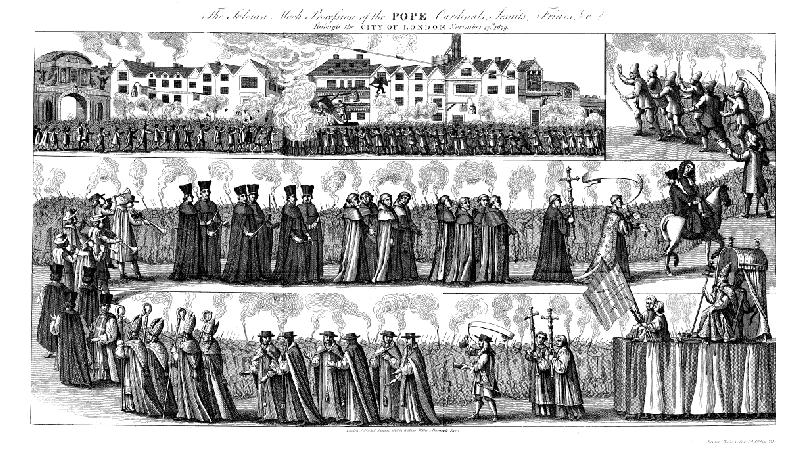
The burning a Pope in effigy, was a ceremony performed upon the anniversary of queen Elizabeth's coronation. When parties ran high betwixt the courtiers and opposition, in the latter part of Charles the II. reign, these anti-papal solemnities were conducted by the latter, with great state and expence, and employed as engines to excite the popular resentment against the duke of York, and his religion. The following curious 223 Footnote: description of one of these tumultuary processions, in 1679, was extracted by Ralph, from a very scarce pamphlet; it is the ceremony referred to in the epilogue; and it shall be given at length, as the subject is frequently alluded to by Dryden. The Solemn Mock Procession of the POPE, Cardinals, Friars, &c. Through the CITY OF LONDON November 17.th 1679. "On the said 17th of November, 1679, the bells, generally, about the town, began to ring at three o'clock in the morning. At the approach of the evening, (all things being in readiness) the solemn procession began, setting forth from Moregate, and so passed, first to Aldgate, and thence through Leadenhall-street, by the Royal Exchange, through Cheapside, and so to Temple-bar in the ensuing order, viz. "Came six whifflers, to clear the way, in pioneer caps, and red waistcoats. "A bellman ringing, and with a loud (but doleful) voice, crying out all the way, remember Justice Godfrey. "A dead body, representing justice Godfrey, in a decent black habit, carried before a jesuit, in black, on horse-back, in like manner as he was carried by the assassins to Primrose Hill. "Next after Sir Edmonbury, so mounted, came a priest in a surplice, with a cope embroidered with dead bones, skeletons, skulls, and the like, giving pardons very plentifully to all those who should murder protestants; and proclaiming it meritorious. "Then a priest in black alone, with a great silver cross. "Four carmelites, in white and black habits. "Four grey-friars, in the proper habits of their order. "Six jesuits, with bloody daggers. "A concert of wind music. "Four bishops, in purple, and lawn sleeves, with a golden crosier on their breast, and crosier-staves in their hands. "Four other bishops, in Pontificalibus, with surplices, and rich embroidered copes, and golden mitres on their heads. "Six cardinals, in scarlet robes and caps. "The Pope's doctor, i.e. Wakeman,[a] with jesuits-powder in one hand, and an urinal in the other. "Two priests in surplices, with two golden crosses. "Lastly, The Pope, in a lofty, glorious pageant, representing a chair of state, covered with scarlet, richly embroidered and fringed, and bedecked with golden balls and crosses: At his feet a cushion of state, and two boys in surplices with white silk banners, and bloody crucifixes and daggers with an incense pot before them, censing his holiness, who was arrayed in a splendid scarlet gown, lined through with ermin, and richly daubed with gold and silver lace; on his head a triple crown of gold, and a glorious collar of gold and precious stones, St Peter's keys, a number of beads, agnus deis, and other catholic trumpery. At his back, his holiness's privy counsellor, the degraded Seraphim, (anglice the devil,) frequently caressing, hugging, and whispering him, and oft times instructing him aloud to destroy his majesty, to forge a protestant plot, and to fire the city again, to which purpose he held an infernal torch in his hand. 224 "The whole procession was attended with 150 flambeaux and lights, by order; but so many more came in volunteers, as made up some thousands. "Never were the balconies, windows, and houses more numerously lined, or the streets closer throng'd with multitudes of people, all expressing their abhorrence of Popery, with continual shouts and exclamations; so that 'tis modestly computed, that, in the whole progress, there could not be fewer than two hundred thousand spectators. "Thus with a slow, and solemn state, they proceeded to Temple Bar; where with innumerable swarms, the houses seemed to be converted into heaps of men, and women, and children, for whose diversion there were provided great variety of excellent fireworks. "Temple Bar being, since its rebuilding, adorned with four stately statues, viz. those of Queen Elizabeth and King James, on the inward, or eastern side, fronting the city; and those of King Charles the I. of blessed memory, and our present gracious sovereign, (whom God, in mercy to these nations, long preserve!) on the outside, facing towards Westminster; and the statue of Queen Elizabeth in regard to the day, having on a crown of gilded laurel, and in her hand a golden shield, with this motto inscribed: The Protestant Religion, and Magna Charta, and flambeaux placed before it. The Pope being brought up near thereunto, the following song, alluding to the posture of those statues, was sung in parts, between one representing the English Cardinal (Howard)[b] and others acting the people: CARDINAL NORFOLK. From York to London town we come, To talk of Popish ire, To reconcile you all to Rome, And prevent Smithfield fire. PLEBEIANS. Cease, cease, thou Norfolk Cardinal, See yonder stands Queen Bess; Who sav'd our souls from Popish thrall: O Queen Bess, Queen Bess, Queen Bess! Your Popish plot, and Smithfield threat, We do not fear at all; For lo! beneath Queen Bess's feet, You fall, you fall, you fall. "'Tis true, our King's on t'other side, A looking tow'rds Whitehall: But could we bring him round about; He'd counterplot you all. 225 "Then down with James, and set up Charles, On good Queen Bess's side; That all true Commons, Lords, and Earls, May wish him a fruitfull bride." Now God preserve great Charles our King, And eke all honest men; And traitors all to justice bring: Amen, Amen, Amen. "Then having entertained the thronging spectators for some time, with the ingenious fireworks, a vast bonfire being prepared, just over against the inner temple gate, his holiness, after some compliments and reluctancies, was decently toppled from all his grandeur, into the impartial flames; the crafty devil leaving his infallibilityship in the lurch, and laughing as heartily at his deserved ignominious end, as subtle jesuits do at the ruin of bigotted Lay Catholics, whom themselves have drawn in; or, as credulous Coleman's abettors did, when, with pretences of a reprieve at last gasp, they had made him vomit up his soul with a lye, and sealed his dangerous chops with a halter. This justice was attended with a prodigious shout, that might be heard far beyond Somerset-house; and 'twas believed the echo, by continued reverberations, before it ceased, reached Scotland, (the Duke was then there;) France, and even Rome, itself, damping them all with a dreadfull astonishment." From a very rare broadside, in the collection made by Narcissus Luttrell. Footnotes: Sir George Wakeman was physician to the queen, and a catholic. He was tried for the memorable Popish plot and acquitted, the credit of the witnesses being now blasted, by the dying declarations of those who suffered. Philip, the 3d son of Henry Earl of Arundel, and brother to the Duke of Norfolk, created a Cardinal in 1675. He was a second cousin of Lady Elizabeth Howard, afterwards the wife of our poet.
226
[Blank Page]
227