Volume 4 — An Essay Towards A New Theory Of Vision
Reading edition
1. My design is to shew the manner wherein we perceive by Sight the Distance, Magnitude, and Situation of objects: also to consider the difference there is betwixt the ideas of Sight and Touch, and whether there be any idea common to both senses286.
2. It is, I think, agreed by all that Distance, of itself and immediately, cannot be seen287. For, distance288 being a line directed endwise to the eye, it projects only one point in the fund of the eye, which point remains invariably the same, whether the distance be longer or shorter289.
[pg 128]
3. I find it also acknowledged that the estimate we make of the distance of objects considerably remote is rather an act of judgment grounded on experience than of sense. For example, when I perceive a great number of intermediate objects, such as houses, fields, rivers, and the like, which I have experienced to take up a considerable space, I thence form a judgment or conclusion, that the object I see beyond them is at a great distance. Again, when an object appears faint and small which at a near distance I have experienced to make a vigorous and large appearance, I instantly conclude it to be far off290. And this, it is evident, is the result of experience; without which, from the faintness and littleness, I should not have inferred anything concerning the distance of objects.
4. But, when an object is placed at so near a distance as that the interval between the eyes bears any sensible proportion to it291, the opinion of speculative men is, that the two optic axes (the fancy that we see only with one eye at once being exploded), concurring at the object, do there make an angle, by means of which, according as it is greater or lesser, the object is perceived to be nearer or farther off292.
5. Betwixt which and the foregoing manner of estimating distance there is this remarkable difference:—that, whereas there was no apparent necessary connexion between small distance and a large and strong appearance, or between great distance and a little and faint appearance, there [pg 129] appears a very necessary connexion between an obtuse angle and near distance, and an acute angle and farther distance. It does not in the least depend upon experience, but may be evidently known by any one before he had experienced it, that the nearer the concurrence of the optic axes the greater the angle, and the remoter their concurrence is, the lesser will be the angle comprehended by them.
6. There is another way, mentioned by optic writers, whereby they will have us judge of those distances in respect of which the breadth of the pupil hath any sensible bigness. And that is the greater or lesser divergency of the rays which, issuing from the visible point, do fall on the pupil—that point being judged nearest which is seen by most diverging rays, and that remoter which is seen by less diverging rays, and so on; the apparent distance still increasing, as the divergency of the rays decreases, till at length it becomes infinite, when the rays that fall on the pupil are to sense parallel. And after this manner it is said we perceive distance when we look only with one eye.
7. In this case also it is plain we are not beholden to experience: it being a certain necessary truth that, the nearer the direct rays falling on the eye approach to a parallelism, the farther off is the point of their intersection, or the visible point from whence they flow.
8. 293Now, though the accounts here given of perceiving near distance by sight are received for true, and accordingly made use of in determining the apparent places of objects, they do nevertheless seem to me very unsatisfactory, and that for these following reasons:—
9. [First294,] It is evident that, when the mind perceives any idea not immediately and of itself, it must be by the means of some other idea. Thus, for instance, the passions which are in the mind of another are of themselves to me invisible. I may nevertheless perceive them [pg 130] by sight; though not immediately, yet by means of the colours they produce in the countenance. We often see shame or fear in the looks of a man, by perceiving the changes of his countenance to red or pale.
10. Moreover, it is evident that no idea which is not itself perceived can be to me the means of perceiving any other idea. If I do not perceive the redness or paleness of a man's face themselves, it is impossible I should perceive by them the passions which are in his mind.
11. Now, from sect. ii., it is plain that distance is in its own nature imperceptible, and yet it is perceived by sight295. It remains, therefore, that it be brought into view by means of some other idea, that is itself immediately perceived in the act of vision.
12. But those lines and angles, by means whereof some men296 pretend to explain the perception297 of distance, are themselves not at all perceived; nor are they in truth ever thought of by those unskilful in optics. I appeal to any one's experience, whether, upon sight of an object, he computes its distance by the bigness of the angle made by the meeting of the two optic axes? or whether he ever thinks of the greater or lesser divergency of the rays which arrive from any point to his pupil? nay, whether it be not perfectly impossible for him to perceive by sense the various angles wherewith the rays, according to their greater or lesser divergence, do fall on the eye? Every one is himself the best judge of what he perceives, and what not. In vain shall any man298 tell me, that I perceive certain lines and angles, which introduce into my mind the various ideas of distance, so long as I myself am conscious of no such thing.
13. Since therefore those angles and lines are not themselves [pg 131] perceived by sight, it follows, from sect. x., that the mind does not by them judge of the distance of objects.
14. [Secondly299,] The truth of this assertion will be yet farther evident to any one that considers those lines and angles have no real existence in nature, being only an hypothesis framed by the mathematicians, and by them introduced into optics, that they might treat of that science in a geometrical way.
15. The [third and300] last reason I shall give for rejecting that doctrine is, that though we should grant the real existence of those optic angles, &c., and that it was possible for the mind to perceive them, yet these principles would not be found sufficient to explain the phenomena of distance, as shall be shewn hereafter.
16. Now it being already shewn301 that distance is suggested302 to the mind, by the mediation of some other idea which is itself perceived in the act of seeing, it remains that we inquire, what ideas or sensations there be that attend vision, unto which we may suppose the ideas of distance are connected, and by which they are introduced into the mind.
And, first, it is certain by experience, that when we look at a near object with both eyes, according as it approaches or recedes from us, we alter the disposition of our eyes, by lessening or widening the interval between the pupils. This disposition or turn of the eyes is attended with a sensation303, which seems to me to be that which in this case brings the idea of greater or lesser distance into the mind.
[pg 132]
17. Not that there is any natural or necessary304 connexion between the sensation we perceive by the turn of the eyes and greater or lesser distance. But—because the mind has, by constant experience, found the different sensations corresponding to the different dispositions of the eyes to be attended each with a different degree of distance in the object—there has grown an habitual or customary connexion between those two sorts of ideas: so that the mind no sooner perceives the sensation arising from the different turn it gives the eyes, in order to bring the pupils nearer or farther asunder, but it withal perceives the different idea of distance which was wont to be connected with that sensation. Just as, upon hearing a certain sound, the idea is immediately suggested to the understanding which custom had united with it305.
18. Nor do I see how I can easily be mistaken in this matter. I know evidently that distance is not perceived of itself306; that, by consequence, it must be perceived by means of some other idea, which is immediately perceived, and varies with the different degrees of distance. I know also that the sensation arising from the turn of the eyes is of itself immediately perceived; and various degrees thereof are connected with different distances, which never fail to accompany them into my mind, when I view an object distinctly with both eyes whose distance is so small that in respect of it the interval between the eyes has any considerable magnitude.
19. I know it is a received opinion that, by altering the disposition of the eyes, the mind perceives whether the angle of the optic axes, or the lateral angles comprehended between the interval of the eyes or the optic axes, are made greater or lesser; and that, accordingly, by a kind of natural geometry, it judges the point of their intersection to be nearer or farther off. But that this is not true I am [pg 133] convinced by my own experience; since I am not conscious that I make any such use of the perception I have by the turn of my eyes. And for me to make those judgments, and draw those conclusions from it, without knowing that I do so, seems altogether incomprehensible307.
20. From all which it follows, that the judgment we make of the distance of an object viewed with both eyes is entirely the result of experience. If we had not constantly found certain sensations, arising from the various disposition of the eyes, attended with certain degrees of distance, we should never make those sudden judgments from them concerning the distance of objects; no more than we would pretend to judge of a man's thoughts by his pronouncing words we had never heard before.
21. Secondly, an object placed at a certain distance from the eye, to which the breadth of the pupil bears a considerable proportion, being made to approach, is seen more confusedly308. And the nearer it is brought the more confused appearance it makes. And this being found constantly to be so, there arises in the mind an habitual connexion between the several degrees of confusion and distance; the greater confusion still implying the lesser distance, and the lesser confusion the greater distance of the object.
22. This confused appearance of the object doth therefore seem to be the medium whereby the mind judges of distance, in those cases wherein the most approved writers of optics will have it judge by the different divergency with which the rays flowing from the radiating point fall on the pupil309. No man, I believe, will pretend to see or feel those imaginary angles that the rays are supposed to form, according to their various inclinations on his eye. But he cannot choose seeing whether the object appear more or less confused. It is therefore a manifest consequence from what has been demonstrated that, instead of the greater or lesser divergency of the rays, the mind makes use of the [pg 134] greater or lesser confusedness of the appearance, thereby to determine the apparent place of an object.
23. Nor doth it avail to say there is not any necessary connexion between confused vision and distance great or small. For I ask any man what necessary connexion he sees between the redness of a blush and shame? And yet no sooner shall he behold that colour to arise in the face of another but it brings into his mind the idea of that passion which hath been observed to accompany it.
24. What seems to have misled the writers of optics in this matter is, that they imagine men judge of distance as they do of a conclusion in mathematics; betwixt which and the premises it is indeed absolutely requisite there be an apparent necessary connexion. But it is far otherwise in the sudden judgments men make of distance. We are not to think that brutes and children, or even grown reasonable men, whenever they perceive an object to approach or depart from them, do it by virtue of geometry and demonstration.
25. That one idea may suggest another to the mind, it will suffice that they have been observed to go together, without any demonstration of the necessity of their coexistence, or without so much as knowing what it is that makes them so to coexist. Of this there are innumerable instances, of which no one can be ignorant310.
26. Thus, greater confusion having been constantly attended with nearer distance, no sooner is the former idea perceived but it suggests the latter to our thoughts. And, if it had been the ordinary course of nature that the farther off an object were placed the more confused it should appear, it is certain the very same perception that now makes us think an object approaches would then have made us to imagine it went farther off; that perception, abstracting from custom and experience, being equally fitted to produce the idea of great distance, or small distance, or no distance at all.
27. Thirdly, an object being placed at the distance above specified, and brought nearer to the eye, we may nevertheless prevent, at least for some time, the appearance's [pg 135] growing more confused, by straining the eye311. In which case that sensation supplies the place of confused vision, in aiding the mind to judge of the distance of the object; it being esteemed so much the nearer by how much the effort or straining of the eye in order to distinct vision is greater.
28. I have here312 set down those sensations or ideas313 that seem to be the constant and general occasions of introducing into the mind the different ideas of near distance. It is true, in most cases, that divers other circumstances contribute to frame our idea of distance, viz. the particular number, size, kind, &c. of the things seen. Concerning which, as well as all other the forementioned occasions which suggest distance, I shall only observe, they have none of them, in their own nature, any relation or connexion with it: nor is it possible they should ever signify the various degrees thereof, otherwise than as by experience they have been found to be connected with them.
29. I shall proceed upon these principles to account for a phenomenon which has hitherto strangely puzzled the writers of optics, and is so far from being accounted for by any of their theories of vision, that it is, by their own confession, plainly repugnant to them; and of consequence, if nothing else could be objected, were alone sufficient to bring their credit in question. The whole difficulty I shall lay before you in the words of the learned Doctor Barrow, with which he concludes his Optic Lectures314:—
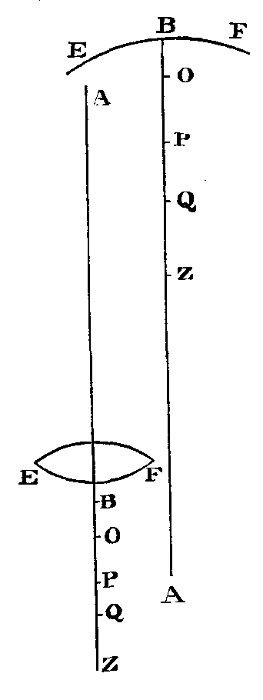
“Hæc sunt, quæ circa partem opticæ præcipue mathematicam dicenda mihi suggessit meditatio. Circa reliquas (quæ φυσικώτεραι sunt, adeoque sæpiuscule pro certis principiis plausibiles conjecturas venditare necessum habent) nihil fere quicquam admodum verisimile succurrit, [pg 136]a pervulgatis (ab iis, inquam, quæ Keplerus, Scheinerus315, Cartesius, et post illos alii tradiderunt) alienum aut diversum. Atqui tacere malo, quam toties oblatam cramben reponere. Proinde receptui cano; nee ita tamen ut prorsus discedam, anteaquam improbam quandam difficultatem (pro sinceritate quam et vobis et veritati debeo minime dissimulandam) in medium protulero, quæ doctrinæ nostræ, hactenus inculcatæ, se objicit adversam, ab ea saltem nullam admittit solutionem. Illa, breviter, talis est. Lenti vel speculo cavo EBF exponatur punctum visibile A, ita distans, ut radii ex A manantes ex inflectione versus axem AB cogantur. Sitque radiationis limes (seu puncti A imago, qualem supra passim statuimus) punctum Z. Inter hoc autem et inflectentis verticem Buspiam positus concipiatur oculus. Quæri jam potest, ubi loci debeat punctum A apparere? Retrorsum ad punctum Z videri non fert natura (cum omnis impressio sensum afficiens proveniat a partibus A) ac experientia reclamat. Nostris autem e placitis consequi videtur, ipsum ad partes anticas apparens, ab intervallo longissime dissito (quod et maximum sensibile quodvis intervallum quodammodo exsuperet), apparere. Cum enim quo radiis minus divergentibus attingitur objectum, eo (seclusis utique prænotionibus et præjudiciis) longius abesse sentiatur; et quod parallelos ad oculum radios projicit, remotissime positum æstimetur: exigere ratio videtur, ut quod convergentibus radiis apprehenditur, adhuc magis, si fieri posset, quoad apparentiam elongetur. Quin et circa casum hunc generatim inquiri possit, quidnam omnino sit, quod apparentem puncti A locum determinet, faciatque quod constanti ratione nunc propius, nunc remotius appareat? Cui itidem dubio nihil quicquam ex hactenus dictorum analogia responderi posse videtur, nisi [pg 137]debere punctum A perpetuo longissime semotum videri. Verum experientia secus attestatur, illud pro diversa oculi inter puncta B, Z, positione varie distans, nunquam fere (si unquam) longinquius ipso A libere spectato, subinde vero multo propinquius adparere; quinimo, quo oculum appellentes radii magis convergunt, eo speciem objecti propius accedere. Nempe, si puncto B admoveatur oculus, suo (ad lentem) fere nativo in loco conspicitur punctum A (vel æque distans, ad speculum); ad O reductus oculus ejusce speciem appropinquantem cernit; ad P adhuc vicinius ipsum existimat; ac ita sensim, donec alicubi tandem, velut ad Q, constituto oculo, objectum summe propinquum apparens in meram confusionem incipiat evanescere. Quæ sane cuncta rationibus atque decretis nostris repugnare videntur, aut cum iis saltem parum amice conspirant. Neque nostram tantum sententiam pulsat hoc experimentum, at ex æquo cæteras quas norim omnes: veterem imprimis ac vulgatam, nostræ præ reliquis affinem, ita convellere videtur, ut ejus vi coactus doctissimus A. Tacquetus isti principio (cui pene soli totam inædificaverat Catoptricam suam) ceu infido ac inconstanti renunciarit, adeoque suam ipse doctrinam labefactarit? id tamen, opinor, minime facturus, si rem totam inspexissit penitius, atque difficultatis fundum attigissit. Apud me vero non ita pollet hæc, nec eousque præpollebit ulla difficultas, ut ab iis quæ manifeste rationi consentanea video, discedam; præsertim quum, ut his accidit, ejusmodi difficultas in singularis cujuspiam casus disparitate fundetur. Nimirum in præsente casu peculiare quiddam, naturæ subtilitati involutum, delitescit, ægre fortassis, nisi perfectius explorato videndi modo, detegendum. Circa quod nil, fateor, hactenus excogitare potui, quod adblandiretur animo meo, nedum plane satisfaceret. Vobis itaque nodum hunc, utinam feliciore conatu, resolvendum committo.”
In English as follows:
“I have here delivered what my thoughts have suggested to me concerning that part of optics which is more properly mathematical. As for the other parts of that science (which, being rather physical, do consequently abound with plausible conjectures instead of certain principles), there has in them scarce anything occurred to my observation [pg 138]different from what has been already said by Kepler, Scheinerus, Des Cartes, &c. And methinks I had better say nothing at all than repeat that which has been so often said by others. I think it therefore high time to take my leave of this subject. But, before I quit it for good and all, the fair and ingenuous dealing that I owe both to you and to truth obliges me to acquaint you with a certain untoward difficulty, which seems directly opposite to the doctrine I have been hitherto inculcating, at least admits of no solution from it. In short it is this. Before the double convex glass or concave speculum EBF, let the point A be placed at such a distance that the rays proceeding from A, after refraction or reflection, be brought to unite somewhere in the axis AB. And suppose the point of union (i.e. the image of the point A, as hath been already set forth) to be Z; between which and B, the vertex of the glass or speculum, conceive the eye to be anywhere placed. The question now is, where the point A ought to appear. Experience shews that it doth not appear behind at the point Z; and it were contrary to nature that it should; since all the impression which affects the sense comes from towards A. But, from our tenets it should seem to follow that it would appear before the eye at a vast distance off, so great as should in some sort surpass all sensible distance. For since, if we exclude all anticipations and prejudices, every object appears by so much the farther off by how much the rays it sends to the eye are less diverging; and that object is thought to be most remote from which parallel rays proceed unto the eye; reason would make one think that object should appear at yet a greater distance which is seen by converging rays. Moreover, it may in general be asked concerning this case, what it is that determines the apparent place of the point A, and maketh it to appear after a constant manner, sometimes nearer, at [pg 139]other times farther off? To which doubt I see nothing that can be answered agreeable to the principles we have laid down, except only that the point A ought always to appear extremely remote. But, on the contrary, we are assured by experience, that the point A appears variously distant, according to the different situations of the eye between the points B and Z. And that it doth almost never (if at all) seem farther off than it would if it were beheld by the naked eye; but, on the contrary, it doth sometimes appear much nearer. Nay, it is even certain that by how much the rays falling on the eye do more converge, by so much the nearer does the object seem to approach. For, the eye being placed close to the point B, the object A appears nearly in its own natural place, if the point B is taken in the glass, or at the same distance, if in the speculum. The eye being brought back to O, the object seems to draw near; and, being come to P, it beholds it still nearer: and so on by little and little, till at length the eye being placed somewhere, suppose at Q, the object appearing extremely near begins to vanish into mere confusion. All which doth seem repugnant to our principles; at least, not rightly to agree with them. Nor is our tenet alone struck at by this experiment, but likewise all others that ever came to my knowledge are every whit as much endangered by it. The ancient one especially (which is most commonly received, and comes nearest to mine) seems to be so effectually overthrown thereby that the most learned Tacquet has been forced to reject that principle, as false and uncertain, on which alone he had built almost his whole Catoptrics, and consequently, by taking away the foundation, hath himself pulled down the superstructure he had raised on it. Which, nevertheless, I do not believe he would have done, had he but considered the whole matter more thoroughly, and examined the difficulty to the bottom. But as for me, neither this nor any other difficulty shall have so great an influence on me, as to make me renounce that which I know to be manifestly agreeable to reason. Especially when, as it here falls out, the difficulty is founded in the peculiar nature of a certain odd and particular case. For, in the present case something peculiar lies hid, which, being involved in the subtilty of nature, will perhaps hardly be discovered till such time [pg 140]as the manner of vision is more perfectly made known. Concerning which, I must own I have hitherto been able to find out nothing that has the least show of probability, not to mention certainty. I shall therefore leave this knot to be untied by you, wishing you may have better success in it than I have had.”
30. The ancient and received principle, which Dr. Barrow here mentions as the main foundation of Tacquet's316 Catoptrics, is, that every “visible point seen by reflection from a speculum shall appear placed at the intersection of the reflected ray and the perpendicular of incidence.” Which intersection in the present case happening to be behind the eye, it greatly shakes the authority of that principle whereon the aforementioned author proceeds throughout his whole Catoptrics, in determining the apparent place of objects seen by reflection from any kind of speculum.
31. Let us now see how this phenomenon agrees with our tenets317. The eye, the nearer it is placed to the point B in the above figures, the more distinct is the appearance of the object: but, as it recedes to O, the appearance grows more confused; and at P it sees the object yet more confused; and so on, till the eye, being brought back to Z, sees the object in the greatest confusion of all. Wherefore, by sect. 21, the object should seem to approach the eye gradually, as it recedes from the point B; that is, at O it should (in consequence of the principle I have laid down in the aforesaid section) seem nearer than it did at B, and at P nearer than at O, and at Q nearer than at P, and so on, till it quite vanishes at Z. Which is the very matter of fact, as any one that pleases may easily satisfy himself by experiment.
32. This case is much the same as if we should suppose an Englishman to meet a foreigner who used the same words with the English, but in a direct contrary [pg 141] signification. The Englishman would not fail to make a wrong judgment of the ideas annexed to those sounds, in the mind of him that used them. Just so in the present case, the object speaks (if I may so say) with words that the eye is well acquainted with, that is, confusions of appearance; but, whereas heretofore the greatest confusions were always wont to signify nearer distances, they have in this case a direct contrary signification, being connected with the greater distances. Whence it follows that the eye must unavoidably be mistaken, since it will take the confusions in the sense it has been used to, which is directly opposed to the true.
33. This phenomenon, as it entirely subverts the opinion of those who will have us judge of distance by lines and angles, on which supposition it is altogether inexplicable, so it seems to me no small confirmation of the truth of that principle whereby it is explained318. But, in order to a more full explication of this point, and to shew how far the hypothesis of the mind's judging by the various divergency of rays may be of use in determining the apparent place of an object, it will be necessary to premise some few things, which are already well known to those who have any skill in Dioptrics.
34. First, Any radiating point is then distinctly seen when the rays proceeding from it are, by the refractive power of the crystalline, accurately reunited in the retina or fund of the eye. But if they are reunited either before they arrive at the retina, or after they have passed it, then there is confused vision.
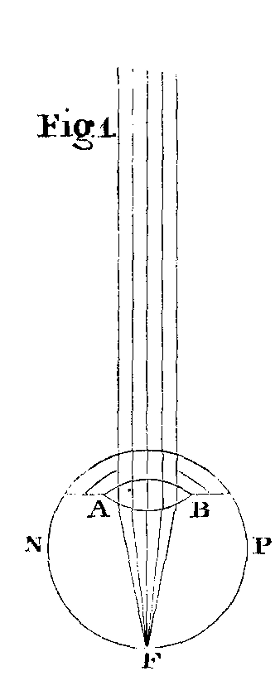
Figure 1
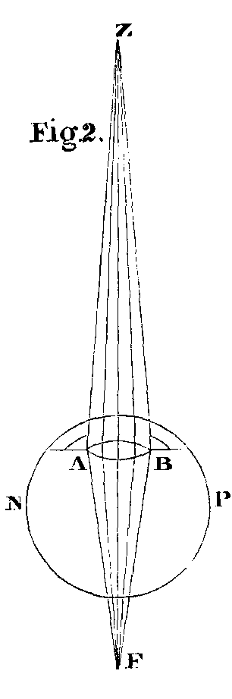
Figure 2
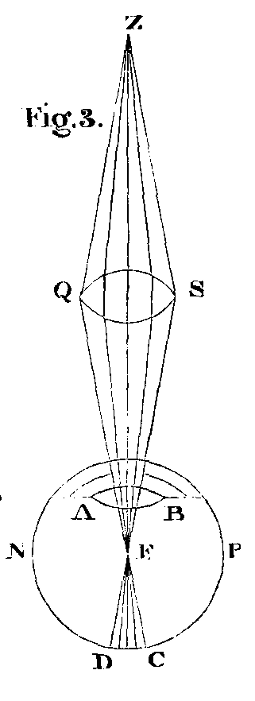
Figure 3
35. Secondly, Suppose, in the adjacent figures, NP represent an eye duly framed, and retaining its natural figure. In fig. 1 the rays falling nearly parallel on the eye, are, by the crystalline AB, refracted, so as their focus, or point of union F, falls exactly on the retina. But, if the rays fall sensibly diverging on the eye, as in fig. 2, then their focus falls beyond the retina; or, if the rays are made to converge by the lens QS, before they come at the eye, as in fig. 3, their focus F will fall before the retina. In which two last cases it is [pg 142] evident, from the foregoing section, that the appearance of the point Z is confused. And, by how much the greater is the convergency or divergency of the rays falling on the pupil, by so much the farther will the point of their reunion be from the retina, either before or behind it, and consequently the point Z will appear by so much the more confused. And this, by the bye, may shew us the difference between confused and faint vision. Confused vision is, when the rays proceeding from each distinct point of the object are not accurately re-collected in one corresponding point on the retina, but take up some space thereon—so that rays from different points become mixed and confused together. This is opposed to a distinct vision, and attends near objects. Faint vision is when, by reason of the distance of the object, or grossness of the interjacent medium, few rays arrive from the object to the eye. [pg 143] This is opposed to vigorous or clear vision, and attends remote objects. But to return.
36. The eye, or (to speak truly) the mind, perceiving only the confusion itself, without ever considering the cause from which it proceeds, doth constantly annex the same degree of distance to the same degree of confusion. Whether that confusion be occasioned by converging or by diverging rays it matters not. Whence it follows that the eye, viewing the object Z through the glass QS (which by refraction causeth the rays ZQ, ZS, &c. to converge), should judge it to be at such a nearness, at which, if it were placed, it would radiate on the eye, with rays diverging to that degree as would produce the same confusion which is now produced by converging rays, i.e. would cover a portion of the retina equal to DC. (Vid. fig. 3, sup.) But then this must be understood (to use Dr. Barrow's phrase) “seclusis prænotionibus et præjudiciis,” in case we abstract from all other circumstances of vision, such as the figure, size, faintness, &c. of the visible objects—all which do ordinarily concur to form our idea of distance, the mind having, by frequent experience, observed their several sorts or degrees to be connected with various distances.
37. It plainly follows from what has been said, that a person perfectly purblind (i.e. that could not see an object distinctly but when placed close to his eye) would not make the same wrong judgment that others do in the forementioned case. For, to him, greater confusions constantly suggesting greater distances, he must, as he recedes from the glass, and the object grows more confused, judge it to be at a farther distance; contrary to what they do who have had the perception of the objects growing more confused connected with the idea of approach.
38. Hence also it doth appear, there may be good use of computation, by lines and angles, in optics319; not that the mind judges of distance immediately by them, but because it judges by somewhat which is connected with them, and to the determination whereof they may be subservient. Thus, the mind judging of the distance [pg 144] of an object by the confusedness of its appearance, and this confusedness being greater or lesser to the naked eye, according as the object is seen by rays more or less diverging, it follows that a man may make use of the divergency of the rays, in computing the apparent distance, though not for its own sake, yet on account of the confusion with which it is connected. But so it is, the confusion itself is entirely neglected by mathematicians, as having no necessary relation with distance, such as the greater or lesser angles of divergency are conceived to have. And these (especially for that they fall under mathematical computation) are alone regarded, in determining the apparent places of objects, as though they were the sole and immediate cause of the judgments the mind makes of distance. Whereas, in truth, they should not at all be regarded in themselves, or any otherwise than as they are supposed to be the cause of confused vision.
39. The not considering of this has been a fundamental and perplexing oversight. For proof whereof, we need go no farther than the case before us. It having been observed that the most diverging rays brought into the mind the idea of nearest distance, and that still as the divergency decreased the distance increased, and it being thought the connexion between the various degrees of divergency and distance was immediate—this naturally leads one to conclude, from an ill-grounded analogy, that converging rays shall make an object appear at an immense distance, and that, as the convergency increases, the distance (if it were possible) should do so likewise. That this was the cause of Dr. Barrow's mistake is evident from his own words which we have quoted. Whereas had the learned Doctor observed that diverging and converging rays, how opposite soever they may seem, do nevertheless agree in producing the same effect, to wit, confusedness of vision, greater degrees whereof are produced indifferently, either as the divergency or convergency of the rays increaseth; and that it is by this effect, which is the same in both, that either the divergency or convergency is perceived by the eye—I say, had he but considered this, it is certain he would have made a quite contrary judgment, and rightly concluded [pg 145] that those rays which fall on the eye with greater degrees of convergency should make the object from whence they proceed appear by so much the nearer. But it is plain it was impossible for any man to attain to a right notion of this matter so long as he had regard only to lines and angles, and did not apprehend the true nature of vision, and how far it was of mathematical consideration.
40. Before we dismiss this subject, it is fit we take notice of a query relating thereto, proposed by the ingenious Mr. Molyneux, in his Treatise of Dioptrics (par. i. prop. 31. sect. 9), where, speaking of the difficulty we have been explaining, he has these words: “And so he (i.e. Dr. Barrow) leaves this difficulty to the solution of others, which I (after so great an example) shall do likewise; but with the resolution of the same admirable author, of not quitting the evident doctrine which we have before laid down, for determining the locus objecti, on account of being pressed by one difficulty, which seems inexplicable till a more intimate knowledge of the visive faculty be obtained by mortals. In the meantime I propose it to the consideration of the ingenious, whether the locus apparens of an object placed as in this ninth section be not as much before the eye as the distinct base is behind the eye?” To which query we may venture to answer in the negative. For, in the present case, the rule for determining the distance of the distinct base, or respective focus from the glass is this: As the difference between the distance of the object and focus is to the focus or focal length, so the distance of the object from the glass is to the distance of the respective focus or distinct base from the glass. (Molyneux, Dioptr., par. i. prop. 5.) Let us now suppose the object to be placed at the distance of the focal length, and one-half of the focal length from the glass, and the eye close to the glass. Hence it will follow, by the rule, that the distance of the distinct base behind the eye is double the true distance of the object before the eye. If, therefore, Mr. Molyneux's conjecture held good, it would follow that the eye should see the object twice as far off as it really is; and in other cases at three or four times its due distance, or more. But this manifestly contradicts experience, the object never appearing, at farthest, beyond its due distance. Whatever, therefore, is built on this supposition [pg 146] (vid. corol. i. prop. 57. ibid.) comes to the ground along with it.
41. From what hath been premised, it is a manifest consequence, that a man born blind, being made to see, would at first have no idea of distance by sight: the sun and stars, the remotest objects as well as the nearer, would all seem to be in his eye, or rather in his mind. The objects intromitted by sight would seem to him (as in truth they are) no other than a new set of thoughts or sensations, each whereof is as near to him as the perceptions of pain or pleasure, or the most inward passions of his soul. For, our judging objects perceived by sight to be at any distance, or without the mind, is (vid. sect, xxviii.) entirely the effect of experience; which one in those circumstances could not yet have attained to320.
42. It is indeed otherwise upon the common supposition—that men judge of distance by the angle of the optic axes, just as one in the dark, or a blind man by the angle comprehended by two sticks, one whereof he held in each hand321. For, if this were true, it would follow that one blind from his birth, being made to see, should stand in need of no new experience, in order to perceive distance by sight. But that this is false has, I think, been sufficiently demonstrated.
43. And perhaps, upon a strict inquiry, we shall not find that even those who from their birth have grown up in a continued habit of seeing are irrecoverably prejudiced on the other side, to wit, in thinking what they see to be at a distance from them. For, at this time it seems agreed on all hands, by those who have had any thoughts of that matter, that colours, which are the proper and immediate object of sight, are not without the mind.—But then, it will be said, by sight we have also the ideas of extension, and figure, and motion; all which may well be thought without and at some distance from the mind, though colour should [pg 147] not. In answer to this, I appeal to any man's experience, whether the visible extension of any object do not appear as near to him as the colour of that object; nay, whether they do not both seem to be in the very same place. Is not the extension we see coloured, and is it possible for us, so much as in thought, to separate and abstract colour from extension? Now, where the extension is, there surely is the figure, and there the motion too. I speak of those which are perceived by sight322.
44. But for a fuller explication of this point, and to shew that the immediate objects of sight are not so much as the ideas or resemblances of things placed at a distance, it is requisite that we look nearer into the matter, and carefully observe what is meant in common discourse when one says, that which he sees is at a distance from him. Suppose, for example, that looking at the moon I should say it were fifty or sixty semidiameters of the earth distant from me. Let us see what moon this is spoken of. It is plain it cannot be the visible moon, or anything like the visible moon, or that which I see—which is only a round luminous plain, of about thirty visible points in diameter. For, in case I am carried from the place where I stand directly towards the moon, it is manifest the object varies still as I go on; and, by the time that I am advanced fifty or sixty semidiameters of the earth, I shall be so far from being near a small, round, luminous flat that I shall perceive nothing like it—this object having long since disappeared, and, if I would recover it, it must be by going back to the earth from whence I set out323. Again, suppose I perceive by sight the faint and obscure idea of something, which I doubt whether it be a man, or a tree, or a tower, but [pg 148] judge it to be at the distance of about a mile. It is plain I cannot mean that what I see is a mile off, or that it is the image or likeness of anything which is a mile off; since that every step I take towards it the appearance alters, and from being obscure, small, and faint, grows clear, large, and vigorous. And when I come to the mile's end, that which I saw first is quite lost, neither do I find anything in the likeness of it324.
45. In these and the like instances, the truth of the matter, I find, stands thus:—Having of a long time experienced certain ideas perceivable by touch325—as distance, tangible figure, and solidity—to have been connected with certain ideas of sight, I do, upon perceiving these ideas of sight, forthwith conclude what tangible ideas are, by the wonted ordinary course of nature, like to follow. Looking at an object, I perceive a certain visible figure and colour, with some degree of faintness and other circumstances, which, from what I have formerly observed, determine me to think that if I advance forward so many paces, miles, &c., I shall be affected with such and such ideas of touch. So that, in truth and strictness of speech, I neither see distance itself, nor anything that I take to be at a distance. I say, neither distance nor things placed at a distance are themselves, or their ideas, truly perceived by sight. This I am persuaded of, as to what concerns myself. And I believe whoever will look narrowly into his own thoughts, and examine what he means by saying he sees this or that thing at a distance, will agree with me, that what he sees [pg 149] only suggests to his understanding that, after having passed a certain distance, to be measured by the motion of his body, which is perceivable by touch326, he shall come to perceive such and such tangible ideas, which have been usually connected with such and such visible ideas. But, that one might be deceived by these suggestions of sense, and that there is no necessary connexion between visible and tangible ideas suggested by them, we need go no farther than the next looking-glass or picture to be convinced. Note that, when I speak of tangible ideas, I take the word idea for any the immediate object of sense, or understanding—in which large signification it is commonly used by the moderns327.
46. From what we have shewn, it is a manifest consequence that the ideas of space, outness328, and things placed at a distance are not, strictly speaking, the object of sight329; they are not otherwise perceived by the eye than by the ear. Sitting in my study I hear a coach drive along the street; I look through the casement and see it; I walk out and enter into it. Thus, common speech would incline one to think I heard, saw, and touched the same thing, to wit, the coach. It is nevertheless certain the ideas intromitted by each sense are widely different, and distinct from each other; but, having been observed constantly to go together, they are spoken of as one and the same thing. By the variation of the noise, I perceive the different distances of the coach, and know that it approaches before I look out. Thus, by the ear I perceive distance just after the same manner as I do by the eye.
47. I do not nevertheless say I hear distance, in like [pg 150] manner as I say that I see it—the ideas perceived by hearing not being so apt to be confounded with the ideas of touch as those of sight are. So likewise a man is easily convinced that bodies and external things are not properly the object of hearing, but only sounds, by the mediation whereof the idea of this or that body, or distance, is suggested to his thoughts. But then one is with more difficulty brought to discern the difference there is betwixt the ideas of sight and touch330: though it be certain, a man no more sees and feels the same thing, than he hears and feels the same thing.
48. One reason of which seems to be this. It is thought a great absurdity to imagine that one and the same thing should have any more than one extension and one figure. But, the extension and figure of a body being let into the mind two ways, and that indifferently, either by sight or touch, it seems to follow that we see the same extension and the same figure which we feel.
49. But, if we take a close and accurate view of the matter, it must be acknowledged that we never see and feel one and the same object331. That which is seen is one thing, and that which is felt is another. If the visible figure and extension be not the same with the tangible figure and extension, we are not to infer that one and the same thing has divers extensions. The true consequence is that the objects of sight and touch are two distinct things332. It may perhaps require some thought rightly to conceive this distinction. And the difficulty seems not a little increased, because the combination of visible ideas hath constantly the same name as the combination of tangible ideas wherewith it is connected—which doth of necessity arise from the use and end of language333.
50. In order, therefore, to treat accurately and unconfusedly of vision, we must bear in mind that there are two sorts of objects apprehended by the eye—the one primarily and immediately, the other secondarily and by intervention of the former. Those of the first sort neither are nor appear to be without the mind, or at any distance off334. [pg 151] They may, indeed, grow greater or smaller, more confused, or more clear, or more faint. But they do not, cannot approach, [or even seem to approach 335] or recede from us. Whenever we say an object is at a distance, whenever we say it draws near, or goes farther off, we must always mean it of the latter sort, which properly belong to the touch336, and are not so truly perceived as suggested by the eye, in like manner as thoughts by the ear.
51. No sooner do we hear the words of a familiar language pronounced in our ears but the ideas corresponding thereto present themselves to our minds: in the very same instant the sound and the meaning enter the understanding: so closely are they united that it is not in our power to keep out the one except we exclude the other also. We even act in all respects as if we heard the very thoughts themselves. So likewise the secondary objects, or those which are only suggested by sight, do often more strongly affect us, and are more regarded, than the proper objects of that sense; along with which they enter into the mind, and with which they have a far more strict connexion than ideas have with words337. Hence it is we find it so difficult to discriminate between the immediate and mediate objects of sight, and are so prone to attribute to the former what belongs only to the latter. They are, as it were, most closely twisted, blended, and incorporated together. And the prejudice is confirmed and riveted in our thoughts by a long tract of time, by the use of language, and want of reflection. However, I doubt not but anyone that shall attentively consider what we have already said, and shall say upon this subject before we have done (especially if he pursue it in his own thoughts), may be able to deliver himself from that prejudice. Sure I am, it is worth some [pg 152] attention to whoever would understand the true nature of vision.
52. I have now done with Distance, and proceed to shew how it is that we perceive by sight the Magnitude of objects338. It is the opinion of some that we do it by angles, or by angles in conjunction with distance. But, neither angles nor distance being perceivable by sight339, and the things we see being in truth at no distance from us340, it follows that, as we have shewn lines and angles not to be the medium the mind makes use of in apprehending the apparent place, so neither are they the medium whereby it apprehends the apparent magnitude of objects.
53. It is well known that the same extension at a near distance shall subtend a greater angle, and at a farther distance a lesser angle. And by this principle (we are told) the mind estimates the magnitude of an object341, comparing the angle under which it is seen with its distance, and thence inferring the magnitude thereof. What inclines men to this mistake (beside the humour of making one see by geometry) is, that the same perceptions or ideas which suggest distance do also suggest magnitude. But, if we examine it, we shall find they suggest the latter as immediately as the former. I say, they do not first suggest distance and then leave it to the judgment to use that as a medium whereby to collect the magnitude; but they have as close and immediate a connexion with the magnitude as with the distance; and suggest magnitude as independently of distance, as they do distance independently of magnitude. All which will be evident to whoever considers what has been already said and what follows.
54. It has been shewn there are two sorts of objects apprehended by sight, each whereof has its distinct magnitude, or extension—the one, properly tangible, i.e. to be perceived and measured by touch, and not immediately falling under the sense of seeing; the other, properly and immediately visible, by mediation of which the former is brought in view. Each of these magnitudes are greater or [pg 153] lesser, according as they contain in them more or fewer points, they being made up of points or minimums. For, whatever may be said of extension in abstract342, it is certain sensible extension is not infinitely divisible343. There is a minimum tangibile, and a minimum visibile, beyond which sense cannot perceive. This every one's experience will inform him.
55. The magnitude of the object which exists without the mind, and is at a distance, continues always invariably the same: but, the visible object still changing as you approach to or recede from the tangible object, it hath no fixed and determinate greatness. Whenever therefore we speak of the magnitude of any thing, for instance a tree or a house, we must mean the tangible magnitude; otherwise there can be nothing steady and free from ambiguity spoken of it344. Now, though the tangible and visible magnitude do in truth belong to two distinct objects345, I shall nevertheless (especially since those objects are called by the same name, and are observed to coexist346), to avoid tediousness and singularity of speech, sometimes speak of them as belonging to one and the same thing.
56. Now, in order to discover by what means the magnitude of tangible objects is perceived by sight, I need only reflect on what passes in my own mind, and observe what those things be which introduce the ideas of greater or lesser into my thoughts when I look on any object. And these I find to be, first, the magnitude or extension of the visible object, which, being immediately perceived by sight, is connected with that other which is tangible and placed at a distance: secondly, the confusion or distinctness: and thirdly, the vigorousness or faintness of the aforesaid [pg 154] visible appearance. Cæteris paribus, by how much the greater or lesser the visible object is, by so much the greater or lesser do I conclude the tangible object to be. But, be the idea immediately perceived by sight never so large, yet, if it be withal confused, I judge the magnitude of the thing to be but small. If it be distinct and clear, I judge it greater. And, if it be faint, I apprehend it to be yet greater. What is here meant by confusion and faintness has been explained in sect. 35.
57. Moreover, the judgments we make of greatness do, in like manner as those of distance, depend on the disposition of the eye; also on the figure, number, and situation347 of intermediate objects, and other circumstances that have been observed to attend great or small tangible magnitudes. Thus, for instance, the very same quantity of visible extension which in the figure of a tower doth suggest the idea of great magnitude shall in the figure of a man suggest the idea of much smaller magnitude. That this is owing to the experience we have had of the usual bigness of a tower and a man, no one, I suppose, need be told.
58. It is also evident that confusion or faintness have no more a necessary connexion with little or great magnitude than they have with little or great distance. As they suggest the latter, so they suggest the former to our minds. And, by consequence, if it were not for experience, we should no more judge a faint or confused appearance to be connected with great or little magnitude than we should that it was connected with great or little distance.
59. Nor will it be found that great or small visible magnitude hath any necessary relation to great or small tangible magnitude—so that the one may certainly and infallibly be inferred from the other. But, before we come to the proof of this, it is fit we consider the difference there is betwixt the extension and figure which is the proper object of touch, and that other which is termed visible; and how the former is principally, though not immediately, taken notice of when we look at any object. This has been before mentioned348, but we shall here inquire into the cause thereof. We regard the objects that environ us in proportion as they are adapted to benefit or injure our own [pg 155] bodies, and thereby produce in our minds the sensations of pleasure or pain. Now, bodies operating on our organs by an immediate application, and the hurt and advantage arising therefrom depending altogether on the tangible, and not at all on the visible, qualities of any object—this is a plain reason why those should be regarded by us much more than these. And for this end [chiefly349] the visive sense seems to have been bestowed on animals, to wit, that, by the perception of visible ideas (which in themselves are not capable of affecting or anywise altering the frame of their bodies), they may be able to foresee350 (from the experience they have had what tangible ideas are connected with such and such visible ideas) the damage or benefit which is like to ensue upon the application of their own bodies to this or that body which is at a distance. Which foresight, how necessary it is to the preservation of an animal, every one's experience can inform him. Hence it is that, when we look at an object, the tangible figure and extension thereof are principally attended to; whilst there is small heed taken of the visible figure and magnitude, which, though more immediately perceived, do less sensibly affect us, and are not fitted to produce any alteration in our bodies.
60. That the matter of fact is true will be evident to any one who considers that a man placed at ten foot distance is thought as great as if he were placed at the distance only of five foot; which is true, not with relation to the visible, but tangible greatness of the object: the visible magnitude being far greater at one station than it is at the other.
61. Inches, feet, &c. are settled, stated lengths, whereby we measure objects and estimate their magnitude. We say, for example, an object appears to be six inches, or six foot long. Now, that this cannot be meant of visible inches, &c. is evident, because a visible inch is itself no constant determinate magnitude351, and cannot therefore serve to mark out and determine the magnitude of any [pg 156] other thing. Take an inch marked upon a ruler; view it successively, at the distance of half a foot, a foot, a foot and a half, &c. from the eye: at each of which, and at all the intermediate distances, the inch shall have a different visible extension, i.e. there shall be more or fewer points discerned in it. Now, I ask which of all these various extensions is that stated determinate one that is agreed on for a common measure of other magnitudes? No reason can be assigned why we should pitch on one more than another. And, except there be some invariable determinate extension fixed on to be marked by the word inch, it is plain it can be used to little purpose; and to say a thing contains this or that number of inches shall imply no more than that it is extended, without bringing any particular idea of that extension into the mind. Farther, an inch and a foot, from different distances, shall both exhibit the same visible magnitude, and yet at the same time you shall say that one seems several times greater than the other. From all which it is manifest, that the judgments we make of the magnitude of objects by sight are altogether in reference to their tangible extension. Whenever we say an object is great or small, of this or that determinate measure, I say, it must be meant of the tangible and not the visible extension352, which, though immediately perceived, is nevertheless little taken notice of.
62. Now, that there is no necessary connexion between these two distinct extensions is evident from hence—because our eyes might have been framed in such a manner as to be able to see nothing but what were less than the minimum tangibile. In which case it is not impossible we might have perceived all the immediate objects of sight the very same that we do now; but unto those visible appearances there would not be connected those different tangible magnitudes that are now. Which shews the judgments we make of the magnitude of things placed at a distance, from the various greatness of the immediate objects of sight, do not [pg 157] arise from any essential or necessary, but only a customary, tie which has been observed betwixt them.
63. Moreover, it is not only certain that any idea of sight might not have been connected with this or that idea of touch we now observe to accompany it, but also that the greater visible magnitudes might have been connected with and introduced into our minds lesser tangible magnitudes, and the lesser visible magnitudes greater tangible magnitudes. Nay, that it actually is so, we have daily experience—that object which makes a strong and large appearance not seeming near so great as another the visible magnitude whereof is much less, but more faint,353 and the appearance upper, or which is the same thing, painted lower on the retina, which faintness and situation suggest both greater magnitude and greater distance.
64. From which, and from sect. 57 and 58, it is manifest that, as we do not perceive the magnitude of objects immediately by sight, so neither do we perceive them by the mediation of anything which has a necessary connexion with them. Those ideas that now suggest unto us the various magnitudes of external objects before we touch them might possibly have suggested no such thing; or they might have signified them in a direct contrary manner, so that the very same ideas on the perception whereof we judge an object to be small might as well have served to make us conclude it great;—those ideas being in their own nature equally fitted to bring into our minds the idea of small or great, or no size at all, of outward objects354, just as the words of any language are in their own nature indifferent to signify this or that thing, or nothing at all.
65. As we see distance so we see magnitude. And we see both in the same way that we see shame or anger in the looks of a man. Those passions are themselves invisible; they are nevertheless let in by the eye along with colours and alterations of countenance which are the immediate object of vision, and which signify them for no other reason than barely because they have been observed to accompany them. Without which experience we should [pg 158] no more have taken blushing for a sign of shame than of gladness.
66. We are nevertheless exceedingly prone to imagine those things which are perceived only by the mediation of others to be themselves the immediate objects of sight, or at least to have in their own nature a fitness to be suggested by them before ever they had been experienced to coexist with them. From which prejudice every one perhaps will not find it easy to emancipate himself, by any the clearest convictions of reason. And there are some grounds to think that, if there was one only invariable and universal language in the world, and that men were born with the faculty of speaking it, it would be the opinion of some, that the ideas in other men's minds were properly perceived by the ear, or had at least a necessary and inseparable tie with the sounds that were affixed to them. All which seems to arise from want of a due application of our discerning faculty, thereby to discriminate between the ideas that are in our understandings, and consider them apart from each other; which would preserve us from confounding those that are different, and make us see what ideas do, and what do not, include or imply this or that other idea355.
67. There is a celebrated phenomenon356 the solution whereof I shall attempt to give, by the principles that have been laid down, in reference to the manner wherein we apprehend by sight the magnitude of objects.—The apparent magnitude of the moon, when placed in the horizon, is much greater than when it is in the meridian, though the angle under which the diameter of the moon is seen be not observed greater in the former case than in the latter; and [pg 159] the horizontal moon doth not constantly appear of the same bigness, but at some times seemeth far greater than at others.
68. Now, in order to explain the reason of the moon's appearing greater than ordinary in the horizon, it must be observed that the particles which compose our atmosphere do intercept the rays of light proceeding from any object to the eye; and, by how much the greater is the portion of atmosphere interjacent between the object and the eye, by so much the more are the rays intercepted, and, by consequence, the appearance of the object rendered more faint—every object appearing more vigorous or more faint in proportion as it sendeth more or fewer rays into the eye. Now, between the eye and the moon when situated in the horizon there lies a far greater quantity of atmosphere than there does when the moon is in the meridian. Whence it comes to pass, that the appearance of the horizontal moon is fainter, and therefore, by sect. 56, it should be thought bigger in that situation than in the meridian, or in any other elevation above the horizon.
69. Farther, the air being variously impregnated, sometimes more and sometimes less, with vapours and exhalations fitted to retund and intercept the rays of light, it follows that the appearance of the horizontal moon hath not always an equal faintness, and, by consequence, that luminary, though in the very same situation, is at one time judged greater than at another.
70. That we have here given the true account of the phenomena of the horizontal moon, will, I suppose, be farther evident to any one from the following considerations:—First, it is plain, that which in this case suggests the idea of greater magnitude, must be something which is itself perceived; for, that which is unperceived cannot suggest to our perception any other thing357. Secondly, it must be something that does not constantly remain the same, but is subject to some change or variation; since the appearance of the horizontal moon varies, being at one time greater than at another. [Thirdly, it must not lie in the circumjacent or intermediate objects, such as mountains, houses, fields, &c.; because that when all those objects are [pg 160] excluded from sight the appearance is as great as ever358.] And yet, thirdly359, it cannot be the visible figure or magnitude; since that remains the same, or is rather lesser, by how much the moon is nearer to the horizon. It remains therefore, that the true cause is that affection or alteration of the visible appearance, which proceeds from the greater paucity of rays arriving at the eye, and which I term faintness: since this answers all the forementioned conditions, and I am not conscious of any other perception that does.
71. Add to this that in misty weather it is a common observation, that the appearance of the horizontal moon is far larger than usual, which greatly conspires with and strengthens our opinion. Neither would it prove in the least irreconcilable with what we have said, if the horizontal moon should chance sometimes to seem enlarged beyond its usual extent, even in more serene weather. For, we must not only have regard to the mist which happens to be in the place where we stand; we ought also to take into our thoughts the whole sum of vapours and exhalations which lie betwixt the eye and the moon: all which co-operating to render the appearance of the moon more faint, and thereby increase its magnitude, it may chance to appear greater than it usually does even in the horizontal position, at a time when, though there be no extraordinary fog or haziness just in the place where we stand, yet the air between the eye and the moon, taken altogether, may be loaded with a greater quantity of interspersed vapours and exhalations than at other times360.
72. It may be objected that, in consequence of our principles, the interposition of a body in some degree opaque, which may intercept a great part of the rays of light, should render the appearance of the moon in the meridian as large as when it is viewed in the horizon. To which I answer, it is not faintness anyhow applied that suggests [pg 161] greater magnitude; there being no necessary, but only an experimental, connexion between those two things. It follows that the faintness which enlarges the appearance must be applied in such sort, and with such circumstances, as have been observed to attend the vision of great magnitudes. When from a distance we behold great objects, the particles of the intermediate air and vapours, which are themselves unperceivable, do interrupt the rays of light, and thereby render the appearance less strong and vivid. Now, faintness of appearance, caused in this sort, hath been experienced to co-exist with great magnitude. But when it is caused by the interposition of an opaque sensible body, this circumstance alters the case; so that a faint appearance this way caused does not suggest greater magnitude, because it hath not been experienced to co-exist with it.
73. Faintness, as well as all other ideas or perceptions which suggest magnitude or distance, does it in the same way that words suggest the notions to which they are annexed. Now, it is known a word pronounced with certain circumstances, or in a certain context with other words, hath not always the same import and signification that it hath when pronounced in some other circumstances, or different context of words. The very same visible appearance, as to faintness and all other respects, if placed on high, shall not suggest the same magnitude that it would if it were seen at an equal distance on a level with the eye. The reason whereof is, that we are rarely accustomed to view objects at a great height; our concerns lie among things situated rather before than above us; and accordingly our eyes are not placed on the top of our heads, but in such a position as is most convenient for us to see distant objects standing in our way. And, this situation of them being a circumstance which usually attends the vision of distant objects, we may from hence account for (what is commonly observed) an object's appearing of different magnitude, even with respect to its horizontal extension, on the top of a steeple, e.g. a hundred feet high, to one standing below, from what it would if placed at a hundred feet distance, on a level with his eye. For, it hath been shewn that the judgment we make on the magnitude of a thing depends not on the visible appearance only, but also on divers other circumstances, any [pg 162] one of which being omitted or varied may suffice to make some alteration in our judgment. Hence, the circumstance of viewing a distant object in such a situation as is usual and suits with the ordinary posture of the head and eyes, being omitted, and instead thereof a different situation of the object, which requires a different posture of the head, taking place—it is not to be wondered at if the magnitude be judged different. But it will be demanded, why a high object should constantly appear less than an equidistant low object of the same dimensions; for so it is observed to be. It may indeed be granted that the variation of some circumstances may vary the judgment made on the magnitude of high objects, which we are less used to look at; but it does not hence appear why they should be judged less rather than greater? I answer, that in case the magnitude of distant objects was suggested by the extent of their visible appearance alone, and thought proportional thereto, it is certain they would then be judged much less than now they seem to be. (Vid. sect. 79.) But, several circumstances concurring to form the judgment we make on the magnitude of distant objects, by means of which they appear far larger than others whose visible appearance hath an equal or even greater extension, it follows that upon the change or omission of any of those circumstances which are wont to attend the vision of distant objects, and so come to influence the judgments made on their magnitude, they shall proportionally appear less than otherwise they would. For, any of those things that caused an object to be thought greater than in proportion to its visible extension being either omitted, or applied without the usual circumstances, the judgment depends more entirely on the visible extension; and consequently the object must be judged less. Thus, in the present case the situation of the thing seen being different from what it usually is in those objects we have occasion to view, and whose magnitude we observe, it follows that the very same object being a hundred feet high, should seem less than if it was a hundred feet off, on (or nearly on) a level with the eye. What has been here set forth seems to me to have no small share in contributing to magnify the appearance of the horizontal moon, and deserves not to be passed over in the explication of it.
[pg 163]
74. If we attentively consider the phenomenon before us, we shall find the not discerning between the mediate and immediate objects of sight to be the chief cause of the difficulty that occurs in the explication of it. The magnitude of the visible moon, or that which is the proper and immediate object of vision361, is no greater when the moon is in the horizon than when it is in the meridian. How comes it, therefore, to seem greater in one situation than the other? What is it can put this cheat on the understanding? It has no other perception of the moon than what it gets by sight. And that which is seen is of the same extent—I say, the visible appearance hath the very same, or rather a less, magnitude, when the moon is viewed in the horizontal than when in the meridional position. And yet it is esteemed greater in the former than in the latter. Herein consists the difficulty; which doth vanish and admit of the most easy solution, if we consider that as the visible moon is not greater in the horizon than in the meridian, so neither is it thought to be so. It hath been already shewn that, in any act of vision, the visible object absolutely, or in itself, is little taken notice of—the mind still carrying its view from that to some tangible ideas, which have been observed to be connected with it, and by that means come to be suggested by it. So that when a thing is said to appear great or small, or whatever estimate be made of the magnitude of any thing, this is meant not of the visible but of the tangible object. This duly considered, it will be no hard matter to reconcile the seeming contradiction there is, that the moon should appear of a different bigness, the visible magnitude thereof remaining still the same. For, by sect. 56, the very same visible extension, with a different faintness, shall suggest a different tangible extension. When therefore the horizontal moon is said to appear greater than the meridional moon, this must be understood, not of a greater visible extension, but of a greater tangible extension, which, by reason of the more than ordinary faintness of the visible appearance, is suggested to the mind along with it.
[pg 164]
75. Many attempts have been made by learned men to account for this appearance362. Gassendus363, Des Cartes364, Hobbes365, and several others have employed their thoughts on that subject; but how fruitless and unsatisfactory their endeavours have been is sufficiently shewn in the Philosophical Transactions366 (Numb. 187, p. 314), where you may see their several opinions at large set forth and confuted, not without some surprise at the gross blunders that ingenious men have been forced into by endeavouring to reconcile this appearance with the ordinary principles of optics367. Since the writing of which there hath been published in the Transactions (Numb. 187, p. 323) another paper relating to the same affair, by the celebrated Dr. Wallis, wherein he attempts to account for that phenomenon; which, though it seems not to contain anything new, or different from what had been said before by others, I shall nevertheless consider in this place.
76. His opinion, in short, is this:—We judge not of the magnitude of an object by the optic angle alone, but by the optic angle in conjunction with the distance. Hence, though the angle remain the same, or even become less, yet, if withal the distance seem to have been increased, the object shall appear greater. Now, one way whereby we estimate the distance of anything is by the number and extent of the intermediate objects. When therefore the moon is seen in the horizon, the variety of [pg 165] fields, houses, &c. together with the large prospect of the wide extended land or sea that lies between the eye and the utmost limb of the horizon, suggest unto the mind the idea of greater distance, and consequently magnify the appearance. And this, according to Dr. Wallis, is the true account of the extraordinary largeness attributed by the mind to the horizontal moon, at a time when the angle subtended by its diameter is not one jot greater than it used to be.
77. With reference to this opinion, not to repeat what has been already said concerning distance368, I shall only observe, first, that if the prospect of interjacent objects be that which suggests the idea of farther distance, and this idea of farther distance be the cause that brings into the mind the idea of greater magnitude, it should hence follow that if one looked at the horizontal moon from behind a wall, it would appear no bigger than ordinary. For, in that case, the wall interposing cuts off all that prospect of sea and land, &c. which might otherwise increase the apparent distance, and thereby the apparent magnitude of the moon. Nor will it suffice to say, the memory doth even then suggest all that extent of land, &c. which lies within the horizon, which suggestion occasions a sudden judgment of sense, that the moon is farther off and larger than usual. For, ask any man who from such a station beholding the horizontal moon shall think her greater than usual, whether he hath at that time in his mind any idea of the intermediate objects, or long tract of land that lies between his eye and the extreme edge of the horizon? and whether it be that idea which is the cause of his making the aforementioned judgment? He will, without doubt, reply in the negative, and declare the horizontal moon shall appear greater than the meridional, though he never thinks of all or any of those things that lie between him and it. [And as for the absurdity of any idea's introducing into the mind another, whilst itself is not perceived, this has already fallen under our observation, and is too evident to need any farther enlargement on it369.] Secondly, it seems impossible, by this hypothesis, to account for the moon's [pg 166] appearing, in the very same situation, at one time greater than at another; which, nevertheless, has been shewn to be very agreeable to the principles we have laid down, and receives a most easy and natural explication from them. [370For the further clearing up of this point, it is to be observed, that what we immediately and properly see are only lights and colours in sundry situations and shades, and degrees of faintness and clearness, confusion and distinctness. All which visible objects are only in the mind; nor do they suggest aught external371, whether distance or magnitude, otherwise than by habitual connexion, as words do things. We are also to remark, that beside the straining of the eyes, and beside the vivid and faint, the distinct and confused appearances (which, bearing some proportion to lines and angles, have been substituted instead of them in the foregoing part of this Treatise), there are other means which suggest both distance and magnitude—particularly the situation of visible points or objects, as upper or lower; the former suggesting a farther distance and greater magnitude, the latter a nearer distance and lesser magnitude—all which is an effect only of custom and experience, there being really nothing intermediate in the line of distance between the uppermost and the lowermost, which are both equidistant, or rather at no distance from the eye; as there is also nothing in upper or lower which by necessary connexion should suggest greater or lesser magnitude. Now, as these customary experimental means of suggesting distance do likewise suggest magnitude, so they suggest the one as immediately as the other. I say, they do not (vide sect. 53) first suggest distance, and then leave the mind from thence to infer or compute magnitude, but suggest magnitude as immediately and directly as they suggest distance.]
78. This phenomenon of the horizontal moon is a clear instance of the insufficiency of lines and angles for explaining the way wherein the mind perceives and estimates the magnitude of outward objects. There is, nevertheless, a use of computation by them372—in order to determine the [pg 167] apparent magnitude of things, so far as they have a connexion with and are proportional to those other ideas or perceptions which are the true and immediate occasions that suggest to the mind the apparent magnitude of things. But this in general may, I think, be observed concerning mathematical computation in optics—that it can never373 be very precise and exact374, since the judgments we make of the magnitude of external things do often depend on several circumstances which are not proportional to or capable of being defined by lines and angles.
79. From what has been said, we may safely deduce this consequence, to wit, that a man born blind, and made to see, would, at first opening of his eyes, make a very different judgment of the magnitude of objects intromitted by them from what others do. He would not consider the ideas of sight with reference to, or as having any connexion with, the ideas of touch. His view of them being entirely terminated within themselves, he can no otherwise judge them great or small than as they contain a greater or lesser number of visible points. Now, it being certain that any visible point can cover or exclude from view only one other visible point, it follows that whatever object intercepts the view of another hath an equal number of visible points with it; and, consequently, they shall both be thought by him to have the same magnitude. Hence, it is evident one in those circumstances would judge his thumb, with which he might hide a tower, or hinder its being seen, equal to that tower; or his hand, the interposition whereof might conceal the firmament from his view, equal to the firmament: how great an inequality soever there may, in our apprehensions, seem to be betwixt those two things, because of the customary and close connexion that has grown up in our minds between the objects of sight and touch, whereby the very different and distinct ideas of those two senses are so blended and confounded together as to be mistaken for one and the same thing—out of which prejudice we cannot easily extricate ourselves.
[pg 168]
80. For the better explaining the nature of vision, and setting the manner wherein we perceive magnitudes in a due light, I shall proceed to make some observations concerning matters relating thereto, whereof the want of reflection, and duly separating between tangible and visible ideas, is apt to create in us mistaken and confused notions. And, first, I shall observe, that the minimum visibile is exactly equal in all beings whatsoever that are endowed with the visive faculty375. No exquisite formation of the eye, no peculiar sharpness of sight, can make it less in one creature than in another; for, it not being distinguishable into parts, nor in anywise consisting of them, it must necessarily be the same to all. For, suppose it otherwise, and that the minimum visibile of a mite, for instance, be less than the minimum visibile of a man; the latter therefore may, by detraction of some part, be made equal to the former. It doth therefore consist of parts, which is inconsistent with the notion of a minimum visibile or point.
81. It will, perhaps, be objected, that the minimum visibile of a man doth really and in itself contain parts whereby it surpasses that of a mite, though they are not perceivable by the man. To which I answer, the minimum visibile having (in like manner as all other the proper and immediate objects of sight) been shewn not to have any existence without the mind of him who sees it, it follows there cannot be any part of it that is not actually perceived and therefore visible. Now, for any object to contain several distinct [pg 169] visible parts, and at the same time to be a minimum visibile, is a manifest contradiction.
82. Of these visible points we see at all times an equal number. It is every whit as great when our view is contracted and bounded by near objects as when it is extended to larger and remoter ones. For, it being impossible that one minimum visibile should obscure or keep out of sight more than one other, it is a plain consequence that, when my view is on all sides bounded by the walls of my study, I see just as many visible points as I could in case that, by the removal of the study-walls and all other obstructions, I had a full prospect of the circumjacent fields, mountains, sea, and open firmament. For, so long as I am shut up within the walls, by their interposition every point of the external objects is covered from my view. But, each point that is seen being able to cover or exclude from sight one only other corresponding point, it follows that, whilst my sight is confined to those narrow walls, I see as many points, or minima visibilia, as I should were those walls away, by looking on all the external objects whose prospect is intercepted by them. Whenever, therefore, we are said to have a greater prospect at one time than another, this must be understood with relation, not to the proper and immediate, but the secondary and mediate objects of vision—which, as hath been shewn, do properly belong to the touch.
83. The visive faculty, considered with reference to its immediate objects, may be found to labour of two defects. First, in respect of the extent or number of visible points that are at once perceivable by it, which is narrow and limited to a certain degree. It can take in at one view but a certain determinate number of minima visibilia, beyond which it cannot extend its prospect. Secondly, our sight is defective in that its view is not only narrow, but also for the most part confused. Of those things that we take in at one prospect, we can see but a few at once clearly and unconfusedly; and the more we fix our sight on any one object, by so much the darker and more indistinct shall the rest appear.
84. Corresponding to these two defects of sight, we may imagine as many perfections, to wit, 1st. That of comprehending in one view a greater number of visible points; [pg 170] 2dly, of being able to view them all equally and at once, with the utmost clearness and distinction. That those perfections are not actually in some intelligences of a different order and capacity from ours, it is impossible for us to know376.
85. In neither of those two ways do microscopes contribute to the improvement of sight. For, when we look through a microscope, we neither see more visible points, nor are the collateral points more distinct, than when we look with the naked eye at objects placed at a due distance. A microscope brings us, as it were, into a new world. It presents us with a new scene of visible objects, quite different from what we behold with the naked eye. But herein consists the most remarkable difference, to wit, that whereas the objects perceived by the eye alone have a certain connexion with tangible objects, whereby we are taught to foresee what will ensue upon the approach or application of distant objects to the parts of our own body—which much conduceth to its preservation377—there is not the like connexion between things tangible and those visible objects that are perceived by help of a fine microscope.
86. Hence, it is evident that, were our eyes turned into the nature of microscopes, we should not be much benefitted by the change. We should be deprived of the forementioned advantage we at present receive by the visive faculty, and have left us only the empty amusement of seeing, without any other benefit arising from it. But, in that case, it will perhaps be said, our sight would be endued with a far greater sharpness and penetration than it now hath. But I would fain know wherein consists that sharpness which is esteemed so great an excellency of sight. It is certain, from what we have already shewn378, that the minimum visibile is never greater or lesser, but in all cases constantly the same. And in the case of microscopical eyes, I see only this difference, to wit, that upon the ceasing of a certain observable connexion betwixt the divers perceptions of sight and touch, which before enabled us to [pg 171] regulate our actions by the eye, it would now be rendered utterly unserviceable to that purpose.
87. Upon the whole, it seems that if we consider the use and end of sight, together with the present state and circumstances of our being, we shall not find any great cause to complain of any defect or imperfection in it, or easily conceive how it could be mended. With such admirable wisdom is that faculty contrived, both for the pleasure and convenience of life.
88. Having finished what I intended to say concerning the Distance and Magnitude of objects, I come now to treat of the manner wherein the mind perceives by sight their Situation379. Among the discoveries of the last age, it is reputed none of the least, that the manner of vision has been more clearly explained than ever it had been before. There is, at this day, no one ignorant that the pictures of external objects are painted on the retina or fund of the eye; that we can see nothing which is not so painted; and that, according as the picture is more distinct or confused, so also is the perception we have of the object380. But then, in this explication of vision, there occurs one mighty difficulty, viz. the objects are painted in an inverted order on the bottom of the eye: the upper part of any object being painted on the lower part of the eye, and the lower part of the object on the upper part of the eye; and so also as to right and left. Since therefore the pictures are thus inverted, it is demanded, how it comes to pass that we see the objects erect and in their natural posture?
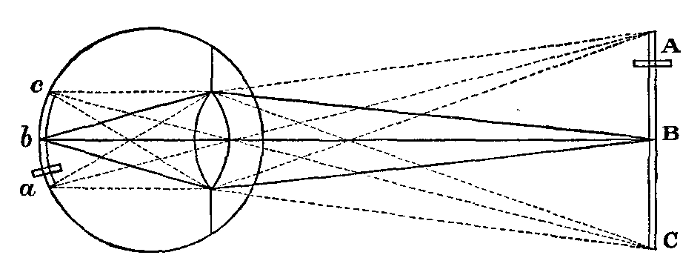
Figure 4
89. In answer to this difficulty, we are told that the mind, perceiving an impulse of a ray of light on the upper part of the eye, considers this ray as coming in a direct line from the lower part of the object; and, in like manner, tracing the ray that strikes on the lower part of the eye, it is directed to the upper part of the object. Thus, in the adjacent figure, C, the lower point of the object ABC, is projected on c the upper part of the eye. So likewise, the highest point A is projected on a the lowest part of the eye; which makes the representation cba inverted. But the mind—considering [pg 172] the stroke that is made on c as coming in the straight line Cc from the lower end of the object; and the stroke or impulse on a, as coming in the line Aa from the upper end of the object—is directed to make a right judgment of the situation of the object ABC, notwithstanding the picture of it be inverted. Moreover, this is illustrated by conceiving a blind man, who, holding in his hands two sticks that cross each other, doth with them touch the extremities of an object, placed in a perpendicular situation381. It is certain this man will judge that to be the upper part of the object which he touches with the stick held in the undermost hand, and that to be the lower part of the object which he touches with the stick in his uppermost hand. This is the common explication of the erect appearance of objects, which is generally received and acquiesced in, being (as Mr. Molyneux tells us, Diopt. part ii. ch. vii. p. 289) “allowed by all men as satisfactory.”
90. But this account to me does not seem in any degree true. Did I perceive those impulses, decussations, and directions of the rays of light, in like manner as hath been set forth, then, indeed, it would not at first view be altogether void of probability. And there might be some pretence for the comparison of the blind man and his cross sticks. But the case is far otherwise. I know very well that I perceive no such thing. And, of consequence, I cannot thereby make an estimate of the situation of objects. Moreover, I appeal to any one's experience, whether he be conscious to himself that he thinks on the intersection made by the radius pencils, or pursues the impulses they give in right lines, whenever he perceives by sight the position of [pg 173] any object? To me it seems evident that crossing and tracing of the rays, &c. is never thought on by children, idiots, or, in truth, by any other, save only those who have applied themselves to the study of optics. And for the mind to judge of the situation of objects by those things without perceiving them, or to perceive them without knowing it382, take which you please, it is perfectly beyond my comprehension. Add to this, that the explaining the manner of vision by the example of cross sticks, and hunting for the object along the axes of the radius pencils, doth suppose the proper objects of sight to be perceived at a distance from us, contrary to what hath been demonstrated383. [We may therefore venture to pronounce this opinion, concerning the way wherein the mind perceives the erect appearance of objects, to be of a piece with those other tenets of writers in optics, which in the foregoing parts of this treatise we have had occasion to examine and refute384.]
91. It remains, therefore, that we look for some other explication of this difficulty. And I believe it not impossible to find one, provided we examine it to the bottom, and carefully distinguish between the ideas of sight and touch; which cannot be too oft inculcated in treating of vision385. But, more especially throughout the consideration of this affair, we ought to carry that distinction in our thoughts; for that from want of a right understanding thereof, the difficulty of explaining erect vision seems chiefly to arise.
92. In order to disentangle our minds from whatever prejudices we may entertain with relation to the subject in hand, nothing seems more apposite than the taking into our thoughts the case of one born blind, and afterwards, when grown up, made to see. And—though perhaps it may not be a task altogether easy and familiar to us, to divest ourselves entirely of the experiences received from sight, so as to be able to put our thoughts exactly in the posture of such a one's—we must, nevertheless, as far as possible, endeavour to frame true conceptions of what might reasonably be supposed to pass in his mind386.
[pg 174]
93. It is certain that a man actually blind, and who had continued so from his birth, would, by the sense of feeling, attain to have ideas of upper and lower. By the motion of his hand, he might discern the situation of any tangible object placed within his reach. That part on which he felt himself supported, or towards which he perceived his body to gravitate, he would term lower, and the contrary to this upper; and accordingly denominate whatsoever objects he touched.