Chapter IX
Reading edition
1542-1547
KATHARINE PARR—THE PROTESTANTS WIN THE LAST TRICK
The disappearance of Katharine Howard and the temporary eclipse of Norfolk caused no check to the progress of the Catholic cause in England. When Gardiner was with the Emperor in the summer of 1541 he had been able to make in Henry’s name an agreement by which neither monarch should treat anything to the other’s disadvantage for the next ten months; and as war loomed nearer between Charles and Francis, the chances of a more durable and binding treaty being made between the former and Henry improved. When Gardiner had hinted at it in Germany, both Charles and Granvelle had suggested that the submission of Henry to the Pope would be a necessary preliminary. But the Emperor’s brother, Ferdinand, was in close grips with the Turk in Hungary, and getting the worst of it; Francis was again in negotiation with the infidel, and French intrigue in Italy was busy. Henry therefore found that the Emperor’s tone softened considerably on the report of Chapuys’ conversation at Windsor in February, whilst the English terms became stiffer, as Francis endeavoured to turn his feigned negotiations with Henry into real ones. The whole policy of Henry at the period was really to effect an armed league with the Emperor, by means of which France might be humiliated, perhaps dismembered, whilst Henry was welcomed back with open arms by the great Catholic power, in spite of his contumacy, and the hegemony of England established over Scotland. In order the better to incline Charles to essential concessions, it was good policy for Henry to give several more turns of the screw upon his own subjects, to prove to his future ally how devout a Catholic he was, and how entirely Cromwell’s later action was being reversed.
The great Bibles were withdrawn from the churches, the dissemination of the Scriptures restricted, and the Six Articles were enforced more severely than ever;[230] but yet when, after some months of fencing and waiting, Chapuys came to somewhat closer quarters with the English Council, he still talked, though with bated breath now, about Henry’s submission to the Pope and the legitimation of the Princess Mary. But the Emperor’s growing need for support gradually broke down the wall of reserve that Henry’s defection from Rome had raised, and Gardiner and Chapuys, during the spring of 1542, were in almost daily confabulation in a quiet house in the fields at Stepney.[231] In June the imperial ambassador made a hasty visit to Flanders to submit the English terms for an alliance to the Queen Regent. Henry’s conditions in appearance were hard, for by going to war with France he would, he said, lose the great yearly tribute he received from that country; but Charles and his sister knew how to manage him, and were not troubled with scruples as to keeping promises. So, to begin with, the commercial question that had so long been rankling, was now rapidly settled, and the relations daily grew more cordial. Henry had agents in Germany and Flanders ordering munitions of war and making secret compacts with mercenary captains; he was actively reinforcing his own garrisons and castles, organising a fine fleet, collecting vast fresh sums of money from his groaning subjects, and in every way preparing himself to be an ally worth purchase by the Emperor at a high price.
In July 1542 the French simultaneously attacked the imperial territory in four distinct directions; and Henry summoned the ambassadors of Charles and Francis to Windsor to tell them that, as war was so near him, he must raise men for his defence, especially towards Scotland, but meant no menace to either of the Continental powers. Chapuys had already been assured that the comedy was only to blind the French, and cheerfully acquiesced, but the Frenchmen took a more gloomy view and knew it meant war. With Scotland and Henry it was a case of the lamb and the wolf. Henry knew that he dared not send his army across the Channel to attack France without first crushing his northern neighbour. The pretended negotiations with, and allegations against, the unfortunate Stuart were never sincere. James was surrounded by traitors: for English money and religious rancour had profoundly divided the Scottish gentry; Cardinal Beaton, the Scots King’s principal minister, was hated; the powerful Douglas family were disaffected and in English pay; and the forces with which James V. rashly attempted to raid the English marches in reprisal for Henry’s unprovoked attacks upon him were wild and undisciplined. The battle of Solway Moss (November 1542) was a disgraceful rout for the Scots, and James, heart-broken, fled from the ruin of his cause to Tantallon and Edinburgh, and thence to Falkland to die. Then, with Scotland rent in twain, with a new-born baby for a Queen, and a foreign woman as regent, Henry could face a war with France by the side of the Emperor, with assurance of safety on his northern border, especially if he could force upon the rulers of Scotland a marriage between his only son and the infant Mary Stuart, as he intended to do.
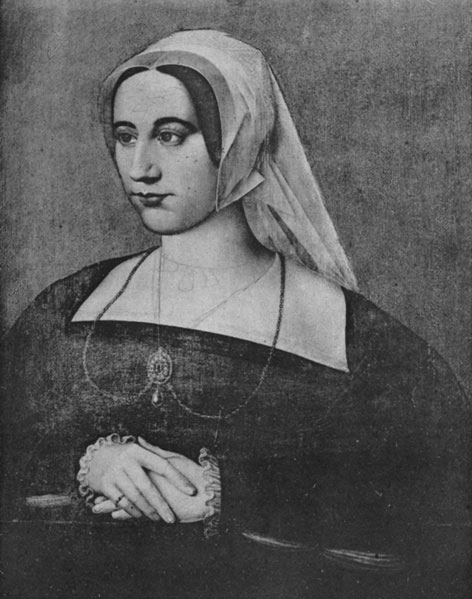
KATHARINE PARR
From a painting in the collection of the Earl of Ashburnham
There was infinite haggling with Chapuys with regard to the style to be given to Henry in the secret treaty, even after the heads of the treaty itself had been agreed upon. He must be called sovereign head of the English Church, said Gardiner, or there would be no alliance with the Emperor at all, and the difficulty was only overcome by varying the style in the two copies of the document, that signed by Chapuys bearing the style of; “King of England, France, and Ireland, etc.,” and that signed by the English ministers adding the King’s ecclesiastical claims. If the territories of either monarch were invaded the other was bound to come to his aid. The French King was to be summoned to forbear intelligence with the Turk, to satisfy the demands of the Emperor and the King of England in the many old claims they had against him, and no peace was to be made with France by either ally, unless the other’s claims were satisfied. The claims of Henry included the town and county of Boulogne, with Montreuil and Therouenne, his arrears of pension, and assurance of future payment: and the two allies agreed within two years to invade France together, each with 20,000 foot and 5000 horse.[232] This secret compact was signed on the 11th February 1543; and the diplomatic relations with France were at once broken off. At last the repudiation of Katharine of Aragon was condoned, and Henry was once more the Emperor’s “good brother”;—a fit ally for the Catholic king, the champion of orthodox Christianity. As if to put the finishing touch upon Henry’s victory, Charles held an interview with the Pope in June 1543 on his way through Italy, and succeeded in persuading him that the inclusion of the King who defied the Church in the league of militant Catholics was a fit complement to the alliance of France and enemies of all Christianity; and would secure the triumph of the Papacy and the return of England into the fold.
Whilst the preparations for war thus went busily forward on all sides, with Chantonnay in England and Thomas Seymour in Germany and Flanders arranging military details of arms, levies, and stores, and the Emperor already clamouring constantly for prompt English subsidies and contingents against his enemies, Henry, full of importance and self-satisfaction at his position, contracted the only one of his marriages which was not promoted by a political intrigue, although at the time it was effected it was doubtless looked upon as favouring the Catholic party. Certainly no lady of the Court enjoyed a more blameless reputation than Katharine Lady Latimer, upon whom the King now cast his eyes. A daughter of the great and wealthy house of Parr of Kendal, allied to the royal blood in no very distant degree, and related to most of the higher nobility of England, she was, so far as descent was concerned, quite as worthy to be the wife of a king as the unfortunate daughters of the house of Howard. Her brother, Lord Parr, soon to be created Earl of Essex and Marquis of Northampton, a favourite courtier of the King and a very splendid magnate,[233] had been one of the chief enemies of Cromwell; who had in his last days usurped the ancient earldom which Parr had claimed in right of his Bourchier wife, whilst Katharine’s second husband, Neville Lord Latimer, had been so strong a Catholic as to have risked his great possessions, as well as his head, by joining the rising in the North that had assumed the name of the Pilgrimage of Grace and had been mainly directed against Cromwell’s measures. She was, moreover, closely related to the Throckmortons, the stoutly Catholic family whose chief, Sir George, Cromwell had despoiled and imprisoned until the intrigue already related drove the minister from power in June 1540, with the mysterious support, so it is asserted, of Katharine Lady Latimer herself, though the evidence of it is not very convincing.[234]
Katharine had been brought up mostly in the north country with extreme care and wisdom by a hard-headed mother, and had been married almost as a child to an elderly widower, Lord Borough, who had died soon afterwards, leaving her a large jointure. Her second husband, Lord Latimer, had also been many years older than herself; and accompanying him, as she did, in his periodical visits to London, where they had a house in the precincts of the Charterhouse, she had for several years been remarkable in Henry’s Court, not only for her wide culture and love of learning, but also for her friendship with the Princess Mary, whose tastes were exactly similar to her own. Lord Latimer died in London at the beginning of 1543, leaving to Katharine considerable property; and certainly not many weeks can have passed before the King began to pay his court to the wealthy and dignified widow of thirty-two. His attentions were probably not very welcome to her, for he was a terribly dangerous husband, and any unrevealed peccadillo in the previous life of a woman he married might mean the loss of her head.
There was another reason than this, however, that made the King’s addresses especially embarrassing to Katharine. The younger of the two magnificent Seymour brothers, Sir Thomas, had thus early also approached her with offers of love. He was one of the handsomest men at Court, and of similar age to Katharine. He was already very rich with the church plunder, and was the King’s brother-in-law; so that he was in all respects a good match for her. He must have arrived from his mission to Germany immediately after Lord Latimer’s death, and remained at Court until early in May, about three months; during which time, from the evidence of Katharine’s subsequent letters, she seems to have made up her mind to marry him. It may be that the King noticed signs of their courtship, for Sir Thomas Seymour was promptly sent on an embassy to Flanders in company with Dr. Wotton, and subsequently with the English contingent to the Emperor’s army to France, where he remained until long after Henry’s sixth marriage.
That Henry himself lost no time in approaching the widow after her husband’s death is seen by a tailor’s bill for dresses for Lady Latimer being paid out of the Exchequer by the King’s orders as early as the 16th February 1543, when it would seem that her husband cannot have been dead much more than a month. This bill includes linen and buckram, the making of Italian gowns, “pleats and sleeves,” a slope hood and tippet, kirtles, French, Dutch, and Venetian gowns, Venetian sleeves, French hoods, and other feminine fripperies; the amount of the total being £8, 9s. 5d.; and, as showing that even before the marriage considerable intimacy existed between Katharine and the Princess Mary, it is curious to note that some of the garments appear to have been destined for the use of the latter.[235] By the middle of June the King’s attentions to Lady Latimer were public; and already the lot of the sickly, disinherited Princess Mary was rendered happier by the prospective elevation of her friend. Mary came to Court at Greenwich, as did her sister Elizabeth; and Katharine is specially mentioned as being with them in a letter from Dudley, the new Lord Lisle, to Katharine’s brother, Lord Parr, the Warden of the Scottish Marches. The King had then (20th June) just returned from a tour of inspection of his coast defences, and three weeks later Cranmer as Primate issued a licence for his marriage with Katharine Lady Latimer, without the publication of banns.
On the 12th July 1543 the marriage took place in the upper oratory “called the Quynes Preyevey Closet” at Hampton Court. When Gardiner the celebrant put the canonical question to the bridegroom, his Majesty answered “with a smiling face,” yea, and, taking his bride’s hand, firmly recited the usual pledge. Katharine, whatever her inner feelings may have been, made a bright and buxom bride, and from the first endeavoured, as none of the other wives had done, to bring together into some semblance of family life with her the three children of her husband. Her reward was that she was beloved and respected by all of them; and Princess Mary, who was nearly her own age, continued her constant companion and friend.[236]
As she began so she remained; amiable, tactful, and clever. Throughout her life with Henry her influence was exerted wherever possible in favour of concord, and I have not met with a single disparaging remark with regard to her, even from those who in the last days of the King’s life became her political opponents. Her character must have been an exceedingly lovable one, and she evidently knew to perfection how to manage men by humouring their weak points. She could be firm, too, on occasions where an injustice had to be remedied. A story is told of her in connection with her brother Parr, Earl of Essex, in the Chronicle of Henry VIII., which, so far as I know, has not been related by any other historian of the reign.
Parr fell in love with Lord Cobham’s daughter, a very beautiful girl, who, as told in our text, was mentioned as one of the King’s flames after Katharine Howard’s fall. Parr had married the great Bourchier heiress, but had grown tired of her, and by suborned evidence charged her with adultery, and she was found guilty and sentenced to death. “The good Queen, his sister, threw herself at the feet of the King and would not rise until he had promised to grant her the boon she craved, which was the life of the Countess (of Essex). When the King heard what it was, he said, But, Madam, you know that the law enacts that a woman of rank who so forgets herself shall die unless her husband pardon her. To this the Queen answered, Your Majesty is above the law, and I will try to get my brother to pardon. Well, said the King, if your brother be content I will pardon her.” The Queen then sends for her brother and upbraids him for bringing perjured witnesses against his wife, which he denies and says he has only acted in accordance with the legal evidence. “I can promise you, brother, that it shall not be as you expect: I will have the witnesses put to the torture, and then by God’s help we shall know the truth.” Before this could be done Parr sent his witnesses to Cornwall, out of the way: and again Katharine insisted upon the Countess’ pardon, by virtue of the promise that the King had given her. This somewhat alarmed Parr, and Katharine managed to effect a mutual renunciation, after which Parr married Lord Cobham’s daughter.[237]
Gardiner had been not only the prelate who performed the ceremony but had himself given the bride away; so that it may fairly be concluded that he, at least, was not discontented with the match. Wriothesley, his obedient creature, moreover, must have been voicing the general feeling of Catholics when he wrote to the Duke of Suffolk in the North his eulogy of the bride a few days after the wedding. “The King’s Majesty was mareid onne Thursdaye last to my ladye Latimor, a woman, in my judgment, for vertewe, wisdomme and gentilnesse, most meite for his Highnesse: and sure I am his Mate had never a wife more agreable to his harte than she is. Our Lorde sende them long lyf and moche joy togethir.”[238] Both the King’s daughters had been at the wedding, Mary receiving from Katharine a handsome present as bride’s-maid; but Henry had the decency not to bid the presence of Anne of Cleves. She is represented as being somewhat disgusted at the turn of events. Her friends, and perhaps she herself, had never lost the hope that if the Protestant influence became paramount, Henry might take her back. But the imperial alliance had made England an enemy of her brother of Cleves, whose territory the Emperor’s troops were harrying with fire and sword; and her position in England was a most difficult one. “She would,” says Chapuys, “prefer to be with her mother, if with nothing but the clothes on her back, rather than be here now, having specially taken great grief and despair at the King’s espousal of his new wife, who is not nearly so good-looking as she is, besides that there is no hope of her (Katharine) having issue, seeing that she had none by her two former husbands.”[239]
As we have seen, Katharine had all her life belonged to the Catholic party, of which the northern nobles were the leaders, and doubtless this fact had secured for her marriage the ready acquiescence of Gardiner and his friends, especially when coupled with the attachment known to exist between the bride and the Princess Mary. But Katharine had studied hard, and was devoted to the “new learning,” which had suddenly become fashionable for high-born ladies. The Latin classics, the writings of Erasmus, of Juan Luis Vives, and others were the daily solace of the few ladies in England who had at this time been seized with the new craze of culture, Katharine, the King’s daughters, his grand-nieces the Greys, and the daughters of Sir Anthony Cook, being especially versed in classics, languages, philosophy, and theology. The “new learning” had been, and was still to be, for the most part promoted by those who sympathised with the reformed doctrines, and Katharine’s devotion to it brought her into intimate contact with the learned men at Court whose zeal for the spread of classical and controversial knowledge was coupled with the spirit of inquiry which frequently went with religious heterodoxy.
Not many days after the marriage, Gardiner scented danger in this foregathering of the Queen with such men as Cranmer and Latimer, and at the encouragement and help given by her to the young princesses in the translation of portions of the Scriptures, and of the writings of Erasmus. There is no reason to conclude that Katharine, as yet, had definitely attached herself to the reform party, but it is certain that very soon after her marriage her love of learning, or her distrust of Gardiner’s policy and methods, caused her to look sympathetically towards those at Court who went beyond the King in his opposition to Rome. Gardiner dared not as yet directly attack either Katharine or Cranmer, for the King was personally much attached to both of them, whilst Gardiner himself was never a favourite with him. But indirectly these two persons in privileged places might be ruined by attacking others first; and the plan was patiently and cunningly laid to do it, before a new party of reformers led by Cranmer, reinforced by Katharine, could gain the King’s ear and reverse the policy of his present adviser. At the instance of Gardiner’s creature Dr. London, a canon of Windsor, a prosecution under the Six Articles was commenced against a priest and some choristers of the royal chapel, and one other person, who were known to meet together for religious discussion. For weeks London’s spies had been listening to the talk of those in the castle and town who might be suspected of reformed ideas; and with the evidence so accumulated in his hand, Gardiner moved the King in Council to issue a warrant authorising a search for unauthorised books and papers in the town and castle of Windsor. Henry, whilst allowing the imprisonment of the accused persons with the addition of Sir Philip Hoby and Dr. Haines, both resident in the castle, declined to allow his own residence to be searched for heretical books. This was a set back for Gardiner’s plan; but it succeeded to the extent of securing the conviction and execution at the stake of three of the accused. This was merely a beginning; and already those at Court were saying that the Bishop of Winchester “aimed at higher deer” than those that had already fallen to his bow.[240]
Hardly had the ashes of the three martyrs cooled, than a mass of fresh accusations was formulated by London against several members of the royal household. The reports of spies and informers were sent to Gardiner by the hand of Ockham, the clerk of the court that had condemned the martyrs, but one of the persons accused, a member of Katharine’s household, received secret notice of what was intended and waylaid Ockham. Perusal of the documents he bore showed that much of the information had been suborned by Dr. London and his assistant Simons, and Katharine was appealed to for her aid. She exerted her influence with her husband to have them both arrested and examined. Unaware that their papers had been taken from Ockham, they foreswore themselves and broke down when confronted with the written proofs that the case against the accused had been trumped up on false evidence with ulterior objects. Disgrace and imprisonment for the two instruments, London and Simons, followed,[241] but the prelate who had inspired their activity was too indispensable to the King to be attacked, and he, firm in his political predominance, bided his time for yet another blow at his enemies, amongst whom he now included the Queen, whose union with the King he and other Catholics had so recently blessed.
Cranmer, secure as he thought in the King’s regard and in his great position as Primate, had certainly laid himself open to the attacks of his enemies, by his almost ostentatious favour to the clergy of his province who were known to be evading or violating the Six Articles. The chapter of his own cathedral was profoundly divided, and the majority of its members were opposed to what they considered the injustice of their Archbishop. Cranmer’s commissary, his nephew Nevinson, whilst going out of his way to favour those who were accused before the chapter of false doctrine, offended deeply the majority of the clergy by his zeal—which really only reflected that of the Archbishop himself—in the displacing and destruction of images in the churches, even when the figures did not offend against the law by being made the objects of superstitious pilgrimages and offerings. For several years past the cathedral church of Canterbury had been a hotbed of discord, in consequence of Cranmer’s having appointed, apparently on principle, men of extreme opinions on both sides as canons, prebendaries, and preachers; and so great had grown the opposition in his own chapter to the Primate’s known views in the spring of 1543, that it was evident that a crisis could not be long delayed, especially as the clergy opposed to the prelate had the letter of the law on their side, and the countenance of Gardiner, Bishop of Winchester, all powerful as he was in the lay counsels of the King.
Some of the Kentish clergy who resented the Archbishop’s action had laid their heads together in March 1543, and formulated a set of accusations against him. This the two most active movers in the protest had carried to the metropolis for submission to Gardiner. They first, however, approached the Dr. London already referred to, who rewrote the accusations with additions of his own, in order to bring the accused within the penal law. The two first movers, Willoughby and Searl, took fright at this, for it was a dangerous thing to attack the Archbishop, and hastily returned home; but Dr. London had enough for his present purpose, and handed his enlarged version of their depositions to Gardiner. London’s disgrace, already related, stayed the matter for a time, but a few months afterwards a fresh set of articles, alleging illegal acts on the part of the Archbishop, was forwarded by the discontented clergy to Gardiner, and the accusers were then summoned before the Privy Council, where they were encouraged to make their testimony as strong as possible. When the depositions were complete they were sent to the King by Gardiner, in the hope that now the great stumblingblock of the Catholic party might be cleared from the path, and that the new Queen’s ruin might promptly follow that of the Primate.
But they reckoned without Henry’s love for Cranmer. Rowing on the Thames one evening in the late autumn soon after the depositions had been handed to him, the King called at the pier by Lambeth Palace and took Cranmer into his barge. “Ah, my chaplain,” he said jocosely, as the Archbishop took his seat in the boat, “I have news for you. I know now who is the greatest heretic in Kent;” and with this he drew from his sleeve and handed to Cranmer the depositions of those who had sought to ruin him. The Archbishop insisted upon a regular Commission being issued to test the truth of the accusations; but Henry could be generous when it suited him, and he never knew how soon he might need Cranmer’s pliable ingenuity again. So, although he issued the Commission, he made Cranmer its head, and gave to him the appointment of its members; with the natural result that the accusers and all their abettors were imprisoned and forced to beg the Primate’s forgiveness for their action.[242] But the man who gave life to the whole plot, Bishop Gardiner of Winchester, still led the King’s political counsels, much as Henry disliked him personally; for the armed alliance with the Emperor could only bring its full harvest of profit and glory to the King of England if the Catholic powers on the Continent were convinced of Henry’s essential orthodoxy, notwithstanding his quarrel with the Pope.[243] So, though Cranmer might be favoured privately and Katharine’s coquetting with the new learning and its professors winked at, Gardiner, whose Catholicism was stronger than that of his master, had to be the figure-head to impress foreigners.
In July 1543 the English contingent to aid the imperial troops to protect Flanders was sent from Guisnes and Calais under Sir John Wallop. By the strict terms of the treaty they were only to be employed for a limited period for the defence of territory invaded by the enemy; but soon after Wallop’s arrival he was asked to take part in the regular siege of Landrecy in Hainault, that had been occupied by the French. Henry allowed him to do so under protest. It was waste of time, he said, and would divert the forces from what was to be their main object; but if he allowed it, he must have the same right when the war in France commenced to call upon the imperial contingent with him also to besiege a town if he wished to do so. Both the allies, even before the war really began, were playing for their own hands with the deliberate intention of making use of each other; and in the dismal comedy of chicanery that followed and lasted almost to Henry’s death, this siege of Landrecy and that of St. Disier were made the peg upon which countless reclamations and recriminations were hung. The Emperor was ill, in dire need of money, and overwhelmed with anxiety as to the attitude of the Lutheran princes during the coming struggle. His eyes were turned towards Italy, and he depended much upon the diversion that Henry’s forces might effect by land and sea; and conscious that the campaign must be prompt and rapid if he was to profit by it, he sent one of his most trusted lieutenants, Ferrante Gonzaga, Viceroy of Sicily, to England at the end of the year 1543 to settle with Henry the plan of the campaign to be undertaken in the spring.
His task was a difficult one; for Henry was as determined to use Charles for his advantage as Charles was to use him. After much dispute it was agreed that Henry, as early in the summer as possible, should lead his army of 35,000 foot and 7000 horse to invade France from Calais, whilst the imperial troops were to invade by Lorraine, form a junction with the English on the Somme, and push on towards Paris. Rapidity was the very essence of such a plan; but Henry would not promise celerity. He could not, he said, transport all his men across the sea before the end of June: the fact being that his own secret intention all along was to conquer the Boulognais country for himself, gain a free hand in Scotland, and leave the Emperor to shift as he might. Utter bad faith on both sides pervaded the affair from first to last. The engaging and payment of mercenaries by England, the purchase of horses, arms, and stores, the hire of transport, the interference with commerce—everything in which sharp dealing could be employed by one ally to get the better of the other was taken advantage of to the utmost. Henry, enfeebled as he was by disease and obesity, was determined to turn to his personal glory the victory he anticipated for his arms. His own courtiers dared not remonstrate with him; and, although Katharine prayed him to have regard for his safety, he brushed aside her remonstrances as becoming womanly fears for a dearly loved husband. Charles knew that if the King himself crossed the Channel the English army would not be at the imperial bidding. Envoys were consequently sent from Flanders to pray Henry, for his health’s sake, not to risk the hardships of a sea voyage and a campaign. The subject was a sore one with him; and when the envoy began to dwell too emphatically upon his infirmities, he flew into a passion and said that the Emperor was suffering from gout, which was much worse than any malady he (Henry) had, and it would be more dangerous for the Emperor to go to the war.
Henry’s decision to accompany his army at once increased the importance of Katharine; who, in accordance with precedent, would become regent in her husband’s absence. A glimpse of her growing influence at this time is seen in a letter of hers, dated 3rd June 1544, to the Countess of Hertford, that termagant Ann Stanhope who afterwards was her jealous enemy. Hertford had been sent in March to the Scottish Border to invade again, and this time utterly crush Scotland, where Henry’s pensioners had played him false, and betrothed their infant Queen to the heir of France. The Countess, anxious that her husband should be at home during the King’s absence—probably in order that if anything happened to Henry, Hertford might take prompt measures on behalf of the new King, his nephew, and safeguard his own influence—wrote to Katharine praying for her aid.[244] The Queen’s answer is written on the same sheet of paper as one from Princess Mary to the Countess, whose letters to Katharine had been sent through the Princess. “My lord your husband’s comyng hyther is not altered, for he schall come home before the Kynge’s Majesty take hys journey over the sees, as it pleaseth his Majesty to declare to me of late. You may be ryght assured I wold not have forgotten my promise to you in a matter of lesse effect than thys, and so I pray you most hartely to think....—Kateryn the Quene.”[245]
Since Henry insisted upon going to the war himself the next best thing, according to the Emperor’s point of view, to keeping him away was to cause some Spanish officer of high rank and great experience to be constantly close to him during the campaign. Except the little skirmishes on the borders of Scotland, Englishmen had seen no active military service for many years, and it was urged upon Henry that a general well acquainted with modern Continental warfare would be useful to him. The Emperor’s Spanish and Italian commanders were the best in the world, as were his men-at-arms; and a grandee, the Duke of Najera, who was on his way from Flanders to Spain by sea, was looked upon as being a suitable man for the purpose of advising the King of England. Henry was determined to impress him and entertained him splendidly, delaying him as long as possible, in order that he might be persuaded to accompany the English forces. The accounts of Najera’s stay in England show that Katharine had now, the spring of 1544, quite settled down in her position as Queen and coming Regent. Chapuys mentions that when he first took Najera to Court he “visited the Queen and Princess (Mary), who asked very minutely for news of the Emperor ... and, although the Queen was a little indisposed, she wished to dance for the honour of the company. The Queen favours the Princess all she can; and since the Treaty with the Emperor was made, she has constantly urged the Princess’ cause, insomuch as in this sitting of Parliament she (Mary) has been declared capable of succeeding in default of the Prince.”[246]
A Spaniard who attended Najera tells the story of the Duke’s interview with Katharine somewhat more fully. “The Duke kissed the Queen’s hand and was then conducted to another chamber, to which the Queen and ladies followed, and there was music and much beautiful dancing. The Queen danced first with her brother very gracefully, and then Princess Mary and the Princess of Scotland (i.e. Lady Margaret Douglas) danced with other gentlemen, and many other ladies also danced, a Venetian of the King’s household dancing some gaillards with such extraordinary activity that he seemed to have wings upon his feet; surely never was a man seen so agile. After the dancing had lasted several hours the Queen returned to her chamber, first causing one of the noblemen who spoke Spanish to offer some presents to the Duke, who kissed her hand. He would likewise have kissed that of the Princess Mary, but she offered her lips; and so he saluted her and all the other ladies.[247] The King is regarded as a very powerful and handsome man. The Queen is graceful and of cheerful countenance; and is praised for her virtue. She wore an underskirt, showing in front, of cloth of gold, and a sleeved over-dress of brocade lined with crimson satin, the sleeves themselves being lined with crimson velvet, and the train was two yards long. She wore hanging from the neck two crosses and a jewel of very magnificent diamonds, and she wore a great number of splendid diamonds in her headdress.” The author of this curious contemporary document excels himself in praise of the Princess Mary, whose dress on the occasion described was even more splendid than that of the Queen, consisting as it did entirely of cloth of gold and purple velvet. The house and gardens of Whitehall also moved the witness to wonder and admiration. The green alleys with high hedges of the garden and the sculpture with which the walks were adorned especially attracted the attention of the visitors, and the greatness of London and the stately river Thames are declared to be incomparable.[248]
The Duke of Najera, unwilling to stay, and, apparently, not impressing Henry very favourably, went on his way; and was immediately followed by another Spanish commander of equal rank and much greater experience in warfare, the Duke of Alburquerque, and he, too, was received with the splendour and ostentation that Henry loved, ultimately accompanying the King to the siege of Boulogne as military adviser; both the King and Queen, we are told, treating him with extraordinary favour.[249]
By the time that Henry was ready to cross the Channel early in July to join his army, which several weeks before had preceded him under the command of Norfolk and Suffolk, the short-lived and insincere alliance with the Emperor, from which Henry and Gardiner had expected so much, was already strained almost to breaking point. The great imperialist defeat at Ceresole in Savoy earlier in the year had made Henry more disinclined than ever to sacrifice English men and treasure to fight indirectly the Emperor’s battle in Italy. Even before that Henry had begun to show signs of an intention to break away from the plan of campaign agreed upon. How dangerous it would be, he said, for the Emperor to push forward into France without securing the ground behind him. “Far better to lay siege to two or three large towns on the road to Paris than to go to the capital and burn it down.” Charles was indignant, and continued to send reminders and remonstrances that the plan agreed upon must be adhered to. Henry retorted that Charles himself had departed from it by laying siege to Landecy. The question of supplies from Flanders, the payment and passage of mercenaries through the Emperor’s territories, the free concession of trading licences by the Queen Regent of the Netherlands, and a dozen other questions, kept the relations between the allies in a state of irritation and acrimony, even before the campaign well began, and it is clear thus early that Henry started with the fixed intention of conquering the territory of Boulogne, and then perhaps making friends with Francis, leaving the Emperor at war. With both the great rivals exhausted, he would be more sought after than ever. He at once laid siege to Montreuil and Boulogne, and personally took command, deaf to the prayers and remonstrances of Charles and his sister, that he would not go beyond Calais, “for his health’s sake”; but would send the bulk of his forces to join the Emperor’s army before St. Disier. The Emperor had himself broken the compact by besieging Landrecy and St. Disier; and so the bulk of Henry’s army sat down before Boulogne, whilst the Emperor, short of provisions, far in an enemy’s country, with weak lines of communication, unfriendly Lorraine on his flank and two French armies approaching him, could only curse almost in despair the hour that he trusted the word of “his good brother,” the King of England.
Katharine bade farewell to her husband at Dover when he went on his pompous voyage,[250] and returned forthwith to London, fully empowered to rule England as Regent during his absence. She was directed to use the advice and counsel of Cranmer, Wriothesley, the Earl of Hertford, who was to replace her if she became incapacitated, Thirlby, and Petre; Gardiner accompanying the King as minister. The letters written by Katharine to her husband during his short campaign show no such instances of want of tact as did those of the first Katharine, quoted in the earlier pages of this book. It is plain to read in them the clever, discreet woman, determined to please a vain man; content to take a subordinate place and to shine by a reflected light alone. “She thanks God for a prosperous beginning of his affairs;” “she rejoices at the joyful news of his good health,” and in a business-like way shows that she and her council are actively forwarding the interests of the King with a single-hearted view to his honour and glory alone.
During this time the young Prince Edward and his sister Mary were at Hampton Court with the Queen; but the other daughter, Elizabeth, lived apart at St. James’s. Though it is evident that the girl was generally regarded and treated as inferior to her sister, she appears to have felt a real regard for her stepmother, almost the only person who, since her infancy, had been kind to her. Elizabeth wrote to the Queen on the 31st July a curious letter in Italian. “Envious fortune,” she writes, “for a whole year deprived me of your Highness’s presence, and, not content therewith, has again despoiled me of that boon. I know, nevertheless, that I have your love; and that you have not forgotten me in writing to the King. I pray you in writing to his Majesty deign to recommend me to him; praying him for his ever-welcome blessing; praying at the same time to Almighty God to send him good fortune and victory over his enemies; so that your Highness and I together may the sooner rejoice at his happy return. I humbly pray to God to have your Highness in His keeping; and respectfully kissing your Highness’ hand.—Elizabeth.”[251]
Katharine indeed, in this trying time of responsibility, comes well out of her ordeal. The prayer[252] composed by her for peace at this period is really a beautiful composition; and the letter from her to her husband, printed by Strype, breathes sentiment likely to please such a man as Henry, but in language at once womanly and dignified. “Although the distance of time and account of days,” she writes, “neither is long nor many, of your Majesty’s absence, yet the want of your presence, so much beloved and desired by me, maketh me that I cannot quietly pleasure in anything until I hear from your Majesty. The time therefore seemeth to me very long, with a great desire to know how your Highness hath done since your departing hence; whose prosperity and health I prefer and desire more than mine own. And, whereas I know your Majesty’s absence is never without great need, yet love and affection compel me to desire your presence. Again the same zeal and affection forceth me to be best content with that which is your will and pleasure. Thus, love maketh me in all things set apart mine own convenience and pleasure, and to embrace most joyfully his will and pleasure whom I love. God, the knower of secrets, can judge these words to be not only written with ink but most truly impressed upon the heart. Much more I omit, less it be thought I go about to praise myself or crave a thank. Which thing to do I mind nothing less, but a plain simple relation of the love and zeal I bear your Majesty, proceeding from the abundance of the heart.... I make like account with your Majesty, as I do with God, for His benefits and gifts heaped upon me daily; acknowledging myself to be a great debtor to Him, not being able to recompense the least of His benefit. In which state I am certain and sure to die, yet I hope for His gracious acceptance of my goodwill. Even such confidence have I in your Majesty’s gentleness, knowing myself never to have done my duty as were requisite and meet for such a noble Prince, at whose hands I have received so much love and goodness that with words I cannot express it.”[253]
It will be seen by this, and nearly every other letter that Katharine wrote to her husband, that she had taken the measure of his prodigious vanity, and indulged him to the top of his bent. In a letter written to him on the 9th August, referring to the success of the Earl of Lennox, who had just married Henry’s niece, Margaret Douglas, and had gone to Scotland to seize the government in English interest, Katharine says: “The good speed which Lennox has had, is to be imputed to his serving a master whom God aids. He might have served the French king, his old master, many years without attaining such a victory.” This is the attitude in which Henry loved to be approached, and with such letters from his wife in England confirming the Jove-like qualities attributed to him in consequence of his presence with his army in France, Henry’s short campaign before Boulogne was doubtless one of the pleasantest experiences in his life.
To add to his satisfaction, he had not been at Calais a week before Francis began to make secret overtures for peace. It was too early for that, however, just yet, for Henry coveted Boulogne, and the sole use made of the French approaches to him was to impress the imperial agents with his supreme importance. The warning was not lost upon Charles and his sister the Queen Regent of the Netherlands, who themselves began to listen to the unofficial suggestions for peace made by the agents of the Duchess d’Etampes, the mistress of Francis, in order, if possible, to benefit herself and the Duke of Orleans in the conditions, to the detriment of the Dauphin Henry. Thenceforward it was a close game of diplomatic finesse between Henry and Charles as to which should make terms first and arbitrate on the claims of the other.
St. Disier capitulated to the Emperor on the 8th August; and Charles at once sent another envoy to Henry at Boulogne, praying him urgently to fulfil the plan of campaign decided with Gonzaga, or the whole French army would be concentrated upon the imperial forces and crush them. But Henry would not budge from before Boulogne, and Charles, whilst rapidly pushing forward into France, and in serious danger of being cut off by the Dauphin, listened intently for sounds of peace. They soon came, through the Duke of Lorraine; and before the end of August the Emperor was in close negotiation with the French, determined, come what might, that the final settlement of terms should not be left in the hands of the King of England. Henry’s action at this juncture was pompous, inflated, and stupid, whilst that of Charles was statesmanlike, though unscrupulous. Even during the negotiations Charles pushed forward and captured Epernay and Château Thierry, where the Dauphin’s stores were. This was on the 7th September, and then having struck his blow he knew that he must make peace at once. He therefore sent the young Bishop of Arras, Granvelle, with a message to Henry which he knew would have the effect desired. The King of England was again to be urged formally but insincerely to advance and join the Emperor, but if he would not the Emperor must make peace, always providing that the English claims were satisfactorily settled.
Arras arrived in the English camp on the 11th September. He found Henry in his most vaunting mood; for only three days before the ancient tower on the harbour side opposite Boulogne had been captured by his men.[254] He could not move forward, he said; it was too late in the season to begin a new campaign, and he was only bound by the treaty to keep the field four months in a year. If the Emperor was in a fix, that was his look-out. The terms, moreover, suggested for the peace between his ally and France were out of the question, especially the clause about English claims. The French had already offered him much better conditions than those. Arras pushed his point. The Emperor must know definitely, he urged, whether the King of England would make peace or not, as affairs could not be left pending. Then Henry lost his temper, as the clever imperial ministers knew he would do, and blurted out in a rage: “Let the Emperor make peace for himself if he likes, but nothing must be done to prejudice my claims.” It was enough for the purpose desired, for in good truth the Emperor had already agreed with the French, and Arras posted back to his master with Henry’s hasty words giving permission for him to make a separate peace. In vain for the next two years Henry strove to unsay, to palliate, to disclaim these words. Quarrels, bursts of violent passion, incoherent rage, indignant denials, were all of no avail; the words were said, and vouched for by those who heard them; and Charles hurriedly ratified the peace already practically made with France on terms that surprised the world, and made Henry wild with indignation.
The Emperor, victor though he was, in appearance gave away everything. His daughter or niece was to marry Orleans, with Milan or Flanders as a dowry; Savoy was to be restored to the Duke, and the French were to join the Emperor in alliance against the Turk. None knew yet—though Henry may have suspected it—that behind the public treaty there was a secret compact by which the two Catholic sovereigns agreed to concentrate their joint powers and extirpate a greater enemy than the Turk, namely, the rising power of Protestantism in Europe. Henry was thus betrayed and was at war alone with France, all of whose forces were now directed against him. Boulogne fell to the English on the 14th September, three days after Arras arrived in Henry’s camp, and the King hurried back to England in blazing wrath with the Emperor and inflated with the glorification of his own victory, eager for the applause of his subjects before his laurels faded and the French beleagured the captured town. Gardiner and Paget, soon to be joined temporarily by Hertford, remained in Calais in order to continue, if possible, the abortive peace negotiations with France. But it was a hopeless task now; for Francis, free from fear on his north-east frontier, was determined to win back Boulogne at any cost. The Dauphin swore that he would have no peace whilst Boulogne remained in English hands, and Henry boastfully declared that he would hold it for ever now that he had won it.
Thenceforward the relations between Henry and the Emperor became daily more unamiable. Henry claimed under the treaty that Charles should still help him in the war, but that was out of the question. When in 1546 the French made a descent upon the Isle of Wight, once more the treaty was invoked violently by the King of England: almost daily claims, complaints, and denunciations were made on both sides with regard to the vexed question of contraband of war for the French, mostly Dutch herrings; and the right of capture by the English. The Emperor was seriously intent upon keeping Henry on fairly good terms, and certainly did not wish to go to war with him; but he had submitted to the hard terms of the peace of Crespy with a distinct object, and dared not jeopardise it by renewing his quarrel with France for the sake of Henry.
Slowly it had forced itself upon the mind of Charles that his own Protestant vassals, the Princes of the Schmalkaldic league, must be crushed into obedience, or his own power would become a shadow; and his aim was to keep all Christendom friendly until he had choked Lutheranism at its fountain-head. From the period of Henry’s return to England in these circumstances, growing sympathy for those whom a Papal and imperial coalition were attacking caused the influence of the Catholic party in his Councils gradually but spasmodically to decline. Chapuys, who himself was hastening to the grave, accompanied his successor Van Der Delft as ambassador to England at Christmas (1544), and describes Henry as looking very old and broken, but more boastful of his victory over the French than ever. He professed, no doubt sincerely, a desire to remain friendly with the Emperor; and after their interview with him the ambassadors, without any desire being expressed on their part, were conducted to the Queen’s oratory during divine service. In reply to their greetings and thanks for her good offices for the preservation of friendship and her kindness to Princess Mary, Katharine “replied, very graciously, that she did not deserve so much courtesy from your Majesty (the Emperor). What she did for Lady Mary was less than she would like to do, and was only her duty in every respect. With regard to the maintenance of friendship, she said she had done, and would do, nothing to prevent its growing still firmer, and she hoped that God would avert the slightest dissension; as the friendship was so necessary, and both sovereigns were so good.”[255]
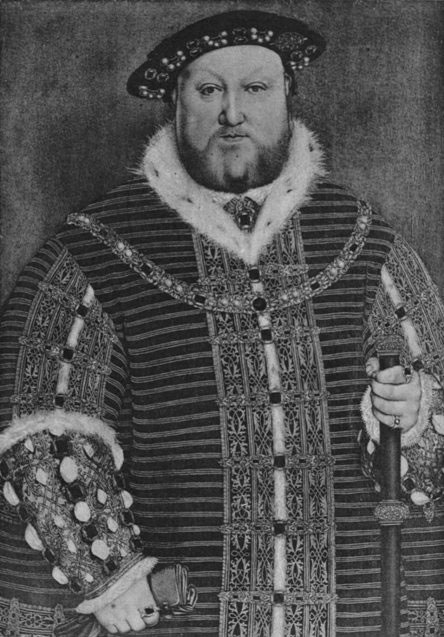
HENRY VIII.
From a portrait by Holbein in the possession of the Earl of Warwick
Katharine was equally amiable, though evidently now playing a political part, when four months later the aged and crippled Chapuys bade his last farewell to England. He was being carried in a chair to take leave of Henry at Whitehall one morning in May at nine o’clock. He was an hour earlier than the time fixed for his audience, and was passing through the green alleys of the garden towards the King’s apartments, when notice was brought to him that the Queen and Princess Mary were hastening after him. He stopped at once, and had just time to hobble out of his chair before the two ladies reached him. “It seemed from the small suite she had with her, and the haste with which she came, as if her purpose in coming was specially to speak to me. She was attended only by four or five ladies of the chamber, and opened the conversation by saying that the King had told her the previous evening that I was coming that morning to say good-bye. She was very sorry, on the one hand, for my departure, as she had been told that I had always performed my duties well, and the King trusted me; but on the other hand she doubted not that my health would be better on the other side of the sea. I could, however, she said, do as much on the other side as here, for the maintenance of the friendship, of which I had been one of the chief promoters. For this reason she was glad I was going; although she had no doubt that so wise and good a sovereign as your Majesty (i.e. the Emperor) would see the need and importance of upholding the friendship, of which the King, on his side, had given so many proofs in the past. Yet it seemed to her that your Majesty had not been so thoroughly informed hitherto, either by my letters or otherwise, of the King’s sincere affection and goodwill, as I should be able to report verbally. She therefore begged me earnestly, after I had presented to your Majesty her humble service, to express explicitly to you, all that I had learned here of the good wishes of the King.”[256]
There was much more high-flown compliment both from Katharine and her step-daughter before the gouty ambassador went on his way; but it is evident that Katharine, like her husband, was at this time (May 1545) apprehensive as to the intentions of Charles and his French allies towards England, and was still desirous to obtain some aid in the war under the treaty, in order, if possible, to weaken the new friendship with France and the Catholic alliance. In the meanwhile the failure of Gardiner’s policy, and the irritation felt at the Emperor’s abandonment of England, placed the minister somewhat under a cloud. He had failed, too, to persuade the Emperor personally to fulfil the treaty, as well as in his negotiations for peace with the French; and, as his sun gradually sank before the King’s annoyance, that of Secretary Paget, of Hertford, of Dudley, and of Wriothesley, now Lord Chancellor, a mere time-serving courtier, rose. The Protestant element around Katharine, too, became bolder, and her own participation in politics was now frankly on the anti-Catholic side. The alliance—insincere and temporary though it was—between the Emperor and France, once more produced its inevitable effect of drawing together England and the German Lutherans. It is true that Charles’ great plan for crushing dissent by the aid of the Pope was not yet publicly known; but the Council of Trent was slowly gathering, and it was clear to the German princes of the Schmalkaldic league that great events touching religion and their independence were in the air; for Cardinal Farnese and the Papal agents were running backward and forward to the Emperor on secret missions, and all the Catholic world rang with denunciation of heresy.
In June the new imperial ambassador, Van Der Delft, sounded the first note of alarm from England. Katharine Parr’s secretary, Buckler, he said, had been in Germany for weeks, trying to arrange a league between the Protestant princes and England. This was a matter of the highest importance, and Charles when he heard of it was doubly desirous of keeping his English brother from quite breaking away; whilst in September there arrived in England from France a regular embassy from the Duke of Saxony, the Landgrave of Hesse, the Duke of Würtemburg, and the King of Denmark, ostensibly to promote peace between England and France, but really bent upon effecting a Protestant alliance. Henry, indeed, was seriously alarmed. He was exhausted by his long war in France, harassed in the victualling of Boulogne and even of Calais, and fully alive to the fact that he was practically defenceless against an armed coalition of the Emperor and France. In the circumstances it was natural that the influence over him of his wife, and of his brother-in-law Hertford, both inclined to a reconciliation with France and an understanding with the German Protestants, should increase.
Katharine, now undisguisedly in favour of such a policy, was full of tact; during the King’s frequent attacks of illness she was tender and useful to him, and the attachment to her of the young Prince Edward, testified by many charming little letters of the boy, too well known to need quotation here, seemed to promise a growth of her State importance. The tendency was one to be strenuously opposed by Gardiner and his friends in the Council, and once more attempts were made to strike at the Queen through Cranmer, almost simultaneously with a movement, flattering to Henry and hopeful for the Catholic party, to negotiate a meeting at Calais or in Flanders between him and the Emperor, to settle all questions and make France distrustful. For any such approach to be productive of the full effects desired by Gardiner, it was necessary to couple with it severe measures against the Protestants. Henry was reminded that the coming attack upon the German Lutherans by the Emperor, with the acquiescence of France, would certainly portend an attack upon himself later; and he was told by the Catholic majority of his Council that any tenderness on his part towards heresy now would be specially perilous. The first blow was struck at Cranmer, and was struck in vain. The story in full is told by Strype from Morice and Foxe, and has been repeated by every historian of the reign. Gardiner and his colleagues represented to Henry that, although the Archbishop was spreading heresy, no one dared to give evidence against a Privy Councillor whilst he was free. The King promised that they might send Cranmer to the Tower, if on examination of him they found reason to do so. Late that night Henry sent across the river to Lambeth to summon the Archbishop from his bed to see him, told him of the accusation, and his consent that the accused should be judged and, if advisable, committed to the Tower by his own colleagues on the Council. Cranmer humbly thanked the King, sure, as he said, that no injustice would be permitted. Henry, however, knew better, and indignantly said so; giving to his favourite prelate his ring for a token that summoned the Council to the royal presence.
The next morning early Cranmer was summoned to the Council, and was kept long waiting in an ante-room amongst suitors and serving-men. Dr. Butts, Henry’s privileged physician, saw this and told the King that the Archbishop of Canterbury had turned lackey; for he had stood humbly waiting outside the Council door for an hour. Henry, in a towering rage, growled, “I shall talk to them by-and-by.” When Cranmer was charged with encouraging heresy he demanded of his colleagues that he should be confronted with his accusers. They refused him rudely, and told him he should be sent to the Tower. Then Cranmer’s turn came, and he produced the King’s ring, to the dismay of the Council, who, when they tremblingly faced their irate sovereign, were taken to task with a violence that promised them ill, if ever they dared to touch again the King’s friend. But though Cranmer was unassailable, the preachers who followed his creed were not. In the spring of 1546 the persecutions under the Six Articles commenced afresh, and for a short time the Catholic party in the Council had much their own way, having frightened Henry into abandoning the Lutheran connection, in order that the vengeance of the Catholic league might not fall upon him, when the Emperor had crushed the Schmalkaldic princes.[257]
Henry’s health was visibly failing, and the two factions in his Court knew that time was short in which to establish the predominance of either at the critical moment. On the Protestant side were Hertford, Dudley, Cranmer, and the Queen, and on the other Gardiner, Paget, Paulet, and Wriothesley; and as Katharine’s influence grew with her husband’s increasing infirmity, it became necessary for the opposite party if possible to get rid of her before the King died. In February 1546 the imperial ambassador reported: “I am confused and apprehensive to have to inform your Majesty that there are rumours here of a new Queen, although I do not know why or how true they may be. Some people attribute them to the sterility of the Queen, whilst others say that there will be no change whilst the present war lasts. The Duchess of Suffolk is much talked about, and is in great favour; but the King shows no alteration in his behaviour towards the Queen, though she is, I am informed, annoyed at the rumours.”[258] Hints of this sort continued for some time, and evidently took their rise from a deliberate attack upon Katharine by the Catholic councillors. She herself, for once, failed in her tact, and laid herself open to the designs of her enemies. She was betrayed into a religious discussion with Henry during one of his attacks of illness, in the presence of Gardiner, much to the King’s annoyance. When she had retired the Bishop flattered Henry by saying that he wondered how any one could have the temerity to differ from him on theology, and carried his suggestions further by saying that such a person might well oppose him in other things than opinions. Moved by the hints at his danger, always a safe card to play with him, the King allowed an indictment to be drawn up against Katharine, and certain ladies of her family, under the Six Articles. Everything was arranged for the Queen’s arrest and examination, when Wriothesley, the Lord Chancellor, a servile creature who always clung to the strongest side, seems to have taken fright and divulged the plot to one of her friends. Katharine was at once informed and fell ill with fright, which for a short time deferred the arrest. Being partially recovered she sought the King, and when he began to talk about religion, she by her submission and refusal to contradict his views, as those of one far too learned for her to controvert, easily flattered him back into a good humour with her. The next day was fixed for carrying her to the Tower, and again Henry determined to play a trick upon his ministers. Sending for his wife in the garden, he kept her in conversation until the hour appointed for her arrest. When Wriothesley and the guard approached, the King turned upon him in a fury, calling him knave, fool, beast, and other opprobrious names, to the Lord Chancellor’s utter surprise and confusion.
The failure of the attack upon Katharine in the summer of 1546 marks the decline of the Catholic party in the Council. Peace was made with France in the autumn; and Katharine did her part in the splendid reception of the Admiral of France and the great rejoicings over the new peace treaty (September 1546). Almost simultaneously came the news of fresh dissensions between the Emperor and Francis; for the terms of the peace of Crespy were flagrantly evaded, and it began to be seen now that the treaty had for its sole object the keeping of France quiet and England at war whilst the German Protestants were crushed. Not in France alone, but in England too, the revulsion of feeling against the Emperor’s aims was great. The treacherous attack upon his own vassals in order to force orthodoxy upon them at the sword’s point had been successful, and it was seen to constitute a menace to all the world. Again Protestant envoys came to England and obtained a loan from Henry: again the Duke Philip of Bavaria, who said that he had never heard mass in his life until he arrived in England, came to claim the hand of the Princess Mary;[259] and the Catholics in the King’s Council, forced to stand upon the defensive, became, not the conspirators but those conspired against. Hertford and Dudley, now Lord Admiral, were the King’s principal companions, both in his pastimes and his business; and the imperial ambassador expressed his fears for the future to a caucus of the Council consisting of Gardiner, Wriothesley, and Paulet, deploring, as he said, that “not only had the Protestants their openly declared champions ... but I had even heard that some of them had gained great favour with the King, though I wished they were as far away from Court as they were last year. I did not mention names, but the persons I referred to were the Earl of Hertford and the Lord Admiral. The councillors made no reply, but they clearly showed that they understood me, and continued in their great devotion to your Majesty.”[260]
Late in September the King fell seriously ill, and his life for a time was despaired of. Dr. Butts had died some months before, and the Queen was indefatigable in her attendance; and the Seymours, as uncles of the heir, rose in importance as the danger to the King increased. The only strong men on the Council on the Catholic side were Gardiner, who was extremely unpopular and already beaten, and Norfolk. Paulet was as obedient to the prevailing wind as a weathercock; Wriothesley was an obsequious, greedy sycophant; Paget a humble official with little influence, and the rest were nonentities. The enmity of the Seymours against the Howards was of long standing, and was as much personal as political; especially between the younger brother, Sir Thomas Seymour, and the Earl of Surrey, the heir of Norfolk, whose quarrels and affrays had several times caused scandal at Court. There was much ill-will also between Surrey and his sister, the widowed Duchess of Richmond, who after the death of her young husband had been almost betrothed to Sir Thomas Seymour.[261] With these elements of enmity a story was trumped up which frightened the sick King into the absurd idea that Surrey aimed at succeeding to the crown, to the exclusion of Henry’s children. It was sufficient to send him to the Tower, and afterwards to the block as one of Henry’s most popular victims. His father, the aged Duke of Norfolk, was got rid of by charges of complicity with him. Stripped of his garter, the first of English nobles was carried to the Tower by water, whilst his brilliant poet son was led through the streets of London like a pickpurse, cheered to the echo by the crowd that loved him. The story hatched to explain the arrests to the public, besides the silly gossip about Surrey’s coat-of-arms and claims to the crown, was, that whilst the King was thought to be dying in November at Windsor, the Duke and his son had plotted to obtain possession of the Prince for their own ends on the death of his father. Having regard for the plots and counterplots that we know divided the Council at the time, this is very probable, and was exactly what Hertford and Dudley were doing, the Prince, indeed, being then in his uncle’s keeping at Hertford Castle.
At the end of December the King suffered from a fresh attack, which promised to be fatal. He was at Whitehall at the time, whilst Katharine was at Greenwich, an unusual thing which attracted much comment; but whether she was purposely excluded by Hertford from access to him or not, it is certain that the Protestant party of which she, the Duchess of Suffolk, and the Countess of Hertford were the principal lady members, and the Earl of Hertford and Lord Admiral Dudley the active leaders, alone had control of affairs. Gardiner had been threatened with the Tower months before, and had then only been saved by Norfolk’s bold protest. Now Norfolk was safe under bolts and bars, whilst Wriothesley and Paulet were openly insulted by Hertford and Dudley, and, like their chief Gardiner, lay low in fear of what was to come when the King died.[262] They were soon to learn. The King had been growing worse daily during January. His legs, covered with running ulcers, were useless to him and in terrible torture. His bulk was so unwieldy that mechanical means had to be employed to lift him. Surrey had been done to death in the Tower for high treason, whilst yet the King’s stiffened hand could sign the death-warrant; but when the time came for killing Norfolk, Henry was too far gone to place his signature to the fatal paper. Wriothesley, always ready to oblige the strong, produced a commission, stated to be authorised by the King, empowering him as Chancellor to sign for him, which he did upon the warrant ordering the death of Norfolk, whose head was to fall on the following morning. But it was too late, for on the morrow before the hour fixed for the execution the soul of King Henry had gone to its account, and none dared carry out the vicarious command to sacrifice the proudest noble in the realm for the convenience of the political party for the moment predominant.
On the afternoon of 26th January 1547 the end of the King was seen to be approaching. The events of Henry’s deathbed have been told with so much religious passion on both sides that it is somewhat difficult to arrive at the truth. Between the soul in despair and mortal anguish, as described by Rivadeneyra, and the devout Protestant deathbed portrayed by some of the ardent religious reformers, there is a world of difference. The accepted English version says that, fearing the dying man’s anger, none of the courtiers dared to tell him of his coming dissolution, until his old friend Sir Anthony Denny, leaning over him, gently broke the news. Henry was calm and resigned, and when asked if he wished to see a priest, he answered: “Only Cranmer, and him not yet.” It was to be never, for Henry was speechless and sightless when the Primate came, and the King could answer only by a pressure of his numbed fingers the question if he died in the faith of Christ. Another contemporary, whom I have several times quoted, though always with some reservation, says that Henry, some days before he died, took a tender farewell of the Princess Mary, to whose motherly care he commended her young brother; and that he then sent for the Queen and said to her, “‘It is God’s will that we should part, and I order all these gentlemen to honour and treat you as if I were living still; and, if it should be your pleasure to marry again, I order that you shall have seven thousand pounds for your service as long as you live, and all your jewels and ornaments.’ The good Queen could not answer for weeping, and he ordered her to leave him. The next day he confessed, took the sacrament, and commended his soul to God.”[263]
Henry died, in fact, as he had lived, a Catholic. The Reformation in England, of which we have traced the beginnings in this book, did not spring mature from the mind and will of the King, but was gradually thrust upon him by the force of circumstances, arising out of the steps he took to satisfy his passion and gratify his imperious vanity. Freedom of thought in religion was the last thing to commend itself to such a mind as his, and his treatment of those who disobeyed either the Act of Supremacy or the Bloody Statute (the Six Articles) shows that neither on the one side or the other would he tolerate dissent from his own views, which he characteristically caused to be embodied in the law of the land, either in politics or religion. The concession to subjects of the right of private judgment in matters of conscience seemed to the potentates of the sixteenth century to strike at the very base of all authority, and the very last to concede such a revolutionary claim was Henry Tudor. His separation from the Papal obedience, whilst retaining what, in his view, were the essentials of the Papal creed, was directed rather to the increase than to the diminution of his own authority over his subjects, and it was this fact that doubtless made it more than ever attractive to him. To ascribe to him a complete plan for the aggrandisement of England and her emancipation from foreign control, by means of religious schism, has always appeared to me to endow him with a political sagacity and prescience which, in my opinion, he did not possess, and to estimate imperfectly the forces by which he was impelled.
We have seen how, entirely in consequence of the unexpected difficulties raised by the Papacy to the first divorce, he adopted the bold advice of Cranmer and Cromwell to defy the Pope on that particular point. The opposition of the Pope was a purely political one, forced upon him by the Emperor for reasons of State, in order to prevent a coalition between England and France; and there were several occasions when, if the Pope had been left to himself, he would have found a solution that would have kept England in the orthodox fold. But for the persistence of the opposition Henry would never have taken the first step that led to the Reformation. Having taken it, each other step onward was the almost inevitable consequence of the first, having regard to the peculiar character of the King. It has been the main business of this book to trace in what respect the policy that ended in the great religious schism was reflected or influenced by the matrimonial adventures of the King, who has gone down to history as the most married monarch of modern times. We have seen that, although, with the exception of Katharine of Aragon and Anne Boleyn, each for a short time, the direct influence of Henry’s wives upon events was small, each one represented, and coincided in point of time with, a change in the ruling forces around the King. We have seen that the libidinous tendency of the monarch was utilised by the rival parties, as were all other elements that might help them, to forward the opportunity by which a person to some extent dependent upon them might be placed at the side of the King as his wife; and when for the purpose it was necessary to remove the wife in possession first, we have witnessed the process by which it was effected.
The story from this point of view has not been told before in its entirety, and as the whole panorama unrolls before us, we mark curiously the regular degeneration of Henry’s character, as the only checks upon his action were removed, and he progressively defied traditional authority and established standards of conduct without disaster to himself. The power of the Church to censure or punish him, and the fear of personal reprobation by the world, were the influences that, had they retained their force over him to the end, would probably have kept Henry to all appearance a good man. But when he found, probably to his own surprise, that the jealous divisions of the Catholic powers on the Continent made defiance of the Church in his case unpunishable, and that crafty advisers and servile Parliaments could give to his deeds, however violent and cruel, the sanction of Holy Writ and the law of the land, there was no power on earth to hold in check the devil in the breast of Henry Tudor; and the man who began a vain, brilliant sensualist, with the feelings of a gentleman, ended a repulsive, bloodstained monster, the more dangerous because his evil was always held to be good by himself and those around him.
In his own eyes he was a deeply wronged and ill-used man when Katharine of Aragon refused to surrender her position as his wife after twenty years of wedlock, and appealed to forces outside England to aid her in supporting her claim. It was a rebellious, a cruel, and a wicked thing for her and her friends to stand in the way of his tender conscience, and of his laudable and natural desire to be succeeded on the throne by a son of his own. Similarly, it seemed very hard upon him that all Europe, and most of his own country, should be threateningly against him for the sake of Anne Boleyn, for whom he had already sacrificed and suffered so much, and particularly as she was shrewish and had brought him no son. He really was a most ill-used man, and it was a providential instance of divine justice that Cromwell, in the nick of time, when the situation had become unendurable and Jane Seymour’s prudish charms were most elusive, should fortunately discover that Anne was unworthy to be Henry’s wife, and Cranmer should decide that she never had been his wife. It was not his fault, moreover, that Anne of Cleves’ physical qualities had repelled him. A wicked and ungenerous trick had been played upon him. His trustful ingenuousness had been betrayed by flatterers at the instance of a knavish minister, who, not content with bringing him a large unsympathetic Dutch vrow for a wife, had pledged him to an alliance with a lot of insignificant vassal princes in rebellion against the greater sovereigns who were his own peers. It was a just decree of heaven that the righteous wisdom of Gardiner and Norfolk should enable it to be demonstrated clearly that the good King had once more been deceived, and that Anne, and the policy she stood for, could be repudiated at the same time without opprobrium or wrongdoing. Again, how relentless was the persecution of the powers of evil against the obese invalid of fifty who married in ignorance of her immoral past a light-lived beauty of seventeen, and was undeceived when her frivolity began to pall upon him by those whose political and religious views might benefit by the disgrace of the party that had placed Katharine Howard by the King’s side as his wife. That the girl Queen should lose her head for lack of virtue before her marriage and lack of prudence after it, was, of course, quite just, and in accordance with the law of the land—for all that Henry did was strictly legal—but it was a heartrending thing that the good husband should suffer the distress of having once believed in so unworthy a wife. Still Katharine Howard was not sacrificed in vain, for, although the Catholic policy she represented suffered no check, for reasons set forth in earlier pages, the King’s sad bereavement left him in the matrimonial market and enhanced his price as an ally, for much of the future depended upon the wife and the party that should be in possession when the King died. As we have seen, the Protestants, or rather the anti-Catholics, won the last trick; and Somerset’s predominance meant that the Reformation in England should not be one of form alone but of substance.
The life of Katharine Parr after Henry’s death hardly enters into the plan of this book; but a few lines may be devoted to it, and to her pitiable end. The instant rise of the Protector Somerset on the death of Henry brought with it a corresponding increase in the importance of his brother Sir Thomas, then Lord Seymour of Sudeley, who was certainly no less ambitious than his brother, and probably of much stronger character. For a time all went well between the brothers, Thomas being created Lord Admiral, to the annoyance of Dudley—now Earl of Warwick—who had held the office, and receiving great grants of forfeited estates and other wealth. But soon the evident attempts of Lord Seymour to rival his elder brother, and perhaps to supplant him, aroused the jealousy of Somerset, or more likely of his quarrelsome and haughty wife.
Some love passages, we have seen, took place between Seymour and Katharine Parr before her marriage with the King, so that it need not be ascribed to ambition that the lover should once more cast his eyes upon the royal widow before the weeds for the King had been cast aside.[264] Katharine, with a large dower that has already been mentioned, lived alternately in her two mansion-houses at Chelsea and Hanworth; and to her care was consigned the Lady Elizabeth, then a girl of fourteen. As early as the beginning of May 1547, Seymour had visited the widowed Queen at Chelsea with his tale of love. Katharine was now thirty-four years of age, and having married in succession three old men, might fairly be entitled to contract a fourth marriage to please herself. There was no more manly or handsome figure in England than that of Seymour, with his stately stature, his sonorous voice, and his fine brown beard; and in his quiet meetings with the Queen in her pretty riverside garden at Chelsea, he appears to have found no difficulty in persuading Katharine of the sincerity of his love.
For a time the engagement was kept secret; but watchful eyes were around the Queen, especially those of her own kin, and the following letter, written by Seymour to her on the 17th May, shows that her sister, Lady Herbert, at least, had wind from Katharine of what was going on: “After my humble commendations of your Highness. Yester night I supped at my brother Herbert’s, of whom, for your sake besydes my nown, I receved good cheyre. And after the same I received from your Highness by my sister Herbert[265] your commendations, which were more welcome than they were sent. And after the same she (Lady Herbert) waded further with me touching my being with your Highness at Chelsey, which I denied; but that, indeed, I went by the garden as I went to the Bishop of London’s howse; and at this point I stood with her for a time, till at last she told me further tokens that made me change colour; and she, like a false wench, took me with the maner. Then, remembering what she was, and knowing how well ye trusted her, I examined her whether these things came from your Highness and by that knew it to be true; for the which I render unto your Highness my most umbell and harty thanks: for by her company (in default of yours) I shall shorten the weeks in these parts, which heretofore were three days longer in every of them than they were under the planets at Chelsey. Besydes this commoditye I may ascertain (i.e. inform) your Highness by her how I do proceed in my matter....” Seymour goes on to say that he has not yet dared to try his strength until he is fully in favour, this having reference apparently to his intention of begging his brother to permit the marriage, and then he proceeds: “If I knew by what means I might gratify your Highness for your goodness to me at our last being together, I should not be slack to declare mine to you again, and the intent that I will be more bound to your Highness, I do make my request that, yf it be nott painfull to your Highness, that once in three days I may receve three lynes in a letter from you; and as many lynes and letters more as shall seem good to your Highness. Also I shall ombeley desyr your Highness to geve me one of your small pictures yf ye hav one left, who with his silence shall give me occasion to think on the friendly cheere I shall have when my sawght (suit?) shall be at an end. 12 o’clock in the night this Tewsday the 17th May 1547. From him whom ye have bound to honour, love, and in all lawful thynges obbey.—T. Seymour.”
The Queen had evidently pledged her troth to her lover at the previous meeting; and it would appear that when Katharine had promised to write to him but once a fortnight her impatience, as much as his, could ill suffer so long a silence. Either in answer to the above letter, or another similar one, Katharine wrote: “My Lord, I send you my most humble and hearty commendations, being desirous to know how ye have done since I saw you. I pray ye be not offended with me in that I send sooner to you than I said I would, for my promise was but once a fortnight. Howbeit, the time is well abbreviated, by what means I know not, except weeks be shorter at Chelsey than in other places. My Lord, your brother hath deferred answering such requests as I made to him till his coming hither, which he sayeth shall be immediately after the term. This is not the first promise I have received of his coming, and yet unperformed. I think my lady (i.e. the Duchess of Somerset) hath taught him that lesson, for it is her custom to promise many comings to her friends and to perform none. I trust in greater matters she is more circumspect.”[266] Then follows a curious loving postscript, which shows that Katharine’s fancy for Seymour was no new passion. “I would not have you think that this, mine honest good will toward you, proceeds from any sudden motion of passion; for, as truly as God is God, my mind was fully bent the other time I was at liberty to marry you before any man I know. Howbeit, God withstood my will therein most vehemently for a time, and through His grace and goodness made that possible which seemed to me most impossible: that was, made me renounce utterly mine own will, and follow His most willingly. It were long to write all the process of this matter. If I live I shall declare it to you myself. I can say nothing; but as my lady of Suffolk saith: ‘God is a marvellous man.’—Katheryn the Quene.”[267]
The course of true love did not run smoothly. Somerset, and especially his wife, did not like the idea of his younger brother’s elevation to higher influence by his marrying the Queen-Dowager; and the Protector proved unwilling to grant his consent to the marriage. Katharine evidently resented this, and was inclined to use her great influence with the young King himself over his elder uncle’s head. When Seymour was in doubt how to approach his brother about it, Katharine wrote spiritedly: “The denial of your request shall make his folly more manifest to the world, which will more grieve me than the want of his speaking. I would not wish you to importune for his goodwill if it come not frankly at first. It shall be sufficient once to require it, and then to cease. I would desire you might obtain the King’s letters in your favour, and also the aid and furtherance of the most notable of the Council, such as ye shall think convenient, which thing being obtained shall be no small shame to your brother and sister in case they do not the like.” In the same letter Katharine rather playfully dallies with her lover’s request that she will abridge the period of waiting from two years to two months, and then she concludes in a way which proves if nothing else did how deeply she was in love with Seymour. “When it shall pleasure you to repair hither (Chelsea) ye must take some pains to come early in the morning, so that ye may be gone again by seven o’clock; and thus I suppose ye may come without being suspect. I pray ye let me have knowledge overnight at what hour ye will come, that your portress (i.e. Katharine herself) may wait at the gate to the fields for you.”
It was not two years, or even two months, that the impatient lovers waited: for they must have been married before the last day in May 1547, four months after Henry’s death. Katharine’s suggestion that the boy King himself should be enlisted on their side, was adopted; and he was induced to press Seymour’s suit to his father’s widow, as if he were the promoter of it. When the secret marriage was known to Somerset, he expressed the greatest indignation and anger at it; and a system of petty persecution of Katharine began. Her jewels, of which the King had left her the use during her life, were withheld from her; her jointure estates were dealt with by Somerset regardless of her wishes and protests; and her every appearance at Court led to a squabble with the Protector’s wife as to the precedence to be accorded to her. On one occasion it is stated that this question of precedence led in the Chapel Royal to a personal encounter between Katharine and proud Ann Stanhope.
Nor was Katharine’s life at home with her gallant, empty-headed, turbulent husband, cloudless. The Princess Elizabeth lived with them; and though she was but a girl, Seymour began before many months of married life to act suspiciously with her. The manners of the time were free; and Seymour might perhaps innocently romp suggestively, as he did, sometimes alone and sometimes in his wife’s presence, with the young Princess as she lay in bed; but when Katharine, entering a chamber suddenly once, found young Elizabeth embraced in her husband’s arms, there was a domestic explosion which led to the departure of the girl from the Chelsea household.[268] Katharine was pregnant at the time; and Elizabeth’s letter to her on her leaving Chelsea shows that although, for the sake of prudence, the girl was sent away, there was no great unkindness between her and her stepmother in consequence. She says that she was chary of her thanks when leaving, because “I was replete with sorrow to depart from your Highness, especially leaving you undoubtful of health, and, albeit I answered little, I weighed more deeper when you said you would warn me of all the evils that you should hear of me.”
When the poor lady’s time drew near, she wrote a hopeful yet pathetic letter to her husband, who was already involving himself in the ambitious schemes that brought his head to the block. Both she and her husband in their letters anticipated the birth of their child with a frankness of detail which make the documents unfitted for reproduction here; and it is evident that, though they were now often separated, this looked-for son was to be a new pledge to bind them together for the future. In June 1548 Seymour took his wife to Sudeley Castle for her confinement; and from there carried on, through his agents with the King, his secret plots to supersede his brother Somerset as Protector of the realm. He and his wife were surrounded by a retinue so large, as of itself to constitute a menace to the Protector; but Katharine’s royal title gave a pretext for so large a household, and this and her personal influence secured whilst she lived her husband’s safety from attack by his brother.
At length, on the 30th August, Katharine’s child was born, a daughter, and at first all went well. Even Somerset, angry and distrustful as he was, was infected by his brother’s joy, and sent congratulations. But on the fourth day the mother became excited, and wandered somewhat; saying that she thought she would die, and that she was not being well treated. “Those who are about me do not care for me, but stand laughing at my grief,” she complained to her friend Lady Tyrwhitt. This was evidently directed against Seymour, who stood by. “Why, sweetheart,” he said, “I would you no hurt.” “No, my Lord,” replied Katharine, “I think so; but,” she whispered, “you have given me many shrewd taunts.” This seems to have troubled Seymour, and he suggested to Lady Tyrwhitt that he should lie on the bed by the Queen’s side and try to calm her; but his efforts were without effect, for she continued excitedly to say that she had not been properly dealt with. These facts, related and magnified by attendants, and coupled with Seymour’s desire to marry Elizabeth as soon as his wife died, gave rise to a pretty general opinion that Katharine was either poisoned or otherwise ill treated. But there are many circumstances that point in the contrary direction, and there can be no reasonable doubt now, that although in her inmost mind she had begun to distrust her husband, and the anxiety so caused may have contributed to her illness, she died (on the 5th September) of ordinary puerperal fever.
She was buried in great state in the chapel at Sudeley Castle, and her remains, which have been examined and described several times, add their testimony to the belief that the unfortunate Queen died a natural death. The death of Katharine Parr, the last, and least politically important, of Henry’s six wives, took place, so far as English history is concerned, on the day that heralded the death of her royal husband. From the moment that Somerset and his wife sat in the seats of the mighty there was no room for the exercise of political influence by the Queen-Dowager; and these latter pages telling of her fourth marriage, this time for love, form but a human postscript to a political history.