Volume 2 — Introductory material (continued 4)
Reading edition
This same Sam Whitbread was now to figure conspicuously in the life of Mr. Richard B. Sheridan. The ex-proprietor was found to have an interest in the theatre to the amount of £150,000—not a trifle to be despised; but he was now past sixty, and it need excite no astonishment that, even with all his liabilities, he was unwilling to begin again the cares of management, or mismanagement which he had endured so many years. He sold his interest, in which his son Tom was joined, for £60,000. This sum would have cleared off his debts and left him a balance sufficient to secure comfort for his old age. But it was out of the question that any money matters should go right with Dick Sheridan. Of the rights and wrongs of the quarrel between him and Whitbread, who was the chairman of the committee for building the new theatre, I do not pretend to form an opinion. Sheridan was not naturally mean, though he descended to meanness when hard pressed—what man of his stamp does not? Whitbread was truly friendly to him for a time. Sheridan was always complaining that he was sued for debts he did not owe, and kept out of many that were due to him. Whitbread knew his man well, and if he withheld what was owing to him, may be excused on the ground of real friendship. All I know is, that Sheridan and Whitbread quarrelled; that the former did not, or affirmed that he did not, receive the full amount of his claim on the property, and that, when what he had received was paid over to his principal creditors, there was little or nothing left for my lord to spend in banquets to parliamentary friends and jorums of brandy in small coffee-houses.
Because a man is a genius, he is not of necessity an upright, honest, ill-used, oppressed, and cruelly-entreated man. Genius plays the fool wittingly, and often enough quite knowingly, with its own interests. It is its privilege to do so, and no one has a right to complain. But then Genius ought to hold its tongue, and not make itself out a martyr, when it has had the dubious glory of defying common-sense. If Genius despises gold, well and good, but when he has spurned it, he should not whine out that he is wrongfully kept from it. Poor Sheridan may or may not have been right in the Whitbread quarrel; he has had his defenders, and I am not ambitious of being numbered among them; but whatever were now his troubles were brought on by his own disregard of all that was right and beautiful in conduct. If he went down to the grave a pauper and a debtor, he had made his own bed, and in it he was to lie.
Lie he did, wretchedly, on the most unhappy bed that old age ever lay in. There is little more of importance to chronicle of his latter days. The retribution came on slowly but terribly. The career of a ruined man is not a pleasant topic to dwell upon, and I leave Sheridan's misery for Mr. J. B. Gough to whine and roar over when he wants a shocking example. Sheridan might have earned many a crown in that capacity, if temperance-oratory had been the passion of the day. Debt, disease, depravity—these words describe enough the downward career of his old age. To eat, still more to drink, was now the troublesome enigma of the quondam genius. I say quondam, for all the marks of that genius were now gone. One after another his choicest properties made their way to 'my uncle's.' The books went first, as if they could be most easily dispensed with; the remnants of his plate followed; then his pictures were sold; and at last even the portrait of his first wife, by Reynolds, was left in pledge for a 'further remittance.'
The last humiliation arrived in time, and the associate of a prince, the eloquent organ of a party, the man who had enjoyed £15,000, a year, was carried off to a low sponging-house. His pride forsook him in that dismal and disgusting imprisonment, and he wrote to Whitbread a letter which his defenders ought not to have published. He had his friends—stanch ones too—and they aided him. Peter Moore, ironmonger, and even Canning, lent him money and released him from time to time. For six years after the burning of the old theatre, he continued to go down and down. Disease now attacked him fiercely. In the spring of 1816 he was fast waning towards extinction. His day was past; he had outlived his fame as a wit and social light; he was forgotten by many, if not by most, of his old associates. He wrote to Rogers, 'I am absolutely undone and broken-hearted.' Poor Sheridan! in spite of all thy faults, who is he whose morality is so stern that he cannot shed one tear over thy latter days! God forgive us, we are all sinners; and if we weep not for this man's deficiency, how shall we ask tears when our day comes? Even as I write, I feel my hand tremble and my eyes moisten over the sad end of one whom I love, though he died before I was born. 'They are going to put the carpets out of window,' he wrote to Rogers, 'and break into Mrs. S.'s room and take me. For God's sake let me see you!' See him!—see one friend who could and would help him in his misery! Oh! happy may that man count himself who has never wanted that one friend, and felt the utter helplessness of that want! Poor Sheridan! had he ever asked, or hoped, or looked for that Friend out of this world it had been better; for 'the Lord thy God is a jealous God,' and we go on seeking human friendship and neglecting the divine till it is too late. He found one hearty friend in his physician, Dr. Bain, when all others had forsaken him. The spirit of White's and Brookes', the companion of a prince and a score of noblemen, the enlivener of every 'fashionable' table, was forgotten by all but this one doctor. Let us read Moore's description: 'A sheriff's officer at length arrested the dying man in his bed, and was about to carry him off, in his blankets, to a sponging-house, when Dr. Bain interfered.' Who would live the life of revelry that Sheridan lived to have such an end? A few days after, on the 7th of July, 1816, in his sixty-fifth year, he died. Of his last hours the late Professor Smythe wrote an admirable and most touching account, a copy of which was circulated in manuscript. The Professor, hearing of Sheridan's condition, asked to see him, with a view, not only of alleviating present distress, but of calling the dying man to repentance. From his hands the unhappy Sheridan received the Holy Communion; his face, during that solemn rite,—doubly solemn when it is performed in the chamber of death, 'expressed,' Smythe relates, 'the deepest awe' That phrase conveys to the mind impressions not easy to be defined, not soon to be forgotten.
Peace! there was not peace even in death, and the creditor pursued him even into the 'waste wide,'—even to the coffin. He was lying in state, when a gentleman in the deepest mourning called, it is said, at the house, and introducing himself as an old and much-attached friend of the deceased, begged to be allowed to look upon his face. The tears which rose in his eyes, the tremulousness of his quiet voice, the pallor of his mournful face, deceived the unsuspecting servant, who accompanied him to the chamber of death, removed the lid of the coffin, turned down the shrowd, and revealed features which had once been handsome, but long since rendered almost hideous by drinking. The stranger gazed with profound emotion, while he quietly drew from his pocket a bailiff's wand, and touching the corpse's face with it, suddenly altered his manner to one of considerable glee, and informed the servant that he had arrested the corpse in the king's name for a debt of £500. It was the morning of the funeral, which was to be attended by half the grandees of England, and in a few minutes the mourners began to arrive. But the corpse was the bailiff's property, till his claim was paid, and nought but the money would soften the iron capturer. Canning and Lord Sidmouth agreed to settle the matter, and over the coffin the debt was paid.
Poor corpse! was it worth £500—diseased, rotting as it was, and about to be given for nothing to mother earth? Was it worth the pomp of the splendid funeral and the grand hypocrisy of grief with which it was borne to Westminster Abbey? Was not rather the wretched old man, while he yet struggled on in life, worth this outlay, worth this show of sympathy? Folly; not folly only—but a lie! What recked the dead of the four noble pall-bearers—the Duke of Bedford, the Earl of Lauderdale, Earl Mulgrave, and the Bishop of London? What good was it to him to be followed by two royal highnesses—the Dukes of York and Sussex—by two marquises, seven earls, three viscounts, five lords, a Canning, a lord mayor, and a whole regiment of honourables and right honourables, who now wore the livery of grief, when they had let him die in debt, in want, and in misery? Far more, if the dead could feel, must he have been grateful for the honester tears of those two untitled men, who had really befriended him to the last hour and never abandoned him, Mr. Rogers and Dr. Bain. But peace; let him pass with nodding plumes and well-dyed horses to the great Walhalla, and amid the dust of many a poet let the poet's dust find rest and honour, secure at last from the hand of the bailiff. There was but one nook unoccupied in Poet's Corner, and there they laid him. A simple marble was afforded by another friend without a title—Peter Moore.
To a life like Sheridan's it is almost impossible to do justice in so narrow a space as I have here. He is one of those men who, not to be made out a whit better or worse than they are, demand a careful investigation of all their actions, or reported actions—a careful sifting of all the evidence for or against them, and a careful weeding of all the anecdotes told of them. This requires a separate biography. To give a general idea of the man, we must be content to give that which he inspired in a general acquaintance. Many of his 'mots,' and more of the stories about him, may have been invented for him, but they would scarcely have been fixed on Sheridan, if they had not fitted more or less his character: I have therefore given them. I might have given a hundred more, but I have let alone those anecdotes which did not seem to illustrate the character of the man. Many another good story is told of him, and we must content ourselves with one or two. Take one that is characteristic of his love of fun.
Sheridan is accosted by an elderly gentleman, who has forgotten the name of a street to which he wants to go, and who informs him precisely that it is an out-of-the-way name.
'Perhaps, sir, you mean John Street?' says Sherry, all innocence.
'No, an unusual name.'
'It can't be Charles Street?'
Impatience on the part of the old gentleman.
'King Street?' suggests the cruel wit.
'I tell you, sir, it is a street with a very odd name!'
'Bless me, is it Queen Street?'
Irritation on the part of the old gentleman.
'It must be Oxford Street?' cries Sheridan as if inspired.
'Sir, I repeat,' very testily, 'that it is a very odd name. Every one knows Oxford Street!'
Sheridan appears to be thinking.
'An odd name! Oh! ah! just so; Piccadilly, of course?'
Old gentleman bounces away in disgust.
'Well, sir,' Sheridan calls after him, 'I envy you your admirable memory!'
His wit was said to have been prepared, like his speeches, and he is even reported to have carried his book of mots in his pocket, as a young lady of the middle class might, but seldom does, carry her book of etiquette into a party. But some of his wit was no doubt extempore.
When arrested for non-attendance to a call in the House, soon after the change of ministry, he exclaimed, 'How hard to be no sooner out of office than into custody!'
He was not an inveterate talker, like Macaulay, Sydney Smith, or Jeffrey: he seems rather to have aimed at a striking effect in all that he said. When found tripping he had a clever knack of getting out of the difficulty. In the Hastings speech he complimented Gibbon as a 'luminous' writer; questioned on this, he replied archly, 'I said vo-luminous.'
I cannot afford to be voluminous on Sheridan, and so I quit him.
BEAU BRUMMELL
Two popular Sciences.—'Buck Brummell' at Eton.—Investing his Capital.— Young Cornet Brummell.—The Beau's Studio.—The Toilet.—'Creasing Down.'—Devotion to Dress.—A Great Gentleman.—Anecdotes of Brummell.— 'Don't forget, Brum: Goose at Four!'—Offers of Intimacy resented.—Never in love.—Brummell out Hunting.—Anecdote of Sheridan and Brummell.—The Beau's Poetical Efforts.—The Value of a Crooked Sixpence.—The Breach with the Prince of Wales.—'Who's your Fat Friend?'—The Climax is reached.—The Black-mail of Calais.—George the Greater and George the Less.—An Extraordinary Step.—Down the Hill of Life.—A Miserable Old Age.—In the Hospice Du Bon Sauveur.—O Young Men of this Age, be warned!
It is astonishing to what a number of insignificant things high art has been applied, and with what success. It is the vice of high civilization to look for it and reverence it, where a ruder age would only laugh at its employment. Crime and cookery, especially, have been raised into sciences of late, and the professors of both received the amount of honour due to their acquirements. Who would be so naïve as to sneer at the author of 'The Art of Dining?' or who so ungentlemanly as not to pity the sorrows of a pious baronet, whose devotion to the noble art of appropriation was shamefully rewarded with accommodation gratis on board one of Her Majesty's transport-ships? The disciples of Ude have left us the literary results of their studies, and one at least, the graceful Alexis Soyer, is numbered among our public benefactors. We have little doubt that as the art, vulgarly called 'embezzlement,' becomes more and more fashionable, as it does every day, we shall have a work on the 'Art of Appropriation.' It is a pity that Brummell looked down upon literature: poor literature! it had a hard struggle to recover the slight, for we are convinced there is not a work more wanted than the 'Art of Dressing,' and 'George the Less' was almost the last professor of that elaborate science.
If the maxim, that 'whatever is worth doing at all is worth doing well,' hold good, Beau Brummell must be regarded in the light of a great man. That dressing is worth doing at all, everybody but a Fiji Islander seems to admit, for everybody does it. If, then, a man succeeds in dressing better than anybody else, it follows that he is entitled to the most universal admiration.
But there was another object to which this great man condescended to apply the principles of high art—I mean affectation. How admirably he succeeded in this his life will show. But can we doubt that he is entitled to our greatest esteem and heartiest gratitude for the studies he pursued with unremitting patience in these two useful branches, when we find that a prince of the blood delighted to honour, and the richest, noblest, and most distinguished men of half a century ago were proud to know him? We are writing, then, of no common man, no mere beau, but of the greatest professor of two of the most popular sciences—Dress and Affectation. Let us speak with reverence of this wonderful genius.
George Brummell was 'a self-made man.' That is, all that nature, the tailors, stags, and padding had not made of him, he made for himself—his name, his fame, his fortune, and his friends—and all these were great. The author of 'Self-help' has most unaccountably omitted all mention of him, and most erroneously, for if there ever was a man who helped himself, and no one else, it was, 'very sincerely yours, George Brummell.'
George Bryan Brummell, the second son of this worthy man, honoured by his birth the 7th of June, 1778. No anecdotes of his childhood are preserved, except that he once cried because he could not eat any more damson tart. In later years he would probably have thought damson tart 'very vulgar.' He first turns up at Eton at the age of twelve, and even there commences his distinguished career, and is known as 'Buck Brummell.' The boy showed himself decidedly father to the man here. Master George was not vulgar enough, nor so imprudent, it may be added, as to fight, row, or play cricket, but he distinguished himself by the introduction of a gold buckle in the white stock, by never being flogged, and by his ability in toasting cheese. We do not hear much of his classical attainments.
The very gentlemanly youth was in due time passed on to Oriel College, Oxford. Here he distinguished himself by a studied indifference to college discipline and an equal dislike to studies. He condescended to try for the Newdigate Prize poem, but his genius leaned far more to the turn of a coat-collar than that of a verse, and, unhappily for the British poets, their ranks were not to be dignified by the addition of this illustrious man. The Newdigate was given to another; and so, to punish Oxford, the competitor left it and poetry together, after having adorned the old quadrangle of Oriel for less than a year.
He was now a boy of seventeen, and a very fine boy, too. To judge from a portrait taken in later life, he was not strictly handsome; but he is described as tall, well built, and of a slight and graceful figure. Added to this, he had got from Eton and Oxford, if not much learning, many a well-born friend, and he was toady enough to cultivate those of better, and to dismiss those of less distinction. He was, through life, a celebrated 'cutter,' and Brummell's cut was as much admired—by all but the cuttee—as Brummel's coat. Then he had some £25,000 as capital and how could he best invest it? He consulted no stockbroker on this weighty point; he did not even buy a shilling book of advice such as we have seen advertised for those who do not know what to do with their money. The question was answered in a moment by the young worldling of sixteen: he would enter a crack regiment and invest his guineas in the thousand per cents. of fashionable life.
His namesake, the Regent, was now thirty-two, and had spent those years of his life in acquiring the honorary title of the 'first gentleman of Europe' by every act of folly, debauch, dissipation, and degradation which a prince can conveniently perpetrate. He was the hero of London society, which adored and backbit him alternately, and he was precisely the man whom the boy Brummell would worship. The Regent was colonel of a famous regiment of fops—the 10th Hussars. It was the most expensive, the most impertinent, the best-dressed, the worst-moralled regiment in the British army. Its officers, many of them titled, all more or less distinguished in the trying campaigns of London seasons, were the intimates of the Prince-Colonel. Brummell aspired to a cornetcy in this brilliant regiment, and obtained it; nor that alone; he secured, by his manners, o his dress, or his impudence, the favour and companionship— friendship we cannot say—of the prince who commanded it.
By this step his reputation was made, and it was only necessary to keep it up. He had an immense fund of good nature, and, as long as his money lasted, of good spirits, too. Good sayings—that is, witty if not wise— are recorded of him, and his friends pronounce him a charming companion. Introduced, therefore, into the highest circles in England, he could scarcely fail to succeed. Young Cornet Brummell became a great favourite with the fair.
His rise in the regiment was of course rapid: in three years he was at the head of a troop. The onerous duties of a military life, which vacillated between Brighton and London, and consisted chiefly in making oneself agreeable in the mess-room, were too much for our hero. He neglected parade, or arrived too late: it was such a bore to have to dress in a hurry. It is said that he knew the troop he commanded only by the peculiar nose of one of the men, and that when a transfer of men had once been made, rode up to the wrong troop, and supported his mistake by pointing to the nose in question. No fault, however, was found with the Regent's favourite, and Brummell might have risen to any rank if he could have supported the terrific labour of dressing for parade. Then, too, there came wars and rumours of wars, and our gallant captain shuddered at the vulgarity of shedding blood: the supply of smelling-salts would never have been liberal enough to keep him from fainting on the battle-field. It is said, too, that the regiment was ordered to Manchester. Could anything be more gross or more ill-bred? The idea of figuring before the wives and daughters of cotton-spinners was too fearful; and from one cause or another our brave young captain determined to retire, which he did in 1798.
It was now, therefore, that he commenced the profession of a beau, and as he is the Prince of Beaux, as his patron was the Beau of Princes, and as his fame has spread to France and Germany, if only as the inventor of the trouser; and as there is no man who on getting up in the morning does not put on his clothes with more or less reflection as to whether they are the right ones to put on, and as beaux have existed since the days of the emperor of beaux, Alexander the Macedonian, and will probably exist to all time, let us rejoice in the high honour of being permitted to describe how this illustrious genius clothed his poor flesh, and made the most of what God had given him—a body and legs.
The private life of Brummell would in itself serve as a book of manners and habits. The two were his profoundest study; but, alas! his impudence marred the former, and the latter can scarcely be imitated in the present day. Still as a great example he is yet invaluable, and must be described in all detail.
His morning toilette was a most elaborate affair. Never was Brummell guilty of déshabille. Like a true man of business, he devoted the best and earliest hours—and many of them too—to his profession, namely— dressing. His dressing-room was a studio, in which he daily prepared that elaborate portrait of George Brummell which was to be exhibited for a few hours in the club-rooms and drawing-rooms of town, only to be taken to pieces again, and again made up for the evening. Charles I. delighted to resort of a morning to the studio of Vandyck, and to watch his favourite artist's progress. The Regent George was no less devoted to art, for we are assured by Mr. Raikes that he often visited his favourite beau in the morning to watch his toilet, and would sometimes stay so late that he would send his horses away, insisting on Brummell giving him a quiet dinner, 'which generally ended in a deep potation.'
There are, no doubt, many fabulous myths floating about concerning this illustrious man; and his biographer, Captain Jesse, seems anxious to defend him from the absurd stories of French writers, who asserted that he employed two glovers to covers his hands, to one of whom were intrusted the thumbs, to the other the fingers and hand, and three barbers to dress his hair, while his boots were polished with champagne, his cravats designed by a celebrated portrait painter, and so forth. These may be pleasant inventions, but Captain Jesse's own account of his toilet, even when the Beau was broken, and living in elegant poverty abroad, is quite absurd enough to render excusable the ingenious exaggerations of the foreign writer.
The batterie de toilette, we are told, was of silver, and included a spitting-dish, for its owner said 'he could not spit into clay.' Napoleon shaved himself, but Brummell was not quite great enough to do that, just as my Lord So-and-so walks to church on Sunday, while his neighbour, the Birmingham millionaire, can only arrive there in a chariot and pair.
His ablutions took no less than two whole hours! What knowledge might have been gained, what good done in the time he devoted to rubbing his lovely person with a hair-glove! Cleanliness was, in fact, Brummell's religion; perhaps because it is generally set down as 'next to godliness,' a proximity with which the Beau was quite satisfied, for he never attempted to pass on to that next stage. Poor fool, he might rub every particle of moisture off the skin of his body—he might be clean as a kitten—but he could not and did not purify his mind with all this friction; and the man who would have fainted to see a black speck upon his shirt, was not at all shocked at the indecent conversation in which he and his companions occasionally indulged.
The body cleansed, the face had next to be brought up as near perfection as nature would allow. With a small looking-glass in one hand, and tweezers in the other, he carefully removed the tiniest hairs that he could discover on his cheeks or chin, enduring the pain like a martyr.
Then came the shirt, which was in his palmy days changed three times a day, and then in due course the great business of the cravat. Captain Jesse's minute account of the process of tying this can surely be relied on, and presents one of the most ludicrous pictures of folly and vanity that can be imagined. Had Brummell never lived, and a novelist or play-writer described the toilet which Captain Jesse affirms to have been his daily achievement, he would have had the critics about him with the now common phrase—'This book is a tissue, not only of improbabilities, but of actual impossibilities.' The collar, then, was so large, that in its natural condition it rose high above the wearer's head, and some ingenuity was required to reduce it by delicate folds to exactly that height which the Beau judged to be correct. Then came the all-majestic white neck-tie, a foot in breadth. It is not to be supposed that Brummell had the neck of a swan or a camel—far from it. The worthy fool had now to undergo, with admirable patience, the mysterious process known to our papas as 'creasing down.' The head was thrown back, as if ready for a dentist; the stiff white tie applied to the throat, and gradually wrinkled into half its actual breadth by the slow downward movement of the chin. When all was done, we can imagine that comfort was sacrificed to elegance, as it was then considered, and that the sudden appearance of Venus herself could not have induced the deluded individual to turn his head in a hurry.
It is scarcely profitable to follow this lesser deity into all the details of his self-adornment. It must suffice to say that he affected an extreme neatness and simplicity of dress, every item of which was studied and discussed for many an hour. In the mornings he was still guilty of hessians and pantaloons, or 'tops' and buckskins, with a blue coat and buff waistcoat. The costume is not so ancient, but that one may tumble now and then on a country squire who glories in it and denounces us juveniles as 'bears' for want of a similar precision. Poor Brummell, he cordially hated the country squires, and would have wanted rouge for a week if he could have dreamed that his pet attire would, some fifty years later, be represented only by one of that class which he was so anxious to exclude from Watier's.
But it was in the evening that he displayed his happy invention of the trouser, or rather its introduction from Germany. This article he wore very tight to the leg, and buttoned over the ankle, exactly as we see it in old prints of 'the fashion.' Then came the wig, and on that the hat. It is a vain and thankless task to defend Brummell from the charge of being a dandy. If one proof of his devotion to dress were wanted, it would be the fact that this hat, once stuck jauntily on one side of the wig, was never removed in the street even to salute a lady—so that, inasmuch as he sacrificed his manners to his appearance, he may be fairly set down as a fop.
The perfect artist could not be expected to be charitable to the less successful. Dukes and princes consulted him on the make of their coats, and discussed tailors with him with as much solemnity as divines might dispute on a mystery of religion. Brummell did not spare them. 'Bedford,' said he, to the duke of that name, fingering a new garment which his grace had submitted to his inspection, 'do you call this thing a coat?' Again, meeting a noble acquaintance who wore shoes in the morning, he stopped and asked him what he had got upon his feet. 'Oh! shoes are they,' quoth he, with a well bred sneer, 'I thought they were slippers.' He was even ashamed of his own brother, and when the latter came to town, begged him to keep to the back streets till his new clothes were sent home. Well might his friend the Regent say, that he was 'a mere tailor's dummy to hang clothes upon.'
But in reality Brummell was more. He had some sharpness and some taste. But the former was all brought out in sneers, and the latter in snuff-boxes. His whole mind could have been put into one of these. He had a splendid collection of them, and was famous for the grace with which he opened the lid of his box with the thumb of the hand that carried it, while he delicately took his pinch with two fingers of the other. This and his bow were his chief acquirements, and his reputation for manners was based on the distinction of his manner. He could not drive in a public conveyance, but he could be rude to a well-meaning lady; he never ate vegetables—one pea he confessed to—but he did not mind borrowing from his friends money which he knew he could never return. He was a great gentleman, a gentleman of his patron's school—in short, a well-dressed snob. But one thing is due to Brummell: he made the assumption of being 'a gentleman' so thoroughly ridiculous that few men of keen sense care now for the title: at least, not as a class-distinction. Nor is it to be wondered at; when your tailor's assistant is a 'gentleman,' and would be mightily disgusted at being called anything else, you, with your indomitable pride of caste, can scarcely care for the patent.
Brummell's claim to the title was based on his walk, his coat, his cravat, and the grace with which he indulged, as Captain Jesse delightfully calls it, 'the nasal pastime' of taking snuff, all the rest was impudence; and many are the anecdotes—most of them familiar as household words—which are told of his impertinence. The story of Mrs. Johnson-Thompson is one of those oft-told tales, which, from having become Joe Millers, have gradually passed out of date and been almost forgotten. Two rival party-givers rejoiced in the aristocratic names of Johnson and Thompson. The former lived near Finsbury, the latter near Grosvenor Square, and Mrs. Thompson was somehow sufficiently fashionable to expect the Regent himself at her assemblies. Brummell among other impertinences, was fond of going where he was not invited or wanted. The two rivals gave a ball on the same evening, and a card was sent to the Beau by her of Finsbury. He chose to go to the Grosvenor Square house, in hopes of meeting the Regent, then his foe. Mrs. Thompson was justly disgusted, and with a vulgarity quite deserved by the intruder, told him he was not invited. The Beau made a thousand apologies, hummed, hawed, and drew a card from his pocket. It was the rival's invitation, and was indignantly denounced. 'Dear me, how very unfortunate,' said the Beau, 'but you know Johnson and Thompson—I mean Thompson and Johnson are so very much alike. Mrs. Johnson-Thompson, I wish you a very good evening.'
Perhaps there is no vulgarity greater than that of rallying people on their surnames, but our exquisite gentleman had not wit enough to invent one superior to such a puerile amusement. Thus, on one occasion, he woke up at three in the morning a certain Mr. Snodgrass, and when the worthy put his head out of the window in alarm, said quietly, 'Pray, sir, is your name Snodgrass?'—'Yes, sir, it is Snodgrass.' 'Snodgrass— Snodgrass—it is a very singular name. Good-bye, Mr. Snodgrass.' There was more wit in his remark to Poodle Byng, a well-known puppy, whom he met one day driving in the Park with a French dog in his curricle. 'Ah,' cried the Beau, 'how d'ye do, Byng? a family vehicle, I see.'
It seems incredulous to modern gentlemen that such a man should have been tolerated even at a club. Take, for instance, his vulgar treatment of Lord Mayor Combe, whose name we still see with others over many a public-house in London, and who was then a most prosperous brewer and thriving gambler. At Brookes' one evening the Beau and the Brewer were playing at the same table, 'Come, Mash-tub', cried the 'gentleman,' 'what do you set?' Mash-tub unresentingly set a pony, and the Beau won twelve of him in succession. Pocketing his cash, he made him a bow, and exclaimed, 'Thank you, Alderman, in future I shall drink no porter but yours.' But Combe was worthy of his namesake, Shakspere's friend, and answered very aptly, 'I wish, sir, that every other blackguard in London would tell me the same.'
Then again, after ruining a young fool of fortune at the tables, and being reproached by the youth's father for leading his son astray, he replied with charming affectation, 'Why, sir, I did all I could for him. I once gave him my arm all the way from White's to Brookes'!'
When Brummell really wanted a dinner, while at Calais, he could not give up his impertinence for the sake of it. Lord Westmoreland called on him, and, perhaps out of compassion, asked him to dine at three o'clock with him. 'Your Lordship is very kind,' said the Beau, 'but really I could not feed at such an hour.' Sooner or later he was glad to feed with any one who was toady enough to ask him. He was once placed in a delightfully awkward position from having accepted the invitation of a charitable but vulgar-looking Britisher at Calais. He was walking with Lord Sefton, when the individual passed and nodded familiarly. 'Who's your friend, Brummell?'—'Not mine, he must be bowing to you.' But presently the man passed again, and this time was cruel enough to exclaim, 'Don't forget, Brum, don't forget—goose at four!' The poor Beau must have wished the earth to open under him. He was equally imprudent in the way in which he treated an old acquaintance who arrived at the town to which he had retreated, and of whom he was fool enough to be ashamed. He generally took away their characters summarily, but on one occasion was frightened almost out of his wits by being called to account for this conduct. An officer who had lost his nose in an engagement in the Peninsula, called on him, and in very strong terms requested to know why the Beau had reported that he was a retired hatter. His manner alarmed the rascal, who apologized, and protested that there must be a mistake; he had never said so. The officer retired, and as he was going, Brummell added: 'Yes, it must be a mistake, for now I think of it, I never dealt with a hatter without a nose.'
So much for the good breeding of this friend of George IV. and the Duke of York.
His affectation was quite as great as his impudence: and he won the reputation of fastidiousness—nothing gives more prestige—by dint of being openly rude. No hospitality or kindness melted him, when he thought he could gain a march. At one dinner, not liking the champagne, he called to the servant to give him 'some more of that cider:' at another, to which he was invited in days when a dinner was a charity to him, after helping himself to a wing of capon, and trying a morsel of it, he took it up in his napkin, called to his dog—he was generally accompanied by a puppy, even to parties, as if one at a time were not enough—and presenting it to him, said aloud, 'Here, Atons, try if you can get your teeth through that, for I'm d—d if I can!'
To the last he resented offers of intimacy from those whom he considered his inferiors, and as there are ladies enough everywhere, he had ample opportunity for administering rebuke to those who pressed into his society. On one occasion he was sauntering with a friend at Caen under the window of a lady who longed for nothing more than to have the great arbiter elegantiarum at her house. When seeing him beneath, she put her head out, and called out to him, 'Good evening, Mr. Brummell, won't you come up and take tea?' The Beau looked up with extreme severity expressed on his face, and replied, 'Madam, you take medicine—you take a walk—you take a liberty—but you drink tea,' and walked on, having, it may be hoped, cured the lady of her admiration.
In the life of such a man there could not of course be much striking incident. He lived for 'society,' and the whole of his story consists in his rise and fall in that narrow world. Though admired and sought after by the women—so much so that at his death his chief assets were locks of hair, the only things he could not have turned into money—he never married. Wedlock might have sobered him, and made him a more sensible, if not more respectable member of society, but his advances towards matrimony never brought him to the crisis. He accounted for one rejection in his usual way. 'What could I do, my dear fellar,' he lisped, 'when I actually saw Lady Mary eat cabbage?' At another time he is said to have induced some deluded young creature to elope with him from a ball-room, but managed the affair so ill, that the lovers (?) were caught in the next street, and the affair came to an end. He wrote rather ecstatic love-letters to Lady Marys and Miss ——s, gave married ladies advice on the treatment of their spouses and was tender to various widows, but though he went on in this way through life, he was never, it would seem, in love, from the mere fact that he was incapable of passion.
Perhaps he was too much of a woman to care much for women. He was certainly egregiously effeminate. About the only creatures he could love were poodles. When one of his dogs, from over-feeding, was taken ill, he sent for two dog-doctors, and consulted very gravely with them on the remedies to be applied. The canine physicians came to the conclusion that she must be bled. 'Bled!' said Brummell, in horror; 'I shall leave the room: inform me when the operation is over.' When the dog died, he shed tears—probably the only ones he had shed since childhood: and though at that time receiving money from many an old friend in England, complained, with touching melancholy, 'that he had lost the only friend he had!' His grief lasted three whole days, during which he shut himself up, and would see no one; but we are not told that he ever thus mourned over any human being.
His effeminacy was also shown in his dislike to field-sports. His shooting exploits were confined to the murder of a pair of pet pigeons perched on a roof, while he confessed, as regards hunting, that it was a bore to get up so early in the morning only to have one's boots and leathers splashed by galloping farmers. However, hunting was a fashion, and Brummell must needs appear to hunt. He therefore kept a stud of hunters in his better days, near Belvoir, the Duke of Rutland's, where he was a frequent visitor, and if there was a near meet, would ride out in pink and tops to see the hounds break cover, follow through a few gates, and return to the more congenial atmosphere of the drawing-room. He, however, condescended to bring his taste to bear on the hunting-dress; and, it is said, introduced white tops instead of the ancient mahoganies. That he could ride there seems reason to believe, but it is equally probable that he was afraid to do so. His valour was certainly composed almost entirely of its 'better part,' and indeed had so much prudence in it that it may be doubted if there was any of the original stock left. Once when he had been taking away somebody's character, the 'friend' of the maligned gentleman entered his apartment, and very menacingly demanded satisfaction for his principal, unless an apology were tendered 'in five minutes.' 'Five minutes!' answered the exquisite, as pale as death, 'five seconds, or sooner if you like.'
Brummell was no fool, in spite of his follies. He had talents of a mediocre kind, if he had chosen to make a better use of them. Yet the general opinion was not in favour of his wisdom. He quite deserved Sheridan's cool satire for his affectation, if not for his want of mind.
The Wit and the Beau met one day at Charing Cross, and it can well be imagined that the latter was rather disgusted at being seen so far east of St. James's Street, and drawled out to Sheridan,—'Sherry, my dear boy, don't mention that you saw me in this filthy part of the town, though, perhaps, I am rather severe, for his Grace of Northumberland resides somewhere about this spot, if I don't mistake. The fact is, my dear boy, I have been in the d——d City, to the Bank: I wish they would remove it to the West End, for re-all-y it is quite a bore to go to such a place; more particularly as one cannot be seen in one's own equipage beyond Somerset House,' etc. etc. etc. in the Brummellian style.
'Nay, my good fellow,' was the answer to this peroration, 'travelling from the East? impossible!'
'Why, my dear boy, why?'
'Because the wise men came from the East,'
'So, then, sa-ar—you think me a fool?'
'By no means; I know you to be one,' quoth Sherry, and turned away. It is due to both the parties to this anecdote to state that it is quite apocryphal, and rests on the slenderest authority. However, whether fool or not, Brummell has one certain, though small, claim upon certain small readers. Were you born in a modern generation, when scraps of poetry were forbidden in your nursery, and no other pabulum was offered to your infant stomach, but the rather dull biographies of rather dull, though very upright men?—if so, I pity you. Old airs of a jaunty jig-like kind are still haunting the echoes of my brain. Among them is—
'The butterfly was a gentleman, Which nobody can refute: He left his lady-love at home, And roamed in a velvet suit.'
I remember often to have ruminated over this character of an innocent, and, I believe, calumniated, insect. He was a gentleman, and the consequences thereof were twofold: he abandoned the young woman who had trusted her affections to him, and attired his person in a complete costume of the best Lyons silk-velvet, not the proctor's velvet, which Theodore felt with thumb and finger, impudently asking 'how much a yard?' I secretly resolved to do the same thing as Mr. Butterfly when I came of age. But the said Mr. Butterfly had a varied and somewhat awful history, all of which was narrated in various ditties chanted by my nurse. I could not quite join in her vivid assertion that she would
'——be a butterfly, Born in a bower, Christened in a tea-pot, And dead in an hour.'
Aetat four, life is dear, and the idea of that early demise was far from welcome to me. I privily agreed that I would not be a butterfly. But there was no end to the history of this very inconstant insect in our nursery lore. We didn't care a drop of honey for Dr. Watts's 'Busy Bee;' we infinitely preferred the account—not in the 'Morning Post'—of the 'Butterfly's Ball' and the 'Grasshopper's Feast; and few, perhaps, have ever given children more pleasures of imagination than William Roscoe, its author. There were some amongst us, however, who were already being weaned to a knowledge of life's mysterious changes, and we sought the third volume of the romance of the flitting gaudy thing in a little poem called 'The Butterfly's Funeral.'
Little dreamed we, when in our prettly little song-books we saw the initial 'B.' at the bottom of these verses, that a real human butterfly had written them, and that they conveyed a solemn prognostication of a fate that was not his. Little we dreamed, as we lisped out the verses, that the 'gentleman who roamed in a' not velvet but 'plum-coloured suit,' according to Lady Hester Stanhope, was the illustrious George Brummell, The Beau wrote these trashy little rhymes—pretty in their way—and, since I was once a child, and learnt them off by heart, I will not cast a stone at them. Brummell indulged in such trifling poetizing, but never went further. It is a pity he did not write his memoirs; they would have added a valuable page to the history of 'Vanity Fair.'
Brummell's London glory lasted from 1798 to 1816. His chief club was Watier's. It was a superb assemblage of gamesters and fops—knaves and fools; and it is difficult to say which, element predominated. For a time Brummell was monarch there; but his day of reckoning came at last. Byron and Moore, Sir Henry Mildmay and Mr. Pierrepoint, were among the members. Play ran high there, and Brummell once won nearly as much as his squandered patrimony, £26.000. Of course he not only lost it again, but much more—indeed his whole capital. It was after some heavy loss that he was walking home through Berkeley Street with Mr. Raikes, when he saw something glittering in the gutter, picked it up, and found it to be a crooked sixpence. Like all small-minded men, he had a great fund of superstition, and he wore the talisman of good luck for some time. For two years, we are told, after this finding of treasure-trove, success attended him in play—macao, the very pith of hazard, was the chief game at Watier's—and he attributed it all to the sixpence. At last he lost it, and luck turned against him. So goes the story. It is probably much more easily accountable. Few men played honestly in those days without losing to the dishonest, and we have no reason to charge the Beau with mal-practice. However this may be, his losses at play first brought about his ruin. The Jews were, of course, resorted to; and if Brummell did not, like Charles Fox, keep a Jerusalem Chamber, it was only because the sum total of his fortune was pretty well known to the money-lenders.
'Then came the change, the check, the fall; Pain rises up, old pleasures pall. There is one remedy for all.'
This remedy was the crossing of the Channel, a crossing kept by beggars, who levy a heavy toll on those who pass over it.
The decline of the Beau was rapid, but not without its éclat. A breach with his royal patron led the way. It is presumed that every reader of these volumes has heard the famous story of 'Wales, ring the bell!' but not all may know its particulars.
A deep impenetrable mystery hangs over this story. Perhaps some German of the twenty-first century—some future Giffard, or who not—will put his wits to work to solve the riddle. In very sooth il ne vaut pas la chandelle. A quarrel did take place between George the Prince and George the Less, but of its causes no living mortal is cognizant: we can only give the received versions. It appears, then, that dining with H.R.H. the Prince of Wales, Master Brummell asked him to ring the bell. Considering the intimacy between them, and that the Regent often sacrificed his dignity to his amusement, there was nothing extraordinary in this. But it is added that the Prince did ring the bell in question—unhappy bell to jar so between two such illustrious friends!—and when the servant came, ordered 'Mr. Brummell's carriage!' Another version palms off the impertinence on a drunken midshipman, who, being related to the Comptroller of the Household, had been invited to dinner by the Regent. Another yet states that Brummell, being asked to ring the said bell, replied, 'Your Royal Highness is close to it.' No one knows the truth of the legend, any more than whether Homer was a man or a myth. It surely does not matter. The friends quarrelled, and perhaps it was time they should do so, for they had never improved one another's morals; but it is only fair to the Beau to add that he always denied the whole affair, and that he himself gave as the cause of the quarrel his own sarcasms on the Prince's increasing corpulency, and his resemblance to Mrs. Fitzherbert's porter, 'Big Ben.' Certainly some praise is due to the Beau for the sans, froid with which he appeared to treat the matter, though in reality dreadfully cut up about it. He lounged about, made amusing remarks on his late friend and patron, swore he would 'cut' him, and in short behaved with his usual aplomb. The 'Wales, ring the bell,' was sufficient proof of his impudence, but 'Who's your fat friend?' was really good.
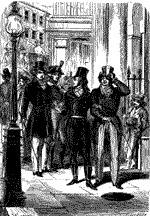
"WHO'S YOUR FAT FRIEND?"
Brummell was scotched rather than killed by the Prince's indifference. He at once resolved to patronise his brother, the Duke of York, and found in him a truer friend. The duchess, who had a particular fondness for dogs, of which she is said to have kept no fewer, at one time, than a hundred, added the puppy Brummell to the list, and treated him with a kindness in which little condescension was mixed. But neither impudence nor the blood-royal can keep a man out of debt, especially when he plays. The Beau got deeper and deeper into the difficulty, and at last some mysterious quarrel about money with a gentleman who thenceforward went by the name of Dick the Dandy-killer, obliged him to think of place and poverty in another land. He looked in vain for aid, and among others Scrope Davies was written to to lend him 'two hundred,' 'because his money was all in the three per cents.' Scrope replied laconically—
'MY DEAR GEORGE, 'It is very unfortunate, but my money is all in the three per cents. Yours, 'S. DAVIES,'
It was the last attempt. The Beau went to the opera, as usual, and drove away from it clear off to Dover, whence the packet took him to safety and slovenliness in the ancient town of Calais. His few effects were sold after his departure. Porcelaine, buhl, a drawing or two, double-barrelled Mantons (probably never used), plenty of old wine, linen, furniture, and a few well-bound books, were the Beau's assets. His debts were with half the chief tradesmen of the West End and a large number of his personal friends.
The climax is reached: henceforth Master George Bryan Brummell goes rapidly and gracefully down the hill of life.
The position of a Calais beggar was by no means a bad one, if the reduced individual had any claim whatever to distinction. A black-mail was sedulously levied by the outcasts and exiles of that town on every Englishman who passed through it; and in those days it was customary to pass some short time in this entrance of France. The English 'residents' were always on the look-out, generally crowding round the packet-boat, and the new arrival was sure to be accosted by some old and attached friend, who had not seen him for years. Just as Buttons, who is always breaking the plates and tumblers, has the invariable mode of accounting for his carelessness, 'they fell apart, sir, in my 'ands!' so these expatriated Britons had always a tale of confidence misplaced—security for a bond—bail for a delinquent, or in short any hard case, which compelled them, much against their wills, to remain 'for a period' on the shores of France. To such men, whom you had known in seven-guinea waistcoats at White's and Watier's, and found in seven-shilling coats on the Calais pier, it was impossible to refuse your five-pound note, and in time the black-mail of Calais came to be reckoned among the established expenses of a Continental tour.
Brummell was a distinguished beggar of this description, and managed so adroitly that the new arrivals thought themselves obliged by Mr. Brummell's acceptance of their donations. The man who could not eat cabbages, drive in a hackney-coach, or wear less than three shirts a day, was now supported by voluntary contributions, and did not see anything derogatory to a gentleman in their acceptance. If Brummell had now turned his talents to account; if he had practised his painting, in which he was not altogether despicable; or his poetry, in which he had already had some trifling success: if he had even engaged himself as a waiter at Quillacq's, or given lessons in the art of deportment, his fine friends from town might have cut him, but posterity would have withheld its blame. He was a beggar of the merriest kind. While he wrote letters to friends in England, asking for remittances, and describing his wretched condition on a bed of straw and eating bran bread, he had a good barrel of Dorchester ale in his lodgings, his usual glass of maraschino, and his bottle of claret after dinner; and though living on charity, could order new snuff-boxes to add to his collection, and new knick-knacks to adorn his room. There can be no pity for such a man, and we have no pity for him, whatever the rest of the world may feel.
Nothing can be more contemptible than the gradual downfall of the broken beau. Yet, if it were doubted that his soul ever rose above the collar of a coat or the brim of a hat, his letters to Mr. Raikes in the time of his poverty would settle the question. 'I heard of you the other day in a waistcoat that does you considerable credit, spick-and-span from Paris, a broad stripe, salmon-colour, and cramoisé. Don't let them laugh you into a relapse—into the Gothic—as that of your former English simplicity.' He speaks of the army of occupation as 'rascals in red coats waiting for embarkation.' 'English education,' he says in another letter, 'may be all very well to instruct the hemming of handkerchiefs, and the ungainly romps of a country-dance, but nothing else; and it would be a poor consolation to your declining years to see your daughters come into the room upon their elbows, and to find their accomplishments limited to broad native phraseology in conversation, or thumping the "Woodpecker" upon a discordant spinet.' And he proceeds to recommend a 'good French formation of manners,' and so forth.
Nor did he display any of that dignity and self-respect which are generally supposed to mark the 'gentleman.' When his late friend and foe, by this time a king, passed through Calais, the Beau, broken in every sense, had not pride enough to keep out of his way. Many stories are told of the manner in which he pressed himself into George IV.'s notice, but the various legends mostly turn upon a certain snuff-box. According to one quite as reliable as any other, the Prince and the Beau had in their days of amity intended to exchange snuff-boxes, and George the Greater had given George the Less an order on his jeweller for a tabatière with his portrait on the top. On their quarrel this order was, with very bad taste, rescinded, although Brummell's snuff-box had already passed into the Prince's hands and had not been returned. It is said that the Beau employed a friend to remind the king of this agreement, and ask for his box; to whom the latter said that the story was all nonsense, and that he supposed 'the poor devil,' meaning his late intimate friend, wanted £100 and should have it. However, it is doubtful if the money ever reached the 'poor devil.' The story does not tell over well, for whatever were the failings and faults of George IV., he seems to have had a certain amount of good nature, if not absolutely of good heart, and possessed, at least, sufficient sense of what became a prince, to prevent his doing so shabby an act, though he may have defrauded a hundred tradesmen. In these days there were such things as 'debts of honour,' and they were punctiliously attended to. There are, as we have said, various versions of this story, but all tend to show that Brummell courted the notice of his late master and patron on his way through the place of his exile; and it is not remarkable in a man who borrowed so freely from all his acquaintances, and who was, in fact, in such a state of dependence on their liberality.
Brummell made one grand mistake in his career as a Beau: he outlived himself. For some twenty-four years he survived his flight from England, to which country he never returned. For a time he was an assiduous writer of begging-letters and the plague of his friends. At length he obtained the appointment of consul at the good old Norman town of Caen. This was almost a sinecure, and the Beau took care to keep it so. But no one can account for the extraordinary step he took soon after entering on his consular duties. He wrote to Lord Palmerston, stating that there were no duties attached to the post, and recommending its abolition. This act of suicide is partly explained by a supposed desire to be appointed to some more lively and more lucrative consulate; but in this the Beau was mistaken. The consulate at Caen was vacated in accordance with his suggestion, and Brummell was left penniless, in debt, and to shift for himself. With the aid of an English tradesman, half grocer, half banker, he managed to get through a period of his poverty, but could not long subsist in this way, and the punishment of his vanity and extravagance came at last in his old age. A term of existence in prison did not cure him, and when he was liberated he again resumed his primrose gloves, his Eau de Cologne, and his patent vernis for his boots, though at that time literally supported by his friends with an allowance of £120 per annum. In the old days of Caen life this would have been equal to £300 a year in England, and certainly quite enough for any bachelor; but the Beau was really a fool. For whom, for what should he dress and polish his boots at such a quiet place as Caen? Yet he continued to do so, and to run into debt for the polish. When he confessed to having, 'so help him Heaven,' not four francs in the world, he was ordering this vernis de Guiton, at five francs a bottle, from Paris, and calling the provider of it a 'scoundrel,' because he ventured to ask for his money. What foppery, what folly was all this! How truly worthy of the man who built his fame on the reputation of a coat! Terrible indeed was the hardship that followed his extravagance; he was actually compelled to exchange his white for a black cravat. Poor martyr! after such a trial it is impossible to be hard upon him. So, too, the man who sent repeated begging-letters to the English grocer, Armstrong, threw out of window a new dressing-gown because it was not of the pattern he wished to have.
Retribution for all this folly came in time. His mind went even before his health. Though only some sixty years of age, almost the bloom of some men's life, he lost his memory and his powers of attention, His old ill-manners became positively bad manners. When feasted and feted, he could find nothing better to say than 'What a half-starved turkey.' At last the Beau was reduced to the level of that slovenliness which he had considered as the next step to perdition. Reduced to one pair of trousers, he had to remain in bed till they were mended. He grew indifferent to his personal appearance, the surest sign of decay. Drivelling, wretched, in debt, an object of contempt to all honest men, he dragged on a miserable existence. Still with his boots in holes, and all the honour of beau-dom gone for ever, he clung to the last to his Eau de Cologne, and some few other luxuries, and went down, a fool and a fop, to the grave. To indulge his silly tastes he had to part with one piece of property after another; and at length he was left with little else than the locks of hair of which he had once boasted.
I remember a story of a labourer and his dying wife. The poor woman was breathing her last wishes. 'And, I say, William, you'll see the old sow don't kill her young uns?'—'Ay, ay, wife, set thee good.' 'And, I say, William, you'll see Lizzy goes to schule reg'lar?'—'Ay, ay, wife, set thee good.' 'And, I say, William, you'll see Tommy's breeches is mended against he goes to schule again?'—'Ay, ay, wife, set thee good.'—'And, I say, William, you'll see I'm laid proper in the yard?' William grew impatient. 'Now never thee mind them things, wife, I'll see to 'em all, you just go on with your dying.' No doubt Brummell's friends heartily wished that he would go on with his dying, for he had already lived too long; but he would live on. He is described in his last days as a miserable, slovenly, half-witted old creature, creeping about to the houses of a few friends he retained or who were kind enough to notice him still, jeered at by the gamins, and remarkable now, not for the cleanliness, but the filthiness and raggedness of his attire.
Poor old fool! one cannot but pity him, when wretched, friendless, and miserable as he was, we find him, still graceful, in a poor café near the Place Royale, taking his cup of coffee, and when asked for the amount of his bill, answering very vaguely, 'Oui, Madame, à la pleine lune, à la pleine lune.'
The drivellings of old age are no fit subject for ridicule, yet in the case of a man who had sneered so freely at his fellow-creatures, they may afford a useful lesson. One of his fancies was to give imaginary parties, when his tallow dips were all set alight and his servant announced with proper decorum, 'The Duchess of Devonshire,' 'Lord Alvanley, 'Mr. Sheridan,' or whom not. The poor old idiot received the imaginary visitors with the old bow, and talked to them in the old strain, till his servant announced their imaginary carriages, and he was put drivelling to bed. At last the idiocy became mania. He burnt his books, his relics, his tokens. He ate enormously, and the man who had looked upon beer as the ne plus ultra of vulgarity, was glad to imagine it champagne. Let us not follow the poor maniac through his wanderings. Rather let us throw a veil over all his drivelling wretchedness, and find him at his last gasp, when coat and collar, hat and brim, were all forgotten, when the man who had worn three shirts a day was content to change his linen once a month. What a lesson, what a warning! If Brummell had come to this pass in England, it is hard to say how and where he would have died. He was now utterly penniless, and had no prospect of receiving any remittances. It was determined to remove him to the Hospice du Bon Sauveur, a Maison de Charité, where he would be well cared for at no expense. The mania of the poor creature took, as ever, the turn of external preparation. When the landlord of his inn entered to try and induce him to go, he found him with his wig on his knee, his shaving apparatus by his side, and the quondam beau deeply interested in lathering the peruke as a preliminary to shearing it. He resisted every proposal to move, and was carried down stairs, kicking and shrieking. Once lodged in the Hospice, he was treated by the soeurs de charité with the greatest kindness and consideration. An attempt was made to recall him to a sense of his future peril, that he might at least die in a more religious mood than he had lived; but in vain. It is not for us, erring and sinful as we are, to judge any fellow-creature; but perhaps poor Brummell was the last man to whom religion had a meaning. His heart was good; his sins were more those of vanity than those of hate; it may be that they are regarded mercifully where the fund of mercy is unbounded. God grant that they may be so; or who of us would escape? None but fiends will triumph over the death of any man in sin. Men are not fiends; they must and will always feel for their fellow-men, let them die as they will. No doubt Brummell was a fool—a fool of the first water, but that he was equally a knave was not so certain. Let it never be certain to blind man, who cannot read the heart, that any man is a knave. He died on the 30th of March, 1840, and so the last of the Beaux passed away. People have claimed, indeed for D'Orsay, the honour of Brummell's descending mantle, but D'Orsay was not strictly a beau, for he had other and higher tastes than mere dress. It has never been advanced that Brummell's heart was bad, in spite of his many faults. Vanity did all. Vanitas vanitatem. O young men of this age, be warned by a Beau, and flee his doubtful reputation! Peace then to the coat-thinker. Peace to all—to the worst. Let us look within and not judge. It is enough that we are not tried in the same balance.
THEODORE EDWARD HOOK.
The Greatest of Modern Wits.—-What Coleridge said of Hook.—Hook's Family.—Redeeming Points.—Versatility.—Varieties of Hoaxing.—The Black-wafered Horse.—The Berners Street Hoax.—Success of the Scheme.— The Strop of Hunger.—Kitchen Examinations.—The Wrong House.—Angling for an Invitation.—The Hackney-coach Device.—The Plots of Hook and Mathews.—Hook's Talents as an Improvisatore.—The Gift becomes his Bane.—Hook's Novels.—College Fun.—Baiting a Proctor.—The Punning Faculty.—Official Life Opens.—Troublesome Pleasantry.—Charge of Embezzlement.—Misfortune.—Doubly Disgraced.—No Effort to remove the Stain.—Attacks on the Queen.—An Incongruous Mixture.—Specimen of the Ramsbottom Letters.—Hook's Scurrility.—Fortune and Popularity.—The End.
If it be difficult to say what wit is, it is well nigh as hard to pronounce what is not wit. In a sad world, mirth hath its full honour, let it come in rags or in purple raiment. The age that patronises a 'Punch' every Saturday? and a pantomime every Christmas, has no right to complain, if it finds itself barren of wits, while a rival age has brought forth her dozens. Mirth is, no doubt, very good. We would see more, not less, of it in this unmirthful land. We would fain imagine the shrunken-cheeked factory-girl singing to herself a happy burthen, as she shifts the loom,—the burthen of her life, and fain believe that the voice was innocent as the sky-lark's. But if it be not so—and we know it is not so—shall we quarrel with any one who tries to give the poor care-worn, money-singing public a little laughter for a few pence? No, truly, but it does not follow that the man who raises a titter is, of necessity, a wit. The next age, perchance, will write a book of 'Wits and Beaux,' in which Mr. Douglas Jerrold, Mr. Mark Lemon, and so on, will represent the wit of this passing day; and that future age will not ask so nicely what wit is, and not look for that last solved of riddles, its definition. Hook has been, by common consent, placed at the head of modern wits. When kings were kings, they bullied, beat, and and brow-beat their jesters. Now and then they treated them to a few years in the Tower for a little extra impudence. Now that the people are sovereign, the jester fares better—nay, too well. His books or his bon-mots are read with zest and grins; he is invited to his Grace's and implored to my Lord's; he is waited for, watched, pampered like a small Grand Lama, and, in one sentence, the greater the fool, the more fools he makes.
If Theodore Hook had lived in the stirring days of King Henry VIII., he would have sent Messrs. Patch and Co. sharply to the right-about, and been presented with the caps and bells after his first comic song. No doubt he was a jester, a fool in many senses, though he did not, like Solomon's fool, 'say in his heart' very much. He jested away even the practicals of life, jested himself into disgrace, into prison, into contempt, into the basest employment—that of a libeller tacked on to a party. He was a mimic, too, to whom none could send a challenge; an improvisatore, who beat Italians, Tyroleans, and Styrians hollow, sir, hollow. And lastly—oh! shame of the shuffle-tongued—he was, too, a punster. Yes, one who gloried in puns, a maker of pun upon pun, a man whose whole wit ran into a pun as readily as water rushes into a hollow, who could not keep out of a pun, let him loathe it or not, and who made some of the best and some of the worst on record, but still—puns.
If he was a wit withal, it was malgré soi, for fun, not for wit, was his 'aspiration.' Yet the world calls him a wit, and he has a claim to his niche. There were, it is true, many a man in his own set who had more real wit. There were James Smith, Thomas Ingoldsby, Tom Hill, and others. Out of his set, but of his time, there was Sydney Smith, ten times more a wit: but Theodore could amuse, Theodore could astonish, Theodore could be at home anywhere; he had all the impudence, all the readiness, all the indifference of a jester, and a jester he was.
Let any one look at his portrait, and he will doubt if this be the king's jester, painted by Holbein, or Mr. Theodore Hook, painted by Eddis. The short, thick nose, the long upper lip, the sensual, whimsical mouth, the twinkling eyes, all belong to the regular maker of fun. Hook was a certificated jester, with a lenient society to hear and applaud him, instead of an irritable tyrant to keep him in order: and he filled his post well. Whether he was more than a jester may well be doubted; yet Coleridge, when he heard him, said: 'I have before in my time met with men of admirable promptitude of intellectual power and play of wit, which, as Stillingfleet says:
"The rays of wit gild wheresoe'er they strike,"
but I never could have conceived such readiness of mind and resources of genius to be poured out on the mere subject and impulse of the moment.' The poet was wrong in one respect. Genius can in no sense be applied to Hook, though readiness was his chief charm.
The famous Theodore was born in the same year as Byron, 1788, the one on the 22nd of January, the other on the 22nd of September; so the poet was only nine months his senior. Hook, like many other wits, was a second son. Ladies of sixty or seventy well remember the name of Hook as that which accompanied their earliest miseries. It was in learning Hook's exercises, or primers, or whatever they were called, that they first had their fingers slapped over the piano-forte. The father of Theodore, no doubt, was the unwitting cause of much unhappiness to many a young lady in her teens. Hook père was an organist at Norwich. He came up to town, and was engaged at Marylebone Gardens and at Vauxhall; so that Theodore had no excuse for being of decidedly plebeian origin, and, Tory as he was, he was not fool enough to aspire to patricianism.
The younger son of 'Hook's Exercises' developed early enough a taste for ingenious lying—so much admired in his predecessor—Sheridan, He 'fancied himself' a genius, and therefore, from school-age, not amenable to the common laws of ordinary men. Frequenters of the now fashionable prize-ring—thanks to two brutes who have brought that degraded pastime into prominent notice—will hear a great deal about a man 'fancying himself.' It is common slang and heeds little explanation. Hook 'fancied himself' from an early period, and continued to 'fancy himself,' in spite of repeated disgraces, till a very mature age. At Harrow, he was the contemporary, but scarcely the friend, of Lord Byron. No two characters could have been more unlike. Every one knows, more or less, what Byron's was; it need only be said that Hook's was the reverse of it in every respect. Byron felt where Hook laughed. Byron was morbid where Hook was gay. Byron abjured with disgust the social vices to which he was introduced; Hook fell in with them. Byron indulged in vice in a romantic way; Hook in the coarsest. There is some excuse for Byron, much as he has been blamed. There is little or no excuse for Hook, much as his faults have been palliated. The fact is that goodness of heart will soften, in men's minds, any or all misdemeanours. Hook, in spite of many vulgar witticisms and cruel jokes, seems to have had a really good heart.
I have it on the authority of one of Hook's most intimate friends, that he was capable of any act of kindness, and by way of instance of his goodness of heart, I am told by the same person that he on one occasion quitted all his town amusements to solace the spirit of a friend in the country who was in serious trouble. I, of course, refrain from giving names: but the same person informs me that much of his time was devoted in a like manner, to relieving, as far as possible, the anxiety of his friends, often, indeed, arising from his own carelessness. It is due to Hook to make this impartial statement before entering on a sketch of his 'Sayings and Doings,' which must necessarily leave the impression that he was a heartless man.
Old Hook, the father, soon perceived the value of his son's talents; and, determined to turn them to account, encouraged his natural inclination to song-writing. At the age of sixteen Theodore wrote a kind of comic opera, to which his father supplied the music. This was called 'The Soldier's Return.' It was followed by others, and young Hook, not yet out of his teens, managed to keep a Drury Lane audience alive, as well as himself and family. It must be remembered, however, that Liston and Matthews could make almost any piece amusing. The young author was introduced behind the scenes through his father's connection with the theatre, and often played the fool under the stage while others were playing it for him above it, practical jokes being a passion with him which he developed thus early. These tricks were not always very good-natured, which may be said of many of his jokes out of the theatre.
He soon showed evidence of another talent, that of acting as well as writing pieces. Assurance was one of the main features of his character, and to it he owed his success in society; but it is a remarkable fact, that on his first appearance before an audience he entirely lost all his nerve, turned pale, and could scarcely utter a syllable. He rapidly recovered, however, and from this time became a favourite performer in private theatricals, in which he was supported by Mathews and Mrs. Mathews, and some amateurs who were almost equal to any professional actors. His attempts were, of course, chiefly in broad farce and roaring burlesque, in which his comic face, with its look of mock gravity, and the twinkle of the eyes, itself excited roars of laughter. Whether he would have succeeded as well in sober comedy or upon public boards may well be doubted. Probably he would not have given to the profession that careful attention and entire devotion that are necessary to bring forward properly the highest natural talents. It is said that for a long time he was anxious to take to the stage as, a profession, but, perhaps—as the event seems to show—unfortunately for him, he was dissuaded from what his friends must have thought a very rash step, and in after years he took a violent dislike to the profession. Certainly the stage could not have offered more temptations than did the society in which he afterwards mixed; and perhaps under any circumstances Hook, whose moral education had been neglected, and whose principles were never very good, would have lived a life more or less vicious, though he might not have died as he did.
Hook, however, was not long in coming very prominently before the public in another capacity. Of all stories told about him, none are more common or more popular than those which relate to his practical jokes and hoaxes. Thank heaven, the world no longer sees amusement in the misery of others, and the fashion of such clever performance is gone out. It is fair, however, to premise, that while the cleverest of Hook's hoaxes were of a victimizing character, a large number were just the reverse, and his admirers affirm, not without some reason, that when he had got a dinner out of a person whom he did not know, by an ingenious lie, admirably supported, he fully paid for it in the amusement he afforded his host and the ringing metal of his wit. As we have all been boys—except those that were girls—and not all of us very good boys, we can appreciate that passion for robbery which began with orchards and passed on to knockers. It is difficult to sober middle-age to imagine what entertainment there can be in that breach of the eighth commandment, which is generally regarded as innocent. As Sheridan swindled in fun, so Hook, as a young man, robbed in fun, as hundreds of medical students and others have done before and since. Hook, however, was a proficient in the art, and would have made a successful 'cracksman' had he been born in the Seven Dials. He collected a complete museum of knockers, bell-pulls, wooden Highlanders, barbers' poles, and shop signs of all sorts. On one occasion he devoted a whole fortnight to the abstraction of a golden eagle over a shop window, by means of a lasso. A fellow dilettante in the art had confidentially informed him of its whereabouts, adding that he himself despaired of ever obtaining it. At length Hook invited his friend to dinner, and on the removal of the cover of what was supposed to be the joint, the work of art appeared served up and appropriately garnished. Theodore was radiant with triumph; but the friend, probably thinking that there ought to be honour among thieves, was highly indignant at being thus surpassed.
Another achievement of this kind was the robbery of a life-sized Highlander, who graced the door of some unsuspecting tobacconist. There was little difficulty in the mere displacement of the figure; the troublesome part of the business was to get the bare legged Celt home to the museum, where probably many a Lilliputian of his race was already awaiting him. A cloak, a hat, and Hook's ready wit effected the transfer. The first was thrown over him, the second set upon his bonneted head, and a passing hackney coach hailed by his captor, who before the unsuspecting driver could descend, had opened the door, pushed in the prize, and whispered to Jehu, 'My friend—very respectable man but rather tipsy.' How he managed to get him out again at the end of the journey we are not told.
Hook was soon a successful and valuable writer of light pieces for the stage. But farces do not live, and few of Hook's are now favourites with a public which is always athirst for something new. The incidents of most of the pieces—many of them borrowed from the French—excited laughter by their very improbability; but the wit which enlivened them was not of a high order, and Hook, though so much more recent than Sheridan, has disappeared before him.
But his hoaxes were far more famous than his collection of curiosities, and quite as much to the purpose; and the imprudence he displayed in them was only equalled by the quaintness of the humour which suggested them. Who else would have ever thought, for instance, of covering a white horse with black wafers, and driving it in a gig along a Welsh high-road, merely for the satisfaction of being stared at? It was almost worthy of Barnum. Or who, with less assurance, could have played so admirably on the credulity of a lady and daughters fresh from the country as he did, at the trial of Lord Melville? The lady, who stood next to him, was, naturally, anxious to understand the proceedings, and betrayed her ignorance at once by a remark which she made to her daughter about the procession of the Lords into the House. When the bishops entered in full episcopal costume, she applied to Hook to know who were 'those gentlemen?' 'Gentlemen,' quoth Hook, with charming simplicity; 'ladies, I think you mean; at any rate, those are the dowager peeresses in their own right.' Question followed question as the procession came on, and Theodore indulged his fancy more and more. At length the Speaker, in full robes, became the subject of inquiry. 'And pray, sir, who is that fine looking person?'—'That, ma'am, is Cardinal Wolsey,' was the calm and audacious reply. This was too much even for Sussex; and the lady drew herself up in majestic indignation. 'We know better than that, sir,' she replied: 'Cardinal Wolsey has been dead many a good year.' Theodore was unmoved. 'No such thing, my dear madam,' he answered, without the slightest sign of perturbation: 'I know it has been generally reported so in the country, but without the slightest foundation; the newspapers, you know, will say anything.'
But the hoax of hoaxes, the one which filled the papers of the time for several days, and which, eventually, made its author the very prince of hoaxsters, if such a term can be admitted, was that of Berners Street. Never, perhaps, was so much trouble expended, or so much attention devoted, to so frivolous an object. In Berners Street there lived an elderly lady, who, for no reason that can be ascertained, had excited the animosity of the young Theodore Hook, who was then just of age. Six weeks were spent in preparation, and three persons engaged in the affair. Letters were sent off in every direction, and Theodore Hook's autograph, if it could have any value, must have been somewhat low in the market at that period, from the number of applications which he wrote. On the day in question he and his accomplices seated themselves at a window in Berners Street, opposite to that unfortunate Mrs. Tottenham, of No 54, and there enjoyed the fun. Advertisements, announcements, letters, circulars, and what not, had been most freely issued, and were as freely responded to. A score of sweeps, all 'invited to attend professionally,' opened the ball at a very early hour, and claimed admittance, in virtue of the notice they had received. The maid-servant had only just time to assure them that all the chimneys were clean, and their services were not required, when some dozen of coal-carts drew up as near as possible to the ill-fated house. New protestations, new indignation. The grimy and irate coalheavers were still being discoursed with, when a bevy of neat and polite individuals arrived from different quarters, bearing each under his arm a splendid ten-guinea wedding-cake. The maid grew distracted; her mistress was single, and had no intention of doubling herself; there must be some mistake; the confectioners were dismissed, in a very different humour to that with which they had come. But they were scarcely gone when crowds began to storm the house, all 'on business.' Rival doctors met in astonishment and disgust, prepared for an accouchement; undertakers stared one another mutely in the face, as they deposited at the door coffins made to order—elm or oak—so many feet and so many inches; the clergymen of all the neighbouring parishes, high church or low church, were ready to minister to the spiritual wants of the unfortunate moribund, but retired in disgust when they found that some forty fishmongers had been engaged to purvey 'cod's head and lobsters' for a person professing to be on the brink of the grave.
The street now became the scene of fearful distraction. Furious tradesmen of every kind were ringing the house-bell, and rapping the knocker for admittance—such, at least, as could press through the crowd as far as the house. Bootmakers arrived with Hessians and Wellingtons—'as per order'—or the most delicate of dancing-shoes for the sober old lady; haberdashers had brought the last new thing in evening dress, 'quite the fashion,' and 'very chaste:' hat-makers from Lincoln and Bennett down to the Hebrew vendor in Marylebone Lane, arrived with their crown-pieces; butchers' boys, on stout little nags, could not get near enough to deliver the legs of mutton which had been ordered; the lumbering coal-carts 'still stopped the way.' A crowd—the easiest curiosity in the world to collect—soon gathered round the motley mob of butchers, bakers, candlestick-makers, and makers and sellers of everything else that mortal can want; the mob thronged the pavement, the carts filled the road, and soon the carriages of the noble of the land dashed up in all the panoply of state, and a demand was made to clear the way for the Duke of Gloucester, for the Governor of the Bank, the Chairman of the East India Company, and last, but, oh! not least, the grandee whose successor the originator of the plot afterwards so admirably satirized—the great Lord Mayor himself. The consternation, disgust, and terror of the elderly female, the delight and chuckling of Theodore and his accomplices, seated at a window on the opposite side of the road, 'can be more easily imagined than described;' but what were the feelings of tradesmen, professional men, gentlemen, noblemen, and grand officials, who had been summoned from distant spots by artful lures to No. 54, and there battled with a crowd in vain only to find that there were hoaxed; people who had thus lost both time and money, can be neither described nor imagined. It was not the idea of the hoax—simple enough in itself—which was entitled to the admiration accorded to ingenuity, but its extent and success, and the clever means taken by the conspirators to insure the attendance of every one who ought not to have been there. It was only late at night that the police succeeded in clearing the street, and the dupes retired, murmuring and vowing vengeance. Hook, however, gloried in the exploit, which he thought 'perfect.'
But the hoaxing dearest to Theodore—for there was something to be gained by it—-was that by which he managed to obtain a dinner when either too hard-up to pay for one, or in the humour for a little amusement. No one who has not lived as a bachelor in London and been reduced—-in respect of coin—to the sum of twopence-halfpenny, can tell how excellent a strop is hunger to sharpen wit upon. We all know that
'Mortals with stomachs can't live without dinner;'
and in Hook's day the substitute of 'heavy teas' was not invented. Necessity is very soon brought to bed, when a man puts his fingers into his pockets, finds them untenanted, and remembers that the only friend who would consent to lend him five shillings is gone out of town; and the infant, Invention, presently smiles into the nurse's face. But it was no uncommon thing in those days for gentlemen to invite themselves where they listed, and stay as long as they liked. It was only necessary for them to make themselves really agreeable, and deceive their host in some way or other. Hook's friend, little Tom Hill, of whom it was said that he knew everybody's affairs far better than they did themselves, was famous for examining kitchens about the hour of dinner, and quietly selecting his host according to the odour of the viands. It is of him that the old 'Joe Miller' is told of the 'haunch of venison.' Invited to dinner at one house, he happens to glance down into the kitchen of the next, and seeing a tempting haunch of venison on the spit, throws over the inviter, and ingratiates himself with his neighbour, who ends by asking him to stay to dinner. The fare, however, consisted of nothing more luxurious than an Irish stew, and the disappointed guest was informed that he had been 'too cunning by half,' inasmuch as the venison belonged to his original inviter, and had been cooked in the house he was in by kind permission, because the chimney of the owner's kitchen smoked.
The same principle often actuated Theodore; and, indeed, there are few stories which can be told of this characteristic of the great frolicker, which have not been told a century of times.
For instance: two young men are strolling, towards 5 P.M., in the then fashionable neighbourhood of Soho; the one is Terry, the actor—the other, Hook, the actor, for surely he deserves the title. They pass a house, and sniff the viands cooking underground. Hook quietly announces his intention of dining there. He enters, is admitted and announced by the servant, mingles with the company, and is quite at home before he is perceived by the host. At last the dénouement came; the dinner-giver approached the stranger, and with great politeness asked his name. 'Smith' was, of course, the reply, and reverting to mistakes made by servants in announcing, &c., 'Smith' hurried off into an amusing story, to put his host in good humour. The conversation that followed is taken from 'Ingoldsby':—
'But, really, my dear sir,' the host put in, 'I think the mistake on the present occasion does not originate in the source you allude to; I certainly did not anticipate the honour of Mr. Smith's company to-day.'
'No, I dare say not. You said four in your note, I know, and it is now, I see, a quarter past five; but the fact is, I have been detained in the City, as I was going to explain—'
'Pray,' said the host, 'whom do you suppose you are addressing?'
'Whom? why Mr. Thompson, of course, old friend of my father. I have not the pleasure, indeed, of being personally known to you, but having received your kind invitation yesterday,' &c. &c.
'No, sir, my name is not Thompson, but Jones,' in highly indignant accents.
'Jones!' was the well-acted answer: 'why, surely, I cannot have—yes I must—good heaven! I see it all. My dear sir, what an unfortunate blunder; wrong house—what must you think of such an intrusion? I am really at a loss for words in which to apologize; you will permit me to retire at present, and to-morrow—'
'Pray, don't think of retiring,' rejoined the host, taken with the appearance and manner of the young man. 'Your friend's table must have been cleared long ago, if, as you say, four was the hour named, and I am too happy to be able to offer you a seat at mine.'
It may be easily conceived that the invitation had not to be very often repeated, and Hook kept the risible muscles of the company upon the constant stretch, and paid for the entertainment in the only coin with which he was well supplied.
There was more wit, however, in his visit to a retired watchmaker, who had got from government a premium of £10,000 for the best chronometer. Hook was very partial to journeys in search of adventure; a gig, a lively companion, and sixpence for the first turnpike being generally all that was requisite; ingenuity supplied the rest. It was on one of these excursions, that Hook and his friend found themselves in the neighbourhood of Uxbridge, with a horse and a gig, and not a sixpence to be found in any pocket. Now a horse and gig are property, but of what use is a valuable of which you cannot dispose or deposit at a pawnbroker's, while you are prevented proceeding on your way by that neat white gate with the neat white box of a house at its side? The only alternative left to the young men was to drive home again, dinnerless, a distance of twenty miles, with a jaded horse, or to find gratuitous accommodation for man and beast. In such a case Sheridan would simply have driven to the first inn, and by persuasion or stratagem contrived to elude payment, after having drunk the best wine and eaten the best dinner the house could afford. Hook was really more refined, as well as bolder in his pillaging.