William Le Queux (continued 2)
Reading edition
“I’ve sent no one,” I responded, astounded at this fresh phase of the affair. “What kind of lady was she—old or young?”
“Middle-aged.”
“Well-dressed?”
“Yes, sir. She spoke with a funny kind of lisp, which made me think she might be a foreigner. She said she knew you quite well, being a friend of your aunt’s, and that you were travelling down to Hampshire this morning, your uncle having been taken ill. I remarked that it was strange that you shouldn’t come home for your bag and things, but she gave me a message from you to send a bag packed with your clothes by train from Waterloo to Christchurch Station marked ‘To be called for.’”
“But didn’t you think her story a very lame one, Parker?” I asked, angry that my old serving-woman should have thus been misled and deceived.
“Of course I did, sir, especially as you were absent all night. I told her that, and she said that you had called upon her, and finding your aunt, Lady Durrant, there on a visit, remained to supper. While at supper a telegram had arrived summoning your aunt home, as your uncle had been taken dangerously ill, and at once you had resolved to accompany her. But you’ve hurt your head, sir, haven’t you?” she added, noticing my bandages.
“Yes,” I answered. “I fell down. It is nothing—my own carelessness.”
The story was, to say the least, a most ingenious one. Whoever the mysterious woman was she apparently knew that my uncle, Sir Charles Durrant, lived in the neighbourhood of Christchurch; that he was at that moment in a very critical state of health, suffering from paralysis, and further, that I had considerable expectations from him, and would not hesitate to travel down to see him if I knew him to be worse. One thing, therefore, was quite plain, namely, that my family affairs were perfectly well known to these persons whose movements were so mystifying.
“It was foolish of you, Parker, very foolish indeed, to have given credence to such an absurd tale as that,” I said, annoyed. “You are usually a shrewd woman, but you have displayed no discretion in this affair—none whatever.”
“I’m very sorry, sir,” the woman answered. “But I knew that if Sir Charles were worse you’d go down to the Manor at once. Did you really send nobody, sir?”
“No; nobody at all. There’s some underhand business in all this, Parker, so keep your wits about you.”
“And haven’t you seen her ladyship at all, sir?” she inquired, in her turn astonished.
“No, and, moreover, I know nothing of this mysterious woman who came to you with this cock-and-bull story. Did she say where she lived, or give any card?”
“No, she didn’t, sir.”
“I suppose you’d know her again if you saw her?”
“Well,” she answered with considerable hesitancy, “I don’t know as I should, sir. You see, she wore one of them white lace veils which makes it difficult to distinguish the features.”
“But what object could any one have in coming to you and telling a falsehood in that manner?” I cried, my anger increased by the knowledge of Parker’s inability to again recognise the bearer of the false message.
“I don’t know, I’m sure, sir,” was the woman’s reply, in a voice which showed how deeply she regretted the occurrence.
“How long was she here?” I inquired.
“About five minutes. She asked me to let her see your sitting-room and the reading-books with the embossed letters, as she was much interested in you, and had heard so much of you from Lady Durrant.”
“And you showed them to her?”
“Yes, sir.”
“Then you had no right to do so without my permission, Parker,” I said angrily. “You are an old and trusted servant, and should have known better.”
“I’m very sorry, sir. The truth was that she seemed such a well-spoken lady, and her manner was so perfect that I thought you would not like to offend her.”
“Recollect that if any other persons call they are not to enter my rooms on any pretext,” I said decisively.
“Very well, sir. I acknowledge that I was entirely in the wrong in allowing her to pry about the place.”
“And when she had gone?”
“Then I went over to the butcher’s in the Strand to get a bit of steak.”
“And saw nothing more of her?”
“Yes, sir. I did see her again. As I was coming back I met her in the Strand, at the corner of Arundel Street, walking with a gentleman who looked like a City man. She said something to him, and he turned and had a good look at me.”
“Then it must have been this same woman who was in my chambers here when I returned,” I said.
“A woman here?” she ejaculated.
“Yes; when I entered there was a woman here, and she escaped as though she were a thief. She must have gone out and rejoined the man, who was awaiting her somewhere in the vicinity. That would bear out the fact that you encountered her again.”
“But how could she get in? I’m always careful to see that the door is properly closed.”
“Probably she stole the extra latch-key while prying about the place. See whether it is still on the nail.” She crossed the room, and next moment gasped—“It’s gone, sir!”
“Ah!” I said. “Just as I thought! The story she told you was a mere excuse to obtain admittance to the place, and, if possible, to get possession of the key. This she obtained, and, having watched you out, returned and continued her search for something she desired to secure. We must at once examine the whole place, and seek to discover what’s been stolen.”
“Do you think she was a common thief, sir?” inquired Parker, dumbfounded by the ingenuity with which the latch-key had been secured.
“I don’t know what to believe at present,” I answered. “We must investigate first, and form our conclusions afterwards. Now, make a thorough search and see what has been disturbed and what is missing.”
I had no intention of entering into a long explanation with Parker regarding the events of that fateful night, or to disturb her peace of mind by relating any of the tragic circumstances. Therefore, I went to my room and locked away my muddy, blood-stained clothing, and afterwards returned, and with my hands felt the various objects in my sitting-room, to assure myself that none was displaced or missing.
Chapter Eight.
The Stranger.
The visit of this mysterious woman in the white lace veil—at that time a fashionable feminine adornment—was, I felt assured, more than a coincidence. That it had some connexion with the strange events of the past night seemed certain, yet, try how I would, I could form no definite idea of either the motive of the visit or the object of her search. As far as Parker could discover, nothing whatever had been taken. A writing-table, the drawers of which contained some family papers, had apparently been hastily examined, but no object of value, nor any paper, had been extracted. Therefore I concluded that I had returned before the intruder had had time to make the complete examination of my effects which she had intended.
A curious thought occurred to me. Was the intruder in the white veil none other than the mysterious Edna herself?
As the day wore on I became more and more impressed by the belief that my surmise was the actual truth. Yet the cabman West had declared that she was young and pretty, while Parker expressed herself positive that she was middle-aged. But of the two statements I accepted that of the cabman as the more reliable. He had seen her in the broad daylight without the veil.
The fact of her concealing her features in a species of fine window-curtain proved an attempt at disguise, therefore what more likely than that she should contrive to render her features older, and thus impose upon Parker, whose sight was not over good? In any case, however, if it were really Edna, she had certainly lost no time in carrying out her design, and further, she must have been fully aware of my intended return.
Days passed, hot blazing days and stifling nights, when the dust of throbbing, ever-roaring London seemed over my heart. Each morning, with Parker’s assistance, I searched the newspapers, but nothing appeared to show that that strange midnight crime had been discovered. Were there two victims, or only one? How strange it was that although I had been present I could not tell I only knew that the male victim was young and well-dressed, probably a gentleman, and that he had been stabbed by a cowardly blow which had proved almost instantly fatal. That woman’s scream that had sounded so shrill and agonised in the dead stillness of the night I remembered plainly as though it were but an hour ago—indeed, I remember it now as distinctly as ever. Was it the cry of Edna herself?
In my helplessness I could do nothing but remain silent, and keep my terrible secret to myself. Unable either to communicate with the police or seek the assistance of my friend, I found that any endeavour to seek a solution of the problem was mere sowing of the wind. My thoughts hour by hour, as I sat alone in my dingy room, my poor blind eyes a black void, were of the ghastly affair, and in all its phases I considered it, trying to find some motive in the subsequent actions of the unscrupulous persons into whose hands I had had the misfortune to fall.
I heard of Dick through the office of his journal. He was down with fever at some outlandish place on the Afghan frontier, and would certainly not be home for a couple of months or so.
At first I was puzzled how to get rid of my soiled and blood-stained clothes so that Parker should not discover them, and at last hit upon the expedient of making them into a bundle and going forth one night when she was over at Kennington with her daughter Lily, the dancing-girl, and casting them into the Thames from the Embankment. It was a risky operation, for that part of London is well guarded by police after dark; nevertheless I accomplished it in safety, and was much amused a few days later by reading in an evening paper that they had been found near London Bridge and handed over to the river police, who, of course, scented a mystery. The blood-stains puzzled them, and the journal hinted that Scotland Yard had instituted inquiries into the ownership of the discarded suit of clothes. The paragraph concluded with that sentence, indispensable in reporting a mystery, “The police are very reticent about the matter.”
Fortunately, having cut out the maker’s name, and taken everything from the pockets which might serve as a clue to ownership, I felt perfectly safe, and eagerly read the issue of the same journal on the following evening, which told how the stains had been analysed, and found to be those of human blood.
A little more than a week had passed since my remarkable midnight adventure, when one morning I received a brief note by post, which Parker read to me. It consisted of only two typewritten lines stating that at mid-day I would receive a visitor, and was signed with the strange word “AVEL.”
It was, I knew, a message from Edna, and I dressed myself with greater care in expectation that she herself would visit me. In this, however, I was disappointed, for after existing some three hours on tiptoe with anxiety I found my visitor to be a well-spoken, middle-aged man, whose slight accent when introducing himself betrayed that he was an American.
When we were alone, with the door closed, he made the following explanation—
“I have called upon you, Mr Heaton, at the request of a lady who is our mutual friend. You have, I presume, received a letter signed ‘Avel’?”
“Yes,” I said, remembering how that I had promised to blindly and obediently render my protectress whatever assistance she desired. “I presume you desire some service of me. What is it?”
“No,” he said. “You are mistaken. It is with regard to the terrible affliction from which I see you are suffering that I have been sent.”
“Are you a medical man?” I inquired, with some astonishment.
“I am an oculist,” was his reply.
“And your name?”
“Slade—James Slade.”
“And you have been sent here by whom?”
“By a lady whose real name I do not know.”
“But you will kindly explain, before we go further, the circumstance in which she sought your aid on my behalf,” I said firmly.
“You are mutual friends,” he answered, somewhat vaguely. “It is no unusual thing for a patient to seek my aid on behalf of a friend. She sent me here to see you, and to examine your eyes, if you will kindly permit me.”
The man’s bearing irritated me, and I was inclined to resent this enforced subjection to an examination by one of whose reputation I knew absolutely nothing. Some of the greatest oculists in the world had looked into my sightless eyes and pronounced my case utterly hopeless. Therefore I had no desire to be tinkered with by this man, who, for aught I knew, might be a quack whose sole desire was to run up a long bill.
“I have no necessity for your aid,” I answered, somewhat bluntly. “Therefore any examination is entirely waste of time.”
“But surely the sight is one of God’s most precious gifts to man,” he answered, in a smooth, pleasant voice; “and if a cure is possible, you yourself would, I think, welcome it.”
“I don’t deny that,” I answered. “I would give half that I possess—nay, more—to have my sight restored, but Sir Leopold Fry, Dr Measom, and Harker Halliday have all three seen me, and agree in their opinion that my sight is totally lost for ever. You probably know them as specialists?”
“Exactly. They are the first men in my profession,” he answered. “Yet sometimes one treatment succeeds where another fails. Mine is entirely and totally different to theirs, and has, I may remark, been successful in quite a number of cases which were pronounced hopeless.”
Mere quackery, I thought. I am no believer in new treatments and new medicines. The fellow’s style of talk prejudiced me against him. He actually placed himself in direct opposition to the practice of the three greatest oculists in the world.
“Then you believe that you can actually cure me?” I remarked, with an incredulous smile.
“All I ask is to be permitted to try,” he answered blandly, in no way annoyed by my undisguised sneer.
“Plainly speaking,” I answered, “I have neither inclination nor intention to place myself at your disposal for experiments. My case has been pronounced hopeless by the three greatest of living specialists, and I am content to abide by their decision.”
“Oculists are liable to draw wrong conclusions, just as other persons may do,” he remarked. “In a matter of this magnitude you should—permit me to say so—endeavour to regain your sight and embrace any treatment likely to be successful. Blindness is one of man’s most terrible afflictions, and assuredly no living person who is blind would wish to remain so.”
“I have every desire to regain my sight, but I repeat that I have no faith whatever in new treatment.”
“Your view is not at all unnatural, bearing in mind the fact that you have been pronounced incurable by the first men of the profession,” he answered. “But may I not make an examination of your eyes? It is, of course, impossible to speak with any degree of authority without a diagnosis. You appear to think me a charlatan. Well, for the present I am content that you should regard me as such;” and he laughed as though amused.
He seemed so perfectly confident in his own powers that I confess my hastily formed opinion became moderated and my prejudice weakened. He spoke as though he had detected the disease which had deprived me of vision, and knew how to successfully combat it.
“Will you kindly come forward to the window?” he requested, without giving me time to reply to his previous observations. I obeyed his wish.
Then I felt his fingers open my eyelids wide, and knew that he was gazing into my eyes through one of those glasses like other oculists had used. He took a long time over the right eye, which he examined first, then having apparently satisfied himself, he opened the left, felt it carefully, and touched the surface, of the eyeball, causing me a twinge of pain.
“As I thought!” he ejaculated when he had finished. “As I thought! A slight operation only is necessary. The specialists whom you consulted were wrong in their conclusions. They have all three made an error which is very easy to make, yet it might have deprived you of sight for your whole life.”
“What!” I cried, in sudden enthusiasm. “Do you mean to tell me solemnly that you can perform a miracle?—that you can restore my sight to me?”
“I tell you, sir,” he answered quite calmly, “that if you will undergo a small operation, and afterwards subject yourself to a course of treatment, in a fortnight—or, say three weeks—you will again open your eyes and look upon the world.”
His words were certainly startling to me, shut out so long from all the pleasures of life. This stranger promised me a new existence, a world of light and movement, of colour, and of all the interests which combine to make life worth living. At first I was inclined to scorn this statement of his, yet so solemnly had he uttered it, and with such an air of confidence, that I became half convinced that he was more than a mere quack.
“Your words arouse within me a new interest,” I said. “When do you propose this operation?”
“To-morrow, if you will.”
“Will it be painful?”
“Not very—a slight twinge, that’s all.”
I remained again in doubt. He noticed my hesitation, and urged me to submit.
But my natural caution asserted itself, and I felt disinclined to place myself in the hands of one of whose bona fides I knew absolutely nothing.
As politely as I could I told him this, but he merely replied—
“I have been sent by the lady whom we both know as Edna. Have you no confidence in her desire to assist you?”
“Certainly I have.”
“She has already explained to me that you have promised to carry out her wishes. It is at her urgent request that I have come to you with the object of giving you back your sight.”
“She wishes me to submit to the experiment?”
“Pardon me. It is no experiment,” he said. “She desires you to submit yourself to my treatment. If you do, I have entire confidence that in a week or so you will see almost as well as I do.”
I hesitated. This stranger offered me the one great desire of my life—the desire of every person who is afflicted with blindness—in return for a few moment’s pain. Edna had sent him, prefaced by the mysterious letter signed “Avel.” It was her desire that I should regain my sight; it was my desire to discover her and look upon her face.
“If I find your name in the Medical Register I will undergo the operation,” I said at last.
“To search will be in vain,” he responded, in the same even tone.
“Then your name is assumed?”
“My practice is not a large one, and I have no need to be registered,” he said evasively.
His words again convinced me that he was a mere quack. I had cornered him, for he was palpably confused.
“As I have already told you,” I said, with some warmth, “your attempts at persuasion are utterly useless. I refuse to allow my eyes to be tampered with by one who is not a medical man.”
He laughed, rather superciliously I thought.
“You prefer your present affliction?”
“Yes,” I snapped.
“Then, now that you force me to the last extremity,” he said firmly, “I have this to present to you.”
And next moment I felt within my hand a paper neither the nature of which, nor the writing thereon, could I distinguish; yet from his voice I knew instinctively that this stranger, whoever he was, held triumph over me.
Chapter Nine.
From the Unknown.
“I have no knowledge of what this is,” I said, puzzled, holding the paper he had given me.
“Then I will read it to you,” he responded; and taking it from my hand, he repeated the words written there. Even then I doubted him, therefore I took the paper into the kitchen and bade Parker read it. Then I knew that he had not deceived me, for Parker repeated the very same words that he had read, namely—
“The first request made to you, Wilford Heaton, is that you shall repose every confidence in Doctor Slade, and allow him to restore your sight. Obey.
“Avel.”
The note was very brief and pointed, written, I learnt, like the first note, with a typewriter, so that no clue might be afforded by the calligraphy. It was an order from the unknown person whom I had promised to blindly and faithfully obey. At the time I had given the mysterious Edna that promise I was in deadly peril of my life. Indeed, the promise had been extracted from me under threat of death, and now, in the security of my own home, I felt very disinclined to conform with the wishes of some person or persons whom I knew not. I saw in what a very serious position I had placed myself by this rash promise, for I might even be ordered to commit a crime, or, perhaps, for aught I knew, have unwittingly allied myself with some secret society.
The one desire which ever possessed me, that of being able to look upon the unseen woman with the musical voice, who had at one time been my protectress and my captor, urged me, however, in this instance, to accede. There was evidently some object in making this attempt to give me back my sight, and if it really succeeded I alone would be the gainer.
Understand that I had no faith whatever in the stranger who had thus come to me with a promise of a miraculous cure; on the other hand, I felt that he was a mere charlatan and impostor. Nevertheless, I could not be rendered more blind than I was, and having nothing to lose in the experiment, any gain would be to my distinct advantage.
Therefore, after further argument, I very reluctantly promised to allow him to operate upon me on the morrow.
“Good,” he answered. “I felt sure that your natural desire for the restoration of your sight would not allow your minor prejudices to stand in the way. Shall we say at noon to-morrow.”
“Any hour will suit me,” I answered briefly, with a rather bad grace.
“Then let it be at noon. I and my assistant will be here by eleven-thirty.”
“I should prefer to come to your surgery,” I said, with the idea of obtaining some knowledge of the stranger’s address. If I knew where he lived I could easily find out his real name.
“That is, unfortunately, impossible,” he answered blandly. “I am staying at an hotel. I do not practise in London.”
He seemed to have an ingenious answer always upon the tip of his tongue.
So, after some further conversation, in which he continually foiled any attempt I made to gain further knowledge of Edna or of himself, he rose and bade me adieu, promising to return on the morrow with the necessary instruments.
With a rather unnecessary show of punctuality he arrived next day, accompanied by a younger, sad-voiced man, and after some elaborate preparations, the nature of which I guessed from my own medical knowledge, I sat in my big armchair, and placed myself entirely at his disposal. From the first moment that he approached me and examined me prior to producing anaesthesia of the part to be operated upon I knew that my prejudice had been hastily formed. He was no quack, but careful, confident, and skilled, with a firm hand evidently used to such cases.
To fully describe what followed can be of no interest to any save medical men, therefore suffice it to relate that the operation lasted about an hour, after which my eyes were carefully bandaged, and my attendant and his assistant left. Slade called each day at noon, and carefully dressed my eyes, on each occasion expressing satisfaction at my progress, but always impressing upon me the absolute necessity for remaining with the blinds closely drawn, so that no ray of light should reach me. Darkness did not trouble me, yet Parker found it rather difficult to serve my meals in the gloom, and was very incredulous regarding the mysterious doctor’s talents. She viewed the whole affair just as I had once done, and, without mincing words, denounced him as a quack, who was merely running up a long bill for nothing.
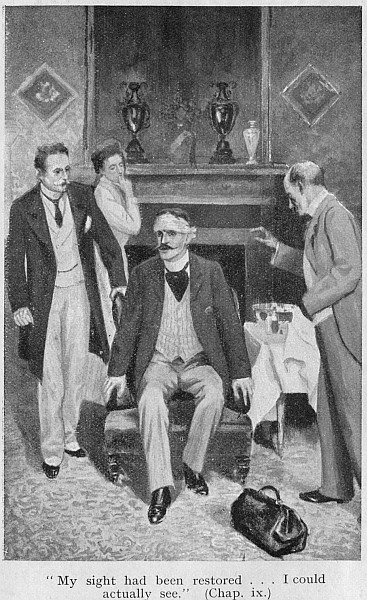
For nearly three weeks I lived with the Venetian blinds of my sitting-room always down, and with a thick curtain drawn across them, shutting out all light, as well as a good deal of air, until the summer heat became stifling. Hour after hour I sat alone, my hands idly in my lap, ever wondering what the success of this experiment would be. Should I ever again see, after those grave and distinct pronouncements of Fry and the rest, who had plainly told me that my sight was for ever destroyed? I dared not to hope, and only remained inert and thoughtful, congratulating myself that I had at least obeyed the dictum of my mysterious and unknown correspondent, under whose influence I had so foolishly placed myself.
At last, however—it was on a Sunday—Slade came, and as usual raised the bandages and bathed my eyes in a solution of atropine. Then, having made a careful examination, he went to the window, drew aside the curtains, and slightly opened the Venetian blinds.
In an instant I cried aloud for joy.
My sight had been restored. The desire of my life was an accomplished fact. I could actually see!
Dimly I could distinguish his short, burly form between myself and the faint light of the half-opened blinds, but even though all was as yet misty and indistinct, I knew that what had been averred was the actual truth—the specialists had been mistaken. With care and continued treatment my sight would strengthen until I became like other men.
“I can see!” I cried excitedly. “I can see you, doctor—and the light—and the blinds!”
“Then you acknowledge that what I told you was the truth—that I did not lie to you when I told you that your case was not beyond recovery?”
“Certainly. You told me the truth,” I said hastily. “At the time it seemed too improbable, but now that you have shown me proof, I must ask your pardon if any words of mine have given you offence.”
“You’ve not offended me in the slightest, my dear sir,” he answered pleasantly. “Persevere with the treatment, and continue for another few days in darkness, and then I feel confident that a perfectly satisfactory cure will have been effected. Of course, we must not expect a clear vision at once, but by degrees your sight will slowly become stronger.”
And with those words he closed the blinds and drew the curtain close, so that the room was again darkened.
Imagine the thankfulness that filled my heart! It was no illusion. I had actually seen the narrow rays of sunlight between the half-opened blind and the dark silhouette of the short, stout, full-bearded man who was effecting such a marvellous cure.
I gripped his hand in the darkness, and thanked him.
“How can I sufficiently repay you?” I said. “This service you have rendered me has opened up to me an absolutely new life.”
“I desire no repayment, Mr Heaton,” he answered in his deep, hearty voice. “That my treatment of malignant sclerotitis is successful, and that I have been the means of restoring sight to one of my fellow-men, is sufficient in itself.”
“But I have one question I wish to ask you,” I said. “The mode in which you were introduced to me is extremely puzzling. Do you know nothing of the lady named Edna?”
“I know her—that is all.”
“Where does she live?”
“I regret that I am not able to answer your question.”
“You are bound to secrecy regarding her?”
“I may as well admit the truth—I am.”
“It’s extraordinary,” I ejaculated. “Very extraordinary!”
“Not so extraordinary as the recovery of your vision,” he observed. “Remain perfectly quiet, and don’t take upon yourself any mental problems. A great deal now depends upon your own calmness.”
The fact that my sight was gradually returning to me seemed too astonishing to believe. This man Slade, whoever he was, had performed a feat in surgery which seemed to me miraculous.
Again and again I thanked him, but when he had gone and I told Parker she only gave vent to a grunt of incredulity. Yet had I not actually seen the silhouette of Slade, and the streaks of sunlight beyond? Had I not already had ocular proof that a cure was being effected?
What would Dick, dear old Dick, say on his return when he found me cured? I laughed as I pictured to myself his amazement at finding me at the railway-station on his arrival—looking for him.
Through a whole month Slade came regularly each day at noon, and surely, by slow degrees, my vision became strengthened, until at length I found that, even though I wore smoke-darkened glasses, I could see almost as well as I had done in the days of my youth. The glasses destroyed all colour, it was true, yet I could now go forth into the busy Strand, mingle with the bustling crowds, and revel in their life and movement. Indeed, in those first days of the recovery of my vision I went about London in taxis and omnibuses, hither and thither, with all the enthusiasm of a country cousin or a child on his first visit to the Metropolis. All was novel and interesting on my return to a knowledge of life.
Slade, I found, was a gentlemanly fellow with the air of a clever physician, but all my efforts to discover his abode proved unavailing, and, moreover, just as the cure was complete he one day failed to call as usual. Without word he relinquished me just as suddenly as he had come; but he had restored to me that precious sense which is one of God’s chief gifts.
In those September days, when all the world seemed gay and bright, I went forth into the world with a new zest for life. I took short trips to Richmond and Hampton Court, so that I might again gaze upon the green trees, the winding river, and the fields that I loved so well; and I spent a day at Brighton, and stood for a full couple of hours watching the rolling sea beating upon the beach. Six weeks before I was a hopeless misanthrope, whose life had been utterly sapped by the blighting affliction upon me. Now I was strong and healthy in mind and in body; prepared to do anything or to go anywhere.
It was a fancy of mine to go down to the home of my youth, Heaton Manor, a place well known to those acquainted with the district around Tewkesbury. The great old mansion, standing in the centre of a wide, well-wooded park that slopes down to the Severn close to the Haw Bridge, had long been closed, and in the hands of the old servant Baxter and his wife. Indeed, I had never lived there since, on my father’s death, it had passed into my possession. The rooms were opened for my inspection, and as I wandered through them and down the long oak-panelled gallery, from the walls of which rows of my time-dimmed ancestors, in their ruffles, velvets, and laces looked down solemnly, a flood of recollections of my sunny days of childhood crowded upon me.
Seven years had passed since my last visit there. The old ivy covered manor was, indeed, dilapidated, and sadly out of repair. The furniture and hangings in many of the rooms seemed rotting with damp and neglect, and as I entered the nursery, and was shown my own toys, it seemed as though, like Rip Van Winkle, I had returned again to life after a long absence.
Alone, I wandered in the park down the avenue of grand old elms. The wide view across the brimming river, with Hasfield Church, and the old Tithe Barn at Chaceley standing prominent in the landscape, had, I saw, in no way changed. I looked back upon the house—a grand old home it was, one that any man might have been proud of, yet of what use was it to me? Should I sell it? Or should I allow it to still rot and decay until my will became proved, and it passed into the hands of my heirs and assigns?
I felt loth to part with it, for the old place had been built soon after the fierce and historic battle had been fought at Tewkesbury, and ever since Richard Heaton had commanded one of the frigates which went forth to meet the Armada, it had been the ancestral home of the Heatons.
How strange it all was! At every turn I peered upon the world through my grey glass spectacles, and took as keen an interest in it as does a child. All seemed new to me; my brain, like a child’s, became filled with new impressions and fresh ideas. After my dull, colourless existence of sound and touch, this bright life of movement filled me with a delight that pen cannot describe. Imagine, however, what joy it is to one who has been pronounced incurably blind to look upon the world again and taste of its pleasures. It was that joy which gave lightness to my heart.
Yet over all was one grim shadow—the remembrance of that fateful night with its grim tragedy. Who was Edna? Where was she? What was she?
Through her instrumentality I had regained my sight, but her identity and her whereabouts still remained hidden, as she had plainly told me they would be before we had parted.
Hither and thither I went, fêted and feasted by my friends at the Savage, the Devonshire, and other clubs, yet my mind was ever troubled by the mystery of the woman who had, from motives that were entirely hidden, exerted herself on my behalf, first in saving my life from unscrupulous assassins, and, secondly, in restoring my vision.
I entertained a strong desire to meet her, to grasp her small hand, to thank her. I longed to see her.
Chapter Ten.
The Girl in Blue.
The man who abandons all hope is constantly haunted by fears. This is as strange as it is unjust, like much else in our everyday life. Even though there had returned to me all the joys of existence, yet I was still haunted by an ever-present dread—a terror lest some terrible mandate should suddenly be launched upon me by the unknown director of my actions.
My situation was, to say the least, a most extraordinary one. Valiantly I strove to rid myself of the obsession which constantly crept upon me whenever my attention was not actually distracted by the new existence that had so mysteriously been opened up to me. For a little while I would let my mind dwell upon the terrifying thought that I was entirely helpless in the hands of one who was, without doubt, unscrupulous. I had pledged my honour to keep secret that appalling midnight crime, and to act always as directed. Edna herself, the woman whose voice sounded so tender, whose hands were so small and soft to the touch, had forced me to this. To her alone was due this state of constant anxiety as to what might next be demanded of me. The thought would creep upon me, now pausing, now advancing, until at length it wrapped me round and round, and stifled out my breath, like a death-mask of cold clay. Then my heart would sink, my sight seemed to die, even sound would die until there seemed an awful void—the void of death for ever and for ever dumb, a dreadful, conquering silence.
A thousand times I regretted that I had in that moment of my utter helplessness given my promise to conceal the mysterious crime. Yet, when I recollected with what extraordinary ingenuity I had been deceived by the man whom I had believed to be a police-constable, the deep cunning which had been displayed in obtaining from my lips a statement of all the facts I knew, and the subsequent actions of the cool-headed Edna, my mind became confused. I could see no solution of the extraordinary problem, save that I believed her to be deeply implicated in some plot which had culminated in the murder of the young man, and that she herself had some strong personal motive in concealing the terrible truth.
With the return of my vision my sense of hearing had, curiously enough, become both weakened and distorted. Sounds I had heard when blind presented quite a different impression now that I could see. The blind hear where those with eyesight can detect nothing. The ears of the former train themselves to act as eyes also, yet the moment the vision is recovered the sharpened sense of hearing again assumes its normal capacity. Hence I found that I could not distinguish voices and sounds so quickly as before; indeed, the voices of those about me sounded some how different now I had recovered my sight.
My friends, into whose circle they declared I had returned like one from the grave, welcomed me everywhere, and I confess that, notwithstanding the oppression constantly upon me, I enjoyed myself to the top of my bent. I still remained in my dingy, smoke-grimed rooms in Essex Street, really more for Parker’s sake than for my own, and also, of course, in order to be near Dick when he returned, but nearly every evening I was out somewhere or other, going here and there about town.
In the middle of October, when most men I knew were away on the moors, I had a dinner engagement one evening with the Channings, in Cornwall Gardens. Colonel Channing, a retired officer of the Guards, was a man I had known during greater part of my lifetime. His service had been mainly of a diplomatic character, for he had served as British military attaché at Berlin and Vienna, and now lived with his wife and daughter in London, and seemed to divide his time mainly between the St. James’s and the United Service Clubs. He was a merry old fellow, with white hair and moustache and a florid complexion, the dandified air of attaché still clinging to him.
As he sat at the head of his table, his habitual monocle in his eye, and the tiny green ribbon of the order of the Crown of Italy in the lapel of his dining-jacket, he looked a perfect type of the ex-attaché. His wife, a rather spare woman of fifty, who seemed to exist externally in a toilette of black satin and lace, was pleasant, though just a trifle stiff, probably because of her long association with other diplomatists’ wives; while Nellie Channing was a happy, fair-haired girl, who wore pretty blouses, motored, golfed, flirted and shopped in the High Street in the most approved manner of the average girl of South Kensington.
Nellie and I had always been good friends. She had been at school in England while her parents had been abroad, but on completing her education she had lived some five years or so in Vienna, and had thus acquired something of the cosmopolitan habit of her father. She looked charming in her pink blouse, a trifle decolleté, as she sat on my left at dinner, and congratulated me upon my recovery.
If, however, Nellie Channing was pretty, her beauty was far eclipsed by that of my neighbour on my right, a tall, dark-haired girl in blue, a Miss Anson, who with her mother, a quiet, white-haired elderly lady, were the only other guests in addition to myself. From the moment we were introduced I saw that Mrs Anson’s daughter possessed a face that was absolutely perfect, rather oval in shape, with large, beautiful eyes, that seemed to shine as they looked upon me, and to search me through and through. Her complexion was good, her cheeks well-moulded, her mouth small and perfectly formed; her teeth gleamed white ever and anon as she smiled at the Colonel’s humorous remarks, and her nose was just sufficiently tip-tilted to give her countenance a piquant air of coquetry.
Her costume, rich and without any undue exaggeration of trimming or style, spoke mutely of the handiwork of a first-class couturière. The shade of turquoise suited her dark beauty admirably, and the bodice, cut discreetly low, revealed a neck white and firmly moulded as that of the Venus of Milo. Around her throat, suspended by a golden chain so fine as to be almost imperceptible, was a single diamond set in a thin ring of gold, a large stone of magnificent lustre. It was her only ornament, but, flashing and glittering with a thousand fires, it was quite sufficient. She wore no rings. Her hands, white and well-formed, were devoid of any jewels. The single diamond gleamed and glittered as it rose and fell upon her breast, an ornament assuredly fit to adorn a princess.
Mrs Anson sat opposite me, chatting pleasantly during the meal, and now and then her daughter would turn, raise her fine eyes to mine for an instant, and join in our conversation. That she was exceedingly clever and well-informed I at once detected by her terse and smart criticism of the latest play, which we discussed. She compared it, with a display of knowledge that surprised me, to a French play but little known save to students of the French drama, and once or twice her remarks upon stage technicalities caused me to suspect that she was an actress.
Mrs Anson, however, dispelled this notion by expressing her disapproval of the stage as a profession for women, an opinion with which her daughter at once agreed. No, she could not be an actress, I felt assured. Both mother and daughter bore the unmistakable hallmark of gentlewomen.
I sat beside Mabel Anson in rapt admiration. Never before in all my life had my eyes fallen upon so perfect an incarnation of feminine grace and marvellous beauty; never before until that moment had a woman’s face held me in such enchantment.
Presently the conversation turned, as it so often does at dinner-tables, upon certain engagements recently announced, whereupon the Colonel, in the merry, careless manner habitual to him, advanced the theory that most girls married with a view to improve their social position.
“As to a husband’s fortune,” remarked his wife, with that stiff formality which was her peculiar characteristic, “it really isn’t so important to a woman as the qualities which lead to fortune—ambition, determination, industry, thrift—and position such a man may attain for himself.”
“And in education?” inquired Miss Anson, softly, apparently interested in the argument.
“In education a man certainly should be his wife’s equal,” answered Mrs Channing.
“And is not good temper essential with a husband?—come, now. Let’s hear your ideas on that point,” said the Colonel, chaffingly, from behind the big épergne.
Mabel Anson hesitated. For an instant her lustrous eyes met mine, and she at once lowered them with a downward sweep of her long dark lashes.
“I don’t argue that a girl thinking seriously of her future husband should lay any great stress on good temper,” she answered, in a sweet musical voice. “A soldierly form, a pair of good eyes, a noble profile—any of these might easily outweigh good temper.”
“Ah! there, I fear, I disagree with you,” I remarked smilingly. “It has always appeared to me that after the first year or so married people rarely think of each other’s features, because they are always in each other’s presence. They become heedless of whether each other’s features are classical or ugly; but they never fail to be cognisant of one another’s temper or shortcomings.”
“You speak as though from experience,” she laughed, without, however, attempting to combat my argument.
Another outburst of laughter greeted this bantering remark of hers.
“No,” observed Nellie, on my other hand. “Mr Heaton is the most confirmed bachelor I know. I believe he’s a woman-hater—if the truth were told.”
“Oh, really, Miss Channing!” I protested. “That’s certainly too bad of you. I assure you I’m no hater of the sex, but an admirer.”
“Heaton’s about to make a pretty speech,” observed the jovial, red-faced Colonel. “Go on, Wilford, my dear fellow, we’re all attention.”
“No,” I said, laughing. “I’ve been drawn quite unfairly into this controversy. Therefore I’ll preserve a masterly silence.”
“Mr Heaton is, I think, diplomatic,” laughed the dark, handsome girl next to me. “He has cleared his character of the aspersion cast upon it, and preserves a dignified attitude.” And she turned and smiled gaily upon me in triumph.
She was exquisitely charming. I sat at her side gossiping merrily, while to my dazzled gaze she presented a beautiful picture of youthful airy delicacy—feminine sweetness combined with patrician grace. For the first time in all my life that petticoated paradox, woman, conveyed to me the impression of perfect beauty, of timidity and grace, combined with a natural, inborn dignity. There was nothing forced or unnatural in her manner as with other women I had met; none of that affected mannishness of deportment and slangy embellishments of conversation which are so characteristic of girls of to-day, be they daughters of tradesmen or of peers.
She gave me the impression—why, I cannot tell—of one who had passed under the ennobling discipline of suffering and self-denial. A melancholy charm tempered the natural vigour of her mind; her spirit seemed to stand upon an eminence and look down upon me as one inferior to her in intellect, in moral principle—in fact, in everything. From the very first moment when I had bowed to her on our introduction she held me spell-bound in fascination.
When the ladies had left, and I sat alone with the Colonel, smoking over a liqueur, I inquired about her.
“Mrs Anson is the widow of old General Anson,” he said. “He died about twelve years ago, and they’ve since lived a great deal abroad.”
“Well off?” I inquired, with affected carelessness.
“Very comfortably, I should say. Mrs Anson has a fortune of her own, I believe. They have a house at present in The Boltons.”
“Mabel is extremely good-looking,” I remarked.
“Of course, my dear boy,” laughed the Colonel, with his liqueur-glass poised in his hand, a twinkle in his eye. “Between us, she’s the prettiest girl in London. She creates a sensation wherever she goes, for beauty like hers isn’t met with twice in a lifetime. Lucky chap, whoever marries her.”
“Yes,” I said reflectively, and then diligently pursued the topic in an endeavour to learn further details regarding her. My host either knew very little, or purposely affected ignorance—which, I was unable to determine. He had known her father intimately, having been in his regiment long ago. That was about all I learnt further.
So we tossed away our cigars, drained our glasses, and rejoined the four ladies who were awaiting us in the drawing-room, where later, at Mrs Channing’s urgent persuasion, my divinity in blue seated herself at the piano, and in a sweet, clear contralto sang in Italian a charming solo from Puccini’s Bohême, the notable opera of that season.
Then, with the single diamond glittering at her throat, she came back to where I stood, and sinking into the cosy-corner with its pretty hangings of yellow silk, she accepted my congratulations with a delicate grace, a charming dignity, and a grateful smile.
At last, however, the hour of parting came, and reluctantly—very reluctantly—I took her small hand, bent over it, and handed her into her carriage beside her mother.
“Good-night,” she cried merrily, and next instant the fine pair of bays plunged away into the rainy night.
I returned into the hall, and my host helped me into my overcoat.
We were alone, for I had made my adieux to his wife and daughters.
“Wilford,” he said very gravely, as he gripped my hand prior to my departure, “we are old friends. Will you permit me to say one word without taking offence at it?”
“Certainly,” I answered, surprised. “What is it?”
“I’ve noticed to-night that, like many another man, you are entranced by the beauty of Mabel Anson. Be careful not to make a fool of yourself.”
“I don’t understand,” I said quickly.
“Well, all I would say is, that if you desire happiness and peace of mind, steel your heart against her,” he answered with a distinct air of mystery.
“You speak in enigmas.”
“I merely give you a timely warning, that’s all, my dear fellow. Now, don’t be offended, but go home and think it over, and resolve never again to see her—never, you understand—never.”
Chapter Eleven.
The Fourteenth of October.
Long and deeply I pondered over the Colonel’s words. That he had some underlying motive in thus warning me against the woman by whom I had become so fascinated was vividly apparent, yet to all my demands he remained dumb. On the afternoon following I found him in the St. James’s Club—that club of diplomatists—and reverted to the subject. But all the response he vouchsafed was—
“I’ve merely warned you, my dear fellow. I shall say no more. I, of course, don’t blame you for admiring her, I only tell you to pull yourself up short.”
“But why?”
“Because if you go further than admiration you’ll be treading dangerous ground—devilish dangerous, I can assure you.”
“You mean that she has a jealous lover?” I suggested.
“She has no lover, as far as I’m aware,” he answered.
“Then, speaking candidly, Channing,” I said, “I don’t see why you should turn prophet like this without giving me any reason.”
“My reason is briefly told,” he said with unusual gravity. “I don’t wish to see you upset and unhappy, now that you’ve recovered your sight.”
His words seemed very lame ones.
“Why should I be unhappy?”
“Because Mabel Anson can never be more to you than an acquaintance; she can never reciprocate your love. I tell you plainly that if you allow yourself to become entranced and all that sort of thing, you’ll only make a confounded ass of yourself.”
“You certainly speak very plainly,” I observed, annoyed that he should interfere so prematurely in a matter which was assuredly my affair alone.
“I speak because I have your welfare at heart, Wilford,” he answered in a kindly tone. “I only regret now that I asked you to my table to meet her. It is my fault—entirely my fault.”
“You talk as though she were some genius of evil,” I laughed. “Let me act as I think fit, my dear Channing.”
“Let you go headlong to the devil, eh?” he snapped.
“But to love her is not to go on the downward path, surely?” I cried incredulously.
“I warn you, once and for all, to have nothing whatever to do with her,” he said. “I know her—you do not.”
But I laughed him to scorn. His words seemed utterly absurd, as though his mind were filled by some strong prejudice which he dared not to utter for fear of laying himself open to an action for slander. If her acquaintance were so extremely undesirable, why did he invite her and her mother to his table? His words were not borne out by his own actions.
So I bade him farewell rather coolly, and left the club abruptly, in anger with myself at having sought him, or bestowed a single thought upon his extraordinary warning.
In the days that followed my mind was fully engrossed by recollections of her charm and beauty. Like every other man, I had had, before my blindness, one or two minor affairs of the heart, but never before had I experienced the grand passion. I had, indeed, admired several other women of various ages and various stations, but none had ever approached in grace, beauty, or refinement the woman who had so suddenly come into my life, and so quickly gone out of it.
Yes, I openly confess that I, who had of later years determined to remain a bachelor, was deeply in love with her. Indeed, for the time, I actually forgot the grim shadow of evil which had in my blindness fallen upon me.
Hither and thither in the great world of London I went with my eyes ever open in eagerness to catch a glimpse of her. I lounged in the Row at the fashionable hour; went to the opera, and swept boxes and stalls with my glasses; and strolled about Regent Street, Oxford Street, and High Street, Kensington, in the vicinity of those great drapery emporiums so dear alike to the feminine heart and to the male pocket. For ten days or so I spent greater part of my time in searching for her slim, erect figure among the bustling London crowds. I knew her address, it was true, but my acquaintance was not sufficient to warrant a call, therefore I was compelled to seek a chance encounter.
All, however, was in vain. I had firmly resolved to take no heed of the Colonel’s extraordinary premonition, and laughed at his dehortatory suggestions; for I meant at all costs to meet her again. One day I suddenly recollected that in conversation Mrs Anson had mentioned that her daughter was a student at the Royal Academy of Music. If so, then she would undoubtedly go there alone on certain days to take her lessons. By carefully watching I might, I thought, meet her as if by accident. So I at once set to work to make inquiries, and discovered through tipping one of the hall-porters of the institution that Miss Anson came there every Tuesday and Friday at two o’clock in the afternoon. The next day chanced to be Tuesday, therefore I went to Hanover Square and waited for her at the corner of Tenterden Street. As I watched I saw quite a number of smart-looking lady students pass into the institution, but, although I remained on the alert for nearly two hours, she did not come, and at length I was compelled to return home wearied, unsuccessful, and dispirited.
That night, however, a blow fell upon me. An incident which I had constantly dreaded occurred, for by the last post was delivered one of those strange typewritten mandates from the unknown. The envelope was a blue-grey one, such as lawyers use, and the postmark showed that it had been dispatched from the Lombard Street office, in the City. I tore it open in fear and trepidation, and glanced at the few even lines it contained. The lines I read were signed by the word “Avel,” traced with a heavy hand in rough Roman capitals, and were as follows:—
“To-morrow, the fourteenth of October, enter the Park at Grosvenor Gate at four o’clock, and wait at the third seat on the path which leads to the band-stand.”
I stood silent, with the mysterious missive in my hand. Some secret service was evidently required of me. The shadow of that fateful night had again fallen, crushing me beneath its weight of mystery and crime. I thought of the unknown Edna, and pictured her in comparison with Mabel. In my helplessness I had become an unwilling tool in the hands of the former, and now I hated and despised her. This galling servitude which she had imposed upon me under penalty of death was doubly irksome now that I loved; yet so mysterious and tragic were all the circumstances that I feared to break the bond that I had given.
In ordinary circumstances I think I should have been eager to obey this sudden demand to go to the Park on the following day. There was a distinct air of adventure in the appointment, and, eager to fathom the mystery surrounding Edna, I saw that this meeting might furnish me with some clue. But I recollected Mabel, all sweetness and purity, and hated it all. Edna had declared that she herself was not the mysterious “Avel,” yet I had no reason to disbelieve her statement. To me it seemed as though she were acting under instructions which had for their object the preservation of the secret of the midnight crime.
Who was the young man who had fallen victim? His identity puzzled me always, until the problem had become so perplexing as to drive me to despair. Although time after time I had searched the newspapers, I had found no one answering to his description mentioned as missing. He had evidently been done to death and his body disposed of without a single inquiry, while the crime had been concealed with an ingenuity which appalled me. Might I, myself, not fall victim in a similar manner if I refused to obey these strange mandates of an unknown hand?
These thoughts were the reverse of reassuring, for even if I went to the police they would be unable to assist me. A detective might keep the appointment in the Park, but it was certain on seeing a stranger in the vicinity the person who intended to meet me would give him a very wide berth.
That hot night I lay awake through many hours calmly reviewing the whole situation. On the last occasion when I had obeyed the order of my mysterious correspondent—sent undoubtedly at Edna’s instigation—I had profited considerably. Was the present order for good or for evil?
Naturally, I had always been fond of adventure, for I came of a family of sailors. But the gruesome incidents of that single night when I had wandered alone in London had utterly unnerved me. I had become so surrounded by mystery that each effort of mine to elucidate it caused me to sink deeper and deeper into the complex quagmire of uncertainty.
Perhaps Edna herself desired to speak with me, now that I could see. This suggestion took possession of me, and next morning I was anxious and interested in the appointment. Soon after three I took an omnibus from the Strand to the corner of Park Lane, and on the stroke of four entered the Park at Grosvenor Gate and glanced eagerly around. No one was in the vicinity save one or two loungers of the “unemployed” type and two or three nursemaids with children. Without difficulty I soon found the seat indicated, and sat down to wait. It was a pleasant spot beneath a large chestnut tree, quiet and more secluded than any of the others. Evidently my correspondent knew the Park well.
I lit a cigarette and possessed myself in patience. After some five minutes or so a female figure entered the gate and approached in my direction. It was that of an elderly woman of rather common type, and as she came straight towards me I waited her with some curiosity, but she passed me by without a look, and continued on her way. Then I knew that she was not the person who intended to meet me, and laughed within myself.
My position was one of curiosity, sitting there prepared to meet some person unknown. We have all of us, at one time or another, sat awaiting persons we have never before seen, and we have invariably found mental pictures of their appearance utterly different from their real aspect. It was so with me at that moment. I sat waiting and wondering for half an hour or so, watching narrowly all who chanced to approach, until I began to suspect that for some reason or other the appointment would not be kept.
A glance at my watch showed it to be already twenty minutes to five. My patience was exhausted, and I felt annoyed that I should be thus brought here on a purposeless errand. Of one man who had passed, a dark-faced, ill-dressed lounger, I had had my suspicions. He had idled past, feigning to take no notice of my presence, yet I saw that he was covertly watching me. Perhaps he had been sent to see whether I had come there alone. I waited and waited, but in vain.
The shadows had lengthened, the sun was sinking behind the trees in Kensington Gardens, and at length I cast away the end of my last remaining cigarette and rose to depart. Perhaps some untoward incident had occurred, and I should receive a further communication from my unknown correspondent. I had, at least, carried out my part of the compact, and was therefore free. So I took my stick and set forth towards Grosvenor Gate at a brisk pace, for I was tired of waiting, and my limbs were cramped by my long and fruitless vigil.
I had almost reached the gate leading out to Park Lane when of a sudden, at a sharp bend of the path, a dark figure loomed up before me.
In an instant I drew up speechless, aghast, amazed. The mystery was absolutely dumbfounding.
Chapter Twelve.
“It is his!”
The figure before me was that of a woman, calm, sweet-faced, her countenance rendered piquant by its expression of surprise.
It was none other than Mabel Anson.
Dressed in a tight-fitting tailor-made gown of some dark cloth, and a neat toque, she looked dignified and altogether charming. The slight severity of attire became her well, for it showed her marvellous figure to perfection, while the dash of red in her hat gave the necessary touch of colour to complete a tasteful effect. Her countenance was concealed by the thinnest of gauze veils, and as she held forth her well-gloved hand with an expression of pleasure at the unexpected meeting, her bangles jingled musically.
“This is indeed a most pleasant surprise, Miss Anson,” I said, when I recovered speech, for so sudden had been our encounter that in the moment of my astonishment my tongue refused to utter a sound.
“And to me also,” she laughed.
“I’ve been wondering and wondering when we should meet again,” I blurted forth. “I’m so very glad to see you.”
For the first few moments after she had allowed her tiny hand to rest for an instant in mine we exchanged conventionalities, and then suddenly, noting a roll of music in her hand, I asked—
“Are you going home?”
“Yes, across the Park,” she laughed. “Mother forbids it, but I much prefer the Park to those stuffy omnibuses.”
“And you’ve been to your music, I suppose?” I inquired.
“Yes. I’ve not been well for the past few days, and have missed several lessons. Now, like a good pupil, I’m endeavouring to make them up, you know.” And she laughed merrily.
“How many times a week do you go to the Academy?” I asked, surprised that she should have gone there that day, after what the hall-porter had told me.
“Twice, as a general rule,” she remarked; “but just now I’m rather irregular.”
“And so you prefer to cross the Park rather than ride by omnibus?”
“Certainly. Mother doesn’t approve of girls riding on the tops of ’buses, and says it’s fast. Therefore I’d much rather walk, for at this hour half London seems to be going from Piccadilly Circus to Hammersmith. I go right across, past the Serpentine, through Kensington Gardens to the Broad Walk, and out by the small gate next the Palace Hotel,” she added, with a sweep of her gloved hand.
Her eyes were lovely. As she stood there in the fading sunlight she seemed the fairest vision I had ever seen. I stood spell-bound by her marvellous beauty.
“And may I not act as your escort on your walk to-day?” I asked.
“Certainly. I have no objection,” she answered with graceful dignity, therefore I turned and walked beside her, carrying her music.
We took the road, which leads straight away to the Magazine, and crosses the Serpentine beyond. There in the yellow glow of the October sunset I lounged at her side and drank my fill of her loveliness. Surely, I thought, there could be no more beautiful woman in all the world. The Colonel’s strange warning recurred to me, but I laughed it to scorn.
As we passed beneath the rustling trees the sun’s last rays lit up her beautiful face with a light that seemed ethereal and tipped her hair until there seemed a golden halo about her. I was no lovesick youth, be it remembered, but a man who had had a bitter experience of the world and its suffering. Yet at that hour I was fascinated by the grace of her superb carriage, the suppleness of her figure, the charm of her sweet smile, and the soft music of her voice as she chatted to me.
She told me of her love for music; and from the character of the pieces which formed her studies I knew that she must be a musician of a no mean order. The operatic melody which she had sung at the Colonel’s was, she declared, a mere trifle. We discussed the works of Rossini and Massent, of Wagner and Mendelssohn, and of Verdi, Puccini, Mascagni, Perosi, and such latter-day composers. I had always prided myself that I knew something of music, but her knowledge was far deeper than mine.
And so we gossiped on, crossing the Park and entering Kensington Gardens—those beautiful pleasure grounds that always seem so neglected by the majority of Londoners—while the sun sank and disappeared in its blood-red afterglow. She spoke of her life abroad, declaring that she loved London and was always pleased to return to its wild, turbulent life. She had spent some time in Paris, in Vienna, in Berlin, but no one was half as interesting, she declared, as London.
“But you are not a Londoner, are you?” I asked.
“No, not exactly,” she responded, “although I’ve lived here such a long time that I’ve become almost a Cockney. Are you a Londoner?”
“No,” I answered; “I’m a countryman, born and bred.”
“I heard the Colonel remark that other night that you had been afflicted by blindness for some time. Is that so?”
I responded in the affirmative.
“Terrible!” she ejaculated, glancing at me with those wonderful dark eyes of hers that seemed to hold me in fascination and look me through and through. “We who possess our eyesight cannot imagine the great disadvantages under which the blind are placed. How fortunate that you are cured!”
“Yes,” I explained. “The cure is little short of a miracle. The three greatest oculists in London all agreed that I was incurable, yet there one day came to me a man who said he could give me back my sight. I allowed him to experiment, and he was successful. From the day that I could see plainly he, curiously enough, disappeared.”
“How strange! Did he never come and see you afterwards?”
“No. He took no reward, but simply discontinued his visits. I do not even know his real name.”
“How extraordinary!” she observed, greatly interested. “I really believe that there is often more romance and mystery in real life than in books. Such a circumstance appears absolutely bewildering.”
“If to you, Miss Anson, then how much more to me! I, who had relinquished all hope of again looking upon the world and enjoying life, now find myself actually in possession of my vision and able to mix with my fellow-men. Place yourself for a moment in my position, and try to imagine my constant thankfulness.”
“You must feel that a new life is opened to you—that you have begun a fresh existence,” she observed with a true touch of sympathy in her sweet voice. Then she added, as if by afterthought. “How many of us would be glad to commence life afresh!”
The tone in which she uttered that sentence seemed incongruous. A few moments before she had been all brightness and gaiety, but in those words there vibrated a distinctly gloomy note.
“Surely you do not desire to commence your life again?” I said.
She sighed slightly.
“All of us have our burden of regrets,” she answered vaguely, raising her eyes for an instant to mine, and then lowering them.
We appeared in those moments to grow confidential. The crimson and orange was fast fading from the sky. It was growing dark beneath the shadow of the great elms, and already the line of street lamps out in Kensington Gore were twinkling through the foliage on our left. No one was in the vicinity, and we were walking very slowly, for, truth to tell, I desired to delay our parting until the very last moment. Of all the leafy spots in giant London, there is none so rural, so romantic, or so picturesque in summer as that portion of Kensington Gardens lying between Queen’s Gate and the Broad Walk. Save for the dull roar of distant traffic, one might easily fancy one’s self far in the country, a hundred miles from the sound of Bow Bells.
“But you are young, Miss Anson,” I observed philosophically, after a brief pause. “And if I may be permitted to say so, you have scarcely begun to live your life. Yet you actually wish to commence afresh!”
“Yes,” she responded briefly, “I do. Strange, is it not?”
“Is the past, then, so full of bitterness?” I asked, the Colonel’s strange warning recurring to me at the same moment.
“Its bitterness is combined with regrets,” she answered huskily, in a low voice.
“But you, young, bright, happy, and talented, who need not think of the trials of everyday life, should surely have no regrets so deep as to cause you this anxiety and despair,” I said, with a feeling of tenderness. “I am ten years older than you, therefore I may be permitted to speak like this, even though my words may sound presumptuous.”
“Continue,” she exclaimed. “I assure you that in my present position I appreciate any words of sympathy.”
“You have my deepest sympathy, Miss Anson; of that I assure you,” I declared, detecting in her words a desire to confide in me. “If at your age you already desire to recommence life, your past cannot have been a happy one.”
“It has been far from happy,” she answered in a strange, mechanical voice. “Sometimes I think that I am the unhappiest woman in all the world.”
“No, no,” I hastened to reassure her. “We all, when in trouble, imagine that our burden is greater than that of any of our fellows, and that while others escape, upon us alone fall the graver misfortunes.”
“I know, I know,” she said. “But a pleasant face and an air of carelessness ofttimes conceal the most sorrowful heart. It is so in my case.”
“And your sorrow causes you regret, and makes you wish to end your present life and commence afresh,” I said gravely. “To myself, ignorant of the circuit stances, it would seem as though you repented of some act or other.”
“What do you mean?” she gasped quickly, looking at me with a strange expression in her dark eyes. “I do not repent—I repent nothing!”
I saw that I had made a grave mistake. In my fond and short-sighted enthusiasm I had allowed myself to speak a little too confidentially, whereupon her natural dignity had instantly rebelled. At once I apologised, and in an instant she became appeased.
“I regret extremely that you should have such a weight of anxiety upon your heart,” I said. “If I can do anything to assist you, rely upon me.”
“You are extremely kind,” she answered in a gloomy tone; “but there is nothing—absolutely nothing.”
“I really can’t understand the reason why, with every happiness around you, you should find yourself thus plunged in this despair,” I remarked, puzzled. “Your home life is, I presume, happy enough?”
“Perfectly. I am entirely my own mistress, save in those things which might break through the ordinary conventionalities of life. I must admit to you that I am rather unconventional sometimes.”
I had wondered whether, like so many other girls, she had some imaginary grievance in her home; but now, finding that this was not so, it naturally occurred to me that the cause of her strange desire to live her life over again arose through the action of some faithless lover. How many hundreds of girls with wealth and beauty, perfectly happy in all else, are daily wearing out their lives because of the fickleness of the men to whom they have foolishly given their hearts! The tightly-laced corsets of every eight girls in ten conceals a heart filled by the regrets of a love long past; the men smile airily through the wreaths of their tobacco-smoke, while the women, in those little fits of melancholy which they love to indulge in, sit and reflect in silence upon the might-have-beens. Is there, I wonder, a single one of us, man or woman, who does not remember our first love, the deep immensity of that pair of eyes; the kindly sympathy of that face, which in our immature years we thought our ideal, and thereupon bowed the knee in worship? If such there be, then they are mere unrefined boors without a spark of romance in their nature, or poetry within their soul. Indeed, the regrets arising from a long-forgotten love ofttimes mingle pleasure with sadness, and through one’s whole life form cherished memories of those flushed days of a buoyant youth. To how many of those who read these lines will be recalled vivid recollections of a summer idyll of long ago; a day when, with the dainty or manly object of their affections, they wandered beside the blue sea, or on the banks of the tranquil, willow-lined river, or perhaps hand-in-hand strolled beneath the great old forest trees, where the sunlight glinted and touched the gnarled trunks with grey and gold! To each will come back the sweet recollection of a sunset hour now long, long ago, when they pressed the lips of the one they loved, and thought the rough world as rosy as that summer afterglow. The regret of those days always remains—often only a pleasant memory, but, alas! sometimes a lamentation bordering upon despair, until the end of our days.
“And may I not know something, however little, of the cause of this oppression upon you?” I asked of her, after we had walked some distance in silence. “You tell me that you desire to wipe out the past and commence afresh. The reason of this interests me,” I added.
“I don’t know why you should interest yourself in me,” she murmured. “It is really unnecessary.”
“No, no,” I exclaimed hastily. “Although our acquaintance has been of but brief duration, I am bold enough to believe that you count me among your friends. Is it not so?”
“Certainly, or I would not have given you permission to walk with me here,” she answered with a sweetness which showed her unostentatious delicacy of character.
“Then, as your friend, I beg of you to repose whatever confidence in me you may think fit, and to be assured that I will never abuse it.”
“Confidences are unnecessary between us,” she responded. “I have to bear my grief alone.”
“Your words sound strange, coming from one whom I had thought so merry and light-hearted,” I said.
“Are you, then, ignorant of the faculty a woman has of concealing her sorrows behind an outward show of gaiety—that a woman always possesses two countenances, the face and the mask?”
“You are scarcely complimentary to your own sex,” I answered with a smile. “Yet that is surely no reason why you should be thus wretched and downhearted.” Her manner puzzled me, for since the commencement of our conversation she had grown strangely melancholy—entirely unlike her own bright self. I tried to obtain from her some clue to the cause of her sadness, but in vain. My short acquaintance with her did not warrant me pressing upon her a subject which was palpably distasteful; nevertheless, it seemed to me more than strange that she should thus acknowledge to me her sorrow at a moment when any other woman would have practised coquetry.
“I can only suffer in silence,” she responded when I asked her to tell me something of the cause of her unhappiness.
“Excuse my depression this evening. I know that to you I must seem a hypochondriac, but I will promise you to wear the mask—if ever we meet again.”
“Why do you speak so vaguely?” I inquired in quick apprehension. “I certainly hope that we shall meet again, many, many times. Your words would make it appear as though such meeting is improbable.”
“I think it is,” she answered simply. “You are very kind to have borne with me like this,” she added, her manner quickly changing; “and if we do meet, I’ll try not to have another fit of melancholy.”
“Yes, Miss Anson,” I said, halting in the path, “let us meet again. Remember that we have to-day commenced a friendship—a friendship which I trust will last always.”
But she slowly shook her head, as though the heavy sadness of her heart still possessed her.
“Friendship may exist between us, but frequent meetings are, I fear, impossible.”
“Why? You told me only a moment ago that you were your own mistress,” I observed.
“And so I am in most things,” she answered. “But as far as meeting you, we can only leave that to chance.”
“Why?”
“Please do not endeavour to force me to explanations,” she answered with firmness. “I merely tell you that frequent meetings with you are unlikely—that is all.”
We had walked on, and were nearing the gate leading out into the High Street, Kensington.
“In other words, then, you are not altogether pleased with my companionship?”
“No, really,” she laughed sweetly. “I didn’t say that. You have no reason to jump at such a conclusion. I thank you very much indeed for your words of sympathy.”
“And you have no desire to see me again?” I interrupted, in a tone of bitter disappointment.
“If such were the case, ours would be a very extraordinary friendship, wouldn’t it?” and she lifted her eyes to mine with a kindly look.
“Then I am to take it that my companionship on this walk has not been distasteful to you?” I asked anxiously.
She inclined her head with dignified air, saying. “Certainly. I feel that this evening I have at least found a friend—a pleasant thought when one is comparatively friendless.”
“And as your friend—your devoted friend—I ask to be permitted to see you sometimes,” I said earnestly, for, lingering at her side, I was very loth to part from her. “If I can ever be of any assistance, command me.”
“You are very kind,” she answered, with a slight tremor in her voice. “I shall remember your words always.” Then, putting forth her well-gloved hand, as we stood upon the kerb of the High Street, she added, “It is getting late. We’ve taken such a long time across the Park that I must drive home;” and she made a gesture to a passing hansom.
“Before we part,” I said, “I will give you a card, so that should you require any service of me you will know where to write;” and, as we stood beneath the street lamp, I drew out a card and, with a pencil I took from my vest-pocket, scribbled my address.
In silence she watched, but just as I had finished she suddenly gripped my hand, uttering a loud cry of amazement.
“What’s that you have there?” she demanded. “Let me see it!”
Next instant—before, indeed, I could be aware of her intention—she had snatched the pencil from my grasp, and was examining it closely beneath the gaslight.
“Ah!” she gasped, glaring at me in alarm. “It is—yes, it is his!”
The small gold pencil which I had inadvertently used was the one I had taken from the pocket of the dead unknown on that fateful August night.
Chapter Thirteen.
The Enchantment of a Face.
The face of Mabel Anson, my new-found friend and idyll, had in that instant changed. Her countenance was pale as death, while the hand holding the small pencil trembled.
“Whence did you obtain this?” she demanded in an awe-stricken tone, which showed plainly that she recognised it. She held her breath in expectancy.
What could I reply? To explain the truth was impossible, for I had pledged my honour to Edna to preserve the secret. Besides, I had no wish to horrify her by the strange story of my midnight adventure. Hence a lie arose involuntarily to my lips.
“I found it,” I stammered.
“Found it? Where?”
“I found it when groping about during the time I was blind, and I’ve carried it ever since, wondering whether one day I should discover its owner.”
“It is extraordinary?” she gasped—“most extraordinary.”
“You appear to recognise it,” I observed, much puzzled at her attitude. “If you can tell me to whom it belongs I will return it.”
She hesitated, and with a quick effort regained her self-control.
“I mean it possesses an extraordinary resemblance to one I have seen many times before—but I suppose there are lots of pencil-cases of the same shape,” she added with affected carelessness.
“But there is a curious, unintelligible cypher engraved upon it,” I said. “Did you notice it?”
“Yes. It is the engraving which makes me doubt that I know its owner. His initials were not those.”
“You speak in the past tense,” I observed. “Why!”
“Because—well, because we are no longer friends—if you desire to know the truth;” and she handed me back the object, which, with the dress-stud, formed the only clue I had to the identity of the unfortunate victim of the assassin.
There was something in her manner which was to me the reverse of convincing. I felt absolutely certain that this unimportant object had, in reality, been identified by her, and that with some hidden motive she was now intentionally misleading me.
“Then you do not believe that this really belonged to your friend?” I asked, holding it up to her gaze.
“No,” she answered quickly, averting her face as though the sight of it were obnoxious. “I feel certain that it did not. Its resemblance is striking—that’s all.”
“It would have been a remarkable coincidence if it really were the property of your friend,” I said.
“Very remarkable,” she admitted, still regarding me strangely. “Yet the trite saying that ‘The world is small’ is nevertheless very true. When I first saw it I felt certain it belonged to a gentleman I knew, but on closer examination I find it is older, more battered, and bears initials which have evidently been engraved several years.”
“Where did your friend lose his?” I inquired, reflecting upon the lameness of her story. The mere recognition of a lost pencil-case would never have affected her in the manner that sight of this one had if there were not some deeper meaning attached to it.
“I have no idea. Indeed, I am not at all sure that it is not still in his possession.”
“And how came you to be so well acquainted with its aspect?” I asked, in eagerness to ascertain the truth.
She hesitated for a few moments. “Because,” she faltered—“because it was a present from me.”
“To an admirer?”
She did not answer, but even in that dim lamplight I detected the tell-tale flush mounting to her cheeks.
Then, in order, apparently, to cover her confusion, she added—
“I must really go. I shall be late for dinner, and my mother hates to wait for me. Good-bye.”
Our hands clasped, our eyes met, and I saw in hers a look of deep mystery, as though she held me in suspicion. Her manner and her identification of that object extracted from the pocket of the dead man were very puzzling.
“Good-bye,” I said. “I hope soon to have the pleasure of meeting you again. I have enjoyed this walk of ours immensely.”
“When we meet—if ever we do,” she answered with a mischievous smile, “remember that I have promised to wear the mask. Good-bye.” And she twisted her skirts gracefully, entered the cab, and a moment later was driven off, leaving me alone on the kerb.
I hesitated whether to return home by ’bus or Underground Railway, but, deciding on the latter, continued along the High Street to the station, and journeyed to the Temple by that sulphurous region of dirt and darkness known as the “Inner Circle.”
The reader may readily imagine how filled with conflicting thoughts was my mind on that homeward journey. Although I adored Mabel Anson with a love beyond all bounds, and would on that evening have declared my passion for her had I dared, yet I could not disguise from myself that sight of the pencil-case I had taken from the dead unknown had wrought an instant and extraordinary change in her.
She had identified it. Of that fact there was no doubt. Her lame explanation that it bore a resemblance to the one she had given to her friend was too palpably an afterthought. I was vexed that she should have thus attempted a deception. It was certainly true that one gold pencil-case is very like another, and that a Birmingham maker may turn out a thousand of similar pattern, yet the intricate cypher engraved on the one in question was sufficient by which to identify it. It was these very initials which had caused her to deny that it was really the one she had purchased and presented; yet I felt convinced that what she had told me was untrue, and that those very initials had been placed upon it by her order.
Again, had she not spoken of its owner in the past tense? This, in itself, was a very suspicious circumstance, and led me to the belief that she was aware of his death. If he were dead, then certainly he would no longer be her friend.
Her sudden and abject amazement at seeing the pencil in my hand; her exclamation of surprise; her eagerness to examine it; all were facts which showed plainly that she knew that it remained no longer in his possession, and was yet dumbfounded to find it in my hand. Had she not also regarded me with evident suspicion? Perhaps, having identified her present, she suspected me of foul play?
The thought held me petrified. For aught I knew she might be well aware of that man’s tragic end, and the discovery of part of his property in my possession was to her evidence that I had committed murder.
My position was certainly growing serious. I detected in the rather formal manner in which she took leave of me a disinclination to shake my hand. Perhaps she believed it to be the hand of the murderer. Indeed, my declaration that I had found that incriminating object was in itself sufficient to strengthen her suspicion if, as seemed quite probable, she was aware of her friend’s tragic end. Yet I had really found it. It was no lie. I had found it in his pocket, and taken it as a clue by which afterwards to identify him.
Now, if it were true that the man who had been struck dead at my side was actually Mabel’s friend, then I was within measurable distance of elucidating the mystery of that fateful night and ascertaining the identity of the mysterious Edna, and also of that ruler of my destiny, who corresponded with me under the pseudonym of “Avel.”
This thought caused me to revert to that hour when I had sat upon the seat in the Park, keeping a tryst with some person unknown. Seated in the corner of the railway-carriage I calmly reflected. More than a coincidence it seemed that at the moment my patience became exhausted, and I rose to leave the spot my mysterious correspondent had appointed for the meeting, I should have come face to face with the woman whose grace and beauty held me beneath their spell. For some purpose—what I knew not—I had been sent to that particular seat to wait. I had remained there in vain, smoking a dozen cigarettes, reading through my paper even to the advertisements, or impatiently watching every person who approached, yet the moment I rose I encountered the very person for whom I had for days past been in active search.
Had Mabel’s presence there any connexion with the mysterious order which I had obeyed? Upon this point I was filled with indecision. First, what possible connecting link could there be between her natural movements and the letter from that unknown hand? As far as I could discern there was absolutely none, I tried to form theories, but failed. I knew that Mabel attended at the Royal Academy of Music, and what was more natural than that she should cross the Park on her way home? Her way did not lie along the path where I had kept such a watchful vigil, and had I not risen and passed towards Grosvenor Gate at that moment we should not have met. There, indeed, seemed no possible combination between the request I had received from my unknown correspondent and her presence there. In my wild imaginings I wondered whether she were actually the woman whom in my blindness I had known as Edna, but next instant flouted the idea.
The voice, the touch, the hand, all were different. Again, her personal appearance was not at all that of the woman described by West, the cabman who had driven me home after my strange adventures.
No; she could not be Edna.
As the train roared through the stifling tunnels City-wards, I strove to arrive at some decision. Puzzled and perplexed at the various phases presented by the enigma which ever grew more and more complicated, I found any decision an extremely difficult matter. I am not a man given to forming theories upon insufficient evidence, nor jumping to immature conclusions, therefore I calmly and carefully considered each fact in its sequence as related in this narrative. The absence of motives in several instances prevented any logical deduction. Nevertheless, I could not somehow prevent a suspicion arising within me that the appointment made by my anonymous correspondent had some remote connexion with my meeting with the woman who had so suddenly come into my life—a mere suspicion, it is true, but the fact that no one had appeared to keep the appointment strengthened it considerably.
Whenever I thought of Mabel, recollections of Channing’s strange admonition arose within me. Why had he uttered that warning ere I had been acquainted with her a few hours? To say the least, it was extraordinary. And more especially so as he refused to give any explanation of his reasons.
The one dark spot in my life, now that I had recovered my sight, was the ever-present recollection of that midnight tragedy. Its remembrance held me appalled when I thought of it. And when I reflected upon my own culpability in not giving information to the police, and that in all probability this neglect of mine had allowed the assassin to escape scot free, I was beside myself with vexation and regret. My thoughts for ever tortured me, being rendered the more bitter by the reflection that I had placed myself in the power of one who had remained concealed, and whose identity was inviolable.
As I declared in the opening of the narrative, it seems almost incredible that in these end-of-the-century-days a man could find himself in such a plight, surrounded by mysterious enemies, and held in bondage by one unknown and unrevealed. Laboriously I tried to unravel the tangled skein of events and so extricate myself, but, tired with the overtask, I found that the mystery grew only more inscrutable.
The woman I loved—the woman to whom I had fondly hoped some day ere long to make the declaration of the secret of my heart—had discovered in my possession an object which might well be viewed as evidence of a foul and cowardly crime. I feared—indeed, I felt assured—that her sweet sympathy had, in an instant, been turned to hatred.
I loved her. I adored her with all the strength of my being, and I knew that without her my life, in the future must only be an aimless blank. In the sweetest natures there can be no completeness and consistency without moral energy, and that Mabel possessed it was plainly shown. In her confidences with me as we traversed the Park and Kensington Gardens she had shown, with the most perfect artfulness, that she had that instinctive unconscious address of her sex which always renders a woman doubly charming. Persons who unite great sensibility and lively fancy possess unconsciously the power of placing themselves in the position of another and imagining rather than perceiving what is in their hearts. A few women possess this faculty, but men never. It is not inconsistent with extreme simplicity of character, and quite distinct from that kind of art which is the result of natural acuteness and habits of observation—quick to perceive the foibles of others, and as quick to turn them to its own purpose; which is always conscious of itself, and if united with strong intellect, seldom perceptible to others.
In her chat with me she had no design formed or conclusion previously drawn, but her intuitive quickness of feeling, added to her imagination, caused her to half-confide in me her deep sorrow. Her compassionate disposition, her exceeding gentleness, which gave the prevailing tone to her character, her modesty, her tenderness, her grace, her almost ethereal refinement and delicacy, all showed a true poetic nature within, while her dark, fathomless eyes betrayed that energy of passion which gave her character its concentrated power.
Was it any wonder, even though she might have been betrayed into a momentary tergiversation, that I bowed down and worshipped her? She was my ideal; her personal beauty and the tender sweetness of her character were alike perfect. Therefore my love for her was a passion—that headlong vehemence, that fluttering and hope, fear and transport, that giddy intoxication of heart and sense which belongs to the novelty of true love which we feel once, and but once, in our lives.
Yet I was held perplexed and powerless by her unexpected and unacknowledged identification of that clue to the unknown dead.