I. THE BAGOBO. (continued 2)
Reading edition
The balance of the people can be roughly divided between freeman and slaves, but slavery here is of such a mild type, and the members of that class become so quickly merged into the tribe that the lines cannot be closely drawn. Women and children secured in raids become the slaves of their captors, and may be bought and sold, or pass by inheritance, like other property. It is considered proper for a man to live with his slave without marrying her, but should she become pregnant she is usually given her freedom at once; if not then, she is certain to be upon the death of her master, while her offspring are free and legitimate heirs. Children born to a slave couple remain in their class, as do those born to a slave mother and a man not her master. These slaves are treated with kindness and consideration and seldom try to make their escape. In fact it is often difficult to pick out the members of this class from the other members of the family.
The chief aim in life of the man is to have the right to wear the blood-red clothing and to be known as magani. As stated earlier in the paper, this term is applied to a man who has killed two or more persons. He is then entitled to wear the peculiar chocolate-colored head covering (Plate XXV). When his score has reached four he can don blood-red trousers, and when he has six lives to his credit he is permitted to wear the complete blood-red suit and to carry a bag of the same color.[30] From that time on his clothing does not change with the number of his victims, but his influence increases with each life put to his credit. It is said that formerly, at Digos and Bansalan, a man who had killed twenty or more was known as gemáwan, and was distinguished by a black hemp suit. This claim to the black clothing is no longer respected, and such garments are worn by any who desire them. The man who has never killed a person is called matálo, a rather slighting term signifying one who has no desire to fight but remains at home with the women. A man who kills an unfaithful wife and her admirer may count the two on his score. He may also count those of his townspeople whom he has killed in fair fight, but unprovoked murder will be punished by the death of the offender. The candidate for magani honors may go to an unfriendly town, or to a neighboring tribe, and kill without fear of censure from his own people.
[30] This is the rule at Cibolan. At Malilla and Digos, the kerchief may be worn when one life has been taken, the trousers for two, the coat for three, and finally the sack for four.
[Transcriber's note: matálo in the paragraph above means "coward."]
The magani is one of the leaders in a war party; he is chosen to inflict the death penalty when it is decreed, and it is men of this class that assist in the human sacrifices. He is under the special protection of Mandarangan and Darago, and all petitions to these powerful spirits must be made through him. His clothing is considered the property of these spirits, and when such specimens were secured for the collection, the wearer would invariably place the garment beside some prized article, such as a knife or spear, then taking a green betel nut would rub the garment and object, meanwhile beseeching the spirits to leave the one and enter the other. Later the nut was placed in the tambara belonging to those spirits. A father may not bequeath to his son the right to the red clothing; and such articles, together with his weapons, should be buried with him. Should one not entitled to these garments dare to make use of them, the spirits would straightway cause his body to swell or turn yellow, and he would die.
In a previous paragraph we mentioned the unorganized priesthood, the members of which are known as mabalian. Men are not barred from this profession, but the greater number of its members are old, or middle-aged, women.[31] A woman may live the greater part of her life without an idea of becoming a member of this order, and then suddenly be warned in dreams, by visions, or by other mabalian that she has been chosen by the spirits. The one thus elected becomes a pupil of a qualified mabalian and for several months will be drilled in the duties of that office. She will be taught the medicines to be used at certain times,[32] the duties of a midwife, the correct method of building shrines and conducting ceremonies, and finally, she will learn the prayers with which the spirits should be addressed. It seems to be the belief that, at times during the ceremonies, the mabalian may be possessed by a spirit and that she then speaks not as a mortal but as the spirit itself. She also knows how to weave and dye the turban worn by the magani, and because of this accomplishment is considered to be under the protection of Baitpandi,[33] and is permitted to wear garments made of red cloth, the same as the magani.
[31] There are five mabalian in Cibolan, all of whom are women past middle life.
[32] A medicine is used with the idea that it assists in driving away evil influences.
[33] The patron spirit of the weavers.
The workers in the various crafts are under the guidance and protection of special spirits, but there is no bar against other members of the tribe entering those professions.
Apparently then, Bagobo society is divided into several classes or divisions, but with the exception of a few individuals in the slave class, there is a possibility or an opportunity for each member of the tribe to enter any class open to his or her sex. Even a slave woman may become the wife of a datu, and her son may assume the leadership of the tribe.
LAWS. PROPERTY AND INHERITANCE.
The laws of the people are those imposed by custom and religion, and are equally binding on all classes. Public opinion is sufficient to prevent most crimes; the fear of offending the spirits is a further deterrent; while the final bar is the drastic punishment meted out by the datu. Theft is punished by the levying of a fine if the culprit is able to pay, or by a term of servitude if he has no property. If a husband finds that his wife has been unfaithful, he should kill both her and her admirer, but the spear with which he avenges his wrongs should be left in the body of one of the victims, as a sign that the murder was provoked by the fault. When this is done the husband cannot be held accountable either to the datu or to the dead person's relatives. If, however, he withdraws the weapon, the brothers or other male relatives of the deceased have a right and a duty to avenge the deaths. A man who has killed his wife and her lover is allowed to count both on his score towards becoming a magani—a further incentive for him to avenge his wrongs. Cases are known where the husband accepted payment for his wife's affections, but it was considered a sign of weakness, or cowardice, and the man lost caste. Unprovoked murder of one from the same or a friendly village is punished by death.
A man having illicit relations with a slave woman, not his own, is subjected to a heavy fine or a term of servitude. Incest should be punished by the death of the culprits for should such a crime go unpunished the spirits would cause the sea to rise and cover the land. Datu Tongkaling claims that on two occasions, since he became ruler, he has put such offenders to death. In the first case he had the couple bound and thrown into the sea, while in the second instance, they were tied to trees in the forest and sacrificed in the presence of all the people of the village.
Prohibitions exist against the wearing of the clothing which distinguishes warriors and priestesses, and there are rules governing the conduct of individuals while near shrines or during ceremonies, but punishment for the breaking of these rules is meted out by the spirits rather than by the datu.
Each settlement is recognized as having property rights to all adjacent lands. Within these recognized limits, its members may take up as much land as they need, provided it is not already in use, but when a field is, for any reason, abandoned it again becomes the property of the community. Individual ownership extends to houses, furnishings, and all articles of clothing, as well as to weapons, traps, animals, and slaves. Although bought with a price the wife is still very independent and has undisputed rights to her baskets, cooking utensils, looms, and to the finery with which she adorns her person.
Since all the people assist in the support of the datu they consider his home to be, to a certain extent, their own and make use of it and its furnishings without question.
Probably at no place in the world has borrowing gone to greater extremes than here. When attempting to purchase clothing, or articles in daily use, the writer frequently found that not a single garment worn by an individual was his own; and it was usually necessary to consult several persons in order to secure a complete outfit.
Upon the death of a man, his property is taken in charge by his first wife, or by the old men, and is divided equally among his wives and children, with perhaps a little extra added to the share of the first mate. The belongings of a free-born woman go to her children, or, in case she is barren, are given to her relatives. In cases where both the parents are dead, the children pass into the care of the father's family.
Despite the fact that property is owned by individuals, a large part of the labor, especially in house-building and in the fields, is done in common. When a man desires to clear or plant a field or to build a house, he summons his friends to aid him and they respond with no idea of payment other than their food and drink, and the return of like services when they are in similar need.
BIRTH.
For about six months before and after the birth of a child the mother is relieved from hard labor; she is not allowed to taste of any thing sour, neither may she eat dried fish or flesh, lest her child be thin and weak. The father is under no restrictions other than that he is expected to remain near to his home for a few days following the birth of a child. Other action on his part would be considered by the spirits as an admission that he does not care for the child, and they would cause the umbilical cord to decay so that the child would die. The mother is delivered in the regular dwelling, where she is attended by two or more midwives or mabalian.[34] She is placed with her back against an inclined board, while in her hands she holds a rope which is attached to the roof. With the initial pains, one of the midwives massages the abdomen, while another prepares a drink made from leaves, roots, and bark, and gives it to the expectant woman. The preparation of this concoction was taught by friendly spirits, and it is supposed to insure an easy delivery. Still another mabalian spreads a mat in the middle of the room, and on it places valuable cloths, weapons, and gongs, which she offers to the spirits; praying that they will make the birth easy and give good health to the infant. The articles offered at this time can be used by their former owners but as they are now the property of the spirits they must not be sold or traded. The writer was very anxious to secure an excellent weapon which had been thus offered. The user finally agreed to part with it but first he placed it beside another of equal value, and taking a piece of betel nut he rubbed each weapon with it a number of times, then dipping his fingers in the water he touched both the old and the new blades, all the time asking the spirit to accept and enter the new weapon. The child is removed by the mabalian who, in cutting the umbilical cord, makes use of the kind of knife used by the members of the child's sex, otherwise the wound would never heal. The child is placed on a piece of soft betel bark, "for its bones are soft and our hands are hard and are apt to break the soft bones," then water is poured over it and its body is rubbed with pogonok.[35] The afterbirth is placed in a bamboo tube, is covered with ashes and a leaf, and the whole is hung against the side of the dwelling where it remains until it falls of its own accord or the house is destroyed. In Cibolan the midwife applies a mixture of clay and herbs called karamir to the eyes of all who have witnessed the birth "so that they will not become blind." Having done this she gives the child its name, usually that of a relative, and her duties are over. As payment she will receive a large and a small knife, a plate, some cloth, and a needle.[36]
[34] In Cibolan the midwife is called taratEk-Ekn, and need not be a mabalian.
[35] A medicine made of bark and rattan.
[36] The payment given at the birth of a boy is somewhat greater than that for a girl.
In Malilla the naming does not take place until three clays after the birth, and the eyes are not always anointed, although the old people agree that it is an ancient custom and "a good thing to do." At that time the mat containing the gifts is spread on the floor and the offerings are again called to the attention of the spirits, who are urged to look to the welfare of the child. Should the infant be ailing, or cry a great deal, it is a sign that the spirits are displeased with the name given to it and another will be substituted; however, this does not seem to be done with an idea of fooling the spirits, as is the case with some other tribes. The child is nursed until two or three years of age, or until another takes its place. There is no superstition concerning twins, but triplets are at once put to death by filling their mouths with ashes, otherwise "the parents would die, for they are like dogs."
When questioned concerning abortion, Datu Tongkaling asserted that he considered it "very bad," and that he would prohibit any mabalian who assisted in such a practice from continuing her profession, but he said that despite his orders secret medicines which produce that result are sometimes administered. Such a practice is not common, however, as children are greatly desired and no worse slur can be applied to a woman than to speak of her as barren.
So far as could be learned there is no ceremony or celebration of any kind when a child reaches the age of puberty but soon thereafter its teeth will be filed and blackened. In some villages the boys are circumcised, but the practice is not compulsory, neither is it general throughout the territory.
MARRIAGE.
Marriage among the Bagobo takes place much later than is common among most Philippine tribes, the couple often being eighteen or twenty years of age. As a rule the parents of the boy select the girl and negotiate the match. Going to the house of the girl they casually broach the subject and if her parents are favorable, a day is set to discuss the details. This meeting is attended by the friends and relatives of both families, and two head-men or datu must also be present to represent the contracting parties. The price the girl should bring varies according to the wealth of the interested parties and the accomplishments of the bride. Whatever the sum paid, the father of the girl must make a return present equal to one-half the value of the marriage gift "so that he does not sell his daughter like a slave." Usually marriage does not take place until a year or more after this settlement, and during the interval the boy must serve his father-in-law to be. When the time for the final ceremony arrives the relatives and friends assemble and for two or three days they feast and make merry. A mabalian spreads a mat on the floor, places on it many valuable articles and then offers all to the spirits, in order that they may be pleased to give the couple a long and prosperous life together. Finally, she puts a dish of rice on the mat and, after offering it to the spirits, places it between the boy and the girl as they sit on the floor. The girl takes a handful of the rice and feeds it to the boy who, in turn, feeds her, and the ceremony is complete. The couple may then go to their new home, but for several years the girl's family will exact a certain amount of service from the groom.
A slight variation of the usual order occurred recently at the marriage of one of Datu Tongkaling's sons. At that time all the details were arranged by the datu, who, accompanied by his son and a number of relatives, went to the girl's house and proposed the union. After the girl had brought wine, betel nut, and food, and had placed them before the visitors, she was directed by her mother to make a carrying bag for her lover. Had she objected to the union and refused to make this gift, her decision would probably have been accepted as final and all negotiations abandoned. However, it is not customary for the young people to refuse to carry out the wishes of their elders. As the girl offered no objections, the party fell to discussing the price the groom should pay, and finally, after several hours of bargaining, decided that he should furnish her father with one agong,[37] one horse, and a double betel box.[38] Five days later, when he paid this sum, he received a return gift of one agong and ten skirts from the bride's mother. About one-half the value of the groom's gift was distributed among the girl's relatives, who were at the same time admonished that, in case a separation should occur, they would be expected to return an equal amount. In the presence of about a hundred friends, the pair drank wine from the same dish, then submitted to having a little hair cut from their heads, and were pronounced man and wife. Before they retired for the night the mabalian combed their hair, then, having directed the groom to precede his bride to their sleeping place, she secured a child and placed it on the mat between the pair. This, she explained, was an old custom, and was done so that the girl might not be ashamed, for she was not the first to sleep there. Having finished this duty, she returned to the center of the room and placed a number of plates and a knife on the tambara, where they were allowed to remain for four days as offerings to the anito, Manama, Toglái and the tigyama.[39] At the end of that period the plates were attached to the outside walls of the house, and the knife returned to its former owner. This completed the duties of the mabalian who returned home carrying an agong, the payment for her services.
[37] Large copper gong.
[38] Much more is often given. One girl in Cibolan brought six horses, five agongs, and several spears and knives.
[39] See p. 107. [Transcriber's note: 5 pages after this.]
A man may have as many wives as he desires and can afford, but he may not take a second mate until a child has been born to the first union, or the wife has been proved beyond doubt to be barren. The groom renders no services to the father of the second wife, but instead of this pays a double price for the girl, for he not only pays her parents but is forced also to give a like sum to his first wife, who, in turn, presents it to her father. Should a third wife be added to the family a sum equal to her cost is divided among the earlier wives. The first wife is generally the lady of the house and does not particularly object to having other girls added to the family, provided they are willing to obey her. Datu Tongkaling has had four wives, three of whom are still living.
If a couple cannot agree, a separation can be arranged by applying to the local head-man, who, after listening to their troubles, decides which one is at fault, and whether or no the marriage gifts must be returned. When a couple parts, plates, bowls, and jars are sometimes broken as a sign that they will never live together again and the spirits are thus called to witness. A divorced woman may remarry, but unless the sum originally paid for her has been returned, the new groom must pay such an amount to the first husband.
SICKNESS AND DEATH.
In case of illness a mabalian administers some simple remedy without any call on the spirits. If, however, the sickness does not yield readily to this treatment, it is evident that the trouble is caused by some spirit who can only be appeased by a gift, Betel nuts, leaves, food, clothing, and some article in daily use by the patient are placed in a dish of palm bark and on top of all is laid a roughly carved figure of a man. This offering is passed over the body of the patient while the mabalian addresses the spirits as follows. "Now, you can have the man on this dish, for we have changed him for the sick man. Pardon anything this man may have done, and let him be well again." Immediately after this the dish is carried away and hidden so that the sick person may never see it again, for should he do so the illness would return.
According to Father GISBERT a doll is carved from a piece of wood and the spirit is addressed: "O God, Thou who has created men and trees, and all things, do not deprive us of life, and receive in exchange this bit of wood which has our face."
In obstinate cases the invalid may be removed from his own house to another, in order that he may be under the care of the good spirits residing there. The mabalian appplies[sic] certain medicines and then decrees a period of taboo, during which no outsiders may enter the house. Those within at the time the medicine was given may go out if they desire, but must return there to sleep. Should it become evident that the patient will die he is taken back to his own place, otherwise his family would be called upon to reimburse the owner of the house in which the death occurs, for bringing evil or unfriendly spirits into their dwelling.
Governor Bolton describes a somewhat different procedure among the members of the Guianga branch of this tribe. Having learned that Datu Angalan was ill he went to see him, but found his house deserted. The datu was finally located in a small hut about a hundred yards away from his own dwelling, with no attendants. The governor writes, "When I went in the tribesmen entered. I soon found that I had broken a charm which prevented anyone seeing him for a certain time; that he had been placed in the hut for that reason, and to insure his not dying in the large house. It is likely that they had a human sacrifice at that time."[40]
[40] Extract from letters of Gov. Bolton, in files of the Governor at Davao.
Following a death the body is covered with good clothing and is placed in the middle of the house. Wailers sit by the corpse, fanning it to keep away flies, or making an occasional offering of food; while the friends gather to talk of the virtues of the deceased, to console the family, and to partake of the food and drink which has been provided for the gathering. The body is kept over one night, and in the case of great personages, for three days, or until the coffin—a large log split in halves and hollowed out—is prepared. When this is ready the body is placed in it, together with some prized articles of the deceased. After the top has been fitted to the lower portion, they are lashed together and the cracks are filled with lime.[41] The body is buried beneath the house, and the grave is protected by a bamboo fence, within which is placed food, small offerings, or perhaps a shield and spear. In some instances the coffin is allowed to remain in the house, which is then abandoned. It is said that when Datu Taopan died his funeral lasted ten days, and on the last day the house was decked, inside and out, with flowers and valuable gifts, and was then deserted.
[41] When the deceased has been a person of note the coffin is sometimes decorated or colored. The coffin of a magani should be red, yellow, and black; while that of a mabalian should be yellow, black, and brown.
Following the burial the family lives in the house where the death occurred until a human sacrifice has been made. During this period they live very quietly, eat poor food, wear old clothing, and abstain from all amusements. If their wealth permits, they may shorten the period of mourning by making a special sacrifice, but in most cases the bereaved will wait until the yearly sacrifice when they will purchase a share in the victim and thus remove the taboo. Following the offering, the old house is abandoned and is allowed to fall to pieces for "the man has gone and his house must go also." The procedure is the same for women, and for children who have survived infancy.
BELIEFS CONCERNING THE SOUL, SPIRITS, ORACLES, AND MAGIC.
There is some variance, in different parts of the Bagobo area, in the beliefs concerning the spirits or souls of a man. In Cibolan each man and woman is supposed to have eight spirits or gimokod, which dwell in the head, the right and left hands and feet, and other parts not specified. At death these gimokod part, four from the right side of the body, going up to a place called palakalángit, and four descending to a region known as karonaronawan.These places differ in no respects from the present home of the Bagobo, except that in the region above it is always day, and all useful plants grow in abundance. In these places the gimokod are met by the spirits, Toglái and Tigyama, and by them are assigned to their future homes. If a man has been a datu on earth, his spirits have like rank in the other life, but go to the same place as those of common people. The gimokod of evil men are punished by being crowded into poor houses. These spirits may return to their old home for short periods, and talk with the gimokod of the living through dreams, but they never return to dwell again on earth.
In the districts to the west of Cibolan the general belief is that there are but two gimokod, one inhabiting the right side of the body, the other the left. That of the right side is good, while all evil deeds and inclinations come from the one dwelling on the left. It is a common thing when a child is ill to attach a chain bracelet to its right arm and to bid the good spirit not to depart, but to remain and restore the child to health. In Malilla it is believed that after death the spirit of the right side goes to a good place, while the one on the left remains to wander about on earth as a buso,[42] but this latter belief does not seem to be shared by the people of other districts.
[42] See p. 107.
Aside from the gimokod the Bagobo believe that there exists a great company of powerful spirits who make their homes in the sky above, in the space beneath the world, or in the sea, in streams, cliffs, mountains, or trees. The following is the list related by Datu Tongkaling, a number of mabalian, and others supposed to have special knowledge concerning these superior beings.
I. Eugpamolak Manobo, also called Manama and Kalayágan. The first and greatest of the spirits, and the creator of all that is. His home is in the sky from whence he can observe the doings of men. Gifts for him should be white, and should be placed above and in the center of offerings intended for other spirits. He may be addressed by the mabalian, the datu, and wise old men.
II. Tolus ka balakat, "dweller in the balakat[43]." A male spirit who loves the blood, but not the flesh of human beings, and one of the three for whom the yearly sacrifice is made. Only the magani may offer petitions to him. He is not recognized by the people of Digos and vicinity.
[43] A hanger in which offerings are placed.
III and IV. Mandarangan and his wife Darago. This couple look after the fortunes of the warriors, and in return demand the yearly sacrifice of a slave. They are supposed to dwell in the great fissure of Mt. Apo, from which clouds of sulphur fumes are constantly rising. The intentions of this pair are evil, and only the utmost care on the part of the magani can prevent them from causing quarrels and dissentions[sic] among the people, or even actually devouring some of them.
V. Taragómi/Taragomi. A male spirit who owns all food. He is the guardian of the crops and it is for him that the shrine known as parobanian is erected in the center of the rice field.
VI. Tolus ka towangan. The patron of the workers in brass and copper.
VII. Tolus ka gomanan. Patron of the smiths.
VIII. Baitpandi. A female spirit who taught the women to weave, and who now presides over the looms and the weavers.
IX. and X. Toglái, also called Si Niladan and Maniládan, and his wife Toglibon. The first man and woman to live on the earth. They gave to the people their language and customs. After their death they became spirits, and are now responsible for all marriages and births. By some people Toglái is believed to be one of the judges over the shades of the dead, while in Bansalan he is identified with Eugpamolak Manobo.
XI. Tigyama. A class of spirits, one of whom looks after each family. When children marry, the tigyama of the two families unite to form one who thereafter guards the couple. While usually well disposed they are capable of killing those who fail to show them respect, or who violate the rules governing family life.
XII. Diwata. A class of numerous spirits who serve Eugpamolak Manobo.
XIII. Anito. A name applied to a great body of spirits, some of whom are said formerly to have been people. They know all medicines and cures for illness, and it is from them that the mabalian secures her knowledge and her power. They also assist the tigyama in caring for the families.
XIV. Buso. Mean, evil spirits who eat dead people and have some power to injure the living. A young Bagobo described his idea of a buso as follows: "He has a long body, long feet and neck, curly hair, and black face, flat nose, and one big red or yellow eye. He has big feet and fingers, but small arms, and his two big teeth are long and pointed. Like a dog he goes about eating anything, even dead persons." As already noted, the people of Malilla are inclined to identify the gimokod of the left side with this evil class.
XV. Tagamaling. Evil spirits who dwell in big trees.
XVI. Tigbanua. Ill disposed beings inhabiting rocks and cliffs in the mountains. These last two classes are frequently confused with the buso.
In addition to these, the old men of Malilla gave the following:
1. Tagareso. Low spirits who cause people to become angry and to do little evil deeds. In some cases they cause insanity.
2. Sarinago. Spirits who steal rice. It is best to appease them, otherwise the supply of rice will vanish rapidly.
3. Tagasoro. Beings who cause sudden anger which results in quarrels and death. They are the ones who furnish other spirits with human flesh.
4 and 5. Balinonok and his wife Balinsogo. This couple love blood and for this reason cause men and women to fight or to run amuck.
6. Siring. Mischievous spirits who inhabit caves, cliffs, and dangerous places. They have long nails and can be distinguished by that characteristic. They sometimes impersonate members of the family and thus succeed in stealing women and children, whom they carry to their mountain homes. The captives are not eaten but are fed on snakes and worms, and should they try to escape the siring will scratch them with their long nails.
Other spirits were named and described by individuals, but as they are not generally accepted by the people of the tribe they are not mentioned here.
The stars, thunder and lightning, and similar phenomena are generally considered as "lights or signs" belonging to the spirits, yet one frequently hears hazy tales such as that "the constellation Marara is a one-legged and one-armed man who sometimes causes cloudy weather at planting time so that people may not see his deformities," or we are told that "the sun was placed in the sky by the creator, and on it lives an evil spirit who sometimes kills people. The sun is moved about by the wind;" again, "the sun and moon were once married and all the stars are their children."
Despite repeated assertions by previous writers that the Bagobo are fire-worshippers no evidence was obtained during our visit to support the statement. The older people insisted that it was not a spirit and that no offerings were ever made to it. One mabalian stated that fire was injurious to a woman in her periods and hence it was best for her not to cook at such times; she was also of the opinion that fire was of two kinds, good and bad, and hence might belong to both good and bad spirits.
A common method used by the spirits to communicate with mortals is through the call of the limokon[44] All the people know the meaning of its calls and all respect its warnings. If a man is starting to buy or trade for an article and this bird gives its warning the sale is stopped. Should the limokon call when a person is on the trail he at ones doubles his fist and thrusts it in the direction from which the warning comes. If it becomes necessary to point backwards, it is a signal to return, or should the arm point directly in front it is certain that danger is there, and it is best to turn back and avoid it. When it is not clear from whence the note came, the traveler looks toward the right side. If he sees there strong, sturdy trees, he knows that all is well, but if they are cut or weaklings, he should use great care to avoid impending danger. When questioned as to why one should look only to the right, an old man quickly replied: "The right side belongs to you; the left side is bad and belongs to someone else."
[44] See p. 63, note. [Transcriber's note: footnote above beginning, "A dove."]
Sneezing is a bad omen, and should a person sneeze when about to undertake a journey, he knows that it is a warning of danger, and will delay until another time.
Certain charms, or actions, are of value either in warding off evil spirits, in causing trouble or death to an enemy, or in gaining an advantage over another in trading and in games. One type of charm is a narrow cloth belt in which "medicines" are tied. These medicines may be peculiarly shaped stones, bits of fungus growth, a tooth, shell, or similar object. Such belts are known as pamadan, or lambos, and are worn soldier-fashion over one shoulder. They are supposed to protect their owners in battle or to make it easy for them to get the best of other parties in a trade, A little dust gathered from the footprint of an enemy and placed in one of these belts will immediately cause the foe to become ill.
It is a simple matter to cause a person to become insane. All that is needed is to secure a piece of his hair, or clothing, place it in a dish of water and stir in one direction for several hours.
Father GISBERT relates the following method of detecting theft:
"There are not, as a rule, many thefts among the Bagobo, for they believe that a thief can be discovered easily by means of their famous bongat. That consists of two small joints of bamboo, which contain certain mysterious powders. He who has been robbed and wishes to determine the robber takes a hen's egg, makes a hole in it, puts a pinch of the above said powder in it, and leaves it in the fire. If he wishes the robber to die he has nothing else to do than to break the egg; but since the thief may sometimes be a relative or a beloved person, the egg is not usually broken, so that there may be or may be able to be a remedy. For under all circumstances, when this operation is performed, if the robber lives, wherever he may be, he himself must inform on himself by crying out, 'I am the thief; I am the thief,' as he is compelled to do (they say) by the sharp pain which he feels all through his body. When he is discovered, he may be cured by putting powder from the other joint into the water and bathing his body with it. This practice is very common here among the heathens and Moros. A Bagobo, named Anas, who was converted, gave me the bongat with which he had frightened many people when a heathen."
In Bansalan crab shells are hung over the doors of houses, for these shells are distasteful to the buso who will thus be kept at a distance.
I was frequently told of persons who could foretell the future by means of palmistry, but was never able to see a palmist at work, or to verify the information.
MUSIC, DANCES AND CEREMONIES.
The music for the dances is generally furnished by one or more persons beating on several agongs of different sizes and notes, which are suspended in regular order from the house rafters (Plate XXXa). The player stands in front of the line and begins to beat the instruments with a padded stick. Oftentimes he is accompanied by a man who strikes a wooden drum with the palm of one hand and a stick held in the other. The music grows faster, emphasizing certain beats, until it becomes a compelling rhythm that starts the feet of the onlookers, and suddenly a man or woman begins to dance. At first she keeps time to the music by raising on her toes and heels, bending the knees and twisting the body from side to side, but soon she becomes more animated, the feet are raised high above the floor and brought down with a sort of shuffle which reminds one of the sound made by the feet of a clog dancer. Still swaying her body, she begins to circle, contra-clockwise, around the gongs, and soon she is joined by others until all the dancing space is filled. The scene is most picturesque, for these dances usually occur at night, in rooms illuminated only by the flickering light of torches. The rich clothing of the participants loses nothing of its beauty in this dim light, while the bells and rattles with which each dancer surrounds arms, legs and ankles, add to the din and weirdness of the occasion. Before the dance has progressed far the musicians begin to keep time with their feet and frequently dance away from their instruments, circle, and then return to continue the music.
With slight variation, this is the dance used on all occasions. At certain ceremonies small gongs, or the bolang bolang,[45] replace the agongs, and at times also a single dancer will accompany himself on the kodloñ—a long wooden guitar with rattan strings (Plate XXXb).
[45] An instrument made by placing a small board on a rice mortar. This is pounded or beaten with short sticks, or with the wooden pestles.
In this description we have named a large share of the musical instruments used by the Bagobo. The women frequently play on a sort of guitar made of a section of bamboo from the outside of which narrow strings are cut. These are raised and made taut with small wooden bridges and are then picked with a stick or the fingers (Fig. 33). Bamboo Jew's-harps and mouth flutes are played by the men, but the nose flute, so common in most parts of the Philippines, was not seen in use here.
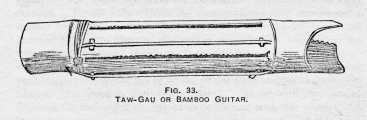
The ceremonies and dances are so closely associated with every day affairs that in the description of the life of the people up to this point we have left only a few still to be discussed. These are, in the main, very similar throughout the Bagobo belt, but to avoid confusion the description here given of the two greatest events of the year—the GinEm ceremony and the human sacrifice—deals with Cibolan, unless expressly stated to the contrary.
The greatest of all Bagobo ceremonies—the GinEm—may be given by the datu within three or four months after the appearance of the constellation Balatik, when the moon is new or full. Its object is to thank the spirits for success in war or domestic affairs, to ward off sickness and other dangers, to drive away the buso, and finally to so gratify the spirits that they will be pleased to increase the wealth of all the people. Datu Tongkaling expressed a belief that this ceremony is in a way related to the rice harvest, "for it is always made when there is plenty of rice in the granaries." It appears to the writer, however, that this ceremony probably originated in connection with warfare.
According to the tales of the old men, it was formerly the custom to go on a raid before this ceremony was to take place, and successful warriors would bring home with them the skulls of their victims which they tied to the patan'nan.[46] It seems also to have been closely associated with the yearly sacrifice, for it was never made until after the appearance of the constellation Balatik, and without doubt a sacrifice frequently did take place during the first day of the ceremony, at the time the decorated poles were raised. However, such an offering at this time did not relieve the datu from the obligation of making the regular sacrifice.
[46] Ceremonial poles dedicated to Mandarangan and Darago. In Digos and Bansalan the skulls were not taken but hair cut from the heads of enemies was placed in the swinging altar balakat, and were left there until the conclusion of the ceremony.
Datu Ansig of Talun informed me that, unless the death of some great person made a special sacrifice necessary, there was only one such offering made during the year, and that at the time the decorated poles were placed in the dwelling.
The time for the festival having been agreed upon, messengers are sent to other datu and head-men, inviting them and their people to attend. Sufficient food is prepared for the guests and when all is ready the mabalian takes one chicken from among those to be used for food and frees it as an offering to the gimokod. It is bidden to wander about in the forest, and no one will molest the fowl, for should he do so he is certain to become ill.[47] The mabalian has previously placed festoons of leaves and vines at various points in the house and now she spreads a mat on the floor. A jar of balaba, wine, stands at each corner, while at one end is an agong, and a plate containing betel nut, leaf, and two varieties of rattan; at the other end are several tambara. When all is thus prepared the people place offerings of beautiful clothing, knives, and other costly gifts on the mat. Two mabalian, a man and a woman call upon the spirits,[48] urging them to look with favor on the offering made by the people, to grant them a good year with health and plentiful harvests, to let their journeys be without mishap, and to keep them all under their constant care. The tambara are fastened in various parts of the house, and the gifts are hung on or laid beside them. Later these offerings may be removed by their former owners who now regard them as being loaned to them by the spirits.
[47] This offering is not made at Bansalan, neither has the mabalian any part in the ceremonies of the first day.
[48] Those called at this time are Toglái, Toglibon, tigyma, and Kalayágan—Eugpamolak Manobo.
[Transcriber's note: The word tigyma in the above footnote should be spelled tigyama.]
Following the offering the magani go to a bamboo thicket and cut two large poles, one nine sections long, the other eight. With each stroke of the knife the men give their battle cry, then when the poles are felled, all seize hold and carry them to the house of the datu. Here they are decorated, first by being cut down for short distances, thus leaving the lower part attached so that the shavings make a sort of fringe, and then by attaching strips of palm or bamboo leaves and cloth or palm leaf streamers. When complete these poles are known as patan'nan and are then the property of the spirits Mandanagan and Darago. The longer one is for the male spirit, while the one of eight sections is for his wife. Under no circumstances may anyone not a magani touch these poles. They are carried into the house and are fastened near to the elevated platform at the end of the room where the datu or leading magani stands ready to sacrifice a chicken. He allows some of the blood from the offering to drip onto the poles, at the same time begging the spirits not to let the people fight or quarrel during the GinEm, "for blood is now being offered." In at least two recent offerings the datu urged the spirits to be content with this offering of a fowl, since it was impossible for them to kill a man. At this time, it is said, the skulls of enemies should be attached to the patan'nan. As the leader finishes his offering, the men and boys gather about the poles and yell lustily, then sit quietly down and amuse themselves by chewing betel nut until the chicken, just killed, and the other food has been prepared for eating. Old dishes are placed in the center of the floor and in them food is offered for all the spirits, but in the exact center of all is a large plate of white food for the supreme being. A second large dish of food is placed in a tambara at the corner of the room as an offering to the warrior deities "so that they will not eat anyone during the fiesta." Again the spirits are besought to give them a good year, with abundant crops, health, and success in war. Going to the patan'nan each magani, beginning with the datu or his son, takes hold of the poles, and in a loud voice, begins to confess all his warlike deeds. He relates how and when he killed his victims, the number of sacrifices he has participated in, the towns he has sacked and the slaves he has captured. In short, he tells of all the manly deeds he has performed in order to gain the right to wear his red suit and be known as magani. When all have confessed, the men and boys eat the chicken which was sacrificed before the poles, and from then until near midnight, all the people may dance to the music of the agongs or may indulge in feasting and drinking. From the middle of the night until daybreak they chant songs or poems, many words of which are now obsolete so that they are not fully understood.[49]
[49] Mr. Gohn informs me that at midnight during the last GinEm made by Datu Ali in Santa Cruz, a gun was fired, and the datu said that a sacrifice should have taken place at that time.
The festival may last one or more days. The last held in Cibolan (1909) extended through two days and nights. At that time no offerings were made to the spirits on the second day, but the people feasted and drank while the datu gathered a little apart and held a council.
In Malilla the second day of this ceremony is called EgbikbEgáybe and is given over almost entirely to the women. Two tambara are erected in the house, and young betel nut buds and women's skirts are hung on them. The women and some men form a line and dance in a circle around the offerings, keeping time to music furnished by beating small gongs, or by pounding on a board resting on a rice mortar.[50] Before each dance the mabalian informs a spirit that this dance is for him and it is customary to add a gift of some kind to those already on the tambara. Sixteen spirits are thus honored. Throughout the day there is much feasting and drinking, and at some time before sunset the women are baptized. Having filled an old agong with water, the mabalian dips certain leaves into it and sprinkles the heads of the women present eight times, meanwhile bidding the spirits to grant to them a good mind and habit.
[50] See p. 110, note. [Transcriber's note: back 3 pages, the footnote beginning, "An instrument made by placing...."]
Mr. Gohn, a planter of Santa Cruz who has witnessed a number of these ceremonies, says that with the Bagobo of that place it was customary for the datu to baptize the women prior to the day of GinEm. On the second day, a mabalian provided a long palm leaf, and a number of betel nut buds which, she said, represented streams, rivers, tribes, and individuals. Taking up a bud she swung the palm leaf above it, chanting meanwhile, and, as she finished, handed it to the datu who opened it and read the signs sent by the spirits. At the conclusion of this act, all the women went to the river to bathe.
In the writings of the early missionary fathers stationed among the Bagobo are found many references to human sacrifices. Since American occupation several articles have appeared describing this custom, and following the sacrifice held in Talun in 1907, this practice became the subject of official communication between the Governor of the District and his superiors. While these descriptions agree, in the main, there are so many minor variations that it seems best to first relate the account given to the writer by Datu Tongkaling and ten of his magani, after which we shall take up some of the earlier accounts, and the official correspondence of 1907.
Datu Tongkaling is a magani. He claims to have killed more than thirty of his enemies in fair fight and to have assisted in, or to have witnessed, an even greater number of sacrifices. Prior to his elevation to the office of datu he had aided in several of the yearly offerings. At the time he became datu he entertained all his people for seven days and on the morning of the last day, in the presence of his subjects, he alone sacrificed a decrepit Bila-an slave for whom he had paid three agongs. Hence, probably, no man in the tribe is better fitted to describe this event than he.
According to him, a sacrifice should be held each year following the appearance in the sky of a constellation of seven stars known as Balatik ("pig trap").[51] The stars are placed there by the spirits for two purposes:—first, to inform the people that it is time to prepare for the clearing of new fields; second, to remind them that they should offer a slave to Mandarangan, Darago, and Balakat as payment for the good year they have enjoyed, and to secure their good will for the coming season. A great epidemic or continued calamaties[sic] might also be signs that the spirits were in need of another offering, and this could take place at any time. Upon the death of an adult it becomes the duty of the family to make a sacrifice, but, unless the deceased is of very great importance, they may wait until the yearly sacrifice[52] when they can purchase a share in it. The one other occasion for which this offering is obligatory is the installation of a new datu in office. For the yearly event the ruler should provide a decrepit slave, and then invite all those who have had death or trouble in the family and who wish a part in the sacrifice to help bear the expense of the ceremony. Guests gather from near and far and for two or three days, feast, dance, and make merry in the house of the datu. On the morning of the last day they accompany their leader to a great tree in the forest and there witness or take part in the sacrifice. The victim is tied with his back to the tree, his arms stretched high above his head. Meanwhile a little table or altar is constructed near by, and on it the principals place their offerings of betel nut, clothes, or weapons, and on top of all is a dish of white food for Eugpamolak Manobo. When all is ready one of the magani begins a prayer, begging the spirits to look and see that the people are following the old custom, to give them success in battle, and to protect their homes from sickness and enemies. The prayer being completed, the datu places his spear below and just in front of the right armpit; then all those who have purchased a share in the victim take hold of the weapon, and at a signal given by the datu, thrust it through the body. As soon as it is withdrawn, the magani who has offered the greatest price for the privilege attempts to cut the body in two with one blow of his fighting knife. If he fails in the attempt, another tries, and so on until someone succeeds. The two portions are then released from the tree and cast into a shallow grave near by. Before the body is covered with earth any person who wishes may cut off a portion of the flesh or hair and carry it to the grave of some relative whom he may have reason to believe is being troubled by evil spirits. In such a case the evil spirit will be content to eat of the slave, and cease disturbing the other body. Returning to the house of the datu, the people continue the dancing and merry-making throughout another night.
[51] This is the constellation Orion which appears early in December.
[52] We have already seen that this offering sometimes occurs during the GinEm ceremony.
The following accounts are extracts from the official correspondence forwarded by the Governor of Davao to the Governor of the Moro Province:
"I have the honor to submit herewith a full report of an investigation made by myself and the Senior Inspector of Constabulary of Davao, regarding a human sacrifice made by the Bagobos at Talun near Digos on Dec. 9th, 1907.
"We left Davao on the morning of the 27th of December and arrived at Digos in the afternoon of the same day. An order was immediately sent out to the Bagobos of Talun to come down to Digos to meet us.
"On the morning of the 30th, the entire population of Talun—men, women and children, to the number of almost one hundred and fifty—arrived at Digos. They were informed that it was reported that a human sacrifice had been made at their town and that the authorities desired to know if this was so.
"Datto[sic] Ansig replied that it was true that a sacrifice had been held as stated and that both he and his people were ready to tell all about it as to the best of their belief they had committed no crime, but only followed out a religious custom practiced by themselves and their ancestors from time immemorial.
"From the statements made by Ansig and his followers, it appears as follows:
"That the Bagobos have several gods, 'Bacalad,' God of the spirits, Agpanmole[sic] Monobo[sic], God of good and his wife the goddess Dewata; Mandarangan, the God of evil (corresponding perhaps to our devil) and to whom sacrifice is made to appease his wrath which is shown by misfortune, years of drought, or evil befalling the tribe or its members, also it is at times necessary to offer him human sacrifice so that he will allow the spirits of the deceased to rest, etc. They say that in case a Bagobo of rank or influence dies, and his widow be unable to secure another husband, it is necessary for her to offer sacrifice to appease the spirit of her departed husband in order that she may secure another. In order that these sacrifices be not made too often, it is customary for the old men of the town to gather together once each year during a time when a collection of seven stars, three at right angle to the other four, are seen in the heavens at seven o'clock in the evening, which is said to occur once each year during the first part of the month of December.
"This collection of stars is called by the Bagobos 'Balatic,' and is the sign of the sacrifice, that is, if a sacrifice is to occur, it must take place during the time that the stars are in this position.
"The old men meet and decide if enough misfortune has overtaken the tribe or village during the period since the last sacrifice to render necessary another tribute to the god of evil. It is not necessary to offer a sacrifice for each evil, but when the misfortunes amount to a considerable, a sacrifice is held to cover the entire lot.
"In this case it appears that two widows, Addy and Obby, went to Datto[sic] Ansig and requested that he arrange a sacrifice to appease the spirits of their departed husbands which were bothering them. Ansig called a meeting of the old men at which were present besides himself Bagobos Oling, Pandaya, and Ansig, and these four decided that as they had not had a sacrifice since the great drought (about three years ago) and that since that time many evils had befallen them, it would be well to offer a sacrifice. These four men sent out to find a slave for sacrifice, the finder becoming the chief of the sacrifice.
"Ongon, a henchman of Datto Ansig, purchased from Bagobo Ido, a Bilan slave boy named Sacum about eight years old and who was deaf and cross-eyed, and had other defects of vision, making him of little or no value as a laborer. Ido originally received this slave from Duon, a Bilan, as a wedding present when he married Duon's daughter about a year ago.
"Ongon agreed to pay Ido five agongs for the boy and took him to the house of Ansig where arrangements were made for the sacrifice by calling on all who for any reason had need to appease the evil spirits to come and take part. Three days after the slave was brought to the house of Ansig, the people met at Talun near the river Inolia, a short distance from Ansig's house, this being the regular place of sacrifice.
"Leaving the house of Ansig the boy Sacum was seated upon the ground near the place of sacrifice. He was naked but no other preparation was made with regard to the person. Upon a platform or bench of bamboo about two feet high and a foot or two square was placed a small basket or receptacle made of the bark of the bunga tree; in this each person present and taking part in the sacrifice placed a piece of betel-nut, over this the men placed their head handkerchiefs and the women strips of the bark of the palma tree. Upon this the men laid their bolos, and spears were then stuck in the ground in a circle around the platform. Next Datto Ansig as chief of the sacrifice made an oration which was about as follows: 'Oh, Mandarangan, chief of evil spirits and all the other spirits, come to our feast and accept our sacrifice. Let this sacrifice appease your wrath and take from us our misfortunes, granting us better times.'
"After this, the boy Sacum was brought forward by Ongon, placed against a small tree about six feet high, his hands tied above his head, and his body tied to the tree with bejuco strips at the waist and knees. Ansig then placed a spear at the child's right side at a point below the right arm and above the margin of the ribs. This lance was grasped by the widows Addy and Obby, who at a signal from Ansig forced it through the child's body, it coming out at the other side. It was immediately withdrawn and the body cut in two at the waist by bolos in the hands of Moesta Barraro and Ola, after which the body was cut down and chopped into bits by the people present, each of whom was allowed to take a small portion as a momento[sic] of the occasion, the remainder of the body being buried in a hole prepared for it.
"It is said the child was deaf and almost blind and that it did not realize what was to happen to it until the moment it was tied up when it began to cry; further, that death was almost instantaneous, the only cry being one uttered when the spear first entered the child's body.
"Datto Ansig, a man about sixty years of age, says that in his life he has attended or officiated at fifty human sacrifices, more or less, both among the Bagobos and the Bilanes, and that human sacrifice is also practiced among the Tagacolos, although he has never been present at one held by that tribe.
"The Bagobos do not sacrifice any but old and decrepit or useless slaves captured from other tribes, but the Bilanes sacrifice even their own people.
"Being asked if it was customary to eat any portion of the body sacrificed, Ansig replied that it was not customary nor did he know of any case where such had occurred.
"The last sacrifice before this was held at Talun during the year of the drought (about 1905) when a Bilan slave, an old man who was paralyzed in one arm, was sacrificed by Datto Oling, his master.
"Asked if the sacrifice of an animal would not do as well as that of a human being, they said, 'No, better to have no sacrifice at all.'
"They appeared utterly unconscious of having committed any crime, told their story with frankness, said it was a matter not talked about among their own people but that if we wanted to know the facts they would give them to the authorities. They claimed the offering of human sacrifices by their tribe to be an old custom and, as far as they knew the only way to appease the wrath of the evil spirits, but said if they were ordered to give the custom up they would do so even if the devil got them all."
Then follows the statement of an eye-witness to the ceremony:
"My name is Modesta Barrera; I live in the town of Santa Cruz, my father being a Visayan, my mother a Bagobo. I cannot read or write, and I think that I am about twenty-three years old, although I am not certain on that point.
"On the 8th instant myself, Baon, Otoy, and Oton left Santa Cruz early in the morning to go to Talun, a day's march from Santa Cruz, for the purpose of trading with the natives of Talun, and also to collect some debts which they owed Baon. We remained that night at Saculampula, near Talun, where Ungon and Ido, two Bagobos, live with their families. There we found two children the only persons at the house who informed us that we should go to the house of Ambing, at Talun, where we could sell our merchandise. On the morning of the 9th we got up about 7 or 8 o'clock and started for Ambing's house. When within about an hour's walk of the house, we found a great many people congregated together. We were told that a human sacrifice had just taken place and on approaching to discover what had happened, we saw a little boy about eight or nine years old, the upper half of whose body was suspended by the wrists to a tree, the lower half lying on the ground. The child had been thus tied up while alive and had been cut into two parts at the waist; this was about the position of the body when we saw it.
"Immediately about twenty persons began to chop the body into small pieces; and Ansig, the datto of Talun, came over to us and gave Baon two pieces of the victim's hair attached to the scalp, which is a sign of the sacrifice. The victim was a slave owned and sacrificed by Datto Ansig. The first bolo cut which severs the body at the waist and which in this case we were told was done by Ansig is always performed by the person making the sacrifice. The people present were guests of Ansig and were not responsible for the killing, though it is the custom for the more favored ones to assist in chopping the victim into small pieces after death."
In the letters written by Father GISBERT in 1886, are many references to the religious practices of the Bagobo, from which the following are extracts:
"The feast which they hold before the sowing is a criminal and repugnant trago-comedy. The tragical part is the first thing that is done. When they have assembled in the middle of the woods * * * they tightly bind the slave whom they are going to sacrifice. All armed with sharp knives, leap and jump about their victim striking him, one after the other, or several at one time, amid infernal cries and shouts, until the body of the victim sacrificed has been cut to bits. From the place of the sacrifice they then go to the house of their chief or the master of the feast, holding branches in their hands which they place in a large bamboo, which is not only the chief adornment but the altar of the house in which they meet * * * The principal part is reserved for the old man or master of the feast, he standing near the bamboo which I have mentioned above, holding the vessel of wine in his hand, and, talking with his comrades, addresses the great demon called Darago, whose feast they are celebrating, in the following words: 'Darago, we are making you this feast, with great good will and gladness, offering you the blood of the sacrifice which we have made and this wine which we drink so that you may be our friend, accompany us, and be propitious in our wars.' * * * * * * * * * * *
"When they marry, if the lovers think that it will be of any use they make a human sacrifice so that they may have a good marriage, so that the weather may be good, so that they may have no storm, sickness, etc., all things which they attribute to the devil. In the same way also when they learn that there is any contagious disease, or fear death, several of them assemble and make a human sacrifice, asking the devil to let them live, since they generously offer him that victim. They also believe that the disease can be conjured. But the time that it is necessary to make a sacrifice, according to the law of the Bagobos, is at the death of anyone of the family, before they can remove the laláoan or mourning * * * At the point and on the day assigned, all the sacrificers assemble, or possibly one member of each of the families who are in mourning, at times fifty or more. The value of the slave sacrificed is paid among them all, and he who pays most has the right to sacrifice first."**
**In BLAIR and ROBERTSON, Vol. XLIII. pp. 244-51, will be found a very interesting letter from FATHER GISBERT, in which he describes the sacrifice of a Bagabo[sic] half-blood who had fallen in debt.
The official files in the Governor's office at Davao contain an account, written by Gov. Bolton, of the sacrifice at Cataloonan, July 1, 1904. This was held to secure the return to health of Chief Obo, who later died.
[Transcriber's note: The two paragraphs immediately above both comprise a single footnote.]
By the side of the trail, or in the forests, little shrines or platforms about 3 ft. high and a foot square at the top, are frequently seen. These are known as buis and are erected for the buso, in order to avert their displeasure and to keep them at a distance from the dwellings. When the family has been subjected to petty annoyances, or when for any other reason, the mabalian thinks an offering should be made, she orders the family to provide her with betel nut, a piece of iron, and bits of broken dishes, or castoff clothing. These are placed on the platform and the buso are exhorted to come and accept them. Good offerings are never made to this class of spirits, for "they do not expect to be treated like the more powerful." A shrub known as dalingding is planted by the side of the shrine so that its location may be known even after the platform has fallen, and all passersby will make some small offering, hoping thus to keep these evil beings in good humor.
Rain can be stopped by placing an offering of a leg ring, or prepared betel nut beside the trail and presenting them to the Gimokod, at the same time asking them to stop the downpour.
DECORATIVE ART.
To a stranger entering a Bagobo house, in the absence of its owners, it appears that the people have little artistic development. He sees no paintings, no drawings, and few, if any, attempts to beautify the house with carvings. The pots sitting by the fire, show no decoration nor do the other household utensils exhibit embellishment of any kind. A closer study of the field baskets, however, shows a slight attempt to produce ornamentation by changing the weave of the central band from that at the top and bottom, or by adding a few rude lines in pitch. The moment the people enter, however, all is changed. The clothing they wear is covered with intricate patterns, some realistic, others highly conventionalized (Plate XXXI). Wonderful designs in beads or shell disks appear on coats, jackets, and carrying bags, while at neck, waist, shoulder, and at the bottom of sleeves and trousers are other figures in fine embroidery or applique. Strands of beads and seeds exhibiting a great variety of designs surround the necks of both men and women, while rings, armlets, leglets, and anklets of beads, plaited material or metal, are common. Combs are covered with pitch and inlaid with beads, or patterns are incised in the wood and filled with lime. Ear plugs exhibit beautiful delicate patterns inlaid with brass or silver.
A glance at the weapons carried by the man shows that his knife has been ornamented with caps of brass (Plate XXXII), the metal guard has cut or cast patterns in its surface, while sheath and carrying belt are covered with thin brass plates, painted lines, or a beaded cloth (Plate XXXIII) with bells attached. Fronts and backs of shields are covered with incised designs, while the metal ferrule next to the spear head seldom lacks in conventionalized figures. So the list might be extended to cover the women's knives and their pocket and carrying baskets, as well as the betel boxes and lime holders used by both sexes. In short, there seems to be no end to the list of personal ornaments and equipment which may be improved by carvings, arrangements of beads or metal castings and inlays. Even the horses are decorated with artificial forelocks of hair and beads. Strings of bells surround their necks, while saddles and whips display the aesthetic taste of their owners.
A part of this decoration is apparently realistic and will readily be identified by any member of the tribe; another part is suggestive and with a widely known meaning, but by far the greater number of designs have no generally accepted signification. The writer spent many hours securing the names of the designs on textiles, ornaments, or on lime boxes, only to receive the reply "done to make pretty," or to find that no two of five or a dozen informants could agree on many patterns, while frequently it was found that some obliging individual had volunteered names at one time which he could not remember on the day following. It is possible that a long residence with the people and diligent inquiry along this line might yield more definite results, but for the present the writer must content himself by showing some typical examples of the decorative art, and adding a few notes to the same.
The great majority of baskets lack in decoration, other than that which can be obtained by a slight change in the weave. In these a central band can be distinguished from those at top and bottom, although the same material is used and there is only a minor variation in the technique.
Small carrying receptacles, or trinket baskets, frequently have designs produced by plaiting the rattan or bamboo of natural color with that which has been blackened (Plate XXXIVa). No uniform meaning or pattern name seems to be attached to the designs shown in this specimen, but an incised design on the wooden rim was readily identified as a crocodile.
The small baskets in the coiled weave sometimes have the fronts entirely covered with beads which are woven into the basket in parallel lines. The tobacco box shown in Plate XXXV has been covered with cloth and pitch, in which an artistic design made from the yellow cuticle of an orchid has been inlaid. Plate XXXVb shows the wooden tops of three tobacco boxes. Nos. 1 and 2 are carved and inlaid with beads and buttons in designs which "look pretty," but number 3 depicts a hunting scene in which two men and a dog are hunting the alligator. Several beads are missing so that it requires quite a stretch of the imagination to secure the impression the native artist meant to impart.
The prized trinket baskets of the women generally have the fronts covered with cloth, to which hundreds of colored beads are sewed, in elaborate designs (Plate XXXVI).
The patterns brought out in the weaving are as beautiful and intricate as they are confusing. Five typical specimens of cloth used in women's skirts are shown in Plate XXXVII. In them can be found several apparently different designs to some of which names were assigned, but as there was no agreement among my informers I refrain from giving them here. The pattern marked X in (c) was generally identified as "alligator," yet the weavers were by no means agreed.
The strip of cloth (Plate XXXVIII) was intended for the center breadth in a woman's skirt and shows the typical designs employed in the best garments.
The extensive use of beads is shown in Plates XXXIX-XL. Carrying bags, clothing, combs, necklaces, armlets, belts and sheath covers are partially covered with or made up of colored beads, always in designs, yet very few of these patterns have generally accepted meanings or names. The same holds true of the designs in shell disks, which, on the finer garments, take the place of beads. A few exceptions to this are found in which realistic patterns appear in (Plate XXXIb and Fig. 34).
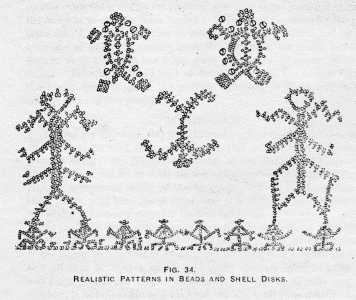
Like the bead work, the embroidery and applique found on many garments are added "to make pretty." Some of this work is quite fine, but in general that of recent years is either inferior to that found on old garments or is borrowed from, or made by, the Bila-an women. Some garments, with designs produced by oversewing before dyeing, are seen here, but they are recent importations from the Kulaman or Tagakaolo tribes.
Necklaces and leglets are made of rattan and are decorated with burned lines or by being overlaid with platted strips of orchid and fern cuticle (Fig. 2).
A few rare specimens, such as personal ornaments or basket rims, have sewed in designs in which the sewing has been done with fern cuticle (Plate XXXIVb).
Incised patterns appear on nearly all the bamboo lime and tobacco holders, but here individual fancy plays such an important part that a hundred specimens might be examined without finding duplicate patterns. Fig. 14. shows nine of these tubes covered with cut-in designs, yet only one figure, that marked X in b could be identified. This was said to be the familiar crocodile.
Coming to the work in brass and copper we encounter an entirely new type of design. In some cases straight inlaid or overlaid strips and twisted wires are used to ornament the specimen; while in the raised and cut-in lines on the bells we find simple patterns. In the main, however, the ornamentation on this class of material consists of complicated scrolls (Plate XLI), designs suggesting flower or tree patterns, or conventionalized figures. One only needs to compare these objects with similar specimens from Borneo and the Malayan Islands of the South, to find the source of this type of ornamentation.[53] In fact the imitation of Moro wares is practiced today. In Plate XLIa and b are shown two betel nut boxes—No. 1 the work of the Samal Moro, No. 2 the imitation of the inlaid work on the top of the first specimen. This last was made in my presence, and with the expressed intention of duplicating the Moro box. However, in this case, as in all others, the Bagobo caster did not attempt to exactly reproduce the work of another, but simply borrowed a broad idea, and thus he often creates new forms.
[53] See LING ROTH, Oriental Silver Work.
Not once did the writer receive a name for any pattern or design shown in metal work. A careful study of the method of work, of the articles produced, and of the folk-lore and religious observances connected with the work in brass and copper brings one to the conclusion that this class of work is of comparatively recent introduction and that the instructors in the art were the Samal Moro.
Mention has already been made of the designs incised on combs and other objects which are afterwards filled with lime. Just here it is interesting to note that, so far as is known, the southern end of Mindanao and adjacent small islands, are the only parts of the Philippines in which this decoration, so typical of Melanesia, is to be found.
Realistic carvings were seen used in only two capacities. The first in certain ceremonies, where extremely crude wooden figures were offered to the spirits in exchange for the sick person (see p. 103), and the second, the wooden decoys used in hunting doves (See Plate XVIII).
Summing up our present information we can say: first, that the Bagobo makes use of certain realistic designs which in some cases have become conventionalized but still retain their former significance; second, that the greater part of decoration in beads, shell disks, embroidery or applique, as well as the incised designs in lime boxes and the like, have no meaning to the people of the present day, and are added only to make the objects more beautiful in the eyes of the owners. In this work there are no set patterns and each artist gives full reign to the fancy in producing these figures. Third, that the ideas for the patterns inlaid, incised, and cast in brass or copper, are furnished by the examples of this work coming from the Malays to the south, but that even in these the artist has taken great liberties in the execution of the design. Fourth, that one type of decoration, i. e., the incised figures filled with lime, suggests the possible influence of Melanesia on the artistic ideas of this people.
MYTHOLOGY.
During my stay with this tribe I heard parts of many folk-tales, some chanted, others told with gravity, and still others which caused the greatest levity. My limited knowledge of the dialect and pressure of other work caused me to delay the recording of these tales until I should begin a systematic study of the language. Owing to unforeseen circumstances, that time never came, and it is now possible to give only the slightest idea of a very rich body of tales.[54]
[54] Since this was written MISS BENEDICT has published an excellent collection of Bagobo Myths (Journal of American Folklore, 1913, XXVI. pp. 13-63.)
In the main these stories are an attempt to account for the present order of things. In the tale which we quoted in part, at the beginning of the paper, we are told of an all-powerful being who created the earth and all that is. Other spirits and many animals inhabited the sky and earth which the creator had made. Of the latter only one, the monkey, is named. He and his kind, we are told, once inhabited and owned all the world, but were dispossessed by two human beings, Toglái and Toglibon, from whom all the people of the world are descended. After their death a great drought caused the people to disperse and seek out new homes in other parts. They journeyed in pairs and because of the objects which they carried with them, they are now known by certain names. One couple, for instance, carried with them a small basket called bira-an, and for this reason their children are known as Bira-an (Bila-an). From the time of the dispersion until the arrival of the Spaniards we learn that certain mythical heroes performed wonderful feats, in some cases being closely identified with the spirits themselves, in others making use of magic, the knowledge of which seems to have been common in those times.
The two following tales are typical of those commonly heard in a Bagobo gathering. The first was told by Urbano Eli, a Bagobo of Malilla.
"After the people were created a man named LumábEt was born. He could talk when he was one day old and the people said he was sent by Manama. He lived ninety seasons and when still a young man he had a hunting dog which he took to hunt on the mountain. The dog started up a white deer and LumábEt and his companions followed until they had gone about the world nine times when they finally caught it. At the time they caught the deer LumábEt's hair was grey and he was an old man. All the time he was gone he had only one banana and one camote with him for food. When night came he planted the skin of the banana and in the morning he had ripe bananas to eat, and the camotes came the same way. When he had caught the deer LumábEt called the people to see him and he told them to kill his father. They obeyed him and then LumábEt took off his headband and waved it in the air over the dead man, and he at once was alive again. He did this eight times and at the eighth time his father was small like a little boy, for every time the people cut him in two the knife took off a little flesh. So all the people thought LumábEt was like a god.
"One year after he killed the deer he told all the people to come into his house, but they said they could not, for the house was small and the people many. But LumábEt said there was plenty of room, so all entered his house and were not crowded. The next morning the diwata, tigyama, and other spirits came and talked with him. After that he told the people that all who believed that he was powerful could go with him, but all who did not go would be turned into animals and buso. Then LumábEt started away and those who stayed back became animals and buso.
"He went to the place Binaton, across the ocean, the place where the earth and sky meet. When he got there he saw that the sky kept going up and down the same as a man opening and closing his jaws. LumábEt said to the sky 'You must go up,' but the sky replied 'No.' At last LumábEt promised the sky that if he let the others go he might catch the last one who tried to pass; so the sky opened and the people went through; but when near to the last the sky shut down and caught the bolo of next to the last man. The last one he caught and ate.
"That day LumábEt's son Tagalion was hunting and caught many animals which he hung up. Then he said he must go to his father's place; so he leaned an arrow against a baliti tree and sat on it. It began to grow down and carried him down to his father's place, but when he arrived there were no people there. He saw a gun, made out of gold, and some white bees in the house. The bees said 'You must not cry; we can take you to the sky,' So he rode on the gun, and the bees took him to the sky and he arrived there in three days.
"One of the men was looking down on the land below, and all of the spirits made fun of him and said they would take out his intestines so that he would be like one of them and never die. The man refused to let them, and he wanted to go back home because he was afraid; so Manama said to let him go.
"The spirits took leaves of the karan grass and tied to his legs, and made a chain of the grass and let him down to the earth. When he reached the earth he was no longer a man but was an owl."
(2) The second tale, which was recorded by P. Juan Doyle, S. J., is as follows:
"In one of the torrents which has its origin at the foot of Apo, there were two eels which, having acquired extraordinary magnitude, had no room in so little water, on account of which they determined to separate, each one taking a different direction in search of the sea or the great lakes. One arrived, happily, at the sea by the Padada river, and from it came eels in the sea. The other descending a torrent, swimming and confining himself as well as he might, enclosed in these narrow places, said to himself 'I haven't the slightest idea of what the sea is, but it appears to me that when I see before me an extraordinary clearness on a limpid surface, that must be the sea, and with one spring I will jump into it.' So saying, he arrived at a point where the torrent formed a cascade. He noticed that it cut off the horizon and to his view it appeared of an extraordinary clearness; he thought he could swim there without limit, and at his pleasure, and that this, in fine, must be the sea. He darted into it, but the unhappy one was dashed against the rocks, and too fatigued to swim through the rough waters, he lost his life. His body lay there inert and formed undulations which are now the folds which the earth forms to the left of Mt. Apo."
<
OTHER BRANCHES OF THE TRIBE.
To the south and southwest of Mt. Apo, and west of Digos, are seven settlements, the inhabitants of which are known as Obo or Tigdapaya. On the south they meet the Bila-an, and, like this latter people, extend over the watershed into the valley of the Cotabato river. On the northwest they come in contact with the Ata. They have intermarried with both of these tribes, have adopted many of their customs, and in some cases their manner of dress. However, they consider themselves, and are considered by the Bagobo, as a part of that tribe, and recognize Tongkaling as their chief. Bagobo customs and blood predominate, although intermarriage with the Negrito was evident in nearly every individual of this division seen by the writer.
Immediately wrest of Daliao are three villages whose people are known as Eto or Ata. Aside from a slightly greater percentage of individuals showing negroid features, these people do not differ in any respect from the Bagobo. It does not seem that they should be classed with the people later referred to as Ata. To the north, their lands join the territory held by the Guianga.
The habitat of the division called Guianga begins a few miles back of the Gulf and extends west to the watershed. An east and west line drawn through the village of Taloma marks their southern boundary, while to the north they approach the Lasan river. They are found in a number of scattered settlements which owe allegiance and are subject to five petty datu. Tongkaling is not recognized as having any authority in the district, and there seems to be no remembrance of a time when any of the Bagobo rulers held authority over the Guianga. Physically and culturally they do not seem to be far removed from the Bagobo, while their language is so closely related that individuals of the two divisions, meeting for the first time can carry on a conversation. There is, however, considerable variation between the dialects, both in intonation and vocabulary.
Further study may result in raising this branch to the dignity of a tribe, but the information at hand does not justify us in considering them other than a dialect group of the Bagobo.