Round The World With A Billiard-Cue.
Reading edition
By Melbourne Inman, British Billiard Association Champion.
In this amusing article the well-known professional describes some of the curious experiences that befell him during his recent tour round the world—a tour on which his "only visible means of support" was his cue. He met all sorts and conditions of men, and—what was more important—all sorts and conditions of billiard-tables, but, as this narrative shows, managed to extract not a little amusement from his misadventures.

THE hundred and one minor accidents which occur in the average globe-trotter's journeyings were, in my case, added to and enlarged by the fact that to a certain extent my tour depended upon the amount of patronage I received. To travel round the world with a billiard cue and case as one's only visible means of support is an undertaking which requires a considerable amount of doing. That I succeeded so well I put down to the fact that the Britisher abroad is a sportsman of the best sort, and will do anything and pay anything to see one of the Mother Country's champions playing his game, no matter what that game may be. During my journey I went completely round the world, visiting Ceylon twice, Australia three times, New Zealand twice, Tasmania, China, the Straits Settlements, India, and Burma, the total distance covered being close on a hundred thousand miles, and the time occupied by the tour over eighteen months.
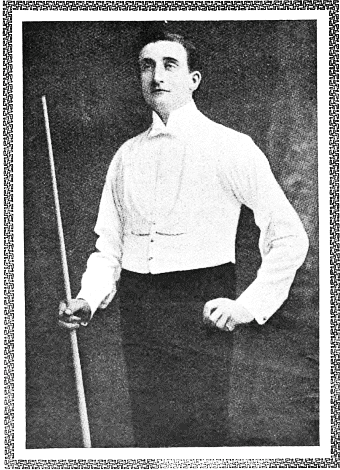
MR. MELBOURNE INMAN, BRITISH BILLIARD ASSOCIATION CHAMPION. From a Photograph.
My chief difficulties were the tables which were provided. I did not expect to meet with absolutely correct ones, but sometimes I would be led into a room and introduced to some bedraggled wreck on four or five legs and blandly informed that that was the thing upon which I had to show my powers as a billiard-player! The only thing which saved me from a sudden and total loss of reputation was the fact that my opponent usually did a great deal worse than I, and my efforts to avoid the unorthodox pitfalls, such as open gaps in the cloth, grooves at the pockets, and so forth, were seen and appreciated by the habitués of the place who used the table themselves, and were only too familiar with its peculiarities.
My first really amusing adventure occurred at Colombo, Ceylon. I was booked to play a Mr. G——, who was a well-known personage, being sub-editor of the local paper, and had to give him eight hundred start in a game of twelve hundred up. The match took place at the Globe Hotel, and when I entered the room I saw that a good crowd of natives had gathered to watch the game. They were evidently very anxious to see their champion win, and chattered away volubly while the game was in progress. Now silence is indispensable if good billiards is to be played, but I stuck to my work until suddenly dull thuds began to sound on the ceiling above. The lights over the table quivered and danced with the reverberations, and presently, in despair, I called the proprietor to one side and asked him what on earth was happening up there.
"Oh, that's all right," he said, cheerily. "There's a troupe of dancing girls come here to practise every evening, and they are doing it now!"
With a stifled groan I went back to my task, but the din grew louder and louder, and at last became so continuous that I could not hear the marker's voice registering the score, while the vibration was positively alarming. At last, feeling I could endure it no longer, I went over to the marker and informed him that I was going to stop. Handing him my cue, I told him to put it away in my case, as I would play no more.
He took my cue from me and, turning to the spectators, cried, stolidly:—
"There will be an interval of ten minutes for refreshments."
The cool way in which he gave out this announcement tickled me, and I forgot my annoyance. Presently, the landlord having prevailed upon the nautch girls to cease their gyrations, the game was continued.
I was in the middle of a decent "break," and rapidly overhauling my opponent, when I noticed a black shadow whizzing about the table legs and flashing up and down among the spectators. Now, anyone who plays billiards will know that the light on the table makes it extremely difficult for the eyes to follow movement in the shadows around the room, and it was not until the thing brushed against my legs that I stopped playing and looked around.
The audience was standing up, wildly excited. I thought at first that it was my play which made them do this, but the flattering idea was quickly dispelled. I saw a lean brown arm sweep down and a wildly-spitting, furry object swung across the room and shot out of the window.
"What on earth was that?" I asked, startled.
"It's all right, Mr. Inman," replied the marker. "A wild cat has been rushing around here for the last ten minutes, but one of the gentlemen has just pitched it out of the window!"
I succeeded in winning the game all right, but did not finish until long after one o'clock in the morning. As we started at 9 p.m. and the heat during the whole four hours was terrific, it may be imagined that, what with interruptions from nautch girls and wild cats, I considered I had earned my fee, and a trifle over.
I came across something really unique in the way of rules in an hotel at Newara-Eliya, where I was booked to play. In the billiard-room, immediately opposite the table, where everyone could see it, hung a card bearing the following announcement:—
Gentlemen cutting the cloth will pay—
For first cut 100 rupees.
Second cut 50 rupees.
Third cut 20 rupees.
Any subsequent cut 10 rupees.
Judging from the appearance of the cloth, I should think that table must have been a veritable gold-mine to its proprietor, if he collected all the fines. Evidently his motto was "Cut and come again."
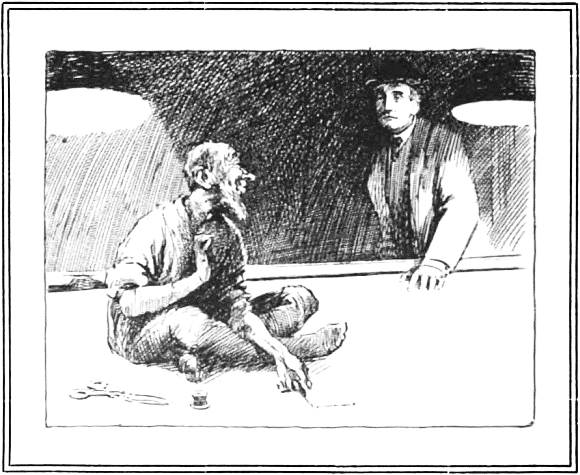
"JEST PUTTIN' THINGS TO RIGHTS A BIT."
While staying at Wellington, New Zealand, I was invited to play at the Tararua Club, Pahiatua, some hundred and twenty miles away. I accepted the offer and, assuming that my stay there would be very short, left my wife at Wellington and travelled up to Pahiatua alone. I was met at the station by a number of gentlemen, and, after the usual liquid refreshment, went along to see the table on which I had to play. When I entered the room I saw a long, thin man squatting cross-legged in the centre of the table, stitching away at the cloth for all he was worth. Somewhat surprised, I introduced myself, whereupon the man explained that he was the local tailor, "jest puttin' things to rights a bit" for me.
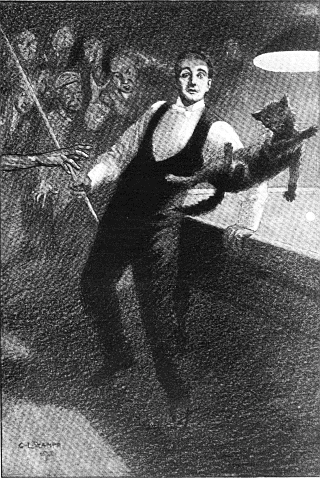
"A WILDLY-SPITTING, FURRY OBJECT SWUNG ACROSS THE ROOM."
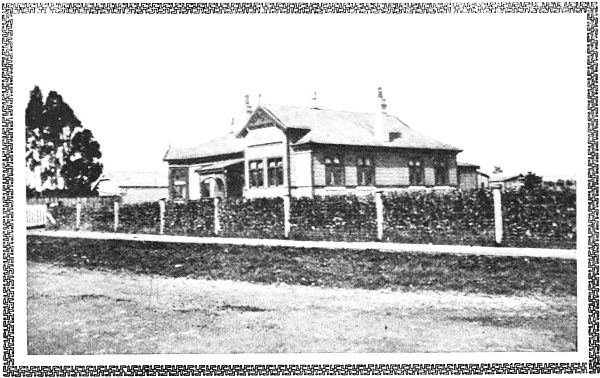
THE TARARUA CLUB, PAHIATUA, N.Z., WHERE MR. INMAN MET WITH SEVERAL AMUSING EXPERIENCES. From a Photograph.
The table itself wasn't at all bad, but when I looked at it closely I noticed that the billiard spot (the black spot on the table which indicates where the red ball is usually placed) was at least three inches too far to one side.
I had become fairly hardened to trying conditions by this time, but to attempt to play with the red ball inches out of its recognised position was more than I dared do.
"What's the matter with that spot?" I asked. "It isn't right, is it?"
The man of the needle slued around on the cloth and squinted at the spot.
"Seems sorter crooked," he agreed, slowly; "but the fac' of the matter is that we change the position of that yere spot once a week. Otherwise it'd work a hole in the cloth!"
That beat me. I fled for the hotel and sought out the gentleman who had invited me to come there. He listened to my tale of woe and then, asking me to wait for a moment, disappeared.
I don't know whether they balloted or not, but the spot was moved into its right place, and the situation—so far as I was concerned—saved.
I had been told when I arrived there that, although there were no passenger trains from Pahiatua to Wellington at that hour of the night, I should still be able to get to Wellington when the game was over, as a goods train, known locally as the "Wild Cat," stopped at Pahiatua some time about midnight on its way down-country.
When the game was over, however, and I got back to the hotel, I found that the "Wild Cat" was a very doubtful kind of train and only stopped at Pahiatua when it thought it would! This particular night, it soon appeared, was one of its "off" nights—it never showed up at the station at all!
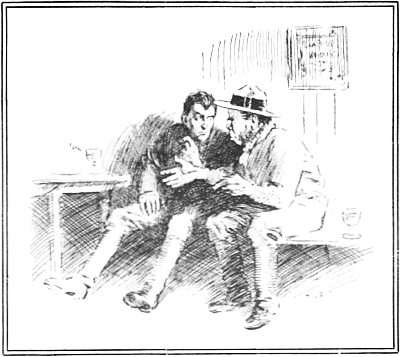
"THE 'UMAN RACE STARTED FROM MONKEYS—AND DON'T YOU FORGET IT!"
Everybody was very kind to me and made me as comfortable as possible. While I sat in the bar, waiting for the train which never came, I noticed in a corner a couple of men with their heads together, talking very earnestly. One of them was an old squatter, the other an obvious new-comer, and their argument seemed so heated and absorbing that I gradually edged my way along the seat towards them to try and hear what it was they found so engrossing.
I half expected it would be sheep, or land values, or old-age pensions, but when I came within hearing distance the squatter was saying:—
"I tell you, sonny, the 'uman race started from monkeys—and don't you forget it!"
Darwin's theory in the back-blocks of New Zealand! I went straight to bed after that. To run up against a philosophical tailor, a movable billiard spot, a train with ideas of its own, and Darwin's theory, all in the same afternoon, was putting too severe a strain on a mere perambulating billiardist.
Even then, however, I had not finished with Pahiatua. In the small hours of the morning I awoke and saw that the room was filled with a dense, pungent mist. It would clear away for a moment, and the daylight would filter into the room; then down would come the fog, and the same peculiar smell would rise to my nostrils again. I lay still, watching this peculiar phenomenon for some time. I had seen so many strange things happen in the country that I accepted this as another of them.
Presently I heard heavy footsteps crossing my room.
"Who's that?" I asked.
"Only me, Mr. Inman," answered the voice of one of my friends of the previous night. "I've just come along to tell you not to be scared. The fire is nearly out."
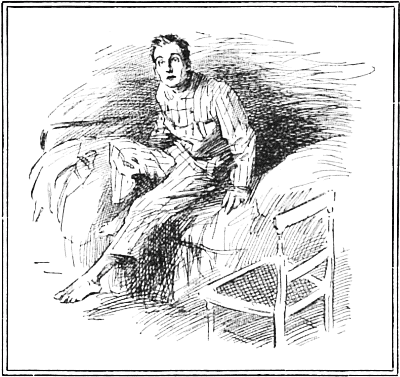
"FIRE! I JUMPED FROM THE BED AND RACED TO THE WINDOW."
Fire! I jumped from the bed and raced to the window. Immediately opposite the hotel I saw a huge pile of blackened wood, from which thick clouds of smoke were slowly curling. The mournful heap represented all that was left of a huge store, whose proprietor I had met and chatted with some eight hours before.
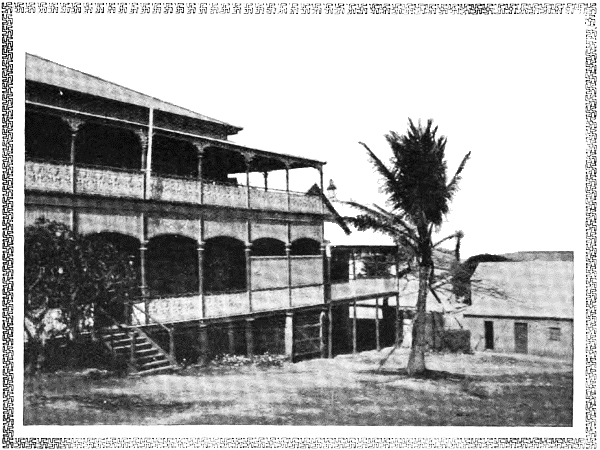
THE GRAND HOTEL, THURSDAY ISLAND, WHERE THEY HAVE EARTHQUAKES "ONLY ABOUT THREE TIMES A WEEK!" From a Photograph.
I turned to my friend and saw that he was fully dressed.
"How long have you been up?" I asked.
"Three or four hours," he replied. "You see, the flames were coming over this way, and we all lent a hand to get it under."
"But, bless my soul," I said, "why on earth did you let me sleep on here?"
"Oh, you were all right," he returned, airily. "We didn't want to disturb you till the last minute. You've a long journey before you."
I knew that it was kindly meant, but at the time, at least, I did not quite appreciate it. I had been a sort of unconscious Casabianca for the best part of the night, and that "last minute" might have been a very exciting one. Yes, Pahiatua is one of the places I shall not easily forget.
I suppose one does get used to these little eccentricities of Nature. I remember, when I visited far-away Thursday Island, the landlord of the Grand Hotel, who had arranged a match for me, said in a confidential aside to me just as I landed on the quay:—
"I don't think you will find the table very straight, Mr. Inman. We had a bit of an earthquake here last night, which shook it up a bit!"
"That's nice, cheerful news," I said. "How often do you have earthquakes?"
"Well, we're not so bad as some places," he answered. "They only happen about three times a week!"
My stay at Thursday Island lasted exactly twenty-four hours; I am not anxious to acquire an intimate knowledge of earthquakes. I brought away with me as a souvenir a copy of what is proudly claimed to be "the smallest newspaper in the world," the Thursday Island Pilot, a facsimile of which is here reproduced. It is a single sheet, measuring about fourteen inches by eight.
On one occasion I "put my foot in it" fairly. It happened in Southern India, at a place where I was booked to play at the local club. The journey took twelve hours by boat, and when I arrived I was told that a gentleman was waiting for me. I thought that he was bound to be the secretary of the club, who had arranged all details with me, and chatted to him as we made our way towards the village.
Presently we passed a ramshackle-looking building, the walls of which, as far as I could judge, were made out of empty biscuit-tins and soap-boxes. It straggled over half an acre of ground, and troops of hungry dogs were sniffing around it.
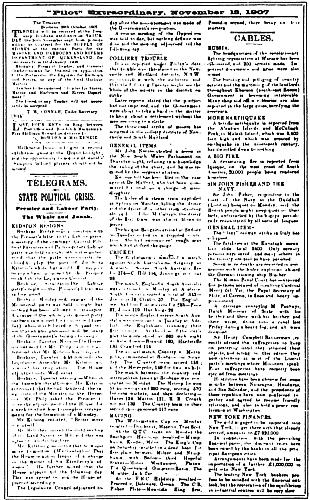
THE "THURSDAY ISLAND PILOT," WHICH IS BELIEVED TO BE THE SMALLEST NEWSPAPER IN THE WORLD.
I thought that I might venture on a little humour just to liven up the conversation, so, pointing to the building, I said:—
"A cow shed, I suppose?"
He followed the direction of my outstretched finger, and a pained look came into his eyes.
"That's the hotel you're going to stay at," he said.
I gasped, but blundered on.
"What a horrible-looking hole!" I cried. "I shall never be able to get my wife to stay there."
"It's not so bad inside," was the reply, in rather a peculiar tone of voice.
The rest of our tramp was finished in a strained silence. I thought that, perhaps, as secretary of the club, my new friend was afraid that the accommodation would not please me. On the steps of the club I was met by a dapper little gentleman, and my companion, nodding to both of us, turned on his heel and disappeared.
"I am Mr. ——, Mr. Inman," said the man on the steps, and mentioned the name of the secretary with whom I had been in communication.
"Then who was that gentleman I have just left?" I asked, in surprise.
"That is the landlord of the hotel!" he explained.
Then, of course, I saw my mistake, and, when I met mine host again, hastened to make my apologies and patch things up as best I could. I am sure, however, that, deep down in his heart, my thoughtless words rankled. Both my wife and I took it in turns to praise everything whenever we saw him listening, but, alas! to the very end of our stay he wore a look of anxiety and care. Only when we stood on the deck of the little steamer and waved our farewells to him did the faintest suspicion of a smile flicker on his brown face. It may have been the fact that he was seeing the last of us that conjured the smile up, but I hope not.
One other little incident, and I have done. While playing at Kalgoorlie, Australia, I was approached by a resident and asked to call at his house to give a few lessons to his wife. The terms he offered were so high that I could not refuse, and so, when I had a few hours to spare, he and I went to his home.
I was introduced to his wife—a charming woman with all the true Colonial hospitality and kindliness—and we sat down in what was obviously the best room in the house and chatted for about half an hour. Finally, thinking that I ought to be up and doing something for my money, I suggested that, if the lady was quite ready, we ought to adjourn to the billiard-room, so that the lessons might commence.
"This is our billiard-room," said my host.
I looked round in amazement. "But where is the table?"
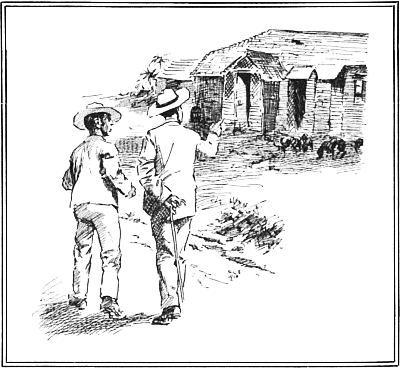
"THAT'S THE HOTEL YOU'RE GOING TO STAY AT."
He went to one corner of the room, lifted a small three-feet-by-six miniature table top, and placed it on the dining-table in front of me.
"This is our table," he said, proudly.
I felt as though it was taking money under false pretences to try to teach billiards on such a makeshift affair, and said as much, but the old gentleman would have none of it, so I set to work and did my best. But it was an ordeal which I have no wish to repeat, for cue, balls, and everything else were in proportion to the size of the table. In fact, I believe that the old fellow could do more on the thing than I could. Anyhow, he seemed a little hurt at my inability to run up a three-figure break on it, and on the way back to town again regaled me with yarns of what several of his squatter friends could do on that table in the way of piling up centuries.
We parted good friends, but I don't think he thought quite so much of my billiard-playing then as he had done at first. He was pained, perhaps, to find that it had limitations, and that a three-feet-by-six table was one of them!