Bertram Mitford (continued 2)
Reading edition
But though I see the flash, the bullet passes over my head unhurt, yet it hums into the thick of those behind, and there is more than one yell of death. Now I spring upon this great Ibuna, but before I can strike him my assegai—the King’s Assegai—is dashed from my hand by a clubbed gun. It has been done by one of their women—a great, ugly, toad-like witch, with grey hair. But immediately half a dozen spears enter her body, and she falls yelling. At the same time, under cover of my shield, I seize the great umkonto again, and close with the leader, hand to hand. He has a knife—no time has he to load—and we are at too close quarters for the long gun to be clubbed again. He aims now a furious kick at me. Ha! is it thus that such vermin fight? Then I leap upon him, and with one mighty stroke my great assegai lays him open from the throat downwards.
“Hau! dog of the Amabuna,” I cried, as he fell, “dost care now that the smoke of thine ugly carcase should reach the nostrils of the King?”
Now was a terrible medley of Amabuna and children of the Great Great One. The air was black and heavy with smoke, and the jarring crash of weapons, and the thunder of the shock, as our impi came, thick and fast, pouring over the wagons on all sides, and a forest of tufted shields was dancing in the moke, and blades tossed redly on high, reeking with the stream of life. And against the vaporous gloom could be seen the outlined faces of our warriors, the children of blood, as, with teeth bared, they threw their heads back and howled like hyenas because they could not get enough to slay, could not get at it quick enough. And the Amabuna fought—yes, they fought—and when it came to the last their women fought more fiercely than the men; yet all were brave. But what could they do against us, against our might? Driven hither and thither, broken up into handfuls, they stood back to back, men and women alike, sick with wounds and the flow of their own blood, that ran in streams; yet they struck and struck. Ha! our spears were blunted that day, and reddened indeed, and our pealing yells of rage and victory rent the skies again and again!
All were slain. We spared none. Their women also we killed, for not even among the younger did we see any who were fit to spare and take before the King, so evil-featured and unwashen and shapeless were these. The children, too, were slain, having their brains dashed out against the wagon-wheel, or flung into the air to be caught upon the spears of the warriors as they descended again.
The battle was over now, for none were left to fight. Our warriors, like wild beasts who had tasted blood, were rolling their eyes hither and thither in search of more life to destroy. But there was none.
Then something seemed to move in one of the wagons. There was a wild howl, and a rush. My brother Mgwali was first. Plunging his hand beneath some sacking, he drew out the body of a little child.
It was a girl-child, and as Mgwali plucked it from its place of shelter, and held it aloft by the back of its clothing, I could see that it was yet unhurt. But it was terribly frightened. Its great blue eyes were starting from its head, and its long hair, like shining threads of sunlight, streamed down over the dark shoulder and arm of Mgwali, dabbling in the blood which yet lay undried upon him.
“Hau! Throw it up, Mgwali!” cried those who stood by, gripping their assegais ready to receive its little body on the blades. But before this could happen I leaped to the spot.
“Hold!” I roared, extending my stick. “Hold!”
The young men snarled, like hungry dogs reft of a bone. But they dared say no word, knowing that he who disputed my orders in the field of battle tasted death that moment. Still Mgwali held the child aloft, gazing at me in wonder. But at a further glance from me he set it down.
“See!” I said. “This is not a child of the Amabuna. It has the look of a child of a race of kings!”
The little thing sat on the ground, staring at the ring of grim faces and bloody weapons, trembling, and too frightened even to cry. And there was a look about it which moved me to spare its life. Its eyes were blue as the heavens above, and its soft skin and pink cheeks, and red, flower-like mouth marked it off as quite a different race to the leather-skinned herd we had just slain. So I began to speak it fair and soft, and found that it understood a few of my words, and, lo! it crept over to me, and began to hide behind my shield, hoping to shut out the fierce faces of the warriors who stood looking on, uttering many a deep-throated gasp of amazement. And well they might, Nkose; for here was I, the fiercest fighter of all that blood-stained impi—I, who had slain with my own hand as many of the foe as any other could boast of—and yet here was this little thing, with the eyes of heaven, and hair like a stream of sunlight, shrinking up against me for protection and shelter, as though I were her father. In truth, it was strange.
Not now, however, was the time for indulging in any further softness of this kind; so, placing the little one in the care of Mgwali, and making it known that whoever should attempt to harm her should pay the penalty with his life, I went to muster the warriors, who were busy plundering the wagons. Great stores of gwai were there, and sacks of corn and flour, and all manner of things which were good. Such, however, were spoil for the Great Great One, to whom, of course, we had despatched runners immediately, announcing our victory.
Now we mustered our ranks to return in triumph to the King. Whau! we had lost many. In heaps our slain lay around—for the long guns of the Amabuna shot quickly and true. And there, in the midst of their wagon-fort, lay the ripped corpses of the Amabuna; and already the vultures were gathering in clouds overhead. Then as we marched, black and terrible, to the place where the Great Great One awaited, with the thunder of one loud and mighty voice, the warriors sang—
“Ningepinde nimhlab ’Umzilikazi, Leyo ’Nkunzi mnyama, Leyo ’Búbese mninimandhla! Ca-bo! Ca-bo!” “Not again shall you stab Umzilikazi, That Black Bull, That Mighty Lion! Oh, no! Oh, no!”
Chapter Six.
The Burning of Ekupumuleni.
The spoils which were taken from the wagons of the Amabuna pleased the King greatly. The wagons themselves were useless to us, because none among us understood how to make the oxen draw them. So a party of men was ordered off to burn them, having first removed all the iron parts which might be of use. But what pleased the Great Great One most was the number of long guns and the plentiful supply of powder and ball which we took; and this, indeed, some of us did understand the use of moderately well. Howbeit, it was long before we became skilled in the use of them, and by that time, Nkose, nearly all the powder and ball was expended. But the tiny captive, with the eyes of heaven and hair like the crest of the sun, the Great Great One said I had done right to save. Yet, as he knew not what to do with her, he ordered that I should be a father to her for the present, adding that, as the last time I had spared one from the slaughter it had brought good to him and the nation—meaning the case of old Masuka—so now, perhaps, the same would hold. Now, I was right glad of the King’s decision, Nkose, for I had already begun to look upon this little one as child of my own. So I made her over to the youngest of my wives, Fumana, who took care of her and loved her greatly.
Now, although we had made an end, utter and complete, of those Amabuna who came against us, and of the abatagati among ourselves who had plotted with them, yet the mind of Umzilikazi was not at ease. For he knew something of that people, had heard how they swarmed in such numbers over the country to the westward as to leave no further room, but were crowded out, and ever moving onward to seize upon new lands. Even then, as we had heard, they were plotting to seize land from Dingane, and if, as might befall, the Zulu power was worsted, and the House of Senzangakona forced to seek out other country, might not we have the remaining strength of Dingane falling upon us any day, even as we had fallen upon and swept aside those who lay in our own path? Further, although of those Amabuna whom we had eaten up, not one was left alive to carry back the tidings to his own people, yet, sooner or later, such tidings would reach them, and then we might expect their vengeance. Now, if those comparatively few whom we had slain—some score and a half of families—had fought so fiercely and dealt so much death amid our ranks with their long guns, what sort of foes would their kinsfolk prove, assailing us in force and unhampered by women and children? Or they might form a temporary alliance with Dingane; and then how should we stand against the combined strength of two such terrible and formidable foes?
All these considerations were debated gravely by the King and a secret council of the izinduna, of whom I was one, and it was decided to abandon Ekupumuleni and the surrounding country, and to march upon and seize the fair lands occupied by the People of the Blue Cattle, upon which I had reported. Howbeit, the real reason for this decision was not to be talked about, a good and sufficient reason for the people at large being that the land upon which we meant to swoop down was better than that wherein we now dwelt.
It took time to send round to all the cattle outposts and muster the nation at large, but this was done at last. The cattle and the movable property was sent on in charge of the women and slaves, and for several days the izanusi were busy making múti, and doctoring us all for our new undertaking. Then came the last night we were to spend in Ekupumuleni, and through the hours of darkness the wild howlings of the izanusi sounded at intervals; for it was no light thing thus quitting the place which had been our home for so long a time.
But with dawn of day, when all men turned out fully armed—for a muster of our whole fighting strength had been ordered to march out from Ekupumuleni in fitting state—a shiver of amazement, and horror, and dismay ran through all. And well it might. For in the middle of the great open space had been reared four stakes, and, impaled upon each, quivered the trussed-up body of a man; and the groan of horror and of fear deepened, for in the agonised, distorted features of those four all men recognised the traitorous izinduna and the head witch-doctor, Notalwa.
This, then, was the secret of their fate, which so far had lain in dark and terrible mystery. They had been kept for such an end.
Five chief traitors had there been; yet here were but four! The first astonishment over, men looked at each other—their eyes asking in mute surprise where was the fifth? And of those who thus marvelled none wondered more than myself.
On the centre stake, raised half the height of a man above the others, was the body of Tyuyumane. On either hand of him were impaled Ncwelo and Senkonya, and, a little in front, Notalwa. Where, then, was Ntelani? Where, then, was my father? Well, wherever he was, it was not there.
The stake of impalement is a terrible thing, Nkose, and was seldom used among us—only once, indeed, since we had gone out from Zululand, and then in the case of three chiefs who had come in to konza to Umzilikazi, and had departed, laughing at their promise. Now, however, by the hideous fate to which he had adjudged these ringleaders of the conspiracy, it was clear that the King intended to strike terror into all who might at any future time be tempted to travel the same road.
They were still alive, those wretches—for a man may live a day or more in that torment, and these had not long been on the stakes. And as we stood gazing upon them thus suffering, several izimbonga came running forth from the isigodhlo—roaring like lions, trumpeting like elephants, bellowing like bulls—shouting the praise and the royal titles of the King. And from the whole army, ranged on either side of the open space in two immense half-moons, these were taken up, and re-echoed again and again.
But Umzilikazi, advancing down the centre, with his head thrown proudly back, halted, and held up his hand.
“Cry not to me the Bayéte, my children!” he said, in clear and ringing tones. “Cry it to your King, Tyuyumane. Behold him, yonder—your King, Tyuyumane!”
Bitter and biting as serpents were the words, splendid the gesture, as the Great Great One waved a hand towards the chief of the impaled traitors, who was raised higher than the rest. An awestruck murmur ran through the ranks. None knew what to do; for the humour of a King is of the nature of fire, in that it is not a thing to be played with.
“What? Have ye no word, my children? Have ye no greetings for your King, Tyuyumane—your new King, who reigns from a high seat? See, I will set you the example.”
Then going before the stake whereon writhed Tyuyumane, the Great Great One mocked him, crying—
“Hail, Tyuyumane! Hail, new King of the Amazulu—ruler of the world! Is thy seat high enough? Is it soft enough? Ha! Praise him, ye izimbonga! Cry him the Bayéte, ye warriors!”
The impaled wretch gave a quivering heave, and his lips curled back from his jaw, baring the teeth, which were locked together in the agony of his torment. It was a fearful sight, for though ruthless in the heat of battle, yet at this moment we saw not red; and these sufferers, though deservedly thus punished, were of our own blood. Yet none pitied overmuch Notalwa, for the izanusi were hated and feared by all.
“We leave thee in peace, Tyuyumane,” went on Umzilikazi, still mocking. “We go out from thee, because a nation cannot own two kings. We leave thee, but will konza to thee from afar. We leave thee our royal dwelling, Ekupumuleni. We leave thee in the midst of thine izinduna,”—with a wave towards Ncwelo and Senkonya, between whom he was impaled. “We leave thee, too, our head izanusi, Notalwa, and we go forth, homeless and scanty in possessions, to seek a new home. Thou, who art weary, need travel no further. Ekupumuleni, ‘the Place of Rest,’ shall be thy resting-place forever. Ha! Hlala gahle, Tyuyumane! Rest in peace!”
With this mocking salutation, the King turned away, and, preceded by the izimbonga shouting in praise of the royal justice, he paced for the last time, and with great state, through the principal gate of Ekupumuleni, and, mounting his horse, which was awaiting him outside, signed that we should commence our march. Then, as the immense array of armed warriors, in full war adornments, filed out of the great gate, spreading forth over the plain as the waves of a dark sea, once more was raised the song of triumph which told of our victory over the Amabuna:
“Ningepinde nimhlab ’Umzilikazi! Ha—ha—ha! Ca-bo! Ca-bo!”
And soon the mighty kraal which had been the home of a warrior-nation for so long a time was quite deserted—given over to those four grisly figures, writhing there upon their stakes in blood and agony.
But scarcely had the rear of the last column passed out through the gates than flames and smoke were seen issuing from four points of the kraal at once. The King had given secret orders that it should be thus fired; and the blaze, once kindled, leaped from dome to dome of the thatch huts, running along the dry thorn fences with a crackling roar like the volleys from the guns of the Amabuna; and now in a marvellously short space of time the immense circle of Ekupumuleni was wrapped in huge sheets of flame; and in the dense smoke-clouds which rolled down upon the whole of its area, before towering aloft to the heavens, the bodies upon the stakes were completely swallowed up. And then all cried aloud in praise of the mercy of the King, who had thus shortened the just suffering of those traitors by the swift death of suffocation, while rendering them such a noble tomb as the ashes of a royal dwelling.
Such then was the end of Ekupumuleni, the Place of Rest; and again as we resumed our journeyings, again as we swept northward upon our devastating way, our path might have been read by the line of the vultures in the heavens, by the track of wild beasts through the brake and the grass, running side by side with us, well knowing who should supply them with plentiful and easy prey.
Now none knew why the King should have been minded to spare my father, Ntelani, for that the latter had been spared all now knew. Yet he was cut off from all fellowship with his equals, and was forced to accompany our march, sullen and sad, unarmed, and in the midst of a guard consisting only of slaves. Some thought it was because he was the father of him who wielded the King’s Assegai; others that he was reserved for an even worse fate; but all wondered he did not take his own life rather than live on thus—he an induna of high degree, now forced to herd with Amaholi and the lowest of the people.
The little blue-eyed child whom I had taken from among the Amabuna had by now quite lost all fear of us, and would laugh and play as merry as the merriest of our children. My two younger wives cared for her greatly; indeed, I think they loved her more than they did their own children. But Nangeza, my inkosikazi, looked upon this little one with a scowling brow. It would draw ill upon us, she used to declare, to bring into our midst a child of such a race. However, beyond frowns and growlings even she dare not go; for the child had been given into my charge by the King, and to harm it meant death; nor was Nangeza tired of life just then. This little one, too, feared nothing, not even the King himself; and often, when Umzilikazi was moving abroad, and all were bowing down before him with words of bonga, she would dart away from those who would have restrained her, and run out all alone, and, standing before the Great Great One, throw up her tiny hand in the air, and cry aloud the Bayéte, her blue eyes laughing up into the King’s face. And he would talk softly to her, and presently send round a couple of white calves or two or three goats for her to play with. And we named her Kwelanga, from “Kanya Kwelanga,” the “Light of the Sun,” because her hair, all bright as of gold, seemed to reflect that light.
So our nation journeyed on, and more than one moon had waxed and waned. And there was a brightening up of spirits among the warriors, and talk and songs of war; for now we knew we were drawing near the country of the People of the Blue Cattle, the land of richness and promise, the land which should be ours.
Chapter Seven.
Untúswa’s Embassy.
We had halted some days at a convenient place to hunt. The King was in high good humour, for the land with each day’s progress fell off in no wise from the report I had made upon it.
“In truth, Untúswa, thou art a wise man as well as a brave one, though young in years,” he said one day, as we sat beneath the shade of a great tree, taking snuff; for Umzilikazi, with a number of his body-guard, and three or four izinceku, had gone on in advance of the remainder of the nation, intending to hunt before the game was scared out of our path. But the game we sought was fierce and dangerous game—the lion, and the elephant, and the buffalo—and in the slaying of such none was bolder or more skilful than the King himself. I was the only induna of the party, and, indeed, it seemed to me that Umzilikazi liked to find some reason for keeping me about him, even as when I was a boy and unringed.
“It seems to me,” he went on, after I had uttered my thanks for his word of approval, “it seems to me that we are drawing near to the country of the Chief of the Blue Cattle, yet the choicest of those cattle have not travelled our way, nor have their owners sent to beg to be allowed to live. How do you explain this, Untúswa?”
“The Bakoni are a nation of fools, Great Great One. Their warriors are numerous, but they do not look much of warriors. They, in their ignorance, fear not the might of the all-devouring Amazula. Give but the word, Father, and the day we sight their town, there shall not be a man left.”
“Thou art a lion-cub, indeed, Untúswa,” said the King, with a laugh. “No. I have another mind in this matter. I will not destroy these people, for I think to make use of them—that is, I will give them one more chance. I will send to their chief, that he delay not to come in and place his neck beneath my foot. But who to send? None but these slaves speak with the tongue of those people—and who can trust a slave?—and Masuka is too old, and to me too valuable.”
This last the King said rather to himself than to me, yet I understood his meaning.
“Send me, Father,” I said. “I am able to converse with these people, and who better can explain the mind of the King in such a matter?”
“That is so, Untúswa. But it is like sending thee to thy death; for, if these people are wallowing in their folly to the extent of refusing to konza to me, it is as likely as not they will slay my messenger. And it is not a very great death for a fighting captain.”
“When a man dies in the service of the King, any death is a great death,” I answered. “Send me, Black Elephant.”
Umzilikazi took snuff a moment and pondered.
“I will send thee, son of Ntelani,” he said. “Who now is there to bear thee company, for thou must go alone, with one other, and four slaves to carry thy game. I will not that an induna of the King go before the chief of a numerous nation unattended.”
It was, as the King had said, a dangerous service. The Bakoni, I knew, were relying on their numbers. It was extremely probable they would put me to death in the first instance, and, at any rate, certain that they would do so later, when they realised that our impis were actually drawing near to sweep them off the face of the earth. Yet I felt sure that the Great Great One had some reason in sending me; and, even had I not, never was I known to think twice when ordered to any post of danger. I was the only induna with the King there in our advanced camp, but among the royal body-guard was that aforementioned younger brother of mine, Mgwali, son of the same mother as Sekweni, who was put to death for suffering himself to be overpowered at his post. Him now I named to the King.
“It is well,” said Umzilikazi. “Go now to this chief named Tauane, which appears to mean in the tongue of his race, ‘A Young Lion,’ and say that not many days off draweth near an old lion, whose roar is louder—that unless I behold the usual tribute, brought by himself in person, before we are within a day’s march of his town, he and his people are already dead. Go!”
I stood before the King, cried aloud the Bayéte, and strode off. I armed myself with my great war-shield, several strong assegais, and a heavy knobstick. Then I took in my hand the King’s Assegai, and sent for my brother Mgwali.
“Pick out four of the slaves, load them with such things as we need for a long march, and follow me. It is the ‘word’ of the King!”
I stepped forth from the camp with my face turned northward. Before I had gone far I heard a sound of singing, and footsteps behind me, and immediately I was overtaken by my brother, and behind him the four Amaholi bearing loads.
“Whither are we bound, son of my father?” he asked, now that he had time for speech. I told him.
“Whau! It is like the King sending two men to take a whole nation by the beard!” he said, with a joyous laugh. “Yet, Untúswa, I am glad to be one of those chosen, for know that I am tired of my own hair, and would fain wear the ring instead of it. Moreover, thou sayest that these Bakoni maidens are fair.”
“Thou shalt soon see for thyself, Mgwali. Yet it may be that a grimmer embrace awaits us both in their town. How likest thou that, son of my father?”
“I care not. Hau! Ibúbese!” he cried, hurling an assegai with the quickness of lightning at a long, yellow gliding shape, which had darted from a thicket in front of us. But the lion uttered a quick, frightened yelp, and made off unhurt. The spear had fallen short.
“No more of that—no more of that!” I cried, in anger. “We are on the King’s service, boy. No time have we to stop and hunt. Our game lies yonder, and it may be yet more dangerous than the slaying of lions.”
Not many days had we to travel before we drew near the Great Place of the Bakoni; and, from the commotion which our appearance excited among the inhabitants of such outlying kraals as we passed, we felt pretty sure that the news of our approach had already been conveyed to the chief. And such, indeed, was the case; for on the last rise, which should bring us within sight of the town, we were surrounded by two large bands of armed warriors.
“Delay us not,” I cried haughtily, with a wave of the hand, as these made as though they would have drawn up across our path. “Delay us not. We carry the ‘word’ of the Black Elephant to the Chief of the Blue Cattle.”
We did not halt, we did not slacken our pace. We marched right into the midst of that company of armed men as though none were there. They gave way in silence, but formed up on either side of us in the manner of an escort, and in this order we drew near to the town—not exchanging a word, though we could hear the slaves behind, who bore our burdens, whispering to each other excitedly. Thus we entered, and as we did so the same thought was in both our minds. How, and in what manner should we depart from it again?
The plain for some distance outside the town was dotted about with people: women in groups, men with weapons in their hands, children herding the sleek, blue-coloured cattle, but all gazing with unbounded curiosity upon two men walking alone into their midst as though kings over them, and such indeed we felt.
In those days, Nkose, I was at the very height of my strength and manhood. Now I am old and wrinkled, but I am not short. Then I was of a largeness of limb in proportion to my lofty stature. My body was a framework of hard muscles, and indeed there was not a man in our nation who could overcome me in strength or surpass me in agility, in which my brother, Mgwali, was somewhat my inferior; yet even he was a giant in comparison with the people among whom we now were, though in other matters than strength and stature they seemed far from being a race of fools. Indeed, I have thought since that the King may have had such a contrast in his eye when he sent me to represent him among these people.
If this place had struck me as large before, it now seemed doubly so. In among the huts, too, were strange circular stone walls, here and there, looking like old and strong buildings, for their strength was immense. The huts were without end; they were built of grass, rising to a point, and were neat and clean. We were conducted to one, and bidden to rest, for that the chief would confer with us on the morrow.
“That may not be,” I said decidedly. “This night must the ‘word’ of the Great King be spoken. To-morrow may be too late for ye, O people of the Blue Cattle.”
“E—hé!” assented my brother.
Our escort looked at one another, and their looks were blank. However, they invited us to enter the hut, saying that food and drink should be brought us, and that meanwhile my words should be carried to the ears of Tauane.
We had finished the piece of beef which had been sent us, and had drained the large bowl of tywala, when messengers arrived to announce that the council of the nation would be convened at sundown, and that the “word” to be returned to our King would then be made known to us.
At the appointed time we set forth, Mgwali and I, fully armed, and bearing our shields. As we walked behind our guides, I noted the intense curiosity which our appearance was inspiring, and laughed to myself. For I heard the bystanders, especially the women, comparing our stature and fierce aspect with that of their own people, and saying if we were representatives of that horrible race—of which they had already begun to hear—then, indeed, they were as good as dead. Moreover, while not appearing to do so, I took note of the high fortified hill, which lay a little way back from the town, and thought I could find a way up it—wherein, however, I might have been wrong.
The men of the nation were gathered in an immense half-circle, like the formation of one of our impis when throwing out flanking “horns.” They sat at the upper end of a great open square, and in the bend of the half-circle were grouped the principal councillors and chiefs, and, a little in advance of the rest, clothed in the skin of a maned lion, and wearing ornaments of gold, sat the chief, Tauane. Behind were several huts of much larger size than any of the others.
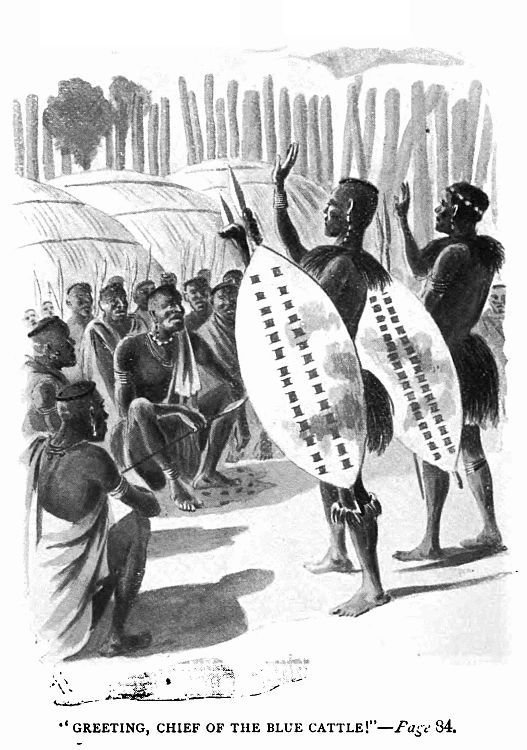
Although those immediately in front of us were not armed, yet the ranks on either side showed a perfect glitter of spears. The shields were square, and not made of oxhide, like ours, but of wood. We knew at a glance that, were our death intended, we should stand no chance whatever. Two men, however brave, however well armed, would be nothing among these.
“Greeting, Chief of the Blue Cattle!” I said, as we drew near. “Remember you the name of Untúswa, son of Ntelani, and an induna of the Great King? It is a name I promised you should hear again.”
Tauane frowned, and I could see his gaze rest meaningly on our weapons. These we had gone so far as to hold in our left hands only, extending the right, open and in greeting. Further, he expected we should have bent down before him; but I, an induna of the King, a Zulu of pure blood, and coming of a kingly house, thought myself an immeasurably greater man than even the head chief of such a large and wealthy tribe as this.
“Is the nation gathered to hear my message, the ‘word’ of the Great Great One?” I asked, without further ceremony.
“Speak it, stranger,” said the chief shortly.
“This it is, then, Chief of the Blue Cattle, and councillors and people of the Bakoni. The ‘word’ of Umzilikazi, the Great King—the Black Elephant, whose tread shaketh the world—is short, even as the measure he meteth out to they who think to defy him. This it is:—‘Go, now, to this chief, Tauane, the lion-cub, and say that not many days off there draweth near an old lion, whose roar is louder than his own—that unless I behold the usual tribute, brought by himself in person, before we are within a day’s march of his town, he and his people are already dead.’ Such was the word of the founder of nations, the eater-up of disobedient peoples, O Tauane, and councillors of the Bakoni.”
I was not sure, Nkose that that moment was not my last. Such a chorus of rage went up from the armed ranks as I delivered my message as might have been heard a great way off.
“To death with him!” they roared. “To death with the man who wears the black ring! Let him be burnt in the fire!”
But of all this I took no notice. I even gave a slight laugh, as I stood, with my head thrown back, looking down upon Tauane.
“Such is the word of the Great Great One,” I repeated, slowly.
“Have you ever done a bolder act, stranger?” said Tauane. “Hear you these? They howl for the blood of him who has insulted their nation and chief. Have you ever done a bolder act?”
“I have, indeed—an act which has won me the isicoco I wear—also this”—holding forth the King’s Assegai. “If they howl now, what will they do when the ‘word’ of Umzilikazi, the mighty King, is not obeyed. Never does he send forth his ‘word’ twice. Now, when wilt thou konza to the Elephant, O Tauane? The sooner the better!”
The howl that went up now was terrible to hear. The dense lines of armed warriors sprang to their feet and hurled themselves upon us, spears uplifted.
Mgwali and I stood back to back, covered by our shields. We would die like Zulu warriors, but before we did so the King’s Assegai should cleave in twain the heart of the chief. This Tauane knew, and made furious signs to his people to forbear. But they would not listen, and it seemed that in a moment more we should fall beneath the weight of the corpses of the Bakoni whom we would carry with us to the Dark Unknown, when there arose a new and sudden tumult out beyond the lines of those who would have slain us.
Up the open square men were running—fleeing as before some great and unknown terror—calling out wildly and looking back as they ran. Every hand was stayed, each uplifted weapon lowered. Away, over the plain, dust-clouds were moving, and soon we could descry among them the advancing horns of driven cattle. Our hearts leaped. Soon we expected to behold the avenging spears of our nation. The King had repented him of our errand of peace. Our army was even now hurrying to sweep this rebellious people from the land.
“Arm yourselves, men of the Bakoni!” cried the fugitives. “Foes are at our gate! Three days have we fled before them, such of us as are left to flee, with what we could save of our cattle. Yonder they come! They will soon be here!”
Now in the disturbance which followed, the Bakoni thought no more of taking our lives. Wildly the fugitives urged that all should at once take refuge in the hills, for that a strange and mighty race was advancing like a devouring swarm of locusts, its warriors as countless in number as the destroying insects themselves. They had received warning in time and had fled; had received warning from the remnant of those who had already been devoured. But those around us laughed. Look at their strength; at their armed might! Whom did they fear? Had they not behind them, too, an impregnable fortress?
The eyes of all were directed to the fleeing cattle. But as these drew near, urged on by their drivers, no further dust-cloud beyond them betokened the advance of a pursuing enemy. If there had been such, he had prudently drawn off on finding himself too near their great town, the Queen of the North, decided the chiefs and councillors of the Bakoni. They little knew—ah, they little knew!
During this disturbance we two had quite recovered our proud and disdainful calmness. We stood watching what went on as though in it we had no lot or part. At last, when it had quieted down somewhat, Tauane spoke:
“It will be well to retire to your house, ye two strangers. On the morrow will be decided the answer that shall be sent to your King.”
Chapter Eight.
The Scourge.
The morrow came, but with it no answer to the King’s “word.” The day was spent by the Bakoni in sending forth scouting parties to look for the rumoured enemy, but these returned bearing no further news, and the chiefs and people of this doomed race felt safer than ever.
No council was convened in the evening and now, feeling sure that no answer was intended, I sent an angry message to Tauane, saying that I would give him till the middle of the following day, and that unless I had his reply by then I should depart; that his chance of safety would have gone by, and that when next he saw me it would be in the forefront of the destroyers.
We did not sleep much that night, my brother and I. We feared even to eat the food supplied to us until we had first caused one of our slaves to partake freely of it. We talked together in a low voice and made our plans.
Morning dawned. We stepped outside our hut, and, lo! all things looked as usual. Women were passing to their ordinary work. Cattle were being milked—those fine blue cattle of which these people were so fond. Young men lounged about, scarcely armed, laughing with the girls, and old men sat taking snuff and chattering. As we stood before our door, their attention was drawn to us, though their remarks were uttered too low for us to catch.
“Of a truth, some of these Bakoni maidens are good to look upon!” murmured my brother, as a string of girls, calabash on head, stepped by.
“Peace, boy,” I answered sternly. “What have we to do with such, we who bear the ‘word’ of the King?”
Taking a rod, I planted it upright in the earth. We stood watching it; but no message came from the Chief of the Blue Cattle. The shadow thrown out by the rod was now scarcely twice the length of a man’s finger. Then I directed Mgwali to cause our four slaves to gather together their loads, for the time for departure had arrived. Only three, however, appeared. The fourth was not to be found. Clearly he had deserted. This looked badly.
The sun had reached his highest. The rod which I had planted in the earth cast no shadow now.
At a word from me we stepped forth, my brother and I together, the three remaining slaves but a few paces behind. As we passed through the town we noticed some of those strange-looking stone walls we had seen on our first arrival. These were about the height of a man’s head—though, in places, higher—and were built in a round formation, seeming to encircle a second enclosure. We noticed just then that the outer wall was entered by a narrow opening just wide enough to admit the body of a man.
But now all our attention was turned upon ourselves, for we were suddenly encompassed by a crowd of armed Bakoni. These, flourishing their weapons, ordered us, in angry and jeering tones, to return to the hut we had occupied. Oh, those fools, who thought to dictate orders to the second induna of the army of the Great King!
We did not even halt; but, instead of assailing us, a number of them rushed upon our slaves, and speared them under our eyes. Haul they fell, those unfortunate Amaholi, simply cut into strips. What happened then, Nkose, I scarcely knew. I saw red. We both “saw red.” The thunder of our fierce war shout frightened them as though it was the roar of a lion in their midst. I heard and felt the hiss of the King’s Assegai as it rushed through the body of the warrior nearest to me, splitting it nigh in twain. Then, as a buffet from my great shield sent another staggering, he, too, was devoured by the dark-handled spear. Whau, Nkose! I know not how many we slew. Leaping hither and thither, roaring like lions, we hewed our way; yet we were but two, and they were hundreds. They yielded before us, only to close up again immediately. Au! they had never seen Zulus in battle before. But even Zulus, being but two, cannot go on fighting all day against the might of a whole nation, and surrounded on all sides. We might kill a number, but our death was certain at last.
Now, of death we thought not at all, for in battle it is not our custom to think of aught beyond how many enemies we could kill. But to me came the thought that I would like to live, if only to assist in destroying the whole of this den of jackals. And I saw the means of attaining to that purpose.
“The wall, Mgwali!” I cried. “Through them—to the wall! We can hold that. It is our only chance.”
I spoke in Zulu, which they understood not. During the conflict we had been drawing nearer and nearer to the wall. Now, as we turned to face it, we were confronted by a double line of Bakoni. Their shields and spears were ready. We could not hope to break through them.
“Leap, Mgwali, leap!” I growled, feeling the searing burn of a spear blade grazing my shoulder. Covered by our shields, we gathered our legs under us, and leaped. Au! we could leap in those days. Right over the heads of the lines of our foes we flew, and immediately, and before they had time to recover their amaze, we had gained the shelter of the stone walls.
Not too soon, though, for we had only just time to turn and receive them, as a crowd of our enemies flung themselves against the opening. Then the King’s Assegai had meat to eat. Au! in a moment the opening was so filled up with bodies that they alone formed a defence; and, as I have said, the opening was narrow, and would only admit one man at a time.
The Bakoni fell back, yelling shrilly in their rage. We two were covered with blood from head to foot, and our spears were dripping. My brother had a deep spear-cut in his leg, from which the blood was welling in a manner I did not like. Both of us had other wounds, but slight, though a blow from an axe, which had been hurled at me, and which I had just warded off my ear, catching it on the elbow, had come near disabling my right arm. We put our heads above the wall and laughed at our cowardly enemies.
“Ha! dogs—jackals!” I cried. “Have you fought enough? We have not. Come now, and have some more. We are but two, you are a nation. Does the whole nation of the People of the Blue Cattle fear two men? What then will it do before the hosts of the Great King?”
And we took snuff, laughing loudly at this army of cowards, who dared not come within a certain distance of us.
“Wait there, black baboons! You are in a trap, ringed ape!” they cried, jeering at our darker colour. “You are trapped, like the tshukuru in the pit. We will spear you at our ease!” And a few assegais came whistling past our heads.
(Note: tshukuru means Rhinoceros.)
Then they hurled their spears up straight in the air, so they should fall back on our heads. But we only made houses of our shields, and laughed louder than ever, as the spears came down, “zip—zip,” like hailstones on the roof of a hut. We returned them to their owners, too, for we taught them that Zulu warriors, when it came to spear-throwing, had nothing to learn from any other race. This drove them back yet further, and we sat and rested, and sang the war-song of the King.
Our plan was to remain there until dark, then to make a dash through their lines, and this we had little fear of failing to accomplish, wherefore we felt no great concern now. But what puzzled us throughout was that Tauane should have treated the King’s messengers with violence, remembering how impressed he was upon our first visit to his country; and not until afterwards did we learn the true reason, which was this.
During the time he had been in our midst, the slave who had deserted us had learned that, great and formidable as our nation was, still it was a fugitive nation—that behind it was a greater, from whose vengeance we were fleeing. This he had imparted to Tauane, destroying in the minds of that chief and his councillors the terror which our name and appearance had at first inspired. A fleeing nation could not be a very formidable one, they reasoned, looking around upon the wealth and strength of their own settled and numerous people; and, accordingly, they resolved to meet Umzilikazi’s demands with quiet defiance, detaining, meanwhile, the persons of his messengers. Ah! they little knew, those poor fools—they little knew!
Time went by, and, secure behind our stone walls, we felt as though we should like to go to sleep. But we dared not do this—at any rate, not more than one of us at a time. We saw the people gathering, till it seemed that we were beleaguered by the whole Bakoni nation. To those who had first assailed us came other companies of warriors; and behind them women and children, all gazing eagerly at the “two black baboons,” as they called us, in a trap. Then a new move seemed to be taking place among them. A number of people were staggering under huge loads of reeds and dry bushes. We started up eagerly, for now we saw their plan. They intended to burn us out.
A wild yell of delight went up from the whole assembly as these loads of combustibles were borne forward from all sides. We had no means of stopping them. We had hurled back, generally with effect, nearly all the assegais which had been thrown inside the walls; besides, even had we not done so, the bodies of those who approached were so hidden by the loads they bore or pushed before them that they were quite shielded. Amid yells and shrieks of laughter the burdens were placed in a ring, close up against the walls, while more were fetched. It seemed that we were, indeed, as these dogs had said, like trapped rhinoceros.
The walls were of hard stone, and, of course, would not burn. But the mass of that flaming, glowing stuff was so enormous that the heat and smoke would be enough to smother us many times over. We took counsel together, and thought hard.
As I said before, Nkose, the construction of these walls was that of an inclosure within an inclosure, even like the plan of our own kraals. The centre space, ringed round by the outer wall, was large enough to contain perhaps threescore men, not standing very close together; the outer ring was only wide enough to allow one to stand at a time. There was just a single chance of escape.
The outside wall was now surrounded by a high fence of dry stuff—higher than a man’s head; and, amid a roar of delight from the thousands who were watching, we saw blue columns of smoke curling up from the circle all round. At the same time red tongues of flame shot forth, crackling shrilly as they licked among the dry thorns and grass. In a moment the heat became unbearable, engirdled, as we were, within a ring of flame; and the dense, choking volumes of smoke swept in upon us, blinding us completely.
“If we would not see the end of our lives, we must get within the inner wall, son of my father,” I said.
Mgwali uttered not a word. A great cloud of smoke beat down upon us, and, taking advantage of its folds, we climbed over the inner wall. As we did so the smoke-cloud parted, and in the flash of a glance we could see that the place was surrounded by a dense belt of Bakoni warriors, many ranks deep, watching the place in motionless attention, their spears and axes ready for us when we should attempt to break through, as they were sure we must. No; there was no escape that way.
Once within the inner wall, we found we could breathe more freely. The smoke rolled in its thick, choking fumes, but by crouching low to the ground we could still find air; but what air there was we knew was going: our senses were going, our heads grew hot, and our brain was throbbing as though to burst. Then there came for the first time a faint puff of air, followed by another less faint. We could see the sky above. The wind was rising. The smoke-clouds were dispersing. From that peril we were saved.
And now, as we crouched low in our place of refuge, it seemed to us that the voices of the multitude without had taken a different tone. We listened with wide ears. There was a hurrying to and fro of thousands of feet—of eager feet, of frightened feet. Then, raising our heads cautiously above the top of the wall, we peered forth.
The place was still engirdled by a ring of smouldering, glowing ashes, the heat from whose red caverns almost blinded us at first. The smoke had nearly all dispersed, and the whole of the plain stood revealed to our gaze. But the dense belt of armed warriors which we had last seen encompassing us had broken up, and its attention was but little given to us at all.
Every eye was bent upon the distant sky-line, which was bordered by a range of hills. From these the dust was now whirling in clouds, sweeping on rapidly towards us—nearer and nearer—and behind it still, black columns of smoke were mounting to the heavens. Our hearts were ready to burst with wild delight, for well did we know the meaning of this. But our enemies gazed upon it in blank and chill dismay, with hearts turned to water; for its meaning they, too, began to read, as was made clear by the wild hubbub of voices, some panic-stricken, but all eager, all excited. Then, with shrill shrieks, the women and children took flight in every direction.
On whirled the great dust-clouds, spreading over the plain afar on either hand, and through them appeared the tossing heads and horns of thousands and thousands of cattle, the sleek blue-coloured herds of the Bakoni. The ground rumbled like approaching thunder beneath their furious hoofs as they streamed madly forward. And behind them now was visible something else—a vast array of naked figures and of tufted shields, the blue gleam of wavy lines of spears. Regardless now of the danger from those around, we sprang on the wall and danced and shouted, jeering at those who just now were threatening us—the strength of a nation against two men!
“Ho, dogs! jackals! cowards!” we cried. “Flee now to your burrows. Yonder is the army of the Great King—the hand of the Great Great One, stretched forth to avenge his messengers.”
The immense herd of cattle had now divided, and was streaming off in the distance to right and to left, leaving in its place that mighty array of the conquerors of the world sweeping forward upon this doomed people who had been mad enough to defy their wrath.
“Ho, Tauane! young lion!” I shouted, as the chief passed close beneath. “Yonder is the lion whose roar is the loudest. Go, tell him what has been your treatment of his messengers.”
The chief heard, but made no answer as he hurried away, and we could see him and his war-captains disposing their warriors in battle array. And, indeed, they made a brave show, being more numerous than our own, and as well armed. But who can withstand the rush of the Zulu lion?
From our high position we could take in the whole of that battle. Battle, did I say? It can hardly be called a battle. In spite of the dense and well-armed array confronting them, our warriors did not even slacken their pace. Coming on at a swift but steady run, covered with their great shields, their heads bent slightly forward, their eyes glaring like red coals, the air thrilling with their fierce war-whistle or hiss, as it really was, the aspect of the King’s host was so terrific that the Bakoni, for all their numbers, began to hesitate and look wildly around, thinking of flight. But no time was allowed them even for this. Our people were upon them. The crash of shields was as the thunder of the storm-driven billow striking the shore. Whole lines went down, and, pouring over them, the warriors of the Great King delayed not a moment. The Bakoni could not stand a second time. Their battle rank was broken—rolled up as one might roll up a newly-stripped hide. With wild, shrill shrieks of despair they turned and fled headlong.
Then the roar that went up from the ranks of our warriors was as the roar of an army of lions. Fleet-footed, they pressed on the disordered masses of the flying foe, hewing them down like corn, yet still preserving their own order of battle. The panic which had seized upon the Bakoni was complete. They were slaughtered as they fell, slaughtered like stricken sheep, and over them poured the destroying lines of their devourers—slaying ever, slaying and slaying—showing no mercy; for these people had rejected the King’s mercy with scorn and insult. The day of mercy was now past.
Chapter Nine.
The Living Bridge.
We waited no longer, Mgwali and I. We leaped from our shelter, waving our shields and shouting the King’s war-cry. We had to dash through the glowing ring of ashes which still smouldered redly around our place of refuge, but if it burnt us we knew it not, for we were not in the mind to feel hurts. But, as we dashed forth, black and terrible, to take our share in the slaughter, we found ourselves in the thick of the flying Bakoni.
In the very midst of them we were, hemmed in so close that, we had but to move our hands, and with each thrust a man fell, as a slain bullock when the point of the assegai is placed behind his shoulder, and in this manner we swiftly cleared a ring around us. At first they saw nothing, looking neither to the one side nor the other, as they fled, their heads stretched out before them. But when they did look up, and beheld Zulu shields right in among them, Zulu spears rising and falling, they shrieked aloud in their terror, fleeing even more wildly than ever. Thus we, being but two, were carried along in this flying rout—killing, killing, till we were well nigh weary. Never a weapon was raised against us; no resistance even did they attempt. So great was the fear which was upon them that they allowed themselves to be slain like cattle, and Mgwali and I slew and slew, and laughed aloud.
We had gained the further edge of the town, and now we thought it time to get out of the crowd and rejoin our people. So we worked our way clear without difficulty and turned our faces toward our approaching countrymen.
Then as we were among the huts once more, another great mass of Bakoni suddenly appeared, fleeing for their lives. We sprang forth to meet them, sounding our shrill war-whistles, but these valiant warriors, seeing Zulu shields thus suddenly in front of them, halted, and, turning, strove to flee back the way they had come. But their rear ranks, panic-stricken, crashed against them, forcing them on; yet the fear of the enemy they had seen in front—for they could not have noticed that we were but two—was so great that they would not advance, and the whole of that armed crowd stood shouting and shrieking, crumpled back in the most deadly confusion, not knowing which way to run. At last, turning off from their original course, they streamed wildly out upon the plain, we two pursuing them and laughing as we had never laughed in our lives.
But they had not far to run, for the further “horn” of our army had swung round here, and blindly they rushed upon the lines of Zulu spears, even as they had intended, but a brief while back, we should rush upon theirs. A half-circle of tufted shields, and of blades now reddened and reeking, hemmed them in. The air quivered with the shrill buzzing war-whistle. Whau! Nkose! before a man could have counted fifty, there was not one of those Bakoni left alive. Then a mighty shout of laughter arose from the slayers.
“Ho, Untúswa!” they cried. “We thought these dogs had devoured thee. And, thou, Mgwali! Ha! we have been paying them for your deaths. Greeting, sons of Ntelani! Greeting!”
Thus clamoured my comrades. But I made no reply. Up went my right hand, my weapons dropped upon the corpses of the slain Bakoni, and I cried aloud the Bayéte; for I saw that I was standing in the presence of the King.
Umzilikazi was on horseback. He had led the first onset in person; but, finding with what a craven and cowardly foe he had to deal, he had dropped back in disgust, ordering his children to stamp out the lot, save such as it was customary to spare.
“Welcome, Untúswa!” he exclaimed. “I thought you dead—that these cowardly dogs had slain him whom I had sent as my voice. Yet here you meet us—you and the boy yonder—driving hundreds of armed men before you like so many cattle!”
“No praise is due to these dogs that we still live, O Great Great One, for they have killed our slaves, and rushed upon us to kill us, but we fought our way to yonder wall, whence we defied their whole nation. Then they heaped fire around to burn us out. Behold, Elephant, it is still smoking!”
The King’s glance rested upon the stone-wall, and a flash of eager interest lit up his eyes.
“Ha! I have an idea!” he cried. “It is good. Go now among your shields, son of Ntelani. They wait to welcome you. We will make an end of these people, who laughed at my offers of mercy.”
Shouts of greeting hailed my return, as I sped along the ranks, for I was well liked by the fighting men, especially the younger ones, and none had expected ever to behold me again. I joined for a moment in counsel with Kalipe, and then we surrounded the town. We fired the huts, and the flame spread from thatch to thatch, till, before long, it gave forth so great a heat that we could hardly endure to remain at our posts.
But, as the flames began to spread, there came rushing out terrified figures, thick and fast—men, women, and children; all such as had not been able to escape to the fortified hill, which Tauane had so proudly pointed out to me. They came out, only to be met by a ring of blades. They were slain, speared through again and again, and flung back into the flames, all save such few of the young girls who seemed fair enough for captives; yet even of these not many were spared, for our people “saw red,” Nkose, as the custom with us is when there is battle and blood-shedding, and at such times every living thing is slaughtered. Besides, we were doubly exasperated against these, who had dared offer violence to the King’s ambassadors, and mercy was a fire of which no spark was kindled in any of our breasts that day.
Leaving the burning town when there remained no more to slay, we formed in columns, and marched to the fortified mountain. But by the time we reached it, the sun was sinking, and the King gave orders that the army should rest. The mountain was surrounded, so that no living thing thereon might escape, and, great fires being kindled, we went into camp. But, first of all, the King ordered a slaughter of cattle to take place. Whau! that was a sight! They were driven up—hundreds of beasts of the fine blue-coloured cattle—and ringed in by the slayers. Hau! then began a scene! Not all fell at once to the assegai: many escaped. Maddened by the blood, the terrified beasts, their horns clashing and eyes glowing, broke through the ring, and their frenzied bellowing mingled with the deafening whistles of those in pursuit as, with heads lowered, and tails aloft, they scattered over the plain in all directions, some bristling with spears which had been hurled into their bodies. But all, or nearly all, were slaughtered at last, and soon the fires were hissing and sputtering with huge red quarters. Then, as we devoured the blue cattle, we who engirdled the hill united around our fires in one grand war-dance, and the chant of the King’s war-song was more terrible than the thunder of heaven, and, indeed, if those upon the hill, awaiting their fate in the morning, did not die of fear, it must have been that they had no room left for any more fear. And away over the plain a dull red glow hung above the ashes of the burnt town, whence would the night wind ever and again sweep up a whirling shower of sparks.
Not much did we sleep, for we passed the night in dancing and feasting. Then in the grey of dawn we stormed the mountain, surrounded as it was on every side. We had to ascend with some care, yet so eager were our young men that several lost their lives through being crowded over the edge of a cliff rather than pause to allow passage to their fellows. They had tasted blood. All were eager to begin killing again.
A long, low wall lay right across our march. Over this they poured before the word could be given to restrain them, and yells of surprise and pain went up from those who did. For on the other side the ground was staked with spear-heads and spikes of iron, and upon these writhed the bodies of the too eager soldiers. So close together were these spikes that if a man succeeded in freeing himself from one, he was immediately impaled upon another. Moreover, in the struggling and confusion each thrust his fellow down, and thus unknowingly impaled him. Numbers died in this way.
The ascent at this point was steep and rough. Above and in front rose a great cliff, which had to be surmounted by a long gully piercing its face and winding round by a gradual ascent beyond our view. We could see the tracks of cattle, fresh and plentiful, leading up this, and if cattle had been driven by it, why then, indeed, it was a broad and open road for the soldiers of the King.
With shouts of rage, which spoke ill for those above when we should reach them, the warriors wrenched up the blades and spikes, and having thus opened a passage, poured onward and upward. We soon gained the entrance to the gully, and now we could hear the sound of voices above and the lowing of cattle. Then, as we turned the corner of this passage, and were expecting to rush on to the summit with a roar of victory, lo! the way was barred by another stone wall.
Right across our path it stretched, from cliff to cliff, and the defile was there so narrow that scarce fifty men could walk in a line. But this time no man was eager to spring over that wall, fearing the ground might be staked on the other side, and this, indeed, was the case, and with longer and sharper iron points than the place we had already passed. Moreover, these points reached back almost as far as a spear might be thrown.
I gave orders to demolish the wall, but no sooner was the first stone torn up than a volley of rocks was showered upon us from above, killing several. So narrow was the passage wherein we stood that our whole impi could have been slain piecemeal by this means.
As the rocks came crashing down upon us, I noted that the brow of the cliff, on the side whence they fell, overhung. I gave the word then for the warriors to quit the centre way and press themselves closely against the base of this cliff, and when this was done the stones crashed out harmlessly, not being able to fall upon us as we stood. The bulk of the impi was in the background and beyond reach of the falling rocks.
Now, this check concerned me greatly. The only way of ascending further was to tear down the wall and pluck up the stakes; yet every time this was attempted a shower of great stones fell from above, killing more of our people than these cowardly jackals had been able to slay face to face in the open field. Standing beneath the shelter of the overhanging cliff, I thought hard. Then my heart leaped and my blood thrilled wildly. I had lighted upon a plan.
“Come hither, son of my father,” I called, “and carry my word to the Great Great One.”
Now, whether Mgwali liked or not being sent back from the front of the battle that I knew not, for he made no sign thereof, and herein he was wise; for, were he ten times the son of my father, he who should have disputed my orders at such a time would have spoken his last word. For a few moments I whispered in my brother’s ear; then, as I bade him go, he sped away down the mountain side, running and leaping with the speed of a buck.
So we rested beneath the shelter of the cliff for a space, taking snuff, and laughing at the attempts made by those above to reach us with the stones. Once, indeed, they caused some of their oxen to leap out from the height, in the hope that these might crush us, but they were disappointed. We roared with laughter as the crushed beef fell before us, harming nobody, and rolling down the slope in many a shattered and bleeding mass.
At length, as the sun rose clear above the far horizon, striking blood-red upon the iron walls of the great cliffs, a multitude of persons was seen coming up the slope. A loud exclamation of astonishment arose from the warriors as in these they recognised prisoners whom we had taken on our march, and some few of the Bakoni who had been spared in outlying kraals. They were panting and breathless, but they dared not hang back, for they were urged on by the spears of a number of our people behind, foremost among whom I described my brother, Mgwali.
“Now, my children!” I cried. “Behold your bridge! These shall carry us over the spike-studded ground!”
A roar of delight, of admiration, went up from the impi as my plan became clear. Forced onward, the exhausted groans and despairing shrieks of the driven herd, the human herd, mingled with the loud yells of their drivers. As the foremost of them swept past us a shower of rocks from above crashed down upon them, splattering us with their blood, yet even then they dared not waver, for the spears of the breast of the impi had now closed up behind them, goading them on, ruthlessly slaying those who fell exhausted. On they rushed, several hundreds of them, surging over the wall.
But the frantic shrieks of those who fell first upon the spikes availed nothing. The remainder poured over them, for they had to do it—being there for that purpose—and fell in their turn, and others behind them, and so on, until not one of the sharp blades which so thickly studded the ground was visible. All were buried within and beneath the bodies of those we had driven over them. Then, as I gave the signal, the whole impi charged forward, trampling over this shrieking mangled mass of human beings. But we were on clear ground again. My plan had succeeded. I had thrown a bridge over that terrible gulf of spear points—a bridge built of the living bodies of our captives!
As we sprang to the clear summit of the mountain we beheld outstretched before us a broad table-land, grassy and level, and at the further end a rocky cone. This space was alive with cattle and fleeing groups of fugitives, striving to gain that end, for the mountain was only to be gained by two sides. We did not shout now. With heads bent and eyes glowing, each warrior grasping his spear in readiness, we swept across that level summit. Wildly those doomed ones fled—fled for the only side still open; but here they rushed upon the spears of Kalipe, and were driven back, so that they were now hemmed in with blades. Au! then we began to kill! We slew and slew until we could hardly raise our arms; but what I was keenly on the alert for was the chief, Tauane; for Umzilikazi had specially ordered that, if possible, this man should be taken alive.
Wearied with killing, I shouted to the groups of screaming Bakoni still alive, both men and women, who now lay upon the ground, begging hard for their lives:
“Where is Tauane? Where is the Chief of the Blue Cattle?”
They hesitate to reply. Immediately our assegais set to work again. Then some of the women screamed out:
“Yonder he is, Lion. There, among those.”
I followed their glance. A group of men, terror-stricken, sat huddled together, their looks wildly imploring that mercy they knew it would be useless to ask. Already our warriors were bounding upon them with uplifted spears. But I ran forward and ordered them to forbear.
“Greeting, Chief of the Blue Cattle!” I cried aloud in a great mocking voice. “Greeting, young lion, lord of thousands and thousands of spears. What was my ‘word’ but this day? That the next time the Chief of the Bakoni saw my face it would be in the forefront of the destroyers; and it is so. But how do I again behold the chief of so many spears and shields? Is it armed and fighting to the death? Not so. It is crouching low, and weeping even as these miserable women!”
“Xi!” cried the warriors in contemptuous disgust, the sharp click sounding in chorus like the cracking of sticks. “Bayéte, Nkulu ’nkulu!” they mocked. “We konza to thee, young lion, who roars louder than the Lion of the Amandebeli.”
Thus they jeered the fallen chief, and amid their shouts of laughter I gave orders that he should be tied with his right hand to his left ankle, so that he could walk only with great difficulty. This I did, Nkose, because he was contemptible as a pitiful coward. Had he been a brave man, although he was doomed, I would have spared him insult; but for a chief, the chief of a nation, to crouch among the women and whine for mercy—au! he deserved all that befell him.
“Now,” I cried, when I had set aside those whom I judged should be taken alive to the King, “as for these, they shall have a choice of deaths. Yonder the cliff is high, and the way thereto is smooth and level. Hold! give them a fair chance. Go now, ye that remain of the nation of Bakoni! Hambani gahle!”
The warriors roared aloud at this jest. Those of the vanquished who were left alive started to run, doubtless hoping to find a way of escape. But there was none such, for the cliff went down in a smooth wall to a vast depth. Then I gave the word, and the young men leaped forward in pursuit, and in a moment that sunny cliff brow was red with death. Every one of the Bakoni had been forced to spring from the height or was speared.
Chapter Ten.
The Mystery Queen.
While the young men were thus amusing themselves, Nkose, I ran my gaze over the faces of the prisoners whom we had spared, and as I did so it fell upon a countenance which made me start and grip my assegai. The man who owned this face met my glance, and shook with fear. And well he might; for, in spite of a plentiful besmearing of red ochre, I knew that face and he saw that I did—knew it for the face of the deserter, the slave Maroane.
“Spare me, father,” he murmured quickly in the Sechuana tongue. “Spare me, and I will tell you something that will be worth knowing—something which the King would give me my life ten times over to know.”
“Speak, dog!” I said. “Speak or die!”
But he would not. He talked swiftly and low in the Sechuana tongue, which none of our people understood, urging me to go apart with him for a space.
Just then the mountain-top was covered with our warriors, for Kalipe’s impi had now joined mine. All were in a state of the highest excitement and delight. Some were resting, some were dancing, some singing, some jeering the prisoners, others caring for wounds they had received, but the hubbub of voices was enough to make a man deaf. In the commotion I managed to get Maroane apart unobserved.
“Now, slave, thy last hour has come,” I said. “What are thy tidings?”
“Spare my life, father, and they shall be yours,” he said. “Only promise me my life.”
“Hearken, dog,” I growled, fingering the point of my spear. “If what thou showest me is worth thy miserable life, then I will not take it. But speak, or I slay thee here. That is my ‘word.’”
He knew it was. He knew that I was not one to speak twice.
“Come with me, father,” he said. “But—come alone.”
We threaded our way through many a noisy and boisterous group who jeered and threatened the man in front of me, reckoning him one of the Bakoni. But I restrained them, giving an order here, and a word of advice there, in my capacity of second in command. All thought I was going on a round of inspection, and then thought no more about anything at all. The while Maroane had been craftily leading me the complete circle of the mountain-top, and now we had gained the rocky cone which arose from the further end. Then, as we passed behind it, and the people were lost to view, Maroane bent down suddenly in the grass and dragged out by the heels the dead body of a man. Another, too, he dragged forth, then turned panting to me.
“In here, leader of the King’s might,” he said.
I looked in amazement. Under the bodies which he had removed was a hole slanting downwards into the earth, partly hidden in the long grass. The slave explained that these two had been purposely killed by their own people, in order to conceal this opening with their bodies.
Now, I had already known what it is to walk in darkness through the heart of the earth, as you will remember, Nkose, when I followed Gungana into the cave of the Izimu, or Eaters-of-Men. But for such places I have no liking, wherefore I growled:
“And what will I find, dog, when I have left the light of day?”
The fellow’s eyes shone with excitement.
“The Queen of the múti of the Bakoni, father. She is beautiful,” he whispered. “And, indeed, my life is well worth this secret.”
“Ha! lead on, dog,” I said. “But beware that thou beholdest not the end of this spear-point through thy chest.”
I trod in Maroane’s footsteps in almost complete darkness for a little way, and while I did so I pondered. What was going to be revealed? I was ever eager to look into strange mysteries—a longing implanted in me, I think, by old Mazuka. And now I heard a wild, sweet voice singing, and it seemed to me the words were in the Zulu tongue.
Now it grew light, and in a moment we walked out from the darkness of the underground passage, and stood in the light of day.
It was a marvellous place, like an enormous bowl hollowed out in the face of the cliff. The rock sloped gradually outward, and above it a narrow belt of blue sky, but overhead the vaulted roof of the cliff. The floor of this place was of solid stone. It was a marvellous hiding-place, for from beneath the face of the cliff showed no sort or sign of a break. Why had not the craven Tayane sought refuge here? But perhaps even from him was the secret hidden.
This strange rock-nest was occupied by one human being—a woman. As I sprang into her view a low sharp scream of terror escaped her, and, covering her head, she sank down at the further end of the place; not, however, before I was able to see that she was of most beautiful and shapely build. She expected instant death. Yet she begged for mercy, and the voice that came from beneath the beaded robe which covered her was marvellously enthralling. She begged that her life might be spared, or taken as quickly and painlessly as possible. That she was terrified could hardly be wondered at, for my appearance must have been terrifying in the extreme. I had borne far from the smallest share in the slaughter of the Bakoni, and now, weapons, shield, and person were covered with blood. As I leaped into view she at once took me for the first of the slayers. But the words with which she appealed to me were spoken well and fluently in our own tongue.
“What is this?” I said. “The tongue of the Zulu in the mouth of a stranger?”
“I know you, son of Ntelani,” she said, without looking up from her crouching attitude. “I have seen you more than once, messenger of the King.”
“But I have not seen you, stranger, who speakest with the voice of the west wind. Uncover now, that I may do so, before we return to the King.”
“To the King? To Umzilikazi?” she uttered, in a tone as of fear. “That may not be. Look now, son of Ntelani, and say whether I am to fall a spoil to the King.”
Throwing off the beaded robe, she stood upright, and now I saw that my first glimpse had told me no lie. She was tall—tall as Nangeza—but never did I see more perfect proportions and rounder, firmer limbs. She, like Nangeza, was light of colour; but, unlike Nangeza, there was a softness, a sweetness in her face, and in her clear eyes, which was enough to befool any man, being young, who looked. She wore the short beaded petticoat and gold ornaments of the Bakoni, but her hair was gathered up in the impiti, or reddened cone, such as is worn by Zulu women.
Now, for all my bragging to the King that I cared not about women, I was, in those days, just as great a fool as others of my age, and although in a general way I did not care to add to the number of my wives, yet, when I came upon such a woman as this, I was apt to leave my reason and ordinary sense so far behind that a long journey would be required to pick it up again. So when this one—revealing herself thus suddenly—threw out those words about falling a spoil to the King, my reason started away—to hunt game perhaps; and the thought that ran through my mind was that I would, by some means, keep her for myself.
“Who art thou, sister?” I said; “and how art thou called?”
“I am called Lalusini, and my Zulu blood is as pure as thine own, son of Ntelani. Perhaps purer.”
“Hau!” I cried, bringing my hand to my mouth in amazement. “Here is a marvel! Then how earnest thou here, Lalusini, whom this dog just now named Queen of the Bakoni múti?”
“In that he told no lie, Untúswa,” she answered, with a glance at the slave. “But the tale is over-long to be told at such a time.”
My attention being recalled to the slave, I turned to look at him. He was crouching on the ground behind me—eyes, ears, mouth, all wide-open, looking scared somewhat; and, indeed, he would have looked more so could he have read what was passing in my mind. For I had resolved that this woman should belong to me alone; and that this should be so I must leave her here—and, indeed, her first words had seemed to point that way—for such an one as she, did Umzilikazi once set his eyes upon her, she would be taken into the isigodhlo at that moment. But the secret of this hiding-place was known to three of us—Maroane being the third—and I felt that it was shared by just one too many.
“I saw thee, Untúswa,” she went on, “thee and another. I saw thee, the chief of two men, laying down terms to an armed and angry nation. I saw thee again—thee and another—in the ruined walls; two men keeping back swarms of yonder dogs; and my heart went out to thee, and to the days when I dwelt among my own people. Yes, my heart went out to thee, thou great, brave fighter; but if it were better that it should go out to the King—”
This she spoke in a low voice, but with a look that shook my pulses, and made me mad. I sware then that she should not be delivered up to the King, but should remain hidden there, and belong to me, and to me alone; and my words seemed to please her. I promised to return shortly, but now I must depart, or the warriors would be wondering at my absence.
“Lead on now, dog!” I said to the slave. And it was the last word his ears ever heard, for when we had passed through the dark passage, and gained the outer air, I seized him by the ankle, and overthrew him; then bringing my knobstick down upon the back of his neck, I laid him dead before he could utter a sound. No second blow was required. The secret of the hiding-place was now shared by two only.
It is true, Nkose, that I had made a half-promise to spare his life, but to do so now would be to throw away my own. Nor could the dog be relied upon to preserve silence. He had betrayed me once, and deserted to the Bakoni; he would certainly not hesitate to betray me again—this time to the Great Great One himself.
But as I returned, and mixed with the people, I told myself that I was indeed the very king of fools. Had I not thrown away my life before for the sake of a woman, and to-day this same woman was an element of great trouble and disturbance in my life? And now, here I was, older, and with plentiful experience, doing exactly the same thing again! For to secrete captives or cattle taken in war was one of the most deadly offences in the eyes of the King. Its penalty was death, and more than death, for it was usually death by torture. And this deadly offence, I, Untúswa, the second fighting captain and trusted induna of the King, had deliberately committed; and all for the sake of a woman! In truth was I the very chief of fools!
Yet, at the time, I did not so name myself; for as we returned in triumph, with the captives in our midst, streaming down the mountain-side, and singing the war-song of Umzilikazi, I, for once, thought but little of warrior-pride, for my mind was back in that strange hiding-place, and in my ears was still the music of the voice of her whom I had found there. A spell indeed as of witchcraft had she cast over me; and now, as I walked among the triumphant warriors, I seemed quite outside of their rejoicings. It might be witchcraft, I told myself, but it was witchcraft that rose above the fear of death.
The plain beneath was covered with the blue cattle of the Bakoni, and, huddled in groups, were the women captives, frightened and sad. Other captives were there—men—and these had a set, still, stony look, for they reckoned themselves as already dead. To these were added the others we had brought down from the summit of the mountain—that fortified mountain which Tauane had boasted was able to defy the world. Yet we had ascended it so easily!
“Ha, Chief of the Blue Cattle!” I said mockingly. “Behold thy fortress! Behold the lion who roars louder than thee! Thou art already dead, thou who wouldst have done violence to the ambassadors of the Great King!”
“Perhaps not,” he muttered, more to himself than to me. “Perhaps not. It may be that I can tell the King that which is worth my life.”
Now, Nkose, my heart stood still within me, for these were exactly the words of Maroane the slave. To how many was known the existence of Lalusini—the secret of her hiding-place? Had I dared, I would have slain Tauane with my own hand, but this was impossible. He was the King’s prisoner. Walking in the midst of the other captives, no colour had I for slaying him, and had I done so I should have drawn down upon myself the darkest suspicion. True, there was no direct proof, as yet, that I was aware of the secret, but the King’s distrust would be aroused and my undoing would then be a certainty. And, over and above all this, the thought that Lalusini might be reft from me filled my mind with a fierce and savage dread. I felt capable of slaying the King himself rather than that should befall.
Then the whole army mustered in two immense half-circles, and the tufted shields and waving plumes, and the quiver of assegai-hafts made a noise like that of a mighty wind shaking a forest, and amid the thunder of the war-song, the King appeared, preceded by several izimbonga. These were roaring like lions, trumpeting like elephants, bellowing like bulls, wriggling like snakes, each ornamented with the skin, or horns, or teeth of the animal he represented and which constituted the King’s titles.
Umzilikazi was arrayed in a war-dress of white ostrich-feathers and flowing cow-hair. The great white shield was held over him by his shield-bearer, but he himself carried a shield made of the skin of a lion, and a broad-bladed dark-handled spear similar to the one which he had given to me. It was not often the King appeared in all the war-adornments of a fighting leader, and now that he did the mad delight of the warriors knew no bounds.
“Elephant who bears the world!” they roared. “Divider of the sun! Black Serpent of Night! Black Bull, whose horns bear fire! Lion whose roar causeth the stars to fall!” were some of the phrases of bonga which arose; and, indeed, the King himself could hardly command silence, and then not for a very long time, so great was the excitement.
“Come hither, Untúswa,” said the Great Great One. “Thou shalt be my voice, for I talk not with the tongue of these dogs. Bring forward the dog who names himself a young lion.”
Tauane was brought forward. Deeming his obeisance not low enough, one of the body-guard seized him by the back of the neck and forced his face down on to the very earth before the King.
“Down, dog!” he growled. “Down before the Founder of Nations, the Scourge of the World!”
And in fierce, threatening chorus the warriors echoed the words.
Having contemplated with a scornful sneer the grovelling captive, Umzilikazi said—
“Speak now with my tongue, Untúswa. But wait. Let old Masuka be sent for. Two tongues are better than one.”
Now I saw myself again undone, Nkose, for in turning that language into our own I thought not to render it all, and therein lay safety. But the old Masuka would certainly render it word for word. Still, my snake was watching over me then, for a message came from the old isanusi that he was making múti, as befitted so serious a time. This answer, which no other man among us would have dared to send, unless he were more than tired of his life, seemed to satisfy the King.
“No matter,” he said. “Thou wert my tongue before, Untúswa, when I despatched thee to offer favour to this dog who calls himself a lion Thou shalt be my tongue now.”
Chapter Eleven.
The End of Tauane.
As the King thus spoke, Nkose, I felt safe again, for old Masuka might not arrive before I had finished interpreting, and when that time had come I felt sure that the moments left to the captive chief of the Blue Cattle would be few indeed.
“So, brother!” said the Great Great One, speaking in that soft and pleasant voice which was the most terrible of all, “so, brother—who thought to rule the world? What bad dreams disturbed thy night’s rest to cause thee to make a mock of my messengers?”
This I put to Tauane. But he made no reply save a murmur, waiting for the King to continue.
“I offered thee life, and thou didst choose death; death for thyself and thy people. Go, ask such as remain of the tribes and peoples which have lain in and around our path—ask if the son of Matyobane was ever known to send forth his ‘word’ twice?”
Still the chief made no reply, save for a murmur. But there was a light in his eyes as of hope, for Umzilikazi’s voice was soft and pleasant, and therein he read mercy. Ha! we knew better than that—knew that for such a purpose the King’s voice had better have in it the roar of thunder.
“Not only didst thou turn a deaf ear to my offer of thy life and the lives of thy people, O Chief of the Blue Cattle,” went on Umzilikazi, “but to my messenger, Untúswa, thou didst offer violence, to him and to those who were with him. But for my arrival in time, he who was the tongue of the King would have been slain; slain by thee and thy people. What hast thou to say, Chief of the Blue Cattle?”
This I put to Tauane in glee, for I had not forgotten how they had smoked us like bees within the stone walls; how, but for our prowess and their cowardice, we should long since have been slain; how that we in our capacity of ambassadors should have been sacred, but, instead, had been set upon and assailed by these dogs of Bakoni. He urged eagerly in excuse that for what had happened he was not responsible, that he had been unable to control his people, which, when I had rendered into our tongue, raised an exclamation of derision from all who heard it; for to us the idea of a people refusing to listen to the voice of its chief, or any man remaining a chief who was unable to compel the implicit obedience of his people, seemed the most ridiculous thing in the whole world. If he thought to save his own life by throwing the blame upon his people, why then, never made any man a greater mistake, for never was cowardice in any form a way to the favour of Umzilikazi.
“And that is all thou hast to say, thou treacherous and cowardly dog?” said the King, dropping his soft and pleasant voice and pointing his spear at the captive chief.
“Not all, O Black Elephant,” was the answer; and now I felt on my own trial, for, if he mentioned the secret of Lalusini’s existence and hiding-place, how could I suppress it, or turn it into something else? I knew that none of the izinduna or others seated near by understood that language, yet many of the Amaholi, or slaves, did; and although these were in the background, I knew not how far Tauane’s voice might reach.
“There is yet more I would say,” he answered. “It is whispered that the great nation before whose irresistible bravery our race has gone down is followed by a hostile nation greater even than itself, before whom it flees. Now, O King, our weapons are good, and there are still some of our warriors left. Let them therefore konza to the Elephant of the Amandebeli, so when the Lion of the Zulu roars in pursuit behind, he will be met by many more spears than he had expected.”
This offer of alliance was so ludicrous that the warriors listening could not restrain their shouts of derision.