Part 1 — CHAPTER III.
Reading edition
Arrival of Lesher and Wonderly—Our Start South—First Buffalo Herd—Cimaron River—Strayed Team—Old Hunters—How to Hunt Buffaloes—Wolf Hunt—Prairie Fire—Herd at Ten-Mile Creek—Blizzard—Find a Frozen Man—Hide Season Ends.
When the October sun was creeping from the horizon and the melancholy winds were roaring over the dry, brown prairie, two young men of Montgomery County, Ohio,—Charles Wonderly and David Lesher,—came out on the train and met us at Granada. Being now a party of four, we were well prepared, and went to Las Animas to lay in supplies for a buffalo campaign. We bought flour, meal, salt, pepper, tobacco, etc., and a few sacks of corn to feed our horses when the winter’s snow had come. We also took a keg of brandy, for snake-bites, and enough ammunition to kill everything in Texas. We then came east, into the Arkansas Valley, intending to strike south from Granada.
When we got within fifteen miles of Granada some cow-boys came riding up the valley, spurring their ponies to their utmost, and warning settlers that a band of Cheyennes had been seen down the river. Great excitement prevailed for the safety of the wives and children, who—there being but a few families—were hurried to the ranche of Captain Irwin. We brought our ponies under the cover of our guns, and took quarters in the same adobe hut.
John and myself had seen a little skirmishing before, and by this time were pretty well acclimated; but Dave and Charles!—boys just from protected homes and the quietude of civilization,—imagine their feelings after reading of the bloody deeds of the red-man, and now that their yells were in their very ears.
The windows and port-holes were thrown open, and with Sharpe’s rifles in our hands we keenly watched for a red devil upon whom to try our skill.
There was a school-marm staying there, to teach the children of Mr. Irwin, and with her I had previously become acquainted. After waiting for some time for Indians, I concluded to take advantage of the occasion, and to beat my sword into a pruning-hook and try to hook a little love out of the school-marm. She was late from the East, and, it is needless to say, was much excited. This made her quite gentle; and by assuming a brave appearance, with my big gun in hand and telling her there was no danger, I gained her confidence, and she hung to my arm like a squirrel to a hickory sapling when hunters are thick. You may all talk about Indians being good marksmen, but I will venture to say that there is not an Indian in the whole Cheyenne nation that could shoot me nearer the heart than did that school-marm in the little adobe ranche.
Hours flew by like leaves before the wind, and at length a man came riding up and stated that he was the person who gave the alarm. He was a tender-foot cow-boy. He stated that one of their boys had started upon his pony to cross the plain to another range about twenty miles distant; that just as he was going over the raise he saw four or five Indians on horseback cut him off from camp and chase him out of sight, quirting their ponies to their utmost speed. He had also heard a shot fired, and which he supposed had told his death. We questioned him very closely, and told him how he might have been deceived; but he was very positive, and said he would swear to his statement. At this, four of us, well mounted and with each a brace of six-shooters and a Sharpe’s rifle, started out to trace up our friend. We went to the raise where he said he had seen them pass over, and by a careful examination could discover but one horse-track in the sand, and this showed that the horse had been running. After scouring the country for several miles and seeing but the single track, all began to theorize how he might have been deceived; and although he expressed himself very positive, we concluded to go back and wait until morning, when the young man was to come back.
It was an anxious night for the settlers, who expected a general slaughter in the valley; and the bloody outrages committed in the neighboring ranges, of which reports had been coming in daily from all directions, lent terror to those who had infants to protect. As for me, Indians or no Indians, what cared I so the school-marm came off safely!
At last the darkness began to give way to the light of the morn; and about nine o’clock, through a field-glass, from a house-top, an object was sighted in the distance. Nearer and nearer and plainer and plainer it became, until we were all satisfied that the lost was found and the dead had come to life. He was much surprised at the excitement his little chase had caused. He said that just as he was going over the raise he chased four great sand-hill cranes, and shot at them over the hill. The scene was now explained and the mystery solved. These cranes are large, and in flying along close to the ground our friend had imagined the long, slender wings whipping the air, to be Indian arms whipping their ponies; and knowing them to be in the country still colored the imagination. The young man was much mortified at his deception; and they all laughed at him so much that he peered toward the hills as though wishing the Indians would come and ally with him to kill the whole valley. This little incident taught us to always be on our guard and to never run until we saw the elephant.
The school-marm thanked me for my kindness, and gave me an affectionate good-by; and as we pulled out she looked after us, and Dave and Charles drew long breaths, as though envying me my affectionate relations with the Birdie of the prairie.
Leaving the valley and going south, we came upon a broad, level plain, where the horizon looked like a great wagon-wheel and we could see many miles in all directions. The first water was Plum Creek, in nine miles. This is a dry gulch running through the prairie, with pools every mile or two. In very dry summers they become dry. The next water was Butte Creek, in six miles; and here we camped for the night. This is like Plum Creek, only the gulch is very deep and the country is extremely rough upon either side. The valley is full of cotton-wood trees and brier-bushes; and the hungry wolves howled loudly behind every hill. Dave and Charles had heard too much about wolves to rest easily where they were so numerous; and the roar of their rifles and six-shooters made the night a lively one. In the morning several big grays lay dead in the valley as the result of the late lead-storm. I told them that they would have to be saving with the ammunition; but they said ammunition would be of no use when they were devoured by wolves, and we would have been eaten up alive that very night had they not fought so hard; “for,” said they, “as we sat by the fire their eyes glittered among the hills like stars in the heavens, and every now and then a big fellow would howl out at our very sides, as much as to say, ‘I got him.’”
We took an early start, and traveled over the dry country until the sun was hiding himself in the west, when, having traveled full thirty miles, we again came among the hills and caught sight of the tops of some little trees that grew in a deep gulch, and we knew we were now near water.
We had advanced but a short distance after sighting the trees when we also saw some dark objects just beyond. “Buffaloes!” was the first flash through our minds; and our field-glass told us that we were right. Buffaloes were what we were hunting; and, mounting my pony, with my big Sharpe in hand, I was soon wending my way down the deep, dry gulch until I was just opposite the herd; and, tying the pony to a cotton-wood, I crawled up to survey. There were thirty-eight in the herd, and they were leisurely feeding up a green ravine that lay parallel with Bear Creek and led into it some distance below. They were several hundred yards south of me, but by crawling cautiously along I succeeded in getting into the ravine about four hundred yards above them without being noticed, and impatiently awaited the oncome. When they got within about three hundred yards of me some of the old bulls appeared to see me, and, with heads erect, on they came, stopping at intervals to paw the earth and ring my ears with their bellowing. The whole herd at length saw me, and curiously started to inspect the dark object stretched out upon the plain before them. I thought about shooting until they were within two hundred yards of me, when my giant strength failed me and I lay like the slain Goliath, helplessly stretched upon the earth. I had often heard of buck-ague, but if that was my attack I am sure its effects were never fully described; for I felt as though a bucketful of blood jumped through my heart at a time, and every time my pulse beat I believe I jumped four inches from the sod. This was the first wild herd I had ever seen; and having my first experience upon the open plain all by myself, without a tree to climb or a stump to hide behind in case of immersion, I must say somewhat terrified me; and while thinking of all the danger I might be in, they suddenly started off in a lope, as though scenting me, and certainly to my very great relief. This was now my opportunity to try my hand; and, running to the top of a little knoll, I took aim from my knee at an old bull that had stopped to look back, and pulled. I did not consider that I was firing a one-hundred-grain gun, and having my nose entirely too close it was some time before I was conscious of what had taken place. When the blood had stopped running and the smoke had cleared away, and I found that I had not shot myself, I looked up to see the last buffalo disappear behind the raise. Sheepishly I retired, amid the shouts from the boys; and though we had no success this time we knew that we were now in the buffalo region at last, and supposed ourselves more able to tackle the next gang, be it great or small.
The water of which we just spoke we learned to be Bear Creek; and a pretty ravine it was, too. The water stood in little pools like Butte Creek, and these were fed by springs. There were a great many cattle and rich pasture there, and old cow-camps were to be seen all up and down the creek. Stopping here for several days, we enjoyed ourselves very much in the thick shade of the little trees through the heat of the day; and though we saw no more buffalo, antelopes were numerous, and we had much sport shooting these shy creatures as they came down unconsciously from the plain to quench their thirst from the pools among the mighty Bear Creek bluffs. Charles had never shot an antelope; and to describe the maneuvering of his first experience would fill a volume. One morning he came running into camp and said that a flock of antelopes were coming in to water just below, and grabbing a rifle he dashed away. I followed him closely, and when he crawled up behind a rock to shoot I was near him behind another and could see it all. Down came a big buck to the pool, and after looking slyly around began to drink. This was Charley’s opportunity; and after going through all the motions of a monkey in a show-pen, whang went the rifle, and down came the buck. “Right through the heart, by thunder!” said he, and throwing down his rifle he dashed upon his prey. He had caught him through the loins; and though the buck struggled hard, Charley hung to him like a Dutch butcher, and at last cut off his wind. I made off for camp, and Charley never knew that I was near. Soon he came in whistling, with the buck across his back; and though it weighed at least one hundred and twenty-five pounds, he stood in camp full five minutes with the buck upon his back, explaining how he did it. We all laughed a great deal at Charley’s shooting antelope through the heart, and he often asked us how the devil we knew where he aimed.
We at length grew eager for another trial at the kings of the prairie, and pulled out for the Cimaron River, where we expected to make a head-quarter camp and put in the winter hunting over the South. We reached the river after a march of about thirty miles, and were now about seventy-five miles south of the A., T., & S. F. R. R., and all civilization. Skirting the banks of every water we had yet passed were little trees; but here there was not even a twig the size of a finger.
We had learned before to burn buffalo-chips, and as far as fuel was concerned we were all right; but the next question, and the most perplexing, was how to make a house in which to store our supplies, and for our protection in winter, as well as a retreat from danger. Here lay the spade and there stuck the pick, but the only material we could see for a house was the dry earth. Dave was a carpenter, and we told him he should begin the frame. But he said he was not used to working in that kind of timber. We found a deep dry gulch leading to the river, and going to work we soon had a chamber dug in the bank, eighteen feet long and twelve feet wide, four feet deep on the lower side, and seven feet deep on the high side, with a narrow pass-way into the gulch. We then dug a fireplace in the high side, and worked from top and bottom until we finished the flue. All was then completed but the roof; and using our tent-poles for supporters, we stretched a couple of wagon-sheets from the high to the low side, and pegged them to the ground at each end. We had thus a tolerably safe retreat from the wind and sun; and moving all our things in there, we concluded to wait for a few days and then go to Bear Creek for poles to put on a good roof. The weather being very fine, and not having seen a sprinkle for many days, we put the work off from time to time; and one evening of the first week in our new abode, when least expecting it, we were much surprised to see the sky suddenly veil itself with dark clouds, and empty its flood upon us. I had read about the windows of heaven being opened, but, my God! I thought the whole side of the house had fallen out upon this occasion. The floor of our house was sticky clay, and not having seen a sprinkle for so long, while our muslin roof carried off the dampness, we enjoyed the occasion very much. Soon, however, the ground began to soften, the pins to pull out, and the fun was then at an end. The water falling upon the loose canvas, it bagged down, and directly out came a peg, and splash came two or three buckets of water into our new house. Seeing that we might as well have no cover at all, we piled our things upon boxes and covered them with oilcloth, and took it as it came. Our tent was ripped to pieces, and this was our only scheme. Soon the mud was ankle-deep all over our new floor, and the last smoke slowly curled from the few damp buffalo-chips that lay frying upon the hearth. Our condition about that time was not at all enviable; and we looked in every direction and contemplated every scheme. But we at last concluded that foxes have dry holes, and the birds of the air have sheltered nests; but greenhorn buffalo-hunters must stand in mud up to their knees and be baptized in a way that God knows is not agreeable to anybody’s belief. Charles and myself figured on the wagon, and throwing a lot of wolf-hides and our harness upon the ground, we crawled under the wagon upon them; and wrapping ourselves in our wet blankets, we took the collars for pillows and tried to think ourselves comfortable. But the wind was blowing fiercely and the rain falling at an incredible rate. We were soon completely drenched; and the water gurgled good, good, good, down through the horse-collars. The water was rushing in torrents down the hill-sides, and stood in sheets upon the level. We saw clearly that it was immersion or get out of there, and we chose the latter. Our wits were then at an end, and we concluded that if we owned hell and that country, we would rent out the latter and live in the former. A chicken sitting out upon the naked limb of an apple-tree in a cold winter’s storm is not to be compared to a boy standing in mud knee-deep, with water dashing about his ears like a water-wheel, and pouring from his nose like a house-spout, and not even a pin to hang himself up on. Dave was all the while silent, and seated upon a box in the dug-out, wrapped in a blanket, and looking into the fireplace as though comparing the place with hell, and rebel prisons, and all other noted places in his dreams. John had learned some of the western dialect, and was seated upon the wagon, with a blanket over him, rehearsing what he had learned; and I thought from what little I knew of it he succeeded very well, and learned fast, and remembered first-rate.
We, however, were living, though not in the best of humor, when about three o’clock in the morning it suddenly turned cold and began to sleet. Now if any painter can picture the scene of that camp, or any writer describe the condition and feeling of that party who groped in the darkness of that cave on the banks of the Cimaron on that cold, dreary morn, he must have been there himself. Every blanket that we had, and every thread of clothing that wrapped our forms was wet and dripping. There was not a dry piece of fur; and we raced over the prairie and rubbed ourselves to keep the blood in circulation. I tell you the sharp wind that whistled by and roared among the hills soon aroused Dave from his slumbers, and he was the most frantic racer I ever saw. He could run over a jack-rabbit in one hundred yards. When we were tired of running, with pick and spade we set to work digging in the earth at the mouth of the dug-out to keep warm and to lower it so as to drain out the water and mud. Morning came and we were still alive, but redder noses than ours never roamed a Colorado dram-shop. Our horses, too, were covered with ice, and must have felt pretty uncomfortable. At length the sun slowly rolled from the horizon and sent his sparkling beams upon the dismal plain, and drew all animation to the eastern slopes. By great exercise we managed to dry our clothes upon us, and felt pretty comfortable again.
We had now escaped the cold, but the hunger part was yet to come. John and myself had had an experience of fourteen days upon flap-jacks, and two days and a half without eating or drinking, and of course we did not figure quite as closely as Dave and Charles, who had been but a few weeks from the land of plenty and comfort. Nevertheless, we had to fast that day until toward evening, when we found some small rushes upon the banks of the river, which were dried in the sun. Placing some bones together, we built a fire upon them with the rushes and kept it up until the bones were heated. Then slicing some meat real fine, we put it in a thin sheet-iron skillet, and placing it upon the heated bones, and continually applying rushes, we were enabled to fry ourselves a little repast. This was a new scheme, and while delighted with our ingenuity we forgot that we had nothing but meat, and thought it the best meat we had eaten for many days. We were very glad to see the face of the plain once more dry, and determined to prepare for the next immersion.
The next day Charles and myself started for Bear Creek for poles, and John and Dave stayed with the camp. We got to Bear Creek that day and cut the poles in the evening, and the next morning started back. About sunset we were at home; and the next day we placed the poles over the hole or cave, and after covering them with rushes, applied a coat of dirt. Our house was then completed, and we were prepared for future contingencies.
Here was the tender-foot outfit, our home a dark cave in the bluff of the Cimaron, seventy-five miles from the smallest settlement, and our only neighbors the wild animals of the plain. Our long-hunted range was at last reached, and the buffalo could be seen upon the distant hill-sides, and their lowing could be distinctly heard. The gray wolf, of which we had heard so much, was here too in such numbers as to be very bold; and their piercing howls, which would make the boldest inexperienced man shudder, could be heard at night at our very door.
Being now in the happy hunting-ground, we prepared for a big hunt. We had the Sharpe rifle,—forty-five caliber, one hundred grains,—and forty-five caliber Colt, and Smith & Wesson six-shooters. Having the best of fire-arms, and loads of ammunition, we felt ourselves a match for anything that chose a daylight battle; and now for the hunt.
By having our camp so well concealed, the game at first came close around the dug-out, entirely unconscious of an enemy; but from the daily explosions in that ravine they soon learned to be shy, and appeared to regard the little hole in the ground as a dangerous place.
We saw our first antelope in western Nebraska, where they were so wild that the most experienced hunter could scarcely ever succeed in killing one. They had become more and more numerous, however, until we were now in their very homes, and little bands could be seen upon every hill. This animal is some larger than a sheep, and is white-and-brown spotted. The bucks are the larger, and have horns about eight inches long. They are the most vigilant animal of the prairie; and in their most quiet state usually take one bite and two looks, and upon the least alarm start off at such speed as to almost baffle the eye. We had exhausted our ingenuity and had many days’ experience before we could successfully make our bullets tell in the vigilant herds. The following are some of the successful schemes: In cold, stormy weather they take shelter in the ravines and behind the bluffs, and of course can then be readily shot, in a rough country; but in ordinary weather they usually keep upon high places, so that you can scarcely ever get near enough to shoot them without being detected. In this case, take a horse and start off obliquely toward them; be upon the leeward side, and never look directly at them. Keep sidling toward the flock, and going round, but be cautious that you never go directly toward them. In this way one can often get within shooting distance, which is fair at four hundred yards. If you have no horse, go as closely as you can without being detected, and then crawl,—always keeping the wind of them, as they will scare quicker at scent than at sight. When they look toward you, do not move a finger, and look down; but when they are not looking, crawl quickly. They usually become very curious, and come toward you, snuffing the air and stamping their feet. Then watch your chance; for when they are once satisfied that you are an enemy, and start to run, you might as well try to shoot the lightning’s glare. A red flag is a very good thing to tie on your hat, and then get in some conspicuous place and lie still. It will not be long before they will come to see you. They are very sharp, and use great cunning in investigating the dangers that lurk in their vicinity. They can often be deceived by getting some one to drive a wagon obliquely toward them, and at some place near, where there is a little raise or bunch of weeds or grass, jump off while the wagon is moving. Be careful that you are not detected. They will watch the team very closely, and as the wagon circles to the other side of them and their backs are turned to you, you can often crawl upon them without being discovered. If they start to run, just throw a ball in the sand ahead of them. Several balls will often so excite them that they are as apt to run toward you as any other way. Always shoot behind the shoulder, if possible; for they are animals of such great spirit that anything but a mortal shot does not appear to disable them; and I have heard of an antelope with three legs broken and both eyes shot out, outrunning a horse in a fair race. I shall not vouch for the truth of this, but there is more truth about it than any person who has never seen an antelope would be willing to believe. Any person who can hunt this animal with success is truly an ingenious sportsman.
We took advantage of the buffaloes that came among the river-hills near our camp, and in a couple of days we had a load of meat, consisting of shoulder-clods, saddles, humps, and tongues; and Dave and myself started north to the Arkansas Valley to sell out, while John and Charles stayed in camp. We made it to Bear Creek in one day, Butte Creek the next, and the third day about noon we came to the railroad. There were many emigrants going up the valley to the mountains, and to these and the settlers we had no trouble in disposing of our load at five cents per pound. The load brought us just fifty dollars.
We found it a little unhandy to have our grub and cooking outfit scattered promiscuously through the wagon, and I thought it would be nice and convenient to have a mess-box. So, the morning that we started back for camp we passed by a neat little adobe house, and we stopped to ask the man for his doors, to make a mess-box. There was no one about, so we took off the only two doors and drove on. Dave, with all his Methodist Episcopal modesty,—which he had forgotten to leave at home,—said it was not right to take the doors; but I told him that I was a member of the Colorado State Board of Equalization; and a house without doors was still better than doors without a house. This was downright hunter’s logic.
We camped at Butte Creek for the night, and in the evening we worked up the doors. We made a cupboard three feet high, as wide as the wagon-bed, and fourteen inches deep; and then boxed and shelved it to suit our needs, leaving a space to the right large enough for a fifty-pound sack of flour, and in the bottom of the cupboard a space for the bread-pan, oven, frying-pan, etc. The rest was partitioned off in smaller spaces for pepper, salt, baking-powder, etc. Then, taking out the end-gate, we set the cupboard in the back part of the wagon and passed the bed-rods through it, and it was fastened. We then made a door large enough to cover the face of the cupboard, and with the hinges that we had saved from the doors hinged it to the bottom of the wagon-bed; and making a latch to the top of the cupboard, with a piece of calf-hide and a pin, the box was neatly finished. I then cut off a stick the height of the bottom of the wagon-bed, and wiring it to the door where it was latched, the thing was completed. The lid could be unlatched, and, coming down, it would rest upon the stake, and there was a table, and everything in the mess-chest was clean and handy. This arrangement was so splendid that a broad grin came over Dave’s face in spite of his conscience.
The next morning we arose and started for Bear Creek, reaching it just at sunset. Wishing to give our team as much range as possible without leaving them entirely free (and having no hobbles), we took a picket-rope about thirty feet long and tied one end around each horse’s neck. We thought they would hardly stray far from camp; and after watching them for a while, and discovering that they never both took a notion to go the same way, we felt that they were secure, and after supper lay down for the night. The weather was warm, the evening was beautiful, and our sleep was sweet. At daylight I arose to look for the horses. I went among the hills and upon the highest bluffs, and peered in every direction; but there was not a horse in sight. We tried to track them, but they had no shoes on, and their tracks could not be distinguished from those of the wild herds. After hunting among the hills and down the ravines until noon, we concluded that they must have gone back to the railroad to tell the fellow who took his doors. We had left the riding ponies at the camp upon the Cimaron, and we were now left afoot. We had turned them upon the north side of the creek, and not being able to find where they had crossed over to the south, our suspicion was strengthened; and taking a few biscuits in our pockets, with compass in hand, we struck northward across the thirty-mile stretch of dry plains for Butte Creek. We had nothing to carry water in, and a pint of brandy was all we took to drink.
The afternoon was very warm, and the sand was burning hot. The brandy tasted like sugar-water, and was gone before we had traveled five miles. We became very dry when we were about midway; but the dwellings and shade trees were very scarce in that country, and we were compelled to stand it. One of my boots rubbed a great blister upon my heel, and I pulled the boot off and went barefooted. The foot soon became sore upon the scorching sand, and tearing a sleeve from my hunting-coat I tied it around my foot for a moccasin. All animals range along the water, feeding out from five to eight miles; and there were several miles of our journey upon which there was not an animal or insect, and the country was level as a floor. We sat down now and then to rest; but it was a rather uncomfortable rest. We were compelled to walk very rapidly to reach water that night; and as we rushed along, the bright sun and the heat that curled from the hot sand almost blinded us.
Once, while we were sitting down, we saw something that looked like horses far to the north, and taking our glass we fully convinced ourselves that we were right; for we could plainly see them walking along tied together. We kept our eyes upon them, and in two hundred yards we came upon two old buffalo bones, which the mirage had loomed up into large objects. We then saw how mirage could deceive, especially when aided by imagination.
The walk would have been nothing if we could have had water; but I tell you we were pretty well dried out when a little after sunset we came among the Bear Creek hills. A little stream came crystalling down from a spring away up in the bluff; and after drinking of its beautiful waters and taking a good wash, we looked around for the horses, knowing that if they had struck the creek they would not leave the water for several hours at least. Anxious to intercept their further travel to the north, we went up and down the creek by the moonlight for several miles; but no horses.
We came upon an old picket cow-ranch among the hills, and concluded to stop there until morning. We were met at the door by three or four skunks, which in spite cf our friendly salute opened a double-barrel fire upon us with their heads the other way. They were very obstinate, and we were compelled to kill them. We then had control of the shanty, which smelled like a reservoir of cologne for the rest of the night. There was a little stone fireplace in one end of the house, and we built a fire to keep away the wolves and skunks. We had no blankets, but were doing very well, when about eleven o’clock the wind arose and it turned cold. We then needed a fire; but the little trees were mostly green, and there was no loose wood, and we had no ax. There were two holes for windows and a big place for a door, and these being open the cold wind went howling through our house like a breeze from the north pole. The house was made with poles put in the ground close together, and we began at the door to tear out the posts for fuel. The wind blew colder and colder, and toward morning a light snow fell. There was very little of the house left when the morning dawned, and we could not help thinking of the man along the Arkansas who was living in the house that belonged to our doors. We had not seen any game, so a biscuit was our breakfast. We felt first-rate, but one of my feet being one blister from heel to toe, and the other terribly rubbed, a long walk was to me a little disagreeable; and I determined to patronize the first shoe-maker I crossed.
The morning was very cool, and we thought it best for Dave to return to the wagon at Bear Creek, and I would go to the river; and if our team had not come up there I was to buy another and return. I had torn the sleeves from my coat, and Dave had given me a large handkerchief. With these I wrapped my feet; but they were so terribly sore and swelled that I could scarcely stand. Dave dashed to the south with his compass in one hand and his rifle in the other, and I hobbled to the north. I broke myself two canes; and after I got warmed up I flew rapidly along, and came into Granada at nine o’clock. I found out that day that our horses had not been seen; so in the evening I bought two good ponies, and in the morning started for Bear Creek. A little before sunset I came among the hills, and struck the creek a mile below the wagon. On my way up I came upon Dave in a deep ravine, roasting a piece of a deer he had killed. I brought a quart of pepper-sauce along down from Granada, and this, with a good square mess of roast venison, made us feel first-rate. We sat around the fire talking and chatting and broiling venison most of the night; and there was not much of the deer-saddle left in the morning. We then hooked up our ponies; and though they were a little wild, we went prancing along for the Cimaron. We came into camp at sunset and found the boys well, but very uneasy lest we had lost our compass and become bewildered, or had been cut off by the Indians. We had exchanged teams, and had a great deal of promiscuous experience since we parted; and this, with the story of the cupboard, furnished enough narrative with which to interest John and Charles the greater part of the night. Charles said it was all right to take the doors if there were no ready-made cupboard in the house; otherwise, it was a sin (in Colorado). We spread our blankets and lay down late in the night, and slept sweetly. We arose at the dawning of the morn, and after a good mess of buffalo-meat, with nice warm biscuits, we went out in the soft morning air. As we stood upon the hill-side at the river’s edge, the zephyrs fanned us like the breath of heaven; and the sun, as it rolled from the eastern sky, appeared to us more majestic than ever before. Away down the valley we could see the buffaloes feeding upon the rich pasture; and upon the brow of a hill to the south were two large wolves, feasting upon an antelope they had just killed. In our native Ohio we had seen the buffalo behind the strong high fence, and the wolf in the iron cage; but here they were with their wild neighbors in the garden of nature, ruminating in the free, open air. The scene was striking; and it was all natural; the hand of man had not figured there; and though far from civilization, we felt happy, and the Cimaron waters appeared to smile upon us as they hurried by.
We spent a few days in exploring the surrounding country, and went far up and down the river acquainting ourselves with the hills and valleys.
The hide season was now here, and being well prepared, we expected to take many a pelt, and have lots of sport. We had prepared ourselves with a great many little pegs, and with these we pinned to the ground, flesh side up, the hides that we gathered, until the hill-side in front of our door was pretty well covered. Every now and then we met a brother hunter upon the plains; and with him we had many a pleasant chat, and learned the history of the country from the present back through many years. It is interesting to listen to the tales of the old hunters who roamed the wild prairie thirty years ago, and who have ever since neighbored with wild animals and savages, and reaped a livelihood from the western wilds. They say that many years ago, when they first came to the country, if a person were upon a slight elevation when the herd was passing by, the valley would be covered with buffaloes as far as the eye could reach, rendering the whole country a dark, moving mass, and compelling the Forty-niners en-route for California to stop over for whole days, until the herd crossed over. Though there were small herds of thirty and forty moving in all directions, the main herd moved in a body, and unlike cattle, kept closely together. Before the time of railroads through the West, they used to hunt all winter and dry the hides, and haul them east in the spring, making large profits. But when the Kansas Pacific, Union Pacific, and Atchison, Topeka & Santa Fe railroads were built, the buffaloes were very plenty; and meat being in good demand, and having an outlet for the shipment of hides, great numbers of hunters swarmed the prairie, and the slaughter of the animal was wholesale. Good robe hides then being worth four and five dollars, the animal, rich and delicious, and for which many a poor eastern family would be thankful, after being stripped of its winding-sheet, was left to decay in the sun or be devoured by the howling wolves. They say they used to lie down upon the prairie and shoot; and the longer they shot, and the more they killed, the thicker they came around; and they often found it necessary to get out of the way to keep themselves from being trampled into the earth. In this way they were slaughtered by thousands. The number became rapidly reduced, until to-day the main herd consists of but a few thousands, and small herds of twenty and thirty wander here and there, reclining upon the soft plain and nipping the rich grass from the hills that once echoed the bellowings of the innumerable herd. The great numbers spoken of somewhat startled us, and sounded more like a fable than a pleasant story; but when we traveled over the plains and saw sometimes fifty and sixty skeletons almost on a heap, and whole acres almost covered with bones whitening in the sun, and sometimes being able to jump from one buffalo-head to another for several hundred yards (especially in the Republican Valley), we were persuaded to believe what we were told.
Upon reflection, it seems a sin that these animals were shot down in such great numbers only for the pelts, and so much of the best meat in the world left to waste in the sun or be devoured by the wild, carnivorous animals of the prairie; but the truth is, no cattle or sheep could be raised or any use made of the country so long as these mighty herds continued to trample it. The hunters say they used to start out in the morning without a cent in their pockets, and at night they would often have pelts enough, together with the meat they found sale for along the railroad, to pay them seventy-five or one hundred dollars, which they would gamble and drink away before morning, very often. “Ah!” say they, “we have been here many years, and have spent many a fortune in the vile dens so numerous in the West; but the great herds have now almost faded away, and instead of having plenty, as we might have, we are now poor men, wandering over the plains for a living.”
It used to be very dangerous to be in the way when they were upon a stampede, for they were as irresistible as the ocean wave; and it is said that more than one outfit, horses and all, has been trod into the dust by the trampling thousands that made the valleys roar. But stampedes have for some years ceased to be very dangerous, and buffalo-hunting has for some time been a science, and is practiced as follows: A person or company, with teams, saddle-ponies, ammunition, and provisions, go out to where the buffaloes range, and there make a head-quarter camp,—usually a dug-out, for timber is scarce,—and there unload. When the herd is killed and frightened away from camp, one or two stay in camp to watch over what is left there and the rest start out with wagons in the following order: The hunter has a big cartridge-rifle,—usually a one-hundred-grain Sharpe, or one hundred and twenty grains, which is called a big fifty,—fifty caliber. These guns weigh from twelve to eighteen pounds, and carry from a mile and a half to two miles. He also has a large belt, with loops to hold forty or fifty cartridges, and a good knife. One man usually does the shooting for the outfit, though two sometimes go together. The skinner or skinners, with ammunition, beds, and provisions, follow with the wagon or wagons, and keep just in sight of the hunter. When he sees a herd he crawls and creeps until he is within shooting distance, and fires down the leader. The herd will not fly without a leader; and until they have a new one selected he is again ready, and downs him. Watching his chances, and being a good shot, in this way he sometimes succeeds in getting down fifty or sixty buffaloes. One man said he one time shot down one hundred and sixty in one stand. When the blood begins to flow freely the herd becomes very much excited; and while horning the wounded ones and pawing in the blood, with tails lashing the air, and almost deafening you with their bellowing, it is enough to terrify an inexperienced hunter. And any person who has been there, I assure you, will make himself just as scarce as possible on such occasions; for a wounded buffalo is very dangerous. When the herd leaves,—from the hunter ceasing to fire, or making a mis-shot,—the skinners come up and go to work, and the hunter follows up the herd on foot and takes down one here and there, and tries for another stand, which depends very much upon his skill as a hunter. Sometimes this chase is kept up all day, and the hunter has no success until about sundown, when they have become somewhat used to the crack of the rifle, and being tired and hungry they slacken up; and while fighting the wounded ones the hunter gets in a few good shots, and right there loads his wagons. When the wagons are well loaded they start for camp to unload the hides and stretch them out to dry. Several hundred hides being sometimes stretched out at one camp, it presents quite an attractive scene. When the hides are dry, they are put in piles of ten apiece, and staked and tied down. In the spring they are hauled to market.
Sometimes the meat is jerked, which is done as follows: The hump, shoulder-clods, and saddles are the only parts used. This meat is cut in strips as thick as a man’s wrist, and after being seasoned is hung upon wooden racks in the sun, and a slow fire built under it to smoke; and in about two days it is jerked. This meat can be taken to the mountains in the spring and sold readily for fifteen and twenty cents per pound. This is the way it is done; and when the herd changes its range, as it often does, you must then pull up and follow, and again locate; though you can hunt from one hundred to one hundred and fifty miles around one camp.
There is now another hunt; and that is the wolf-hunt. This is done with strychnine. When you first come into a country (before there are so many carcasses), just kill an antelope or buffalo, and while the meat is warm cut out several hundred baits, an inch square, perforate them and put in a little of the poison, and give the meat a little rubbing. Now put the baits in a sack, and after tying one end of your picket-rope to the horn of your saddle and the other end round a large piece of the meat, start upon a six or eight mile circle around the carcass, dragging the fresh meat, and dropping a bait every one hundred yards. In some parts of the plains, especially along little waters, the wolves and skunks are very numerous; and after sunset they can be heard howling in every direction, and they hurry to the newly-spilled blood. When they strike the circle where the meat has been dragged they will start around upon it, picking up the baits, and dropping at about the second. In the morning the hunter mounts his pony and starts round his circle, skinning the wolves and skunks, and often has a pony-load of pelts from wolves, skunks, badgers, swifts, etc. The wolf-hides are worth two dollars and fifty cents apiece, and the bounty is from fifty cents to five dollars a head—according to the county. Skunks are worth forty-five cents, and badger and swift hides are worth forty cents apiece. There is much to be made at this business; and being well prepared for the full catalogue of prairie sports, we cast our baits and shot our game.
We had very comfortable quarters upon the Cimaron, and the game was also plenty here. The country upon either side of the river, for a half mile to the north and south, was very rough; and in these deep gulches and pretty ravines many a buffalo, deer, and antelope breathed out his last.
Just after twilight one night in December we were all in camp at head-quarters when a great light to the north attracted our attention. The whole northern sky suddenly turned red, and the heavens were lighted up as with the lightning’s glare. Brighter and brighter it grew until the sight was grand beyond all description. The very air began to turn warm, and the gale that blew from the north brought with it great clouds of smoke. At length the forked tongues of the flames began to dart up from behind the
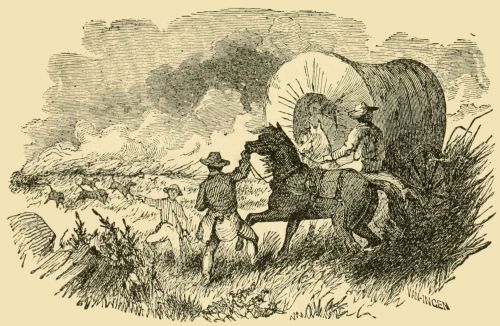
THE PRAIRIE FIRE.
Bear Creek bluffs, thirty miles away, and soon the whole country, as far as the eye could reach to the west and far to the east, was in a flame. The grass was thick and tolerably high, and the flames rolled over the level prairie like a tide upon the ocean and with mighty velocity. We set fire to the grass upon the south side of the river, and with a roar it disappeared over the hills. We then rushed our teams and wagons across the stream upon the burned space and watched the oncome. The thirty miles were skimmed in a short time, and buffaloes, deer, antelopes, and wolves came in a tumultuous throng, howling and bellowing, with the fire close in the rear. On came the conflagration, leaping, whizzing, and roaring like thunder; and it was a sight to see the animals plunge precipitately into the stream. Now and then an old, shaggy wolf would be outrun by the flames, and when the hair began to singe such howling was never heard. The heat was so intense that but few animals got through the blaze alive, and they were left in the hot ashes, and came out pretty well singed and sore. The cattle of the vicinity ran frantic in every direction, and some were suffocated. Our rich, golden range was now blackened; and there was no pasture in the surrounding country except the short, green grass in the valley. We were now compelled to follow the animals to the land of pasture. The cow-men and hunters turned out, and the fire was extinguished in the sand-hills of New Mexico, but a few miles to the south of us. This was the first real prairie-fire we had yet seen, and it being at night added greatly to its splendor.
It is a penitentiary offense in that country to willfully fire the prairie, and the stock-men seldom make much court expense when the scoundrel is found. Their proceedings are very summary, and the prisoner is never again guilty of the same offense—in this world. The Indians often do it to destroy the pasture in other quarters and drive the game to their grounds; and for it many a red-skin has soared to the happy hunting-ground upon the wings of death.
It is unlawful for white men to kill more meat in the Indian Territory than just what is needed for immediate use, under penalty of the confiscation of all they have. This is watched over by the government authorities stationed there. However, the fire had not reached the territory, and there were great herds of buffaloes upon their rich pasture; and we cautiously made this part our range.
Our first trip after the fire was to the east. So, fixing that cupboard in the wagon, and taking enough flour for biscuits for several days, we left Dave and John in camp, and Charles and myself wound down the green valley for the unburned regions. In about five miles we came upon pasture, and camped for the night upon the river-bank, full twenty-five miles from head-quarters. This brought us about to the Kansas line. It was a beautiful night, and almost as light as day. The wolves were so numerous and bold that we were compelled to sleep by the fire, and about twelve o’clock they came into the very camp and tackled the big blood-hound that we always had with the wagon. Unfortunately for one of the trespassers, old Lee sunk his fangs into his neck and never loosed his hold until he was dead. The horses were frightened all night; and Charles said he expected we were just upon the spot where the whole d——n pack slept every night. We stripped off several pelts in the morning; and when the sun was high we started north for the ten-mile arroyo of which we had heard old hunters speak. We had only gone a little way when we met an old bull coming quietly down a ravine toward the river; and after riding to the top of a hill and finding no herd to be near, I concluded to give him a chase. I got within a quarter of a mile of him, when he saw me and started back north. This was a sign of a herd; and knowing that if he would reach it he would stampede the whole herd, I rode upon him with all the speed that my mustang could summon. He was a perfect racer; but in spite of his efforts I came alongside of him, and the second ball from my Smith & Wesson stretched him struggling upon the earth with a bullet through his lungs. When the wagon came up we skinned him and took the meat we wanted and drove on, expecting soon to come upon a herd. The breaks of Ten-Mile Creek began to ruffle the smooth surface, and we saw a small bunch of buffaloes feeding in a gulch. We came into a narrow, deep ravine, and through this we drove the team, cautiously circling to the north. I crawled to the top of the ravine among the high grass, and there, not more than three hundred yards from me, was a herd of at least two thousand, some ruminating, and some feeding upon a high table-land about half a mile in diameter, and which was nearly surrounded by the deep ravine we were in. It was now near sundown, and after carefully circling the herd, we camped upon the west and to the leeward of them. After carefully fastening the horses, and commanding Lee to stay with the wagon, we crawled up among the grass for action. They were just two hundred yards off and we were ready, and the battle opened with the roar of two one-hundred-grain guns. My animal came to its knees with a broken shoulder, and Charley’s dropped in its tracks without a struggle. After a few rounds we had the blood started freely, and the cracking of the rifles was drowned in the mighty bellowing. We crept up closer and closer, until Charles darted behind the bull that he had first shot, intending to use him for a rest. We were fifty yards apart, and at the first shot that Charles took from his new fort, he was surprised to see the bull spring to his feet and make fight. His gun was empty and the bull was loaded; and seeing his chances in this unequal combat, he grabbed the bull by the tail and held on for dear life. They flew around the circle at the rate of ninety revolutions per minute; the bull bellowing and frothing, and Charles flying around with his bare head, calling out to me to shoot the bull. It was so darned funny to see a buffalo and a man waltz together that I could not do anything for laughing. I knew very well that the hind end of a buffalo was not dangerous, and I was just as sure that Charley would never let go of the tail. So I stood there for several minutes enjoying the circus. Charles drew out his big knife and tried to strike him in the heart; but he was at the wrong end for that, and his gouging only made the bull the more furious. At length Charley began to swing his partner a little slower, and having worked down into the ravine, the bull spied the wagon and made toward it with great fury. Charles called out for Lee, and with a dash and a snap he had his teeth firmly fastened in the nose of the bull. Charles was now relieved; and quickly thrusting a cartridge into his gun he lay the bull bleeding upon the ground. All this time I had been rolling upon the grass laughing; and at this moment I heard a bellow and a loud snort, and looking around I saw a wounded buffalo within a few jumps of me. The tail was the other way, and knowing my chances to be few, I grabbed my rifle, and resting upon my knee, I let him come so close that I could see his eyes bat,—knowing the skull to be very thick,—and fired. The ball pierced the mighty skull, and the blood spurted as he plunged forward dead. I looked out from behind the hill to see if Charley was preparing to shoot me when I came in; and when I saw him sitting upon the wagon fanning himself with his hat, I ventured up. He commenced on me in the Colorado dialect; but he was puffing and blowing, and having the advantage of him I did the talking to suit myself. I told him I thought any person who had the power to raise the dead ought to be able to kill it again; and besides, he slung the bull around so darned fast that I could not shoot with safety.
Well, the darkness began to thicken all over the country, and we concluded not to shoot any more that night. We found an old well in the ravine, and dug it several feet deeper, but found no water. From what we had heard hunters say, we expected to find water here, and had brought none along, so that ours that night was a dry camp. We skinned and cut up four of the buffaloes that night, and taking some of the fresh meat we heated it up a little in the frying-pan, leaving the juice in it; and a supper of this did very well, so we retired for the night. The wolves were howling in every direction, and hurrying to the fresh blood; and the snorting and bellowing of the buffaloes could be heard away in the night. Up to twelve o’clock there was not a cloud in the sky; but at that time a purple veil was drawn across the heavens almost as quick as thought, and the wind began to blow cold. We had a good bed, and placing two of our green hides upon the ground flesh sides together, we built upon them, and in spite of the cold kept comfortable.
Toward morning the gale increased, and at daylight we were in the midst of a blizzard. This is a heavy gale in which sharp ice, as fine as salt, falls so thickly that you can not see two feet ahead; and it is not safe to leave camp twenty steps without a rope around the waist. We were in a deep ravine; and having tied the horses to the wagon they were somewhat sheltered; then throwing a robe over the dog, we lay quietly in our snug bed. The tempest raged and roared over the plain all that day, and the snow fell, more or less, continually. Twilight began to gather, and the storm was still howling. We had nothing to eat that day, but we had quenched our thirst with snow and felt very well. Morning came, and it was yet too cold to live; and the blizzard had renewed its fury. We had brought a little corn along, to feed in a pinch; but this was a bigger pinch than we had bargained for, and our horses began to look pretty hollow. About noon the snow ceased falling; but the wind was as cold as ice and past all endurance. At sundown we crawled from our retreat, and found the snow a foot in depth over all the prairie. We shoveled it away from the side of a ledge, and trimming down a few hackberry bushes that grew upon the side of a bluff, we started a fire. They were green, and burned very poorly; but the buffalo-chips were all covered, and it was the best we had. Our meat was like stone; and for supper we chopped it off with the ax. We did not fry it much, but it was good any how. We also melted a little snow for the horses, and after giving them the last corn we had, we crept into bed.
In the morning the wind had lulled and a thick fog hung like night over the face of the plain. We could not see each other fifty yards away. We thought it necessary, under the circumstances, to make for head-quarters, and leave to the wolves the six buffaloes that we had not skinned, and which were now like stones.
Having broken our compass in bed, and the two buttes in southern Colorado—which guide the hunters and herders of the country—being hidden in the mist, we were left with our unaided ability to steer our way. We took the Indian way of ranging objects on ahead; but the snow was deep and the objects few, and about nine o’clock we came across the track of an outfit which, from the number of horse-tracks and the dog’s trail, we knew to be our own. Well, we followed it back, and soon came into the old camp and stopped for the night.
In the morning it was clear, and the sun shone out brightly; and the reflection almost blinded us as we went along. The team was very lank, and worried slowly through the snow. About noon we came into the Cimaron valley, and after watering, plodded on without unhitching. At sundown we saw smoke coming from the hill-side away up the valley, but in spite of our efforts it was dark when we came in. There were plenty of provisions and lots of fuel, and we had a social that night. It took Charles a long time to relate his experience with the buffalo, and the boys plagued him a great deal about trying to kill a bull with its own tail.
The next morning the sun again arose in a cloudless sky and darted his warm rays upon the face of the snow-covered plain, and the white veil soon melted away. It took the horses several days to recruit, and the short, green grass in the valley filled them out slowly. We pegged our green hides in the sun to dry; and having a load of saddles, humps, and tongues, we prepared to take a trip to the Arkansas.
One pretty morning John and myself started with the load, and left Dave and Charles in camp. We stopped at Bear Creek for the night; and directly after striking camp we had our attention attracted to a singular-looking object upon the side of the bluff away down the creek. We took out the glass, and it looked like a roll of buffalo-hides. After supper we picketed the horses, and taking our rifles, we strolled down the creek to investigate the curious object. Coming up to it we found it to be a buffalo-hide rolled up; and peeping in at one end we saw a man. The hide was taken from an old bull, and was almost an inch thick; and being frozen, it was as much as we could do to cut him from his narrow prison-walls. He was a middle-aged man, and was almost exhausted; but we took him to the fire and gave him to eat, and then heard his story. He said he was a cow-man from Texas, and had been to Granada and was returning when he was ingulfed in a furious blizzard a few miles north of Bear Creek. He said he had but two blankets, and having no matches, he knew he must perish; and happening to see a stray bull among the hills, he rode on to him and shot him, and concluded to take the hide to wrap himself in. His horse broke loose while he was skinning the bull, and he was left alone; so, spreading the hide upon the ground, fur side down, he spread the two blankets upon it, and then lay himself upon them and rolled up tightly. The green hide froze, and he was as securely incased as though he were within a steel boiler. He had been there five days; and being behind the bluff the sun had not reached and softened the hide. He said he had kept comfortable, with the exception of his feet, and with them he had suffered a great deal. Upon investigation, they were both found to be frozen; and we took him to Las Animas to the doctor, who amputated them both at the instep. He often said that a man without toes was better than no man, that he surely would have perished had he not captured the buffalo, and that, if we had not found him, a few days later the hide would have been his grave.
We found ready sale for our meat, and were soon steering again for the Cimaron. We came across several outfits, each of which had been more or less frozen in the late blizzard. Some had lost fingers, and others toes; and we heard of one whole outfit of three men, north of the Arkansas, freezing to death. We were not in the least injured, and we congratulated ourselves upon our being prepared with a good bed.
We came in sight of camp about sundown, and riding ahead and seeing no one about the camp, I concluded to try the boys; so, riding up over the hill, I came down upon the dug-out with a whoop, and fired several shots from my six-shooter as I circled to the east, and lying flat upon the pony I shot down a ravine just in front of the dug-out, my back being all that could be seen. Whiz! went a bullet just over my backbone; and I was satisfied that the boys were not asleep, and that they could shoot pretty well too. So I dismounted at a place in the gulch where my horse was hidden, and taking a white handkerchief I raised it to view to try the boys; but white flag or no white flag, the two old black gun-barrels lay up alongside of the cave door and there was no such thing as a flag of truce taking them down. I was a hundred yards off, and I swear I was afraid to put up my head to make myself known. At length they saw the team coming, and knowing my disposition, they then mistrusted that it was me in the ravine. When I was sure that the boys knew who I was, I mounted my poney and rode into camp. The boys acknowledged that I had completely deceived them, and that they took me for an Indian riding down there to draw them out, and then a whole band would fire upon them from every hill. Dave said he had done his finest to hit me on the wing, but he could see nothing but my back, and that went down the ravine as swift as a cork over the cataract of Niagara, and he supposed he shot wild. I told him that he did very well, and I would not like him to do better upon like occasions. Charley said he would like to have cut a suspender off anyhow, just to give me some caution.
We hunted for many miles around, including north-eastern New Mexico and the “pan-handle” of Texas. We had the hill-side covered with hides for some distance; and game becoming scarce, we concluded to pile up our hides and load up our outfit and start for other quarters. We followed the Cimaron down into Kansas; and just before we went into the territory we came on to a large herd of buffaloes, and killed enough to load our wagon with hides, leaving the rich, delicious meat to the wolves. We followed the river into the territory, and one evening a government officer with three men came out from Salt Springs to our camp; for we had been reported killing buffaloes in the territory. The officer rode up insultingly, and without any questions began to abuse us and call us trespassers and thieves, and said he had a great mind to upset the wagon and burn every hide we had. We told him we had not killed the buffaloes in the territory. But he continued his abuse; and thinking it about our time to talk, and being four against four, we told him we had enough talk now, and we wanted to see him burn the hides. We were well prepared; and seeing his position, he rode off with his men—I suppose partially convinced that a star upon the breast of an abusive scoundrel does not enable him to ride over honest men.
It was now getting late in the season, and we concluded to haul our hides to market and travel over the south during the summer. We left the outfit at the dug-out, and two stayed with it and the other two hauled hides. We took up two fall loads, and had as many more as we could haul with the outfit the third trip. We shipped them to Kansas City and sold them well, and struck a rich dividend. We camped up and down the Arkansas, fishing and occasionally shooting a deer among the brush along the river, and spending some time moving in the refined society of the valley, and now and then staying a little late conversing with the cultured daughters of the ranchmen. We spent many pleasant days and evenings thus; and after trimming up the outfit carefully, and laying in a good supply of ammunition and such eatables as we supposed would be needed on our trip, we were ready to start again for southern sights.