III THE DESERT AND THE WORLD
Reading edition
217
I A CHAIN OF HAPPENINGS
Winter changing to summer I gave up life in towns and set off upon a new adventure. In May I was looking at Bokhara and the gay-coloured meditative Mohammedan world. In June I was tramping across Russian Central Asia the way the pioneers go to find new land and new life. My road companions were people who had given up the old and were seeking the new—not farther West but farther East. By July I had crossed to southern Siberia, and was away on the Altai Mountains when the War with Germany broke out. In the autumn I returned in the wake of the mobilised Russian army, and was in Moscow during the first month of its enthusiasm, then at Libau and Vilna and Warsaw, at Petrograd, and home to England. I wrote my book on the War. All the winter I wrote and spoke for Russia. Life resolved itself into lectures, speeches, addresses, meetings, and all with the view of making Russia and especially Russian Christianity better known in England. Time flies in such a way, and very 218quickly it was May again and time to set out upon a new adventure. So I took up my quest of Martha and Mary once more and set out for Egypt, hoping to be able to go from Egypt to Russia the way Christianity came to her. For a great deal of Russian Christianity came from the Egyptian deserts and had its source in the life led there by the hermits during the first five centuries after Christ.
Doubtless the quiet life of the hermit saints had more power to change the world than all the clangorous wars of their time, than the talk and the gossip and the cheering and the hooting, than the foes laid low or tyrants raised to power. There is a beautiful passage of Nietzsche—“The thoughts that change the world come on doves’ feet. The world revolves round the inventors of new values; noiselessly it revolves.” So if we would know what sort of a Europe is going to be, or of Russia what sort of an East she will be—
Oh! Russia, what sort of an East will you be,
The East of Xerxes or of Christ?
it is necessary to seek the ideas of to-morrow in the quiet places where they lurk unseen, not in the clash of the Great War. The trenches are pungent with fumes, the earth itself deaf from the sound of artillery, both Nature and Man’s work lie blasted and ruined along a long but narrow stretch of land—that is the front, the War, the biggest and only thing in the world. But I must leave it and go 219southward and eastward to the places where ideas are born.
In May when I left England the streets of London were flocking with merry crowds; there was a vigorous popular optimism in the air. At night the Soho restaurants were packed, the theatres ablaze with the glamour of success. Paris was different. One European capital was bright; another silent, vigilant, and clad in serious garb. The enemy was encamped and militant and near. South to Marseilles, to the vivacious, light-hearted, southern port! The ship by which I sailed for Egypt was painted an austere leaden colour to resemble a man-of-war or armed merchantman, and so deceive the enemy lurking under the waves—a masked ship. We were delayed a week in the port through lack of labouring hands; for every one had gone to the War. We watched liner after liner go out of the harbour laden with young soldiers going to fight the Turk and win Constantinople.
My slow ship left the land and slipped away through the night as it should, towards Egypt, unhasting, unresting, over the calm shadowy Mediterranean ... an almost fourth-dimensional progress, a mysterious magical journey. The stars looked through soft vigils and possessed a mystery; they dreamed over us as we went. We disturbed nothing; we went on. I sat up in the prow of the vessel and looked forward—the eye of the boat.
220... Everything is akin to me
That dwells in the land of mystery.
The ship is masked; its colour is the colour of the waves at night. The ship is pleased. A shadowy blue-grey ship going forward calmly, equably, yet triumphantly, ever gently forward, towards the unknown, the mysterious....
221
II THE HERMITS
The first effort of the Apostles towards the establishment of Christianity was along the way of Martha—the sharing out of the money and the starting of a sort of Christian-socialist state. But life taught them that this was impracticable, and they and all the early Christians soon found themselves working and living and praying in an altogether different way—driven into the wilderness, stoned out of cities, hounded into gaol, faced with the horrors of torture or barbarous execution. There were soon more Christians in the desert places of the earth, living in caves and in forests, than there were in the towns and villages. Some fled from persecution, others were driven by the Spirit; and no doubt all, when they found themselves cut off from the world, began to share in the meditative idea of Christianity. They obtained the consolation of wanderers, and found a new significance in the promise of the Comforter. They had visions; they met the resurrected spirits of those who had died in the Lord. The strange life they had to live brought a romantic 222mystery into the possibilities of the road and the outside world, so that when one met a stranger there was the doubt that he might be an angel, that he might even be the risen Lord Himself. The heavens opened, and sweet music accompanied the vision of the Grail. The stigmata appeared on the hands and bodies of those who had attained to unity with Christ.
Yet those who went out into the wilderness, alike those who fled persecution and those who went out voluntarily to seek and be alone with God, were tempted “of the devil” as they phrased it. The town and the world which they wished to overcome tempted them back. They had left behind in “the world” fathers, mothers, brides, children, friends, money, position, pleasure. They lived on locusts and wild honey and grains and roots—and they longed for the good meat of the city. They were ragged, unwashed, bruised, unkempt—they longed for the freshness of the bath, white linen, and clean clothes. Their bones ached and they were tired—they longed for soft beds. They were solitary and longed for company, longed especially for the company of women. And the devil who tempted them was a dragon that could never be killed, which, slain, but changed to a different shape. The temptation was put forward in new guise, and the lure of sin more subtly baited. They entered into the temptation of Jesus as they entered also into his sufferings.
223They drew men unto them. All those whose minds were troubled by the monstrous woman—Babylon—thought of the Christian solitude in the desert. It became a not infrequent phenomenon—the going into the desert “to save one’s soul.” The wild places of the earth began to have names and fame. Hermits lived in places where no one had ever lived before, and the curious came out to see them. By their spiritual virtues they made the desert, which was barren in the material sense, blossom as the rose.
The caves in the mountains by the Dead Sea filled with anchorites, and the holy men looked upon the dead salt lake that had once been the gay world of Sodom and Gomorrah. The mountain supposed to be the mountain of Christ’s temptations became honeycombed with the abodes of world-forsakers. “If a man does not say to himself in his innermost heart, God and I, we are alone in the world; he will never find rest,” said one, and betook himself to Mount Sinai. The Virgin Mary sailing in a boat with St. Thomas and St. John was wrecked off the coast of Macedonia and miraculously washed ashore on the mountain of Athos; and in due course there appeared on the strange uninhabited mountain an antique Greek, lean, long-haired, unutterably devout, and he lived in a cave and meditated on the Mother of God. Another followed and another, till a laura was founded.
224The hermits gave Christianity a new bias. One has only to compare an ascetic’s dream, the majesty and the mystery of the Revelation of St. John, with the sweet reasonableness of the Gospels ... “A sower went forth to sow,” and the like ... to see how great is the change in the spirit of the Church under the influence of the anchorites. Such a sentence as—“To him that overcometh I will give of the hidden manna, and will give him a white stone, and in the stone a new name written, which no man knoweth saving he that receiveth it,” comes straight from the desert and is part and parcel of the spiritual fervour of the early Church.
The hermit based his life on Christ’s wanderings in the wilderness and His denial of the world, on the idea of bearing the Cross, and on the promised second coming of Christ. As Christ renounced the power of changing stones into bread, so they renounced the power of bread, the feeding of the hungry, i.e. service in the world, the way of Martha. As Christ refused the throne of Caesar when the devil was ready to show him the way to obtain it, so they refused to try to establish Christ’s kingdom in a material form. They denied all material power—denied that the power of Caesar was real power, that physical force had power, that money had power. St. Arsenius, the anchorite, was offered all the revenues of Egypt by the Emperor Arcadius and asked to use them for the help of the poor, the hermits, and the monks; but Arsenius refused, 225saying that such work would be worldly and was not for him. The same Arsenius inherited a great fortune, his cousin’s estate, but refused it.
“When did my cousin die?”
“Two months ago,” he was told.
“Oh, then the estate is not mine, for I died long before that,” said Arsenius.
He had died to the world, and to money among other worldly things.
The hermits also denied the physical senses—our ordinary sight, hearing, touching.... “Grieve not that thou art without what even flies and gnats possess,” said Antony, the father of Egyptian hermits, to blind Didymus; “rejoice that through thy physical blindness thy spiritual sight has become more clear.” The hermits took upon themselves oaths of silence, went into remote places where was the most abject barrenness of earth, the utter negation of all physical life and material power. Not content with the privations of the Sahara they went into abominable marshes like the soda swamps of Nitria, where they mortified even the most innocent of the senses, the sense of smell. They strove to be as it were dead in all the physical body and limbs, and in the physical senses. “Unless a man imagines to himself that he has been lying for three years in the grave and under the earth, he will never die to himself,” said Moses the Ethiopian, a simple negro anchorite, who though he seemed black in the body was all white in the soul.
226In this denial they did things which seem fantastic to the modern world. They dug their graves in advance and lived in them till they died. They stood on one leg, the foot of the other leg on their knee, their arms outstretched as if crucified to the air; they climbed to the height of ancient pillars and remained there praying for years. Pachomius is said to have prayed for days together, standing with outstretched arms as immovably as if his body had been fastened to a cross. His eyes were lifted upward at a strange angle and were full of light, he gazed in fixed rapture as if his eyes were resting on a celestial vision. In this Pachomius praying thus an artist might show a picture of what the hermit stood for. These hermits were not foolish; they were mighty and wonderful like the living word of God itself. They were living hieroglyphics.
It must be remembered that Christianity had to overcome a world of philosophy, had to absorb all that lay in the philosophy of the East, in the religions of Egypt and Greece, and of the Jews. Thanks to the hermits, Christianity took to itself all that was vital in all extant ideas. By the life and death of Jesus the seed of Christianity was sown, thrown into the spiritual life of the world, and instead of springing up immediately and bearing fruit, it sent its strength downward like the seed of a mighty tree; it grew deeper into the spiritual world rather than higher, became more mysterious and secret rather than manifest and clear.
227To-day Christianity is of different portent. But in those days the enthusiasts, visionaries, and saints did not clearly know what Christianity was: Christianity was not clear to them; they sensed it, it had possession of them, they were in a state of exaltation because of it. Christianity was growing through them, growing deeper. Their intellectual conceptions of what Christianity was and was not were often quite mistaken—but the vision they could not express was authentic. The new idea was in the air. Hence, for instance, the gift of tongues. People listening to the apostles were caught by the idea, even though the language spoken was foreign to them. Christianity was imparted by enthusiasm alone, by the gait, the gesture, the expression of countenance of the believer, the living hieroglyphic; and it did not matter that the apostles spoke one language and the listener another. The spirit of truth sat in the faces of the apostles like tongues of fire and spoke for them. In those days many who had never seen an apostle dreamed and became Christians, heard a voice from heaven, were struck blind by the heavenly vision like Saul, whose mind on the way to Damascus was far from Christianity, but whose soul was so near that even at the stoning of Stephen there could have been but the thinnest partition between him and the great splendour. Many people in those days went about in strange apprehension—as if the world were coming to an end, and quite 228truly a world, that of the Romans, was coming to an end—and suddenly they were aware of the mystery, and without a word of proselytism gave up everything and went to the desert.
Needless to say, the number of Christians grew, and the reputation of the Christians grew. Persecution soon ceased, and presently it became such a mark of distinction to be a Christian that all the mundane crowd came in and called itself Christian. Some of them were Christian in name only, and their children in superstitious obedience. Even till to-day Christianity is cumbered about with the descendants of this mass of people, the great crowd who vaguely assent to the term Christian but have only a remote conception of what Christianity really is. The riotous and lascivious population of Alexandria supporting worldly Cyril, though Christian in name, was nothing less than an obstacle to Christianity, an opaque mass between the light shining in the desert and the north whither the light should shine. Still, when “the world” came in and called itself Christian there were a great many who took their conversion seriously, and of these, many went to the desert and schooled themselves to become hermits, tried the life to see what it was like. Ammon and his bride were dressed, ready for their nuptial festivities, when the revelation came to them, and on their wedding-day they resolved to forego the worldly tie of marriage and live in the desert as holy bachelor and virgin. 229They dwelt in Nitria and entertained thousands of young men and women of the rich and cultured world and meditated on the hermit’s life, Ammon receiving the men at his cell, his bride the women at hers. After some time Ammon, who was rich, founded a monastery, and he and his bride agreed to part, she going to a distant place to continue her work, he remaining to establish his. Ammon became abbot of the monastery, and under him were four thousand monks; this was in the evil-smelling swamp of Nitria, on the fringe of the Sahara, some forty miles west of what is now the Alexandria-Soudan railway. People began to flock to the desert. There were tens of thousands of hermits and monks and consecrated virgins waiting for the coming of the Bridegroom of the Church. These Christian converts gave to the desert the largest human population it has ever had. There were four hundred monasteries in the desert of Nitria alone. It was possible to invent such an anecdote about the younger Macarius the anchorite as that some one gave him a bunch of grapes and he, being so altruistic, took it to a neighbouring anchorite, that anchorite to another, and so on, till the grapes had made the whole circuit of the Sahara and came back to Macarius again, preserved all the way by the virtue of the self-denying hermits.
The desert had an atmosphere of Christianity. Many aged solitaries like Arsenius and Paphnutius took to the road with sacred missions. The hermit’s 230life was not always continuous cave-dwelling. St. Arsenius, a gracious genius, went to the councils of Emperors; we read of men like Paphnutius returning to “the world” at the obedience of the heavenly vision and saving people whom the Lord needed. Thaïs, the courtesan of Alexandria, was taken from the midst of her gay life and brought to a cell in the desert. The anchorites found for her this beautiful prayer, “Thou who formed’st me have mercy,” and Thaïs was saved, though she died. And she was numbered among the Marys. No hermit setting out upon the road took away money with him or had thought for the morrow. That was a golden rule in their ways; money counted for nothing. Serapion the Sindonite sold himself as a slave in order that he might save those who were slaves of the world; and he put the money he received as the price of himself in a pit and covered it with earth. He was a perfect servant, and by his humility and sweetness touched the heart of his master and mistress, who soon learned to say the Lord’s Prayer with him and were converted to Christianity. One day they said to Serapion: “We are unworthy that you should be our servant and slave, take back, we pray you, your freedom!”
Serapion replied that he thanked God for the day when his mission was accomplished, and thanked his master and mistress for his freedom. Then he went to the pit where the purchase money was buried and brought it to his two converted friends. 231They were much astonished, and implored Serapion to keep the money. But he refused though they wept, and he set off for the desert once more, cared for by the Lord.
Nothing counted in Egypt except Christianity. Monasteries and churches sprang up all over the land. The rich women who gave up all for Christ’s sake gave their jewels to the adornment of the screens and altars in the desert churches, and it was thought to be the best place for jewels, fruitlessly sacrificed to the spiritual. The wealthy bequeathed their estates to the Church, hoping thereby to find grace in heaven; and the Church employed the wealth so gained for the building of new monasteries and the employment of Byzantine painters and metal workers, for the upkeep of their institutions, and for alms. It seems the new wealth did not altogether spoil the life in the desert. Egypt was particularly suited to be the mysterious source of contemplative Christianity and its spiritual power—the greatest deserts in the world, the emptiest landscape, the incomprehensible Nile coming out of the depths of mysterious and untrodden Africa, the ancient monuments of religion, the Sphinx, the pyramids, the obelisks ... the oldest domain of man, a land of tombs. But for the Mohammedan hordes Egypt must have remained the true holy land of Christianity. As it is, the life lived in Egypt at that time is certainly the spiritual inspiration of the Eastern Church till this day.
232It is somewhat astonishing to reflect that in the early centuries of our era Christianity in Egypt was alone with the ancient monuments of Egypt, and that those monuments were in a considerably greater state of grandeur that they are to-day. There was very little robbing of the tombs and destruction of old buildings before the coming of Saracens—those terrible robbers and destroyers. Egypt has now become associated with Mohammedanism in a secondary way. But in the days of the hermits there were none of those mosques which guides delight to show one now as part of the interest of Egypt—the alabaster mosque, the mosque of Sultan Hassan, all built with stolen stones. But Christianity and the worship of Isis were side by side, the Egyptian religion of death side by side with the Christian religion of death to the world. No wonder that the early Christians embalmed their dead, and that they painted the faces on wood as the Egyptians had painted the faces of the dead on the cases of the mummies, or that regarding hieroglyphics they began to paint Christian hieroglyphics—the frescoes peculiar to the Eastern Church. Paphnutius flinging a stone at the Sphinx learned his mistake when he saw a look of sadness come over the face, and the lips seemed to murmur to him the name of Christ.
The influence of Egypt went northward. As the gospel is read facing the north, and the belfries of Eastern Churches calling the people to worship are 233put northward of the holy building, so the whole Church looked northward. Constantinople was the capital of the Eastern World. The embalmed bodies of the saints who had died in the desert were taken thither, the faces of the dead were painted into the fresco and the ikon. Hermits appeared in all the desolate mountains and rocks of Greece and Bulgaria and Asia Minor. Christianity crossed the Black Sea, and hermits appeared in the Caucasus, and stately cathedrals were built on the shores of the sea. Christianity sailed up the Russian rivers and hid in the Russian forests. Only in the year 988 was Russia officially converted to Christianity, but long before that the Christian hermits and missionaries had appeared. St. Andrew himself is said to have been the first to come to Russia. The religion that came in was the religion of the hermit, and the faces on the ikons were the faces of anchorites who had died in Egypt or Asia Minor. Christianity took various aspects, but its vital source was the spiritual life of the hermit in the wilderness.
Anon, Egypt was overrun by the Turks. The jewels were plucked from the screens and ikon-frames, the monasteries and churches were pulled down, the monks and hermits put to the sword, and practically the whole material evidence of the existence of Christianity was swept away as if a storm of the dead sand itself had come over it. One year the desert was a-tinkle with 234Christian bells, choric with Christian psalms; the next year all was desolation, and when an ancient hermit missed by the Arabs came to Nitria he found not one human being there, and he lived amongst the ruins of monasteries and chapels as if the place were the remotest and most solitary in which a world-forsaker could dwell. In its turn, also, Constantinople fell, and the Hellespont and Bosphorus, the issue to Russia, became Mohammedan. Eastern Christianity receded to Greece, was shut away in Russia. And Greece and Russia, and especially Russia, have preserved the direct traditions of the early Church and what Christianity originally meant. With them has remained the spiritual fervour of the hermits.
235
III IN THE DESERT
Between the Nile and the Red Sea lay the desert of the Thebaid, and the remote monastery of St. Anthony is now reached after two days’ camel ride from the station Beni Suef. The desert of Scete where Arsenius lived—the desert where Philammon the hero of “Hypatia” learned to be a monk—is on the Upper Nile. What was Nitria is now Wadi el Natrun, and is reached by three days’ camel ride from the Pyramids, or via Khatadba, one of the stations on a loop of the Cairo-Alexandria railway. The shrines of the hermits are in the hands of the Copts, a simple Christian people, said to be the lineal descendants of the ancient Egyptians. The Coptic Church is an Eastern one, and it is the lineal descendant of the Church of Egypt that flourished in the first centuries of Christianity. Only whereas the Church of Egypt was a brightly living church, the Coptic Church is going on in a tradition. What is valuable in the Coptic Church to-day is that it has slept through many centuries unchanging, that it has never been rich and pompous, never erudite, 236never pleasure-loving. It has withstood the Arabs through dwelling in the wilderness and fortifying its churches and monastery walls and being hard. It has never had the opportunity to thrive. So it has preserved the traditions and something of the spirit of early Christianity, and in the half-ruined temples of the desert you may see the stigmata of Christ.
I had some difficulty finding out about the monasteries: no one goes to Egypt to visit Christian shrines, so my desire to know where the ancient hermits had lived sounded strange and unwonted in the ears of most people. But at length, through the Bishop of Jerusalem and Marcus Bey Simaika, the leader of the Coptic community in Cairo, I got a letter from the Patriarch and full directions as to how to reach the desert shrines. I chose to go to Nitria.
Out of sight of the grey triangles of the Pyramids, out of sight of everything, and over the even, empty desert, white, yellow, burning, rose-lined on the horizon, glaring ... heat and light beat upward from the sand on which and into which the terrible and splendid sun drives its armies all day. The air is so dry and light that one seems to have lost weight. There is a feeling of unusual exhilaration.
I came on horseback to an oasis, not a bountiful 237and delectable oasis with shade of palm trees, fruit to pluck above the head, and cold water bubbling from a spring below, but a poisonous marsh overgrown with reeds full of reptiles and blood-sucking flies. There are good and evil oases. This was the marsh that gave its name to Nitria—the soda marsh. The hermits chose it because it was even worse than the desert. My black horse prances along on somewhat doubtful turf, and then once more to the loose and heavy sand blown into waves and undulating like the sea. On the horizon lies the strange blunt silhouette of the first of the monasteries, and without a trace to follow, we plunge through the sand towards it. We come up to it at last, an enigmatical-looking building which has the shapelessness and silence of a ruin. How silent it is! What a deathly and unearthly silence! It seems hardly possible that human beings are living there. The cream-coloured walls are lined, patched, broken, gigantic. It is a rectangular fortress. There is but one entrance, and that is a small one and heavily barred. There are no steps in the sand; if yesterday had any footfalls the wind has smoothed them away, and the breathless silence is one which it seems almost possible to hold in one’s hand.
From the high yellow battlement an old loose rope hangs down, and is evidently connected with a bell.
Jingle-jangle-jangle! I ring the bell and wait 238expectantly. There is a long silence and I ring again, jingle-jangle, jangle-jangle-jangle! Then some one comes and laboriously undoes the little door, and a dishevelled, bare-footed monk appears. I present the letter which I bear from the Patriarch, and am admitted. The monks are pleased; all shake hands. I sit on one divan, and five of them on another. One novice washes my hands, another brings me a glass of a brown-coloured drink—it is medlar juice and water, and is full of the fibre of the fruit. This finished, he brings me a glass of pink sugar water, then coffee all round, thimble-fulls of sweet coffee. The abbot, a fine-looking fellow with regular features, broad face, black moustache and beard, and with an open space showing the freshness of the lower lip, is talkative. He has a towel wrapped round his brows for turban, and fingers black beads as he talks. Next to him is a comfortable-looking monk in a blue smock and white knitted skull-cap on his head. Next to him, an old fellow with wizened bare legs and feet, old yellow rags on his grizzled head, ragged black cassock over his grey underclothes.
“What do you do all day?” I asked.
“Pray, read, sing,” they answered.
“What do you think of the war?”
“The war does not touch us. If they come and kill us, we don’t mind, but we pray each day that God will bring it soon to a close.”
“If the Arabs come, what will you do?”
239“If they shoot at us we will throw bread to them, that will be our reply.”
“Do you have many visitors?”
“Not many.”
“Do the Russian pilgrims come here to pray?”
“Yes, some.”
“Are you content to live out here in the Sahara whilst all sorts of great events are happening in the world, and content to have no news and never mix with the people of the city? In England we’re too busy, one couldn’t escape to a place like this even if one wanted to.”
The abbot gave me a remarkable reply:
“I think there is room for everybody: one seeks money, that is his way; another prays, that is his way; another does his duty and ploughs, that is his way. There are many ways. You know of Martha and Mary. Martha was right, but Mary’s good part was right also.”
How touching it was for me to get this true reply in this remote monastery, and to hear of Martha and Mary in the first half-hour of conversation with the monks. My mind was preoccupied with the ideas of Martha and Mary, and here was this simple Coptic abbot using almost the same terms to express himself as I might use myself.
There were in this monastery about sixteen monks, and in the desert altogether there may be about one hundred and fifty. Once there were thousands of holy men and hundreds of monasteries. 240There was gold in the monasteries, there were jewels and pictures. Not an inch of the little desert temples but was covered with Byzantine fresco.
But the Saracen came and murdered the cultured clergy, and tore away the jewels, as was fit, and rolled down many a wall, wrecked many an altar. There was a sixty years’ gap in the Christian history of the desert. Then a wilder type of Christian took possession, Arabs who had been converted, or enslaved Copts who had forgotten their own language and learned that of their masters. They brought Arabic gospels and liturgies. They repaired some of the ruins of the old monasteries and churches, and they put up Arabic inscriptions and painted out the old Coptic frescoes and hieroglyphics with frescoes of their own conception. They built round their temples impregnable fortress walls with draw-bridges at a height of forty feet above the level of the desert. They withstood sieges and persisted ... to this day.
The abbot showed me round the monastery. The buildings were all a patchwork of ruins and repairs and changes. The frescoes had been white-washed out in nearly every part. The old stained glass, broken and shapeless, was mortared in with new glass. And yet there was a real odour of antiquity in the place. The patterns in the ikons were but dust patterns, and the face of the Virgin crumbled away as the abbot took the picture down to show me. In a niche here and there left by 241accident were the original frescoes in wonderful purple and crimson, pictures of the choric saints, their faces and bodies all of that unearthly and mystical shape and colour by which the early Christians loved to represent citizenship of heaven and denial of the world.
The lectern had a nail on which to fix the candle. The communion cup was swathed in the oldest vestments of the monastery. In an ordinary cupboard with easy-swinging wooden door I was shown the mummies of the sixteen Patriarchs of the Coptic Church. Sixteen Patriarchs in a cupboard, each wrapped in his robes and tied up compactly! The Abbot unwrapped one a little and showed me the dried brown flesh. The seventeenth Patriarch, he from whom I had my letter, will find a place in this cupboard in his turn.
In one of the churches I was shown the box with the sacred remains of Macarius, the primitive hermit in whose name the monastery had been founded.
They showed me the books from which the service is read, all hand-copied volumes. I wondered especially at a copy of the New Testament, written ages ago in Coptic and now spattered on every page and every paragraph with new and ancient spots of candle grease.
From the vault of one of the churches hang seven old dusty ostrich eggs by long strings. A monk explained to me that as the ostrich looks to its egg as the most precious thing in life, so they look to 242God in their prayers—at least, the egg is to remind them.
We went into the fortress church, the only entrance to which is at a height of forty feet by a bridge from the outer rampart. They showed me how the bridge could be drawn in and the monks be secure from assault of arms. Up on the ramparts a novice had his duty beside a pile of bread and a stoup of water. When Bedouin beggars ring the monastery bell, he lowers them bread and water in a basket. “We give away twice as much as we eat ourselves,” said the Abbot, showing me the bakery. Here were hundreds of wheaten loaves in long stone receptacles, good bread, but made dirty so that the monks should not get to prize it. They showed me illuminated books a thousand years old, showed me the scrivener’s cell where among many quills a monk still copies the Scriptures day by day. They showed me one chapel the whole floor of which was covered with chillies drying, showed me the long room where every evening all the monks gather about the Abbot to read the gospel and discuss its meanings, showed me the massive doors, two feet thick, of wood and iron, meant to resist the Arab. In one room was a small cask, and the Abbot took a tin mug and drew me a little wine—communion wine. I drank half; he finished.
The monks were most kind, simple and loving. It was an amusing spectacle at lunch. I lunched; every one else waited on me. A beautiful Abyssinian 243boy washed my hands, two monks shelled eggs all the time and filled my plate, two others stripped cucumbers for me, another kept helping me to hot milk soup in which slabs of sugar were dissolving. The Abbot stood above me with a feather-brush waving the flies off me. Every one was talking. There was especial interest in the questions which the Abyssinian boy who had washed my hands was continually trying to put. He was a beautiful stripling who could have been posed for Christ Himself, but for the fact that he was black. He was tall and gentle, with large liquid eyes. He was not a monk, but a pilgrim stranded in the desert. He had been on his way to Jerusalem, and had been turned back from Port Said because of the War. He was anxious to hear from me whether I knew of any way of getting to Jerusalem now. The Abbot was the only one who knew Abyssinian, and he interpreted. Alas! I could give him no hope of getting through to the Holy Sepulchre.
I lunched, and slept a little, and the brethren of the monastery slept. Then my horse was brought out to me and I rode away across the sand. Before going, I went to the western side of the monastery and looked out over the Desert. Thousands of miles it went on, level, empty, burning, and yet mysterious. Some Coptic hermits have wandered forth into its mystery and are living the antique life of the anchorite out there. At least, so the Abbot told me, though he couldn’t say where they are or 244how they live. Only now and again, at rare intervals, some one of them comes back to the monastery to communion and then disappears once more.
I rode away to Bir Hooker, where I stayed the night. That is on the other side of the salt marshes. There an enterprising British company is producing thousands of tons of caustic soda annually. The antique hermits chose this spot in the Desert because of the death-dealing odours which intensified their denial of the world, but in another era, behold British business men doing in the way of trade and worldly gain or duty what these others do in the name of denial of the world. As the Abbot said: There are various ways of serving God, the way of Martha and the way of Mary.
Still, the manager of the caustic soda works, a shrewd and circumspect Scotsman of Protestant temperament, would like to have the sixteen Patriarchs buried decently and, if he could, spend three days in each of the monasteries tidying up. “It’s not showing due respect to the dead,” said he, “nor is it sanitary, nor decent. I’ve nothing to say against the monks; they are simple and kind and hospitable. But they’re just wasting their lives. They’re doing nothing, making nothing.”
The manager would show the monks how they ought to keep house. But better still, he would clear them all out. They are very good, very kind, there is nothing against them, but what are they 245doing, he asks. Their lives are pure waste. They don’t produce caustic soda.
I go to my room to sleep, and then at midnight come out again to see the full moon flooding the vast plain of sand with light, and to realise once more the breathless and perfect stillness of the desert.
246
IV THE WORLD
From the Desert back to the town, to “the world,” to the hurly-burly of Cairo and the flesh-pots of Egypt! It is war-time, the summer of 1915, the Turks are being fought on the Peninsula of Gallipoli. The city is full of soldiers, sunburned Australians and New Zealanders who have not yet been in action but are being kept lest the Arabs should come out of the Desert and strive to efface the English and French civilisation of the banks of the lower Nile and so add more ruins to the ruins of Egypt. The city is majestical with its broad streets, white stone palaces and stately mansions, its wondrous river and its mighty bridges. The dryness, cleanness, and whiteness of a city that knows no rain; the city gleams in a vast supply of sunshine. The wind blows all the time from the Desert, and wafts heat in the face as from a furnace. A city of life and gay energy. The fountain of life plays rapidly and brilliantly all the time, throwing up all colours, forms, faces. There is a sense of resplendent and tremendous gaiety. No 247one comes to Cairo to be an ascetic and mortify the flesh. But every building, every sight and sound, says, “Life, life, life.” All around is death—the Desert which is death itself, the Pyramids which are tombs, the old cities and ruins which are the bodies of ancient civilisations passed away. But every sight and sound in the oasis of the great city says—Live, be gay, let the pulse beat fast, let the heart go and be glad, let the eyes sparkle and burn, let the lips form words of passion and pleasure.
There is a sense of an immense antiquity which in contrast with the little second of the present moment makes the latter less important, less holy. There is a subtle smell in the air, an odour that makes the head a little dizzy and the hands a little feverish as you walk; it is the actual odour of antiquity, a finest dust in suspension in the wind, the dust of decay from past ages. All that dies in Egypt becomes dry, and only after centuries turns to dust and loses form. That which rots away in a year in our northern clime keeps its semblance for a thousand years in Egypt. The stones of the houses of native Cairo were many of them quarried by the ancients; the wooden beams and joists have lasted from the days of the Pharaohs, and only now are gently crumbling. Here the very stones can be used to manure the fields. Subtly, secretly, the seventh foundation is always crumbling away and passing in dust into the Desert air. The smell in the air is partly the fine dust of mummies, of the bodies that 248were once erect and nervous and vivid, gay and felicitous and moving, the mysterious flocking humans of thousands of years ago.
The streets roll forward with flocking crowds—dark faces, brown faces, sallow faces; red caps and straw hats and little turbans and smocks and burnous; negroes, Copts, Arabs, women in white veils, women with dark veils; Europeans, soldiers, hawkers, mendicants, post-card sellers, newspaper vendors. Along the centre of the broad sun-swept roadways crash the electric trams; the rubber-tyred cabs and wide-hooded victorias follow pleasantly; the motor-cars proceed; the military auto-cycles pant; and the heavy ox and buffalo carts of the natives blunder along at the sides. There is doing everywhere, happening, being. Voluminous and promiscuous action floods and surges through the city with the traffic. It is life everywhere. And yet mingled with life there is death. There is plague in Cairo, and every now and then the eyes rest on a native funeral procession, one procession, two processions, five processions, ten processions all following one another. They are in every street, and they go past with their strange pomp of death, with the body and the mourners and the keeners and professional howlers. The brightly living crowd on the footways each side of the road pause a moment and think, “Some one has died,” and pass on, oblivious, intent on life.
In luxurious hotels gentle and beautiful Nubians 249are handing out delicate fare, rich dishes cooked and served in that sought-out and magnificent style that Egypt has inherited from ages of epicurism. And a wonderful assembly of officers and ladies, rich pleasure-seekers and tourists from the Mediterranean shores, invalids, receives—sitting at flower-decked tables in great halls. Many restless souls fall into the rhythm of Egypt and feel themselves part of a great and satisfying grandeur. It is borne in upon the mind that the rich have always lived in a certain way in Egypt, and that the grandeur of Pharaoh and of Antony and Cleopatra are one and the same with the grandeur of to-day. A living thread of crimson and gold runs through the centuries of Egypt and is caught to-day, unbroken. Cairo is the capital of the Desert, and yet I do not know. It seems to me even at midday, when the sun glares over the stones, that somehow the Desert does not exist, or that it is in profound darkness, and that Cairo is a city all lamps, an island of effulgent light encompassed on all sides with darkness. It is barely credible that the sun of Cairo is the terrible sun of the Sahara, the sun whose monstrous arms clasp thousands of miles of scorched sand and wasted world, that the sun may not even notice Cairo as it looks on the Desert. But those who live in the cities of Egypt are enough unto themselves.
A strange impression, in the afternoon, to go down side streets and observe the throngs of young 250men, unsteady on their feet but bright-eyed and thirsty-lipped, greedy, eager; the strong-limbed sun-burnt Colonial soldiers dancing with Arab girls, the café-chantants, shooting-saloons, bars, bad houses, the barrel-organs, the smell of the air.
One can spare a questioning thought as to the homes of the soldiers. They come to Egypt from a fresh Colonial country, from good homes, pure women who are their mothers, gentle and innocent girls who are their brides. They nobly offer themselves to fight for their race against a false idea and a predatory nation. Tears fall at their departure. Prayers accompany them. But though bound for France and England they suddenly find their destination changed to Turkey, and they are put down, for convenience, in Egypt. They are dumped upon this mysterious and astonishing country as if one bit of dry land were just the same as any other, and without any notion of the spiritual significance of being stranded here. No blame to any one. Providence directs the destinies of men and women.
The first army that came were the wildest, boldest, and they plunged right away into the sin and gaiety and dangerous pleasures of the city, conducted by the money-grubbing but ingenious and smiling Arabs to the gambling dens, dancing-houses, and strange parlours of the back streets. They were cheated, swindled, robbed whilst drunk, robbed whilst asleep, but they saw strange sights and tasted unusual pleasures, sating the new eyes 251and lips which Egypt had given them. At last, the time drawing nigh for their departure for the Dardanelles, they resolved to get back part of what they had lost in the back streets of the city—certain things they could never get back—and they went down in force and sacked the houses and rushed the Arabs and Arab women to the streets and took back what they could find. There was a great riot. The native police were called out, and they fired at the screaming mob. Such scenes were enacted in the city that brought to mind the continuous street-rioting in Alexandria in the old early-Christian days. But what is most significant in the sight of these fine young men in the city is the realisation of the impure strain they take back with them from Egypt to the women and the children of Australia and New Zealand.
Night comes over the stately city, and the Europeans in their white clothes come in greater numbers into the streets. The great remote staring moon stands over the broad highway and arched bridges. Heat seems to be generated through the haze in the sky, but a light dry breeze is ever blowing, and the pungent sweetish odour of the city is in the nostrils. In the contrast of darkness and night silence the clangour of Eastern music is more stirring. It stirs the body, not the soul, and is like the sensuous music of Nebuchadnezzar, the 252music of cornet, flute, harp, sackbut, psaltery, and dulcimer. Dark women with gold ornaments hang out from curtainless windows or lurk just inside doorways and dark passages, ready to coil snake-like upon a prey. In the roadways a shouting, calling crowd. In the taverns they are singing “Tipperary” and “We won’t go home till morning”; some men are standing on the tables, others are trying to put gawky Arab girls through the steps of a tango. The music jangles. The whole street has a collective voice, a strange tinkling and murmuring uproar.
A tall, lank, loose-jawed, genial Copt would show you the haunts of evil, and offers his services to procure you pleasure. You have said “No” to him; he stands there where you left him on the pavement in his long cotton rags, smiling gently and cogitatively—the same type as stood in the city of the Pharaohs in the old days of the Israelitish bondage. It is strange to reflect that they find in the mummies of those who lived so many thousands of years ago the marks of “the city’s disease,” and the sign of the impure strain. There is a community of sin. What was in ancient Egypt is in the world to-day and was not invented in any recent time but has been carried on from one human being to another, to many others, and from them to others still.
I look at the mummies of Egypt, at the bright pictures of the people, fresh as if painted yesterday. 253These paintings on the coffin-lids live, they are the real people. You know that the brown, dry bodies wrapped in thick folds of linen did once walk, and were the beautiful society of some era five or six thousand years ago. There is in Cairo the unwrapped mummy of the majestical Pharaoh who would not let the children of Israel go. As you look at his face time is bridged over, and you see how brief a space is our vaunted history of man and what parochial dwellers in time we are, rolling our eyes and hushing our accents when we speak of a hundred or a thousand years, as if those seconds of being were of vast extent, tiring the angels to get over them. There lies old Pharaoh, brown, but still in the flesh. He has a Roman nose, distinguished features, the face of a man of learning; there is a look of Dante about him. His neck has shrunk to the size of a bird’s neck and his head rather dangles on it, but it is an actual head and an actual face.
Pharaoh is unwrapped, but beside him stands an unopened pupa case; the linen is fresh as when new, and daintily folded and tied as on the day of burial five thousand years ago. A lotus flower lies in the coffin; it looks as if it had been picked last month and had wilted a little, and yet it may have been picked by the princess herself, and she was a daughter of one of the Pharaohs—perchance even of her who found and cherished the baby Moses.
254When you read of Jacob in the Old Testament, that—
... the physicians embalmed him. And forty days were fulfilled for him; for so are fulfilled the days of those which are embalmed: and the Egyptians mourned for him threescore and ten days. And when the days of his mourning were past ... Joseph went up to bury his father: and with him went up all the servants of Pharaoh, the elders of his house, and all the elders of the land of Egypt ...
you realise that there is perhaps somewhere a mummy of Jacob, and a modern might see him face to face.
Time flies. But the distance is near. I would like to imagine one night in ancient Egypt. The faces on the coffins, as I look at them, lid after lid, are quite realisable, those broad cheeks and bright eyes.... I suppose one could find five thousand mummies who in their lifetime were contemporaries, and one night they are all thinking about much the same thing. Something is toward at the Court; their chairs or carriages or chariots come for them; they are decked out, they have their jewels in their hair, their fine garb, their vanities, spites, triumphs, vexations, loves, ambitions. They dwell in their present moment, eyes burn, hearts beat faster, lips frame vain words. The same moon is on high, the same odour in the air. They bend their gaze towards the throne, they flock towards the throne as if the touch of it were miraculous. Vanity of vanities! The Israelites had to go out to the 255Desert to find the ten commandments and the Mosaic laws. Vanity of vanities—and is it not all vanity? Is not the life of the ascetics in the Desert vanity also? No, for they have denied the world. They have said No to Egypt and gone into the wilderness to seek a promised land. In their shrunken pearly faces is written a different allegiance from that of Pharaoh. They deny that this world is our world, that our life is our true life, that death is really death.
But we do not condemn the gay crowd that imagination has summoned from the linen wrappings of the tombs, nor the glimmering of khaki and burnous in the purlieus of Cairo in that moment we call 1915. Mankind is one and indivisible.
Outside the city stand the three triangles and the woman’s head, signs written in the sand which might cause all people to know that there was some mystery about Cairo.
The dead are sleeping and you cannot wake them. There are crowns on their heads, and they sleep that fixed, unearthly, steady sleep, undisturbed, untouched, uncorrupted. Egypt that was is dreaming Egypt that is. Out in the Desert sits the Sphinx with an I-am-that-I-am expression on its face.
256
V ST. SOPHIA
... new Jerusalem, coming down from God out of heaven ... as a bride adorned for her husband.
Kingsley remarks that though Cyril thought he was establishing the kingdom of God upon earth, he was in reality establishing a sort of devil’s kingdom. The kingdom of God was independent of Cyril. And yet, of course, a great deal of the material success of Christianity was due to Cyril—if Christianity can really have such a thing as material success. Cyril was a sort of Cæsar to whom must be rendered the things that are Cæsar’s. And in his day imperial Cæsar himself had become Christian, and kings were to arise who would claim as a divine right, not only the things that are Cæsar’s but also the things that are God’s.
They were in their day accounted great, and there was noise about them and lights, and throngs of those who flock to noise and light. But though some were mighty instruments of the Divine Will, the spiritual power did not proceed from them but from the silences and the obscurities and privacies 257of life. But for the holy men in the desert Cyril could no more have gloried and lasted than could a blossom without root. And on the other hand, Cyril and his like, and what they stood for, were in one sense the blossom and fruit of the seed sown by the hermits. It was the hermits who gave the spiritual impulse to Alexandria. Alexandria in turn gave new hermits to the desert—as new seeds fall from flowers in autumn. Such is the unity of the Church.
It seems at first as if the rude cave or cell of the hermit cannot be reconciled with the splendour of the churches of their time, with, for instance, the wondrous cathedral of St. Sophia, as if the wretched cave or hole in the earth were a contradiction of the great marble temple, painted and gilded and set with all manner of gold ornament and precious stone—and yet there is this obvious reconciliation, that the one is the seed, the other the blossom; the one the prayer in secret, the other the reward made openly; one the white light, the other the rainbow of Creation.
The first centuries of Christianity were a wild time. Many religions and philosophies were in the throes of glorious death, exchanging their mortality for Christian immortality. The music of change streams upward in wild, rapturous, sensuous, and agonising melody. Ten thousand passions and tragedies of conflicting import ravish the senses, and the heart leaps and the blood dances in the veins at 258the spectacle of death becoming life, or the heart sinks and the face pales at the dread of life turning to death. Only the calm soul sees the myriad colours blend at last and become reconciled in the whiteness of Christ.
And that whiteness into which the other creeds must merge is the Holy Wisdom, the Sancta Sophia, with the name of which the early Eastern Church identified itself, representing the Bride of Christ as a new Athene, Sophia, the Christian Wisdom.
The Holy Wisdom distilled from Isis and Athene and thousands of other goddesses and conceptions that died to become Christian, the water of life distilled from all the magical fluids of antiquity. The wild waste of passion and colour, the almost barbarous pageantry of the early Church, is the pageantry of autumn; the reds and browns and yellows, the flame-colours and death-colours, that go before the whiteness of Christmas.
The cathedral of St. Sophia itself, the beautiful symbol of the Bride of Christ, is the representation of the death of thousands of creeds to become immortal in the new Christian conception. There is not an idea that is being transmuted that does not find its counterpart in the sacred edifice.
A mystic wrote: “St. Sophia was not born or created, but was built.” A relic, the dust or bones of those who had died for the faith, was built between every tenth stone in the walls of the cathedral. The walls were of granite and marble; 259the pillars of porphyry, malachite, and glimmering alabaster; the floor of polished marble; the doors of cedar inlaid with ivory and amber. Its height was as the height of heaven, its breadth as that of the earth. They brought the glory and honour of the nations into it. Trees of silver with lights for fruit sprang from the floor, like the tree of life in the midst of the City. Silver boats with oil and floating wicks hung from the domes. The stone canopy above the ambo bore a great cross inlaid with diamonds and pearls. Above the screen which shut off the choir were twelve columns overlaid with silver, and between them representations of the Jewish prophets, the Holy Family, and the four Evangelists—the past, the present, and the future of Christianity. The altar was raised upon a throne of gold, and was formed of thousands of precious stones and gems and pearls that had been crushed to dust and diffused in molten gold—as if of the pure lives and passions of all men a wine had been pressed into a precious chalice. On all the walls and on many of the pillars were painted the pageant of the Church, the prophets walking with God, the Saviour revealing God, the saints and martyrs and champions living and dying for the truth. There was not a religious history nor a Christian life that did not find its counterpart or emblem in the frescoes of St. Sophia. The cathedral and the idea of Sophia functionised every true conception and beautiful life lived in its day. It was “The Word” written in 260stone, and standing instead of the ruined and almost illegible tablets of Moses. It was the white stone in which the new name was written.
The idea of St. Sophia is reduplicated throughout the Eastern Church. It is a-gleam in millions of ikons, endeavours to paint the all of Christianity and the living breathing Church itself, the Bride. It is the inspiration of such a cathedral as that of St. Basil, that marvellous mediæval passion in stone built by Ivan the Terrible in the Red Square of Moscow—hence its many colours, its extraordinary diversity of shapes, its harmonisation of incongruous angles and solecisms of form, its many chapels and standing places by which the Byzantine architect endeavoured to suggest that each and every one who entered the cathedral might find a particular place where it was most fitting he should stand and praise, a particular chapel where he might kneel in secret. Astonishing to find the architectural idea coming up again in such an unlikely place as New York, in the cathedral of St. John, which will be the largest church in the world, and pre-eminently the cathedral of the West. Into the walls and body of this new cathedral bits of every kind of stone existent in America are being built. St. John, built from the substance of the world, will be the counterpart of St. Sophia, built of the substance of the other world, and having the dust of martyrs between each tenth stone—the 261cathedral of the way of Martha and the West balancing the cathedral of the way of Mary and the East.
Roman Catholicism was founded on the rock of apostolic succession. St. Peter’s represents the House built upon a rock, the House that shall survive all storms and tempests. Eastern Christianity or Orthodoxy was founded on St. Sophia, the Holy Wisdom; and whereas Catholicism is a House built on the earth, Orthodoxy is a House vouchsafed from heaven, the new Jerusalem coming down from God out of heaven ... as a bride adorned for her husband.
The word is one and the same. But the Roman Catholic is the least free of individuals, religiously. The rock of apostolic succession is the rock of infallibility. And whereas a foundation of wisdom implies freedom of individual thought, a foundation of infallibility implies intellectual and religious servitude. A Roman Catholic who thinks for himself in religious matters has already begun to be a heretic and has a sin to confess to his father confessor.
The service in one of our London churches frequently ends on the antiphone:
I am the Living Bread,
Which came down from heaven.
Whoso eateth Me shall live for ever.
262Even among the least religious people the sitting down together to a meal makes a certain intimacy. The loaf which is broken for you and me and another goes to make flesh and blood in each of us. Without any reflection or thought we know that we are nearer because we have broken bread together. At the symbolical meal, Communion, we are consciously nearer. By virtue of the bread that was broken for us we know ourselves nearer to one another.
Unity is the deepest knowledge. There are moments when one feels one would with deep emotion offer one’s ego and individuality upon the altar of unity, when one would cease to be John Brown or Ivan Ivanovitch, and become one with the human race, giving up one’s rich treasure of memories and experiences, character, developed intelligence, dear idiosyncrasies. In the depths of that humility is discovered a new graciousness and love, a new faith.
Only at death do we pass completely to the unity, though in life at rare moments we can apprehend it. That unity is not necessarily the unity of the family, of the human race as a family; it may be the human race is after all only one human being—Sophia, the Bride of Christ.
263
VI FROM EGYPT TO RUSSIA
On the quay at Alexandria flocks of Russian peasant pilgrims with great bundles on their backs, men and women who had been in Jerusalem when the Great War broke out, or at Mount Sinai in the desert seeking remote shrines and holy men. As Smerdyakof said, “No one in these days can move mountains into the sea by faith, unless perhaps one man in the world, or at most two, and they most likely saving their souls in secret somewhere in the Egyptian desert”; and the peasant pilgrim, through the traditions of his Church, always looks to these deserts for spiritual power.
Besides the Christian pilgrims are hundreds of refugee Jews driven out of Zion by the belligerent Turk, many of them patriarchal types of great piety, long-bearded men with multiplex wrinkles on their brows.
My ship goes riding over the sea to Greece, passing the seven churches, those candles lit in the dim dawn of Christianity, passing Cyprus and Patmos and a thousand nameless islands where 264lived mystics, hermits, and writers of the early Church. We carried ikons brought from Jerusalem to be carried back to Russia. The pilgrims sang Christian hymns; the Jewish patriarchs, with phylacteries on their brows, read the Mosaic books and the prophets. Nearly every one on the boat was bound for Russia. We went thither the way these things have ever gone, from the desert northward over the sea. Not in vain does the reader of the Gospel stand facing the north; not in vain is the belfry of the cathedral built on the northern side. The direct message of Christianity has been the message that has gone northward.
The cathedral of Christianity, our St. Sophia in large, may perhaps be imagined in this guise.
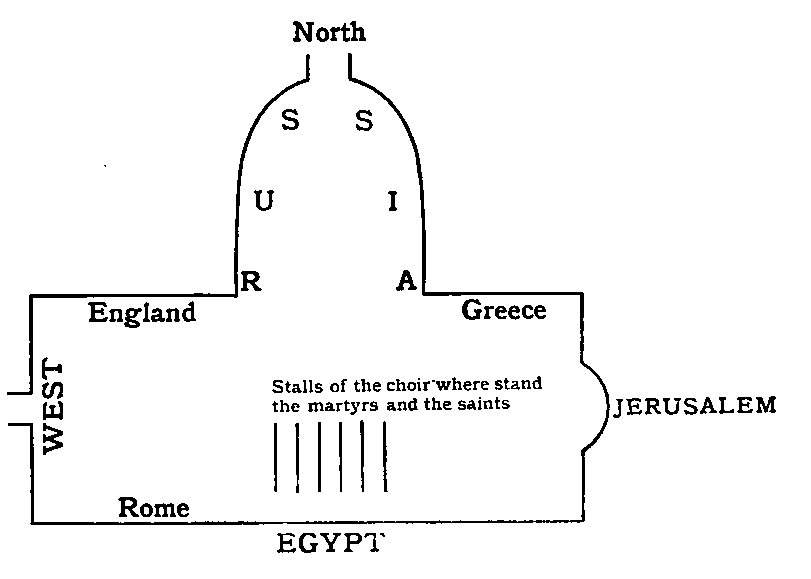
St. Sophia.
Egypt is the choir of the cathedral where stand the martyrs and the saints singing in white robes. Through the gates at the north and the west come 265those who hear the sweet tidings and the heavenly music.
The journey from Egypt to Russia is like going across our great Sophia from the splendid choir to the multitudes who have come out of the forests to listen.
Christianity went over the waves to Athos and Tsargrad, to the Greek and Roman cities of the Black Sea shores, and up the mighty rivers to Kief and Novgorod and Yaroslaf, down the great Volga, driving the Tartar before it, across the forests and along the rivers where lived the primeval nature-worshippers of Russia, brought by knights in armour, by priests and bishops, engendered by hermits and martyrs, enforced eventually by princes and monarchs, interwoven with the splendour of mediæval chivalry. Russia became officially Christian in 988, when King Vladimir and his hosts were baptized in the Dnieper at Kief. A cathedral of St. Sophia, “mother of Russian churches,” springs up at Kief, St. Sophia appears at Novgorod, St. Sophia at Yaroslaf. At the time of our Edward the Confessor Russia was as fervently Christian as England. And the seed, no doubt, had sunk deeper or had been wafted into remoter solitudes. There was room in Russia for Christianity to mature in the popular mind.
At last the Turks streamed across the Levant, and severed the Christian world in two. Foolish and naïve Mahomet came stamping into the great 266cathedral of Sophia on horseback, shouting out at the foot of the sublime altar, “There is no god but God, and Mahomet is His prophet.” Legend says that on that day a priest was celebrating Mass at the altar, and he prayed that the body of Christ might be saved from profanation. As an answer to his prayer the stones gaped, and priest and Host were enclosed, as the relics had been that in earlier days were placed between the tenth stones. The priest was probably murdered as he broke the bread, and, it is true, he has been taken into the wall and has become part of the Bride.
Leopards have their dens where Christian hermits once prayed to God, and they do not know that the ground is holy ground. And the ferocious yet simple Turk has it not in his power to profane Sancta Sophia. When the time comes he can be driven back to the wilds whence he came.
Constantinople falls. But Christianity does not fall, rather it grows. Russian Christianity is saved from much ecclesiastical exploitation, Levantine corruption, and materialism by the severance of the earthly tie, the break-up of the patriarchate of Tsargrad. After the Turks took Constantinople Russian Christianity was fed by the angels. Hence its fair face to-day.
Over the sea to Russia, to the Kremlins round the many-domed churches, to the gleaming ikons, to the great choruses, resplendent and triumphant Orthodoxy; to the land where ever day and night 267there is witness, where the young men see visions and the old men dream dreams; to Kief, to Novgorod, to Moscow, to the Kremlin, to the great pink-walled hill that stands above the mother-city crowned with churches. Bowing at the Ilinskaya, baring the head to enter at the Spassky Gate ... my eyes rest on the wan wall of St. John the Great. I climb to the belfry and let my fingers pass lovingly over the bulging bells. I light a candle in the cathedral of the Assumption. I walk across the broad open spaces where Napoleon’s cannon are ranged and listen to the sad slow chime of the Kremlin clock giving the hours and the quarters. Here again is a holy city standing above a merely worldly city, this walled hill over commercial Moscow, this Sophia exalted above Prudentia.
In the first autumn of the War, when I was at Moscow, I used to go to the Kremlin last thing each night. They were beautifully starry and peaceful nights. The churches and the low pavements that wander among the cobbles were flooded with silver, the toothed battlements and antediluvian old towers of the Kremlin walls seemed gigantically exaggerated in silhouette, and yet, though exaggerated, in a way truer, as if the ordinary vision of them we had by day was not correct, as if they were really in themselves of enormous importance and correspondingly enormous proportions. The moat of the Moscow river lay murky below, 268and afar among the vast congregation of the houses of the city a lamp burned here and there as if before votive shrines. Motionless sentries stood in front of the cathedrals. One’s own steps echoed startlingly. The single liquid melody of the Kremlin chime broke out and poured away—ding, ding, ding, ding, dong, dell, dell. Holy Russia was watching.
I went into a cathedral: still many candles were burning. I walked along the walls: lamps were alight before holy pictures set in the old bricks. There was a perfect stillness and serenity. I paused, and the mind went across Moscow and beyond it fifteen hundred miles to Poland and Germany and Austria where was another scene, a more exterior scene and manifestation of the life of Russia,—Russia in arms against a false ideal. Russia was serene though Russia was in deadly struggle. The heart was beating faithfully, strong hands were smiting the foe.
In the night the hundreds of Napoleon’s black cannon had a sinister aspect, each one seemed pointed at me. The mind went back to their real hour of history when from them death blazed forth; when instead of this stillness and serenity the thunder and tumult of battle was around them. They are death’s heads of what once were live guns; they are greedy as death, menacing as death—harmless also as death. Away above them among the glittering stars stand the gold crosses of the churches, the splendour of God. The mind’s eye 269takes in hundreds and thousands of gold crosses, waving, dipping, lifting, triumphant, the grand processional aspect of the Church. Even at this moment how many are dying, how many souls are passing. In the Kremlin in the still night Holy Russia is watching. Away on the battlefields the brave are dying. Look, in the Kremlin you see their crosses among the stars; listen, you hear the heavenly chorus swelling as they join the great procession of the Church.
From Egypt to Russia, and then from Russia West once more to England. The tempestuous War still rages, and in the seasons of history it is deep winter. Ravenous winds lash the bare trees, howl through the churchyards. Or the wind dies down awhile and bitter frost sets in, and the merciless hungry stars stare at the dead earth. Or heavy clouds come over and the snow sifts down, becomes deeper, communes with the breeze, wreathes itself in fantastic drifts. On the still branches of the forest the snow is balanced, or only disturbed by ravens flitting awkwardly from one tree to another. It is the winter of history, but the season will change. Under the crusted streams the water is flowing, flowers are rising under the snow, flowers from the living seed. The seed lives through the four seasons, and the seed is the Word of God.
271