CONTENTS. (continued 3)
Reading edition
“Then sign at once,” said Vanderhausen; “I am weary.”
At the same time he produced a small case of writing materials, and Gerard signed the important document.
“Let this youth witness the covenant,” said the old man; and Godfrey Schalken unconsciously signed the instrument which bestowed upon another that hand which he had so long regarded as the object and reward of all his labours.
The compact being thus completed, the strange visitor folded up the paper, and stowed it safely in an inner pocket.
“I will visit you to-morrow night, at nine of the clock, at your house, Gerard Douw, and will see the subject of our contract. Farewell.” And so saying, Wilken Vanderhausen moved stiffly, but rapidly out of the room.
Schalken, eager to resolve his doubts, had placed himself by the window in order to watch the street entrance; but the experiment served only to support his suspicions, for the old man did not issue from the door. This was very strange, very odd, very fearful. He and his master returned together, and talked but little on the way, for each had his own subjects of reflection, of anxiety, and of hope.
Schalken, however, did not know the ruin which threatened his cherished schemes.
Gerard Douw knew nothing of the attachment which had sprung up between his pupil and his niece; and even if he had, it is doubtful whether he would have regarded its existence as any serious obstruction to the wishes of Mynher Vanderhausen.
Marriages were then and there matters of traffic and calculation; and it would have appeared as absurd in the eyes of the guardian to make a mutual attachment an essential element in a contract of marriage, as it would have been to draw up his bonds and receipts in the language of chivalrous romance.
The painter, however, did not communicate to his niece the important step which he had taken in her behalf, and his resolution arose not from any anticipation of opposition on her part, but solely from a ludicrous consciousness that if his ward were, as she very naturally might do, to ask him to describe the appearance of the bridegroom whom he destined for her, he would be forced to confess that he had not seen his face, and, if called upon, would find it impossible to identify him.
Upon the next day, Gerard Douw having dined, called his niece to him, and having scanned her person with an air of satisfaction, he took her hand, and looking upon her pretty, innocent face with a smile of kindness, he said:
“Rose, my girl, that face of yours will make your fortune.” Rose blushed and smiled. “Such faces and such tempers seldom go together, and, when they do, the compound is a love-potion which few heads or hearts can resist. Trust me, thou wilt soon be a bride, girl. But this is trifling, and I am pressed for time, so make ready the large room by eight o’clock to-night, and give directions for supper at nine. I expect a friend to-night; and observe me, child, do thou trick thyself out handsomely. I would not have him think us poor or sluttish.”
With these words he left the chamber, and took his way to the room to which we have already had occasion to introduce our readers—that in which his pupils worked.
When the evening closed in, Gerard called Schalken, who was about to take his departure to his obscure and comfortless lodgings, and asked him to come home and sup with Rose and Vanderhausen.
The invitation was of course accepted, and Gerard Douw and his pupil soon found themselves in the handsome and somewhat antique-looking room which had been prepared for the reception of the stranger.
A cheerful wood-fire blazed in the capacious hearth; a little at one side an old-fashioned table, with richly-carved legs, was placed—destined, no doubt, to receive the supper, for which preparations were going forward; and ranged with exact regularity stood the tall-backed chairs whose ungracefulness was more than counterbalanced by their comfort.
The little party, consisting of Rose, her uncle, and the artist, awaited the arrival of the expected visitor with considerable impatience.
Nine o’clock at length came, and with it a summons at the street-door, which, being speedily answered, was followed by a slow and emphatic tread upon the staircase; the steps moved heavily across the lobby, the door of the room in which the party which we have described were assembled slowly opened, and there entered a figure which startled, almost appalled, the phlegmatic Dutchmen, and nearly made Rose scream with affright; it was the form, and arrayed in the garb, of Mynher Vanderhausen; the air, the gait, the height was the same, but the features had never been seen by any of the party before.
The stranger stopped at the door of the room, and displayed his form and face completely. He wore a dark-coloured cloth cloak, which was short and full, not falling quite to the knees; his legs were cased in dark purple silk stockings, and his shoes were adorned with roses of the same colour. The opening of the cloak in front showed the under-suit to consist of some very dark, perhaps sable material, and his hands were enclosed in a pair of heavy leather gloves which ran up considerably above the wrist, in the manner of a gauntlet. In one hand he carried his walking-stick and his hat, which he had removed, and the other hung heavily by his side. A quantity of grizzled hair descended in long tresses from his head, and its folds rested upon the plaits of a stiff ruff, which effectually concealed his neck.
So far all was well; but the face!—all the flesh of the face was coloured with the bluish leaden hue which is sometimes produced by the operation of metallic medicines administered in excessive quantities; the eyes were enormous, and the white appeared both above and below the iris, which gave to them an expression of insanity, which was heightened by their glassy fixedness; the nose was well enough, but the mouth was writhed considerably to one side, where it opened in order to give egress to two long, discoloured fangs, which projected from the upper jaw, far below the lower lip; the hue of the lips themselves bore the usual relation to that of the face, and was consequently nearly black. The character of the face was malignant, even satanic, to the last degree; and, indeed, such a combination of horror could hardly be accounted for, except by supposing the corpse of some atrocious malefactor, which had long hung blackening upon the gibbet, to have at length become the habitation of a demon—the frightful sport of satanic possession.
It was remarkable that the worshipful stranger suffered as little as possible of his flesh to appear, and that during his visit he did not once remove his gloves.
Having stood for some moments at the door, Gerard Douw at length found breath and collectedness to bid him welcome, and, with a mute inclination of the head, the stranger stepped forward into the room.
There was something indescribably odd, even horrible about all his motions, something undefinable, something unnatural, unhuman—it was as if the limbs were guided and directed by a spirit unused to the management of bodily machinery.
The stranger said hardly anything during his visit, which did not exceed half an hour; and the host himself could scarcely muster courage enough to utter the few necessary salutations and courtesies: and, indeed, such was the nervous terror which the presence of Vanderhausen inspired, that very little would have made all his entertainers fly bellowing from the room.
They had not so far lost all self-possession, however, as to fail to observe two strange peculiarities of their visitor.
During his stay he did not once suffer his eyelids to close, nor even to move in the slightest degree; and further, there was a death-like stillness in his whole person, owing to the total absence of the heaving motion of the chest caused by the process of respiration.
These two peculiarities, though when told they may appear trifling, produced a very striking and unpleasant effect when seen and observed. Vanderhausen at length relieved the painter of Leyden of his inauspicious presence; and with no small gratification the little party heard the street door close after him.
“Dear uncle,” said Rose, “what a frightful man! I would not see him again for the wealth of the States!”
“Tush, foolish girl!” said Douw, whose sensations were anything but comfortable. “A man may be as ugly as the devil, and yet if his heart and actions are good, he is worth all the pretty-faced, perfumed puppies that walk the Mall. Rose, my girl, it is very true he has not thy pretty face, but I know him to be wealthy and liberal; and were he ten times more ugly—”
“Which is inconceivable,” observed Rose.
“These two virtues would be sufficient,” continued her uncle, “to counterbalance all his deformity; and if not of power sufficient actually to alter the shape of the features, at least of efficacy enough to prevent one thinking them amiss.”
“Do you know, uncle,” said Rose, “when I saw him standing at the door, I could not get it out of my head that I saw the old, painted, wooden figure that used to frighten me so much in the church of St. Laurence at Rotterdam.”
Gerard laughed, though he could not help inwardly acknowledging the justness of the comparison. He was resolved, however, as far as he could, to check his niece’s inclination to ridicule the ugliness of her intended bridegroom, although he was not a little pleased to observe that she appeared totally exempt from that mysterious dread of the stranger, which, he could not disguise it from himself, considerably affected him, as it also did his pupil Godfrey Schalken.
Early on the next day there arrived from various quarters of the town, rich presents of silks, velvets, jewellery, and so forth, for Rose; and also a packet directed to Gerard Douw, which, on being opened, was found to contain a contract of marriage, formally drawn up, between Wilken Vanderhausen of the Boom-quay, in Rotterdam, and Rose Velderkaust of Leyden, niece to Gerard Douw, master in the art of painting, also of the same city; and containing engagements on the part of Vanderhausen to make settlements upon his bride far more splendid than he had before led her guardian to believe likely, and which were to be secured to her use in the most unexceptionable manner possible—the money being placed in the hands of Gerard Douw himself.
I have no sentimental scenes to describe, no cruelty of guardians or magnanimity of wards, or agonies of lovers. The record I have to make is one of sordidness, levity, and interest. In less than a week after the first interview which we have just described, the contract of marriage was fulfilled, and Schalken saw the prize which he would have risked anything to secure, carried off triumphantly by his formidable rival.
For two or three days he absented himself from the school; he then returned and worked, if with less cheerfulness, with far more dogged resolution than before; the dream of love had given place to that of ambition.
Months passed away, and, contrary to his expectation, and, indeed, to the direct promise of the parties, Gerard Douw heard nothing of his niece or her worshipful spouse. The interest of the money, which was to have been demanded in quarterly sums, lay unclaimed in his hands. He began to grow extremely uneasy.
Mynher Vanderhausen’s direction in Rotterdam he was fully possessed of. After some irresolution he finally determined to journey thither—a trifling undertaking, and easily accomplished—and thus to satisfy himself of the safety and comfort of his ward, for whom he entertained an honest and strong affection.
His search was in vain, however. No one in Rotterdam had ever heard of Mynher Vanderhausen.
Gerard Douw left not a house in the Boom-quay untried; but all in vain. No one could give him any information whatever touching the object of his inquiry; and he was obliged to return to Leyden, nothing wiser than when he had left it.
On his arrival he hastened to the establishment from which Vanderhausen had hired the lumbering, though, considering the times, most luxurious vehicle which the bridal party had employed to convey them to Rotterdam. From the driver of this machine he learned, that having proceeded by slow stages, they had late in the evening approached Rotterdam; but that before they entered the city, and while yet nearly a mile from it, a small party of men, soberly clad, and after the old fashion, with peaked beards and moustaches, standing in the centre of the road, obstructed the further progress of the carriage. The driver reined in his horses, much fearing, from the obscurity of the hour, and the loneliness of the road, that some mischief was intended.
His fears were, however, somewhat allayed by his observing that these strange men carried a large litter, of an antique shape, and which they immediately set down upon the pavement, whereupon the bridegroom, having opened the coach-door from within, descended, and having assisted his bride to do likewise, led her, weeping bitterly and wringing her hands, to the litter, which they both entered. It was then raised by the men who surrounded it, and speedily carried towards the city, and before it had proceeded many yards the darkness concealed it from the view of the Dutch chariot.
In the inside of the vehicle he found a purse, whose contents more than thrice paid the hire of the carriage and man. He saw and could tell nothing more of Mynher Vanderhausen and his beautiful lady. This mystery was a source of deep anxiety and almost of grief to Gerard Douw.
There was evidently fraud in the dealing of Vanderhausen with him, though for what purpose committed he could not imagine. He greatly doubted how far it was possible for a man possessing in his countenance so strong an evidence of the presence of the most demoniac feelings to be in reality anything but a villain; and every day that passed without his hearing from or of his niece, instead of inducing him to forget his fears, tended more and more to intensify them.
The loss of his niece’s cheerful society tended also to depress his spirits; and in order to dispel this despondency, which often crept upon his mind after his daily employment was over, he was wont frequently to prevail upon Schalken to accompany him home, and by his presence to dispel, in some degree, the gloom of his otherwise solitary supper.
One evening, the painter and his pupil were sitting by the fire, having accomplished a comfortable supper. They had yielded to that silent pensiveness sometimes induced by the process of digestion, when their reflections were disturbed by a loud sound at the street-door, as if occasioned by some person rushing forcibly and repeatedly against it. A domestic had run without delay to ascertain the cause of the disturbance, and they heard him twice or thrice interrogate the applicant for admission, but without producing an answer or any cessation of the sounds.
They heard him then open the hall door, and immediately there followed a light and rapid tread upon the staircase. Schalken laid his hand on his sword, and advanced towards the door. It opened before he reached it, and Rose rushed into the room. She looked wild and haggard, and pale with exhaustion and terror; but her dress surprised them as much even as her unexpected appearance. It consisted of a kind of white woollen wrapper, made close about the neck, and descending to the very ground. It was much deranged and travel-soiled. The poor creature had hardly entered the chamber when she fell senseless on the floor. With some difficulty they succeeded in reviving her, and on recovering her senses she instantly exclaimed, in a tone of eager, terrified impatience,—
“Wine, wine, quickly, or I’m lost!”
Much alarmed at the strange agitation in which the call was made, they at once administered to her wishes, and she drank some wine with a haste and eagerness which surprised him. She had hardly swallowed it, when she exclaimed with the same urgency,—
“Food, food, at once, or I perish!”
A considerable fragment of a roast joint was upon the table, and Schalken immediately proceeded to cut some, but he was anticipated; for no sooner had she become aware of its presence than she darted at it with the rapacity of a vulture, and, seizing it in her hands, she tore off the flesh with her teeth and swallowed it.
When the paroxysm of hunger had been a little appeased, she appeared suddenly to become aware how strange her conduct had been, or it may have been that other more agitating thoughts recurred to her mind, for she began to weep bitterly, and to wring her hands.
“Oh! send for a minister of God,” said she; “I am not safe till he comes; send for him speedily.”
Gerard Douw despatched a messenger instantly, and prevailed on his niece to allow him to surrender his bedchamber to her use; he also persuaded her to retire to it at once and to rest; her consent was extorted upon the condition that they would not leave her for a moment.
“Oh that the holy man were here!” she said; “he can deliver me. The dead and the living can never be one—God has forbidden it.”
With these mysterious words she surrendered herself to their guidance, and they proceeded to the chamber which Gerard Douw had assigned to her use.
“Do not—do not leave me for a moment,” said she. “I am lost for ever if you do.”
Gerard Douw’s chamber was approached through a spacious apartment, which they were now about to enter. Gerard Douw and Schalken each carried a wax candle, so that a sufficient degree of light was cast upon all surrounding objects. They were now entering the large chamber, which, as I have said, communicated with Douw’s apartment, when Rose suddenly stopped, and, in a whisper which seemed to thrill with horror, she said,—
“O God! he is here—he is here! See, see—there he goes!”
She pointed towards the door of the inner room, and Schalken thought he saw a shadowy and ill-defined form gliding into that apartment. He drew his sword, and raising the candle so as to throw its light with increased distinctness upon the objects in the room, he entered the chamber into which the figure had glided. No figure was there—nothing but the furniture which belonged to the room, and yet he could not be deceived as to the fact that something had moved before them into the chamber.
A sickening dread came upon him, and the cold perspiration broke out in heavy drops upon his forehead; nor was he more composed when he heard the increased urgency, the agony of entreaty, with which Rose implored them not to leave her for a moment.
“I saw him,” said she. “He’s here! I cannot be deceived—I know him. He’s by me—he’s with me—he’s in the room. Then, for God’s sake, as you would save, do not stir from beside me!”
They at length prevailed upon her to lie down upon the bed, where she continued to urge them to stay by her. She frequently uttered incoherent sentences, repeating again and again, “The dead and the living cannot be one—God has forbidden it!” and then again, “Rest to the wakeful—sleep to the sleep-walkers.”
These and such mysterious and broken sentences she continued to utter until the clergyman arrived.
Gerard Douw began to fear, naturally enough, that the poor girl, owing to terror or ill-treatment, had become deranged; and he half suspected, by the suddenness of her appearance, and the unseasonableness of the hour, and, above all, from the wildness and terror of her manner, that she had made her escape from some place of confinement for lunatics, and was in immediate fear of pursuit. He resolved to summon medical advice as soon as the mind of his niece had been in some measure set at rest by the offices of the clergyman whose attendance she had so earnestly desired; and until this object had been attained, he did not venture to put any questions to her, which might possibly, by reviving painful or horrible recollections, increase her agitation.
The clergyman soon arrived—a man of ascetic countenance and venerable age—one whom Gerard Douw respected much, forasmuch as he was a veteran polemic, though one, perhaps, more dreaded as a combatant than beloved as a Christian—of pure morality, subtle brain, and frozen heart. He entered the chamber which communicated with that in which Rose reclined, and immediately on his arrival she requested him to pray for her, as for one who lay in the hands of Satan, and who could hope for deliverance only from Heaven.
That our readers may distinctly understand all the circumstances of the event which we are about imperfectly to describe, it is necessary to state the relative positions of the parties who were engaged in it. The old clergyman and Schalken were in the ante-room of which we have already spoken; Rose lay in the inner chamber, the door of which was open; and by the side of the bed, at her urgent desire, stood her guardian; a candle burned in the bedchamber, and three were lighted in the outer apartment.
The old man now cleared his voice, as if about to commence; but before he had time to begin, a sudden gust of air blew out the candle which served to illuminate the room in which the poor girl lay, and she with hurried alarm, exclaimed:
“Godfrey, bring in another candle; the darkness is unsafe.”
Gerard Douw, forgetting for the moment her repeated injunctions in the immediate impulse, stepped from the bedchamber into the other, in order to supply what she desired.
“O God! do not go, dear uncle!” shrieked the unhappy girl; and at the same time she sprang from the bed and darted after him, in order, by her grasp, to detain him.
But the warning came too late, for scarcely had he passed the threshold, and hardly had his niece had time to utter the startling exclamation, when the door which divided the two rooms closed violently after him, as if swung to by a strong blast of wind.
Schalken and he both rushed to the door, but their united and desperate efforts could not avail so much as to shake it.
Shriek after shriek burst from the inner chamber, with all the piercing loudness of despairing terror. Schalken and Douw applied every energy and strained every nerve to force open the door; but all in vain.
There was no sound of struggling from within, but the screams seemed to increase in loudness, and at the same time they heard the bolts of the latticed window withdrawn, and the window itself grated upon the sill as if thrown open.
One last shriek, so long and piercing and agonized as to be scarcely human, swelled from the room, and suddenly there followed a death-like silence.
A light step was heard crossing the floor, as if from the bed to the window; and almost at the same instant the door gave way, and yielding to the pressure of the external applicants, they were nearly precipitated into the room. It was empty. The window was open, and Schalken sprang to a chair and gazed out upon the street and at the canal below. He saw no form, but he beheld, or thought he beheld, the waters of the broad canal beneath settling ring after ring in heavy circular ripples, as if a moment before disturbed by the immersion of some large and heavy mass.
No trace of Rose was ever after discovered, nor was anything certain respecting her mysterious wooer detected or even suspected; no clue whereby to trace the intricacies of the labyrinth, and to arrive at a distinct conclusion was to be found. But an incident occurred, which, though it will not be received by our rational readers as at all approaching to evidence upon the matter, nevertheless produced a strong and a lasting impression upon the mind of Schalken.
THE WATERS OF THE BROAD CANAL BENEATH SETTLING RING AFTER RING IN HEAVY CIRCULAR RIPPLES.
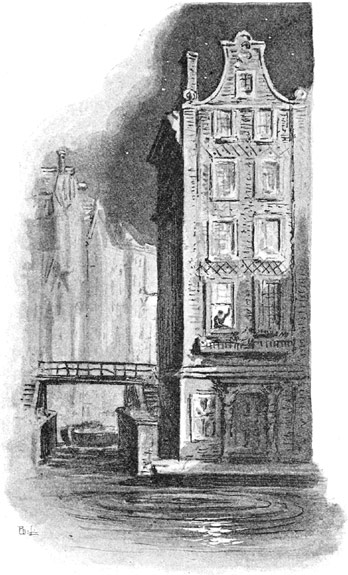
Many years after the events which we have detailed, Schalken, then remotely situated, received an intimation of his father’s death, and of his intended burial upon a fixed day in the church of Rotterdam. It was necessary that a very considerable journey should be performed by the funeral procession, which, as it will readily be believed, was not very numerously attended. Schalken with difficulty arrived in Rotterdam late in the day upon which the funeral was appointed to take place. The procession had not then arrived. Evening closed in, and still it did not appear.
Schalken strolled down to the church—he found it open; notice of the arrival of the funeral had been given, and the vault in which the body was to be laid had been opened. The official who corresponds to our sexton, on seeing a well-dressed gentleman, whose object was to attend the expected funeral, pacing the aisle of the church, hospitably invited him to share with him the comforts of a blazing wood fire, which as was his custom in winter time upon such occasions, he had kindled on the hearth of a chamber which communicated by a flight of steps with the vault below.
In this chamber Schalken and his entertainer seated themselves; and the sexton, after some fruitless attempts to engage his guest in conversation, was obliged to apply himself to his tobacco-pipe and can to solace his solitude.
In spite of his grief and cares, the fatigues of a rapid journey of nearly forty hours gradually overcame the mind and body of Godfrey Schalken, and he sank into a deep sleep, from which he was awakened by some one shaking him gently by the shoulder. He first thought that the old sexton had called him, but he was no longer in the room.
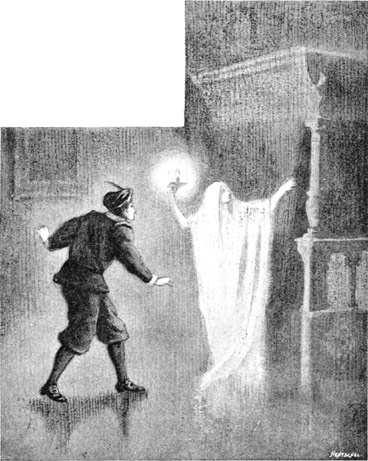
He roused himself, and as soon as he could clearly see what was around him, he perceived a female form, clothed in a kind of light robe of muslin, part of which was so disposed as to act as a veil, and in her hand she carried a lamp. She was moving rather away from him, and towards the flight of steps which conducted towards the vaults.
Schalken felt a vague alarm at the sight of this figure, and at the same time an irresistible impulse to follow its guidance. He followed it towards the vaults, but when it reached the head of the stairs, he paused; the figure paused also, and turning gently round, displayed, by the light of the lamp it carried, the face and features of his first love, Rose Velderkaust. There was nothing horrible, or even sad, in the countenance. On the contrary, it wore the same arch smile which used to enchant the artist long before in his happy days.
A feeling of awe and of interest, too intense to be resisted, prompted him to follow the spectre, if spectre it were. She descended the stairs—he followed; and, turning to the left, through a narrow passage she led him, to his infinite surprise, into what appeared to be an old-fashioned Dutch apartment, such as the pictures of Gerard Douw have served to immortalize.
Abundance of costly antique furniture was disposed about the room, and in one corner stood a four-post bed, with heavy black cloth curtains around it. The figure frequently turned towards him with the same arch smile; and when she came to the side of the bed, she drew the curtains, and by the light of the lamp which she held towards its contents, she disclosed to the horror-stricken painter, sitting bolt upright in the bed, the livid and demoniac form of Vanderhausen. Schalken had hardly seen him when he fell senseless upon the floor, where he lay until discovered, on the next morning, by persons employed in closing the passages into the vaults. He was lying in a cell of considerable size, which had not been disturbed for a long time, and he had fallen beside a large coffin which was supported upon small stone pillars, a security against the attacks of vermin.
To his dying day Schalken was satisfied of the reality of the vision which he had witnessed, and he has left behind him a curious evidence of the impression which it wrought upon his fancy, in a painting executed shortly after the event we have narrated, and which is valuable as exhibiting not only the peculiarities which have made Schalken’s pictures sought after, but even more so as presenting a portrait, as close and faithful as one taken from memory can be, of his early love, Rose Velderkaust, whose mysterious fate must ever remain matter of speculation.
SHE DREW THE CURTAINS.
The picture represents a chamber of antique masonry, such as might be found in most old cathedrals, and is lighted faintly by a lamp carried in the hand of a female figure, such as we have above attempted to describe; and in the background, and to the left of him who examines the painting, there stands the form of a man apparently aroused from sleep, and by his attitude, his hand being laid upon his sword, exhibiting considerable alarm; this last figure is illuminated only by the expiring glare of a wood or charcoal fire.
The whole production exhibits a beautiful specimen of that artful and singular distribution of light and shade which has rendered the name of Schalken immortal among the artists of his country. This tale is traditionary, and the reader will easily perceive, by our studiously omitting to heighten many points of the narrative, when a little additional colouring might have added effect to the recital, that we have desired to lay before him, not a figment of the brain, but a curious tradition connected with, and belonging to, the biography of a famous artist.
“The earth hath bubbles as the water hath— And these are of them.”
In the south of Ireland, and on the borders of the county of Limerick, there lies a district of two or three miles in length, which is rendered interesting by the fact that it is one of the very few spots throughout this country in which some vestiges of aboriginal forests still remain. It has little or none of the lordly character of the American forest, for the axe has felled its oldest and its grandest trees; but in the close wood which survives live all the wild and pleasing peculiarities of nature: its complete irregularity, its vistas, in whose perspective the quiet cattle are browsing; its refreshing glades, where the grey rocks arise from amid the nodding fern; the silvery shafts of the old birch-trees; the knotted trunks of the hoary oak, the grotesque but graceful branches which never shed their honours under the tyrant pruning-hook; the soft green sward; the chequered light and shade; the wild luxuriant weeds; the lichen and the moss—all are beautiful alike in the green freshness of spring or in the sadness and sere of autumn. Their beauty is of that kind which makes the heart full with joy—appealing to the affections with a power which belongs to nature only. This wood runs up, from below the base, to the ridge of a long line of irregular hills, having perhaps, in primitive times, formed but the skirting of some mighty forest which occupied the level below.
But now, alas! whither have we drifted? whither has the tide of civilization borne us? It has passed over a land unprepared for it—it has left nakedness behind it; we have lost our forests, but our marauders remain; we have destroyed all that is picturesque, while we have retained everything that is revolting in barbarism. Through the midst of this woodland there runs a deep gully or glen, where the stillness of the scene is broken in upon by the brawling of a mountain-stream, which, however, in the winter season, swells into a rapid and formidable torrent.
There is one point at which the glen becomes extremely deep and narrow; the sides descend to the depth of some hundred feet, and are so steep as to be nearly perpendicular. The wild trees which have taken root in the crannies and chasms of the rock are so intersected and entangled, that one can with difficulty catch a glimpse of the stream which wheels, flashes, and foams below, as if exulting in the surrounding silence and solitude.
This spot was not unwisely chosen, as a point of no ordinary strength, for the erection of a massive square tower or keep, one side of which rises as if in continuation of the precipitous cliff on which it is based. Originally, the only mode of ingress was by a narrow portal in the very wall which overtopped the precipice, opening upon a ledge of rock which afforded a precarious pathway, cautiously intersected, however, by a deep trench cut out with great labour in the living rock; so that, in its pristine state, and before the introduction of artillery into the art of war, this tower might have been pronounced, and that not presumptuously, impregnable.
The progress of improvement and the increasing security of the times had, however, tempted its successive proprietors, if not to adorn, at least to enlarge their premises, and about the middle of the last century, when the castle was last inhabited, the original square tower formed but a small part of the edifice.
The castle, and a wide tract of the surrounding country, had from time immemorial belonged to a family which, for distinctness, we shall call by the name of Ardagh; and owing to the associations which, in Ireland, almost always attach to scenes which have long witnessed alike the exercise of stern feudal authority, and of that savage hospitality which distinguished the good old times, this building has become the subject and the scene of many wild and extraordinary traditions. One of them I have been enabled, by a personal acquaintance with an eye-witness of the events, to trace to its origin; and yet it is hard to say whether the events which I am about to record appear more strange and improbable as seen through the distorting medium of tradition, or in the appalling dimness of uncertainty which surrounds the reality.
Tradition says that, sometime in the last century, Sir Robert Ardagh, a young man, and the last heir of that family, went abroad and served in foreign armies; and that, having acquired considerable honour and emolument, he settled at Castle Ardagh, the building we have just now attempted to describe. He was what the country people call a dark man; that is, he was considered morose, reserved, and ill-tempered; and, as it was supposed from the utter solitude of his life, was upon no terms of cordiality with the other members of his family.
The only occasion upon which he broke through the solitary monotony of his life was during the continuance of the racing season, and immediately subsequent to it; at which time he was to be seen among the busiest upon the course, betting deeply and unhesitatingly, and invariably with success. Sir Robert was, however, too well known as a man of honour, and of too high a family, to be suspected of any unfair dealing. He was, moreover, a soldier, and a man of intrepid as well as of a haughty character; and no one cared to hazard a surmise, the consequences of which would be felt most probably by its originator only.
Gossip, however, was not silent; it was remarked that Sir Robert never appeared at the race-ground, which was the only place of public resort which he frequented, except in company with a certain strange-looking person, who was never seen elsewhere, or under other circumstances. It was remarked, too, that this man, whose relation to Sir Robert was never distinctly ascertained, was the only person to whom he seemed to speak unnecessarily; it was observed that while with the country gentry he exchanged no further communication than what was unavoidable in arranging his sporting transactions, with this person he would converse earnestly and frequently. Tradition asserts that, to enhance the curiosity which this unaccountable and exclusive preference excited, the stranger possessed some striking and unpleasant peculiarities of person and of garb—though it is not stated, however, what these were—but they, in conjunction with Sir Robert’s secluded habits and extraordinary run of luck—a success which was supposed to result from the suggestions and immediate advice of the unknown—were sufficient to warrant report in pronouncing that there was something queer in the wind, and in surmising that Sir Robert was playing a fearful and a hazardous game, and that, in short, his strange companion was little better than the Devil himself.
Years rolled quietly away, and nothing very novel occurred in the arrangements of Castle Ardagh, excepting that Sir Robert parted with his odd companion, but as nobody could tell whence he came, so nobody could say whither he had gone. Sir Robert’s habits, however, underwent no consequent change; he continued regularly to frequent the race meetings, without mixing at all in the convivialities of the gentry, and immediately afterwards to relapse into the secluded monotony of his ordinary life.
It was said that he had accumulated vast sums of money—and, as his bets were always successful and always large, such must have been the case. He did not suffer the acquisition of wealth, however, to influence his hospitality or his house-keeping—he neither purchased land, nor extended his establishment; and his mode of enjoying his money must have been altogether that of the miser—consisting merely in the pleasure of touching and telling his gold, and in the consciousness of wealth.
Sir Robert’s temper, so far from improving, became more than ever gloomy and morose. He sometimes carried the indulgence of his evil dispositions to such a height that it bordered upon insanity. During these paroxysms he would neither eat, drink, nor sleep. On such occasions he insisted on perfect privacy, even from the intrusion of his most trusted servants; his voice was frequently heard, sometimes in earnest supplication, sometimes raised, as if in loud and angry altercation with some unknown visitant. Sometimes he would for hours together walk to and fro throughout the long oak-wainscoted apartment which he generally occupied, with wild gesticulations and agitated pace, in the manner of one who has been roused to a state of unnatural excitement by some sudden and appalling intimation.
These paroxysms of apparent lunacy were so frightful, that during their continuance even his oldest and most faithful domestics dared not approach him; consequently his hours of agony were never intruded upon, and the mysterious causes of his sufferings appeared likely to remain hidden for ever.
On one occasion a fit of this kind continued for an unusual time; the ordinary term of their duration—about two days—had been long past, and the old servant who generally waited upon Sir Robert after these visitations, having in vain listened for the well-known tinkle of his master’s hand-bell, began to feel extremely anxious; he feared that his master might have died from sheer exhaustion, or perhaps put an end to his own existence during his miserable depression. These fears at length became so strong, that having in vain urged some of his brother servants to accompany him, he determined to go up alone, and himself see whether any accident had befallen Sir Robert.
He traversed the several passages which conducted from the new to the more ancient parts of the mansion, and having arrived in the old hall of the castle, the utter silence of the hour—for it was very late in the night—the idea of the nature of the enterprise in which he was engaging himself, a sensation of remoteness from anything like human companionship, but, more than all, the vivid but undefined anticipation of something horrible, came upon him with such oppressive weight that he hesitated as to whether he should proceed. Real uneasiness, however, respecting the fate of his master, for whom he felt that kind of attachment which the force of habitual intercourse not unfrequently engenders respecting objects not in themselves amiable, and also a latent unwillingness to expose his weakness to the ridicule of his fellow-servants, combined to overcome his reluctance; and he had just placed his foot upon the first step of the staircase which conducted to his master’s chamber, when his attention was arrested by a low but distinct knocking at the hall-door. Not, perhaps, very sorry at finding thus an excuse even for deferring his intended expedition, he placed the candle upon a stone block which lay in the hall and approached the door, uncertain whether his ears had not deceived him. This doubt was justified by the circumstance that the hall entrance had been for nearly fifty years disused as a mode of ingress to the castle. The situation of this gate also, which we have endeavoured to describe, opening upon a narrow ledge of rock which overhangs a perilous cliff, rendered it at all times, but particularly at night, a dangerous entrance. This shelving platform of rock, which formed the only avenue to the door, was divided, as I have already stated, by a broad chasm, the planks across which had long disappeared, by decay or otherwise; so that it seemed at least highly improbable that any man could have found his way across the passage in safety to the door, more particularly on a night like this, of singular darkness. The old man, therefore, listened attentively, to ascertain whether the first application should be followed by another. He had not long to wait. The same low but singularly distinct knocking was repeated; so low that it seemed as if the applicant had employed no harder or heavier instrument than his hand, and yet, despite the immense thickness of the door, with such strength that the sound was distinctly audible.
The knock was repeated a third time, without any increase of loudness; and the old man, obeying an impulse for which to his dying hour he could never account, proceeded to remove, one by one, the three great oaken bars which secured the door. Time and damp had effectually corroded the iron chambers of the lock, so that it afforded little resistance. With some effort, as he believed, assisted from without, the old servant succeeded in opening the door; and a low, square-built figure, apparently that of a man wrapped in a large black cloak, entered the hall. The servant could not see much of this visitor with any distinctness; his dress appeared foreign, the skirt of his ample cloak was thrown over one shoulder; he wore a large felt hat, with a very heavy leaf, from under which escaped what appeared to be a mass of long sooty-black hair; his feet were cased in heavy riding-boots. Such were the few particulars which the servant had time and light to observe. The stranger desired him to let his master know instantly that a friend had come, by appointment, to settle some business with him. The servant hesitated, but a slight motion on the part of his visitor, as if to possess himself of the candle, determined him; so, taking it in his hand, he ascended the castle stairs, leaving the guest in the hall.
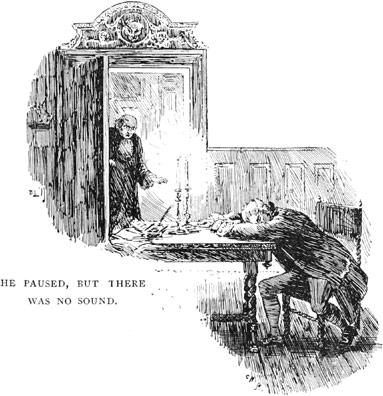
On reaching the apartment which opened upon the oak-chamber he was surprised to observe the door of that room partly open, and the room itself lit up. He paused, but there was no sound; he looked in, and saw Sir Robert, his head and the upper part of his body reclining on a table, upon which two candles burned; his arms were stretched forward on either side, and perfectly motionless; it appeared that, having been sitting at the table, he had thus sunk forward, either dead or in a swoon. There was no sound of breathing; all was silent, except the sharp ticking of a watch, which lay beside the lamp. The servant coughed twice or thrice, but with no effect; his fears now almost amounted to certainty, and he was approaching the table on which his master partly lay, to satisfy himself of his death, when Sir Robert slowly raised his head, and, throwing himself back in his chair, fixed his eyes in a ghastly and uncertain gaze upon his attendant. At length he said, slowly and painfully, as if he dreaded the answer,—
“In God’s name, what are you?”
“Sir,” said the servant, “a strange gentleman wants to see you below.”
At this intimation Sir Robert, starting to his feet and tossing his arms wildly upwards, uttered a shriek of such appalling and despairing terror that it was almost too fearful for human endurance; and long after the sound had ceased it seemed to the terrified imagination of the old servant to roll through the deserted passages in bursts of unnatural laughter. After a few moments Sir Robert said,—
“Can’t you send him away? Why does he come so soon? O Merciful Powers! let him leave me for an hour; a little time. I can’t see him now; try to get him away. You see I can’t go down now; I have not strength. O God! O God! let him come back in an hour; it is not long to wait. He cannot lose anything by it; nothing, nothing, nothing. Tell him that! Say anything to him.”
The servant went down. In his own words, he did not feel the stairs under him till he got to the hall. The figure stood exactly as he had left it. He delivered his master’s message as coherently as he could. The stranger replied in a careless tone:
“If Sir Robert will not come down to me; I must go up to him.”
The man returned, and to his surprise he found his master much more composed in manner. He listened to the message, and though the cold perspiration rose in drops upon his forehead faster than he could wipe it away, his manner had lost the dreadful agitation which had marked it before. He rose feebly, and casting a last look of agony behind him, passed from the room to the lobby, where he signed to his attendant not to follow him. The man moved as far as the head of the staircase, from whence he had a tolerably distinct view of the hall, which was imperfectly lighted by the candle he had left there.
He saw his master reel, rather than walk, down the stairs, clinging all the way to the banisters. He walked on, as if about to sink every moment from weakness. The figure advanced as if to meet him, and in passing struck down the light. The servant could see no more; but there was a sound of struggling, renewed at intervals with silent but fearful energy. It was evident, however, that the parties were approaching the door, for he heard the solid oak sound twice or thrice, as the feet of the combatants, in shuffling hither and thither over the floor, struck upon it. After a slight pause, he heard the door thrown open with such violence that the leaf seemed to strike the side-wall of the hall, for it was so dark without that this could only be surmised by the sound. The struggle was renewed with an agony and intenseness of energy that betrayed itself in deep-drawn gasps. One desperate effort, which terminated in the breaking of some part of the door, producing a sound as if the door-post was wrenched from its position, was followed by another wrestle, evidently upon the narrow ledge which ran outside the door, overtopping the precipice. This proved to be the final struggle; it was followed by a crashing sound as if some heavy body had fallen over, and was rushing down the precipice through the light boughs that crossed near the top. All then became still as the grave, except when the moan of the night-wind sighed up the wooded glen.
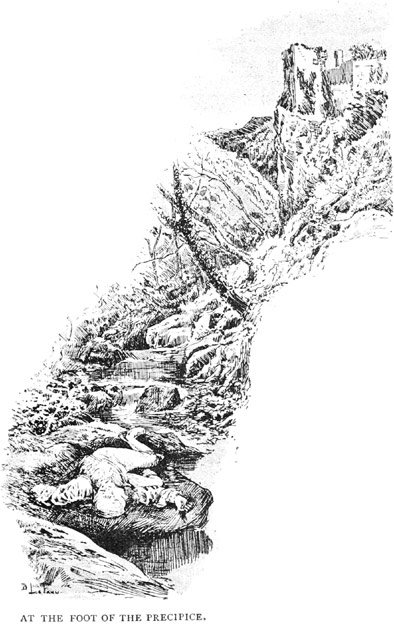
The old servant had not nerve to return through the hall, and to him the darkness seemed all but endless; but morning at length came, and with it the disclosure of the events of the night. Near the door, upon the ground, lay Sir Robert’s sword-belt, which had given way in the scuffle. A huge splinter from the massive door-post had been wrenched off by an almost superhuman effort—one which nothing but the gripe of a despairing man could have severed—and on the rocks outside were left the marks of the slipping and sliding of feet.
At the foot of the precipice, not immediately under the castle, but dragged some way up the glen, were found the remains of Sir Robert, with hardly a vestige of a limb or feature left distinguishable. The right hand, however, was uninjured, and in its fingers were clutched, with the fixedness of death, a long lock of coarse sooty hair—the only direct circumstantial evidence of the presence of a second person.
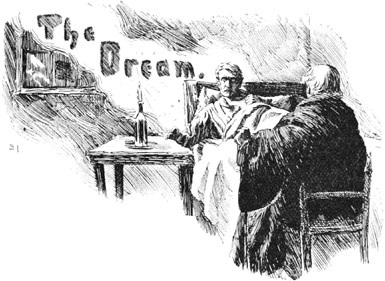
Dreams! What age, or what country of the world, has not felt and acknowledged the mystery of their origin and end? I have thought not a little upon the subject, seeing it is one which has been often forced upon my attention, and sometimes strangely enough; and yet I have never arrived at anything which at all appeared a satisfactory conclusion. It does appear that a mental phenomenon so extraordinary cannot be wholly without its use. We know, indeed, that in the olden times it has been made the organ of communication between the Deity and His creatures; and when a dream produces upon a mind, to all appearance hopelessly reprobate and depraved, an effect so powerful and so lasting as to break down the inveterate habits, and to reform the life of an abandoned sinner, we see in the result, in the reformation of morals which appeared incorrigible, in the reclamation of a human soul which seemed to be irretrievably lost, something more than could be produced by a mere chimera of the slumbering fancy, something more than could arise from the capricious images of a terrified imagination. And while Reason rejects as absurd the superstition which will read a prophecy in every dream, she may, without violence to herself, recognize, even in the wildest and most incongruous of the wanderings of a slumbering intellect, the evidences and the fragments of a language which may be spoken, which has been spoken, to terrify, to warn and to command. We have reason to believe too, by the promptness of action which in the age of the prophets followed all intimations of this kind, and by the strength of conviction and strange permanence of the effects resulting from certain dreams in latter times—which effects we ourselves may have witnessed—that when this medium of communication has been employed by the Deity, the evidences of His presence have been unequivocal. My thoughts were directed to this subject in a manner to leave a lasting impression upon my mind, by the events which I shall now relate, the statement of which, however extraordinary, is nevertheless accurate.
About the year 17—, having been appointed to the living of C——h, I rented a small house in the town which bears the same name: one morning in the month of November, I was awakened before my usual time by my servant, who bustled into my bedroom for the purpose of announcing a sick call. As the Catholic Church holds her last rites to be totally indispensable to the safety of the departing sinner, no conscientious clergyman can afford a moment’s unnecessary delay, and in little more than five minutes I stood ready, cloaked and booted for the road, in the small front parlour in which the messenger, who was to act as my guide, awaited my coming. I found a poor little girl crying piteously near the door, and after some slight difficulty I ascertained that her father was either dead or just dying.
“And what may be your father’s name, my poor child?” said I. She held down her head as if ashamed. I repeated the question, and the wretched little creature burst into floods of tears still more bitter than she had shed before. At length, almost angered by conduct which appeared to me so unreasonable, I began to lose patience, and I said rather harshly,—
“If you will not tell me the name of the person to whom you would lead me, your silence can arise from no good motive, and I might be justified in refusing to go with you at all.”
“Oh, don’t say that—don’t say that!” cried she. “Oh, sir, it was that I was afeard of when I would not tell you—I was afeard, when you heard his name, you would not come with me; but it is no use hidin’ it now—it’s Pat Connell, the carpenter, your honour.”
She looked in my face with the most earnest anxiety, as if her very existence depended upon what she should read there. I relieved the child at once. The name, indeed, was most unpleasantly familiar to me; but, however fruitless my visits and advice might have been at another time, the present was too fearful an occasion to suffer my doubts of their utility, or my reluctance to re-attempting what appeared a hopeless task, to weigh even against the lightest chance that a consciousness of his imminent danger might produce in him a more docile and tractable disposition. Accordingly I told the child to lead the way, and followed her in silence. She hurried rapidly through the long narrow street which forms the great thoroughfare of the town. The darkness of the hour, rendered still deeper by the close approach of the old-fashioned houses, which lowered in tall obscurity on either side of the way; the damp, dreary chill which renders the advance of morning peculiarly cheerless, combined with the object of my walk—to visit the death-bed of a presumptuous sinner, to endeavour, almost against my own conviction, to infuse a hope into the heart of a dying reprobate—a drunkard but too probably perishing under the consequences of some mad fit of intoxication; all these circumstances served to enhance the gloom and solemnity of my feelings, as I silently followed my little guide, who with quick steps traversed the uneven pavement of the Main Street. After a walk of about five minutes, she turned off into a narrow lane, of that obscure and comfortless class which is to be found in almost all small old-fashioned towns, chill, without ventilation, reeking with all manner of offensive effluviæ, and lined by dingy, smoky, sickly and pent-up buildings, frequently not only in a wretched but in a dangerous condition.
“Your father has changed his abode since I last visited him, and, I am afraid, much for the worse,” said I.
“Indeed he has, sir; but we must not complain,” replied she. “We have to thank God that we have lodging and food, though it’s poor enough, it is, your honour.”
Poor child! thought I. How many an older head might learn wisdom from thee—how many a luxurious philosopher, who is skilled to preach but not to suffer, might not thy patient words put to the blush! The manner and language of my companion were alike above her years and station; and, indeed, in all cases in which the cares and sorrows of life have anticipated their usual date, and have fallen, as they sometimes do, with melancholy prematurity to the lot of childhood, I have observed the result to have proved uniformly the same. A young mind, to which joy and indulgence have been strangers, and to which suffering and self-denial have been familiarized from the first, acquires a solidity and an elevation which no other discipline could have bestowed, and which, in the present case, communicated a striking but mournful peculiarity to the manners, even to the voice, of the child. We paused before a narrow, crazy door, which she opened by means of a latch, and we forthwith began to ascend the steep and broken stairs which led to the sick man’s room.
As we mounted flight after flight towards the garret-floor, I heard more and more distinctly the hurried talking of many voices. I could also distinguish the low sobbing of a female. On arriving upon the uppermost lobby, these sounds became fully audible.
“This way, your honour,” said my little conductress; at the same time, pushing open a door of patched and half-rotten plank, she admitted me into the squalid chamber of death and misery. But one candle, held in the fingers of a scared and haggard-looking child, was burning in the room, and that so dim that all was twilight or darkness except within its immediate influence. The general obscurity, however, served to throw into prominent and startling relief the death-bed and its occupant. The light fell with horrible clearness upon the blue and swollen features of the drunkard. I did not think it possible that a human countenance could look so terrific. The lips were black and drawn apart; the teeth were firmly set; the eyes a little unclosed, and nothing but the whites appearing. Every feature was fixed and livid, and the whole face wore a ghastly and rigid expression of despairing terror such as I never saw equalled. His hands were crossed upon his breast, and firmly clenched; while, as if to add to the corpse-like effect of the whole, some white cloths, dipped in water, were wound about the forehead and temples.
As soon as I could remove my eyes from this horrible spectacle, I observed my friend Dr. D——, one of the most humane of a humane profession, standing by the bedside. He had been attempting, but unsuccessfully, to bleed the patient, and had now applied his finger to the pulse.
“Is there any hope?” I inquired in a whisper.
A shake of the head was the reply. There was a pause, while he continued to hold the wrist; but he waited in vain for the throb of life—it was not there: and when he let go the hand, it fell stiffly back into its former position upon the other.
“The man is dead,” said the physician, as he turned from the bed where the terrible figure lay.
Dead! thought I, scarcely venturing to look upon the tremendous and revolting spectacle. Dead! without an hour for repentance, even a moment for reflection. Dead! without the rites which even the best should have. Was there a hope for him? The glaring eyeball, the grinning mouth, the distorted brow—that unutterable look in which a painter would have sought to embody the fixed despair of the nethermost hell—These were my answer.
The poor wife sat at a little distance, crying as if her heart would break—the younger children clustered round the bed, looking with wondering curiosity upon the form of death, never seen before.
When the first tumult of uncontrollable sorrow had passed away, availing myself of the solemnity and impressiveness of the scene, I desired the heart-stricken family to accompany me in prayer, and all knelt down while I solemnly and fervently repeated some of those prayers which appeared most applicable to the occasion. I employed myself thus in a manner which I trusted was not unprofitable, at least to the living, for about ten minutes; and having accomplished my task, I was the first to arise.
I looked upon the poor, sobbing, helpless creatures who knelt so humbly around me, and my heart bled for them. With a natural transition I turned my eyes from them to the bed in which the body lay; and, great God! what was the revulsion, the horror which I experienced on seeing the corpse-like, terrific thing seated half upright before me. The white cloths which had been wound about the head had now partly slipped from their position, and were hanging in grotesque festoons about the face and shoulders, while the distorted eyes leered from amid them—
“A sight to dream of, not to tell.”
I stood actually riveted to the spot. The figure nodded its head and lifted its arm, I thought, with a menacing gesture. A thousand confused and horrible thoughts at once rushed upon my mind. I had often read that the body of a presumptuous sinner, who, during life, had been the willing creature of every satanic impulse, had been known, after the human tenant had deserted it, to become the horrible sport of demoniac possession.
I was roused by the piercing scream of the mother, who now, for the first time, perceived the change which had taken place. She rushed towards the bed, but, stunned by the shock and overcome by the conflict of violent emotions, before she reached it she fell prostrate upon the floor.
I am perfectly convinced that had I not been startled from the torpidity of horror in which I was bound by some powerful and arousing stimulant, I should have gazed upon this unearthly apparition until I had fairly lost my senses. As it was, however, the spell was broken—superstition gave way to reason: the man whom all believed to have been actually dead was living!
Dr. D—— was instantly standing by the bedside, and upon examination he found that a sudden and copious flow of blood had taken place from the wound which the lancet had left; and this, no doubt, had effected his sudden and almost preternatural restoration to an existence from which all thought he had been for ever removed. The man was still speechless, but he seemed to understand the physician when he forbade his repeating the painful and fruitless attempts which he made to articulate, and he at once resigned himself quietly into his hands.
I left the patient with leeches upon his temples, and bleeding freely, apparently with little of the drowsiness which accompanies apoplexy. Indeed, Dr. D—— told me that he had never before witnessed a seizure which seemed to combine the symptoms of so many kinds, and yet which belonged to none of the recognized classes; it certainly was not apoplexy, catalepsy, nor delirium tremens, and yet it seemed, in some degree, to partake of the properties of all. It was strange, but stranger things are coming.
During two or three days Dr. D—— would not allow his patient to converse in a manner which could excite or exhaust him, with anyone; he suffered him merely as briefly as possible to express his immediate wants. And it was not until the fourth day after my early visit, the particulars of which I have just detailed, that it was thought expedient that I should see him, and then only because it appeared that his extreme importunity and impatience to meet me were likely to retard his recovery more than the mere exhaustion attendant upon a short conversation could possibly do. Perhaps, too, my friend entertained some hope that if by holy confession his patient’s bosom were eased of the perilous stuff which no doubt oppressed it, his recovery would be more assured and rapid. It was then, as I have said, upon the fourth day after my first professional call, that I found myself once more in the dreary chamber of want and sickness.
The man was in bed, and appeared low and restless. On my entering the room he raised himself in the bed, and muttered, twice or thrice,—
“Thank God! thank God!”
I signed to those of his family who stood by to leave the room, and took a chair beside the bed. So soon as we were alone, he said, rather doggedly,—
“There’s no use in telling me of the sinfulness of bad ways—I know it all. I know where they lead to—I have seen everything about it with my own eyesight, as plain as I see you.” He rolled himself in the bed, as if to hide his face in the clothes; and then suddenly raising himself, he exclaimed with startling vehemence, “Look, sir! there is no use in mincing the matter: I’m blasted with the fires of hell; I have been in hell. What do you think of that? In hell—I’m lost for ever—I have not a chance. I am damned already—damned—damned!”
The end of this sentence he actually shouted. His vehemence was perfectly terrific; he threw himself back, and laughed, and sobbed hysterically. I poured some water into a tea-cup, and gave it to him. After he had swallowed it, I told him if he had anything to communicate, to do so as briefly as he could, and in a manner as little agitating to himself as possible; threatening at the same time, though I had no intention of doing so, to leave him at once in case he again gave way to such passionate excitement.
“It’s only foolishness,” he continued, “for me to try to thank you for coming to such a villain as myself at all. It’s no use for me to wish good to you, or to bless you; for such as me has no blessings to give.”
I told him that I had but done my duty, and urged him to proceed to the matter which weighed upon his mind. He then spoke nearly as follows:—
“I came in drunk on Friday night last, and got to my bed here; I don’t remember how. Sometime in the night it seemed to me I wakened, and feeling unasy in myself, I got up out of the bed. I wanted the fresh air; but I would not make a noise to open the window, for fear I’d waken the crathurs. It was very dark and throublesome to find the door; but at last I did get it, and I groped my way out, and went down as asy as I could. I felt quite sober, and I counted the steps one after another, as I was going down, that I might not stumble at the bottom.
“When I came to the first landing-place—God be about us always!—the floor of it sunk under me, and I went down—down—down, till the senses almost left me. I do not know how long I was falling, but it seemed to me a great while. When I came rightly to myself at last, I was sitting near the top of a great table; and I could not see the end of it, if it had any, it was so far off. And there was men beyond reckoning sitting down all along by it, at each side, as far as I could see at all. I did not know at first was it in the open air; but there was a close smothering feel in it that was not natural. And there was a kind of light that my eyesight never saw before, red and unsteady; and I did not see for a long time where it was coming from, until I looked straight up, and then I seen that it came from great balls of blood-coloured fire that were rolling high overhead with a sort of rushing, trembling sound, and I perceived that they shone on the ribs of a great roof of rock that was arched overhead instead of the sky. When I seen this, scarce knowing what I did, I got up, and I said, ‘I have no right to be here; I must go.’ And the man that was sitting at my left hand only smiled, and said, ‘Sit down again; you can never leave this place.’ And his voice was weaker than any child’s voice I ever heerd; and when he was done speaking he smiled again.
“Then I spoke out very loud and bold, and I said, ‘In the name of God, let me out of this bad place.’ And there was a great man that I did not see before, sitting at the end of the table that I was near; and he was taller than twelve men, and his face was very proud and terrible to look at. And he stood up and stretched out his hand before him; and when he stood up, all that was there, great and small, bowed down with a sighing sound; and a dread came on my heart, and he looked at me, and I could not speak. I felt I was his own, to do what he liked with, for I knew at once who he was; and he said, ‘If you promise to return, you may depart for a season;’ and the voice he spoke with was terrible and mournful, and the echoes of it went rolling and swelling down the endless cave, and mixing with the trembling of the fire overhead; so that when he sat down there was a sound after him, all through the place, like the roaring of a furnace. And I said, with all the strength I had, ‘I promise to come back—in God’s name let me go!’
“And with that I lost the sight and the hearing of all that was there, and when my senses came to me again, I was sitting in the bed with the blood all over me, and you and the rest praying around the room.”
Here he paused, and wiped away the chill drops which hung upon his forehead.
I remained silent for some moments. The vision which he had just described struck my imagination not a little, for this was long before Vathek and the “Hall of Eblis” had delighted the world; and the description which he gave had, as I received it, all the attractions of novelty beside the impressiveness which always belongs to the narration of an eye-witness, whether in the body or in the spirit, of the scenes which he describes. There was something, too, in the stern horror with which the man related these things, and in the incongruity of his description with the vulgarly received notions of the great place of punishment, and of its presiding spirit, which struck my mind with awe, almost with fear. At length he said, with an expression of horrible, imploring earnestness, which I shall never forget,—
“Well, sir, is there any hope; is there any chance at all? or is my soul pledged and promised away for ever? is it gone out of my power? must I go back to the place?”
In answering him, I had no easy task to perform; for however clear might be my internal conviction of the groundlessness of his fears, and however strong my scepticism respecting the reality of what he had described, I nevertheless felt that his impression to the contrary, and his humility and terror resulting from it, might be made available as no mean engines in the work of his conversion from profligacy, and of his restoration to decent habits and to religious feeling.
I therefore told him that he was to regard his dream rather in the light of a warning than in that of a prophecy; that our salvation depended not upon the word or deed of a moment, but upon the habits of a life; that, in fine, if he at once discarded his idle companions and evil habits, and firmly adhered to a sober, industrious, and religious course of life, the powers of darkness might claim his soul in vain, for that there were higher and firmer pledges than human tongue could utter, which promised salvation to him who should repent and lead a new life.
I left him much comforted, and with a promise to return upon the next day. I did so, and found him much more cheerful, and without any remains of the dogged sullenness which I suppose had arisen from his despair. His promises of amendment were given in that tone of deliberate earnestness which belongs to deep and solemn determination; and it was with no small delight that I observed, after repeated visits, that his good resolutions, so far from failing, did but gather strength by time; and when I saw that man shake off the idle and debauched companions whose society had for years formed alike his amusement and his ruin, and revive his long-discarded habits of industry and sobriety, I said within myself, There is something more in all this than the operation of an idle dream.
One day, some time after his perfect restoration to health, I was surprised, on ascending the stairs for the purpose of visiting this man, to find him busily employed in nailing down some planks upon the landing-place, through which, at the commencement of his mysterious vision, it seemed to him that he had sunk. I perceived at once that he was strengthening the floor with a view to securing himself against such a catastrophe, and could scarcely forbear a smile as I bid “God bless his work.”
He perceived my thoughts, I suppose, for he immediately said:
“I can never pass over that floor without trembling. I’d leave this house if I could, but I can’t find another lodging in the town so cheap, and I’ll not take a better till I’ve paid off all my debts, please God; but I could not be asy in my mind till I made it as safe as I could. You’ll hardly believe me, your honour, that while I’m working, maybe a mile away, my heart is in a flutter the whole way back, with the bare thoughts of the two little steps I have to walk upon this bit of a floor. So it’s no wonder, sir, I’d thry to make it sound and firm with any idle timber I have.”
I applauded his resolution to pay off his debts, and the steadiness with which he perused his plans of conscientious economy, and passed on.
Many months elapsed, and still there appeared no alteration in his resolutions of amendment. He was a good workman, and with his better habits he recovered his former extensive and profitable employment. Everything seemed to promise comfort and respectability. I have little more to add, and that shall be told quickly. I had one evening met Pat Connell, as he returned from his work, and as usual, after a mutual, and on his side respectful salutation, I spoke a few words of encouragement and approval. I left him industrious, active, healthy—when next I saw him, not three days after, he was a corpse.
The circumstances which marked the event of his death were somewhat strange—I might say fearful. The unfortunate man had accidentally met an old friend just returned, after a long absence; and in a moment of excitement, forgetting everything in the warmth of his joy, he yielded to his urgent invitation to accompany him into a public house, which lay close by the spot where the encounter had taken place. Connell, however, previously to entering the room, had announced his determination to take nothing more than the strictest temperance would warrant.
But oh! who can describe the inveterate tenacity with which a drunkard’s habits cling to him through life? He may repent, he may reform, he may look with actual abhorrence upon his past profligacy; but amid all this reformation and compunction, who can tell the moment in which the base and ruinous propensity may not recur, triumphing over resolution, remorse, shame, everything, and prostrating its victim once more in all that is destructive and revolting in that fatal vice?
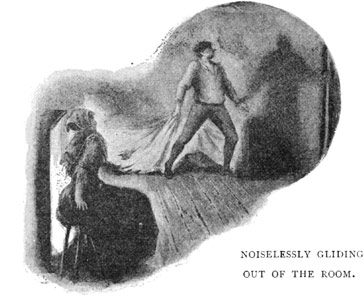
The wretched man left the place in a state of utter intoxication. He was brought home nearly insensible, and placed in his bed. The younger part of the family retired to rest much after their usual hour; but the poor wife remained up sitting by the fire, too much grieved and shocked at the occurrence of what she had so little expected, to settle to rest. Fatigue, however, at length overcame her, and she sank gradually into an uneasy slumber. She could not tell how long she had remained in this state; but when she awakened, and immediately on opening her eyes, she perceived by the faint red light of the smouldering turf embers, two persons, one of whom she recognized as her husband, noiselessly gliding out of the room.
“Pat, darling, where are you going?” said she.
There was no answer—the door closed after them; but in a moment she was startled and terrified by a loud and heavy crash, as if some ponderous body had been hurled down the stair.
Much alarmed, she started up, and going to the head of the staircase, she called repeatedly upon her husband, but in vain.
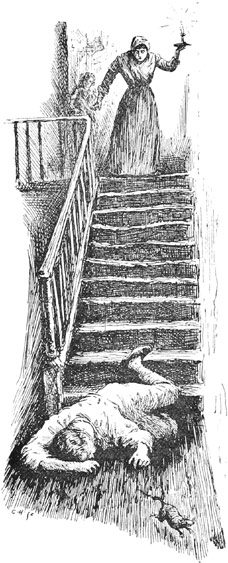
She returned to the room, and with the assistance of her daughter, whom I had occasion to mention before, she succeeded in finding and lighting a candle, with which she hurried again to the head of the staircase.
At the bottom lay what seemed to be a bundle of clothes, heaped together, motionless, lifeless—it was her husband. In going down the stairs, for what purpose can never now be known, he had fallen helplessly and violently to the bottom, and coming head foremost, the spine of the neck had been dislocated by the shock, and instant death must have ensued.
The body lay upon that landing-place to which his dream had referred.
It is scarcely worth endeavouring to clear up a single point in a narrative where all is mystery; yet I could not help suspecting that the second figure which had been seen in the room by Connell’s wife on the night of his death might have been no other than his own shadow.
I suggested this solution of the difficulty; but she told me that the unknown person had been considerably in advance of her husband, and on reaching the door, had turned back as if to communicate something to his companion.
It was, then, a mystery.
AT THE FOOT OF THE STAIRS.
Was the dream verified?—whither had the disembodied spirit sped? who can say? We know not. But I left the house of death that day in a state of horror which I could not describe. It seemed to me that I was scarce awake. I heard and saw everything as if under the spell of a nightmare. The coincidence was terrible.
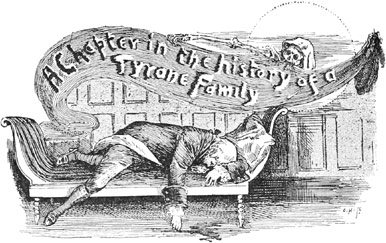
In the following narrative I have endeavoured to give as nearly as possible the ipsissima verba of the valued friend from whom I received it, conscious that any aberration from her mode of telling the tale of her own life would at once impair its accuracy and its effect.
Would that, with her words, I could also bring before you her animated gesture, the expressive countenance, the solemn and thrilling air and accent with which she related the dark passages in her strange story; and, above all, that I could communicate the impressive consciousness that the narrator had seen with her own eyes, and personally acted in the scenes which she described. These accompaniments, taken with the additional circumstance that she who told the tale was one far too deeply and sadly impressed with religious principle to misrepresent or fabricate what she repeated as fact, gave to the tale a depth of interest which the recording of the events themselves could hardly have produced.
I became acquainted with the lady from whose lips I heard this narrative nearly twenty years since, and the story struck my fancy so much that I committed it to paper while it was still fresh in my mind; and should its perusal afford you entertainment for a listless half hour, my labour shall not have been bestowed in vain.
I find that I have taken the story down as she told it, in the first person, and perhaps this is as it should be.
She began as follows:
My maiden name was Richardson, the designation of a family of some distinction in the county of Tyrone. I was the younger of two daughters, and we were the only children. There was a difference in our ages of nearly six years, so that I did not, in my childhood, enjoy that close companionship which sisterhood, in other circumstances, necessarily involves; and while I was still a child, my sister was married.
The person upon whom she bestowed her hand was a Mr. Carew, a gentleman of property and consideration in the north of England.
I remember well the eventful day of the wedding; the thronging carriages, the noisy menials, the loud laughter, the merry faces, and the gay dresses. Such sights were then new to me, and harmonized ill with the sorrowful feelings with which I regarded the event which was to separate me from a sister whose tenderness alone had hitherto more than supplied all that I wanted in my mother’s affection.
The day soon arrived which was to remove the happy couple from Ashtown House. The carriage stood at the hall-door, and my poor sister kissed me again and again, telling me that I should see her soon.
The carriage drove away, and I gazed after it until my eyes filled with tears, and, returning slowly to my chamber, I wept more bitterly and, so to speak, more desolately, than ever I had wept before.
My father had never seemed to love or to take an interest in me. He had desired a son, and I think he never thoroughly forgave me my unfortunate sex.
My having come into the world at all as his child he regarded as a kind of fraudulent intrusion; and as his antipathy to me had its origin in an imperfection of mine too radical for removal, I never even hoped to stand high in his good graces.
My mother was, I dare say, as fond of me as she was of anyone; but she was a woman of a masculine and a worldly cast of mind. She had no tenderness or sympathy for the weaknesses, or even for the affections, of woman’s nature, and her demeanour towards me was peremptory, and often even harsh.
It is not to be supposed, then, that I found in the society of my parents much to supply the loss of my sister. About a year after her marriage, we received letters from Mr. Carew, containing accounts of my sister’s health, which, though not actually alarming, were calculated to make us seriously uneasy. The symptoms most dwelt upon were loss of appetite, and a cough.
The letters concluded by intimating that he would avail himself of my father and mother’s repeated invitation to spend some time at Ashtown, particularly as the physician who had been consulted as to my sister’s health had strongly advised a removal to her native air.
There were added repeated assurances that nothing serious was apprehended, as it was supposed that a deranged state of the liver was the only source of the symptoms which at first had seemed to intimate consumption.
In accordance with this announcement, my sister and Mr. Carew arrived in Dublin, where one of my father’s carriages awaited them, in readiness to start upon whatever day or hour they might choose for their departure.
It was arranged that Mr. Carew was, as soon as the day upon which they were to leave Dublin was definitely fixed, to write to my father, who intended that the two last stages should be performed by his own horses, upon whose speed and safety far more reliance might be placed than upon those of the ordinary post-horses, which were at that time, almost without exception, of the very worst order. The journey, one of about ninety miles, was to be divided; the larger portion being reserved for the second day.
On Sunday a letter reached us, stating that the party would leave Dublin on Monday, and in due course reach Ashtown upon Tuesday evening.
Tuesday came: the evening closed in, and yet no carriage; darkness came on, and still no sign of our expected visitors.
Hour after hour passed away, and it was now past twelve; the night was remarkably calm, scarce a breath stirring, so that any sound, such as that produced by the rapid movement of a vehicle, would have been audible at a considerable distance. For some such sound I was feverishly listening.
It was, however, my father’s rule to close the house at nightfall, and the window-shutters being fastened, I was unable to reconnoitre the avenue as I would have wished. It was nearly one o’clock, and we began almost to despair of seeing them upon that night, when I thought I distinguished the sound of wheels, but so remote and faint as to make me at first very uncertain. The noise approached; it became louder and clearer; it stopped for a moment.
I now heard the shrill screaming of the rusty iron, as the avenue gate revolved on its hinges; again came the sound of wheels in rapid motion.
“It is they,” said I, starting up; “the carriage is in the avenue.”
We all stood for a few moments breathlessly listening. On thundered the vehicle with the speed of the whirlwind; crack went the whip, and clatter went the wheels, as it rattled over the uneven pavement of the court. A general and furious barking from all the dogs about the house hailed its arrival.
We hurried to the hall in time to hear the steps let down with the sharp clanging noise peculiar to the operation, and the hum of voices exerted in the bustle of arrival. The hall door was now thrown open, and we all stepped forth to greet our visitors.
The court was perfectly empty; the moon was shining broadly and brightly upon all around; nothing was to be seen but the tall trees with their long spectral shadows, now wet with the dews of midnight.
We stood gazing from right to left as if suddenly awakened from a dream; the dogs walked suspiciously, growling and snuffling about the court, and by totally and suddenly ceasing their former loud barking, expressed the predominance of fear.
We stared one upon another in perplexity and dismay, and I think I never beheld more pale faces assembled. By my father’s directions, we looked about to find anything which might indicate or account for the noise which we had heard; but no such thing was to be seen—even the mire which lay upon the avenue was undisturbed. We returned to the house, more panic-struck than I can describe.
On the next day, we learned by a messenger, who had ridden hard the greater part of the night, that my sister was dead. On Sunday evening she had retired to bed rather unwell, and on Monday her indisposition declared itself unequivocally to be malignant fever. She became hourly worse, and, on Tuesday night, a little after midnight, she expired.
I mention this circumstance, because it was one upon which a thousand wild and fantastical reports were founded, though one would have thought that the truth scarcely required to be improved upon; and again, because it produced a strong and lasting effect upon my spirits, and indeed, I am inclined to think, upon my character.
I was, for several years after this occurrence, long after the violence of my grief subsided, so wretchedly low-spirited and nervous, that I could scarcely be said to live; and during this time, habits of indecision, arising out of a listless acquiescence in the will of others, a fear of encountering even the slightest opposition, and a disposition to shrink from what are commonly called amusements, grew upon me so strongly, that I have scarcely even yet altogether overcome them.
We saw nothing more of Mr. Carew. He returned to England as soon as the melancholy rites attendant upon the event which I have just mentioned were performed; and not being altogether inconsolable, he married again within two years; after which, owing to the remoteness of our relative situations, and other circumstances, we gradually lost sight of him.
I was now an only child; and, as my elder sister had died without issue, it was evident that, in the ordinary course of things, my father’s property, which was altogether in his power, would go to me; and the consequence was, that before I was fourteen, Ashtown House was besieged by a host of suitors. However, whether it was that I was too young, or that none of the aspirants to my hand stood sufficiently high in rank or wealth, I was suffered by both parents to do exactly as I pleased; and well was it for me, as I afterwards found, that fortune, or rather Providence, had so ordained it, that I had not suffered my affections to become in any degree engaged, for my mother would never have suffered any silly fancy of mine, as she was in the habit of styling an attachment, to stand in the way of her ambitious views—views which she was determined to carry into effect in defiance of every obstacle, and in order to accomplish which she would not have hesitated to sacrifice anything so unreasonable and contemptible as a girlish passion.
When I reached the age of sixteen, my mother’s plans began to develop themselves; and, at her suggestion, we moved to Dublin to sojourn for the winter, in order that no time might be lost in disposing of me to the best advantage.
I had been too long accustomed to consider myself as of no importance whatever, to believe for a moment that I was in reality the cause of all the bustle and preparation which surrounded me; and being thus relieved from the pain which a consciousness of my real situation would have inflicted, I journeyed towards the capital with a feeling of total indifference.
My father’s wealth and connection had established him in the best society, and consequently, upon our arrival in the metropolis, we commanded whatever enjoyment or advantages its gaieties afforded.
The tumult and novelty of the scenes in which I was involved did not fail considerably to amuse me, and my mind gradually recovered its tone, which was naturally cheerful.
It was almost immediately known and reported that I was an heiress, and of course my attractions were pretty generally acknowledged.
Among the many gentlemen whom it was my fortune to please, one, ere long, established himself in my mother’s good graces, to the exclusion of all less important aspirants. However, I had not understood or even remarked his attentions, nor in the slightest degree suspected his or my mother’s plans respecting me, when I was made aware of them rather abruptly by my mother herself.
We had attended a splendid ball, given by Lord M——, at his residence in Stephen’s Green, and I was, with the assistance of my waiting-maid, employed in rapidly divesting myself of the rich ornaments which, in profuseness and value, could scarcely have found their equals in any private family in Ireland.
I had thrown myself into a lounging-chair beside the fire, listless and exhausted after the fatigues of the evening, when I was aroused from the reverie into which I had fallen by the sound of footsteps approaching my chamber, and my mother entered.
“Fanny, my dear,” said she, in her softest tone, “I wish to say a word or two with you before I go to rest. You are not fatigued, love, I hope?”
“No, no, madam, I thank you,” said I, rising at the same time from my seat, with the formal respect so little practised now.
“Sit down, my dear,” said she, placing herself upon a chair beside me; “I must chat with you for a quarter of an hour or so. Saunders” (to the maid), “you may leave the room; do not close the room door, but shut that of the lobby.”
This precaution against curious ears having been taken as directed, my mother proceeded:
“You have observed, I should suppose, my dearest Fanny—indeed, you must have observed Lord Glenfallen’s marked attentions to you?”
“I assure you, madam—” I began.
“Well, well, that is all right,” interrupted my mother. “Of course, you must be modest upon the matter; but listen to me for a few moments, my love, and I will prove to your satisfaction that your modesty is quite unnecessary in this case. You have done better than we could have hoped, at least, so very soon. Lord Glenfallen is in love with you. I give you joy of your conquest;” and, saying this, my mother kissed my forehead.
“In love with me!” I exclaimed in unfeigned astonishment.
“Yes, in love with you,” repeated my mother; “devotedly, distractedly in love with you. Why, my dear, what is there wonderful in it? Look in the glass, and look at these,” she continued, pointing, with a smile, to the jewels which I had just removed from my person, and which now lay in a glittering heap upon the table.
“May there not—” said I, hesitating between confusion and real alarm, “is it not possible that some mistake may be at the bottom of all this?”
“Mistake, dearest! none,” said my mother. “None; none in the world. Judge for yourself; read this, my love.” And she placed in my hand a letter, addressed to herself, the seal of which was broken. I read it through with no small surprise. After some very fine complimentary flourishes upon my beauty and perfections, as also upon the antiquity and high reputation of our family, it went on to make a formal proposal of marriage, to be communicated or not to me at present, as my mother should deem expedient; and the letter wound up by a request that the writer might be permitted, upon our return to Ashtown House, which was soon to take place, as the spring was now tolerably advanced, to visit us for a few days, in case his suit was approved.
“Well, well, my dear,” said my mother, impatiently; “do you know who Lord Glenfallen is?”
“I do, madam,” said I, rather timidly; for I dreaded an altercation with my mother.
“Well, dear, and what frightens you?” continued she. “Are you afraid of a title? What has he done to alarm you? He is neither old nor ugly.”
I was silent, though I might have said, “He is neither young nor handsome.”
“My dear Fanny,” continued my mother, “in sober seriousness, you have been most fortunate in engaging the affections of a nobleman such as Lord Glenfallen, young and wealthy, with first-rate—yes, acknowledged first-rate abilities, and of a family whose influence is not exceeded by that of any in Ireland. Of course, you see the offer in the same light that I do—indeed, I think you must.”
This was uttered in no very dubious tone. I was so much astonished by the suddenness of the whole communication, that I literally did not know what to say.
“You are not in love?” said my mother, turning sharply, and fixing her dark eyes upon me with severe scrutiny.
“No, madam,” said I, promptly; horrified—what young lady would not have been?—at such a query.
“I’m glad to hear it,” said my mother, drily. “Once, nearly twenty years ago, a friend of mine consulted me as to how he should deal with a daughter who had made what they call a love-match—beggared herself, and disgraced her family; and I said, without hesitation, take no care for her, but cast her off. Such punishment I awarded for an offence committed against the reputation of a family not my own; and what I advised respecting the child of another, with full as small compunction I would do with mine. I cannot conceive anything more unreasonable or intolerable than that the fortune and the character of a family should be marred by the idle caprices of a girl.”