Front matter (continued 2)
Reading edition
“Sed neque Medorum silvæ, ditissima terra—”
the note of Virgil’s praise of Italy was ours for a while, and
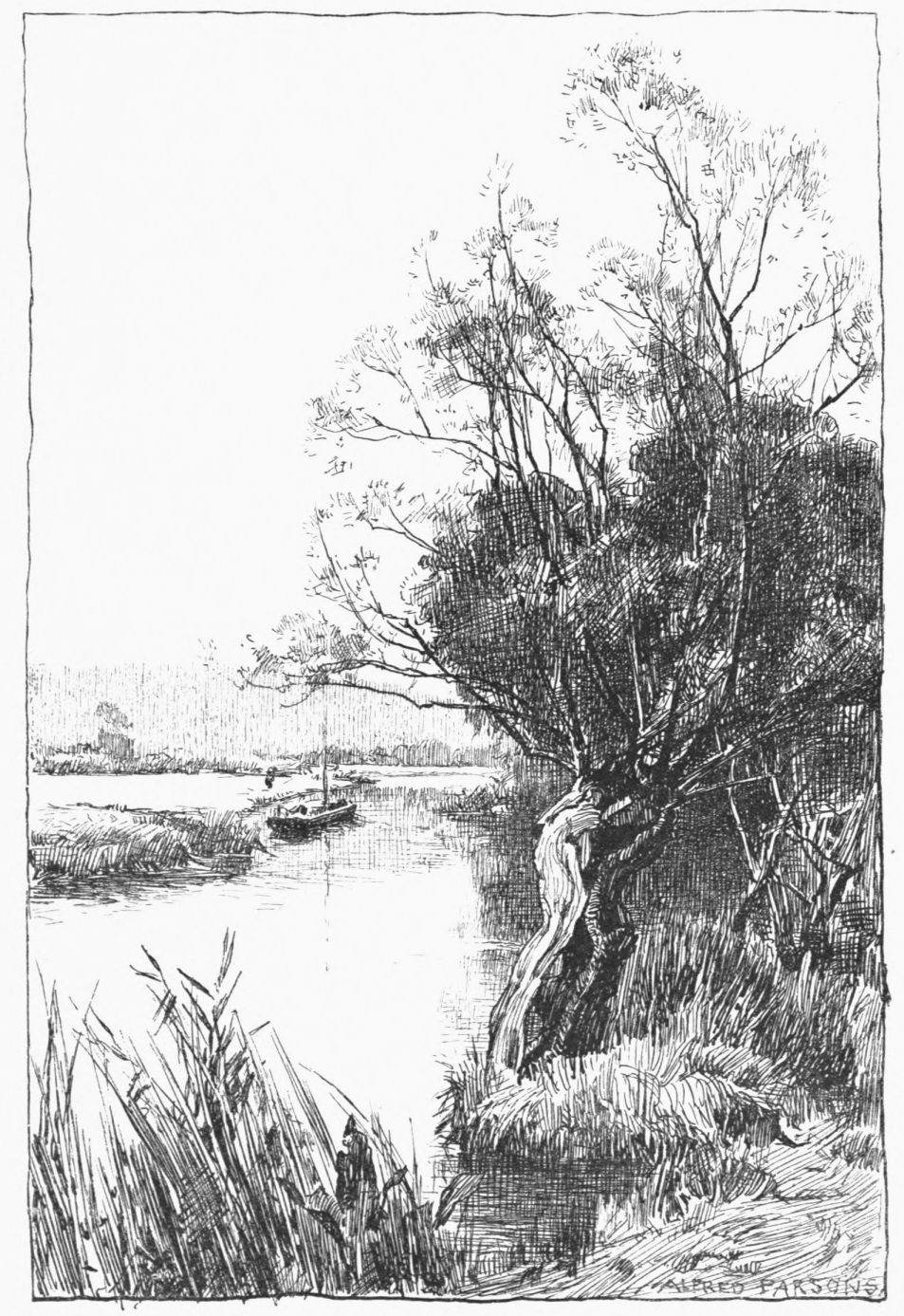
NEAR ECKINGTON
his pride to inherit a land of immemorial towns—a land made fertile by tillage and watered by “rivers stealing under hoary walls.”
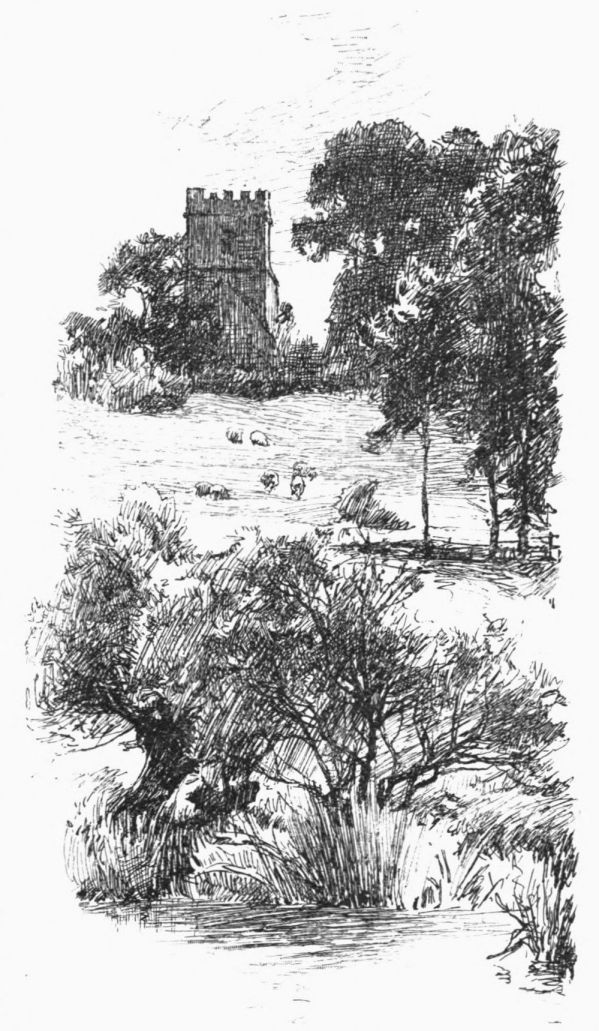
STRENSHAM CHURCH
A little below the bridge Avon is joined by the Defford (or, as it was once called, Depeford) Brook, its last considerable tributary, which rises on the west of the Lickey Hills; and a little farther on we turn a sharp bend where, above the old willows on our right, a field of rank grass rises steeply to Strensham church and vicarage. Behind the stumpy tower lies Strensham village, not to be seen from the river. Here, in 1612, Samuel Butler was born, the author of “Hudibras,” and a monument stands to his memory within the church, beside other fine ones belonging to the Russell family. He was born in obscurity, and died a pauper—a poet (to use the words which Dennis wrote for his other monument in Westminster Abbey) who “was a whole species of poets in one; admirable in a manner in which no one else has been tolerable—a manner in which he knew no guide, and has found no follower.” Very few can read that epitaph without recalling the more famous epigram upon it:
“The poet’s fate is here in emblem shown; He asked for bread, and he received a stone.”
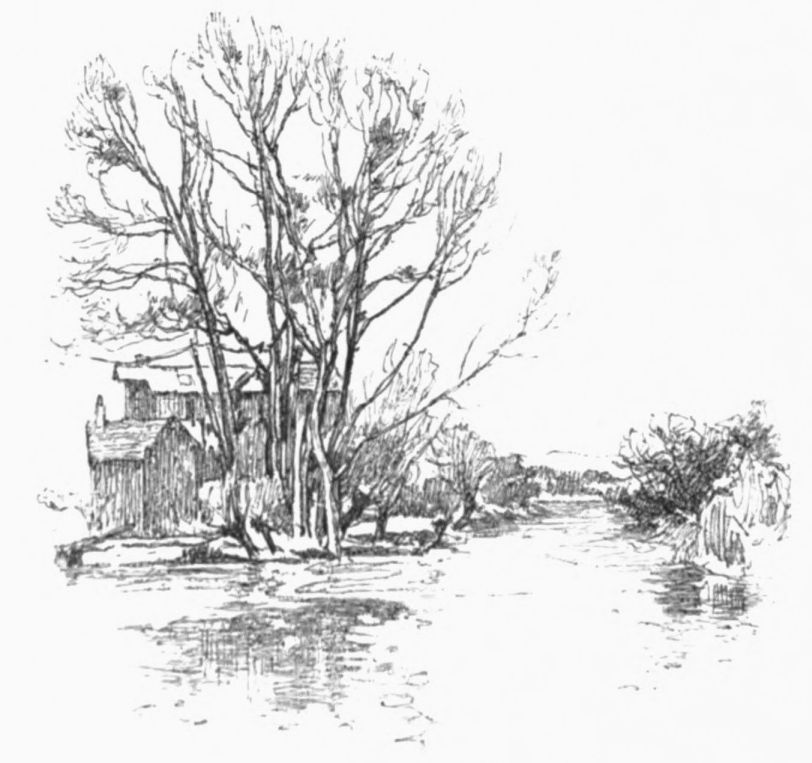
STRENSHAM MILL
Below Strensham we pass a lock—the last before reaching Tewkesbury—and two mills, the first and larger and more modern one deserted. Mr. Sandys’s task was here not difficult, for the Avon Valley is so level that only two locks are required in the fifteen miles from Pershore. We have scarcely left the lock when the sharp steeple of Bredon,
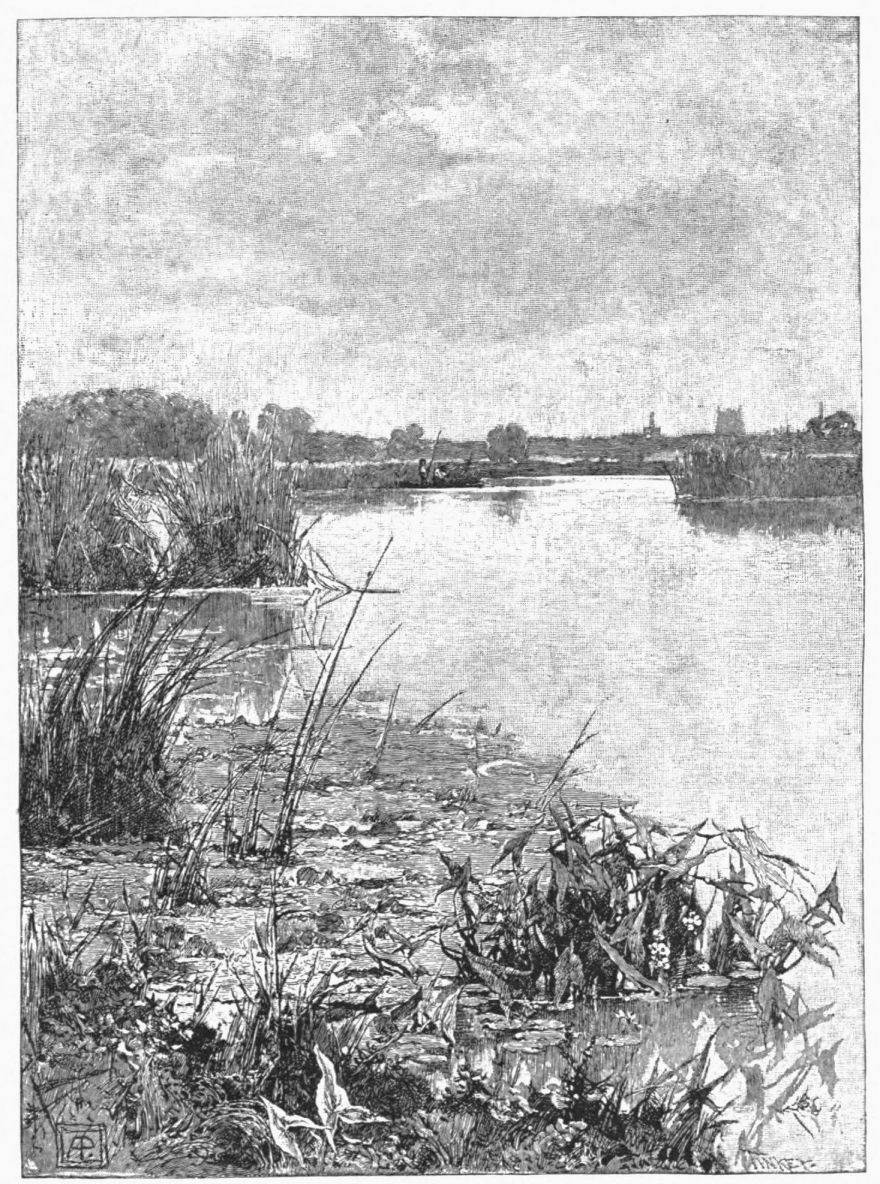
ARROW-HEADS, NEAR TEWKESBURY
at the western extremity of Bredon Hill, points out the direction of the river. To this village, during the civil war, Bishop Prideaux, of Worcester, retired on a stipend of four shillings and sixpence a week. “This reverse of fortune,” says Ireland, “he bore with much cheerfulness, although obliged to sell his books and furniture to procure subsistence. One day, being asked by a neighbor, as he passed through the village with something under his gown, what had he got there?—he replied he was become an ostrich, and forced to live upon iron—showing some old iron which he was going to sell at the blacksmith’s to enable him to purchase a dinner.” The living of Bredon was, in more peaceful times, one of the fattest in the bishop’s diocese, as is hinted by a huge tithe-barn on the slope above us, with a chamber over its doorway, doubtless for the accountant.
From Bredon we came to Twining Ferry, three miles below Strensham, and the flat meadows beyond it, over which the tower of Tewkesbury Abbey and the tall chimneys of its mills now began to loom through a rainy sky upon which night was fast closing. It is just before the town is reached that the Avon parts to join the Severn in four streams—one over a weir, another through a lock, the remaining two after working mills. Being by this both wet and hungry, we disembarked at the boat-yard beside Mythe Bridge, and walked up to our inn beneath the dark, irregular gables of High Street, resolved to explore the town next day.
Tewkesbury lies along the southern bank of Mill Avon, the longest branch of our divided river, which, flowing under Mythe Bridge, washes on its left the slums and back gardens of the town before it passes down to work the Abbey Mill. One of these gardens—that of the Bell and Bowling-Green Inn—will be recognized by all readers of “John Halifax, Gentleman,” and the view from the yew-hedged bowling-green itself shall be painted in Mrs. Craik’s own words:
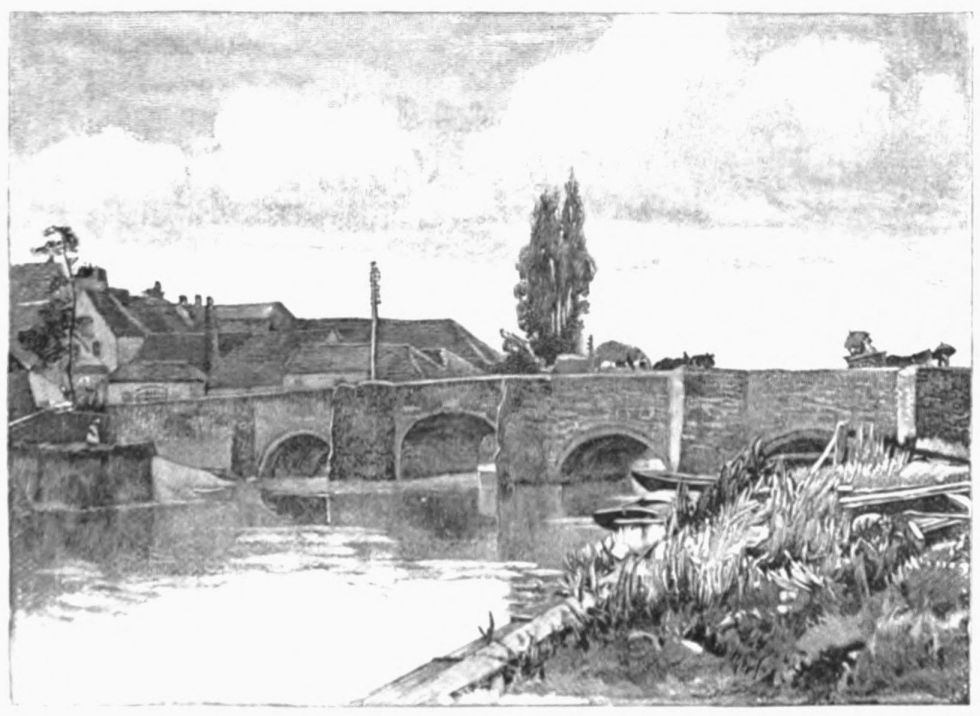
MYTHE BRIDGE, TEWKESBURY
“At the end of the arbor the wall which enclosed us on the riverward side was cut down—my father had done it at my asking—so as to make a seat, something after the fashion of Queen Mary’s seat at Stirling, of which I had read. Thence one could see a goodly sweep of country. First, close below, flowed the Avon—Shakespeare’s Avon—here a narrow, sluggish stream, but capable, as we sometimes knew to our cost, of being roused into fierceness and foam. Now it slipped on quietly enough, contenting itself with turning a flour-mill hard by, the lazy whir of which made a sleepy, incessant monotone which I was fond of hearing. From the opposite bank stretched a wide green level called the Ham, dotted with pasturing cattle of all sorts. Beyond it
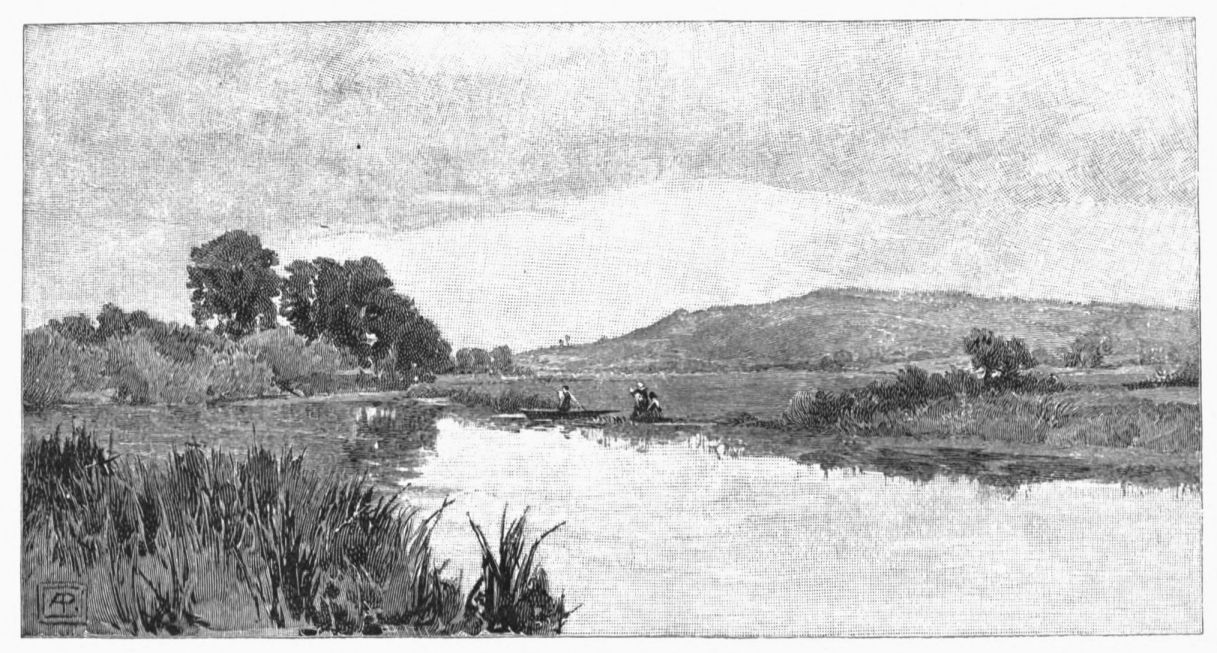
TWINING FERRY
was a second river, forming an arc of a circle round the verdant flat. But the stream itself lay so low as to be invisible from where we sat; you could only trace the line of its course by the small white sails that glided in and out, oddly enough, from behind clumps of trees and across meadow-lands.”
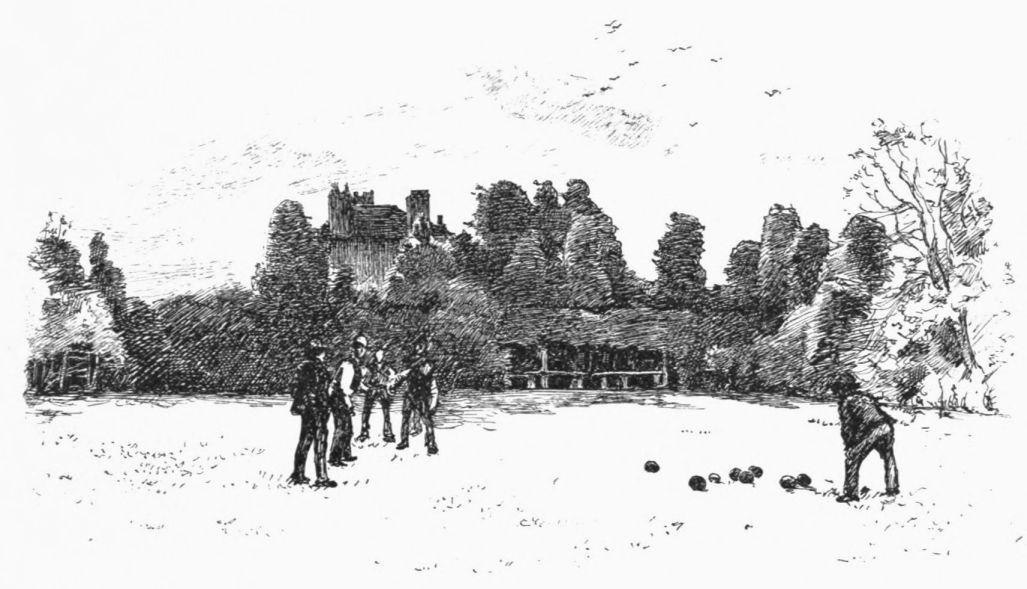
THE BOWLING-GREEN, TEWKESBURY
This second stream is, of course, the Severn, sweeping broadly by the base of Mythe Hill. An advertisement that we saw posted in Tewkesbury streets gave us the size of the intervening meadow; it announced that the after or latter math of the Severn Ham was to be sold by order of the trustees—172 acres, 2 roods, 28 perches of grass in all. The Ham is let by auction, and the money divided among the inhabitants of certain streets.
We lingered to observe the yew hedge, “fifteen feet high and as many thick,” and talk to a waiter who now appeared at the back door of the inn. He seemed to feel his black suit and white shirt-front incongruous with their surroundings, and explained the cause of their presence. The Tewkesbury Bowling Club had held its annual dinner there the night before. He showed us the empty bottles.
“Evidently a very large club,” we said.
“No, sirs; thirsty.”
The Abbey Mill, which droned so pleasantly in Phineas Fletcher’s ears, stands close by, under the shadow of the Abbey Church, its hours of work and rest marked by the clock and peal of eight sweet-toned bells in the Abbey Tower.
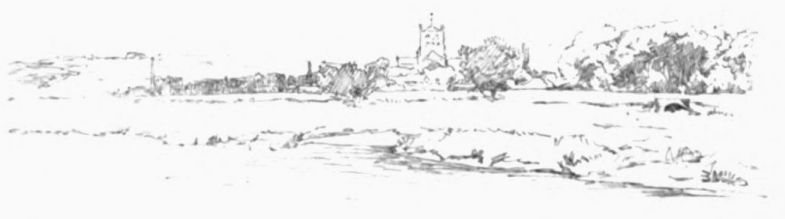
TEWKESBURY, FROM THE SEVERN
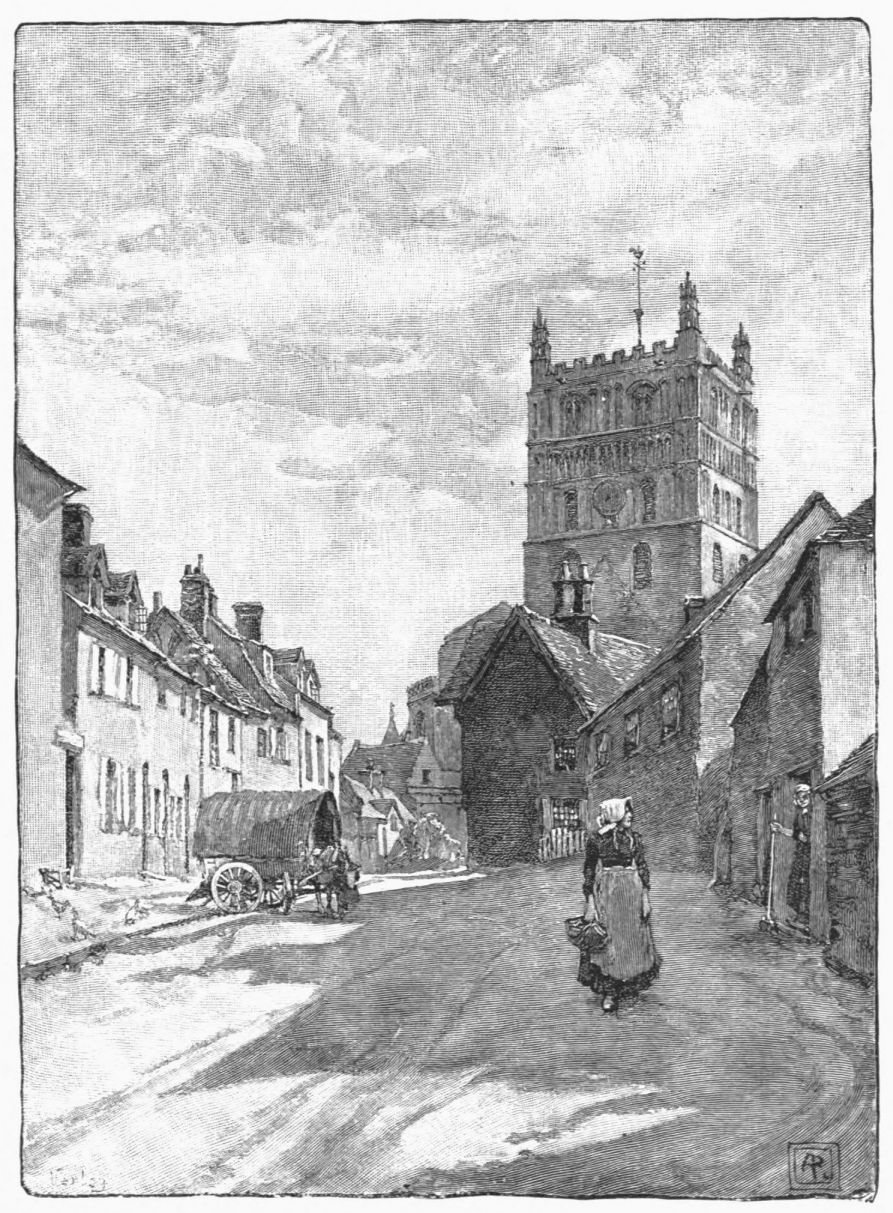
It is well that this tower should stand where it does. If to one who follows the windings of Avon the recurrent suggestion of its scenery be that of permanence, here fitly, at his journey’s end, he finds that permanence embodied monumentally in stone. No building that I know in England—not Westminster Abbey, with all its sleeping generations—conveys the impression of durability in the same degree as does this Norman tower, which, for eight centuries, has stood foursquare to the storms of heaven and the frenzy of men. Though it rises one hundred and thirty-two feet from the ground to the coping of its battlements, and though its upper stages contain much exquisite carving, there is no
MILL STREET, TEWKESBURY
lightness on its scarred, indomitable face, but only strength. The same strength is repeated within the church by the fourteen huge cylindrical columns from which the arches spring to bear the heavy roof of the nave. In spite of the groining and elaborate traceries above, the rich eastern windows, the luxuriant decoration of the chantry chapels and their monuments, these fourteen columns give the note of the edifice. To them we return, and, standing beside them, are able to ignore the mutilations of years, and see the old church as it was on a certain spring day in 1471, when its painted windows colored the white faces, and its ceilings echoed the cries, of the beaten Lancastrians that clung to its altar for sanctuary.
OLD HOUSE, TEWKESBURY
For “in the field by Tewkesbury,” a little to the south, beside the highway that runs to Gloucester and Cheltenham, the crown of England has been won and lost. There, on the 4th of May, 1471, the troops of Queen Margaret and the young Prince Edward, led by the Duke of Somerset from Exeter to join another army that the Earl of Pembroke was raising in Wales, were overtaken by Edward IV., who had hurried out from Windsor to intercept them. Footsore and bedraggled, they had reached Tewkesbury on the 3d, and “pight their field in a close euen hard at the towne’s end, hauing the towne and abbeie at their backes; and directlie before them, and upon each side of them, they were defended with cumbersome lanes, deepe ditches, and manie hedges, besides hils and dales, so as the place seemed as noisome as might be to approach unto.” From this secure position they were drawn by a ruse of the Crookback’s, and slaughtered like sheep. Many, we know, fled to the abbey, were seized there and executed by dozens at Tewkesbury Cross, where High Street and Burton Street divide. Others were chased into the river by the Abbey Mill and drowned. A house in Church Street is pointed out as the place where Edward, Prince of Wales, was slain, and some stains in the floor boards of one of the upper rooms are still held to be his blood-marks. Tradition has marked his burial-place in the Abbey Church, and written above it, “Eheu, hominum furor: matris tu sola lux es, et gregis ultima spes.” The dust of his enemy Clarence—“false, fleeting, perjured Clarence”—lies but a little way off, behind the altar-screen.
There is a narrow field, one of the last that Avon washes, down the centre of which runs a narrow, withy-bordered watercourse. It is called the “Bloody Meadow,” after the carnage of that day, when, as the story goes, blood enough lay at its foot to float a boat; and just beyond our river is gathered to the greater Severn.