Chapter III · (continued 2)
Reading edition
On the evening of December 1st, the Holy Father learned for the first time that the new Emperor had never contracted an ecclesiastically legal marriage with Josephine, his reputed wife. Despite the fact that all preparations for the great ceremony had been completed, the Pope sent word to Napoleon that he should refuse to take part in the coronation on the morrow unless the Emperor and Josephine should contract their marriage vows that very night in the presence of a duly authorized priest of the Church. Again the Emperor, fretful and impatient as he was, yielded to the demands of the Pope, and the marriage ceremony was performed at midnight in the chapel of the Tuileries in the presence of Cardinal Fesch, uncle to Napoleon. The following day, December 2nd, the Conqueror of Europe, the great Dictator of France, realized the dream of his lifetime. The solemn ceremony of his consecration and coronation as Emperor of the French took place in the great cathedral of Notre Dame in the midst of all the splendor which the united resources of Church and State could afford. The ceremony began shortly after ten o'clock, when Napoleon, proceeding with Josephine to the foot of the altar, in the presence of the Holy Father made the solemn promise that he would maintain peace in the Church of God. The two candidates for royalty knelt upon cushions and received from His Holiness the oils and imperial consecration. Napoleon then ascended the altar, and taking the crown into his own hands placed it upon his head, after which he took up the smaller crown of the Empress and bearing it to Josephine crowned her. She received the diadem kneeling. The ceremony was concluded with the Te Deum.
Pius VII. returned to Rome after what was to him a humiliating and exacting journey. Indeed he could congratulate himself that he had at all escaped perpetual exile at Paris. Before he had left that city, the new Emperor, flushed with his recent glories, conceived the plan of retaining the Pope at Paris. The latter, however, had prepared himself for the demand and could answer courageously, that if they were to use force they would have at Paris only a poor monk called Barnabas Chiaramonti. Before he had left Rome he had arranged that in such an emergency a new Pope would be immediately elected.
THE AFFAIR OF JEROME.
Even at the entrance of the Eternal City, new complications met to annoy and confuse him, which, however, he settled with his usual diplomatic firmness and condescension. The affair of Prince Jerome was just then attracting attention. The latter, a lad of nineteen, and brother of the Emperor, had married while in America, December 24, 1803, a certain Miss Patterson, a descendant of one of Maryland's best families. The ceremony was performed by Archbishop Carroll, and was valid in the eyes of the Church. Upon his returning to France with his young bride he was met by the anger of his imperial brother, who as soon as possible wrote to Pope Pius VII.: "I have several times spoken to Your Holiness about a brother, nineteen years old, whom I sent on a frigate to America, and who after a month's stay, married in Baltimore—although a minor—a Protestant daughter of an American merchant. He has just returned; he feels the extent of his fault. I have sent back Miss Patterson, his alleged wife, to America. According to our laws the marriage is null. A Spanish priest so far forgot his duty as to give the nuptial blessing." Napoleon then proceeds to request the Pope to declare the marriage invalid, giving as his principal reasons: That the lady was a Protestant; that Jerome was yet a minor according to French law; that the Gallican Church of France held it invalid, and that the marriage was clandestine and null according to the Council of Trent. To all these objections the Holy Father answered that the marriage was entirely valid, that it was not subject to the Council of Trent, the decrees of which had not been published in America, and that it was not in his power to annul the same unless stronger reasons were brought forward to warrant such action. To this determination the Pope adhered unflinchingly, despite the threats and revengeful actions of Napoleon. Even later, in 1807, when Jerome was married to a princess of Wurtemburg, the Holy Father, far from consenting, renewed his declaration as to the validity of the first marriage.
Napoleon, now at the summit of his political and military career, looked forward to still other conquests. He had crowned himself Emperor of the French at Paris; he received another crown at Milan, making him king of Italy. Then came Austerlitz and Jena and Eylau to humiliate Austria and Prussia and Russia. He became a king-maker by placing his brothers upon the thrones of Naples, Holland and Westphalia. The battle of Wagram, 1809, brought Austria to the feet of the Emperor, who demanded in marriage the hand of the Austrian Emperor's daughter, the Princess Maria Louisa. Josephine, her claims long vanished, was divorced from Napoleon upon the plea of State necessity. An emperor to be an emperor indeed, must be able to look upon the children who shall carry his great name to posterity. The marriage of Josephine and Napoleon had been fruitless in this regard; reasons of State, therefore, demanded, according to Napoleon, that a dissolution should take place, and that a new empress be called to the throne. This reasoning of Napoleon was accepted by Europe; only the Holy Father withheld his approbation and assent. Josephine was divorced and the Emperor remarried to Maria Louisa. It was on this occasion that the terms were coined in the ecclesiastical world "the red and the black cardinals," at the great ceremony which was performed by Cardinal Fesch in the Tuileries, April 2, 1810. Of the twenty-nine cardinals then in Paris, thirteen, including Consalvi, refused to honor the occasion with their presence. This mark of disapprobation was punished by the Emperor who besides depriving them of their salaries forbade them to wear the colors or insignia of their cardinalatial rank. Hence their designation as the black cardinals. These two divorces betray sufficiently the shallow honor of Napoleon in dealing with the Church, a quality which other events of this period brought more into evidence.
The vainglorious assumptions of the Emperor knew no bounds. Petted and flattered where he was not feared, he often smiled as he heard himself compared with Alexander, Caesar, or Charlemagne. He designed as a means of greater glory the complete solidification of his empire under his own supreme control. Only one obstacle lay in the way of his colossal ambition. He chafed at the thought that there was yet in Italy one little state which would hold out against his pretensions; and then, hurried on by the lust of power, and blinded by prosperity, this pretended successor of Charlemagne proceeded against the Pope. Again the aged Pontiff remonstrated. He reminded Napoleon of his former injustice in the matter of the Organic Articles; he reproached him for the injurious dispositions of the Civil Code which he had introduced into France, especially the law granting divorce, the tendency of which laws was to render the discipline of the Church almost null; and now in the face of this new danger, the projected subjugation of the States of the Church, he reminded the Emperor of the judgments that the Almighty must send upon those who disregard His Divine ordinances. The words of the Pope, instead of moderating the intentions of Napoleon, served only to fill him with violent anger. He determined thenceforth to cast aside all promptings of conscience and to take immediate steps for the complete subjugation of Rome. Benevento and Ponte Corvo at once fell into his hands; his troops took possession of Ancona and all cities on the Adriatic coast; Rome itself was invaded; the Papal militia was incorporated with the French; the Pope was deprived of every official necessary for the direction of ecclesiastical affairs, and surrounded by a guard in his own palace of the Quirinal.
EXCOMMUNICATION OF NAPOLEON.
For these outrages the Holy Father addressed Napoleon: "By the bowels of the mercy of our God we exhort, we pray, we conjure you, Emperor and King Napoleon, to change your designs, to clothe yourself again with those sentiments which you manifested at the beginning of your reign. Remember that there is a God and King above you; remember, and always keep before your mind, that you will see very soon and in a terrible manner how those who command others shall by Him be judged with the utmost rigor." The holy Pontiff then published in the face of Europe a solemn protest against the unjust pretensions of Napoleon.
In a frenzy of rage the Emperor made answer to this complaint from the French camp at Schoenbrunn by declaring Rome an imperial and free city. On June 10, 1809, the pontifical standard was taken down from Castle San Angelo and the tri-color hoisted in its place. The same day Pius VII. and Cardinal Pacca, hearing of the event, exclaimed sorrowfully, in the words of the dying Savior: "Consummatum est." The Pope had long felt the necessity of excommunicating his enemies, but had forborne up to this time in the hope that the Emperor might display some spirit of repentance. As soon as he perceived that such hope was groundless, he only needed this crowning act of sacrilege to close the doors of his heart, and to proceed to make use of the spiritual arms of the Church. That same night the venerable Pontiff signed the Bull of Excommunication against Napoleon and all concerned in this spoliation. A courageous man was found who, before the morning, affixed this Bull to the doors of the principal churches of Rome. It was of course torn down as soon as discovered and carried to Napoleon, who was then in camp at Vienna.
Two years before, in July, 1807, the Emperor had asked scornfully: "What does the Pope mean by the threat of excommunicating me? Does he suppose that the arms will fall from the hands of my soldiers?" It was but a few years later when the arms did actually fall from the hands of his soldiers in the great retreat from Moscow when famine and cold tore them from their grasp.
ARREST OF THE POPE.
The Emperor now determined to proceed against the person of the Pope. General Radet was commissioned to arrest the Holy Father and Cardinal Pacca and to conduct them immediately away from Rome. The story of that arrest and the indignities heaped upon the aged Pontiff during his journey could not well be told in a few pages. We will then make it suffice to narrate only the salient facts.
At six o'clock on the morning of July 6, 1809, the French troops burst into the palace of the Quirinal. Radet, after a very few words of explanation, seized the Holy Father, and hurried him, with his faithful Cardinal Pacca, into a dingy carriage which was waiting in readiness. The Pope was absolutely without proper provision of clothing or money. There was no leave-taking, no words of consolation from his faithful subjects, but as a criminal is dragged away to punishment, so was Pius VII. carried out of Rome, across the Campagna to the north, until he reached the place of his captivity at Savona. Here he remained for three years, always under restraint and closely guarded.
AT SAVONA.
In the meantime the imperial jailer made use of every expedient to break down the firm will of his august prisoner. It was shortly after the marriage of Napoleon and Maria Louisa that the Emperor, acting upon the advice of the Austrian Prince Metternich, sent the Ritter von Lebzeltern, envoy of Austria to the Holy See, to attempt a mediation. In this meeting the Emperor proposed that the Pope should take up his residence at Avignon, while retaining his title to the temporal sovereignty; if he wished to reside in Rome, he must resign the temporal sovereignty, though permitted in such case to keep up the outward forms of Papal independence such as receiving and sending ambassadors and envoys. He declared at the same time through Lebzeltern, that he had no need of reconciliation with the Pope; that his bishops had the necessary powers for the granting of matrimonial dispensations, that the Code Napoleon authorized civil marriage, and that in the prime difficulty of all, the institution of bishops, he could set aside the action of the Pope and make use of a national council. The answer of Pius VII. was firm and uncompromising. He rejected the proposal of resigning his temporal power, he demanded free communication with his bishops and the faithful. He dismissed Lebzeltern without any concessions whatever, leaving the case exactly as it stood before that envoy's visit.
The anger of the Emperor upon learning the mind of the Pope did not prevent him from making another attempt at reconciliation. This time he sent two of the red cardinals, Spina and Caselli, formerly the Papal negotiators for the Concordat, who met with no greater success. Napoleon now determined to take the reins of ecclesiastical government into his own hands. He began this course by appointing Cardinal Maury, the Bishop of Montefiascone, to the post of Archbishop of Paris. The measure met with instant condemnation, especially from Pope Pius VII. who, writing to the Cardinal, reproached him for betraying the Church: "You are not ashamed," he said, "of taking part against Us in a contest which we only carry on to defend the dignity of the Church." To these remonstrances of the Holy Father the unhappy Cardinal paid no heed. For daring to thus utter his condemnation of the Emperor's conduct and Maury's treachery, Napoleon determined to punish the Pope. The apartments of the Holy Father were broken into by imperial orders, all writing materials were taken away, his books, even his breviary, were forbidden him, his servants were sent away to Fenestrelle, his household expenses were cut down (five pauli, about fifty cents a day for each person being allowed for the maintenance of his household), the carriages he had used were sent to Turin, and even the fisherman's ring was demanded and sent to Paris. Before this was done, however, the Pope broke the ring in two.
Napoleon now began to seek precedents in history for the deposing of the Pope. Not succeeding in this he began a systematic persecution of priests and laymen suspected of too ardent piety, hoping thus to render devotion to the exiled Pope odious. Chafing at the ill success of all these subversive measures Napoleon determined upon a final scheme. He recalled the independence of the Russian czar in matters of Greek Church discipline; he reflected that George III. was undisturbed by any show of independence on the part of the English hierarchy. Why, therefore, should not Napoleon, the conqueror of Europe, make to himself a new schism, a new hierarchy, institute his own bishops, and be free from the troublesome superintendence of the Pope? The idea was inviting, and the Emperor immediately took steps towards its accomplishment. A great council was called at Paris. Its permanent presiding officer was Cardinal Fesch, the uncle of the Emperor, and it numbered among its deliberators one hundred and four French and Italian bishops. Like other councils it discussed matters of universal importance, but its chief debates concerned the canonical institution of the French hierarchy. In this matter the council decided that no bishop might be considered legitimate who had not obtained his canonical institution from the great Father of the faithful. Yet that the council might not displease the Emperor it was decided that a deputation of bishops be sent to Savona to again beg the Holy Father to institute the candidates proposed. Again the Pope renewed his refusal, though, for the sake of peace, he agreed that if the sovereign Pontiff should delay such institution for six months, it might then be granted by the metropolitan or senior bishop. This was merely a delegation of power, not a cession, and was granted only for the emergency of the time being.
The Council of Paris was, taken collectively, null, inasmuch as it was convoked and carried on without the requisite conditions. Its decrees were, therefore, without any binding force. In fact, even the Emperor himself recognized this and was only too happy to find a pretext for its dissolution.
AT FONTAINEBLEAU.
Napoleon now perceived that if he was to gain anything over the will of the Pope he must contrive to have his illustrious prisoner nearer to his own person. Under the pretext, therefore, that the English ships were hovering about Savona to liberate the Pope, the Emperor shortly after the termination of the Council of Paris, caused the Holy Father to be removed secretly to the palace of Fontainebleau. (June 16, 1812).
The conduct of the Emperor during the stay at Fontainebleau was in keeping with his past behavior. Under a specious display of ceremonial reverence towards Pius VII. he concealed a course of cruel treatment unworthy of a man, much less of a sovereign. It is true, the palace of Fontainebleau was not wanting in regal magnificence, that the table of the Pope was all that might be desired, and that the servants who surrounded him showed due respect for their spiritual ruler. At the same time the Emperor himself acted the part of a bully and braggart towards a weak and feeble old man. An insulting tone of voice ever accompanied the most insulting demands, until the Pontiff worn out and half delirious with agony was made to yield to the most unwarrantable demands. Thus it was that upon the bed of sickness the Holy Father was finally led to apply his signature to a Concordat which, in a state of health, he would have repudiated in the most decided terms. It must be remembered, however, that this yielding was not in an affair of faith and morals, nor did it concern the Universal Church; it was a cession for the time being of temporal rights, not even a final session, but one made temporarily in the interests of peace, and as such did not affect the Papal position as the teacher and ruler of all the faithful. The Emperor, in his joy at this apparent victory, began at once to show unwonted kindness towards the Pope, and as a sign of his good will, permitted the old cardinals, the faithful black cardinals, to return from prison and exile to comfort him in his captivity. This concession proved unfortunate for Napoleon, for scarcely had they gained access to the Sovereign Pontiff than they began to represent to him the immense importance of the Concordat which he had signed. It was represented as a renunciation of all those inalienable rights which belonged to him, not personally, but as the Sovereign Ruler of the Roman States, a most humiliating concession after all he had hitherto borne in their defence. The Holy Father in deep sorrow protested that the document was not definitive, but merely a preliminary statement, which should be reconsidered before publication, so that the Concordat of that year was really without Pontifical authority. Thereupon, he made known to Napoleon his objections, retracted everything contained in the Concordat, rendering it thereby null. This decision of the Sovereign Pontiff only rendered the Emperor all the more furious, and incited him to renew the discomforts of his prisoner. His cardinal advisers were again sent into exile or to prison, while he commanded that the Concordat of 1813 should be everywhere executed without further delay.
RETURN OF THE POPE TO ROME.
But the hour had already sounded for the total ruin of the tyrant. He who had trodden Europe under foot, now discovered Europe armed to meet him. With Germany consumed by a superhuman resolve to be free; with his old generals weary of fighting and struggling for the glory of a single man; with even his own relative, Murat, a partial traitor; with murmurings and threats resounding on all sides, Napoleon was not slow to perceive that his fortunes were in a precarious state. The year went by and battles were fought; some gained, some lost. The great campaign against Russia, with its consequent humiliating retreat had given the signal. The great Conqueror, who had once claimed a kind of sovereignty over a large part of Europe, now found France hardly able to uphold his imperial authority. In his desire to repair some of the wrongs he had perpetrated he liberated the Holy Father, in the beginning of the year 1814. But the repentance came too late. Already the enemy stood before the gates of Paris, and Napoleon learned that the day of his imperial domination was at an end. In his despair he fled to Fontainebleau, and there, in the very same chamber wherein he had confined his spiritual superior, he signed the articles of his abdication (April 6, 1814). His fate was soon sealed by those triumphant powers against which he had so long contended, and he retired a humbler man to his place of exile upon the island of Elba.
RETURN OF PIUS VII.
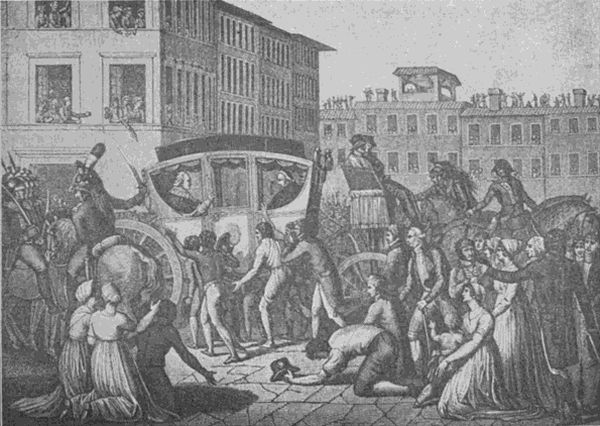
Meanwhile Pius VII., who was by this time far on his way to Rome, was waiting at Imola for the final ending of the great tragedy which was taking place in France, and hearing of the downfall of his old-time foe, he hurried on with all dispatch to Rome. He arrived there on May 24, 1814, and made a solemn entrance into the Eternal City, whence five years before, he had been dragged away with so much violence. The joy and enthusiasm of the people, augmented by the memories of recent usurpation and tyranny, were unbounded. It was not alone that Rome had regained her sovereign but the Church also had again her beloved head, and all the Catholic world took part in the triumph of Religion over the unbridled ambition of her enemies.
It is true the storm had not entirely subsided. Napoleon again broke forth from captivity, and the Holy See for a moment trembled lest new outrages might yet be perpetrated against the Church. But before the danger could have been brought to its accomplishment, the newly arisen Napoleon was again overthrown at Waterloo, June 18, 1815, after which he was exiled beyond all hope of return, to the lonely island of St. Helena, where he died on May 5, 1821, after six years of penance.
Peace now settled upon the troubled Church. Religion once more dried the tears of sorrow, and the Pope, restored to the love of his faithful people, began to give his attention to arts nobler than that of war; the raising up of Catholic peoples in the knowledge of that God, Who, after purging them in the land of bondage, had overwhelmed their enemies and brought them to newer and richer prospects in the land of promise.