Chapter Twelfth. THE DEFENCE OF RIVAS. (continued 2)
Reading edition
In the offers thus submitted by Henningsen, nothing was said of the native Nicaraguans then in Rivas. Walker, therefore, informed Henningsen that he would sign nothing, or agree to nothing, unless ample guarantees were given for the safety, both in person and property, of the native Nicaraguans. Hence, when Henningsen returned at 10 o’clock, A.M., on the first of May, with the draft of an agreement to be signed by Walker and Davis, it contained a clause protecting all natives of Central America then in Rivas. The convention submitted to Davis, and signed by him, reads as follows:
“Rivas, May 1, 1857.
“An agreement is hereby entered into between Gen. William Walker, on the one part, and Commander H. Davis, of the U. S. Navy, on the other part, and of which the stipulations are as follows:
“Firstly, Gen. Wm. Walker, with sixteen officers of his staff, shall march out of Rivas with their side-arms, pistols, horses, and personal baggage, under the guarantee of the said Capt. Davis, of the U. S. Navy, that they shall not be molested by the enemy, and shall be allowed to embark on board the U. S. vessel-of-war, the St. Mary’s, in the harbor of San Juan del Sur, the said Capt. Davis, undertaking to transport them safely on the St. Mary’s to Panama.
“Secondly, The officers of Gen. Walker’s army shall march out of Rivas with their side-arms, under the guarantee and protection of Capt. Davis, who undertakes to see them safely transported to Panama, in charge of a United States officer.
“Thirdly, The privates and non-commissioned officers, citizens, and employees of Departments, wounded or unwounded, shall be surrendered with their arms to Capt. Davis, or one of his officers, and placed under his protection and control, he pledging himself to have them safely transported to Panama, in charge of a United States officer, in separate vessels from the deserters from the ranks, and without being brought into contact with them.
“Fourthly, Capt. Davis undertakes to obtain guarantees, and hereby does guarantee that all natives of Nicaragua, or of Central America, now in Rivas, and surrendered to the protection of Capt. Davis, shall be allowed to reside in Nicaragua, and be protected in life and property.
“Fifthly, It is agreed that such officers as have wives and families in San Juan del Sur, shall be allowed to remain there under the protection of the U. S. Consul, till an opportunity offers of embarking for Panama or San Francisco.
“Gen. Walker and Capt. Davis mutually pledge themselves to each other that this agreement shall be executed in good faith.”
It will be noticed that this agreement was made entirely between Walker and Davis, and the Allies were not mentioned in it except as “the enemy.” Nor would it be necessary, unless for the singular conduct of Commander Davis afterward, to say that no other agreements were made or entered into, except the one which was signed by the respective parties.
After Davis had agreed to the terms of the convention, Henningsen returned to Rivas, and ordered the cannon, foundry, and ammunition to be destroyed, by breaking the trunnions, and sawing through the carriages of the former, by breaking up the steam-engine, fan, and cupola of the foundry, and throwing the ammunition and powder into the arsenal-yard wells. “In this manner were destroyed,” according to Henningsen’s report, “in the arsenal, two twelve-pounder brass howitzers, three six-pounder iron guns, four light iron twelve-pounder mortars, four brass guns taken from the enemy, viz.: one four-pounder, and three five-pounder guns; in the ordnance office, fifty-five thousand cartridges, three hundred thousand caps, fifteen hundred pounds of powder. There remained undestroyed: fifty-five shell, three hundred and twenty twenty-four-pound shot—fired into Rivas by the enemy—two hundred and forty six-pound shot, of iron cast from the enemy’s shot, from bell-metal, or from lead.”
While Swingle and Potter were, under Henningsen’s direction, executing the orders for the destruction of the articles in the arsenal and ordnance, Walker sent for the surgeon-general, Coleman, and informing him of the agreement made with Davis, instructed him to remain in charge of the hospital, and see that the sick and wounded were properly cared for. He then made out a list of the officers who were to accompany him on board the St. Mary’s, and notified them to prepare forthwith to proceed to San Juan del Sur. The officers thus selected were, Henningsen, Hooff, Brady, Natzmer, Waters, Henry, Swingle, Rogers, Tucker, Kellum, McAllenny, West, Williamson, McEachin, McMichael, Hankins, and Bacon. About five o’clock in the afternoon, Commander Davis, with Zavala, arrived at Walker’s quarters; and Henningsen and Davis repaired to the Plaza, where all the troops of the garrison were formed. The order of the day, containing the agreement between Walker and Davis, was then read to the troops, and the garrison was delivered to the commander of the St. Mary’s. The state of the garrison, when given over to the United States officer, was: Wounded and sick in and out of hospital, surgeons, and hospital attendants, 173; prisoners, 102; officers, non-commissioned, and privates, exclusive of the 16 going to San Juan, 148; employees of departments and armed citizens, 86; native troops, 40. While Henningsen was turning over the garrison to Davis, Walker, accompanied by the officers he had selected, and by Gen. Zavala, rode out of Rivas, and took the road for San Juan del Sur. On the night of the first of May, a few hours after leaving Rivas, the Nicaraguan officers were aboard the St. Mary’s.
Commander Davis did not reach the St. Mary’s until the morning of the 2d. Soon after he came aboard the sloop he proposed to Walker that the schooner Granada should be given into his hands without the use of force. Of course the proposal was rejected. He then said to Walker that the latter might keep the arms and ammunition on the schooner if he would give up the vessel. This was a proposition to sell the Granada, with all the glories of the 23d of November, for the paltry cargo aboard of her; and there was not a lieutenant in the service of Nicaragua who would not have rejected it, with scorn and contempt for the officer, so far forgetful of his own honor as to utter the proposal. Just before dinner, on the 2d, Davis went ashore, leaving written orders with his first lieutenant to take the schooner. The log of the Granada, for the 2d, says: “At 4 P.M. Lieut. Maury came on board the schooner, and requested me to turn over the schooner to Capt. Davis. I asked why I should do so. He answered that Capt. Davis considered it his duty to seize her if I did not give her up, as he looked upon her as included in the treaty between himself and Gen. Walker. I refused to give her up.” Then Maury returned to the St. Mary’s, and requested Walker to give an order to Fayssoux to turn over the schooner to him. Walker replied he would not give the order, unless there was a demonstration of overwhelming force on the part of the St. Mary’s. Maury brought the broadside of the sloop to bear on the Granada, and then he received the order of surrender. The log continues: “He (that is Maury) returned in half an hour, with an order from Gen. Walker to turn her over to the United States; he was accompanied by 100 armed men and a howitzer. At 4.30 P.M. the Nicaraguan flag was hauled down, and the United States’ run up in its place, and my crew sent on shore.” Finally, on the 4th of May, the Granada was turned over to Costa Rica, and the person who received her for that republic was an aid of Cañas, a Jamaica negro, known by the name of Captain Murray.
This was a fit conclusion to the combined efforts of the British and United States naval forces to get the Americans out of Nicaragua. The descendant of revolutionary ancestors,[7] bearing, in his own name of Irvine that of a grandsire who was a general officer in the war of Independence—himself fitted by the purity and integrity of his character to adorn the service of any power on either continent—was forced to give way to a negro subject of Her Britannic Majesty holding a commission from the Republic of Costa Rica. The poet could not have imagined aught more striking or more characteristic.
Thus have I, during a leisure thrust on me against my will, tried to tell clearly and concisely the story of the rise, progress, and close, for a time, of the War in Nicaragua. Doubtless many brave deeds and some worthy names have escaped the notice they deserve, for I have been obliged to write almost entirely from memory, with few papers or documents to refresh my recollection of events now some time past. My main effort has been to trace as distinctly as I could the causes of the war, the manner in which it was waged, and the circumstances attending its conclusion. As I said in the last general order published at Rivas: “Reduced to our present position by the cowardice of some, the incapacity of others, and the treachery of many, the army has yet written a page of American history which it is impossible to forget or erase. From the future, if not from the present, we may expect just judgment.” That which you ignorantly call “Filibusterism” is not the offspring of hasty passion or ill-regulated desire; it is the fruit of the sure, unerring instincts which act in accordance with laws as old as the creation. They are but drivellers who speak of establishing fixed relations between the pure white American race, as it exists in the United States, and the mixed Hispano-Indian race, as it exists in Mexico and Central America, without the employment of force. The history of the world presents no such Utopian vision as that of an inferior race yielding meekly and peacefully to the controlling influence of a superior people. Whenever barbarism and civilization, or two distinct forms of civilization, meet face to face, the result must be war. Therefore, the struggle between the old and the new elements in Nicaraguan society was not passing or accidental, but natural and inevitable. The war in Nicaragua was the first clear and distinct issue made between the races inhabiting the northern and the central portions of the continent. But while this contest sprang from natural laws, I trust the foregoing narrative shows that the stronger race kept throughout on the side of right and justice; and if they so maintained their cause in Central America let them not doubt of its future success. Nor kings nor presidents can arrest a movement based on truth and conducted with justice; and the very obstacles they place in the way merely prepare those who are injured for the part they are to play in the world’s history. He is but a blind reader of the past who has not learned that Providence fits its agents for great designs by trials, and sufferings, and persecutions. “By the cross thou shalt conquer” is as clearly written in the pages of history as when the startled emperor saw it blazing in letters of light athwart the heavens. In the very difficulties with which the Americans of Nicaragua have had to contend I see the presage of their triumph. Let me, therefore, say to my former comrades, be of good cheer: faint not, nor grow weary by the way, for your toils and your efforts are sure in the end to win success. With us there can be no choice; honor and duty call on us to pursue the path we have entered, and we dare not be deaf to the appeal. By the bones of the mouldering dead at Masaya, at Rivas, and at Granada, I adjure you never to abandon the cause of Nicaragua. Let it be your waking and your sleeping thought to devise means for a return to the land whence we were unjustly brought. And, if we be but true to ourselves, all will yet end well.
THE END.
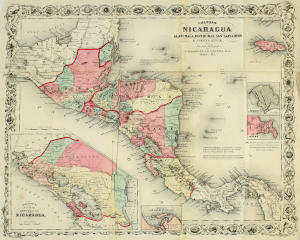
COLTON’S NICARAGUA
GUATEMALA, HONDURAS, SAN SALVADOR & COSTA RICA.
Revised, Enlarged AND PUBLISHED BY S. H. GOETZEL & Co. Mobile, Ala.