BOOK ONE The Golden Child (continued 2)
Reading edition
Many such days the little group had together. German days, French days, Italian days came in regular succession. “Chuck” disputed with him about the days, and Bardek took great joy in his wordy battles over the sort of weather that prevailed. To all but “Chuck” it was quite evident that his succession of days was a transparent device to give Gorgas constant exercise in the fluent, living language; but save for the laughing eyes and occasional wink, he stoutly stood for the theory that the weather made his skin change. Bohemians, he claimed, belonged to no country and to every country and were doomed all their lives to slip back and forth through various national personalities. The weather did it.
“You have only one country!” he told “Chuck” scornfully. “How sorry I am for you! So you hooray for the stars and stripes, and you make the grand racket on the Fourt’ of July, an’ you rage at Sout’ America, and Europe, an’ all the other little peoples. Poof!” he blew himself up into his own notion of the spread-eagle American orator. “You could fight the whole wor-r-ld, wit’ hands tied behind the back—and the whole wor-r-ld would laugh in zere sleeve, and make such pictures in the comic papers, about which you would know nothing. Oh, how sorry I am for you, Chucks, who have only one country, when I, Bardek, have so many! In France I sing the Marseillaise on the fourteen of July; in Germany I celebrate the eighteen of January, the birthday of the Empire; and in Poland, on the twelve of September, I drink to Sobieski, who saved Poland from the Turk—an’ at no time do I rage, and make boasts at any country. You are proud of only one land, Chucks; I, Bardek, am homesick for all the wor-r-ld!”
One day when they went back through the hidden path and under the arch of briers into the enclosure, not a vestige of Bardek and his belongings remained.
“He will come back when he wishes to be here again,” Gorgas explained, with just a shade of disappointment. But she did not wholly conceal her gratification. Lately she had been feeling terribly guilty over her clandestine meetings with the Bohemian. She could date the beginning of her worry over the matter. It had come suddenly in the night when she awoke trembling and weeping over she knew not what. Fires burned in her, and she discovered an intense longing to give up what had been heretofore the most helpful experience in her life: her solitude, her freedom from the necessity of communicating. Now she cried out for a brother or a sister or a mother to whom she could tell everything, even trivial things. Until now she had fared alone, self-sufficient as a tree, and had never spoken to anyone, even to Bardek, of what meant most to her. On this night, as she lay awake, she reveled in the despairs of loneliness.
At about that time Blynn had appeared and had satisfied her need. To him she had unburdened, and had come away pure and heightened as after confession.
All this had made her self-conscious in her visits to Bardek. He had remarked the change in her, and talked about it, as was his way; which made her, somehow, ashamed. When her cheeks flamed under his persistent candor, he would call to his wife in great delight. In some Hungarian dialect he would invite her to look at the bud bursting; the little, green leaves unfolding; the fresh, sweet petals stretching themselves. There never was any doubt as to his meaning.
After that when Gorgas parted the elder branches and looked into his bower she came with the face of a child-woman, full of subtle new dignity, an unstudied preoccupation, as if the mind within were very, very busy on its great affairs.
And guilt seized her, without giving a single reason. “It is wrong!” sang a humming in her ears. “What is wrong?” she would ask herself wildly. “It is wrong! It is wrong!” the voices would cry; and no one could tell her what was wrong.
With Blynn beside her she looked steadily at the blanched circle left by the tent.
“Well!” she gave a deep, healthy exhalation, and stepped back into the narrow path. “I’m both sorry and glad. I don’t know why I should be glad; but I am. It is all mixed—m-mixed u-up.” Her lips quivered though her eyes smiled gamely. “I don’t know whether I am going to cry or laugh.”
“Shall I toss a coin?” Blynn inquired.
“Chuck” was examining the “hunky” and speculating upon moving in as soon as he could wheedle a tent out of his father. Blynn and Gorgas stood close together facing each other in the path. Her eyes searched his steadily until they slowly brimmed and shut out all view.
“I guess I’m mo-mostly g-glad!” she put out her hands toward him and lightly touched his sleeve.
“If you cry now,” whispered the man, “you’ll splash me awfully. Let’s wait till we have more room.”
That decided the matter. It was a hearty burst of girlish laughter which cleared the air like the proverbial thunder. All the way home they sang and danced and played “tag” and raced.
“When will Bardek be back?” Blynn asked before he bade the children goodby.
“Perhaps next week; perhaps next month,” Gorgas conjectured. “Once he stayed away two months. Oh, he’ll be along again soon. A tout à l’heure, m’sieu’.” She stepped gaily up the walk toward her own door. “Auf wiedersehen und -hören und -sprechen. Until I see you and hear you and speak you again!”
Yet the month passed away, and another month and many months, but Cresheim Valley saw no trace of Bardek.
Along in November the mails brought a carefully wrapped package containing eighty-two dollars and six cents. A note in French said simply:
“It was a robber who bought your plate, but I will not ask too much for the art which I stole from Varri. I do penance by taking so little. The miser! For my silver and copper I charge you a trifle—which I have taken out. What is here is yours—well earned, golden child.
“Until we meet and talk again,
“Bardek.”
After a conference with Mr. Blynn, Gorgas forwarded the package anonymously to the treasurer of the Children’s Aid Society.
“It is an offering to propitiate the theft from G’sepp’ G’ovan’ Varri,” said Blynn; “let us hope it will count as a mass for the peace of Varri’s penurious soul.”
VII A “FRENCH DAY” AT NIGHT
MRS. LEVERING did not mean to neglect her children; but her life was busy with the running of a big household, and with the claims of neighbors, the church, and charitable organizations. In her home life she was delightfully lax and unsystematic; but it was liberty for all, not a bad arrangement for domestic happiness, when it works.
Her two children had come along without making much demand upon her. If they had been frail or sickly she would have been the promptest of nurses, and perhaps she would have learned more about them; but they grew along sturdily without so much as a single call for help. As a result they instinctively repelled coddling. There were no effusive greetings between mother and daughter, no kissings at night time, and only the most casual peck at lengthy partings. It was a very sensible and practical environment; and, on the whole, satisfactory to the Levering family.
Mrs. Levering treated her daughters as if they were her own age. There was no “baby-talk” at any stage of their upbringing. Nearly everything was discussed openly, but that did not mean that the children had a vote in everything. Unconventional as the mother was in most things, she threw about the children a protective ring of unwritten rules, over which there was no debate—almost the same code that her own mother had used. Gorgas could fight against going to school and win. School was an expense, anyway; and Gorgas seemed to be doing very well by herself with such help as the mother fancied Keyser was giving her; and many children managed pretty well with a tutor or two. But acquaintances, especially male, were scrutinized and limited; late night prowlings were forbidden; there was no latch-key for any save the master-of-the-house—who never went out!—and all letters, outgoing and incoming, must pass inspection.
So, you see, Mrs. Levering had no tingle of conscience concerning her children; on the contrary, she had many exalted moments at the thought of all her prohibitory care over them.
Allen Blynn was O. K.’d as a matter of course. Everyone knew all about him. He was an honor man at college; his mother was of “good people,” descendants of somebody or other; and he was of the faculty of the University. Of course, his manners were right—he used a fork properly; he was charmingly considerate of ladies; children liked him; and he had a good, honest face; but the other qualifications, the college honors and the university degrees really made him “moral,” and therefore a free and unrestricted companion of her two girls. Besides, the mother was thrifty enough to see the advantage of securing so excellent and so inexpensive a tutor for Gorgas.
On the days when he and Gorgas studied together it grew to be the custom for the tutor to stay on for the informal family dinner, to get his “pay,” as he had bargained, of good food and good company. They were jolly affairs, full of gay chatter and serious discussion of men and things. Blynn radiated on these occasions, for the dinner was his natural habitat. On the tennis-courts he was an indifferent actor; but whenever the game was speech, he scored masterfully.
Guests seemed to drop in fortuitously on these evenings, while the dinner grew imperceptibly more elaborate. With a daughter aged twenty-two, Mrs. Levering’s instincts told her when to entertain young people, and Miss Keyser Levering was a more modern mental replica of her mother. Edwin Morris, the university tennis champion, still in his late ’teens, was a frequent visitor, as were “Sam” Davis, the “law-man”; Keyser’s chums, Mary Weston and Betty Sommers; Diccon, a newspaper-man, and a collegian of Blynn’s time; and Leopold, a distinguished-looking young English Jew, of the science department of the University.
Others came and went, but these gradually drifted together to form the core of a little social group.
On these occasions Gorgas seemed to disappear. She shrank visibly into the rôle of little girl invited to look on. Her animated and accomplished sister overpowered her and made her a speechless dependent. All the gaucheries of childhood came out to daunt her. She stumbled against things, spilled her salt, and walked about with ox-like grace. One mild, reproving look from her sister would make her trebly clumsy for the evening.
Blynn tried often to bring her out, but it only increased her seeming stupidity. After all, she was a child, he reminded himself, but not without puzzled memories of the strange age she could put on when they were alone together.
Keyser, whom Blynn had rechristened “Kate,”—a name which everyone took up—was so charmingly at ease that in spite of his desire to befriend the little sister, he found his talk gravitating toward the elder.
And Gorgas was really content to look on, to listen and, above all, to remain completely unnoticed. She did not always succeed, much to her public confusion. With Morris, the tennis boy, she was more comfortable, save when he tried to draw her out into the circle. This he discovered early he must not do; so he contrived to sit beside her and tell her about his college pranks in undertones. When he discovered that she played tennis and had won the Junior cup, he took her in charge forthwith; and on other days met her on the courts and gave her an exceptional practice. Their “doubles” combination soon grew to be practically unbeatable.
One evening the conversation drifted to the culture-war over Latin and Greek. Blynn was trying to show how the absorption in these studies, which rarely got beyond the veriest elements, was keeping our generation from the marvelous literatures of Europe. Centuries from now, he claimed, the modern languages would be looked upon as even more classical than the ancients.
“I am handicapped in my work,” he admitted, “because I do not know Danish, Swedish, Spanish, Italian, German, and French; I mean, really know them. A school child in any country of Europe would laugh at my attempts to speak or read the languages. No one ever hinted to me what were the real tools of scholarship.”
Leopold told of his classical training under tutors in England. He had begun to read Latin at eight, added Greek at nine, and he could not remember when he was unable to understand French and German.
“America is giving up foreign languages,” Leopold summed up. “The students will not put the time on them.”
“But I know they will,” Blynn returned firmly, “if the thing is taught reasonably. You began at eight and nine, Leopold; well, that’s the age to do it.”
The conversation threatened to become pedagogic and heavy, but the girls were interested, too. Mary Weston told of some phenomenal pianists who had been developed in just that way.
“The teacher told me she took them young, four to five years; visited them every day. There was no hateful ‘practice.’ ‘Mar-y! have you done your scales today?’ ‘No-m.’ ‘Then come right in this minute and do them!’ I can hear my mother calling me yet. Result: ‘Chapel in the Mountains’ with the left hand over,” she illustrated comically on the table, “‘Dum, dum, dum, twinkle-innkle-ink!’ That’s almost my repertoire.... This teacher got her youngsters over every difficulty without a single growl. Master Stewardson—you heard him, Kate,”—everyone had adopted Blynn’s “Kate”—“at the Willings’—he’s one of them. Wasn’t he slick?”
Mary drew an imaginary bow across her arm and whined the opening of the “Spring Song.”
“Bravo!” applauded Leopold, “that’s bully, you know. Sounds just like a violin—one with a bad throat.”
“I thought she fingered well,” added Davis.
Diccon insisted that he heard an open string. He always abominated the open string.
A burst of imitators overtook the table, violins, flageolets, bassoons, bass-viols. Morris took the prize with the sextette from “Lucia” as done by Sousa on a half-dozen interrupting muted trombones.
“All of which proves,” summed up Betty Sommers, when the fun had died down, “that none of us knows music.”
Davis, the law-man, protested—he had been a growling bass-viol: “Don’t say that. We have merely cultivated virtuosity at the expense of—”
“Skill,” “Music,” “Everything,” he was helped out.
“At the expense of—I demand the floor, Madam Chairman—at the expense of—”
“Our neighbors,” Gorgas put in quietly.
“Good!” cried Davis. “Amendment accepted. Ah! Somnolent and suspicious Mount Airy! This; night’s joy will be chronicled as dissipation, and tongues will wag. Here’s to our neighbors,” and he tossed off a handful of salted almonds.
“We don’t know music,” insisted Blynn, his mind not at all diverted by the clamor; “and we don’t know anything.”
“I arise to protest,” Mary Weston appealed to Mrs. Levering. “This male professor has cast aspersions upon the expensive education we girls have achieved via the instruction imparted at the ‘Misses Warren’s Select French and English School for Young Ladies.’”
Laughter from the girls showed how much they valued this expensive training.
“If I had a catalog here,” Mary persisted, “I could prove to you how thoroughly well we were brung up. ‘You must nevah say, “raised,” my deah young lady,’” Mary was in full swing imitating the elder Miss Warren. “‘Beets are “raised”; turnips and cabbages are “raised”; young ladies are “reahed,” ah! “reahed”!’”
“Kate” joined in with a mock quotation from the catalog. Interruptions were frequent. “‘The young ladies of this school are taught the French language according to the natural method. Conversation is encouraged. All the work of the French class is conducted entirely in the French language. A correct accent is insisted upon.’”
Imitation of the French teachers followed, along with samples of the kind of French that was “encouraged.”
“There’s my proof,” Blynn went on. “Everyone here has studied French for one or more years. Some of us have been abroad where each had a chance to test it out. Who really knows any French, except Leopold? I don’t mean ability to read. Anybody can guess what French means; but can anyone here really talk and think in French? I have met German boys, still in school, who could talk with me in English and could pass me many times in French. They got it all out of their schools. In other words, they gave their time, the most precious hours of their lives, and got something lasting.”
The conversation broke in two. The upper end of the table were agreeing with Blynn, the lower end were trying with much laughter to carry on a discussion in French.
“Je vous aime, je vous adore, que voulez-vous encore?” Betty remarked to Diccon. “It means, ‘I just dote on you, Dicky-boy.’”
“Je ne comprends pas,” replied Diccon. “Score a point for me. It’s all French, every bit of it guaranteed. Je ne comprends pas. ‘I don’t understand.’ I used it all over Paris. ‘I don’t understand’ fits anywhere.”
“J’ai un petit frère,” volunteered Davis. “It means, ‘I have a little brother.’ I haven’t any little brother, but that’s French, all right.”
“Adieu! Adieu! Adieu!” said Kate.
They were taking turns. Blynn saw a chance to surprise them.
“Here! children,” he rapped on the table. “I have a game for you. Each of us will show off his French. Leopold is debarred; he is French. No! We’ll let him in.... Let me see,” he glanced hurriedly about the table. “We’ll take partners, each talk to his vis-à-vis.” He produced his watch. “I’ll make it easy. One full minute speech and one full minute reply. Time out for all pauses. Repetitions not allowed. Get ready. Kate and Diccon will begin, the gentleman first.”
Gorgas leaned over eager-eyed to watch the fun, until swiftly it came to her that she and Leopold would be last. Toward Blynn she cast a terrified appeal.
While the first two were blundering joyfully through their minute he slipped around to her and whispered.
“Please carry this out for me! If you say the word, I’ll have them excuse you.... I’ll take all the blame. It’s only fun. Please!”
“All right,” she nodded. But her face, for a humming second, lost some of its ruddy tan.
Their ludicrous book sentences encouraged her, and made her feel suddenly strong and unabashed. Into her mind came pictures of clear, blue-sky days with Bardek gesticulating and spouting his vivid jargon.
Davis was telling about his brother. “I have a little brother. J’ai un petit frère,” he announced with great eagerness, and stopped. Betty had got through by cleverly remembering a conjugation: “I drink, you drink, he drinks, she drinks, it drinks, we drink,” etc. Mary claimed foul on the ground that conjugations didn’t make sense; but her own contribution was a familiar medley: “Monsieur, bureau, Lafayette, encore, dèpot, merci, madame, bon-bon.” Morris tried “Alice in Wonderland.” “’Twas brillig and the slithey toves did gyre and gimble on the wabe,” but was caught; although he insisted that it was as much French as anything.
To be sure, no one was really trying. Betty, no doubt, could have blundered along tolerably well, and Davis had taken part in a French play, much of which he probably remembered. The game was a frolic and was so played, until Leopold spoke.
“Ma chère amie,” he leaned over and gazed earnestly at Gorgas. He was a dark, grave looking man, the type of scholar Jew. Everyone, of course, could follow his carefully chosen phrases. “When I look into your eyes,” he said slowly, “I see treasure there; for you have that which the world, with all its seeming care for franc and sou, regards ever as above price. First, you have youth, with the future all to spend; and you have faithfulness, a vast store—I see it in your steady brown eyes; and you have beauty born of these two, youth and faithfulness. And besides, while you speak seldom, and sit serene apart, you have rare, rare thoughts. Would that I could share them.”
It seemed almost like a trick to play upon Gorgas, the unschooled. There was a little uneasiness. Mrs. Levering was about to give an appropriate excuse when Gorgas replied.
Her tones were deep and French to the very roots. Her features changed; turns and twists of eye and mouth, which she had caught unwittingly from Bardek, swept across the animated young face and gave a new charm to her words. Ah, how often lately had Bardek made much that same speech to her! And how often had she flamed in reply! Tonight she was swift to rebuke the man before her, first, for his open flattery—Gorgas was quite wrong, here, as she found out later; Leopold was never more honest—and secondly, for his attempt to make a public jest of her. Gorgas could never believe that she was good to look at; always she grew flustered at sudden praise, suspecting some hidden irony.
She came back with nervous, rapid-fire Gallic, a sudden contrast to his deliberate language. She told him that he should not have said that sort of thing to her, especially before all these people. It may be true. She would not deny that she had all the virtues, but her friends were those who did not gabble smart phrases about her eyes and her ears and her nose as if they were properties for sale. Why couldn’t he have talked of impersonal things as the others had? Well! He would be paid back in kind. Well! She would look into his eyes, and what does she see? Sapristi! Nothing; for his eyes are away. They are busy watching the faces of girls and reporting lies about them!
Leopold, astonished at the spirited attack, offered a most humble apology, and protested his sincerity, keeping steadily to the French, which was to him almost a second tongue. She tossed him aside with a swift change of mood. She knew that it was all fun; but that sort of personal praise always made her unhappy.
He had not thought she would understand, he offered in excuse.
That did not help his case a bit, she returned quickly, for then he had evidently sought deliberately to make her a laughing stock. “Vous voulez rire,” she said, “mais je n’aime pas qu’on se moque de moi!”
Their parley grew less warm. He forced her to laugh by pointing out the gaping crowd of elders. He told her that no one present could possibly give a translation of their conversation, for it had been carried on, not in the studied pace suitable for foreigners, but clipped and jammed into a swift colloquial clatter.
“Look at Diccon,” Leopold went on, still keeping away from English. “He is so surprised, his mouth won’t come shut for a week. And Betty, she—” and so on until nearly everyone in the company was tolled off.
Sensation! The discovery that the Prince really wanted Cinderella after all was nothing in comparison. Where did she get it? Had she lived abroad? No. Had she gone to school? No. Then she must have had tutors. Ah! There it was. Allen Blynn, by way of silly books, had done the trick. Marvelous! Hearty congratulations! It was a miracle of pedagogy.
Blynn denied everything; but they put it down to modesty. Needless to say, from that hour Gorgas was respected by the elder girls and was brought more into their circle. And from that hour, too, she lost the major part of her left-handedness in public. She began to move across the room without striking chairs or sliding ashamed into secluded corners.
Some of the same dignity of bearing, so natural in the open out-of-doors, began to appear within doors; her native comedy spirit, the gift of dramatic caricature, gradually unclosed, to the great surprise of her elder sister.
VIII “MY THEORY IS ——”
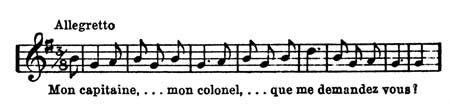
Mon capitaine, ... mon colonel, ... que me demandez-vous?
[Audio content is not currently supported on your device. [MusicXML]
BLYNN visited his youngsters or had them on his own grounds with the regularity of a physician looking up his patients. Those that were out of reach he held by correspondence. Yet always his visits or his letters seemed the most casual thing. The youngsters looked for him because it meant a splendid sort of play, something organized and meaningful. When children play alone they get into ruts and they waste great time in small disputes; an umpire or a director keeps things moving.
About this time Blynn began to keep a card index of his “cases,” recording all available facts about character, and special abilities; and in addition, data to show the ground they had covered, with notes of suggestive treatment.
There was no difficulty over any of the cases save that of Gorgas. He had not the least notion what to do with her. On many counts she was entirely too wise for her teacher. He knew that she must have constant practice in German, French, and Italian, or she would lose much of her previous holdings; she must not neglect her work in copper; she should have other studies, science, history, literature, mathematics, music; and she should have opportunity to continue the development of her physical self.
A forge was constructed in a disused stone spring-house. No one interfered with any eccentric device that Blynn suggested; it began to be generally conceded that he could perform miracles with children—Gorgas’ French and, later, the discovery of her knowledge of German and Italian caused everyone to look upon him as a wizard—so there was no objection to the fitting-up of a complete coppersmith’s workshop in the old spring-house.
When he came to take stock of her mental furnishings he found some strange wares. Gardiner’s “The Femine” he had laid to the door of Bardek; but of all Bardek’s odd learning, “The Femine” was not a part; indeed, he would have scoffed at the contents. An aunt, a “Gorgas,” had left her namesake a few hundred dollars a year, the interest of which was to be spent in books. Ever since she could remember, Gorgas had been permitted to spend that small sum as she should choose. The effect of the responsibility was to give her a keen interest in the book-reviews of such magazines as came regularly to the house. And with the growth of the private collection, there came also a fine love for books.
Her little “den” was across the hall from the library. One afternoon Blynn found her there and spent many astonished minutes poring over her treasures.
“You have read all this?” he inquired incredulously.
She gave several pleased little nods. “Nearly all. Some were too much for me. I shall give them up until I grow into them. I get only a few every quarter; so it grows gradually,” she explained.
“Why, some of this is material I ought to know myself—and don’t; books I’ve promised myself to read.... How did you get to know there were such things? Bardek, again?”
Oh, no! The advertisements of the Atlantic Monthly; the book chat in Harper’s, and the Nation; and especially the remarks of wise persons—like Mr. Blynn!—who have no idea that “a chiel’s among ye takin’ notes.” There was really a note-book with publishers’ names and prices; one had to buy carefully so as to get the best for the money (Pennsylvania-German thrift cropping out here, thought Blynn).
“That one,” she touched a volume, “he’s too much for me. Everybody is talking about him. The magazines are full of it; and you and Mr. Leopold are always quoting. That made me buy. I got good binding, too. Don’t you just love fine bindings?” She stroked the leather cover gently. “But I suppose I’ll have to know more before I can understand.”
Browning was the big man in those days; he was receiving his belated hero-worship and, as usual, it was noisy and overdone.
Blynn ran the pages over and stopped at “Andrea del Sarto.” Then he read. It needed only a touch of explanation here and there to set the pathetic monologue and make clear the simple story of this great failure.
The poem was plain enough now, she said; and it was beautiful; but why did Andrea leave his great work, give up all that was really dear in life, and in his middle days suffer poverty and disgrace, all for that worthless Lucrezia?
Why, indeed! Blynn promised to show her reproductions of Sarto’s paintings, especially the fine figure of young John the Baptist; then she might understand; for Lucrezia was the model for that spiritual face. She must have had qualities to inspire a picture like that. A man would give up much for a woman who called him, even—this is the puzzle of life—even though he knew she were worthless.
“Do you suppose,” she asked, “that in the first years of their marriage they were—” She wanted to say “lovers,” but that’s a hard word to say aloud in English. Except on the stage or in novels, we avoid direct reference to love. We seem to be half ashamed of it. “Do you think,” she began again, “they really—cared?”
“I should think so,” he guessed. “Most folks do, for awhile. We can’t get into the private history of families; but from the outside it seems that—uh—affection,” he was also shying at the word, “soon dies out. It rather frightens one to look on the hundreds of indifferent or possibly discordant couples who, no doubt, were one time violently—uh—enamored of each other. It doesn’t seem possible to keep the thing up!”
“If that’s true, I’m sorry,” she said seriously.
“So am I.”
“Why should it be true?”
“I’ve often puzzled over it. My theory is—”
She laughed. “Do you know, you always begin that way? ‘My theory is.’ But go on, I’m interested.... I like your theories.... You don’t care if I say what I think; do you?”
“Oh, dear, no!” he smiled. “I was only thinking how full of theories I am. I haven’t breathed half of them aloud yet.... I wouldn’t dare.... Well, my theory is that two people who—uh—”
“Yes?” She was sitting cross-legged on the floor and looking steadily up at him.
He looked down at her a second or two, studying her frank eyes.
“Would you mind sitting on a chair?” he asked.
“Mais, oui,” yet she did not stir. “But I am quite comfy here, mon père.”
“Uh!” he grinned. “Don’t call me ‘father.’”
“You are ten years older,” she contended, “and—”
“How did you discover that?”
“I asked Edwin.”
“Edwin?”
“Edwin Morris.”
“Oh, your tennis chum. How old is he?”
“Eighteen; only five years older than I.”
“H’m!” he looked at her suspiciously; but she seemed quite guiltless.
“Why mustn’t I sit on the floor, mon p— mon duc, mon prince?”
She hummed the air of “La Tour, Prends Garde,” that old song which the French children sing and act so prettily in the summer evenings, reminding us of our own “London Bridge is Falling Down.” Gorgas touched the words softly,
“Mon duc, mon prince! Mon duc, mon prince! Je viens me plaindre à vous.”
“Duke and prince?” he shook his head. “I’m too American for that.”
Without further word she sang the next stanza,
“Mon capitaine, Mon colonel! Que me demandez-vous?”
“Ah, that’s better,” Blynn smiled.
“And why, mon capitaine,” she smiled back, “may I not sit on the floor?”
“Well, I’ll tell you,” he explained. “It’s—legs. I’ve discovered something about you.” He spoke with exaggerated jocularity. “When I see your underpinnings, I know I am talking to a child, aged thirteen, who looks upon me as a grandfather; but when you squat on the floor and look up at me like a little coquette”—his tone was that of pure banter—“I get the craziest notion possible into my head, that you have grown up and—that you are sitting there quietly laughing at all my tedious explanation, and well—you know, you fooled me completely that day on the tennis-courts. I could have sworn you were at least twenty-two.”
“Why do you need—to treat me—differently?”
Her eyes rested on him now with quiet gravity. They looked into him and seemed to explore his very mind. This child had been schooled all her life to mask her feelings until few suspected she was capable of any. In this confident hour she unmasked and let him see without shame that he was her capitaine, under whom she would serve right loyally. Youth and faithfulness! Blynn could see all that, too, in her eyes; and perhaps something else, which disturbed him and caused him to come to instant decision.
“Do you know, young lady,” he broke the spell of the silence abruptly, “that in October you are going to the Misses Warren’s Select French and English School for Young Ladies?”
“No!” she stood up. “I won’t go. Who said I must go? That hateful place? Why, everybody makes fun of it. It—it would be torture. I won’t go! Please, Mr. Blynn, don’t let them send me there.”
“But you must go somewhere,” he soothed. “I’ve been inquiring. They’ve made a number of changes since the death of the elder sister. It’s really quite a decent place now. What you need is not book education, but social education.”
“What!”
“I put that badly. I mean you should mix more with your own generation. There are girls who—”
“Girls! I don’t want to know any. Most of them are just simpletons, smirking at boys. Boys! boys! boys! That’s their whole talk. They aren’t interested in books or anything. I tell you, I couldn’t stand being all day with girls. I couldn’t breathe. I—”
“Now, steady,” he calmed her. “I won’t make you do anything you don’t want to do. That’s a bargain; isn’t it? No Warren business, if you don’t like it. Remember, you’re going to do as you like.”
“Yes,” she said more calmly; but all the rebellion in her was stirring.
“To tell you the truth, I haven’t worked out the plan yet. The Warren school is—well, I’m thinking about it. I’ve been looking into the School of Applied Arts, too.”
“That’s more like it,” she was blinking hard.
“You see,” he showed her his perplexity. “You and I aren’t getting anywhere. We just sit around and talk and talk—at least, I do—”
“But that’s the joy of it,” she was astonished at his sudden dullness. “Don’t you like our—talks?”
“Bless my soul, yes! They’re great! You bring me out; make me think of things I didn’t know I knew. Enjoy it? Jerusalem! But your mother thinks I am teaching you things—”
“Why, you are,” her eyes grew wide. “Every day I learn lots from you. I can’t give you up, Mr. Blynn. Why, we have the most beautiful pow-wows. Nobody else really talks to me. Look,” she picked up the Browning, “you have given me Andrea today; I never could have gotten it myself. And I’m just nervous thinking of more you will give me. Don’t—don’t—send me off, just when we were—. It’s mean!” she quavered, stamping her foot in vexation, for she had prided herself on not being a weeping person, and lately the tears were swelling on the flimsiest provocation.
But he was firm about regular school and took pains to make his reasons clear to her. His scheme for her—which gradually began to form as he talked—was special hours at Miss Warren’s in German and French. They had a new Swiss teacher there who had a splendid bi-lingual training. She would also get music, mathematics and Latin. Once or twice a week she would take the metal classes in the School of Applied Arts. The Italian she would have to keep up by reading, for awhile at least.
“But English literature?” she protested. “Aren’t you going to keep on with your readings? Why, we’ve hardly begun!”
“Perhaps,” he held out. “Some of it I will surely do; perhaps I’ll arrange a little class with your sister and Betty Sommers.”
“That will not be so nice,” she admitted. “But,” with seeming understanding of the expression that swept across his face, “if you think it best, mon capitaine, I’ll give them a share.”
Youth and faithfulness shone in her eyes again; and the frankness of childhood.
He collected his belongings, borrowed a book from her shelf and prepared to go.
“There!” she said. “I knew we had forgotten something. That horrid school thing hopped in between and spoiled it all.” She held the Browning open to “Andrea del Sarto.” “You were telling me your theory about married people, and why they don’t—keep on—keep on—”
“Oh, yes,” he helped. “Well, my theory is a very simple one. There is no patent on it, but no one seems to want to use it.” He knitted his brows and looked afar off. “I think young people ought to prepare ahead of time for all that’s to follow. They get lost in the beginnings—for there are beginnings, and there are middles and ends, each is different. They ought to prepare themselves to go on from one stage of affection into another, without surprise or suspicion of each other. And better, they should study all the little paths that tend to take them apart. Therefore, they should cultivate many of the same interests, insist upon having many associations together, and refuse to let a separate set of occupations absorb them too much—like housekeeping or whist playing for the woman, and selling cheeses, let us say, for the man. Memory is the thing that binds one’s life together; married people should see to it that they have many, many beautiful memories in common. There! that’s a long speech; and it’s my theory. There must be a flaw in it somewhere, or more folks would have adopted it. I have faith in it—I have faith, you notice, in all my theories. One should. If ever I have the chance to try it out, I’ll do my best to make it work.”
“It will work,” she said simply.
“That’s encouraging, now,” he laughed. “What makes you think so?”
“My theory is that the woman is always willing to have memories, the kind you speak of. It is the man who flies off to his own affairs and leaves her to just dig along.”
“Ah! Amazonian,” he cried. “That’s out of Gardiner!”
“No,” quietly. “I have been watching my neighbors, that’s all. Men are awfully excited about men-things. I don’t blame them. They do have lots of fun, boys and men.... But you will make it work, all right.”
“Why?”
“Well,” she thought, “you will try; and then you aren’t at all interested in yourself—No! you aren’t—You are always thinking of somebody else. I’ve watched you—”
“Oh!” he cried, “you’ll make me self-conscious.”
“Often, I’ve watched you. I notice that your eye is always looking to see what other persons need. You get chairs before other men notice they are wanted, and you open doors, and pass things before they’re asked for, and all that sort of thing.... And, you understand—”
“Understand?”
“Yes; you understand ... you understand—me, for instance.”
They looked at each other a quiet second or two.
“I wonder if I do,” he said, trying to smile like a grandfather.
They walked across the hall into the library.
“Oh, you know all about little me,” she laughed, and shook her head as if it were a doleful burden.
IX “BONG-JOUR”
THE winter was spent for Gorgas pretty much as Blynn had planned. She was entered as a pupil in the Misses Warren Select French and English School for Young Ladies; but the desertion from freedom was not made easily; nor was it ever entirely successful. Gorgas was the vagabond type. In literature Vagabondia has its charming unconventional men, but seldom if ever has the female of this species been put forward without shocking sensitive souls. The unconventional woman is—well, no better than she should be. Somehow the world has worshipped its men when they step forth from its fetters of use and wont, but it looks terribly askance at women of equal daring.
On the morning of the opening of school Gorgas rode solemnly on Gyp, without even the “shining morning face” of Shakespeare’s famous reluctant schoolboy. She was full of forebodings of coming disaster. Professor Blynn, her capitaine, had said, go; that was the sole impelling force. She knew that she could not turn back without distressing him; he it was who had taken the rebellious untamed forces of her little life and had bound them both with and against her will. It was terrible, this bowing to the decisions of another; terrible and unutterably satisfying! She pondered on this contradictory fact as she let Gyp trot forward; upon the convicting desires that found reasonable lodgment in her mind: the desire to turn Gyp’s head right about for a canter toward Bardek and Cresheim Valley, and the greater wish to obey the will of another, to plod straight forward and suffer the pangs of a strange schooldom. Her conscience had a fine glow of satisfaction with each step toward the disagreeable adventure.
Miss Warren saw her from the window.
“Surely that is not one of our new girls?” she exclaimed to the secretary.
Both drew aside the heavy lace curtains, discreetly keeping themselves at a polite distance in the shadows.
“It is Gorgas Levering,” the secretary replied.
“But she is riding astride!” Miss Warren looked helplessly about. “Like a man!” she added. “Mercy! Do go out and tell her—”
But Gorgas cut that command short by dismounting—like a man. She was leading Gyp toward the stables, one arm over the horse’s mane, her head erect, her eyes focused far away. At that moment she was enjoying a childlike delight in successful martyrdom. As she passed around the school—really a fine old Colonial mansion—she came face to face with Miss Warren framed in a massive side door.
“You are Miss Gorgas Levering, I presume?” Miss Warren made the statement with disarming graciousness.
“Miss Warren!” Gorgas ejaculated.
The child was startled by the apparition, conjuring up the photograph on Keyser’s dressing-table, that now spoke in the flesh, like an ancient figure in history suddenly come to life; and her spirits oozed. The regality of this distinguished-looking woman struck at her and took away her sense of equality. In the presence of Miss Warren one had always to struggle against an overwhelming feeling of personal inferiority.
“I am so glad you have come early,” Miss Warren ignored the exclamation. “Perhaps you would like to come in and freshen yourself after your ride.”
Miss Warren’s attire was spotless. Without a further word Gorgas realized that there was something vulgar and unclean in riding a horse. She became conscious of her dusty appearance and of Gyp’s warm, sweaty body.
“Home, Gyp,” she said, and turned his head about and patted him smartly on the flank. Gyp trotted off alone.
Miss Warren took in the unconventional attire.
“You are wearing—uh—bloomers; are you not?” she asked in a noncommittal tone.
Then Gorgas answered in a phrase she had never before used in speaking to her elders. It was the reply of servants and underlings; something she knew should not be said, but it came unbidden to her lips.
“Yes, ma’am,” she said.
Instantly she was aware of having surrendered her will completely to the overpowering superiority of the woman before her. Her face flamed; she would have given all she possessed to have recalled the expression; but it was out, and she was condemned. From afar she heard the quiet explanation from Miss Warren that young ladies should not say “yes, ma’am”; they should say, “Yes, Miss Warren.” All of which she knew by instinct, yet she could offer no explanation. She was suffused with shame.
“It is too late to ask you to go home and change,” Miss Warren spoke kindly as she ushered Gorgas into the house and showed her the way to the water-taps. “Fortunately we have a few proper skirts in the lockers that you may wear over your—uh—riding costume. While you are getting refreshed I will have Miss Lewis find one for you.”
Meekly Gorgas let herself be decked in a faded blue serge skirt, which bulged uncomfortably and succeeded in taking out of her the remaining grains of spirit. If she had entertained any thought of walking through the spacious doorway and bolting for Gyp and freedom, that inharmonious skirt tethered her to the spot like a chain anchor.
She sat on a bench under a window in the wide corridor. A teacher or two came in.
“Bon jour!” they greeted Miss Warren, who bon-joured them in return. “Old Bong-joor,” Gorgas remembered, was one of the private names for Miss Warren among the alumnæ. Other French phrases, mainly about the weather, were passed back and forward. Gorgas recognized them instantly as by-words among the Warren graduates, and she knew that they were not quite French. At least it was not Bardek’s way of greeting. That same type of mystic language was leveled at the first few early pupils. They replied in kind, and seemed to know what was expected of them.
“Bon jour, Harriet.”
“Bon jour, Ma-de-moi-selle Warren.”
“Tu est arrivé de bonne heure.”
“Oui, Ma-de-moi-selle Warren.”
“C’est bon, Harriet.”
“Oui, Ma-de-moi-selle Warren.”
There was something comic in the picture presented. The little girls stood at rigid attention and recited their trite phrases, keeping diplomatically to the plain oui or non, and so added to the glory of “The Misses Warren’s French and English School for Young Ladies.” Here was the echo far off in America of a one-time supremacy of French as the language of the upper classes of Europe. Tag-rags of the language lingered for awhile in novels, until it finally died out and was deposited in the back pages of the old Webster dictionary, where the proletariat may still find the meaning of such recondite phrases as “entre nous,” and “on dit.”
“I wish you to know one of our new girls,” Miss Warren would say occasionally after the French pass-words had been given and returned. “This is Miss Gorgas Levering.”
“We welcome you to our school,” the well drilled young ladies would recite, step two steps forward, shake hands like a drill sergeant, bow and retire to a room set apart for assembly.
More “Bon jours” went on until about thirty girls, ranging from ten to eighteen, had assembled. Gorgas was ushered in with the others and given a seat. A bell was tapped somewhere in the house; the polite unnatural murmur hushed. Another bell tapped; the girls rose and stood waiting for the customary prayer, but a clatter in the hall turned heads and set very natural tongues a-wagging. Two or three smart taps on the bell brought only partial order. A heavy voice in the hallway caused smiles of recognition.
“Am I late again?” it cried impatiently.
The words of one of the teachers could not be heard, but the reply of the late-comer was quite clear.
“Darn it, I’m always late!” the heavy voice boomed out. “Your old clock’s wrong. I know I started in plenty of time this morning.”
“Bea Wilcox!” The name was uttered aloud by several excited girls. Miss Warren called the group smartly to attention and requested Miss Lewis to see that proper care was taken of the unruly late-comer, but while heads turned to the front dutifully and silence came, the joyful wreaths on the faces were not so easily ordered away. Bea Wilcox was the one rift in the morning’s respectable gloom.
“I’m sorry, Miss Warren,” Bea exclaimed comfortingly as she tore off her gloves and took her place in assembly. “I tried to get here, honest I did. Your clock’s awful fast.”
“If you please, Miss Wilcox,” the principal assumed her deadliest tones, “we prefer to hear your excuses in private. And I wish you would soften down your very—uh—heavy voice; and please do not say ‘awful?’”
A chill passed over the room, thawed instantly by Bea.
“Oh, all right,” she chirped in cheery basso. “But it ain’t my fault if the clock’s wrong; is it?”
“If you will be so good as not to speak. And pray remember that ‘ain’t’ is not good English.”
“Oh, ain’t it?” she inquired pleasantly, adding, as if to her compatriots, “but I bet the thingembob’s off the pendulum?”
“Miss Wilcox!” the command was peremptory.
“Yes’m?”
The “yes’m” was most deferential. It was meant to be. Miss Wilcox was the big, muscular type of girl that goes in for athletics, cares little for books, loving rather to strive muscle against muscle than to swaddle and grow prim and become self-conscious of nose and eyelash. These athletic girls are glorious at tennis and hockey—Bea Wilcox, at fifteen, was a wonder at both sports; she could even bat and play first-base like a man—but they are not usually considered refined. Delicate intellectual shadings they do not always perceive. Her “yes’m” was a rough attempt at respect, but it drew a titter from the precise young ladies.
The titter from the comic “yes’m” had hardly died out before a far-off bell, tolling lazily, proclaimed that in at least one church tower a belated nine-o’clock was being celebrated.
“There!” cried Miss Wilcox, striking a listening attitude. “Listen! D’y’ hear that! Ah! ha! Miss Warren! We always go by that bell. I told you you were fast.”
“You will kindly leave the room, Miss Wilcox,” Miss Warren spoke with dignified forbearance. “Pray, go to my office.”
“Now, what have I done!” The young lady moved belligerently toward the hallway. “Always getting jumped on for doin’ nothin’.”
What had she done? Gorgas asked herself. But she did not ask aloud. Nor did anyone else. Thirty youngsters watched the unlucky Wilcox girl flounce out of the room, each knowing that it would mean a long lecture, a detention after school, the punishment of much memorization of Bible verses, and perhaps the writing out of a thousand replicas of the sentence, “Children should be seen and not heard”; and certainly it would mean a letter to the elder Wilcoxes, in which Bea would not appear a heroine. There was no protest from her own mates, except the mute flash of understanding from one to the other which implied that here was one more irresistible victory of authority over justice.
Gorgas found herself marching in a silent line—silent save for some furtive whispering as they turned safe corners in hall or stairway—supervised by ferret-eyed teachers. She was tolled off to a group that met in one of the western rooms on the second floor. Trees—big chestnuts—shot above the windows and left a view of lawn and rising hill beyond; and some of their leaves brushed just beyond reach, so that they could be heard distinctly as they whisked back and forth against the house.
Teachers came and went. They heard lessons mainly, and gave marks in a book for every word spoken. While they were gracious in a sort of unbending way, they seemed ever alert, like a Trappist lady superior, to catch someone breaking the eternal vow of silence. Even as they relieved one another on guard, they would watch the class with worried, roving eyes, until the last reluctant moment. That vigilance crept into their faces; it labeled them wherever they went, even in their vacations!
Gorgas was mercifully permitted to look on during the long hours of that first day, although she was given detailed instructions for the lessons that were to be learned by the morrow. There was a long spelling list, including Cambodia, peristyle, ratiocination, caryatid, and other hard ones; a list of the mountains of the world with the exact height of each; a section of American history to be memorized—the story of John Smith and Pocahontas, which nobody believes nowadays—the conjugation of several French verbs, and some problem in arithmetic which aimed to discover that if fourteen men working six hours a day could dig a ditch four feet wide, six feet deep and ten feet long in three days, how many men working four days, seven hours a day, it would require to dig a ditch three feet wide, five feet deep and twelve feet long. And there was “literature”: the memorization of the dates of birth and death of Cotton Mather and his contemporaries.
The French class offered hope at first. Mlle. Schwartz—German-Swiss—looked French as she bobbed into the room, a vivacious, worried little woman. She said, “I hopp you do know the vairbs today.” It was a vain “hopp.” The pièce de resistance was a future perfect:
I shall have been regarded,
Thou shalt have been regarded,
He shall have been regarded.
Gorgas, who knew French, found the phrase new. She wondered if anyone would ever need to “have been regarded.” But to Mlle. Schwartz it was the open sesame to all of French; that and its even more bristling negative interrogative:
Shall I not have been regarded?
Shalt thou not have been regarded? etc.
The prize of Mlle. Schwartz’s praise went to a little be-spectacled girl on the front row who knew her “shall-have-been-regarded’s” backward and forwards.
“Ah! Bessie,” Mlle. Schwartz would pounce on her in despair of the others, “the past anterior!” Bessie knew the past anterior. “The pluperfect!” Bessie knew the pluperfect. And the subjunctive, and the indicative interrogative.
Gorgas felt ashamed. She knew no French, after all! In spite of all her chatter with Bardek, she was ignorant of the language. So she edged over to the Bessie girl at the fifteen minute recess, shyly, as one would toward a superior.
“It was beautiful,” Gorgas spoke quickly in French, a nervous tribute to the perfect scholar. “Ah! how it was beautiful, the conjugations which you know so well!”
“Huh?” Bessie looked across her spectacles. She was munching a bun, and spoke with difficulty.
“The French that you know so wonderfully!” Gorgas kept eagerly to the French. “I speak it and read it, but I never knew about the conjugations. Is it very hard? When I heard you speak I was ashamed not to know them. They all seemed so familiar, yet I did not know them.”
“Don’t she talk funny!” Bessie smiled weakly at the group beside her. Then she added, “I don’t understand her. Is it some foreign language?”
“But you know French!”
“Was that French what you just spoke?”
“Yes.”
“Gee! girls!” Bessie looked about her. “She can talk in French!”
“But you do, too,” Gorgas was fearful of being alone in this.
“Me?” inquired Bessie. “No. I don’t know any speakin’ French. I only know conjugations. Speakin’ French don’t come for years—not till you get to college.”
A heavy voice interrupted. It came from across the lawn.
“Whoo-oo!” it called joyfully and drew nearer. The owner was loping in ungainly bounds. “I’m let out!” Bea Wilcox shouted. Then she glanced at the office corridors and lowered her voice to a hoarse whisper which penetrated almost as far as her normal tones. “I’m loose! Don’t come too near, everybody.” She put her long arms around the nearest girls, one of whom was Gorgas, and hugged them to her. “I’m dangerous, I am! Old Bong-joor said I was—the sweet old Lavender-Box. She said I was to be par-tic-u-lar-ly careful”—old Bong-joor was being imitated now—“not to obflusticate the fiddlesticks of these deah innocent guhls, especially the young lady, Miss, uh, Brownface, who had just enrolled. Where’s Brownface?”
Brownface was being hugged gloriously by Bea’s strong right arm.
“Oh! Oh!” Bea cried as she loosed the other arm and hugged Gorgas to her. “Be careful, Browny. Don’t get too close to me. I’m dangerous!” Back and forth she rocked Gorgas. “I’m ketchin’. I’m the human colery morbus.”
“And she can talk in French,” piped up Bessie of the spectacles.
Bea thrust Gorgas at arms length.
“Can you?”
“Yes.”
“Honest?”
“Yes.”
“Is it ketchin’?” This with mock fear.
Only laughter answered this question.
“Well, I want it to be.” Bea nodded her head vindictively. “I want to ketch a whole lot of it. Old Bong-joor gave me ten pages of French exercises to write out. Browny, you’re my lucky stone. I’m going to love you.” She grabbed Gorgas once more and rocked her like a baby, “Will you do every one of them for me?”
Gorgas said she would be glad to help.
“Help?” croaked Bea. “I don’t want help. I just want you to do the whole biz for me. I can’t even punctuate in French. And see here, Bessie Four-eyes,” she reached forward with her foot and drew that lady nearer, “if anybody ‘spills’ this to Bong-joor—anybody, mind; I’m not sayin’ who—they’ll have their backbones taken out very carefully and dusted off—bone by bone.”
The good arm never left Gorgas. It protected her and warmed her and temporarily drove off the chill of the school-house.
X HONORIFICABILITUDINITATIBUS
BUT even the impetuous friendliness of Bea Wilcox could not quite dispel the chill of the school-house. Until some arrangements could be made for afternoon hours at the Applied Arts School Gorgas was to spend her whole day at the Warren School. They were hours of dreary inactivity, enforced silence, enforced immobility; and “lessons” that appealed to no normal healthy instinct.
In two weeks Gorgas rebelled. Every night she had memorized dutifully the odds and ends of unprofitable facts that had been detailed for home study. But they would not stay fixed in her mind. She knew the exact height in feet of Mt. Etna, the list of the counties of her native State with the name of the chief city, innumerable pages of a stupid political history of the United States, lists of births and deaths, and the population of a score of cities. Bessie and her tribe, weaklings physically, shone in the class-room. They “knew” everything. They were eager to display and greedy for book-facts; but they never questioned the usefulness of anything.
“The population of New York city, Miss Levering, please?” Miss Lewis, the geography teacher, was quizzing.
“May I ask, Miss Lewis,” Gorgas plucked up courage to inquire, “why anyone should have to know that?”
“Please do not be impertinent, Miss Levering.”
Miss Lewis was not a good disciplinarian and she knew it. A native graciousness and meekness prevented her from succeeding in quelling pupils; but she struggled hard to dominate.
“Oh, I don’t mean to be impertinent,” Gorgas went on eagerly. “But population is always changing. Our book tells us the number of people who lived in New York, but only for 1880. Why, that was eight years ago! With millions of immigrants and—uh—births, you know, it must be much bigger now. When you were a school girl you had to memorize populations, but, you see, they’re of no use now. We’ll have to do it all over again after the census of 1890; won’t we?”
“I—I—well, I suppose so; yes,” Miss Lewis had never questioned the traditional pabulum of the school course. She was not of courageous mould. “But I am afraid you will have to learn your lessons just the same. So kindly answer my question: what is the population of New York?”
“But, don’t you see,” Gorgas did not notice the eager movement among her classmates, who took sides instinctively in favor of every rebellion against authority; nor did she see the weak look of fear and determination in the eyes of her teacher. “But don’t you see, no one can tell? And what do you mean by New York city? All the people who live there? Or the people who visit New York—they say there are thousands and thousands of visitors. And what about Brooklyn and Jersey City—I’ve been looking at the map—it’s all one big city. I know a man who lives in New Jersey who has his business in New York, and he says there are thousands like him. How can you tell how many there are in New York city this minute? Nobody could possibly count them.”
“If you do not know your lesson, Miss Levering, I must ask you to be seated.”
“But you don’t understand,” Gorgas was enthusiastic in her childlike earnestness. “Nobody knows that lesson. Even you don’t know it, Miss Lewis.”
All might have been well, but, unfortunately, the class broke into an unpremeditated whoop. Tappings on the desk brought no respect for authority. The youngsters saw nothing but lovely audacious baiting in Gorgas’ innocent speech.
The tumult brought Miss Warren to the door. Gorgas was still standing, conscious now, as evidenced by her flushed face, that she had caused trouble. Silence fell like a blight on the group; one youngster tugged at Gorgas’ skirt, aiming to be helpful; and another risked punishment by boldly whispering that “Bong-joor” was at the door.
But Gorgas could not retreat. That would be to acknowledge wrongdoing. So she not only stood her ground, but continued speaking.
“I don’t see the use of it, Miss Lewis, really I don’t.”
“What is it that the young lady does not see the use of?” Miss Warren inquired majestically. Even Gorgas knew from the tone that she was already judged and destined for her first punishment. Miss Lewis lamely tried to put the case; she wanted to be fair, but her little four hundred dollars a year, her very life, in fact, was at issue; she could see failure hovering before her, so she plucked up a borrowed strength from the orderly class and threw the blame upon Gorgas.
Miss Warren was quite calm. “I have noticed that Miss Levering, unlike her sister, who was a great credit to our school, does not easily conform to rules. She does not keep a good ‘line,’ and I notice that she talks to others in the halls. I had meant to speak to her about this, and other matters that have come to my attention, but preferred to wait, hoping that as she was new to us she would eventually understand and submit to authority. But it seems that my forbearance was a mistake. We cannot have rebellious spirits in our school, Miss Lewis. It would not be fair to the parents who have entrusted to us the moral responsibility of training their children and who look upon our school as an environment free from contaminating influences. At recess time, Miss Lewis, will you be so good as to send the young lady to my office?”
“I have done nothing wrong, Miss Warren,” Gorgas stirred her nervous tongue to say.
Miss Warren fixed her with a smile.
“I can quite comprehend,” she said, “that you think you have done nothing wrong. However, your parents, wisely or not, have permitted us to be the sole judge in such matters. You will find us very fair and very just; and also very firm.”
The interview with Miss Warren was full of the same numbing type of monologue. But no other “punishment” followed. Gorgas was led to feel that she was on probation; that mercy had been shown to her ignorance of the rights of constituted authority; and that her future stay in the school would be entirely dependent on herself. In the whole interview Gorgas spoke not a single word.
But she raged, nevertheless, at the public humiliation. In the recess periods the girls hailed her with delight, but she got no joy from that. Mistily she thought of Bardek and the free play of thought that he allowed, by which she learned prodigiously every minute; and she thought of Allen Blynn, who treated her as a human being and opened up springs of intellectual delight for her thirsty soul; and even of Leopold, who talked science with her as if she were a colleague. And in none of her conversations with those men had there been aught of heights of mountains, and boundaries of counties, and populations of cities.
One evening, when she had been struggling to memorize a list of uses of the French subjunctive, she resolved to rebel. Leopold had dropped in and had wasted the best part of her study period by chattering with her in French. Together they had reviewed the French lesson for the morrow and agreed that for them the French subjunctive did not exist.
“Even the French do not know those rules,” he told her. “And many persons know them perfectly without knowing French at all.”
“Then I will not learn them,” Gorgas closed her book abruptly.
“I wouldn’t do that!” he laughed. “Miss Warren will send you kiting. And then what will you do?”
“I will leave school,” she decided. “I can’t breathe in that place.”
But she resolved to tell Allen Blynn first. It grieved her to disappoint him; so she would not take the decisive step until she had informed him of all the necessities of the case. He had certain rights, she admitted.
But Allen Blynn was hard to find. His visits to the Leverings had been most infrequent and casual. A suspicion had come to her sensitive soul that he had preferred not to see much of her. Her entrances had usually been the sign for his leave-takings.
She tried to get courage to go directly to him; she had even got so far as the house; but always she fled. So she took the weak course and wrote him:
Dear Mr. Blynn:
I am going to leave school immediately.
I remain,Very sincerely yours, Gorgas Levering.
The next mail brought an answer.
Dear Miss Gorgas:
You are not going to do anything of the sort—at least not until we have had a good talk on Saturday afternoon, beginning promptly at three o’clock.
I also remain,
Very sincerely but very firmly yours, Allen Blynn.
On Saturday afternoon she was waiting for him on the old-fashioned settle before the door of her home.
“Hello, missy!” he called to her from the gate. “When do you graduate?”
“S-sh!” she whispered, and nodded toward the house.
As he drew near he gave a mock whisper in return, “I’ve figured it out that they must have promoted you a class every two days and a half. So you’re to graduate immediately. Tell me about it.”
“We’ve got to walk,” she spoke low.
“Whither, fellow conspirator.”
“To the tennis-courts.”
“Ah!” he mimicked an actor, “’twas there we met.”
“This is no joke,” she declined to catch his spirit. “I’m going to quit.”
It was October and the tennis-courts were bare; so they had the field to themselves as they sat on the home-made judge’s bench.
“‘Begin at the beginning,’” said Blynn, “as the King said to the White Rabbit, ‘go on until you come to the end, and then stop.’”
The tale was unfolded, populations, scoldings, subjunctive and all.
Blynn laughed. “Is it as bad as that? I had no idea the school was such a dungeon. Why, it is supposed to be a first-class institution! I’ll never believe another prospectus.”
“Do you know, Mr. Blynn, how many people are in New York city at this minute?”
“Bless my soul, no!” he shook his head ruefully. “I shouldn’t want to have that on my conscience. It’s much easier to take the count of 1880.”
“But that wasn’t right, even in 1880,” she continued seriously.
“Yes,” he laughed; “New York has grown bigger even while we’ve been talking; or maybe smaller, for half the town may have gone to Coney Island for over Sunday.”
“What does it matter how many people live in New York?” she asked. “I want to know; really. Miss Warren thinks it very important—although she doesn’t know herself how many were there even in 1880.”
“Well, bless my soul, did you ask her?”
“Yes; she told me to come in and see her if ever I wanted to know anything. So one morning I asked her about New York. She made a guess, but she was thousands off. ‘Excuse me, Miss Warren,’ I said—I was sticky with politeness, ‘but I think that’s what it was in 1820. I’m sure it’s grown bigger every year since that time; but I suppose that was the correct answer when you went to school.’”
“Ha! And what did she say to that?”
“She looked me over very carefully, but decided that I didn’t look bright enough. I didn’t. I flattened my face out—this way.” Her face took on the appearance of a dull image; life went out of her eyes.
“Bless my soul, Gorgas, don’t! You look feeble-minded!” And Gorgas knew that Allen Blynn was paying the actress a stupendous compliment. “Go on!” he said. “Go on! This is great!”
“Then I told her the right number, but pretended to guess it—1,202,299—that’s what the book says, anyway. All the time she was hunting for a geography. ‘I’m sure that is not right, Miss Levering,’ but it was: 1,202,299. She hated me for knowing it, too; I could see it in her eye, and I just knew she wouldn’t let me stay right. ‘In 1880,’ I helped her. ‘Ah!’ she swallowed the bait. ‘Of course, Miss Levering, in 1880! But that was eight years ago. Since then, I have no doubt, it has increased considerably—considerably.’ ‘How much is it now, Miss Warren?’ I asked as if she knew everything; ‘how much exactly?’ She swelled up and said, ‘Well, we shan’t be able to tell that until the next census is completed. Of course, no one knows exactly.’”
“Treason!” cried Blynn. “She ought to have been scolded for that speech!”
“And in public!” Gorgas was still vibrating from that open rebuke. “That’s why I got my dressing down before the whole class, too. I’ll never forgive her for that. It was beastly. So I just said sweetly, ‘I am so glad you say that, Miss Warren. That’s what I told Miss Lewis, but she said it was still 1,202,299. It’s funny, too,’ I went on; ‘for that’s what you reprimanded me for before the class. Thank you so much. Goodby,’ and I shot out before she could recover.”
“That’s very subtle,” Blynn commented. “Do you really think she caught your jab?”
“Oh, yes indeedy! If you could see the beady look in old Bong-jour’s eye the next morning. She was ready for me, but so was I. When she bong-joured me I bong-joured her back. Bong-jour! Huh! She doesn’t know French, either.”
“Of course, she doesn’t,” Blynn chuckled. “Most of that school French is the woodenest stuff. How did you find out, Missy?”
“Oh, when she Bong-joured me that morning, I came back fast. It took her off her pins. I asked her questions in French, and then told her in English that she hadn’t answered ’em. I came later than the rest so as there’d be a crowd around. I made her own up that she couldn’t follow me. She tried to talk me down high-and-mighty-like, and pretend that my French was bad; but I jabbered right off to Mlle. Schwartz. Ma’m’selle isn’t very strong on the French herself—”
“What! Another fraud!”
“Well, she can do the French all right, but she’s really German and got her French mostly out of books. But she’s a demon on conjugations and rules.”
“Well, did Ma’m’selle stand by you?”
“You bet. I just went a little slower for her. She’s afraid of me—more afraid of me than she is of Bong-jour—so she always slams French back at me, to show she understands.”
“Well!” Blynn was delighted. “Did the old lady own up?”
“Partly, but everybody in school knows she’s an old fraud. She cried, ‘Slower! Oh, slower! ma cherie, s’il vouz plait,’ with a gasp after each word. But I never slower-ed a minute. I jabbered all the faster.”
“And so you’re going to chuck it?” he inquired mildly.
“Yes.”
He thought for awhile—to her a disconcerting thing; it made her feel in the wrong.
“Oh, I shouldn’t mind the fool lessons, perhaps,” she took new ground, “if it weren’t for the hours of silence, sitting at wooden desks without so much as a squirm. Some day I’ll break out and scream.... You don’t think I ought to stay, do you, Mr. Blynn?”
“Yes,” he nodded cheerfully. “Bad as it is, my advice is to stick.”
“Why?”
“It’s a part of my philosophy.”
“What’s philosophy?”
“Philosophy?” He dug his stick in the sod at the edge of the court. “It’s one’s theory of life.”
She hugged both knees and settled back on the bench.
“I like your theories. Tell me about it.”
“My theory is—”
They both laughed at the memory of the time they had talked over “Andrea del Sarto,” and he had been prolific of “theories.”
“It’s hard to put into words,” he mused. “You know, I’m what the Irish call a ‘spoiled priest.’”
“What’s that?”
“It’s a man who starts out to be a priest, but falters on the way and becomes a teacher. He’s a priest just the same; the religious strain is strong in him; he will preach on the slightest provocation. No matter what he does to earn a living, he will find his main interest in soul saving. There’s always something of the religious zealot in him.”
A look came into his eyes that explained better than words what he meant by zealot; it is the same sort of intense stare, a focusing on some distant ideal, that gives the mark to ascetics and martyrs and socialists, and certain types of reformers. It wasn’t a pleasant look, but it made one confident in the man; confident that he would drive himself, against his own interests, to fulfill the duty as he saw it.
“Well,” he made an attempt to begin, “it seems very unreasonable to you that teachers should ask you to know what they don’t know themselves; to learn things that are of no use; to walk ‘in line’ when you might saunter out your own way; to keep silent when it would do no harm to talk. It seems unreasonable, doesn’t it?”
“Well; it is!”
“I agree with you—absolutely senseless and unreasonable. At the same time, I would obey the rules.”
“Why?”
“Because I am afraid of sensible and reasonable things.”
“I’m not!”
“If it were the custom everywhere to walk into the schoolroom backwards, I should do just that.” His eyes narrowed, and the lines about his mouth grew tense.
“That would be silly.”
“So is the commandment, ‘Thou shall not kill.’”
“What!”
“The reasonable, sensible thing to do is to kill. That’s why we go to war. Killing is the most natural emotion, and it is the acme of reason. No murderer ever feels guilty. He has justified his act by the highest reasons of self-preservation and self-advancement. We live in the most rational age the world has ever known. We have reasoned away all restrictions. There is no such thing as authority any more. In some western states they have abolished the common law, and in the east certain classes of society have abolished even the common decencies. It is unreasonable, they say, to be true to one’s wife, to revere one’s mother, to obey parents, to pay debts, to stand by a friend, to vote for civic betterment. All the commandments are unreasonable, including the greatest, ‘Love thy neighbor as thyself.’ All that we call moral and right is unreasonable. And I believe they are unreasonable. Sin is as justifiable as righteousness—more so, perhaps. I believe that, but I also believe that ‘the wages of sin is death’; that’s why I am afraid of reason.”
“Isn’t it reasonable to be good to others?” Gorgas inquired wonderingly.
“I’m afraid not.” Blynn’s lips were compressed; his gaze was fixed on the farther trees. “Books have been written against it. Goodness is weakness, they tell us; and so it is. The only right is might, they tell us; and that is undoubtedly the law of survival. Deceit, the snare, devouring murder—that is the supreme law of Nature. I believe that; and yet.... I cannot take my side with evil, even though I perish.”
Suddenly he laughed. The slight hardness went out of his eyes—that hidden scourging priest deep within him—and mon capitaine took its place.
“Heigh-ho!” he whistled. “Don’t let me get started on that sort of speech. I’m a little mad on that side. I warn you. If ever I get going again like that, say, ‘Honorificabilitudinitatibus.’... It’s a charm out of ‘Love’s Labour’s Lost.’ Shakespeare invented it.”
“I’ll never say it.”
“Say ‘Honorificabilitudinitatibus,’ and keep your fingers crossed.”
“I won’t. That would be most unreasonable. I want to hear more.”
But he did not go on. “Mother had a horse once who got into the oats,” she offered in illustration. “He foundered. I suppose he thought eating oats was reasonable enough.”
“Well, is it not?” Blynn looked at her. “There are things I want to do that are as reasonable as that. I have gone over every point of the argument and I can’t find a flaw in the reasoning. Every decent instinct I have says, Go ahead. But the unwritten code of my race, the summed up wisdom that we call custom, says, ‘No. Go ahead and you will repent in unforeseen miseries.’... ‘There is a way that seemeth right unto a man, but the end thereof are the ways of death.’... So I obey. There are those who scoff at the candles on the altar, who grow pert at the expense of old mysterious faiths, who would jostle cheek and jowl with Deity. I can quite understand them; but I would hesitate to follow them in very deed.... Did I hear you say ‘Honorificabilitudinitatibus’?”
“No.”
“What are you puzzling over?”
“I was wondering what all this has to do with old Bong-jour. I know it means I’ll have to go back and stand it; but it isn’t—” she laughed—“it isn’t reasonable.”
“No; it isn’t,” he nodded, “and that’s the very reason you should go back. The wisdom that is older than either you or I, Gorgas, says that youth must submit; must endure; must bow to other wills. ‘A boy’s will’—and a girl’s will—‘is the wind’s will.’ The way toward strength and mastery is first to submit. In some respects you should be thankful that the way is hard. The more foolish your school exactions are, the wiser you will become in discovering them. Already you have grown enormously, due to the Warren School. It has brought out your wits to match their stupidity. Remember, I don’t say to submit ignorantly. There’s no growth in that. Give yourself up to the law; but keep your judgment ever on the alert. Extract every ounce of knowledge from your serfdom; but yourself be free. The essence of freedom is not rebellion, but intelligent surrender.”
The sun began to drop down behind Chestnut Hill. A pleasant crispness came into the October afternoon.
“It’s time to go back,” Blynn arose. “I’m afraid the ‘spoiled priest’ has bored you.”
“I like him.”
“He likes you; you are a splendid communicant. You never interrupt the service.”
“Service on the tennis-courts!” she laughed as they jogged down the hill together. “But you won your service,” she smiled up at him.
“Good girl!” he spoke quietly, a deep, congratulatory tone that gave her a joyous surge of delight. Troubles vanished. Her mind became clean-swept as if by magic; pure, sterilized of rebellious miseries. It was mental healing. “Good girl! I’ve won my service; yes; and I’m glad. But according to the rules it’s your turn to serve now. I’ll be watching every gain you make. It’s a great fight, the fight against oneself. Glorious! Don’t give in an inch!”
He was of only fair height, a spare youngish sort of chap; she was tall for fourteen; so they might have been taken at that darkened hour for a pair of loitering swains.
“Where will you be waiting?” Gorgas asked.
“From a near distance,” he answered.
“Why are you so stingy with your talks?” She darted the question with characteristic abruptness. “This is the first real good one we’ve had since ‘Andrea.’”
A group of friendly neighbors passed. The frank smiles on their faces showed that they appreciated the joke of twenty-four and fourteen promenading together. But it struck Blynn like a slap in the face. He glared and raised his hat energetically.
“I must not hover about you,” he spoke almost sharply. “The neighbors would be talking in no time.”
“Oh, they began that long ago,” she spoke without the least concern. “What do I care what people say! Don’t stalk like that. I can’t keep up with you.”
“Well, I do!”
“Do what?”
“Care what people say!” he was terribly in earnest. “I care mightily. You can’t ignore the mass of unseen thoughts and opinions about you. It’s a force like the sea that can rise and swallow you. Don’t set your own opinions up and ignore all that,” he waved his hand over Mount Airy. “You will be like a canoe in mid-ocean. ‘You don’t care what people say!’ Be careful. Sometimes the voice of the race is speaking. And the race is older and wiser than any single person in it. Buried instincts of the race come to the top, and, behold, you have ‘what people say.’ The voice of the people is sometimes the voice of the devil; and sometimes it is the voice of God.”
“What was that word I was to say—Honorifica—what?”
“‘Honorificabilitudinitatibus!’” he laughed heartily, like a good sportsman.
“Well, honorifica—whatever it is!” she said firmly. “What you said this afternoon may have been all right; but this is just stuff and nonsense. Do you think I’d care what anybody in Mount Airy said about me? They’re a pack of blithering fools.”
“Well, perhaps you’re right,” he said cheerfully as he bade her goodby at the gate. “‘Honorificabilitudinitatibus’ is a great charm. It always brings me to my senses! Goodby, Gorgas.”
“Goodby,” she repeated, and turned slowly up the walk. To herself she said, “The fools! The fools!” The memory of the smirking faces that passed them was full upon her. “The fools! Now they’ve scared him off; just when things were going nice!”