Chapter XXII
Reading edition
Lord Aberdeen's return
Lord Aberdeen's return to Ireland, twenty years after his first entry into Dublin as Lord-Lieutenant, was announced immediately after the resignation of Mr. Balfour's ministry. It was to a new Ireland that the viceroy came. Much history had been made since the days when the 'Union of Hearts' presaged a smooth passage to popularity for the Earl of Aberdeen. Successive Tory Governments had laboured upon Irish affairs, and if they had stopped short at Home Rule they had come very near it. The Nationalist party was inclined to be sullen, realizing their futility, and compelled to wait humbly upon Sir Henry Campbell-Bannerman's pleasure. He was independent of them. They were free to join the Opposition if they chose to do so, although the Prime Minister, always consistent, hinted that a Home Rule Bill was about to appear on the Parliamentary horizon. There was the South African business to be got through first; then the fiscal question seemed capable of wasting more public time, and questions of Empire and home finance all blocked the way to the ambitions of the group led by Mr. John Redmond. Astute Nationalists quickly understood that they must wait for another General Election, perhaps two, before their hopes could be realized, and therefore they stood aside while the country blinked its eyes at the unusual sight of Liberals sitting in the seats of the mighty, and new men with even newer names flocking to the Cabinet room in Downing Street.
Meanwhile, the Viceroy of Ireland took possession of his high office. For nearly eight years he had lived in retirement, his Governor-Generalship of Canada beginning in 1893 and ending in 1898. The Canadian period was another record of success for the viceregal pair, who were undoubtedly the most valuable at the disposal of the Government for viceregal positions requiring a long pedigree, a long purse, and the royal attribute of being all things to all men.
The position of a Lord-Lieutenant nominated by a Liberal Prime Minister is the most anomalous and difficult in the Government. He is selected because he is a member of the party in power, and asked to fill a post in which, as the representative of the king, he must not display any political leanings. His Majesty is above politics, and the man who is accorded royal honours in Ireland must represent the king non-politically. Even in this attempt he must needs lay himself open to the charges—eagerly laid against him—of showing favour to either political party, for even a Viceroy of Ireland cannot help being aware of the politics and religion of some of those upon whom he bestows office. In the case of a Liberal Lord-Lieutenant he dwells in a country where Liberalism has been buried for more than a generation, where a religious motive colours every political action, and where bones of contention provide the only food for the hungry politicians.
But the severest handicap to which a Liberal Lord-Lieutenant is subjected arises out of the prevalent notion that Nationalism and disloyalty are almost interchangeable terms. This enables every Unionist to charge the viceroy with pandering to the prejudices of the disloyal majority, and thereby degrading the dignity of his office by condoning insults to the king whom he represents. From time to time Nationalist politicians have declined to drink the king's health, or have marched out of a hall or room at the sound of the first bars of 'God save the King.' Instances readily occur to all acquainted with Ireland. Unionists naturally make the most of this, and the Lord-Lieutenant finds himself criticized by all, the fiercest being those who ought to support him. Had Daniel O'Connell and his fiery successors bred a spirit of personal devotion to the throne of England, Home Rule might have been an accomplished fact thirty years ago, but the attitude adopted by Home Rule's leading propagandists has alienated the sympathies of the voters of Great Britain. Comfortable politicians in Westminster can legislate and talk of Ireland far from the centre of the problem, and unhampered by the local difficulties that are to be met with in Ireland. They know nothing, or else conveniently forget that, while Liberalism in England can, and does, hold Home Rule compatible with loyalty to the king, such an amalgamation of ideas has not been recognized hitherto in Ireland. The viceroy, however, has to face the music, and as the embodiment of kingly rule in Ireland he has to remain a Liberal and a Home Ruler despite the knowledge that Nationalists feel bound to hold aloof from the king's representative until self-government is granted.
Very few Viceroys of Ireland have been Cabinet ministers, and it is, indeed, surprising how any statesman can be expected to act as king in Ireland and as an exponent of his party's policy in Downing Street; but the fact that viceroys do not often sit in the Cabinet does not remove the political aspect of the post. The unwritten law seems to be that while a Tory occupant of the Viceregal Lodge may be as partisan as he wishes, no Lord-Lieutenant chosen by a Liberal premier must open his mouth on the political questions of the day. It is easy to account for this. Unionism superficially means this, at any rate—that the party believes in loyalty to the Crown and the Constitution, while the other side can only retort by declaring that a readjustment of the Constitution would not affect the indissolubility of the Crown.
Nationalists and the Castle
Then, Nationalists are by training and instinct suspicious of the Castle. Irishmen are seldom cowards, but it is only necessary to bring a charge of sycophancy against an Irishman to make him forswear the Castle and all its works. It is, in his opinion, the greatest insult you can offer him. You may question the honour of his ancestors, doubt his honour, or even deride his alleged sense of humour—all these things will leave him cold; but hint that he wants a job, sneer at him because you imagine he is hankering after the fleshpots of Castle Yard or the messes of the Viceregal Lodge, and then take steps to insure your safety. This weapon has proved most effective in the hands of Nationalist writers and journalists, though it has not always succeeded in preventing men holding Nationalist opinions from serving their country on the bench or in the administration of the Government of the land.
English ministers possess more patronage than the Lord-Lieutenant of Ireland, and jobbery is ever rampant in London; but the business of the metropolis is not stopped in order that the multitude may hold up their hands in horror at the action of the jobbers. Happily, England's strength is not in its Civil Service. In Ireland it is different, and whereas the ambition of every family was to have a priest amongst its sons, now a Civil Servant within its ranks is considered more desirable. And the Lord-Lieutenant, as Chief Patron, is the natural prey of the eager, and hopeful, and the disappointed.
Not since the mayoralty of T. D. Sullivan in 1886—during Lord Aberdeen's previous term of office—has the Mansion House in Dawson Street known the presence of a viceroy. Successive Lord Mayors of Dublin have held aloof from the Government—some from conviction, the majority frightened by the bogie of sycophancy. Amateur politicians continue to practise the art of debate on the floors and in the galleries of the City Hall, and their brethren in a more sophisticated manner demonstrated their statesmanlike qualities in Westminster; while the Lord-Lieutenant, the symbol of England's despotic rule, mingles with the aristocratic and official sets, which are mainly Tory. In fact, the Nationalists are afraid to indicate loyalty by accepting the hospitality of the Lord-Lieutenant of Ireland, and, curiously enough, the extreme Unionists adopt precisely the same course when a Liberal Government is in power.
Welcoming the Lord-Lieutenant
Lord Aberdeen made his state entry on February 3, 1906. Only veterans could recall the doings of the Lord-Lieutenant of 1886, but Lord and Lady Aberdeen's names were household words, as they had been no strangers to Ireland during these twenty years, but had identified themselves with much work for the benefit of her industries and welfare, and in many ways the new viceroy and his wife received a sympathetic welcome. They were anxious to mark their term of office by social reform, and to keep the office as far removed from party politics as possible.
Two notable deputations waited on the viceroy at Dublin Castle within a fortnight of his arrival. One consisted of the survivors of the extraordinary popular demonstration that had escorted Lord and Lady Aberdeen out of Dublin in 1886. On that occasion the Lord Mayor of Dublin and members of the Corporation had headed the procession, which was intended to show the affection of the Home Rule party for the Home Rule viceroy. The survivors now read an address of welcome to the Lord-Lieutenant, and as all addresses to the viceroy are carefully subedited, Lord Aberdeen was able to listen to the compliments this particular one contained, and reply in set terms indicating his desire to work in sympathy with all parties in Ireland. Twenty years earlier a different reply might have been possible, but during the interval between the first and second Aberdeen reigns the Tory party had stolen much of the Liberal thunder, and the deputation represented something as Victorian as an antimacassar.
The second deputation was from the City of Belfast, and expressed devotion and loyalty to the throne and to the king's representative. In other words, it was a grim reminder to Lord Aberdeen that the Unionists had their eye on him, and that it behoved him not to air his Home Rule opinions during his viceroyalty. There is an unwritten law that all Lord-Lieutenants of Ireland must be non-political in thought and word, if not in deed, and the rule is always applied with rigour in the case of a Liberal viceroy. To this and all other addresses of welcome it was easy to return a speech of thanks, and Lord Aberdeen promised to visit Belfast at the first available opportunity—a promise which was soon fulfilled, and resulted in many subsequent visits to the northern capital, where Lord and Lady Aberdeen have always been accorded a hearty welcome.
Lord Aberdeen in Rome
It was not very long before the viceroy provided his watchful opponents with food for criticism. In January, 1907, he actually visited Rome without taking the trouble to obtain the consent of the Orangemen, who were horrified to hear that the Lord-Lieutenant of Ireland had been received in audience by the Pope. In this atrocious act they discovered all the evidence of the intention of the Government to consign the lives and property of Protestants to the inquisitorial mercies of the Catholics. The ministry was going to pass Home Rule at once, and in order to make it complete sent the Viceroy of Ireland to interview the Pope, and obtain his views on the matter. This was the opinion of the easily terrified Opposition. These excitable religionists were well aware of the fact that Lord Aberdeen is a Presbyterian, and an office-bearer in that Church. Ready themselves to sacrifice every shred of religion in the cause of politics, they doubted the sincerity of others, and the Lord-Lieutenant was accused of selling his soul to Rome to further the ends of the Government he represented. Religious extremists, whether they be Protestants or Catholics, always present an unedifying caricature of human nature and human sense. English Protestants made themselves just as ridiculous over the visit of the late King Edward paid to the Pope a few years ago. We know that, in the phrase of a great Irishman, the Catholics in England are a sect, while in Ireland they are a nation; but the brass-tongued minority in Ireland seem to dominate the country when they have any opportunity to bring charges against their Catholic fellow-countrymen. Lord Aberdeen passed from the Vatican to the presence of the king of Rome, but this act did not serve to mitigate the heinousness of his first offence.
The year of 1907 was a full and exciting one for all concerned in the viceregal administration of Ireland. On January 24 Mr. Augustine Birrell became Chief Secretary, as Mr. James Bryce was appointed to the embassy at Washington—or, at any rate, was induced to think so—and the new broom came with the intention of sweeping out many abuses. There was to be a superb Irish University; there were whispers of a new Land Act that would bring peace to all concerned; the reform of Trinity College would be accomplished on the advice of the Royal Commission appointed the previous June; and, finally, there was a promise of Home Rule. Apart from these more or less political topics, quieter folk discussed the forthcoming visit of the king and queen, who were venerated by their Irish subjects.
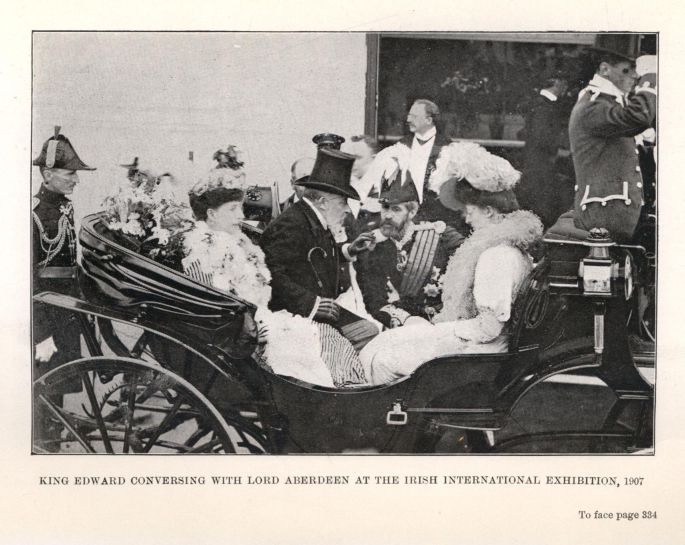
King Edward conversing with Lord Aberdeen at the Irish International Exhibition, 1907
The Dublin Castle jewels
The royal visitors were expected to arrive during the second week of July, and a few days before—on the 6th—it was announced that the famous collection of jewellery, known as the Dublin Castle jewels, had disappeared. The pecuniary value of the jewels was about £40,000, but their intrinsic worth was considerably more than this. The public amazement was nothing compared with the official consternation. These jewels were to have been used during the installation of Lord Pirrie as a Knight of St. Patrick, and King Edward was to have presided at the ceremony. Strange rumours flooded Dublin and travelled on to London. No name was too high or too sacred to be associated with the theft, and every bar-loafer could pose as a persona grata in Court circles by slyly mentioning the mystery and declaring that 'everybody' knew So-and-so was the thief, and that his family were paying ransom for him. It seemed as though the police confined their investigations to Debrett, ignoring those whose lack of rank and title disqualified them for suspicion. The circumstances of this official tragedy were well in keeping with the romantic result. Dublin Castle is the headquarters of the police force and the detective staff, and on ordinary days presents the appearance of a German fort. Those acquainted with Dublin Castle declined to believe for a moment that professional thieves had entered this glorified police-station and stolen the most rigorously-guarded collection of jewels in the country.
King Edward and Queen Alexandra entered Ireland to the accompaniment of ringing cheers, the people being independent of Crown jewels or any other baubles to symbolize their loyalty. The Irish love a sportsman, and if he should happen to be a king as well they love him all the better for that. The magnetic personality of Edward VII. and the infectious charm of Queen Alexandra triumphed in Ireland, and everybody forgot for the time being that there was a Home Rule Government in power, and that a Liberal peer was their Majesties' host. Dublin was favoured greatly by the royal visitors, who daily performed some public act and received the salutations of the people. Those who expected that the absence of the Crown jewels would tend to depreciate the importance and effect of the visit were disappointed agreeably.
It is scarcely necessary to record that throughout the memorable visit of the king and queen Lord and Lady Aberdeen displayed to the best advantage those perfect social qualities for which they are renowned in two continents. Such a period is necessarily one of hard and often anxious work, and the thousand and one questions to be settled offhand, the numberless applications for invitations to be studied and settled, and the natural anxiety for the safety and comfort of their royal guests, are matters that would place the average person at a disadvantage. Lord and Lady Aberdeen, however, have the happy quality of rising to the great heights great occasions demand, and so, if their Majesties' reception was tumultuous and their welcome regal, that accorded day after day to the Lord-Lieutenant and his wife can be described as viceregal. Second only in popularity to their illustrious guests, they proved to the thousands of strangers who visit Ireland in the wake of royalty that it is by no means certain that a Liberal viceroy cannot earn the affection of the country. Common courtesy might account for the respect royalty and royalty's representatives meet with in Ireland, but only genuine affection could inspire the enthusiastic welcomes accorded to King Edward and his son and their viceroy, the Earl of Aberdeen.
The report of the Viceregal Commission appointed to inquire into the circumstances of the theft of the Crown jewels appeared on February 1, 1908. It stated that Sir Arthur Vicars, the Ulster King of Arms, who was the official custodian of the jewels, did not exercise due vigilance or proper care. His resignation followed as a matter of course, though it must be recorded that there was a general impression that Sir Arthur Vicars had been made the official scapegoat. The decision of the Commission by no means satisfied public opinion, and rumour raged furiously again, inspired by all sorts and conditions of statements said to have been omitted from the report, although stated in evidence before the Commissioners. One of these days the secret history of the disappearance of the Dublin Castle jewellery may be revealed. Until that time, it must be classed among the unsolved mysteries of the twentieth century.
A state visit to Belfast in the autumn of 1907, and the unveiling of a statue of Queen Victoria in Dublin on February 15, 1908, were the most notable events of these years. The tragic death of the Hon. Ian Archibald Gordon, their Excellencies' youngest son, took place in November, 1909, the result of a motor-car accident. Mr. Gordon had just become engaged to Miss Violet Asquith, the daughter of the Prime Minister, and the marriage had been looked forward to with pardonable eagerness on both sides, as it would have united at the altar two families bound together by many ties of friendship. The engagement was a secret until the fact was published that Lord Aberdeen's son was at the point of death. Great sympathy was expressed with his devoted parents.
Death of King Edward
The termination of King Edward's brief and splendid reign necessarily placed the court in mourning for twelve months, and the viceroyalty underwent a period of quiescence. King George's accession was proclaimed in Dublin and other cities on May 11, 1910.
The visit of King George and Queen Mary in July, 1911, was the great event of the year. Fresh from the Coronation, their Majesties arrived in Dublin on July 8, holding a Levee, a garden-party, and a drawing-room, reviewing troops in Phoenix Park, and visiting hospitals and institutions. And all in five days! The Prince of Wales and Princess Mary of Wales accompanied their parents, and won for themselves no little popularity. The magnificent reception accorded to the king and queen astonished even those who possessed a knowledge of previous royal visits. At times it exceeded in warmth that extended to King Edward—a feat which many declared to be impossible until it was an accomplished fact. Again Lord and Lady Aberdeen demonstrated their ability and popularity. Once more they were second only to the king and queen. The perfect organization that had displayed itself on the occasion of King Edward's visit was seen again, and if their Majesties had a most strenuous time, they were equally as pleased as their subjects and their viceregal representatives. Not a single discordant note was struck throughout the series of public and private ceremonies performed by the king and queen, and well might Nationalists fear that the spectacle of Irish men and women outdoing the welcome accorded to the king and queen at their Coronation would give to all the world the impression that Ireland's dislike of England was purely a paper one.
When the visit was over, King George telegraphed from the royal yacht expressing his thanks to Lord and Lady Aberdeen.
'Having just arrived, after a most beautiful passage,' he said, 'the queen and I, with the hearty cheers of the Irish people still ringing in our ears, wish once more to express to you and Lady Aberdeen our warm appreciation of all your kindness and trouble to insure our stay in Dublin being a happy and pleasant one. You have indeed succeeded, and we thank you sincerely.'
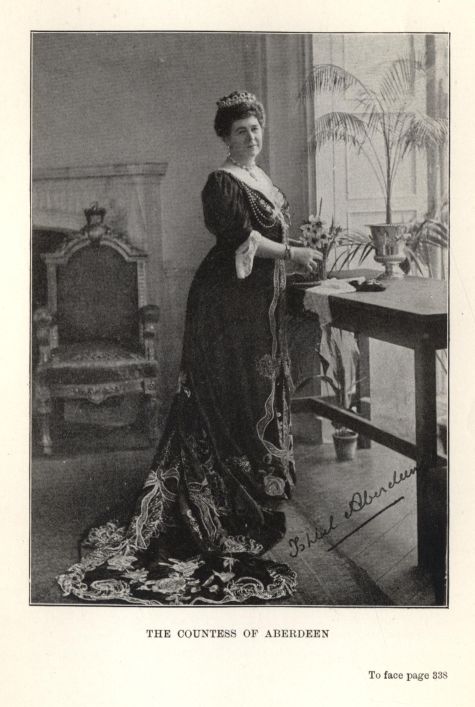
The Countess of Aberdeen
Lady Aberdeen
From the earliest days of her husband's viceroyalty Lady Aberdeen worked actively in connection with numerous philanthropic societies. A champion of women, with a record dating back to the seventies, her specialities are the eradicating of consumption and the improvement of the lot of female workers. Her enthusiasm has led her into conflict with the old order, but Lady Aberdeen has ever been inspired with the best of motives, and she has done a great deal of good.
Lady Aberdeen founded the Women's National Health Association of Ireland in 1907, and the fact that this society has united representatives of every creed and party in the cause of public health and the stamping out of consumption has in itself wrought much indirect good in all parts of Ireland, in addition to the direct result of reducing the death-rate from consumption by one-seventh in three years. There are now over one hundred and fifty branches of this organization, composed of men and women representing all sections of the community, in all parts of Ireland, working devotedly together for the welfare and the happiness of the people as a whole; and these workers have shown a power of initiative in meeting local needs by providing meals for school-children; forming Babies' Clubs, where mothers and their elder daughters are taught how to care for the babies, and how to make small resources go a long way in selecting nourishing food and suitable garments; turning derelict spaces into garden playgrounds; organizing health lectures, health exhibitions, travelling health caravans, besides supporting sanatoria, hospitals, convalescent homes, and maintaining nurses for the care of tuberculosis patients in their own homes.
The success of other notable undertakings might be quoted as an evidence of the support which the present occupants of the Viceregal Lodge can count upon when they identify themselves with any special enterprise.
The Irish Lace Ball of 1907 at the Castle, the Pageant of Irish Industries of 1909, the great Ui Breasail Exhibition and Fête of Irish Industries and Health in 1911, visited by over 176,000 persons in fourteen days, of every shade of opinion and of every class of the community, are events which will be long remembered in the Irish capital in connection with Lord Aberdeen's lengthy reign.
There was a 'storm in a teacup' during the General Election of December, 1910, when Lord Aberdeen aroused the wrath of the Conservatives and Unionists by telegraphing to the Liberal candidate in West Aberdeenshire expressing his own belief that the apprehension that under Home Rule the Protestant minority would suffer was unfounded. A Committee of Privileges composed of members of both Houses of Parliament inquired into the matter, and reported that they found that the viceroy's action had not contravened any Standing Order or regulation. This was accepted, and nothing more was heard of the matter.
Further criticism fell his way when Ireland was in the grip of a railway strike, and he was spending a holiday in Scotland. There was a clamour for the viceroy's presence in Ireland. He was already on his way thither, but though he had been successful in settling the Carriers' Strike some years previously, the present occasion did not offer an opportunity for personal mediation.
The place-hunters
When his term of office ends, Lord Aberdeen can look back upon several years of success in Ireland. He may not be a racing man, and Punchestown may not be a favourite haunt of his, but sterner qualities than a fondness for horse-racing are necessary to succeed as Lord-Lieutenant of Ireland. In the most favourable times it requires a vast amount of tact, a keen sense of humour, and a sense of proportion. Place-hunters abound and office-seekers are innumerable. Dublin Castle is regarded as the haven of hope for all younger sons without talent and briefless barristers hungering for a regular income. They are all suppliants of the Lord-Lieutenant, and several hundreds of years of ascendancy have given them a sense of right in receiving favours, and one of indignation and injustice in the case of refusal. But when all is said and done, the outcry over jobbery in Ireland is absurd, for it is a fact that there is more jobbery in London in a month than in the whole of Ireland in a year.
There have been some attempts to abolish the viceroyalty, but if ornamental it is also useful, because the Irish instinctively respect royalty, and a country populated by the descendants of kings could not be expected to have an instinctive respect for any form of government savouring of Republicanism, or one that left wholly to the imagination the majesty of the Sovereign ruler.
To satisfy all classes, to tolerate the intolerant, and to represent the non-political King of England, although appointed for his political opinions, are the duties of the Lord-Lieutenant. Surrounded by lynx-eyed critics, Tory and Nationalist, he has to be something more than the shadow of the monarch, and he is not allowed to escape criticism, although the king for whom he acts as deputy is supposed to be above it. It is not an enviable post, and never will be. That Lord Aberdeen and Lady Aberdeen have been successful nobody will deny, and Ireland will lose two good friends when their term of office comes to an end.
The introduction of Mr. Asquith's Home Rule Bill makes the Irish viceroy's position more delicate than ever. Its success means the end of the official ascendancy, and bureaucracies always fight desperately until the first shot is fired. When Liberalism has achieved its ambition, the Irish bureaucracy will cease to hold the power that makes or mars every viceroyalty.
INDEX
Abercorn, Marquis and first Duke of, 264
Abercorn's second viceroyalty, Duke of, 273
Aberdeen and Belfast, Lord, 332
Aberdeen and Gladstone, Lord, 295
Aberdeen, fourth Earl of, 257
Aberdeen's first viceroyalty, Lord, 295
Aberdeen, Lady, 296
Aberdeen's second viceroyalty, Lord, 326-342
Aberdeen, seventh Earl of, 295
Aberdeen's visit to Rome, Lord, 332
Abercromby, Sir Ralph, 204
Addison, Joseph, 131
Albert, visit of Prince, 300
Ambrose, Eleanor, 150
America, British North, 216
Andrews, Dr., 157, 175
Anglesey and George IV., Lord, 229
Anglesey and O'Connell, 234
Anglesey divorced, Lord, 230
Anglesey, Marquis of, 227
Anglesey on agitation, 232
Anglesey's second viceroyalty, Lord, 234
Anglo-Irish, Rise of, 31
Annesley, Arthur, 89
Armagh, Archbishop of, 52
Arran, Lord, 128
Asquith's Home Rule Bill, Mr., 342
Asquith, Miss Violet, 337
Bagenal, Sir Nicholas, 74
Balfour, Mr. A. J., 299
Balfour, Mr. Gerald, 310, 315
'Baratariana,' 176
Bedford, fourth Duke of, 161
Bedford, Jasper, Duke of, 57
Bedford, sixth Duke of, 211
Belfast and Lord Aberdeen, 332
Belfast Volunteer Review, 195
Bellingham, Sir Edward, 67
Beresford, 199, 201
Berkeley, Lord, John, 98
Berkeley, Lord Justice, 123
Berkeley, Mary, 72
Berwick, Duke of, 118
Bessborough, fourth Earl of, 247
Bessborough, Lady, 248
Bessborough, O'Connell and Lord, 247
Birch v. Clarendon, 253
Birrell, Mr. Augustine, 334
Blyth, Sir James, 317
Boisseleau, 118
Bolton, Charles Paulet, Duke of, 135
Bosworth, Battle of, 57
'Bottle riot, the,' 225
Boyle, Earl of Shannon, 158
Boyne, Battle of the, 117
Brabazon, 67
Brabazon, Captain, 101
Brereton, Sir William, 66
Brigham, Sir Richard, 74
Bristol and Edmund Burke, 184
Bristol, Lord, 171
British North America, 216
Bruce, Edward, 26
crowned King of Ireland, 25
defeated and killed, 26
Bruce, Robert, 25
and Prior Roger Utlagh, 28
Bryan, Sir Francis, 67
Bryce, Mr. James, 334
Buckingham, Duke of, 103
Buckingham, Marquis of, 192
and Grattan, 190
and Parliament, 190
Buckinghamshire, Earl of, 181
Burke, Edmund, 169
and Bristol, 184
and Irish trade, 184
Burke, murder of Mr., 281
Byron, Lord, 185
Cadogan, Earl, 309
Cadogan's resignation, Lord, 315
Camden, Lady, 203
Camden, Lord, 200
Camden on the Union, 204
Campbell-Bannerman, Sir H., 285
Canada, 216
Canning, 227
Capel of Tewkesbury, Lord, 122
and Jonathan Swift, 122
Carew, John, Lord, 34
Carlisle and Grattan, 184
Carlisle, fifth Earl of, 181
Carlisle, seventh Earl of, 258
Carnarvon and Dublin University, 294
Carnarvon and Parnell, Lord, 290
Carnarvon interview, Parnell on, 292
Carnarvon, Lady, 290
Carnarvon, Lord, 286, 289
Caroline, Queen, 147
Carteret and Swift, 142
Carteret, John, Lord, 139
Cary, 283
Cary, Sir George, 80
Cashel, Archbishop of, 26
Castle, Dublin, 16
Castle, Dudley, 68
Castle, Fotheringay, 76
Castle, Kilcolman, 73
Castle, Ludlow, 69
Castle, Rathfarnham, 173
Castle rebuilt, Dublin, 20
Castlemaine, Ormonde and Lady, 97
Caatlemaine, Phoenix Park and Lady, 97
Castlereagh and Roman Catholic Church, 202
Castlereagh, Lord, 174, 202
Castlereagh's methods, 207
Catholic Association, 232
Catholic Association, O'Connell founds, 226
Catholic Bill, rejection of, 204
Catholic committee, 194
Catholic convention, 196
Catholic disabilities, 196
Catholic Emancipation, 212, 228
Catholic Emancipation, Cornwallis and, 209
Catholic Emancipation and Union, 207
Catholic relief, struggle for, 197
Catholics emancipated, 232
Cavendish, Lady Dorothy, 186
Cavendish, Lord John, 187
Cavendish, murder of Lord Frederick, 281
Chamberlain, Mr., 285
Charles I. and Ormonde, 88
Charles I., Irish money for, 83
Chesterfield and Eleanor Ambrose, 150
Chesterfield and Phoenix Park, 151
Chesterfield, Lady, 151
Chesterfield on Ireland, 151
Chesterfield on Irishmen, 154
Chesterfield on the Irish Parliament, Lord, 154
Chesterfield's 'Letters,' 147
Chesterfield's marriage, 147
Chesterfield's political legacy, 149
Chesterfield, the Earl of, 146
Chichester House, 143
Chichester, Lord, 80
Churchill, Lord Randolph, 275
Church, Gladstone and the Irish, 262
Church of Ireland, Disestablishment of, 267
Clanricarde, Earl of, 61
Clanricarde, Thomond, Earl of, 68
Clare, attempt to lynch Lord, 201
Clare Election, 231
Clare, O'Connell stands for, 231
Clarence, George, Duke of, 54
Clarendon and O'Connell, 249
Clarendon, fourth Earl of, 248
Clarendon, Henry Hyde, Earl of, 107
Clarendon v. Birch, 253
Clement V. and Dublin University, 25
Cleveland's plot, Duchess of, 101
Clifford, Rosemond, 21
Clonmel, Siege of, 92
Coercion Act of 1881, 280
Coinage, introduction of special, 20
Commissioners, Parliamentary, 89
Conellan, Mr. Corry, 252
Coningsby, Lord Justice, 120
Connaught, Visit of Duke of, 270
Cooke, military secretary, 199
Cornwallis and Catholic Emancipation, 209
'Cornwallis Correspondence,' 187
Cornwallis, Lord, 203, 205
Cornwallis, surrender of Humbert to, 207
Corunna, 229
Coventry, Bishop of, 18
Cowley, Lord, 230
Cowper, Earl, 275
Crampton, Sir Philip, 220
Craven, Lady Beatrix, 310
Cromwell, Henry, 94
Cromwell, Oliver, and Ireland, 90
Croft, Sir James, 67
Cullen, Cardinal, 272
Cumberland, Richard, 167
Curragh, George IV. at, 220
Curran, 215
Curran and Emmet, 211
Curran and the Union, 208
Curwen, Archbishop of Dublin, 68
Dantsey, Bishop of Meath, 49
d'Arcy's parliament, 31
d'Arcy, Roger, 33
d'Audeley, Jacques, 23
d'Ardingselles, Guillaume, 23
Deane, Henry, 61
de Balscot, Alexander, 40, 43
de Bermingham, Jean, Earl of Louth, 26
de Bermingham, Walter, 34
de Blaquerie, Lord, 179
de Bromwich, John, 40
de Burgh, Guillaume Fitz-Aldelm, 17
de Burgh, Richard, 22
de Burgh, Sir Guillaume, 24
de Burgh, Sir Thomas, 29
de Burgh, William, Earl of Ulster, 29
de Burghs, the, 30
de Cherlton, Sir John, 29
de Colton, Dean, 39, 41, 44
de Courcy, 19
de Courtenay, Philip, 41
de Dagworth, Sir Nicholas, 39
'Defenders, the,' 197
de Gaveston, Piers, 24
de Gorges, Sir Ralph, 27
de Gray, Sir John, 49
de Grey, Bishop of Norwich, 21
de Grey, Earl, 243
de Grey, Lady, 243
de Joinville, Geoffery, 23
de Lacy, assassination of Hugh, 19
de Lacy, Hugh, 16
de Lacy, Hugh, 18
de Lacy II., Hugh, 19
de la Haye, Guillaume, 23
de la Rochelle, Sir Richard, 23
de la Zouche, Alain, 22
de Londres, Archbishop of Dublin, 21
de Marreis, Geoffery, 22
de Mortimer, Edmund, 40, 49
de Mortimer, Roger, 26
de Mortimer, Roger, 43
de Mortimer, Sir Thomas, 41
de Peche, Richard, 18
de Pembridge, Sir Richard, 38
Derby, Lord, 256, 264
de Rokeby, Sir Thomas, 34
de Saundford, Archbishop of Dublin, 23
Desmond, Earl of, 31
Desmond, Earl of, 54
Desmond, Gerald, fourth Earl of, 37
Desmond, Maurice, Earl of, 34
Desmonds, the, 30
de Stanley, Sir John, 43
de Stanley, Sir John, 44
de Taney, William, 39
de Valognes, Hamon, 19
de Verdun, Theobaude, 25
de Vere, Earl of Oxford, 42
de Vesci, Sir Guillaume, 23
Devolution, 319
Devonshire, William, third Duke of, 145
de Welles, Sir Leon, 49
de Welles, William, 49
de Windsor, Sir William, 38
de Windsor, Sir William, 39
D'Exeter, Richard, 23
'Diamond, Battle of,' 197
Disraeli, 264
Disraeli and Marlborough, 273
Doon, the auction at, 235
Dorset and Mrs. La Touche, 157
Dorset and Peg Woffington, 157
Dorset and the Irish Parliament, 159
Dorset, Duchess of, 217
Dorset, Duke of, 216
Dorset, Lionel Sackville, Duke of, 144, 155
Doyle, Bishop, 247
'Drapier's Letters,' 140
Drogheda, massacre of, 91
Drummond, Thomas, 258
du Bouchet, Mdlle., 147
Dublin after the Union, 209
Dublin Castle, 16
Dublin Castle rebuilt, 20
Dublin Corporation, Perrott's present to, 75
Dublin Evening Post, 214
Dublin, Exhibition of 1870, 270
Dublin Exhibition of 1853, 258
Dublin, Marquis of, 42
Dublin Parliament, 31, 41
Dublin in the eighteenth century, 137, 156
Dublin in the fourteenth century, 34
Dublin in the seventeenth century, 100
Dublin streets, famous, 169
Dublin trade and England, 115
Dublin University and Lord Carnarvon, 294
Dublin University, first mention of, 25
Dublin, university opened in, 27
Dudley Castle, 68
Dudley, Earl of, 317
Dudley, Edmund, 55
Dudley, Lady, 320
d'Ufford, Sir Raoul, 31
D'Ufford, Sir Robert, 23
Duncannon, Lord. See Bessborough
Dundas, 196
Dunraven, Lord, 319
Ebrington, Viscount, 242
Ecclesiastics, banishment of, 82
Ecclesiastical deputies, 23
Eden, Sir William, 182
Edgecumbe, Sir Richard, 58
Edward II., 24
Edward III., 28
Edward IV. and Desmond, 54
Edward VII., death of King, 337
Edward and Queen Alexandra, last visit of King, 335
Edward and Queen Alexandra, visit of King, 321
Edward, Prince, 57
Eglinton and Winton, Earl of, 256
Eglinton tournament, 256
Eldon, Lord, 228
Election of 1885, result of General, 292
Election of 1906, General, 324
Emmet and Curran, 211
Emmet, Robert, 211
Enniskillen, Earl of, 243
English defeats, 19, 34, 43, 44
Erne, Lord, 240
Essex, Arthur Capel, Earl of, 99
Lady, 100
death of, 102
Essex, Captain Brabazon and Lady, 101
Essex, Robert Devereux, Earl of, 76
and Mountjoy, 77, 79
Etienne, 23
'Faerie Queen,' Spenser's, 73
Falkland, Lady, 82
Falkland, Viscount, 82
Famine, the great, 249
Faughard, Battle of, 26
Faulkner, Mary Ann, 165
Fenianism, 260
Fenianism and Mr. Gladstone, 267
Fenianism, Gladstone on, 260
'Field of the Cloth of Gold,' 63
Fitz-Eustace, Edmund, 52
Fitz-Eustace, Sir Roland, 54
Fitz-Geoffery, Jean, 22
Fitzgerald and Clare, Mr., 231
Fitzgerald, Capture of Lord Edward, 206
Fitzgerald, Earl of Kildare, Thomas, 26
Fitzgerald, Lord Edward, 202
Fitzgerald, Maurice, 22
Fitzgerald, Maurice Fitzmaurice, 23
Fitzgerald, Sir James, 64
Fitzgerald, Sir Maurice, 62
Fitz-Gislebert, 17
Fitzmaurice, Thomas, 23
Fitz-Simon, Walter, 59
Fitz-Thomas, Earl of Kildare, 26
Fitzwilliam, Earl, 199
Fitzwilliam, Lady, 75
Fitz-William, Sir William, 68, 75
Fleetwood, Sir Charles, 93
Flood, Henry, 169
Foley's statue of Carlisle, 259
Forster, Mr. W. E., 276
Forster, resignation of, 280
Fotheringay Castle, 76
Fox, Charles James, 182
Franklin, 196
Free Trade and Grattan, 181
Free Trade for Ireland, 181
Froude on Ireland, 206
Froude on Irish Volunteers, 195
Furlong on Lord Wellesley, 226
Gainsborough, Lord, 76
Gardiner, Sir Robert, 76
George and Queen Mary, visit of King, 338
George II. and Lord Chesterfield, 146
George IV. and Lord Anglesey, 229
George IV.'s visit, 219
George on his visit, King, 339
George proclaimed, King, 337
George, visit of Prince, 300
Geraldine family, first of, 17
Geraldines, the, 30
Gladstone and Ireland, 268
Gladstone and the Irish Church, 262
Gladstone and Irish University, 271
Gladstone and Lord Aberdeen, 295
Gladstone on Fenianism, 260
Gloucester, Thomas Plantagenet, Duke of, 43
Goderich, 227
Godolphin, 127
Gordon, death of Hon. Archibald, 337
Gormanstown, Lord of, 35
Gormanstown, Viscount, 57
Gormanstown, Viscount, 62
Gormanstown, Viscount, 59
Government bribery, 202
Grafton, Duke of, 138
Grattan and Dolly Munroe, 174
Grattan and Free Trade, 181
Grattan and Lord Carlisle, 184
Grattan and Phoenix Park, 183
Grattan, Henry, 169
Grattan's position, 183
Grenville, 211
Greville, 233
Grey, Elizabeth, 54
Grey, Lady Elizabeth, 63
Grey, Lord, 56
Grey of Ruthyn, Reginald, 44
Grey of Wilton, Lord, 71
Grouchy, 202
Gunning sisters, the, 154
Habeas Corpus Act, suspension of, 277
Halifax, George, second Earl of, 163
Halifax, Lord, 268
Haddington, Earl of, 237
Hamilton, 'Single-Speech,' 167
Hamilton, Sir George, 111
Hardwicke, Lady, 210
Hardwicke, Lord, 210
Harcourt, Lord, 177
Harcourt, Lord, 179
Harding, 140
Barrel, Sir David, 317
Harrington, William Stanhope, Earl of, 152
Hartington, Lord, 161
Henderson, Sir James, 317
Henniker, Hon. Mrs. Arthur, 307
Henry II. invades Ireland, 15
Henry III. and viceroy, 21
Henry IV. and English colony, 45
Henry VIII., 60
Hereford, Bishop of, 30
Hertford, Earl of, 168
Heytesbury, Lord, 244
Hicks-Beach, Sir Michael, 273, 284, 299
Hobart, 196
Hoche, 202
Holbein's portrait of Kildare, 64
Holland, Lord, 86
Home Rule Bill, defeat of second, 308
Home Rule Bill of 1912, Mr. Asquith's, 342
Home Rule, Gladstone and, 279
Home Rule, Tory party and, 291
Houghton, Lord, 305
'Hours of Idleness,' 185
Humbert to Cornwallis, surrender of, 207
Hyde, Anne, 120
Hyde, Laurence, 107
Ireland and the English party system, 264
Ireland and the Pope, 15, 18
Ireland, Duke of, 42
Ireland, Edward Bruce crowned King of, 25
Ireland, first viceroy of, 16
Ireland, Gladstone on, 268
Ireland, Henry II. invades, 15
Ireland in 1882, 279
Ireland, Jacobean war in, 116
Ireland, proposal to create King of, 42
Ireton, Henry, 93
Irish land, prices of, 72
Irish land, struggle for, 30
Irishmen, Chesterfield on, 154
Irish Free Trade, 181
Irish mines, 32
Irish Parliament and the Civil War, 83
Irish Parliament, character of, 170
Irish Parliament, Declaration of Independence of, 53
Irish Parliament and Duke of York, 53
Irish Parliament's independence, 182
Irish party and Melbourne, 237
Irish trade, 114
Irish trade, Burke and, 184
Irish volunteers, 183
Iveagh, Lord, 317
Jackson, Mr. W. L., 303
Jacobean war in Ireland, 116
James II. and Lady Tyrconnel, 115, 117
James II.'s grant to Tyrconnel, 118
James II. in Ireland, 115
James II.'s Irish policy, 107
Jean, Constable of Chester, 18
Jewels, disappearance of Castle, 334
John in Ireland, King, 20
Jones, Colonel Michael, 89
Kauffmann, Angelica, 174
Kendal, Duchess of, 139
Kenmare, Lord, 194
Keogh, John, 194
Kilcolman Castle, 73
Kildare and London society, 60
Kildare, death of, 65
Kildare, Earl of, 55
Kildare, execution of tenth Earl of, 66
Kildare, Gerald, fifth Earl of, 46
Kildare, Gerald, ninth Earl of, 55
Kildare, Holbein's portrait of, 64
Kildare, Jean Fitz-Thomas, Earl of, 26
Kildare, Maurice, fourth Earl of, 35
Kildare, Maurice Fitz-Thomas, Earl of, 39
Kildare, release of Earl of, 33
Kildare, Thomas Fitzgerald, Earl of, 26
Kildare, Thomas Fitz-Gerald, Earl of, 52
Kildare, Thomas, second Earl of, 28
Kilkenny Castle and William III., 125
Kilkenny Election of 1828, 247
Kilkenny, Statute of, 36
Kilmainham Treaty, 278
Kimberley, Lord, 263
'King Kildare,' 65
King, Sir R., 89
Kingale, 115
Knocdoe, Battle of, 61
'Lady of the Sun, the,' 40
Lake, General, 204
Lambert, Major-General, 93
Land Act of 1870, 267
Land Act of 1870, 269
Land Act of 1881, 277
Land Act of 1903, 318
Land League founded, 277
Langrishe, Hercules, 174
La Touche, Elizabeth, 184
La Touche, Mrs., and Dorset, 157
Laud, 79
Lauzun, 118
le Botiller, Earl of Ormonde, 35
le Botiller, Prior Thomas, 47
le Botiller, Sir Edmund, 25
Lech, Archbishop of Dublin, 25
le Dene, Guillaume, 23
le Gros, Raymond, 17
Leicester, Robert Sidney, Earl of, 84
Leinster, Duke of, 266
Leinster, King of, 16
le Petril, Guillaume, 19
le Scrope, Sir Stephen, 46
le Strange, Sir Thomas, 49
Liberalism in Ireland, 295
'Lilli Burlero, Bullen a la,' 130
Limerick, Siege of, 93
Limerick, Siege of, 118
Limerick, Treaty of, 119
Lionel's army, defeat of Prince, 35
Lionel, Prince, 35
Lincoln, John de la Pole, Earl of, 57
Lisle, Lord, 85
Local Government Bill, the, 311
Loftus, Archbishop of Dublin, 71
Loftus, Lady, 173
Loftus, Lord, 173
Londonderry, Lady, 301
Londonderry, sixth Marquis of, 298
Londonderry, third Marquis of, 274
Long, Mr. Walter, 320
Lord-Lieutenant, first mention of, 29
Louise, visit of Princess, 270
Louth, Jean de Bermingham, Earl of, 26
Lucas, Charles, 152
Ludlow Castle, 69
Lyndhurst, Lord, 228
Maamtrasna case, the, 284
McNally, treachery of, 206
'Magna Charta,' 21
Malmesbury, Lord, 241
'Manchester Martyrs,' 262
Mansion House, last visit by viceroy to, 330
Mansion House Relief Fund, 274
Marechal, Guillaume, 22
Marechal, Guillaume, Earl, 19
Marlborough and Disraeli, 273
Marlborough, Earl of, 118-119
Marlborough, sixth Duke of, 273
Mary of Wales, Princess, 338
Maynooth Castle, Siege of, 65
Maynooth College, foundation of, 201
origin of, 202
McMurrough, Dermot, 16
Melbourne, Irish party and Lord, 237
Melbourne, Lord, 237
Melbourne, O'Connell and Lord, 238
Mirabeau, 195
Mitchelstown affray, 301
Molyneux, 196
Monck, General, 97
Montgomery, Anne, 175
Montgomery, Barbara, 199
Montgomery, Captain, 178
Moor, Colonel John, 89
Moore, Sir John, 229
Moriz, Sir John, 30
Morley, Mr. John, 295, 305
Morley's 'Life of Gladstone' quoted, 279
Mornington, Earl of, 210
Mountjoy and Essex, 77, 79
Mountjoy, Charles Blount, Lord, 78
Mountjoy, Lady, 79
Mulgrave, Lord, 237
Mulgrave, William IV. and Lord, 239
Municipal Bill, Irish, 258
Munroe, Dorothea, 173
Munster, plantation of, 72
Naas Parliament, 56
Napoleon, 216
Napoleon, Louis, 241
Nationalism, beginnings of, 153
'Nation, the,' 252
Norbury, murder of Earl of, 240
Norbury, Toler, Lord, 199
Norfolk, Duke of, 63
Normanby, Lord. See Mulgrave, Lord
Norris, Sir Thomas, 76
Northampton, Lord, 276
Northington, Lord, 189
Northumberland, Hugh Percy, Duke of, 233
Northumberland, Hugh Smithson, Earl and Duke of, 167
Northumberland, Lady, 168
Nugent, Richard, 51
O'Brien, William Smith, 244, 246, 250
O'Connell abandons Repeal, 245
O'Connell and Lord Anglesey, 234
O'Connell and Lord Bessborough, 247
O'Connell and Lord Clarendon, 249
O'Connell and Lord Melbourne, 238
O'Connell and Lord Wellesley, 225
O'Connell and the Duke of Richmond, 214
O'Connell and the viceroyalty, 242
O'Connell arrested, 244
O'Connell, Daniel, 219
O'Connell founds Catholic Association, 226
O'Connell stands for Clare, 231
O'Connell starts Repeal movement, 233
O'Connor, King, 18
O'Donnell, 283
Offaly, Thomas, Lord, 65
Orange Government, 120
Orange lodges, 225
O'Malley, Grace, 69
O'Neill and Cromwell, 92
O'Neill, defeat of, 78
O'Neill, Shane, 67
Ormonde and Wiltshire, Earl of, 53
Ormonde, Cromwell and Lady, 94
Ormonde, death of, 106
Ormonde, Earl of, 63
Ormonde, Earl of, 73, 76
Ormonde, James Butler, first Duke of, 86
and the Civil War, 85
Ormonde, James Butler, first Duke of, and Stafford, 88
honours showered upon, 95
and Lady Castlemaine, 97
recalled, 97
attempt to assassinate, 103
return to Ireland, 104
and the Catholics, 105
superseded, 106
Ormonde, James le Botiller, Earl of, 40
Ormonde, second Earl of, 35
Ormonde's exile, 128
Ormonde, the second Duke of, 124
Ormonde, third Earl of, 43
Ormsby, Sir Lambert, 317
O'Ruarc, murder of Tiarnan, 17
Ossory, death of Lord, 105
Ossory, Earl of, 64
Ossory, Lord, 103
Oxford, Earl of, 55
Pakenham, Catherine, 198
Palmer, Lady. See Ambrose, Eleanor
Palmerston, Lord, 241, 259
Parese, Christopher, 65
Parliament and Act of Union, Irish, 207
Parliament and the Civil War, Irish, 83
Parliament at Naas, 56
Parliament at Trim, 56
Parliament, bribing the Irish, 208
Parliament, character of Irish, 170
Parliamentary commissioners, 89
Parliament, Declaration of Independence of Irish, 53
Parliament, Dorset and the Irish, 159
Parliament House, rebuilding of, 143
Parliament in Dublin, 31, 41
Parliament, Lord Chesterfield on the Irish, 154
Parliament's independence, Irish, 182
Parliament, Townshend and Irish, 171
Parnell and Lord Carnarvon, 290
Parnell and Phoenix Park murders, 283
Parnell arrested and discharged, 277
Parnell, Charles Stewart, 274
Parnell Commission, 301
Parnell, death of, 304
Parnell's leadership, 276
Parnell on the Carnarvon interview, 292
Parnell's second arrest, 278
'Paston Letters,' 60
Patterson of Baltimore, Mrs., 227
Peel, Sir Robert, 214, 218, 228, 232, 242, 243
'Peep o'-day' Boys, 197
Pelham, Sir William, 71
Pembroke, Thomas Herbert, Earl of, 127
Ferrers, Alice, 39
Perrott, Sir John, 72
charges against, 74
and Spanish Armada, 74
Perrott, Thomas, 72
Petersham, Lady Caroline, 155
Phoenix Park and Grattan, 183
Phoenix Park, Chesterfield and, 151
Phoenix Park, Lady Castlemaine and, 97
Phoenix Park murders, 281
Phoenix Park murders, Parnell and, 283
Pile, Sir Thomas D., 314
Pipard, Pierre, 19
Pirrie, Lord, 334
Pitt, William, 161, 193, 196
and the Union, 205
Plantagenet, Maud, 32
Plantation methods, attempt to revive, 94
Plantation of Ireland, 71
Pole, Cardinal, 66
Poor Law Bill, Irish, 258
Pope, Alexander, 136
Pope and Ireland, the, 15, 18
Pope and viceroy, the, 21
Porter, Lord Justice, 120
Portland, third Duke of, 186, 202
Portsmouth, Duchess of, 98
Powis, Lord, 211
Poynings, Sir Edward, 60
Preston, Elizabeth, 86
Primrose, Lady Margaret, 309
Purcell, 130
Radnor, Earl of, 245
Raleigh, Sir Walter, 73
Rathfarnham Castle, 173
Rebellion of 1641, the, 84
Rebellion of '98, 204
Rebellion, Robert Emmet, 211
Redmond, Mr. John, 326
Religious persecution, beginning of, 67
Repeal Movement, O'Connell starts, 233
Repeal, O'Connell abandons, 245
Restoration, the, 95
Ribbonmen, 225
Rich, Lord, 79
Richard II., deposition of, 28
Richard II. in Ireland, 28, 43
'Richard in Iron,' 69
Richmond and Lennox, fourth Duke of, 212
Richmond's libel action, Duke of, 214
Robarts, Lord, 97
Rochester, Earl of, 106
Rochester, Laurence, Earl of, 123
Rockingham, Lord, 185
Roland, Hyacinthe Gabrielle, 224
Roman Catholic Church, plan to endow, 202
Rosebery, Lord, 263
'Rose of Raby, the,' 51
Royal Commissions, 299
Russell, Lady Louisa, 264
Russell, Lord John, 212, 238, 246
and Gladstone, Lord John, 212
and abolition of viceroyalty, 212
Russell, Sir William, 76
Rutland, Duke of, 189
Rutland, Edmund, Earl of, 53
Rye House plot, 102
Sackville, Lord George, 157
Salisbury, Bishop of, 18
Salisbury, Guillaume, Earl of, 21
Salisbury, Lord, 279, 284, 310
Salisbury Ministry, 290
Salisbury's retirement, Lord, 315
Sarsfield, Patrick, 116
St. Albans, Battle of, 52
St. Amaud, Lord of Gormanstown, 35
St. Germans, Earl of, 257
St. John, Elizabeth, 60
St. John, Sir Oliver, 81
St. Leger, Sir Anthony, 66
St. Patrick, creation of Order of, 188
Shannon, Earl of, 158
Shaw, Captain, 319
Sheil, Richard Lalor, 225
Shelburne, Lord, 187
Sheridan, 142
Sheridan, 155
Sheridan, actor, 159
Sheridan, Richard Brinsley, 169
Sherwood, Bishop of Meath, 54
Shrewsbury, Charles, Duke of, 133
Shrewsbury, Sir John Talbot, Earl of, 49
Sidney on the viceroyalty, 68
Sidney, Sir Henry, 67
Sidney, Viscount, 120
Simnel, Lambert, 57
crowned King of Ireland, 57
Skeffington, Sir William, 64
Solomon, R.A., Mr. Solomon J., 317
Somers, 127
Somerville, Sir William, 252
South African War, Ireland and, 313
Spanish Armada and Perrott, 74
Spencer, Earl, 267
on Phoenix Park murders, 281
motion of censure on, 284
banquet to, 284
second viceroyalty, 278
and the Premiership, 287
Spencer, Lady, 270
Spenser, Edmund 73
Statute of Kilkenny, 36
Stephens, James, 260
Stoke, Battle of, 58
Stone, Archbishop, 158
Strafford, Thomas Wentworth, Earl of, 83
and Ormonde, 88
Suffolk, Henrietta Howard, Countess of, 147
Suffolk, John de la Pole, Duke of, 55
Sullivan, Lord Mayor, T. D., 330
Sullivan, Sir Edward, 285
Sunderland, Earl of, 137
Surrey, Thomas Holland, Duke of, 44
Sussex, Earl of, 67
Sutton, Sir John, 49
Swift, Jonathan, 122, 126, 131, 136, 142, 143
Talbot and his salary, Sir John, 48
Talbot, Archbishop of Dublin, 49
Talbot, Lord, 218
Talbot, Richard. See Tyrconnel, Earl of
Talbot, Sir John, 48
Tempest, Lady Frances, 274
Temple, Earl, 188
Thomas of Lancaster, Prince, 45
Thurlos, Battle of, 20
Tithe Bill, Irish, 258
Tithe Commutation Act of 1838, 236
Tithe War, the, 235
Tithe War, cost of, 236
Toler, Chief Justice, 240
Tone, Wolfe, 202
Townshend and duelling, 177
Townshend and Irish Parliament, 171
Townshend, death of Lady, 173
Townshend, Lord, 169
Townshend marries Anne Montgomery, 179
Tory party and Home Rule, 291
Treaty of Limerick, 119
Treaty, the Kilmainham, 278
Trench on disestablishment, Archbishop, 267
Trevelyan, Sir G. O., 285
Trim Castle, mint at, 53
Trim Parliament, 56
Trinity College, 334
Tyrone, Earl of, 76
Tyrconnel and James II., Lady, 115, 117
Tyrconnel, James II.'s grant to, 118
Tyrconnel, Lady, 113
Tyrconnel, Lord, 107
Tyrconnel's death, 118
Ulster, colonization of, 81
Ulster, Countess of, 29
Ulster, murder of Earl of, 29
Ulster, William de Burgh, Earl of, 29
'Undertakers,' 72
Union, Camden on the, 204
Union carried, Act of, 208
Union, Catholic emancipation and Act of, 207
Union, Curran and the, 208
Union, defeat of Act of, 207
Union, Dublin after the, 209
Union, first articles of the, 207
Union, first thoughts of, 181
'Union of Hearts, The,' 296
Union, Pitt and the, 205
United Irishmen, the, 202
University and Lord Carnarvon, Dublin, 294
University, Clement V. and Dublin, 25
University, first mention of Dublin, 25
University, Gladstone and Irish, 271
University opened in Dublin, 27
Utlagh and Robert Bruce, 28
Utlagh, charge against, 28
Utlagh, death of, 30
Utlagh, Prior Roger, 28
Verulam, Earl of, 249
Vicars, Sir Arthur, 336
Viceregal allowance, 39
Viceregal Commission on Castle jewels, 336
Viceregal contracts, 19
Viceregal lodge, purchase of, 182
Viceregal profits, 33
Viceroy and cattle-stealing, 30
Viceroy and Dublin tradespeople, 21
Viceroy and Henry III., 21
Viceroy and Pope, 21
Viceroy of Ireland, the first, 16
Viceroy, petition against, 21
Viceroy sued, 253
'Viceroy, the Hanging,' 71
Viceroy's army, defeat of, 25
Viceroys, character of early, 17
Viceroy's debts, 21
Viceroys, rival, 56
Viceroy's salary, 22, 46
Viceroy's salary increased, 189
Viceroy's salary in eighteenth century, 165
Viceroyalty, early English views regarding, 24
Viceroyalty, Nationalist attitude towards, 329
Viceroyalty, O'Connell and the, 242
Viceroyalty, proposal to abolish, 212
Viceroyalty, Sidney on the, 68
Victoria and Prince Consort in Ireland, Queen, 258
Victoria, death of Queen, 315
Victoria on her visit, Queen, 314
Victoria's first visit to Ireland, Queen, 251
Victoria's last visit, Queen, 313
Victoria's third visit, Queen, 260
Volunteers, Irish, 183
Volunteer review, Belfast, 195
Volunteers, revival of, 195
Wakefield, Battle of, 54
Wales, Edward, Prince of, 338
Wales in Dublin, Prince of, 262
Wales, visit of Prince and Princess of, 265
Wales, visit of Prince of, 286
Wallop, Sir Henry, 71
Walpole's 'Journal of George III.'s Reign,' 193
Walsingham, Petronilla, Countess of, 147
Wandesford, Sir Charles, 84
Warbeck, Perkin, 59
Warrenne and Surrey, Earl of, 22
Warwick, Earl of, 55
Washington, 196
Waterford, Siege of, 91
Waterloo, Battle of, 214
Wellesley, Arthur, 198, 213
Wellesley, Marquis, 222
marriage, 199
attacked in theatre, 225
and O'Connell, 225
Furlong on Lord, 226
second marriage, 227
second Viceroyalty, Lord, 237
Wellington, Duke of, 227
Wellington, Prime Minister, Duke of, 231
Westmoreland, tenth Earl of, 193
Wexford, massacre of, 91
Wharton, the first Lady, 131
Wharton, the second Lady, 131
Wharton, Thomas, Earl of, 128
Whiteboys, 225
White, Mathew, 92
White, Richard, 43
Whitshed, Chief Justice, 141
Whitworth, Lord, 216
William III. at Kilkenny Castle, 125
William IV., 238
William IV. and Lord Mulgrave, 239
Wiltshire, Earl of, 52
Wodehouse, Lord, 260
Woffington and Dorset, 156
Wogan, Sir Jean, 23, 25
Wolfe, Solicitor-General, 199
Wolsey and Kildare, 63
Women's National Health Association of Ireland, 339
Wood's halfpence, 139
Woodville, Elizabeth, 63
World, the, 253
Wyndham Land Act, 318
Wyndham, Mr. George, 315
York, Richard, Duke of, 50, 57
York, visit of Duke and Duchess of, 311
Yorke, Lord Chancellor, 210
Yorktown, Cornwallis's surrender at, 205
Young Ireland insurrection, 249
Zetland, Earl and first Marquis of, 330
BILLING AND SONS, LTD., PRINTERS, GUILDFORD