CLASSICAL HYMNS.
Reading edition
THE worship of Aphrodite in the days of classical paganism is best characterized by two hymns attributed to Homer, but it must be understood that this whole class of poetry constitutes Homeric apocrypha of a comparatively late date. We quote the original from the Teubner edition:
ΣΙΣ ΑΦΡΟΔΙΤΗΝ Κυπρογενῆ Κυθέρειαν ἀείσομαι, ἥτε βροτοῖσι μείλιχα δῶρα δίδωσιν, ἐφ’ ἱμερτῷ δὲ προσώπῳ αἰεὶ μειδιάει καὶ ἐφ’ ἱμερτὸν θέει ἄνθος. Χαῖρε, θεά, Σαλαμῖνος ἐυκτιμένης μεδέουσα καὶ πάσης Κύπρου: δὸς δ’ ἱμερόεσσαν ἀοιδήν. αὐτὰρ ἐγὼ καὶ σεῖο καὶ ἄλλης μνήσομ’ ἀοιδῆς.
A versified translation of our own reads thus:
“My verse shall praise thee, goddess fair and mighty, Great Queen of Cyprus, glorious Aphrodite Who unto mortals love’s sweet gift bestowest And in the charm of richest beauty glowest. Thou holdest in thy hand the magic flower Whose spell subjects us to thy gentle power. Hail, gracious lady, soother of all woes, Who conquerest by pleasing smiles thy foes.
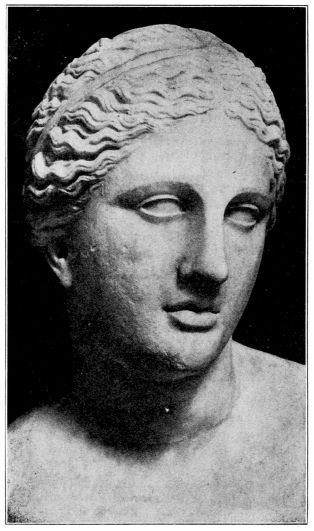
HEAD OF THE CNIDIAN VENUS.
Front view.
As we thy beauty worship and admire Inspire my song with thy celestial fire. So shall my muse forever honor thee And her whom thou commendest unto me.”
Here is another hymn, not less charming:
ΣΙΣ ΑΦΡΟΔΙΤΗΝ Αἰδοίην, χρυσοστέφανον, καλὴν Ἀφροδίτην ᾄσομαι, ἣ πάσης Κύπρου κρήδεμνα λέλογχεν εἰναλίης, ὅθι μιν Ζεφύρου μένος ὑγρὸν ἀέντος ἤνεικεν κατὰ κῦμα πολυφλοίσβοιο θαλάσσης ἀφρῷ ἔνι μαλακῷ: τὴν δὲ χρυσάμπυκες Ὧραι δέξαντ’ ἀσπασίως, περὶ δ’ ἄμβροτα εἵματα ἕσσαν: κρατὶ δ’ ἐπ’ ἀθανάτῳ στεφάνην εὔτυκτον ἔθηκαν καλήν, χρυσείην: ἐν δὲ τρητοῖσι λοβοῖσιν ἄνθεμ’ ὀρειχάλκου χρυσοῖό τε τιμήεντος: δειρῇ δ’ ἀμφ’ ἁπαλῇ καὶ στήθεσιν ἀργυφέοισιν ὅρμοισι χρυσέοισιν ἐκόσμεον, οἷσί περ αὐταὶ Ὧραι κοσμείσθην χρυσάμπυκες, ὁππότ’ ἴοιεν ἐς χορὸν ἱμερόεντα θεῶν καὶ δώματα πατρός. αὐτὰρ ἐπειδὴ πάντα περὶ χροὶ κόσμον ἔθηκαν, ἦγον ἐς ἀθανάτους: οἳ δ’ ἠσπάζοντο ἰδόντες χερσί τ’ ἐδεξιόωντο καὶ ἠρήσαντο ἕκαστος εἶναι κουριδίην ἄλοχον καὶ οἴκαδ’ ἄγεσθαι, εἶδος θαυμάζοντες ἰοστεφάνου Κυθερείης. Χαῖῥ ἑλικοβλέφαρε, γλυκυμείλιχε: δὸς δ’ ἐν ἀγῶνι νίκην τῷδε φέρεσθαι, ἐμὴν δ’ ἔντυνον ἀοιδήν. αὐτὰρ ἐγὼ καὶ σεῖο καὶ ἄλλης μνήσομ’ ἀοιδῆς.
Translated into English verse the hymn reads:
“The venerable Lady I adore, Queen Aphrodite, owner of the shore Of seagirt Cyprus. Thither Zephyr’s breeze Had wafted her as babe with gentle ease. While yet unborn, in briny foam lay she Floating on billows of the surging sea, Whence she came forth. The Seasons young and fair With gold-embroidered bridles guided her, They took her to their arms and they caressed The little maid and had her beauty dressed In garments of Ambrosian fabric wrought. And then a crown of golden weight they brought, Three-handled, which above her head they placed. Her soft white neck with carcanets was graced, The strands of which her silver breast adorn In such a way as by the Seasons worn At dances in sylvestrian resort Or in Olympus at their father’s court. They carried up the babe so fair and wee To the immortals, who in ecstacy Began at once to hug and fondle her And kiss her hands. All vowed that they would wear The sacred flower of this divine fair maid At Hymen’s feast in festival parade. Yea, such great charm the Gods e’en never saw; They gazed and wondered and they stood in awe. O goddess, dark-browed, sweet of voice, In thee my song shall glory to rejoice! On us poor mortals here on earth below Life’s palm and heaven’s happiness bestow.
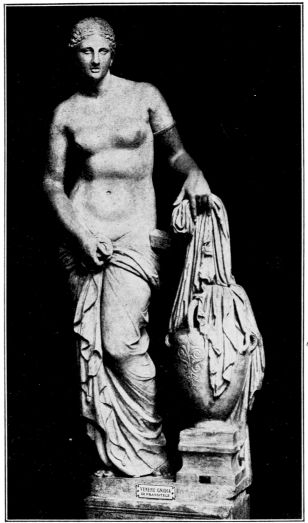
ANOTHER VIEW OF THE CNIDIAN VENUS.
Praised be forever thy divinity, And the fair sex which representeth thee.”
The nature of Venus as the mother of the universe, the mistress of existence, and the representative of all that is charming and lovely endeared her to the philosopher as well as to the poet, and so in Rome at a later day even the freethinker among classical poets, Titus Lucretius, dedicated to her his philosophical book of poetry, De rerum natura, in these often quoted words:[44]
“Mother of Rome, delight of Gods and men, Dear Venus that beneath the gliding stars Makest to teem the many-voyaged main And fruitful lands—for all of living things Through thee alone are evermore conceived, Through thee are risen to visit the great sun— Before thee, Goddess, and thy coming on, Flee stormy wind and massy cloud away; For thee the dedal Earth bears gentle flowers; For thee wide waters of the unvexed deep Smile, and the hollows of the sérene sky Glow with diffusèd radiance for thee! For soon as comes the springtime face of day, And procreant gales blow from the West unbarred. First fowls of air, smit to the heart by thee, Foretoken thy approach, O thou Divine, And leap the wild herds round the happy fields Or swim the bounding torrents. Then amain, Seized with the spell, all creatures follow thee Whithersoever thou walkest forth to lead; And thence through seas and mountains and swift streams, Through leafy homes of birds and greening plains. Kindling the lure of love in every breast, Thou bringest the eternal generations forth. Kind after kind. And since ’tis thou alone Guidest the Cosmos, and without thee naught Is risen to reach the holy shores of light, Nor aught of joyful or of lovely born, Thee do I crave co-partner in that verse Which I presume on Nature to compose For Memmius mine, whom thou hast willed to be Peerless in every grace at every hour— Wherefore, indeed, Divine one, give my words Immortal charm. Lull to a timely rest O’er sea and land the savage works of war, For thou alone hast power with public peace To aid mortality; since he who rules The savage works of battle, puissant Mars, How often to thy bosom flings his strength, O’ermastered by the eternal wound of love— And there, with eyes and full throat backward thrown, Gazing, my Goddess, open-mouthed at thee, Pastures on love his greedy sight, his breath Hanging upon thy lips? Him thus reclined Fill with thy holy body, round, above! Pour from those lips soft syllables to win Peace for the Roman, glorious Lady, peace! For in a season troublous to the state Neither may I attend this task of mine With thought untroubled, nor may mid such events The illustrious scion of the Memmian house Neglect the civic cause.”
* * *
The temples of Aphrodite lie in ruins, and her worship is abandoned; but the ideal of womanhood which she represented has remained to this day, and will remain so long as mankind will continue to exist on earth. The artist of the statue of Milo has left us an unsurpassed interpretation of this ideal which even in its mutilated condition is noble and beautiful. At the same time nature does not cease to actualize the type in every living woman that has been born into the world. Each one of them with all her individual traits, her preferences and even her feminine faults is a specimen of the eternal ideal of womanhood—the divinity of love, of grace, of charm, of beauty, a source of inspiration as well as of physical and intellectual creativeness.
The ancient paganism has passed away and will never come back, but because its superstitions are gone we need no longer scorn its gods. We can recognize their grandeur, their nobility, their beauty, yea their truth; and if we contemplate the representation of their ideals in Greek art, we must own that the Venus of Milo is not the least among them.